High-Pressure Carbonation of Phosphogypsum for Calcium Carbonate Preparation and Crystal Modification Regulation

Abstract
1. Introduction
2. Materials and Methods
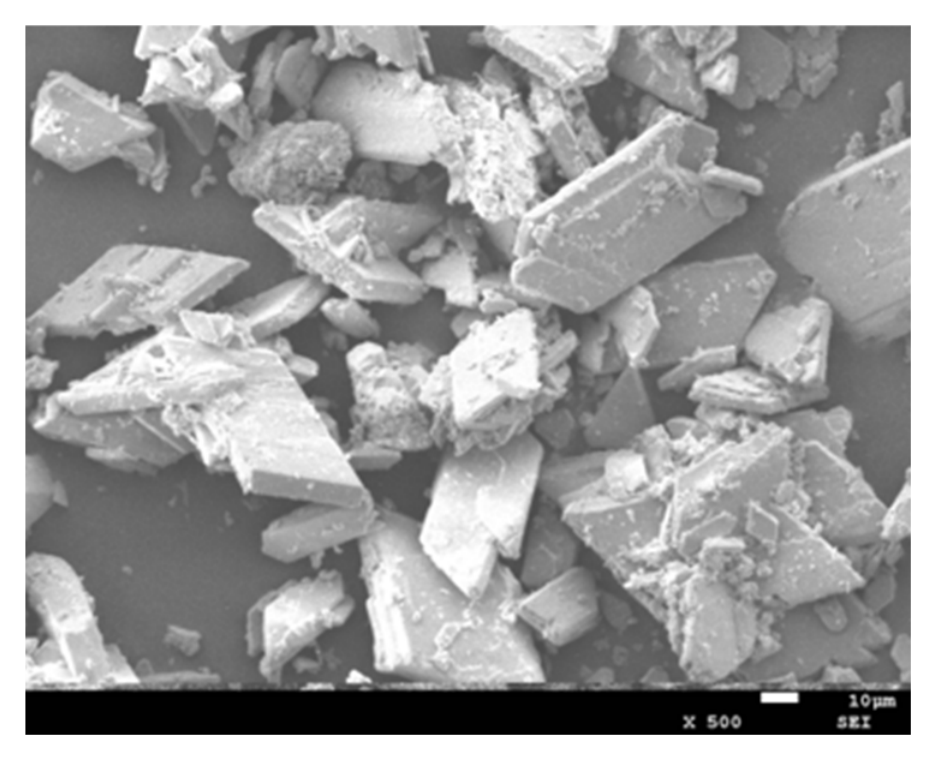
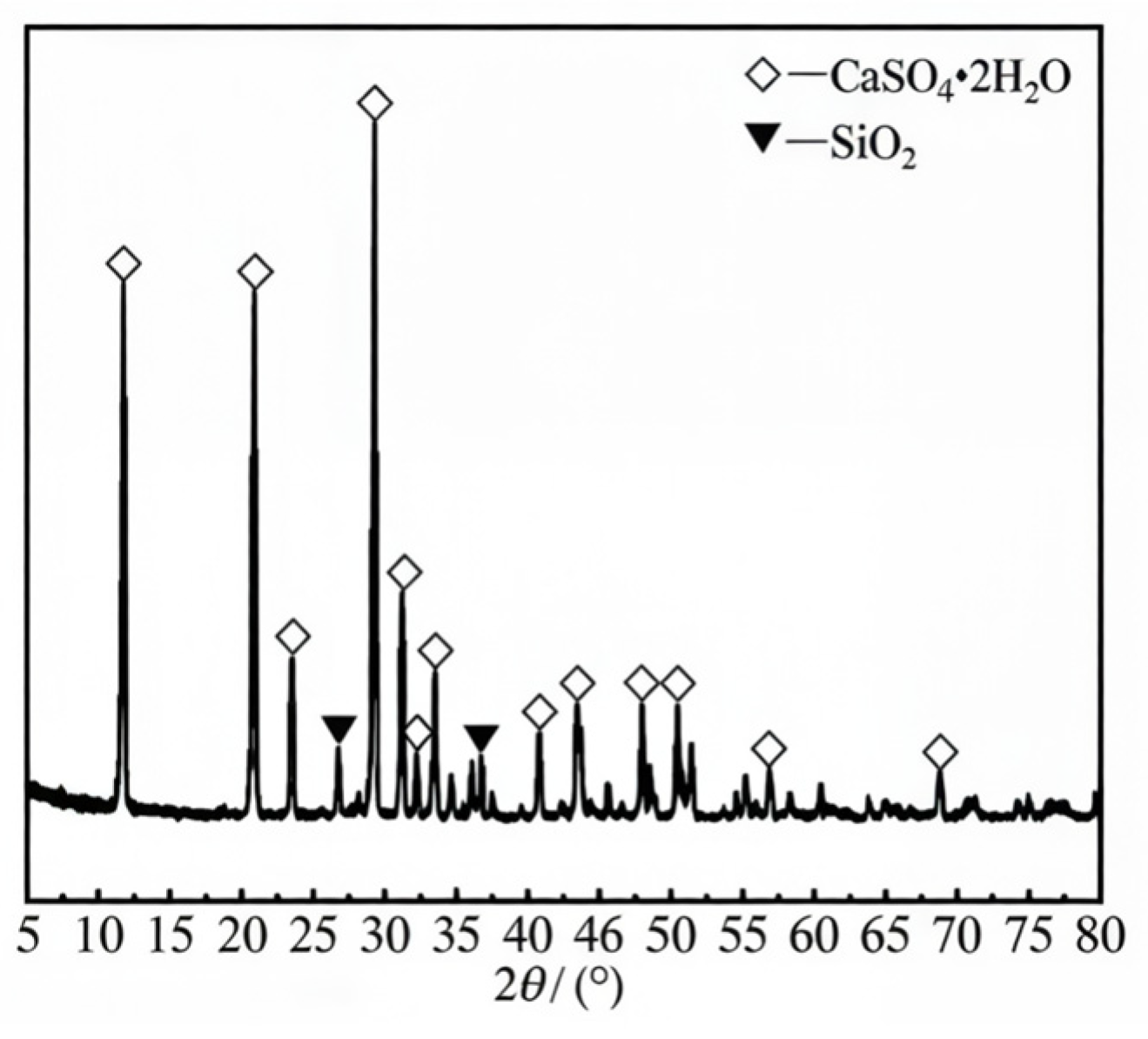
2.1. Materials
2.2. Preparation of CaCO3
Leaching of Ca2+ from PG
2.3. Experimental Methods and Characterization
2.3.1. Determination of Ca2+ Leaching Rate
2.3.2. Determination of Ca2+ Conversion Rate
2.3.3. Characterization Methods
3. Results and Discussion
3.1. Process for CaCO3 Preparation via High-Pressure Carbonation of Phosphogypsum
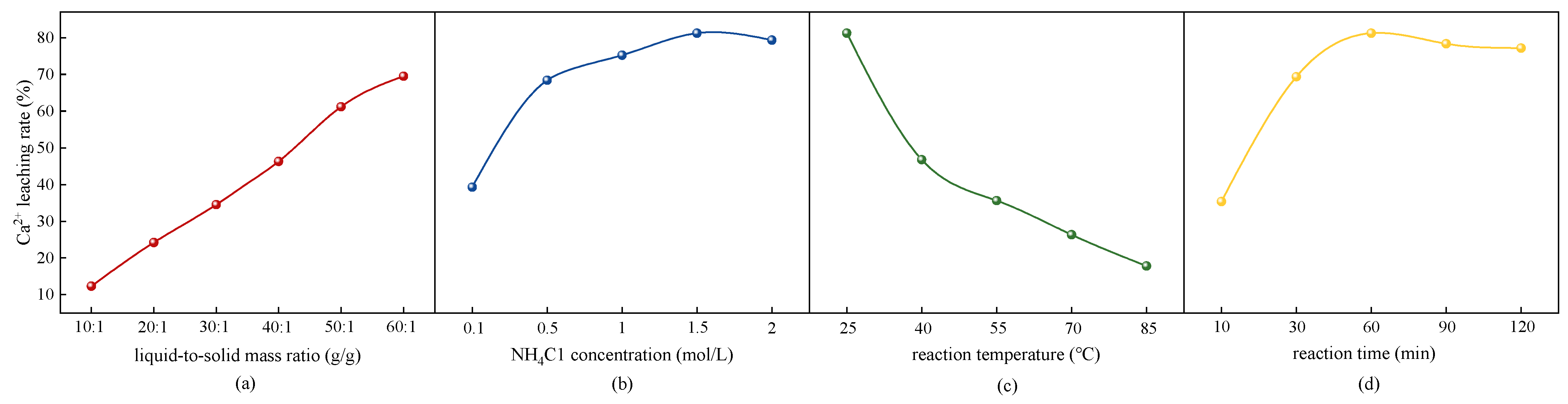
3.1.1. Leaching Rate of Ca2+ in PG
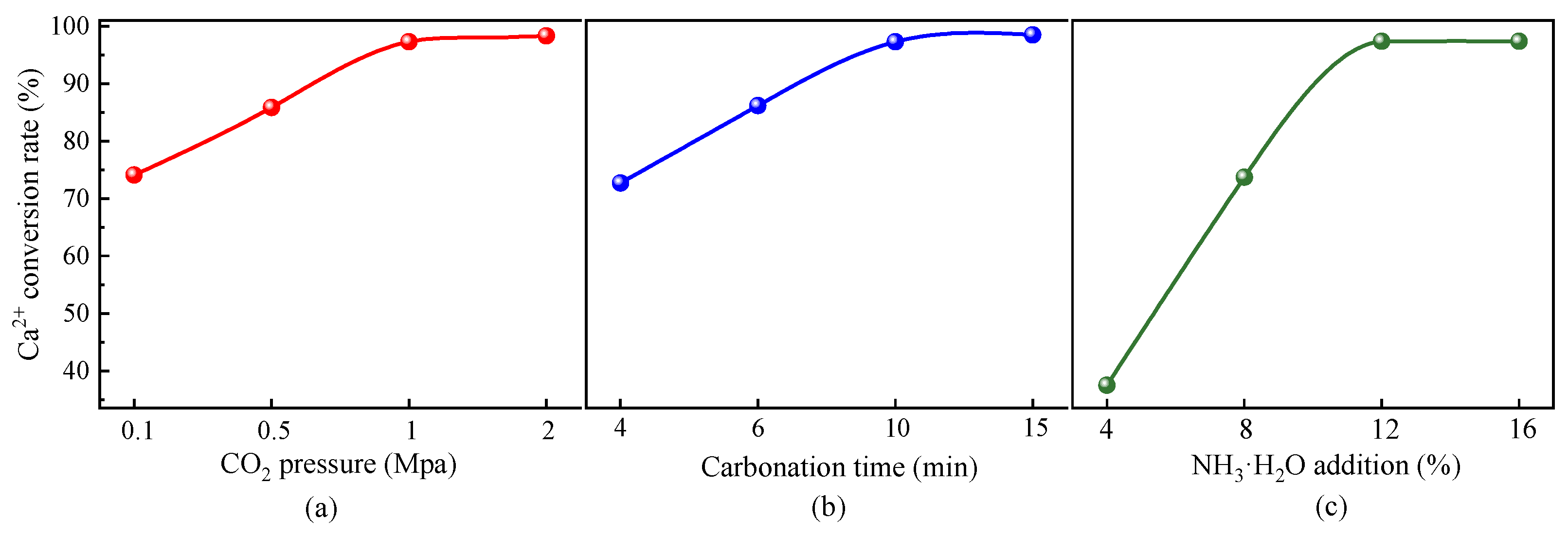
3.1.2. Conversion Rate of Ca2+ in the Leaching Solution
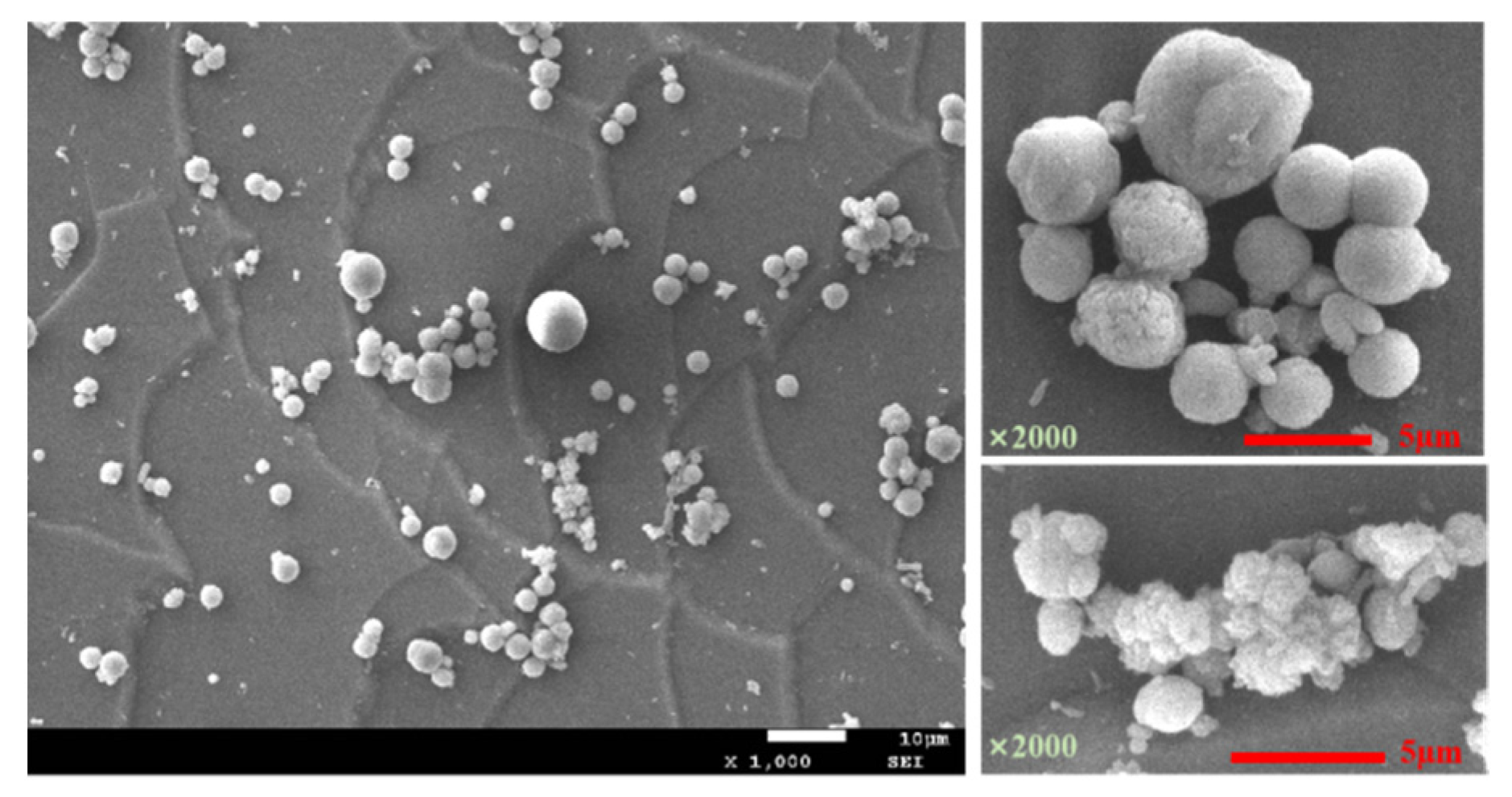
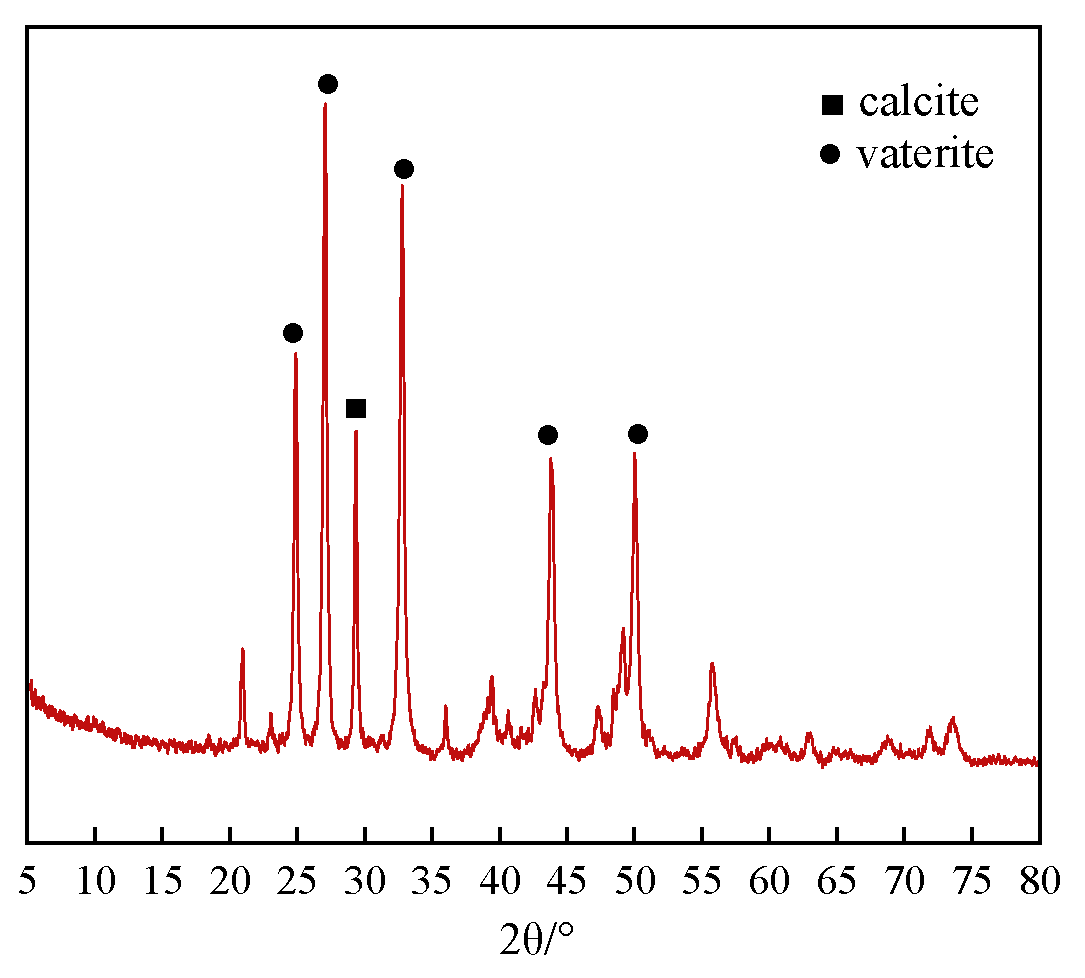
3.1.3. Crystal Morphology Under Optimal High-Pressure Carbonation Conditions
3.2. Modulation of CaCO3 Polymorphs via Organic Additives
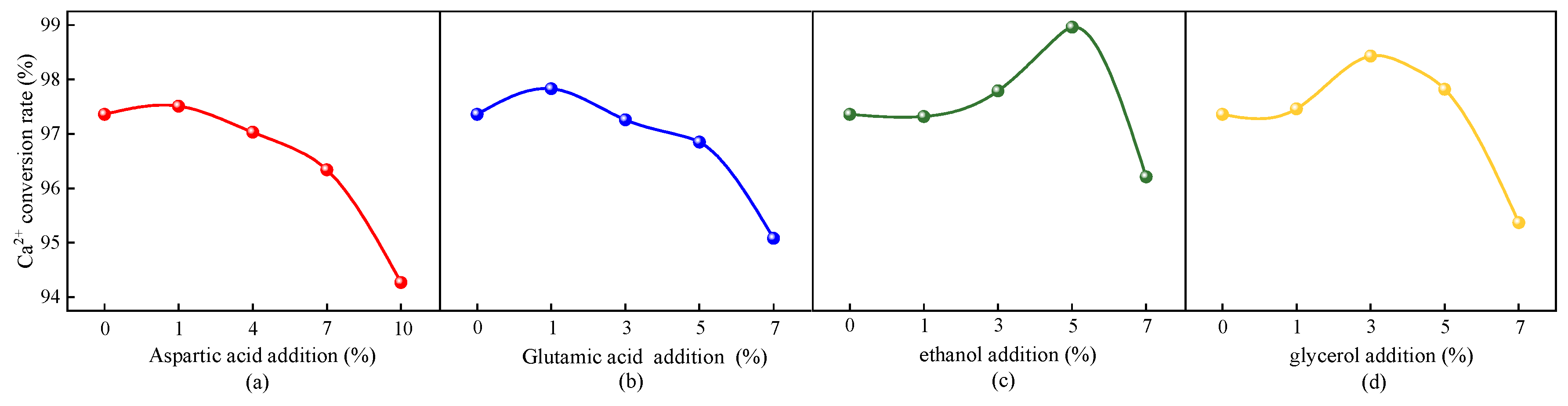
3.2.1. Ca2+ Conversion Rate in Leachate with Different Organic Additives
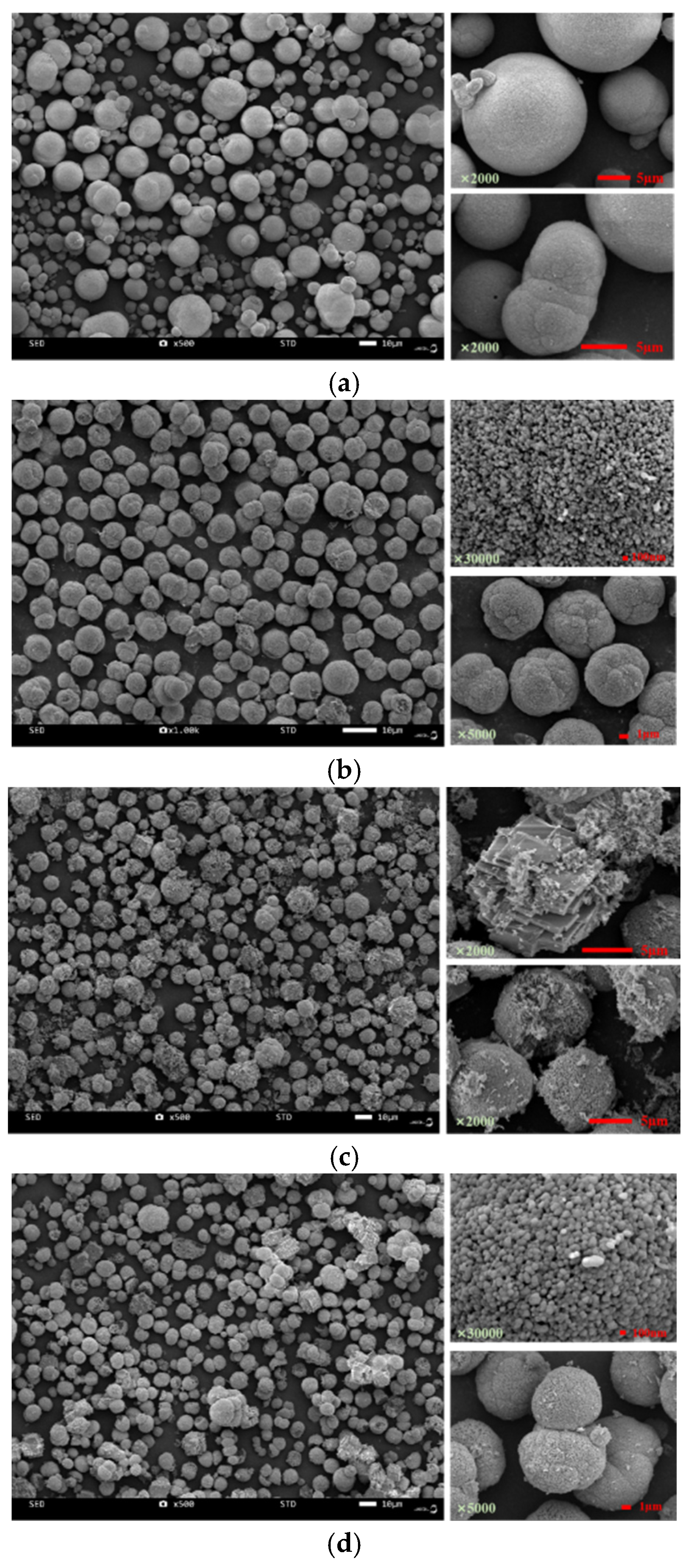
3.2.2. Crystal Morphology of CaCO3 with Different Organic Additives
4. Conclusions
- (1)
- The optimized process for preparing CaCO3 from PG by high-pressure carbonation was as follows. PG was first leached for 60 min at 25 °C using 1.5 mol/L NH4Cl with a liquid-to-solid mass ratio of 60:1, achieving a Ca2+ leaching rate of 81.25%. The resulting Ca2+-rich leachate was then carbonated for 10 min at 25 °C, a CO2 pressure of 1.0 MPa, and 12 vol% NH3·H2O addition, resulting in a Ca2+ conversion rate of 97.36%. The obtained CaCO3 crystals were predominantly vaterite with a quasi-spherical morphology, although particle agglomeration was observed.
- (2)
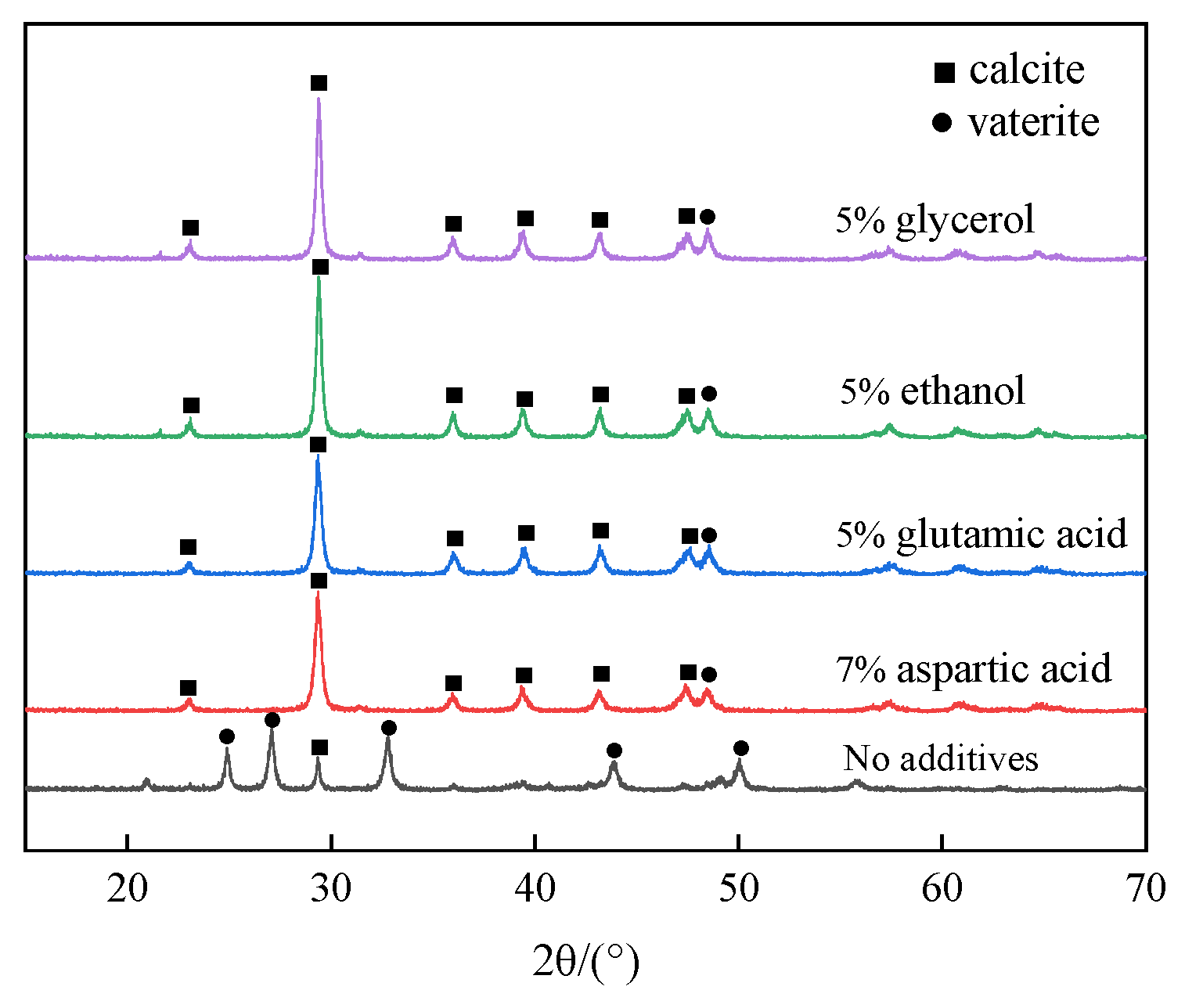
- High-pressure carbonation was further performed using Ca2+-rich leachates containing organic additives, including aspartic acid, glutamic acid, ethanol, and glycerol. In all additive systems, the Ca2+ conversion rate initially increased and then decreased with increasing additive concentration. The optimal dosages were 1 wt% for both aspartic acid and glutamic acid, 5 vol% for ethanol, and 3 vol% for glycerol. The resulting CaCO3 products were predominantly calcite with quasi-spherical morphologies. The particles exhibited relatively uniform sizes and good dispersion. Among the tested additives, glutamic acid and glycerol showed stronger effects on crystal morphology regulation.
Author Contributions
Funding
Institutional Review Board Statement
Informed Consent Statement
Data Availability Statement
Conflicts of Interest
References
- Pan, Z.W.; Chen, Y.L.; Wu, J.; Tan, Y.Z. Study on the Behavior of Swelling-Shrinkage in Hydration Process of Phosphogypsum-based Super-Sulfated Cement. J. China Three Gorges Univ. Nat. Sci. 2023, 45, 63–69. [Google Scholar] [CrossRef]
- Wang, Q.H.; Wang, C.W.; Huang, Z.Y. Optimization of phosphogypsum allocation for filling based on full-region supply and demand matching: A case study of Yichang City. J. Saf. Environ. 2025, 25, 1134–1142. [Google Scholar] [CrossRef]
- Han, Y.; Lin, R.; Wang, X.Y. Carbon conversion technology for performance improvement and environmental benefits of ultra-high-performance concrete containing slag. J. Mater. Res. Technol. 2022, 21, 2571–2583. [Google Scholar] [CrossRef]
- Wang, C.Q.; Wang, Z.Y.; Huang, D.M.; Huang, C.Q.; Chen, Y. Recovery and recycling core of phosphogypsum: Characteristic hazardous elements risk assessment and analysis. Process Saf. Environ. Prot. 2023, 170, 738–756. [Google Scholar] [CrossRef]
- Zhao, D.; Williams, J.M.; Hou, P.K.; Moment, A.J.; Kawashima, S.H. Stabilizing mechanisms of metastable vaterite in cement systems. Cem. Concr. Res. 2024, 178, 107441. [Google Scholar] [CrossRef]
- Martin, J.B. Carbonate minerals in the global carbon cycle. Cem. Concr. Res. 2017, 449, 58–72. [Google Scholar] [CrossRef]
- Pimentel, C.; Montes-Hernandez, G.; Almarza-Cifuentes, P.; Kellermeier, M.; Van, D.; Alexander, E.S. From Waste to Value: Conversion of Calcium Sulfate to Vaterite via Carbon Capture and Storage. Adv. Funct. Mater. 2026, 36, e19977. [Google Scholar] [CrossRef]
- Wu, Y.N.; Hua, Q.X.; Tang, J.W.; Liu, Y. Studieson preparation technology of calcium carbonate whiskers from phosphogypsum. Ind. Miner. Process. 2011, 40, 18–22. [Google Scholar] [CrossRef]
- Bouargane, B.; Biyoune, M.G.; Mabrouk, A.; Bachar, A.; Bakiz, B. Experimental Investigation of the Effects of Synthesis Parameters on the Precipitation of Calcium Carbonate and Portlandite from Moroccan Phosphogypsum and Pure Gypsum Using Carbonation Route. Waste Biomass Valorization 2020, 11, 6953–6965. [Google Scholar] [CrossRef]
- Hou, J.J.; Liu, Z.D.; Ni, X.Y. Unlocking the mysteries: Investigating the kinetic mechanism of calcium carbonate formation from phosphogypsum. Process Saf. Environ. Prot. 2024, 182, 625–637. [Google Scholar] [CrossRef]
- Altiner, M.; Top, S.; Kaymakoglu, B. Ultrasonic-assisted production of precipitated calcium carbonate particles from desulfurization gypsum. Ultrason. Sonochem. 2021, 72, 105421. [Google Scholar] [CrossRef] [PubMed]
- Lin, Y.; Yan, B.J.; Mitas, B.; Li, C.L.; Fabritius, T. Calcium carbonate synthesis from Kambara reactor desulphurization slag via indirect carbonation for CO2 capture and utilization. J. Environ. Manag. 2024, 351, 119773. [Google Scholar] [CrossRef] [PubMed]
- Qiao, J.Y.; Chen, Q.J.; Liu, Z.Q.; Ding, W.J. Experimental study on preparation of vaterite-based calcium carbonate by CO2 mineralization with phosphogypsum. Ind. Miner. Process. 2023, 52, 14–18, 25. [Google Scholar] [CrossRef]
- Chen, Q.G.; Wang, J.; Zhang, Z.Y.; Wang, X.L.; Yang, L. Effects of impurities in leaching liquid of phosphogypsum desulfurization slag on crystal form of calcium carbonate. Chem. Ind. Eng. Prog. 2016, 35, 3714–3719. [Google Scholar] [CrossRef]
- Lopez-Periago, A.M.; Pacciani, R.; Garcia-Gonzalez, C.; Vega, L.F.; Domingo, C. A breakthrough technique for the preparation of high-yield precipitated calcium carbonate. J. Supercrit. Fluids 2010, 52, 298–305. [Google Scholar] [CrossRef]
- Seo, K.S.; Han, C.; Wee, J.H.; Park, J.K.; Ahn, J.W. Synthesis of calcium carbonate in a pure ethanol and aqueous ethanol solution as thesolvent. J. Cryst. Growth. 2005, 276, 680–687. [Google Scholar] [CrossRef]
- Jin, T.T.; Tian, X.L.; Hong, H.L.; Zhu, N.; Han, L.M. Study on preparation and crystalline transformation of nano- and micro-CaCO3 by supercritical carbon dioxide. Powder Technol. 2020, 370, 29–38. [Google Scholar] [CrossRef]
- Konopacka-Lyskawa, D.; Koscielska, B.; Karczewski, J. Effect of some organic solvent-water mixtures composition on precipitated calcium carbonate in carbonation process. J. Cryst. Growth. 2015, 418, 25–31. [Google Scholar] [CrossRef]
- Luo, J.; Kong, F.T.; Ma, X.S. Effects of aspartic acid on polymorph and morphology of calcium carbonate in biomimetic carbonation. Inorg. Chem. Ind. 2017, 49, 26–30. [Google Scholar]
- Yang, S.L.; Gao, Q.; Wang, H.T. Biomimetic mineralization of calcium carbonate with acidic amino acid. J. Nat. Sci. Heilongjiang Univ. 2010, 27, 495–499+503. [Google Scholar] [CrossRef]
- Zhao, Y.Y.; Han, Z.Z.; Yan, H.X.; Zhao, H.; Tucker, M.E. Selective Adsorption of Amino Acids in Crystals of Monohydrocalcite Induced by the Facultative Anaerobic Enterobacter ludwigii SYB1. Front. Microbiol. 2021, 12, 696557. [Google Scholar] [CrossRef] [PubMed]
- Zhao, H.P.; Chen, J.; Liu, C.Q.; Wei, S.; Chao, C. Solubility of Calcium Carbonate in Ammonium Chloride Aqueous Solution at T = (298.15, 323.15, and 348.15) K. J. Chem. Eng. Data. 2015, 60, 3201–3208. [Google Scholar] [CrossRef]
- Shen, L.; Sippola, H.; Li, X.; Lindberg, D.; Taskinen, P. Thermodynamic Modeling of Calcium Sulfate Hydrates in the CaSO4–H2O System from 273.15 to 473.15 K with Extension to 548.15 K. J. Chem. Eng. Data. 2019, 64, 2697–2709. [Google Scholar] [CrossRef] [PubMed]
- Xiao, Y.; Sun, W.J.; Tan, Y.Z.; Sun, D.A.; Xing, D.L. Enhancement of phosphogypsum-based solid waste cementitious materials via seawater and metakaolin synergy: Strength, microstructure, and environmental benefits. Sustain. Mater. Technol. 2024, 41, e01029. [Google Scholar] [CrossRef]
- El-Sheikh, S.M.; Barhoum, A.; Deng, Y. Effects of cationic surfactant during the precipitation of calcium carbonate nano-particles on their size, morphology, and other characteristics. Colloids Surf. A 2013, 422, 44–49. [Google Scholar] [CrossRef]
- Konopacka-Lyskawa, D.; Koscielska, B.; Karczewski, J.; Gołąbiewska, A. The influence of ammonia and selected amines on the characteristics of calcium carbonate precipitated from calcium chloride solutions via carbonation. Mater. Chem. Phys. 2017, 193, 13–18. [Google Scholar] [CrossRef]
- Hu, M.Y.; Huang, M.P.; Jin, S.M.; Guo, Y.H. Technical Process for Synthesis of Vaterite Calcium Carbonate by Using L-aspartic Acid. Min. Metall. Eng. 2019, 39, 93–96, 101. [Google Scholar]
- Wu, L.N.; Chen, X.; Zhang, G.L.; Yang, W.X.; Wu, Q.H. Mineralization and morphology control of CaCO3 induced by glutamic acid derivatized carbon dots. J. Cryst. Growth. 2023, 618, 127330. [Google Scholar] [CrossRef]
- Trushina, D.B.; Bukreeva, T.V.; Kovalchuk, M.V.; Antipina, M.N. CaCO3 vaterite microparticles for biomedical and personal careapplications. Mater. Sci. Eng. C 2014, 45, 644–658. [Google Scholar] [CrossRef] [PubMed]
- Svenskaya, Y.L.; Fattah, H.; Inozemtseva, O.A.; Ivanova, A.G.; Shtykov, S.N. Key Parameters for Size- and Shape-Controlled Synthesis of Vaterite Particles. Cryst. Growth Des. 2018, 18, 331–337. [Google Scholar] [CrossRef]
- Trushina, D.B.; Bukreeva, T.V.; Antipina, M.N. Size-Controlled Synthesis of Vaterite Calcium Carbonate by the Mixing Method: Aiming for Nanosized Particles. Cryst. Growth Des. 2016, 16, 1311–1319. [Google Scholar] [CrossRef]
- Kim, I.W.; Robertson, R.E.; Zand, R. Effects of some nonionic polymeric additives on the crystallization of calcium carbonate. Cryst. Growth Des. 2005, 5, 513–522. [Google Scholar] [CrossRef]
- Deguchi, K.; Osanai, S.C.; Umezawa, S. Synthesis and Physicochemical Properties of Dipeptide Type Surfactants: IN-Dodecanoylglutamyl-glutamic acid and glutamyl-aspartic acid. J. Oleo Sci. 2001, 50, 763–772. [Google Scholar] [CrossRef]
- Luo, M.Z.; Zhang, G.Q.; Fang, Y.H.; Cao, L.Z.; Guo, Z.B. Calcium carbonate crystallization process from the mineralization of calcium chloride waste. Sep. Purif. Technol. 2023, 319, 124066. [Google Scholar] [CrossRef]
- Mokkath, J.H. Impact of Adsorption of Straight Chain Alcohol Molecules on the Optical Properties of Calcite (10.4) Surface. Nanomaterials 2022, 12, 1460. [Google Scholar] [CrossRef] [PubMed]
- Olsen, R.; Leirvik, K.N.; Kvamme, B. Adsorption characteristics of glycols on calcite and hematite. AIChE J. 2019, 65, e16728. [Google Scholar] [CrossRef]



| SO3 | CaO | SiO2 | A12O3 | Fe2O3 | K2O | CuO | P2O5 | F | Loss |
|---|---|---|---|---|---|---|---|---|---|
| 50.22 | 35.31 | 10.94 | 0.57 | 0.68 | 0.56 | 0.02 | 0.59 | 0.87 | 0.24 |
Disclaimer/Publisher’s Note: The statements, opinions and data contained in all publications are solely those of the individual author(s) and contributor(s) and not of MDPI and/or the editor(s). MDPI and/or the editor(s) disclaim responsibility for any injury to people or property resulting from any ideas, methods, instructions or products referred to in the content. |
© 2026 by the authors. Licensee MDPI, Basel, Switzerland. This article is an open access article distributed under the terms and conditions of the Creative Commons Attribution (CC BY) license.
Share and Cite
Huang, S.; Liu, D.; Zhang, X.; Zhang, T. High-Pressure Carbonation of Phosphogypsum for Calcium Carbonate Preparation and Crystal Modification Regulation. Materials 2026, 19, 2787. https://doi.org/10.3390/ma19132787
Huang S, Liu D, Zhang X, Zhang T. High-Pressure Carbonation of Phosphogypsum for Calcium Carbonate Preparation and Crystal Modification Regulation. Materials. 2026; 19(13):2787. https://doi.org/10.3390/ma19132787
Chicago/Turabian StyleHuang, Shiyu, Dongmei Liu, Xiaoxiang Zhang, and Taotao Zhang. 2026. "High-Pressure Carbonation of Phosphogypsum for Calcium Carbonate Preparation and Crystal Modification Regulation" Materials 19, no. 13: 2787. https://doi.org/10.3390/ma19132787
APA StyleHuang, S., Liu, D., Zhang, X., & Zhang, T. (2026). High-Pressure Carbonation of Phosphogypsum for Calcium Carbonate Preparation and Crystal Modification Regulation. Materials, 19(13), 2787. https://doi.org/10.3390/ma19132787