Depth of Cure of a Simplified Bulk-Fill Universal Composite and a Conventional Resin-Based Composite



Abstract
1. Introduction
- The four shades of Tetric plus Fill would not reach the manufacturer’s claims of a 4 mm depth of cure after a 10 s exposure using the Bluephase PowerCure [42].
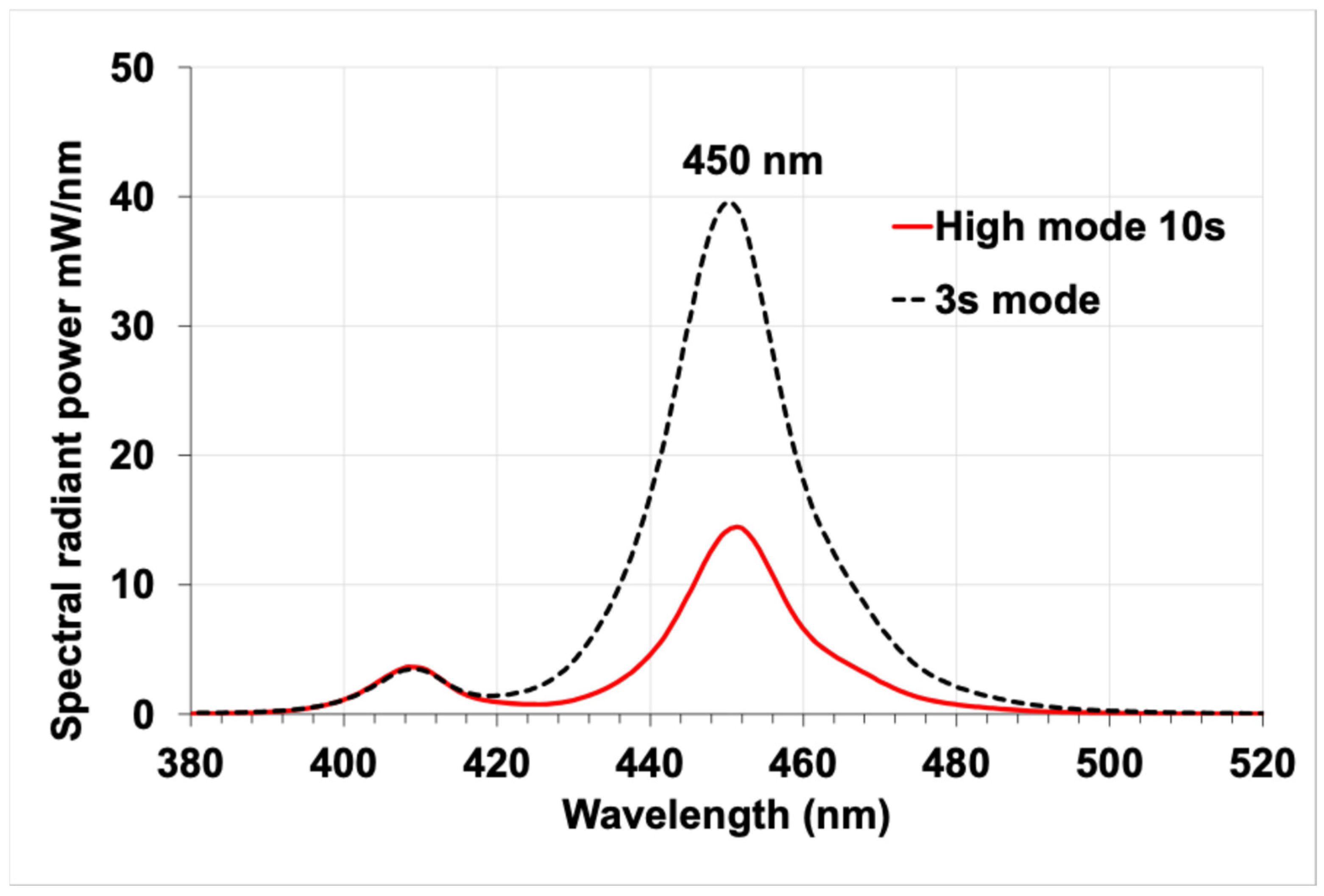
- For the tested RBCs, the 3 s extra-high irradiance mode would not achieve the same depth of cure as the 10 s high mode using the Bluephase PowerCure.
- Filtek Supreme Ultra would not reach the manufacturer’s claims of a 2 mm depth of cure in 3 s using the extra-high irradiance mode of the Bluephase PowerCure [46].
2. Materials and Methods
2.1. Materials
2.2. Sample Preparation
2.3. Photopolymerization Protocols
2.4. Vickers Microhardness
2.5. Sample Size and Total Measurements
2.6. Depth of Cure
2.7. Statistics
3. Results
4. Discussion
5. Conclusions
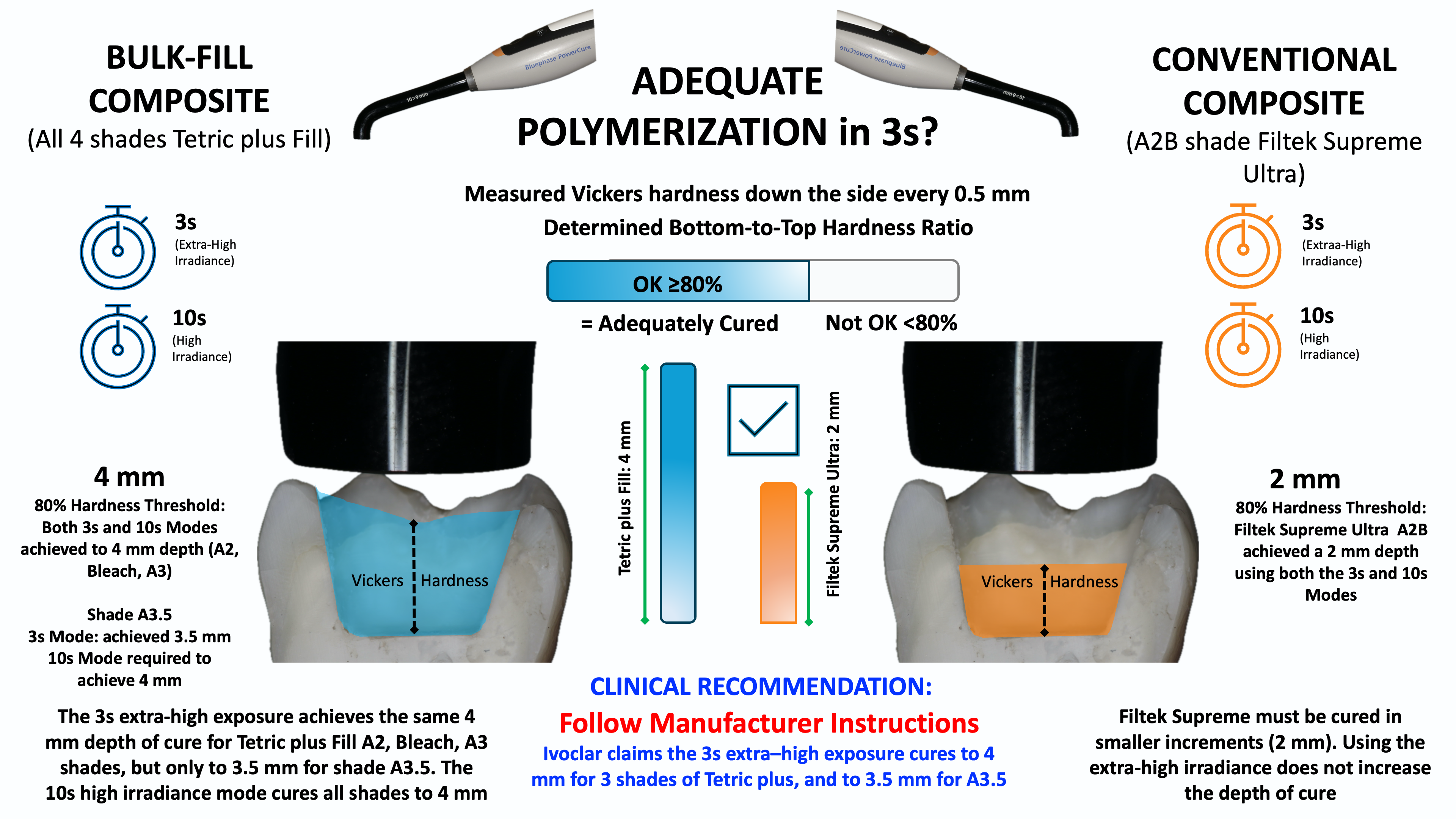
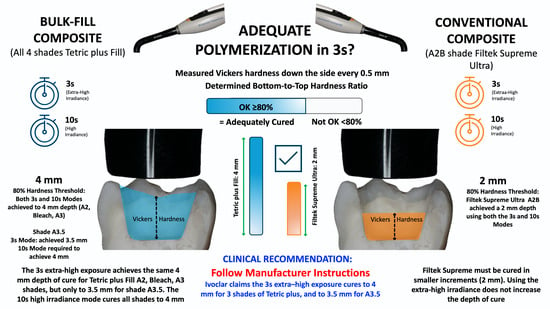
- The simplified bulk-fill universal composite, Tetric plus Fill, met the manufacturer’s DoC claims.
- Tetric plus Fill Bleach, A2 and A3 plus Fill reached their claimed DoC of 4.0 mm with both the 3 s extra-high and 10 s high exposure modes from the Bluephase PowerCure.
- Tetric plus Fill A3.5 plus reached its claimed DoC of 3.5 mm with the extra-high 3 s exposure and 4.0 mm DoC with the 10 s high exposure from the Bluephase PowerCure.
- The conventional composite, Filtek Supreme Ultra, achieved the 80% threshold to a depth of 2.0 mm using both the 3 s extra-high and 10 s high exposure modes from the Bluephase PowerCure.
Author Contributions
Funding
Data Availability Statement
Acknowledgments
Conflicts of Interest
References
- WHO. World Health Organization. Sugars and Dental Caries. Available online: https://www.who.int/news-room/fact-sheets/detail/sugars-and-dental-caries (accessed on 1 October 2021).
- Vujicic, M.; Listl, S. An Economic Perspective of the Global Burden of Dental Caries. Available online: https://www.acffglobal.org/wp-content/uploads/2021/03/An-economic-perspective-on-the-burden-of-dental-caries.pdf (accessed on 1 May 2025).
- Vos, T.; Allen, C.; Arora, M.; Barber, R.M.; Bhutta, Z.A.; Brown, A.; Carter, A.; Casey, D.C.; Charlson, F.J.; Chen, A.Z.; et al. Global, regional, and national incidence, prevalence, and years lived with disability for 310 diseases and injuries, 1990–2015: A systematic analysis for the Global Burden of Disease Study 2015. Lancet 2016, 388, 1545–1602. [Google Scholar] [CrossRef] [PubMed]
- Watts, D.C. Light-curing dental resin-based composites: How it works and how you can make it work. Front. Dent. Med. 2023, 4, 1108316. [Google Scholar] [CrossRef] [PubMed]
- Ferracane, J.L.; Mitchem, J.C.; Condon, J.R.; Todd, R. Wear and marginal breakdown of composites with various degrees of cure. J. Dent. Res. 1997, 76, 1508–1516. [Google Scholar] [CrossRef] [PubMed]
- Vandewalle, K.S.; Ferracane, J.L.; Hilton, T.J.; Erickson, R.L.; Sakaguchi, R.L. Effect of energy density on properties and marginal integrity of posterior resin composite restorations. Dent. Mater. 2004, 20, 96–106. [Google Scholar] [CrossRef] [PubMed]
- Lima, R.B.W.; Troconis, C.C.M.; Moreno, M.B.P.; Murillo-Gomez, F.; De Goes, M.F. Depth of cure of bulk fill resin composites: A systematic review. J. Esthet. Restor. Dent. 2018, 30, 492–501. [Google Scholar] [CrossRef] [PubMed]
- Frauscher, K.E.; Ilie, N. Depth of cure and mechanical properties of nano-hybrid resin-based composites with novel and conventional matrix formulation. Clin. Oral Investig. 2012, 16, 1425–1434. [Google Scholar] [CrossRef] [PubMed]
- Ferracane, J.L.; Hilton, T.J.; Stansbury, J.W.; Watts, D.C.; Silikas, N.; Ilie, N.; Heintze, S.; Cadenaro, M.; Hickel, R. Academy of Dental Materials guidance-Resin composites: Part II-Technique sensitivity (handling, polymerization, dimensional changes). Dent. Mater. 2017, 33, 1171–1191. [Google Scholar] [CrossRef] [PubMed]
- Maktabi, H.; Ibrahim, M.; Alkhubaizi, Q.; Weir, M.; Xu, H.; Strassler, H.; Fugolin, A.P.P.; Pfeifer, C.S.; Melo, M.A.S. Underperforming light curing procedures trigger detrimental irradiance-dependent biofilm response on incrementally placed dental composites. J. Dent. 2019, 88, 103110. [Google Scholar] [CrossRef] [PubMed]
- Moon, H.J.; Lee, Y.K.; Lim, B.S.; Kim, C.W. Effects of various light curing methods on the leachability of uncured substances and hardness of a composite resin. J. Oral Rehabil. 2004, 31, 258–264. [Google Scholar] [CrossRef] [PubMed]
- Vervliet, P.; De Nys, S.; Duca, R.C.; Boonen, I.; Godderis, L.; Elskens, M.; Van Landuyt, K.L.; Covaci, A. Identification of chemicals leaching from dental resin-based materials after in vitro chemical and salivary degradation. Dent. Mater. 2022, 38, 19–32. [Google Scholar] [CrossRef] [PubMed]
- Martinez-Gonzalez, M.; Fidalgo-Pereira, R.C.; Torres, O.; Silva, F.; Henriques, B.; Ozcan, M.; Souza, J.C.M. Toxicity of resin-matrix cements in contact with fibroblast or mesenchymal cells. Odontology 2023, 111, 310–327. [Google Scholar] [CrossRef] [PubMed]
- Susgun Yildirim, Z.; Eyiler, E.; Bek Kurklu, Z.G. Effect of thickness on the degree of conversion, monomer elution, depth of cure and cytotoxicity of bulk-fill composites. J. Oral Sci. 2023, 65, 121–126. [Google Scholar] [CrossRef] [PubMed]
- Durner, J.; Obermaier, J.; Draenert, M.; Ilie, N. Correlation of the degree of conversion with the amount of elutable substances in nano-hybrid dental composites. Dent. Mater. 2012, 28, 1146–1153. [Google Scholar] [CrossRef] [PubMed]
- Durner, J.; Schrickel, K.; Watts, D.C.; Becker, M.; Draenert, M.E. Direct and indirect eluates from bulk fill resin-based-composites. Dent. Mater. 2022, 38, 489–507. [Google Scholar] [CrossRef] [PubMed]
- Fujioka-Kobayashi, M.; Miron, R.J.; Lussi, A.; Gruber, R.; Ilie, N.; Price, R.B.; Schmalz, G. Effect of the degree of conversion of resin-based composites on cytotoxicity, cell attachment, and gene expression. Dent. Mater. 2019, 35, 1173–1193. [Google Scholar] [CrossRef] [PubMed]
- Palin, W.M.; Leprince, J.G.; Hadis, M.A. Shining a light on high volume photocurable materials. Dent. Mater. 2018, 34, 695–710. [Google Scholar] [CrossRef] [PubMed]
- Sword, R.J.; Bachand, W.; Mears, B.; Quibeuf, L.; Looney, S.; Price, R.B.; Rueggeberg, F.A. Effect of Operator Experience on Ability to Place Sequential, 2-mm-thick Increments of Composite. Oper. Dent. 2021, 46, 327–338. [Google Scholar] [CrossRef] [PubMed]
- Tardem, C.; Albuquerque, E.G.; Lopes, L.S.; Marins, S.S.; Calazans, F.S.; Poubel, L.A.; Barcelos, R.; Barceleiro, M.O. Clinical time and postoperative sensitivity after use of bulk-fill (syringe and capsule) vs. incremental filling composites: A randomized clinical trial. Braz. Oral Res. 2019, 33, e089. [Google Scholar] [CrossRef] [PubMed]
- Torres, C.R.; Jurema, A.L.; Souza, M.Y.; Di Nicolo, R.; Borges, A.B. Bulk-fill versus layering pure ormocer posterior restorations: A randomized split-mouth clinical trial. Am. J. Dent. 2021, 34, 143–149. [Google Scholar] [CrossRef] [PubMed]
- ISO 4049; Dentistry Polymer-Based Filling, Restorative Materials. International Organization for Standardization: Geneva, Switzerland, 2019.
- Kleverlaan, C.J.; de Gee, A.J. Curing efficiency and heat generation of various resin composites cured with high-intensity halogen lights. Eur. J. Oral Sci. 2004, 112, 84–88. [Google Scholar] [CrossRef] [PubMed]
- Fan, P.L.; Stanford, C.M.; Stanford, W.B.; Leung, R.; Stanford, J.W. Effects of backing reflectance and mold size on polymerization of photo-activated composite resin. J. Dent. Res. 1984, 63, 1245–1247. [Google Scholar] [CrossRef] [PubMed]
- Harrington, E.; Wilson, H.J. Depth of cure of radiation-activated materials—Effect of mold material and cavity size. J. Dent. 1993, 21, 305–311. [Google Scholar] [CrossRef] [PubMed]
- Erickson, R.L.; Barkmeier, W.W. Curing characteristics of a composite. Part 2: The effect of curing configuration on depth and distribution of cure. Dent. Mater. 2014, 30, e134–145. [Google Scholar] [CrossRef] [PubMed]
- Erickson, R.L.; Barkmeier, W.W. Effect of mold diameter on the depth of cure of a resin-based composite material. Eur. J. Oral Sci. 2017, 125, 88–92. [Google Scholar] [CrossRef] [PubMed]
- AlShaafi, M.M.; AlQussier, A.; AlQahtani, M.Q.; Price, R.B. Effect of Mold Type and Diameter on the Depth of Cure of Three Resin-Based Composites. Oper. Dent. 2018, 43, 520–529. [Google Scholar] [CrossRef] [PubMed]
- Erickson, R.L.; Barkmeier, W.W. Comparisons of ISO depth of cure for a resin composite in stainless-steel and natural-tooth molds. Eur. J. Oral Sci. 2019, 127, 556–563. [Google Scholar] [CrossRef] [PubMed]
- Vandewalle, K.S.; Roberts, H.W.; Rueggeberg, F.A. Power distribution across the face of different light guides and its effect on composite surface microhardness. J. Esthet. Restor. Dent. 2008, 20, 108–117; discussion 118. [Google Scholar] [CrossRef] [PubMed]
- Shimokawa, C.; Turbino, M.L.; Giannini, M.; Braga, R.R.; Price, R.B. Effect of Curing Light and Exposure Time on the Polymerization of Bulk-Fill Resin-Based Composites in Molar Teeth. Oper. Dent. 2020, 45, E141–E155. [Google Scholar] [CrossRef] [PubMed]
- Price, R.B.; Rueggeberg, F.A.; Harlow, J.; Sullivan, B. Effect of mold type, diameter, and uncured composite removal method on depth of cure. Clin. Oral Investig. 2016, 20, 1699–1707. [Google Scholar] [CrossRef] [PubMed]
- Ribeiro, M.; Maucoski, C.; Price, R.B.; Soares, C.J. Effect of a 3-second Off-label Exposure on the Depth of Cure of Eight Resin-based Composites. Oper. Dent. 2024, 49, 421–431. [Google Scholar] [CrossRef] [PubMed]
- Flury, S.; Hayoz, S.; Peutzfeldt, A.; Husler, J.; Lussi, A. Depth of cure of resin composites: Is the ISO 4049 method suitable for bulk fill materials? Dent. Mater. 2012, 28, 521–528. [Google Scholar] [CrossRef] [PubMed]
- Ilie, N.; Hilton, T.J.; Heintze, S.D.; Hickel, R.; Watts, D.C.; Silikas, N.; Stansbury, J.W.; Cadenaro, M.; Ferracane, J.L. Academy of Dental Materials guidance-Resin composites: Part I-Mechanical properties. Dent. Mater. 2017, 33, 880–894. [Google Scholar] [CrossRef] [PubMed]
- Alrahlah, A.; Silikas, N.; Watts, D.C. Post-cure depth of cure of bulk fill dental resin-composites. Dent. Mater. 2014, 30, 149–154. [Google Scholar] [CrossRef] [PubMed]
- Price, R.B.; Whalen, J.M.; Price, T.B.; Felix, C.M.; Fahey, J. The effect of specimen temperature on the polymerization of a resin-composite. Dent. Mater. 2011, 27, 983–989. [Google Scholar] [CrossRef] [PubMed]
- Wang, R.; Wang, Y. Depth-dependence of Degree of Conversion and Microhardness for Dual-cure and Light-cure Composites. Oper. Dent. 2020, 45, 396–406. [Google Scholar] [CrossRef] [PubMed]
- DeWald, J.P.; Ferracane, J.L. A comparison of four modes of evaluating depth of cure of light-activated composites. J. Dent. Res. 1987, 66, 727–730. [Google Scholar] [CrossRef] [PubMed]
- Aravamudhan, K.; Floyd, C.J.; Rakowski, D.; Flaim, G.; Dickens, S.H.; Eichmiller, F.C.; Fan, P.L. Light-emitting diode curing light irradiance and polymerization of resin-based composite. J. Am. Dent. Assoc. 2006, 137, 213–223. [Google Scholar] [CrossRef] [PubMed]
- Bouschlicher, M.R.; Rueggeberg, F.A.; Wilson, B.M. Correlation of bottom-to-top surface microhardness and conversion ratios for a variety of resin composite compositions. Oper. Dent. 2004, 29, 698–704. [Google Scholar] [PubMed]
- Ivoclar. Tetric® Plus Fill: Instructions for Use. Available online: https://www.ivoclar.com/en_li/products/composites/tetric-plus (accessed on 1 May 2025).
- Burke, F.J.T.; Crisp, R.J.; Palin, W.M.; Sands, P.; Thompson, O.; Jones, J.; James, A.; Osborne-Smith, K. A randomised controlled trial of a nanofilled composite at three years: Did selective enamel etching have an effect? Eur. J. Prosthodont. Restor. Dent. 2017, 25, 35–41. [Google Scholar] [CrossRef] [PubMed]
- Sekundo, C.; Fazeli, S.; Felten, A.; Schoilew, K.; Wolff, D.; Frese, C. A randomized clinical split-mouth trial of a bulk-fill and a nanohybrid composite restorative in class II cavities: Three-year results. Dent. Mater. 2022, 38, 759–768. [Google Scholar] [CrossRef] [PubMed]
- Schoilew, K.; Fazeli, S.; Felten, A.; Sekundo, C.; Wolff, D.; Frese, C. Clinical evaluation of bulk-fill and universal nanocomposites in class II cavities: Five-year results of a randomized clinical split-mouth trial. J. Dent. 2023, 128, 104362. [Google Scholar] [CrossRef] [PubMed]
- Filtek Supreme Ultra Instructions for Use. 3M Oral Care. St. Paul, MN, USA. Available online: https://multimedia.3m.com/mws/media/1317671O/3m-filtek-one-bulk-fill-restorative-technical-product-profile.pdf (accessed on 1 May 2025).
- Ivoclar. Bluephase PowerCure. Available online: https://ivoclarvivadent.showpad.com/share/Keq3j2xzMX6OLB0HsvHbB (accessed on 1 May 2022).
- Kaiser, C.; Price, R.B. Effect of time on the post-irradiation curing of six resin-based composites. Dent. Mater. 2020, 36, 1019–1027. [Google Scholar] [CrossRef] [PubMed]
- Lee, C.I.; Yi, M.D.; Gage, B.M.; Yarbrough, L.N.; Kirkwood, B.J.; Lien, W. Post-Cure Polymerization and Depth-of-Cure Behaviors of Dental Bulk-Fill Resin-Based Composites. Med. J. 2021, 74–82. [Google Scholar]
- Scotti, N.; Venturello, A.; Borga, F.A.; Pasqualini, D.; Paolino, D.S.; Geobaldo, F.; Berutti, E. Post-curing conversion kinetics as functions of the irradiation time and increment thickness. J. Appl. Oral Sci. 2013, 21, 190–195. [Google Scholar] [CrossRef] [PubMed]
- Braga, S.; Schettini, A.; Carvalho, E.; Shimokawa, C.; Price, R.B.; Soares, C.J. Effect of the Sample Preparation and Light-curing Unit on the Microhardness and Degree of Conversion of Bulk-fill Resin-based Composite Restorations. Oper. Dent. 2022, 47, 163–172. [Google Scholar] [CrossRef] [PubMed]
- Price, R.B.; Sullivan, B. Effect of Indenter Load on Vickers Microhardness and Indentation Depth of One Resin Composite. Materials 2024, 17, 6156. [Google Scholar] [CrossRef] [PubMed]
- Keles, Z.H.; Ucuncu, M.K. To polish or not to polish? An evaluation of the accuracy in measuring depth of cure calculated by microhardness ratio. BMC Oral Health 2025, 25, 987. [Google Scholar] [CrossRef] [PubMed]
- Almuallem, Z.; McDonnell, S.; Busuttil-Naudi, A.; Santini, A. The Effect of Irradiation Distance on Light Transmittance and Vickers Hardness Ratio of Two Bulk-fill Resin-based Composites. Eur. J. Prosthodont. Restor. Dent. 2016, 24, 203–214. [Google Scholar] [CrossRef] [PubMed]
- Yang, J.; Silikas, N.; Watts, D.C. Pre-heating time and exposure duration: Effects on post-irradiation properties of a thermo-viscous resin-composite. Dent. Mater. 2020, 36, 787–793. [Google Scholar] [CrossRef] [PubMed]
- Babaier, R.; Alhotan, A.; Haider, J.; Silikas, N.; Watts, D.C. Effects of two dentifrices on the surface properties and staining susceptibility of polymer-based materials. J. Prosthodont. 2025, 34, 965–976. [Google Scholar] [CrossRef] [PubMed]
- Alayed, A.; Silikas, N.; Watts, D.C. The effect of photoinitiator systems on resin-based composite containing ZnO-nanoparticles. Dent. Mater. 2025, 41, 220–228. [Google Scholar] [CrossRef] [PubMed]
- R Core Team. R: A Language and Environment for Statistical Computing; R Foundation for Statistical Computing: Vienna, Austria, 2025; Available online: https://www.R-project.org (accessed on 28 July 2025).
- Bayne, S.C. Correlation of clinical performance with ‘in vitro tests’ of restorative dental materials that use polymer-based matrices. Dent. Mater. 2012, 28, 52–71. [Google Scholar] [CrossRef] [PubMed]
- Macan, M.; Marosevic, A.; Spiljak, B.; Simunovic, L.; Par, M.; Marovic, D.; Juric-Kacunic, D.; Tarle, Z. Proposition of New Testing Procedure for the Mechanical Properties of Bulk-Fill Materials. Materials 2023, 16, 4868. [Google Scholar] [CrossRef] [PubMed]



| Product, Shade and Manufacturer | Abbreviation Used and Lot Number | Resin Matrix | Filler | Filler (wt. %/vol. %) |
|---|---|---|---|---|
| Tetric plus Fill: A2 plus. Ivoclar, Schaan, Liechtenstein | TpF A2 plus Cavifils (YM0205) | UDMA, Bis-GMA, aromatic-aliphatic UDMA, Bis-EMA, DCDMA, Tricyclodecane dimethanol dimethacrylate TCD-DMDA, Camphorquinone, Ivocerin. | Strontium glass, copolymer, mixed oxide (SiO2/ZrO2), ytterbium trifluoride | Total content of inorganic fillers: 70 wt%/51–52 vol% Particle size of the inorganic fillers: 0.01–3.0 μm |
| Tetric plus Fill: Bleach plus. Ivoclar, Schaan, Liechtenstein | TpF Bleach plus Cavifils (YM0208) | UDMA, Bis-GMA, aromatic-aliphatic UDMA, Bis-EMA, DCDMA, Tricyclodecane dimethanol dimethacrylate TCD-DMDA, Camphorquinone, Ivocerin. | Strontium glass, copolymer, mixed oxide (SiO2/ZrO2), ytterbium trifluoride | Total content of inorganic fillers: 70 wt%/51–52 vol% Particle size of the inorganic fillers: 0.01–3.0 μm |
| Tetric plus Fill: A3 plus. Ivoclar, Schaan, Liechtenstein | TpF A3 plus Cavifils (YM0206) | UDMA, Bis-GMA, aromatic-aliphatic UDMA, Bis-EMA, DCDMA, Tricyclodecane dimethanol dimethacrylate TCD-DMDA, Camphorquinone, Ivocerin. | Strontium glass, copolymer, mixed oxide (SiO2/ZrO2), ytterbium trifluoride | Total content of inorganic fillers: 70 wt%/51–52 vol% Particle size of the inorganic fillers: 0.01–3.0 μm |
| Tetric plus Fill: A3.5 plus. Ivoclar, Schaan, Liechtenstein | TpF A3.5 plus Cavifils (YM0207) | UDMA, Bis-GMA, aromatic-aliphatic UDMA, Bis-EMA, DCDMA, Tricyclodecane dimethanol dimethacrylate TCD-DMDA, Camphorquinone, Ivocerin. | Strontium glass, copolymer, mixed oxide (SiO2/ZrO2), ytterbium trifluoride | Total content of inorganic fillers: 70 wt%/51–52 vol% Particle size of the inorganic fillers: 0.01–3.0 μm |
| 3M™ Filtek™ Supreme Ultra Universal Restorative: A2B (Body). Solventum (formerly 3M Oral Care), St. Paul, MN, USA | FSU A2B | Bis-GMA; Bis-EMA(6); UDMA; minor TEGDMA and PEGDMA (viscosity/shrinkage modifiers) Camphorquinone | Silane-treated zirconia and silica. Non-agglomerated/non-aggregated 20 nm silica; non-agglomerated/non-aggregated 4–11 nm zirconia; aggregated zirconia/silica nanoclusters (≈0.6–10 µm clusters for dentin/enamel/body shades). | Inorganic nanofiller filler loading (A2B body shade): ~78.5 wt%/63.3 vol%. |
| RBC | Exposure Protocol | HV 0.0 mm | HV 0.5 mm | HV 1.0 mm | HV 1.5 mm | HV 2.0 mm | HV 2.5 mm | HV 3.0 mm | HV 3.5 mm | HV 4.0 mm | HV 4.5 mm | HV 5.0 mm |
|---|---|---|---|---|---|---|---|---|---|---|---|---|
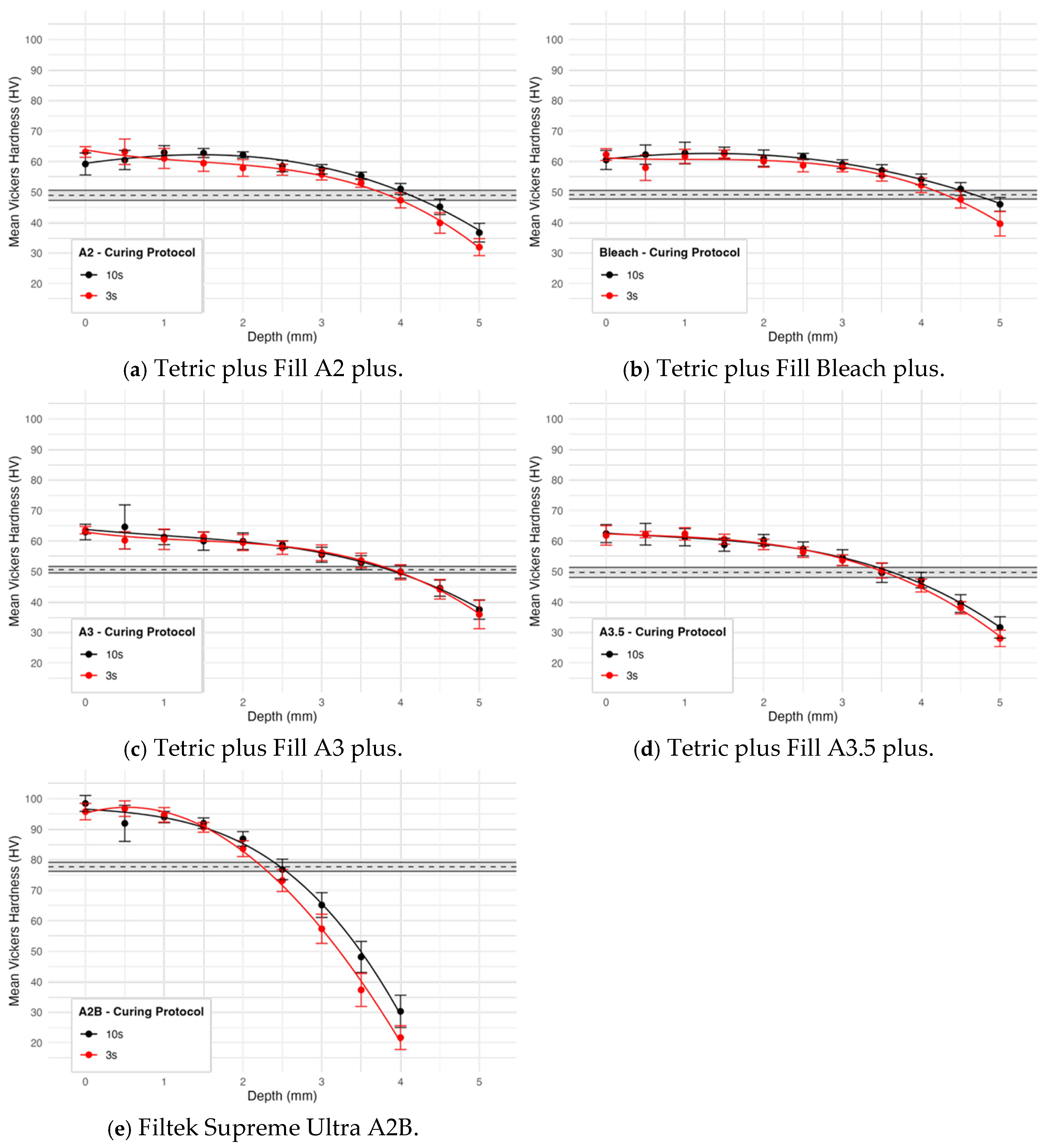
| TpF A2 plus | 3 s | 63.16 (0.61) | 63.22 (1.46) | 61.05 (1.15) | 59.49 (0.94) | 57.92 (0.97) | 57.32 (0.63) | 55.76 (0.63) | 53.01 (0.50) | 47.34 (0.89) | 39.90 (1.19) | 31.97 (0.97) |
| 10 s | 59.21 (1.27) | 60.53 (1.11) | 62.98 (0.80) | 62.82 (0.52) | 62.20 (0.35) | 58.58 (0.66) | 57.48 (0.55) | 55.35 (0.42) | 51.05 (0.63) | 45.20 (0.89) | 36.70 (1.07) | |
| TpF A3 plus | 3 s | 63.56 (0.42) | 60.23 (1.00) | 60.58 (1.17) | 61.41 (0.53) | 59.50 (0.92) | 57.79 (0.76) | 56.16 (0.91) | 53.61 (0.84) | 49.76 (0.87) | 44.21 (1.13) | 35.92 (1.64) |
| 10 s | 62.95 (0.89) | 64.62 (2.54) | 61.29 (0.87) | 60.00 (1.06) | 59.95 (0.95) | 58.81 (0.44) | 55.51 (0.87) | 52.92 (0.80) | 49.94 (0.75) | 44.56 (0.93) | 37.54 (1.11) | |
| TpF A3.5 plus | 3 s | 61.85 (1.13) | 62.13 (0.36) | 62.38 (0.71) | 60.61 (0.57) | 58.88 (0.60) | 56.34 (0.60) | 53.70 (0.62) | 50.36 (0.87) | 45.40 (0.74) | 38.11 (0.71) | 28.09 (0.94) |
| 10 s | 62.43 (1.04) | 62.24 (1.25) | 61.25 (0.99) | 58.79 (0.75) | 60.29 (0.66) | 57.43 (0.80) | 54.56 (0.91) | 49.59 (1.11) | 47.19 (0.89) | 39.51 (1.02) | 31.68 (1.21) | |
| TpF Bleach plus | 3 s | 62.32 (0.68) | 58.00 (1.47) | 61.72 (0.81) | 62.51 (0.46) | 60.09 (0.68) | 58.77 (0.75) | 58.10 (0.51) | 55.46 (0.65) | 52.22 (0.83) | 47.60 (0.99) | 39.63 (1.42) |
| 10 s | 60.54 (1.10) | 62.29 (1.11) | 62.81 (1.25) | 62.88 (0.65) | 61.12 (0.94) | 61.66 (0.36) | 59.20 (0.50) | 57.11 (0.66) | 54.16 (0.62) | 51.02 (0.74) | 45.99 (0.80) | |
| FSU A2B | 3 s | 95.78 (0.94) | 96.77 (0.90) | 94.71 (0.84) | 90.64 (0.56) | 83.64 (0.92) | 73.19 (1.26) | 57.37 (1.68) | 37.32 (1.90) | 21.71 (1.35) | TOO SOFT | TOO SOFT |
| 10 s | 98.44 (0.92) | 91.93 (2.08) | 93.98 (0.65) | 91.98 (0.61) | 86.83 (0.84) | 76.82 (1.19) | 65.16 (1.43) | 48.15 (1.79) | 30.31 (1.82) | TOO SOFT | TOO SOFT |
Disclaimer/Publisher’s Note: The statements, opinions and data contained in all publications are solely those of the individual author(s) and contributor(s) and not of MDPI and/or the editor(s). MDPI and/or the editor(s) disclaim responsibility for any injury to people or property resulting from any ideas, methods, instructions or products referred to in the content. |
© 2026 by the authors. Licensee MDPI, Basel, Switzerland. This article is an open access article distributed under the terms and conditions of the Creative Commons Attribution (CC BY) license.
Share and Cite
Maquère, A.; DeWolf, D.; Labrie, D.; Price, R.B. Depth of Cure of a Simplified Bulk-Fill Universal Composite and a Conventional Resin-Based Composite. Materials 2026, 19, 2657. https://doi.org/10.3390/ma19122657
Maquère A, DeWolf D, Labrie D, Price RB. Depth of Cure of a Simplified Bulk-Fill Universal Composite and a Conventional Resin-Based Composite. Materials. 2026; 19(12):2657. https://doi.org/10.3390/ma19122657
Chicago/Turabian StyleMaquère, Alexis, Darien DeWolf, Daniel Labrie, and Richard B. Price. 2026. "Depth of Cure of a Simplified Bulk-Fill Universal Composite and a Conventional Resin-Based Composite" Materials 19, no. 12: 2657. https://doi.org/10.3390/ma19122657
APA StyleMaquère, A., DeWolf, D., Labrie, D., & Price, R. B. (2026). Depth of Cure of a Simplified Bulk-Fill Universal Composite and a Conventional Resin-Based Composite. Materials, 19(12), 2657. https://doi.org/10.3390/ma19122657