Si-Based Lithium-Ion Battery Anodes: Material Design and Challenges



Abstract
1. Introduction
2. Diverse Si-Based Anode Materials
2.1. Silicon
2.2. Silicon Oxide
2.3. Silicon Nitride
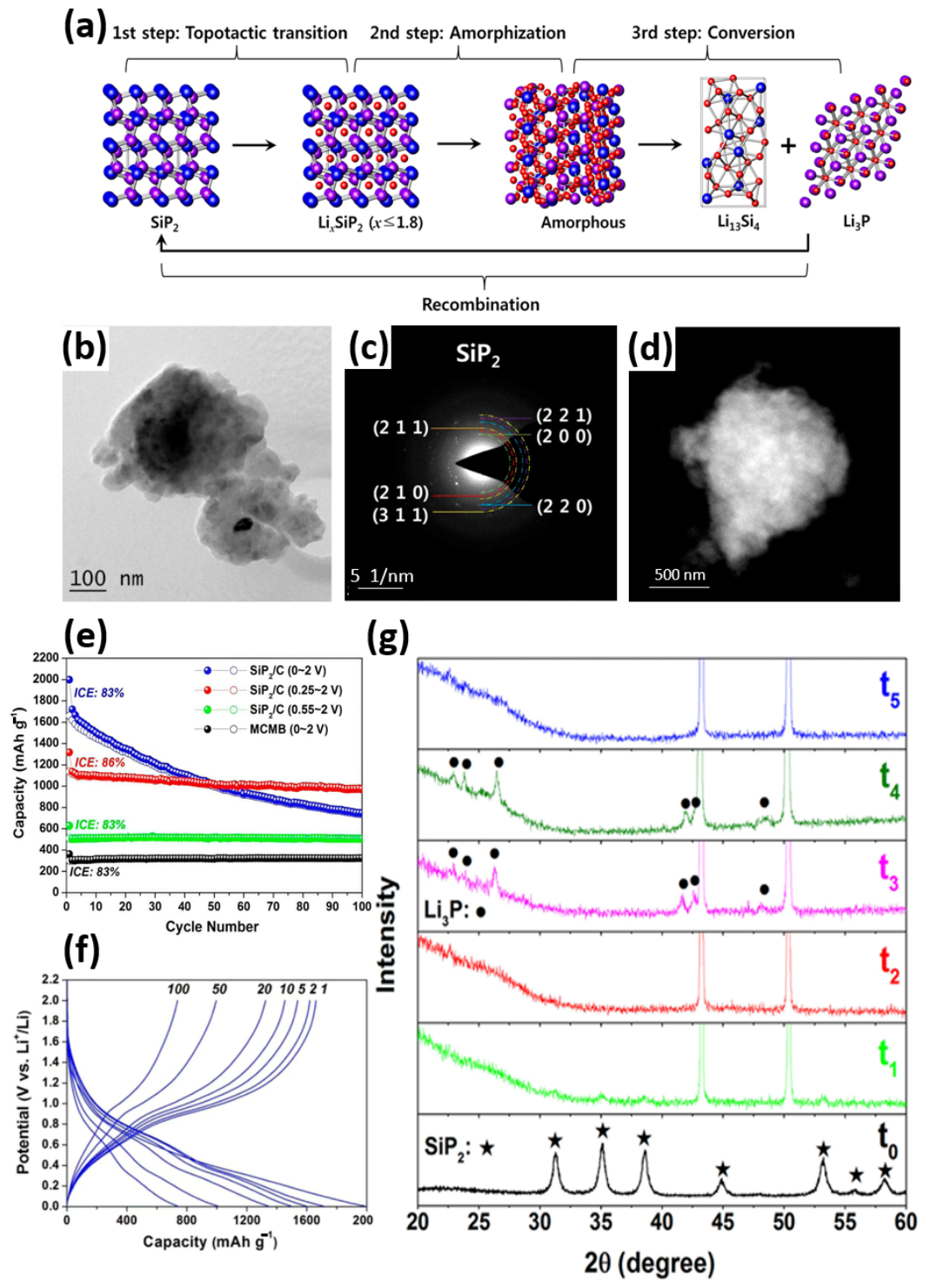
2.4. Silicon Phosphide
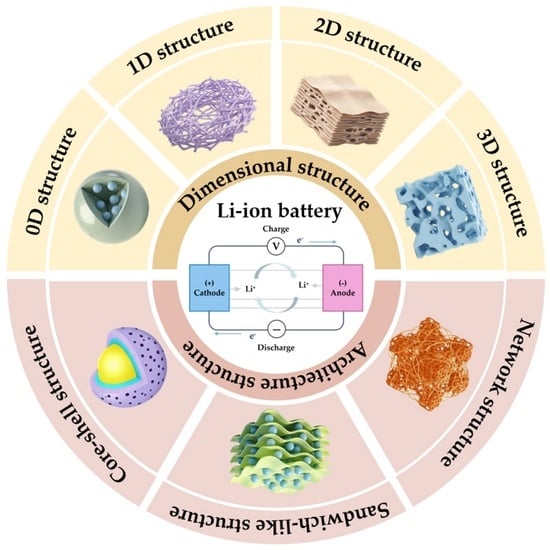
3. Structural Design of Si-Based Materials
3.1. Dimensional Design
3.1.1. 0D Structure Design
3.1.2. 1D Structure Design
3.1.3. 2D Structure Design
3.1.4. 3D Structure Design
3.2. Architecture Design
3.2.1. Core–Shell Structure
3.2.2. Sandwich-like Structure
3.2.3. Network Structure
4. Future Challenges
4.1. Mechanism Elucidation
4.1.1. Function of Individual In Situ Characterization
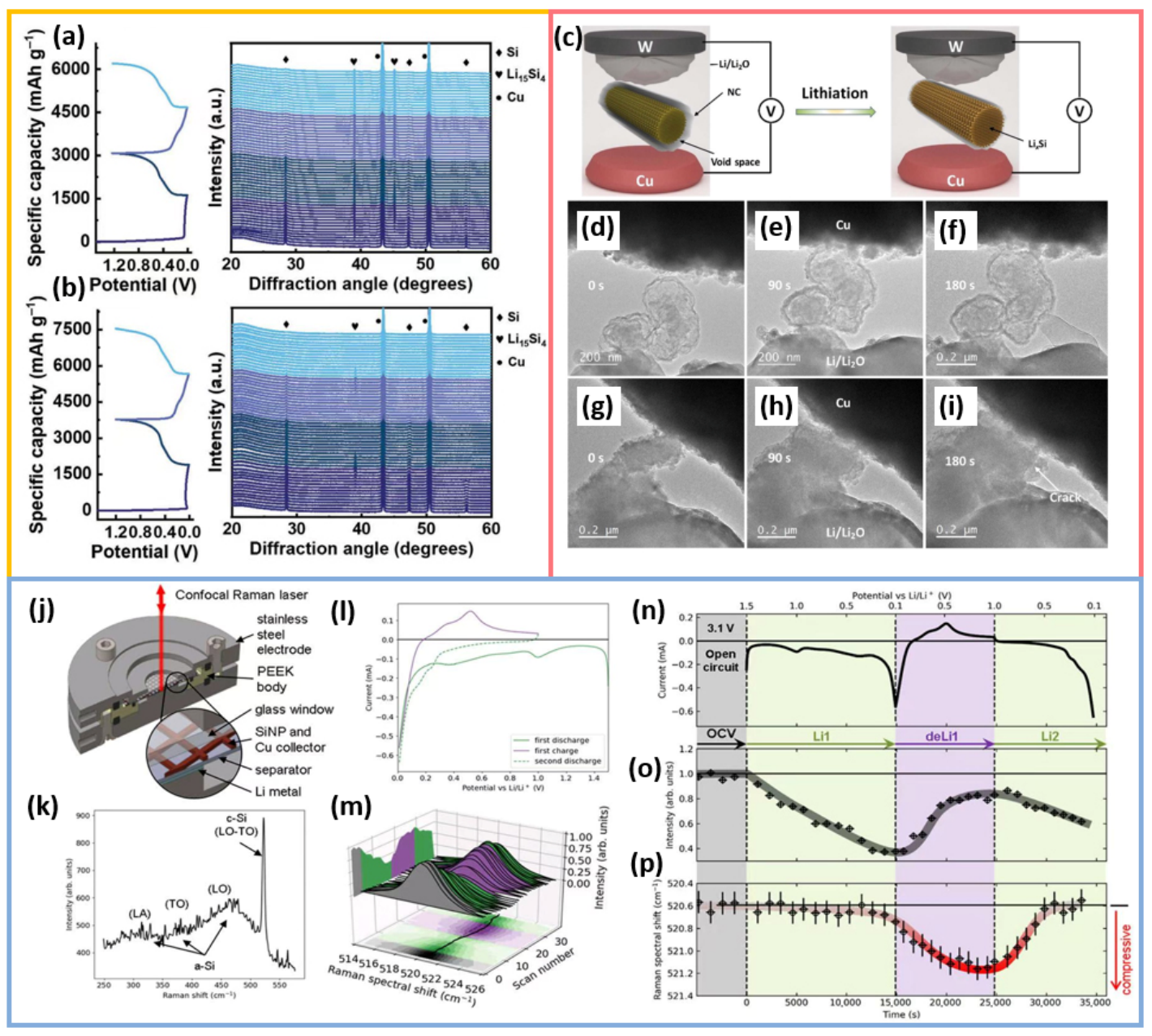
4.1.2. Coupling of Various In Situ Characterization
4.2. Structural Customization
4.3. Cost, Scalability and Safety
4.4. Full-Cells
5. Conclusions and Perspective
- (1)
- The sophisticated structural design of Si-based anodes is crucial for addressing the inherent problems of these materials, including severe volume expansion and low electrical conductivity, and for facilitating industrialization. Advanced technologies, such as 3D printing, overcome the limitations of traditional processes by enabling precise control over molding parameters and structural models. 3D printing enables the fabrication of customized Si-based anode structures and the construction of 3D continuous conductive networks, thereby promoting the synergistic transport of electrons and ions.
- (2)
- In the traditional manufacturing process of Si-based anodes, the lack of precise control over process parameters often leads to material defects, such as excessive impurities, coating fractures, and the uneven distribution of structural pores. Big data analysis and machine learning can optimize process parameters to precisely control the composition and structural configuration, thereby overcoming these limitations. Neural networks and random forest models can effectively reveal the implicit relationship between processing conditions and material performance. Moreover, multi-objective optimization algorithms like NSGA-II can achieve precise matching between process parameters and structural design specifications.
- (3)
- The Si-based anode has an extremely high theoretical capacity (4200 mAh g−1), significantly higher than that of graphite. However, there is still a considerable gap between the practical performance and the theoretical value of the Si-based anode. To bridge this gap, several aspects need to be improved to enhance the practical performance. Firstly, using in situ XRD and DFT calculations to clarify the phase transition path during lithiation and to design structures with low diffusion barriers to address the kinetic limitation issue. Secondly, self-repairing systems with dynamic covalent bonds to alleviate structural fatigue caused by cyclic stress. Thirdly, effective matching of high-capacity Si-based anodes with cathodes and electrolytes in the full-cell should be achieved to prevent performance degradation due to insufficient lithium supply.
- (4)
- The lithium storage process of Si-based anodes is rather complex, and traditional characterization methods are unable to achieve real-time correlation between structure and performance. Next-generation in situ characterization techniques can precisely identify the key rate-limiting factors during the lithium storage process. This can be achieved by simultaneously acquiring and separating signals from the electric field, stress field, and concentration field. Moreover, through real-time detection of dynamic interface changes, an intrinsic correlation between dynamic interface stability and cycle life is accurately established. The future development of in situ characterization techniques requires improved spatial and temporal resolution to track transient processes and the use of machine learning for advanced multimodal data fusion to reduce signal interference from components like electrolytes, thereby enhancing the accuracy of mechanism analysis.
- (5)
- Experimental studies have limitations in describing the microscopic mechanism of lithium storage. Atomic-scale simulations and electronic structure calculations can effectively reveal the fundamental lithium-storage processes. They can also accurately describe interfacial electronic states and reaction energy barriers. Although progress has been made, there are still challenges in model mismatch and multi-scale coupling. Therefore, it is essential to further develop multi-scale computational methods. It is also important to combine them with machine learning for parameter calibration. These efforts can improve model accuracy and bridge the gap between theoretical and experimental results.
Author Contributions
Funding
Data Availability Statement
Acknowledgments
Conflicts of Interest
References
- Zhang, X.; Liu, X.; Jia, A.; Song, B.; Gao, W.; He, L.; Zhou, B.; Hu, K.; Zhang, H.; Wu, Y.; et al. Sb-terminated functionalized interlayer with dual-function mechanism enables highly stable lithium metal batteries. Adv. Powder Mater. 2026, 5, 100365. [Google Scholar] [CrossRef]
- Arif, M.; Li, X.; Fu, Z.; Zhong, Y.; Hu, G.; Zhu, T.; Feng, X. Photo-assisted Li/Zn-air batteries and supercapacitors: Material design, working mechanism and challenges. Adv. Powder Mater. 2025, 4, 100316. [Google Scholar] [CrossRef]
- Chen, X.; Ahmad, M.; Hussain, I.; Zhang, Z.; Wang, H.; Lu, Y.; Hu, Q.; Wang, C.; Zhang, K. Bursting and transforming MOF into n-type ZnO and p-type NiO based heterostructure for supercapacitive energy storage. Nano Mater. Sci. 2025, 7, 711–718. [Google Scholar] [CrossRef]
- Zheng, D.; Sun, X.; An, C.; Pan, F.; Qin, C.; Wang, Z.; Deng, Q.; Song, Y.; Li, Y. Flexible multi-layered porous CuxO/NiO (x = 1, 2) photo-assisted electrodes for hybrid supercapacitors: Design and mechanism insight. Chem. Eng. J. 2023, 473, 145289. [Google Scholar] [CrossRef]
- Kumari, N.; Kumar, S.; Karmacharya, M.; Dubbu, S.; Kwon, T.; Singh, V.; Chae, K.; Kumar, A.; Cho, Y.K.; Lee, I. Surface-textured mixed-metal-oxide nanocrystals as efficient catalysts for ROS production and biofilm eradication. Nano Lett. 2021, 21, 279–287. [Google Scholar] [CrossRef]
- Lee, J.; Dubbu, S.; Kumari, N.; Kumar, A.; Lim, J.; Kim, S.; Lee, I. Magnetothermia-induced catalytic hollow nanoreactor for bioorthogonal organic synthesis in living cells. Nano Lett. 2020, 20, 6981–6988. [Google Scholar] [CrossRef]
- Dutta, S.; Kumari, N.; Dubbu, S.; Jang, S.; Kumar, A.; Ohtsu, H.; Kim, J.; Kawano, M.; Cho, S.; Lee, I. Highly mesoporous metal organic frameworks as synergistic multimodal catalytic platforms for divergent cascade reactions. Angew. Chem. Int. Ed. 2020, 59, 3416. [Google Scholar] [CrossRef] [PubMed]
- Sun, X.; Qin, C.; Zhao, B.; Jia, S.; Wang, Z.; Yang, T.; Liu, X.; Pan, L.; Zheng, L.; Luo, D.; et al. A cation and anion dual-doping strategy in novel Li-rich Mn-based cathode materials for high-performance Li metal batteries. Energy Storage Mater. 2024, 70, 103559. [Google Scholar] [CrossRef]
- Liu, C.; Jia, S.; Yang, T.; Liu, J.; Zhou, X.; Wang, Z.; Dong, H.; Shi, Z.; Zhang, Y.; Chen, Z. Scalable and ultrathin dual entangled network polymer electrolytes for safe solid-state sodium batteries. Angew. Chem. Int. Ed. 2025, 64, e202505938. [Google Scholar] [CrossRef] [PubMed]
- Wang, Z.F.; Wang, H.Y.; Liu, X.L.; Chen, Y.X.; Zhao, Y.; Zhang, Y.G.; Han, Q.Q.; Qin, C.L.; Bakenov, Z.; Wang, Y.C.; et al. Single Zn atoms anchored on hollow carbon nanofiber network for dendrite-free lithium metal anode of flexible Li-S full-cell. Rare Met. 2023, 42, 3705–3717. [Google Scholar] [CrossRef]
- Kim, Y.; Kim, D.; Bae, M.; Chang, Y.; An, W.Y.; Hong, H.; Hwang, S.J.; Kim, D.; Lee, J.; Piao, Y. In situ formation of bifunctional interlayer on 3D conductive scaffold for dendrite-free Li metal batteries. Energy Environ. Mater. 2025, 8, e12861. [Google Scholar] [CrossRef]
- Dai, D.; Yan, P.; Zhou, X.; Li, H.; Zhang, Z.; Wang, L.; Han, M.; Lai, X.; Qiao, Y.; Jia, M.; et al. LPEO enhanced LAGP composite solid electrolytes for lithium metal batteries. Green Carbon 2024, 2, 310–315. [Google Scholar] [CrossRef]
- Wang, F.; Guan, Z.; Wei, J.; Mu, R.; Jiang, L.; Wang, Y.; Liu, W.; Chen, H. In situ graphitization of bamboo-derived carbon and synergistic thinning strategy for multilayer graphene conversion: By passing the graphite exfoliation process. ACS Sustain. Chem. Eng. 2024, 12, 12457–12467. [Google Scholar] [CrossRef]
- Kumar, A.; Kumari, N.; Dubbu, S.; Kumar, S.; Kwon, T.; Koo, J.; Lim, J.; Kim, I.; Cho, Y.K.; Rho, J.; et al. Nanocatalosomes as plasmonic bilayer shells with interlayer catalytic nanospaces for solar-light-induced reactions. Angew. Chem. Int. Ed. 2020, 59, 9460–9469. [Google Scholar] [CrossRef]
- Acharya, A.; Dubbu, S.; Kumar, S.; Kumari, N.; Kim, Y.; So, S.; Kwon, T.; Wang, Z.; Park, J.; Cho, Y.K.; et al. Atomically conformal metal laminations on plasmonic nanocrystals for efficient catalysis. J. Am. Chem. Soc. 2021, 143, 10582–10589. [Google Scholar] [CrossRef]
- Huang, Z.X.; Zhang, T.; Zhang, X.C.; Gu, L.R.; Zou, Y.Y.; An, L.Q.; Rao, L.X.; Zhou, W. Failure mechanisms of lithium-ion batteries upon local indentation and three-point bending based on mechanical behaviors. Thin Walled Struct. 2026, 218, 114138. [Google Scholar] [CrossRef]
- Dong, X.; Yao, M.; Xiang, S. A load-balanced deformable expert network for lithium-ion battery remaining useful life prediction. J. Energy Storage 2026, 141, 119587. [Google Scholar] [CrossRef]
- Li, F.; Tian, Y.H.; Ge, L.X.; Fan, S.L.; Gong, M.S.; Fan, K.; Hou, P.Y.; Wei, X.Q. Crystal growth kinetics of single-crystal Ni-rich layered cathodes for high-energy lithium-ion batteries. Trans. Nonferrous Met. Soc. China 2025, 35, 1975–1986. [Google Scholar] [CrossRef]
- Dong, L.; Wang, Z.; Mi, C.; Zhao, W.; Qin, C.; Luo, C.; Wang, Z. Defect-rich hierarchical porous spinel MFe2O4 (M = Ni, Co, Fe, Mn) as high-performance anode for lithium ion batteries. Mater. Today Chem. 2024, 35, 101853. [Google Scholar] [CrossRef]
- Chang, P.; Liu, Z.; Xi, M.; Guo, Y.; Wu, T.; Ding, J.; Liu, H.; Huang, Y. Frustrated lewis pairs regulated solid polymer electrolyte enables ultralong cycles of lithium metal batteries. Adv. Powder Mater. 2025, 4, 100263. [Google Scholar] [CrossRef]
- Jin, G.; Luo, C.; Wang, Z.; Jia, S.; Yu, H.; Zhang, C.; Wang, Q.; Zhang, B.; Wang, Z. Unraveling phase transition pathway of spinel (FeCoCrNiMn)3O4 high-entropy oxide anodes for long-life Li-ion batteries. Mater. Today Chem. 2025, 48, 102949. [Google Scholar] [CrossRef]
- Dong, L.; Wang, Z.; Li, Y.; Jin, C.; Dong, F.; Zhao, W.; Qin, C.; Wang, Z. Spinel-structured, multi-component transition metal oxide (Ni,Co,Mn)Fe2O4−x as long-life lithium-ion battery anode material. Batteries 2023, 9, 54. [Google Scholar] [CrossRef]
- Lee, Y.R.; Hong, S.; Kim, K.; Park, J.; Kim, J.; Kang, B.; Kim, Y.; Lee, C.; Son, S.; Cho, B.; et al. Multiscale carbon-integrated silicon anode for stable cycling under practical lithium-ion battery conditions. Adv. Energy Mater. 2025, e04250. [Google Scholar] [CrossRef]
- Wu, C.; Yang, Y.; Zhang, Y.; Xu, H.; He, X.; Wu, X.; Chou, S. Hard carbon for sodium-ion batteries: Progress, strategies and future perspective. Chem. Sci. 2024, 15, 6244. [Google Scholar] [CrossRef]
- Arshad, F.; Azam, M.U.; Manurkar, N.; Zhang, F.; Idrees, B.S.; Ahmad, A.; Xu, L.; Wu, F.; Chen, R.; Li, L. Life cycle assessment of lithium-ion and secondary batteries: A comparative analysis on environmental impacts and graphite recycling. eTransportation 2026, 27, 100514. [Google Scholar] [CrossRef]
- Zhu, W.; Zhao, J.; Tao, X. MoS2-carbon based nanocomposites as anodes for lithium-ion batteries: A review. J. Energy Storage 2024, 84, 110934. [Google Scholar] [CrossRef]
- Ding, Y.; Guo, Y.; Wu, D.; Wang, S. Pmma-C44: A novel 3D carbon-based anode with dual-specification pore structure for high-performance lithium-ion batteries. Mater. Today Commun. 2025, 49, 113747. [Google Scholar] [CrossRef]
- Quan, Z.; Lu, A.; Wang, F.; Liu, Z.; Wang, S.; Zhou, Y.; Zhang, C.; Ye, C.; Liu, J.; Tan, J. Soft carbon filled in expanded graphite layer pores for superior fast-charging lithium-ion batteries. Carbon 2024, 229, 119500. [Google Scholar] [CrossRef]
- Zhou, J.; Wang, X.; Chen, X.; Luo, Z. Water-based block copolymer binders for stable and high-performance silicon-based lithium-ion battery anodes. ACS Appl. Polym. Mater. 2025, 7, 14303–14312. [Google Scholar] [CrossRef]
- Wang, T.; Wang, Z.; Li, H.; Cheng, L.; Wu, Y.; Liu, X.; Meng, L.; Zhang, Y.; Jiang, S. Recent status, key strategies, and challenging prospects for fast charging silicon-based anodes for lithium-ion batteries. Carbon 2024, 230, 119615. [Google Scholar] [CrossRef]
- Deng, J.G.; Feng, H.Q.; Xu, Y.L.; Guo, S.G.; Li, J.P.; Huo, K.F.; Fu, J.J.; Gao, B.; Chu, P.K. Metallic Sb-stabilized porous silicon with stable SEI and high electron/ion conductivity boosting lithium-ion storage performance. Rare Met. 2024, 43, 4234–4242. [Google Scholar] [CrossRef]
- Saidi, N.M.; Abdah, M.A.A.M.; Mustafa, M.N.; Walvekar, R.; Khalid, M.; Khosla, A. Advancements in silicon anodes for enhanced lithium-ion batteries performance: Innovations toward next-gen superbatteries. Battery Energy 2025, 4, e20240048. [Google Scholar] [CrossRef]
- Chen, S.; Xu, H.; Xu, X.; Mu, X.; Yuan, H.; Wei, R.; Nie, L.; Cao, H.; Ai, C.; Huang, T.; et al. Silicon-nanoparticle-embedded hard carbon as high-capacity anode for all-solid-state lithium batteries. J. Power Sources 2025, 651, 237540. [Google Scholar] [CrossRef]
- Xiao, X.; Xu, J.; Zhang, C.; Huang, M.; Miao, Y.; Yao, J.; Lin, X.; Geng, S.; Lyu, T.; Wu, Y.; et al. Structural regulation and interface engineering in silicon-based anodes for high-energy-density lithium-ion batteries: A comprehensive review. J. Energy Chem. 2026, 113, 327–364. [Google Scholar] [CrossRef]
- Sun, X.; Wu, Z.; Li, S.; Wang, K.; Qian, D.; Weng, Y.; Zhou, C.; Liang, C.; Ling, M. Hollow biochar fiber enhanced conductive network with self-adaptive stress dispersion for highly robust silicon-based anodes. J. Power Sources 2025, 656, 238035. [Google Scholar] [CrossRef]
- Moon, D.B.; Jo, M.H.; Ahn, H.J. Tuning Si@SiOx core/shell structures by controlling the microwave heating temperature for ultrafast lithium-ion battery anodes. Appl. Surf. Sci. 2026, 719, 165077. [Google Scholar] [CrossRef]
- Wang, Y.; Song, J.; Fan, H.; Luo, Y.; Song, Z.; Jin, Y.; Kim, S.; Liu, W. Gradient design for Si-based microspheres as ultra-stable Li-storage anode. Energy Storage Mater. 2025, 74, 103939. [Google Scholar] [CrossRef]
- Zhao, J.; Cai, F.; Wang, B.; Ren, J.; Guo, Z.; Du, Y.; Helal, M.H.; El-Bahy, Z.M.; Wang, Z.; Sha, J. Advances and future perspectives on silicon-based anodes for lithium-ion batteries. Adv. Colloid Interface Sci. 2025, 343, 103543. [Google Scholar] [CrossRef]
- Zhang, Y.; Zhang, Y.; Deng, Q.; Kuang, G.; Lin, R. Improving the performance of lithium-ion batteries by micron-sized silicon particles coated with nano-ZnS anode materials. J. Energy Storage 2024, 81, 110483. [Google Scholar] [CrossRef]
- Choi, Y.J.; Bae, J.Y.; Park, S.; Kim, Y.; Kim, S.H.; Lee, H.; Bae, J.S.; Kim, T.; Shin, S.; Lee, Y.; et al. Origins of abrupt capacity degradation in lithium-ion batteries with silicon-based anodes. Adv. Energy Mater. 2025, 15, e02143. [Google Scholar] [CrossRef]
- Cho, C.H.; Jeong, W.U.; Lim, C.H.; Yoon, J.K.; Bon, C.Y.; Yang, K.S.; Park, M.S. Facile synthesis of nano-Si/graphite-carbon anode through microwave-induced carbothermal shock for lithium-ion batteries. Carbon 2024, 229, 119542. [Google Scholar] [CrossRef]
- Zhang, J.; Zhu, K.; Kong, Z.; Ji, D.; Liang, P.; Wang, J.; Yan, K.; Liu, J. Glucose-assisted solvothermal synthesis of hierarchical micro-nano yolk-shell V2O3 microspheres as an anode material for lithium-ion batteries. Nano Mater. Sci. 2025, 7, 837–846. [Google Scholar] [CrossRef]
- Li, L.; Shi, Q.; Wang, Z.; Wang, J.; Zhang, C.; Zhang, J.; Liu, X.; Bachmatiuk, A.; Shen, Y.; Lu, C.; et al. Revitalizing micro-sized Si-based anodes through advanced structural design and interface stabilization: A review. Small 2025, 21, e06603. [Google Scholar] [CrossRef]
- Dong, L.; Luo, C.; Wang, Y.; Meng, S.; Yu, H.; Zhao, W.; Qin, C.; Wang, Z. Prelithiation enhanced initial Coulombic efficiency and cycling stability of spinel (FeCoCrNiMn)3O4 high entropy oxide anode. J. Energy Storage 2024, 98, 113185. [Google Scholar] [CrossRef]
- Mi, C.; Wang, Z.; Yang, S.; Liu, X.; Wang, Y.; Wang, Z. Porous Al11Ce3 intermetallics as effective sulphur host networks for stable lithium-sulphur batteries. J. Mater. Chem. C 2025, 13, 9014–9026. [Google Scholar] [CrossRef]
- Sun, Z.; Wang, Y.; Yang, T.; Wang, Z.; Wang, Z.; Shi, Z.; Zhang, Y.; Chen, Z. Constructing low-strain cation storage via high-entropy doping to stabilize layered oxide cathodes for advanced sodium-ion batteries. Small 2025, 21, 2502861. [Google Scholar] [CrossRef] [PubMed]
- Hou, F.; Min, X.; Wu, X.; Liu, Y.G.; Huang, Z.; Mi, R.; Fang, M. Recent research progress in modification strategies of silicon oxide-based anode materials for lithium-ion batteries. J. Energy Storage 2025, 127, 117132. [Google Scholar] [CrossRef]
- Zhu, G.; Chao, D.; Xu, W.; Wu, M.; Zhang, H. Microscale silicon-based anodes: Fundamental understanding and industrial prospects for practical high-energy lithium ion batteries. ACS Nano 2021, 15, 15567–15593. [Google Scholar] [CrossRef] [PubMed]
- Zhang, L.; AI-Mamun, M.; Wang, L.; Dou, Y.; Qu, L.; Dou, S.; Liu, H.; Zhao, H. The typical structural evolution of silicon anode. Cell Rep. Phys. Sci. 2022, 3, 100811. [Google Scholar] [CrossRef]
- Li, Y.; Li, Q.; Chai, J.; Wang, Y.; Du, J.; Chen, Z.; Rui, Y.; Jiang, L.; Tang, B. Si-based anode lithium-ion batteries: A comprehensive review of recent progress. ACS Mater. Lett. 2023, 5, 2948–2970. [Google Scholar] [CrossRef]
- Zhao, H.; Li, J.; Zhao, Q.; Huang, X.; Jia, S.; Ma, J.; Ren, Y. Si-based anodes: Advances and challenges in Li-ion batteries for enhanced stability. Electrochem. Energy Rev. 2024, 7, 11. [Google Scholar] [CrossRef]
- Wen, C.J.; Huggins, R.A. Chemical diffussion in intermediate phases in the lithium-silicon system. J. Solid State Chem. 1981, 37, 271–278. [Google Scholar] [CrossRef]
- Obrovac, M.N.; Christensen, L. Structural changes in silicon anodes during lithium insertion/extraction. Electrochem. Solid-State Lett. 2004, 7, A93. [Google Scholar] [CrossRef]
- Wang, J.; He, Y.; Fan, F.; Liu, X.; Xia, S.; Liu, Y.; Harris, C.T.; Li, H.; Huang, J.; Mao, S.X.; et al. Two-phase electrochemical lithiation in amorphous silicon. Nano Lett. 2013, 13, 709–715. [Google Scholar] [CrossRef]
- Levitas, V.; Attariani, H. Anisotropic compositional expansion and chemical potential for amorphous lithiated silicon under stress tensor. Sci. Rep. 2013, 3, 1615. [Google Scholar] [CrossRef]
- Tritsaris, G.; Zhao, K.; Okeke, O.; Kaxiras, E. Diffusion of lithium in bulk amorphous silicon: A theoretical study. J. Phys. Chem. C 2012, 116, 22212–22216. [Google Scholar] [CrossRef]
- Ramasubramanian, A.; Yurkiv, V.; Foroozan, T.; Ragone, M.; Shahbazian-Yassar, R.; Mashayek, F. Lithium diffusion mechanism through solid-electrolyte interphase in rechargeable lithium batteries. J. Phys. Chem. C 2019, 123, 10237–10245. [Google Scholar] [CrossRef]
- Li, B.; Goldman, A.; Xu, J. Reactive diffusion of lithium in silicon in anode materials for Li-ion batteries. Materialia 2023, 29, 101796. [Google Scholar] [CrossRef]
- Chan, C.K.; Peng, H.; Liu, G.; Mcilwrath, K.; Zhang, X.; Huggins, R.A.; Cui, Y. High-performance lithium battery anodes using silicon nanowires. Nat. Nanotechnol. 2008, 3, 31–35. [Google Scholar] [CrossRef] [PubMed]
- Yan, B.; Hou, J.; Guo, L.; Sun, C.; Jia, F.; Zhang, R.; Sang, J.; Gao, S.; Wang, Q. Homogeneous encapsulation of Si-based anode in carbon electrospinning nanofibers for high-performance lithium-ion batteries. J. Energy Storage 2026, 143, 119733. [Google Scholar] [CrossRef]
- Hong, J.; Cheng, K.; Xu, G.; Stapelberg, M.; Kuai, Y.; Sun, P.; Qu, S.; Zhang, Z.; Geng, Q.; Wu, Z.; et al. Novel silicon/copper nanowires as high-performance anodes for lithium ion batteries. J. Alloys Compd. 2021, 875, 159927. [Google Scholar] [CrossRef]
- Hwa, Y.; Park, C.M.; Sohn, H.J. Modified SiO as a high performance anode for Li-ion batteries. J. Power Sources 2013, 222, 129–134. [Google Scholar] [CrossRef]
- Lee, J.I.; Park, S. High-performance porous silicon manoxide anodes synthesized via metal-assisted chemical etching. Nano Energy 2013, 2, 146–152. [Google Scholar] [CrossRef]
- Xu, T.; Wang, Q.; Zhang, J.; Xie, X.; Xia, B. Green synthesis of dual carbon conductive network-encapsulated hollow SiOx spheres for superior lithium-ion batteries. ACS Appl. Mater. Interfaces 2019, 11, 19959–19967. [Google Scholar] [CrossRef] [PubMed]
- Shi, K.; Yi, W.; Su, W.; Xiao, Q.; Wang, Z.; Li, X.; Mu, J.; Tang, W.; Peng, Z.; Yao, H. ZnO-coated silicon oxide nano-anode: Synergistic enhancement of cycling and thermal stability of lithium-ion batteries. Energy Environ. Mater. 2025, e70126. [Google Scholar] [CrossRef]
- Liu, Z.; Zhao, Y.; He, R.; Luo, W.; Meng, J.; Yu, Q.; Zhao, D.; Zhou, L.; Mai, L. Yolk@Shell SiOx/C microspheres with semi-graphitic carbon coating on the exterior and interior surfaces for durable lithium storage. Energy Storage Mater. 2019, 19, 299–305. [Google Scholar] [CrossRef]
- Sharma, A.K.; Sharma, K.; Gupta, M.K.; Guo, F.; Ichikawa, T.; Jain, A.; Agarwal, S. Si3N4 as an alternative of Silicon for the anode application in all-solid-state Li-ion batteries. Energy Storage 2024, 6, e70010. [Google Scholar] [CrossRef]
- Suzuki, N.; Cervera, R.B.; Ohnishi, T.; Takada, K. Silicon nitride thin film electrode for lithium-ion batteries. J. Power Sources 2013, 231, 186–189. [Google Scholar] [CrossRef]
- Ulvestad, A.; Skare, M.O.; Foss, C.E.; Krogsaeter, H.; Reichstein, J.F.; Preston, T.J.; Maehlen, J.P.; Andersen, H.F.; Koposov, A.Y. Stoichiometry-controlled reversible lithiation capacity in nanostructured silicon nitrides enabled by in situ conversion reaction. ACS Nano 2021, 15, 16777–16787. [Google Scholar] [CrossRef]
- Ramar, A.; Sanjana, K.; Wang, F.M. Carbides and Nitrides: Advanced materials for engineering the electrochemistry of silicon anodes for high energy density Lithium-Ion battery. Chem. Eng. J. 2024, 491, 151921. [Google Scholar] [CrossRef]
- Reinhold, R.; Mikhailova, D.; Gemming, T.; Missyul, A.B.; Nowka, C.; Kaskel, S.; Giebeler, L. Silicon monophosphide as a possible lithium battery anode material. J. Mater. Chem. A 2018, 6, 19974. [Google Scholar] [CrossRef]
- Kwon, H.T.; Lee, C.K.; Jeon, K.J.; Park, C.M. Silicon Diphosphide: A Si-Based three-dimensional crystalline framework as a high-performance Li-ion battery anode. ACS Nano 2016, 10, 5701–5709. [Google Scholar] [CrossRef]
- Park, B.H.; Haghighat-Shishavan, S.; Nazarian-Samani, M.; Kim, K.B. High-performance silicon diphosphide/nanocarbon composite anode for Li-ion batteries: Role of chemical bonding and interfaces in the establishment of cycling stability. J. Power Sources 2019, 434, 226759. [Google Scholar] [CrossRef]
- Wang, C.Y.; Yi, Y.H.; Chang, W.C.; Kao, T.L.; Tuan, H.Y. Multi-walled carbon nanotube-wrapped SiP2 as a superior anode material for lithium-ion and sodium-ion batteries. J. Power Sources 2018, 399, 49–58. [Google Scholar] [CrossRef]
- Zhang, J.; Li, M.; Wang, Y.; Pang, T.; Wen, Y.; Qiu, J.; Han, D. Porous Si@C nanosheets derived from photovoltaic Si waste as a high-performance anode material for lithium-ion batteries. Energy Fuels 2025, 39, 13757–13767. [Google Scholar] [CrossRef]
- Yu, H.; Li, Y.; Liu, F.; Wang, L.; Song, Y. Yolk shell structured YS-Si@N-doped carbon derived from covalent organic frameworks for enhanced lithium storage. J. Colloid Interface Sci. 2024, 662, 313–321. [Google Scholar] [CrossRef] [PubMed]
- Kilian, S.; Wiggers, H. Gas-phase synthesis of silicon-rich silicon nitride nanoparticles for high performance lithium–ion batteries. Part. Part. Syst. Charact. 2021, 38, 2100007. [Google Scholar] [CrossRef]
- Duveau, D.; Israel, S.; Fullenwarth, J.; Cunin, F.; Monconduit, L. Pioneer study of SiP2 as negative electrode for Li- and Na-ion batteries. J. Mater. Chem. A 2016, 4, 3228–3232. [Google Scholar] [CrossRef]
- Yi, S.; Yan, Z.; Li, X.; Wang, Z.; Ning, P.; Zhang, J.; Huang, J.; Yang, D.; Du, N. Design of phosphorus-doped porous hard carbon/Si anode with enhanced Li-ion kinetics for high-energy and high-power Li-ion batteries. Chem. Eng. J. 2023, 473, 145161. [Google Scholar] [CrossRef]
- Chen, K.; Xiong, J.; Yu, H.; Wang, L.; Song, Y. Si@nitrogen-doped porous carbon derived from covalent organic framework for enhanced Li-storage. J. Colloid Interface Sci. 2023, 634, 176–184. [Google Scholar] [CrossRef] [PubMed]
- Sreenarayanan, B.; Vicencio, M.; Bai, S.; Lu, B.; Mao, O.; Adireddy, S.; Bao, W.; Meng, Y.S. Recycling silicon scrap for spherical Si-C composite as high-performance lithium-ion battery anodes. J. Power Sources 2023, 578, 233245. [Google Scholar] [CrossRef]
- Wu, P.; Shi, B.; Tu, H.; Guo, C.; Liu, A.; Yan, G.; Yu, Z. Pomegranate-type Si/C anode with SiC taped, well-dispersed tiny Si particles for lithium-ion batteries. J. Adv. Ceram. 2021, 10, 1129–1139. [Google Scholar] [CrossRef]
- Lu, Y.; Zhang, M.D.; Dong, Z.L.; He, Z.Q.; Wu, M.B. A porous silicon composite coated with a defect-rich carbon network for use as a high-performance anode material in lithium-ion batteries. New Carbon Mater. 2025, 40, 1184–1192. [Google Scholar] [CrossRef]
- Mu, X.; Xu, X.; Xu, H.; Huang, T.; Yu, A. Ultrastable monodisperse resin-based spherical Si-C materials with micropore confined growth of silicon nanoclusters for lithium-ion battery anodes. Adv. Funct. Mater. 2025, 35, 2504545. [Google Scholar] [CrossRef]
- Huang, W.; Gao, J.; Miao, L.; Zhou, J.; Yang, G.; Liu, W.; Jiang, Y.; Qin, H.; Zhang, Z.; Lei, X.; et al. Si@nitrogen-doped carbon nanoparticles for lithium-ion battery anodes. ACS Appl. Nano Mater. 2024, 7, 10350–10360. [Google Scholar] [CrossRef]
- Liu, S.; Wang, Q.; Wang, R.; Cui, X. Dual-layer carbon protected coaxial cable-like Si-based composites as high-performance anodes for lithium-ion batteries. J. Alloys Compd. 2022, 896, 163069. [Google Scholar] [CrossRef]
- Liu, R.; Shen, C.; Dong, Y.; Qin, J.; Wang, Q.; Iocozzia, J.; Zhao, S.; Yuan, K.; Han, C.; Li, B.; et al. Sandwich-like CNTs/Si/C nanotubes as high performance anode materials for lithium-ion batteries. J. Mater. Chem. A 2018, 6, 14797–14804. [Google Scholar] [CrossRef]
- Amiinu, I.S.; Imtiaz, S.; Geaney, H.; Kennedy, T.; Kapuria, N.; Singh, S.; Ryan, K.M. A thin Si nanowire network anode for high volumetric capacity and long-life lithium-ion batteries. J. Energy Chem. 2023, 81, 20–27. [Google Scholar] [CrossRef]
- Pendashteh, A.; Tomey, R.; Vilatela, J.J. Nanotextile 100% Si anodes for the next generation energy-dense li-ion batteries. Adv. Energy Mater. 2024, 14, 2304018. [Google Scholar] [CrossRef]
- Ahad, S.A.; Kennedy, T.; Geaney, H. Si nanowires: From model system to practical li-ion anode material and beyond. ACS Energy Lett. 2024, 9, 1548–1561. [Google Scholar] [CrossRef]
- Fang, J.; Li, J.; Zhang, W.; Qin, L.; Wu, K.; Hui, L.; Gong, T.; Li, D.; Hu, Y.; Li, A.; et al. Molecular layer deposited mechanically and chemically robust niobicone interface empowering silicon nanowire anodes with competent cyclabilities. Chem. Eng. J. 2024, 484, 149387. [Google Scholar] [CrossRef]
- Wei, J.; Qin, C.; Pang, X.; Zhang, H.; Li, X. One-dimensional core-shell composite of AgNWs@Si@GO for high-specific capacity and high-safety anode materials of lithium-ion batteries. Ceram. Int. 2021, 47, 4937–4943. [Google Scholar] [CrossRef]
- Qin, G.; Jia, Z.; Sun, S.; Wu, H.; Hu, K.; Liu, D.; Gao, Y.; Chen, J. Carbon-coated Si nanosheets as anode materials for high-performance lithium-ion batteries. ACS Appl. Nano Mater. 2024, 7, 7595–7604. [Google Scholar] [CrossRef]
- Wang, P.P.; Zhang, Y.X.; Fan, X.Y.; Zhong, J.X.; Huang, K. Synthesis of Si nanosheets by using sodium chloride as template for high-performance lithium-ion battery anode material. J. Power Sources 2018, 379, 20–25. [Google Scholar] [CrossRef]
- Ma, Z.; Wang, L.; Wang, D.; Huang, R.; Wang, C.; Chen, G.; Miao, C.; Peng, Y.; Li, A.; Miao, Y. Crucial contact interface of Si@graphene anodes for high-performance Li-ion batteries. Appl. Surf. Sci. 2022, 603, 154383. [Google Scholar] [CrossRef]
- Liu, X.; Zhang, J.; Si, W.; Xi, L.; Eichler, B.; Yan, C.; Schmidt, O.G. Sandwich nanoarchitecture of Si/reduced graphene oxide bilayer nanofilms for li-ion batteries with long cycle life. ACS Nano 2015, 9, 1198–1205. [Google Scholar] [CrossRef] [PubMed]
- Xu, P.; Guo, D.; Lin, X.; Wang, X.; Zhang, Z.; Zeng, C.; Liao, M.; Su, Z.; Huang, Q.; Zhang, M. Non-toxic synthesis of sandwich -like graphite sheet@Si@C anode material with strong face-to-face bonding by Si-C bonds for lithium-ion batteries. J. Energy Storage 2024, 98, 113225. [Google Scholar] [CrossRef]
- Zhang, M.; Zhao, L.; Sun, D.; Sun, Y.; Xu, C.; Lu, S.; Li, T.; Li, Y.; Xiao, Z. S doped CNTs scaffolded Si@C spheres anode toward splendid high-temperature performance in Lithium-ion Battery. Appl. Surf. Sci. 2023, 626, 157254. [Google Scholar] [CrossRef]
- Yi, X.; Zhang, F.; Wang, J.; Wang, S.; Tong, H.; An, T.; Yu, W.J. Facile synthesis of N-C/Si@G nanocomposite as a hgih-performance anode material for Li-ion batteries. J. Alloys Compd. 2021, 872, 159716. [Google Scholar] [CrossRef]
- Gao, M.; Tang, Z.; Wu, M.; Chen, J.; Xue, Y.; Guo, X.; Liu, Y.; Kong, Q.; Zhang, J. Self-supporting N, P doped Si/CNTs/CNFs composites with fiber network for high-performance lithium-ion batteries. J. Alloys Compd. 2021, 857, 157554. [Google Scholar] [CrossRef]
- Ji, H.; Chen, Q.; Hua, K.; Ma, Q.; Wang, R.; Zhang, L.; Zhang, C. Si nanoparticles embedded in porous N-doped carbon fibers as a binder-free and flexible anode for high-performance lithium-ion batteries. J. Alloys Compd. 2023, 936, 168256. [Google Scholar] [CrossRef]
- Wang, B.; Li, X.; Luo, B.; Zhang, X.; Shang, Y.; Cao, A.; Zhi, L. Interwined network of Si/C nanocables and carbon nanotubes as lithium-ion battery anodes. ACS Appl. Mater. Interfaces 2013, 5, 6467–6472. [Google Scholar] [CrossRef]
- Chen, N.; Lv, Y.; Zou, Y.; Ao, Z.; Huang, Y.; Zou, H. Corn-like Si derived from sepiolite as anode for advanced lithium-ion batteries. J. Alloys Compd. 2022, 925, 166704. [Google Scholar] [CrossRef]
- Men, X.; Kong, X.; Yang, X.; Wang, B.; Wang, Y.; Liu, Y.; Yu, L.; Li, H.; Xu, B. Synthesis of a pomegranate shaped reduced graphene oxide stabilized secondary Si nanoparticles composite anode for lithium ion batteries. Int. J. Hydrogen Energy 2020, 45, 29492–29504. [Google Scholar] [CrossRef]
- Zhang, W.; Li, W.; Gui, S.; Wang, X.; Zhang, Z.; Chen, Q.; Wei, J.; Tu, S.; Duan, X.; Wang, X.; et al. Engineering a low-strain Si@TiSi2@NC composite for high-performance lithium-ion batteries. ACS Appl. Mater. Interfaces 2024, 16, 26234–26244. [Google Scholar] [CrossRef]
- Xiao, Z.; Lei, C.; Yu, C.; Chen, X.; Zhu, Z.; Jiang, H.; Wei, F. Si@Si3N4@C composite with egg-like structure as high-performance anode material for lithium ion batteries. Energy Storage Mater. 2020, 24, 565–573. [Google Scholar] [CrossRef]
- Xia, M.; Chen, B.; Gu, F.; Zu, L.; Xu, M.; Feng, Y.; Wang, Z.; Zhang, H.; Zhang, C.; Yang, J. Ti3C2Tx MXene nanosheets as a robust and conductive tight on Si anodes significantly enhance electrochemical lithium storage performance. ACS Nano 2020, 14, 5111−5120. [Google Scholar] [CrossRef]
- Gao, X.; He, P.; Ren, J.; Xu, J. Modeling of contact stress among compound particles in high energy lithium-ion battery. Energy Storage Mater. 2019, 18, 23–33. [Google Scholar] [CrossRef]
- Gao, Y.; Song, S.; He, F.; Kong, X.; Xiao, Z.; Cui, X.; Cao, L.; Zhang, Y.; Liu, Z.; Yang, P. Controllable synthesis of hollow dodecahedral Si@C core-shell structures for ultrastable lithium-ion batteries. Small 2024, 20, 2406489. [Google Scholar] [CrossRef] [PubMed]
- Chen, K.; Shen, Y.; Ruan, W.; Zhang, M. Hollow core-shell Si-PEI@ZIF-67 with cross-linking effect for high-performance Li-ion batteries. J. Power Sources 2024, 621, 235231. [Google Scholar] [CrossRef]
- Agyeman, D.A.; Song, K.; Lee, G.H.; Park, M.; Kang, Y.M. Carbon-coated Si nanoparticles anchored between reduced graphene oxides as an extremely reversible anode material for high energy-density Li-ion battery. Adv. Energy Mater. 2016, 6, 1600904. [Google Scholar] [CrossRef]
- Chen, Y.; Huang, J.; Chen, Z.; Zeng, H.; Wu, Z.; Yang, H.; Chen, L.; Sun, Q.; Qian, W. Electrospun sandwich-structured C@Si/C@C as anode for advanced lithium-ion batteries. Appl. Surf. Sci. 2025, 699, 163139. [Google Scholar] [CrossRef]
- Jiang, M.; Zhang, F.; Zhu, G.; Ma, Y.; Luo, W.; Zhou, T.; Yang, J. Interface-amorphized Ti3C2@Si/SiOx@TiO2 anodes with sandwiched structures and stable lithium storage. ACS Appl. Mater. Interfaces 2020, 12, 24796–24805. [Google Scholar] [CrossRef] [PubMed]
- Dong, H.; Xie, H.; Song, Q.; Ning, Z. Multilayer boron doped Si@SiOx/C from Si-Ca alloy for lithium-ion battery anodes. J. Energy Storage 2024, 90, 111960. [Google Scholar] [CrossRef]
- Im, J.; Kwon, J.D.; Kim, D.H.; Yoon, S.; Cho, K.Y. P-doped SiOx/Si/SiOx sandwich anode for Li-ion batteries to achieve high initial coulombic efficiency and low capacity decay. Small Methods 2022, 6, 2101052. [Google Scholar] [CrossRef]
- Zhu, H.; Du, X.; Xu, Z.; Lin, Z.; Li, X.; Wang, X. Si-Ni nanofoam composites with a 3D nanoporous structure as a high-loading lithium-ion battery anode. ACS Appl. Energy Interfaces 2022, 5, 7392–7399. [Google Scholar] [CrossRef]
- Guan, H.B.; Ren, M.X.; Zeng, R.; Qin, T.; Wang, S.G.; Hou, Y.L.; Zhao, D.L. Core-shell structure and 3D CNTs networks promote Si@Cu nanoparticle anodes with enhanced reversible capacity and cyclic performance for Li-ion batteries. Int. J. Hydrogen Energy 2023, 48, 816–827. [Google Scholar] [CrossRef]
- Li, Y.; Chen, G.; Yang, H.; Geng, X.; Luo, Z.; Zhang, C.; Huang, L.; Luo, X. Three-dimensional porous Si@SiOx/Ag/CN anode derived from deposition silicon waste toward high-performance li-ion batteries. ACS Appl. Mater. Interfaces 2023, 15, 43887–43898. [Google Scholar] [CrossRef]
- Cheng, D.; Liu, Y.; Li, Z.; Rao, T.; Luo, D.; Zheng, P.; Guo, C.; Wang, J.; Pan, F.; Deng, Y.; et al. An easy-to-prepare flexible 3D network aqueous binder with gradient hydrogen bonding for high-performance silicon anodes. J. Power Sources 2024, 602, 234328. [Google Scholar] [CrossRef]
- He, D.; Li, P.; Wang, T.; Wan, Q.; Zhou, H.; Wu, M.; Qu, X. A novel approach to synthesize micrometer-sized porous Si/SiOx@C with internally and externally interweaved CNTs as a high performance anode for lithium-ion batteries. J. Power Sources 2024, 621, 235309. [Google Scholar] [CrossRef]
- Pan, Y.; Yang, D.; Luo, C.; Chen, J.; Sui, Z.; Tian, Q. Nano-Fe3C in-situ embedded into porous carbon wrapped nano-Si composite towards stable high-performance lithium-ion battery anode. J. Energy Storage 2024, 95, 112430. [Google Scholar] [CrossRef]
- Zhang, Y.Q.; Xia, X.H.; Wang, X.L.; Mai, Y.J.; Shi, S.J.; Tang, Y.Y.; Gu, C.G.; Tu, J.P. Three-dimensional porous nano-Ni supported silicon composite film for high-performance lithium-ion batteries. J. Power Sources 2012, 213, 106–111. [Google Scholar] [CrossRef]
- Niu, P.; Zhou, Y.; Li, Z.; Xiao, Y.; Su, M.; Zhou, S.; Hou, X.; Liu, Y. Synergetic design of a coralline-like Si/Ni/C anode material with microstructure and gradient interface for lithium-ion batteries. J. Alloys Compd. 2023, 933, 167785. [Google Scholar] [CrossRef]
- Wang, F.; Tang, S.; Han, X.; Wu, Y.; Lu, L.; Yu, C.; Sun, X.; Ouyang, M. Aging mechanism of Ni-rich cathode-based lithium-ion batteries: Focusing on upper cut-off voltages. Chem. Eng. J. 2024, 500, 157026. [Google Scholar] [CrossRef]
- Pin, M.; Choi, J.; Chang, J.H.; Schenk, A.S.; Han, J.; Wacławek, S.; Kim, Y.; Cheong, J.Y. In situ X-ray based analysis of anode materials for lithium-ion batteries: Current status and future implications. Energy Storage Mater. 2024, 73, 103798. [Google Scholar] [CrossRef]
- Wang, J.; Zhang, Q.; Liu, S.; Liu, Y.; Yang, X.; Feng, K. Hierarchical engineering, heterogeneous engineering, and defect engineering enabled high-performanced NbO2.5−x@C anode material for lithium-ion batteries. J. Energy Storage 2025, 132, 117794. [Google Scholar] [CrossRef]
- Hernandha, R.F.H.; Umesh, B.; Patra, J.; Chen, C.Y.; Li, J.; Chang, J.K. Core-shell Si@SiOC particles synthesized using supercritical carbon dioxide fluid dioxide fluid for superior Li-ion storage performance. Adv. Sci. 2024, 11, 2401350. [Google Scholar] [CrossRef]
- Shen, Y.; Zhang, J.; Chen, S.; Qu, K.; Yang, Z.; Peng, Y. Advances of transmission electron microscopy research for lithium-ion batteries. Nano Energy 2025, 140, 111065. [Google Scholar] [CrossRef]
- Xu, W.; Sun, Z.; Tang, C.; Cheng, Z.; Sun, W.; Du, A.; Zhang, Q.; Wu, M.; Zhang, H. Biomimetics-driven design of micron-sized SiO composites for high-performance lithium-ion batteries. Adv. Funct. Mater. 2025, 35, 2422743. [Google Scholar] [CrossRef]
- Su, Y.; Lei, X.; Han, Z.; Liu, H.; Xiao, J.; Su, Y.; Ren, S.; Lin, Y.; Hu, Q.; Yang, R.; et al. Structural reversibility of nanoscaled Sn anodes. Nano Lett. 2024, 24, 5332–5341. [Google Scholar] [CrossRef]
- Ji, P.; Lei, X.; Su, D. In Situ Transmission electron microscopy methods for lithium-ion batteries. Small Methods 2024, 8, 2301539. [Google Scholar] [CrossRef] [PubMed]
- Du, F.H.; Ni, Y.; Wang, Y.; Wang, D.; Ge, Q.; Chen, S.; Yang, H.Y. Green fabrication of silkworm cocoon-like silicon-based composite for high-performance Li-ion batteries. ACS Nano 2017, 11, 8628–8635. [Google Scholar] [CrossRef] [PubMed]
- Zhong, C.; Zhu, J.; Li, X.; Weng, S.; Wang, Z.; Wang, L.; Li, Y.; Zhan, C.; Wang, X. Rapidly-formed interphase facilitating fast-charging lithium-ion batteries. ACS Energy Lett. 2025, 10, 4627–4635. [Google Scholar] [CrossRef]
- Ji, X.; Wei, Y.; Yang, H.; Lu, Z.; Jin, S.; Jin, H.; Kong, X.; Ji, H. Extended plateau capacity of hard carbon anode for high energy lithium-ion batteries. Small 2024, 20, 2402616. [Google Scholar] [CrossRef]
- Ou, S.; Liu, C.; Yang, R.; Fan, W.; Xie, Z.; Li, B.; Meng, T.; Zou, C.; Shu, D.; Tong, Y. Supramolecular-driven construction of multilayered structure by modified hummers method for robust silicon anode. Energy Storage Mater. 2024, 73, 103814. [Google Scholar] [CrossRef]
- Zheng, T.; Gong, L.; Yang, X.; Sun, T.; Liu, Z.; Xu, Q.; Wang, Z.; Wang, Y.; Wang, K.; Qi, D.; et al. 110,000 ultralong cycling lithium-ion battery enabled by highly crystalline 2D covalent organic framework. J. Energy Chem. 2025, 110, 434–443. [Google Scholar] [CrossRef]
- Tardif, S.; Pavlenko, E.; Quazuguel, L.; Boniface, M.; Maréchal, M.; Micha, J.S.; Gonon, L.; Mareau, V.; Gebel, G.; Bayle-Guillemaud, P.; et al. Operando Raman spectroscopy and synchrotron X-ray diffraction of lithiation/delithiation in silicon nanoparticle anodes. ACS Nano 2017, 11, 11306–11316. [Google Scholar] [CrossRef]
- Zhang, Q.; Wang, Y.; Deng, Q.; Chu, Y.; Dong, P.; Chen, C.; Wang, Z.; Xia, Z.; Yang, C. In situ and real-time monitoring the chemical and thermal evolution of Lithium-ion batteries with single-crystalline Ni-rich layered oxide cathode. Angew. Chem. Int. Ed. 2024, 63, e202401716. [Google Scholar] [CrossRef]
- Vanpeene, V.; King, A.; Maire, E.; Roué, L. In situ characterization of Si-based anodes by coupling synchrotron X-ray tomography and diffraction. Nano Energy 2019, 56, 799–812. [Google Scholar] [CrossRef]
- Thapa, A.; Gao, H. High areal loading silicon nanoparticle-based lithium-ion batteries. ACS Appl. Mater. Interfaces 2025, 17, 9219–9230. [Google Scholar] [CrossRef]
- Park, G.; Choi, J.; Jung, D.; Par, J.S.; Kang, Y. Three-dimensional porous pitch-derived carbon coated Si nanoparticles-CNT composite microsphere with superior electrochemical performance for lithium ion batteries. J. Alloys Compd. 2020, 821, 153224. [Google Scholar] [CrossRef]
- Zhang, Z.; Wang, H.; Cheng, M.; He, Y.; Han, X.; Luo, L.; Su, P.; Huang, W.; Wang, J.; Li, C.; et al. Confining invasion directions of Li+ to achieve efficient Si anode material for lithium-ion batteries. Energy Storage Mater. 2021, 42, 231–239. [Google Scholar] [CrossRef]
- Chae, S.; Park, S.; Ahn, K.; Nam, G.; Lee, T.; Sung, J.; Kim, N.; Cho, J. Gas phase synthesis of amorphous silicon nitride nanoparticles for high-energy LIBs. Energy Environ. Sci. 2020, 13, 1212. [Google Scholar] [CrossRef]



| Si-Based Anode Materials | Samples | Volume Expansion | Electrode Loading (mg cm−2) | Areal Capacity (mAh cm−2) | Current Density (A g−1) | ICE | Cycle Number | Reversible Capacity (mAh g−1) | Ref. |
|---|---|---|---|---|---|---|---|---|---|
| Silicon | Si@C-650 | 280−320% | 1.0–1.2 | 0.87 | 1 | 84% | 200 | 198.1 | [75] |
| YS-Si@NC-60 | 280−320% | — | 7.429 | 0.1 | 82.2% | 110 | 1446 | [76] | |
| Silicon oxide | SiO@C | 200−260% | 10 | 1.52 | 0.152 | 66% | 50 | 1490 | [63] |
| SiO@ZnO | 200−260% | 2.6–4 | 1.27 | 0.1 | 81.2% | 500 | 978.65 | [65] | |
| SiOx/C-CVD | 220−250% | 1.5–2.0 | 1.75–2.33 | 0.1 | 67.4% | 150 | 981 | [66] | |
| Silicon nitride | Si3N4 | 200−240% | — | — | 0.085 | — | 150 | 400 | [67] |
| SiN0.92 | 210−250% | — | — | 0.18 | Over 80% | 100 | 1300 | [68] | |
| SiN0.7 | 220–260% | 0.9–1.1 | 1.23–1.50 | 0.684 | 54.3% | 300 | ≈1123 | [77] | |
| Silicon phosphide | SiP | 280−320% | — | — | 0.1 | 32% | 50 | 550 | [71] |
| SiP2/nanocarbon | 300−340% | 1.5 | 2.37 | 0.1 | 88% | 100 | 1515 | [73] | |
| MWCNT-coated SiP2 | 300–340% | 1.5 | 1.52 | 0.5 | 73% | 100 | 1622 | [74] | |
| SiP2 | 300–340% | 1.5 | 1.47 | 0.149 | 84% | 30 | 980 | [78] |
| Dimensionality | Materials | Electrode Loading (mg cm−2) | Areal Capacity (mAh cm−2) | Current Density (A g−1) | ICE | Cycle Number | Reversible Capacity (mAh g−1) | Reference |
|---|---|---|---|---|---|---|---|---|
| 0D | PoHC@Si@C | 2.5 | 3.53 | 0.3 | 83.2% | 80 | 857 | [79] |
| 1.5 | 200 | 550 | ||||||
| p-Si@DCN | — | — | 0.1 | 78% | 50 | 1710 | [83] | |
| 1 | 300 | 1161 | ||||||
| 1D | NC@Si@CNTs | — | — | 0.2 | 62.5% | 150 | 1752 | [86] |
| 2 | 150 | 910 | ||||||
| CNTs/Si/C nanotubes | — | — | 0.5 | 66.2% | 1000 | 1508.5 | [87] | |
| 2 | 1000 | 932.2 | ||||||
| 2D | pSi@C | 0.39–0.52 | 0.872–1.163 | 1 | — | 150 | 2236 | [93] |
| 5 | 500 | 467.8 | ||||||
| GS@Si@C | 1 | 1.48 | 0.2 | 84% | 100 | 1471.81 | [97] | |
| 2 | 600 | 1028.5 | ||||||
| 3D | N-C/Si@G | — | — | 0.5 | ≈86% | 500 | 1190 | [99] |
| 5 | 800 | 701.4 | ||||||
| N, P doped Si/CNTs/CNFs | — | — | 0.2 | ≈67% | 100 | 1142 | [100] | |
| 2 | 500 | 401 | ||||||
| Si/P-NCFs | 0.5 | 0.693 | 0.1 | 67.24% | 100 | 1386 | [101] | |
| 1 | 1000 | 942 | ||||||
| Si with a corn-like structure | 0.71–0.80 | 0.56–0.63 | 0.2 | 75.1% | 200 | 1447 | [103] | |
| 1 | 500 | 788 |
| Structure | Materials | Electrode Loading (mg cm−2) | Areal Capacity (mAh cm−2) | Current Density (A g−1) | ICE | Cycle Number | Reversible Capacity (mAh g−1) | Reference |
|---|---|---|---|---|---|---|---|---|
| Core–shell structure | Si@TiSi2@NC | 0.7 | 1.52 | 0.2 | 83.6% | 100 | 1553.3 | [105] |
| 2 | 1000 | 847 | ||||||
| HD–Si@C | 1.19–1.33 | 0.85–0.95 | 0.2 | 54% | 250 | 927.1 | [109] | |
| 5 | 3000 | 713 | ||||||
| Si-PEI@ZIF-67 | — | — | 1 | 65.8% | 500 | 1134.4 | [110] | |
| 5 | 200 | 828.7 | ||||||
| Sandwich-like structure | Ti3C2@Si/SiOx@TiO2 | 0.8–1.1 | 0.75–1.03 | 0.5 | 66.3% | 100 | 720 | [112] |
| 1 | 250 | 365 | ||||||
| B-Si@SiOx/C-700 | 1.0 | 0.66 | 1 | 63.1% | 500 | 659.3 | [114] | |
| 2 | 1000 | 460 | ||||||
| Network structure | Si@Cu/CNTs | — | — | 0.1 | 82.68% | 50 | 2107.5 | [117] |
| 1 | 100 | 1676.1 | ||||||
| Si@Fe3C@PC | — | — | 0.1 | 62.6% | 380 | 1320.1 | [121] | |
| 3 | 1500 | 680 | ||||||
| 3D porous Ni/Si | 0.3 | 0.73 | 0.84 | 60% | 100 | 2025 | [122] | |
| 4.2 | 100 | 1420 | ||||||
| Si/Ni/C | 1.4 | 1.46 | 0.2 | 77.3% | 100 | 1044 | [123] | |
| 2 | 500 | 511 |
| In Situ Characterization Techniques | Principle | Key Function | Advantages | Disadvantages | Spatial Resolution |
|---|---|---|---|---|---|
| In situ TEM | The transmission electron beam penetrates the sample, interacts with the atoms and generates signals. | 1. Evolution of electrode morphology 2. Nucleation, growth and reconfiguration process of SEI film. | High spatial resolution, capable of reaching the atomic level. | Requires ultra-thin samples (≤100 nm). | 0.1 nm |
| In situ SEM | The electron beam scans the surface of the sample, exciting secondary electrons/backscattered electrons. | 1. Evolution of electrode morphology 2. Detection of the growth state of lithium dendrites. | The field of view is wide, and the characterization results are close to the overall characteristics of the sample. | The measurement accuracy is not as high as that of TEM. | μm~nm |
| In situ XRD | X-rays irradiate the sample, interacting with the crystal lattice to produce coherent diffraction. | 1. Crystal structure and phase transition 2. Quantitative analysis of the variation in phase content with potential. | In situ XRD can detect the overall structure and composition of the sample. | Generally, it can only analyze crystalline substances. | μm~nm |
| In situ Raman | The sample is exposed to laser light, which excites the molecular/atomic vibrations and generates Raman scattering light. | Identify the formation of crystalline/non-crystalline Si and LixSi alloys. | Strong ability to analyze small areas. | 1. The spatial resolution is limited by the laser spot. 2. It is susceptible to fluorescence interference. | 10 nm~1 μm |
| In situ EIS | Apply a small sinusoidal voltage/current, measure the impedance response at different frequencies. | Analyze the impedance of the SEI film, as well as the changes in charge transfer resistance and bulk Li+ diffusion resistance. | 1. Sensitive to interface dynamic changes. 2. Without sample damage, it can achieve long-term monitoring. | No spatial resolution, only the average resistance of the entire battery can be obtained. | − |
| In situ XPS | X-rays irradiate the sample, exciting the photoelectrons. The surface elements can be determined by analyzing the binding energy/peak shape of the photoelectrons. | 1. Analyze the chemical composition of the SEI film. 2. Real-time monitoring of the growth process of the SEI film. | The detection sensitivity for thin surface films (at the nanometer level) is extremely high. | It can only analyze the surface information of the sample. | μm |
| In situ XRCT | X-rays penetrate the sample. Different phases within the sample absorb and scatter X-rays differently; hence, a three-dimensional structure image of the sample is obtained. | 1. Non-destructive monitoring. 2. Monitoring the three-dimensional growth path of lithium dendrites. | It enables three-dimensional morphology analysis. | The test takes a long time and has a low time resolution. | μm |
| In situ AFM | Through the tiny displacement of the probe, changes in the force on the surface are sensed and converted into surface topography images. | Monitor the morphological evolution and the mechanical properties of the electrode surface. | It can simultaneously achieve morphological analysis and mechanical property testing. | It can only analyze the surface information of the sample, and the testing field is small. | ~1 nm |
| Application Scenarios | Failure Mechanism | Key Performance Requirements | Corresponding Structural Design Strategies |
|---|---|---|---|
| Fast charging | 1. The drastic volume changes lead to an irreversible collapse of the conductive network. 2. Silicon particles detach from the conductive network, forming “dead Si”. 3. Significantly enhanced concentration polarization and electrochemical polarization. 4. The increased risk of lithium extraction. | 1. Fast reaction kinetics in high-rate. 2. Outstanding structural stability and pulverization resistance. 3. Low interfacial resistance and stable SEI. | Nanostructure, hollow structure, three-dimensional conductive network structure. |
| Low temperatures | 1. The restricted diffusion of Li+ in SEI, and the significantly increased charge transfer impedance and interfacial resistance. 2. The intensified concentration gradient. 3. Unsynchronized lithiation inside the particles induces stress concentration and electrode cracking. | 1. The rapid transport capability of Li+ at low temperatures 2. The uniform lithiation of the entire electrode. 3. SEI with ionic conductivity, toughness and low-temperature stability | Nanostructure, carbon material composite structure. |
| Wide temperature range | 1. Strategies optimized for a single temperature region degrade the performance in other temperature ranges. 2. The insufficient temperature adaptability of SEI. 3. The mismatch of thermal-physical-chemical in multicomponent electrode system. | 1. Controllable and moderate volume expansion. 2. The temperature-adaptive SEI. 3. Thermodynamic, mechanical and electrochemical temperature compatibility | 1. Construct three-dimensional structures via compounding with conductive and rigid skeletal materials. 2. Yolk core–shell structure. |
| Methods | Preparation Cost | Safety | Scalability Evaluation |
|---|---|---|---|
| Mechanical milling methods | Low production cost. 1. The raw material is inexpensive industrial silicon powder. 2. The post-treatment only mainly involves drying and screening. | Medium level of safety. Flammable silicon powder. | High scalability. The ball milling equipment is a mature device that supports continuous large-scale production. |
| Spray drying method | Medium synthesis cost. 1. Preparing the raw material into a solution requires the use of organic solvents. 2. The drying process needs high-temperature hot air. | Medium security level. 1. The volatility and flammability of organic solvents 2. The high temperature of the drying tower. | High scalability. 1. The spray drying equipment is a continuous production line. 2. The atomization and drying parameters are easy to adjust, and the product uniformity is high. |
| Chemical vapor method | High synthesis cost. 1. The silicon source requires high purity and is expensive. 2. Large energy consumption during high-temperature reactions. | Low safety. 1. The flammable, explosive and highly toxic silicon source. 2. The reaction process produces corrosive gases like HCl. | Moderate scalability. 1. Most CVD equipment is for batch production. 2. The temperature and silicon source concentration distribution within the equipment are uneven. |
| Template method | High production costs. 1. The template reagents and etching agents are expensive. 2. The raw material utilization rate is less than 50%. | Low safety. 1. The toxic and corrosive etchant. 2. During the high-temperature baking of the template, powder splashing is prone to occur. | Low scalability. 1. The template method involves non-continuous reactions 2. The complex template removal process. |
| Hydrothermal method | Moderate synthesis cost. 1. Low raw material prices, high raw material utilization rate and simple maintenance. 2. Medium equipment costs and moderate reaction energy consumption. | Medium safety level. The hydrothermal autoclave is prone to exploding under high temperature and high pressure. | Low scalability. Due to the size and safety requirements of the autoclave, it is impossible to achieve large-scale production, resulting in low production efficiency. |
| Magnesium thermal reduction method | Low preparation cost. 1. The raw material prices are extremely low, and the energy consumption is moderate. 2. The post-processing mainly involves acid washing, and the cost of consumables is low. | Low safety. 1. Magnesium powder is flammable. 2. The exothermic reaction caused by the magnesium thermal reduction releases a large amount of heat | Moderate scalability. During large-scale production, there may be issues of insufficient or excessive reduction due to the decrease in temperature uniformity. |
| Sol–gel method | High preparation cost. 1. The price of the organic silicon source is high and it requires high purity. 2. A large amount of organic solvents is used in the reaction process. | Medium safety level. 1. The organic solvents are flammable and volatile. 2. During the reaction process, there is a high-temperature reaction that may cause powder splashing. | Low scalability. The sol–gel process is a non-continuous process. When preparing in large quantities, the products are prone to agglomeration and structural defects. |
| Full-Cell | Anode Materials | Cathode Materials | Electrode Loading (mg cm−2) (Up: Anode, Down: Cathode) | Areal Capacity (mAh cm−2) (Up: Anode, Down: Cathode) | Current Density (A g−1) | ICE | Cycle Number | Capacity Retention | Ref. |
|---|---|---|---|---|---|---|---|---|---|
| Si@TiSi2@NC‖NCM622 | Silicon-carbon, TiSi2 | LiNi0.6Co0.2Mn0.2O2 | 1.2 | — | 0.6 | 85.3% | 50 | 80.2% | [105] |
| 12.1 | — | ||||||||
| n-Si@G-C‖NCM811 | Silicon-carbon | LiNi0.8Co0.1Mn0.1O2 | 4.3 | 2.42 | 1.5 | — | 300 | 71.3% | [41] |
| 8.2 | 2.2 | ||||||||
| Si-CNTs‖NMC | Silicon-carbon | LiNi0.8Mn0.1Co0.1O2 | 6.13 | 7.65 | 0.16 | 85.1% | 100 | 56% | [140] |
| 35 | 6.98 | ||||||||
| Si NWs‖LMO | Silicon | LiMn2O4 | 1.04 | 2.09 | 0.12 | — | 500 | 42.3% | [88] |
| — | 1.89 | ||||||||
| Si-CNT@PC‖LNMO | Silicon-carbon | LiNi0.5Mn1.5O4 | 0.42 | 0.2 | 1 | 72% | 50 | 95% | [141] |
| 4.2 | — | ||||||||
| Si NR‖LiCoO2 | Silicon | LiCoO2 | 0.5 | 2 | 1 | — | 500 | 78% | [142] |
| — | 1.8 | ||||||||
| GS@Si@C‖LiFeO4 | Silicon-carbon | LiFeO4 | 1 | 1.48 | 0.5 | 82% | 100 | 85.9% | [97] |
| — | 1.23 | ||||||||
| MWCNT-wrapped SiP2‖LiFePO4 | Silicon phosphide-carbon | LiFeO4 | 1.5 | 1.45 | 4 | — | 150 | 94% | [74] |
| — | 1.2 | ||||||||
| SiN‖NCM622 | Silicon nitride | LiNi0.6Co0.2Mn0.2O2 | 12.6 | 5.67 | — | — | 150 | 87% | [143] |
| 12.5 | 2.32 |
Disclaimer/Publisher’s Note: The statements, opinions and data contained in all publications are solely those of the individual author(s) and contributor(s) and not of MDPI and/or the editor(s). MDPI and/or the editor(s) disclaim responsibility for any injury to people or property resulting from any ideas, methods, instructions or products referred to in the content. |
© 2026 by the authors. Licensee MDPI, Basel, Switzerland. This article is an open access article distributed under the terms and conditions of the Creative Commons Attribution (CC BY) license.
Share and Cite
Wu, Y.; Wang, Z. Si-Based Lithium-Ion Battery Anodes: Material Design and Challenges. Materials 2026, 19, 2580. https://doi.org/10.3390/ma19122580
Wu Y, Wang Z. Si-Based Lithium-Ion Battery Anodes: Material Design and Challenges. Materials. 2026; 19(12):2580. https://doi.org/10.3390/ma19122580
Chicago/Turabian StyleWu, Yuyang, and Zhifeng Wang. 2026. "Si-Based Lithium-Ion Battery Anodes: Material Design and Challenges" Materials 19, no. 12: 2580. https://doi.org/10.3390/ma19122580
APA StyleWu, Y., & Wang, Z. (2026). Si-Based Lithium-Ion Battery Anodes: Material Design and Challenges. Materials, 19(12), 2580. https://doi.org/10.3390/ma19122580