Electromechanical Impedance Data-Driven Metal Structural Tensile Stress Identification Using Generative Adversarial Networks

Abstract
1. Introduction
- (1)
- A GAN-based admittance data enhancement framework, i.e., EMAGAN, is formulated to generate qualified synthetic EMA signals for metal structures, which eliminates measuring inefficiency and deficiency with a speed hundreds of times higher than conventional measuring approaches.
- (2)
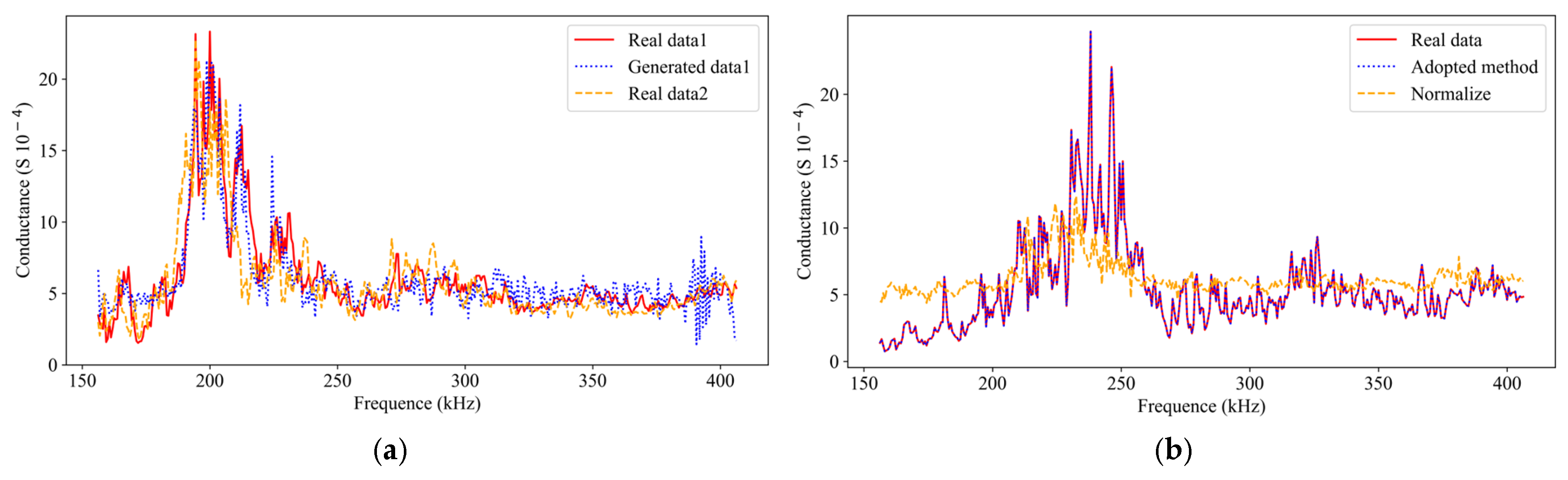
- A novel normalization algorithm was tuned to collaboratively foster the EMAGAN-based data generation, which profitably reduces more than 22.5 times of errors for the generated data. Generated datasets feeding to the CNN model achieve higher accuracy and faster convergence for structural stress prediction.
2. Methodology
2.1. EMA Technique for Stress Identification
2.2. Principle of GANs
3. Proposed Framework for Automated Stress Identification
3.1. Architecture of EMAGAN
3.2. Flow Diagram for Enhanced EMA Data-Based Stress Identification
4. Experimental Investigations
4.1. Experimental Procedure
4.2. Stress Detection via Raw EMA Signature
4.3. Enhancement of EMA Signals
4.4. Stress Quantification via Enhanced EMA Signature
5. Conclusions
- (1)
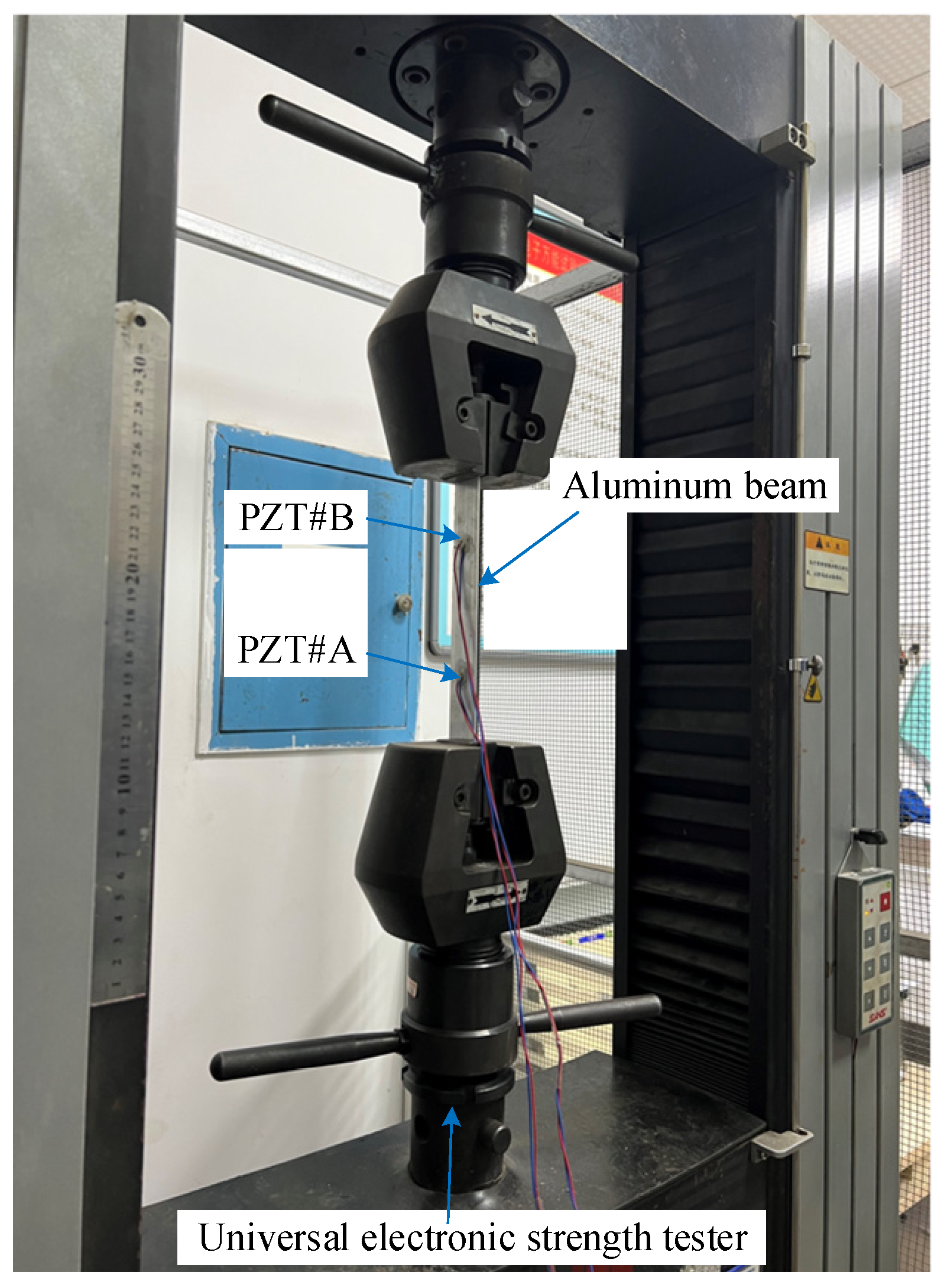
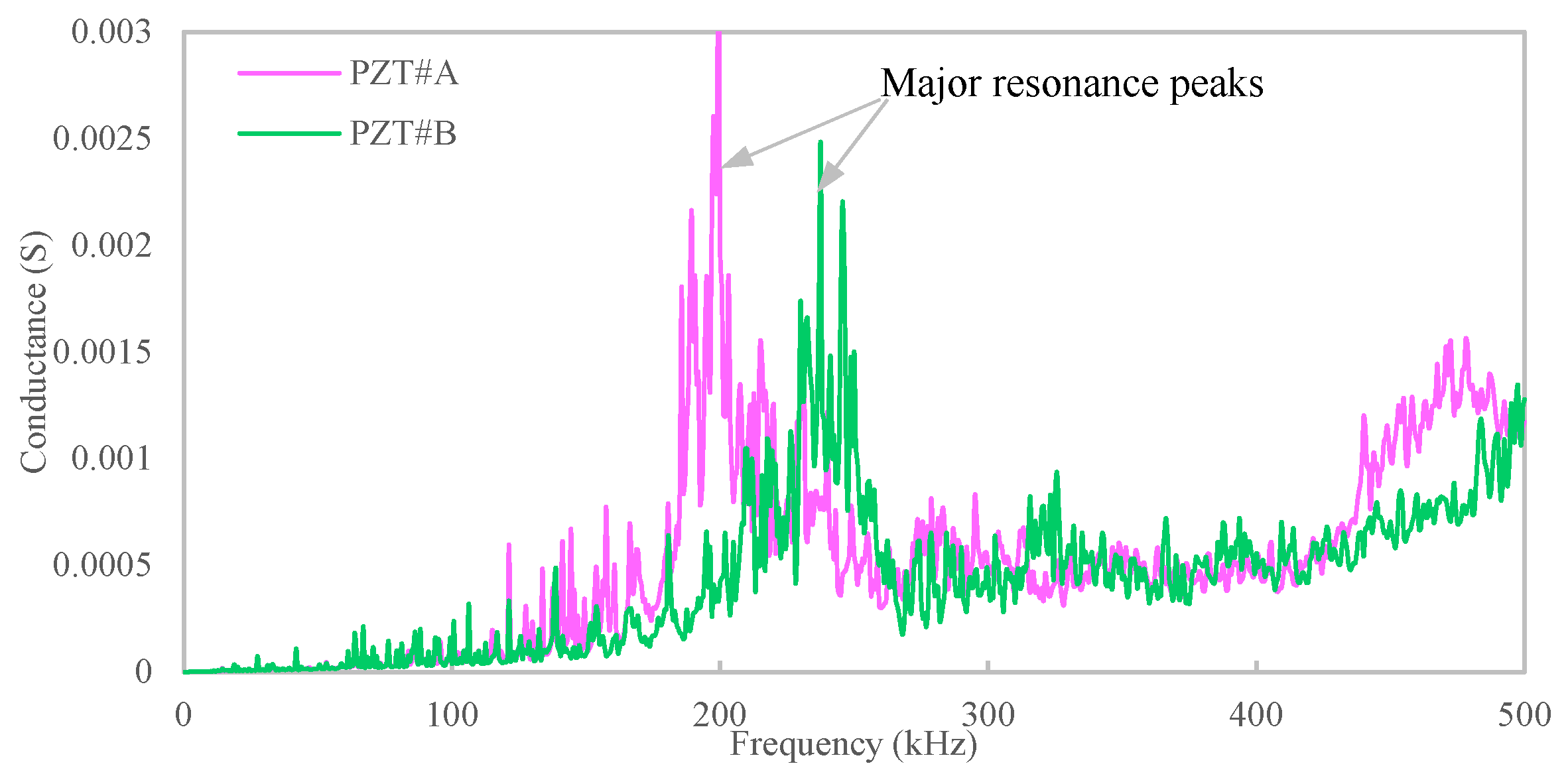
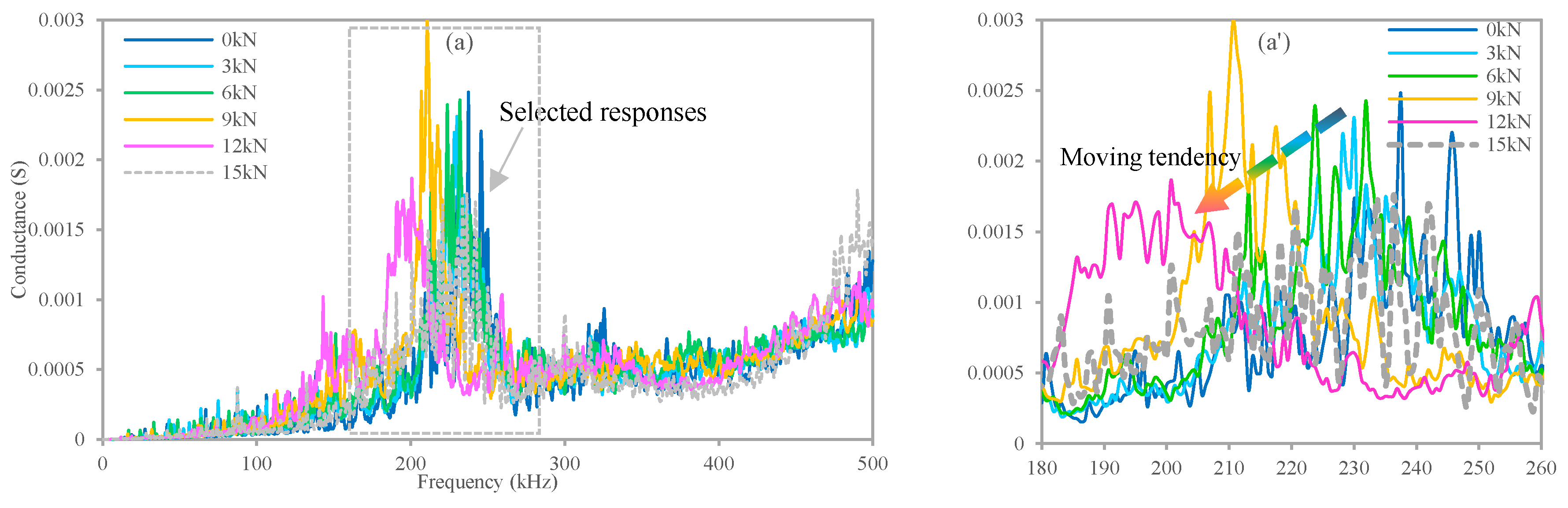
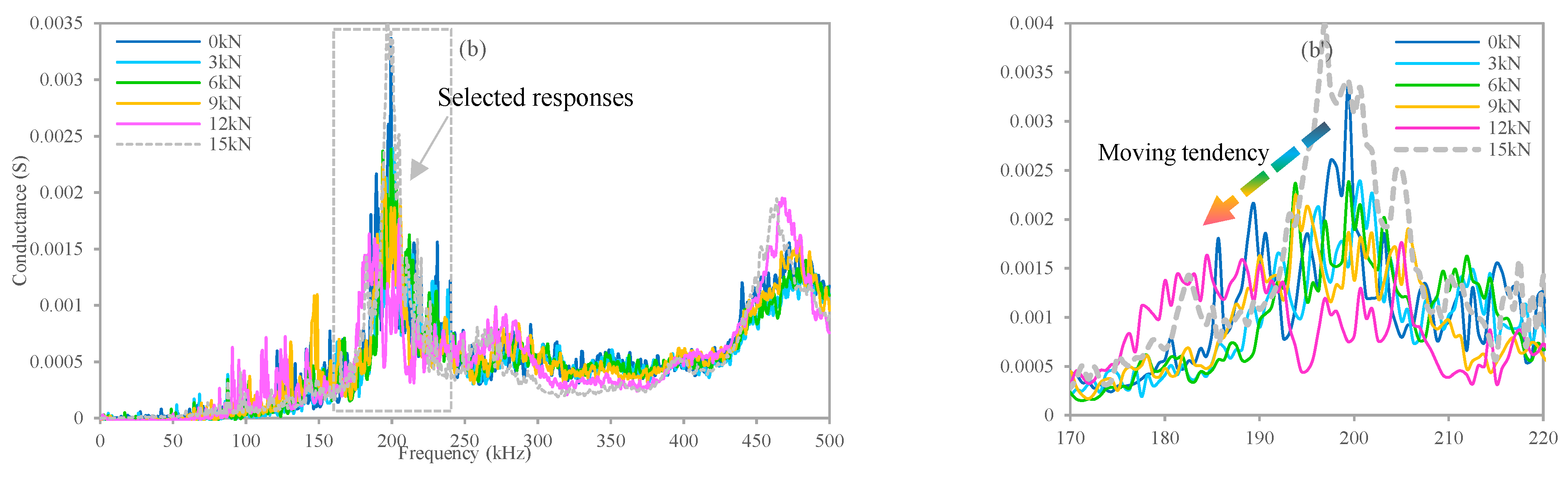
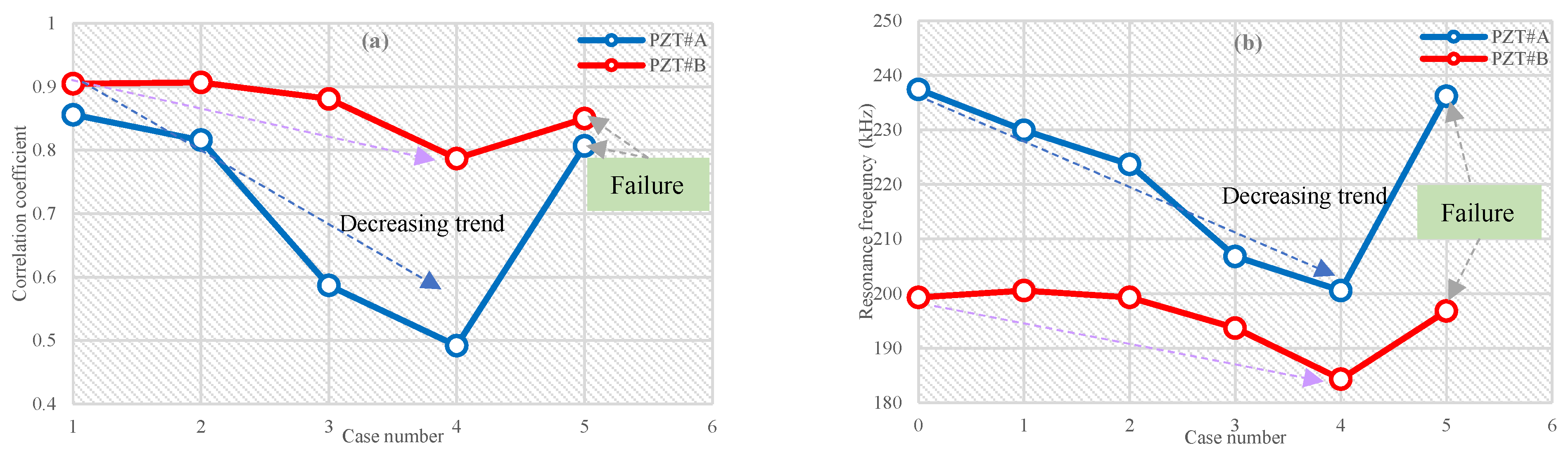
- Qualitative identification of axial tensile stress applied in an aluminum beam specimen shows that resonance peak clusters of the conductance spectrums for two bonded PZT transducers have uniform LD shifts (i.e., decrease both in the resonance frequency and magnitude) with the increment in load steps before failure. Corresponding to the stress increments of 20%, 40%, 60% and 80% of the ultimate tensile strength, quantifiable variations in the maximum resonance frequency shift, decreasing by 0.63%, 0.00%, 2.82%, and 5.52% and 0.22%, 2.65%, 2.82%, and 7.53%, while those of the CC index values decrease 4.67%, 31.43%, and 42.52% and 3.16%, 5.79%, and 13.04% for PZT#A and #B, respectively. The random relationship between stress and EMA variations makes it difficult to accurately identify the stress level.
- (2)
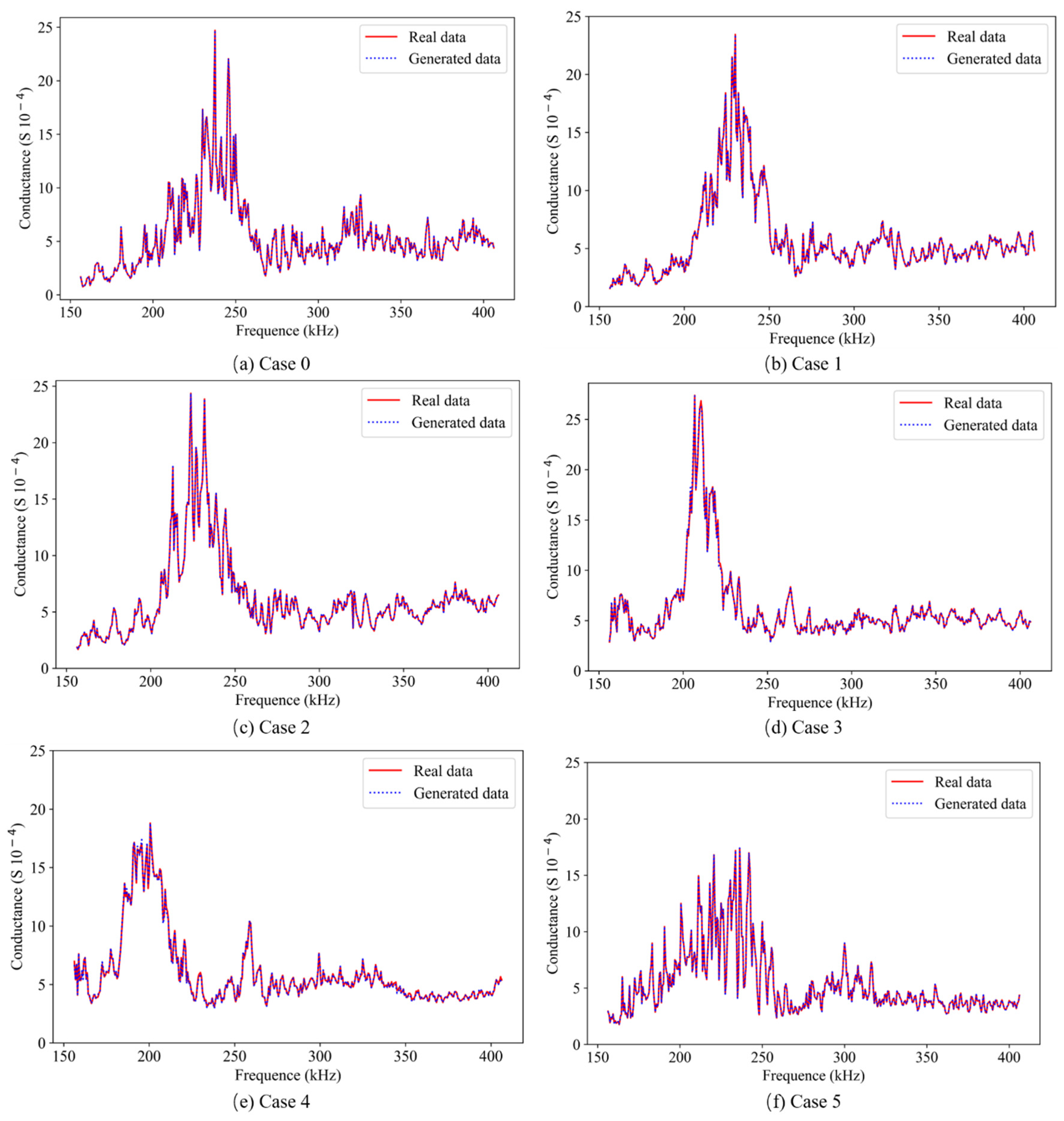
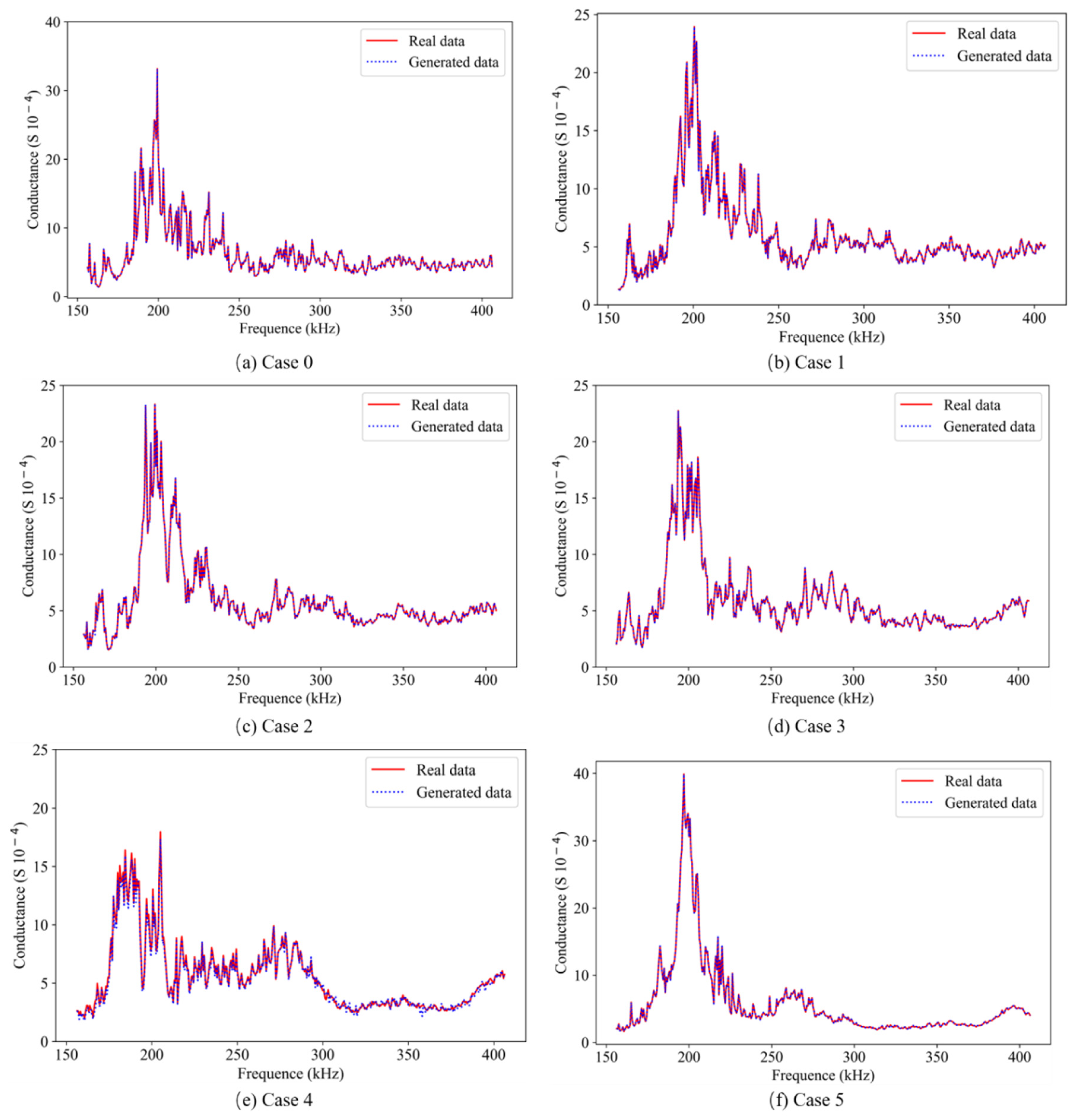
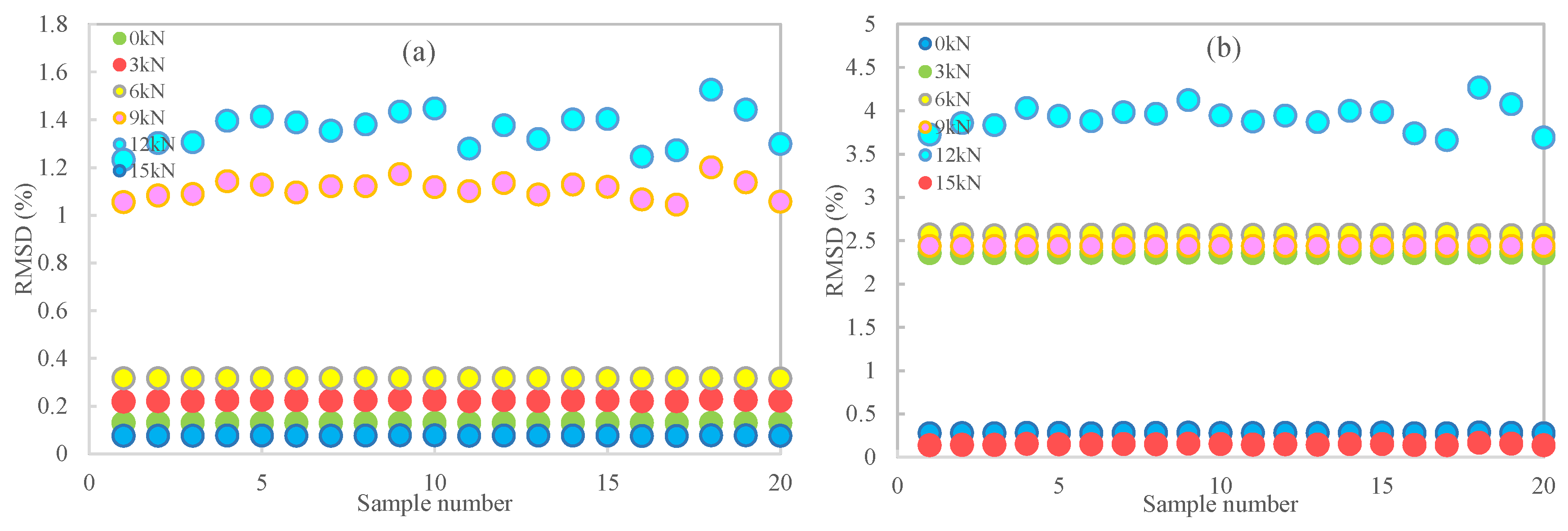
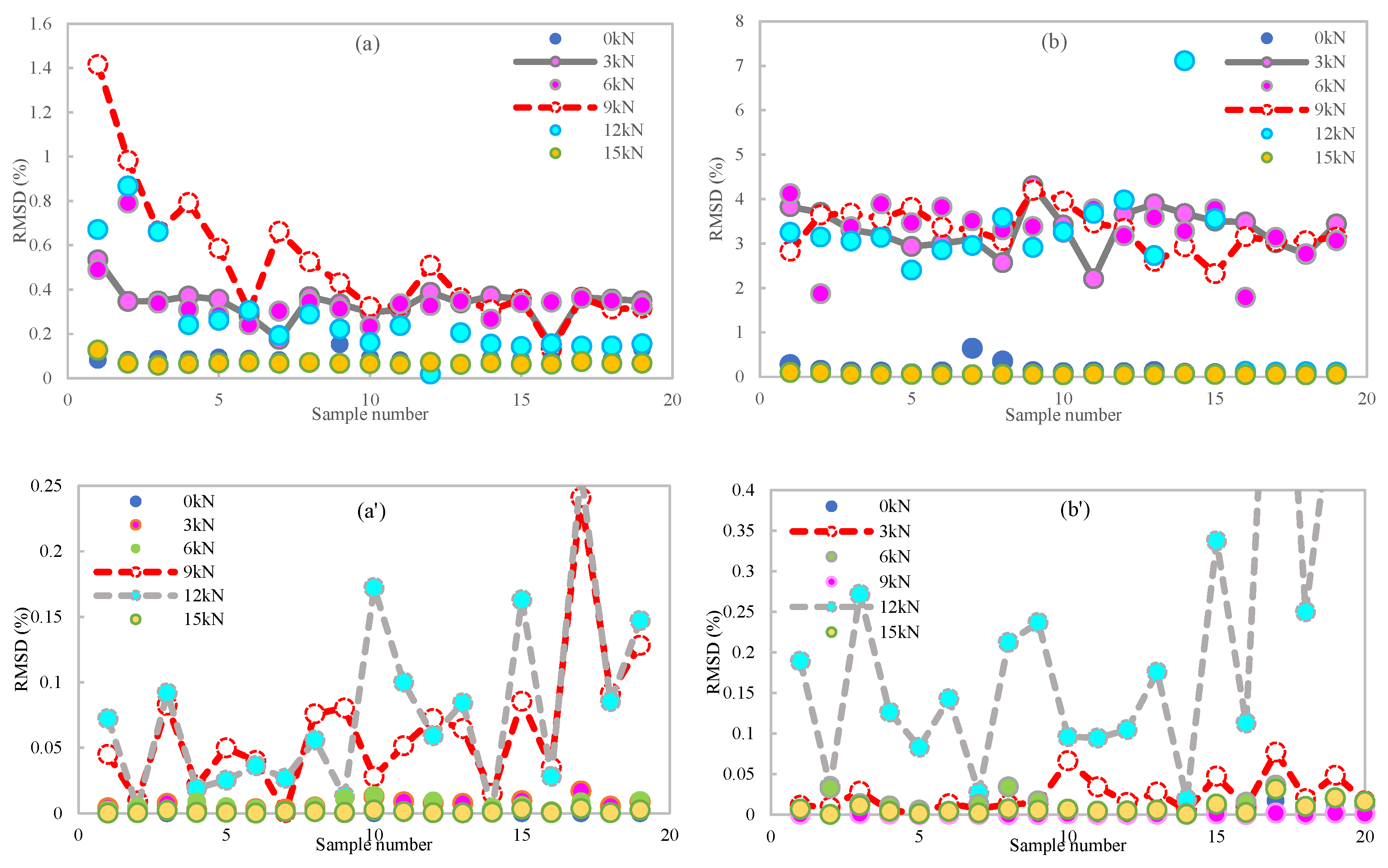
- The validity test of the EMAGAN demonstrates that the pre-normalization of original EMA signals affects the accuracy of synthetic ones, which collaborated with a new normalized algorithm that has errors less than 22.5 times compared to using traditional ones. Training of the EMAGAN was conducted to generate 50 groups of eligible conductance spectra that perfectly matched the original ones regardless of intensive resonance peak clusters, merely costing approximate 15 s for each case and exceeding 380 times faster than the normal measurement method. Performance evaluation shows that all errors that existed in the RMSD index between the generated and original conductance datasets are respectively less than 1.8% and 4.5% for the two transducers, while those between the generated ones are merely around 1%.
- (3)
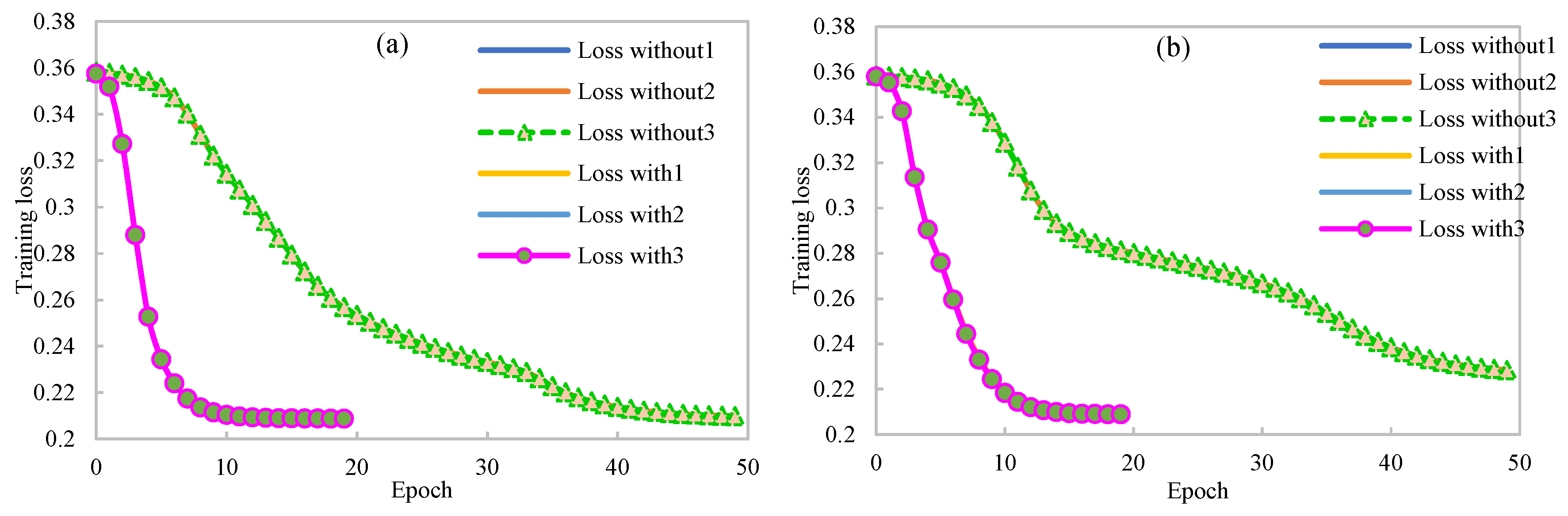
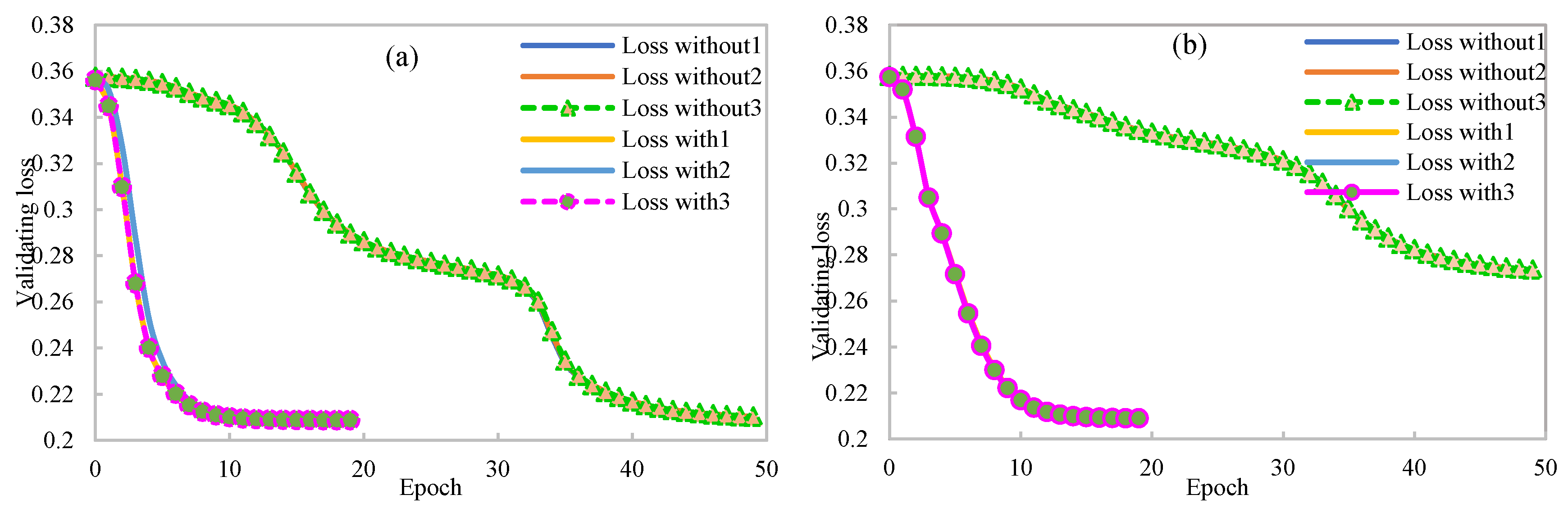
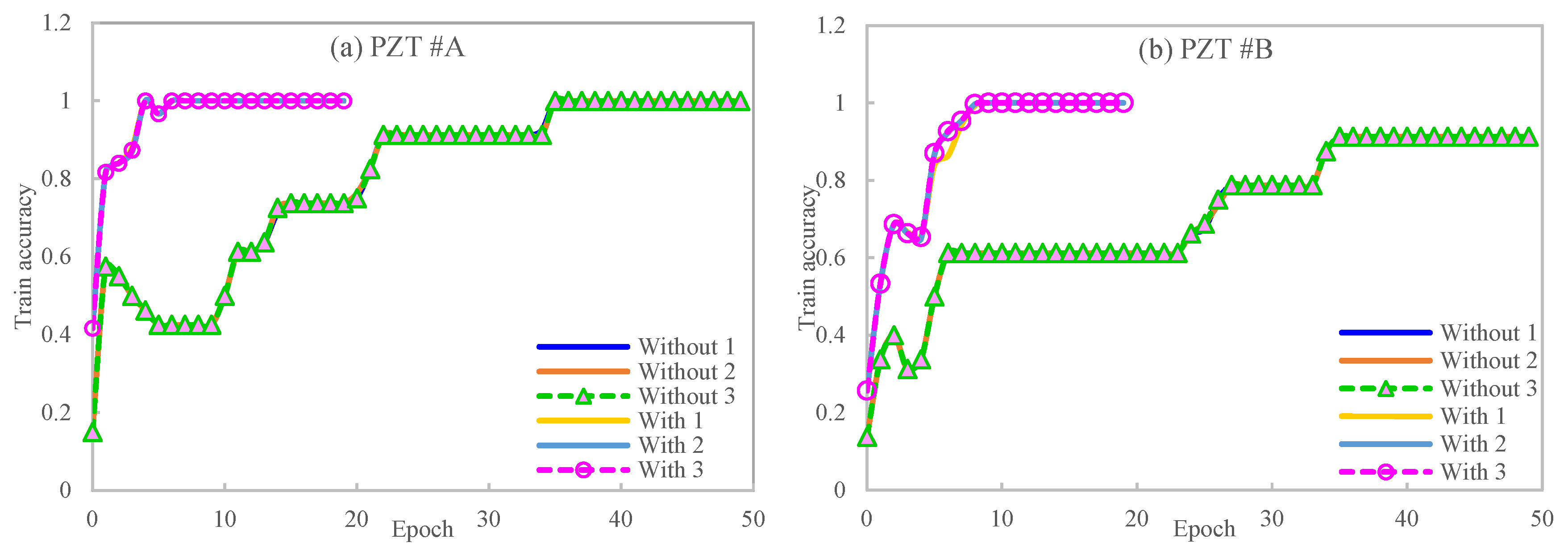
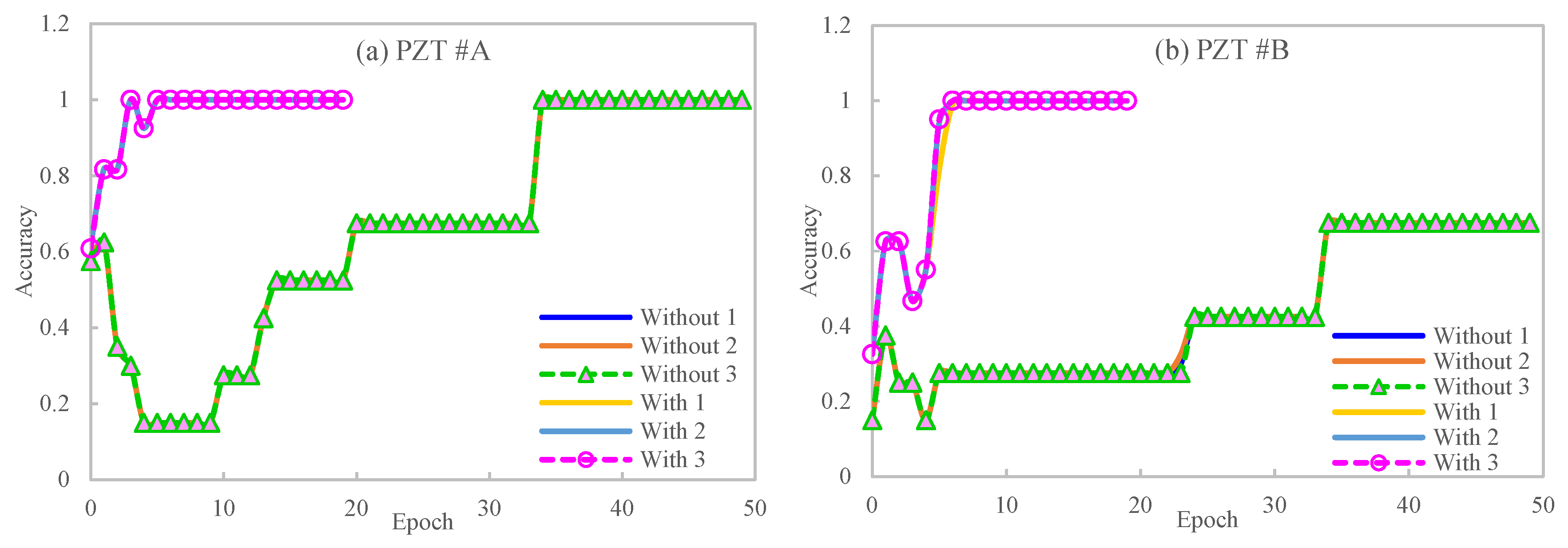
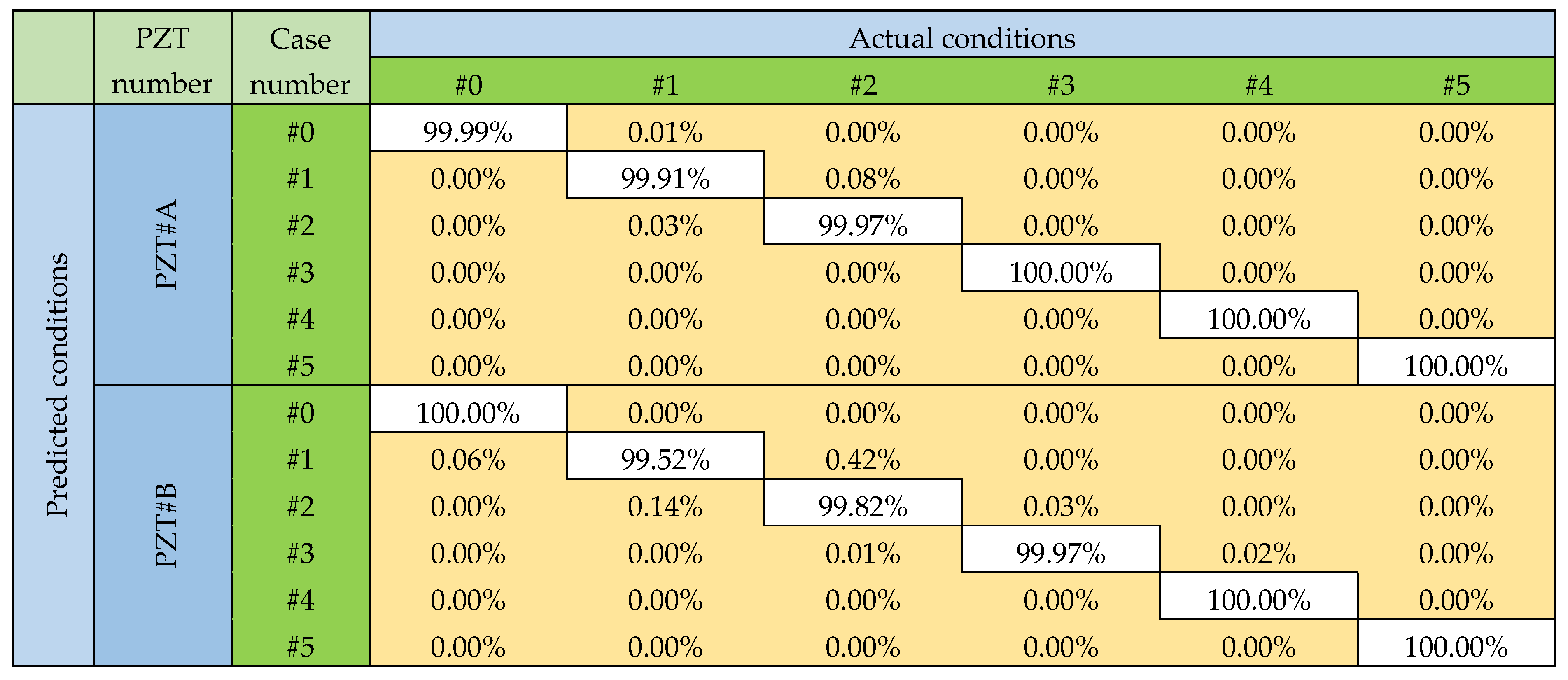
- Enhanced EMA datasets feeding to an adaptive CNN model for the quantification of tensile stress demonstrate that the training and validation accuracy for PZT#A and #B could reach to 100% in a few seconds when using the enhanced dataset, which is superiorly higher than that without data enhancement. A cross test of the CNN model by feeding the real datasets to the model trained by generated ones indicates that prediction probabilities are all over 99.52% and most even up to 100%. Results confirm that data enhancement improves identification accuracy, overcomes overfitting and accelerates convergence of the CNN model, which consequently provides a possible paradigm of data-driven stress identification of in situ metal structures.
Author Contributions
Funding
Data Availability Statement
Acknowledgments
Conflicts of Interest
References
- Shi, F.; Michaels, J.E.; Lee, S.J. In situ estimation of applied biaxial loads with Lamb waves. J. Acoust. Soc. Am. 2013, 133, 677–687. [Google Scholar] [CrossRef] [PubMed]
- Li, J.; Hao, H.; Fan, K.; Brownjohn, J. Development and application of a relative displacement sensor for structural health monitoring of composite bridges. Struct. Control Health Monit. 2015, 22, 726–742. [Google Scholar] [CrossRef]
- Teng, J.; Lu, W.; Wen, R.; Zhang, T. Instrumentation on structural health monitoring systems to real world structures. Smart Struct. Syst. 2015, 15, 151–167. [Google Scholar] [CrossRef]
- Zhu, X.; Scalea, F.L. Thermal stress measurement in continuous welded rails using the hole-drilling method. Exp. Mech. 2017, 57, 165–178. [Google Scholar] [CrossRef]
- Ma, C.; Huang, J.; Chen, H. Residual stress measurement in textured thin film by grazing-incidence X-ray diffraction. Thin Solid Films 2002, 418, 73–78. [Google Scholar] [CrossRef]
- Huang, C.; Wang, L.; Wang, K. Residual stress identification in thin plates based on modal data and sensitivity analysis. Int. J. Solids Struct. 2022, 236–237, 111350. [Google Scholar] [CrossRef]
- Makris, A.; Ramault, C.; Van Hemelrijck, D.; Zarouchas, D.; Lamkanfi, E.; Van Paepegem, W. An investigation of the mechanical behavior of carbon epoxy cross ply cruciform specimens under biaxial loading. Polym. Compos. 2010, 31, 1554–1561. [Google Scholar] [CrossRef]
- Duquennoy, M.; Ouaftouh, M.; Ourak, M. Ultrasonic evaluation of stresses in orthotropic materials using Rayleigh waves. NDT E Int. 1999, 32, 189–199. [Google Scholar] [CrossRef]
- Mohabuth, M.; Kotousov, A.; Ng, C.T. Effect of uniaxial stress on the propagation of higher-order Lamb wave modes. Int. J. Non-Linear Mech. 2016, 86, 104–111. [Google Scholar] [CrossRef]
- Wang, W.; Xu, C.; Zhang, Y.; Zhou, Y.; Meng, S.; Deng, Y. An improved ultrasonic method for plane stress measurement using critically refracted longitudinal waves. NDT E Int. 2018, 99, 117–122. [Google Scholar] [CrossRef]
- Song, G.; Gu, H.; Mo, Y. Smart aggregates: Multi-functional sensors for concrete structures—A tutorial and a review. Smart Mater. Struct. 2008, 17, 33001. [Google Scholar] [CrossRef]
- Na, W.S.; Baek, J. A review of the piezoelectric electromechanical impedance based structural health monitoring technique for engineering structures. Sensors 2018, 18, 1307. [Google Scholar] [CrossRef]
- Ayres, J.W.; Lalandey, F.; Chaudhry, Z.; Rogers, C.A. Qualitative impedance-based health monitoring of civil infrastructures. Smart Mater. Struct. 1998, 7, 599–605. [Google Scholar] [CrossRef]
- Ai, D.; Luo, H.; Zhu, H. Numerical and experimental investigation of flexural performance on pre-stressed concrete structures using electromechanical admittance. Mech. Syst. Signal Process. 2019, 128, 244–265. [Google Scholar] [CrossRef]
- Chalioris, C.E.; Kytinou, V.K.; Voutetaki, M.E.; Karayannis, C.G. Flexural damage diagnosis in reinforced concrete beams using a wireless admittance monitoring system—Tests and finite element analysis. Sensors 2021, 21, 679. [Google Scholar] [CrossRef]
- Bhalla, S.; Kaur, N. Prognosis of low-strain fatigue induced damage in reinforced concrete structures using embedded piezo-transducers. Int. J. Fatigue 2018, 113, 98–112. [Google Scholar] [CrossRef]
- Ai, D.; Du, L.; Li, H.; Zhu, H. Corrosion damage identification for reinforced concrete beam using embedded piezoelectric transducer: Numerical simulation. Measurement 2022, 192, 110925. [Google Scholar] [CrossRef]
- Lim, Y.Y.; Soh, C.K. Fatigue life estimation of a 1D aluminium beam under mode-I loading using the electromechanical impedance technique. Smart Mater. Struct. 2011, 20, 125001. [Google Scholar] [CrossRef]
- Negi, P.; Chhabra, R.; Kaur, N.; Bhalla, S. Health monitoring of reinforced concrete structures under impact using multiple piezo-based configurations. Constr. Build. Mater. 2019, 222, 371–389. [Google Scholar] [CrossRef]
- Voutetaki, M.E.; Papadopoulos, N.A.; Angeli, G.M.; Providakis, C.P. Investigation of a new experimental method for damage assessment of RC beams failing in shear using piezoelectric transducers. Eng. Struct. 2016, 114, 226–240. [Google Scholar] [CrossRef]
- Narayanan, A.; Subramaniam, K.V.L. Experimental evaluation of load-induced damage in concrete from distributed microcracks to localized cracking on electro-mechanical impedance response of bonded PZT. Constr. Build. Mater. 2016, 105, 536–544. [Google Scholar] [CrossRef]
- Karayannis, C.G.; Voutetaki, M.E.; Chalioris, C.E.; Providakis, C.P.; Angeli, G.M. Detection of flexural damage stages for RC beams using Piezoelectric sensors (PZT). Smart Struct. Syst. 2015, 15, 997–1018. [Google Scholar] [CrossRef]
- Annamdas, V.G.M.; Yang, Y.; Soh, C.K. Influence of loading on the electromechanical admittance of piezoceramic transducers. Smart Mater. Struct. 2007, 16, 1888–1897. [Google Scholar] [CrossRef]
- Xu, D.; Banerjee, S.; Wang, Y.; Huang, S.; Cheng, X. Temperature and loading effects of embedded smart piezoelectric sensor for health monitoring of concrete structures. Constr. Build. Mater. 2015, 76, 187–193. [Google Scholar] [CrossRef]
- Rebillat, M.; Guskov, M.; Balmes, E.; Mechbal, N. Simultaneous influence of static load and temperature on the electromechanical signature of piezoelectric elements bonded to composite aeronautic structures. J. Vib. Acoust.-Trans. ASME 2016, 138, 064504. [Google Scholar] [CrossRef]
- Narayanan, A.; Subramaniam, K. Sensing of damage and substrate stress in concrete using electro-mechanical impedance measurements of bonded PZT patches. Smart Mater. Struct. 2016, 25, 095011. [Google Scholar] [CrossRef]
- Lim, Y.Y.; Soh, C.K. Effect of varying axial load under fixed boundary condition on admittance signatures of electromechanical impedance technique. J. Intell. Mater. Syst. Struct. 2012, 23, 815–826. [Google Scholar] [CrossRef]
- Seddik, B.A.; Rouchon, J.F. Resonant flexional piezoelectric force sensor based on the analysis of electromechanical impedance for aircraft application. In 2010 IEEE International Conference on Industrial Technology; IEEE: New York, NY, USA, 2010; pp. 591–596. [Google Scholar]
- Huynh, T.C.; Kim, J.T. Impedance-based cable force monitoring in tendon-anchorage using portable PZT-interface technique. Math. Probl. Eng. 2014, 2014, 784731. [Google Scholar] [CrossRef]
- Annamdas, V.G.M.; Pang, J.H.L.; Zhou, K.; Song, B. Efficiency of electromechanical impedance for load and damage assessment along the thickness of lead zirconate titanate transducers in structural monitoring. J. Intell. Mater. Syst. Struct. 2013, 24, 2008–2022. [Google Scholar] [CrossRef]
- Liang, Y.; Li, D.; Parvasi, S.M.; Song, G. Load monitoring of pin-connected structures using piezoelectric impedance measurement. Smart Mater. Struct. 2016, 25, 105011. [Google Scholar] [CrossRef]
- Huo, L.; Chen, D.; Liang, Y.; Li, H.; Feng, X.; Song, G. Impedance based bolt pre-load monitoring using piezoceramic smart washer. Smart Mater. Struct. 2017, 26, 57004. [Google Scholar] [CrossRef]
- Annamdas, V.G.M.; Soh, C.K. Load monitoring using a calibrated piezo diaphragm based impedance strain sensor and wireless sensor network in real time. Smart Mater. Struct. 2017, 26, 45036. [Google Scholar] [CrossRef]
- Annamdas, V.G.M.; Soh, C.K. Contactless load monitoring in near-field with surface localized spoof plasmons—A new breed of metamaterials for health of engineering structures. Sens. Actuators A 2016, 244, 156–165. [Google Scholar] [CrossRef]
- Radhika, M.A.; Annamdas, V.G.M. Experimental studies on structural load monitoring using piezoelectric transducer based electromechanical impedance method. Sci. J. Rev. 2013, 2, 37–50. [Google Scholar]
- Calderon-Moreno, J.M. Stress induced domain switching of PZT in compression tests. Mater. Sci. Eng. A-Struct. Mater. Prop. Microstruct. Process. 2001, 315, 227–230. [Google Scholar] [CrossRef]
- Ong, C.W.; Yang, Y.; Naidu, A.S.K.; Lu, Y.; Soh, C.K. Application of the electro-mechanical impedance method for the identification of in-situ stress in structures. In Proceedings of the Smart Structures, Devices, and Systems; SPIE: Bellingham, WA, USA, 2002; Volume 4935, pp. 503–514. [Google Scholar]
- Zhu, X.; Scalea, F.L. Sensitivity to axial stress of electro-mechanical impedance measurements. Exp. Mech. 2016, 56, 1599–1610. [Google Scholar] [CrossRef]
- Annamdas, V.G.M.; Soh, C.K. Evaluation of peak-free electromechanical piezo-impedance and electromagnetic contact sensing using metamaterial surface plasmons for load monitoring. Smart Mater. Struct. 2017, 26, 15003. [Google Scholar] [CrossRef]
- Ai, D.; Luo, H.; Wang, C.; Zhu, H. Monitoring of the load-induced RC beam structural tension/compression stress and damage using piezoelectric transducers. Eng. Struct. 2018, 154, 38–51. [Google Scholar] [CrossRef]
- Wang, X.; Liu, H.; Liu, G.; Xu, D. Modeling of Static Stress Identification Using Electromechanical Impedance of Embedded Piezoelectric Plate. Sensors 2024, 24, 7096. [Google Scholar] [CrossRef] [PubMed]
- Ai, D.; Li, H.; Zhu, H. Flexure-critical stress and damage identification in RC beam structure using embedded piezoelectric transducers: 2D modelling and experimental investigations. Constr. Build. Mater. 2023, 409, 134017. [Google Scholar] [CrossRef]
- Sapidis, G.M.; Naoum, M.C.; Papadopoulos, N.A. Electromechanical Impedance-Based Compressive Load-Induced Damage Identification of Fiber-Reinforced Concrete. Infrastructures 2025, 10, 60. [Google Scholar] [CrossRef]
- Annamdas, V.G.M.; Radhika, M.A. Electromechanical impedance of piezoelectric transducers for monitoring metallic and non-metallic structures: A review of wired, wireless and energy-harvesting methods. J. Intell. Mater. Syst. Struct. 2013, 24, 1021–1042. [Google Scholar] [CrossRef]
- Park, S.; Lee, J.J.; Yun, C.B.; Inman, D.J. Electro-mechanical impedance-based wireless structural health monitoring using PCA-data compression and k-means clustering algorithms. J. Intell. Mater. Syst. Struct. 2008, 19, 509–520. [Google Scholar] [CrossRef]
- Malinowski, P.H.; Wandowski, T.; Singh, S.K. Employing principal component analysis for assessment of damage in GFRP composites using electromechanical impedance. Compos. Struct. 2021, 266, 113820. [Google Scholar] [CrossRef]
- Min, J.; Park, S.; Yun, C.B.; Lee, C.G.; Lee, C. Impedance-based structural health monitoring incorporating neural network technique for identification of damage type and severity. Eng. Struct. 2012, 39, 210–220. [Google Scholar] [CrossRef]
- Na, S.; Lee, H.K. Neural network approach for damaged area location prediction of a composite plate using electromechanical impedance technique. Compos. Sci. Technol. 2013, 88, 62–68. [Google Scholar] [CrossRef]
- Ai, D.; Mo, F.; Yang, F.; Zhu, H. Electromechanical impedance-based concrete structural damage detection using principal component analysis incorporated with neural network. J. Intell. Mater. Syst. Struct. 2022, 33, 2241–2256. [Google Scholar] [CrossRef]
- Yang, J.; Zhu, H.; Wang, D.; Ai, D. The compensation technique of tensile force effect on the electro-mechanical impedance method for structural health monitoring. J. Intell. Mater. Syst. Struct. 2015, 26, 2477–2488. [Google Scholar] [CrossRef]
- Huynha, T.C.; Park, J.H.; Jungc, H.J.; Kim, J.T. Quasi-autonomous bolt-loosening detection method using vision-based deep learning and image processing. Autom. Constr. 2019, 105, 102844. [Google Scholar] [CrossRef]
- Ince, T.; Kiranyaz, S.; Eren, L.; Askar, M.; Gabbouj, M. Real-time motor fault detection by 1-D convolutional neural networks. IEEE Trans. Ind. Electron. 2016, 63, 7067–7075. [Google Scholar] [CrossRef]
- Zhang, W.; Li, C.; Peng, G.; Chen, Y.; Zhang, Z. A deep convolutional neural network with new training methods for bearing fault diagnosis under noisy environment and different working load. Mech. Syst. Signal Process. 2018, 100, 439–453. [Google Scholar] [CrossRef]
- Yu, Y.; Rashidi, M.; Samali, B.; Mohammadi, M.; Nguyen, T.N.; Zhou, X. Crack detection of concrete structures using deep convolutional neural networks optimized by enhanced chicken swarm algorithm. Struct. Health Monit. 2022, 21, 2244–2263. [Google Scholar] [CrossRef]
- Abdeljaber, O.; Avci, O.; Kiranyaz, S.; Gabbouj, M.; Inman, D.J. Real-time vibration-based structural damage detection using one-dimensional convolutional neural networks. J. Sound Vib. 2017, 388, 154–170. [Google Scholar] [CrossRef]
- Rezende, S.W.F.; Moura, J.D.V.; Neto, R.M.F.; Gallo, C.A.; Steffen, V. Convolutional neural network and impedance-based SHM applied to damage detection. ERX 2020, 2, 35031. [Google Scholar] [CrossRef]
- Oliveira, M.A.; Monteiro, A.V.; Vieira, J. A new structural health monitoring strategy based on PZT sensors and convolutional neural network. Sensors 2018, 18, 2955. [Google Scholar] [CrossRef]
- Zhou, L.; Chen, S.; Ni, Y.; Choy, A.W.H. EMI-GCN: A hybrid model for real-time monitoring of multiple bolt looseness using electromechanical impedance and graph convolutional networks. Smart Mater. Struct. 2021, 30, 35032. [Google Scholar] [CrossRef]
- Li, H.; Ai, D.; Zhu, H.; Luo, H. Integrated electromechanical impedance technique with convolutional neural network for concrete structural damage quantification under varied temperatures. Mech. Syst. Signal Process. 2021, 152, 107467. [Google Scholar] [CrossRef]
- Ai, D.; Mo, F.; Han, Y.; Wen, J. Automated identification of compressive stress and damage in concrete specimen using convolutional neural network learned electromechanical admittance. Eng. Struct. 2022, 259, 114176. [Google Scholar] [CrossRef]
- Rangwala, H.; Vora, T.; Baz, A. Integrating machine learning with electromechanical impedance for non-destructive detection of bolt looseness in steel structures. Case Stud. Constr. Mater. 2025, 23, e05430. [Google Scholar] [CrossRef]
- Yan, Q.; Yang, W.; Yang, Y.; Zhang, C.; Xiong, Z.; Zhong, H.Y.; Yang, W. Intelligent monitoring of impact damage within concrete through deep learning-empowered electromechanical impedance technique. Measurement 2025, 253, 117642. [Google Scholar] [CrossRef]
- Chen, Y.; Lin, W.; Chen, H.; Du, Y.; Wei, J. Automatic detection method for loose bolts in steel frame structures based on wearable lightweight impedance system and multi-channel information fusion deep learning model. Struct. Health Monit. 2026, 1–21. [Google Scholar] [CrossRef]
- Ta, Q.B.; Pham, N.L.; Kim, J.T. Integrated Estimation of Stress and Damage in Concrete Structure Using 2D Convolutional Neural Network Model Learned Impedance Responses of Capsule-like Smart Aggregate Sensor. Sensors 2024, 24, 6652. [Google Scholar] [CrossRef]
- Ai, D.; Yang, K. Axial pressure and damage identification of plate rubber bearings using transfer learning of electromechanical admittance signals from different PZT transducers. Eng. Struct. 2025, 341, 120787. [Google Scholar] [CrossRef]
- Nguyen, T.T.; Huynh, T.C.; Phan, T.T.V.; Ho, D.D.; Pradhan, A.M.S. Deep learning-based autonomous damage-sensitive feature extraction for impedance-based prestress monitoring. Eng. Struct. 2022, 259, 114172. [Google Scholar] [CrossRef]
- Ho, D.D.; Kim, J.T.; Hoang, N.D.; Tran, M.H.; Pradhan, A.M.S.; Truong, G.T.; Huynh, T.C. Structural Condition Assessment of Steel Anchorage Using Convolutional Neural Networks and Admittance Response. Buildings 2024, 14, 1635. [Google Scholar] [CrossRef]
- Goodfellow, I.; Pouget-Abadie, J.; Mirza, M.; Xu, B.; Warde-Farley, D.; Ozair, S.; Courville, A.; Bengio, Y. Generative Adversarial Networks. Commun. ACM 2020, 63, 139–144. [Google Scholar] [CrossRef]
- Ledig, C.; Theis, L.; Huszar, F.; Caballero, J.; Cunningham, A.; Acosta, A.; Aitken, A.; Tejani, A.; Totz, J.; Wang, Z.; et al. Photorealistic single image super-resolution using a generative adversarial network. In Proceedings of the IEEE Conference on Computer Vision and Pattern Recognition (CVPR); IEEE: New York, NY, USA, 2017; pp. 4681–4690. [Google Scholar]
- Isola, P.; Zhu, J.Y.; Zhou, T.; Efros, A.A. Image-to-Image Translation with Conditional Adversarial Networks. In Proceedings of the IEEE Conference on Computer Vision and Pattern Recognition (CVPR 2017), Honolulu, HI, USA, 21–26 July 2017; IEEE: Piscataway, NJ, USA, 2017; pp. 5967–5976. [Google Scholar]
- Zhang, W.; Li, X.; Jia, X.D.; Ma, H.; Luo, Z.; Li, X. Machinery fault diagnosis with imbalanced data using deep generative adversarial networks. Measurement 2020, 152, 107377. [Google Scholar] [CrossRef]
- Zheng, T.; Song, L.; Wang, J.; Teng, W.; Xu, X.; Ma, C. Data synthesis using dual discriminator conditional generative adversarial networks for imbalanced fault diagnosis of rolling bearings. Measurement 2020, 158, 107741. [Google Scholar] [CrossRef]
- Li, Y.; Zou, W.; Jiang, L. Fault diagnosis of rotating machinery based on combination of Wasserstein generative adversarial networks and long short term memory fully convolutional network. Measurement 2022, 191, 110826. [Google Scholar] [CrossRef]
- Gao, Y.; Zhai, P.; Mosalam, K.M. Balanced semisupervised generative adversarial network for damage assessment from low-data imbalanced-class regime. Comput. Aided Civ. Infrastruct. Eng. 2021, 36, 1094–1113. [Google Scholar] [CrossRef]
- Fan, G.; Li, J.; Hao, H.; Xin, Y. Data driven structural dynamic response reconstruction using segment based generative adversarial networks. Eng. Struct. 2021, 234, 111970. [Google Scholar] [CrossRef]
- Ge, L.; Sadhu, A. Domain adaptation for structural health monitoring via physics-informed and self-attention-enhanced generative adversarial learning. Mech. Syst. Signal Process. 2024, 211, 111236. [Google Scholar] [CrossRef]
- Koenig, T.; Cadau, L.; Wagner, F.; Kley, M. A generative adversarial network-based data augmentation approach with transient vibration data. Procedia Comput. Sci. 2023, 225, 1340–1349. [Google Scholar] [CrossRef]
- Tien, T.B.; Quang, T.V.; Ngoc, L.N.; Ngoc, H.T. Time series data recovery in SHM of large-scale bridges: Leveraging GAN and Bi-LSTM networks. Structures 2024, 63, 106368. [Google Scholar] [CrossRef]
- Wang, X.; Bao, T.; Gong, J.; Zhang, J.; Xu, Y. Missing data imputation method for dams based on multi-head attention mechanisms and generative adversarial networks. Eng. Struct. 2025, 336, 120350. [Google Scholar] [CrossRef]
- Liang, C.; Sun, F.P.; Rogers, C.A. Coupled electro-mechanical analysis of adaptive material systems-determination of the actuator power consumption and system energy transfer. J. Intell. Mater. Syst. Struct. 1997, 8, 335–343. [Google Scholar] [CrossRef]
- Goodfellow, I.; Pouget-Abadie, J.; Mirza, M.; Xu, B.; Warde-Farley, D.; Ozair, S.; Courville, A.; Bengio, Y. Generative adversarial nets. In Proceedings of the Advances in Neural Information Processing Systems, Montreal, QC, Canada, 8–13 December 2014; MIT Press: Cambridge, MA, USA, 2014; pp. 2672–2680. [Google Scholar]
- Ratliff, L.J.; Burden, S.A.; Sastry, S.S. Characterization and computation of local nash equilibria in continuous games. In Proceedings of the Communication, Control, and Computing, Monticello, IL, USA, 2–4 October 2013; IEEE: New York, NY, USA, 2013; pp. 917–924. [Google Scholar]
- Arjovsky, M.; Chintala, S.; Bottou, L. Wasserstein generative adversarial networks. In Proceedings of the International conference on Machine Learning; PMLR: Cambridge, MA, USA, 2017; pp. 214–223. [Google Scholar]
- LeCun, Y.; Bottou, L.; Bengio, Y.; Haffner, P. Gradient-based learning applied to document recognition. Proc. IEEE 1998, 86, 2278–2324. [Google Scholar] [CrossRef]
- Argentino, A.; Radicioni, L.; Bono, F.M.; Bernardini, L.; Benedetti, L.; Cazzulani, G.; Somaschini, C.; Belloli, M. Data normalization for the continuous monitoring of a steel truss bridge: A case study from the Italian railway line. J. Infrastruct. Intell. Resil. 2025, 4, 100171. [Google Scholar] [CrossRef]
- Ai, D.; Luo, H.; Zhu, H. Diagnosis and validation of damaged piezoelectric sensor in electromechanical impedance technique. J. Intell. Mater. Syst. Struct. 2017, 28, 837–850. [Google Scholar] [CrossRef]
- Park, G.; Farrar, C.R.; Scalea, F.L.; Cocciam, S. Performance assessment and validation of piezoelectric active-sensors in structural health monitoring. Smart Mater. Struct. 2006, 15, 1673–1683. [Google Scholar] [CrossRef]



| Item | Density | Piezoelectric Coefficients | Resistance | Curie Temperature | Electromechanical Coefficient | Piezoelectric Coefficients (m/V) |
|---|---|---|---|---|---|---|
| PZT-5 | 7.86 | ≥400 × 10−12 | ≥1000 | ≥330 | 0.8 |
| Case Label | Applied Load (kN) | Stress Level (MPa) | Prediction Output |
|---|---|---|---|
| #0 | 0 | 0.00 | [1, 0, 0, 0, 0, 0] |
| #1 | 3 | 45.00 | [0, 1, 0, 0, 0, 0] |
| #2 | 6 | 90.01 | [0, 0, 1, 0, 0, 0] |
| #3 | 9 | 135.01 | [0, 0, 0, 1, 0, 0] |
| #4 | 12 | 180.02 | [0, 0, 0, 0, 1, 0] |
| #5 | 15 | 225.02 | [0, 0, 0, 0, 0, 1] |
| Data Number | Item | Data Component | Amount | |
|---|---|---|---|---|
| #1 | With enhancement | Training | Real + generated dataset | 300 |
| Validation | Real + generated dataset | 120 | ||
| #2 | Without enhancement | Training | Real dataset | 80 |
| Validation | Real dataset | 40 | ||
| #3 | Model test | Training | Real + generated dataset | 300 |
| Testing | Real dataset | 120 |
Disclaimer/Publisher’s Note: The statements, opinions and data contained in all publications are solely those of the individual author(s) and contributor(s) and not of MDPI and/or the editor(s). MDPI and/or the editor(s) disclaim responsibility for any injury to people or property resulting from any ideas, methods, instructions or products referred to in the content. |
© 2026 by the authors. Licensee MDPI, Basel, Switzerland. This article is an open access article distributed under the terms and conditions of the Creative Commons Attribution (CC BY) license.
Share and Cite
Ai, D.; Zhang, R. Electromechanical Impedance Data-Driven Metal Structural Tensile Stress Identification Using Generative Adversarial Networks. Materials 2026, 19, 2445. https://doi.org/10.3390/ma19122445
Ai D, Zhang R. Electromechanical Impedance Data-Driven Metal Structural Tensile Stress Identification Using Generative Adversarial Networks. Materials. 2026; 19(12):2445. https://doi.org/10.3390/ma19122445
Chicago/Turabian StyleAi, Demi, and Rui Zhang. 2026. "Electromechanical Impedance Data-Driven Metal Structural Tensile Stress Identification Using Generative Adversarial Networks" Materials 19, no. 12: 2445. https://doi.org/10.3390/ma19122445
APA StyleAi, D., & Zhang, R. (2026). Electromechanical Impedance Data-Driven Metal Structural Tensile Stress Identification Using Generative Adversarial Networks. Materials, 19(12), 2445. https://doi.org/10.3390/ma19122445