Article

Wear Resistance of Zirconia-Reinforced WC-6Co Hardmetals: A Case Study

1
Institute of Geology and Oil and Gas K. Turysova, Satbayev University, Satpaev Str. 22, Almaty 050013, Kazakhstan
2
V. Bakul Institute for Superhard Materials, National Academy of Science of Ukraine, Avtozavodska Str. 2, 04074 Kyiv, Ukraine
3
Faculty of Production Engineering, University of Life Sciences in Lublin, 28 Głęboka St., 20-612 Lublin, Poland
4
Institute of Mechanical Science, Vilnius Gediminas Technical University, 11 Sauletekio al., LT-10223 Vilnius, Lithuania
5
Faculty of Safety Engineering and Civil Protection, Fire University, 52/54 Słowackiego Street, 01-629 Warsaw, Poland
6
Faculty of Mechanical Engineering, Casimir Pulaski Radom University, Stasieckiego Str. 54, 26-600 Radom, Poland
7
Institute of Nature Management, Dnipro University of Technology, Av. Dmytra Yavornytskoho 19, 49005 Dnipro, Ukraine
8
Department of Mechanics and Oil and Gas Engineering, Faculty of Engineering, Toraighyrov University, Pavlodar 140008, Kazakhstan
*
Author to whom correspondence should be addressed.
Materials 2026, 19(12), 2436; https://doi.org/10.3390/ma19122436
Submission received: 23 April 2026 / Revised: 3 June 2026 / Accepted: 5 June 2026 / Published: 7 June 2026
(This article belongs to the Section Advanced Composites)

Abstract

WC–Co composites are widely applied in various industries due to their high hardness and wear resistance. The addition of zirconia further enhanced the composite, improving grain refinement and reducing the friction coefficient. Zirconia submicron particulate reinforcement strengthened the cobalt binder phase, significantly improving the wear resistance. Tribological tests were performed in ball-on-flat dry sliding mode, against an Al2O3 counter body. The specimen WC–6Co–10ZrO2 exhibited a decrease in volumetric loss ΔV by 66% compared to 94WC–6Co composite, and the wear rates Ws showed a 50% decrease for 4 wt.% zirconia addition and up to 80% when 10 wt.% ZrO2 was added. In tribological tests, a five times larger load, 100 N instead of 20 N, caused an increase in the wear rate 1.1, 1.3, and 1.9 times for WC–Co, WC–6Co–4ZrO2, and WC–6Co–10ZrO2 compositions, respectively. Abrasive and adhesive wear mechanisms were identified.

1. Introduction

Hardmetals such as cemented carbides belong to a group of composite materials consisting of a carbide phase of high hardness bonded by a ductile metallic binder. These materials are widely applied due to their high hardness and wear resistance, and a suitability for harsh working conditions [1,2]. An important example of hardmetal is tungsten carbide with cobalt bond (WC–Co), which has been very popular since 1923. It is estimated that up to 72% of tungsten produced worldwide is used to produce WC carbide for fabrication of WC–Co composites [3]. Cobalt not only plays the role of a binder for hard particles, but it also provides toughness for the metal–matrix composite, so that the balance between hardness and toughness depends on the proportion and dispersion of cobalt phase in the composite. It was demonstrated in [4] that the Co phase contributed to the creation of numerous dimple fractures and, due to the inertia effect of crack propagation, improved plastic deformation of the composite.
For cutting tools application, the proportion of cobalt usually is from 6% up to 15% by mass [5]. The excellent balance of mechanical properties, including high fracture toughness and compressive strength, can be attributed to the low dihedral angle of the WC–Co system and cobalt’s ability to dissolve large amounts of tungsten carbide not dissolved in WC [6]. The performance of WC–Co hardmetals is dependent on several factors, such as cobalt binder proportion [7], initial powder morphology [8], carbide grain size [9], and microstructural homogeneity [10].
WC-based composites are used for components that are designed for use in harsh conditions, where excellent resistance to abrasive and erosive wear is required [11]. However, abrasive wear and brittle fracture as the main failure modes motivate research aimed at simultaneous improvement of the toughness and wear resistance [12]. Mechanical and tribological properties including wear of WC–Co composites have been systematically studied in search of ways to improve their performance [13]. Among others, understanding the mechanisms of WC-Co behavior under various mechanical loads and thermal conditions is critical for performance improvement of tools and components [14].
Generally, WC–Co composites are fabricated by powder metallurgy, WC and Co powders being first precisely mixed to ensure required homogeneity, then compacted and sintered [15]. WC–Co hardmetals are usually produced using liquid phase sintering techniques at temperatures below the melting points of both WC (2800 °C) and cobalt (1495 °C) [16]. In particular, it was demonstrated that dense and hard composites could be sintered using the Spark Plasma Sintering method (SPS) at temperatures 1100–1300 °C, at holding time varying from 5 up to 15 min [17]. In the present study, WC–Co hardmetal was sintered using a modified, patented SPS method to examine the possibility of improvement of its wear resistance.
Zirconia being itself an excellent engineering material with remarkable properties [18] can also serve as an additive for enhancement of WC-Co composites. Since zirconia coatings can be used as a thermal barrier to prevent oxidation [19], it can be expected, among others, that the presence of zirconia may reduce the intensity of WC and Co oxidation wear [20]. For instance, Jiand et al. [21] introduced ZrO2 additive to WC–12Co cermet and demonstrated a significant improvement in its wear resistance, especially at elevated temperatures. Wang with collaborators [22] published research results demonstrating the enhancing effects of zirconia addition on the microstructural features and related mechanical and tribological properties of WC-Co coatings. Analysis of pure WC and pure ZrO2 ceramics, as well as WC–Co, WC–Co–ZrO2, ZrO2–WC combinations, revealed good toughness and hardness of WC–Co–ZrO2 systems, and indicated promising perspectives of their wear resistance, worthy of further investigations [23]. Yang with colleagues [24] demonstrated that the addition of yttria and zirconia improved microstructure and mechanical properties of WC-8Co metal matrix composite, inhibiting the growth of tungsten carbide grains. Jiang with co-authors [25] reported that tetragonal ZrO2 inclusions exhibited good interfacial bonding with the Co matrix and WC filler, hindering intergranular fracture and enhancing toughness due to the stress-induced phenomenon of phase transformation.
However, wear resistance and related wear mechanisms of the zirconia-reinforced WC-Co composites have not been investigated. The aim of this paper is to report new results obtained from research on the WC–6 wt.%Co hardmetals reinforced with 3 wt.% yttria-stabilized zirconia (3YSZ) powders in proportions of 4 wt.% and 10 wt.% [26]. The addition of YSZ was demonstrated to enhance the metallic phase with hard, particulate reinforcement, to improve the binding of carbide grains, and to inhibit grain growth, thus improving the wear resistance of the composite.

2. Materials and Methods

The composites were fabricated using metallic cobalt powder of particle size 2.0–3.0 µm, tungsten carbide marked WC 1750 H with average particle size 2.0–4.0 µm (Global Tungsten & Powders spol. s.r.o., Bruntal, Czech Republic), and ZrO2 nanopowder partially stabilized with 3 wt.% Y2O3 (NANOE, Ballainvilliers, France) of average particle size 20–100 nm. Yttria served not only as a stabilizer for the zirconia phase, but also supported grain refinement, improving the overall uniformity of WC–Co carbide grains [27].
The powders were mixed in proportions 94 wt.%WC–6 wt.%Co (specimen WC–6Co), 90.24 wt.%WC–5.76 wt.%Co–4 wt.%ZrO2 (specimen WC–6Co–4ZrO2) and 84.6 wt.%WC–5.4 wt.%Co–10 wt.%ZrO2 (specimen WC–6Co–10ZrO2). After ultrasound dispersion in distilled water, the mixture was processed for 20 min with a Pulverisette 7 planetary micro mill (Fritsch GmbH, Idar-Oberstein, Germany) with balls’ diameters 1.5 mm. The rotational speed was 912 rpm, which corresponded with acceleration 640 m/s2. Then the mixed powders were dried in an oven for a period of 24 h at the temperature T0 = 80 °C.
The powders were sintered in graphite dies by the modified SPS method called electroconsolidation and described in another publication [28]. The cylindrical specimens had diameters 25 mm and height 5 mm. Based on the initial results published earlier [29], the following process parameters were chosen: vacuum 6 Pa, alternating current 5000 A, voltage 6 V, heating rate 500 °C/min, sintering temperature Tsint = 1350 °C, uniaxial pressure P = 30 MPa, holding time t = 3 min. Electroconsolidation of WC–Co-based composites at these parameters had been found to ensure high density and small grain sizes of the specimens [26].
The as-prepared specimens were ground with diamond discs of the type 1A1-200 × 20 × 51 D213 (K50) G and polished for 31/3 h using the polishing machine ATM Saphir 550 (ATM Qness GmbH, Mammelzen, Germany). The obtained surfaces were mirror-like and exhibited Ra below 0.1 μm, according to the requirements of relevant standard [30].
The microstructural features of the specimens were analyzed in a scanning electron microscope (SEM) Zeiss EVO 50 XVP (Carl Zeiss Microscopy GmbH, Jena, Germany) using morphological and material contrasts from Compact Zeiss BackScattered Detector (CZ BSD, Carl Zeiss Microscopy, Jena, Germany). The elemental composition and phase components were determined using energy dispersive X-ray spectroscopy (EDX) with application of an Ultim Max 100 analyzer (Oxford Instruments, Abingdon, UK). To verify the chemical composition of the phases visualized in Z-contrast, local energy-dispersive X-ray microanalysis was performed at four characteristic points of the structure. A field-emission scanning electron microscope type SU-70 EDS (Hitachi, Tokyo, Japan) was used to study the surface topography and to analyze the geometry of the wear traces after the tribotest. Photographs of the polished surfaces in polarized light were obtained from an optical microscope Axioscope 5 (Carl Zeiss Microscopy GmbH, Jena, Germany).
The friction coefficient μ and the specific wear rate Ws were measured according to the ASTM [31] and ISO [32] standards using a friction testing machine produced by Optimol Instruments Prüftechnik GmbH (München, Germany). The reciprocating test mode with dry sliding of the ball-on-flat model was used with frequency f = 50 Hz. The tests were carried out with loads of 20 N and 100 N for t = 300 s. An Al2O3 ball of diameter 10 mm was used as the counter body. To study the geometry of the wear traces and the wear volume obtained as a result of the tribotest, a Taylor Hobson CCI interference profilometer (Taylor Hobson, Leicester, UK) was used. Each measurement was carried out on a 2.5 × 1.4 mm area, which allowed covering the entire wear trace and standardizing the measurements for each subsequent trace. The resulting 3D topography of the wear trace allowed calculating the wear volume. The diameter of the abrasion area on the counter body was measured using a Nikon MM-40/L3FA optical measuring microscope (Nikon Corp., Tokyo, Japan). The diameter was measured in two perpendicular directions, parallel to the course of the counter body and in the perpendicular direction, and then the arithmetic mean was calculated for each test made for a given material. The experiments were repeated three times, so that averages and deviations could be analyzed.
Based on the collected data on volumetric loss ΔV [mm3] and sliding distance L [m], specific wear rate Ws was calculated using Equation (1) [33]:
W s = V F N L ,
where FN is the normal force applied to the counter body [N]. The sliding distance was calculated as follows:
L = 2f·l·t,
where l is the single path of the reciprocating movement [m], f is the oscillation movement frequency [Hz], and t is the time [s].

3. Results and Discussion

The results presented in the following sub-sections cover microstructural features, friction coefficients, wear rates and wear mechanisms of the examined materials.

3.1. Microstructural Features

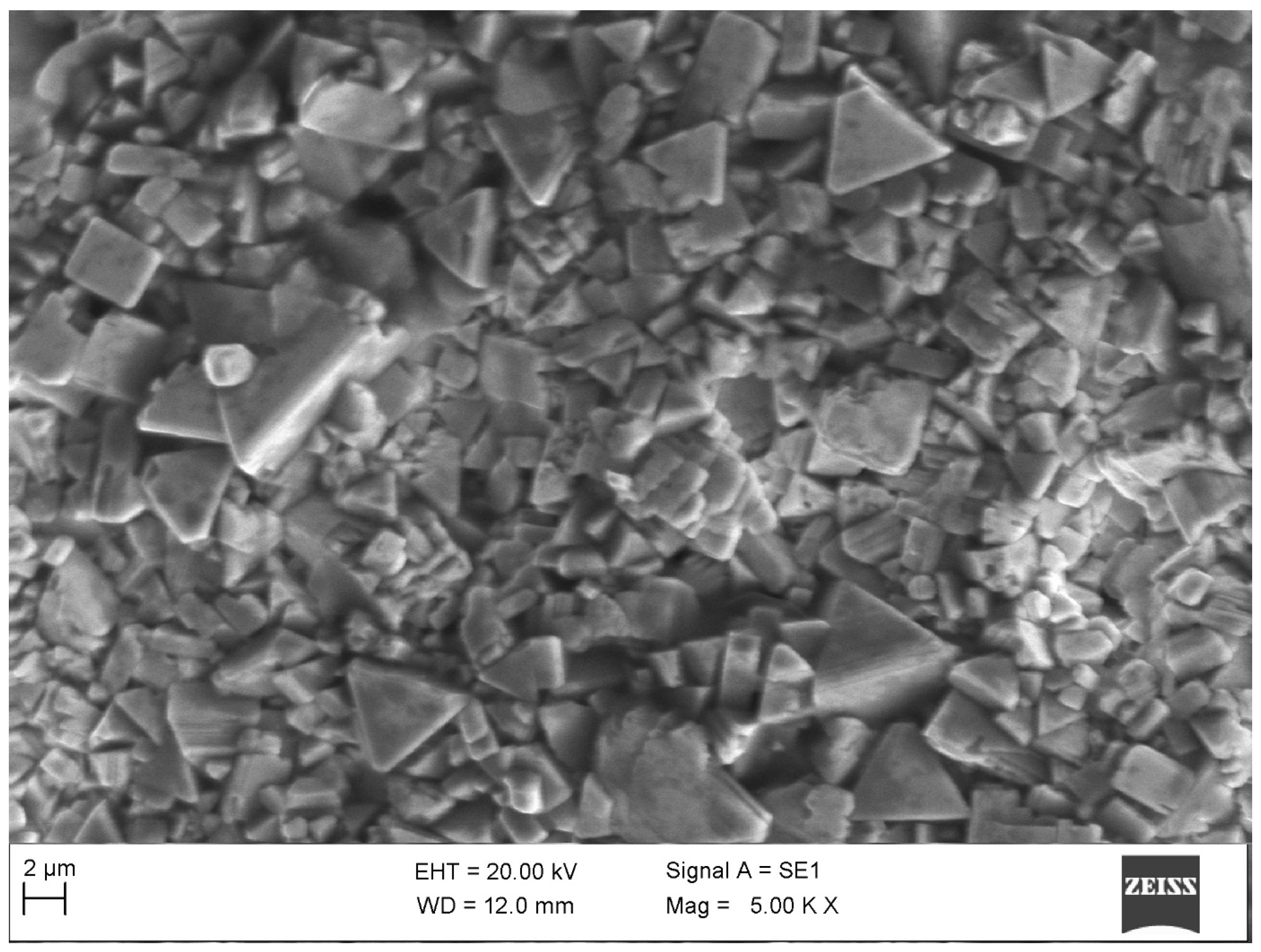
Microstructural analysis of the surface of WC–6Co sintered samples demonstrated typical morphology of tungsten carbide grains seen in Figure 1. Since the surface had not been polished, the real morphology of the grains can be distinguished, which was formed during the liquid-phase sintering. The image clearly shows crystals of WC powder with pronounced faceting. The vast majority of grains have a shape of triangular prisms with sharp edges and corners. Such a clear geometric shape is an indicator of normal grain growth and high quality of the starting powder.
The structure shown in Figure 1 exhibited high polydispersity. Along with large grains (4–8 μm in size), a fraction of smaller crystallites (1–2 μm) is seen between the large grains. This corresponds to the particle size distribution of the initial powder (1–10 μm) and indicates dense packing of particles during the electroconsolidation process under uniaxial pressure P = 30 MPa. Since the content of the metal binding phase is small, ca 6 wt.%, no significant accumulations of free cobalt appeared on the surface. The cobalt bond is distributed mainly in the form of thin layers between the WC grains, enhancing their consolidation. Due to the absence of mechanical surface treatment, a high roughness and presence of deep shadows between groups of grains can be seen. The observed insignificant porosity is mainly represented by intergranular voids, typical for the free surface of a sintered composite.
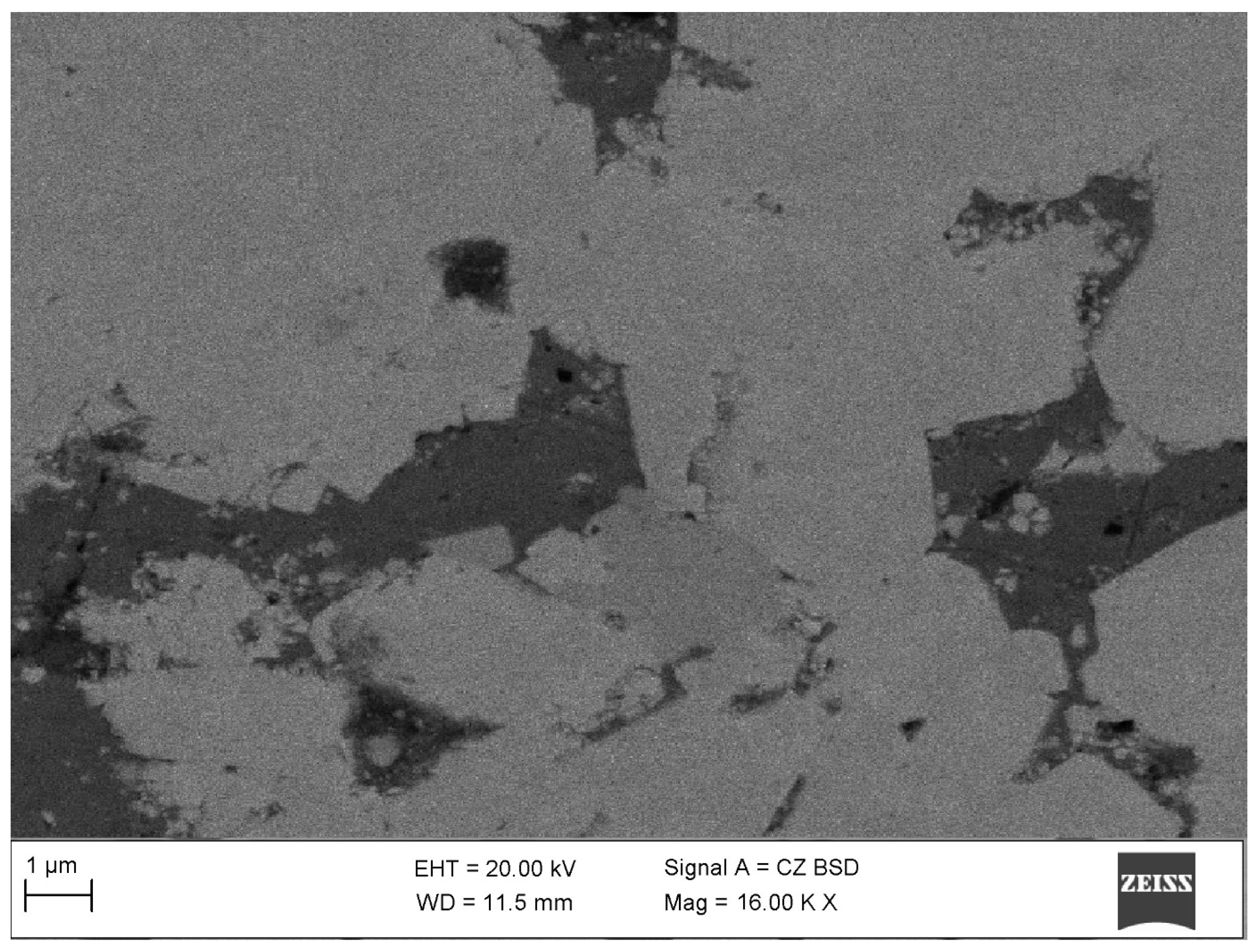
Microstructure study on polished surfaces at high magnification in the contrast mode using Back Scattered Electrons Detector (BSED) allowed for identification of the distribution of reinforcing nanoparticles in the composite structure. Figure 2 obtained with Z-contrast presents the image with clearly distinguished main structural components. WC grains are visualized as the brightest areas due to the high atomic number of tungsten (Z = 74). They have clear boundaries and form a rigid skeleton of the material. The cobalt bond is represented in the form of darker areas between the carbide grains, since the atomic number of cobalt (Z = 27) is much lower than that of tungsten. Within the background of the dark cobalt matrix, some small, bright, dispersed inclusions of ZrO2 can be clearly seen. Their increased brightness compared to cobalt is explained by higher average atomic number of zirconium (Z = 40).
Image analysis reveals that the introduced ZrO2 nanoparticles of size 20–100 nm are located mainly inside the cobalt bond volumes, but they did not dissolve in Co during sintering. The zirconia particles are distributed relatively evenly, although in some places small agglomerates up to 500 nm can be found. In fact, such localization transforms the metallic bond into a particulate reinforced nanocomposite layer of Co + ZrO2. It is known that in metal alloy composites, specific wear rate decreases with the increasing percentage of ZrO2 particulate reinforcement dispersed along the grain boundaries [34]. The presence of hard, refractory oxide nanoparticles in the ductile cobalt phase can inhibit the dislocation motion and promote another dislocation–precipitate interaction known as Orowan and related mechanisms [35]. Apart from an increase in strength with no drop in ductility, the heat resistance of the material is improved. According to recent reports, the wear resistance of WC–Co system is critically dependent on the structure and hardness of the metal binder interlayers, because during service, the cobalt interlayers are worn out before the WC phase [36]. Thus, the improvement of wear performance can be expected in the WC–6Co–4ZrO2 composite.
Table 1 shows the results of roughness measurements after grinding and after the subsequent polishing process. The treatment resulted in similar surface roughness for samples of the studied materials. This table shows that without a ZrO2 addition, the surface of the WC–6Co composite was smooth after polishing. The root means square (RMS) value of surface roughness of this sample was Ra = 10 nm. The addition of ZrO2 in the amount of 4 wt.% and 10 wt.% to the WC–6Co composite was accompanied by an improvement of the surface roughness decreasing Ra down to 8 nm.
A significant decrease in the roughness Ra of the grinded surface after zirconia addition should be noted. The appearance of damage during the grinding process significantly reduces the fracture strength, fatigue strength, and wear resistance of ceramic components parts to be greatly reduced due to the stress concentration around grinding-induced surface and subsurface cracks [37]. Grinded in the same conditions, specimens with 4 wt.% zirconia exhibited higher resistance to the brittle damages and cracking than that of WC–6Co metal matrix composite, represented by a 24% lower Ra. Thus, it can be expected that the composites with zirconia additive will exhibit greater wear resistance.
The exceptional smoothness of the polished surfaces confirmed a high homogeneity and densification degree, which is extremely important for powder metallurgy. A high surface integrity is definitely a crucial aspect for composites designed to work in harsh conditions involving cyclic loads in severe applications [38].

3.2. Friction Coefficient and Wear Rate

The results of tribological tests for two different loads, 20 N and 100 N, are given in Table 2 and Table 3, respectively. In all cases, the test lasted for t = 300 s, ensuring the sliding distance of L = 15 m. As a result, after the test, a worn area appeared in the tested specimen with its depth corresponding with the volume loss ΔV, and the worn ball formed a flattened side of a certain diameter dependent on the amount of the removed counter body material. The analysis shows that a five times increase in load caused a 94 times increase in the volume loss of the specimens and an increase in the worn area in the diameters ca. 2 times. In the tables below, the values of the friction coefficient μ are also given, measured for the test duration corresponding to the stabilized μ values. The diagrams of the friction coefficient for the three studied composites for loads of 20 and 100 N are shown in Figure 3, Figure 4 and Figure 5 and Figure 6, Figure 7 and Figure 8, respectively.
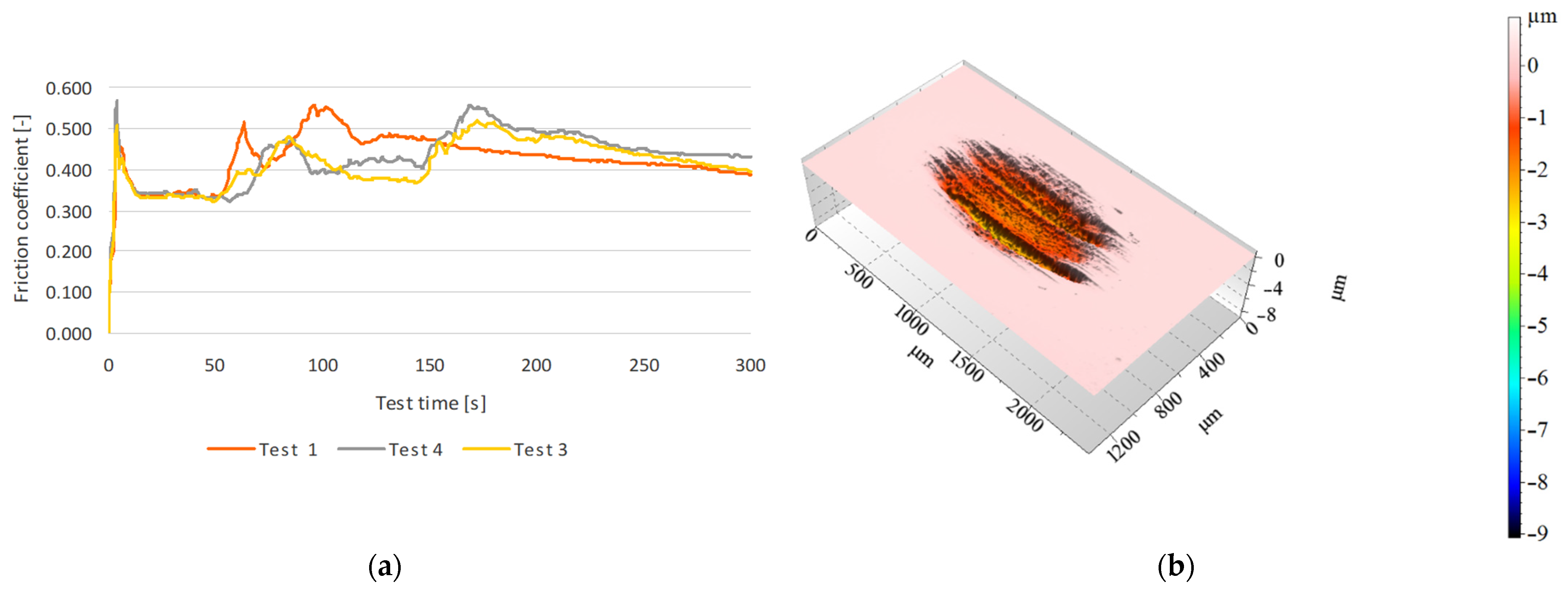
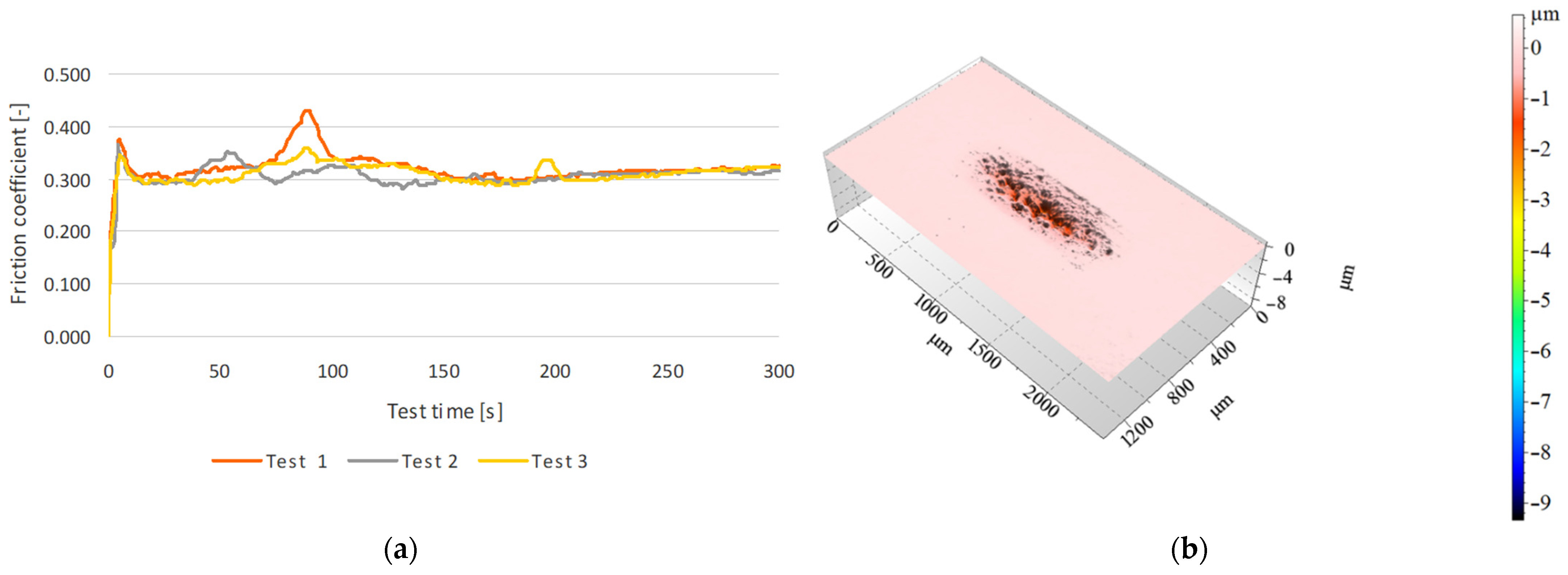
The diagrams of the friction coefficient μ in time t have maxima and regions of stabilized values. During the friction test, different wear mechanisms between the friction pairs dominated at different stages. From Figure 3a it is seen that the friction coefficient μ between the WC–6Co sample and Al2O3 ball exhibited maxima at different time points, reaching values of μ ≈ 0.56 at t ≈ 5 s and t ≈ 100 s, μ ≈ 0.51 at t ≈ 100 s, and μ ≈ 0.54 at t ≈ 170 s. After approximately 270 s of sliding, the friction coefficient μ decreased down to the level of ~0.42– 0.44 and remained almost constant.
The WC–6Co specimen exhibited significant dispersion for volumetric loss results (±0.482 × 10⁻⁵, mm3) and the maximum depth of the scratches seen in Figure 3b, which indicated the abrasive wear mechanism. This can be correlated with the irregular diagrams μ = f(t) where regions of almost constant value correspond with even wear, and local “jumps” of friction coefficient correspond with unsteady abrasive wear.
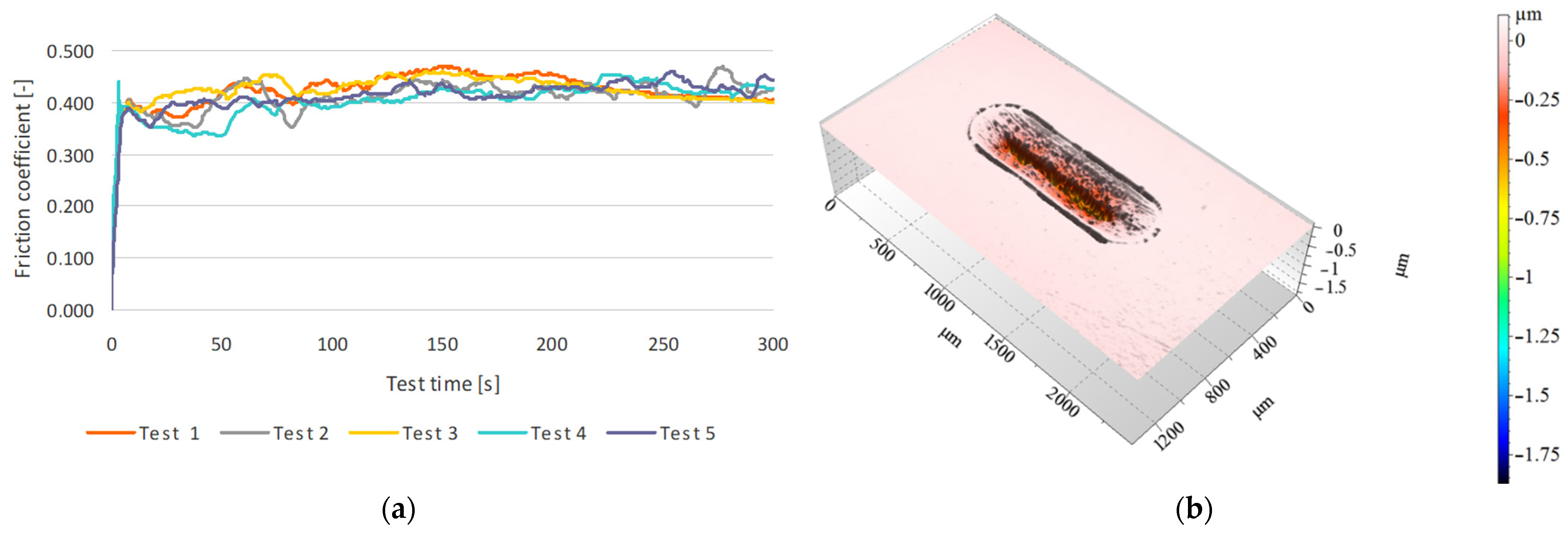
In contrast, the diagram of friction coefficient μ for the specimen with 4 wt.% zirconia shown in Figure 4a is much smoother, though exhibiting some fluctuations. After approximately 50 s of the test, the amplitude of the fluctuations became insignificant with average values between 0.37 and 0.42. The decrease in friction coefficient μ between the WC–6Co–4ZrO2 sample and Al2O3 compared to that of WC–6Co specimen can be attributed to an improved surface integrity. Moreover, the fact that a finer-grained homogeneous microstructure was formed after zirconia addition might have further contributed to the improvement in friction. In a recent report [39], it was noted that when ZrO2 was added to the WC–6Co composition, a more intense refinement took place of the phase components with a decrease in average lattice microdeformations εc and εa in directions c and a, respectively. This phenomenon obviously improved performance of the composite, exhibited also in a regular shape of the worn area shown in Figure 4b, where no single deep scratches are seen.
Among the tested materials, the lowest level of friction was recorded for the WC–6Co–10ZrO2 material in contact with Al2O3 ball counter body. In Figure 5a, the diagram exhibited no oscillations and a constant value around μ = 0.30 after 150 s of sliding test. In all tests, only one single maximum appeared that exceeded μ = 0.4. On the surface of the worn area shown in Figure 5b, smaller and more evenly scattered scratches were observed, accompanied with a decrease in volumetric wear compared to the specimens WC–6Co–4ZrO2 and WC–6Co.
Accordingly, the specimen WC–6Co–10ZrO2 exhibited a decrease in volumetric loss ΔV by 66% compared to WC–6Co composite, with the dispersion of results reduced down to ±0.107 × 10⁻⁵ mm3 (Table 1). The wear rates shown in Table 4 indicate wear resistance improvement with a 50% decrease in Ws for 4 wt.% zirconia addition and 80% for 10 wt.% ZrO2 added, in comparison with WC–6Co.
Decrease in the specific wear rates Ws of the WC-6Co composites with zirconia addition corresponds with the improved friction coefficient µ and smaller wear of both tested specimen (represented by volumetric loss ΔV) and Al2O3 ball counter body (represented by worn flat area diameter). The trend became even more prominent under the increased load FN = 100 N.
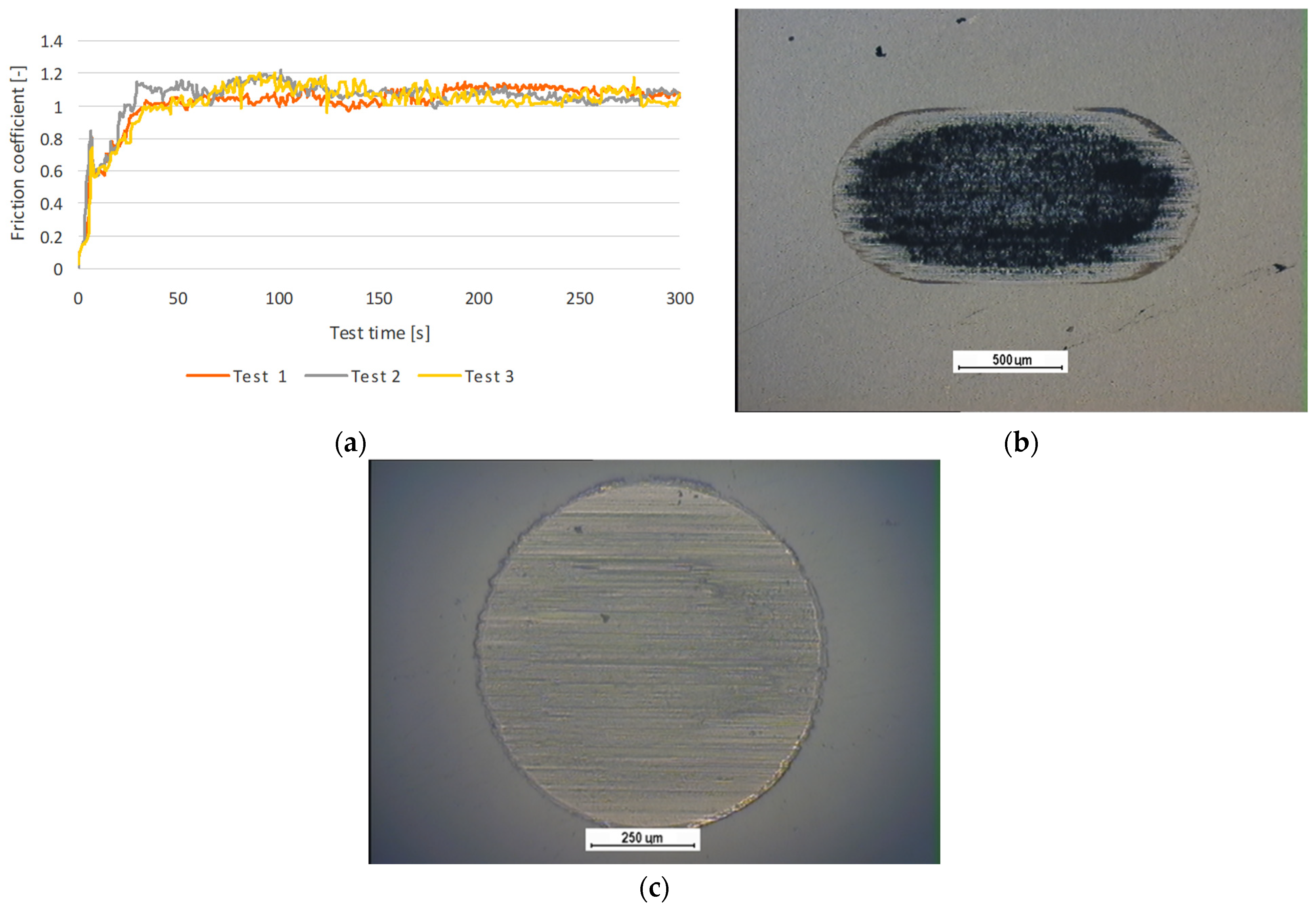
The results of the wear test under extreme load conditions FN = 100 N are shown in Figure 6, Figure 7 and Figure 8. The friction coefficient μ in the WC-6Co composite interaction with Al2O3 ball counter body exhibited extremely high values of 1.1–1.2 in all three test repetitions, as shown in Figure 6a. The initial running-in stage of the friction pair before stabilization was quite short, ca. 30–40 s. After that, μ remained between 1.0 and 1.2 with gradually decreasing amplitudes, exhibiting no sharp maxima. The respective images of worn areas of the WC-6Co specimen and Al2O3 ball are presented in Figure 6b,c.
Photographs of the worn area in Figure 6b exhibited deep and wide scratches on the bottom of the wear groove in WC–6Co sample. Tribological tests under a load of 100 N also led to intensive wear of the counter body. Quite deep parallel scratches were formed on the surface of the Al2O3 ball seen in Figure 6c, indicating intensive abrasive wear of the contacting pair under heavy load.
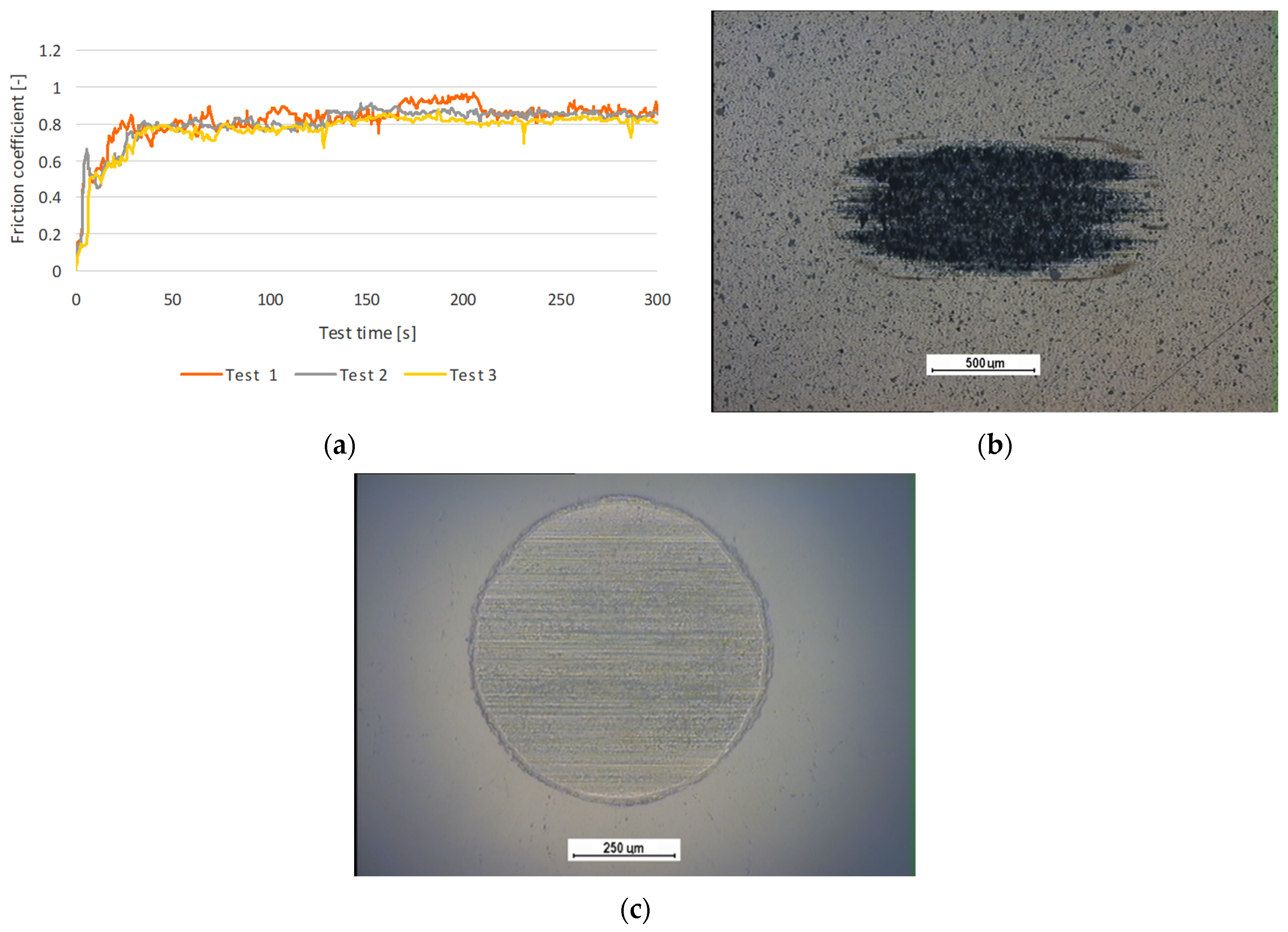
In the case of WC–6Co–4ZrO2 tested in the same conditions, the stabilized level of friction coefficient μ decreased by 25% compared to WC–6Co composite without zirconia additive, from ca. 1.1 down to ca. 0.8 shown in Figure 7a. The worn surfaces of both specimen and counter body in Figure 7b,c, respectively, exhibited scratches much smaller than those seen in Figure 6b,c. The role of abrasive wear evidently reduced in the case of WC–6Co–4ZrO2 composite compared to the WC–6Co material.
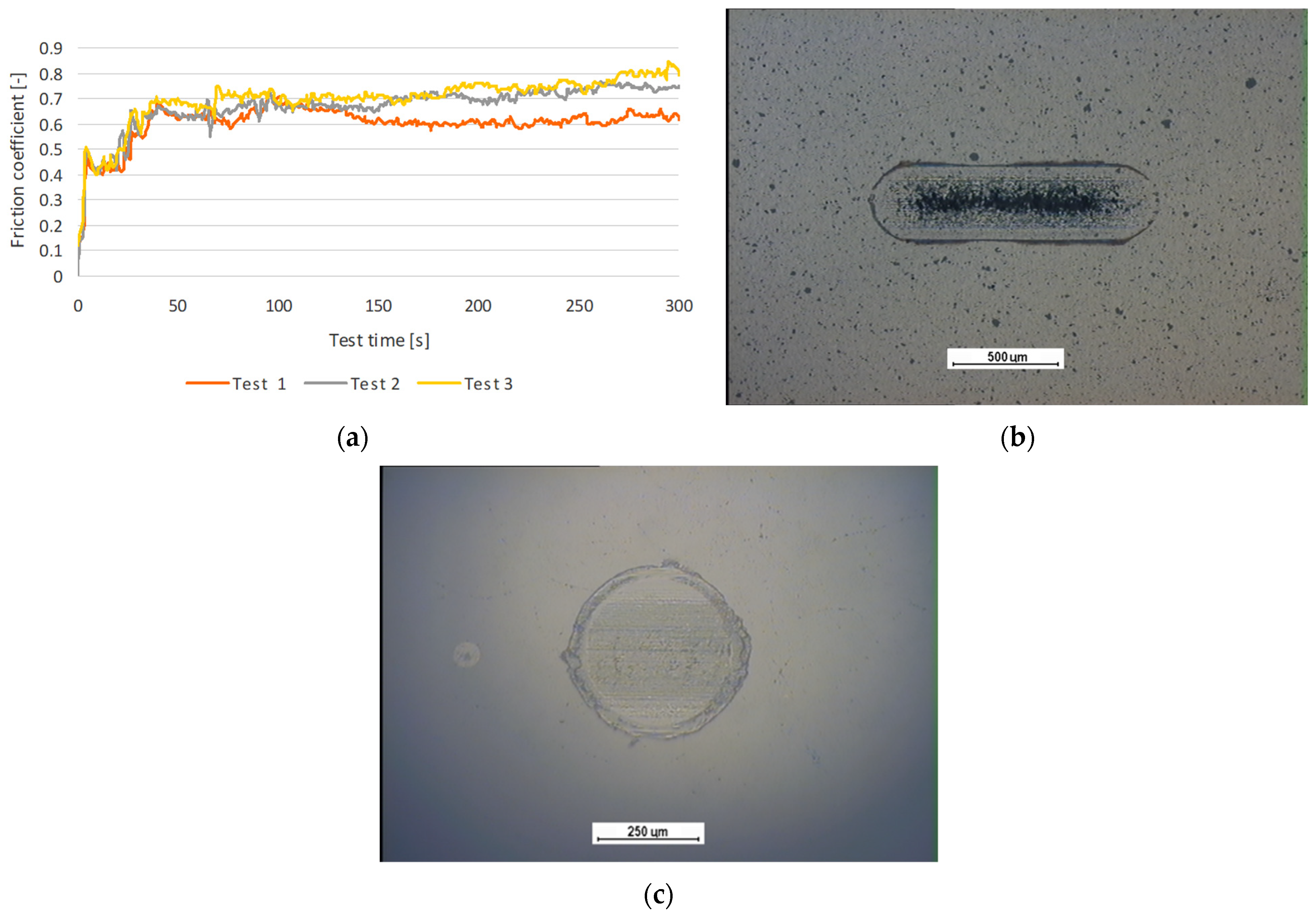
Even lower values of the friction coefficient µ = 0.6–0.7 were found in Figure 8a representing the results for WC–6Co–10ZrO2 composition. These can be attributed to the formation of a more homogeneous fine-grained microstructure. On the surface of the worn area of 10%YSZ-containing sample compared to 4%YSZ-containing one, smaller and more evenly distributed scratches are observed in the photograph in Figure 8b. A similar trend can be found on the flattened worn surface of the Al2O3 ball after the tribotest, shown in Figure 8c, compared to that seen in Figure 7c.
Specific wear rates Ws for the studied compositions at an elevated load of FN = 100 N are given in Table 5. The wear rate for the WC–6Co composite appeared to be 11 times higher than the wear rate of the same sample tested at a load of FN = 20 N shown in Table 4. For comparison, recently reported indices of tolerance to abrasion damage 1/(E2H) [26] were added to Table 5. This index increased by 27% for the composite with 10 wt.% zirconia compared to WC–6Co material, reflecting a significant improvement of wear resistance.
The wear resistance of the WC–6Co composites fabricated by electroconsolidation significantly improved after zirconia additive was introduced. Compared to Ws obtained for WC–6Co composite, the WC–6Co–4ZrO2 and WC–6Co–10ZrO2 samples exhibited wear rates lower by 40% and by 66%, respectively. This finding is especially important for those applications where the components are subject to heavy loads and friction forces.
Notably, the samples with zirconia addition used in this study exhibited a similar relative density 0.985, much higher than 0.948 for WC–6Co sample [40]. Even though WC–6Co had the highest hardness HV, its fracture toughness KIC and tolerance to abrasion damage 1/(E2H) appeared to be the lowest. The decrease in hardness after zirconia addition can be explained by the fact that HV of ZrO2 is by 30–35% lower than that of WC. However, the presence of zirconia enhanced interfacial areas, since its hardness was HV = 13–14 GPa, while that of cobalt was HV = 1.0–1.3 GPa. As a result, interfacial damages played a smaller role in the wear process.

3.3. Wear Mechanism

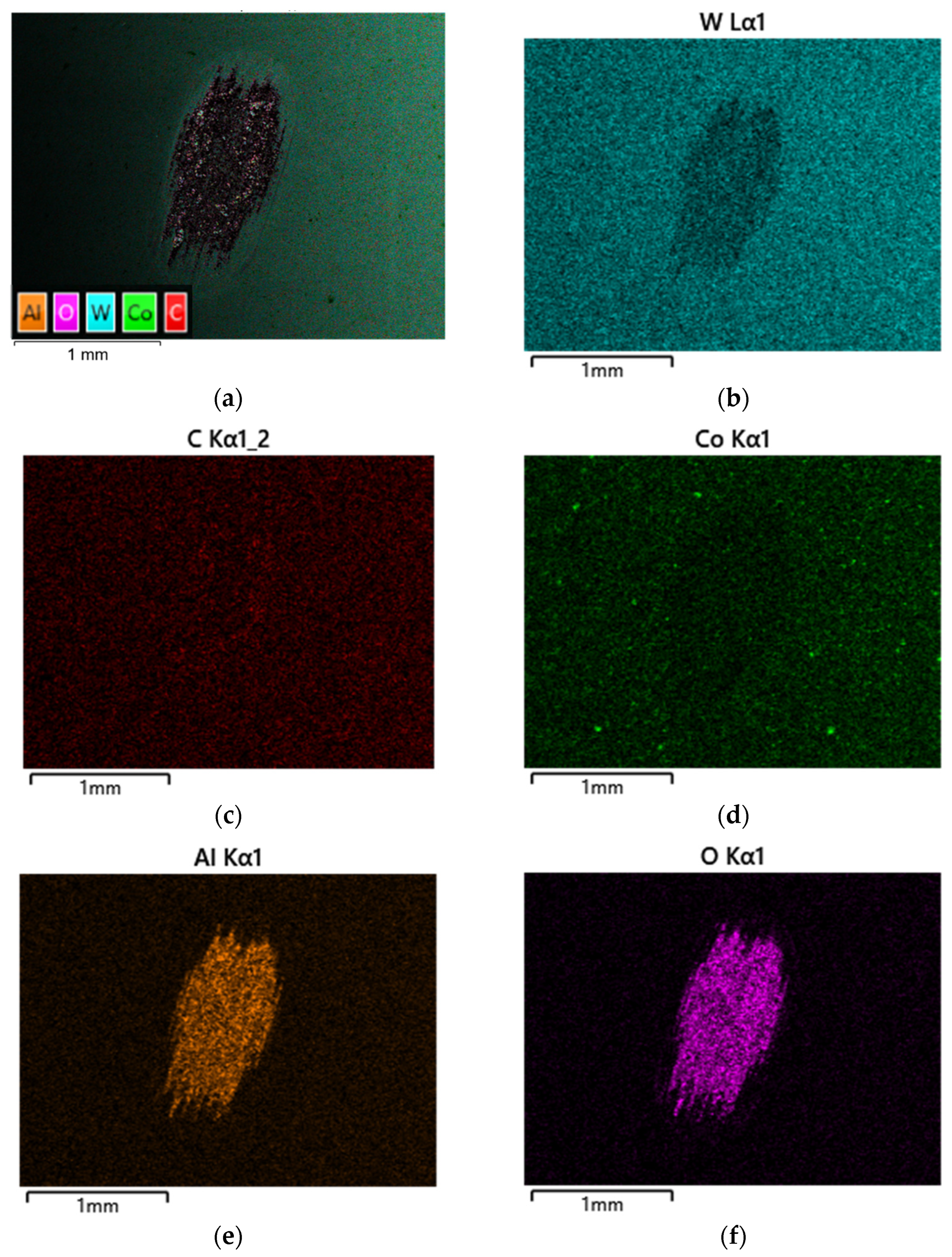
It is difficult to identify the effect of a particular wear mechanism on the wear of a cemented carbide tool, but at least three mechanisms working together can be named: abrasive wear, diffusive wear, and adhesive wear [41]. To understand the mechanisms behind the improved wear resistance of the tested composites, elemental analysis of the worn surfaces was performed. In the element distribution maps seen in Figure 9, the area of the WC–6Co sample in contact with the Al2O3 counter body, apart from the basic elements W, Co, and C, also contained Al and O in some small localized areas. According to the EDS analysis, the distribution of WC and Co elements was uneven, in agreement with the uneven surface topography. Since the distribution of W, Co, and C on the sample surface outside the sliding path is uniform, it can be assumed that plastic deformation of the surface layer took place during the tribological test. The presence of Al from the counter body on the worn surface indicates that, in addition to abrasive wear, adhesive wear played important role in the degradation of WC–6Co sample.
It can be inferred from the analysis that abrasive wear accompanied by plastic deformation and subsequent failure was the primary wear mechanism of WC–6Co composite in interaction with Al2O3 counter body. Adhesive wear and intrusion of counter body debris into the tested composite surface took place, but had a lesser effect on wear intensity. Some of the oxygen seen in Figure 9f may originate from oxidation products [21] like WO3 and CoWO4, but since they are prone to be removed from the friction area during the wear process, their amount on the surface is rather insignificant.
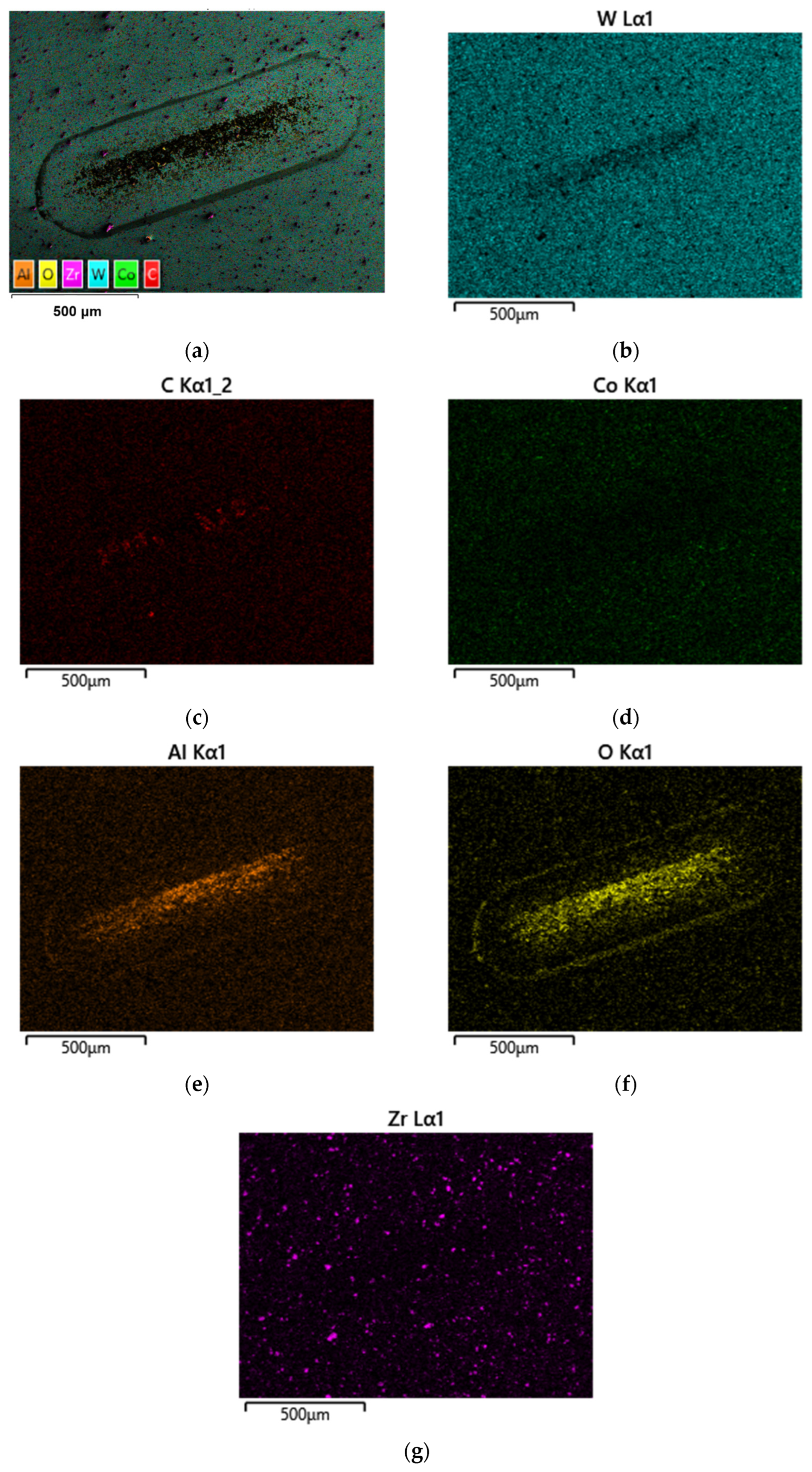
In the elemental distribution maps of the 4%YSZ-containing composite worn surface, Al and O were also detected in addition to the basic elements W, Co, Zr, and C, as shown in Figure 10. This indicates presence of adhesive wear, like in the case of zirconia-free composite. However, the EDS analysis showed more uniform distribution of WC and Co elements on the worn area compared to WC–6Co specimen. The distribution uniformity after the tribological test explains the better surface integrity of WC–6Co–4ZrO2 composite compared to WC–6Co, represented by lower roughness after the same grinding process specified in Table 1 above.
It can be seen that the addition of ZrO2 to the WC–6Co composite reduced the intensity of adhesive wear. This phenomenon can be explained by the tetragonal structure of ZrO2 and formation of a finer-grained structure with a uniform distribution of phase components described in detail in [26]. In previous research [40] it was demonstrated that the composite WC–6Co without zirconia consisted of hexagonal WC phase (a = 0.2906 nm, c = 0.2837 nm), hexagonal graphite, and Co3W3C phase (a = 1.1112 nm), while after the addition of zirconia the composites consisted of WC and Co3W3C phases, amorphous carbon, and tetragonal ZrO2 (a = 0.36019 nm, c = 0.5174 nm).
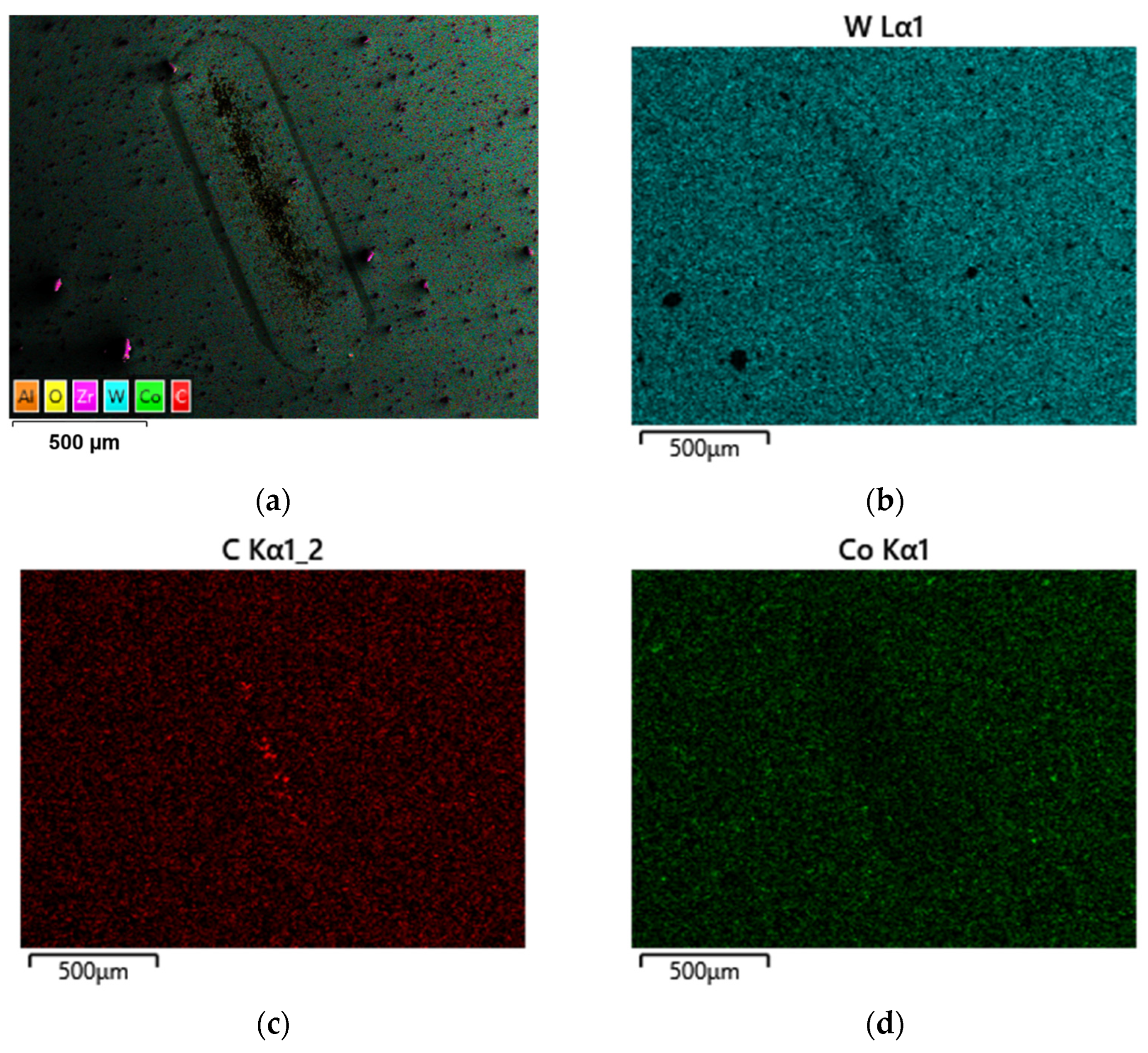
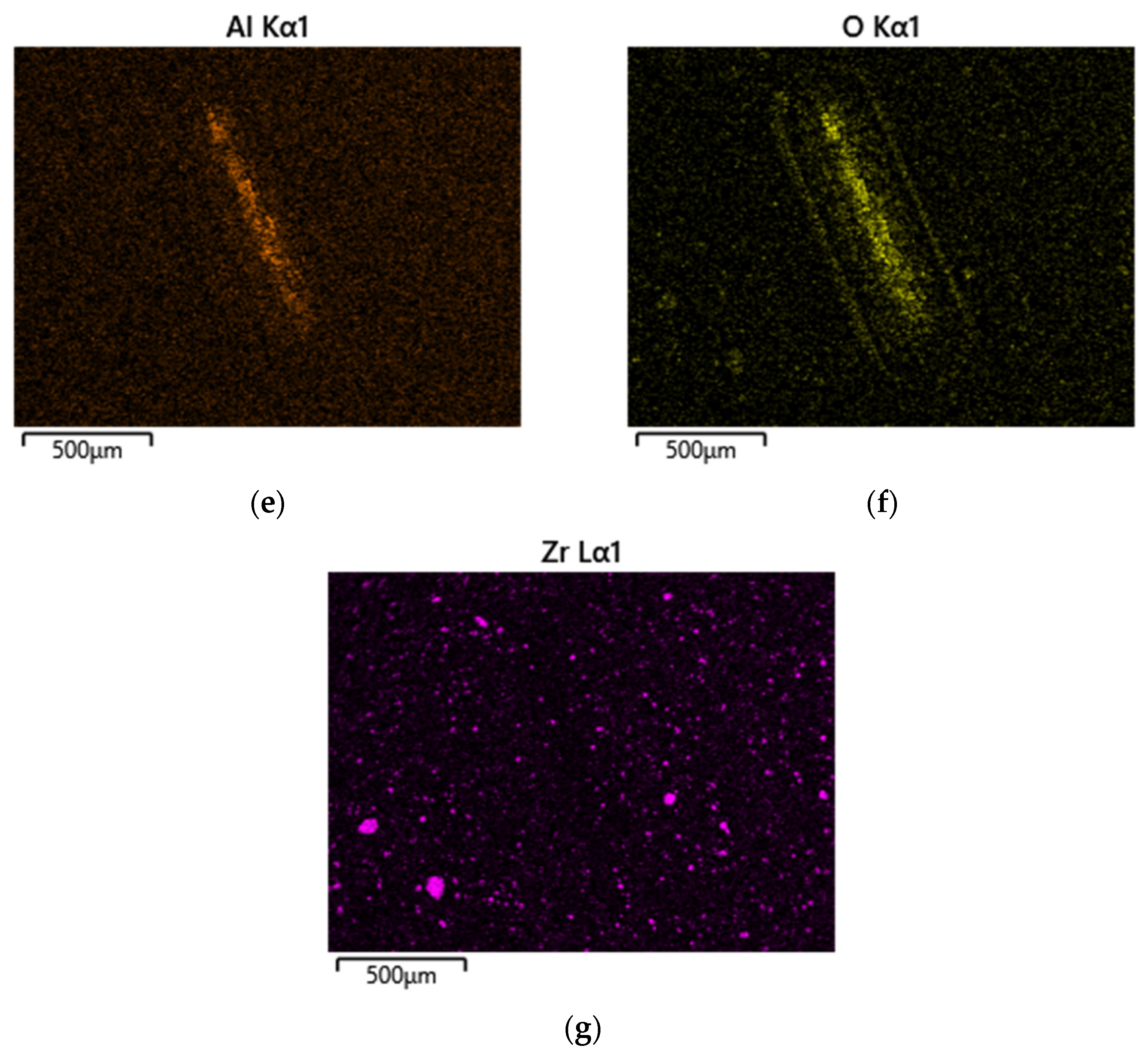
The elemental distribution on the–10ZrO2 sample shown in Figure 11 is essentially the same as that of 4%YSZ-containing composite represented in Figure 10. However, traces of aluminum on the composite surfaces are smaller, and the plastic deformation area is smaller. In the zirconium map shown in Figure 11g, larger agglomerates can be seen than in the case of 4 wt.% of zirconia addition (Figure 10g). Presumably, zirconia concentrated in those agglomerates served as a dry lubricant reducing the friction coefficient and the adhesion component of the wear mechanism.
Thus, it was experimentally confirmed that the addition of 4 wt.%ZrO2 and 10 wt.%ZrO2 nanopowder to the WC–6Co metal matrix composite significantly improved its wear resistance, reducing the adhesive component of the wear mechanism and introducing a sort of dry lubrication. In some applications, e.g., in vacuum and low temperatures, adhesive wear is the main mechanism [42], so that zirconia additive can be particularly helpful in increasing the wear resistance of a tool.
The decreased friction coefficient contributed also to lower plastic deformation and reduced subsequent fatigue degradation of the composite. The presence of zirconia contributed to formation of fine-grained microstructure during the sintering process, and retention of submicron inclusions in the cobalt matrix made up advantages of a nanocomposite.

4. Conclusions

Microstructural analysis and tribological tests of 94 wt.%WC–6 wt.%Co metal matrix composite without and with addition of yttrium-stabilized zirconia in proportions 4 wt.% and 10 wt.% produced by electroconsolidation were carried out in this study and the following conclusions can be drawn.
Microstructural features and surface integrity appeared to be enhanced after zirconia addition. In particular, zirconia nanoparticles formed a nanocomposite in the cobalt matrix and introduced an additional toughening mechanism, while larger agglomerates worked as a dry lubricant in the tribological test. The improved tribological properties of WC–Co composites with ZrO2 additives can be attributed to a more uniform fine-grained structure and lower surface roughness.
The friction coefficient μ in contact with Al2O3 ball counter body under a load of 20 N oscillated in the range of 0.42–0.44 for WC–Co system, and for samples with 4 wt.% and 10 wt.% zirconia it was 0.35–0.42 and 0.30–0.32, respectively. The specific wear rate for the tested composites after the addition of zirconia dropped by 50% and 80%, respectively. Its values of order 10−8 mm3/(N·m) place the tested composites among highly wear-resistant materials.
An increase in the load by five times, from 20 to 100 N in the tribological test, led to an increase in the wear rate 1.1, 1.3, and 1.9 times for WC–Co, WC–6Co–4ZrO2, and WC–6Co–10ZrO2 compositions, respectively. It was found that the predominant wear mechanism for the 94WC–6Co sample under reciprocating friction with an Al2O3 ball was abrasive wear. Adhesive wear, resulting from the embedding of debris into the friction surface, had a lesser effect. The addition of ZrO2 to the WC–6Co composite suppressed adhesive wear, which can be explained by the tetragonal structure of ZrO2 and the formation of a finer-grained structure with a uniform distribution of phase components.
The results demonstrate the potential for developed compositions and the electroconsolidation technique in the production of composite materials for harsh working conditions, such as drilling hard and abrasive rocks.

5. Patents

Patent of Republic of Kazakhstan: Ratov, B.T.; Mechnik, V.A.; Hevorkian, E.S.; Bondarenko, N.A., Rucki, M.; Seidaliev, A.A.; Kuvanov, E.U.; Kalzhanova, A.B.; Morozov, D.; Samociuk, W. Diamond-reinforced composite material. No. 37698, Submission no. 2024/0909.1, 1 November 2024. Published 19 January 2025, Bulletin No. 51.

Author Contributions

Conceptualization, B.R.; methodology, B.R., E.H., M.R. and Z.S.; software, D.P. and Z.S.; validation, M.R., Z.S. and G.A.; formal analysis, V.M., E.H., V.K. and G.A.; investigation, V.M., E.H. and D.P.; resources, E.H. and D.P.; data curation, M.R. and V.K.; writing—original draft preparation, V.M.; writing—review and editing, all authors; visualization, V.M., M.R. and V.K.; supervision, B.R.; project administration, B.R.; funding acquisition, V.M. and G.A. All authors have read and agreed to the published version of the manuscript.

Funding

This research was funded by the Science Committee of the Ministry of Science and Higher Education of the Republic of Kazakhstan, grant No. AP23484450, and Ministry of Education and Science of Ukraine, grant No. 0117U000391.

Institutional Review Board Statement

Not applicable.

Informed Consent Statement

Not applicable.

Data Availability Statement

The original contributions presented in this study are included in the article. Further inquiries can be directed to the corresponding author.

Conflicts of Interest

The authors declare no conflicts of interest.

Abbreviations

The following abbreviations are used in this manuscript:
BSEDBack Scattered Electrons Detector
EDXEnergy dispersive X-ray spectroscopy
RMSRoot means square
SEMScanning electron microscope
SPSSpark Plasma Sintering
YSZYttria-stabilized zirconia

References

  1. García, J.; Collado Ciprés, V.; Blomqvist, A.; Kaplan, B. Cemented carbide microstructures: A review. Int. J. Refract. Met. Hard Mater. 2019, 80, 40–68. [Google Scholar] [CrossRef]
  2. Ravotti, D.A.S.; Correas, H.M.; Luis, N.C. Last decade insights on cemented carbides: A review on alternative binders, new consolidation techniques and advanced characterization. Eclét. Quím. 2024, 49, e-1529. [Google Scholar] [CrossRef]
  3. Polini, R.; Marcucci, A.; D’Ottavi, C.; Nunziante, P.; De Filippis, P.; Marcheselli, G.C. Toward Greener Synthesis of WC Powders for Cemented Tungsten Carbides Manufacturing. ACS Sustain. Chem. Eng. 2021, 9, 8458–8466. [Google Scholar] [CrossRef]
  4. Gao, Y.; Wang, K.; Huang, W.; Deng, H. Dynamic constitutive relation and macro/micro failure mechanism of fine-grained WC-Co composite. Int. J. Refract. Met. Hard Mater. 2024, 124, 106856. [Google Scholar] [CrossRef]
  5. Stanciu, V.I.; Erauw, J.-P.; Boilet, L.; Vitry, V.; Delaunois, F. WC-Co composite made with doped binder: The effect of binder proportion on microstructure and mechanical properties. Int. J. Refract. Met. Hard Mater. 2023, 112, 106161. [Google Scholar] [CrossRef]
  6. Da Silva, A.G.P.; Schubertb, W.D.; Lux, B. The role of the binder phase in the WC-Co sintering. Mater. Res. 2001, 4, 59–62. [Google Scholar] [CrossRef]
  7. Kong, F.; Zhao, W.; Li, H.; He, N. Effect of grain size and cobalt content on machining performance during milling tungsten carbide with PCD tool. Int. J. Refract. Met. Hard Mater. 2024, 123, 106780. [Google Scholar] [CrossRef]
  8. Kumar, K.N.C.; Ramalingam, M.S.; Joshi, W.S.; Sharma, S.; Dahotre, N.B. Role of powder morphology in liquid phase sintering of binder jet additively fabricated WC–Co composite. Addit. Manuf. 2024, 95, 104520. [Google Scholar] [CrossRef]
  9. Franczyk, E.; Małek, M. Empirical Study on the Effect of Tungsten Carbide Grain Size on Wear Resistance, Cutting Temperature, Cutting Forces and Surface Finish in the Milling Process of 316L Stainless Steel. Adv. Sci. Technol. Res. J. 2023, 17, 367–377. [Google Scholar] [CrossRef]
  10. Matthews, S.; Yang, F. Comparison of Microwave Versus Conventional Furnace Heat Treatments of Carbide Composite Thermal Spray Coatings. J. Therm. Spray Technol. 2024, 33, 1643–1673. [Google Scholar] [CrossRef]
  11. Vilhena, L.; Domingues, B.; Fernandes, C.; Senos, A.; Ramalho, A. Mechanical and Tribological Characterization of WC-Co and WC-AISI 304 Composites by a Newly Developed Equipment. Materials 2022, 15, 1187. [Google Scholar] [CrossRef]
  12. Mao, P.; Peng, J.; Chen, K.; Zhou, C.; Gao, J.; Zhang, X.; Xiao, X.; Wu, X.; Peng, R. Effect of deep cryogenic treatment on the mechanical properties of ultrafine WC-Co composite. Int. J. Refract. Met. Hard Mater. 2026, 134, 107429. [Google Scholar] [CrossRef]
  13. Dhari, R.S.; Lappin, F.; Lattemann, M.; Davies, I.J. Homogenised static loading response of WC-Co composites: A hybrid microstructure modelling approach. Int. J. Refract. Met. Hard Mater. 2026, 134, 107493. [Google Scholar] [CrossRef]
  14. Kübarsepp, J.; Juhani, K.; Tarraste, M. Abrasion and Erosion Resistance of Cermets: A Review. Materials 2022, 15, 69. [Google Scholar] [CrossRef]
  15. Liu, J.; Yu, X.; Zhu, B.; Zhu, Q.; Feng, Q. Comprehensive utilization of micro-oxidation and Co coating on the surface of WC particles to greatly reduce the harmful η phase in WC-Co composites—A new strategy. J. Mater. Res. Technol. 2026, 40, 3920–3931. [Google Scholar] [CrossRef]
  16. Upadhyaya, G.S. Materials science of cemented carbides—An overview. Mater. Des. 2001, 22, 483–489. [Google Scholar] [CrossRef]
  17. Niu, Y.; Gong, P.; Xu, X.; Wang, X.; Ma, Y.; Li, M.; Lu, Q.; Yang, H.; Liu, Z.; Zhang, Z.; et al. Preparation of WC-Co cemented carbide by spark plasma sintering: Microstructure evolution, mechanical properties and densification mechanism. Int. J. Refract. Met. Hard Mater. 2025, 126, 106964. [Google Scholar] [CrossRef]
  18. Sailo, L.; Singh, N.M. Zirconium Oxide-Based Materials: An In-Depth Review of Synthesis Strategies and Their Roles in Biomedical, Energy, and Materials Science Applications. JOM 2026, 78, 1893–1927. [Google Scholar] [CrossRef]
  19. Dudnik, E.; Lakiza, S.; Hrechanyuk, I.; Ruban, A.K.; Redko, V.P.; Marek, I.O.; Shmibelsky, V.B.; Makudera, A.A.; Hrechanyuk, N.I. Thermal Barrier Coatings Based on ZrO2 Solid Solutions. Powder Metall. Met. Ceram. 2020, 59, 179–200. [Google Scholar] [CrossRef]
  20. Xia, Y.; Bai, L.; Dong, F.; Ma, F.; Zhang, S.; Shi, H.; Liu, Y. Temperature-driven wear behavior of WC/Co against Si3N4 exposed to air conditions. Int. J. Refract. Met. Hard Mater. 2025, 133, 107342. [Google Scholar] [CrossRef]
  21. Jiang, W.; Lu, H.; Liu, X.; Wang, H.; Li, D.; Liu, C.; Wang, M.; Song, X. Outstanding high-temperature oxidation- and wear-resistance of WC based cermets. J. Mater. Sci. Technol. 2023, 155, 33–46. [Google Scholar] [CrossRef]
  22. Wang, C.; Wang, H.; Hong, H.; Zhao, Z.; Liu, X.; Song, X. Enhancing toughness and wear resistance of ultrafine-structured WC-Co coating via ZrO2 incorporation. Trans. Mater. Res. 2025, 1, 100064. [Google Scholar] [CrossRef]
  23. Ratov, B.; Rucki, M.; Hevorkian, E.; Mechnik, V.; Bondarenko, M.; Bialkowska, A.; Kroisova, D. Analysis of WC-Co and ZrO2-WC matrices from perspective of wear resistance of diamond-reinforced composites. In Proceedings of the Conference Engineering for Rural Development ERDev 2025, Jelgava, Latvia, 21–23 May 2025. [Google Scholar] [CrossRef]
  24. Yang, Y.; Luo, L.M.; Zan, X.; Zhu, X.Y.; Zhu, L.; Wu, Y.C. Study on preparation and properties of WC-8Co cemented carbide doped with rare earth oxide. Int. J. Refract. Met. Hard Mater. 2021, 98, 105536. [Google Scholar] [CrossRef]
  25. Jiang, W.; Lu, H.; Chen, J.; Liu, X.; Liu, C.; Song, X. Toughening cemented carbides by phase transformation of zirconia. Mater. Des. 2021, 202, 109559. [Google Scholar] [CrossRef]
  26. Ratov, B.; Mechnik, V.; Hevorkian, E.; Rucki, M.; Pieniak, D.; Bondarenko, M.; Kolodnitskyi, V.; Starik, S.; Chishkala, V.; Kuttybaev, A.; et al. Properties of WC-Co Cemented Carbide Reinforced with Yttria-Stabilized Zirconia Nanoparticles. J. Compos. Sci. 2026, 10, 156. [Google Scholar] [CrossRef]
  27. Lu, Z.; Qin, Y.; Zhu, X.; Luo, L.; Wu, Y. Microstructure and mechanical properties enhancement of WC-10Co cemented carbide with Y2O3 and VC composite additives. Int. J. Refract. Met. Hard Mater. 2025, 131, 107209. [Google Scholar] [CrossRef]
  28. Hevorkian, E.S.; Nerubatskyi, V.P.; Rucki, M.; Kilikevicius, A.; Mamalis, A.G.; Samociuk, W.; Morozow, D. Electroconsolidation Method for Fabrication of Fine-Dispersed High-Density Ceramics. Nanotechnol. Percept. 2024, 20, 100–113. [Google Scholar]
  29. Gevorkyan, E.; Rucki, M.; Krzysiak, Z.; Chishkala, V.; Zurowski, W.; Kucharczyk, W.; Barsamyan, V.; Nerubatskyi, V.; Mazur, T.; Morozow, D.; et al. Analysis of the Electroconsolidation Process of Fine-Dispersed Structures Out of Hot Pressed Al2O3–WC Nanopowders. Materials 2021, 14, 6503. [Google Scholar] [CrossRef]
  30. ISO 21920-2:2021; Geometrical Product Specifications (GPS)—Surface Texture: Profile. Part 2: Terms, Definitions and Surface Texture Parameters. International Organization for Standardization: Geneva, Switzerland, 2021.
  31. ASTM G99-23; Standard Test Method for Wear and Friction Testing with a Pin-on-Disk or Ball-on-Disk Apparatus. ASTM International: West Conshohocken, PA, USA, 2023.
  32. ISO 20808:2016; Fine Ceramics (Advanced Ceramics, Advanced Technical Ceramics)—Determination of Friction and Wear Characteristics of Monolithic Ceramics by Ball-on-Disc Method. International Organization for Standardization: Geneva, Switzerland, 2021.
  33. Ray, S.K.; Banerjee, A.; Bhangi, B.K.; Pyne, D.; Dutta, B. Tribological analysis—General test standards. In Tribology of Polymers, Polymer Composites, and Polymer Nanocomposites; George, S.C., Haponiuk, J.T., Thomas, S., Reghunath, R., Sarath, P.S., Eds.; Elsevier: Amsterdam, The Netherlands, 2023; pp. 17–50. [Google Scholar] [CrossRef]
  34. Shekhawat, D.; Agarwal, P.; Singh, T.; Singh, A.; Patnaik, A. Effect of Control Factors on Wear Rate of the Ceramic Particulate Filled Metal Alloy Composites: A Comparative Analysis. Arab. J. Sci. Eng. 2023, 48, 11819–11840. [Google Scholar] [CrossRef]
  35. Peng, S.; Wang, Z.; Li, J.; Fang, Q.; Wei, Y. Beyond Orowan hardening: Mapping the four distinct mechanisms associated with dislocation-precipitate interaction. Int. J. Plast. 2023, 169, 103710. [Google Scholar] [CrossRef]
  36. Fan, C.; Sun, J.; Zhao, J.; Yun, X. High entropy alloy bonded cemented carbides: Composition, processing, microstructure, properties and applications. Ceram. Int. 2024, 50, 37460–37503. [Google Scholar] [CrossRef]
  37. Ötenkaya, Ş.; Ünal, R. Effect of surface/subsurface defects on the surface integrity of ceramic materials. J. Korean Ceram. Soc. 2025, 62, 412–436. [Google Scholar] [CrossRef]
  38. Diaz, O.G.; Luna, G.G.; Liao, Z.; Axinte, D. The new challenges of machining Ceramic Matrix Composites (CMCs): Review of surface integrity. Int. J. Mach. Tools Manuf. 2019, 139, 24–36. [Google Scholar] [CrossRef]
  39. Ratov, B.; Mechnik, V.A.; Rucki, M.; Hevorkian, E.; Bondarenko, N.; Prikhna, T.; Moshchil, V.E.; Kolodnitskyi, V.; Morozow, D.; Gusmanova, A.; et al. Enhancement of the Refractory Matrix Diamond-Reinforced Cutting Tool Composite with Zirconia Nano-Additive. Materials 2024, 17, 2852. [Google Scholar] [CrossRef]
  40. Ratov, B.T.; Hevorkian, E.; Mechnik, V.A.; Bondarenko, N.A.; Kolodnitskyi, V.M.; Prikhna, T.O.; Moshchil, V.E.; Nerubaskyi, V.P.; Kalzhanova, A.B.; Bayamirova, R.U.; et al. Effect of the ZrO2 Content on the Strength Characteristics of the Matrix Material of Cdiamond–(WC–Co) Composites Synthesized by Spark Plasma Sintering. J. Superhard Mater. 2024, 46, 175–186. [Google Scholar] [CrossRef]
  41. Hao, Z.; Hou, T.; Du, J.; Fan, Y. Multi-scale predictive modeling of tool wear for machining Inconel 718 with cemented carbide tools. Tribol. Int. 2025, 208, 110662. [Google Scholar] [CrossRef]
  42. Sun, X.; Liu, B.; Guo, C.; Jia, R.; Chen, L.; Liu, B. Friction and wear features of WC-Co hard alloy in vacuum towards potential application for lunar deep subsurface drilling. Vacuum 2026, 244, 114857. [Google Scholar] [CrossRef]
Figure 1. SEM image of the WC–6Co composite surface after sintering, before polishing.
Materials 19 02436 g001
Figure 2. Microstructure of the polished WC–6Co–4ZrO2 composite surface (SEM image in the BSD mode).
Materials 19 02436 g002
Figure 3. Wear test results for the WC–6Co sample against Al2O3 ball under load FN = 20 N: (a) Change in friction coefficient μ with test time t; (b) Topography of the worn surface.
Materials 19 02436 g003
Figure 4. Wear test results for the WC–6Co–4ZrO2 composite against Al2O3 ball under load FN = 20 N: (a) Change in friction coefficient μ with test time t; (b) Topography of the worn surface.
Materials 19 02436 g004
Figure 5. Wear test results for the WC–6Co–10ZrO2 material against Al2O3 ball under load FN = 20 N: (a) Change in friction coefficient μ with test time t; (b) Topography of the worn surface.
Materials 19 02436 g005
Figure 6. Wear test results for the WC–6Co sample against Al2O3 ball under load FN = 100 N: (a) Change in friction coefficient μ with test time t; (b) Photograph of the worn specimen’s surface; (c) Photograph of the worn surface of the Al2O3 ball counter body.
Materials 19 02436 g006
Figure 7. Wear test results for the WC–6Co–4ZrO2 sample against Al2O3 ball under load FN = 100 N: (a) Change in friction coefficient μ with test time t; (b) Photograph of the worn specimen’s surface; (c) Photograph of the worn surface of the Al2O3 ball counter body.
Materials 19 02436 g007
Figure 8. Wear test results for the WC–6Co–10ZrO2 sample against Al2O3 ball under load FN = 100 N: (a) Change in friction coefficient μ with test time t; (b) Photograph of the worn specimen’s surface; (c) Photograph of the worn surface of the Al2O3 ball counter body.
Materials 19 02436 g008
Figure 9. EDS results of elemental distribution on the worn surface of WC–6Co specimen: (a) Combined elemental map; (b) Tungsten distribution; (c) Carbon distribution; (d) Cobalt distribution; (e) Aluminum distribution; (f) Oxygen distribution.
Materials 19 02436 g009
Figure 10. EDS results of elemental distribution on the worn surface of WC–6Co–4ZrO2 specimen: (a) Combined elemental map; (b) Tungsten distribution; (c) Carbon distribution; (d) Cobalt distribution; (e) Aluminum distribution; (f) Oxygen distribution; (g) Zirconium distribution.
Materials 19 02436 g010
Figure 11. EDS results of elemental distribution on the worn surface of WC–6Co–10ZrO2 specimen: (a) Combined elemental map; (b) Tungsten distribution; (c) Carbon distribution; (d) Cobalt distribution; (e) Aluminum distribution; (f) Oxygen distribution; (g) Zirconium distribution.
Materials 19 02436 g011aMaterials 19 02436 g011b
Table 1. Results of roughness measurements.
SpecimenRoughness Ra, μm
After GrindingAfter Polishing
Single MeasurementsMean (RMS)Single MeasurementsMean (RMS)
WC–6Co1.3561.4540.0070.010
1.294
1.5160.010
1.661
1.3990.013
1.501
WC–6Co–4ZrO21.2591.1110.0080.008
1.024
1.0870.007
1.179
0.9820.009
1.138
WC–6Co–10ZrO21.0081.0760.0080.008
1.081
1.2940.010
1.122
0.9750.008
0.977
Table 2. Results of the wear tests under load FN = 20 N.
SpecimenWorn Flattened Surface
Diameters, mm
Mean Diameter
dm = (d1 + d2)/2, mm
Volumetric Loss
of Specimen ΔV × 10−5, mm3
Average Friction Coefficient μ
d1d2
WC–6Co0.4780.3780.4282.203 ± 0.4820.47 ± 0.05
WC–6Co–4ZrO20.4600.3620.4111.132 ± 0.2710.42 ± 0.04
WC–6Co–10ZrO20.4060.3390.3730.446 ± 0.1070.30 ± 0.03
Table 3. Results of the wear tests under load FN = 100 N.
SpecimenWorn Flattened Surface
Diameters, mm
Mean Diameter
dm = (d1 + d2)/2, mm
Volumetric Loss of Specimen ΔV × 10−5, mm3Average Friction Coefficient μ
d1d2
WC–6Co0.8230.8340.82912.377 ± 1.2381.108 ± 0.12
WC–6Co–4ZrO20.6980.6970.6357.202 ± 0.7140.800 ± 0.09
WC–6Co–10ZrO20.4700.4460.4584.208 ± 0.4210.650 ± 0.08
Table 4. Wear rates of the tested composites against Al2O3 ball counter body under load FN = 20 N.
CompositionSpecific Wear Rate
Ws × 10−8, mm3/(N·m)
WC–6Co7.344 ± 0.808
WC–6Co–4ZrO23.772 ± 0.339
WC–6Co–10ZrO21.487 ± 0.149
Table 5. Wear rates of the tested composites against Al2O3 ball counter body under load FN = 100 N and comparison to other properties.
SpecimenSpecific Wear Rate
Ws × 10−8, mm3/(N·m)
Tolerance to Abrasion Damage 1/(E2H) [26]Toughness KIC, MPa·m0.5 [40]Hardness HV, GPa [40]
WC–6Co8.252 ± 0.9081.31 × 10−1613.8 ± 0.7115.9 ± 0.72
WC–6Co–4ZrO24.801 ± 0.4321.40 × 10−1616.9 ± 0.7615.1 ± 0.33
WC–6Co–10ZrO22.805 ± 0.2581.67 × 10−1615.5 ± 0.6013.4 ± 0.84
Disclaimer/Publisher’s Note: The statements, opinions and data contained in all publications are solely those of the individual author(s) and contributor(s) and not of MDPI and/or the editor(s). MDPI and/or the editor(s) disclaim responsibility for any injury to people or property resulting from any ideas, methods, instructions or products referred to in the content.