1. Introduction
Over the years, various techniques have been investigated to efficiently assess the mechanical properties of materials, including stiffness, yield strength, ultimate tensile strength, toughness, and ductility. Tensile testing and indentation methods [
1] are the most commonly used approaches to determine the material parameters that describe its response to applied mechanical loads. Although the tensile test is considered the gold standard for evaluating the complete stress–strain curve, it also has some practical limitations due to the complex equipment, substantial sample size, and repeated measurement requirements. As an alternative approach, instrumented indentation has emerged as a quasi-non-destructive method allowing comparatively simple sample preparation and testing. This method can characterize the mechanical properties by continuously recording force–displacement data during indentation [
2,
3]. Conventionally, indentation tests result merely in a hardness value for the material, which is of limited value compared to a tensile test. In recent years, several groups have demonstrated that the mechanical behaviour of materials can be estimated by the inverse analysis of indentation data, combining experiment and numerical modelling. However, estimating stress–strain curves from indentation response has remained a challenging task due to the indirect nonlinear relation between material parameters and indentation results [
4].
In the past decades, the finite element method (FEM) has been extensively used for the inverse analysis of indentation data for predicting the mechanical properties of materials. The basic idea of inverse parameter identification is to use finite element simulations to reproduce the experimental indentation curves by solving a constrained optimization problem for the material parameters used in the model. Many researchers have proposed a finite element-based inverse method for the identification of plastic material properties, e.g., yield strength and work hardening rate, by using the residual imprint profile obtained from sphero-conical indentation [
5,
6,
7]. Sajjad et al. [
8] presented a novel hybrid method to identify the kinematic hardening parameters describing cyclic plasticity of metals by combining FE simulations and cyclic Vickers indentation. They also did the comparison of the J2-plasticity and crystal plasticity by implementing the Chaboche kinematic hardening model to capture the cyclic hardening behaviour of the materials. Furthermore, in another investigation [
9], the comparison of one-step and two-step optimization strategies is drawn to identify the material parameters for time-dependent viscoplastic and work hardening behaviour of the material. Frydrych and Papanikolaou [
10] proposed that the best way is to fit both the load–displacement curve and the imprint profile at the same time for the unambiguous identification of material parameters. Clyne et al. [
11] reviewed a profilometry-based inverse approach that couples the indent profile from the spherical indentation test and the FEM simulation to extract the true stress–strain behaviour in the plastic regime. In another research [
12], Wang et al. proposed a Bayesian inverse framework to estimate the elasto–plastic material parameters from spherical indentation experiments. They used proper orthogonal decomposition (POD) to efficiently use the imprint profile for the identification of material parameters. They also proved that the non-uniqueness of parameters improves by incorporating multiple indentation loads. Further work [
12,
13,
14] also covered the challenges related to the optimizations, experiments, and FEM simulations. Furthermore, the sample-related problems, e.g., residual stress, anisotropy, and inhomogeneities, are also addressed in their study. In the field of indentation testing, Olaf and Sommer [
15] also contributed by investigating the influence of geometrical imperfections of the indenter on the material behaviour by using experiments and simulations. They did this investigation by comparing both the coated and uncoated materials. Despite the several key advantages of FE-based inverse parameter identification and reliable results, the iterative optimization procedure requires repeated FE simulations, which cause high computational costs, due to significant mesh requirements and the need to solve a contact problem. This limits the choice of optimization methods very significantly to a few efficient ones that approximate a minimum of the loss function with a rather small number of iterations, for example the Nelder–Mead method or the Trust-Region approach with constraints.
With the advancement in data-driven methods, surrogate models have emerged as an efficient alternative to finite element simulations. These surrogate models have the potential to reduce the computational expenses to solve a constrained optimization problem [
16] and provide the statistical approximation of the complex nonlinear behaviour of materials or even the flexural performance of entire structures [
17,
18]. Once the surrogate models are trained on the simulation-based dataset, they can rapidly predict even complex relationships between the input and output without the need for repeated finite element simulations. Over the past few years, neural network-based models have been widely acknowledged as a mainstream tool to represent the nonlinear mapping of the inverse problem and high-dimensional inputs effectively [
19]. Among various neural networks, artificial neural networks (ANNs), also known as multiple-layer perceptrons (MLPs), have been extensively used to solve inverse indentation problems with improved accuracy and robustness. The ANN consists of neurons arranged in an architecture consisting of input, output, and hidden layers interconnected to each other by nonlinear functions and weights, which process information in a way inspired by the human brain [
20,
21]. This architecture can be controlled according to the desired inputs and outputs by adjusting the hyperparameters during the training process [
22]. The back propagation algorithm is responsible for the modification of the weight connections between neurons during training, based on the error between the predicted and target values [
19]. In recent years, numerous scientists have demonstrated that neural networks can implicitly encode the underlying physics of the indentation process. In a study, Jiao et al. [
23] applied a neural network (NN) to extract the accurate stress–strain curves purely from the pile-up and applied indentation load, without requiring the depth sensing information. They have demonstrated that the NN can efficiently learn the elasto–plastic response of materials just from indentation pile-up. Živković et al. [
19] did a comparative study on ANN and multivariate regression analysis (MRA). They found that the ANNs are well suited for solving nonlinear problems and to meet the industrial technical demands. Kim et al. [
24] also adopted a combination of FEM-based simulations and an autoencoder (AE)-shaped ANN model to derive the true stress–strain curves from the indentation results. They confirmed that the true stress–strain curves can be reproduced by using even noisy experimental load–displacement curves. Klötzer et al. [
25], Tyulyukovskiy and Huber [
26] developed a method for the direct identification of viscoplastic material parameters from spherical indentation data. In the first part of their research, they trained a set of neural networks that can identify all unknown material parameters without optimization. In the second part, the robustness of the proposed method was investigated through experiments for validation purposes.
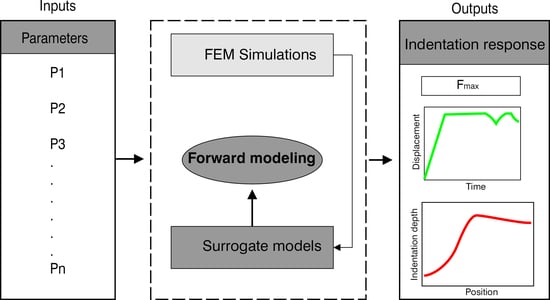
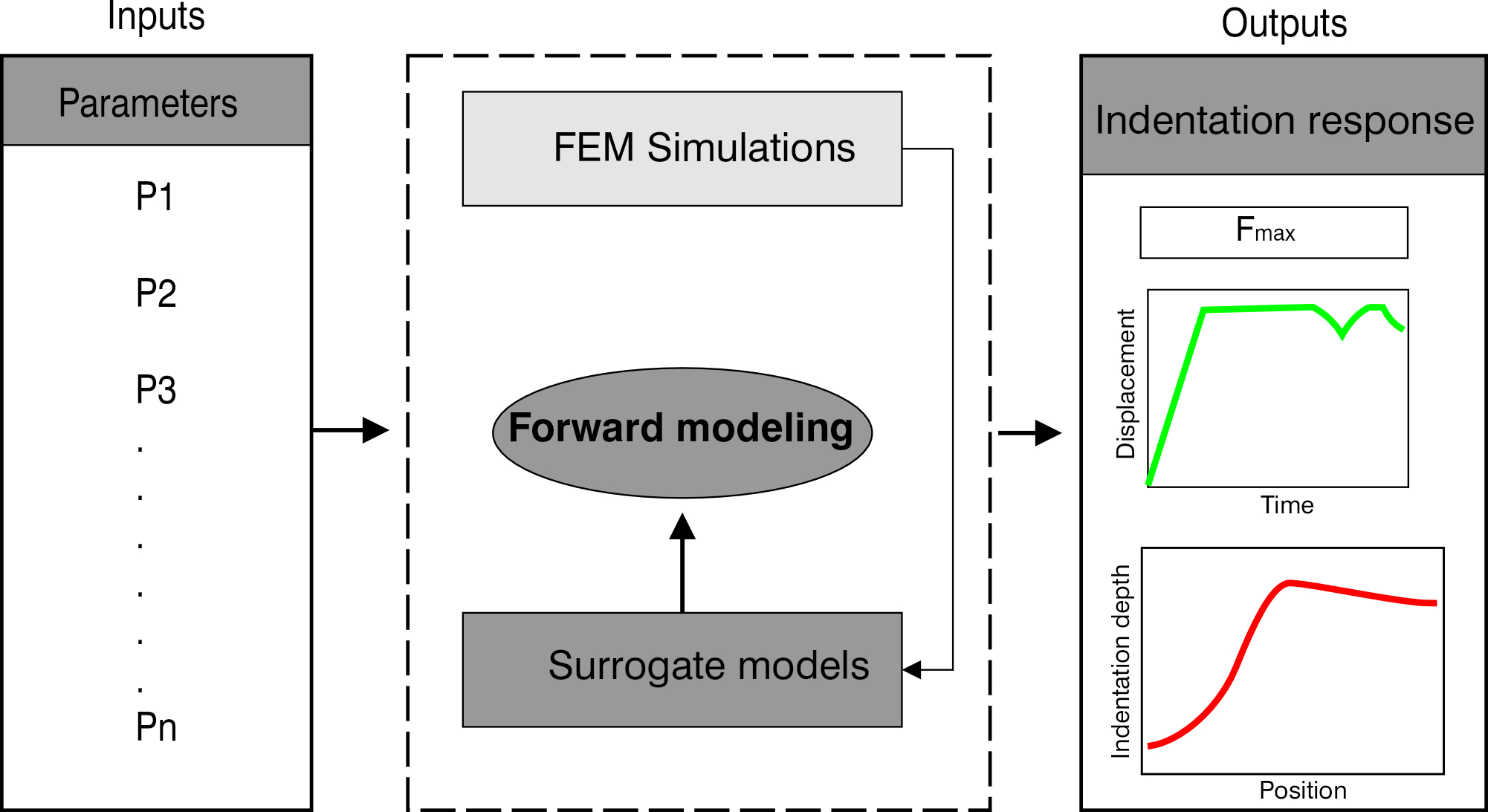
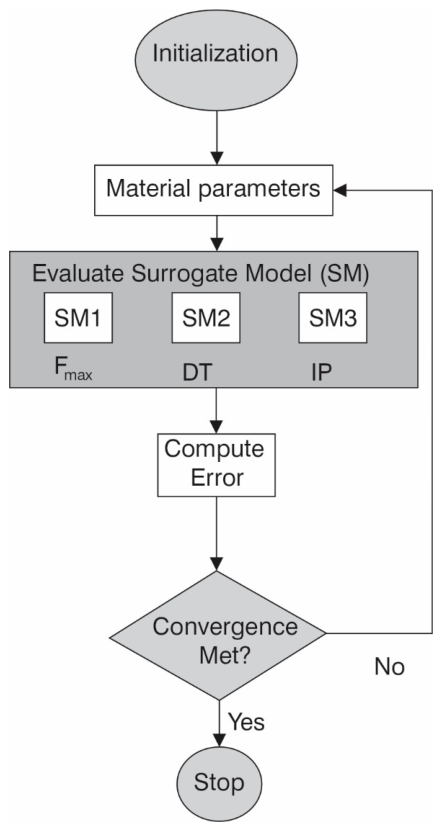
The present study focuses on inverse parameter identification from spherical indentation data by coupling ANN-based surrogate models and optimization methods. A database for the so-called forward problem, i.e., establishing a function between material parameters and indentation results, is generated by finite element simulations covering a pre-defined range of material parameters. Three surrogate models based on ANNs are developed by using a large amount of data, establishing a mapping between the indentation response (maximum indentation force, displacement–time curve, and remaining surface profile) and the representative material parameters. Then, the trained surrogate models, coupled with a powerful optimization algorithm, are employed for inverse identification of material parameters. The performance of the proposed method is evaluated with respect to robustness, accuracy, and computational efficiency. Additionally, the uniqueness of the identified material parameters is analyzed in this work.
2. Constitutive Models for Mechanical Behaviour
In this investigation, the Chaboche [
27] hardening model, including both nonlinear kinematic hardening and isotropic hardening, is employed to capture the cyclic hardening behaviour of materials. It is a widely used hardening model, capable of describing cyclic plasticity, including hardening, softening, the Bauschinger effect, and ratcheting under stress-controlled loading [
28]. In particular, the use of multiple backstress terms, enables the model to reproduce the complex ratcheting phenomena occurring for large stress amplitudes [
29,
30]. At the same time, it can make the parameter handling more complex. Moreover, adding more than three terms does not show a significant improvement in the predictive capability of the model. The studies [
8,
30] showed that two backstress terms are sufficient to describe not only the ratcheting behaviour under moderate stress amplitudes but also the stress–strain (
-
) relations when the applied alternative stress
is smaller than the yield strength
[
30]. In the present work, we also use two backstress terms to avoid parameter redundancy, which might cause limited sensitivity and parameter identifiability. The zeros of the yield function, defined as
based on the von Mises yield criterion [
31], represent the yield surface. Here,
S represents the deviatoric stress tensor,
is the backstress tensor indicating the centre of the yield surface, and
R is the strain-dependent yield resistance of the material. The yielding of material starts once the second deviatoric stress invariant
J2 reduced by the backstress reaches the yield resistance, which also covers isotropic hardening in the form
where
is the initial yield strength,
is the accumulated plastic strain,
controls the rate of isotropic hardening and
is the maximum increase in strength.
The kinematic hardening formulation consists of multiple backstress components, and each backstress term is characterized by two material parameters,
Ci and
as a function of plastic strain, as
where
Ci and
control the initial kinematic hardening modulus and its saturation rate, respectively, with respect to plastic strain increment
.
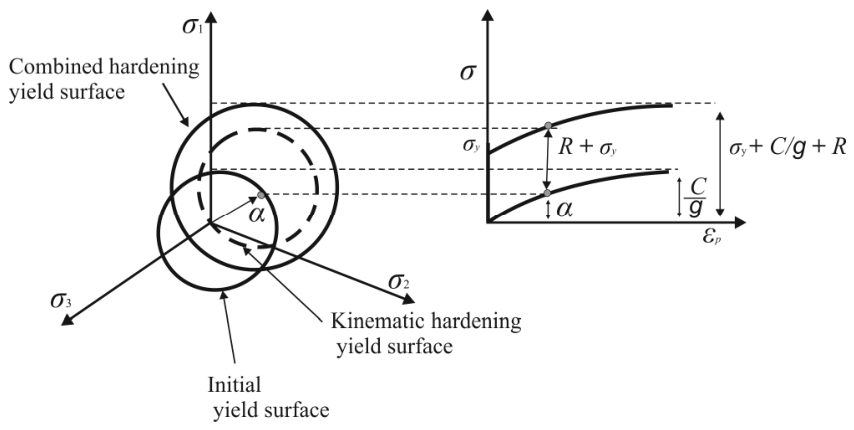
Figure 1 illustrates the evolution of the yield surface, including translation and expansion for kinematic and isotropic hardening, respectively.
To simulate the time-dependent plastic flow, the regularized and integrated form of the classical strain-hardening law, known as the strain-hardening power-law creep model [
32], is implemented in this work. The mathematical representation of the creep model is
It represents the equivalent creep strain rate as a function of current relative stress and accumulated creep strain . Here, q is the equivalent stress, is a reference equivalent stress, is the reference strain rate, and n and m are stress and strain hardening exponents, respectively.
3. Forward Model of Indentation Test
3.1. Finite Element Modelling of Indentation
A two-dimensional (2D) axisymmetric FEM model is developed for the simulation of the indentation process by implementing the commercial software ABAQUS 2022 [
32]. The development of this FEM model is inspired by a previous study [
9] that validates the 2D and 3D indentation models by calibrating indentation experiments for inverse analysis. Due to the rotational symmetry of the model, only the meridional section is considered, which reduces the numerical calculation cost and yields a comparable accuracy in contact response to that of a three-dimensional model [
9].
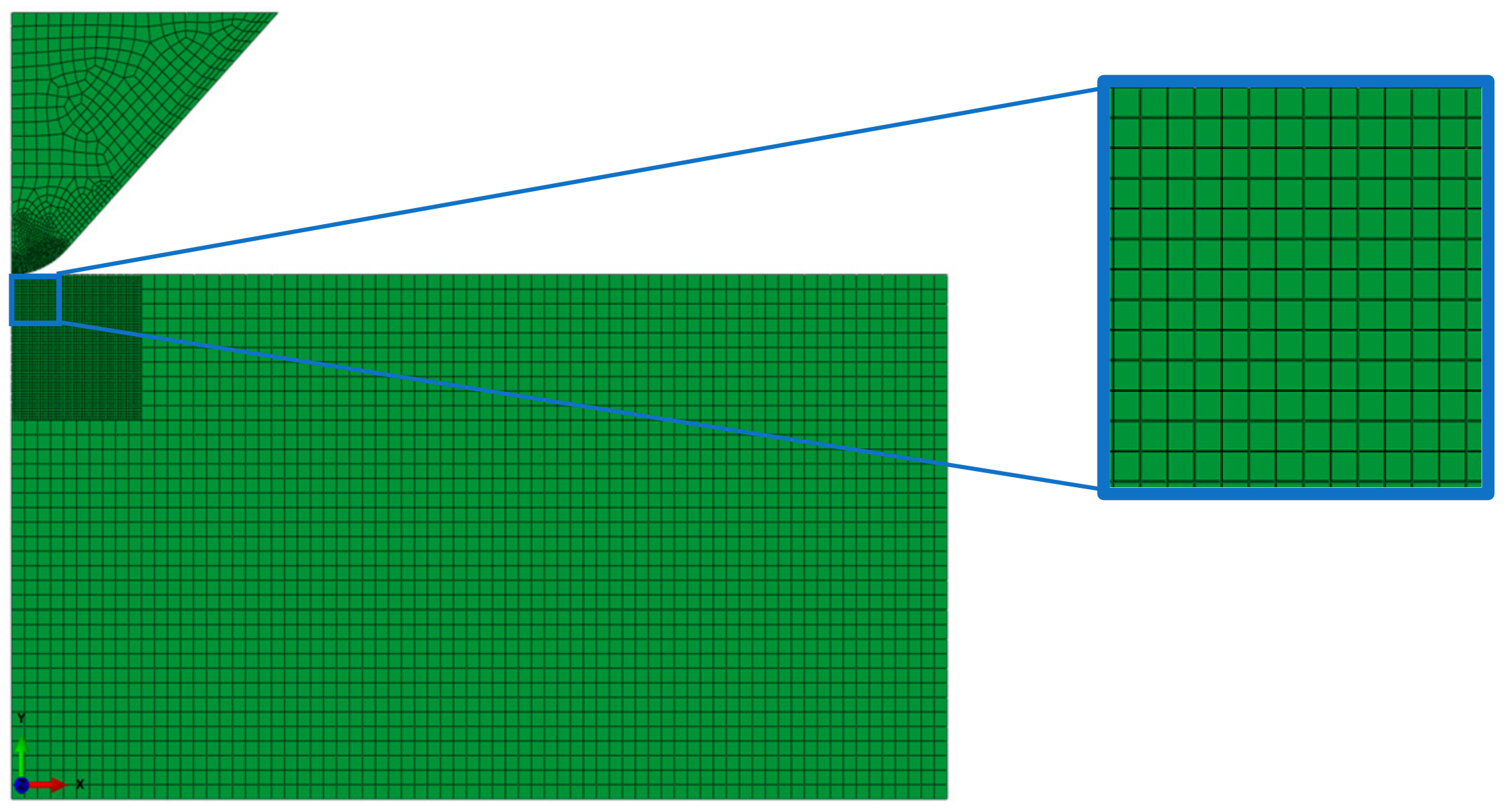
Figure 2 depicts the geometry of the used 2D axisymmetric FEM model. It consists of a spherical indenter of radius 30 µm, defined as an elastic indenter, and is allowed to move only in the vertical direction. The Young’s modulus and Poisson’s ratio for the elastic indenter are 1100 GPa and 0.11, respectively, mimicking the elastic properties of diamond. The load is applied to the surface of the indenter. The probe is completely fixed at the bottom, and displacement is restricted to the symmetry axis. A surface-to-surface type of interaction is used to establish contact between the indenter and the probe. Based on the study [
9], describing the friction effect between a spherical indenter and the specimen, the friction coefficient is set to 0.1 in this work. The entire structure follows the constitutive modelling behaviour described in
Section 2. A refined mesh size of 0.5 µm is applied particularly for the contact region of the specimen beneath the indenter, while the coarser mesh is adopted away from the contact area. The type of elements is CAXBR. By following this pattern of discretization, the numerical stability of the simulations is ensured.
3.2. Data Generation by FEM Simulations
To generate the dataset for the training of the surrogate forward models, a comprehensive FEM simulation campaign is conducted. In this study, the unknown material parameters comprise the initial yield stress (
), three kinematic hardening parameters (
,
,
), two isotropic hardening parameters (
), and two creep parameters (
). In total, there are eight material parameters that need to be identified in this work. All other model parameters are kept constant; in particular, the Young’s modulus and Poisson’s ratio are kept fixed at 211 GPa and 0.3, respectively, for all simulations. The ranges for all variable material parameters that are considered as input variables for the training of the forward surrogate models are given in
Table 1. Those parameters cover a rather broad range of material behaviour, which is meant to include in particular steels and other high-strength alloys. At the beginning of the study, each material parameter was assigned to three discrete levels, resulting in a full-factorial design of experiments (DoE), which is employed to systematically explore the entire parameter space, resulting in 3
8 = 6561 unique combinations of parameters. However, the initial training results indicated that the data on this DoE grid is not sufficient to get reliable surrogate models. Therefore, the dataset has been augmented by approximately 1900 additional off-grid simulations, where the material parameters have been selected randomly on intermediate values between the defined levels of the full-factorial DoE, which significantly improved the performance of the surrogate models.
For each parameter combination, an FEM simulation is performed to compute the corresponding indentation response, which serves as the output. This approach ensures the uniform sampling of the parameter’s input domain, enabling the model to learn the underlying nonlinear relationships between the input parameters and the indentation response. The simulations are performed in two steps. First, displacement-controlled simulations are conducted up to 20% of the indenter radius to extract the maximum indentation force. Then, force-controlled simulations are performed by using the previously extracted force. The following force–time profile is applied to all simulations and comprises one indentation procedure: The indenter is loaded to the maximum indentation force over 10 s and held for 20 s to capture the time-dependent material response. Then it is unloaded to 1% of the maximum force, followed by reloading, a second holding, and a final unloading, where each step has a duration of 5 s. These simulation protocols are based on the indentation experiments, which are the ultimate target of the subsequent investigations.
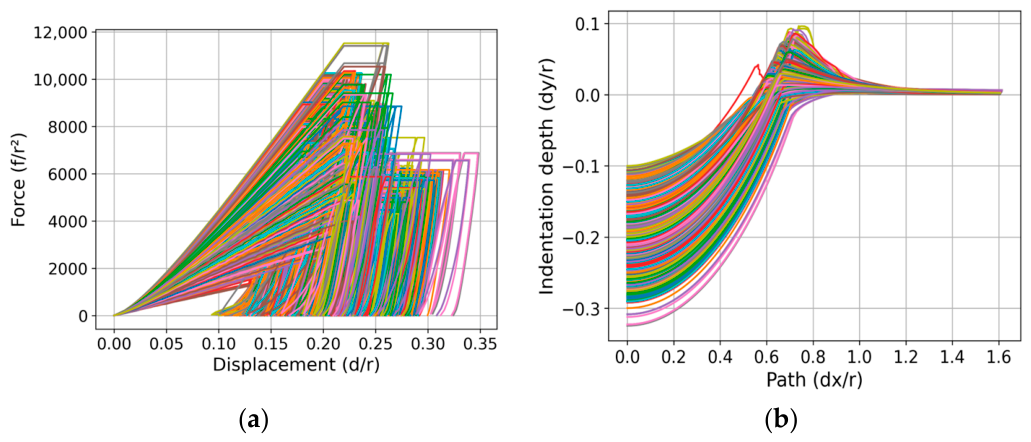
The forward database generated by FEM simulations is shown in
Figure 3. It visualizes the diversity of the indentation response, e.g., force–displacement curves and imprint profiles for all parameter combinations. Here, all the maximum indentation forces and the displacement–time profiles are also shown by force–displacement curves; see
Figure 3a. However, the training data comprise maximum indentation forces, displacement–time curves, and imprint profiles as outputs. Note that all generated data are normalized according to the radius of the spherical indenter, which is 30 μm in this study.
3.3. Surrogate Model-Based on Neural Networks
To approximate the FEM response, three forward surrogate models are developed using a multilayer perceptron (MLP). This method is selected after performing a comparative study between the performance of Random Forest Regression (RFR), Support Vector Regression (SVR) and MLP. Among all these methods, MLP consistently provided significantly improved predictions for all developed forward models. In the present work, only the results based on the MLP architecture are presented. The input layer consists of eight input material parameters, and the output layer is formed by the indentation response. All surrogate models are trained using the same inputs, targeting different outputs, namely, maximum indentation force (IF), displacement–time curve (DT), and imprint profile (IP). In the case of DT and IP, the models are trained to predict the entire response curve in a single forward pass. For each model, multiple neurons form the output layer corresponding to their discretized points. The output response for DT is formulated by 250 discretization or sampling points, while the IP is represented by 96 points. Here, the sampling points of IP are truncated beyond the zero-crossing point, as it contains low informative features that can negatively influence the learning of dominant imprint characteristics. The training after truncating all imprint profiles has significantly improved the accuracy of the IP model. The sampling points are equidistant in time for the DT curve and also with respect to the path along the surface for the indentation profile. Concerning the architecture of the ANN, two hidden layers with different numbers of neurons are used to construct the surrogate models for both DT and IP, whereas only one hidden layer is found to be sufficient for the model to predict the IF. The optimal architecture for each surrogate model is selected based on prediction accuracy and generalization capability. For the hyperparameter optimization, an N-fold splitting of the normalized dataset into 80% training and 20% testing subsets is applied. Then, the final training is performed for 100% of the training data. Finally, all trained surrogate models are validated on the same validation dataset consisting of 254 samples generated at random intermediate points between the nodes of the DoE grid. This validation dataset has neither been used for training nor for hyperparameter optimization.
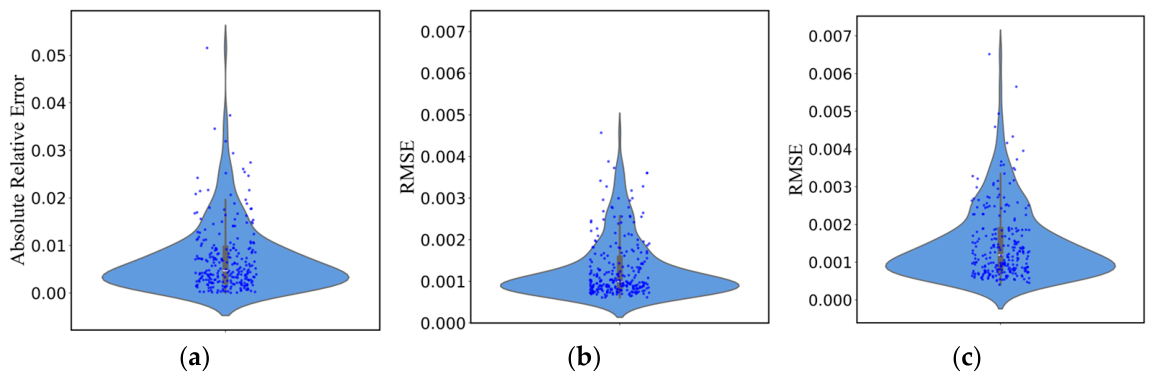
All surrogate models showed a very good approximation of the FEM results, offering a significant reduction in computational cost. To quantify the accuracy of each trained surrogate model, violin plots are employed to visualize the error distributions at the overall prediction of the IF, DT, and IP, respectively; see
Figure 4. The predictive capability of each model is evaluated on the same validation dataset using the different error metrics appropriate to each model’s response. For the prediction of the IF, the model assessment is represented by the absolute relative error between the predicted and reference value of the maximum indentation force.
Figure 4a illustrates the absolute relative error distribution with an average of 0.0072. In this case, the maximum relative error of 0.0515 and a median error of 0.0047 are found. This indicates the accuracy of the peak maximum force within an acceptable range across the validation set. In indentation-based inverse modelling, the error between 1 and 5% is acceptable due to the complex nonlinear relationship between material parameters and indentation response. Here, the average relative error of 0.7% is sufficiently low for its practical application. For both DT and IP, the model accuracy is quantified using root mean squared error (RMSE), defined as
, where
and
represent the true and predicted values, respectively and n is the number of data points. The model for DT showed the highest accuracy with a maximum RMSE of 0.0045 and a median error of 0.0009. However, these measurement errors were found to be slightly higher for the imprint profile, which are 0.0056 and 0.0011, respectively. Overall, both models exhibit very good performance, showing an average RMSE of 0.0013; see (
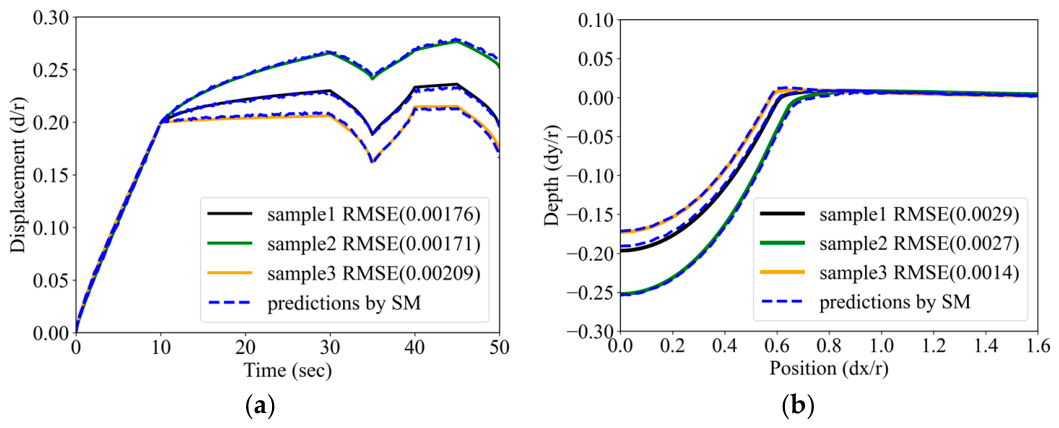
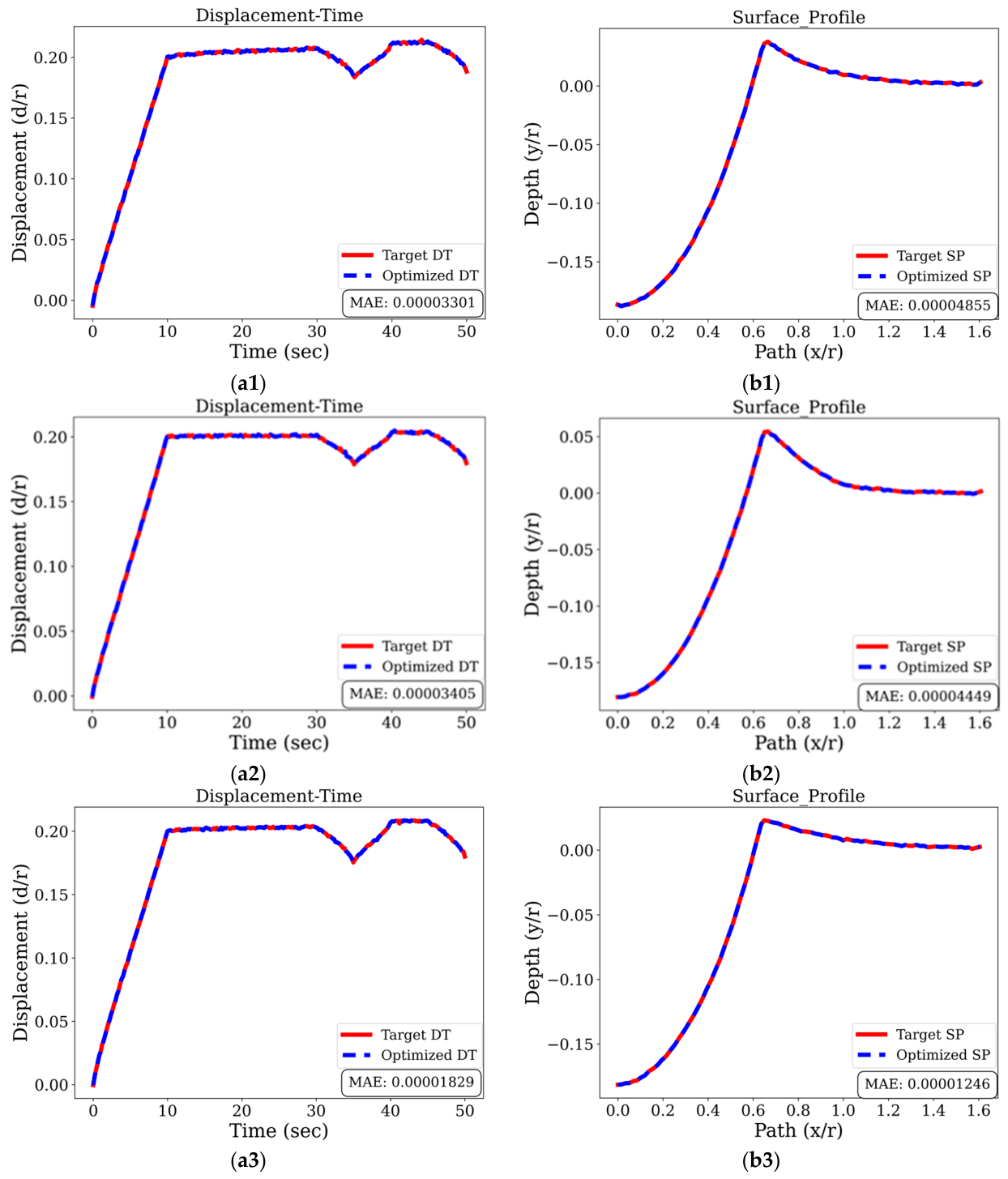
Figure 4b,c). The similar results demonstrate that both surrogate models are equally effective and capable of capturing the evolution of both the DT and the IP. To visualize the small remaining discrepancies between the FEM-based indentation response and the predictions by the corresponding surrogate models, only three randomly selected examples are shown in
Figure 5 and
Table 2.
These samples consist of an off-DoE-grid combination of parameters that are not part of the training dataset. In these examples, the prediction accuracy is measured by following the same error metrics as described above for the violin plots. The surrogate models for DT and IP showed very good comparability between the simulation curves and the predictions by the surrogate models in all three examples. However, a small discrepancy persists depending on the nature of the curves; see
Figure 5.
Table 2 shows the discrepancy between the numerical IF and the prediction by the surrogate model based on the absolute relative error between them. Among these examples, Sample 2 showed the highest absolute relative error of 0.021, and the lowest absolute relative error of 0.003 is shown by Sample 1. The comparative analysis demonstrates that the maximum indentation force model exhibits a relatively inferior performance compared to the models for curve-based prediction. The variation in performance of surrogate models is due to the different nature of the outputs. The maximum indentation force is a single scalar value, which shows higher sensitivity to the nonlinear relationships with input parameters at the peak of the loading stage; meanwhile, the other two models learned well from the multiple output points, enabling them to capture the characteristics of complete curves more effectively.
6. Conclusions
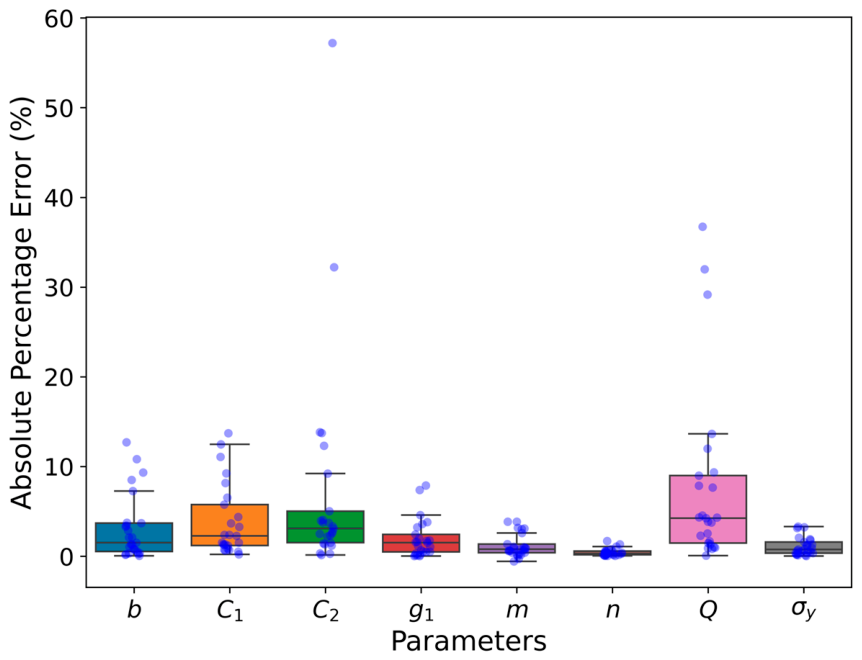
The present study demonstrates a surrogate model-based approach for the inverse identification of material parameters from the micro-indentation data with reduced computational cost. Using artificial neural networks (ANNs), three forward surrogate models were trained on the FEM-based simulation data to predict the maximum indentation force, displacement–time curve, and the imprint profile as a function of the material parameters in a numerically efficient way. While the surrogate models for the displacement–time curve and imprint profile have a very high accuracy, the surrogate model for the maximum indentation force shows the highest relative residual error of all models, with a value of 0.0072. This can be attributed to the strong sensitivity of a single peak value in the region of sharp transition at the maximum loading stage where the behaviour of the material is strongly nonlinear. However, the residual error less than 1% is still acceptable for practical applications. For the validation of the proposed method, the inverse parameter identification is conducted for twenty-eight reference parameter sets that have not been used for training or testing. By applying the numerically efficient surrogate models in a genetic algorithm, eight unknown material parameters for initial yield strength, kinematic and isotropic hardening and creep (, , , , , , , ), are identified with high accuracy. The uniqueness study revealed that the inclusion of the curve-based indentation response, i.e., displacement–time curve and imprint profile, in the objective function yields a good reproducibility of all identified material parameters. It is noted that the exclusion of maximum indentation force from the optimization even improved the uniqueness of identified material parameters. This behaviour can be attributed to the richer information provided by the curve-based targets and the scalar nature of the maximum force. Furthermore, an enhanced reproducibility of parameters was observed by giving the highest weights to the displacement–time curve in the error function. It is also evident that the uniqueness of the identified material parameters gradually improves as the error function approaches a value of zero. A useful indicator for a reliable and consistent identification of material parameters is that the error function has reached a value of less than 10−4. If the final error function has higher values, it is likely that the parameter identification is not yet completed properly. Among all identified material parameters, , , and showed excellent agreement with reference parameters in all cases. In contrast, parameters and showed relatively non-consistent results, as there is only a low sensitivity of the indentation results on these parameters. The genetic algorithm showed its capability to explore the entire parameter space due to the efficiency of the surrogate models. The combination of both played a key role in parameter identification with stable and unique results. Based on these findings, the developed approach is found to be an efficient and robust alternative to computationally expensive FEM simulations and provides a good basis to investigate the inverse analysis for the experimental data.




 ,
,