This is an early access version, the complete PDF, HTML, and XML versions will be available soon.
Article

Process Optimization and Microstructure-Property Regulation of P20 Plastic Mold Steels

1
School of Materials Science and Engineering, Shanghai University, Shanghai 200444, China
2
Composite Research Center, Shanghai University, Shanghai 200444, China
3
State Key Laboratory of Advanced Refractories, Shanghai University, Shanghai 200444, China
*
Author to whom correspondence should be addressed.
Materials 2026, 19(11), 2423; https://doi.org/10.3390/ma19112423 (registering DOI)
Submission received: 6 May 2026 / Revised: 2 June 2026 / Accepted: 4 June 2026 / Published: 5 June 2026
(This article belongs to the Section Metals and Alloys)

Abstract

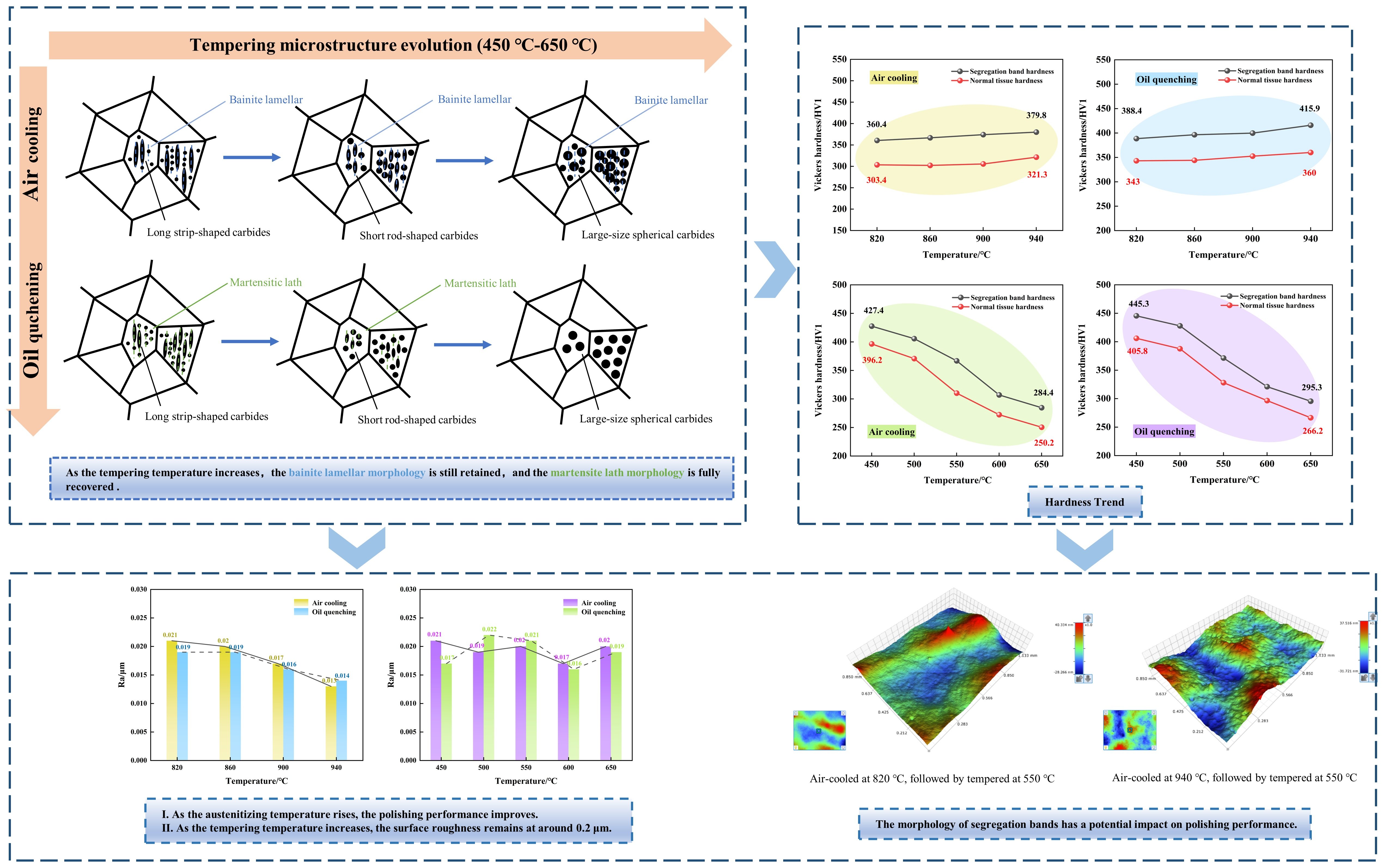
This study systematically investigated the effects of air-cooled pre-hardening and oil-quenched quenching-and-tempering processes on the microstructure, mechanical properties, and polishing performance of P20 plastic mold steel. Increasing the austenitizing temperature from 820 °C to 940 °C resulted in a more uniform carbide distribution, a slight improvement in hardness, and enhanced polishing performance for both processes. However, grain coarsening at 940 °C reduced the impact toughness from 157.6 J to 111.7 J. After tempering at 650 °C, both processes yielded a tempered sorbite microstructure. However, in the air-cooled samples, the carbides were aligned along the bainite lath direction, whereas in the oil-quenched samples, they exhibited an equiaxed, non-directional distribution owing to the complete recovery of the matrix. Austenitizing at 940 °C followed by air cooling and tempering at 550 °C provides the optimal balance of hardness, toughness, and polishing performance. Mitigating elemental segregation and narrowing the segregation bands represent key strategies for further enhancing polishing performance.
Keywords: plastic mold steel; quenching and tempering treatment; mechanical property; polishing performance plastic mold steel; quenching and tempering treatment; mechanical property; polishing performance
Graphical Abstract