Article

Utilization of Robust Zr-Based Metal–Organic Framework for Efficient N2/H2 Separation

School of Chemistry and Chemical Engineering, Shandong University of Technology, Zibo 255000, China
*
Authors to whom correspondence should be addressed.
Materials 2026, 19(11), 2418; https://doi.org/10.3390/ma19112418 (registering DOI)
Submission received: 30 April 2026 / Revised: 19 May 2026 / Accepted: 25 May 2026 / Published: 5 June 2026
(This article belongs to the Special Issue Synthesis and Applications of Metal–Organic Frameworks)

Abstract

The development of energy-efficient separation technologies for nitrogen (N2)–hydrogen (H2) mixtures under conventional industrial conditions remains a critical challenge. Adsorptive separation emerges as a promising strategy, contingent upon the design of high-performance adsorbents with tailored physicochemical properties. In this study, three isoreticular zirconium-based metal–organic frameworks (UiO-66, UiO-66-CH=CH2, and UiO-66-F4) are systematically evaluated for the purification of industrial N2-H2 mixed gases. By integrating static adsorption isotherms, dynamic breakthrough experiments, and molecular dynamics (MD) simulations, we comprehensively characterize the adsorption mechanisms and diffusion kinetics. The results demonstrate that UiO-66-F4 exhibits optimal performance in capturing N2 from N2-H2 mixtures under simulated industrial conditions, owing to its balanced binding affinity, high nitrogen uptake, and favorable micro-/mesoporous diffusion dynamics. This work offers a promising alternative for N2-H2 separation in industrial applications.

1. Introduction

As a kind of essential fuel and energy carrier, hydrogen has been widely applicated in modern industry and emerging energy sources due to having the advantage of zero emissions and being pollution-free [1,2,3,4,5]. Industrial sources of hydrogen include coal gasification, methane reformation, water electrolysis and industrial by-products such as biomass, chlor-alkali, and synthetic ammonia [6,7,8,9,10]. For example, recovering hydrogen from ammonia purge gas is an economic and environmentally benign method [10]. However, the nonpolar N2/H2 pair is one of the most difficult to be separated due to their similar molecular sizes (N2: 3.64 Å, H2: 2.89 Å), similar quadrupole moments (N2: 4.7 × 10−40 C·m2, H2: 0 C·m2), and similar physicochemical properties [8,11]. Compared with other feasible gas separation and purification methods such as condensation, cryogenic rectification, and membrane separation, the technology of adsorptive separation possesses advantages of high efficiency and low consumption, simple technology, and lower industrial-scale construction costs considering the present technical state [12,13,14,15]. Adsorbents with excellent adsorption properties are crucial to the adsorptive separation technique [7,16,17]. As a result, the development of novel adsorptive separation materials, which are more energy efficient than existing materials, will have a significant impact on the economic and environmental costs associated with global H2 production.
Metal–organic frameworks (MOFs) have become a class of representative new porous materials in the fields of molecular capture/adsorptive separation due to their characteristics of flexible and tunable structure, functionally modified pore space, high specific area, and permanent high porosity [18,19,20,21,22,23,24]. Despite extensive research on MOFs, the vast majority focus on synthesis, with limited reports addressing their performance for hydrogen purification, particularly the separation of N2-H2 mixtures, and even fewer investigating this process under dynamic flow conditions [25,26,27,28,29]. Furthermore, the substantial adsorbent quantities required for industrial applications necessitate frameworks that combine excellent adsorption properties with straightforward synthesis to offset operational costs. Zirconium-based MOFs represented by UiO-66 (UiO for University of Oslo) are a fascinating family of robust porous materials with excellent stability, rapid adsorption, low production cost, and ease of regeneration [12,30,31,32]. This makes these frameworks highly attractive for commercial applications. Accordingly, we selected several isostructural UiO-66-type MOFs as candidates to evaluate their performance in separating N2-H2 mixtures. Previous research suggests that the affinity between the frameworks and H2 molecules can be enhanced by exposing a high concentration of open metal sites (OMS) and expanding the π-conjugated system formed by ligand [25,28,33]. Complementing this, our prior work demonstrates that the affinity between the frameworks and N2 molecule was enhanced by introducing F atoms with strong electron-withdrawing ability to the F-pillared-layer frameworks [8]. This enhancement arises because N2 molecules possess a denser electron cloud distribution compared to H2 molecules, leading to stronger induction interactions between N2 molecules and F atoms of the framework [8,34]. Building upon these insights, three analogs with interpenetrative structure, namely UiO-66, UiO-66-CH=CH2, and UiO-66-F4 were selected for adsorptive separating N2 from H2 molecules.
Herein, the adsorptive separation of N2-H2 mixture over Zr-based MOFs (UiO-66, UiO-66-CH=CH2, and UiO-66-F4) was investigated from a thermodynamics and kinetics perspective by combining adsorption experiments and molecular dynamic (MD) simulation. The performance of these hierarchically porous materials was characterized through pure component N2/H2 adsorption isotherms and high-throughput dynamic breakthrough experiments with binary mixtures. Experimental and simulation results jointly demonstrate that UiO-66-F4 exhibits the longest breakthrough time and moderate N2 adsorption capacity, rendering it highly suitable for N2/H2 separation. Its superior separation performance stems from the combined effects of binding site affinity, guest molecule adsorption capacity, and diffusion kinetics within its micro-mesoporous structure. Furthermore, UiO-66-F4’s excellent cyclic stability and recyclability underscore its potential for industrial hydrogen purification from N2-H2 mixtures.

2. Experimental Section

2.1. Materials and Characterization

All raw materials and reagents used for synthesis were purchased from commercial sources and used without further purification. The used gases had the following ultra-high purity: H2 (>99.999%), N2 (>99.999%), and He (>99.999%) was purchased from BaiYan Co., Ltd. (Zibo, China). Powder X-ray diffraction (PXRD) data were collected at room temperature by using a conventional high-resolution (θ–2θ) diffractometer (D8-ADVANCED, Bruker, Germany) with Cu-Kα radiation at a scanning rate of 0.2° s−1 from 3° to 50°. The relevant pore characteristics of the adsorbents (BET specific surface area, pore volume, pore size) are obtained from N2 adsorption at 77 K and relative pressure (P/P0) up to 1 using a Micromeritics 3Flex surface characterization analyzer (Micromeritics Instrument Corporation, Norcross, GA, USA). FT-IR spectra of the samples were recorded by a Nicolet 5700 spectrometer (Thermoelectric, Waltham, MA, USA) in the range of 50–7800 cm−1.

2.2. Synthesis of UiO-66 Type Zirconium-Based MOFs

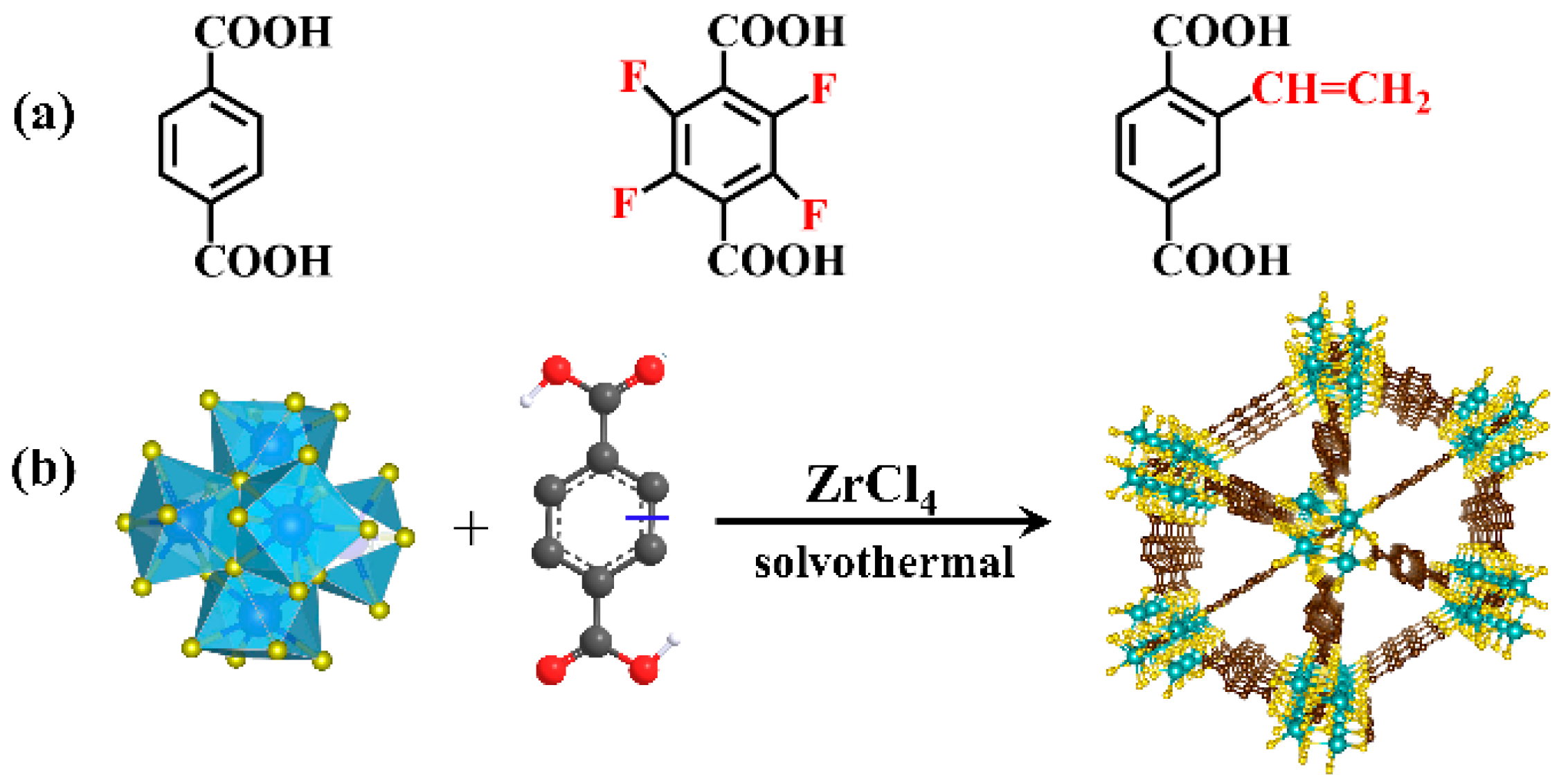
Isostructural UiO-66 samples were synthesized via a modified solvothermal protocol based on established methodologies [30,35,36,37,38], utilizing ZrCl4 as the metal precursor (Scheme 1). Specifically, HBr acid-mediated modulation was incorporated during synthesis, resulting in UiO-66-nHBr variants (where n denotes the molar ratio of HBr to ZrCl4). Two isostructural MOF derivatives with distinct pore architectures were obtained: UiO-66-1HBr (U1) and UiO-66-5HBr (U5). Additionally, UiO-66-CH=CH2 (Uvinyl) and UiO-66-F4 (UF4) were prepared by introducing 2-vinylterephthalic acid and 2,3,5,6-tetrafluoroterephthalic acid ligands, respectively. All as-synthesized materials underwent post-synthetic activation via vacuum treatment at 423 K for 12 h prior to characterization and adsorption performance evaluation.

2.3. Pure-Component Adsorption Experiments

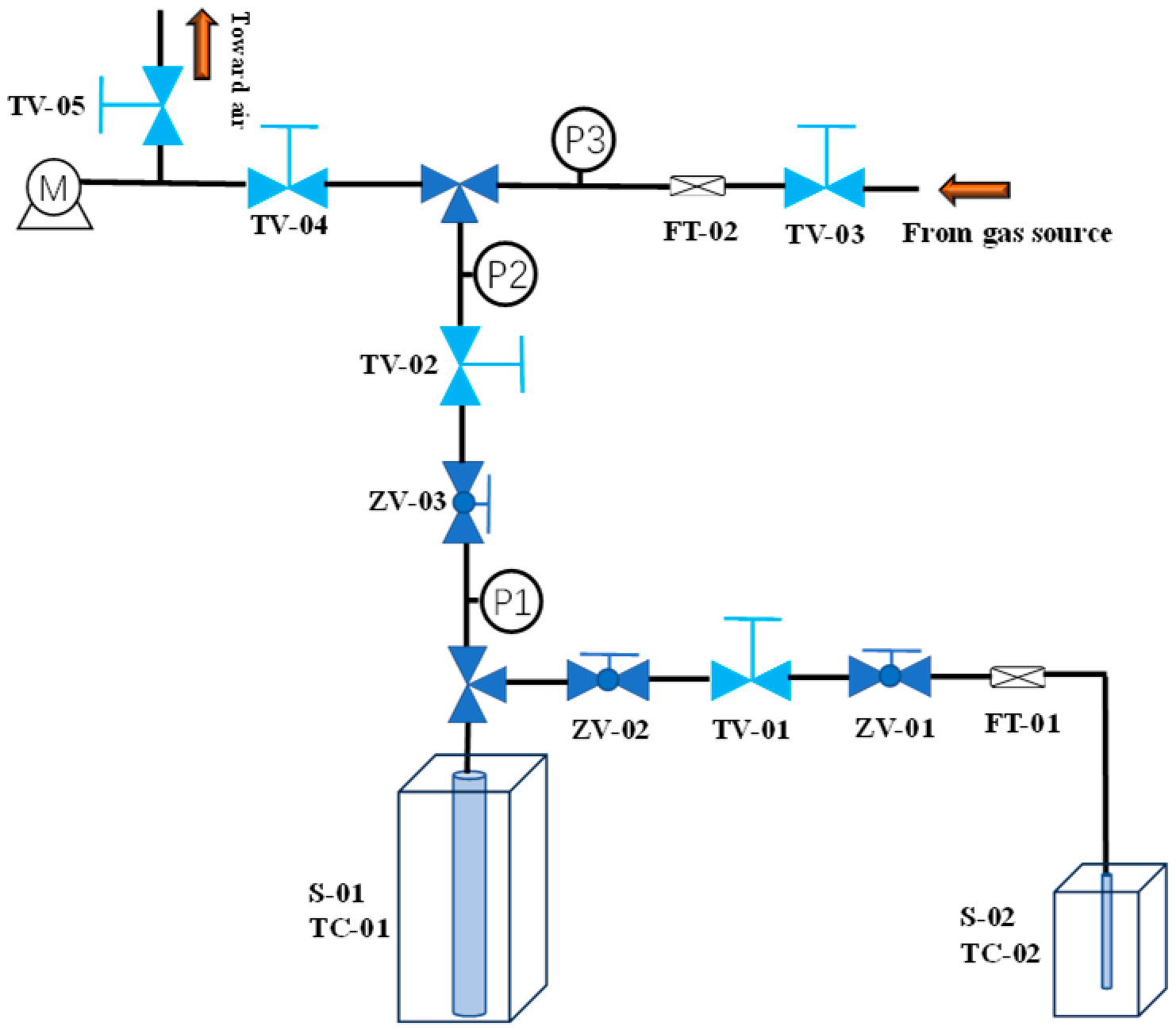
Pure-component adsorption measurements were performed at pressures spanning from 0 to 4000 kPa using a self-assembled static volumetric apparatus (equipped with key components from Shanghai Huotong Experimental Instrument Co., Ltd., Shanghai, China), as illustrated in Figure 1. Approximately 500 mg of sample was loaded into the adsorption slot, after which the entire system was hermetically sealed. Prior to the determination of adsorption isotherms, the free-space volume was measured utilizing helium at room temperature [39]. The gas uptake was calculated based on the material balance principle when expanding a known amount of gas from the reference slot to the adsorption slot. The criterion for achieving adsorption equilibrium was defined as a pressure change of less than 0.5% within 600 s. Subsequently, the gas adsorption amounts on the sample at various pressures were calculated [40,41]. Before each test, the entire sealed system was evacuated for 30 min.

2.4. Isotherm Fitting

Based on the calculation-derived characteristics of experimental data, optimized fitting parameters were systematically determined for curve fitting. This study employed the Langmuir (Equation (1)) [42] and Freundlich (Equation (2)) [43] models to fit the single-component adsorption isotherms of N2 and H2, respectively. Through comparative analysis of the plotted adsorption isotherms and fitting curves, the influence patterns of modified materials on the adsorption performance of H2 and N2 were systematically elucidated.
q e q = q m p p + 1 b
q e q = k p t
where qeq is the gas uptake (mmol/g), qm is Langmuir volume reflecting the maximum uptake of the adsorbent (mmol/g), p is pressure (kPa), b (kPa−1) and k (mmol g−1 kPa−t) are constants associated with temperature and adsorption heat, and t is a constant related to temperature, pore distribution, and adsorption intensity.

2.5. Isosteric Heat (Qst) and Ideal Adsorption Selectivity (SN2/H2)

To determine the coverage-dependent isosteric heat of adsorption (Qst), the pure-component adsorption isothermal data were modeled with the Virial expansion method [28,44]. The adsorption equilibrium was described by the following equation:
l l n P = l n N + 1 T i = 0 m a i N i + j = 0 n b j N j
where P (kPa) represents the equilibrium pressure, N (mg/g) denotes the gas uptake, T (K) is the temperature, and ai and bi are temperature-independent virial parameters [44,45]. The parameters m and n were optimized to ensure a robust fit to the experimental isotherm data. Subsequently, the Qst was calculated via the following equation:
Q s t = R × i = 0 m a i N i
where R is the gas constant (8.314 J mol−1 K−1). This approach enables the extraction of energy landscapes governing adsorbate–adsorbent interactions under varying coverage conditions.
To predict competitive adsorption behavior in multicomponent systems, the Ideal Adsorbed Solution Theory (IAST) was employed to evaluate the adsorption separation selectivity of N2-H2 mixture (SN2/H2) on Zr-based MOFs. The IAST model integrates the pure-component adsorption isotherms derived from the Langmuir and Freundlich models, with fitting parameters obtained from the virial expansion analysis. The selectivity was quantified using the following expression:
S N 2 / H 2 = x N 2 / x H 2 y N 2 / y H 2 = q N 2 / q H 2 p N 2 / p H 2
where qi and pi are the molar loading and partial pressure of component i in equilibrium, respectively. This framework provides a theoretical basis for evaluating the separation efficiency of Zr-MOFs under mixed-gas conditions, bridging single-component adsorption data to practical gas separation scenarios.

2.6. Dynamic Column Breakthrough Experiments

Dynamic column breakthrough experiments were conducted on a commercial multicomponent gas adsorption system (Mixsorb S, 3P INSTRUMENT, Germany) integrated with a mass spectrometer (RGA, MKS, USA) as the detection unit. The cylindrical adsorption column featured an inner diameter of 4.57 mm and an effective length of 45 mm. Prior to experimentation, the adsorbent underwent thermal activation under He flowing (10 mL·min−1) at 473 K (external heater setting, corresponding to column temperature ≈ 413 K) for 6 h. Subsequent breakthrough tests were performed under three distinct feed conditions: (1) H2/N2/He (10/10/80, vol%; carrier gas: He) at 30 mL·min−1 total flow rate; (2) H2/N2/He (10/20/70, vol%) at 30 mL·min−1; (3) H2/N2/He (20/10/70, vol%) at 25 mL·min−1. All experiments were executed under controlled pressure and temperature regimes. Post-test regeneration of the adsorbent was achieved through He purge (10 mL·min−1) at 453 K (external heater setting, column temperature ≈ 393 K) for 3 h prior to each successive run. The experimental sequence ensured complete desorption of previously adsorbed species between cycles, maintaining adsorbent integrity for comparative analysis.

2.7. Molecular Dynamics (MD) Simulations

Molecular dynamics (MD) simulations were performed to explore the confined diffusion behavior of gas molecules within UiO-type MOFs. First, the Vienna ab initio Simulation Package (VASP 6.4.2) [46] was utilized for the geometric optimization of the Cambridge Crystallographic Data files of U1 and UF4. The Perdew–Burke–Ernzerhof (PBE) density function [47] in combination with D3 dispersion correction [48] was used in this optimization procedure. The density cut-off was set at 500 Ry, and the overall energy converged to within 10−6 eV. To calculate the atomic charges of the frameworks, the Density Derived Electrostatic and Chemical (DDEC6) [49,50] method was adopted. Subsequently, Grand Canonical Monte Carlo (GCMC) simulations were performed by the RASPA code [51] using the polarizable force field parameters based on DREDING and Universal Force Field (UFF) [52]. In the GCMC simulation, both the frameworks and guest molecules were treated as rigid molecules. Specifically, H2 and N2 molecules were modeled as three-site rigid molecules. All atomic or metal ionic polarizabilities were obtained from references [53,54]. To ensure the accuracy of the force field, global scale factor ζ (ζ = 0.09) and scaling factors λ were induced to adjust the polarizability and the Lennard-Jones energy parameters respectively. This adjustment was crucial to ensure that the experimental isothermal adsorptive data were in good agreement with the simulated results. All MD simulations were performed within the NVT ensemble and were run for a total duration of 1 ns with a time step of 1 fs. The simulations consisted of 1 × 10⁶ cycles, including 2000 initialization cycles and 2000 equilibration cycles.

3. Results

3.1. Structural Characterization of Isostructural UiO-66 Samples

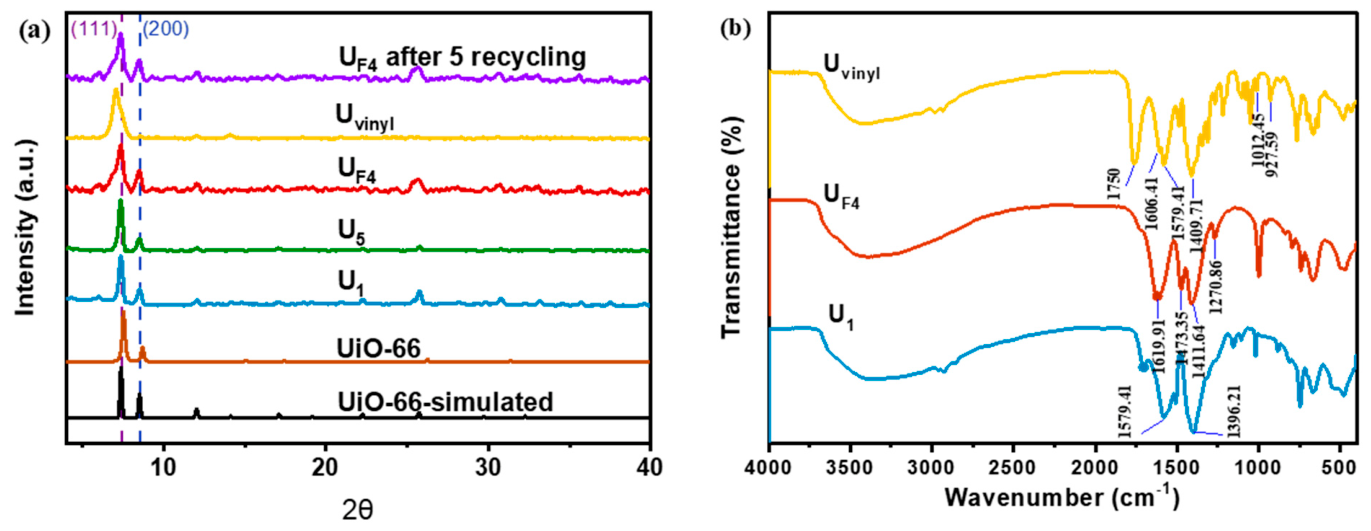
The crystalline integrity of the synthesized isostructural UiO-66 samples was first evaluated via powder X-ray diffraction (PXRD) analysis (Figure 2a). The observed diffraction peaks matched well with literature-reported values for isostructural UiO-66 frameworks [12,31,37], confirming the successful fabrication of high-purity crystalline materials via the solvothermal synthesis route. The main diffraction peaks are located at 2θ = 7.3° and 8.5°, corresponding to the (111) and (200) planes, respectively. Notably, the absence of extraneous peaks further attests to the absence of secondary phases, underscoring the structural homogeneity of the samples.
Complementary Fourier-transform infrared spectroscopy (FT-IR) analysis (Figure 2b) provided molecular-level insights into the framework composition. UiO-66-type materials show complete disappearance of the broad O-H stretch (2500–3300 cm−1), replaced by asymmetric/symmetric COO vibrations at 1579 cm−1 and 1396 cm−1, confirming Zr4+-carboxylate coordination. All spectra lack free carboxylic acid peaks, confirming deprotonation and framework formation. Uvinyl retains vinyl C=C stretch at 1606 cm−1 and =CH2 deformation at 1012 cm−1 and 928 cm−1, while its COO bands shift to 1579 cm−1as) and 1410 cm−1s), indicating minimal electronic perturbation from conjugation. The adsorption band at 1750 cm−1 is also observed in the spectrum of Uvinyl, which we assign to either a combination band of δ(H2O) from trace adsorbed water with framework vibrations, or the C=O stretching vibration of dimers from uncoordinated -COOH groups [55,56]. UF4 exhibits a high-frequency shifted νas(COO) at 1620 cm−1 (due to F-induced electron withdrawal) and intense C-F stretches (1271 cm−1), suggesting a slight alteration in the coordination mode of the carboxylate group with Zr. The distinct splitting of the aromatic C=C skeletal vibration observed at 1473 cm−1 and 1412 cm−1 can be attributed to the strong electron-withdrawing inductive effect induced by the tetrafluoro substitution pattern. This substitution-induced electronic perturbation disrupts the symmetry of the benzene ring, resulting in vibrational mode separation that manifests as two resolved absorption peaks.
As summarized in Table 1 and Figures S1–S4, the isostructural UiO-66-type samples exhibit gradient characteristics in pore structures. U1 (SSA = 1527 m2/g, Vp = 0.63 cm3/g) and U5 (SSA = 1303 m2/g, Vp = 0.55 cm3/g) exhibited microporous-dominated structures (MPW = 5.1~5.4 Å), with their ultra-high surface area and pore volume making them ideal candidates for gas storage. Uvinyl (SSA = 801 m2/g, APW = 43.7 Å) showed a comparable average pore width to U1 (APW = 42.6 Å) but with significantly enhanced mesoporous contribution. Despite reduced specific surface area (702 m2/g) and pore volume (0.41 cm3/g), UF4 (APW = 79.2 Å) exhibits a shift toward larger pore size distribution. This structural transition is corroborated by the characteristic H4-type hysteresis loop in N2 adsorption–desorption isotherms (Figure S4), indicative of mesoporous structure rearrangement. UF4 shows a much larger BJH average pore width than U1, indicating the presence of significant mesoporosity. This mesoporosity mainly comes from ligand defect-induced pore structures. The isostructural UiO-66 materials displayed continuous evolution from microporous to micro-mesoporous structures, with U1 achieving an optimal balance between adsorption capacity and mass transfer efficiency, while UF4’s structural features may be suitable to address specific applications after weighing relevant considerations.

3.2. Adsorption Isotherms

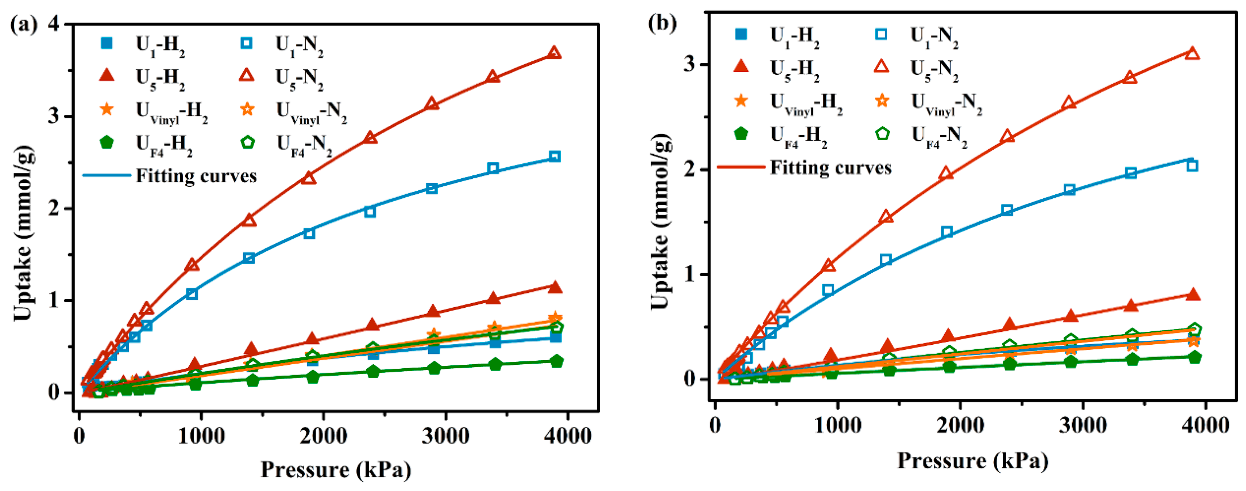
Adsorption isotherms are crucial for understanding the interaction between adsorbates and adsorbents. To this end, the gas isothermal equilibrium adsorption data of pure N2 and H2 were measured at 278 K and 298 K, and the results are plotted in Figure 3. Across all experimental conditions, the adsorption capacities of N2 were consistently higher than those of H2 within the 0–4000 kPa pressure range. It can be attributed to the higher induced adsorption potential formed between zirconium metal and N2 molecules via back-bonding interaction [29,57]. Additionally, molecular quadrupole moments and molecular sizes also play significant roles [11]. Both N2 and H2 uptake showed a downward trend with increasing temperature, indicating that these adsorption processes are typical thermodynamically controlled physisorption. Over the tested pressure and temperature ranges, the order of N2 uptake from high to low was: U5, U1, Uvinyl, and UF4. For hydrogen, U5 exhibited the highest adsorptive capacity, followed by Uvinyl, U1, and UF4. At 278 K and approximately 4000 kPa (Figure 3a), the experimental adsorption capacities of U5, U1, Uvinyl and UF4 reached 3.68 (N2) and 1.13 (H2), 2.56 (N2) and 0.61 (H2), 0.79 (N2) and 0.81 (H2), 0.71 (N2), and 0.34 (H2) mmol/g, respectively. As shown in Figure 3b, at 298 K and 4000 kPa, the adsorption capacity of U5 for N2 and H2 decreased to 3.09 and 0.80 mmol/g, respectively. The N2 adsorption capacities of Uvinyl and UF4 were less remarkable compared to U1 and U5. This may be because U1 and U5 have larger pore volumes than UF4 and Uvinyl (Table 1). In fact, at high pressures, pore volume is a key driving force for adsorption [33]. Moreover, the relatively large adsorption capacity of Uvinyl for H2 is consistent with the conclusion proposed by Yaghi et al., which states that an expanded π-conjugated system will improve the H2 adsorption capacity [58]. Nevertheless, the H2 adsorption capacity was still lower than that of N2. UF4 had the lowest uptake and the smallest slope, which makes it easier to be regenerated. In the low-pressure range, the adsorption isotherms were irregular. This was due to the interference of atmospheric gases that entered the cell when it was transferred from the regeneration station to the analysis port, even though the amounts of gases were extremely small [33]. Given these results, it is challenging to intuitively determine whether the combination of these properties is favorable for the adsorptive separation of N2-H2 mixture using UiO MOFs. The potential performance of these Zr-based analogs in separation requires further investigation through a combination of theoretical analysis and dynamic breakthrough experiments.
By analyzing the original isothermal adsorption data, the ideal adsorption selectivity of each adsorbent for the N2-H2 mixture can be assessed based on a specific adsorption model. As depicted in Figure 3 and Figures S13–S16, within the measurement range, the Langmuir model was employed to fit all the experimental isotherms of N2, whereas the Freundlich model was used for those of H2. The fitted isotherms showed excellent agreement with experimental data (R2 ≥ 0.99), and the detailed fitting parameters are presented in Table S1.

3.3. Isosteric Heat of Adsorption (Qst) and Ideal Selectivity

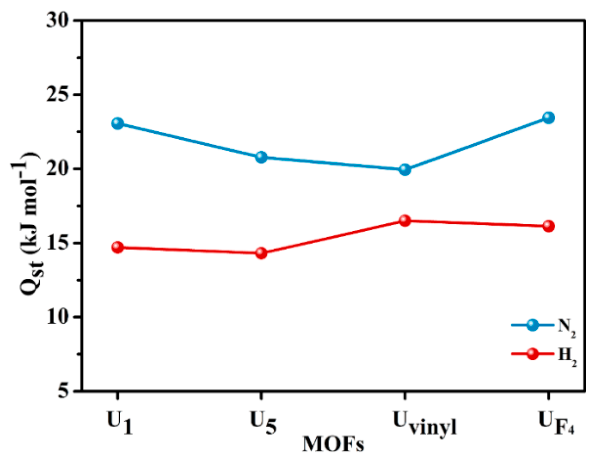
Apart from adsorption capacity, the isosteric heat of adsorption (Qst) is another crucial parameter that helps to understand the trend, state, and spontaneity of the adsorption process, and to evaluate the interaction strength between adsorbate and adsorbent. The relevant parameters for fitting the adsorption heat using the Virial expansion method are detailed in the attached Figures S5–S12. The differences in Qst for UiO MOFs are shown in Figure 4 and compared at nearly zero coverage (with a loading of 0.002 mmol/g).
As shown in Figure 4, on the given UiO MOFs at a loading of 0.002 mmol/g, the Qst of N2 adsorption was consistently higher than that of H2. Among these frameworks, N2 binds most strongly to UF4, followed by U1, U5, and Uvinyl, with initial adsorption enthalpies of 23.4, 23.0, 20.8, and 19.9 kJ/mol, respectively. For H2, the Qst values in descending order are: Uvinyl (16.5 kJ/mol), UF4 (16.1 kJ/mol), U1 (14.7 kJ/mol), and U5 (14.3 kJ/mol), indicating that the preferential adsorption of H2 molecules by Uvinyl and UF4 was more significant. Uvinyl and U5, especially Uvinyl, showed relatively small differences in the initial adsorption heat of H2 and N2, suggesting weak differential adsorption effects. U1 and UF4, by contrast, exhibited stronger differential adsorption effects. Overall, the combined effects of pore size changes and the introduction of functional groups on the initial adsorption enthalpies may outweigh the negative effects of increased coordination defects on the adsorption heat. Naturally, the main interaction between the material and adsorbate is Coulomb attraction, resulting from the synergy of open metal sites (OMS), functionalized pores, and controlled preparation [28].
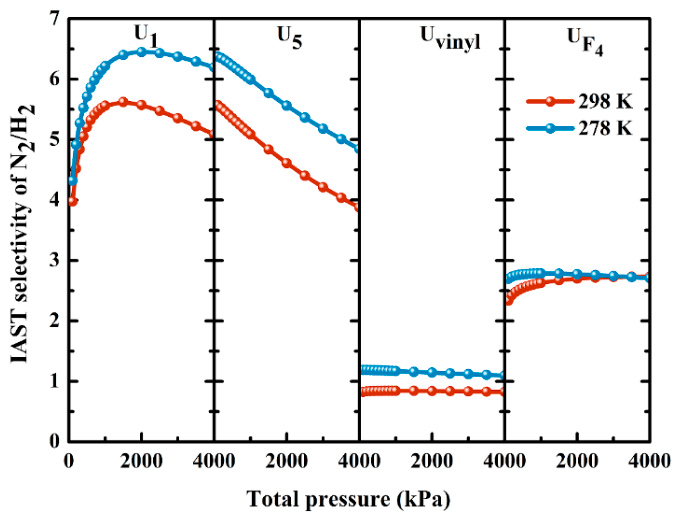
Figure 5 exhibits the IAST selectivity of N2-H2 mixture (N2/H2, 2/1, v/v) on Zr-based MOFs at 278 K and 298 K. As depicted, the N2/H2 selectivity values of the UiO MOFs at 278 K were higher than those at 298 K. U1 and U5 had the highest SN2/H2 values, reaching about 6.5 at 278 K, and remaining above 4.0 even when the pressure approached 4000 kPa. Notably, the SN2/H2 values of U1 increased with pressure, peaking at 6.4 at 2000 kPa and 298 K. This may be related to nonnegligible adsorbate–adsorbate interactions at low coverage [45]. The experimental adsorption selectivity value was close to the simulated value (about 8.0 at 20 bar and 298 K, N2/H2, 3/7, v/v) in reference [7]. However, from an economic perspective of the adsorption process, selectivities greater than 4.0 have limited practical significance [17]. For UF4, the N2/H2 separation selectivity was about 3 across the entire 0~4000 kPa pressure range, with higher selectivity at low pressures. Compared with other Zr-based MOFs, Uvinyl exhibited a low predicted selectivity of about 1.0, which may be attributed to the fact that the enlarged π-conjugated system increases the H2 adsorbed amount (nH2), and this was consistent with the adsorption heat and nN2/nH2. For a separation factor less than 2.0, it is challenging to design a satisfactory adsorption separation process [17]. Notably, since the adsorption amount of N2 and H2 on Zr-based MOFs is low at low pressure, especially UF4 and Uvinyl, there are some uncertainties in the single-component adsorption isotherm fitting.

3.4. Dynamic Column Breakthrough Experiments

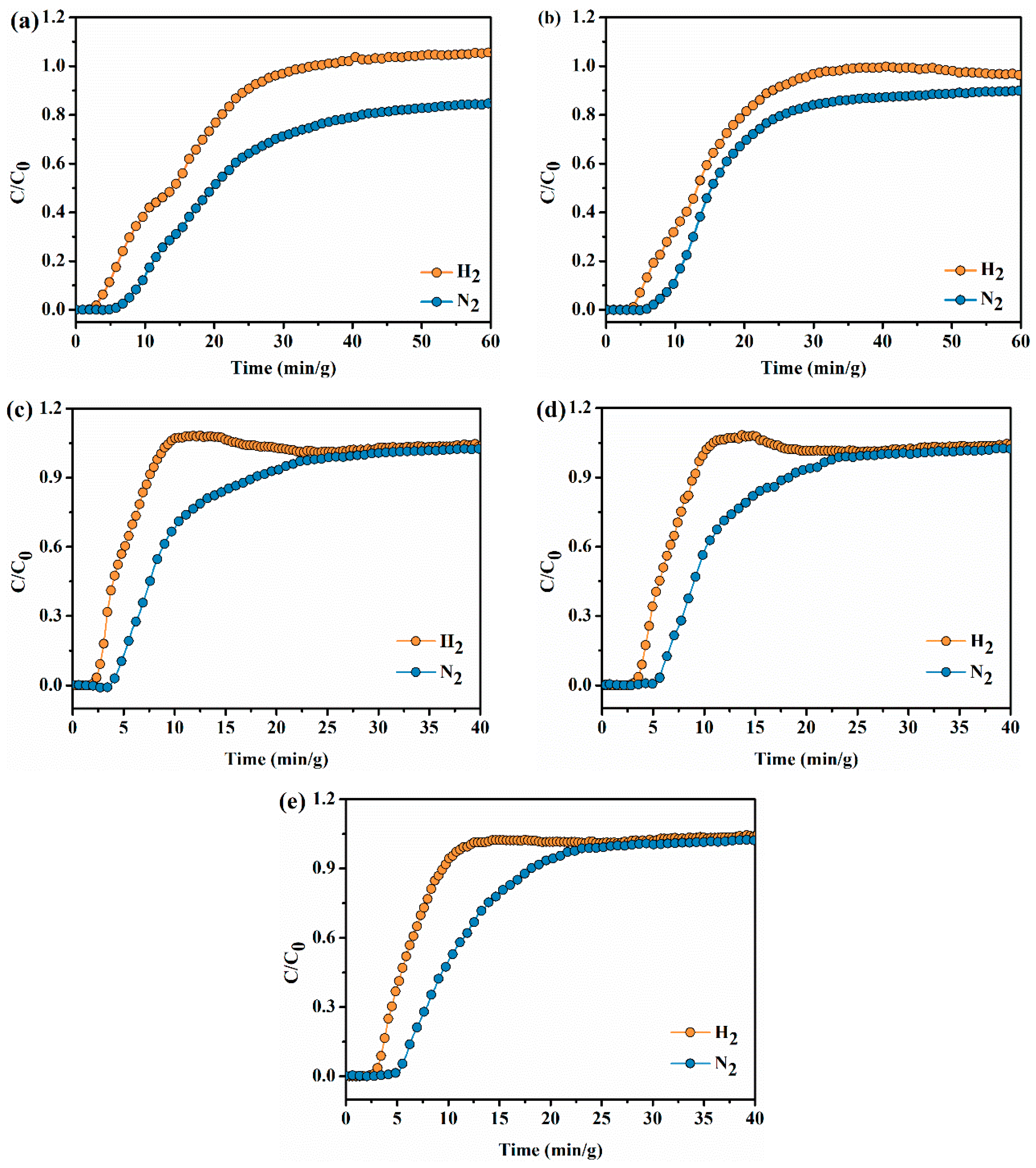
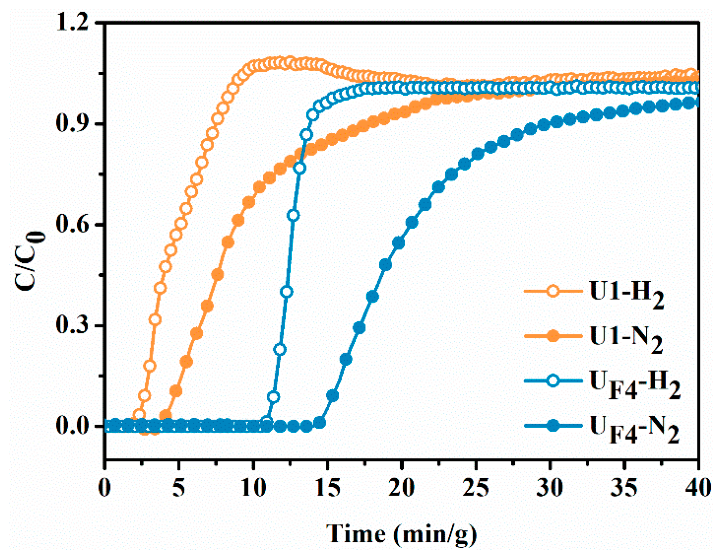
Based on the preceding discussion, U1 and UF4 were selected for multicomponent dynamic column breakthrough measurements to evaluate their N2/H2 separation performance at 298 K and 5 bar. As shown in Figure 6, U1 exhibited limited N2/H2 separation capability across all tested gas mixtures (N2/H2/He ratios: 10/10/80, 20/10/70, 10/20/70, vol%). The breakthrough profiles revealed that N2 displacement occurred before H2 reached adsorption equilibrium, with gas concentration variations only marginally affecting the retention time difference (Δτ = 1.1–2.5 min/g). Increasing H2 concentration to 20% induced a roll-up effect in its breakthrough curves (Figure 6c), suggesting weak H2-framework interactions and low H2 adsorption capacity. While the distinctive hump in Figure 6c,d hinted at potential kinetic separation under 10/20/70 vol% conditions [59,60], pressure elevation to 15 bar eliminated this feature (Figure 6e), demonstrating the impracticality of dynamic separation at elevated pressures. The distended breakthrough curves (Figure 6) indicated intra-crystalline diffusion limitations [61], confirming incomplete thermodynamic equilibrium in the fixed-bed system. In contrast, UF4 demonstrated superior separation performance under identical conditions (N2/H2/He, 10/20/70, vol%; 25 mL/min, 298 K, 5 bar). As depicted in Figure 7, UF4 achieved clear N2/H2 separation with N2 retention time reaching 3.5 min/g, enabling pure H2 recovery during the initial elution phase. The ratio of breakthrough time differential to operating pressure (Δτ/ΔP = 0.7 min·g−1·bar−1) exceeds the PSA process threshold of 0.5, confirming superior pressure-responsive behavior for industrial-scale gas separation. This performance difference arises not only from the affinity between the adsorbent and adsorbate but also from differential gas molecule diffusion rates within the U1 and UF4 frameworks.

3.5. MD Simulations

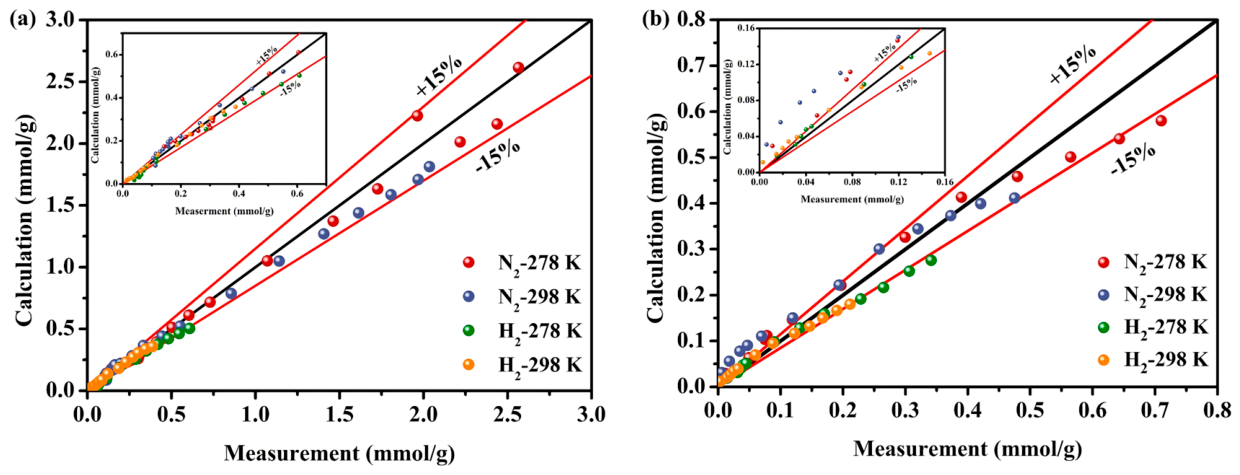
In GCMC simulations, the N2-to-H2 molar ratio in both U1 and UF4 materials is 1:2, consistent with the dynamic breakthrough experiments. The polarizability was calibrated using a global scale factor (ζ = 0.09), while Lennard-Jones energy parameters were scaled by λ to minimize experimental-simulation discrepancies. All polarizable force field parameters and atomic/ionic polarizabilities are provided in Table S2. Figure 8 compares simulated and experimental isothermal adsorption data, showing deviations within ±15% across most pressure conditions.
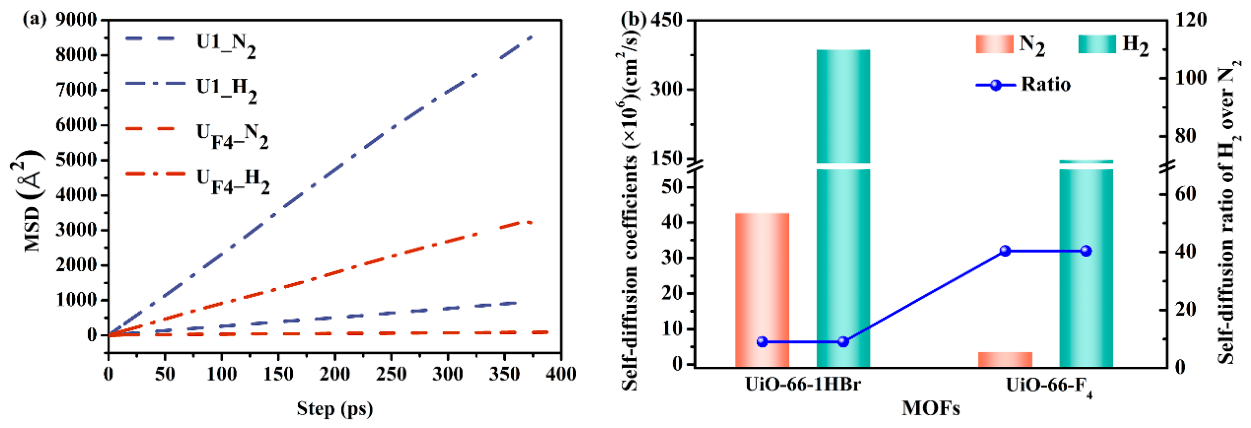
MD simulations reveal distinct gas diffusion behaviors within the adsorbents (Figure 9). The relatively fast diffusion of H2 in U1 is attributed to its high surface area and pore volume (Table 1), which minimizes steric hindrance, and its weak H2-framework interaction (Qst = 14.7 kJ/mol, Figure 4), which reduces surface residence time. The calculated self-diffusion coefficients for H2 and N2 in material U1 were 3.87 × 10⁻⁴ cm2/s and 4.27 × 10⁻⁵ cm2/s, respectively, yielding a diffusion selectivity (DH2/DN2) of 9.05. In contrast, material UF4 exhibited significantly lower diffusivities of 1.48 × 10⁻⁴ cm2/s for H2 and 3.66 × 10⁻⁶ cm2/s for N2, resulting in a markedly higher diffusion selectivity of 40.38. This superior H2 diffusivity drives its preferential occupation of pore space during the initial adsorption phase, which aligns with competitive breakthrough experiments demonstrating an H2 elution time advantage (Δτ = 3.5 min·g−1). The pronounced difference in gas diffusivity, particularly within UF4, underscores its kinetic preference for H2 during adsorption initiation. This simulation result also shows good agreement with the dynamic penetration experiment.
However, thermodynamic equilibrium favors N2 adsorption due to its stronger interactions with the framework, as evidenced by the difference in isosteric heats of adsorption (ΔQst (N2-H2): 8.3 kJ·mol−1, U1; 5.3 kJ·mol−1, UF4). This contrast highlights UF4’s superior kinetic selectivity towards H2 over N2 compared to U1. Crucially, although both adsorbents exhibit higher thermodynamic selectivity for N2, the MD results confirm that the N2-H2 separation mechanism in these micro/mesoporous Zr-MOFs is primarily kinetically controlled.
The efficient N2/H2 separation achieved by UF4 stems from a synergistic mechanism: strong micropore confinement effectively captures N2 (reflected in a van der Waals interaction energy), while the mesoporous structure and the fluorinated pore facilitate accelerated H2 transport. This combination enables UF4 to meet the kinetic performance requirements (Δτ > 3 min·g−1) for industrial PSA processes. Furthermore, UF4’s enhanced N2/H2 adsorption selectivity, validated by competitive dynamic adsorption experiments, establishes it as a viable adsorbent for practical N2/H2 separation applications.

3.6. Cyclic Adsorption Performance Assessment

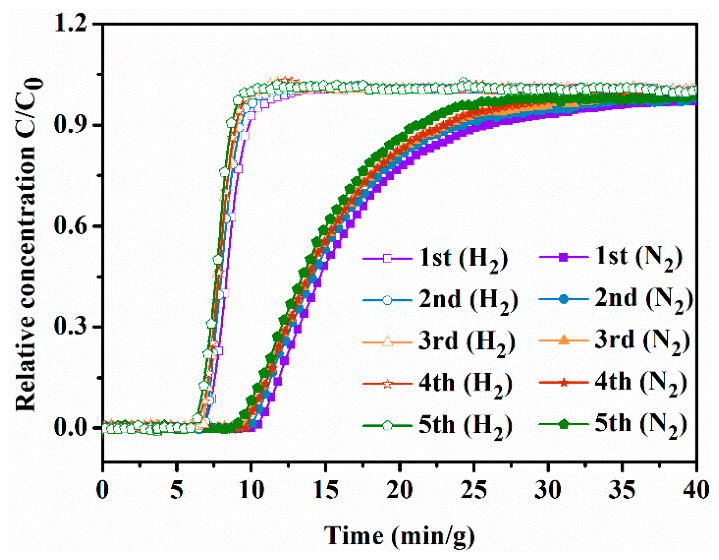
For practical separation applications, adsorbents must exhibit robust regeneration capability and structural stability. To evaluate the cyclic performance of UF4, breakthrough experiments employing a N2/H2/He gas mixture (10/20/70, vol%; 25 mL/min) were conducted for 5 consecutive cycles at 298 K and 5 bar. Between each breakthrough run, the adsorption column was regenerated under 10 mL/min of He gas flow at 453 K (setpoint of the external heater, estimated bed temperature ~393 K) for 3 h.
As illustrated in Figure 10, the breakthrough curves and the characteristic breakthrough time for both N2 and H2 showed negligible variation across the 5 cycles. Furthermore, as confirmed by the PXRD spectra (Figure 2), the framework structure and characteristic morphology of UF4 remained intact after the cyclic testing. This exceptional stability and reproducible performance under repeated adsorption-regeneration conditions strongly supports the practical viability of UF4 for gas separation applications.

4. Conclusions

The present study demonstrates the potential application of UiO-66-F4 (UF4) for the selective separation of N2-H2 gas mixtures. This material exhibits excellent stability and strong adsorbate binding affinity. To evaluate its practical performance, breakthrough experiments were combined with molecular dynamics (MD) simulations. The breakthrough results reveal that UF4 possesses higher selectivity towards N2 over H2, enabling the production of high-purity hydrogen gas from N2-H2 mixtures under specific conditions. The MD simulation results corroborated the breakthrough experimental findings for N2/H2 separation. Furthermore, this work highlights the promising prospects of breakthrough separation technology for addressing the N2/H2 separation challenge. However, research on N2/H2 separation using MOFs as adsorbents, particularly under high-flux conditions and employing breakthrough experiments, remains limited, and significant work is still required.

Supplementary Materials

The following supporting information can be downloaded at: https://www.mdpi.com/article/10.3390/ma19112418/s1.

Author Contributions

J.Z.: Investigation, Formal analysis, Writing—original draft. X.C.: Methodology, Validation, Writing—review and editing. Z.W.: Formal analysis. T.W.: Validation. W.M.: Validation. Q.F.: Conceptualization, Validation. B.-J.W.: Project administration, Funding acquisition, Writing—review and editing. All authors have read and agreed to the published version of the manuscript.

Funding

This research was funded by the National Natural Science Foundation of China (22308198) and the Natural Science Foundation of Shandong province (ZR2020MB121, ZR2023QB072).

Data Availability Statement

The original contributions presented in this study are included in the article/Supplementary Material. Further inquiries can be directed to the corresponding authors.

Conflicts of Interest

The authors declare no conflict of interest.

References

  1. Bernardo, G.; Araújo, T.; Lopes, T.D.S.; Sousa, J.; Mendes, A. Recent advances in membrane technologies for hydrogen purification. Int. J. Hydrogen Energy 2020, 45, 7313–7338. [Google Scholar] [CrossRef]
  2. Kapelewski, M.T.; Runčevski, T.; Tarver, J.D.; Jiang, H.Z.H.; Long, J.R. Record high hydrogen storage capacity in the metal–organic framework Ni2(m-dobdc) at near-ambient temperatures. Chem. Mater. 2018, 30, 8179–8189. [Google Scholar] [CrossRef]
  3. Cai, J.J.; Xing, Y.L.; Zhao, X.B. Quantum sieving: Feasibility and challenges for the separation of hydrogen isotopes in nanoporous materials. RSC Adv. 2012, 2, 8579–8586. [Google Scholar] [CrossRef]
  4. Xu, X.X.; Zhou, Q.; Yu, D.H. The future of hydrogen energy: Bio-hydrogen production technology. Int. J. Hydrogen Energy 2022, 47, 33677–33698. [Google Scholar] [CrossRef]
  5. Khan, M.; Assal, M.E.; Tahir, M.N.; Khan, M.; Ashraf, M.; Hatshan, M.R.; Khan, M.; Varala, R.; Badawi, N.M.; Adil, S.F. Graphene/inorganic nanocomposites: Evolving photocatalysts for solar energy conversion for environmental remediation. J. Saudi Chem. Soc. 2022, 26, 101544. [Google Scholar] [CrossRef]
  6. Ghanbari, T.; Abnisa, F. A review on production of metal organic frameworks (MOFs) for CO2 adsorption. Sci. Total Environ. 2020, 707, 135090. [Google Scholar] [CrossRef]
  7. Banu, A.M.; Friedrich, D.; Brandani, S. A multiscale study of MOFs as adsorbents in H2 PSA purification. Ind. Eng. Chem. Res. 2013, 52, 9946–9957. [Google Scholar] [CrossRef]
  8. Zhang, H.; Fu, Q.; Qin, H.Y.; Chen, X.; Zhang, Q.C. An investigation for H2/N2 adsorptive separation in SIFSIX-2-Cu-I. Int. J. Hydrogen Energy 2023, 48, 26251–26259. [Google Scholar] [CrossRef]
  9. Catumba, B.D.; Sales, M.B.; Borges, P.T. Sustainability and challenges in hydrogen production: An advanced bibliometric analysis. Int. J. Hydrogen Energy 2023, 48, 7975–7992. [Google Scholar] [CrossRef]
  10. Rahimpour, M.R.; Asgari, A. Production of hydrogen from purge gases of ammonia plants in a catalytic hydrogen-permselective membrane reactor. Int. J. Hydrogen Energy 2009, 34, 5795–5802. [Google Scholar] [CrossRef]
  11. Yang, G.; Guo, H.L.; Kang, Z.X.; Zhao, L.; Feng, S. Green hydrogen separation from nitrogen by mixed-matrix membranes consisting of nanosized sodalite crystals. ChemSusChem 2019, 12, 4529–4537. [Google Scholar] [CrossRef]
  12. Cavka, J.H.; Jakobsen, S.; Olsbye, U.; Guillou, N.; Lamberti, C. A new zirconium inorganic building brick forming metal organic-frameworks with exceptional stability. J. Am. Chem. Soc. 2008, 130, 13850–13851. [Google Scholar] [CrossRef]
  13. Chen, Z.J.; Hanna, S.L.; Redfern, L.R.; Alezi, D.; Islamoglu, T. Reticular chemistry in the rational synthesis of functional zirconium cluster-based MOFs. Coord. Chem. Rev. 2019, 386, 32–49. [Google Scholar] [CrossRef]
  14. Shiflett, M.B.; Corbin, D.R.; Yokozeki, A. Comparison of the sorption of trifluoromethane (R-23) on zeolites and in znionic liquid. Adsorpt. Sci. Technol. 2013, 31, 59–83. [Google Scholar] [CrossRef]
  15. Fu, Q.; Yan, H.Y.; Shen, Y.H.; Qin, Y.J.; Zhang, D.H.; Zhou, Y. Optimal design and control of pressure swing adsorption process for N2/CH4 Separation. J. Clean. Prod. 2018, 170, 704–714. [Google Scholar] [CrossRef]
  16. Burgers, I.; Dehdari, L.; Xiao, P.; Li, K.G.; Goetheer, E.; Webley, P. Techno-economic analysis of PSA separation for hydrogen/natural gas Mixtures at hydrogen refuelling stations. Int. J. Hydrogen Energy 2022, 47, 36163–36174. [Google Scholar]
  17. Jasra, R.V.; Choudary, N.V.; Bhat, S.G.T. Separation of gases by pressure swin. Sep. Sci. Technol. 1991, 26, 885–930. [Google Scholar] [CrossRef]
  18. Furukawa, H.; Cordova, K.E.; O’keeffe, M.; Yaghi, O.M. The chemistry and applications of metal-organic frameworks. Science 2013, 341, 1230444. [Google Scholar] [CrossRef]
  19. Furukawa, H.; Ko, N.; Go, Y.B.; Aratani, N.; Choi, S.B.; Choi, E.; Yazaydin, A.Ö.; Snurr, R.Q.; O’keeffe, M.; Kim, J.; et al. Ultrahigh porosity in metal-organic frameworks. Science 2010, 329, 424–428. [Google Scholar] [CrossRef]
  20. Zhao, D.; Yuan, D.Q.; Sun, D.F.; Zhou, H.C. An isoreticular series of metal-organic frameworks with dendritic hexacarboxylate ligands and exceptionally high gas-uptake capacity. Angew. Chem. Int. Ed. 2010, 122, 5485–5489. [Google Scholar]
  21. Kuppler, R.J.; Timmons, D.J.; Fang, Q.R.; Li, J.R.; Makal, T.A.; Young, M.D.; Yuan, D.Q.; Zhao, D.; Zhuang, W.J.; Zhou, H.C. Potential applications of metal-organic frameworks. Coord. Chem. Rev. 2009, 253, 3042–3066. [Google Scholar]
  22. Cairns, A.J.; Eckert, J.; Wojtas, L.; Thommes, M.; Wallacher, D.; Georgiev, P.A.; Forster, P.M.; Belmabkhout, Y.; Ollivier, J.; Eddaoudi, M. Gaining insights on the H2–sorbent interactions: Robust soc-MOF platform as a case study. Chem. Mater. 2016, 28, 7353–7361. [Google Scholar] [CrossRef]
  23. Paiman, S.H.; Rahman, M.A.; Uchikoshi, T.; Abdullah, N.; Othman, M.H.D.; Jaafar, J.; Abas, K.H.; Ismail, A.F. Functionalization effect of Fe-type MOF for methylene blue adsorption. J. Saudi Chem. Soc. 2020, 24, 896–905. [Google Scholar] [CrossRef]
  24. Zhao, C.; Chen, Y.; Gong, S.; Tan, W.; Pan, H.; Liu, X.; Shi, Q. A water stable Cu-MOF/GO composite as a persulfate activator for efficient degradation of dye wastewater. J. Saudi Chem. Soc. 2024, 28, 101856. [Google Scholar]
  25. Mao, D.L.; Griffin, J.M.; Dawson, R.; Fairhurst, A.; Bimbo, N. Metal organic frameworks for hydrogen purification. Int. J. Hydrogen Energy 2021, 46, 23380–23405. [Google Scholar] [CrossRef]
  26. Agueda, V.I.; Delgado, J.A.; Uguina, M.A.; Brea, P.; Spjelkavik, A.I.; Blom, R.; Grande, C. Adsorption and diffusion of H2, N2, CO, CH4 and CO2 in UTSA-16 metal-organic framework extrudates. Chem. Eng. Sci. 2015, 124, 159–169. [Google Scholar] [CrossRef]
  27. Regufe, M.J.; Tamajon, J.; Ribeiro, A.M.; Ferreira, A.; Lee, U.H.; Hwang, Y.K.; Chang, J.S.; Serre, C.; Loureiro, J.M.; Rodrigues, A.E. Syngas purification by porous amino-functionalized titanium terephthalate MIL-125. Energy Fuels 2015, 29, 4654–4664. [Google Scholar] [CrossRef]
  28. Si, Y.N.; Wang, W.J.; El-Sayed, E.S.M.; Yuan, D.Q. Use of breakthrough experiment to evaluate the performance of hydrogen isotope separation for metal-organic frameworks M-MOF-74 (M = Co, Ni, Mg, Zn). Sci. China Chem. 2020, 63, 881–889. [Google Scholar]
  29. Azar, A.N.V.; Velioglu, S.; Keskin, S. Large-scale computational screening of metal organic framework (MOF) membranes and MOF-based polymer membranes for H2/N2 separations. ACS Sustain. Chem. Eng. 2019, 7, 9525–9536. [Google Scholar] [CrossRef]
  30. Chen, X.; Li, Y.J.; Fu, Q.; Qin, H.Y.; Lv, J.N.; Yang, K.; Zhang, Q.C.; Zhang, H.; Wang, M. An efficient modulated synthesis of zirconium metal-organic framework UiO-66. RSC Adv. 2022, 12, 6083–6092. [Google Scholar] [CrossRef]
  31. Hu, Z.G.; Peng, Y.W.; Kang, Z.X.; Qian, Y.H.; Zhao, D. A modulated hydrothermal (MHT) approach for the facile synthesis of UiO-66-type MOFs. Inorg. Chem. 2015, 54, 4862–4868. [Google Scholar] [CrossRef]
  32. Li, K.; Yang, J.; Dou, M.Y.; Gu, P.; Su, H.; Huang, F. Attachment of Fe3O4 nanoparticles on UiO-66: A stable composite for efficient sorption and reduction of selenite from water. J. Saudi Chem. Soc. 2023, 27, 101678. [Google Scholar] [CrossRef]
  33. Hirscher, M.; Panella, B.; Schmitz, B. Metal-organic frameworks for hydrogen storage. Microporous Mesoporous Mater. 2010, 129, 335–339. [Google Scholar] [CrossRef]
  34. Rick, S.W.; Stuart, S.J. Potentials and algorithms for incorporating polarizability in-corporating polarizability in computer simulations. Rev. Comput. Chem. 2002, 18, 89–146. [Google Scholar]
  35. Luu, C.L.; Nguyen, T.T.V.; Nguyen, T.; Hoang, T.C. Synthesis, characterization and adsorption ability of UiO-66-NH2. Adv. Nat. Sci. Nanosci. Nanotechnol. 2015, 6, 025004. [Google Scholar] [CrossRef]
  36. Moghaddam, Z.S.; Kaykhaii, M.; Khajeh, M.; Oveisi, A.R. Synthesis of UiO-66-OH zirconium metal-organic framework and its application for selective extraction and trace determination of thorium in water samples by spectrophotometry. Spectrochim. Acta Part A 2018, 194, 76–82. [Google Scholar] [CrossRef]
  37. Li, Y.P.; Zhang, X.; Zhang, L.; Jiang, K.; Cui, Y.J.; Yang, Y.; Qian, G.D. A nanoscale zr-based fluorescent metal-organic framework for selective and sensitive detection of hydrogen sulfide. J. Solid State Chem. 2017, 255, 97–101. [Google Scholar] [CrossRef]
  38. Zhan, Y.; He, S.; Hu, J.; Zhao, S.; Zeng, G.; Zhou, M.; Zhang, G.A. Sengupta, Robust super-hydrophobic/super-oleophilic sandwich-like UiO-66-F4@rGO composites for efficient and multitasking oil/water separation applications. J. Hazard. Mater. 2020, 388, 121752. [Google Scholar] [CrossRef]
  39. Sun, Y.; Wu, X.; Su, W.; Zhou, Y.P.; Zhou, L. Studies on ordered mesoporous materials for potential clean energy application. Appl. Surf. Sci. 2007, 253, 5650–5655. [Google Scholar] [CrossRef]
  40. Zhou, L.; Sun, Y.; Zhou, Y.P. Storage of hydrogen on carbon materials: Experiments and analyses. Chem. Eng. Commun. 2006, 193, 564–579. [Google Scholar] [CrossRef]
  41. Zhang, Q.C.; Chen, X.; Fu, Q.; Qin, H.Y.; Zhang, H.; Li, H.Y.; Wang, S.D.; Dong, Z.X.; Zhang, Z.Q.; Wang, M. Study on the adsorption separation of CHF3/N2 by an Sifsix-3-Ni metal–organic framework. Ind. Eng. Chem. Res. 2023, 62, 13627–13636. [Google Scholar]
  42. Kust, W. Adsorption aus der Gasphase. Ingenieurwissenschaftliche Grundlagen und technische Verfahren. Angew. Chem. 1998, 101, 650–651. [Google Scholar]
  43. Krooss, B.M.; Bergen Fv Gensterblum, Y.; Siemons, N.; Pagnier, H.J.M.; David, P. High-pressure methane and carbon dioxide adsorption on dry and moisture-equilibrated pennsylvanian coals. Int. J. Coal Geol. 2002, 51, 69–92. [Google Scholar] [CrossRef]
  44. Czepirski, L.; Jagiello, J. Virial type thermal equation of gas solid adsorp. Chem. Eng. Sci. 1989, 44, 797–801. [Google Scholar]
  45. Rowsell, J.L.C.; Yaghi, O.M. Effects of functionalization, catenation, and variation of the metal oxide and organic linking units on the low-pressure hydrogen adsorption properties of metal-organic frameworks. J. Am. Chem. Soc. 2006, 128, 1304–1315. [Google Scholar] [CrossRef]
  46. Kresse, G.; Furthmüller, J. Efficient iterative schemes for ab initio total-energy calculations using a plane-wave basis set. Phys. Rev. B 1996, 54, 11169–11186. [Google Scholar]
  47. Perdew, J.P.; Burke, K. Generalized gradient approximation made simple. Phys. Rev. Lett. 1996, 77, 3865–3868. [Google Scholar] [CrossRef] [PubMed]
  48. Grimme, S.; Antony, J.; Ehrlich, S.; Krieg, H. A consistent and accurate ab initio parametrization of density functional. J. Chem. Phys. 2010, 132, 154104. [Google Scholar] [CrossRef] [PubMed]
  49. Limas, N.G.; Manz, T.A. Introducing DDEC6 atomic population analysis: Part 2. computed results for a wide range of periodic and nonperiodic materials. RSC Adv. 2016, 51, 45727–45747. [Google Scholar] [CrossRef]
  50. Limas, N.G.; Manz, T.A. Introducing DDEC6 atomic population analysis: Part 4. Efficient parallel computation of net atomic charges, atomic spin moments, bond orders, and more. RSC Adv. 2018, 8, 2678–2707. [Google Scholar] [CrossRef] [PubMed]
  51. Dubbeldam, D.; Calero, S.; Ellis, D.E.; Snurr, R.Q. Raspa: Molecular simulation software for adsorption and diffusion in flexible nanoporous materials. Mol. Simul. 2015, 42, 81–101. [Google Scholar] [CrossRef]
  52. Yu, S.Y.; Jing, G.L.; Li, S.N.; Li, Z.F.; Ju, X. Tuning the hydrogen storage properties of MOF-650: A combined DFT and GCMC Simulations Study. Int. J. Hydrogen Energy 2020, 45, 6757–6764. [Google Scholar] [CrossRef]
  53. Van Duijnen, P.T.; Swart, M. Molecular and atomic polarizabilities: Thole’s model revisited. J. Phys. Chem. A 1998, 102, 2399–2407. [Google Scholar] [CrossRef]
  54. Shannon, R.D. Dielectric polarizabilities of ions in oxides and fluorides. J. Appl. Phys. 1993, 73, 348–366. [Google Scholar] [CrossRef]
  55. Drenchev, N.L.; Chakarova, K.K.; Lagunov, O.V.; Mihaylov, M.Y.; Ivanova, E.Z.; Strauss, I.; Hadjiivanov, K.I. In situ FTIR Spectroscopy as a Tool for Investigation of Gas/Solid Interaction: Water-Enhanced CO2 Adsorption in UiO-66 Metal-Organic Framework. J. Vis. Exp. 2020, 156, e60285. [Google Scholar]
  56. Torbina, V.V.; Salaev, M.A.; Paukshtis, E.A.; Liotta, L.F.; Vodyankina, O.V. Effect of Linker Substituent Nature on Performance of Active Sites in UiO-66: Combined FT-IR and DFT Study. Int. J. Mol. Sci. 2023, 24, 14893. [Google Scholar] [CrossRef]
  57. Jaramillo, D.E.; Reed, D.A.; Jiang, H.Z.H.; Oktawiec, J.; Mara, M.W.; Forse, A.C.; Lussier, D.J.; Murphy, R.A.; Cunningham, M.; Colombo, V.; et al. Selective nitrogen adsorption via backbonding in a metal-organic framework with exposed vanadium sites. Nat. Mater. 2020, 19, 517–521. [Google Scholar] [CrossRef]
  58. Ahmed, A.; Seth, S.; Purewal, J.; Wong-Foy, A.G.; Veenstra, M.; Matzger, A.J.; Siegel, D.J. Exceptional hydrogen storage achieved by screening nearly half a million metal-organic frameworks. Nat. Commun. 2019, 10, 1568. [Google Scholar] [CrossRef]
  59. Guan, L.L.; Duan, L.Y.; Xie, Y.C. Adsorptive separation of N2 and Ar on modified NaA Zeolites. Acta Chim. Sin. 2004, 62, 1392–1396. [Google Scholar]
  60. Kluson, P.; Scaife, S.; Quirke, N. The design of microporous graphitic adsorbents for selectiveseparation of gases. Sep. Purif. Technol. 2000, 20, 15–24. [Google Scholar] [CrossRef]
  61. Chen, D.L.; Shang, H.; Zhu, W.D.; Krishna, R. Transient breakthroughs of CO2/CH4 and C3H6/C3H8 mixtures in fixed beds packed with Ni-MOF-74. Chem. Eng. Sci. 2014, 117, 407–415. [Google Scholar] [CrossRef]
Scheme 1. (a) Chemical structures of the organic linkers used in this work (from left to right: terephthalic acid, 2-vinylterephthalic acid, and 2,3,5,6-tetrafluoroterephthalic acid); (b) Synthesis of Zr-based MOFs.
Materials 19 02418 sch001
Figure 1. Schematic representation of the static volumetric experimental set-up. P1, P2, P3: Digital pressure transducers (KELLER LE02 PSIA). M: Dry diaphragm vacuum pump (ULVAC DAP-6D). FT-01, FT-02: Filter (SWAGELOK SS-SCF3-VR4-P-225). TV-01, TV-02, TV-03, TV-04: Needle valve (HANLOK). TV-05: Leak valve (HANLOK). ZV-01, ZV-02, ZV-03: Globe valve (HANLOK). S-01, S-02: Reference slot (10 mL) and adsorption slot (1 mL), respectively (SHANGHAI HUOTNG). TC-01, TC-02: Low temperature thermostatic circulator (HAISHU YIHENG, YHX-08).
Materials 19 02418 g001
Figure 2. (a) PXRD patterns and (b) FT-IR spectra of the three isostructural UiO-66 type MOFs.
Materials 19 02418 g002
Figure 3. Isothermal raw adsorption data and fitting curves of N2 and H2 adsorption on U1 (blue), U5 (red), Uvinyl (yellow), and UF4 (green) at (a) 278 K and (b) 298 K (filled symbols: H2; open symbols: N2).
Materials 19 02418 g003
Figure 4. Initial adsorption enthalpies of N2 and H2 for UiO MOFs at 278 K and 298 K.
Materials 19 02418 g004
Figure 5. IAST predicted selectivity of N2/H2 (2/1, v/v) adsorption on Zr-based MOFs at 278 K and 298 K.
Materials 19 02418 g005
Figure 6. Breakthrough curves of U1 at 298 K for the mixtures of (a) N2/H2/He (10/10/80, vol%, the same below; Flow rate: 30 mL/min) at 5 bar; (b) N2/H2/He (20/10/70; Flow rate: 30 mL/min) at 5 bar; (c) N2/H2/He (10/20/70; Flow rate: 25 mL/min) at 5 bar; (d) N2/H2/He (10/20/70; Flow rate: 25 mL/min) at 10 bar and (e) N2/H2/He (10/20/70; Flow rate: 25 mL/min) at 15 bar.
Materials 19 02418 g006
Figure 7. Breakthrough curves for N2/H2/He (10/20/70, vol%; Flow rate: 25 mL/min) mixture in U1 and UF4 at 298 K and 5 bar.
Materials 19 02418 g007
Figure 8. Comparison of the simulated and measured values of isothermal adsorption on (a) U1 and (b) UF4.
Materials 19 02418 g008
Figure 9. (a) Mean-square displacements for N2-H2 mixture (N2/H2, 10/20, v/v) and (b) self-diffusion coefficients of H2-N2 and its ratio in U1 and UF4 at 298 K.
Materials 19 02418 g009
Figure 10. Breakthrough circulation test results for N2/H2/He (10/20/70, vol%) mixture on an adsorption column of UF4 at 298 K and 5 bar.
Materials 19 02418 g010
Table 1. Adsorbents properties: BET specific surface area (SSA), pore volume (Vp), HK Median pore width (MPW), and BJH desorption average pore width (APW).
AdsorbentSample DesignationSSA (m2/g)Vp (cm3/g)MPW (Å)APW (Å)
UiO-66-1HBrU115270.635.142.6
UiO-66-5HBrU513030.555.438.2
UiO-66-CH=CH2Uvinyl8010.454.843.7
UiO-66-F4UF47020.414.279.2
Disclaimer/Publisher’s Note: The statements, opinions and data contained in all publications are solely those of the individual author(s) and contributor(s) and not of MDPI and/or the editor(s). MDPI and/or the editor(s) disclaim responsibility for any injury to people or property resulting from any ideas, methods, instructions or products referred to in the content.