Article

One-Pot Sr-Free LaFeO3/CeO2-Based Electrocatalytic Composites: Effect of Cerium and Lanthanum Interplay Between Perovskite and Fluorite

by
Laura Valentino
1,
Francesca Deganello
1,
Leonarda Francesca Liotta
1,
Giuseppe Marcì
2 and
Chiara Aliotta
1,*
1
National Research Council of Italy (CNR), Institute of Nanostructured Materials (ISMN) Palermo, Via Ugo La Malfa 153, 90146 Palermo, Italy
2
Department of Engineering, University of Palermo, Viale delle Scienze, Building 6, 90128 Palermo, Italy
*
Author to whom correspondence should be addressed.
Materials 2026, 19(11), 2361; https://doi.org/10.3390/ma19112361
Submission received: 20 March 2026 / Revised: 27 May 2026 / Accepted: 29 May 2026 / Published: 2 June 2026

Highlights

What are the main findings?
  • SCS enables rapid one-pot synthesis of perovskite-fluorite based composites.
  • Perovskite lattice expands due to A- and B-site defect chemistry changes.
  • Raman reveals defect-induced distortion of BO6 octahedra.
What are the implications of the main findings?
  • Perovskite growth on pre-formed CeO2 induces a defect-rich structure.
  • One-pot synthesis reduces the amount of ceria in the composite.
  • Suitable design strategy for SOFC cathodes and redox-active materials.

Abstract

Perovskite-type oxides are among the most promising cathodes for intermediate-temperature solid oxide fuel cells (IT-SOFCs) due to their mixed ionic–electronic conductivity and compositional flexibility. Many high-performance cathodes rely on Sr substitution at the A-site, often associated with surface segregation and long-term degradation. In this work, we explore an alternative strategy based on defect engineering and phase interactions in Sr-free composites. Perovskite-fluorite composites based on LaFe0.8Co0.2O3 were synthesized through a one-pot route designed to promote the formation of a perovskite phase and a limited amount of fluorite-type ceria. This approach allows the introduction of small fractions of Ce into the perovskite lattice, favoring the cooperative coexistence with La-doped CeO2. Structural, microstructural and spectroscopic characterization indicates that Ce influences the crystallization pathway and composite defect chemistry. Variations in lattice parameters and Raman features suggest modifications of perovskite structure consistent with defect formation and lattice distortion. Reduction properties and electrical conductivity measurements indicate that Ce incorporation in the perovskite and oxide interaction affect charge transport and oxygen mobility. The electrochemical results demonstrate that the optimal trade-off between activation energy (Ea) and polarization resistance (Rp) is achieved for the sample, with a nominal cerium content, Ce/(La + Ce) of 0.16. Moreover, the electrochemical properties are found to correlate with the nominal cerium content, which regulates defect chemistry and the resulting composite composition. Overall, results suggest that the one-pot synthesis promotes beneficial interactions between the perovskite and ceria phases, allowing the development of Sr-free ferrite-based materials with enhanced functional properties, minimizing the amount of ceria in the composite.

1. Introduction

Solid oxide fuel cells (SOFCs) are widely regarded as one of the most promising technologies for sustainable energy conversion, offering high electrical efficiency and fuel flexibility while minimizing environmental impact. By operating outside the traditional carbon-based energy chain, SOFCs can efficiently utilize hydrogen and other low-carbon fuels, contributing to the reduction of greenhouse gas emissions and supporting the transition toward sustainable energy systems [1]. Intermediate-temperature SOFCs (IT-SOFCs), operating in the range of 500–800 °C, have attracted increasing attention because they allow the use of less-expensive materials and improved long-term durability compared with conventional high-temperature systems. Despite these advantages, the cathodic oxygen reduction reaction (ORR) remains the major kinetic bottleneck limiting the overall performance of SOFC devices. The ORR involves a sequence of elementary steps including oxygen adsorption, oxygen dissociation, electron transfer, and incorporation of oxygen ions into the oxide lattice of the cathode and electrolyte materials through oxygen vacancies. Once incorporated, oxygen ions migrate through the lattice via vacancy hopping mechanisms, while electronic transport proceeds through small-polaron hopping processes governed by the position of the Fermi level. Consequently, high-performance cathode materials must exhibit mixed ionic–electronic conductivity (MIEC), in which the concentration and mobility of oxygen vacancies and electronic carriers play a fundamental role in determining catalytic activity. Among the various MIEC materials reported in the literature, perovskite-type oxides with the general formula ABO3 have attracted considerable interest because of their compositional flexibility and tunable defect chemistry. Aliovalent substitutions at both the A and B lattice sites allow the control of structural distortions, oxygen vacancy concentration, and electronic structure, thereby enabling the optimization of catalytic and transport properties [2]. Lanthanum ferrite (LaFeO3)-based perovskites represent promising cathode materials due to their good chemical stability and the abundance of iron, which is not considered a critical raw material [3]. The development of cathode materials based on abundant elements is becoming increasingly important in the context of growing global competition for strategic raw materials. To enhance the electrochemical performance of LaFeO3, several doping strategies have been explored. Partial substitution of Fe with transition metals such as Co is known to enhance electronic conductivity and oxygen exchange kinetics by modifying the metal–oxygen bond covalency and the electronic structure of the oxide lattice [4,5]. At the same time, A-site substitution has been widely used to tune the defect chemistry of perovskite oxides and increase the concentration of oxygen vacancies. Many high-performance SOFC cathodes rely on Sr substitution at the A-site, as in La1−xSrxCo1−yFeyO3−δ materials [6,7,8]. However, the use of Sr is associated with well-known stability issues, including surface segregation and the formation of insulating secondary phases during operation, which can lead to long-term degradation of the electrode performance [9]. For this reason, increasing attention has recently been devoted to alternative strategies capable of improving the catalytic properties of ferrite perovskites while avoiding Sr substitution [10,11]. One promising approach consists of exploiting defect engineering strategies based on the introduction of redox-active dopants capable of modifying the defect chemistry of the perovskite lattice [12,13,14,15,16]. In particular, small amounts of cerium introduced at the A-site can influence charge compensation mechanisms and promote the formation of oxygen vacancies while modifying the oxidation state distribution of the B-site transition metals [15,16]. The presence of Ce can also introduce additional redox flexibility due to the Ce4+/Ce3+ couple, which may influence oxygen exchange and catalytic processes [12,17,18,19]. However, according to the literature, Ce exhibits a limited solubility, typically below 10 mol% on Ce-doped LaFeO3 and related systems. For example, Kim et al. reported that, via the EDTA-citrate complexing method, Ce 5 mol% is the maximum limit in LaFeO3, and the attempt to dope with 7% leads to the formation of CeO2 [12]. Similar results were obtained for Ce-doped LaFeO3 nanofibers produced by electrospinning, in which case the solubility limit was 10 mol% [20]. To the best of our knowledge, no articles have reported on Ce-doped LaFe0.8Co0.2O3, although several authors have studied the effects of cerium doping on LaFeO3, pointing to cerium’s limited solubility. Looking at other La-based perovskites, a limited accommodation of cerium in the perovskite lattice, as cobaltite (LaCoO3), was also demonstrated [21].
The role of defects engineering in controlling the functional properties of perovskite oxides has been widely recognized as a powerful strategy to tune catalytic activity and charge transport properties [22]. Moreover, defect formation, such as oxygen vacancy generation, is also a key factor in determining the catalytic performance of perovskite oxides in oxidation reactions [23]. Besides compositional tuning, another important strategy to enhance cathode performance consists of combining perovskite MIEC materials with oxy gen-ion conducting oxides such as cerium oxide (CeO2). Doped ceria is widely used because of its high oxygen ion conductivity and oxygen storage capability. This behavior is also related to its fluorite-type crystal structure, which can accommodate aliovalent cations with relatively large ionic radii, promoting the formation of oxygen vacancies and thereby enhancing ionic transport [24]. As a result, perovskite-fluorite composite electrodes have been extensively investigated for both electrochemical and catalytic applications [5,13,25,26]. The high catalytic activity of ceria is closely related to its ability to form and rearrange oxygen vacancies, which can dynamically adapt under reaction conditions and strongly influence catalytic processes. However, conventional composite cathodes are typically prepared by mechanical mixing of the two phases, and relatively large amounts of ceria—often up to 30–40 wt.%—are required to achieve sufficient ionic conductivity. Such approaches may limit the potential cooperative effects between the perovskite and ceria phases [27]. In recent years, attention has been devoted to synthesis strategies that allow the simultaneous formation of the different oxide phases in a single preparation step [15,16,28]. One-pot synthesis approaches can influence the crystallization pathway of the materials and promote interactions between the phases during their formation. These synthesis induced interactions may affect the defect chemistry, redox properties, and catalytic behavior of the resulting composite materials [29,30]. Similar phase interactions have been shown to influence charge transfer processes and catalytic activity in oxide systems involving ceria and transition metal oxides. For example, the interfacial interaction, arising from one pot synthesis of a nanocomposite containing a major cubic perovskite-doped BaCoO3 phase and a minor hexagonal swedenborgite phase, notably improves the electrocatalytic performance of OER [16]. Moreover, lattice oxygen mobility is enhanced by the mutual synergy between double and single layered perovskites [15]. Similar phase interactions in oxide systems containing ceria and transition metal oxides have been shown to influence charge transfer processes and catalytic activity [5,31]. In this context, the possibility of exploiting the interactions occurring during a one-pot synthesis to design perovskite–ceria composites with reduced ceria content remains relatively unexplored. At the same time, developing ferrite-based cathodes that avoid Sr substitution while maintaining high catalytic activity is an important objective in the perspective of improving long-term stability [32,33].
In the present work, (La,Ce)Fe0.8Co0.2O3-(La,Ce)O2 composites are purposely designed to promote the formation of a perovskite-fluorite composite during one-pot solution combustion synthesis (SCS). The novelty of this approach lies in the exploitation of the low solubility of Ce in the perovskite lattice, promoting a cooperative coexistence between Ce-doped LaFe0.8Co0.2O3 and La-doped CeO2. The interplay of Ce and La between the perovskite and fluorite structure contributes to defect formation in both phases, while the favorable interaction of the perovskite with CeO2 influences the reduction behavior, oxygen exchange properties and electrochemical properties of the system. The research goal is to develop novel Sr-free perovskite-fluorite composites with improved functional properties while minimizing the amount of ceria in the composite.

2. Materials and Methods

2.1. Composite Preparation

Powders with nominal compositions La1.05Ce0.2Fe0.8Co0.2O3, LaCe0.2Fe0.8Co0.2O3, La0.8Ce0.2Fe0.8Co0.2O3, La0.9Ce0.1Fe0.8Co0.2O3, and La0.95Ce0.05Fe0.8Co0.2O3 were synthesized via the solution combustion method using La(NO3)3·6H2O (>99.0%, Fluka Analytical, Chemie, Steiheim, Germany), Ce(NO3)3·6H2O (99.99%, Aldrich, Sigma-Aldrich Chemie, Steinheim, Germany), Fe(NO3)3·9H2O (≥99.95%, Sigma-Aldrich, St. Louis, MO, USA), and Co(NO3)3·6H2O (≥99.99%, Fluka, Sigma-Aldrich Chemie, Steinheim, Germany) as metal precursors and anhydrous citric acid (≥99.5%, Aldrich, Sigma-Aldrich Chemie, Steinheim, Germany) employed as the fuel. The combustion parameter was set to a reducer-to-oxidizer ratio (φ) of 1.5 with a fuel-to-metal cation molar ratio of 2. The pH was adjusted to 6 using an ammonia solution (28.0–30.0% v/v, Aldrich, Sigma-Aldrich Chemie, Steinheim, Germany). Ammonium nitrate (NH4NO3, 98.7%, GPR Rectapur, Leuven, Belgium) was added as an additional oxidant. The resulting aqueous solution was magnetically stirred at 80 °C on a hotplate (VWR Advanced, VMS-C7, Darmstadt, Germany) in a 1 L stainless-steel beaker until a homogeneous gel was formed. The temperature of the hotplate was then set to 350 °C, initiating a self-sustaining combustion reaction that, after a few seconds, produced a brown powder in the case of La1.05Ce0.2Fe0.8Co0.2O3 and LaCe0.2Fe0.8Co0.2O3 and a dark-brown powder for the samples La0.8Ce0.2Fe0.8Co0.2O3, La0.9Ce0.1Fe0.8Co0.2O3 and La0.95Ce0.05Fe0.8Co0.2O3. The as-burned powders were subsequently calcined in static air at 1000 °C. The names of the prepared samples, their nominal composition, and their nominal Ce content, in terms of Ce/(La + Ce), are reported in Table 1. The samples are labeled according to their nominal La and Ce content in the A-site of the perovskite formula, with a fixed B-site composition (Fe 80 mol%, Co 20 mol%). The first number in the label corresponds to the La mol%, whereas the second one indicates the Ce mol%. This nomenclature is adopted to clearly highlight the variation in A-site composition among the prepared materials.

2.2. Membrane Electrode Assemblies

Membrane electrode assemblies (MEAs) with a symmetric cell configuration were prepared to perform electrochemical impedance spectroscopy characterization. The electrolyte powder, Ce0.8Sm0.2O2−x (SDC), was synthesized using a solution combustion reported in a previous paper [24]. Full-density SDC pellets were obtained from the calcined powder at 500 °C by pressing isostatically at 3.4 ton/cm2 and by sintering in static air at 1250 °C for 10 h. The resulting pellets had a diameter of approximately 10 mm and a thickness of about 1 mm. For the cathode deposition, the powders were ground with ethanol (99.8%, Sigma-Aldrich) and Polyethylene Glycol 400 (PEG-400, Sigma-Aldrich) and then mixed for 30 min in an ultrasonic bath to obtain a homogeneous suspension. The resulting inks were applied by screen-printing on both sides of the sintered pellets, dried at 200 °C for 1 h per side, and finally heat-treated at 1100 °C for 2 h in static air.

2.3. Chemical-Physical and Electrochemical Characterization

Powder XRD analysis was performed using a Rigaku MiniFlex600 powder diffractometer (Rigaku Europe SE, Neu-Isenburg, Germany) with Cu Ka radiation (40 kV, 15 mA), Ni filtration, X-ray fluorescence reduction, a 0.05° step size and 1°/min speed. Rietveld refinement of the diffraction patterns was carried out using the GSAS-II package version 5365 [34], refining the Chebyschev polynomial background profile, lattice constants, atomic coordinates, scale factors and crystal size parameters. Database PDF-5+ 2025 (database version 4.2502, software version 4.25.0.3) released by ICDD (International Centre for Diffraction Data, USA) [35] was used for qualitative structural analysis and for the Crystallographic Information Files (cif) files for the refinement.
Raman spectra were recorded using a DXR3 Raman Microscope (Thermo Fisher Scientific S.p.A., MI, Italy) equipped with a 532 nm laser source and characterized by a spatial and confocal depth resolution of 1 and 2 μm, respectively. Spectral processing and analysis were performed using OMNIC for Dispersive Raman software released by Thermo Fisher Scientific Inc. (Thermo Fisher Scientific S.p.A., MI, Italy) For each sample, measurements were collected with the laser power set to 1 mW at 6 different points on the surface, and the resulting spectra were averaged to obtain a representative profile.
Hydrogen temperature programmed reduction (TPR-H2) measurements were carried out with a Micromeritics AutoChem 2910 (Micromeritics Instrument Corp., Norcross, GA, USA). Automated Catalyst Characterization System, equipped with a thermal conductivity detector (TCD). About 0.1 g of sample was used for each measurement. The samples were pre-treated with 5 vol% O2/He at 30 mL/min, heating up (10 °C/min) to 300 °C and holding at this temperature for 30 min. After returning to room temperature, the gas mixture of 5 vol% H2 in Ar was introduced at 30 mL/min into the sample tube. During the analysis, the temperature increased up to 900 °C at a rate of 10 °C/min. The effluent gas was analyzed with a TCD.
Scanning electron microscopy (SEM) was performed using a FEI Quanta 200 ESEM microscope (Thermo-Scientific, Waltham, MA, USA), operating at 30 kV. Before being subjected to SEM analysis, the samples were gilded with a thin layer of gold. On the other hand, an electron microprobe used in an energy dispersive mode (EDX) was employed to obtain information on the actual metal-content percentage present in the samples.
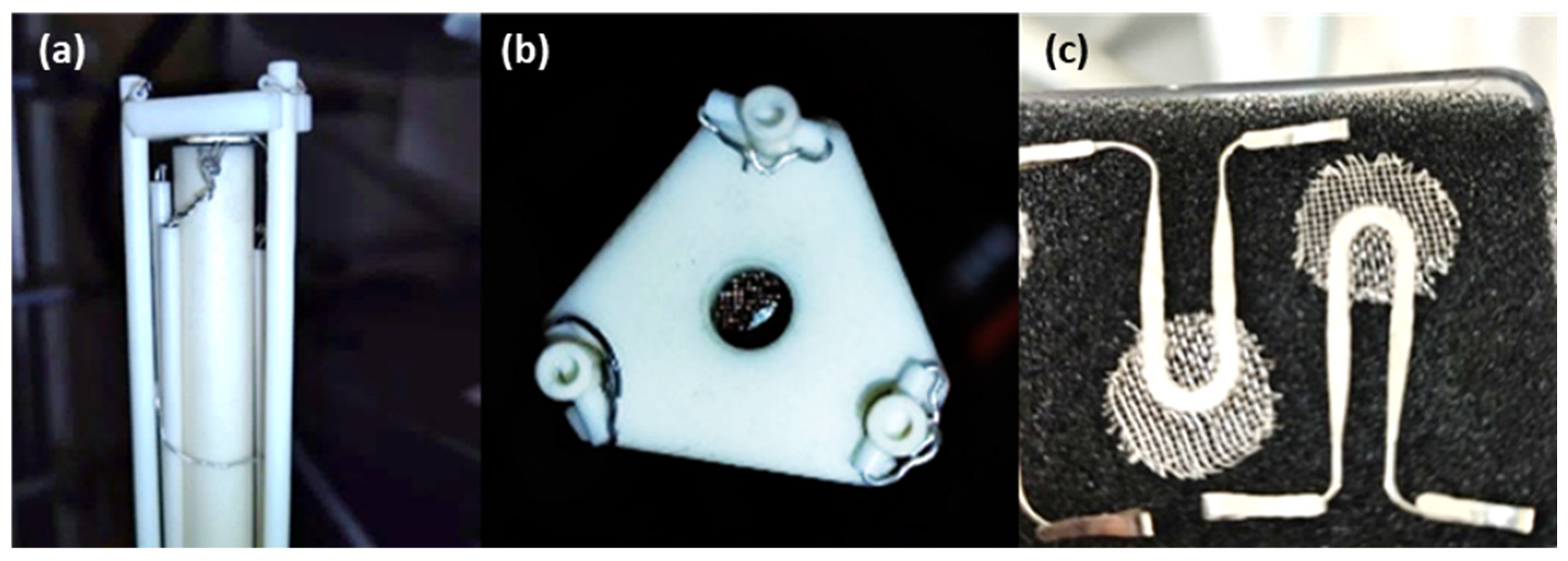
Impedance spectroscopy measurements were conducted employing a Methrohm Autolab impedance analyzer (Metrohm Italian S.r.l., VA) (AC voltage of 0.3 V) equipped with a ProboStat (NorECs AS, Sandvika, Norway) in the 1 × 10⁵–1 × 10⁻² Hz range between 700–850 °C (50 °C steps, with 1 h equilibration at each temperature) in air. The electrochemical cell setup employs two Pt electrode meshes as current collectors in direct contact with both electrodes, applying a constant mechanical pressure on the half-cell through a spring-loaded system (Figure A1). The impedance data were analyzed with ZView software version 4.0, released by Scribner (USA).

3. Results and Discussion

The perovskite-fluorite-based composites (Table 1) were synthesized via solution combustion synthesis (SCS). This method was selected due to its simplicity, rapid reaction kinetics, and cost-effectiveness. Moreover, SCS allows selecting several processing parameters to control the microstructural and redox properties of the final powder [36,37].
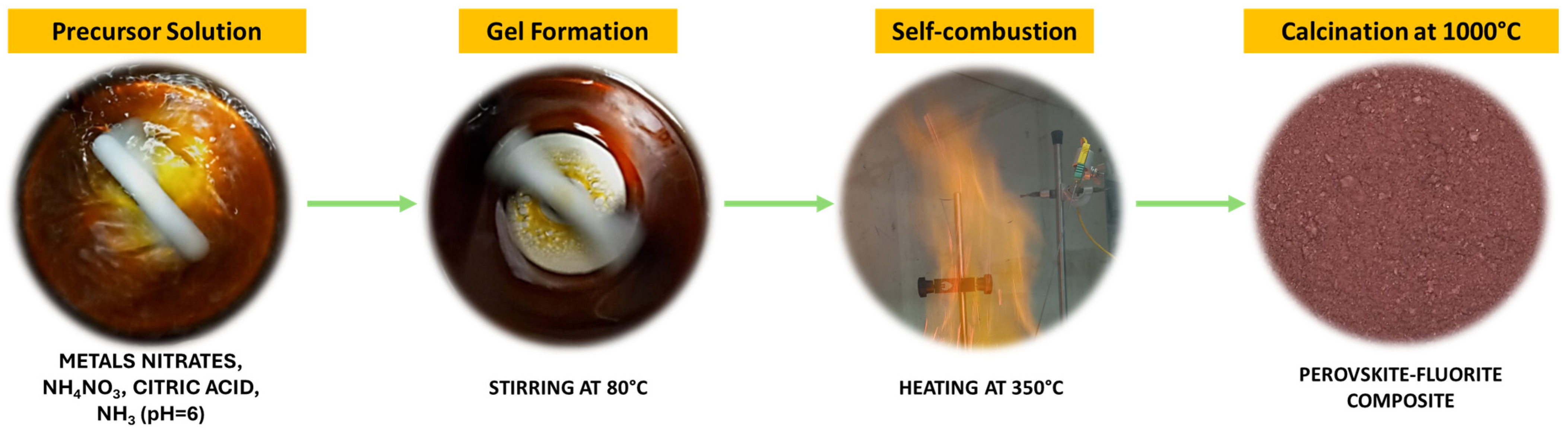
The overall synthesis procedure is schematically illustrated in Figure 1, referring to La105Ce20 as a representative sample. The initial solution was formed by all the reagents and additives dissolved in the same beaker (step 1). The formation of the gel, obtained after solvent evaporation and complexation reactions between citric acid and metal cations (step 2), allows interconnections between the various components, fixing them in a network that, through the following self-combustion (step 3), has a direct influence on the final powder phase composition and microstructure, as reported in the literature [37]. The as-burned powder was formed within a few seconds, and this rapid process promotes the simultaneous reaction of all precursors, enabling a homogeneous distribution and a fast crystallization of the perovskite- and fluorite-based phases directly from the gel network. A subsequent thermal treatment at 1000 °C was necessary to stabilize the final perovskite-based composites and eliminate any residual carbon (step 4).
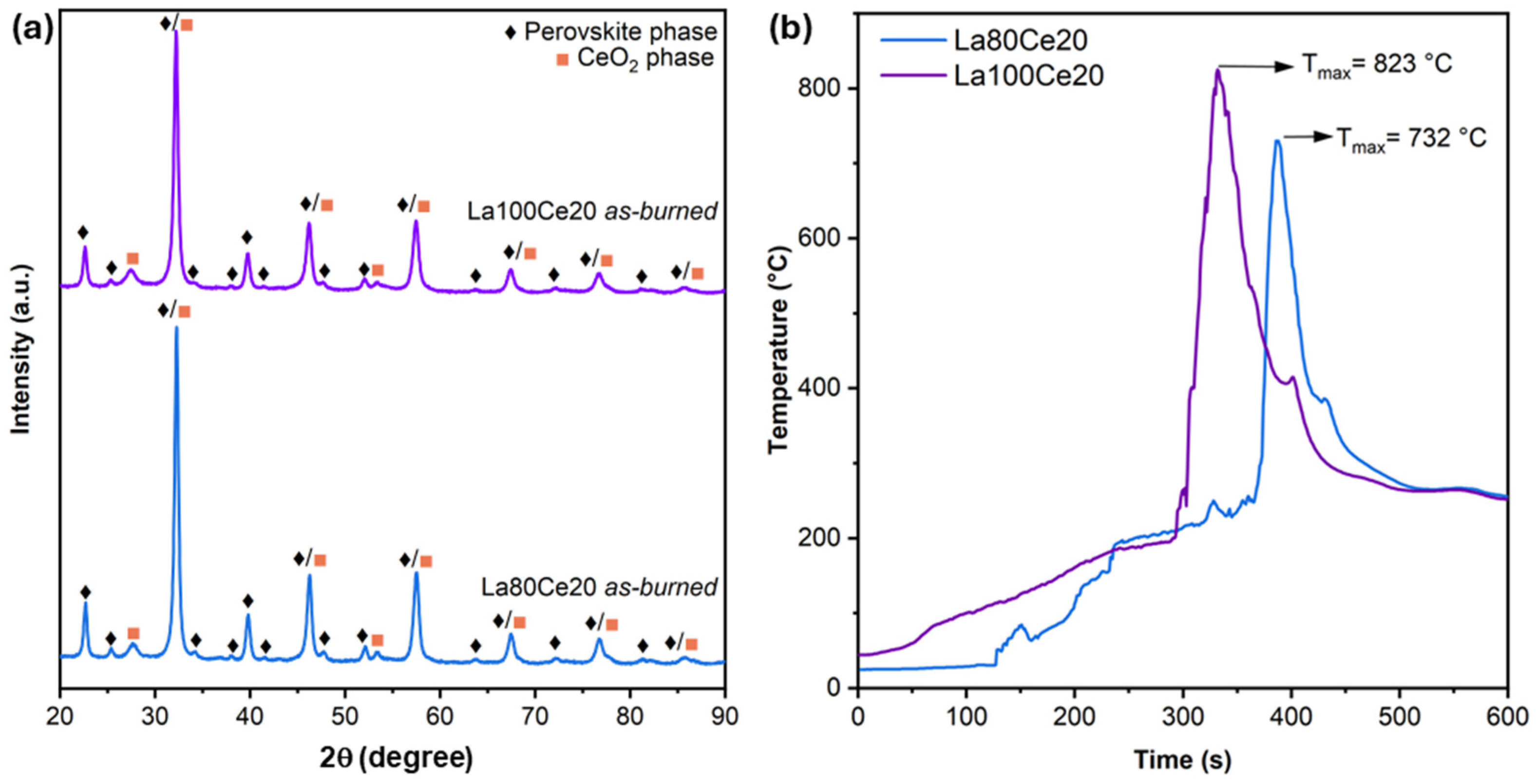
Figure 2a shows the XRD diffraction pattern of the as-burned La100Ce20 and La80Ce20 powders, as examples, whereas Figure 2b contains the relative Temperature vs. Time profiles measured during the self-combustions. In the as-burned powders, the main oxide phases, namely the perovskite phase and fluorite-type ceria phase, were already formed (Figure 2a). Temperature–time profiles indicate that the self-combustion process is completed within 100–150 s, with a maximum temperature of 750–800 °C (Figure 2b). The small shoulder observed on the right side of each peak suggests that phase formation proceeds through successive combustion steps (Figure 2b), in agreement with the multiphase nature of the obtained material.
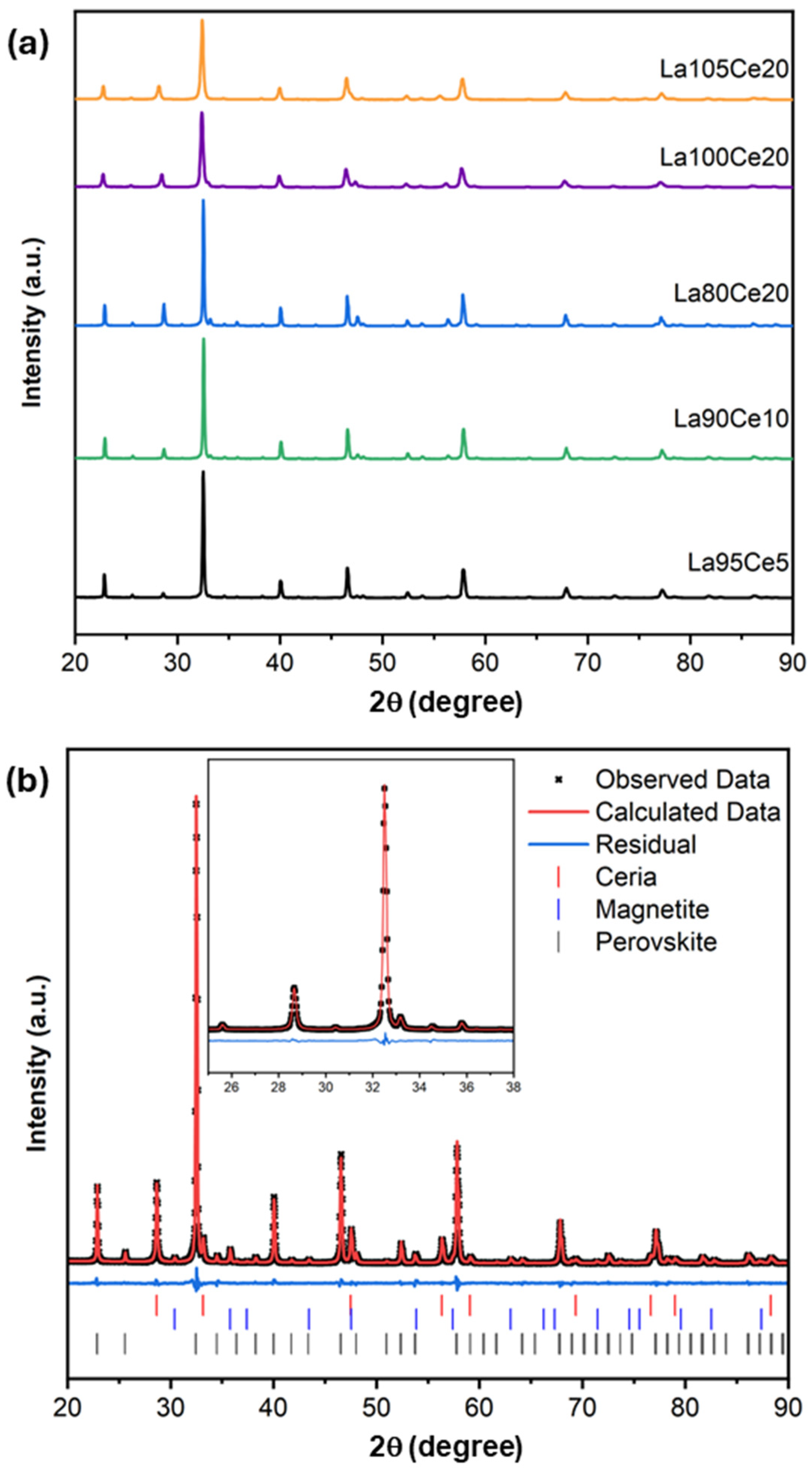
X-ray diffraction analysis coupled with Rietveld refinement was performed on the calcined powders. Figure 3a shows the XRD patterns of the investigated samples, Figure 3b shows the corresponding Rietveld refinement for La80Ce20, as a representative example, whereas the refined structural parameters are summarized in Table 2 and Table A1, including the relative standard deviation values. As a general comment, the main peak of the perovskite phase at about ~32.4 °2θ is visible in all the patterns, together with the main peak of the ceria phase at about ~28.6 °2θ. In detail, according to the synthesis design, the samples La105Ce20 and La100Ce20 exhibit a biphasic system consisting of a perovskite-type oxide with orthorhombic symmetry (space group Pbnm, ICDD PDF Card—01-082-9771) and CeO2 fluorite-type oxide (space group Fm-3m, ICDD PDF Card—00-004-0593). Instead, the samples La80Ce20, La90Ce10 and La95C5 contain three phases, with magnetite, Fe3O4 (space group Fd-3m, ICDD PDF Card—01-080-7683), appearing as the third phase. In all specimens, the perovskite phase is the predominant one, whereas the amount of the fluorite phase increases with increasing cerium content.
As shown in Table 2, perovskite phases exhibit unit cell volumes in the 238.58–239.51 Å3 range, evidencing an expansion if compared to the value of 237.95 Å3 for LaFe0.8Co0.2O3 (ICDD PDF Card—01-082-9771). This expansion could be explained by a partial incorporation of cerium in the perovskite structure, although Ce4+ and Ce3+ are expected to contract the perovskite volume since they have a smaller ionic radius (i.r. 1.14 Å and 1.34 Å in 12th-fold, respectively) than La3+ (i.r. 1.36 in Å 12th-fold). In fact, another structural effect prevails in this case, that is cerium accommodation in the A-site probably forces a Fe3+ (i.r. 0.645 Å in 6th-fold) reduction to Fe2+ (i.r. 0.78 Å in 6th-fold) for maintaining the charge balance in the system, causing a cell volume expansion as highlighted in the literature [12,18,39,40,41,42]. However, the observed cell expansion cannot be justified by the incorporation of cerium at the A-site of the perovskite, since Ce exhibits a limited and synthesis-dependent solubility, typically below 10 mol% according to the literature on Ce-doped LaFeO3 and related systems [12,20,21]. The low cerium solubility is further confirmed by the phase composition results in Table 2, which indicate that the ceria phase is already detected in the La95Ce5 sample, and thus the solubility of cerium in the perovskite structure is below 5 mol%. Moreover, as the nominal cerium content increases in the La95Ce5, La90Ce10, and La80Ce20 sample series, the fraction of ceria as a separate phase progressively grows, in agreement with the consideration that only a small amount of cerium is incorporated into the perovskite lattice. Despite this limited solubility, a systematic increase in unit cell volume is observed from La95Ce5 to La80Ce20 (Table 2). Since cerium incorporation into the perovskite is minimal and almost equal in all the samples, this volume expansion cannot be attributed directly to Ce substitution. Thus, it is likely attributed to a progressive increase in Fe2+ content, due to the reduction of Fe3+, along with a partial reduction of Co3+ (i.r. 0.545 Å, in 6th-fold) to Co2+ (i.r. 0.745 Å, in 6th-fold) within the perovskite structure, resulting in lattice expansion [12,18,39,40,41,42,43]. Furthermore, a possible cause of this increased defectivity could arise from an interaction between the forming perovskite phase and ceria during the one-pot synthesis, where the precursors of the perovskite phase are in contact with ceria prior to crystallization. In fact, the formation of cerium oxide is thermodynamically favored over perovskite during combustion synthesis steps and allows crystal growth of the perovskite phase on the already formed CeO2-based powder.
A further insight is provided by the La100Ce20 and La105Ce20 samples which, despite quite similar nominal cerium contents (Table 1), exhibit perovskite unit cell volumes lower than that of La80Ce20 (Table 2). This can be attributed to a reduced degree of lattice expansion, likely due to a lower amount of reduced B-site cations (Fe2+/Co2+).
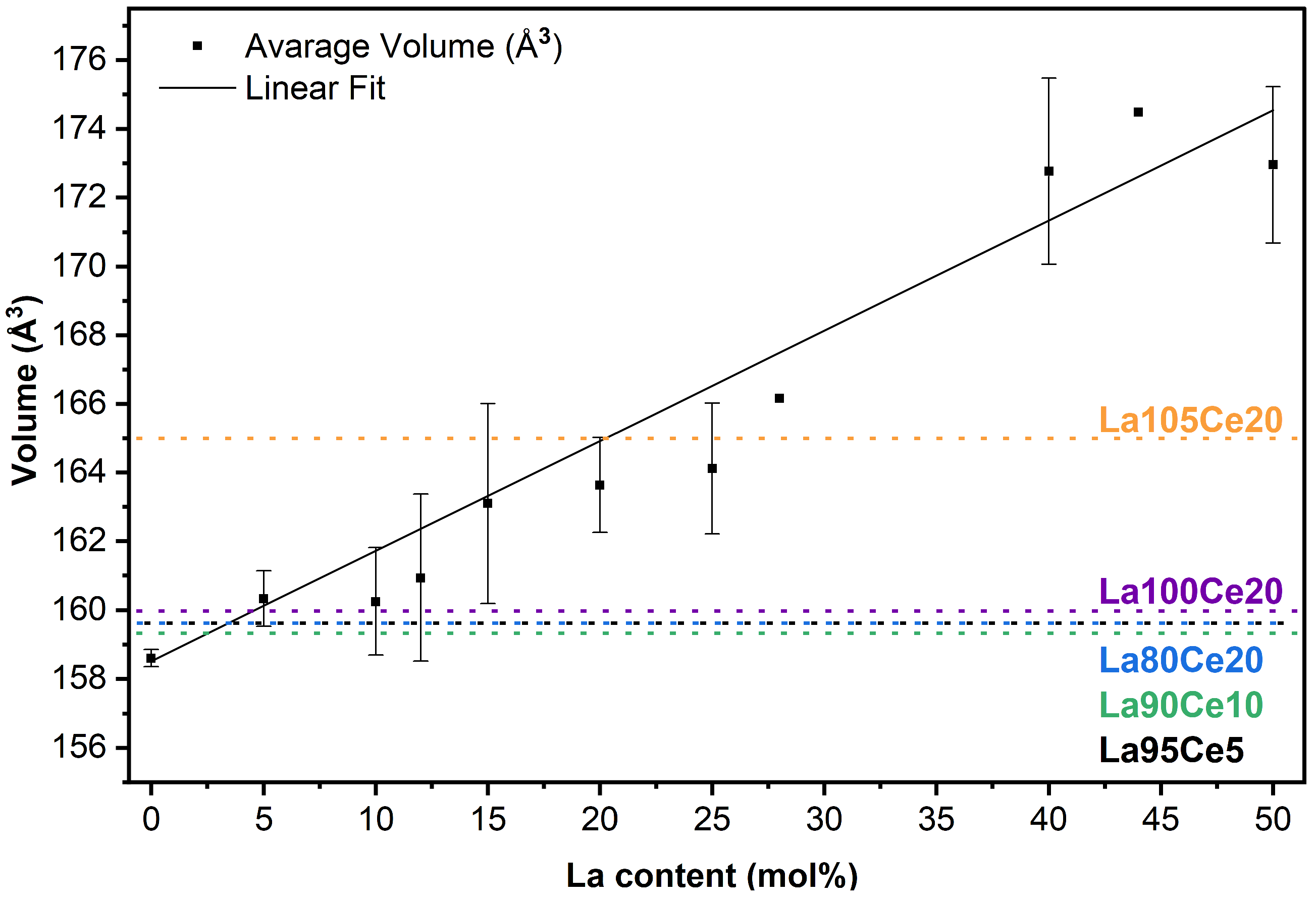
The volume of the fluorite-type CeO2 phase is also affected in all the investigated samples. Indeed, all cell volumes are significantly larger than the undoped ceria average volume of 158.60 Å3, calculated from structural data available in the ICDD database [35], suggesting the formation of the targeted lanthanum-doped ceria phase, since La3+ has a larger i.r. (1.36 Å in 12th-fold) than Ce4+ (1.14 Å in 12th-fold) [39]. To corroborate this finding, a calibration line of average cell volumes as a function of La content is depicted in Figure A2 for a series of La doped-CeO2 (0 ≤ La mol% ≤ 50). The curve was calculated on the basis of structural data listed in the ICDD database, selecting the most reliable PDF entries—high quality marks and ambient environment—and considering the cell volume statistical variability as the standard deviation [35]. Cross-referencing the calibration plot (Figure A2) with the Rietveld results (Table 2), it emerges that the La95Ce5, La90Ce10 and La80Ce20 samples exhibit a cell volume slightly larger than the undoped CeO2, suggesting a La mol % not higher than 5 mol%, whereas the cell volume of La100Ce20 and La105Ce20 falls markedly above that of the undoped CeO2 with the La content likely lying in the range of 5–10 mol% and below 25 mol%, respectively. The presence of La in the ceria phase can be attributed to the limited solubility of Ce in the perovskite lattice, which leads to an excess of La that is incorporated into CeO2 to maintain the overall A-site/B-site cation balance. The extent of La doping in ceria varies depending on the nominal composition, being higher in samples with greater relative La excess.
Looking at the microstructural data in Table A1, the crystal size of both the perovskite and fluorite phases in La105Ce20 and La100Ce20 samples is significantly smaller than that observed in the La95Ce5, La90Ce10 and La80Ce20 samples. This indicates that the two samples with greater relative La content are more defective, as a smaller crystal size is inherently associated with a higher degree of structural disorder in nanostructured materials. Consistently, in this sample the ceria unit cell volume is larger than in the other samples, indicating a higher incorporation of lanthanum into the ceria lattice, which leads to lattice expansion and increased structural distortion. Overall, these results indicate that the La105Ce20 sample exhibits the highest degree of defectivity, affecting both the perovskite and fluorite phases, and thus represents the most structurally disordered system among those investigated.
In summary, the low solubility of cerium promotes the formation of La-doped CeO2 during synthesis while simultaneously favoring the development of a defective, Fe2+/Co2+- rich perovskite-fluorite composite via a one-pot route. On the other hand, lanthanum remains predominantly in the perovskite phase but is also partially incorporated into the ceria phase, forming a ceria–lanthana solid solution. This redistribution is required to maintain overall stoichiometry, as a significant fraction of cerium does not enter the perovskite, and LaFeO3 cannot tolerate either cation deficiency or excess [44]. As a result, an interplay of Ce and La between the perovskite and fluorite phases is established.
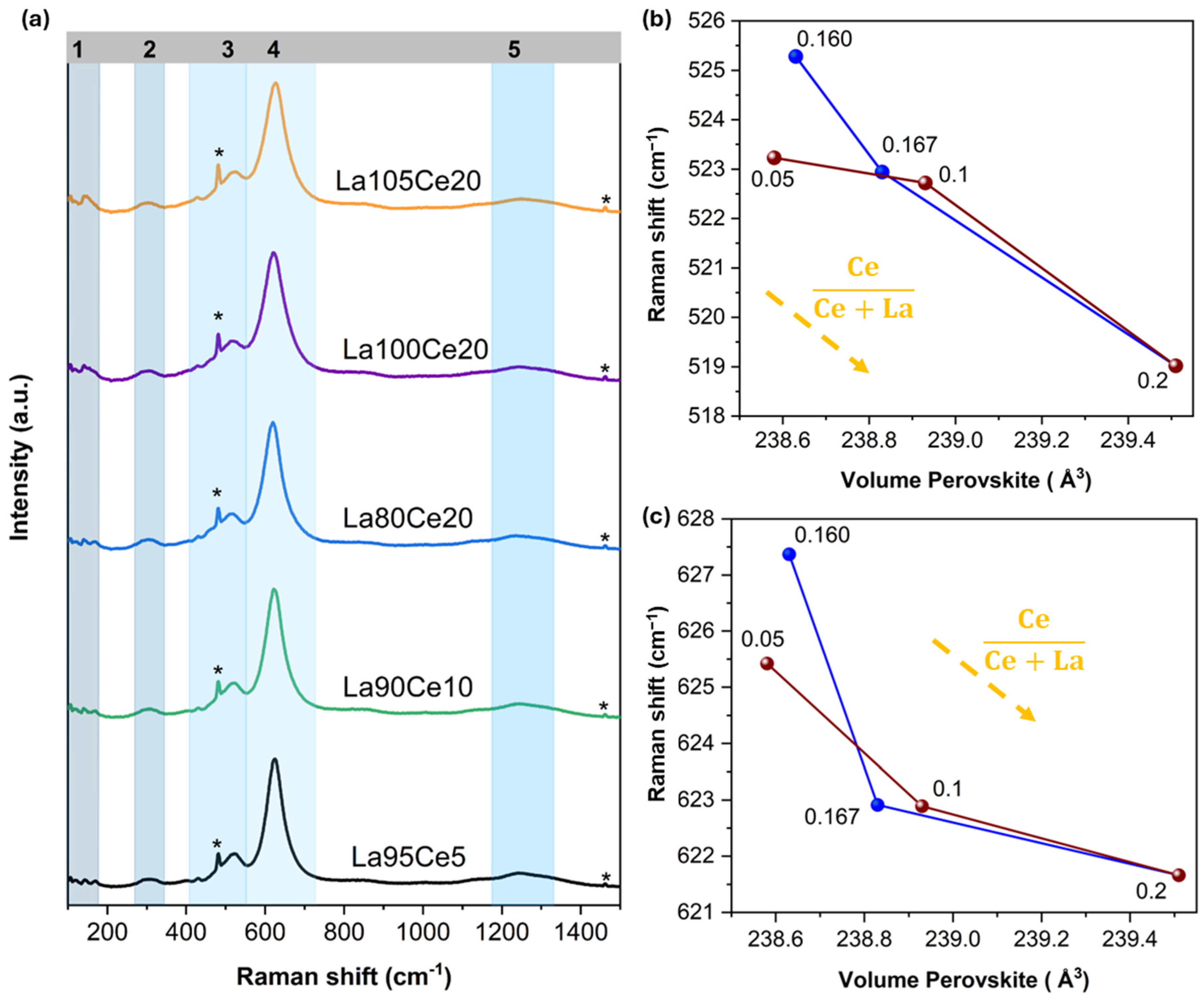
MicroRaman spectroscopy was employed to evaluate material structural distortion and defectivity through the investigation of the Raman active vibrational modes correlated to the Pbnm orthorhombic (24Γ = 7Ag + 7B1g + 5B2g + 5B3g) and Fm-3m cubic structures (F2g) [45,46]. Figure 4a shows the characteristic vibrational fingerprint of the orthorhombic perovskite structure, consistent with LaFeO3-type frameworks governed by four non-equivalent lattice positions (La, Fe, O1, O2). Instead, ceria-related bands are not clearly resolved, as masked by the dominant vibrational modes of the perovskite phase [45]. This observation is consistent with the predominance of the perovskite phase as revealed by the Rietveld refinement (Table 2), together with the limited probing volume of each Raman measurement (~1 µm). Moreover, peak broadening indicates an increased level of structural disorder, in agreement with the lattice expansion observed by XRD (Table 2). As displayed in Figure 4a, five distinct Raman shift regions are identified, corresponding to different types of local distortion The Raman-active modes are located at approximately 100–180 cm−1 (region 1), 260–350 cm−1 (region 2), 410–550 cm−1 (region 3), 550–720 cm−1 (region 4) and 1170–1350 cm−1 (region 5) [47,48,49]. According to the literature, region 1 is attributed to A-site cation displacement arising from La(Ce)-O vibration, while regions 2–4 correspond to BO6 rotation and tilting as well as to stretching and bending motions in O1-B-O2/B-O1/B-O2. The broad feature in region 5 is assigned to second-order Raman scattering, commonly reported for orthorhombic perovskites. The intense peak at ~622 cm−1 (region 4), along with the shoulder at ~500 cm−1, is generally attributed to B–O1/B–O2 stretching vibrations and is known to be highly sensitive to lattice defects such as oxygen vacancies and change in the B-site oxidation state in LaFeO3-based perovskites [41,46,47]. A more detailed view of this behavior is provided in Figure 4b,c, where the Raman shift at peak maximum is plotted as a function of the perovskite unit cell volume. A progressive shift towards low wavenumbers (red shift) is observed with an increase in the perovskite unit cell volume according to a more defective system, due to the partial reduction of B-site cations and oxygen vacancies. As previously discussed, the presence of La-doped ceria contributes to the broad spectral feature observed in the 410–550 cm−1 region, arising from the overlap between the B3g modes of the perovskite lattice and the characteristic F2g vibration of the fluorite-type cerium oxide, generally located near 460–465 cm−1 [20]. However, a distinct peak at ~465 cm−1 in this region is not clearly resolved. The observed broadening within the 410–550 cm−1 (region 3) window may instead reflect nanoscale dispersion of the ceria-based phase, spectral convolution with perovskite modes, or enhanced structural disorder. The Raman data indicate retention of long-range perovskite symmetry while revealing Ce-driven local structural perturbation and defect-sensitive evolution of the B–O framework.
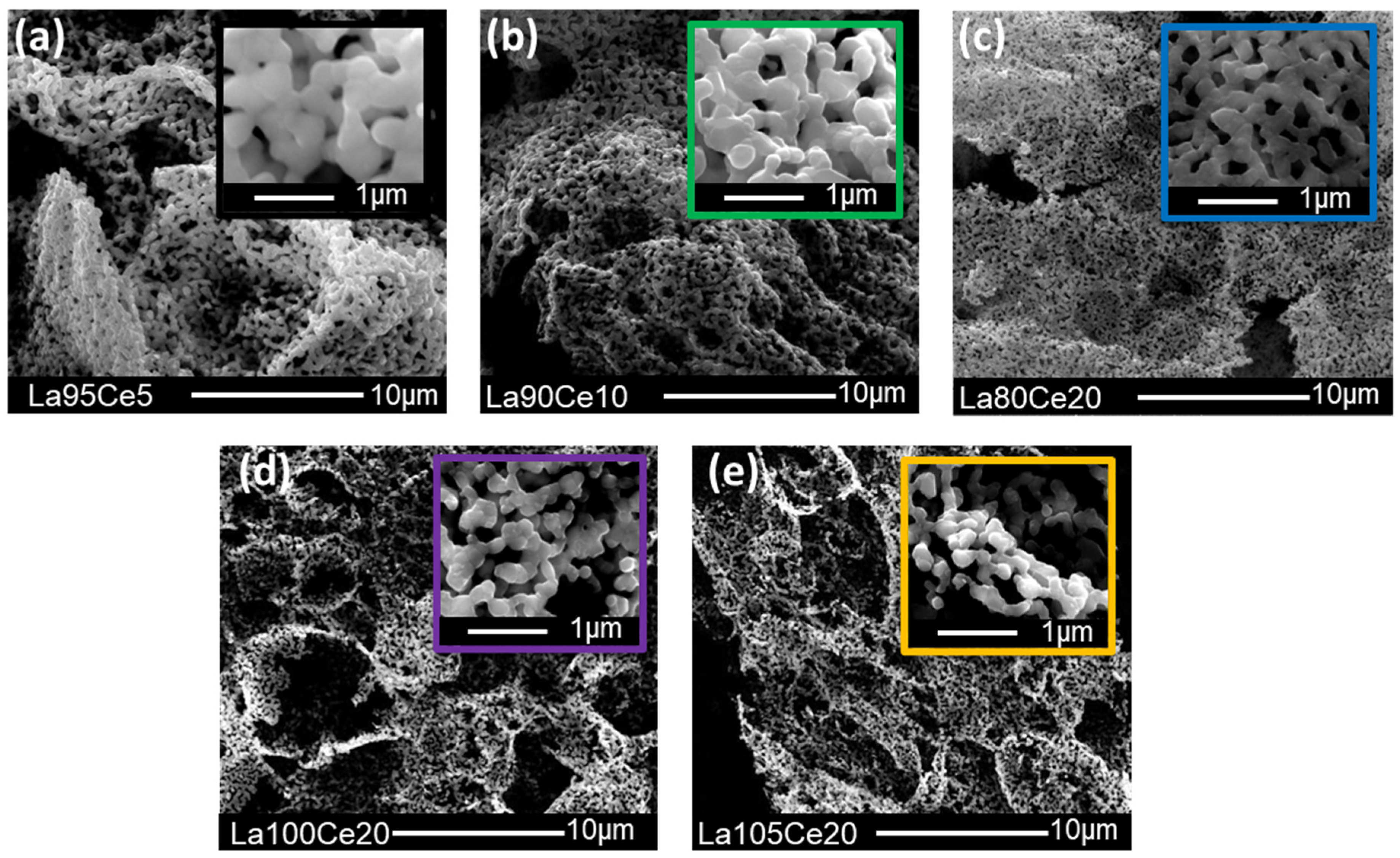
The powders’ morphology was evaluated by SEM analysis, as depicted in Figure 5. All calcined samples appear as agglomerates of nanoparticles with porous characteristics typical of materials prepared by solution combustion synthesis. It is well known that the relatively higher volume of gases released during the combustion event (Figure 1, step 3) leads to the formation of porous powders. These porous features remain recognizable even after high-temperature heat treatment, indicating that the microstructural templating effect of the fuel (citric acid), which burns during the combustion process, is capable of imprinting the powder morphology [37]. However, looking at Figure 5 and Table 3, some evident differences in the mean particle size range of the five samples that are visible seem to be related to the nominal Ce/(La + Ce) ratio. In particular, a narrower particle size range with smaller average dimensions is shown by samples having a higher ratio [40]. Despite powders exhibiting a multiphase nature, the perovskite phase is predominant (Table 2), and most of the particles observed by SEM might be reasonably attributed to the perovskite phase. These microstructural differences further support the hypothesis of a microstructural templating effect of the pre-formed ceria phase on the growth of the perovskite crystals during the one-pot synthesis.
The energy dispersive X-ray spectroscopy results (Table 3) reveal that the percentages of the metals are close to their nominal values, although in the probed EDX zone a slight lanthanum depauperation and a slight iron excess are observed.
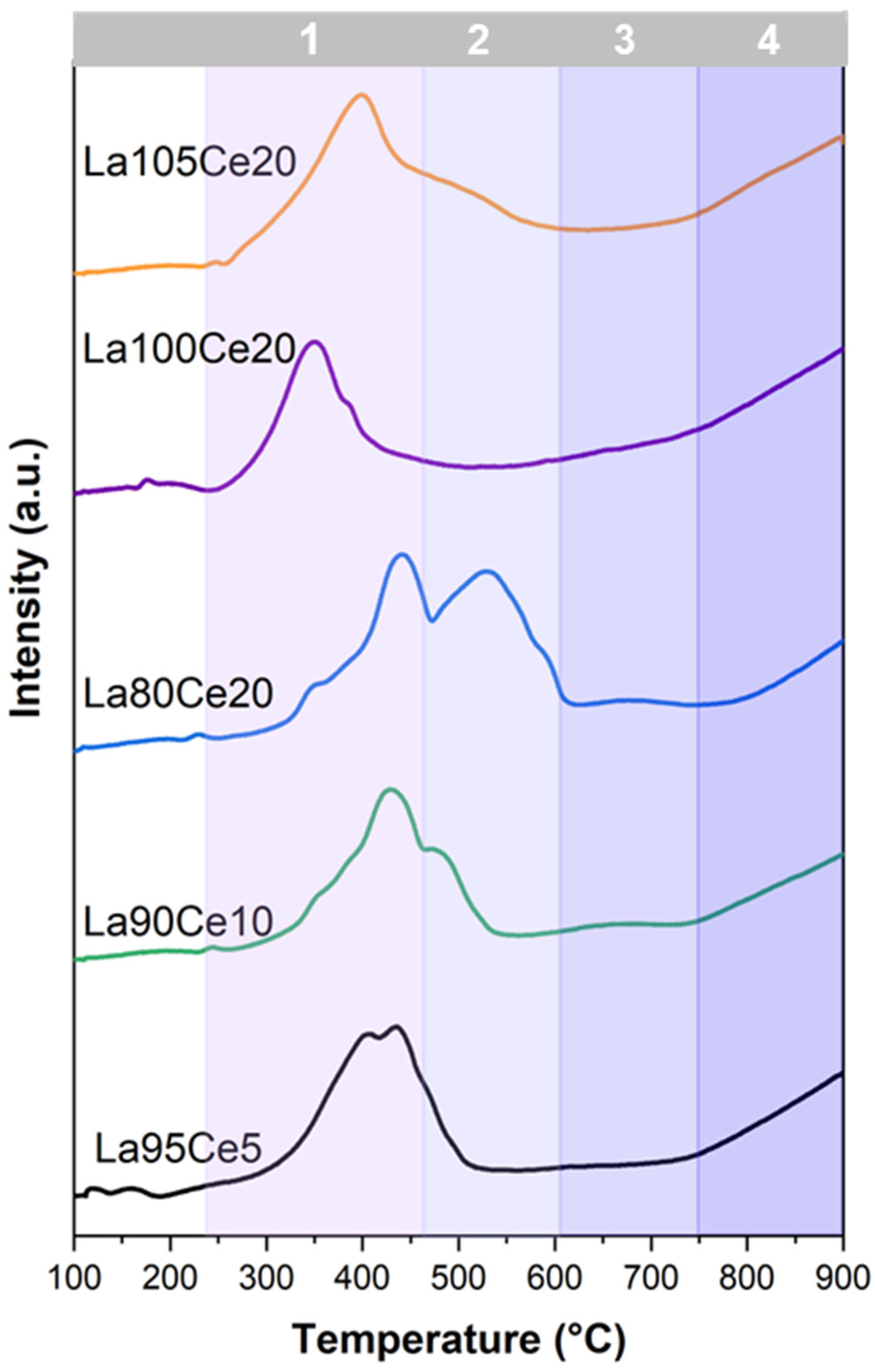
The reduction behavior of the perovskite-fluorite composites series was investigated through H2 temperature-programmed reduction (Figure 6). All samples exhibit hydrogen consumption over a broad temperature range, indicating multiple reduction processes involving B-site cations (Fe3+ and Co3+) as well as contributions from doped-ceria and iron oxide phases identified by the structural analysis (Table 2). The reduction profiles can be divided into four distinct ranges of temperature: a low-temperature region below ~450 °C (region 1), two intermediate regions in the range of ~450–600 °C (region 2) and ~600–750 °C (region 3), and a high-temperature region above 750 °C (region 4). The attribution of these reduction peaks agrees with the literature reports on analogous perovskite systems. In LaFeO3, the reduction proceeds stepwise, with Fe3+ → Fe2+ in the 430–550 °C range and subsequently Fe2+ to metallic Fe0 at temperatures above 700 °C. These processes are typically associated with low hydrogen consumption due to the strong stabilization of iron within the perovskite lattice [47,50,51]. Moreover, the literature reports attribute the low-temperature reduction feature (~300–500 °C) to the removal of surface-adsorbed oxygen species on LaFeO3. In contrast, LaCoO3 exhibits higher reducibility, characterized by two well-defined reduction steps: Co3+ → Co2+ (200–400 °C) and Co2+ → Co0 (450–650 °C) [52]. In the Co-doped LaFeO3 perovskites, these processes overlap, resulting in broadened hydrogen-consumption features that reflect the concurrent reduction of Fe and Co species [47]. Accordingly, the low-temperature region in the investigated perovskite-fluorite composites can be attributed to the reduction of Co3+ → Co2+, together with minor contributions from the removal of surface-adsorbed oxygen species (Figure 6, region 1). The intermediate regions (~450–700 °C) arise from overlapping reduction processes, including Co2+ → Co0 and Fe3+ → Fe2+ (Figure 6, regions 2,3). In all samples, the presence of La-doped CeO2 suggests that the surface Ce4+ → Ce3+ reduction may also contribute within this temperature interval. However, its individual contribution cannot be clearly distinguished due to overlap with the reduction of the transition-metal species [53]. At higher temperatures (>750 °C), hydrogen consumption is mainly associated with the reduction processes of Fe2+ → Fe0 and bulk ceria (Figure 6, region 4). In addition to the perovskite and ceria phases, the presence of segregated Fe3O4 contributes to the observed reduction behavior. According to the literature, magnetite undergoes stepwise reduction via Fe3O4 → FeO at intermediate temperatures (~300–500 °C), followed by FeO → Fe0 at higher temperatures (600–800 °C), which overlap with the reduction of the perovskite metal cations [54]. Consequently, both intermediate- and high-temperature regions likely include contributions from segregated iron oxide phases. This effect is evident in the 600–750 °C range for La95Ce5, La90Ce10 and La80Ce20, where the Fe3O4 content increases from 1.2 to 5.4 wt.% (Table 2), resulting in progressively pronounced high-temperature hydrogen consumption (Figure 6, region 3). Within the same La95Ce5, La90Ce10 and La80Ce20 series, a gradual increase in nominal cerium content further modifies the reduction profile. As the Ce loading increases across these compositions, additional intermediate temperature reduction peaks emerge. At higher nominal Ce content, the CeO2 phase gives rise to a characteristic reduction peak in the 500–600 °C range, in agreement with our previous findings (Figure 6, region 2) [53]. This contribution is particularly evident in La80Ce20, where the La-doped ceria exceeds 14 wt.% according to Rietveld refinement. Further insight can be gained by comparing La80Ce20 with La100Ce20 and La105Ce20, which contain similar amounts of CeO2-based phase but do not exhibit detectable iron oxide phase (Table 2). In La80Ce20, the first reduction peak shifts toward higher temperatures relative to La100Ce20 and La105Ce20, which can be attributed to the presence of segregated iron oxide species. This behavior may suggest that the iron oxide phase influences the reduction pathway, possibly influencing the oxygen mobility. In contrast, La100Ce20 exhibits a reduction peak at lower temperature, indicating enhanced reducibility relative to the other compositions. This peak can be associated with the sequential reduction of Co3+ → Co2+ → Co0 strongly interacting with the CeO2-based phase, with possible additional contribution from surface ceria reduction in the same temperature range. In contrast, La105Ce20 presents a higher contribution from CeO2 surface reduction, highlighting the different weight percentages of the perovskite and ceria phases and, consequently, suggesting different interactions of the two phases. These results demonstrate that variations in the nominal Ce content not only lead to different phase compositions but also influence composite reducibility. Overall, TPR has proven to be an effective technique to compare reduction behavior and phase interactions in perovskite-fluorite composites. The observed shifts of reduction peaks toward low temperatures indicate enhanced oxygen mobility, which could be beneficial for oxygen exchange and transport in SOFC cathode materials.
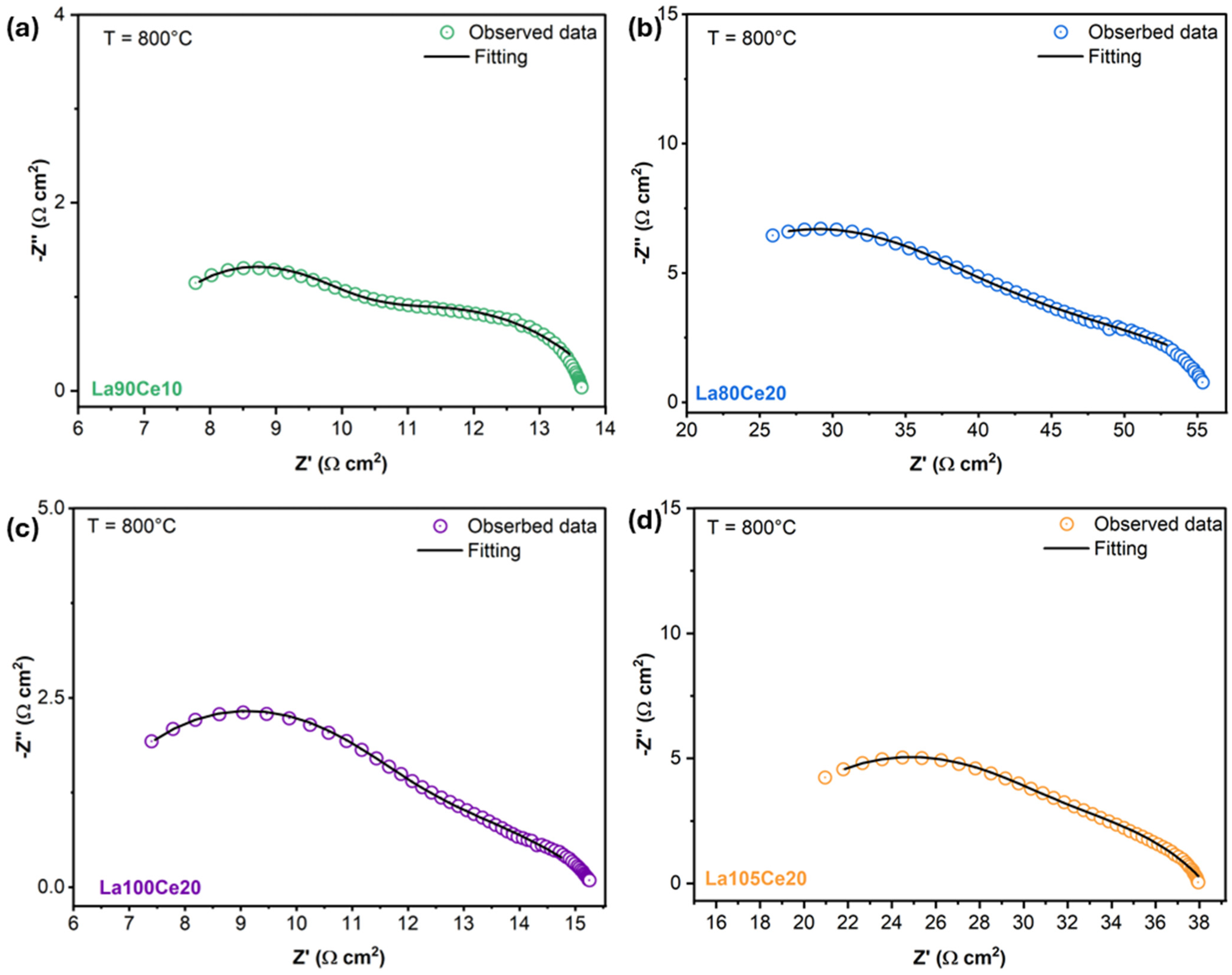
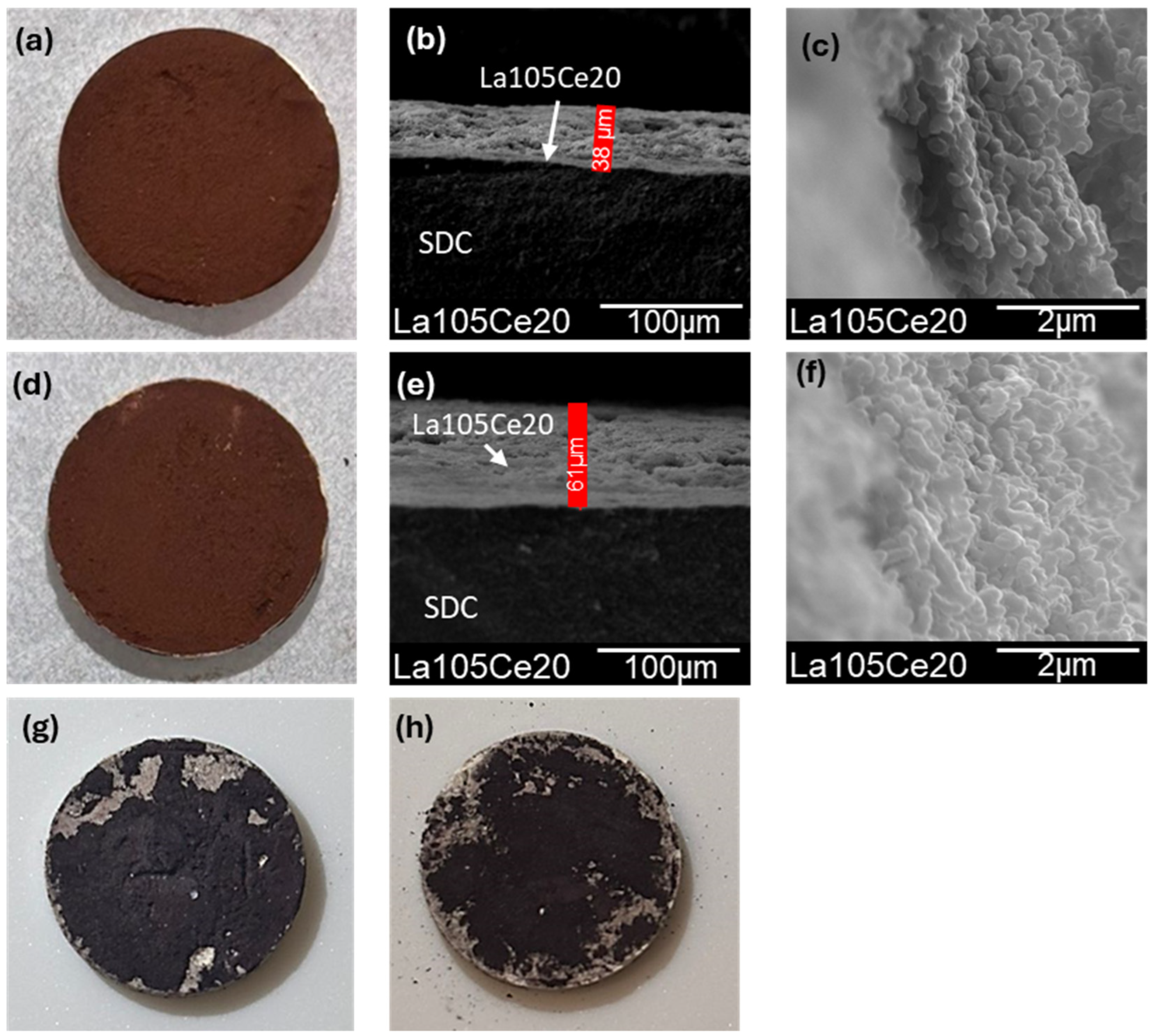
Electrochemical impedance spectroscopy was performed to evaluate the investigated composites as cathode materials for the ORR. All compositions were successfully deposited on SDC, except La95Ce5 (Figure A3a,d,g,h). As shown in Figure A3, the comparison between the pre- and post-test photographs and SEM micrographs of the La105Ce20/SDC/La105Ce20 MEA, taken as a representative sample, reveals that the membrane preserves its overall integrity after testing. In particular, the cross-sectional and electrode-surface SEM images show good adhesion between the electrode and electrolyte layers, without evident delamination or severe microstructural degradation. Figure 7 depicts the Nyquist plots acquired for all tested symmetrical cells at 800 °C, with the relative equivalent circuit fits.
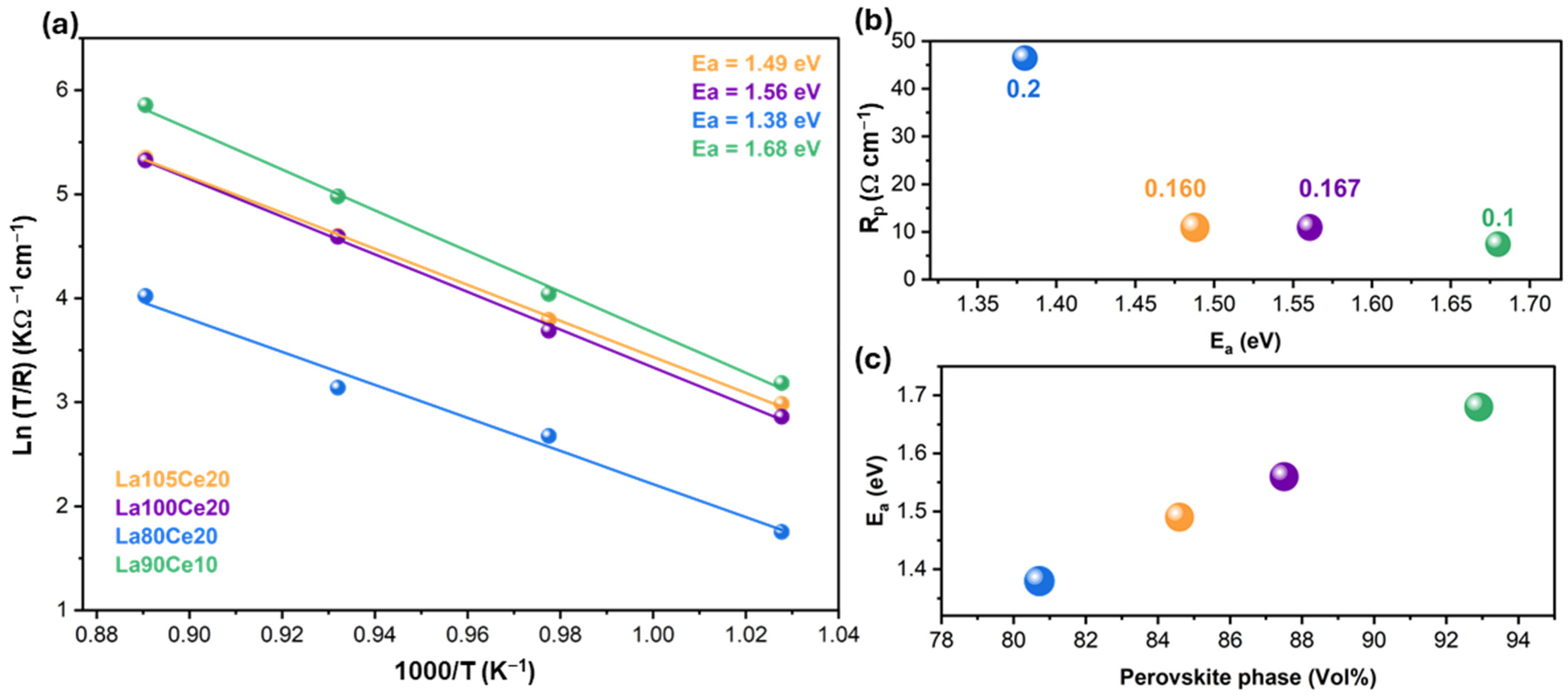
The impedance response of these systems was modeled using an equivalent circuit composed of one resistance (Rs) and two RQ elements connected in series—Rs(R1Q1)(R2Q2)—where R represents the resistance and Q the circuital constant phase element (CPE). The capacitance associated with the CPE can be expressed as C = ( R 1 n Q ) 1 / n , where C is the capacitance and n is an additional fitting parameter [55]. The high-frequency contribution associated with the electrolyte is represented by Rs, while the two RQ elements describe the intermediate-frequency response related to processes at the electrode/electrolyte interface and the low-frequency contribution attributed to electrode transport processes, mainly governed by surface oxygen exchange and bulk charge storage. The total electrode resistance is given by the sum of R1 and R2 and is generally referred to as the polarization resistance, Rp. The Arrhenius plots in Figure 8a, obtained from the temperature dependence of Rp, provide insight into the activation energy of the electrode processes associated with oxygen reduction and oxygen transport. The calculated activation energies, Ea, follow the order La80Ce20 (1.38 eV) < La105Ce20 (1.49 eV) < La100Ce20 (1.56 eV) < La90Ce10 (1.68 eV). Although La80Ce20 exhibits the lowest activation energy, it shows the highest polarization resistance. Conversely, La90Ce10 displays lower polarization resistance despite its higher activation energy. According to the Arrhenius law, in mixed ionic-electronic conductors, both positive and negative carriers contribute to the overall conductivity. Consequently, the Rp, expressed also as area-specific resistance (ASR, i.e., normalized to the electrode area), is strongly influenced by both the concentration and mobility of oxygen vacancies and electrons in the cathode. Focusing on VÖ contribution to positive charge transport, the lower ASR observed for La90Ce10 suggests an increase in the product of vacancy concentration and mobility, since more mobile vacancies facilitate oxygen ion transport and surface exchange. However, the activation energy derived from the Arrhenius plots reflects the combined contributions of oxygen vacancy-mediated transport and interfacial processes. The higher Ea observed for La90Ce10 compared to La80Ce20 and the other samples is indicative of less efficient charge transport and slower oxygen reduction processes. The high resistance observed for La80Ce20 may instead arise from an excessive concentration of vacancies as well as the higher volume of grain boundaries resulting from narrower particle size distribution. At high vacancy concentrations, vacancy–vacancy interactions may occur, leading to vacancy clustering or local lattice distortions, which ultimately hinder oxygen transport and surface exchange processes. This phenomenon could be amplified when there are a greater number of grain boundaries. Focusing on the other two compositions, the Arrhenius plots reveal that the La105Ce20 and La100Ce20 exhibit comparable behavior. In addition, the Rp–Ea correlation indicates that these two compositions provide the best compromise between polarization resistance and activation energy compared with La90Ce10 and La80Ce20 (Figure 8b). As shown above, Rietveld analysis indicates the coexistence of two phases for these two compositions (Table 2), suggesting that interaction between the perovskite and fluorite phases may provide an optimal balance, possibly promoting oxygen transport and surface exchange processes. However, the La105Ce20 sample, with a nominal Ce content of 0.16, appears to represent the best composition, for maximizing the amount of ceria-based phase while maintaining the highest La-loading, as reflected by its unit cell volume. Considering the predominance of the perovskite phase in all composites, its relative fraction is expected to critically influence the electrochemical response. As shown in Figure 8c, the activation energy exhibits an approximately linear dependence on the perovskite phase, as the volume fraction, increasing with the perovskite content. This trend further explains the lowest Ea observed for La80Ce20, which contains the lowest fraction of perovskite, while La90Ce10, with the highest perovskite content, exhibits the highest activation energy. This linear relationship should suggest that the presence of La-doped ceria contributes to lowering the activation energy of the electrode processes, indicating that the ceria phase plays a beneficial role in facilitating oxygen-related transport processes. However, La80Ce20 and La90Ce10 also contain a fraction of magnetite. The presence of this additional phase may influence the electrochemical behavior, and therefore the observed trend cannot be attributed solely to the relative amount of ceria phase.
In contrast, the polarization resistance does not follow a strictly linear dependence on the perovskite fraction. Although the perovskite phase represents the electrocatalytic active component, and therefore a higher perovskite content would be expected to reduce Rp, the observed trend deviates from simple proportionality. This behavior indicates that electrochemical performance is not governed solely by the amount of active perovskite phase but mainly by the interactions between the perovskite and ceria-based phases. As discussed above, the biphasic systems represent the best composites. La105Ce20 and La100Ce20 exhibit lower Rp values than expected from a simple compositional trend, highlighting the beneficial role of the perovskite-fluorite interaction in promoting oxygen transport and surface exchange processes.


4. Conclusions

Sr-free perovskite-fluorite composites based on LaFe0.8Co0.2O3 were successfully synthesized by a one-pot solution combustion synthesis to promote the formation of a perovskite phase together with a limited amount of a fluorite-type ceria phase. Structural analysis indicates that the incorporation of Ce at the A-site of the perovskite occurs only to a small extent, while the majority forms fluorite-type La-doped ceria. Despite its limited incorporation into the perovskite lattice, the overall cerium content significantly affects the defect chemistry of the perovskite. In particular, the progressive increase in the perovskite unit cell volume with increasing nominal Ce content suggests modifications in the oxidation state of B-site cations consistent with expansion of the BO6 octahedra. MicroRaman spectroscopy further supports this finding, revealing changes in the vibrational features associated with the perovskite framework and indicating defect-induced distortions of the BO6 octahedra. This defectivity is ascribed to an interaction of perovskite precursors with the doped ceria phase, which acted during the one-pot synthesis as a structural template for the crystal growth of the perovskite phase. This hypothesis is further supported by the SEM results, which show a clear progressive decrease in the average particle size with increasing nominal cerium content. In all samples, the lanthanum is accommodated in both perovskite and fluorite structures, causing ceria cell volume expansion and increasing defectivity. The interplay of La and Ce between the two phases promotes the formation of composites with proper charge transport and redox properties. Overall, among the investigated composites, La105Ce20 exhibits the most favorable electrochemical performance, providing the best compromise between polarization resistance and activation energy. In conclusion, the one-pot solution combustion synthesis route represents an effective strategy to promote favorable interactions between perovskite and fluorite phases, enabling the development of Sr-free perovskite-fluorite composites with reduced ceria content and enhanced functional properties. The combined use of X-ray diffraction, microRaman spectroscopy, and temperature-programmed reduction analysis proves to be a powerful and versatile approach for elucidating cation interplay between phases, defect chemistry, and redox behavior in these systems. Overall, these findings provide valuable insights that can guide the rational design of novel perovskite oxide–based composites for advanced catalytic and electrocatalytic applications. In this regard, in situ/operando approaches, chemical compatibility electrolyte/electrodes and extended stability tests may offer useful insights for optimizing the design of these composites.

Author Contributions

Conceptualization, F.D. and L.F.L.; methodology, C.A., F.D., L.V. and L.F.L.; software, C.A., F.D., L.V., L.F.L. and G.M.; validation, C.A., F.D., L.V. and L.F.L.; formal analysis, C.A., F.D., L.F.L., L.V. and G.M.; investigation, C.A., F.D., L.V., L.F.L. and G.M.; resources, F.D., C.A. and L.F.L.; data curation, C.A., F.D., L.V., L.F.L. and G.M.; writing—original draft preparation, C.A., L.V. and F.D.; writing—review and editing, C.A., L.V., F.D., L.F.L. and G.M.; visualization, C.A. and L.V.; supervision, C.A., F.D. and L.F.L.; project administration, L.F.L.; funding acquisition, L.F.L. All authors have read and agreed to the published version of the manuscript.

Funding

This research was funded by the “Programma di Ricerca e Innovazione NEST—Network 4 Energy Sustainable Transition” (Partenariato Esteso—PE0000021, CUP B53C22004060006) and Progetto “Ricerca e sviluppo di tecnologie per la filiera dell’idrogeno (POR H2)”, AdP ENEA CNR CUP: B93C22000630006.

Institutional Review Board Statement

Not applicable.

Data Availability Statement

The original contributions presented in this study are included in the article. Further inquiries can be directed to the corresponding author.

Acknowledgments

The authors are thankful to the CNR-ISMN technician Francesco Maria Giordano for performing XRD measurements, to the CNR-ISMN technician Nunzio Gallì for impedance technical support, and to Giuseppe Napoli, Salvatore Romeo and Riccardo Cannata of the CNR-ISMN administrative staff, for their help in NEST and Adp Project administration. Marta Ippolito from University of Palermo is also acknowledged for her collaboration in the experiments. During the preparation of this manuscript/study, the authors used Chat GPT, version GPT-5.3, for the readability of some sentences. The authors have reviewed and edited the output and take full responsibility for the content of this publication.

Conflicts of Interest

The authors declare no conflicts of interest. The funders had no role in the design of the study; in the collection, analyses, or interpretation of data; in the writing of the manuscript; or in the decision to publish the results.

Appendix A

Figure A1. A detailed view of the electrochemical cell setup: (a) front-view photograph showing the half-cell configuration; (b) top-view photograph of the setup; and (c) Pt electrode meshes.
Materials 19 02361 g0a1
Figure A2. Calibration curve (solid line) of the average unit cell volume (black squares) versus La content for La-doped CeO2 (0 ≤ La mol% ≤ 50). The curve was constructed using structural data from the ICDD database [35], considering only high-quality PDF entries collected under ambient conditions. The variability in cell volume is expressed as standard deviation (black bars). Dotted colored lines indicate the fluorite unit cell volumes determined by the Rietveld method for La95Ce5, La90Ce10, La80Ce20, La100Ce20 and La105Ce20 compositions according to Table 2.
Materials 19 02361 g0a2
Figure A3. La105Ce20/SDC/La105Ce20 MEA as a representative example: pre- and post-test pictures (ad), pre- and post-test SEM cross-section images (be), pre- and post-test SEM electrode images (cf). Both sides of the La95Ce5/SDC/La95Ce5 MEA (g,h).
Materials 19 02361 g0a3
Table A1. Crystal size values with uncertainties of the perovskite and fluorite phases, as obtained from Rietveld refinement of the X-ray diffraction data for the investigated samples.
LabelPerovskite Phase
Crystal Size (nm)
CeO2 Phase
Crystal Size(nm)
La105Ce2084 ± 138 ± 1
La100Ce2077 ± 148 ± 1
La80Ce20337 ± 6112 ± 2
La90Ce10252 ± 9116 ± 10
La95Ce5267 ± 6104 ± 8

References

  1. Ruiz, K.; Judez, X.; Fantova, M.; García-Martín, S.; García-Alvarado, F.; Ciaurriz, P.; Aguado, M.; Garbayo, I. Current market status of solid oxide hydrogen technology: From starting materials to system level. Energy Rep. 2026, 15, 109091. [Google Scholar] [CrossRef]
  2. Long, T.; Song, D.; Zhou, Y.; Yu, X.; Wang, X.; Li, C.; Chen, H.; Li, G.; He, F. Modulating Activity of Lattice Oxygen of ABO3 Perovskite Oxides in Redox Reactions: A Review. ACS Appl. Mater. Interfaces 2025, 17, 20590–20612. [Google Scholar] [CrossRef] [PubMed]
  3. Aliotta, C.; Deganello, F. Towards Perovskite Oxide-Based Electrocatalysts with Zero-Critical Elements for Sustainable Energy Production. Sustain. Chem. 2024, 5, 327–329. [Google Scholar] [CrossRef]
  4. Chen, H.; Guo, Z.; Zhang, L.A.; Li, Y.; Li, F.; Zhang, Y.; Chen, Y.; Wang, X.; Yu, B.; Shi, J.-M.; et al. Improving the Electrocatalytic Activity and Durability of the La0.6Sr0.4Co0.2Fe0.8O3−δ Cathode by Surface Modification. ACS Appl. Mater. Interfaces 2018, 10, 39785–39793. [Google Scholar] [CrossRef]
  5. dos Santos-Gómez, L.; Sánchez-Caballero, A.; Porras-Vázquez, J.M.; Zamudio-García, J.; Losilla, E.R.; Marrero-López, D. Engineering phase distribution in LSCF-CGO cathodes for enhanced electrochemical performance in SOFCs. J. Eur. Ceram. Soc. 2026, 46, 118111. [Google Scholar] [CrossRef]
  6. Huang, L.; Cheng, L.; Pan, S.; He, Y.; Tian, C.; Yu, J.; Zhou, H. Effects of Sr doping on the structure, magnetic properties and microwave absorption properties of LaFeO3 nanoparticles. Ceram. Int. 2020, 46, 27352–27361. [Google Scholar] [CrossRef]
  7. Kuhn, J.N.; Ozkan, U.S. Surface properties of Sr- and Co-doped LaFeO3. J. Catal. 2008, 253, 200–211. [Google Scholar] [CrossRef]
  8. Wang, Y.; Wang, Y.; Qi, H.; Tu, B.; Ou, D.; Tan, Y.; Xiong, C.; Qiu, P. Tuning the ORR catalytic activity of LaFeO3-δ-based perovskite cathode for solid oxide fuel cells by doping with alkaline-earth metal elements. Ceram. Int. 2024, 50, 5818–5826. [Google Scholar] [CrossRef]
  9. Dang, X.; Lu, Y.; Fan, Z.; Jiang, Y.; Gao, Z. Strategies to mitigate Sr segregation of the LSCF oxygen electrode for solid oxide cells. J. Mater. Chem. A 2025, 13, 20268–20288. [Google Scholar] [CrossRef]
  10. Deng, M.; Yu, Y.; Wang, Y.; Ma, Z.; Lu, L.; Rui, T.; Lan, Y.; Linghu, J.; Han, N.; Li, Y.; et al. Machine-Learning-Based Screening of Perovskite Cathodes for Low-Temperature Solid Oxide Fuel Cell Operation. Crystals 2026, 16, 68. [Google Scholar] [CrossRef]
  11. Liu, F.; Wang, Q.; Wang, Y.; Liang, Z.; Chen, L.; Cao, L.; Shalaby, M.S.; Petracic, O.; Wei, X.-K. Asymmetric oxygen displacement-induced contrast modulation and multi-state ferroelectricity in distorted perovskite oxides. Appl. Phys. Rev. 2026, 13, 011416. [Google Scholar] [CrossRef]
  12. Kim, M.; Lee, H. Oxygen adsorption capability and electrochemical properties induced by oxygen vacancies in cerium-doped LaFeO3 perovskite oxide. Scr. Mater. 2024, 242, 115880. [Google Scholar] [CrossRef]
  13. Sun, W.; Wei, H.; An, L.; Jin, C.; Wu, H.; Xiong, Z.; Pu, C.; Sun, C. Oxygen vacancy mediated La1-xCexFeO3-δ perovskite oxides as efficient catalysts for CWAO of acrylic acid by A-site Ce doping. Appl. Catal. B Environ. 2019, 245, 20–28. [Google Scholar] [CrossRef]
  14. Talei, R.; Mohammadi, A.; Winterstein, T.F.; Malleier, C.; Schmitz, G.; Penner, S.; Bonmassar, N. Defect-Engineered Perovskites: Atomic Scale Nature of A-Site Vacancy-Stabilized Catalytically Active Phase. J. Am. Chem. Soc. 2026, 148, 9980–9989. [Google Scholar] [CrossRef] [PubMed]
  15. Xu, X.; Pan, Y.; Ge, L.; Chen, Y.; Mao, X.; Guan, D.; Li, M.; Zhong, Y.; Hu, Z.; Peterson, V.K.; et al. High-Performance Perovskite Composite Electrocatalysts Enabled by Controllable Interface Engineering. Small 2021, 17, 2101573. [Google Scholar] [CrossRef]
  16. Abdelghafar, F.; Xu, X.; Guan, D.; Lin, Z.; Hu, Z.; Ni, M.; Huang, H.; Bhatelia, T.; Jiang, S.P.; Shao, Z. New Nanocomposites Derived from Cation-Nonstoichiometric Bax(Co, Fe, Zr, Y)O3−δ as Efficient Electrocatalysts for Water Oxidation in Alkaline Solution. ACS Mater. Lett. 2024, 6, 2985–2994. [Google Scholar] [CrossRef]
  17. Slomski, H.S.; Kaufman, J.L.; Dzara, M.J.; Strange, N.A.; Priest, C.; Hartvigsen, J.L.; Kane, N.; Casteel, M.; Wood, B.C.; Ginley, D.S.; et al. Understanding (La,Sr)(Co,Fe)O3−δ Phase Instability within SOECs Using a Combined Experimental and Atomistic Modeling Approach. ACS Phys. Chem. Au 2025, 5, 207–218. [Google Scholar] [CrossRef]
  18. Arman, M.M.; Imam, N.G.; Loredo Portales, R.; El-Dek, S.I. Synchrotron radiation X-ray absorption fine structure and magnetization improvement of A-site Ce3+ doped LaFeO3. J. Magn. Magn. Mater. 2020, 513, 167097. [Google Scholar] [CrossRef]
  19. Ray, S.K.; Dahal, R.; Ashie, M.D.; Alonzo, S.M.M.; Kc, B.R.; Bastakoti, B.P. Recent Progress on Cerium Oxide-Based Nanostructures for Energy and Environmental Applications. Adv. Energy Sustain. Res. 2025, 6, 2500022. [Google Scholar] [CrossRef]
  20. Luo, H.; Song, C.; Xu, J.; Gan, Y.; Yu, J.; Wang, Y.; Song, Y.; Liu, J.; Hu, Q. Effect of Ce doping on the magnetic properties of LaFeO3 nanofibers. J. Taiwan Inst. Chem. Eng. 2026, 183, 106615. [Google Scholar] [CrossRef]
  21. Ao, R.; Yang, X.; Pu, T.; Dai, Q.; Yang, J.; Xie, L.; Guo, Z.; Ma, L.; Xie, H. Revealing the NO oxidation mechanism by the Ce-doped LaCoO3 perovskite catalysts. Fuel 2026, 411, 138056. [Google Scholar] [CrossRef]
  22. Sun, Y.; Yang, J.; Li, S.; Wang, D. Defect engineering in perovskite oxide thin films. Chem. Commun. 2021, 57, 8402–8420. [Google Scholar] [CrossRef]
  23. Jessica, M.-J.; Juan, T.-P.; Jaime, G.; Alexander, S. Effect of Structural Defects Induced in LaFeO3 and LaMnO3 Catalysts towards Total Oxidation of 2-Propanol. Catal. Lett. 2025, 155, 109. [Google Scholar] [CrossRef]
  24. Aliotta, C.; Liotta, L.F.; La Parola, V.; Martorana, A.; Muccillo, E.N.S.; Muccillo, R.; Deganello, F. Ceria-based electrolytes prepared by solution combustion synthesis: The role of fuel on the materials properties. Appl. Catal. B Environ. 2016, 197, 14–22. [Google Scholar] [CrossRef]
  25. Li, L.; Watanabe, M.; Inada, M.; Ishihara, T. Doped CeO2-LaFeO3 composite cathode for high-temperature CO2 electrolysis: Improved performance and H2S tolerance. Catal. Today 2025, 460, 115470. [Google Scholar] [CrossRef]
  26. Isupova, L.; Gerasimov, E.; Prosvirin, I.; Rogov, V. Catalytic Activity of LaFe0.4Ni0.6O3/CeO2 Composites in CO and CH4 Oxidation Depending on Their Preparation Conditions. Materials 2023, 16, 1142. [Google Scholar] [CrossRef]
  27. Irshad, M.; Siraj, K.; Raza, R.; Ali, A.; Tiwari, P.; Zhu, B.; Rafique, A.; Ali, A.; Kaleem Ullah, M.; Usman, A. A Brief Description of High Temperature Solid Oxide Fuel Cell’s Operation, Materials, Design, Fabrication Technologies and Performance. Appl. Sci. 2016, 6, 75. [Google Scholar] [CrossRef]
  28. Yadav, A.K.; Sinha, S.; Kumar, A. Advancements in composite cathodes for intermediate-temperature solid oxide fuel cells: A comprehensive review. Int. J. Hydrogen Energy 2024, 59, 1080–1093. [Google Scholar] [CrossRef]
  29. Song, Y.; Song, Y.; Wang, Y.; Tian, Y.; Li, J.; Xu, M.; Shao, Z.; Ciucci, F. Advances in Advanced In Situ Assembled CompositeElectrode Materials for Enhanced Solid Oxide CellPerformance. Adv. Funct. Mater. 2024, 34, 2405851. [Google Scholar] [CrossRef]
  30. Zhao, Z.; Zou, M.; Huang, H.; Wofford, H.; Tong, J. Stable perovskite-fluorite dual-phase composites synthesized by one-pot solid-state reactive sintering for protonic ceramic fuel cells. Ceram. Int. 2021, 47, 32856–32866. [Google Scholar] [CrossRef]
  31. He, S.; Li, M.; Hui, J.; Yue, X. In-situ construction of ceria-metal/titanate heterostructure with controllable architectures for efficient fuel electrochemical conversion. Appl. Catal. B Environ. 2021, 298, 120588. [Google Scholar] [CrossRef]
  32. Shao, Q.; Han, X.; Li, K.; Guan, W.; Lv, Z. Coherent heterointerface engineering toward high active and durable composite cathodes for solid oxide fuel cells. Fuel 2026, 405, 136788. [Google Scholar] [CrossRef]
  33. Yu, J.; Liu, X.; Zhong, M.; Yang, S.; Li, L.; Chi, B.; Pu, J. Suppression of Sr Segregation in La0.6Sr0.4Co0.2Fe0.8O3−δ Oxygen Electrode via Ca Doping for Enhanced Performance Stability of Reversible Solid Oxide Cell. ACS Appl. Mater. Interfaces 2026, 18, 11409–11420. [Google Scholar] [CrossRef]
  34. Toby, B.H.; Von Dreele, R.B. GSAS-II: The genesis of a modern open-source all purpose crystallography software package. J. Appl. Crystallogr. 2013, 46, 544–549. [Google Scholar] [CrossRef]
  35. Kabekkodu, S.N.; Dosen, A.; Blanton, T.N. PDF-5+: A comprehensive Powder Diffraction File™ for materials characterization. Powder Diffr. 2024, 39, 47–59. [Google Scholar] [CrossRef]
  36. Deganello, F.; Ippolito, M.; Giannici, F.; Aliotta, C.; Liotta, L.F.; Vecino-Mantilla, S.; Hafsi, Z.; Lo Faro, M. Design of multi-doped strontium ferrate perovskite-based electrocatalysts with medium-entropy and reduced content of critical elements. Chem. Eng. J. 2025, 520, 165946. [Google Scholar] [CrossRef]
  37. Deganello, F.; Tyagi, A.K. Solution combustion synthesis, energy and environment: Best parameters for better materials. Prog. Cryst. Growth Charact. Mater. 2018, 64, 23–61. [Google Scholar] [CrossRef]
  38. Toby, B.H. R factors in Rietveld analysis: How good is good enough? Powder Diffr. 2012, 21, 67–70. [Google Scholar] [CrossRef]
  39. Shannon, R.D. Revised effective ionic radii and systematic studies of interatomic distances in halides and chalcogenides. Acta Crystallogr. Sect. A 1976, 32, 751–767. [Google Scholar] [CrossRef]
  40. Shikha, P.; Kang, T.S.; Randhawa, B.S. Effect of different synthetic routes on the structural, morphological and magnetic properties of Ce doped LaFeO3 nanoparticles. J. Alloys Compd. 2015, 625, 336–345. [Google Scholar] [CrossRef]
  41. Ouldhamadouche, N.; Belguenoune, A.; Bassaid, S.; Dehbi, A.; Ben Rhaiem, A. Synthesis and characterization of LaFeO3 perovskite: Insights into dielectric properties and conduction mechanism. Phys. B Condens. Matter 2025, 714, 417513. [Google Scholar] [CrossRef]
  42. Sheikh, J.; Acharya, S.A.; Deshpande, U.P. Ce-doping effect on modulation of spin-exchange interaction and dielectric behaviour of nanostructured LaFeO3 orthoferrites. Mater. Chem. Phys. 2020, 242, 122457. [Google Scholar] [CrossRef]
  43. Varandili, S.B.; Babaei, A.; Ataie, A. Characterization of B site codoped LaFeO3 nanoparticles prepared via co-precipitation route. Rare Met. 2018, 37, 181–190. [Google Scholar] [CrossRef]
  44. Deganello, F.; Joshi, M.; Liotta, L.F.; La Parola, V.; Marcì, G.; Pantaleo, G. Sustainable Recycling of Insoluble Rust Waste for the Synthesis of Iron-Containing Perovskite-Type Catalysts. ACS Omega 2019, 4, 6994–7004. [Google Scholar] [CrossRef] [PubMed]
  45. Giannici, F.; Gregori, G.; Aliotta, C.; Longo, A.; Maier, J.; Martorana, A. Structure and Oxide Ion Conductivity: Local Order, Defect Interactions and Grain Boundary Effects in Acceptor-Doped Ceria. Chem. Mater. 2014, 26, 5994–6006. [Google Scholar] [CrossRef]
  46. Kumar, N.; Najimu, M.O.; Cho, Y.J.; Gilliard-AbdulAziz, K.L.; Nikolla, E.; Wu, Z.; Wachs, I.E. Probing Surface/Bulk Structural Chemistry of Key Components of Solid Oxide Electrochemical Cells with In Situ/Operando Raman Spectroscopy. Chem. Rev. 2025, 125, 8921–8955. [Google Scholar] [CrossRef]
  47. Pan, F.; Zhang, W.; Ferronato, C.; Valverde, J.L.; Giroir-Fendler, A. Boosting propene oxidation activity over LaFeO3 perovskite catalysts by cobalt substitution. Appl. Catal. A Gen. 2022, 643, 118779. [Google Scholar] [CrossRef]
  48. Chanda, S.; Saha, S.; Dutta, A.; Irfan, B.; Chatterjee, R.; Sinha, T.P. Magnetic and dielectric properties of orthoferrites La1−x PrxFeO3 (x = 0, 0.1, 0.2, 0.3, 0.4 and 0.5). J. Alloys Compd. 2015, 649, 1260–1266. [Google Scholar] [CrossRef]
  49. Mahapatra, A.S.; Mitra, A.; Mallick, A.; Ghosh, M.; Chakrabarti, P.K. Enhanced magnetic property and phase transition in Ho3+ doped LaFeO3. Mater. Lett. 2016, 169, 160–163. [Google Scholar] [CrossRef]
  50. Ansari, A.A.; Ahmad, N.; Alam, M.; Adil, S.F.; Assal, M.E.; Albadri, A.; Al-Enizi, A.M.; Khan, M. Optimization of Redox and Catalytic Performance of LaFeO3 Perovskites: Synthesis and Physicochemical Properties. J. Electron. Mater. 2019, 48, 4351–4361. [Google Scholar] [CrossRef]
  51. Ciambelli, P.; Cimino, S.; De Rossi, S.; Lisi, L.; Minelli, G.; Porta, P.; Russo, G. AFeO3 (A=La, Nd, Sm) and LaFe1−xMgxO3 perovskites as methane combustion and CO oxidation catalysts: Structural, redox and catalytic properties. Appl. Catal. B Environ. 2001, 29, 239–250. [Google Scholar] [CrossRef]
  52. Ansari, A.A.; Adil, S.F.; Alam, M.; Ahmad, N.; Assal, M.E.; Labis, J.P.; Alwarthan, A. Catalytic performance of the Ce-doped LaCoO3 perovskite nanoparticles. Sci. Rep. 2020, 10, 15012. [Google Scholar] [CrossRef]
  53. Østergaard, M.B.; Deganello, F.; La Parola, V.; Liotta, L.F.; Boffa, V.; Jørgensen, M.K. Beneficial effect of cerium excess on in situ grown Sr0.86Ce0.14FeO3–CeO2 thermocatalysts for the degradation of bisphenol A. RSC Adv. 2023, 13, 21459–21470. [Google Scholar] [CrossRef]
  54. Li, Z.; Geng, Y.; Ma, L.; Chen, X.; Li, J.; Chang, H.; Schwank, J.W. Catalytic oxidation of CO over Pt/Fe3O4 catalysts: Tuning O2 activation and CO adsorption. Front. Environ. Sci. Eng. 2020, 14, 65. [Google Scholar] [CrossRef]
  55. Aliotta, C.; Costa, M.; Liotta, L.F.; La Parola, V.; Magnacca, G.; Deganello, F. Peculiar Properties of the La0.25Ba0.25Sr0.5Co0.8Fe0.2O3−δ Perovskite as Oxygen Reduction Electrocatalyst. Molecules 2023, 28, 1621. [Google Scholar] [CrossRef]
Figure 1. Schematic illustration of solution combustion synthesis used to prepare the perovskite-fluorite composite. The pictures refer to La105Ce20 as a representative sample. Step 1: formation of the precursor solution; step 2: formation of the gel network; step 3: self-combustion resulting in the as-burned powder; step 4: thermal treatment.
Materials 19 02361 g001
Figure 2. XRD pattern diffraction (a) and the Temperature/Time profiles measured during combustion (b) of the as-burned powders, La80Ce20 and La100Ce20.
Materials 19 02361 g002
Figure 3. XRD patterns of the investigated perovskite-fluorite composites (a) and Rietveld refinement of La80Ce20 with the phase 2θ positions of ICCD PDF Cards (b).
Materials 19 02361 g003
Figure 4. The Raman spectra of the perovskite-fluorite composites (a) and perovskite unit cell volume as a function of Raman shift at peak maximum in regions 3 and 4 (b,c). The yellow arrow indicates the trend of the calculated Ce nominal content; the red line refers to La95Ce5, La90Ce10 and La80Ce20 samples, and the blue line refers to La105Ce20, La100Ce20 and La80Ce20 (* signals arising from instrument chamber).
Materials 19 02361 g004
Figure 5. SEM images of the powder perovskite–fluorite composites La95Ce5 (a), La90Ce10 (b), La80Ce20 (c), La100Ce20 (d), and La105Ce20 (e). The main images are shown with 10 µm scale bars, while the insets provide higher-magnification details with 1 µm scale bars.
Materials 19 02361 g005
Figure 6. H2-TPR profiles of the perovskite-fluorite composites. The colored areas highlight the main reduction steps discussed in the text.
Materials 19 02361 g006
Figure 7. Nyquist plots (colored circles) and equivalent circuit fittings (black line) of La90Ce10 (a), La80Ce20 (b), La100Ce20 (c) and La105Ce20 (d).
Materials 19 02361 g007
Figure 8. Arrhenius plots (a), polarization resistance at 800 °C as a function of the activation energy (with indication of calculated nominal Ce content) (b), and activation energy as a function of volume fraction of perovskite phase (c) of the investigated samples. Volume fractions were calculated from weight fractions using theoretical densities obtained from Rietveld refinements.
Materials 19 02361 g008
Table 1. List of the prepared samples.
LabelNominal CompositionNominal Ce Content Ce/(La + Ce)
La105Ce20La1.05Ce0.2Fe0.8Co0.2O30.160
La100Ce20LaCe0.2Fe0.8Co0.2O30.167
La80Ce20La0.8Ce0.2Fe0.8Co0.2O30.200
La90Ce10La0.9Ce0.1Fe0.8Co0.2O30.100
La95Ce5La0.95Ce0.05Fe0.8Co0.2O30.050
Table 2. Rietveld refinement results for the investigated samples.
LabelPerovskite Phase
(wt%)
CeO2 Phase (wt%)Fe3O4 Phase (wt%)Perovskite Phase Volume (Å3)CeO2 Phase Volume (Å3)Reliability
Factors a
(%)
La105Ce2084.4 ± 0.215.6 ± 0.20238.63 ± 0.02165.03 ± 0.05wR = 5.29
GOF = 3.31
La100Ce2087.2 ± 0.212.8 ± 0.20238.83 ± 0.02160.12 ± 0.03wR = 4.69
GOF = 2.9
La80Ce2080.1 ± 0.114.2 ± 0.15.7 ± 0.1239.509 ± 0.003159.49 ± 0.01wR = 3.22
GOF = 2.14
La90Ce1092.7 ± 0.25.4 ± 0.11.9 ± 0.1238.93 ± 0.02159.39 ± 0.02wR = 5.98
GOF = 5.70
La95Ce596.0 ± 0.12.83 ± 0.011.22 ± 0.01238.576 ± 0.004159.48 ± 0.06wR = 4.90
GOF = 3.14
a wR: the weighted-profile R-factor; GOF: goodness-of-fit [38].
Table 3. Range of particle sizes, nominal metal atomic composition, and EDX metal atomic composition.
LabelRange of
Particle Size (nm)
Nominal Metal Atomic %EDX Metal
Atomic %
LaCeFeCoLaCeFeCo
La105Ce20100–20046.68.935.58.941.0 ± 0.88.0 ± 0.242.0 ± 0.89.0 ± 0.2
La100Ce20100–20045.59.136.49.141.5 ± 0.87.5 ± 0.243.0 ± 0.88.0 ± 0.2
La80Ce2080–1804010401039.0 ± 0.89.5 ± 0.241.0 ± 0.810.5 ± 0.2
La90Ce10150–400455401041.0 ± 0.84.5 ± 0.143.5 ± 0.911.0 ± 0.2
La95Ce5200–40047.52.5401044.0 ± 0.82.7 ± 0.143.0 ± 0.910.3 ± 0.2
Disclaimer/Publisher’s Note: The statements, opinions and data contained in all publications are solely those of the individual author(s) and contributor(s) and not of MDPI and/or the editor(s). MDPI and/or the editor(s) disclaim responsibility for any injury to people or property resulting from any ideas, methods, instructions or products referred to in the content.