Numerical Simulation of Laser Cladding Using Cable Wires

 ,
,  , , and
Abstract
1. Introduction
2. Experimental
2.1. Materials
2.2. Equipment
3. Models
- (1)
- The melt behaves as an incompressible, laminar Newtonian fluid.
- (2)
- Materials are isotropic.
- (3)
- The laser beam is an ideal top-hat source with negligible variation along z.
- (4)
- Momentum transfer induced by wire feeding is neglected, as the wire feed rate (100 mm/min) is two orders of magnitude lower than the characteristic melt-pool flow velocity, rendering its contribution to the overall momentum balance insignificant.
- (5)
- Vaporization of aluminum is neglected regarding its influence on the clad geometry.
- (6)
- Temperature-dependent thermophysical data were taken from JMatPro 7.0.
3.1. Control Equations
3.2. Laser Heat Source Model
3.3. Boundary
3.4. Surface and Body Forces in the Melt-Pool
3.5. Thermo-Mechanical Model for the Clad Track
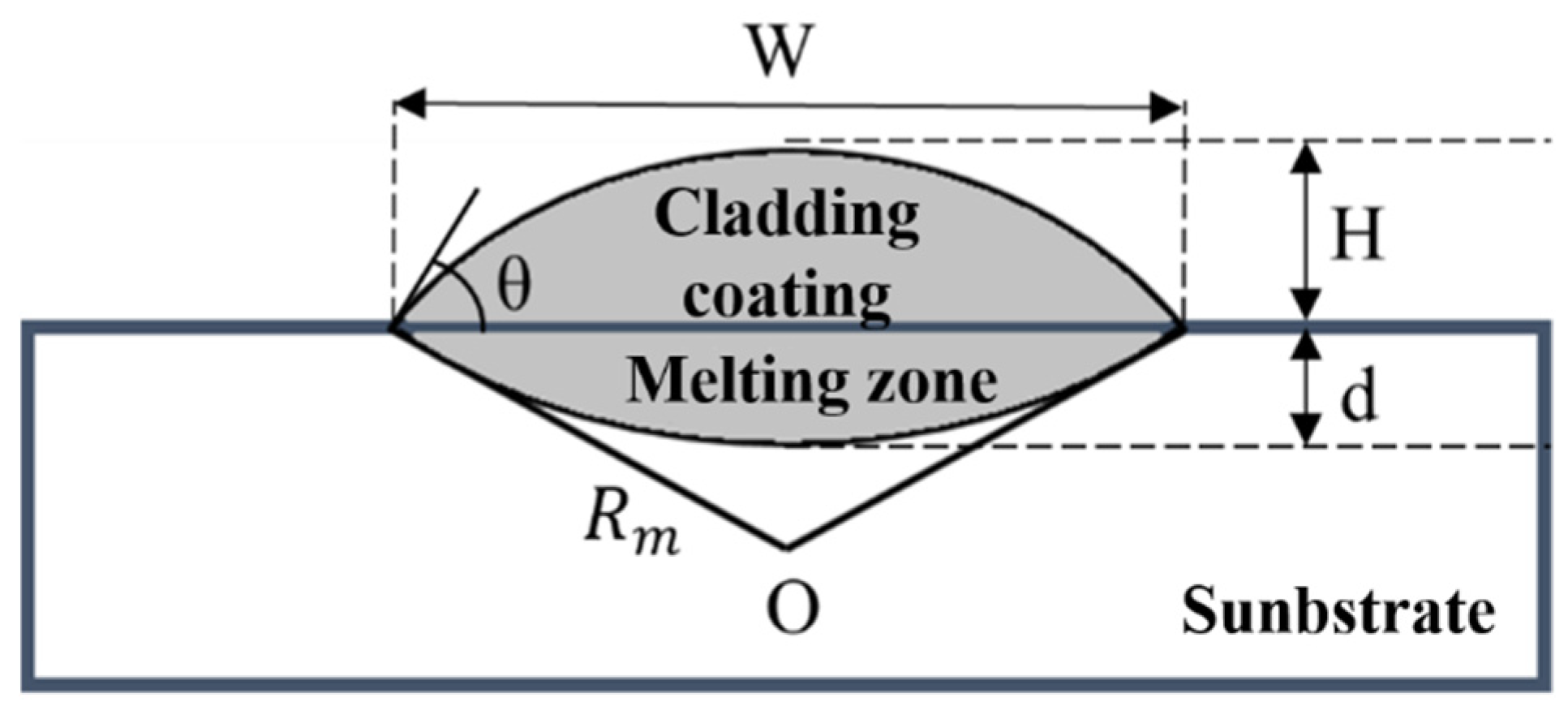
3.6. Mathematical Model of Clad-Track Geometry
3.6.1. Derivation of Process-Parameter–Geometry Relationships
3.6.2. Mathematical Model for Clad-Track Width W
4. Results and Discussions
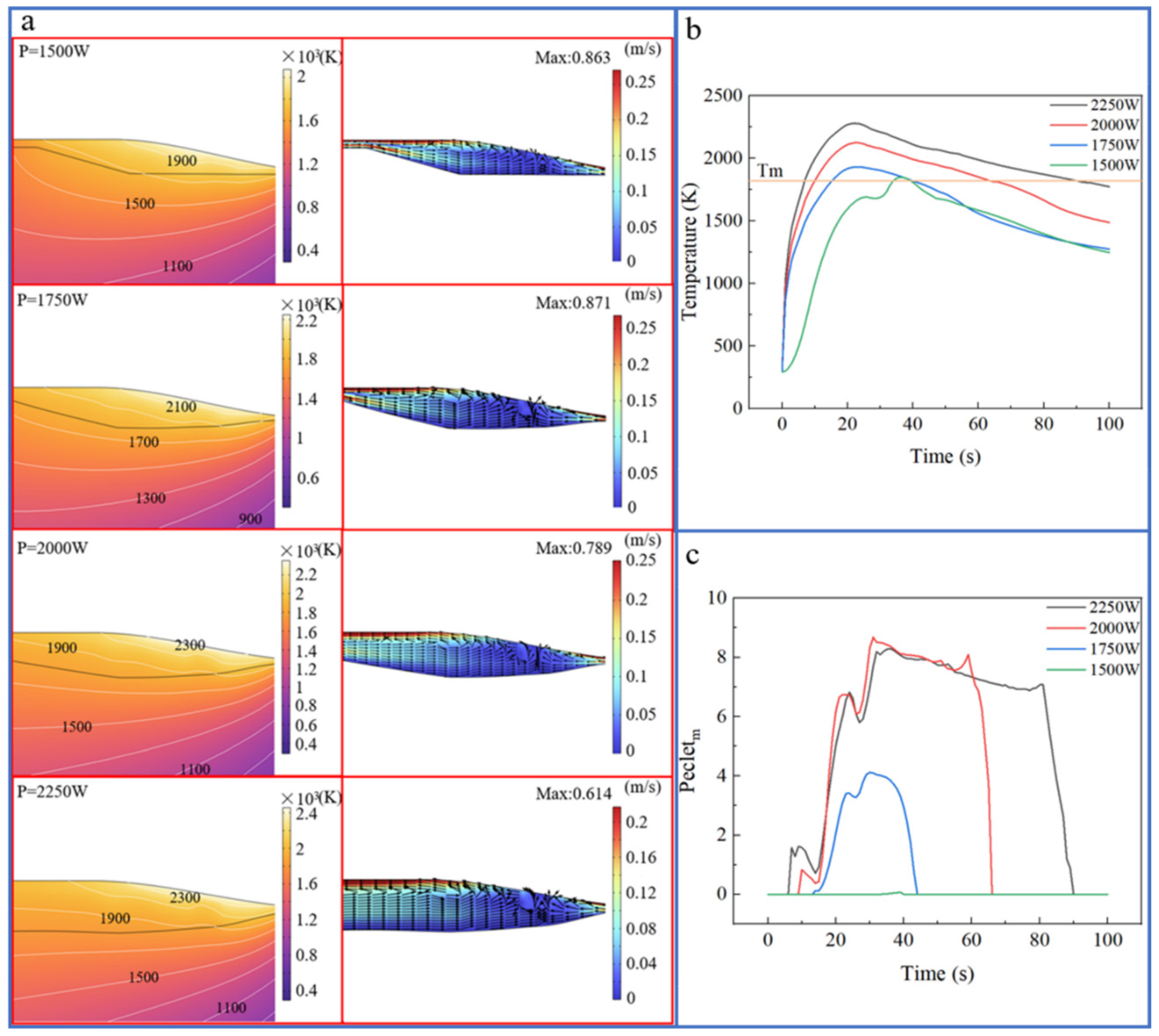
4.1. Molten Pool Behavior Analysis
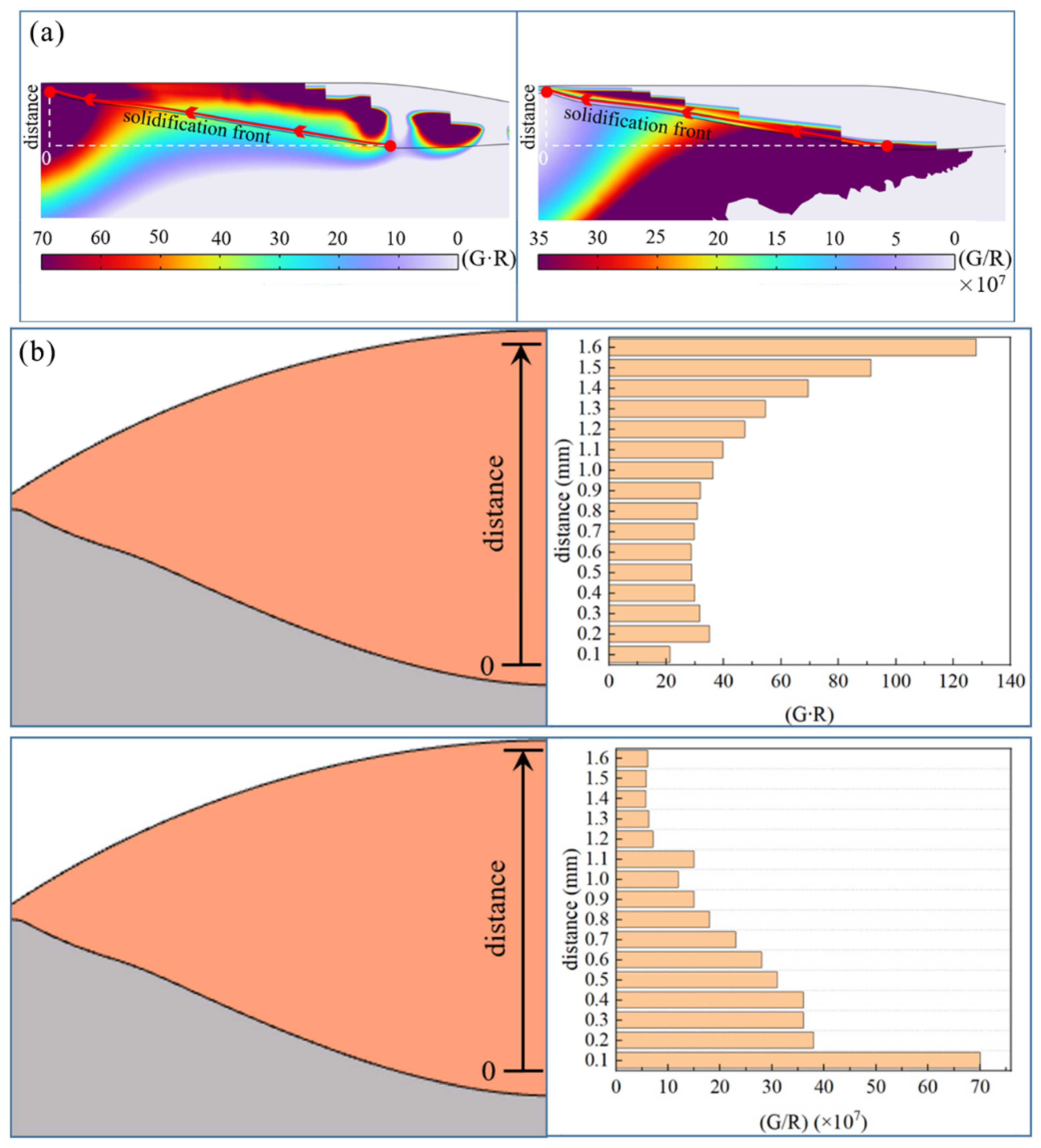
4.2. Solidification Analysis
4.3. Stress Analysis
4.4. Element Distribution Analysis
5. Conclusions
- (1)
- A critical molten pool Péclet number (Pecletm ≥ 8), achieved at a laser power of 2000 W, marks the transition from diffusion-dominated to convection-dominated mixing, eliminating the intrinsic radial segregation of the cable wire. Powers exceeding 2250 W reverse this trend due to viscous dissipation and increase defect susceptibility.
- (2)
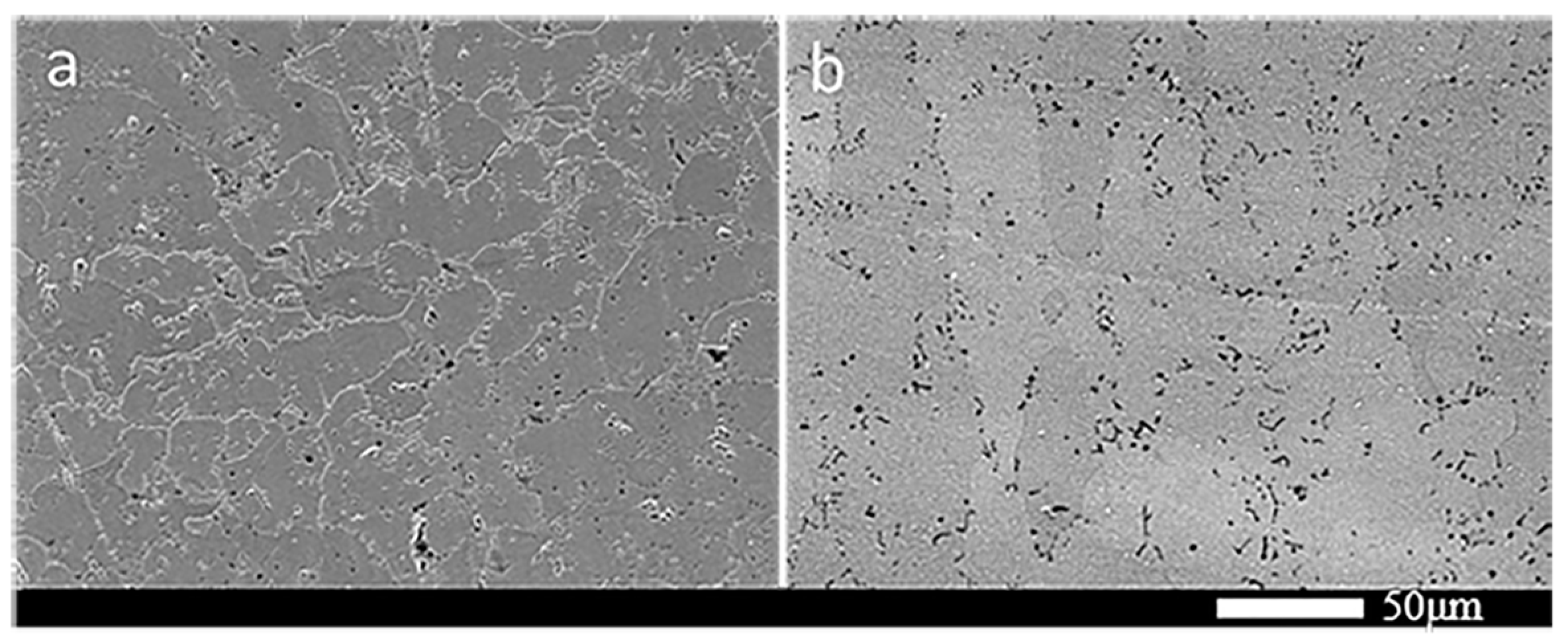
- The columnar-to-equiaxed transition (CET) is governed by the gradients of G·R and G/R. The predicted grain morphology is in exact agreement with previous experimental micrographs, validating the solidification module of the model.
- (3)
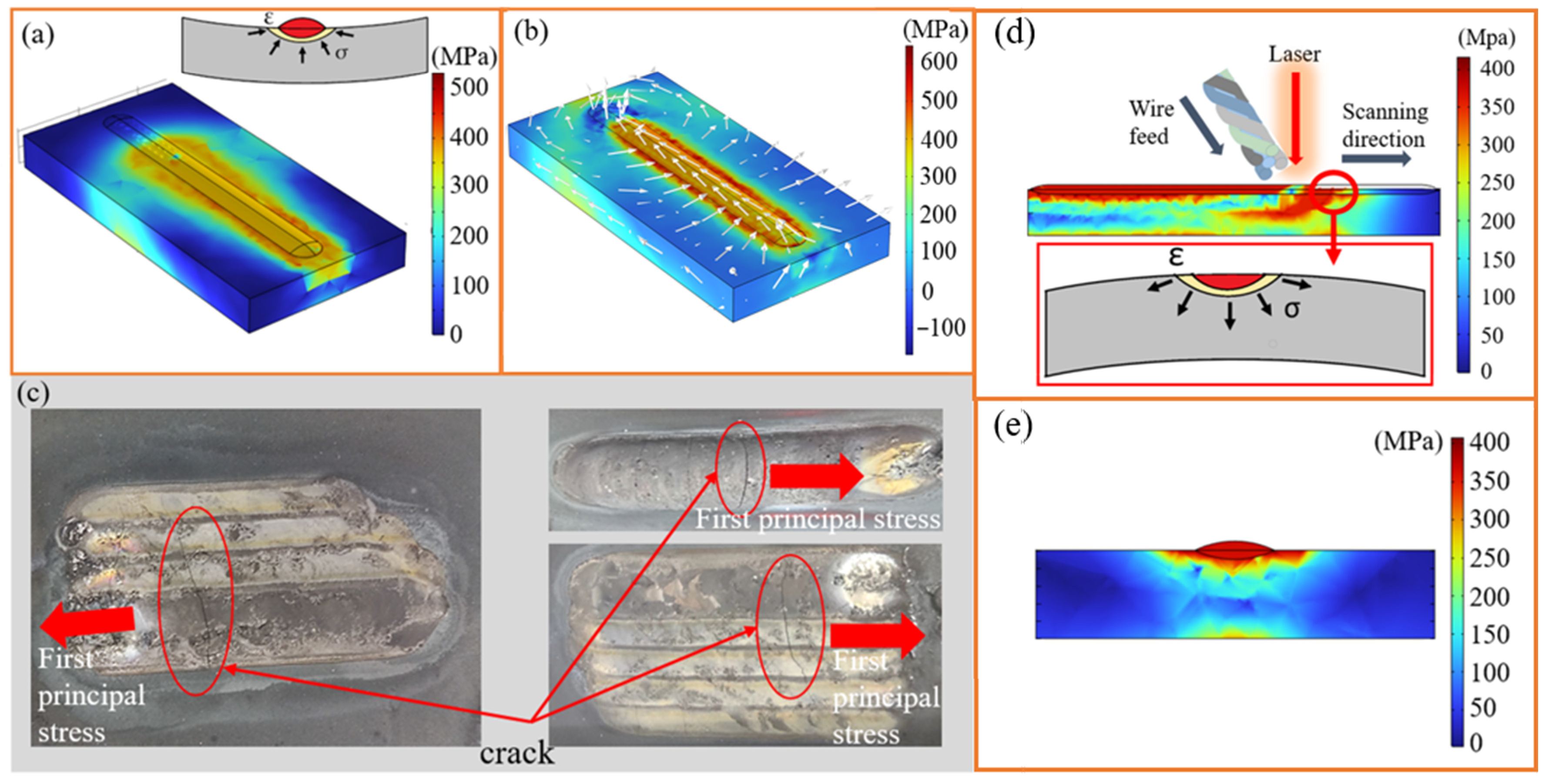
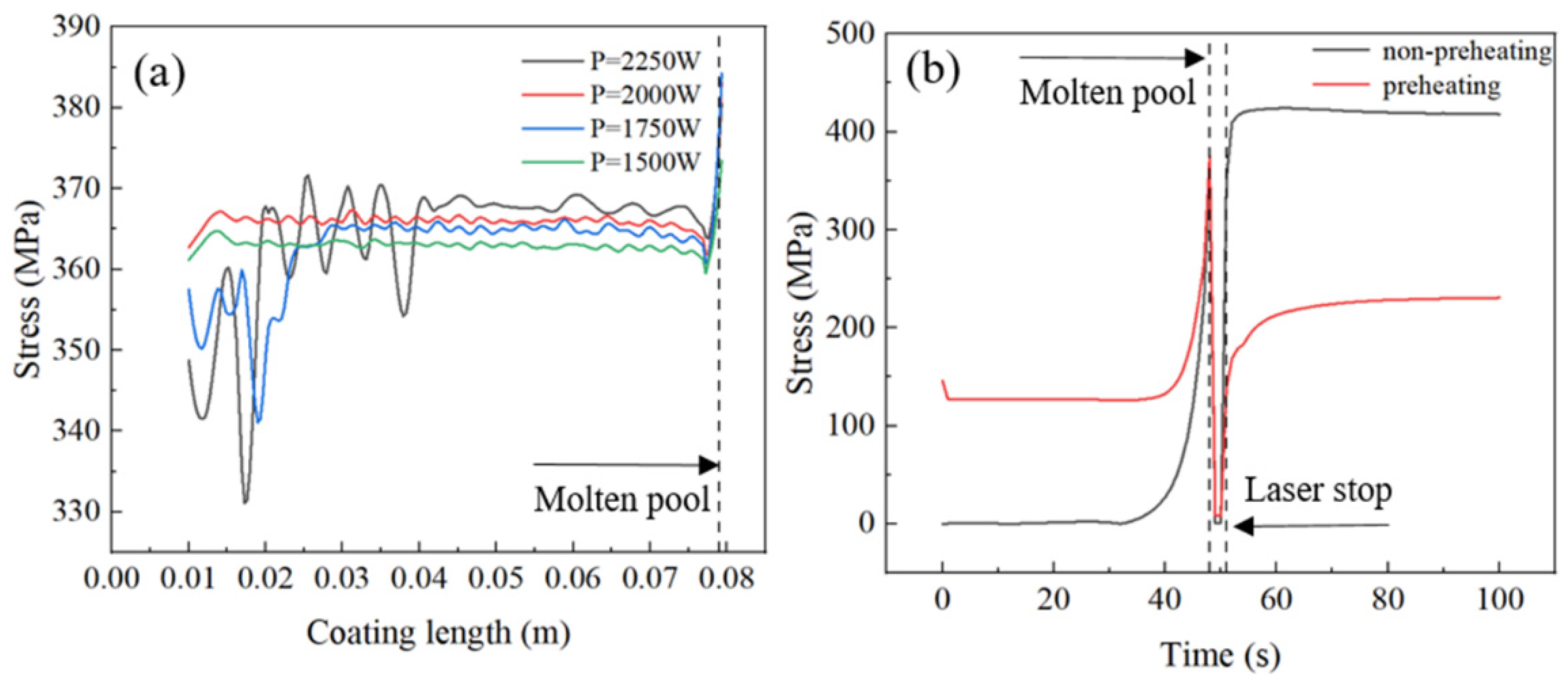
- Tensile residual stress concentrates at the cladding–substrate interface due to thermophysical property mismatch. Preheating the substrate to 400 °C halves the stress amplitude and suppresses crack initiation without the need for additional post-processing.
- (4)
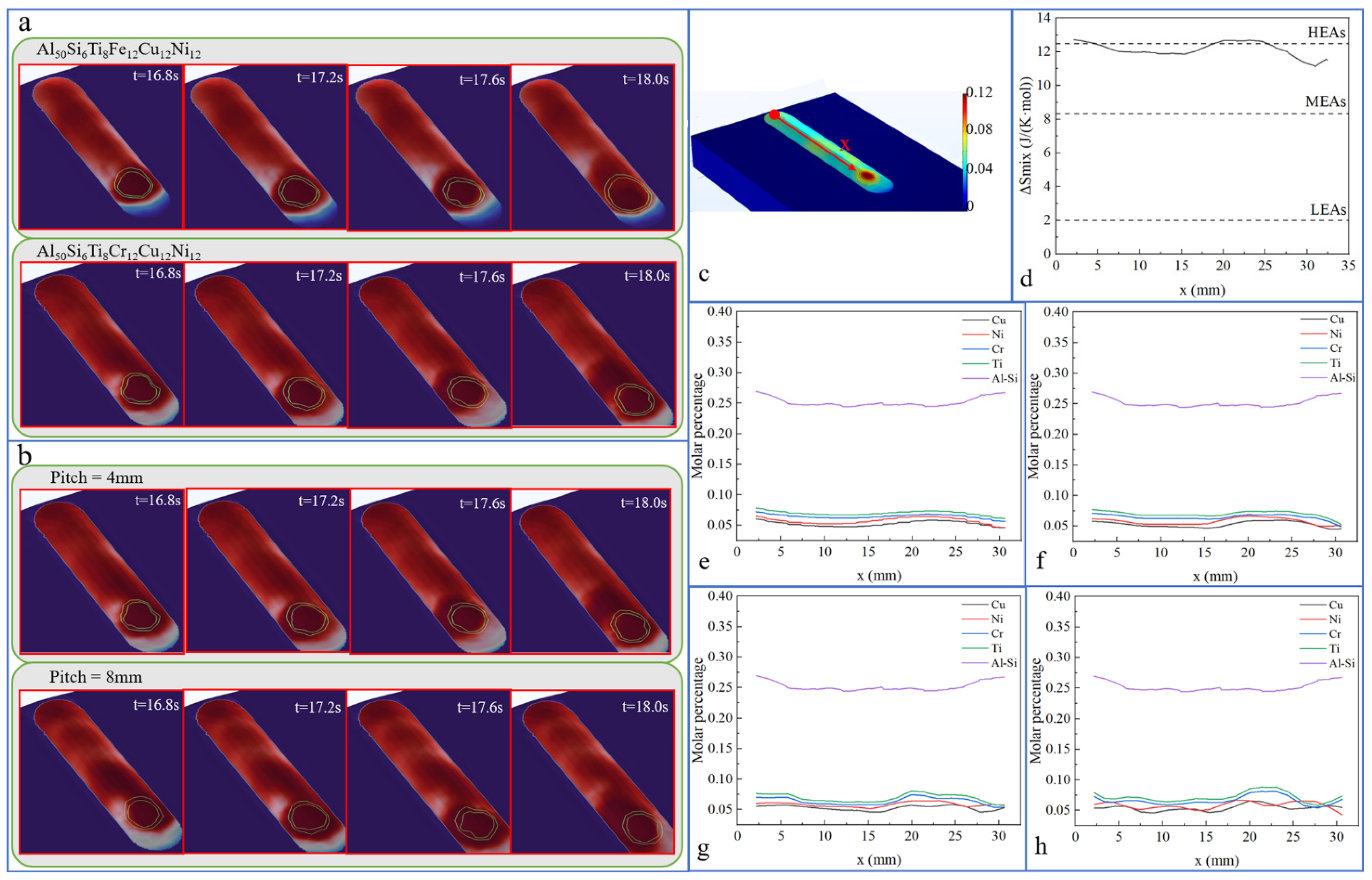
- The surface-active element Cr reduces melt viscosity by approximately 15%, enhancing momentum and mass transfer. Conversely, increasing the cable-wire pitch lengthens elemental residence loops and induces periodic segregation. Thus, a pitch of S ≤ 4 mm is required to maintain lateral homogeneity and retain the coating’s configurational entropy within the HEA regime.
- (5)
- Integrating alloy chemistry, wire architecture, and laser parameters into a unified Péclet–stress–entropy framework provides a priori design guideline for fabricating crack-free, compositionally uniform HEA coatings via cable-wire laser deposition.
Author Contributions
Funding
Data Availability Statement
Conflicts of Interest
References
- Hur, S.M.; Choi, K.H.; Lee, J.K. Determination of fabricating orientation and packing in SLS process. J. Mater. Process Technol. 2001, 112, 269–277. [Google Scholar] [CrossRef]
- Lu, Z.L.; Li, D.C.; Tong, Z.Q.; Lu, Q.P.; Traore, M.M.; Zhang, A.F.; Lu, B.H. Investigation into the direct laser forming process of steam turbine blade. Opt. Laser Eng. 2011, 49, 1101–1110. [Google Scholar] [CrossRef]
- Zhu, G.X.; Zhang, A.F.; Li, D.C. Optimization of laser cladding process parameters based on Nd:YAG laser. Appl. Laser 2009, 29, 388–391. [Google Scholar]
- Zhang, M. Research on the Characteristics of Laser Additive Manufacturing of Titanium Alloy Using Powder Feeding and Wire Feeding Methods. Master’s Thesis, Harbin Institute of Technology, Harbin, China, 2013. [Google Scholar]
- Chen, J.X.; Li, T.; Chen, Y.; Wang, J.; Wang, Y.D.; Lu, Z.P. Ultra-strong heavy-drawn eutectic high entropy alloy wire. Acta Mater. 2023, 243, 118515. [Google Scholar] [CrossRef]
- Capello, E.; Colombo, D.; Previtali, B. Repairing of sintered tools using laser cladding by wire. J. Mater. Process Technol. 2005, 164–165, 990–1000. [Google Scholar] [CrossRef]
- Zhong, M.L.; Liu, W.J. Dominant fields and hotspots in international laser material processing research. Chin. J. Lasers 2008, 35, 1653–1659. [Google Scholar]
- Zhang, D.Y.; Wang, R.Z.; Zhao, J.Z.; Zuo, T. Recent advances in laser direct manufacturing of metal parts. Chin. J. Lasers 2010, 37, 1825–1834. [Google Scholar]
- Kim, J.D.; Peng, Y. Plunging method for Nd:YAG laser cladding with wire feeding. Opt. Laser Eng. 2000, 33, 299–309. [Google Scholar] [CrossRef]
- Ding, D.H.; Pan, Z.X.; Cuiuri, D.; Li, H.J.; Xu, J.; Norrish, J. A tool-path generation strategy for wire and arc additive manufacturing. Int. J. Adv. Manuf. Technol. 2014, 73, 173–183. [Google Scholar] [CrossRef]
- Ding, D.H.; Pan, Z.X.; Cuiuri, D.; Li, H.J.; Xu, J.; Norrish, J. A practical path planning methodology for wire and arc additive manufacturing of thin-walled structures. Robot Comput Integr. Manuf. 2015, 34, 8–18. [Google Scholar] [CrossRef]
- Liu, W.; Jiang, K.; Yan, B.; Liang, H.Y.; Li, Y.; Wang, Y. Cable-wire-fed laser cladding of high-aluminum lightweight high-entropy alloys. Mater. Today Commun. 2024, 39, 108835. [Google Scholar] [CrossRef]
- Wang, W.; Zheng, Y.; Cai, Z.; Zheng, W.; Zhang, C.; Wang, Y.; Zhao, Z.; Feng, D.; Ma, Y.; Yang, J. High-entropy alloy laser cladding with cable-type welding wire: Experimental study and first-principles calculations. Metals 2024, 14, 1294. [Google Scholar] [CrossRef]
- Zhang, J.; Li, M.; Chen, Z.; Wu, D.; Zheng, C.; Huang, K.; Yi, X. Numerical simulation and experimental research on the effects of substrate preheated on the cracks, microstructure, and properties of laser cladding WC-Ni60AA coatings. Mater. Today Commun. 2025, 48, 113469. [Google Scholar] [CrossRef]
- Jiang, Y.C.; Cheng, Y.; Zhang, X.; Yang, J.; Yang, X.; Cheng, Z.Q. Simulation and experimental investigations on the effect of Marangoni convection on thermal field during laser cladding process. Optik 2020, 203, 164044. [Google Scholar] [CrossRef]
- Hu, S.P.; Sun, L.F.; Gao, Y.C.; Zhang, C.; Yu, T.B. Macroscopic temperature field modeling and simulation of nickel-based cladding layers in laser cladding. Appl. Sci. 2025, 15, 11675. [Google Scholar] [CrossRef]
- Dao, M.Y.; Lou, J. Simulations of laser assisted additive manufacturing by smoothed particle hydrodynamics. Comput Methods Appl. Mech. Eng. 2021, 373, 113491. [Google Scholar] [CrossRef]
- Gan, Z.T.; Yu, G.; He, X.L.; Li, S.X. Surface-active element transport and its effect on liquid metal flow in laser-assisted additive manufacturing. Int. Commun. Heat. Mass. Transf. 2017, 86, 206–214. [Google Scholar] [CrossRef]
- Wang, L.P.; Zhang, D.C.; Chen, C.Z.; Fu, H.; Sun, X.M. Multi-physics field coupling and microstructure numerical simulation of laser cladding for engine crankshaft based on CA-FE method and experimental study. Surf. Coat. Technol. 2022, 438, 128396. [Google Scholar] [CrossRef]
- Li, C.; Xu, Y.; Jia, T.H.; Zhao, J.J.; Han, X. Numerical simulation research on multifield coupling evolution mechanism of IN625 laser cladding on nodular cast iron. Int. J. Adv. Manuf. Technol. 2022, 119, 5647–5669. [Google Scholar] [CrossRef]
- Batchelor, G.K. An Introduction to Fluid Dynamics; Cambridge University Press: Cambridge, UK, 2000. [Google Scholar]
- Li, G.; Wang, Z.; Yao, L.; Zhang, K.Y.; Liang, Y.J. Component mixing in laser cladding processes: From single-track to single-layer multi-track and multi-layer multi-track. Surf. Coat. Technol. 2023, 470, 129233. [Google Scholar] [CrossRef]
- Cho, J.H.; Farson, D.F.; Milewski, J.O.; Hollis, K.J. Weld pool flows during initial stages of keyhole formation in laser welding. J. Phys. D. Appl. Phys. 2009, 42, 175502. [Google Scholar] [CrossRef]
- Sun, Z.; Guo, W.; Li, L. Numerical modelling of heat transfer, mass transport and microstructure formation in a high deposition rate laser directed energy deposition process. Addit. Manuf. 2020, 33, 101175. [Google Scholar] [CrossRef]
- Tang, C.; Tan, J.L.; Wong, C.H. A numerical investigation on the physical mechanisms of single track defects in selective laser melting. Int. J. Heat. Mass. Transf. 2018, 126, 957–968. [Google Scholar] [CrossRef]
- Gong, Y.; Wang, L.F.; Zhu, G.X.; Li, D.C. Numerical simulation study of residual stress in laser cladding layers of 316L stainless steel. Appl. Laser 2018, 38, 402–408. [Google Scholar]
- Fu, W.; Fang, H.Y.; Bai, X.B.; Zhang, X.; Li, H. The impact of process path on residual stress in multi-layer multi-pass laser cladding. J. Weld. 2019, 40, 29–33+162. [Google Scholar]
- Sun, S.T.; Fu, H.G.; Chen, S.Y.; Ping, X.L.; Wang, K.M.; Guo, X.Y.; Lin, J.L.; Lei, Y.P. A numerical-experimental investigation of heat distribution, stress field and crack susceptibility in Ni60A coatings. Opt. Laser Technol. 2019, 117, 198–208. [Google Scholar] [CrossRef]
- Yu, T.B.; Qiao, R.Z.; Han, J.B.; Liu, W.; Yang, J. Numerical simulation of the residual stress field in laser cladding on tilted substrates. Hot Work Technol. 2020, 49, 75–79. [Google Scholar]
- Jiang, Q.Y. Simulation analysis of stress fields in multi-pass laser cladding. Hot Work Technol. 2011, 40, 124–127+139. [Google Scholar]
- Cai, G.C.; Yin, Y.; He, C.Y.; Zhang, J.; Wang, Y. Stress analysis of the quenching process of 2A12 aluminum alloy thick plate. Light Alloy Fabr. Technol. 2019, 47, 17–23. [Google Scholar]
- Wang, Y.B.; Jin, G.Y.; Zhang, W. Temperature and thermal stress analysis of aluminum alloy sheets under long-pulse laser action. Chin. J. Laser 2016, 43, 130–137. [Google Scholar]
- Tu, S.J.; Zheng, Y.; Wang, H.; Ma, N.; Wang, Z.M. Comparison of welding deformation and residual stress between laser welding and inert gas shielded welding of SUS304 stainless steel thin plates. Laser J. 2019, 40, 144–149. [Google Scholar]
- Chen, Z.Y.; Zhu, E.C.; Pan, J.L. Numerical simulation of the mechanical properties of wood under complex stress states. Chin. J. Comput Mech. 2011, 28, 629–634, 640. [Google Scholar]
- Wang, Z.Y.; Chen, Y.; Wang, S.G. Progress in numerical simulation analysis of high-energy beam welding of TiAl alloys. Weld. Technol. 2018, 47, 6. [Google Scholar]
- Chen, J.; Tan, H.; Yang, H.O.; Lin, X.; Huang, W.D. Evolution of molten pool shape in the process of laser rapid forming. Chin. J. Lasers 2007, 34, 442–446. [Google Scholar]
- Lalas, C.; Tsirbas, K.; Salonitis, K.; Chryssolouris, G. An analytical model of the laser clad geometry. Int. J. Adv. Manuf. Technol. 2007, 32, 34–41. [Google Scholar] [CrossRef]
- Tabernero, I.; Lamikiz, A.; Martinez, S.; Ukar, E.; de Lacalle, L.N.L. Geometric modelling of added layers by coaxial laser cladding. Phys. Procedia 2012, 39, 913–920. [Google Scholar] [CrossRef]
- Toyserkani, E.; Khajepour, A.; Corbin, S. Three-dimensional finite element modeling of laser cladding by powder injection: Effects of powder feedrate and travel speed on the process. J. Laser Appl. 2003, 15, 153–160. [Google Scholar] [CrossRef]
- Toyserkani, E.; Khajepour, A.; Corbin, S. 3-D finite element modeling of laser cladding by powder injection: Effects of laser pulse shaping on the process. Opt. Laser Eng. 2004, 41, 849–867. [Google Scholar] [CrossRef]
- Davim, J.P.; Oliveira, C.; Cardoso, A. Predicting the geometric form of clad in laser cladding by powder using multiple regression analysis. Mater. Des. 2008, 29, 554–557. [Google Scholar] [CrossRef]
- Onwubolu, G.C.; Davim, J.P.; Oliveira, C.; Cardoso, A. Prediction of clad angle in laser cladding by powder using response surface methodology and scatter search. Opt. Laser Technol. 2007, 39, 1130–1134. [Google Scholar] [CrossRef]
- Steen, W.M.; Weerasinghe, V.M.; Monson, P. Some aspects of the formation of laser clad tracks. In High Power Lasers and Their Industrial Applications; SPIE: Bellingham, WA, USA, 1986; Volume 650, pp. 226–234. [Google Scholar]



| No. | Laser Power Plas (W) | Scanning Speed Vs (mm/s) | Measured Width W (mm) |
|---|---|---|---|
| 1 | 1500 | 0.2 | 7.3 |
| 2 | 1500 | 0.2 | 7.5 |
| 3 | 1750 | 0.2 | 7.9 |
| 4 | 1750 | 0.2 | 7.7 |
| 5 | 2000 | 0.2 | 8.5 |
| 6 | 2000 | 0.2 | 9.0 |
| 7 | 2250 | 0.2 | 9.0 |
| 8 | 2250 | 0.2 | 9.2 |
| 9 | 1825 | 0.2 | 8.0 |
| 10 | 1900 | 0.2 | 9.0 |
| 11 | 1500 | 0.1 | 8.3 |
| 12 | 1750 | 0.1 | 9.1 |
| 13 | 1825 | 0.1 | 9.1 |
| 14 | 2000 | 0.1 | 9.8 |
| 15 | 2250 | 0.1 | 10.1 |
| 16 | 1825 | 0.3 | 7.7 |
| Laser Power (W) | Melt-pool Characteristic Length (mm) |
|---|---|
| 1500 | 1.2 |
| 1750 | 5.2 |
| 2000 | 11.0 |
| 2250 | 16.4 |
Disclaimer/Publisher’s Note: The statements, opinions and data contained in all publications are solely those of the individual author(s) and contributor(s) and not of MDPI and/or the editor(s). MDPI and/or the editor(s) disclaim responsibility for any injury to people or property resulting from any ideas, methods, instructions or products referred to in the content. |
© 2026 by the authors. Licensee MDPI, Basel, Switzerland. This article is an open access article distributed under the terms and conditions of the Creative Commons Attribution (CC BY) license.
Share and Cite
Liu, W.; Guo, X.; Jiang, K.; Liu, J.; Peng, Z.; Lu, X.; Zhang, J.; Cai, Z.; Wu, D.; Xu, Y.; et al. Numerical Simulation of Laser Cladding Using Cable Wires. Materials 2026, 19, 2326. https://doi.org/10.3390/ma19112326
Liu W, Guo X, Jiang K, Liu J, Peng Z, Lu X, Zhang J, Cai Z, Wu D, Xu Y, et al. Numerical Simulation of Laser Cladding Using Cable Wires. Materials. 2026; 19(11):2326. https://doi.org/10.3390/ma19112326
Chicago/Turabian StyleLiu, Weihang, Xueping Guo, Kaiyong Jiang, Jian Liu, Zhaoju Peng, Xizhao Lu, Jianming Zhang, Zhihai Cai, Dehua Wu, Yuchao Xu, and et al. 2026. "Numerical Simulation of Laser Cladding Using Cable Wires" Materials 19, no. 11: 2326. https://doi.org/10.3390/ma19112326
APA StyleLiu, W., Guo, X., Jiang, K., Liu, J., Peng, Z., Lu, X., Zhang, J., Cai, Z., Wu, D., Xu, Y., & Yan, B. (2026). Numerical Simulation of Laser Cladding Using Cable Wires. Materials, 19(11), 2326. https://doi.org/10.3390/ma19112326