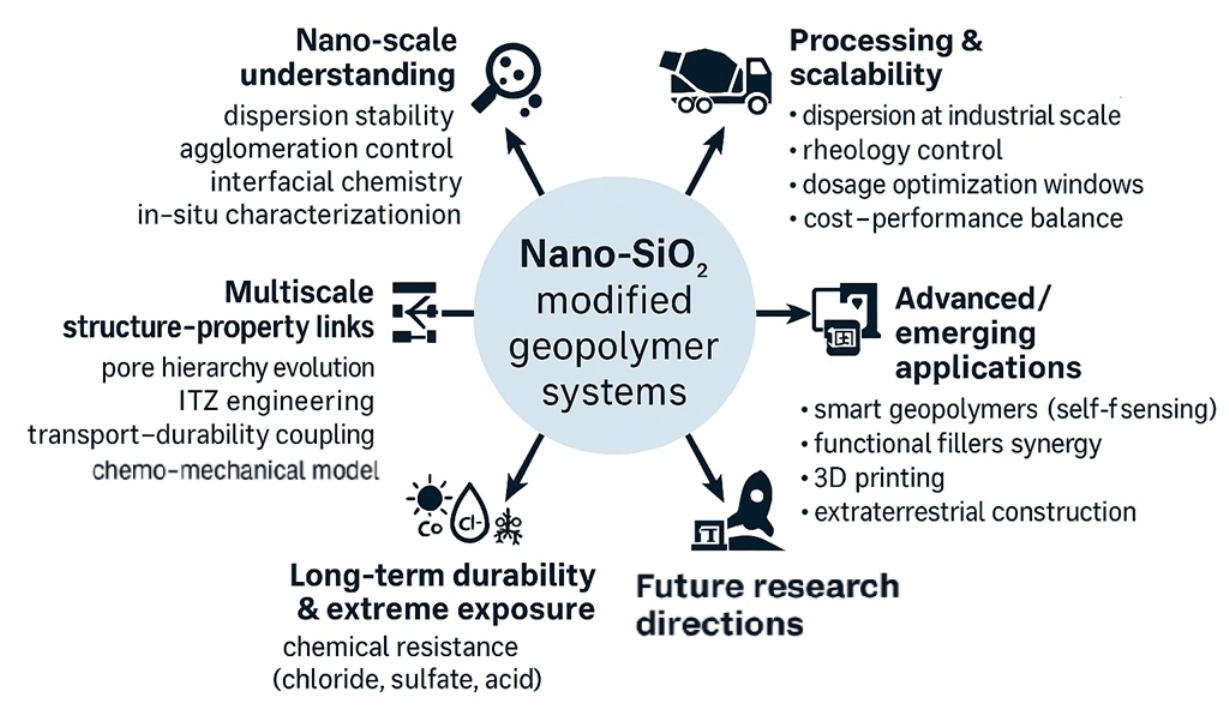
Nano-Silica as Designer Tools for Geopolymer Microstructure Optimization: Effects on Porosity, Interfacial Transition Zone (ITZ), and Mechanical Performance



Highlights
- Nano-silica (NS) acts as an active design tool controlling geopolymer microstructure, porosity, and interfacial transition zone (ITZ) performance.
- Properly dispersed NS enhances strength, durability, and early geopolymerization kinetics at low dosages.
- NS refines pore structure and transforms the ITZ into a dense, load-bearing zone in geopolymer composites.
- The effects of NS are highly system- and dosage-dependent, with no universal optimal addition level.
- NS enables advanced geopolymer applications, including 3D printing, ITZ engineering, and In Situ Resource Utilization (ISRU) materials.
Abstract

1. Introduction
2. Literature Review Methodology
3. Geopolymer Microstructure in the Context of Nano-Silica Modification
4. Nano-Silica: Properties and Design Parameters
4.1. Types of Nano-Silica Used in Geopolymers
4.2. Dosage Strategies and Incorporation Methods
- Alkali-catalyzed NS exhibits superior dispersion within the alkaline geopolymer environment, which enhances its role as both a reactive silica source and a nucleation site. This promotes the simultaneous and homogeneous formation of C-(N)-A-S-H and N-A-S-H gels, leading to a dense, continuous, and highly uniform gel network. As a result, pore size is refined, nanoscale heterogeneity is reduced, and gel connectivity is significantly improved.
- Acid-catalyzed NS shows limited dispersion and a tendency to form agglomerates, especially at higher dosages. While it still contributes additional reactive silica and partially refines the geopolymer microstructure, the gel formation is more localized and less uniform. This results in a discontinuous gel network with increased structural heterogeneity and a higher likelihood of residual pores or weak interfacial zones.
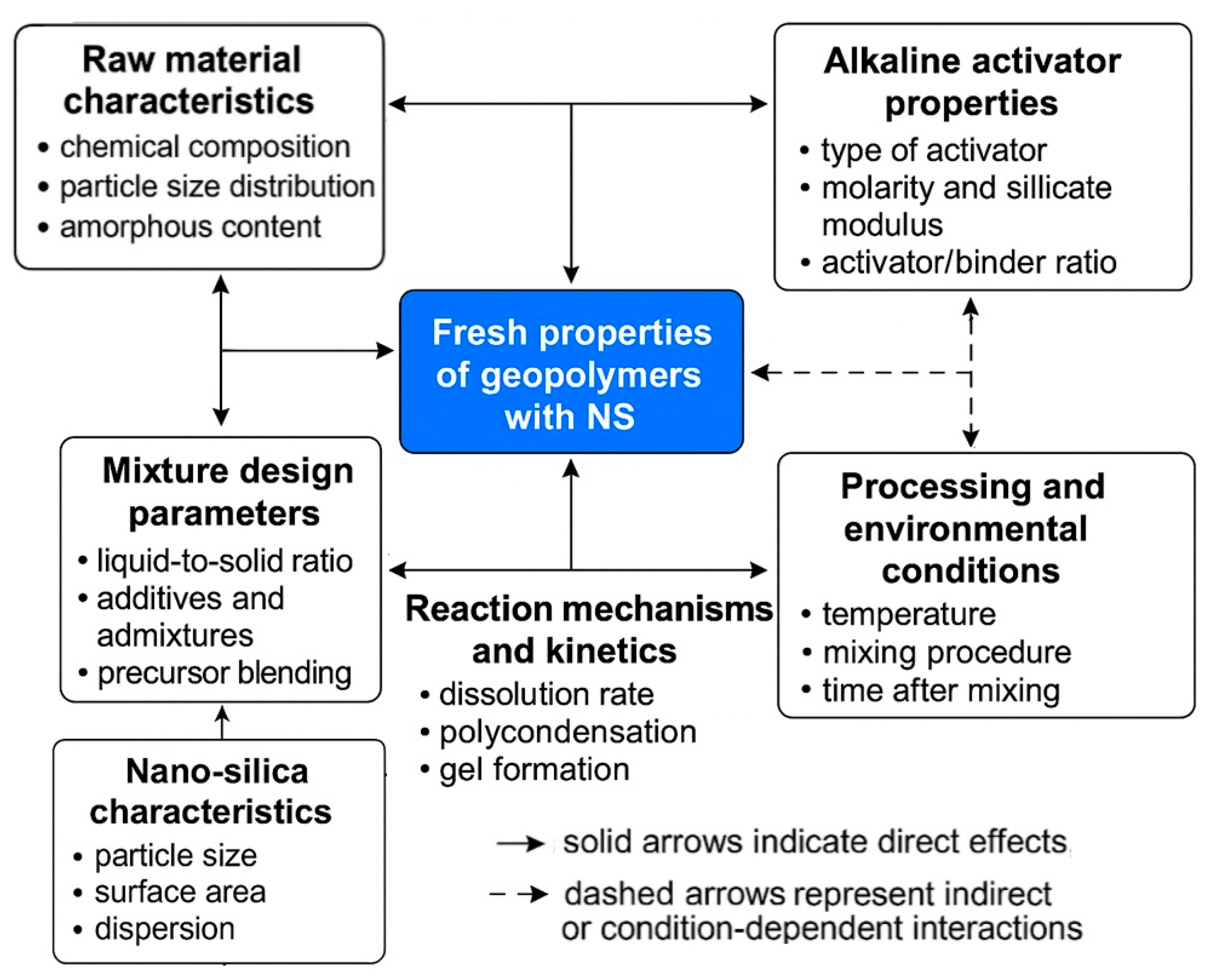
4.3. Influence on Fresh Properties of Geopolymers
5. Mechanisms of Nano-Silica Action in Geopolymers
- The crack deflection effect: when a crack encounters NS-reinforced regions, its path is deflected or branched, increasing fracture energy and improving toughness and durability [35].
6. Influence of Nano-Silica on Porosity and Pore Structure
7. Nano-Silica and Interfacial Transition Zone (ITZ) Optimization
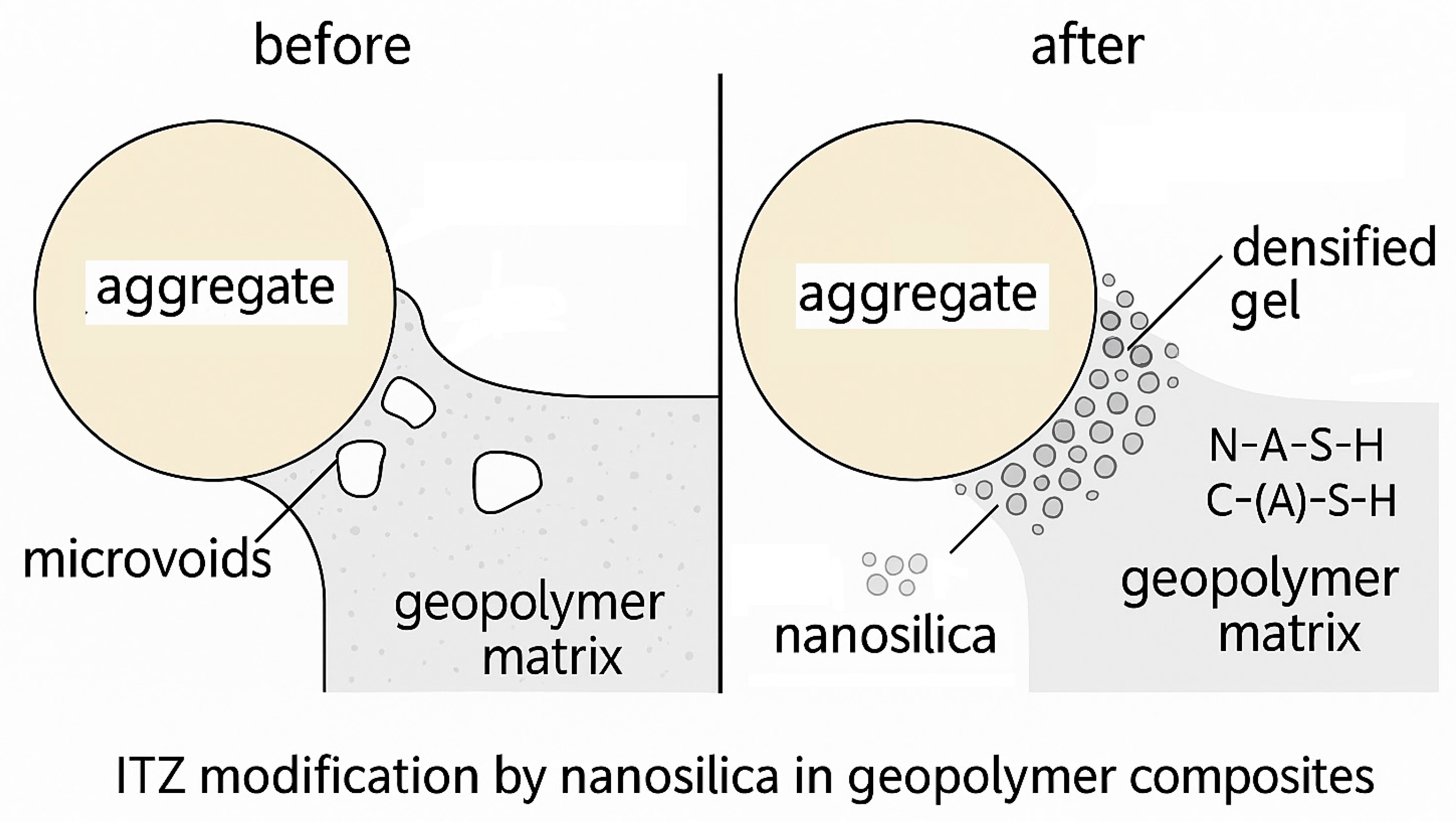
- Heterogeneous nucleation—NS promotes heterogeneous nucleation of N-A-S-H and C-(N)-A-S-H gels at aggregate or reinforcement surfaces, leading to localized matrix densification and the formation of an ITZ with mechanical properties comparable to or exceeding those of the bulk matrix, contrary to the classical view of the ITZ as the weakest phase [7,100].
- Chemical effects specific to geopolymer systems—in geopolymer matrices, NS modifies the local Si/Al ratio and enhances gel polymerization and cross-linking, producing a chemically distinct and stabilized ITZ that is deliberately engineered to improve interfacial bonding and stress-transfer efficiency [7,90].
8. Influence on Mechanical Performance
8.1. Mechanical Properties
8.2. Mechanical Properties at High Temperatures
8.3. Influence of NS on the Mechanical Properties in Hybrid Systems
9. Impact on Water Interaction Properties, Durability and Functional Performance
9.1. Water Interaction Properties and Durability
9.2. Other Functional Properties
9.3. Overview of Influence of NS on Geopolymer Performance
10. Application-Oriented Case Studies
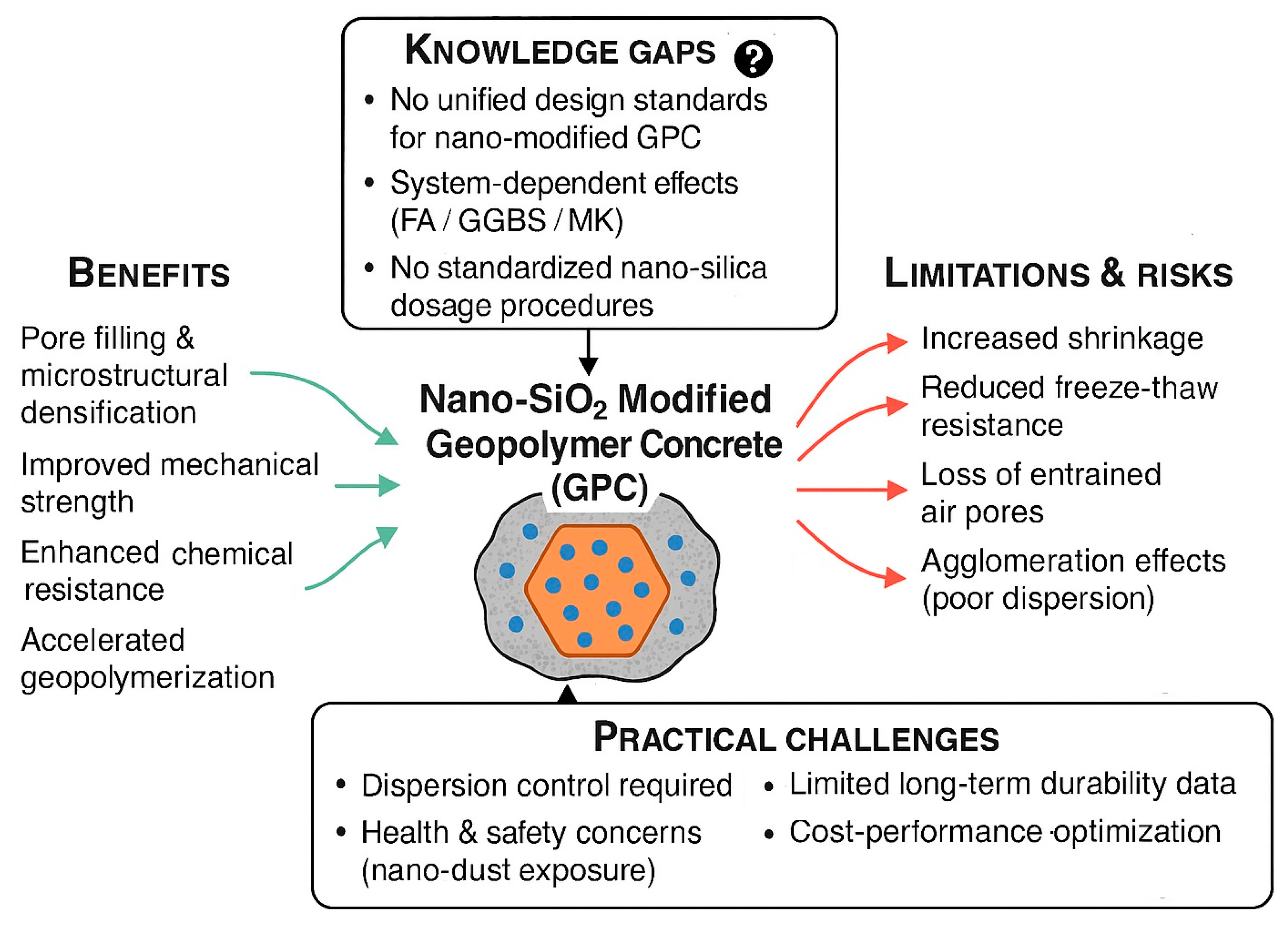
11. Challenges and Limitations
12. Future Directions
13. Conclusions
- Nano-silica fundamentally alters geopolymer systems by acting as an active nanoscale design parameter, enabling deliberate control of geopolymerization kinetics, gel chemistry, and microstructural evolution rather than serving as a passive filler.
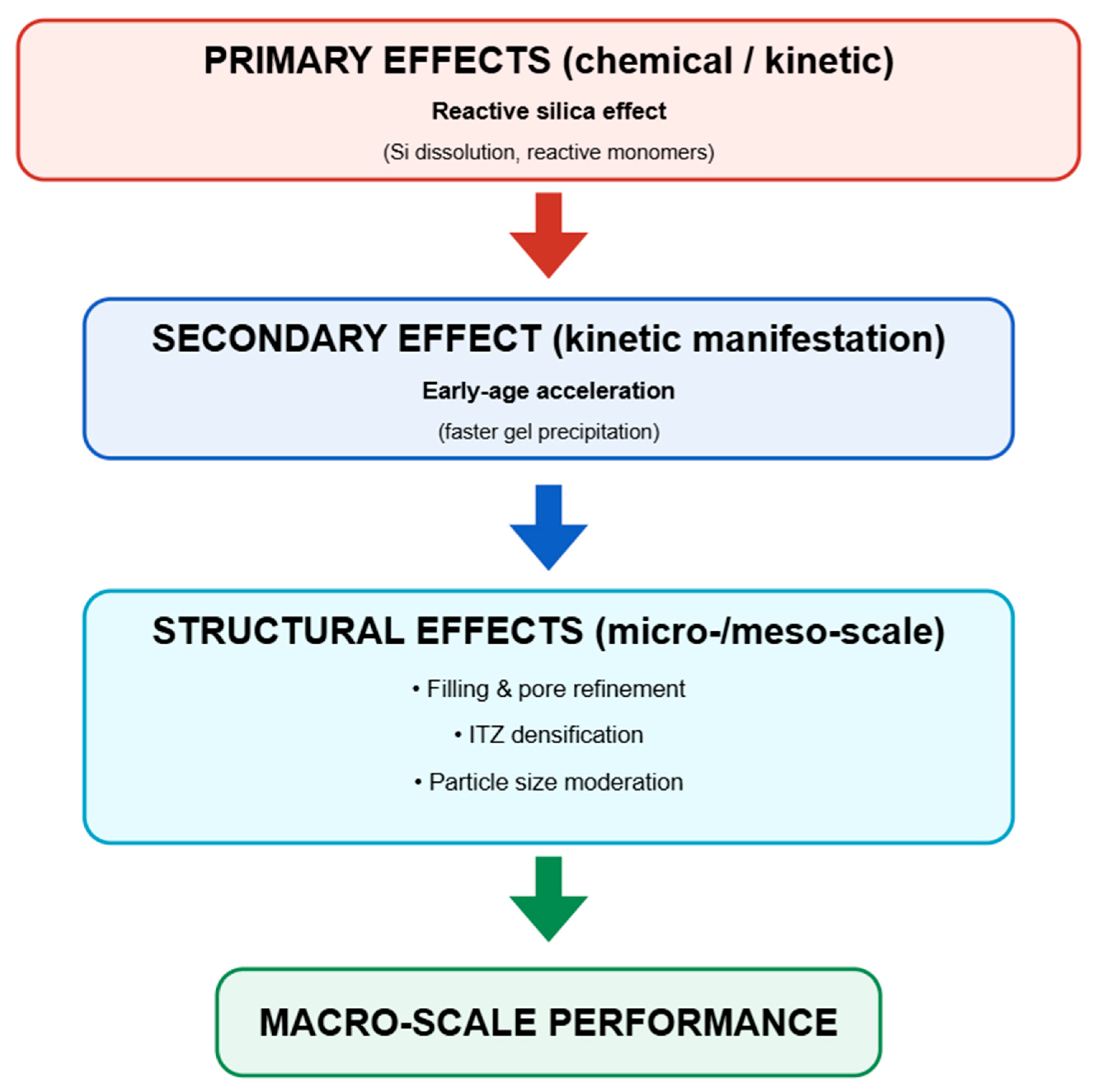
- The primary contribution of NS occurs at the reaction and nucleation stage, where highly reactive amorphous SiO2 accelerates dissolution–polycondensation processes and promotes the formation of continuous, highly cross-linked N-A-S-H and C-(N)-A-S-H gels.
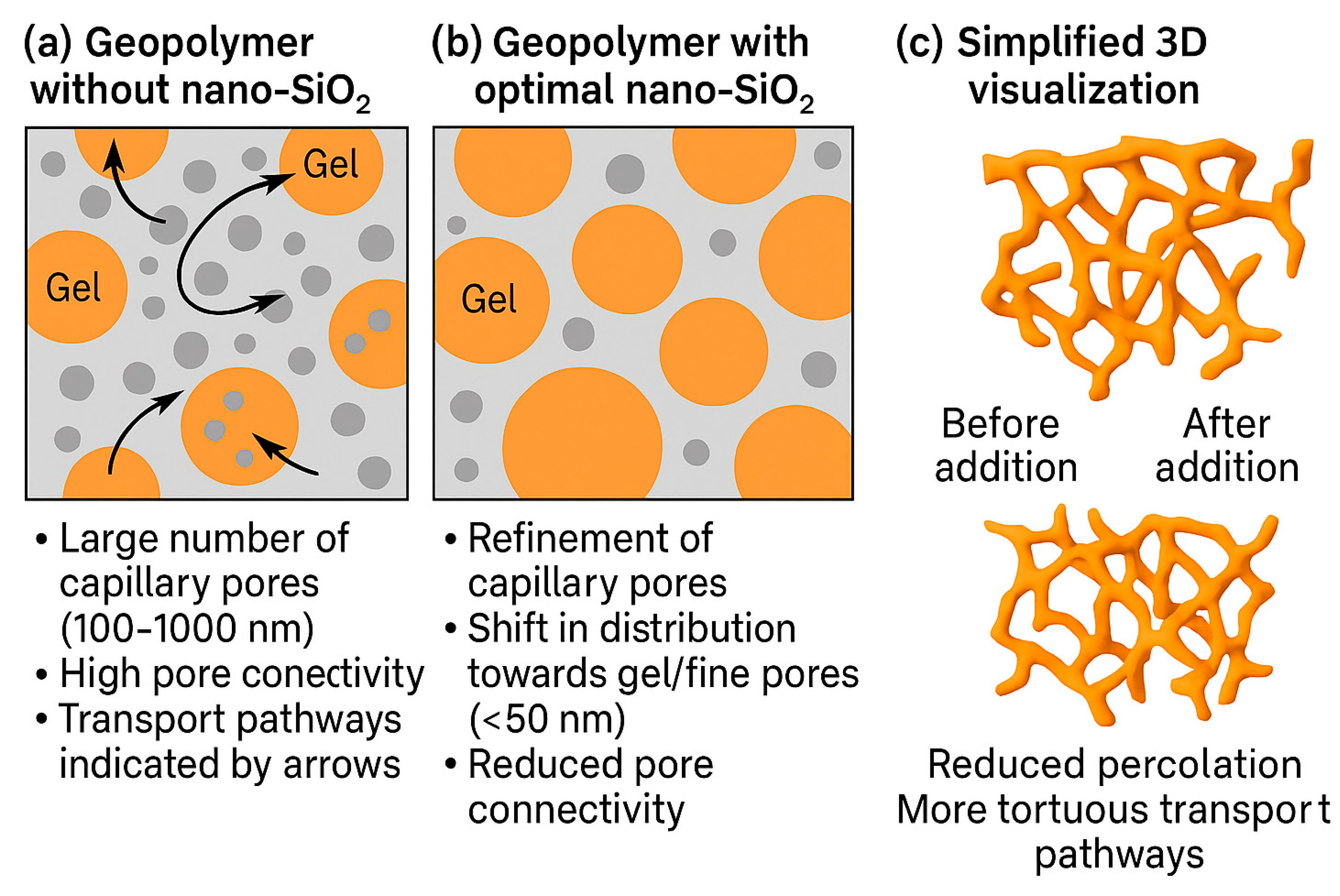
- At the microstructural level, NS consistently induces pore structure refinement, reduces connectivity of capillary pores, and shifts porosity toward gel-scale domains, which directly governs permeability, sorptivity, and durability.
- The presence of NS transforms the ITZ from a weak or passive region into a dense, chemically active, and load-bearing zone, fundamentally redefining ITZ behavior in geopolymer composites compared to OPC systems.
- Improvements in mechanical performance—including compressive, tensile and flexural strength; fracture toughness; fatigue resistance; and high-temperature stability—are shown to be direct consequences of nanoscale gel densification and ITZ engineering.
- NS has a critical enabling role in advanced geopolymer applications, including fiber-reinforced composites, 3D-printed materials, repair mortars, functional coatings, smart/self-sensing systems, self-healing concepts, and extreme-environment applications such as ISRU-based construction.
- The review confirms that NS performance is highly dosage- and system-dependent, controlled by precursor chemistry, calcium availability, the Si/Al ratio, particle size, dispersion quality, and the curing regime; consequently, no universal optimal dosage can be defined.
- Overall, nano-silica enables a microstructure-driven design paradigm for geopolymers, where nanoscale mechanisms are systematically translated into predictable macro-scale performance, supporting the development of durable, multifunctional, and low-carbon construction materials.
Author Contributions
Funding
Institutional Review Board Statement
Informed Consent Statement
Data Availability Statement
Acknowledgments
Conflicts of Interest
Abbreviations
| ANFIS | Adaptive Neuro-Fuzzy Inference System |
| ANN | Artificial Neural Network |
| CDW | Construction and demolition waste |
| CNTs | Carbon nanotubes |
| EDS | Energy-Dispersive X-ray Spectroscopy |
| GGBFS | Ground granulated blast furnace slag |
| ISRU | In Situ Resource Utilization |
| ITZ | Interfacial Transition Zone |
| MIP | Mercury Intrusion Porosimetry |
| NMR | Nuclear Magnetic Resonance |
| NS | Nano-silica |
| OPC | Ordinary Portland Cement |
| PVA | Polyvinyl alcohol |
| SCGC | Self-compacting geopolymer concrete |
| SEM | Scanning Electron Microscopy |
| SF | Silica fume |
| XRD | X-ray Diffraction |
| UPV | Ultrasonic pulse velocity |
References
- Indwar, R.; Mishra, U.; Titiksh, A. Geopolymer Concrete Containing Nanomaterials—A Step toward Sustainable Construction. Environ. Sci. Pollut. Res. 2024, 32, 24356–24397. [Google Scholar] [CrossRef]
- Drabczyk, A.; Kudłacik-Kramarczyk, S.; Korniejenko, K.; Figiela, B.; Furtos, G. Review of Geopolymer Nanocomposites: Novel Materials for Sustainable Development. Materials 2023, 16, 3478. [Google Scholar] [CrossRef]
- Kanagaraj, B.; Anand, N.; Diana Andrushia, A.; Lubloy, E. Pre- and Post-Fire Behavior of Cement and Geopolymer Concrete with Nanomaterials: A Comprehensive Review. Hybrid Adv. 2026, 13, 100624. [Google Scholar] [CrossRef]
- Kumar, A.; Ghosh, P.K.; Pahuja, V. Advancements in Geopolymer Concrete: A Detailed Review of Engineering Properties with Nanomaterial Integration. Iran. J. Sci. Technol. Trans. Civ. Eng. 2025, 49, 2091–2122. [Google Scholar] [CrossRef]
- Shumuye, E.D.; Mehrpay, S.; Fang, G.; Li, W.; Wang, Z.; Uge, B.U.; Liu, C. Influence of Novel Hybrid Nanoparticles as a Function of Admixture on Responses of Engineered Geopolymer Composites: A Review. J. Build. Eng. 2024, 86, 108782. [Google Scholar] [CrossRef]
- Sharif, H.H. Fresh and Mechanical Characteristics of Eco-Efficient GPC Incorporating Nano-Silica: An Overview. Kurd. J. Appl. Res. 2021, 6, 64–74. [Google Scholar] [CrossRef]
- Rambabu, D.; Sharma, S.K.; Akbar, M.A. Properties Exhibited by Nanomaterial Based Geopolymers: A Review. J. Inorg. Organomet. Polym. 2023, 33, 1081–1118. [Google Scholar] [CrossRef]
- Samuvel Raj, R.; Prince Arulraj, G.; Anand, N.; Kanagaraj, B.; Lubloy, E.; Naser, M.Z. Nanomaterials in Geopolymer Composites: A Review. Dev. Built Environ. 2023, 13, 100114. [Google Scholar] [CrossRef]
- Kamal, H.M.; Kadhim, M.J.; Hasan, L.M. Impact of Nanoparticles on the Performance of Metakaolin-Based Geopolymer Composites. J. Mech. Behav. Mater. 2025, 34, 20250072. [Google Scholar] [CrossRef]
- Shilar, F.A.; Ganachari, S.V.; Patil, V.B.; Khan, T.M.Y.; Almakayeel, N.M.; Alghamdi, S. Review on the Relationship between Nano Modifications of Geopolymer Concrete and Their Structural Characteristics. Polymers 2022, 14, 1421. [Google Scholar] [CrossRef]
- Zhang, C.; Khorshidi, H.; Najafi, E.; Ghasemi, M. Fresh, Mechanical and Microstructural Properties of Alkali-Activated Composites Incorporating Nanomaterials: A Comprehensive Review. J. Clean. Prod. 2023, 384, 135390. [Google Scholar] [CrossRef]
- Tian, Y.-H.; Tao, J.-C.; Luo, T.; Li, L. Workability of Nanomodified Self-Compacting Geopolymer Concrete Based on Response Surface Method. Buildings 2024, 14, 3610. [Google Scholar] [CrossRef]
- Han, Q.; Zhang, P.; Wu, J.; Jing, Y.; Zhang, D.; Zhang, T. Comprehensive Review of the Properties of Fly Ash-Based Geopolymer with Additive of Nano-SiO2. Nanotechnol. Rev. 2022, 11, 1478–1498. [Google Scholar] [CrossRef]
- Mustakim, S.M.; Das, S.K.; Mishra, J.; Aftab, A.; Alomayri, T.S.; Assaedi, H.S.; Kaze, C.R. Improvement in Fresh, Mechanical and Microstructural Properties of Fly Ash-Blast Furnace Slag Based Geopolymer Concrete by Addition of Nano and Micro Silica. Silicon 2021, 13, 2415–2428. [Google Scholar] [CrossRef]
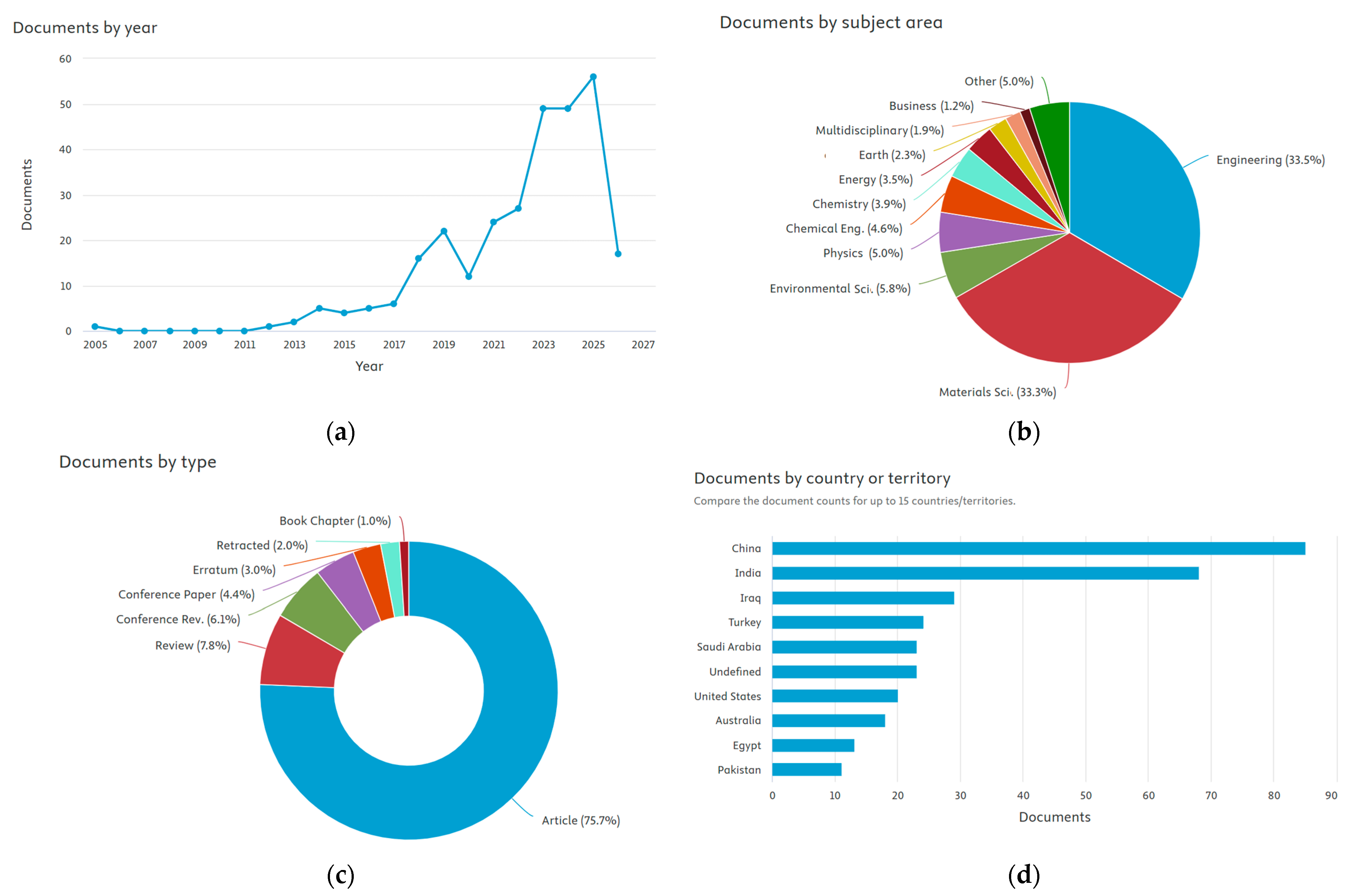
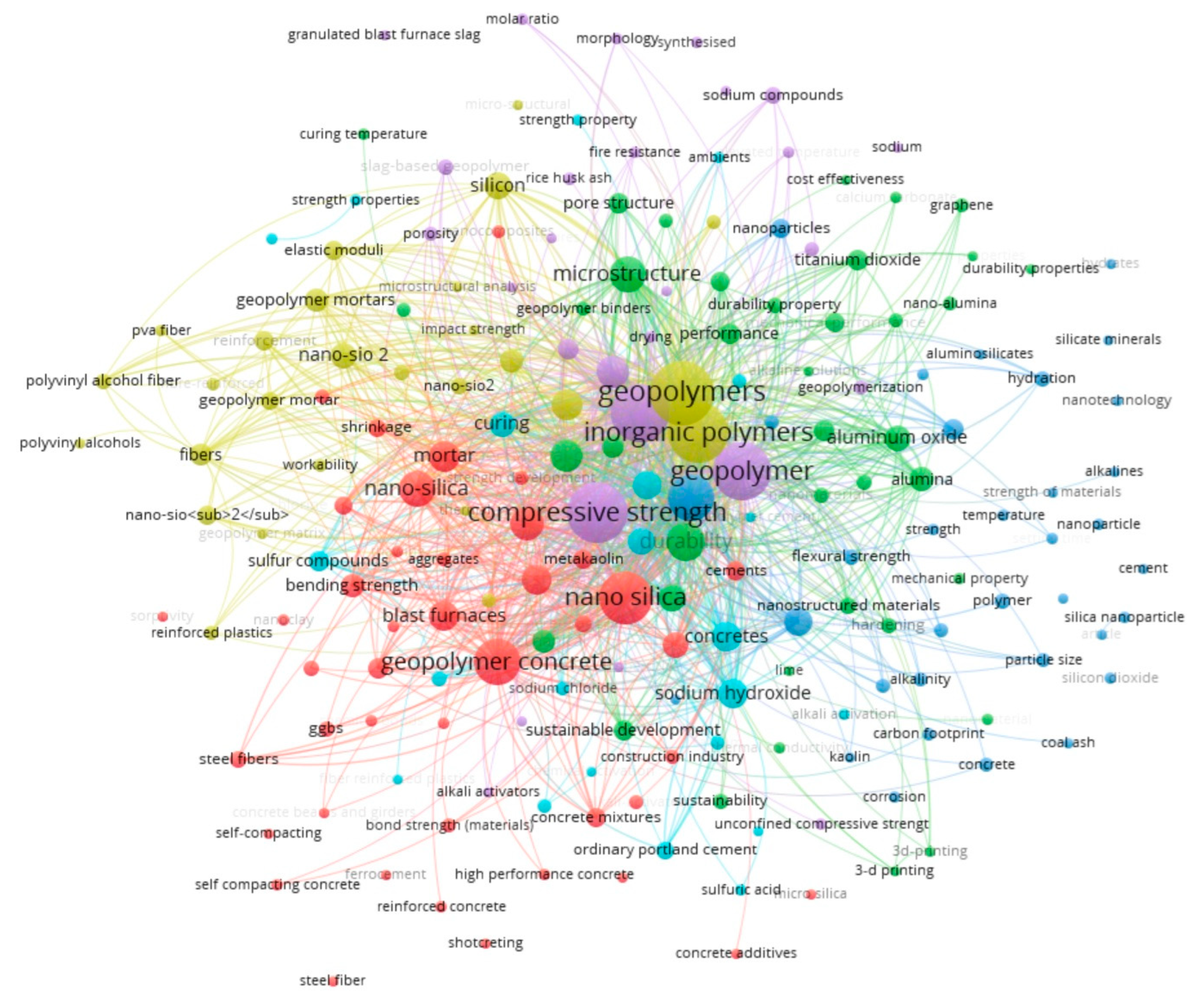
- Scopus. Available online: https://www.scopus.com/term/analyzer.uri?sort=plf-f&src=s&sid=bede7b7a540890eb6e7b4232fc20bf29&sot=a&sdt=a&sl=58&s=%28TITLE-ABS-KEY%28geopolymer%29+AND+TITLE-ABS-KEY%28nano+silica%29%29&origin=resultslist&count=10&analyzeResults=Analyze+results (accessed on 1 April 2026).
- Dhanalakshmi, K.; Sudarvizhi, S.M.; Jose, P.A.; Dhanasekaran, M. Exploring the Chemistry of Metakaolin-Based Geopolymers. J. Polym. Res. 2024, 31, 349. [Google Scholar] [CrossRef]
- Javed, U.; Shaikh, F.U.A.; Sarker, P.K. A Comprehensive Micro-Nano Investigative Approach to Study the Development of Aluminosilicate Gel in Binary Blends of Lithium Slag Geopolymer. Cem. Concr. Compos. 2024, 145, 105338. [Google Scholar] [CrossRef]
- Guan, X.; Xu, M.; Li, B.; Do, H. Interactions between Amorphous Silica and Sodium Alumino-Silicate Hydrate Gels: Insight from Reactive Molecular Dynamics Simulation. J. Phys. Chem. C 2023, 127, 13302–13316. [Google Scholar] [CrossRef]
- Luo, Z.; Li, W.; Gan, Y.; He, X.; Castel, A.; Sheng, D. Nanoindentation on Micromechanical Properties and Microstructure of Geopolymer with Nano-SiO2 and Nano-TiO2. Cem. Concr. Compos. 2021, 117, 103883. [Google Scholar] [CrossRef]
- Yang, N.; Xuan, Q.; Fu, Y.; Ma, X.; Lei, D.; Niu, J.; Dai, J.-G. Phosphate Activated Geopolymer-Based Coating with High Temperature Resistance for Sub-Ambient Radiative Cooling. Sustain. Cities Soc. 2024, 100, 104992. [Google Scholar] [CrossRef]
- Vanitha, N.; Jeyalakshmi, R. Structural Study of the Effect of Nano Additives on the Thermal Properties of Metakaolin Phosphate Geopolymer by MASNMR, XPS and SEM Analysis. Inorg. Chem. Commun. 2023, 153, 110758. [Google Scholar] [CrossRef]
- Vanitha, N.; Thanigaiselvan, R.; Manivannan, M.; Jeyalakshmi, R.; Megha, S.N.; Kesavan, M. Expounding the Application of Nano and Micro Silica as a Complementary Additive in Metakaolin Phosphate Geopolymer for Ceramic Applications—Micro and Nanoscale Structural Investigation. J. Mater. Sci. Mater. Eng. 2024, 19, 32. [Google Scholar] [CrossRef]
- Zidi, Z.; Ltifi, M.; Zafar, I. Synthesis and Attributes of Nano-SiO2 Local Metakaolin Based-Geopolymer. J. Build. Eng. 2021, 33, 101586. [Google Scholar] [CrossRef]
- Rahmawati, C.; Aprilia, S.; Saidi, T.; Aulia, T.B.; Hadi, A.E. The Effects of Nanosilica on Mechanical Properties and Fracture Toughness of Geopolymer Cement. Polymers 2021, 13, 2178. [Google Scholar] [CrossRef]
- Paruthi, S.; Rahman, I.; Husain, A.; Khan, A.H.; Manea-Saghin, A.-M.; Sabi, E. A Comprehensive Review of Nano Materials in Geopolymer Concrete: Impact on Properties and Performance. Dev. Built Environ. 2023, 16, 100287. [Google Scholar] [CrossRef]
- Ahmed, H.U.; Mohammed, A.A.; Mohammed, A.S. Effectiveness of Nano-SiO2 on the Mechanical, Durability, and Microstructural Behavior of Geopolymer Concrete at Different Curing Ages. Arch. Civ. Mech. Eng. 2023, 23, 129. [Google Scholar] [CrossRef]
- Cheng, T.; Lo, K.; Lin, K.; Lan, J. Study on the Effects Nano-SiO2 and Spent Catalyst Ratios on Characteristics of Metakaolin-based Geopolymers. Environ. Prog. Sustain. Energy 2019, 38, 220–227. [Google Scholar] [CrossRef]
- Gayathiri, K.; Praveenkumar, S. Influence of Nano Silica on Fresh and Hardened Properties of Cement-Based Materials—A Review. Silicon 2022, 14, 8327–8357. [Google Scholar] [CrossRef]
- Croissant, J.G.; Butler, K.S.; Zink, J.I.; Brinker, C.J. Synthetic Amorphous Silica Nanoparticles: Toxicity, Biomedical and Environmental Implications. Nat. Rev. Mater. 2020, 5, 886–909. [Google Scholar] [CrossRef]
- Kiprop, S.; Onchiri, R.O.; Gathimba, N. Mechano-Physical Properties and Microstructure of Colloidal Nanosilica-Incorporated Volcanic Ash-Based Geopolymer Mortar after Exposure to Elevated Temperatures. Int. J. Eng. Trends Technol. 2024, 72, 66–85. [Google Scholar] [CrossRef]
- Opara, E.U.; Mayer, A.K.; Mai, C. Impact of Aminosilane and Colloidal Nano-Silica Modification on the Properties of Ambient-Cured Geopolymer-Bonded Lignocellulosic Composites. Constr. Build. Mater. 2024, 441, 137554. [Google Scholar] [CrossRef]
- Mohmmad, S.H.; Shakor, P.; Muhammad, J.H.; Hasan, M.F.; Karakouzian, M. Sustainable Alternatives to Cement: Synthesizing Metakaolin-Based Geopolymer Concrete Using Nano-Silica. Constr. Mater. 2023, 3, 276–286. [Google Scholar] [CrossRef]
- Ahmed, H.U.; Mohammed, A.S.; Faraj, R.H.; Qaidi, S.M.A.; Mohammed, A.A. Compressive Strength of Geopolymer Concrete Modified with Nano-Silica: Experimental and Modeling Investigations. Case Stud. Constr. Mater. 2022, 16, e01036. [Google Scholar] [CrossRef]
- Li, H.; Chen, X.; Shen, D.; Wu, F.; Pleixats, R.; Pan, J. Functionalized Silica Nanoparticles: Classification, Synthetic Approaches and Recent Advances in Adsorption Applications. Nanoscale 2021, 13, 15998–16016. [Google Scholar] [CrossRef]
- Huang, T.; Song, D.; Fang, Q.; Yang, C.; Wu, D.; Li, S.; Luo, Y.; Yan, Y.; Hu, Z. Synthesis of Nonthermal Plasma-Irradiated Polyvalent Manganese (Hydro)Oxide Functionalized Nanosilica for Intensifying Geopolymerized Solidification/Stabilization of Thallium-Contaminated Soil and Mechanism Exploration. Chem. Eng. J. 2023, 469, 143751. [Google Scholar] [CrossRef]
- Saeid, S.A.; Madirisha, M.M.; Ikotun, B.D. Nanomaterials in Geopolymers for Refractory Applications: Trends, Mechanisms, and Challenges. Mater. Circ. Econ. 2026, 8, 20. [Google Scholar] [CrossRef]
- Yuan, Z.; Zhang, Z.; Yao, Y.; Lu, C. Mechanical Performance and Mechanism of Geopolymer Concrete with Recycled Aggregates Impregnated by In-Situ-Generated Nano-Silica. Constr. Build. Mater. 2025, 494, 143569. [Google Scholar] [CrossRef]
- Sun, H.; Pan, G.; Meng, H.; Zhou, F.; Iqbal, S.; Li, J.; Liu, X. Fresh and Hardened Properties of Fly Ash-Based Geopolymer with in Situ Grown Nano-Silica Synthesized by Modified Carbonation Mediated Method. Constr. Build. Mater. 2025, 489, 142390. [Google Scholar] [CrossRef]
- Rodriguez-Otero, A.; Vargas, V.; Galarneau, A.; Castillo, J.; Christensen, J.H.; Bouyssiere, B. Sustainable Harnessing of SiO2 Nanoparticles from Rice Husks: A Review of the Best Synthesis and Applications. Processes 2023, 11, 3373. [Google Scholar] [CrossRef]
- Their, J.M.; Altayawi, O.A.A.; Abdallah, S. Mechanical Properties and Chemical Resistance of Geopolymer Concrete Incorporating Nano-Recycled Glass: Comparative Study of Different Binders. Constr. Build. Mater. 2026, 520, 145994. [Google Scholar] [CrossRef]
- Alvee, A.R.; Malinda, R.; Akbar, A.M.; Ashar, R.D.; Rahmawati, C.; Alomayri, T.; Raza, A.; Shaikh, F.U.A. Experimental Study of the Mechanical Properties and Microstructure of Geopolymer Paste Containing Nano-Silica from Agricultural Waste and Crystalline Admixtures. Case Stud. Constr. Mater. 2022, 16, e00792. [Google Scholar] [CrossRef]
- Al-Naghi, A.A.A.; Salmi, A.; Ghazouani, N.; Elhadi, K.M.; Raza, A. High-Temperature Resilience of Corundum-Enhanced High Strength Geopolymer Mortars: Strength, Microstructure, and Thermal Compatibility. Mater. Struct. 2026, 59, 91. [Google Scholar] [CrossRef]
- AlTawaiha, H.; Alhomaidat, F.; Eljufout, T. A Review of the Effect of Nano-Silica on the Mechanical and Durability Properties of Cementitious Composites. Infrastructures 2023, 8, 132. [Google Scholar] [CrossRef]
- Baweja, D.; Cao, T.; Bucea, L. Investigation of Dispersion Levels of Silica Fume in Pastes, Mortars, and Concrete. In Proceedings of the SP-212: Sixth CANMET/ACI: Durability of Concrete; American Concrete Institute: Farmington Hills, MI, USA, 2003. [Google Scholar]
- Arab, M.A.E.-S.; Mohamed, A.S.; Taha, M.K.; Nasr, A. Microstructure, Durability and Mechanical Properties of High Strength Geopolymer Concrete Containing Calcinated Nano-Silica Fume/Nano-Alumina Blend. Constr. Build. Mater. 2025, 472, 140903. [Google Scholar] [CrossRef]
- Paruthi, S.; Rahman, I.; Husain, A.; Hasan, M.A.; Khan, A.H. Effects of Chemicals Exposure on the Durability of Geopolymer Concrete Incorporated with Silica Fumes and Nano-Sized Silica at Varying Curing Temperatures. Materials 2023, 16, 6332. [Google Scholar] [CrossRef]
- Haruehansapong, S.; Senawang, W.; Dueramae, S.; Panti, S.; Abdulmatin, A.; Kroehong, W.; Pulngern, T.; Tangchirapat, W. Nanoengineered Cement Mortar: Effects of Nanosilica Particle Size and Water-to-Binder Ratio on Mechanical and Durability Performance. ACS Omega 2026, 11, 21590–21604. [Google Scholar] [CrossRef]
- Zhang, L.; Chen, Y.; Wu, W.; Liu, Z.; Yu, Q. Composition-Driven Microstructure Refinement in Geopolymers Enabled by Copper Slag-Based Core-Shell Structure. Cem. Concr. Compos. 2026, 166, 106414. [Google Scholar] [CrossRef]
- Gu, G.; Ma, T.; Chen, F.; Han, C.; Li, H.; Xu, F. Controlling Electromagnetic and Mechanical Behaviors of Geopolymer Matrix with Nano-SiO2@Fe3O4 Magnetofluid for Soft Magnetic Applications. Cem. Concr. Compos. 2024, 145, 105370. [Google Scholar] [CrossRef]
- Ahmed, H.U.; Faraj, R.H.; Hassan, A.Q.; Mohammad, Y.O.; Omer, K.M.; Mohammed, A.S.; Mohammed, A.A. Green Synthesis of Nano-Silica from Olivine Rock and Its Impact on the Mechanical Performance of Geopolymer Concrete Composites. Innov. Infrastruct. Solut. 2023, 8, 202. [Google Scholar] [CrossRef]
- Jaddan, R.I.; Jaber, H.A. Development of High-Performance Geopolymer Paste Utilizing Locally Nano-Metakaolin. J. Teknol. 2025, 88, 203–210. [Google Scholar] [CrossRef]
- Dheyaaldin, M.H.; Mosaberpanah, M.A.; Shi, J.; Alzeebaree, R. The Effects of Nanomaterials on the Characteristics of Aluminosilicate-Based Geopolymer Composites: A Critical Review. J. Build. Eng. 2023, 73, 106713. [Google Scholar] [CrossRef]
- Pham, V.H.; Ve, Q.L.; Vo, C.A.; Ngo, Q.T.; Do, T.T.; Nguyen, A.D. Optimizing Bio-Nano-Silica Synthesis Processes from Rice Husk for Industrial-Scale Applications. Int. J. Precis. Eng. Manuf.-Green Tech. 2025, 12, 991–1004. [Google Scholar] [CrossRef]
- Vignesh, J.; Ramesh, B.; Xavier, J.R. A Comprehensive Review of Materials, Processing, and Performance of Nano-Doped Engineered Geopolymer Composites for Construction Applications. Case Stud. Constr. Mater. 2025, 23, e05625. [Google Scholar] [CrossRef]
- Wang, H.; Zhang, J.; Gu, F.; Liu, S. Nanomaterials-Enhanced Multi-Ion Erosion Degradation Mechanisms and Performance Regulation of CFBFA-GGBS Geopolymer Grouting Materials. Constr. Build. Mater. 2026, 512, 145423. [Google Scholar] [CrossRef]
- Yang, L.; Hu, X.; Liu, Y.; Zhou, D.; Yuan, B.; Liu, S.; Luo, Z.; Li, X.; Jin, D.; Xu, F. Multiscale Characterization of Geopolymers Modified with Alkali-Catalyzed Nano-Silica: Effects on Dispersion and Mechanical Properties. Cem. Concr. Compos. 2026, 165, 106324. [Google Scholar] [CrossRef]
- Wang, Z.; Li, L.; Li, F.; Xi, B. Mechanical Property and Micro-Mechanism of Nano-SiO2 Enhanced Simulated Lunar Soil-Based Geopolymer. J. Build. Eng. 2025, 116, 114730. [Google Scholar] [CrossRef]
- Alagarsamy, V.; Christy, C.F.; Muthukannan, M.; Alengaram, U.J. Analytical and Experimental Study on the Behavior of Self-compacting Geopolymer Concrete with Nanosilica. Struct. Concr. 2026, 1464–4177. [Google Scholar] [CrossRef]
- Choi, H.; Pour-Ghaz, M.; Park, S. Compressive Strength Degradation of Metakaolin-Based Geopolymer with an Excessively High S/A Ratio: Insights from Nanoindentation on N-A-S-H Gel Structure. J. Build. Eng. 2025, 108, 112870. [Google Scholar] [CrossRef]
- Shumuye, E.D.; Liu, C.; Dong, B.; Fang, G.; Iqbal, S.; Mehrpay, S.; Wang, Z. Exploring the Potential of Nano-Silica in Engineering Geopolymer Composite Materials: Composition and Hydration Products. Constr. Build. Mater. 2025, 490, 142502. [Google Scholar] [CrossRef]
- Jeevan, A.K.J.; Sattanathan, M.; Ranjitharamasamy, S.P.; Govindan Radhakrishnan, G.; Govindhan Radhakrishnan, R.K.; Arani, R.P. Mechanical Testing of Novel and Conventional Geopolymer Brick Dried under Passive Solar Dryer with Ferric Chloride Dihydrate as Phase Change Material. Mech. Adv. Compos. Struct. 2026, 13, 23–35. [Google Scholar] [CrossRef]
- Lakshmi, R.; Kathirvel, P.; Sakthivel, E.; Suburam, R.M. Influence of Nano Silica and Metakaolin on the Strength and Durability Properties of Geopolymer Concrete. Iran. J. Sci. Technol. Trans. Civ. Eng. 2026, 50, 427–439. [Google Scholar] [CrossRef]
- Harika, R.; Rao, P.R.; Boomibalan, S.; Kadarkarai, A.; Deivasigamani, R. Durability and Microstructure of Ternary Binder Geopolymer Concrete: A Comprehensive Study. Res. Eng. Struct. Mat. 2025, 2025, 2953–2964. [Google Scholar] [CrossRef]
- Khan, A.H.; Paruthi, S.; Almalki, A.; Magbool, H.M. Influence of Cement Kiln Dust, Volcanic Pumice Dust, and Nano Silica in Heat-Cured GGBS-Based Geopolymer Concrete: Experimental and Predictive Modeling. Innov. Infrastruct. Solut. 2025, 10, 337. [Google Scholar] [CrossRef]
- Gupta, O.P.; Yadav, B. Impact of Polyvinyl Alcohol Fibers and Nano-Silica on the Mechanical and Durability Properties of Geopolymer Mortar for Improved Performance in Harsh Environments. Polym. Adv. Technol. 2025, 36, e70326. [Google Scholar] [CrossRef]
- Raut, J.M.; Pande, P.B.; Madurwar, K.V.; Bahoria, B.V.; Bhagat, R.M.; Kakade, N.T.; Karmore, P.Y.; Pinjarkar, L.; Muley, M. Performance Optimization of Hybrid Nano-Engineered Geopolymer Binders-Based Ultra-High-Performance Concrete. Nano-Struct. Nano-Objects 2025, 42, 101469. [Google Scholar] [CrossRef]
- Guo, X.; Fei, Q.; Wang, G.; Guo, H.; He, N.; Zeng, Z.; Yuan, Y.; Mi, K.; Zeng, W. Reinforcing Particles Trigger Sol-Gel Transition to Produce High-Strength Cementitious Materials with Multiple Reinforcement Mechanisms. Constr. Build. Mater. 2025, 462, 139997. [Google Scholar] [CrossRef]
- Chen, Y.; Liu, Z.; Zhou, D.; Yuan, B.; Liu, S.; Luo, Z.; Li, X.; Jin, D.; Xu, F. Improving Interfacial Bonding between Ordinary Portland Cement and Geopolymer Concrete Using Acid/Alkaline-Catalyzed Nano-SiO2 Sols: Insights into Performance and Mechanisms. Constr. Build. Mater. 2025, 490, 142537. [Google Scholar] [CrossRef]
- Seenipeyathevar, M.S.; Shanmugam, B.; Ramakrishnan, A.; Battena, K.R.; Ramasamy, V.; Murugesan, V. A Comprehensive Study on Advanced Strategies to Improve the Performance, Durability, and Flexible Behavior of Cementitious Materials. Matéria 2024, 29, e20240217. [Google Scholar] [CrossRef]
- Raja, M.A.; Sujatha, S.J. Geopolymer Concrete Cured under Ambient Conditions Using a Single Alkali Activator. Matéria 2024, 29, e20240281. [Google Scholar] [CrossRef]
- Balapanov, B.; Montayev, S.; Aygün, B.F.; Uysal, M. Accelerated Microwave Curing of Hybrid Geopolymers with Nano-Silica for Enhanced Physico-Mechanical Properties. J. Sustain. Constr. Mater. Technol. 2024, 9, 346–354. [Google Scholar] [CrossRef]
- Xu, Z.; Long, H.; Liu, Q.; Yu, H.; Zhang, X.; Hui, D. Mechanical Properties and Durability of Geopolymer Concrete Based on Fly Ash and Coal Gangue under Different Dosage and Particle Size of Nano Silica. Constr. Build. Mater. 2023, 387, 131622. [Google Scholar] [CrossRef]
- Shivasakthivadivelan, R.A.; Geena, M.G.; Reena, L.; Prabhu, C.M.; Kavitha, E.; Brindha, S. Strength and Durability Enhancement in Geopolymer Mortar Incorporating Nano-Silica and Nano-GGBFS. J. Environ. Nanotechnol. 2025, 14, 495–504. [Google Scholar] [CrossRef]
- Vanitha, N.; Revathi, T.; Jeyalakshmi, R. Influence on Rheology and Microstructure of Nanosilica and Modified Polycarboxylate in Water-Glass-Activated Fly Ash/Ground Granulated Blast Furnace Slag Geopolymers. ChemistrySelect 2023, 8, e202203491. [Google Scholar] [CrossRef]
- Mortada, Y.; Masad, E.; Kogbara, R.B.; Mansoor, B.; Seers, T.; Hammoud, A.; Karaki, A. Development of Ca(OH)2-Based Geopolymer for Additive Manufacturing Using Construction Wastes and Nanomaterials. Case Stud. Constr. Mater. 2023, 19, e02258. [Google Scholar] [CrossRef]
- Ahmed, H.U.; Mohammed, A.A.; Mohammed, A.S. Effectiveness of Silicon Dioxide Nanoparticles (Nano SiO2) on the Internal Structures, Electrical Conductivity, and Elevated Temperature Behaviors of Geopolymer Concrete Composites. J. Inorg. Organomet. Polym. 2023, 33, 3894–3914. [Google Scholar] [CrossRef]
- Hu, Y.; Wang, Z.; Zong, S.; Zhu, D. The Effect of Nano-SiO2 on the Mechanical Properties and Degradation of Steel Fiber-Reinforced Geopolymer Composite Material under Freeze-Thaw Cycles. Constr. Build. Mater. 2025, 475, 141198. [Google Scholar] [CrossRef]
- Yi, C.; Boluk, Y.; Bindiganavile, V. Preparation of Geopolymers with Nanosilica and Water-in-Air Pickering Emulsion: Mechanisms Underlying Its Rheology, Polymerization, and Strength. Langmuir 2024, 40, 11436–11449. [Google Scholar] [CrossRef] [PubMed]
- Nanthini, M.; Ganesan, R.; Jaganathan, V. Nano-Silica Integration for Superior Properties in Potassium Feldspar-Based Phosphoric Acid Activated Geopolymers: A Sustainable Approach. Turk. J. Eng. 2025, 9, 211–221. [Google Scholar] [CrossRef]
- Xu, F.; Peng, J.; Si, R.; Li, S.; Yang, D.; Luo, Z.; Li, X.; Wang, W. Effect of Synthesized Sol-Type Nano-SiO2 on the Mechanical Properties and Drying Shrinkage of Fly Ash–Slag-Based Geopolymer. J. Mater. Civ. Eng. 2024, 36, 04024082. [Google Scholar] [CrossRef]
- Xia, D.; Song, N.; Li, B.; Zheng, Y.; Guo, W.; Wu, J.; Wang, S. Understanding the Synergetic Effect of SAP and Nano-Silica on the Mechanical Properties, Drying Shrinkage and Microstructures of Alkali-Activated Slag/Fly Ash-Based Concrete. Constr. Build. Mater. 2024, 455, 139223. [Google Scholar] [CrossRef]
- Chen, Y.; Xia, K.; Jia, Z.; Gao, Y.; Zhang, Z.; Zhang, Y. Extending Applicability of 3D-Printable Geopolymer to Large-Scale Printing Scenario via Combination of Sodium Carbonate and Nano-Silica. Cem. Concr. Compos. 2024, 145, 105322. [Google Scholar] [CrossRef]
- İlcan, H.; Külak, A.Y.; Şahmaran, M. 3D-Printable Construction and Demolition Waste-Based Geopolymer: Investigating the Effects of Additives on Engineering Properties. J. Build. Eng. 2024, 87, 109094. [Google Scholar] [CrossRef]
- Ünal, M.T.; Gökçe, H.S.; Ayough, P.; Alnahhal, A.M.; Şimşek, O.; Nehdi, M.L. Nanomaterial and Fiber-Reinforced Sustainable Geopolymers: A Systematic Critical Review. Constr. Build. Mater. 2023, 404, 133325. [Google Scholar] [CrossRef]
- Xu, Z.; Liu, Q.; Long, H.; Deng, H.; Chen, Z.; Hui, D. Influence of Nano-SiO2 and Steel Fiber on Mechanical and Microstructural Properties of Red Mud-Based Geopolymer Concrete. Constr. Build. Mater. 2023, 364, 129990. [Google Scholar] [CrossRef]
- Zhang, D.; Yang, Q.; Wang, Y.; Li, J. Effects of Nano-SiO2 Additives on Carbon Fiber-Reinforced Fly Ash–Slag Geopolymer Composites Performance: Workability, Mechanical Properties, and Microstructure. Nanotechnol. Rev. 2023, 12, 20230157. [Google Scholar] [CrossRef]
- Shi, C.; Jiménez, A.F.; Palomo, A. New Cements for the 21st Century: The Pursuit of an Alternative to Portland Cement. Cem. Concr. Res. 2011, 41, 750–763. [Google Scholar] [CrossRef]
- Khater, H.M. Effect of Nano-Silica on Microstructure Formation of Low-Cost Geopolymer Binder. Nanocomposites 2016, 2, 84–97. [Google Scholar] [CrossRef]
- Li, H.; Zhang, M.; Ou, J. Flexural Fatigue Performance of Concrete Containing Nano-Particles for Pavement. Int. J. Fatigue 2007, 29, 1292–1301. [Google Scholar] [CrossRef]
- Rashad, A.M. A Comprehensive Overview about the Effect of Nano-SiO2 on Some Properties of Traditional Cementitious Materials and Alkali-Activated Fly Ash. Constr. Build. Mater. 2014, 52, 437–464. [Google Scholar] [CrossRef]
- Chen, L.; Tang, Y. The Effect of Nickel-plated Multiwalled Carbon Nano Tube Fiber and Graphite Nanoparticle on the Mechanical Properties of Reactive Powder Concrete and Reactive Powder Geopolymer Composite Including Slag, Fly Ash, Metakaolin, and Silica Fume. Struct. Concr. 2026, 27, 777–798. [Google Scholar] [CrossRef]
- Yu, K.; Jia, M.; Tian, W.; Yang, Y.; Liu, Y. Enhanced Thermo-Mechanical Properties of Cementitious Composites via Red Mud-Based Microencapsulated Phase Change Material: Towards Energy Conservation in Building. Energy 2024, 290, 130301. [Google Scholar] [CrossRef]
- Chen, Y.; Xu, Z.; Chen, G.; Chen, Y.; Liu, C.; Long, X.; Yin, J. Research on Mechanical Properties and Sulfate Erosion Resistance of Nano-Reinforced Coal Gangue Based Geopolymer Concrete. Nanotechnol. Rev. 2025, 14, 20250225. [Google Scholar] [CrossRef]
- Scrivener, K.L.; Crumbie, A.K.; Laugesen, P. The Interfacial Transition Zone (ITZ) Between Cement Paste and Aggregate in Concrete. Interface Sci. 2004, 12, 411–421. [Google Scholar] [CrossRef]
- Maso, J.-C.; International Union of Testing and Research Laboratories for Materials and Structures (Eds.) Interfacial Transition Zone in Concrete, 1st ed.; RILEM Report; E & FN Spon: London, UK, 1996. [Google Scholar]
- Luo, Z.; Guo, Y.; Zhao, C.; Wang, X.; Zhang, X.; Wu, V.; Li, W. Nano/Micro Characterization on Interfacial Transition Zones in Fly Ash–Based Geopolymer Concrete. In The Path to Green Concrete; Elsevier: Amsterdam, The Netherlands, 2024; pp. 445–475. [Google Scholar]
- Dhanashire, A.; Harika, M.R.; Sai Goutham, R.; Srinivas, Y.; Amith Reddy, K. Geopolymer Concrete with Nano Silica: A Review on the Impact of Sodium Hydroxide Solution Molarity. J. Phys. Conf. Ser. 2024, 2779, 012041. [Google Scholar] [CrossRef]
- Qader, D.N.; Jamil, A.S.; Bahrami, A.; Ali, M.; Arunachalam, K.P. A Systematic Review of Metakaolin-Based Alkali-Activated and Geopolymer Concrete: A Step toward Green Concrete. Rev. Adv. Mater. Sci. 2025, 64, 20240076. [Google Scholar] [CrossRef]
- Sikora, P.; Chougan, M.; Cuevas, K.; Liebscher, M.; Mechtcherine, V.; Ghaffar, S.H.; Liard, M.; Lootens, D.; Krivenko, P.; Sanytsky, M.; et al. The Effects of Nano- and Micro-Sized Additives on 3D Printable Cementitious and Alkali-Activated Composites: A Review. Appl. Nanosci. 2022, 12, 805–823. [Google Scholar] [CrossRef]
- Alanazi, H. Study of the Interfacial Transition Zone Characteristics of Geopolymer and Conventional Concretes. Gels 2022, 8, 105. [Google Scholar] [CrossRef]
- Frieda, F.S.; Greeshma, S. Nanomaterials in Geopolymer Concrete: State of the Art. Innov. Infrastruct. Solut. 2024, 9, 375. [Google Scholar] [CrossRef]
- Wu, C.; Zhou, P.; Hu, Y.; Li, Z.; Li, J.; Zhu, D. Compressive Low-Cycle Fatigue Behavior of Nano-Silica Enhanced Geopolymer Composites with Hybrid Fiber Reinforcement. Compos. Struct. 2025, 372, 119576. [Google Scholar] [CrossRef]
- Xu, Z.; Yu, H.; Sun, X.; Zhao, M.; Hui, D. Research on Mechanical Properties and Microscopic Mechanism of Multi-Based Geopolymer Concrete under Combined Action of Pre-Curing and Nano-Silica. J. Build. Eng. 2024, 97, 110930. [Google Scholar] [CrossRef]
- Zhang, X.; Zhang, P.; Yuan, W.; Hu, S. Durability Prediction of Geopolymer Mortar Reinforced with Nanoparticles and PVA Fiber Using Particle Swarm Optimized BP Neural Network. Nanotechnol. Rev. 2024, 13, 20230214. [Google Scholar] [CrossRef]
- Zhang, P.; Zhang, X.; Yuan, P.; Hu, S. Performance Optimization of Geopolymer Mortar Blending in Nano-SiO2 and PVA Fiber Based on Set Pair Analysis. e-Polymers 2023, 23, 20230015. [Google Scholar] [CrossRef]
- Zhang, P.; Sun, Y.; Guo, Z.; Hong, J.; Wang, F. Strengthening Mechanism of Polyvinyl Alcohol Fibers on Mechanical Properties of Geopolymer Concrete Subjected to a Wet-Hot-Salt Environment. Polym. Test. 2023, 127, 108199. [Google Scholar] [CrossRef]
- Mansourghanaei, M.; Biklaryan, M.; Mardookhpour, A. Durability and Mechanical Properties of Granulated Blast Furnace Slag Based Geopolymer Concrete Containing Polyolefin Fibers and Nano Silica. KSCE J. Civ. Eng. 2024, 28, 209–219. [Google Scholar] [CrossRef]
- Dong, B.; Liu, C.; Shumuye, E.D.; Zhang, Y.; Zhong, H.; Fang, G. Effect of Nano-Silica on Mechanical Properties and Microstructure of Engineered Geopolymer Composites. Cem. Concr. Compos. 2025, 156, 105849. [Google Scholar] [CrossRef]
- Shang, X.; Wang, S.; Gong, B.; Wang, Y.; Li, Y.; Zhong, R. Improved Carbon Fibers Dispersion in Geopolymer Composites. Case Stud. Constr. Mater. 2024, 21, e03480. [Google Scholar] [CrossRef]
- Assaedi, H.; Alomayri, T.; Shaikh, F.; Low, I.-M. Influence of Nano Silica Particles on Durability of Flax Fabric Reinforced Geopolymer Composites. Materials 2019, 12, 1459. [Google Scholar] [CrossRef]
- Pinheiro, V.D.; Alexandre, J.; Xavier, G.D.C.; Marvila, M.T.; Monteiro, S.N.; De Azevedo, A.R.G. Methods for Evaluating Pozzolanic Reactivity in Calcined Clays: A Review. Materials 2023, 16, 4778. [Google Scholar] [CrossRef] [PubMed]
- Li, Z.; Fei, M.-E.; Huyan, C.; Shi, X. Nano-Engineered, Fly Ash-Based Geopolymer Composites: An Overview. Resour. Conserv. Recycl. 2021, 168, 105334. [Google Scholar] [CrossRef]
- Amarender, R.; Rayana, H. Study on the Molarity Effect of Sodium Hydroxide on Geopolymer Concrete Incorporating Nanosilica. J. Phys. Conf. Ser. 2024, 2779, 012040. [Google Scholar] [CrossRef]
- Chiranjeevi, K.; Abraham, M.; Rath, B.; Praveenkumar, T.R. Enhancing the Properties of Geopolymer Concrete Using Nano-Silica and Microstructure Assessment: A Sustainable Approach. Sci. Rep. 2023, 13, 17302. [Google Scholar] [CrossRef]
- Hombali, A.; Selvam, J. Effect of Nano-Silica on the Performance of SBA-Based Geopolymer Concrete. J. Environ. Nanotechnol. 2025, 14, 230–237. [Google Scholar] [CrossRef]
- Zeyad, A.M.; Bayagoob, K.H.; Amin, M.; Mostafa, S.A.; Agwa, I.S. Influence of Nanomaterials on Properties and Durability of Ultra-High-Performance Geopolymer Concrete. Rev. Adv. Mater. Sci. 2024, 63, 20240071. [Google Scholar] [CrossRef]
- Swathi, B.; Vidjeapriya, R. Synergistic Use of Nano-Silica to Enhance the Characterization of Ambient-Cured Geopolymer Concrete. Arch. Civ. Mech. Eng. 2023, 24, 4. [Google Scholar] [CrossRef]
- Behera, D.; Liu, K.-Y.; Rachman, F.; Worku, A.M. Innovations and Applications in Lightweight Concrete: Review of Current Practices and Future Directions. Buildings 2025, 15, 2113. [Google Scholar] [CrossRef]
- Liang, K.; Yang, G.; Wang, X.Q.; Chow, C.L.; Lau, D. Development of Effective Porous Geopolymer Adsorbent with High Strength for Copper(II) Ion Removal. J. Clean. Prod. 2024, 449, 141752. [Google Scholar] [CrossRef]
- Shi, J.; Shen, Y.; Zhang, W.; Fu, Y.; Kong, X. Effects of Three Different Nanomaterials on the Properties and Microstructure of Sludge Based Geopolymers. Constr. Build. Mater. 2024, 414, 134965. [Google Scholar] [CrossRef]
- Mansourghanaei, M.; Mardookhpour, A. Analysis of the Numerical Results Obtained from the Experimental Examination of the Mechanical Properties of Geopolymer Concrete. Numer. Methods Civ. Eng. 2024, 9, 31–41. [Google Scholar] [CrossRef]
- Khater, H.M.; Gharieb, M. Enhancing Physico-Mechanical Properties and Thermal Stability of Geopolymer Composites through Nano-Material Incorporation. Discov. Appl. Sci. 2024, 6, 206. [Google Scholar] [CrossRef]
- Ahmed, T.I.; El-Mehasseb, I.M.; El-Shafai, N.M.; Salama, R.S.; Tobbala, D.E. Investigation the Mechanical, Durability, Heating Struggle, Thermal Gravimetric Examination, and Microstructure of Geopolymer Ceramic Concrete Incorporating Nano-Silica and Nano-Soda-Cans. Constr. Build. Mater. 2025, 467, 140325. [Google Scholar] [CrossRef]
- Zhang, D.; Zhang, S.; Wang, Y.; Mao, M.; Li, J.; Yang, Q. High-Temperature Behaviour of Geopolymer Composites Containing Carbon Fibre and Nano-Silica: Mechanical, Microstructure, and Air-Void Characteristics. Constr. Build. Mater. 2024, 451, 138690. [Google Scholar] [CrossRef]
- Gao, Z.; Zhang, P.; Wang, J.; Wang, K.; Zhang, T. Interfacial Properties of Geopolymer Mortar and Concrete Substrate: Effect of Polyvinyl Alcohol Fiber and Nano-SiO2 Contents. Constr. Build. Mater. 2022, 315, 125735. [Google Scholar] [CrossRef]
- Zhang, P.; Han, X.; Guo, J.; Hu, S. High-Temperature Behavior of Geopolymer Mortar Containing Nano-Silica. Constr. Build. Mater. 2023, 364, 129983. [Google Scholar] [CrossRef]
- Wang, D.; Zhang, Z.; Ding, S.; Ning, C.; Shi, C.; Liu, X.; Ren, Q.; Jiang, Z. Manufacturing a Low-Carbon Geopolymer Self-Sensing Composite for Intelligent Structure. Adv. Compos. Hybrid. Mater. 2025, 8, 363. [Google Scholar] [CrossRef]
- Pham, C.N.; Nguyen, K.T.; Nguyen, B.Q.; Huy Tuan, D.N.; Nguyen, C.T.H.; Tran, L.D.; Man, N.Q.; Chi Bao, N.; Dao, N.N.; Thi, H.L.; et al. Geopolymer Materials Made from Fly Ash, Blast Furnace, and Incinerator Slags in Vietnam: A Study on Their Mechanical and Physical Properties. Mater. Res. Express 2025, 12, 085002. [Google Scholar] [CrossRef]
- Jin, Q.; Zhang, P.; Wu, J.; Sha, D. Mechanical Properties of Nano-SiO2 Reinforced Geopolymer Concrete under the Coupling Effect of a Wet–Thermal and Chloride Salt Environment. Polymers 2022, 14, 2298. [Google Scholar] [CrossRef]
- Sharma, N.; Seema; Paruthi, S. High Performance Geopolymer Concrete Incorporating Nano Silica: Experimental and Economic Assessment. J. Struct. Integr. Maint. 2025, 10, 2581357. [Google Scholar] [CrossRef]
- Kallumari, G.; Vijaya, S. Optimization and Performance Evaluation of Nano Silica–Modified Geopolymer Concrete Using the Taguchi- Grey Relational Analysis Method. Iran. J. Sci. Technol. Trans. Civ. Eng. 2025, 2025, 1–20. [Google Scholar] [CrossRef]
- Dhasarathan, S.; Kumar, P.S. The Durability Behaviour of a Ferrocement Slab Utilizing Ground Granulated Blast Furnace Slag and Nano Silica. Teh. Vjesn. 2024, 31, 2110–2115. [Google Scholar] [CrossRef]
- Ababneh, A.; Al-shouha, A.; Al-Akhras, N.; Matalkah, F. Nano-Silica for Enhancing Corrosion Resistance of Kaolin-Based Geopolymer Concrete. Case Stud. Constr. Mater. 2025, 22, e04210. [Google Scholar] [CrossRef]
- Yang, L.; Zhu, Z.; Zhang, D.; Sun, H.; Huo, W.; Zhang, J.; Wan, Y.; Zhang, C. Influence Mechanism of Nano-SiO2 on Geopolymer Recycled Concrete: Change Mechanism of the Microstructure and the Anti-Carbonation Mechanism. Cem. Concr. Compos. 2024, 146, 105364. [Google Scholar] [CrossRef]
- Deng, F.; Lu, J.; Zhang, M.; Pei, W.; Wan, X.; Yan, Z. Hydro-Thermal-Mechanical Characteristics and Sustainability of Geopolymer Solidified Soils Incorporating Nano-Silica in Cold Regions. Cold Reg. Sci. Technol. 2025, 231, 104397. [Google Scholar] [CrossRef]
- Humur, G.; Çevik, A. Effects of Hybrid Fibers and Nanosilica on Mechanical and Durability Properties of Lightweight Engineered Geopolymer Composites Subjected to Cyclic Loading and Heating–Cooling Cycles. Constr. Build. Mater. 2022, 326, 126846. [Google Scholar] [CrossRef]
- Yuan, Z.; Tang, J.; Ma, W.; Lu, C. Study on the Healing Properties of Engineered Geopolymer Composites (EGC) with External Application of Nano-Silica Solution. J. Build. Eng. 2025, 103, 112027. [Google Scholar] [CrossRef]
- Zhang, M.; He, M.; Pan, Z. Inhibition of Efflorescence for Fly Ash-Slag-Steel Slag Based Geopolymer: Pore Network Optimization and Free Alkali Stabilization. Ceram. Int. 2024, 50, 48538–48550. [Google Scholar] [CrossRef]
- Ma, L.; Sun, M.; Yang, J.; Dai, Q. Nanosilica-Enhanced Geopolymer Cementitious Materials: Mechanistic Insights from Experimental and Computational Simulations. J. Build. Eng. 2024, 98, 111098. [Google Scholar] [CrossRef]
- Mawulé Dassekpo, J.-B.; Iong, C.; Chen, D.; Zhang, F.-L.; Zha, X.; Ye, J. Performance and Characterization of Nano-Engineered Silica Waste Concrete Composite for Efficient Marine Radionuclides Remediation. Cem. Concr. Compos. 2025, 157, 105914. [Google Scholar] [CrossRef]
- Janowska-Renkas, E.; Zdrojek, M.; Kozioł, M.; Kaliciak-Kownacka, A. Effect of Composition of Geopolymer Composites Containing Fly Ash and Waste Glass Powder on Their Durability and Resistivity Demonstrated in Presence of a Nanocarbon Additive in a Form of Graphene. Measurement 2023, 211, 112616. [Google Scholar] [CrossRef]
- Shilar, F.A.; Shilar, M. Review: Foam Geopolymer Synthesis Macro- to Micro-Properties. J. Mater. Sci. 2025, 60, 23176–23226. [Google Scholar] [CrossRef]
- Figiela, B.; Tyliszczak, B.; Bańkosz, M.; Nikolov, A.; Korniejenko, K. Studying the Impact of Cement-Based and Geopolymer Concrete on the Proliferation of Escherichia Coli and Staphylococcus Aureus in Water-Related Applications. Materials 2025, 18, 2560. [Google Scholar] [CrossRef]
- Angelin Lincy, G.; Velkennedy, R. Investigation on the Flexural Behavior of Reinforced Geopolymer Concrete Slabs Incorporating Metakaolin and Nano-silica Composite. Struct. Concr. 2025, 26, 3517–3526. [Google Scholar] [CrossRef]
- Muniyasamy, M.K.; Alagarsamy, V.; Kumar, M.D. Development of Self-Compacting Geopolymer Concrete Paver Blocks Using Sustainable Materials for Medium Traffic Conditions. J. Environ. Nanotechnol. 2025, 14, 196–201. [Google Scholar] [CrossRef]
- Hashemi, A.; Mousavi, S.S.; Nazarpour, H.; Dehestani, M. Effect of Nano-SiO2 and Sulfate Solutions Curing on Bond Strength of GGBFS-Based Geopolymer Repairing Mortar. Constr. Build. Mater. 2024, 435, 136778. [Google Scholar] [CrossRef]
- Qu, C.; Wang, Y. Flame-Retardant Coatings with Ultraviolet Resistance by Doping KH-560 Modified Nano-Silica into Na2SiO3/NaOH-Activated Copper Tailings Geopolymer. Constr. Build. Mater. 2024, 446, 138004. [Google Scholar] [CrossRef]
- Bezerra, B.P.; Luz, A.P. High-Alumina Refractory Castables Bonded with Metakaolin-Based Geopolymers Prepared with Different Alkaline Liquid Reagents. Ceram. Int. 2024, 50, 18628–18637. [Google Scholar] [CrossRef]
- Hu, J.; Zhao, T.; Jia, J.; Guo, J.; Yang, W.; Dong, S.; Li, Z.; Gao, T. Impact of Nano-SiO2 on the Compressive Strength of Geopolymer-Solidified Expansive Soil. Buildings 2024, 14, 3123. [Google Scholar] [CrossRef]
- Tanyildizi, H.; Coskun, A.; Seloglu, M. The Effect of Nano SiO2 on Mechanical Properties of Underwater Geopolymer Mortar. Constr. Build. Mater. 2023, 409, 133882. [Google Scholar] [CrossRef]
- Korniejenko, K.; Mikuła, J.; Brudny, K.; Aruova, L.; Zhakanov, A.; Jexembayeva, A.; Zhaksylykova, L. A Review of Industrial By-Product Utilization and Future Pathways of Circular Economy: Geopolymers as Modern Materials for Sustainable Building. Sustainability 2025, 17, 4536. [Google Scholar] [CrossRef]
- Gastoł, W.; Shalomieiev, V.A.; Tabunschyk, G.V.; Łach, M.; Kozub, B.; Nykiel, M.; Korniejenko, K. Evaluation of the Possibility of Preparing Geopolymer Materials Based on Slags and Fly Ashes from the Thermal Treatment of Municipal Waste. Mater. Werkst. 2025, 56, 757–769. [Google Scholar] [CrossRef]
- Liang, C.; Liu, X.; Zhang, Z.; Wang, C.; Ma, Z. Utilizing Waste Geopolymer Powder as Partial Cement Replacement for Sustainable Cement Mortar: Micro-Macro Properties and Modification. J. Mater. Res. Technol. 2023, 25, 2738–2757. [Google Scholar] [CrossRef]
- Zhang, P.; Sun, Y.; Wu, J.; Hong, J.; Gao, Z. Mechanical Properties and Microstructure of Nano-Modified Geopolymer Concrete Containing Hybrid Fibers after Exposure to Elevated Temperature. Constr. Build. Mater. 2023, 409, 134044. [Google Scholar] [CrossRef]
- Wang, Y.; Zhang, N.; Zhang, S.; Wang, Y.; Xia, R.; Zhang, Y. A Novel Self-Cleaning Ceramic Waste-Slag Geopolymer with Nano-SiO2-TiO2 Photocatalytic Coating. Ceram. Int. 2024, 50, 17135–17144. [Google Scholar] [CrossRef]
- Sharma, N.; Seema; Paruthi, S.; Tipu, R.K. Interpretable GA-PSO-Optimised Deep Learning for Multi-Objective Geopolymer Concrete Strength Prediction. Asian J. Civ. Eng. 2025, 26, 4679–4706. [Google Scholar] [CrossRef]

| No. | Type of NS | Size (Typical) | Description | Advantages | Disadvantages | Source |
|---|---|---|---|---|---|---|
| 1 | Colloidal NS | 10–50 nm (typically 10–30 nm in stable sols) | A dispersion of NS in water (stable sol) ensures good spreading of particles in the matrix and high chemical reactivity. It exhibits a strong nucleation effect and significantly accelerates early-age reactions. | Easy dosing, no dust formation, minimal agglomeration. | Higher cost than dry powder, limited long-term stability of the dispersion. | [30,31] |
| 2 | NS in dry powder form | 5–100 nm (often strongly agglomerated) | Amorphous SiO2 nanoparticles (often produced via flame synthesis) that have a very high specific surface area. Requires intensive dispersion methods (mechanical mixing, ultrasonication). | High reactivity, ease of storage. | Strong tendency to agglomerate, dosing difficulties. | [32,33] |
| 3 | Surface-modified NS | Typically similar to base NS (~10–100 nm) | NS functionalized (e.g., with silane agents) provides improved compatibility with organic or inorganic matrices. Less frequently used in geopolymers, more common in polymers and hybrid composites. | Controlled interfacial interactions. | Higher cost, reduced chemical reactivity of silica. | [5,34,35] |
| 4 | In situ NS | 20–60 nm (variable depending on synthesis conditions) | Generated directly within the system (e.g., from silicate precursors), this ensures a very homogeneous dispersion at the nanoscale. | No agglomeration, excellent integration with the gel network. | Complex process control. | [36,37,38] |
| 5 | Waste-derived/bio-based NS | 10–100 nm (high variability depending on precursor and process) | Produced, for example, from rice husk ash or other silica-rich wastes. Typically amorphous, with variable purity and particle size. | Low cost, environmental benefits. | Variable quality, lower reproducibility of results. | [39,40,41] |
| No. | Type of NS | Average Particle Size [nm] | SiO2 Purity [%] | Typical Dosage Range | Dispersion | Main Effects of NS | Source |
|---|---|---|---|---|---|---|---|
| 1 | NS powder | 75 nm | 90.5% | 3 wt.% of binder | Dry dispersion in the solid binder phase via mechanical mixing | Increase in mechanical properties; microstructural densification and particle interlocking; more homogeneous geopolymer matrix | [61] |
| 2 | NS powder | 40 nm | 95.8% | 0–4 wt.% of binder (optimum: 3 wt.%) | Dry dispersion in the solid binder phase via mechanical mixing | Increase in mechanical properties; reduction in sorptivity and water absorption; improved acid resistance; denser matrix, fewer pores, improved geopolymer gel continuity | [62] |
| 3 | NS powder | 17 nm | 95% | 2–3 wt.% of binder | Dry dispersion in the solid binder phase via mechanical mixing | Accelerated dissolution of Si and Al, increased formation of gel and stronger Si–Al bonding; pore filling and matrix densification; reduction in sorptivity and water absorption; improved sulfate resistance; more compact and homogeneous microstructure | [63] |
| 4 | NS powder | Ultrafine nanoscale particles (exact diameter not specified) | 95–98% | 1–3 wt.% of GGBS 1 (optimum: 2 wt.%) | Dry dispersion in the solid binder phase via mechanical mixing; dispersion assisted by alkaline activator solution and superplasticizer | Acceleration of geopolymerization reactions; increase in mechanical properties; reduction in setting time; densification of the geopolymer matrix; improved resistance to chemical attack and chloride penetration | [64] |
| 5 | NS powder | ≈30 nm | 99.7% | 0–1.0 wt.% of binder (optimum: 1.0 wt.%) | Water–superplasticizer solution, followed by incorporation into the alkaline activator | Matrix densification; increased gel formation, increase in mechanical properties; enhanced crack resistance and fiber–matrix bonding; reduction in workability and higher water demand | [65] |
| 6 | Colloidal NS produced via sol–gel synthesis | 10–30 nm | 99% | 0.16–0.32 wt.% of solid SiO2 | Aqueous silica sol (water-based colloidal dispersion) | Enhanced geopolymerization kinetics; increased compressive strength; refined pore structure; reduced nanoscale heterogeneity; improved gel continuity | [56] |
| 7 | Colloidal NS | 10–50 nm | >99% | 5 wt.% of binder | Alkaline geopolymer precursor slurry, with dispersion achieved through ultrasonication in liquid media followed by mechanical milling to ensure homogeneous distribution | Acceleration of geopolymerization via nucleation effects; microstructural densification and porosity reduction; enhancement of early and long-term compressive and flexural strength; improved thermal stability, durability, and impact resistance, especially in synergy with GO and CNTs | [66] |
| 8 | In situ-grown NS | Approximately 53.96 nm | Not specified | 0.5–3.0 wt.% of fly ash (optimum: 2.0 wt.%) | In situ chemical anchoring on fly ash surfaces via Si–O–Si bonds | Enhanced geopolymerization and gel formation; refined pore structure—reduction in harmful pores (>50 nm); improved compressive strength; reduced nanoparticle agglomeration; slight impact on workability compared to commercial NS; more homogeneous microstructure | [38] |
| No. | Role of NS | Dominant Mechanism | Key Characterization Techniques | Source |
|---|---|---|---|---|
| NANOSCALE | ||||
| 1 | Primary reactive silica source enhancing geopolymerization. | Rapid dissolution of highly reactive amorphous SiO2 and increased availability of silicate species, leading to intensified polycondensation and higher gel cross-linking (N-A-S-H/(C,N)-A-S-H. | FTIR (Si–O–T band shifts), XRD (amorphous hump evolution), TGA/DTG (gel dehydration behavior). | [42] |
| 2 | NS acts as a nano-filler and nucleation enhancer, assisting geopolymer gel development at early stages. | Enhanced geopolymerization potential through nanoscale particle–gel interactions. Filling of nano- and sub-micro voids not accessible to fly ash and GGBFS particles. | Material characterization data (particle size, chemical composition). | [61] |
| 3 | NS acts as nano-fillers occupying nano- and sub-micro voids unavailable to fly ash or metakaolin. Serves as nucleation sites for aluminosilicate gel formation. | Acceleration and enhancement of geopolymerization via increased reactive silica surface and nucleation density. | Material specification (particle size, chemistry). Indirect confirmation through strength and durability gains. | [62] |
| 4 | Reactive silica source and nucleation sites for geopolymer gel formation. | Rapid dissolution of highly reactive Si species combined with heterogeneous nucleation of C-(N)-A-S-H gel, leading to enhanced gel compactness and continuity. | SAXS with Guinier analysis (gel compactness and pore size), AFM (surface topography, modulus mapping, correlation length). | [56] |
| Pore-filling of submicron defects and nanoporosity in ITZs; pozzolanic reaction; nucleation effect. | Chemical reaction and nucleation-controlled densification (accelerating geopolymer gel (N-A-S-H/C-(N)-A-S-H formation at interfaces). | Thermogravimetric analysis (TGA), X-ray diffraction (XRD), nanoindentation. | [37] | |
| 5 | Nucleation and densification agent for binding gel. | Provision of abundant nucleation sites for gel precipitation, resulting in a denser and more homogeneous aluminosilicate network. | FTIR, SEM (gel morphology), nanoindentation (local stiffness of paste). | [42] |
| MICROSCALE | ||||
| 6 | Micro-/nano-filler improving pore structure. | Physical filling of micro- and mesopores and refinement of pore size distribution, reducing capillary porosity. | Mercury Intrusion Porosimetry (MIP), SEM. | [42] |
| 7 | Improvement in interfacial transition zone (ITZ) quality. | Chemical and microstructural densification of the ITZ through enhanced geopolymer gel formation adjacent to aggregates. | Nanoindentation (ITZ modulus and hardness), SEM. | [42] |
| 8 | Denser and more compact geopolymer matrix with fewer visible pores. Reduced capillary pore continuity and crack paths. Improved gel homogeneity. | Micro-filler packing and secondary gel formation (additional aluminosilicate gel produced due to NS reaction). | SEM (qualitative microstructural analysis), water absorption test, sorptivity test (ASTM C1585). | [62] |
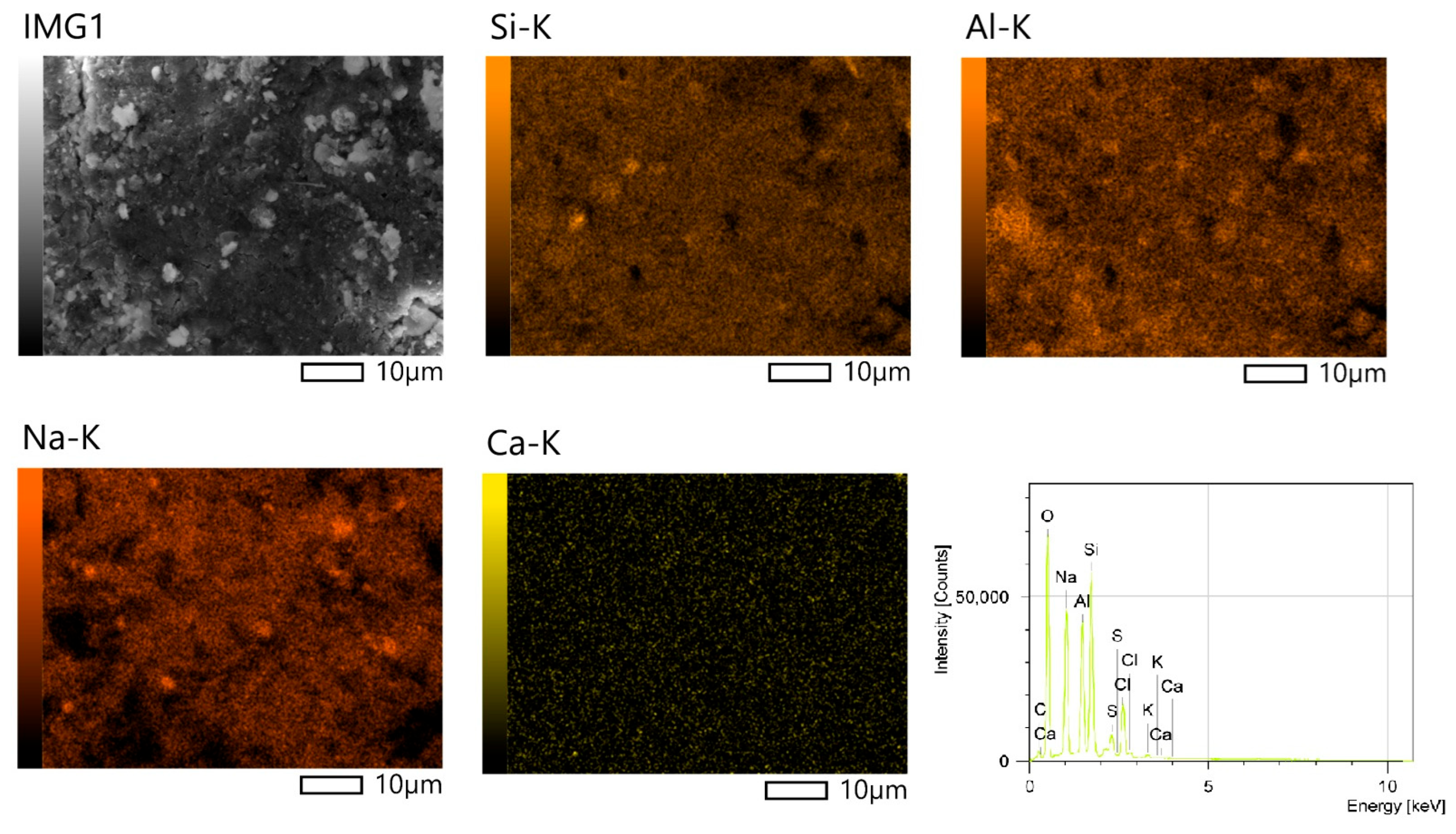
| 9 | Microstructure densifier and interfacial modifier. | Uniform precipitation and growth of geopolymer gel around precursor particles, improved particle–gel bonding, and pore filling at the microstructural level. | SEM (microstructure morphology), EDS mapping (Si and Al distribution), AFM roughness analysis (Ra, Rq). | [56] |
| 10 | Reduction in ITZ width (up to ~10 μm). Significant increase in elastic modulus of ITZs (up to ~96%). Transformation of harmful large pores into finer pores, improving mechanical continuity. | Microstructural densification and stiffness homogenization. | SEM, backscattered electron imaging (BSE), image-based porosity analysis. | [37] |
| 11 | Promotion of viscous sintering at high temperatures. | Facilitation of viscous flow and sintering of the geopolymer matrix above ~800 °C, leading to pore closure and structural compaction. | SEM (sintered morphology), MIP (porosity reduction), XRD (onset of crystalline phases). | [42] |
| MESOSCALE | ||||
| 12 | Contribution to the formation of thermally stable ceramic-like phases. | Transformation of amorphous aluminosilicate gel into stable crystalline phases (e.g., leucite, kalsilite) under high-temperature exposure. | XRD (phase identification), TGA/DTG. | [42] |
| 13 | Enhancement of macroscopic strength and thermal stability. | Indirect macro-scale strengthening through combined gel densification, ITZ improvement, pore refinement, and sintering. | Compressive strength testing, shrinkage measurements correlated with micro/nano analyses. | [42] |
| 14 | Improvement in macroscopic mechanical performance. | Translation of nano- and microscale densification into higher load-bearing capacity, improved stress transfer, and reduced weak zones within the brick body. | Compressive, tensile, and flexural strength testing. | [61] |
| 15 | Improvement in macroscopic mechanical properties. Enhanced acid resistance. | Translation of nano- and microscale densification into improved load transfer, reduced transport of aggressive agents, and higher structural integrity. | Compressive, splitting tensile, and flexural strength tests, mass loss and residual strength after acid exposure. | [62] |
| 16 | Mechanical performance enhancer. | Translation of nanoscale gel densification and microscale structural homogeneity into improved load transfer and mechanical integrity. | Compressive strength testing (early and later ages). | [56] |
| 17 | Improvement in mechanical properties. Enhanced water absorption and crushing index tests. | Improved interfacial bonding and stress redistribution. | Water absorption and crushing index tests. Compressive and flexural strength tests. | [37] |
| Feature | OPC | Geopolymer | Geopolymer with NS |
|---|---|---|---|
| ITZ porosity | high | low–moderate | low |
| ITZ thickness | 20–50 µm | thin/weakly defined (≈10–30 µm) | very thin/often indistinct (<10 µm) 1 |
| ITZ character | passive | reactive | highly reactive |
| ITZ strength | weakest zone | comparable to the matrix | often higher than the matrix |
| Role of NS | none (CH, ettringite) | silica from the activator and precursor, partly influence ITZ | active ITZ designer (reactive Si + filler effect) |
| No. | Precursor | NS Dosage | Compressive Strength | Tensile/Flexural Strength | Reported Effect | Source |
|---|---|---|---|---|---|---|
| 1 | Fly ash + GGBFS | 3 wt.% | 40% increase | Tensile +27%, flexural +33% | Significant improvement due to matrix densification | [62] |
| 2 | Geopolymer bricks | 3 wt.% | 41.5 → 45 MPa | Tensile: 3.35 → 4.5 MPa; flexural: 6.2 → 6.5 MPa | Improved particle interlocking and densification | [61] |
| 3 | Fly ash + GGBFS + SBA | 4 wt.% | 41–43 MPa | 3.9 MPa tensile | +25–30% strength increase | [114] |
| 4 | SBA-based geopolymer (fly ash + GGBFS + SBA) | 2.5 wt.% | +32% | +20–25% (tensile/flexural) | Improved ITZ and geopolymerization | [115] |
| 5 | Sludge-based geopolymer | 2 wt.% | +108.2% | Flexural +69.9% | Highest improvement among nano-additives | [120] |
| 6 | Porous geopolymer adsorbent | 2 wt.% | +63.5% | N/A | Improved structural stability | [119] |
| No. | Aspect/Property | Effect of NS Addition | Dominant Mechanism | Key Benefits | Limitations/Risks |
|---|---|---|---|---|---|
| 1 | Fresh-state properties (workability, rheology) | Decreasing workability at higher dosages; increasing stability and yield stress at lower dosages | High specific surface area; increased water demand; particle packing | Improved shape stability; at low doses, possible improvement in grain packing; in some systems, increased spreading | Reduced flowability, strong dependence on dispersion; increased need for water |
| 2 | Rheological behavior (printability) | Enhancing yield stress and shape stability | Particle packing, thixotropy enhancement | Better printability | High dosage of NS can limit rheological properties |
| 3 | Setting and hardening | Acceleration or, in some systems, delay | Nucleation effect, enhanced dissolution and gel formation | Faster early strength development | Possible disturbance of reaction kinetics |
| 4 | Dimensional stability/shrinkage | Reduction in shrinkage | Structural densification | Improved dimensional stability, reduction in cracks after the curing process | At high doses, an increase in autogenic contraction is possible |
| 5 | Interlayer adhesion (3D printing) | Improved bonding between layers | Enhanced fresh-state cohesion | Good interlayer adhesion in 3D printed products | High dosage can cause agglomerations |
| 6 | Microstructure | Reduced porosity; increased homogeneity | Nano-filler effect, controlled gel growth | Denser and more uniform matrix; reduction in open porosity; improved bonding of gel phases (N-A-S-H/C-(A)-S-H) | Agglomeration may create weak zones; a negative effect due to improper dispersion |
| 7 | Compressive strength | Significant improvement; improvement in early-age strength | Matrix densification, pore refinement | Higher ultimate and early strength | Strength decreases beyond optimal dosage |
| 8 | Flexural/tensile strength | Moderate-to-great improvement | In composites, improved ITZ, stress transfer | Increased toughness and fracture resistance | Excess NS may reduce ductility |
| 9 | Fiber-reinforced systems (and other composites) | Improved crack bridging and interlayer adhesion | Enhanced cohesion and interface quality | Beneficial for strain-hardening composites; enhanced toughness and fracture toughness | Higher sensitivity to processing errors |
| 10 | Shrinkage and cracking | Reduced crack width | Stress redistribution, denser matrix | Improved dimensional stability | Risk of increased autogenous shrinkage at high dosages |
| 11 | Self-healing capacity | Enhanced crack sealing | Promotion of gel re-precipitation | Improved durability and service life | Effectiveness depends on microstructure quality |
| 12 | Durability (permeability, chemical resistance) | Improved resistance to water, chlorides and aggressive media | Reduced connected porosity | Lower water absorption; lower permeability; better chemical stability | Poor dispersion may increase sorptivity |
| 13 | Technological aspects | High efficiency at low dosages | High intrinsic reactivity | Material-efficient modification | Difficult and costly dispersion techniques |
| 14 | Environmental aspects | Indirect reduction in binder demand | Strength and durability enhancement | Potential reduction in structural carbon footprint | NS production is energy-intensive; a lack of complete LCA data for nano-systems |
| 15 | Reproducibility of results | Mechanisms well understood | — | Clear trends at optimal dosages | Large scatter in the literature results; no definitive “universal” dose |
| No. | Application Area | Performance Requirements | Effect of NS | Key Benefits | Practical Limitations | Source |
|---|---|---|---|---|---|---|
| 1 | Reinforced geopolymer concrete slabs for structural elements, such as floor and roof slabs in buildings and infrastructure. | Adequate flexural strength, crack resistance, stiffness, ductility, and energy absorption capacity, together with reliable structural behavior. | NS significantly densifies the geopolymer matrix, reduces voids, delays crack initiation, and enhances load-carrying capacity, stiffness, and energy absorption under flexural loading. | Increased cracking load and ultimate flexural capacity; improvement in stiffness and energy absorption; better crack control and resistance to micro-strain development; improved overall structural efficiency and durability. | Potential issues related to dispersion, cost, and workability at higher NS contents; structural design guidelines for geopolymers with nano-additives are still not standardized. | [144] |
| 2 | Self-compacting geopolymer concrete paver blocks, designed for medium-traffic applications, such as pedestrian walkways, residential driveways, parking areas, and urban pavements. | High compressive, tensile, and flexural strength; low water absorption; good durability under ambient curing conditions; and sufficient structural integrity to resist cracking, abrasion, and environmental exposure during service. | NS enhances matrix densification and geopolymerization, leading to increases in mechanical properties; it simultaneously reduces water absorption and porosity; higher NS contents promote better particle packing and improved formation of binding gel phases. | Improvement in mechanical strength, reduced water absorption, improved durability, and the ability to produce high-performance, low-carbon paver blocks using industrial by-products (system is environmentally sustainable). | Excessive NS content increases water demand and cost, requires careful control of dispersion and mix rheology, and could potentially lead to workability issues if not balanced properly with superplasticizers. | [145] |
| 3 | Geopolymer repair mortars for rehabilitation and strengthening of reinforced concrete structures exposed to sulfate-rich aggressive environments, such as bridge piers, foundations, marine and underground infrastructure. | High bond strength to existing concrete substrate, adequate compressive strength, controlled shrinkage, and durability under sulfate attack, without the need for heat curing. | NS improves geopolymer performance by densifying the matrix, refining pore structure, and enhancing ITZ properties; increases shear and tensile bond strength. | Enhanced bond strength between repair mortar and concrete substrate; improved compressive strength and matrix uniformity; increased resistance to sulfate curing environments; denser and more durable microstructure; synergistic performance when combined with fiber content. | Increased drying shrinkage; sensitivity to NS dosage and dispersion method; requirement for fiber optimization to mitigate shrinkage; long-term durability still requires further validation. | [146] |
| 4 | Flame-retardant and UV-resistant protective coatings for wood-based construction materials (e.g., plywood) used in buildings and transportation. | High flame retardancy, thermal stability at elevated temperatures, resistance to UV-induced aging, and durability of protective performance after long-term exposure. | NS densifies the geopolymer coating, fills pores and microcracks, enhances char formation, promotes stable Si–C–P residues, increases activation energy of thermal decomposition, and improves UV shielding through reflection and absorption. | Significant reduction in peak heat release rate; improvement in flame retardancy index, mitigated the loss of performance after UV aging (>60% reduction in degradation), enhanced thermal stability, and multifunctionality, including formaldehyde adsorption. | Excessive NS content leads to particle agglomeration, uneven dispersion, microcracking, and deterioration in flame-retardant and UV-resistant performance. | [147] |
| 5 | High-alumina refractory castables for intermediate-temperature industrial applications (≈800–1200 °C), particularly in petrochemical units, non-ferrous metal processing, and other thermal process equipment. | Adequate workability; high green strength after curing (before firing); low chemically bound water; high mechanical strength and elastic stability after firing (800–1250 °C); good thermal shock resistance under large temperature gradients; dimensional stability with controlled shrinkage at elevated temperatures. | Reactive silica source that promotes formation of a homogeneous amorphous aluminosilicate gel; contributes to liquid-phase formation during firing, enhancing viscous sintering and densification; influences phase evolution, favoring nepheline formation in Na systems and kalsilite/leucite in K systems; modulates viscosity and quantity of the high-temperature liquid phase, strongly affecting shrinkage and microcracking behavior. | Cement-free bonding system, avoiding drawbacks of calcium aluminate cement; high green mechanical strength; improved densification and strength after firing, especially in Na-based systems; excellent thermal shock resistance; potential for lower CO2 footprint and reduced drying risks. | Excess liquid-phase formation in Na-based geopolymer systems can lead to higher shrinkage, microcracking, and reduced structural reliability near 1250 °C; use of highly alkaline liquids (NaOH/KOH with NS) raises handling and safety considerations; K-based systems, while more thermally stable, show lower densification and strength than Na-based counterparts. | [148] |
| 6 | Self-compacting geopolymer concrete for structural elements, including reinforced beams. | High flowability without segregation; enhanced mechanical strength; improved durability against chloride, acid, and sulfate attack; and reliable structural performance under bending loads. | NS refines the geopolymer matrix by accelerating geopolymerization, densifying the ITZ, enhancing gel formation, and reducing pore connectivity. | Increased compressive, tensile, and flexural strength; reduced water absorption and sorptivity; improved resistance to aggressive environments; and higher load-carrying capacity and ductility of reinforced elements. | Excessive NS content leads to particle agglomeration, reduced workability, formation of weak zones and voids, and subsequent deterioration in mechanical and durability performance. | [58] |
| 7 | Geopolymer-based stabilization of expansive soils for geotechnical applications, such as road subgrades, embankments, and foundation improvement. | Improved unconfined compressive strength, enhanced water stability, and reduced sensitivity of expansive soil to moisture-induced deformation. | NS enhances the geopolymerization process by supplying additional reactive silica, refining the pore structure, and promoting the formation of C–(A)–S–H-type gels, leading to a denser and stronger soil matrix. | Significantly increases compressive strength and water resistance, while improving microstructural compactness and interparticle bonding. | Excessive NS content leads to particle agglomeration, reduced effectiveness, and potential strength loss. | [149] |
| 8 | Geopolymers for sustainable construction, particularly for solidification/stabilization of municipal solid waste incineration fly ash and fast-setting repair or prefabricated materials. | Rapid setting, high early-age and long-term compressive strength, dense microstructure, and effective immobilization of hazardous heavy metals with low leaching potential. | NS accelerates geopolymerization, shortens setting time, enhances early strength, refines pore structure, and improves heavy-metal immobilization through filling, nucleation, and pozzolanic effects. | Significant improvement in early mechanical performance, reduced porosity and permeability, enhanced formation of C–S–H/C–A–S–H gels, and increased conversion of heavy metals into stable chemical forms. | Excessive NS dosage can cause particle agglomeration, reduced dispersion efficiency, and diminishing strength gains, making dosage optimization and proper dispersion critical for practical application. | [139] |
| 9 | Underwater construction and repair applications, such as marine structures, bridge piers, ports, and foundations, where casting and curing take place directly in water. | High compressive strength under underwater curing conditions, resistance to wash-out during placement, sufficient self-compacting ability, low water permeability, retention of mechanical performance comparable to specimens cured at room conditions. | NS improved mechanical and physical performance, with the most pronounced effects observed at 0.5 wt.%. NS increased compressive strength and ultrasonic pulse velocity, and reduced capillary water absorption, indicating a denser geopolymer matrix and accelerated geopolymerization. | Significant increase in compressive strength; high strength retention under underwater curing; improved resistance to wash-out, reflected by lower pH values. Reduced capillary water absorption due to a more compact microstructure. Enhanced formation of binding phases (C-A-S-H and N-A-S-H). | Long-term durability under aggressive marine environments was not addressed. The results are specific to GGBS-based geopolymer mortar and may not be directly transferable to other geopolymer precursor systems. | [150] |
| 10 | Simulated lunar soil-based geopolymer for in situ construction of lunar infrastructure, including load-bearing elements of lunar research stations under ISRU constraints. | High early-age and long-term mechanical strength, low porosity and crack sensitivity, efficient water utilization and recovery, good flowability for molding/3D printing, and stability under extreme lunar thermal and vacuum conditions. | NS enhances geopolymerization through nucleation and chemical bonding effects, densifies the microstructure by pore filling, improves reaction homogeneity, and significantly increases compressive and flexural strength. | Strength enhancement, reduced total porosity and coarse pores, improved crack resistance and thermal stability, higher mass-strength efficiency, and reduced dependence on Earth-supplied materials while maintaining high water recovery efficiency. | Excessive NS addition leads to nanoparticle agglomeration, increased defects and coarse pores, reduced workability, and deterioration in mechanical performance. | [57] |
| 11 | Structural health monitoring of smart and low-carbon civil infrastructure elements (e.g., beams, slabs, and precast components) requiring in situ damage and strain sensing. | High mechanical strength and toughness, stable electrical conductivity, and ultra-high strain-sensing sensitivity with reliable signal response under flexural loading. | NS is critical for refining the nanopore structure, enhancing ionic conductivity through interconnected gel pores, and stabilizing the electrical sensing signal during deformation. | Synergistic improvement in sensitivity (very high gauge factor), crack detection at early stages, good mechanical performance, and reduced carbon footprint. | Sensitivity to mixture design and raw-material variability, complexity of ensuring uniform dispersion, and challenges in large-scale, field-friendly manufacturing and standardization. | [127] |
| 12 | 3D-printable geopolymer mortars based on construction and demolition waste (CDW), intended for additive manufacturing of structural and non-structural building elements. | Adequate printability (extrudability, buildability, shape retention) combined with sufficient mechanical strength, controlled shrinkage-induced cracking, low permeability, and mitigation of efflorescence under ambient curing. | NS refines the pore structure and acts as a nucleation agent, promoting additional geopolymer gel formation and resulting in higher compressive and flexural strength as well as reduced permeability and efflorescence. | Densification of the geopolymer matrix; improved mechanical performance; reduced alkali migration and surface efflorescence; enhanced durability of CDW-based 3D-printed geopolymers. | NS alone does not prevent shrinkage-induced cracking in 3D-printed filaments; effective crack control requires synergistic use with other additives (e.g., methyl cellulose or calcium aluminate cement) and careful control of water demand and reaction kinetics. | [83] |
| 13 | Soft-magnetic construction materials, particularly soft-magnetic layers in airport pavements for induction heating systems (e.g., snow and ice melting), as well as other building applications requiring electromagnetic functionality combined with structural capacity. | The material must exhibit high magnetic permeability, low coercivity, and low hysteresis and eddy current losses under alternating magnetic fields, while simultaneously maintaining adequate mechanical strength and a dense, durable microstructure. | NS acts as a functional carrier and nucleation promoter by improving the dispersion of Fe3O4 nanoparticles, enhancing geopolymerization through nucleation and nano-filling effects, and facilitating a more uniform microstructure that supports both mechanical and electromagnetic performance. | The nano-SiO2@Fe3O4 magnetofluid enables a balanced improvement in electromagnetic and mechanical properties, leading to reduced coercivity, enhanced-saturation magnetization, improved geopolymer gel formation, and an optimized pore structure at an appropriate magnetofluid concentration. | Excessive magnetofluid content increases water demand and pore formation, which can limit further strength gains and deteriorate microstructural compactness; therefore, precise control of nano-SiO2@Fe3O4 dosage and dispersion is essential to avoid diminishing returns. | [49] |
Disclaimer/Publisher’s Note: The statements, opinions and data contained in all publications are solely those of the individual author(s) and contributor(s) and not of MDPI and/or the editor(s). MDPI and/or the editor(s) disclaim responsibility for any injury to people or property resulting from any ideas, methods, instructions or products referred to in the content. |
© 2026 by the authors. Licensee MDPI, Basel, Switzerland. This article is an open access article distributed under the terms and conditions of the Creative Commons Attribution (CC BY) license.
Share and Cite
Korniejenko, K.; Wu, Q. Nano-Silica as Designer Tools for Geopolymer Microstructure Optimization: Effects on Porosity, Interfacial Transition Zone (ITZ), and Mechanical Performance. Materials 2026, 19, 2320. https://doi.org/10.3390/ma19112320
Korniejenko K, Wu Q. Nano-Silica as Designer Tools for Geopolymer Microstructure Optimization: Effects on Porosity, Interfacial Transition Zone (ITZ), and Mechanical Performance. Materials. 2026; 19(11):2320. https://doi.org/10.3390/ma19112320
Chicago/Turabian StyleKorniejenko, Kinga, and Qinglin Wu. 2026. "Nano-Silica as Designer Tools for Geopolymer Microstructure Optimization: Effects on Porosity, Interfacial Transition Zone (ITZ), and Mechanical Performance" Materials 19, no. 11: 2320. https://doi.org/10.3390/ma19112320
APA StyleKorniejenko, K., & Wu, Q. (2026). Nano-Silica as Designer Tools for Geopolymer Microstructure Optimization: Effects on Porosity, Interfacial Transition Zone (ITZ), and Mechanical Performance. Materials, 19(11), 2320. https://doi.org/10.3390/ma19112320