This is an early access version, the complete PDF, HTML, and XML versions will be available soon.
Article

Molecular Dynamics Investigation of CSH/SiO2 Interface Degradation in High-Temperature and Water-Rich Environments


1
College of Pipeline and Civil Engineering, China University of Petroleum, 66# Changjiang West Road, Qingdao 266580, China
2
State Key Laboratory for Tunnel Engineering, School of Civil Engineering, Shandong University, 17923# Jingshi Road, Jinan 250012, China
3
School of Architecture and the Built Environment, KTH Royal Institute of Technology, 100 44 Stockholm, Sweden
4
School of Transportation and Civil Engineering, Shandong Jiaotong University, 5001# Haitang Road, Jinan 250357, China
*
Author to whom correspondence should be addressed.
Materials 2026, 19(11), 2295; https://doi.org/10.3390/ma19112295
Submission received: 6 May 2026 / Revised: 24 May 2026 / Accepted: 26 May 2026 / Published: 28 May 2026
(This article belongs to the Section Construction and Building Materials)

Abstract

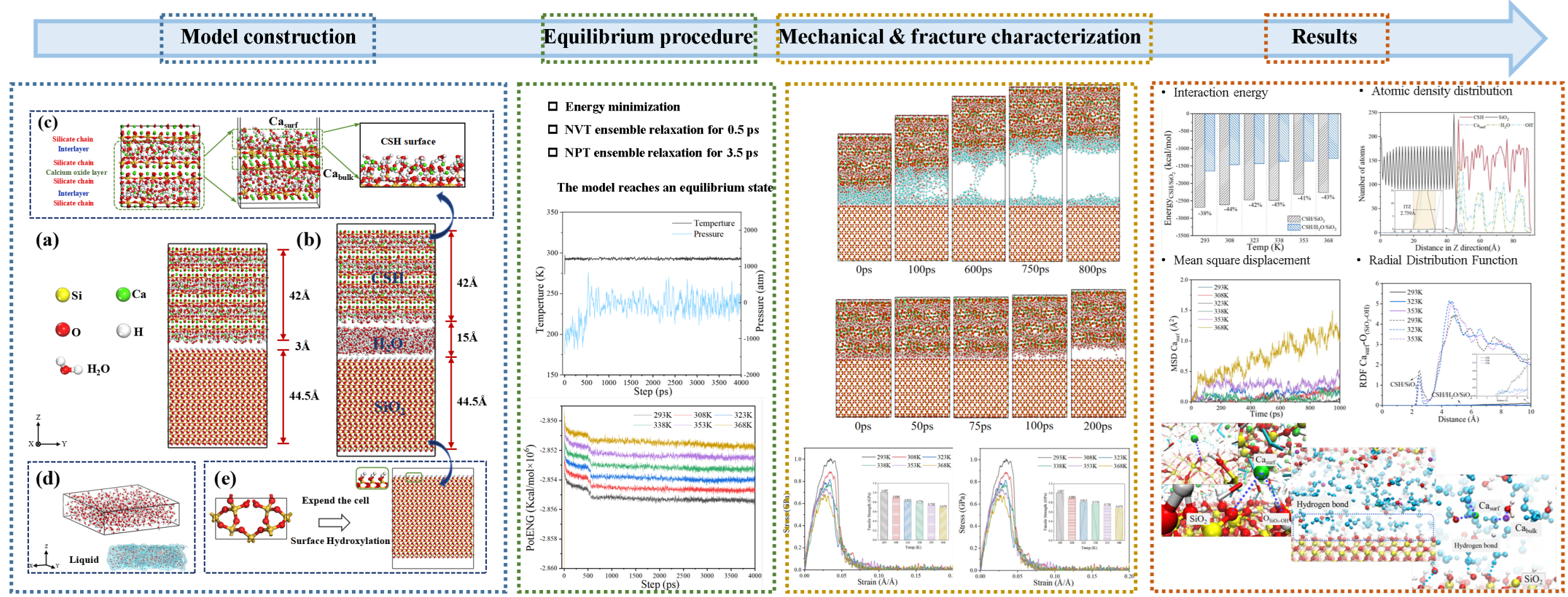
As the critical weak link in grouting reinforcement systems, the interfacial adhesion between cementitious grout and rock minerals is highly susceptible to performance degradation under high-temperature and water-rich conditions. In this paper, molecular dynamics simulations were performed across a temperature range of 293 K to 368 K to systematically investigate the effects of high-temperature and water-rich environments on the mechanical response, bonding structure, and dynamic behavior of the grout–rock interface. All simulations were performed using the LAMMPS package with the ClayFF force field. Two interface models, including a CSH/SiO2 direct-contact model and a CSH/H2O/SiO2 water-containing model, were constructed and subjected to uniaxial tensile tests. Key findings are as follows: (i) The tensile strength and interaction energy of the CSH/SiO2 interface exhibit distinct thermal degradation characteristics. The tensile strength decreases by 32.57%, and the interaction energy by 15.78% when the temperature rises from 293 K to 368 K. High temperatures induce expansion of the interface transition zone from 2.74 Å to 4.60 Å and loosening of the interface structure. (ii) High temperatures intensify atomic diffusion at the interface. The number and stability of Ca-O bonds and hydrogen bonds formed between CSH and SiO2 are reduced, leading to a decline in interfacial adhesion. (iii) The presence of an interfacial water layer significantly impairs the tensile strength and interaction energy of the interface. Compared with the direct-contact interface, the interaction energy is reduced by 38% at 293 K, and the tensile strength decreases by 73.58%. Water molecules in the solution compete for bonding sites of hydrogen bonds and Ca-O bonds at the interface, weakening the direct interaction between CSH and SiO2 and transforming it into an indirect interaction mediated by water molecules.
Keywords: molecular dynamics simulations; CSH/SiO2 interface; high-temperature environment; water-rich environment; interface degradation mechanism molecular dynamics simulations; CSH/SiO2 interface; high-temperature environment; water-rich environment; interface degradation mechanism
Graphical Abstract