This is an early access version, the complete PDF, HTML, and XML versions will be available soon.
Open AccessReview
Advanced Electrode Materials for Water Electrolysis: Design Principles, Performance Trade-Offs, and Technology Pathways Across ALK, PEM, SOEC, and AEM Systems
by
Bożena Łosiewicz
 Bożena Łosiewicz
Institute of Materials Engineering, Faculty of Science and Technology, University of Silesia in Katowice, 41-500 Chorzów, Poland
Materials 2026, 19(11), 2259; https://doi.org/10.3390/ma19112259 (registering DOI)
Submission received: 8 March 2026
/
Revised: 8 May 2026
/
Accepted: 22 May 2026
/
Published: 26 May 2026
Abstract
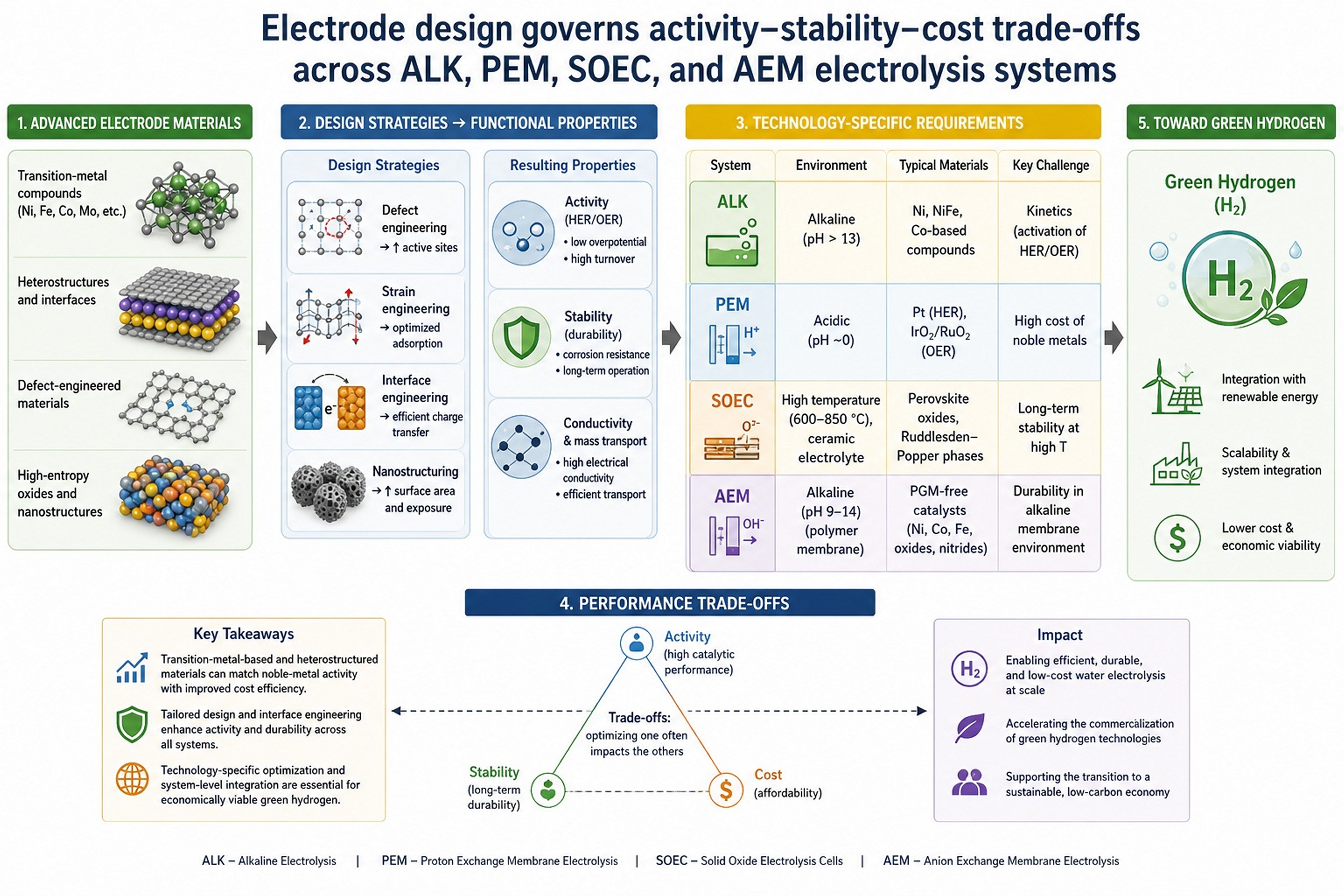
The transition toward low-carbon energy systems has intensified interest in sustainable hydrogen production technologies. One of the most promising methods for producing green hydrogen is water electrolysis powered by renewable energy. This work reviews recent advances in electrode materials used in four major electrolysis technologies: alkaline (ALK), proton exchange membrane (PEM), solid oxide electrolysis cells (SOEC), and anion exchange membrane (AEM). A bibliometric analysis of scientific publications from 2021 to 2025 highlights the rapid growth of research and the increasing importance of electrode materials in improving electrolysis performance. Operating environments, material requirements, and catalytic properties are compared across these systems. Recent developments in electrocatalysts—including transition-metal alloys, heterostructured catalysts, defect-engineered materials, and nanostructured systems—are evaluated in terms of catalytic activity, durability, and scalability. Particular attention is given to reducing noble metal usage while maintaining high electrochemical performance. Results indicate that transition-metal-based catalysts and engineered interfaces can achieve activity comparable to noble-metal systems while offering better cost efficiency. However, challenges related to long-term durability, large-scale synthesis, and standardized testing persist. Continued interdisciplinary research in materials design and electrochemical engineering is essential to enable efficient, durable, and cost-effective green hydrogen production.
Share and Cite
MDPI and ACS Style
Łosiewicz, B.
Advanced Electrode Materials for Water Electrolysis: Design Principles, Performance Trade-Offs, and Technology Pathways Across ALK, PEM, SOEC, and AEM Systems. Materials 2026, 19, 2259.
https://doi.org/10.3390/ma19112259
AMA Style
Łosiewicz B.
Advanced Electrode Materials for Water Electrolysis: Design Principles, Performance Trade-Offs, and Technology Pathways Across ALK, PEM, SOEC, and AEM Systems. Materials. 2026; 19(11):2259.
https://doi.org/10.3390/ma19112259
Chicago/Turabian Style
Łosiewicz, Bożena.
2026. "Advanced Electrode Materials for Water Electrolysis: Design Principles, Performance Trade-Offs, and Technology Pathways Across ALK, PEM, SOEC, and AEM Systems" Materials 19, no. 11: 2259.
https://doi.org/10.3390/ma19112259
APA Style
Łosiewicz, B.
(2026). Advanced Electrode Materials for Water Electrolysis: Design Principles, Performance Trade-Offs, and Technology Pathways Across ALK, PEM, SOEC, and AEM Systems. Materials, 19(11), 2259.
https://doi.org/10.3390/ma19112259
Note that from the first issue of 2016, this journal uses article numbers instead of page numbers. See further details
here.
Article Metrics
Article metric data becomes available approximately 24 hours after publication online.