Article

Composition Design and Property Investigation of Mold Fluxes for the Continuous Casting of Rare-Earth Weathering Steel
1
Zhongda National Engineering & Research Center of Continuous Casting Technology Co., Ltd., Beijing 100081, China
2
China Iron and Steel Research Institute Co., Ltd., Beijing 100081, China
*
Author to whom correspondence should be addressed.
Materials 2026, 19(11), 2236; https://doi.org/10.3390/ma19112236
Submission received: 11 March 2026 / Revised: 23 April 2026 / Accepted: 6 May 2026 / Published: 25 May 2026

Abstract

Conventional CaO–SiO2-based mold fluxes used in the continuous casting of rare-earth weathering steel are prone to severe slag–steel interfacial reactions, resulting in marked compositional changes and progressive property deterioration after rare-earth oxide pickup, which compromises lubrication stability and casting operability. In this study, a novel low-reactivity CaO–Al2O3-based mold flux was designed through phase-diagram-guided composition design, IMCT-based thermodynamic screening, and experimental investigation of melting, viscosity, and crystallization behavior. The originality of this work lies in establishing a design–validation framework for fluxes that remain stable after Ce2O3 absorption, rather than simply replacing the conventional CaO–SiO2 system. Validation against literature SiO2 activity data showed good trend consistency, supporting the use of the IMCT model as a semi-quantitative tool for composition screening. The results showed that CaO, Li2O, and Ce2O3 exhibited relatively high activities, whereas B2O3 showed extremely low activity. When the Ce2O3 content exceeded 5 wt.%, the viscosity remained about 0.30 Pa·s, and when the w(CaO)/w(Al2O3) ratio was higher than 1.6, it stabilized at about 0.25 Pa·s. The minimum melting temperature, 1122.6 °C, was obtained at 5 wt.% Ce2O3. Compared with a conventional CaO–SiO2-based flux, the developed flux showed similar initial processability but much better stability after absorbing 15 wt.% Ce2O3, with less severe deterioration in melting, viscosity, and crystallization behavior. These results provide scientific insight into mold-flux design under rare-earth oxide pickup conditions and practical guidance for improving the continuous casting of rare-earth weathering steels.

1. Introduction

Rare-earth (RE) steels, i.e., steels containing small additions of rare-earth elements, have attracted extensive attention because rare-earth elements can purify molten steel, modify non-metallic inclusions, and produce beneficial microalloying effects. As a result, even a small amount of rare-earth addition can significantly improve the strength, impact toughness, and corrosion resistance of steels, which has promoted their application in carbon steels, alloy steels, stainless steels, and, more recently, weathering steels [1]. Despite these advantages, the continuous casting of RE-bearing steels remains challenging because the high chemical activity of rare-earth elements can strongly disturb the steel/slag interfacial reactions and thereby affect mold-flux stability, lubrication, and heat transfer in the mold.
For conventional CaO–SiO2-based mold fluxes, severe interaction with rare-earth elements and rare-earth oxides is difficult to avoid during continuous casting. On the one hand, dissolved rare-earth elements in molten steel can react readily with reactive slag components, especially SiO2, causing significant slag compositional changes. On the other hand, rare-earth oxides generated in the steel can continuously enter the slag during casting, further altering the flux chemistry and its physicochemical properties [2]. These changes usually increase viscosity and crystallization tendency, impair slag consumption and lubrication, and destabilize mold heat transfer [3]. In practice, such instability may increase the risk of excessive slag-rim formation, unstable casting operation, surface longitudinal cracking, and deterioration of slab surface quality, which limits the wider application of RE-bearing steels in continuous casting [4,5].
Considerable efforts have been devoted to understanding the effects of rare-earth oxides on mold-flux behavior [6,7,8,9,10]. Previous studies have shown that rare-earth oxides can markedly influence melting temperature, viscosity, and crystallization behavior, and that the resulting trends depend strongly on slag basicity and composition. In parallel, CaO–Al2O3-based mold fluxes with Li2O and/or B2O3 additions have been investigated as low-reactivity alternatives to conventional silicate-based systems, mainly because they can reduce the melting temperature without relying on highly reactive SiO2. However, most previous studies have focused on the role of individual components or on the initial physicochemical properties of candidate fluxes, while comparatively less attention has been paid to the integrated design of mold fluxes for RE weathering steel under continuous rare-earth oxide pickup conditions. In particular, there is still a lack of clear understanding of how to design a low-reactivity flux system that can simultaneously maintain acceptable melting behavior, viscosity stability, and controllable crystallization behavior after absorbing substantial amounts of rare-earth oxides.
In view of the above issues, the present work aims to develop a dedicated low-reactivity mold flux for the continuous casting of rare-earth weathering steel based on the CaO–Al2O3–Li2O–B2O3–Ce2O3 system. The study combines phase-diagram-guided composition design, thermodynamic analysis based on the ion and molecule coexistence theory (IMCT), and experimental investigation of melting, viscosity, and crystallization behavior. The originality of this work lies not simply in replacing the CaO–SiO2 system with a CaO–Al2O3-based one, but in establishing an integrated design and validation framework for RE-steel mold fluxes that considers (i) reduced interfacial reactivity, (ii) physicochemical stability after Ce2O3 absorption, and (iii) the evolution of crystallization behavior compared with a conventional mold flux. By clarifying these relationships, this study is expected to provide both scientific insight into flux design under rare-earth oxide pickup conditions and practical guidance for improving lubrication stability, casting operability, and slab surface quality in the continuous casting of RE weathering steels.

2. Slag System Composition Design

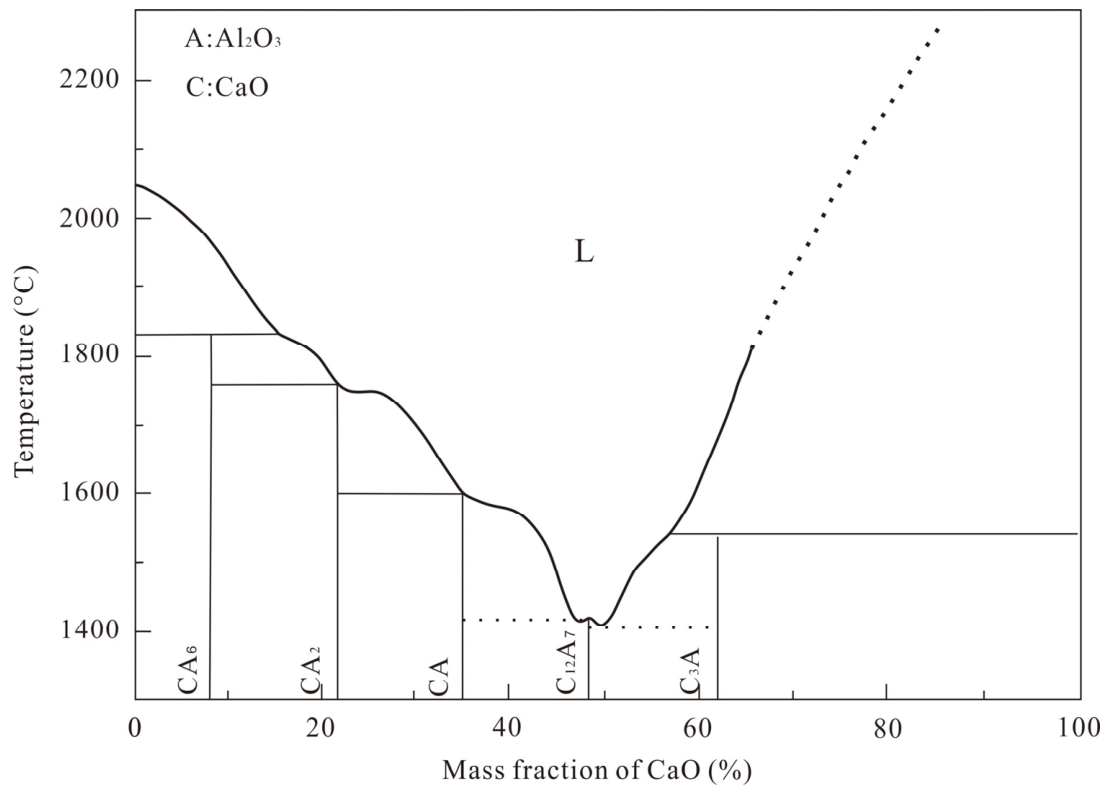
To mitigate severe slag–steel interfacial reactions during the continuous casting of rare-earth weathering steels, reducing the intrinsic reactivity of the mold flux is a critical design objective. Thermodynamic analysis indicates that the standard Gibbs free energy for the reaction between rare-earth Ce and SiO2 is significantly lower than that for its reactions with CaO and Al2O3, implying a much stronger reaction tendency between rare-earth elements and SiO2 [11]. Consequently, in the present work, the composition design strategy was shifted from the conventional CaO-SiO2-based low-melting region to the CaO-Al2O3-based low-melting region (Figure 1). According to the CaO-Al2O3 phase diagram in Figure 2, and considering both melting behavior and compositional tunability, the baseline composition was defined by a w(CaO)/w(Al2O3) ratio in the range of 0.6–2.0.
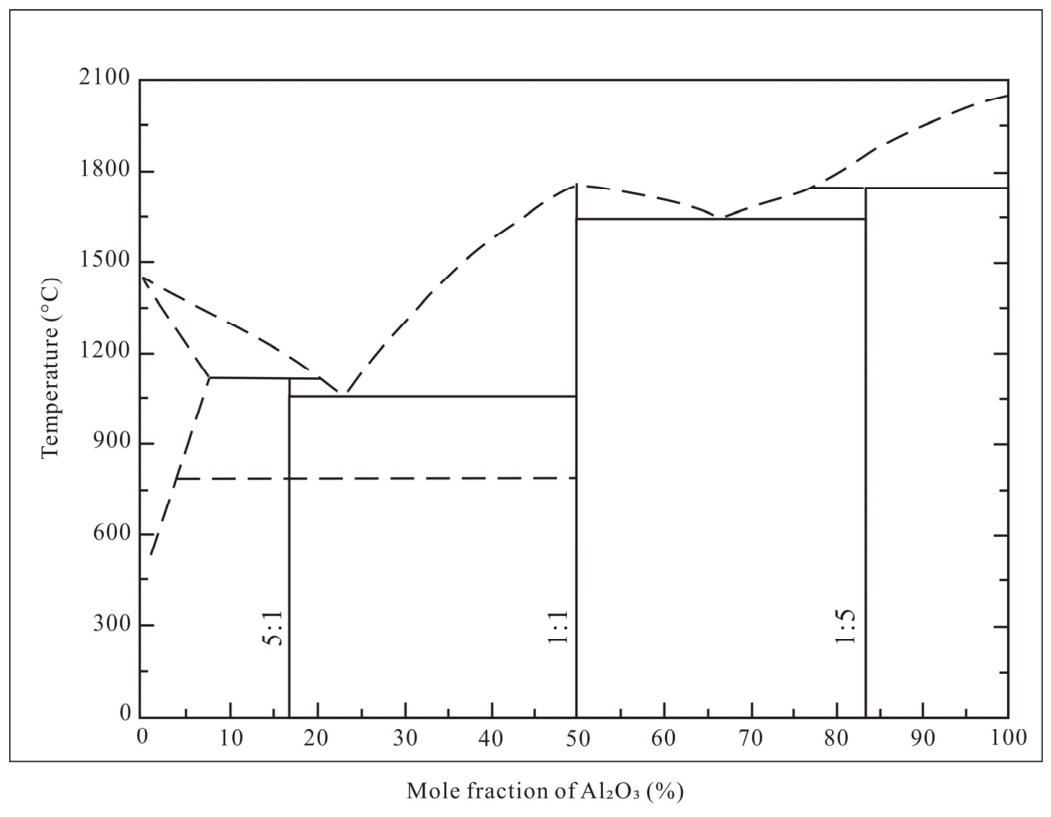
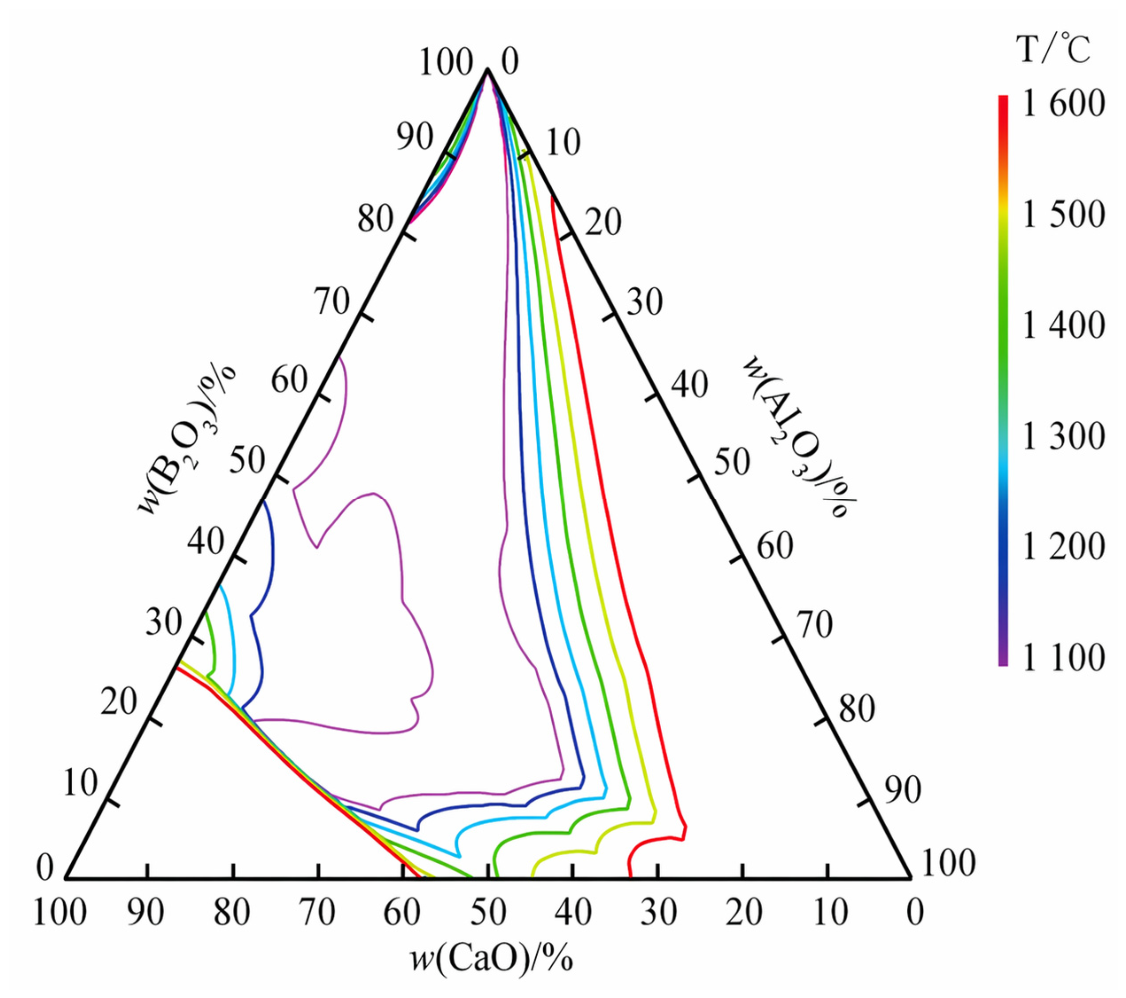
However, the CaO-Al2O3 base system inherently exhibits a relatively high melting temperature, which necessitates the introduction of suitable fluxing agents to reduce the melting temperature and to adjust other physicochemical properties. Thermodynamic evaluation shows that Na2O has a strong reaction tendency with rare-earth Ce, as indicated by its large negative Gibbs free energy of reaction, and was therefore excluded from the flux design. In contrast, Li2O exhibits a much weaker interaction with rare-earth Ce and can effectively suppress the reaction between the mold flux and rare-earth elements while maintaining the stability of slag properties. Furthermore, the Li2O-Al2O3 phase diagram indicates that Li2O can form low-melting-point compounds with Al2O3 in Figure 3, thereby significantly reducing the melting temperature of the slag [12,13,14]. Based on these considerations, Li2O was selected as the primary fluxing agent, and its content was controlled within the range of 5–15 wt.%.
In addition, B2O3, which has a low melting point of approximately 450 °C and readily forms low-melting compounds with various oxides, was introduced to further decrease the melting temperature of the slag system [15,16,17]. Phase diagram analysis of the CaO-Al2O3-B2O3 system shows that increasing the B2O3 content from 0 to 10 wt.% can reduce the melting temperature of the system by as much as ~500 °C in Figure 4. Therefore, considering both melting performance and compositional stability, the B2O3 content in the new mold flux was determined to be in the range of 0–10 wt.%.
To further suppress the reaction between rare-earth elements and the mold flux, in addition to lowering the activity of the reactants, the reaction driving force can also be reduced by increasing the activity of the reaction products [18,19]. On this basis, an appropriate amount of rare-earth oxide Ce2O3 was introduced into the mold flux to inhibit further transfer and reaction of rare-earth elements into the slag and to reduce the overall reactivity of the slag system. Taking into account both thermodynamic considerations and process adaptability, the Ce2O3 content was controlled within the range of 0–20 wt.%.
On the basis of the above design principles, a novel low-reactivity mold flux system with the composition CaO-Al2O3-Li2O-B2O3-Ce2O3 was finally established.

3. Thermodynamic Analysis of Slag Components

3.1. Model Assumptions

Based on the Ion and Molecule Coexistence Theory (IMCT), the CaO-Al2O3-Li2O-B2O3-Ce2O3 slag system was analyzed by integrating published thermodynamic information with calculations performed using FactSage 8.2, and the corresponding structural units of the melt were identified as summarized in Table 1 [20,21]. After determining the structural units that may exist in the molten slag, equilibrium-constant expressions were formulated for all relevant reactions, and an activity-calculation model for the mold flux was subsequently established according to the principle of mass balance.
Assume that m 1 = X C a O , m 2 = X A l 2 O 3 , m 3 = X L i 2 O , m 4 = X B 2 O 3 , m 5 = X C e 2 O 3 , N 1 = N C a O , N 2 = N A l 2 O 3 , N 3 = N L i 2 O , N 4 = N B 2 O 3 , N 5 = N C 2 O 3 , N 6 = N C a O 6 A l 2 O 3 , N 7 = N C a O A l 2 O 3 , N 8 = N 3 C a O A l 2 O 3 , N 9 = N 12 C a O 7 A l 2 O 3 , N 10 = N C a O 2 A l 2 O 3 , N 11 = N 2 A l 2 O 3 B 2 O 3 , N 12 = N 9 A l 2 O 3 2 B 2 O 3 , N 13 = N C a O 2 B 2 O 3 , N 14 = N C a O B 2 O 3 , N 15 = N 2 C a O B 2 O 3 , N 16 = N 3 C a O B 2 O 3 , N 17 = N C a 2 O 3 A l 2 O 3 , N 18 = N C 2 O 3 11 H 2 O 3 , N 19 = N L i 2 O d l 2 O 3 , N 20 = N L i 2 O B 2 O 3 , N 21 = N L i 2 O 2 B 2 O 3 , N 22 = N L i 2 O 3 B 2 O 3 , N 23 = N L i 2 O 4 B 2 O 3 .
Here, ∑X denotes the total moles of all structural units at equilibrium for an assumed 100 g of slag. xi (i = 1, 2, 3… 22) represents the moles of a given substance in the melt after reaction equilibrium is reached. mi (i = 1, 2, 3, 4, 5) denotes the total moles of CaO, Al2O3, Li2O, B2O3, and Ce2O3, respectively, before reaction. Ni (i = 1, 2, 3, 4, 5) is the effective concentration of each component in the slag, which is defined as the activity of that component.
According to the Ion and Molecule Coexistence Theory, CaO, Ce2O3, and Li2O exist as face-centered cubic ionic lattices in the solid state, and in the molten slag these compounds occur as ionic species such as Ca2+, Ce3+, Li+, and O2−, remaining independent rather than existing in molecular form.
The mass-action concentration expressions of the structural units and the corresponding equilibrium reactions used in the model are summarized in Table 2.
According to the mass-balance principle:
i = 1 23   N i = 1
Each component obeys the law of mass conservation, and because the total moles of CaO remain unchanged before and after reaction, Equation (25) can be obtained.
X = m 1 N 1 / 2 + N 6 + N 7 + 3 N 8 + 12 N 9 + N 10 + N 13 + N 14 + 2 N 15 + 3 N 16
Because the total moles of Al2O3 remain unchanged before and after reaction, Equation (26) can be obtained.
X = m 2 N 2 + 6 N 6 + N 7 + N 8 + 7 N 9 + 2 N 10 + 9 N 11 + N 17 + 11 N 18 + N 19
Because the total moles of Li2O remain unchanged before and after reaction, Equation (27) can be obtained.
X = m 3 N 3 / 3 + N 19 + N 20 + N 21 + N 22
Because the total moles of B2O3 remain unchanged before and after reaction, Equation (28) can be obtained.
X = m 4 N 4 + N 11 + 2 N 12 + 2 N 13 + N 14 + N 15 + N 16 + N 20 + 2 N 21 + 3 N 22
Because the total moles of Ce2O3 remain unchanged before and after reaction, Equation (29) can be obtained.
X = m 5 N 5 / 5 + N 17 + N 18
Equations (1)–(29) (Table 2) constitute the activity-calculation model for the CaO–Al2O3–Li2O–B2O3–Ce2O3 system. Finally, the effective concentrations of all structural units can be calculated using the fsolve function in Matlab 2024.
The nonlinear system of equations was solved using Matlab, and the Newton iterative method was adopted as the computational approach. The Newton iterative method is a successive linearization technique for solving the nonlinear system f(x) = 0. Performing a Taylor expansion at an approximate solution x^(k) yields
f x f x k + f x k x x k
Thus, the approximate equation for f(x) = 0 can be expressed as
f x f x k + f x k x x k
where f′(x^(k)) is the Jacobian matrix of f(x), given by
f x k = f 1 x 1 f 1 x 2 Λ f 1 x n f 2 x 1 f 2 x 2 Λ f 2 x n f n x 1 f n x 2 Λ f n x n x = x k
If the Jacobian matrix is nonsingular, the unique solution of the corresponding linearized system can be written as
x k + 1 = x k λ f x k 1 f x k k = 0 , 1 , 2 , Λ
where Equation (33) represents the Newton iterative scheme for solving the nonlinear system f(x) = 0.

3.2. Model Validation

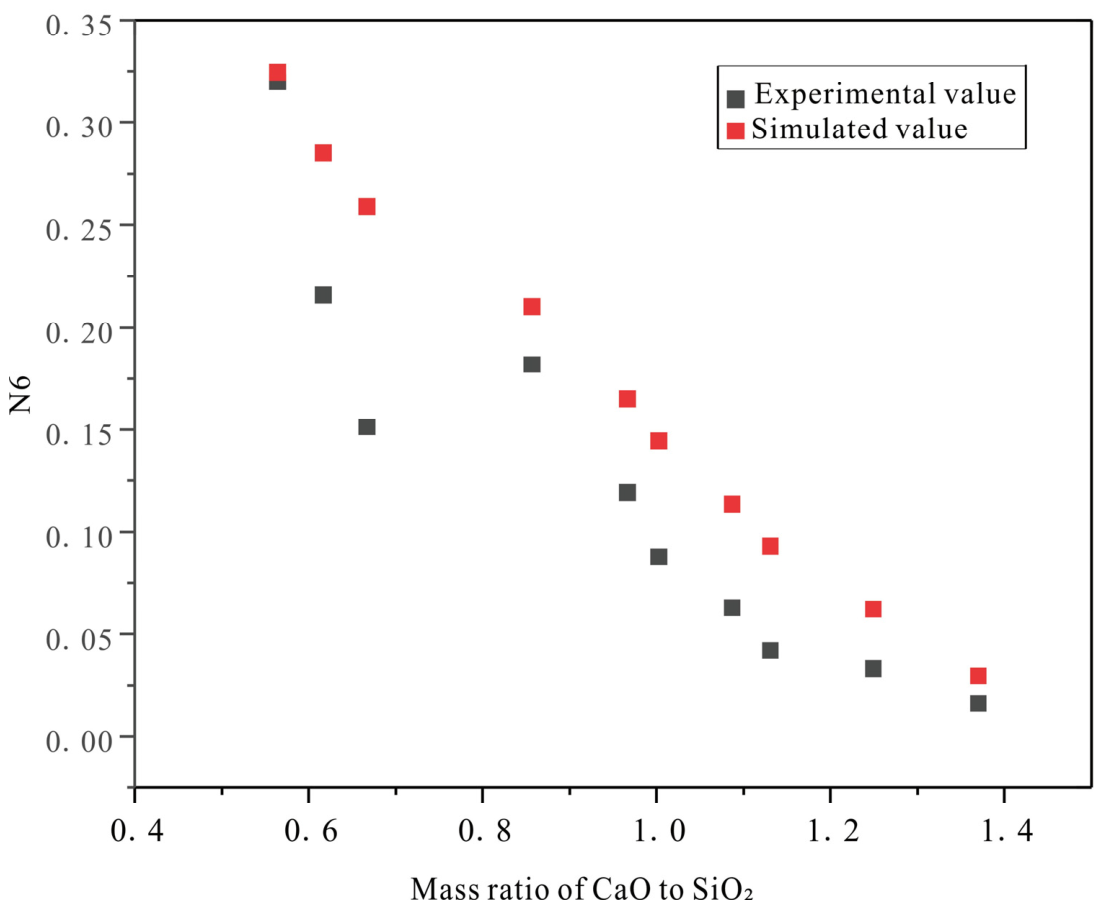
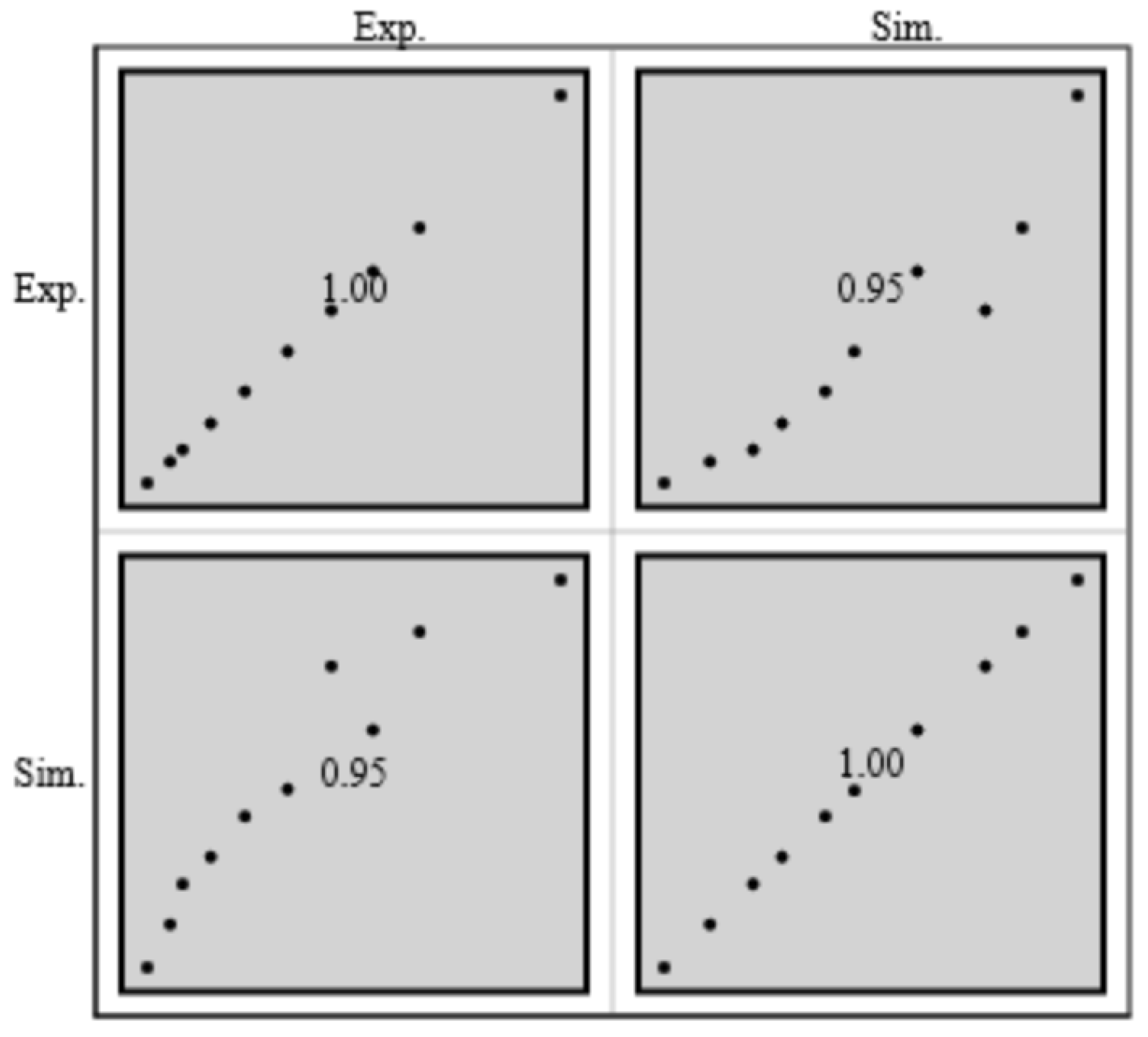
Owing to the complexity of the slag-system compositions calculated by the present model, direct determination of the activities of its constituent components is difficult; therefore, in this study, the experimentally measured SiO2 activity values for the Al2O3–CaF2–CaO–SiO2 slag system at 1823 K reported in Ref. [22] were compared with the values calculated by the present model, and a Pearson correlation analysis was performed. As shown in Figure 5 and Figure 6, Pearson correlation analysis of the experimentally measured values and the model-calculated values indicates that the two vary in the same direction, that is, when the experimental values increase, the simulated values also increase correspondingly; the correlation coefficient is 0.95, indicating an extremely strong positive correlation, as |r| ≥ 0.8 is generally considered to represent a strong correlation. This result demonstrates excellent consistency between the experimental observations and the simulation predictions, indicating that the simulation model can reliably reflect the experimental behavior.

3.3. Activities of Slag Components Under Different Conditions

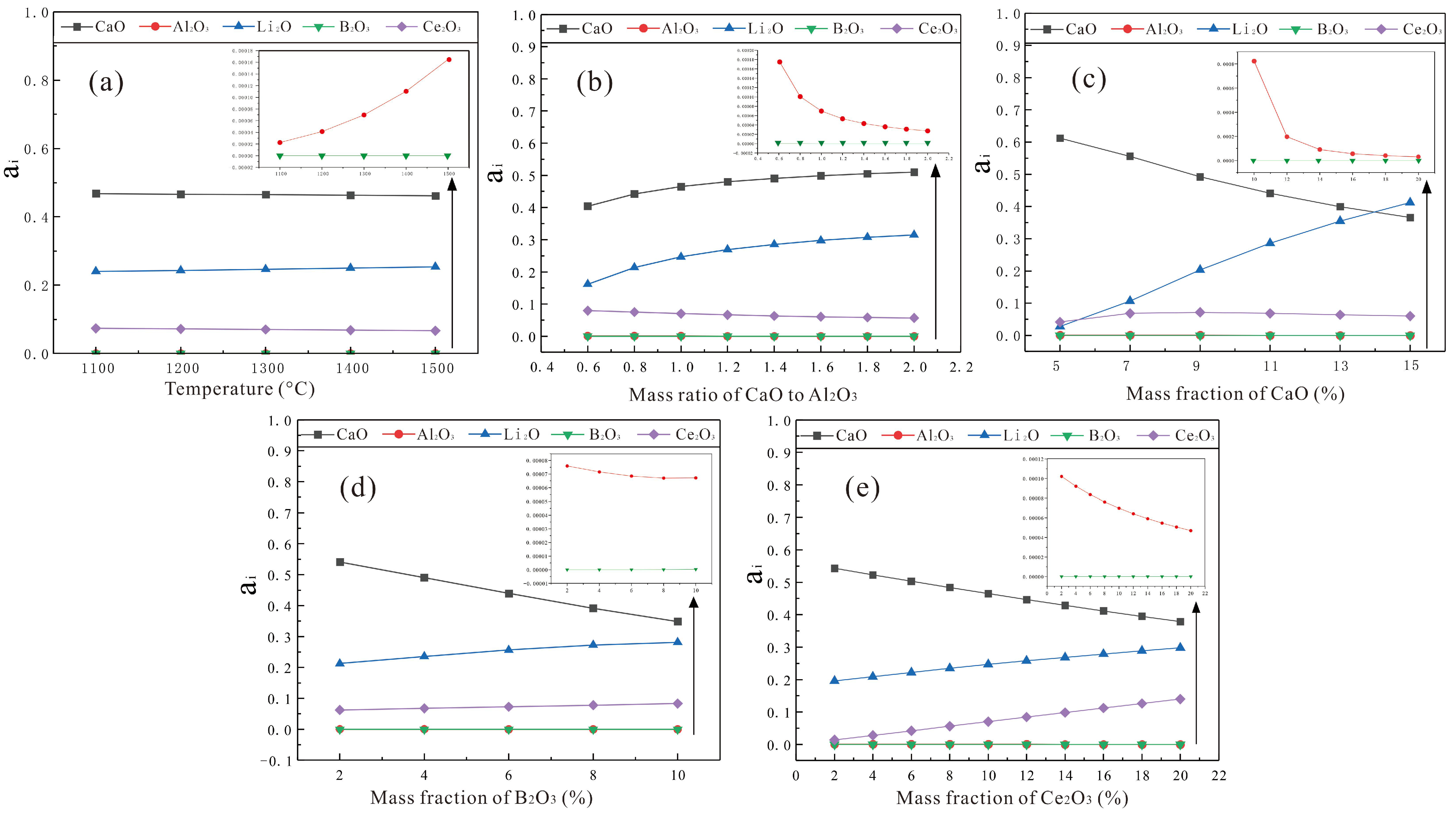
Based on the established computational framework, the baseline mold flux with the composition listed in Table 3 was selected as the reference system. The activities of the primary oxide components in the newly designed flux (CaO, Al2O3, Li2O, B2O3, and Ce2O3), together with those of the major composite oxides potentially present in the slag (e.g., Li2O·Al2O3, 3CaO·B2O3, and 2CaO·B2O3), were calculated under varying temperatures and compositional conditions. The results are summarized in Figure 7.

3.3.1. Effect of Temperature on Component Activities

The calculations indicate that CaO, Li2O, and Ce2O3 exhibit relatively high activities in the novel mold flux, whereas Al2O3 shows low activity and B2O3 remains close to zero across the investigated temperature range. The slag is predicted to contain several stable composite oxides, including Li2O·Al2O3, 3CaO·B2O3, and 2CaO·B2O3. The low reactivity of the mold flux can be rationalized from two aspects. First, low-reactivity constituents such as CaO and Li2O retain high activities, while the comparatively more reactive species B2O3 is thermodynamically suppressed to an extremely low activity, thereby reducing the overall driving force for slag reactions. Second, Ce2O3 is a key product of slag–metal interfacial reactions; its relatively high activity is expected to impede further interfacial reaction progress.
Notably, the activities of Al2O3 and B2O3 remain extremely low at all temperatures. This behavior is primarily attributed to the relatively high CaO fraction in the flux, which promotes the association of Al2O3 and B2O3 with CaO to form stable composite oxides. Consequently, the equilibrium concentrations of Al2O3 and B2O3 in the melt are substantially reduced, driving their activities toward zero.

3.3.2. Effect of w(CaO)/w(Al2O3) on Component Activities

Figure 7b shows the activity evolution of flux components as a function of w(CaO)/w(Al2O3). With increasing w(CaO)/w(Al2O3), the activities of CaO and Li2O increase markedly, Ce2O3 decreases slightly, Al2O3 remains at an extremely low level and continues to decrease, and B2O3 stays near zero. These trends arise mainly from the compositional shift induced by increasing w(CaO)/w(Al2O3): the relative mass fraction of CaO increases while that of Al2O3 decreases, leading to a higher activity of CaO and a lower activity of Al2O3. In parallel, the reduced Al2O3 availability lowers the equilibrium concentrations of Al2O3-bearing composite oxides such as Li2O·Al2O3 and CaO·Al2O3, resulting in decreased activities of these compounds. Moreover, because less Li2O is consumed to form Li2O·Al2O3, a larger fraction of free Li2O remains in the melt, thereby increasing its activity. Overall, within an appropriate compositional window, elevating w(CaO)/w(Al2O3) increases the activities of the low-reactivity constituents CaO and Li2O and thus contributes to reducing flux reactivity.

3.3.3. Effect of Fluxing-Agent Content (Li2O and B2O3) on Component Activities

Figure 7c presents the activities of flux constituents at different Li2O mass fractions. Increasing Li2O leads to a pronounced rise in Li2O activity, while Ce2O3 remains nearly constant and CaO and Al2O3 decrease slightly; B2O3 continues to exhibit an activity close to zero. The elevated Li2O activity enhances its interaction with Al2O3, promoting the formation of Li2O·Al2O3. As a result, the activity of Li2O·Al2O3 increases, accompanied by a further decrease in Al2O3 activity. With continued Li2O addition, the higher equilibrium concentration of Li2O·Al2O3 suppresses the formation of other Al2O3-containing composite oxides (e.g., CaO·Al2O3, 3CaO·Al2O3, and Ce2O3·Al2O3), leading to reduced equilibrium concentrations and activities of these phases.
Figure 7d shows the activity changes induced by varying B2O3 content. As B2O3 increases, the activities of Li2O and Ce2O3 increase (the former more significantly), whereas CaO and Al2O3 decrease. When B2O3 is below ~12 wt.%, its activity remains nearly zero, which is attributed to the strong stabilization of B2O3 through the formation of calcium borates (2CaO·B2O3 and 3CaO·B2O3). Above ~12 wt.% B2O3, the activity of B2O3 shows a slight increase but still remains at a very low level overall. Meanwhile, increasing B2O3 shifts the dominant borate species from 3CaO·B2O3 toward 2CaO·B2O3, as reflected by the increasing activity of 2CaO·B2O3 and the decreasing activity of 3CaO·B2O3.

3.3.4. Effect of Rare-Earth Oxide (Ce2O3) on Component Activities

Figure 7e illustrates the effect of Ce2O3 mass fraction on component activities. Increasing Ce2O3 markedly increases the activities of Ce2O3 and Li2O, while decreasing those of CaO and Al2O3; B2O3 remains close to zero. The increase in Ce2O3 activity is a direct consequence of its higher concentration. In addition, Ce2O3 tends to associate with Al2O3 to form Ce2O3·Al2O3, which lowers Al2O3 activity while increasing the activity of Ce2O3·Al2O3. As Ce2O3·Al2O3 formation intensifies, the formation of Li2O·Al2O3 is comparatively reduced, causing a decrease in Li2O·Al2O3 activity and a concomitant increase in Li2O activity. Moreover, the slight decrease in CaO activity with increasing Ce2O3 promotes the conversion of 3CaO·B2O3 to 2CaO·B2O3. Collectively, increasing Ce2O3 raises the activities of the low-reactivity constituents Li2O and Ce2O3, providing a thermodynamic basis for mitigating slag–metal interfacial reactions and reducing the overall reactivity of the mold flux.

4. Composition Optimization of the Slag System and Investigation of Its Physicochemical Properties

4.1. Methodology

4.1.1. Preparation of Slag Samples

In this chapter, mold fluxes with different compositions were prepared by premelting reagent-grade pure chemicals. To remove moisture and impurities from the reagents, each reagent was calcined in a muffle furnace (National Engineering Research Center for Continuous Casting Technology, Beijing, China) at high temperature for 2 h. The calcined chemical reagents were weighed according to the designed compositions, thoroughly mixed, placed into a graphite crucible, and heated in a high-temperature tube furnace(National Engineering Research Center for Continuous Casting Technology, Beijing, China) at 1200 °C to 1450 °C, where they were held for 1 h to ensure complete melting of the slag samples. After premelting, the mold fluxes were quenched, dried, ground, and sieved to obtain a particle size of less than 0.074 mm for subsequent physicochemical property measurements.

4.1.2. Method for Viscosity Measurement

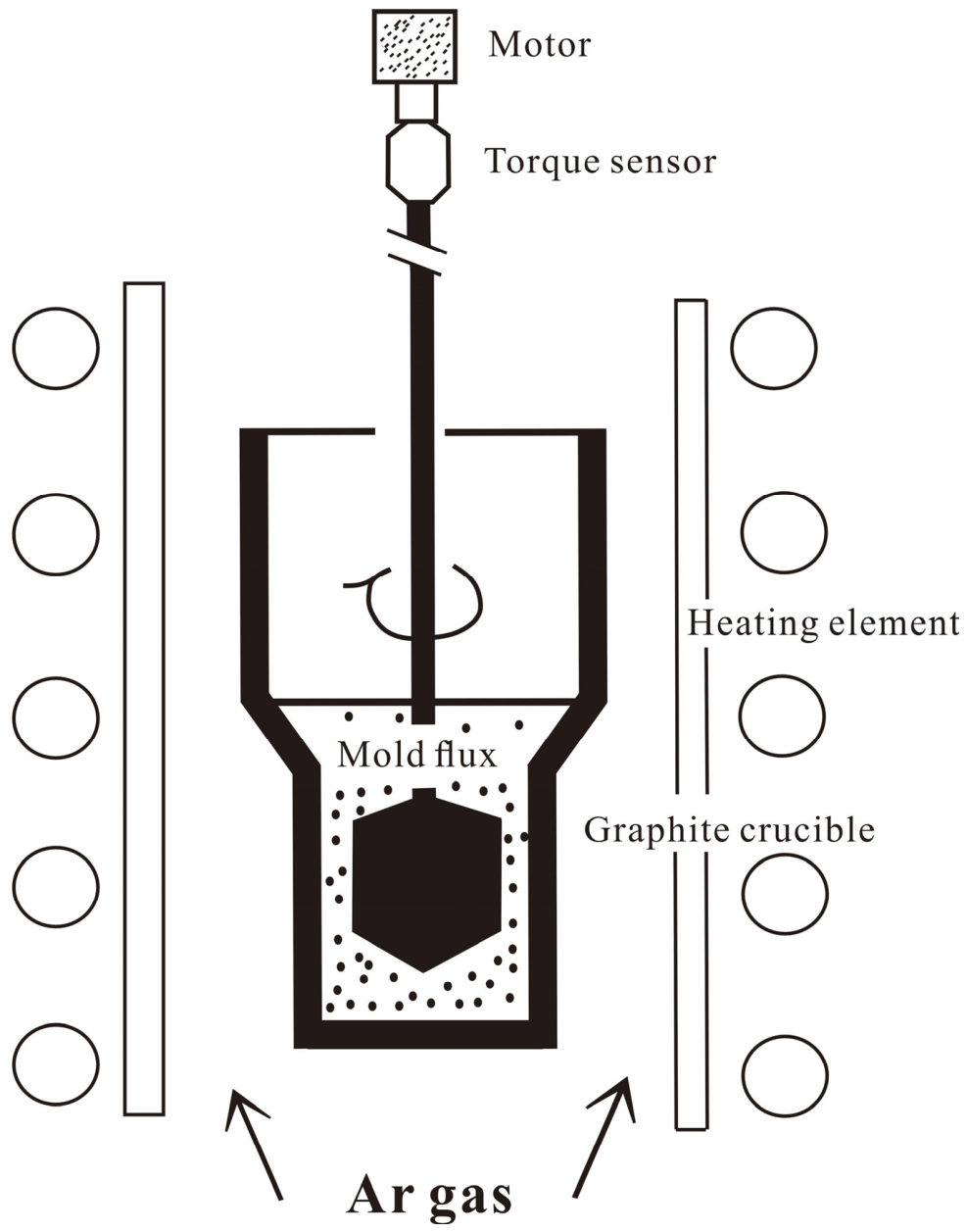
The viscosity characteristics of the mold fluxes were measured using the rotating cylinder method, and the experimental apparatus was an RTW-10 comprehensive melt property tester (National Engineering Research Center for Continuous Casting Technology, Beijing, China), as shown in Figure 8. The main heating unit was a MoSi2 high-temperature furnace, and an S-type thermocouple was used for furnace temperature control and measurement, with a temperature control accuracy of ±0.5 °C. The temperature-measuring thermocouple was positioned at the bottom of the graphite crucible. The graphite crucible used to contain the slag had an outer diameter of 50 mm, an inner diameter of 40 mm, and a height of 80 mm.
The viscosity measurement procedure was as follows.
(1) Before heating, the graphite crucible lined with a molybdenum sheet was placed in the constant-temperature zone of the furnace, and approximately 140 g of premelted slag was weighed and loaded into the crucible. The power supply and control program were then turned on, and the temperature was raised to 1350 °C and held for 30 min to ensure complete melting of the slag sample.
(2) A molybdenum rod was used to stir the molten slag and adjust the slag height to 40 mm, after which the Mo probe and suspension rod were installed so that they were positioned exactly at the center of the furnace tube. The furnace height was then adjusted so that the distance between the lowest end of the Mo probe and the bottom of the graphite crucible was 10 mm.
(3) The viscosity measurement system was started, and the Mo probe was rotated at 200 rpm while the furnace temperature was decreased at a rate of 3 °C/min for viscosity measurement and data recording. The measurement was terminated when the viscosity increased to 10 Pa·s.
(4) After completion of the viscosity measurement, the furnace temperature was raised to a level at which the slag viscosity was relatively low, the molybdenum probe was removed, and the experiment was concluded. To protect the graphite crucible and sleeve, argon was used throughout the experiment as a protective atmosphere.
At high temperatures, the relationship between the viscosity of the mold flux and temperature follows the Arrhenius equation, showing a linear functional relationship. However, when the structure of the mold flux changes, such as when crystalline phases precipitate, the relationship between viscosity and temperature no longer follows the Arrhenius equation. Therefore, the temperature at which the functional relationship between viscosity and temperature begins to deviate from linearity is defined as the break temperature of the continuous casting mold flux. In addition, the apparent activation energy for viscous flow of the mold flux can be obtained by fitting the relationship between viscosity and temperature in the high-temperature region. The activation energy for viscous flow represents the energy required for one mole of particles in the molten slag to move from one equilibrium position to another.

4.1.3. Method for Testing Crystalline Phases

The raw material used in the crystalline phase test was premelted slag. An appropriate amount of slag sample was taken and fully melted at 1350 °C. Subsequently, with reference to the viscosity–temperature curve obtained during continuous cooling, the fully molten slag sample was cooled at a rate of 3 °C/min, and samples were collected at different characteristic temperatures according to the specific scheme. At the break temperature, slag samples were taken and water-quenched to analyze the initial crystalline phases of the mold flux. At the temperature corresponding to a viscosity of 10 Pa·s, slag samples were taken and water-quenched, and phase analysis was conducted on the mold flux after complete crystallization. The phase identification and analysis techniques were as follows.
(1) X-ray diffraction (XRD) analysis.
Phase identification of the mold flux was carried out using a D/max-2500PC X-ray diffractometer (Rigaku Corporation, Akishima, Tokyo, Japan) under the following conditions: Cu target Kα radiation with a wavelength of λ = 1.544426 Å, an operating voltage of 40 kV, a 2θ scanning range of 10–90°, and a scanning rate of 0.033°·s−1.

4.1.4. Method for Measuring Melting Temperature

The melting temperature of the mold flux was determined by the hemisphere point method. As the temperature increased, the amount of liquid phase in the slag gradually increased and the sample softened, causing its shape to change progressively and its height to decrease continuously. After complete melting, the sample spread over the substrate. the temperature at which the sample height decreases to one-half of its original height is defined as the melting temperature.
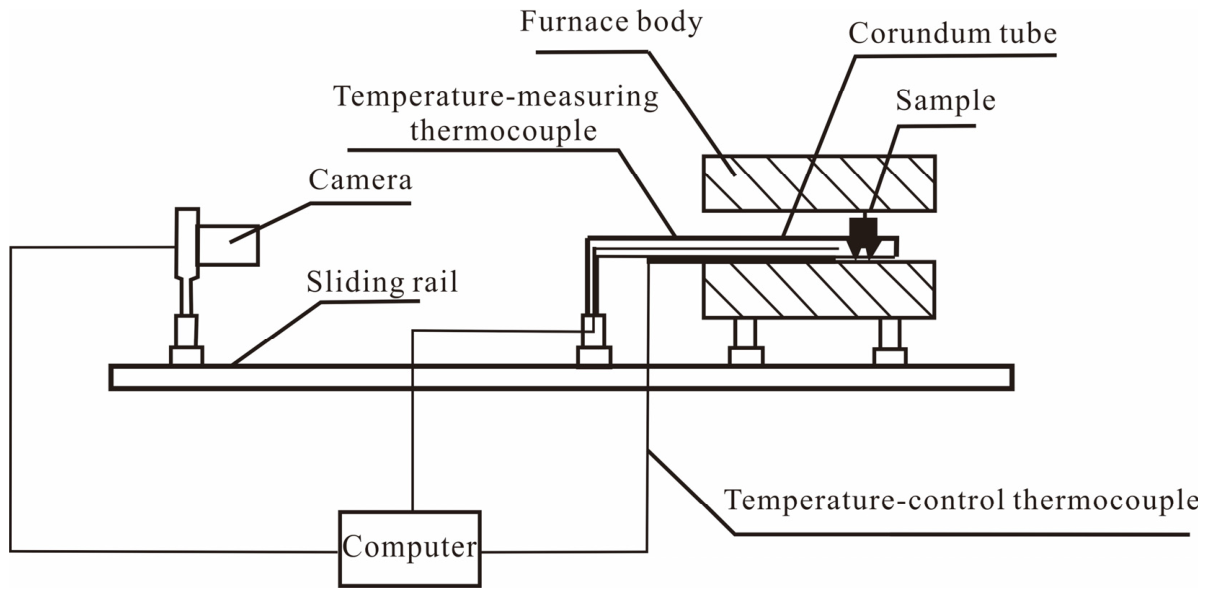
The melting temperature of the mold flux was measured using a melting point and melting rate analyzer (National Engineering Research Center for Continuous Casting Technology, Beijing, China), and the experimental apparatus is shown in Figure 9. The equipment mainly consisted of a heating system, a temperature control system, an imaging system, and a rail transmission system. The heating device was a horizontal tube furnace equipped with U-shaped MoSi2 heating elements, with a maximum operating temperature of 1550 °C. The furnace temperature was controlled by silicon-controlled rectifier components, with a temperature control accuracy of ±2 °C. The optical imaging system was an OLYMPUS high-definition camera. The transmission system was used to move the sample into and out of the heating furnace.
The melting temperature measurement procedure was as follows.
(1) A small amount of premelted slag with a particle size of less than 0.074 mm was mixed with alcohol and pressed into a cylindrical specimen with both diameter and height of 3 mm. The specimen was then placed at the center of an alumina substrate, and the alumina substrate was positioned in the groove of an alumina tube so that the temperature-measuring thermocouple was located directly beneath the alumina substrate.
(2) The temperature control program was set and operated so that the furnace heating rate was 10 °C/min. When the furnace temperature reached 550 °C, the slag sample was introduced into the constant-temperature zone of the furnace, and the positions of the eyepiece and objective lens were adjusted so that a clear projected image appeared on the computer screen, after which the image coordinates were entered.
(3) The temperature corresponding to the point at which the specimen height decreased to one-half of its original height during heating was recorded.
(4) The specimen was removed, and the temperature control program was turned off so that the furnace temperature decreased to room temperature.

4.2. Effect of w(CaO)/w(Al2O3) on Physicochemical Properties of the Mold Flux

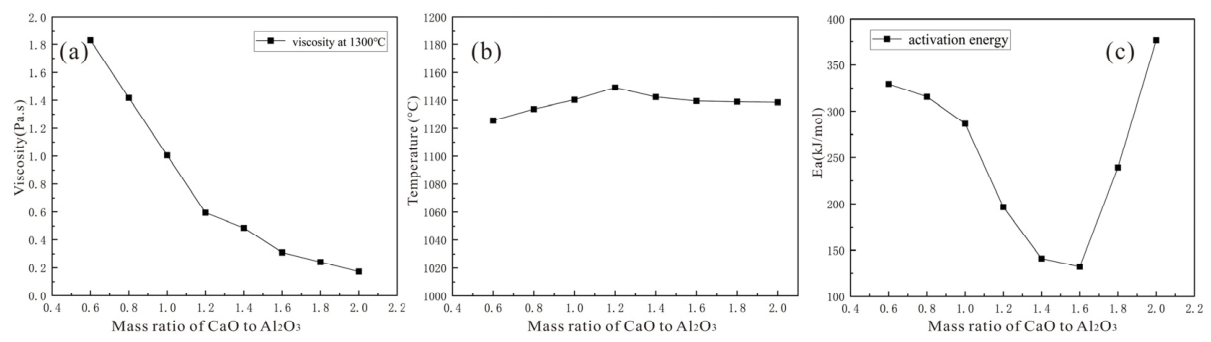
Guided by the theoretical calculations, the w(CaO)/w(Al2O3) ratio of the slag system was systematically adjusted to improve the physicochemical performance of the mold flux. The corresponding melting temperatures are presented in Figure 10a. As w(CaO)/w(Al2O3) increased, the melting temperature exhibited a non-monotonic evolution, increasing initially and then decreasing before approaching a quasi-stable value. The highest melting temperature (1149.2 °C) was obtained at w(CaO)/w(Al2O3) = 1.2, whereas the lowest value (1125.5 °C) occurred at w(CaO)/w(Al2O3) = 0.6. When w(CaO)/w(Al2O3) was within 1.4–2.0, the melting temperature remained nearly constant at approximately 1140 °C.
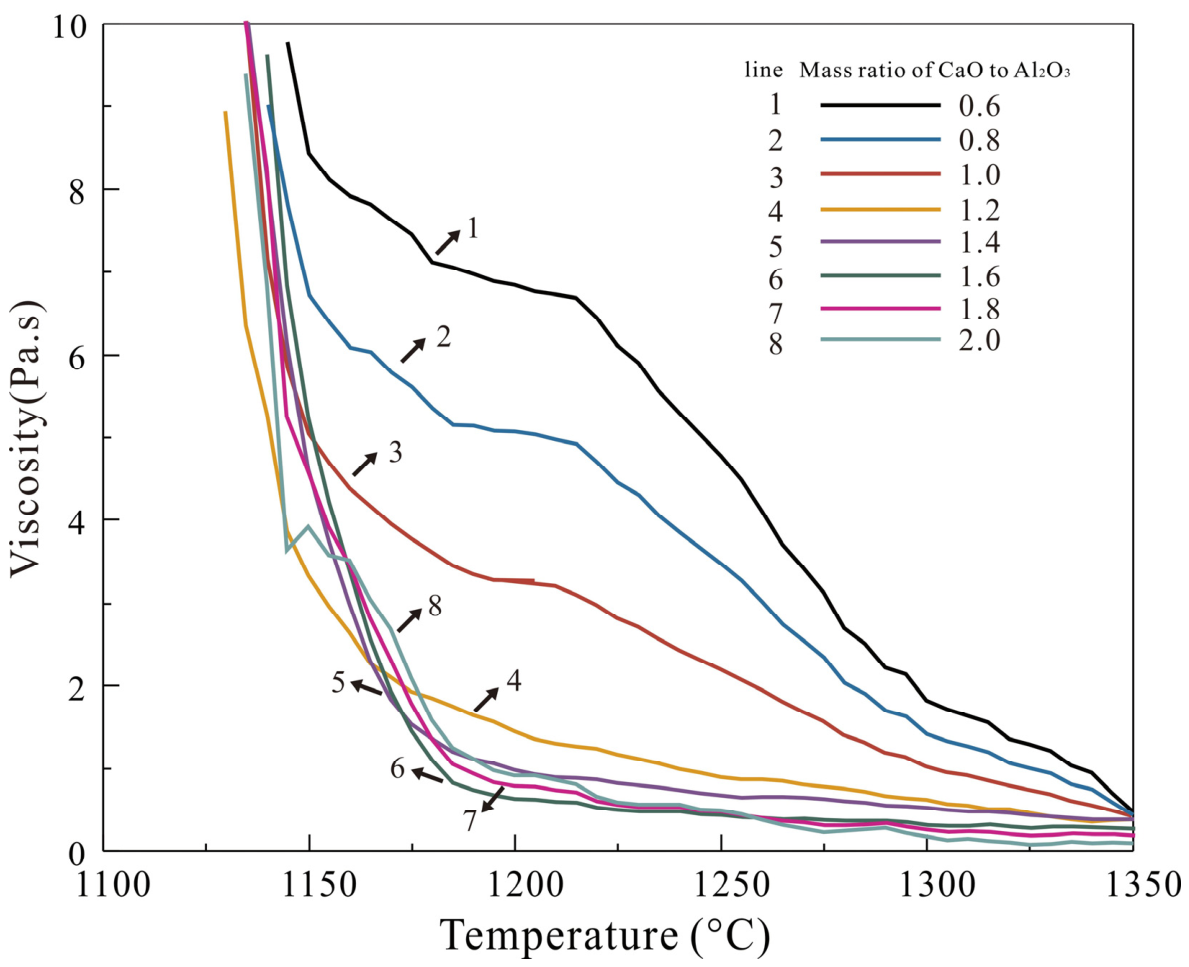
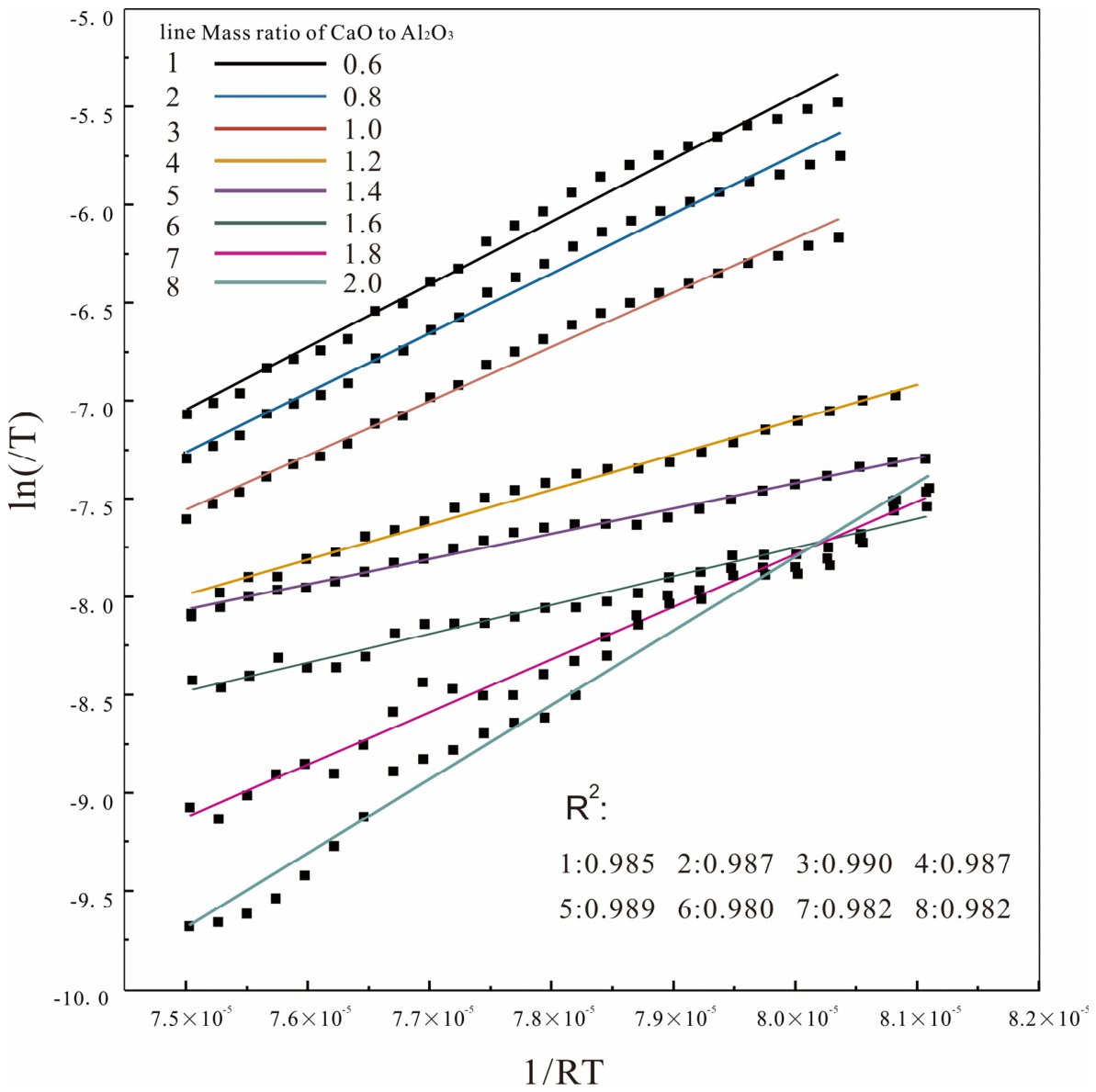
Figure 10 shows the performance parameters of the mold flux under different w(CaO)/w(Al2O3) ratios. Figure 11 presents the viscosity–temperature curves of the mold flux at different w(CaO)/w(Al2O3) ratios. Figure 12 shows the fitting results for the relationship between mold flux viscosity and temperature. The viscosity–temperature behavior was strongly dependent on w(CaO)/w(Al2O3). For w(CaO)/w(Al2O3) = 0.6–1.0, viscosity decreased markedly with increasing temperature below 1300 °C, and the viscosity at 1300 °C exceeded 1 Pa·s; no distinct inflection point was observed in the viscosity curve. At w(CaO)/w(Al2O3) = 1.2, viscosity decreased rapidly with temperature up to ~1200 °C and then decreased more gradually at higher temperatures, again without a clear inflection. In contrast, when w(CaO)/w(Al2O3) increased to 1.4–2.0, a pronounced inflection emerged at around 1200 °C, indicating a transition in flow behavior; prior to the inflection point, viscosity decreased sharply with increasing temperature, whereas beyond the inflection it became relatively stable. Among these compositions, the flux at w(CaO)/w(Al2O3) = 1.60 showed the most stable viscosity before the inflection point, suggesting improved operational stability.
At 1300 °C, the viscosity decreased with increasing w(CaO)/w(Al2O3) and then exhibited a slight rebound before remaining essentially constant; when w(CaO)/w(Al2O3) exceeded 1.6, the viscosity stayed at a low level of ~0.25 Pa·s. The apparent activation energy for viscous flow decreased first and then increased with increasing w(CaO)/w(Al2O3), reaching a minimum of 132.1 kJ·mol−1 at w(CaO)/w(Al2O3) = 1.6, which is consistent with enhanced melt fluidity in this compositional window.
Combined with the analysis of melt structure, as the w(CaO)/w(Al2O3) ratio increases, the mass fraction of CaO in the slag increases, the proportion of O2− ions rises, and the degree of dissociation of the mold flux is enhanced. Moreover, the increase in O2− ions promotes the formation of two-dimensional BO33− triangular structural units, disrupts the three-dimensional network structure, and leads to a decreasing trend in the viscosity of the mold flux.

4.3. Effect of Fluxing-Agent Content on Physicochemical Properties of the Mold Flux

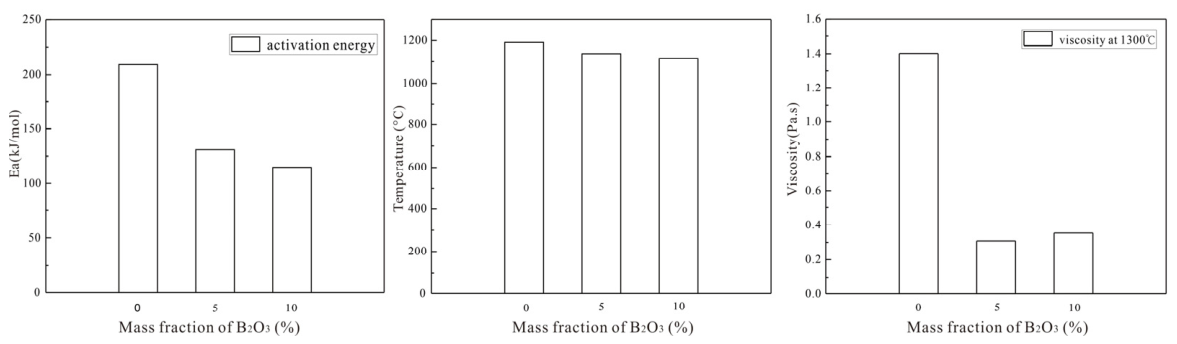
The influence of B2O3 content on melting temperature is shown in Figure 13. The melting temperature decreased progressively with increasing B2O3 mass fraction and reached a minimum of 1118 °C at 10 wt.% B2O3. Relative to the B2O3-free composition, the addition of 5 wt.% B2O3 reduced the melting temperature by 50.7 °C; increasing B2O3 from 5 to 10 wt.% produced an additional reduction of 22.4 °C, indicating that the fluxing efficiency of B2O3 diminishes at higher additions.
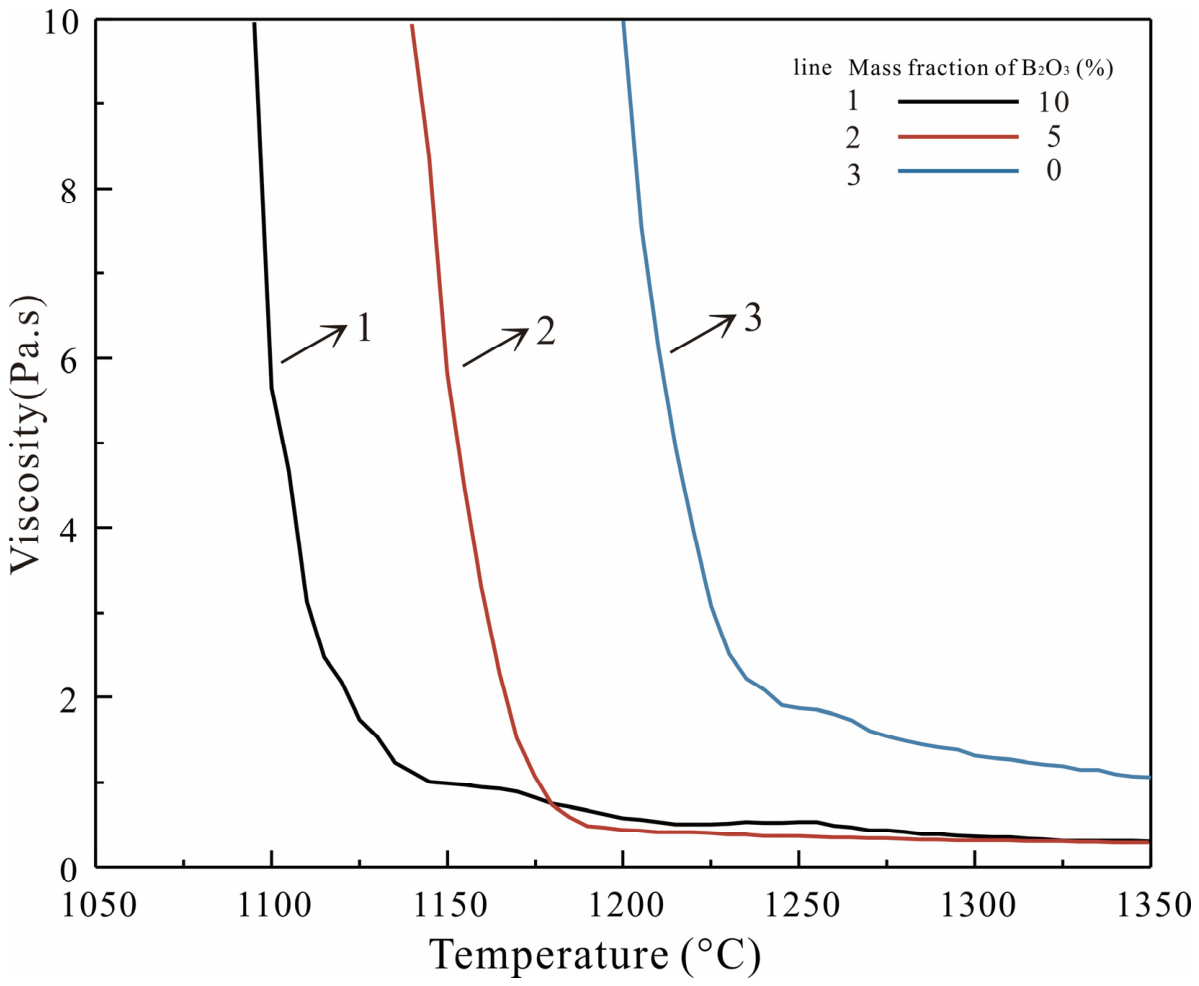
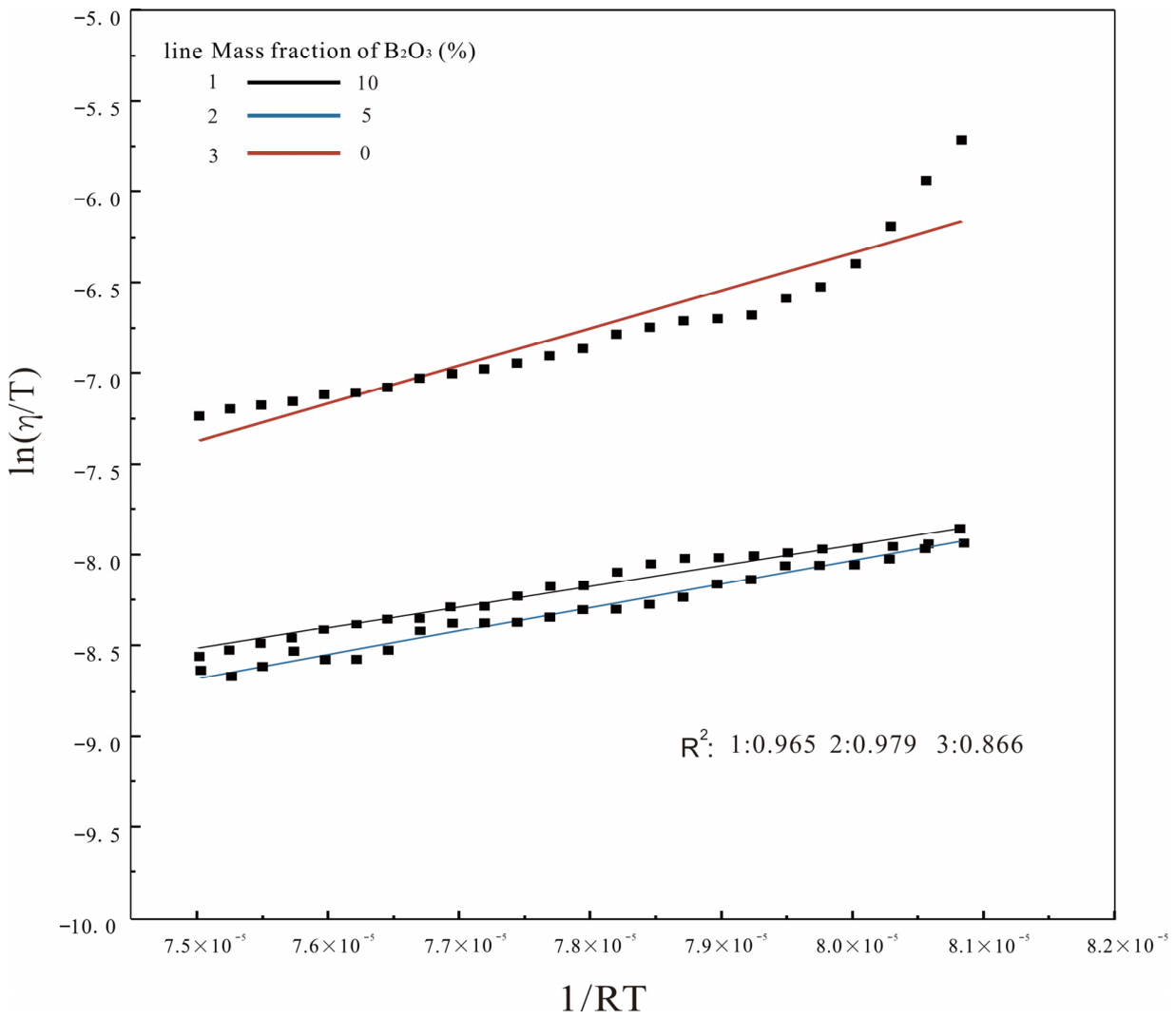
Figure 13 shows the performance parameters of the mold flux at different mass fractions of B2O3. Figure 14 presents the viscosity–temperature curves of the mold flux under different B2O3 mass fractions. Figure 15 shows the fitting results for the relationship between mold flux viscosity and temperature.
For all B2O3 levels, viscosity decreased with increasing temperature, while the inflection temperature shifted to lower values as B2O3 increased, reaching the lowest inflection temperature of 1145 °C at 10 wt.% B2O3. At 1300 °C, viscosity decreased and then slightly increased to an approximately constant value; when B2O3 exceeded 5 wt.%, viscosity remained low at ~0.33 Pa·s. The apparent activation energy for viscous flow decreased with increasing B2O3, reaching a minimum of 115.2 kJ·mol−1 at 10 wt.% B2O3, and remained essentially unchanged in the range of 5–10 wt.% B2O3.
Combined with the analysis of melt structure, it can be concluded that, in the absence of B2O3 addition, the slag contains a relatively large number of highly polymerized AlO45− tetrahedra, resulting in a high degree of polymerization of the mold flux as well as relatively high viscosity and viscous flow activation energy. When 5% B2O3 is added, the proportion of two-dimensional BO33− triangular structures increases, the degree of polymerization of the mold flux decreases significantly, and the viscosity is reduced. When the mass fraction of B2O3 increases from 5% to 10%, the viscosity increases slightly but remains relatively stable. When the mass fraction of B2O3 increases from 0 to 10%, the break temperature of the mold flux decreases continuously, mainly because B2O3 has an extremely low melting point, which can substantially reduce the melting temperature and increase the superheat of the molten slag.
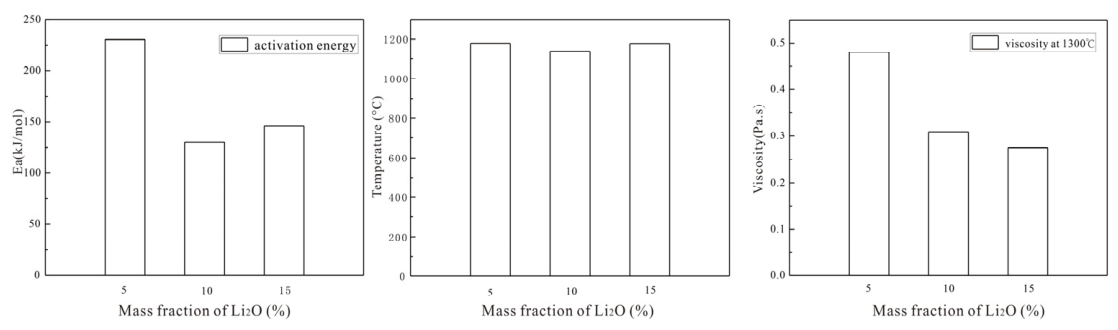
The influence of Li2O content on melting temperature is shown in Figure 16. With increasing Li2O mass fraction, the melting temperature first decreased and then increased, reaching a minimum of 1139.5 °C at 10 wt.% Li2O.
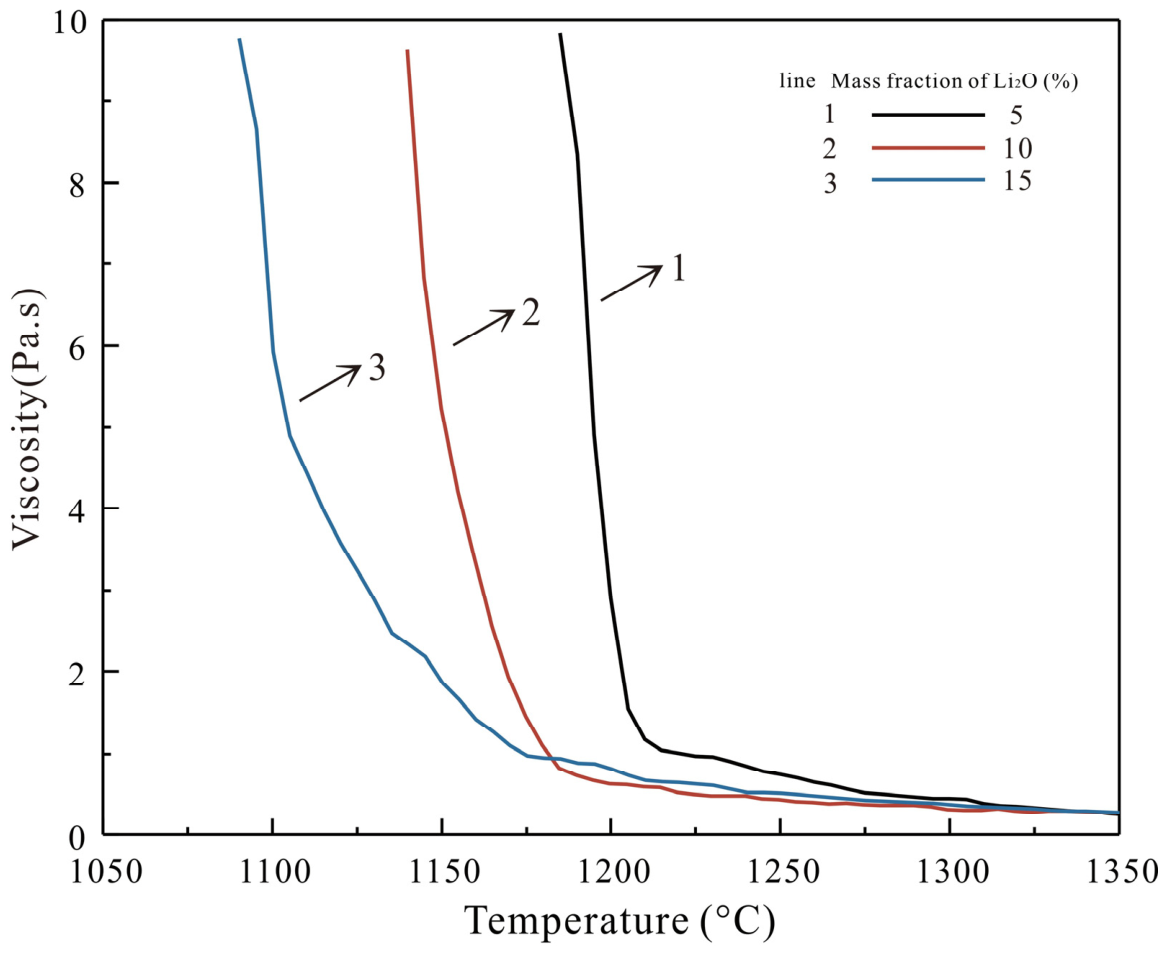
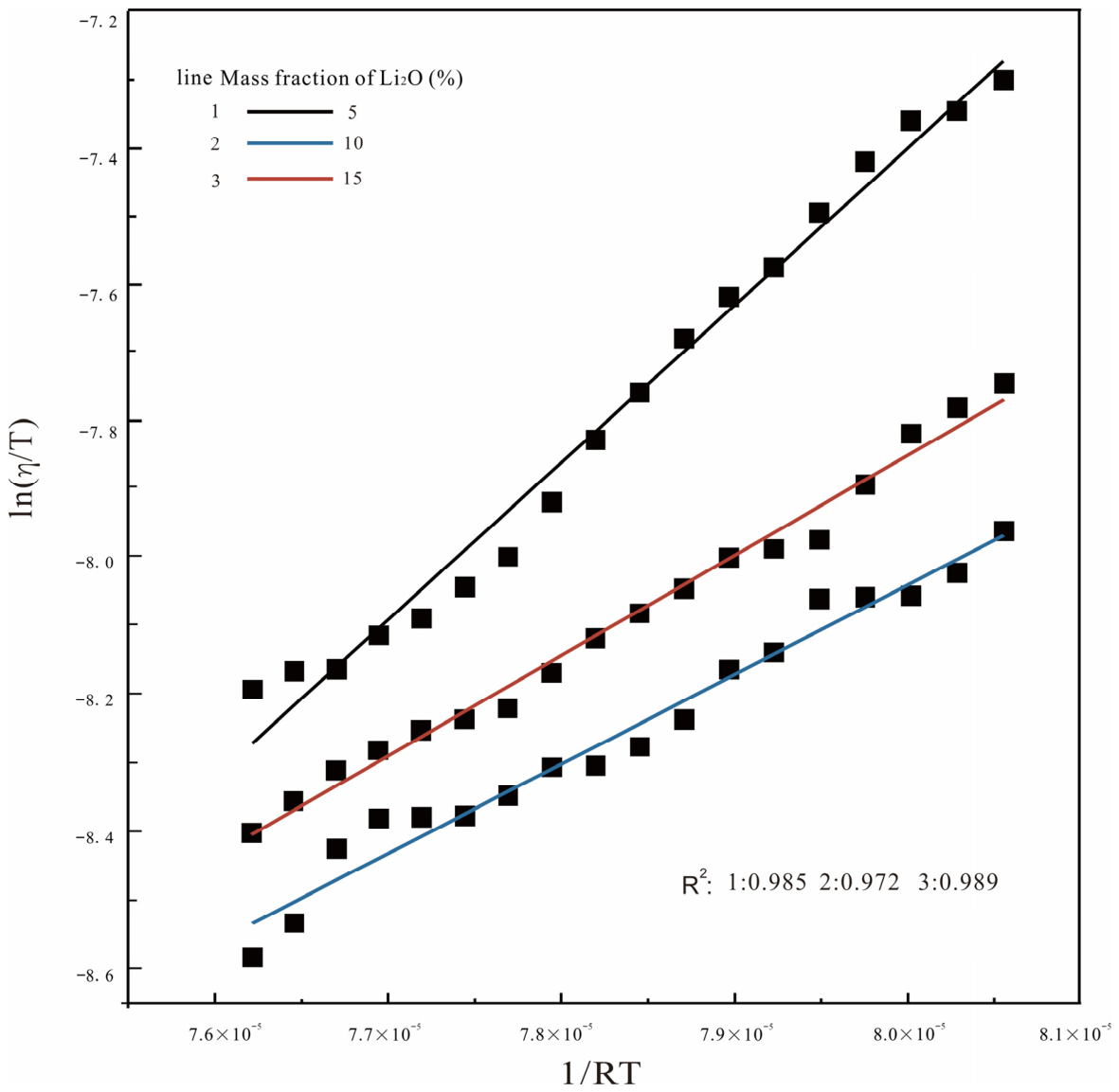
Figure 16 shows the performance parameters of the mold flux at different Li2O mass fractions. Figure 17 presents the viscosity–temperature curves of the mold flux under different Li2O mass fractions. Figure 18 shows the fitting results for the relationship between mold flux viscosity and temperature.
The viscosity results show that, for all Li2O levels, viscosity decreased with increasing temperature and the inflection temperature gradually decreased as Li2O increased, reaching a minimum of 1175 °C at 15 wt.% Li2O. When Li2O exceeded 10 wt.%, the inflection temperature became nearly invariant. The viscosity at 1300 °C decreased with increasing Li2O and reached a minimum of 0.2753 Pa·s at 15 wt.% Li2O; when Li2O was >10 wt.%, the viscosity remained at a low level of ~0.30 Pa·s. The apparent activation energy for viscous flow decreased first and then increased with increasing Li2O, reaching a minimum of 129.9 kJ·mol−1 at 10 wt.% Li2O and remaining essentially constant for 10–15 wt.% Li2O.
Combined with the analysis of melt structure, it can be concluded that, as the mass fraction of Li2O increases, the degree of polymerization of the mold flux shows a continuous decreasing trend, and consequently the viscosity of the mold flux continuously decreases. The break temperature gradually decreases, possibly because the increase in Li2O mass fraction weakens the crystallization ability of the mold flux and alleviates the abrupt change in its viscous characteristics.

4.4. Effect of Ce2O3 Content on Physicochemical Properties of the Mold Flux

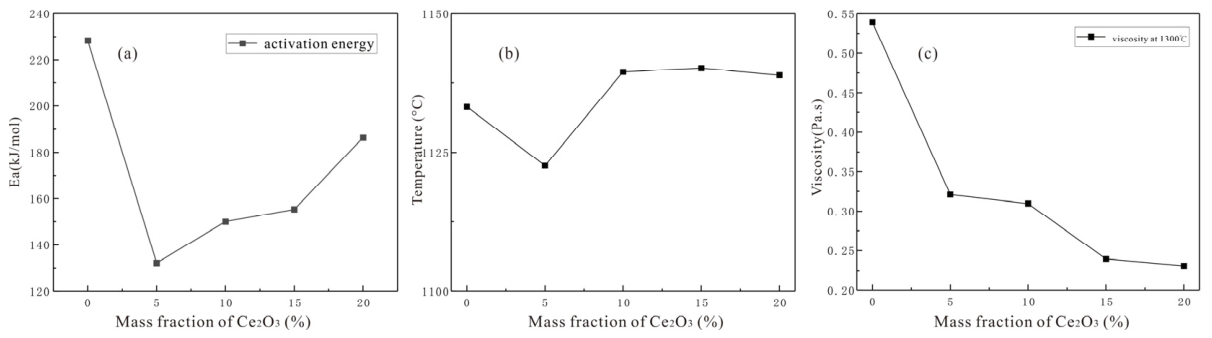
Figure 19a shows the dependence of melting temperature on Ce2O3 mass fraction. As Ce2O3 increased, the melting temperature decreased slightly at first, then increased, and finally approached a stable plateau. The minimum melting temperature (~1122.6 °C) was obtained at 5 wt.% Ce2O3. When Ce2O3 exceeded 10 wt.%, the melting temperature remained relatively stable at approximately 1140 °C.
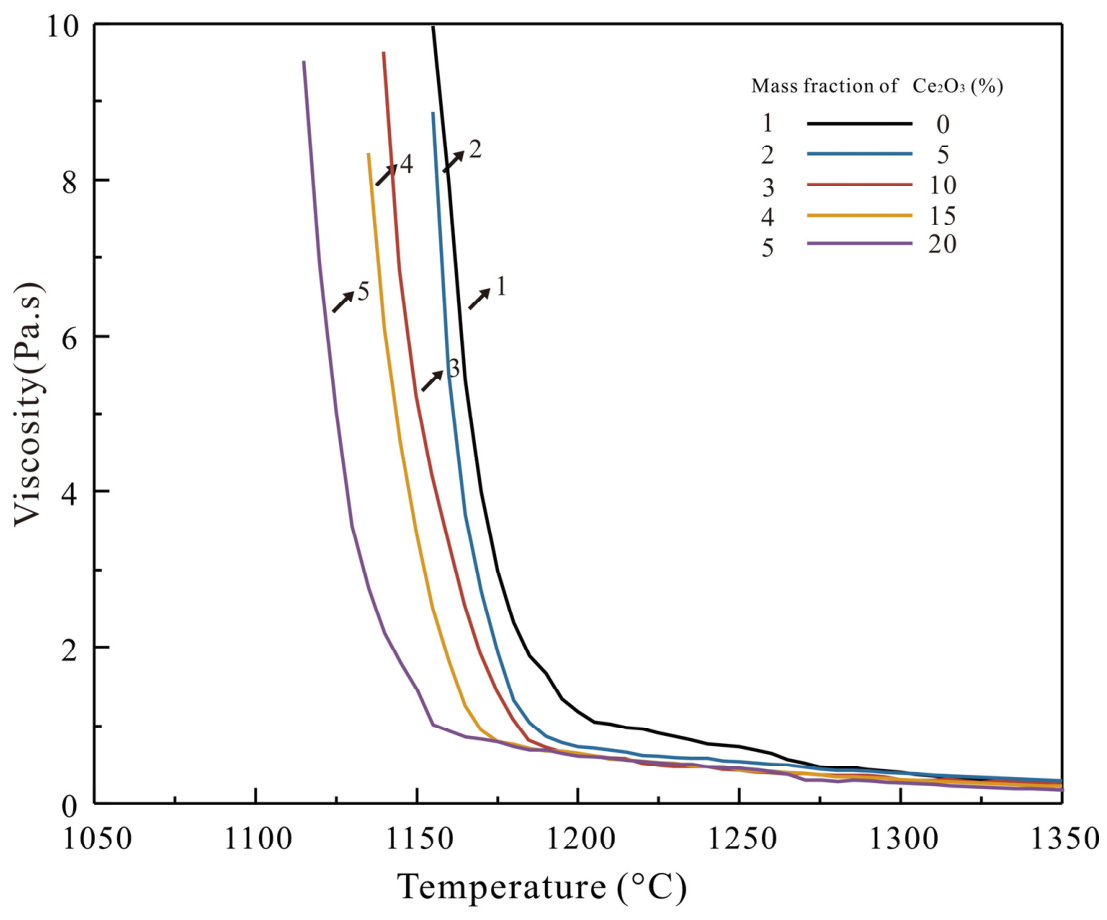
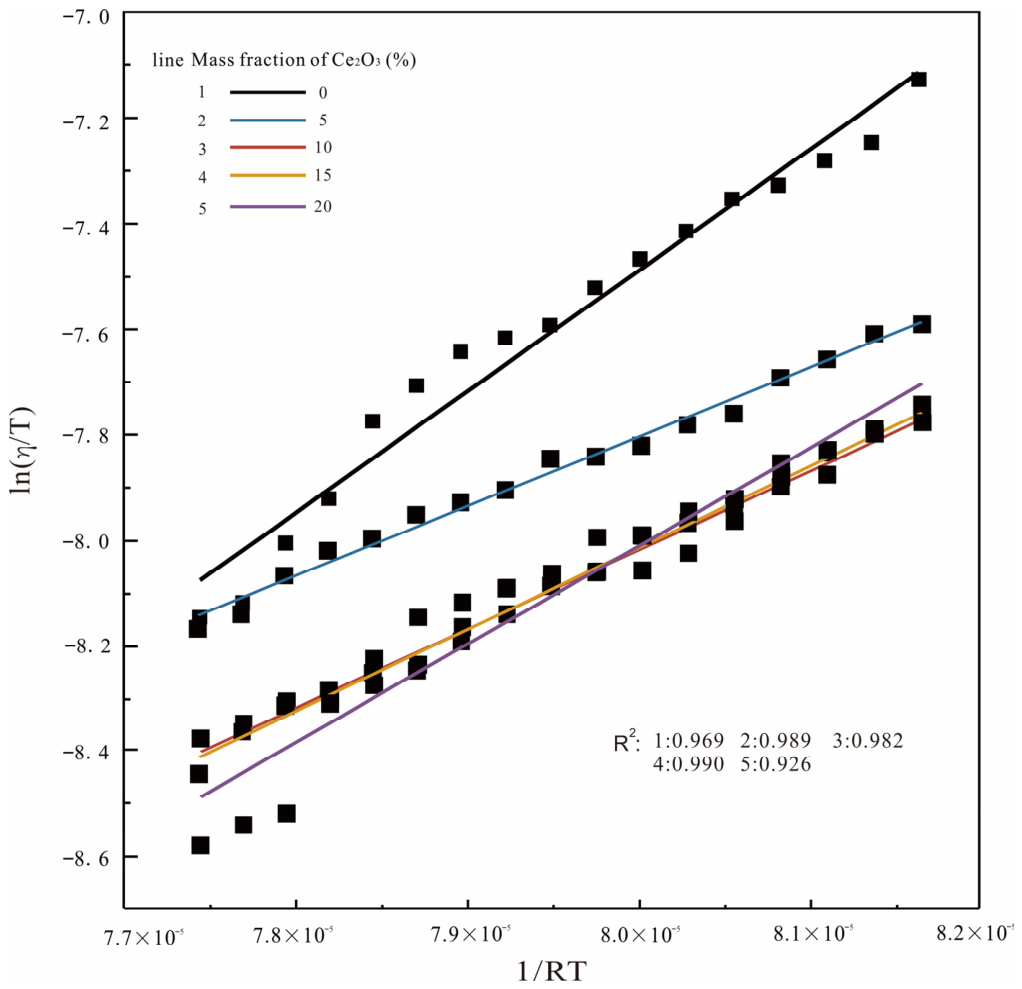
Figure 19 shows the performance parameters of the mold flux at different Ce2O3 mass fractions. Figure 20 presents the viscosity–temperature curves of the mold flux under different Ce2O3 mass fractions. Figure 21 shows the fitting results for the relationship between mold flux viscosity and temperature.
The viscosity trends further corroborate the compositional effect. With increasing Ce2O3 mass fraction, the viscosity–temperature curves consistently decreased with increasing temperature, and the inflection temperature shifted downward, reaching a minimum of 1155 °C at 20 wt.% Ce2O3. At 1300 °C, viscosity decreased with increasing temperature, and when Ce2O3 exceeded 5 wt.%, the viscosity remained low at ~0.30 Pa·s. The apparent activation energy for viscous flow exhibited a decrease followed by an increase with temperature, reaching a minimum of 132.2 kJ·mol−1 at 5 wt.% Ce2O3; moreover, it was nearly invariant when Ce2O3 was within 5–15 wt.%.
Combined with the analysis of melt structure, it can be concluded that when the mass fraction of Ce2O3 does not exceed 10%, the increase in its mass fraction leads to an increase in O2− ions generated by slag dissociation, and the low-polymerization AlO45− tetrahedra Q2 and Q3 gradually transform into AlO69− octahedra, thereby disrupting the network structure, reducing the degree of polymerization, and gradually lowering the viscosity. When the mass fraction of Ce2O3 exceeds 10%, the structural units in the slag tend to reach a stable distribution, the degree of polymerization remains relatively stable, and the viscosity also remains relatively stable.

5. Comparison of Physicochemical Properties Between the Novel Mold Flux and the Conventional Mold Flux

5.1. Development of the Novel Mold Flux

This work used an industrial mold flux applied in the continuous casting of rare-earth weathering steel at a steel plant as a benchmark and carried out the design and development of a new CaO–Al2O3-based mold flux.
Table 4 summarizes the composition and primary properties of the reference flux, in which CaO accounts for 30–40 wt.% and SiO2 for 25–35 wt.%, and the principal fluxing additives are CaF2 and Na2O.
The reference flux shows a melting temperature range of 1100–1180 °C and a viscosity of ~0.15–0.25 Pa·s at 1300 °C, which are sufficient to satisfy the baseline processing requirements for continuous casting of rare-earth weathering steel at the initial stage.
Nevertheless, prolonged casting aggravates slag–steel interfacial reactions, which induces substantial variations in flux chemistry and properties and makes it difficult to maintain stable and smooth casting operation.
Guided by the performance targets of the plant-used flux (Table 4) and informed by the foregoing findings, an optimized new mold flux for rare-earth weathering steel casting was formulated, and the main compositional ranges are presented in Table 5.

5.2. Comparison of Physicochemical Properties Between the Novel and Conventional Mold Fluxes

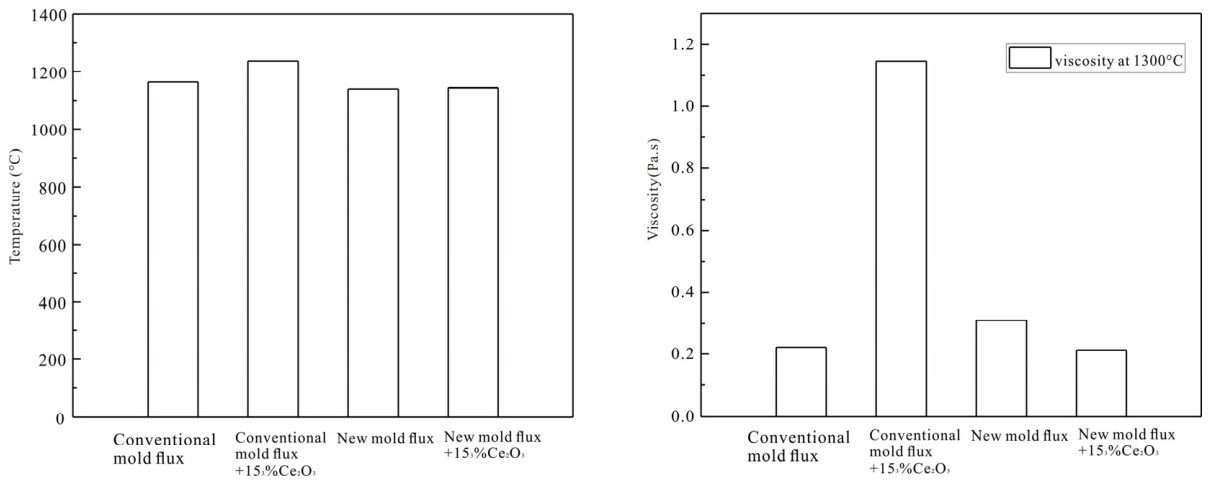
Figure 22 compares the melting temperatures of the novel CaO–Al2O3-based mold flux and the conventional mold flux.
As shown in the figure, the melting temperatures are comparable, and the novel flux exhibits a melting temperature of 1140 °C, indicating that its melting behavior is consistent with that of the industrially used flux.
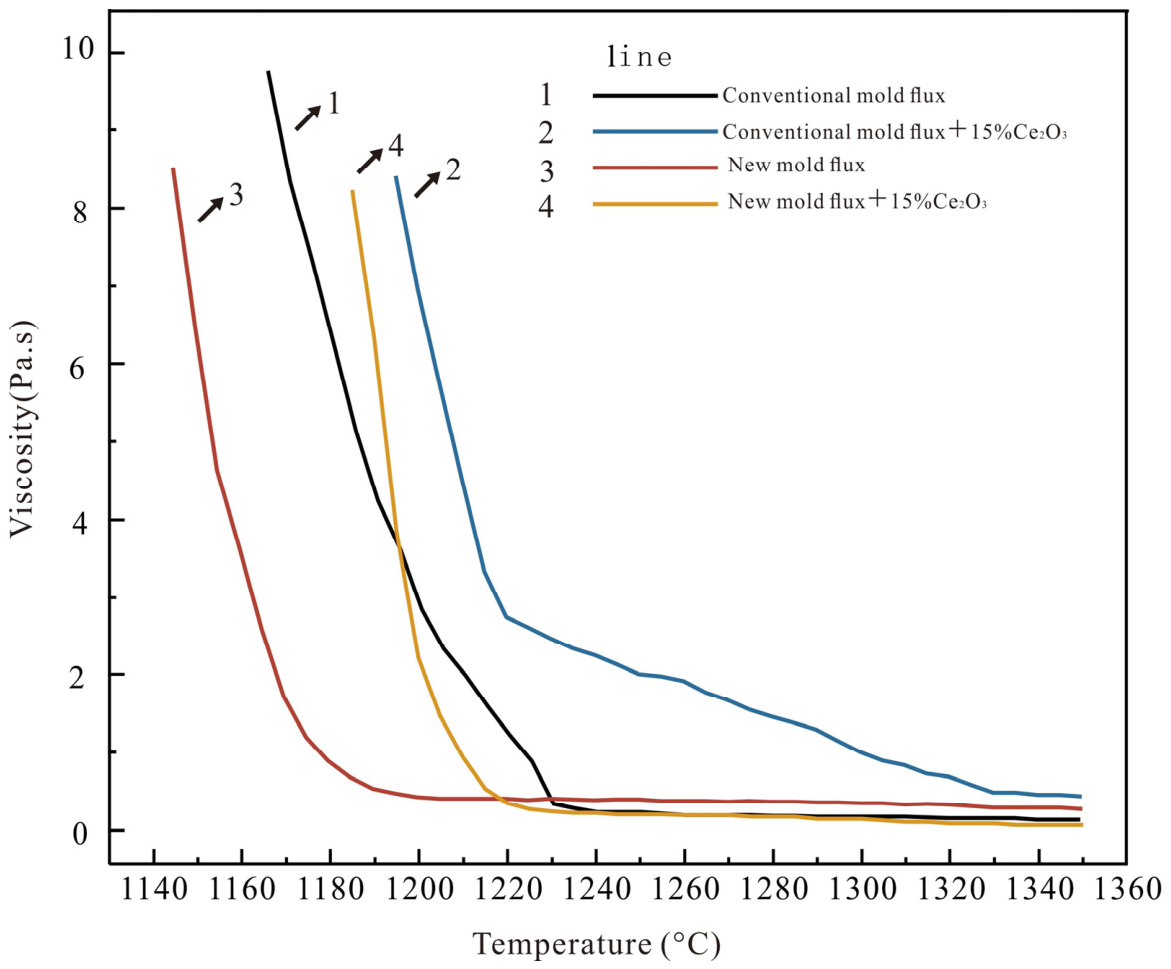
Figure 23 shows a comparison of the viscosity characteristics of the two mold fluxes.
The novel flux exhibits viscosity characteristics broadly similar to those of the conventional flux, demonstrating good process compatibility in terms of the viscosity–temperature dependence and the workable viscosity window.
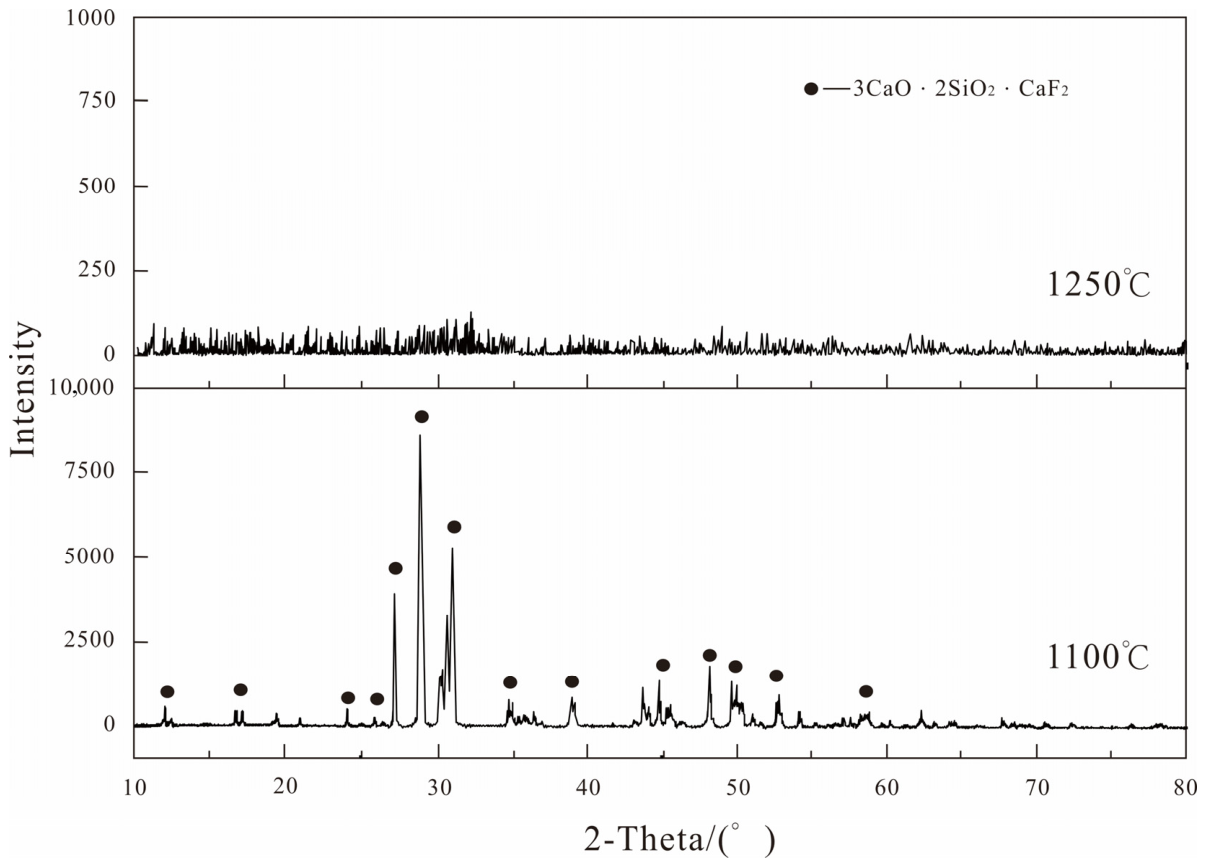
To further elucidate the crystallization behavior, XRD analyses were conducted on quenched samples of the conventional flux at the break temperature (1250 °C) and after full crystallization at 1100 °C, as shown in Figure 24.
The results indicate that the conventional flux remains a homogeneous liquid at the break temperature with no detectable crystalline phases, whereas after cooling to 1100 °C and full crystallization, a large amount of cuspidine (3CaO·2SiO2·CaF2) precipitates.
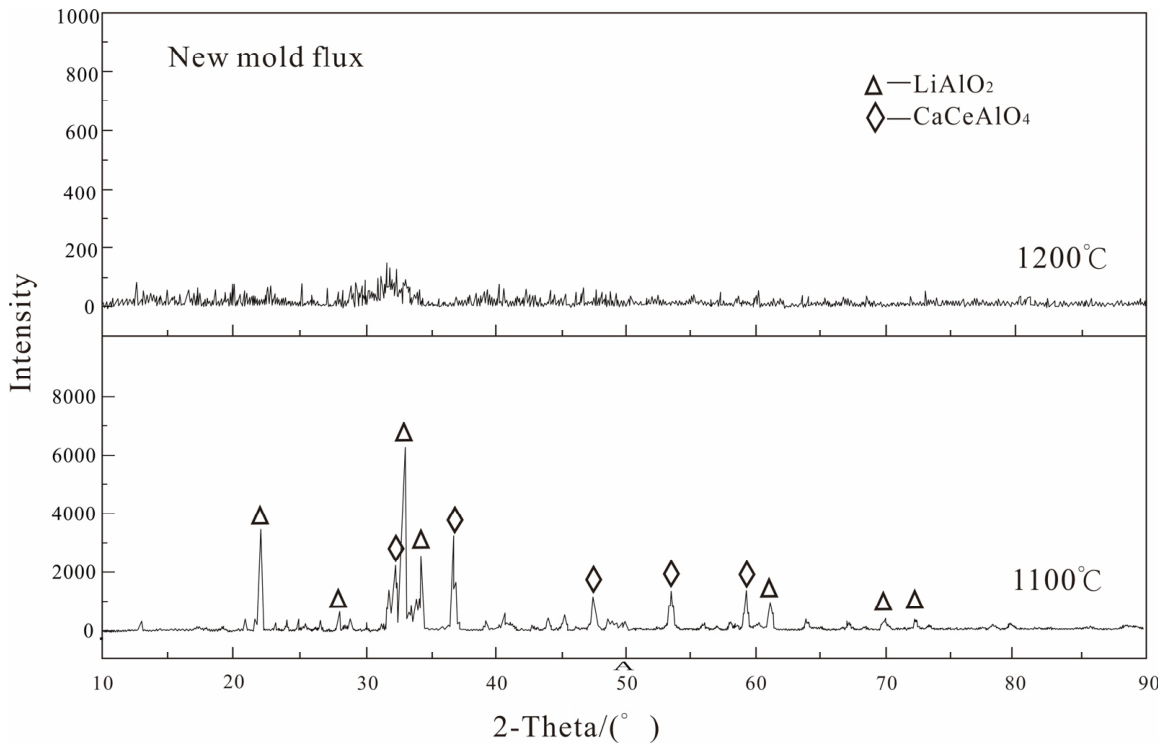
Similarly, Figure 25 presents the XRD patterns of quenched samples of the novel flux near the break temperature and after full crystallization at 1100 °C.
The novel flux also behaves as a homogeneous liquid near the break temperature without crystal precipitation; after full crystallization at 1100 °C, two precipitated phases are observed, with LiAlO2 as the dominant phase and a minor amount of CaCeAlO4.
Overall, the novel CaO–Al2O3-based flux exhibits a crystallization behavior broadly similar to that of the conventional SPH flux, in that no crystalline phases precipitate above the break temperature and a single liquid phase is maintained, whereas below the break temperature after full crystallization, the main precipitates in the novel flux are LiAlO2 and CaCeAlO4.

5.3. Stability Comparison Between the Novel and Conventional Mold Fluxes

Figure 22 compares the melting-temperature responses of the novel and conventional mold fluxes upon uptake of 15% Ce2O3.
The conventional silicate-based flux exhibits a pronounced increase in melting temperature of nearly 100 °C after 15% Ce2O3 uptake; in contrast, the novel flux maintains an almost unchanged melting temperature under the same uptake level, demonstrating excellent melting-temperature stability.
Figure 23 compares the viscosity behavior of the two fluxes following uptake of 15% Ce2O3.
After Ce2O3 uptake, the conventional flux exhibits markedly worsened viscosity characteristics, with ~2-fold higher viscosity at 1300 °C (exceeding 1 Pa·s) and an increase of ~100 °C in break temperature.
By comparison, the novel flux undergoes only minor variations in viscosity-related metrics, indicating superior viscosity stability.
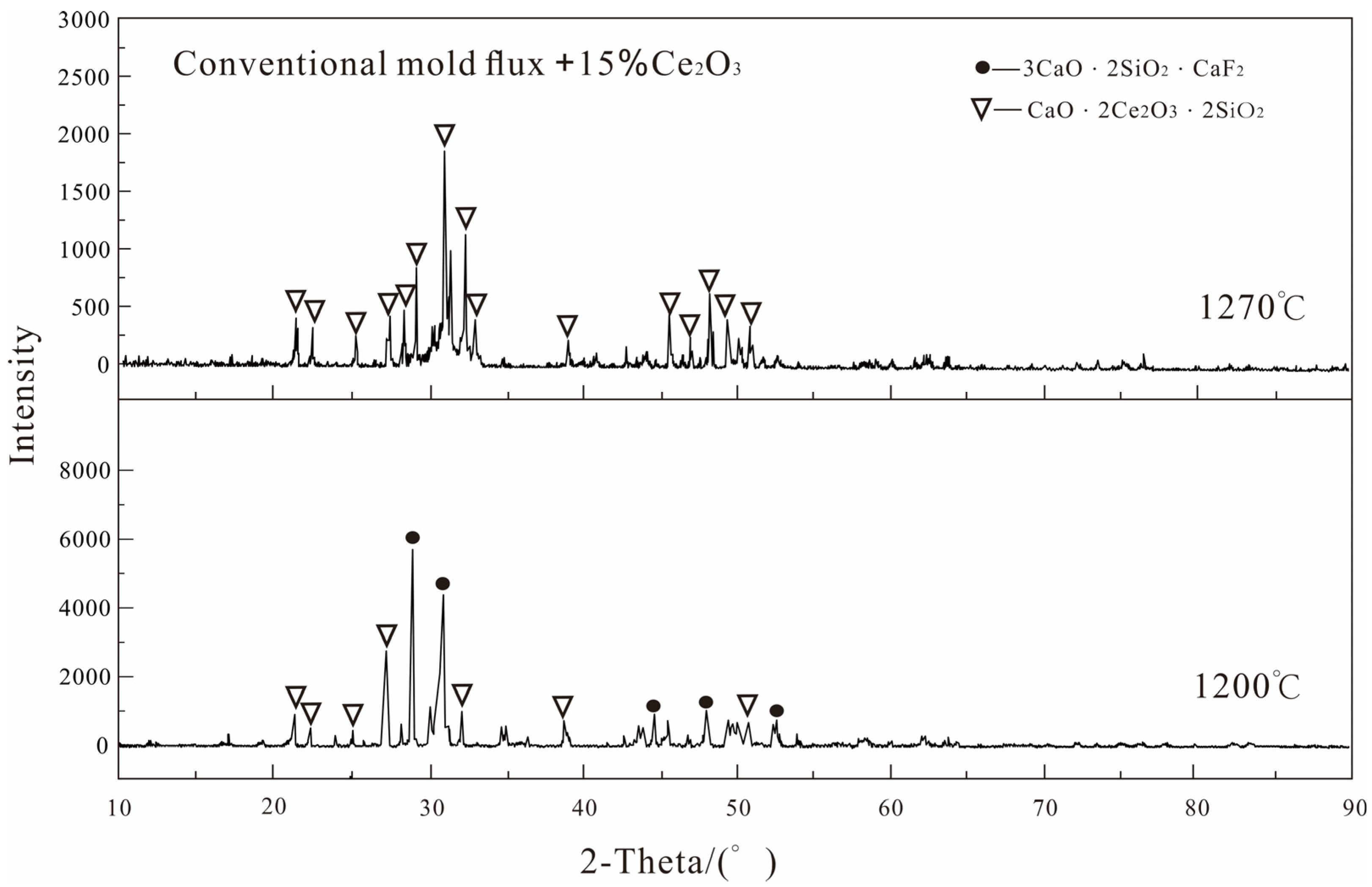
To identify the cause of the deterioration in the conventional flux, quenched samples after 15% Ce2O3 uptake were examined by XRD near the break temperature (1270 °C) and after complete crystallization at 1200 °C, with the results shown in Figure 26.
The XRD results show extensive precipitation of lath- and block-like CaO·2Ce2O3·2SiO2 at 1270 °C, and after complete crystallization at 1200 °C, a large amount of cuspidine (3CaO·2SiO2·CaF2) forms in addition to CaO·2Ce2O3·2SiO2.
Extensive formation of high-melting rare-earth silicate phases significantly raises the solid-phase fraction and the degree of melt polymerization, resulting in pronounced viscosity increase and an elevated break temperature.
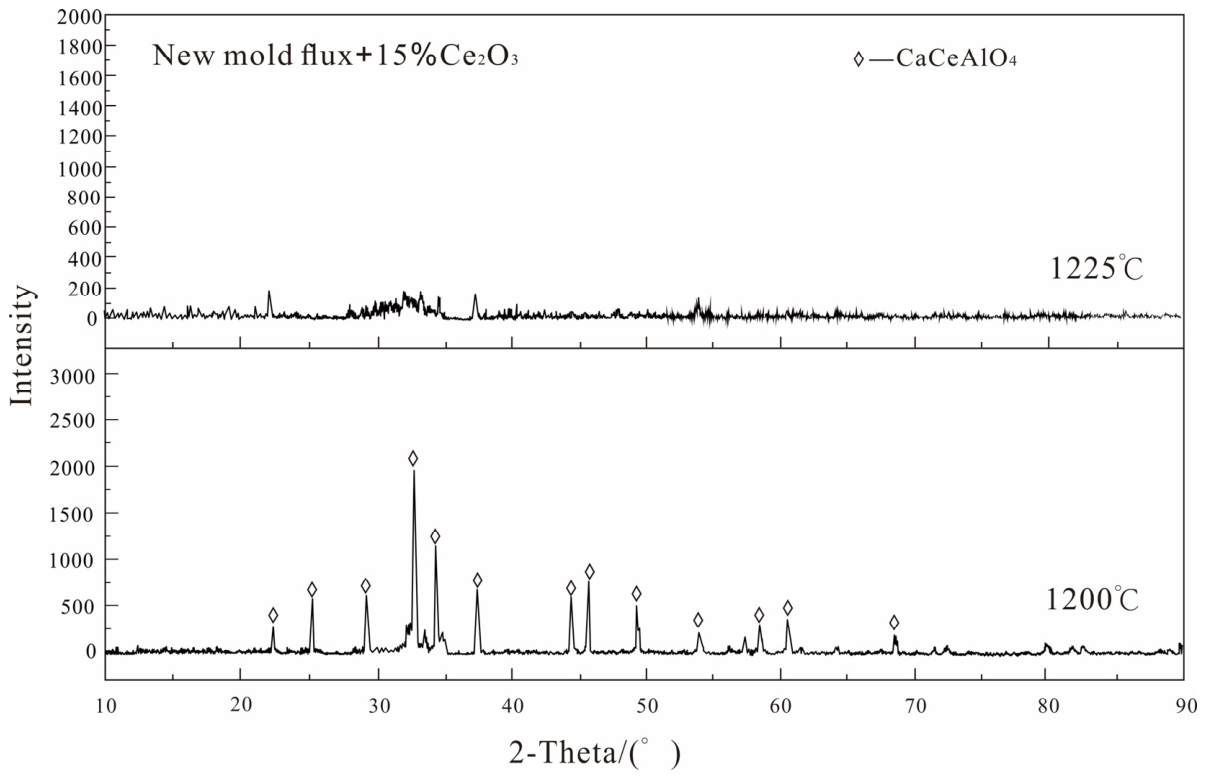
Likewise, Figure 27 shows the XRD patterns of quenched samples of the novel flux after 15% Ce2O3 uptake near the break temperature (1225 °C) and after complete crystallization at 1200 °C.
The results demonstrate that the novel flux is still a single homogeneous liquid phase near the break temperature with no crystallization detected, while after complete crystallization at 1200 °C, the precipitates become solely CaCeAlO4.
In summary, the sharp rises in break temperature and viscosity of the conventional flux upon 15% Ce2O3 uptake mainly stem from massive precipitation of high-melting rare-earth silicate phases, exemplified by CaO·2Ce2O3·2SiO2.
Over-crystallization elevates the solid fraction of the slag film, potentially causing inadequate lubrication and uneven heat transfer at the mold–strand interface and thus hindering stable continuous casting.
In contrast, even after 15% Ce2O3 uptake, the novel flux maintains a single liquid phase near the break temperature, better preserving its lubrication function; while precipitation of CaCeAlO4 raises the break temperature to a certain extent, the effect is substantially less pronounced than in the conventional flux.

5.4. Industrial Implications and Current Limitations

Taken together, the above results indicate that the newly developed CaO–Al2O3-based mold flux not only exhibits lower reactivity toward rare-earth-bearing molten steel, but also maintains better physicochemical stability after rare-earth oxide uptake than the conventional CaO–SiO2-based mold flux. From an industrial perspective, such stability is expected to be beneficial for maintaining lubrication consistency, reducing excessive crystallization of the slag film, and improving the operational stability of continuous casting for rare-earth weathering steels.
In addition to melting temperature, viscosity, and crystallization behavior, the steel–slag interfacial tension is also an important parameter for evaluating mold-flux applicability in continuous casting [23]. Interfacial tension affects slag entrapment tendency, interfacial stability, and lubrication behavior, and therefore has a direct influence on casting smoothness and slab surface quality [24]. In the present work, the improved physicochemical stability of the new mold flux after Ce2O3 absorption suggests that it may also be favorable for maintaining a more stable steel–slag interface during casting. However, because interfacial tension was not measured in this study, this implication remains qualitative. Further work combining interfacial-tension measurement with interfacial-reaction analysis is therefore needed to provide a more complete evaluation of the practical casting performance of the proposed flux.
Another issue that should be considered for industrial application is the compatibility between the CaO–Al2O3-based mold flux and refractory materials [25]. Compared with conventional silicate-based mold fluxes, CaO–Al2O3-rich systems may exhibit different wetting and corrosion behavior toward refractory or ceramic components under prolonged high-temperature service conditions [26]. In the present study, the proposed flux was designed and assessed mainly from the perspectives of slag–metal reactivity and physicochemical stability after rare-earth oxide pickup, whereas its interaction with refractory materials was not investigated. Therefore, although the present results demonstrate that the developed flux is a promising candidate for rare-earth weathering steel casting, its possible influence on refractory service life remains to be clarified. Dedicated compatibility and corrosion tests with representative refractory materials should be carried out before industrial implementation.
Overall, the present study provides a useful design route for developing low-reactivity mold fluxes with improved tolerance to compositional drift during the continuous casting of rare-earth steels. At the same time, the full industrial applicability of the proposed flux still requires further validation through interfacial-property characterization, refractory-compatibility assessment, and pilot-scale or plant-scale casting trials.

6. Conclusions

A low-reactivity CaO–Al2O3-based mold flux for the continuous casting of rare-earth weathering steel was designed and evaluated in the present study through thermodynamic analysis, model calculation, and experimental investigation. The results show that the proposed CaO–Al2O3–Li2O–B2O3–Ce2O3 system provides a feasible composition framework for reducing the reactivity of mold fluxes toward rare-earth-bearing molten steel while maintaining acceptable melting, viscosity, and crystallization characteristics.
An activity calculation model for the CaO–Al2O3–Li2O–B2O3–Ce2O3 system was established based on the ion and molecule coexistence theory (IMCT). The calculated results indicate that CaO, Li2O, and Ce2O3 exhibit relatively high effective activities, whereas B2O3 remains at a very low level and Al2O3 also shows low activity within the present model framework. These results suggest that the newly designed flux system can suppress the contribution of highly reactive components and improve compositional tolerance under rare-earth oxide pickup conditions. However, the present IMCT analysis should be regarded as a semi-quantitative tool for composition screening and relative reactivity evaluation, rather than a direct substitute for experimentally measured absolute thermodynamic activities.
The physicochemical-property measurements show that the viscosity and melting behavior of the proposed flux can be controlled within an appropriate range through compositional optimization. When the Ce2O3 content exceeded 5 wt.%, the viscosity remained at about 0.30 Pa·s, and when the w(CaO)/w(Al2O3) ratio was higher than 1.6, the viscosity stabilized at about 0.25 Pa·s. The minimum melting temperature, approximately 1122.6 °C, was obtained at 5 wt.% Ce2O3. These results indicate that the proposed system is not only low-reactive in thermodynamic tendency, but also capable of maintaining a practically usable viscosity–melting window for continuous casting operation.
Compared with the conventional CaO–SiO2-based mold flux, the newly developed CaO–Al2O3-based mold flux exhibits similar initial melting and viscosity characteristics but significantly improved stability after rare-earth oxide absorption. After absorbing 15 wt.% Ce2O3, the conventional mold flux showed a marked increase in melting temperature, viscosity, and break temperature, whereas the newly designed flux remained comparatively stable. This improved stability is associated with the different crystallization evolution of the two systems: the conventional flux tends to form high-melting rare-earth silicate phases, whereas the new flux evolves toward LiAlO2- and CaCeAlO4-related crystallization products, leading to less severe deterioration in flow and crystallization behavior.
From a practical perspective, the improved stability of the proposed flux after rare-earth oxide absorption is expected to be beneficial for maintaining lubrication consistency, reducing excessive crystallization, and improving casting operability during the continuous casting of rare-earth weathering steels. The present study demonstrates the feasibility of designing a low-reactivity CaO–Al2O3-based mold flux for rare-earth weathering steel continuous casting; however, several aspects still require further verification before industrial application. In particular, interfacial properties, refractory compatibility, and casting-scale performance were beyond the scope of the present work. Future studies should therefore focus on more comprehensive thermodynamic validation together with plant-relevant evaluation of interfacial behavior, refractory interaction, and slab-quality performance.

Author Contributions

Conceptualization, Z.L.; Methodology, Z.L. and Y.W.; Software, Y.W.; Validation, Y.W.; Formal analysis, Y.W.; Investigation, Z.L. and L.X.; Resources, Z.L. and L.X.; Data curation, Z.L. and L.X.; Writing—original draft, Y.W.; Writing—review & editing, Z.L. and L.X.; Visualization, Z.L. and L.X.; Supervision, Z.L. and L.X.; Project administration, Z.L. and L.X. All authors have read and agreed to the published version of the manuscript.

Funding

This research was funded by the National Science and Technology Major Project of China, grant number 2025ZD061200. The APC was funded by China Iron and Steel Research Institute Co., Ltd.

Data Availability Statement

The original contributions presented in this study are included in the article. Further inquiries can be directed to the corresponding author.

Conflicts of Interest

Authors Zhihong Liu, Yang Wang, and Lijun Xu were employed by the Zhongda National Engineering & Research Center of Continuous Casting Technology Co., Ltd. and China Iron and Steel Research Institute Co., Ltd. The funder was not involved in the study design, collection, analysis, interpretation of data, the writing of this article or the decision to submit it for publication.

References

  1. Wang, H.; Bao, Y.-P.; Zhi, J.-G.; Duan, C.-Y.; Gao, S.; Wang, M. Effect of Rare Earth Ce on the Morphology and Distribution of Al2O3 Inclusions in High Strength IF Steel Containing Phosphorus during Continuous Casting and Rolling Process. ISIJ Int. 2021, 61, 657–666. [Google Scholar] [CrossRef]
  2. Yang, W.; Zhang, L.; Ren, Y.; Chen, W.; Liu, F. Formation and Prevention of Nozzle Clogging during the Continuous Casting of Steels: A Review. ISIJ Int. 2024, 64, 1–20. [Google Scholar] [CrossRef]
  3. Cho, J.W.; Shibata, H. Effect of solidification of mold fluxes on the heat transfer in casting mold. J. Non-Cryst. Solids 2001, 282, 110–117. [Google Scholar] [CrossRef]
  4. Fan, L.; Liu, C.; Qi, J.; Jiang, M. Effect of La2O3 on the Viscosity, Crystallization, and Structure of Calcium-silicate-based Mold Flux for Continuous Casting La-bearing FeCrAl Alloy. ISIJ Int. 2021, 61, 2193–2199. [Google Scholar] [CrossRef]
  5. Guo, W.; Liu, X.; Liu, F.; Jin, Y.; Sun, Z.; Ding, Z.; Zhao, Z. Effect of Ce2O3 and CaF2 on viscosity and structure of CaO–SiO2–CaF2–Ce2O3 slag. J. Rare Earths 2025, 43, 620–627. [Google Scholar] [CrossRef]
  6. Qi, J.; Liu, C.; Liu, H.; Li, C.; Jiang, M. Effect of rare earth oxide on the crystallization behavior of CaO–Al2O3-based mold flux for rare earth heat-resistant steel continuous casting. J. Non-Cryst. Solids 2021, 559, 120681. [Google Scholar] [CrossRef]
  7. Zhang, X.; Tian, Y.; Liu, C.; Jiang, F.; Huang, Y. Microscopic Analysis of the Effects of Ce2O3 and CaF2 on the Structure and Properties of Mold Flux for Rare Earth-Containing Steel Continuous Casting. Processes 2025, 13, 3972. [Google Scholar] [CrossRef]
  8. Chen, X.; Deng, T.; Zhao, Z.; Yan, B. Thermodynamic Study on CaO–SiO2–Al2O3–5%MgO–10%Ce2O3 Slag System: Liquidus Lines and Distribution Behavior of Cerium at 1873 K. ISIJ Int. 2020, 60, 1602–1609. [Google Scholar] [CrossRef]
  9. Qi, J.; Liu, C.; Jiang, M. Effect of Li2O on the crystallization behavior of CaO–Al2O3–SiO2–Li2O–Ce2O3 mold slags. Ceram. Int. 2021, 47, 20850–20856. [Google Scholar] [CrossRef]
  10. Zheng, X.; Liu, C.; Jiang, M. Effect of Ce2O3 on Melt Structure and Properties of CaO–Al2O3-based Slag. ISIJ Int. 2022, 62, 1091–1098. [Google Scholar] [CrossRef]
  11. Ma, F.-X.; Gu, Q.; Liu, G.-Q.; Zhang, Y.; Li, H.-X. A systematic study of carbon-free oxide-based lining for preventing submerged entry nozzle clogging in continuous casting of rare earth steel. J. Iron Steel Res. Int. 2025, 32, 1584–1595. [Google Scholar] [CrossRef]
  12. Guo, W.T.; Wang, Z.; Zhao, Z.W.; An, Z.Q.; Wang, W.F. Effect of CeO2 on the viscosity and structure of high-temperature melt of the CaO–SiO2(–Al2O3)–CeO2 system. J. Non-Cryst. Solids 2020, 540, 120085. [Google Scholar] [CrossRef]
  13. Wang, W.; Shao, H.; Zhou, L.; Luo, H.; Wu, H. Rheological behavior of the CaO–Al2O3-based mold fluxes with different Na2O contents. Ceram. Int. 2020, 46, 26880–26887. [Google Scholar] [CrossRef]
  14. Chen, Y.; He, S.P.; Li, Z.R.; Zhang, X.B.; Wang, Q.Q.; Wang, Q. Properties and structure of a new non-reactive mold flux for high-Al steel. J. Iron Steel Res. Int. 2022, 29, 61–70. [Google Scholar] [CrossRef]
  15. Sadaf, S.; Wu, T.; Zhong, L.; Liao, Z.Y.; Wang, H.C. Effect of Basicity on the Structure, Viscosity and Crystallization of CaO–SiO2–B2O3 Based Mold Fluxes. Metals 2020, 10, 1240. [Google Scholar] [CrossRef]
  16. Yeo, T.M.; Cho, J.W.; Alloni, M.; Casagrande, S.; Carli, R. Structure and its effect on viscosity of fluorine-free mold flux: Substituting CaF2 with B2O3 and Na2O. J. Non-Cryst. Solids 2020, 529, 119756. [Google Scholar] [CrossRef]
  17. Zhang, L.; Wang, W.L.; Zhai, B.Y.; Sohn, I. The evolution of the mold flux melt structure during the process of fluorine replacement by B2O3. J. Am. Ceram. Soc. 2020, 103, 112–121. [Google Scholar] [CrossRef]
  18. Zhou, L.J.; Li, H.; Wang, W.L.; Xiao, D.; Zhang, L.; Yu, J. Optimization of the Interfacial Properties between Mold Flux and TiN Substrate through the Regulation of B2O3. ISIJ Int. 2020, 60, 2838–2844. [Google Scholar] [CrossRef]
  19. Yan, X.; Yuan, H.; Zhang, S.; Wang, Q.; Zhang, X.; He, S.; Wang, Q. Effect of interfacial reaction between CaO–BaO–Al2O3-based mold fluxes and high-Mn–high-Al steels on fundamental properties and lubrication of mold flux. Steel Res. Int. 2020, 91, 1900581. [Google Scholar] [CrossRef]
  20. Yan, X.; Pan, W.; Wang, X.; Zhang, X.; He, S.; Wang, Q. Electrical Conductivity, Viscosity and Structure of CaO–Al2O3-Based Mold Slags for Continuous Casting of High-Al Steels. Metall. Mater. Trans. B 2021, 52, 2526–2535. [Google Scholar] [CrossRef]
  21. Zhao, M.; Li, G.; Li, Z.; Wang, Q.; He, S. Study of Thermodynamic for Low-Reactive CaO–BaO–Al2O3–SiO2–CaF2–Li2O Mold Flux Based on the Model of Ion and Molecular Coexistence Theory. Metals 2022, 12, 1099. [Google Scholar] [CrossRef]
  22. Gzielo, A.; Jowsa, J. Activity of SiO2 in slags CaO–SiO2–Al2O3–CaF2. Arch. Hut. 1984, 29, 319–331. [Google Scholar]
  23. Geng, X.; Li, B.; Jiang, Z. Evaluation of Surface Tension of CaO–SiO2–Al2O3-Based Mold Flux Containing Ce2O3. Steel Res. Int. 2023, 94, e2200715. [Google Scholar] [CrossRef]
  24. Yuan, H.; Dan, Z.; Wang, Q.; He, S. Contact angle and adhesion of CaO–SiO2- and CaO–Al2O3-based mold slags on solid steel of various compositions. J. Mater. Res. Technol. 2020, 9, 7828–7837. [Google Scholar] [CrossRef]
  25. Liu, Y.; Rao, J.; Li, G.; Zhang, Z.; Wang, J.; Dong, T. Dissolution of Al2O3–C bricks in 45 wt% CaO-45 wt% SiO2-x wt% CaF2-(10-x) wt% Na2O slag. Ceram. Int. 2022, 48, 19068–19072. [Google Scholar] [CrossRef]
  26. Zhao, Y.-J.; Li, G.-Q.; Wu, Y.; Yuan, C.; Meng, Z.; Deng, X.-X.; Liu, Y. Corrosion behavior of Al2O3–C bricks in MnO-containing mold slag. J. Iron Steel Res. Int. 2024, 31, 1486–1496. [Google Scholar] [CrossRef]
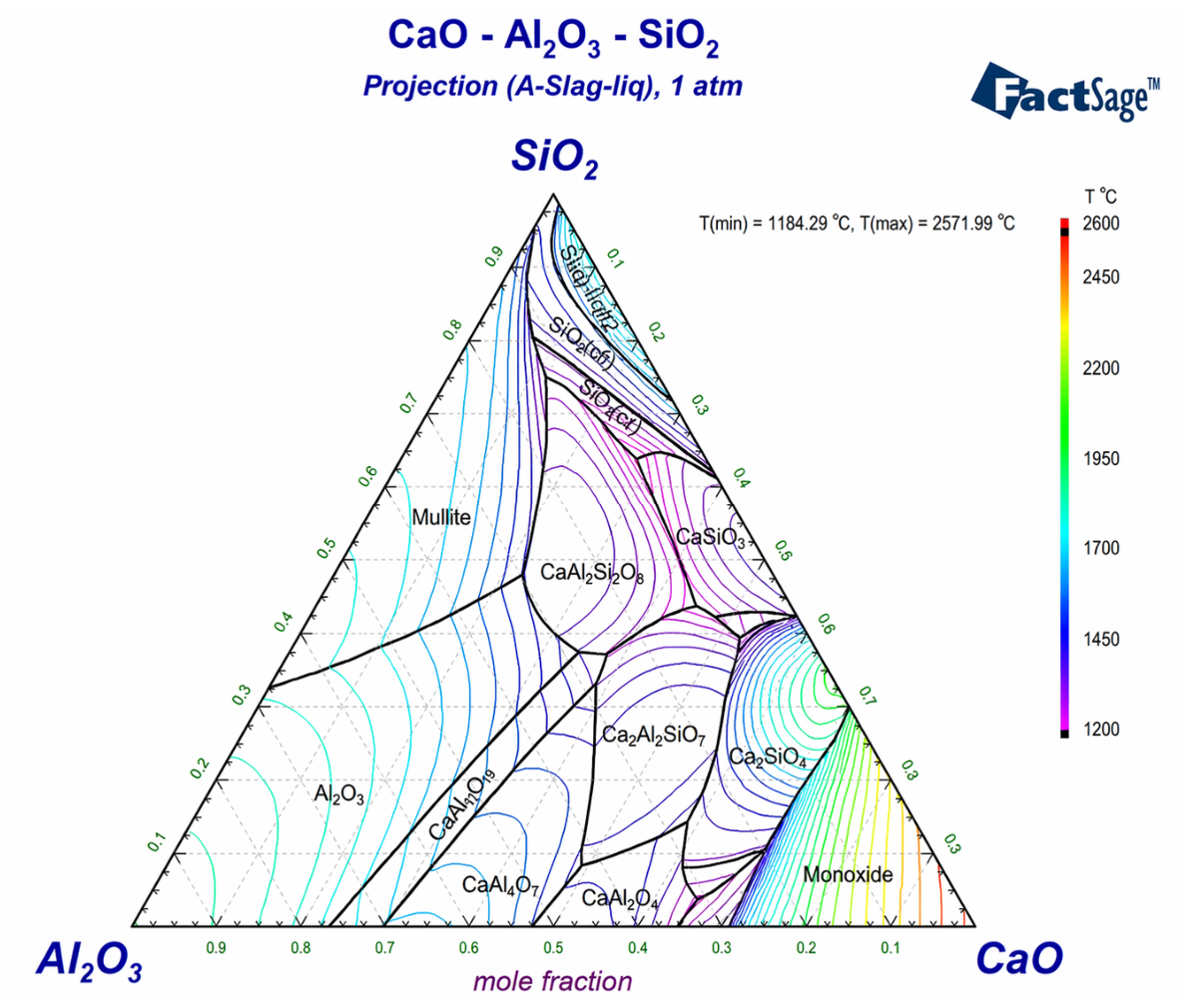
Figure 1. CaO-SiO2-Al2O3 Ternary Phase Diagram.
Materials 19 02236 g001
Figure 2. CaO-Al2O3 Binary Phase Diagram.
Materials 19 02236 g002
Figure 3. Li2O–Al2O3 Binary phase diagram.
Materials 19 02236 g003
Figure 4. Isothermal Section of the CaO-Al2O3-B2O3 System.
Materials 19 02236 g004
Figure 5. Comparison between measured value and calculated value of activity of SiO2.
Materials 19 02236 g005
Figure 6. Pearson correlation analysis between the experimentally measured and model-calculated SiO2 activities.
Materials 19 02236 g006
Figure 7. Activities of individual components in the slag system under different conditions: (a) temperature; (b) w(CaO)/w(Al2O3); (c) w(Li2O); (d) w(B2O3); (e) w(Ce2O3).
Materials 19 02236 g007
Figure 8. Apparatus sketch for measuring the viscosity of mold flux.
Materials 19 02236 g008
Figure 9. Apparatus sketch for measuring the melting temperature of mold flux.
Materials 19 02236 g009
Figure 10. Performance parameters of the mold flux under different w(CaO)/w(Al2O3) ratios: (a) viscosity; (b) temperature; (c) activation energy.
Materials 19 02236 g010
Figure 11. Viscosity temperature curve of mold flux with different w(CaO)/w(Al2O3).
Materials 19 02236 g011
Figure 12. Functional relationship between mold flux viscosity and temperature under different w(CaO)/w(Al2O3) ratios.
Materials 19 02236 g012
Figure 13. Performance parameters of the mold flux at different B2O3 mass fractions.
Materials 19 02236 g013
Figure 14. Viscosity–temperature curves of the mold flux at different B2O3 mass fractions.
Materials 19 02236 g014
Figure 15. Functional relationship between mold flux viscosity and temperature at different B2O3 mass fractions.
Materials 19 02236 g015
Figure 16. Performance parameters of the mold flux at different Li2O mass fractions.
Materials 19 02236 g016
Figure 17. Viscosity–temperature curves of the mold flux at different Li2O mass fractions.
Materials 19 02236 g017
Figure 18. Functional relationship between mold flux viscosity and temperature at different Li2O mass fractions.
Materials 19 02236 g018
Figure 19. Performance parameters of the mold flux at different Ce2O3 mass fractions: (a) viscosity; (b) temperature; (c) activation energy.
Materials 19 02236 g019
Figure 20. Viscosity–temperature curves of the mold flux at different Ce2O3 mass fractions.
Materials 19 02236 g020
Figure 21. Functional relationship between mold flux viscosity and temperature at different Ce2O3 mass fractions.
Materials 19 02236 g021
Figure 22. Comparison of the melting temperature of the mold fluxes after absorbing RE oxide.
Materials 19 02236 g022
Figure 23. Comparison of the viscous properties of the mold fluxes after absorbing RE oxide.
Materials 19 02236 g023
Figure 24. XRD patterns of the conventional mold flux quenched at different temperatures.
Materials 19 02236 g024
Figure 25. XRD patterns of new mold flux quenched at different temperatures.
Materials 19 02236 g025
Figure 26. XRD patterns of the conventional mold flux quenched at different temperatures after absorbing RE oxide.
Materials 19 02236 g026
Figure 27. XRD patterns of new mold flux quenched at different temperatures after absorbing RE oxide.
Materials 19 02236 g027
Table 1. Structural Units in the CaO-Al2O3-Li2O-B2O3-Ce2O3 System.
SystemStructural Units
Ca2+, Li+, Ce3+, O2−, Al2O3, B2O3
Al2O3-CaOCaO·Al2O3, 3CaO·Al2O3, 12CaO·7Al2O3, CaO·2Al2O3, CaO-6Al2O3
Al2O3-B2O32Al2O3·B2O3, 9Al2O3 ·2B2O3
B2O3-CaOCaO-2B2O3, CaO-B2O3, 2CaO ·B2O3, 3CaO ·B2O3
Ce2O3-Al2O3Ce2O3·Al2O3, Ce2O3·11Al2O3
Li2O-Al2O3Li2O·Al2O3
Li2O-B2O3Li2O·B2O3, Li2O·2B2O3, Li2O·3B2O3, Li2O·4B2O3
Table 2. The reaction equations involved in the model mainly include.
ProjectStructural UnitsNoMass Action Concentration of Structural
Ionic species. C a 2 + + O 2 - = CaO (1) N 1 = N C a 2 + + N O 2 - = 2 x 1 / X         x 1 = N 1 X / 2
2 L i + + O 2 - = L i 2 O (2) N 3 = 2 N L i + + N O 2 - = 3   x 3 / X         x 3 =   N 3 X / 3
2 Ce 3 + + 3 O 2 - = Ce 2 O 3 (3) N 5 = 2 N C e 3 + + 3 N O 2 - = 5       x 5 / X     x 5 = N 5 X / 5
Molecular species. A l 2 O 3 (4) N 2 =   x 2 / X x 2 = N 2 X
B 2 O 3 (5) N 4 =   x 4 / X x 4 =   N 4 X
Ion–molecule and molecule–molecule chemical equilibrium reactions ( C a 2 + + O 2 - ) + 6 A l 2 O 3 = C a O (6) 6 A l 2 O 3   N 6 = K 1 N 1 N 2 6 x 6 = N 6 X
( C a 2 + + O 2 ) + A l 2 O = Ca O Al 2 O 3
△G0 = −16380 − 37.58T (J/mol)
(7) N 7 = K 2 N 1 N 2 x 7 = N 7 X
3 ( C a 2 + + O 2 ) + A l 2 O 3 = 3 C a O A l 2 O 3
△G0 = −18000 − 18.83T (J/mol)
(8) N 8 = K 3 N 1 3 N 2 x 8 = N 8 X
12 ( C a 2 +   +   O 2 - )   +   7 A l 2 O 3   =   12 CaO 7 A l 2 O 3
△G0 = −12600 − 24.69T (J/mol)
(9) N 9   = K 4 N 1 12 N 2 7 x 9 =   N 9 X
( C a 2 + +   O 2 - )   +   2 A l 2 O 3   =   CaO 2 A l 2 O 3
△G0 = −86100 − 205.1T (J/mol)
(10) N 10   =   K 5 N 1 N 2 2 x 10 = N 10 X
2 A l 2 O 3   +   B 2 O 3   =   2 A l 2 O 3 B 2 O 3
△G0 = −16700 − 25.52T (J/mol)
(11) N 11 =   K 6 N 2 2 N 4 x 11 = N 11 X
9 A l 2 O 3   +   B 2 O 3   =   9 A l 2 O 3 B 2 O 3
△G0 = −90958.9 + 36.79T (J/mol)
(12) N 12 =   K 7 N 2 9 N 4 x 12   =   N 12 X
C a 2 +   +   O 2 -   +   2 B 2 O 3   =   CaO 2 B 2 O 3
△G0 = −132385.55 − 28.7T (J/mol)
(13) N 13 =   K 8 N 1 N 4 2 x 13 =   N 13 X
( C a 2 + + O 2 - )   +   B 2 O 3   =   CaO B 2 O 3
△G0 = −109694.16 − 0.67T (J/mol)
(14) N 14 = K 9 N 1 N 4 x 14   = N 14 X
2 ( C a 2 + + O 2 - )   +   B 2 O 3   =   2 CaO B 2 O 3
△G0 = −75362.4 − 20.77T (J/mol)
(15) N 15   = K 10 N 1 2 N 4 x 15   = N 15 X
3 ( C a 2 + + O 2 - )   +   B 2 O 3   =   3 CaO B 2 O 3
△G0 = −108019.44 − 46.56T (J/mol)
(16) N 16   =   K 11 N 1 3 N 4 x 16   =   N 16 X
( 2 C e 3 + + 3 O 2 - )   +   A l 2 O 3   =   C e 2 O 3 A l 2 O 3
△G0 = −129790.8 − 54.6T J/mol)
(17) N 17   =   K 12 N 2 N 5 x 17 =   N 17 X
( 2 C e 3 + + 3 O 2 - )   +   11 A l 2 O 3   =   C e 2 O 3 11 A l 2 O 3
△G0 = −60240.99 − 14.19T(J/mol)
(18) N 18 = K 13 N 2 11 N 5 x 18   =   N 18 X
( 2 L i + + O 2 - )   +   A l 2 O 3   =   L i 2 O A l 2 O 3
△G0 = 49331.82 − 80.56T (J/mol)
(19) N 19 = K 14 N 2 N 3 x 19 = N 19 X
( 2 L i + + O 2 - )   +   B 2 O 3   =   L i 2 O B 2 O 3
△G0 = −107100 − 10.59T (J/mol)
(20) N 20 = K 15 N 3 N 4 x 20 =   N 20 X
( 2 L i + + O 2 - )   +   2 B 2 O 3   =   L i 2 O 2 B 2 O 3
△G0 = −134250 − 23.8T (J/mol)
(21) N 21 = K 16 N 3 N 4 2 x 21 =   N 21 X
( 2 L i + + O 2 - )   +   3 B 2 O 3 = L i 2 O 3 B 2 O 3
△G0 = −260640 + 66.97T (J/mol)
(22) N 22 = K 17 N 3 N 4 3 x 22 =   N 22 X
( 2 L i + + O 2 - )   +   4 B 2 O 3   =   L i 2 O 4 B 2 O 3
△G0 = −368200 + 156.9T (J/mol)
(23) N 23 = K 23 N 3 N 4 4 x 23 =   N 23 X
Table 3. Activities of the components in the CaO-Al2O3-based mold flux.
Component(s)Mass Fraction (wt.%)Component Activity at Different Temperatures
1100 °C1200 °C1300 °C1400 °C1500 °C
CaO350.4677230.4663700.4649430.4633350.461468
Al2O3350.0000230.0000410.0000700.0001100.000165
Li2O150.2402650.2432490.2464380.2498780.253599
Ce2O3100.0737090.0719700.0701330.0682570.066393
B2O350.0000000.0000000.0000000.0000000.000000
Li2O·Al2O3 0.1788390.1782810.1775550.1766550.175579
CaO·Al2O3 0.0003140.0005310.0008360.0012410.001753
3CaO·Al2O3 0.0000750.0001320.0002140.0003260.000470
Ce2O3·Al2O3 0.0012800.0016360.0020090.0023870.002761
2CaO·B2O3 0.0041430.0046370.0051070.0055520.005973
3CaO·B2O3 0.0285000.0283170.0280900.0278310.027547
Table 4. Composition and properties of the mold flux for rare-earth weathering steel continuous casting.
Mass Fraction %Properties
CaOSiO2Al2O3Na2OFCMelting temperature/°Cviscosity (1300 °C)/Pa·s
30~4025~355~105~155~104~51100~11800.15~0.25
Table 5. Composition of the new mold flux for rare-earth weathering steel continuous casting (mass fraction)%.
CaOAl2O3Li2OB2O3Ce2O3
43.1~49.226.9~30.85~105~100~10
Disclaimer/Publisher’s Note: The statements, opinions and data contained in all publications are solely those of the individual author(s) and contributor(s) and not of MDPI and/or the editor(s). MDPI and/or the editor(s) disclaim responsibility for any injury to people or property resulting from any ideas, methods, instructions or products referred to in the content.