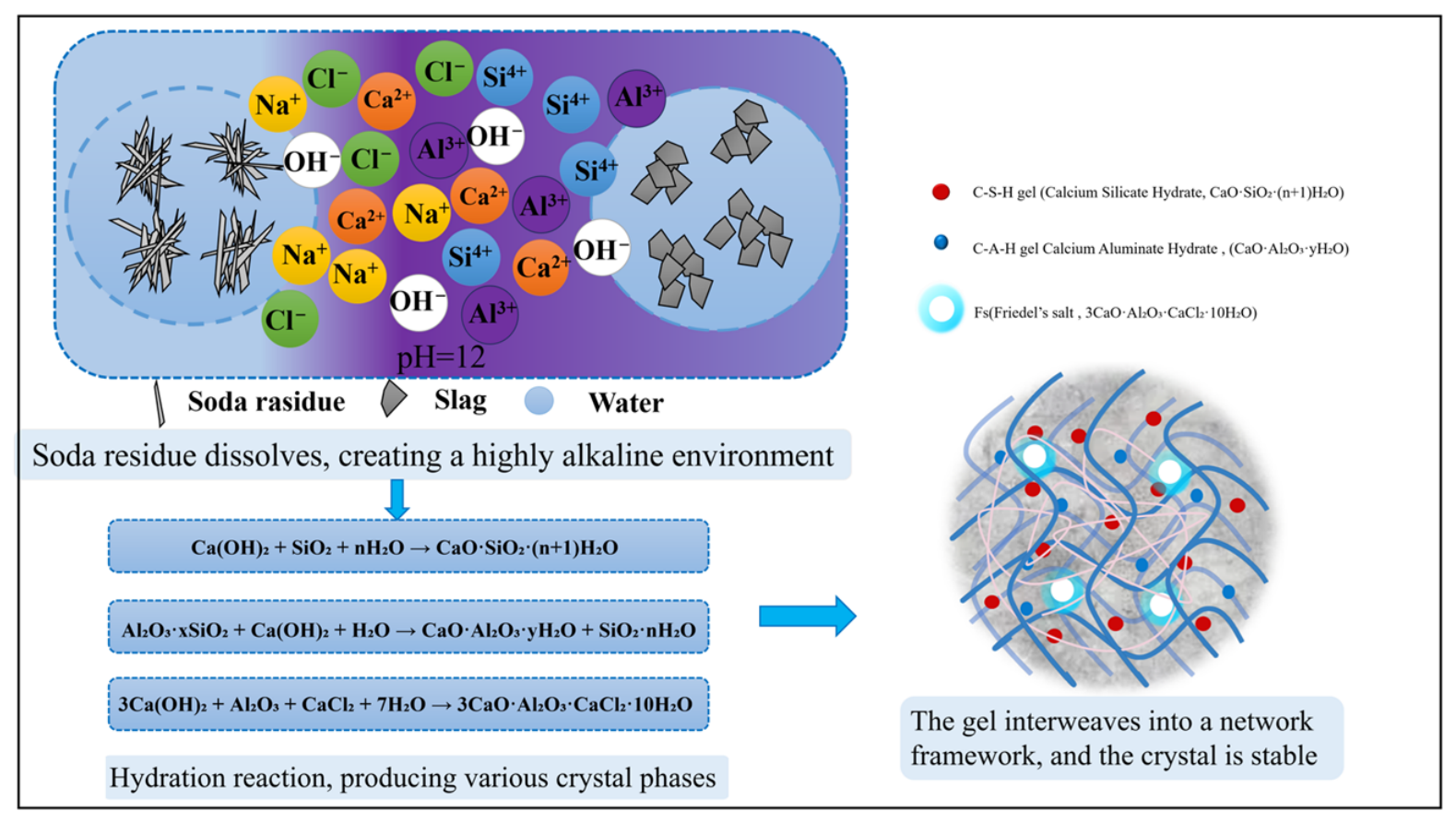
Research Progress on the Application of Soda Residue in Cementitious Materials


Abstract
1. Introduction
2. Literature Search and Screening Methodology
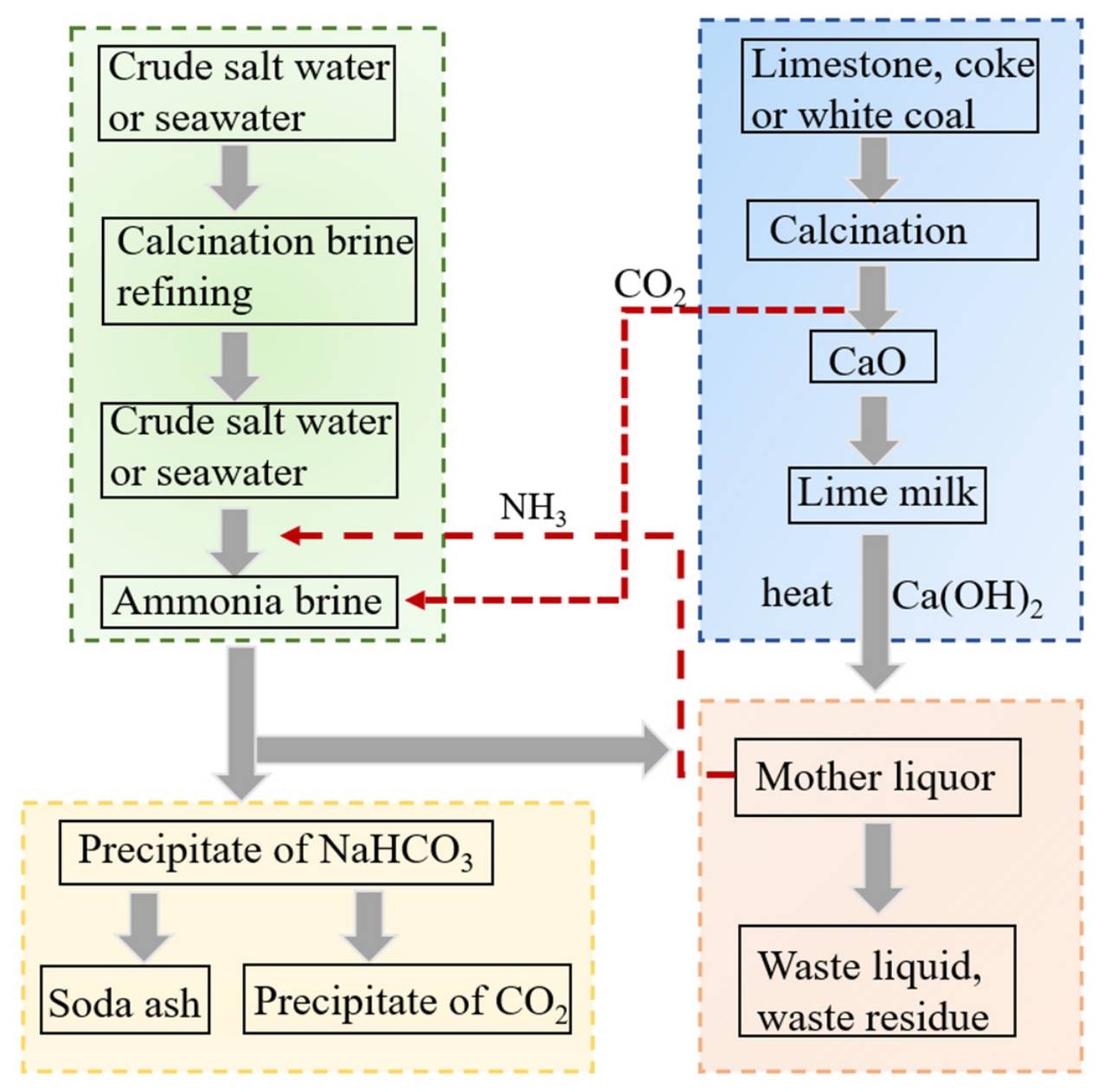
3. Physicochemical Properties of Soda Residue
3.1. Physical Properties
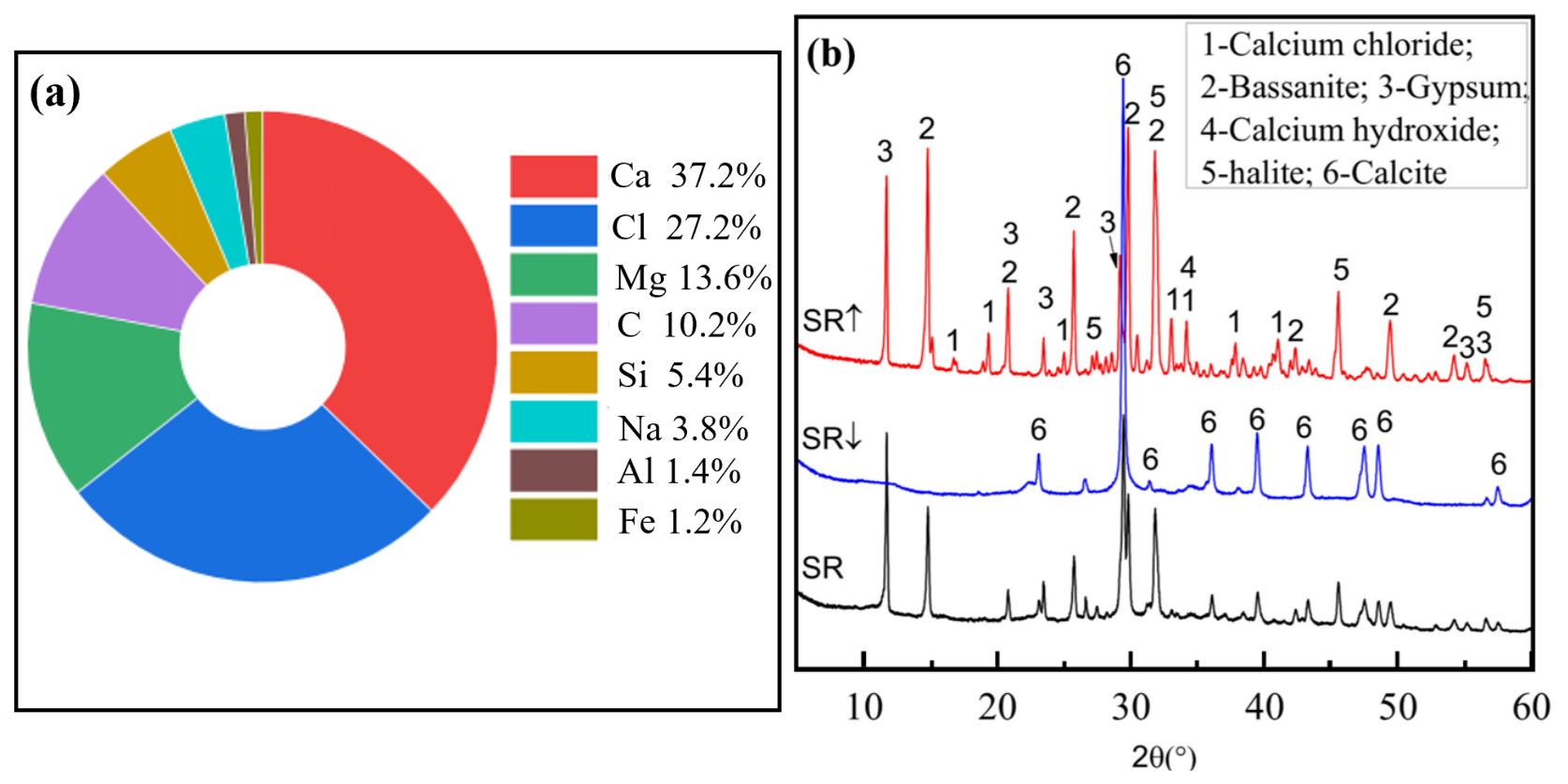
3.2. Chemical Properties

| Literature | CaO | SiO2 | Al2O3 | MgO | Fe2O3 | SO3 | K2O | Na2O | Cl− |
|---|---|---|---|---|---|---|---|---|---|
| An et al. [56] | 39.20 | 5.92 | 1.92 | 6.73 | 0.44 | 5.33 | 0.31 | 4.65 | 35.40 |
| Guo et al. [21] | 43.20 | 9.87 | 3.25 | 9.77 | 0.91 | 5.57 | 0.29 | 3.93 | 23.00 |
| Qi et al. [57] | 40.30 | 9.02 | 2.09 | 10.00 | 0.59 | 6.41 | 0.31 | 3.58 | 27.40 |
| Cheng et al. [58] | 52.25 | 4.06 | 1.76 | 2.33 | 1.17 | 16.97 | 0.15 | 2.46 | 18.39 |
| Pang et al. [59] | 43.51 | 6.48 | 1.77 | 6.91 | 0.69 | 7.63 | 0.47 | 0.1 | 32.25 |
| Xu et al. [60] | 52.88 | 10.19 | 3.25 | 8.35 | 1.23 | 8.87 | 0.38 | 1.84 | 11.95 |
| Li et al. [61] | 42.70 | 9.67 | 3.45 | 9.56 | 0.94 | 0.11 | 030 | 3.84 | 24.00 |
| Chen et al. [62] | 44.70 | 10.10 | 2.55 | 8.09 | 0.89 | 5.97 | 0.43 | 4.40 | 20.30 |
| Song et al. [63] | 35.12 | 4.17 | 2.06 | 2.97 | 0.29 | 2.8 | 0.33 | 13.04 | 39.11 |
3.3. Fabrication Method
3.3.1. Raw Soda Residue (RSR)
3.3.2. Washed Soda Residue (WSR)
3.3.3. Wet-Milled Soda Residue (WMSR)
3.3.4. Calcined Soda Residue (CSR)
3.3.5. Chemically Modified Soda Residue
4. Soda Residue Effect on Concrete Micro Characteristics
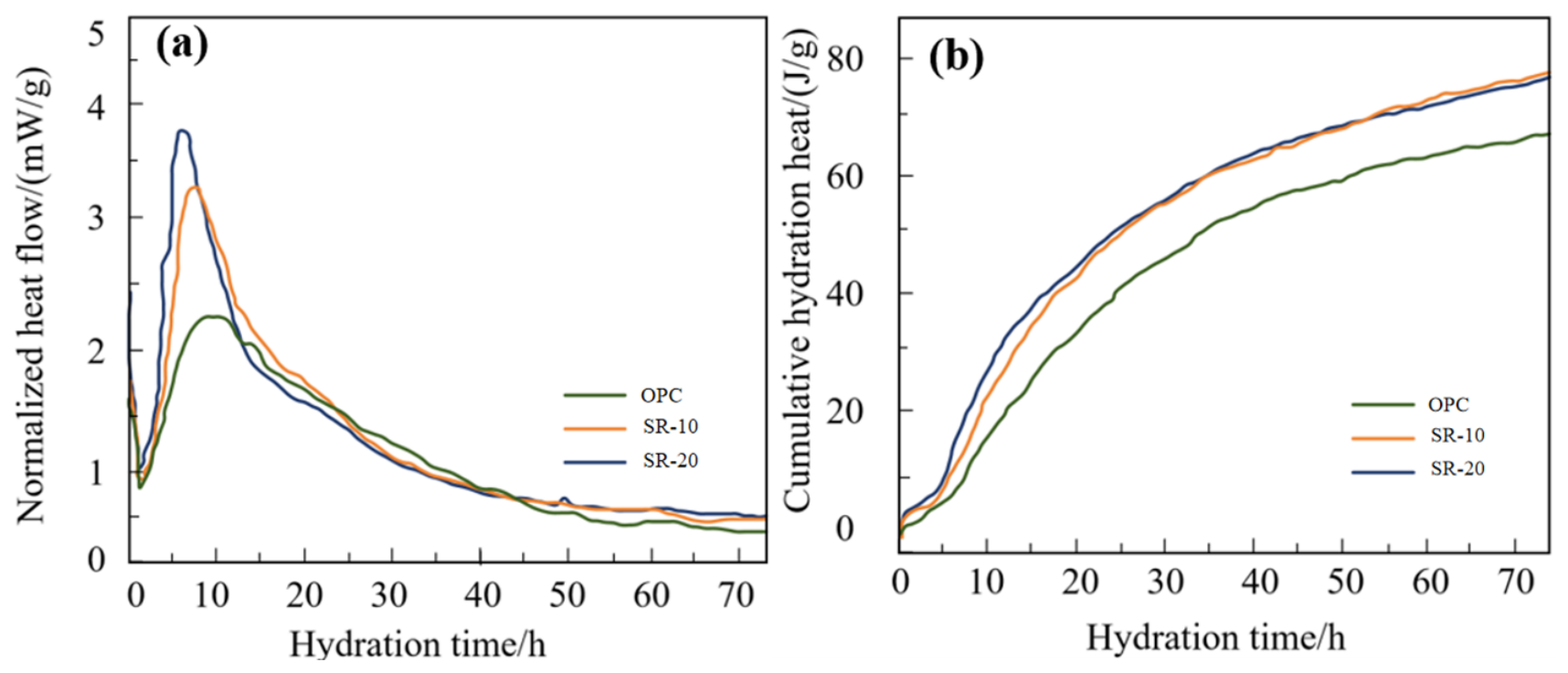
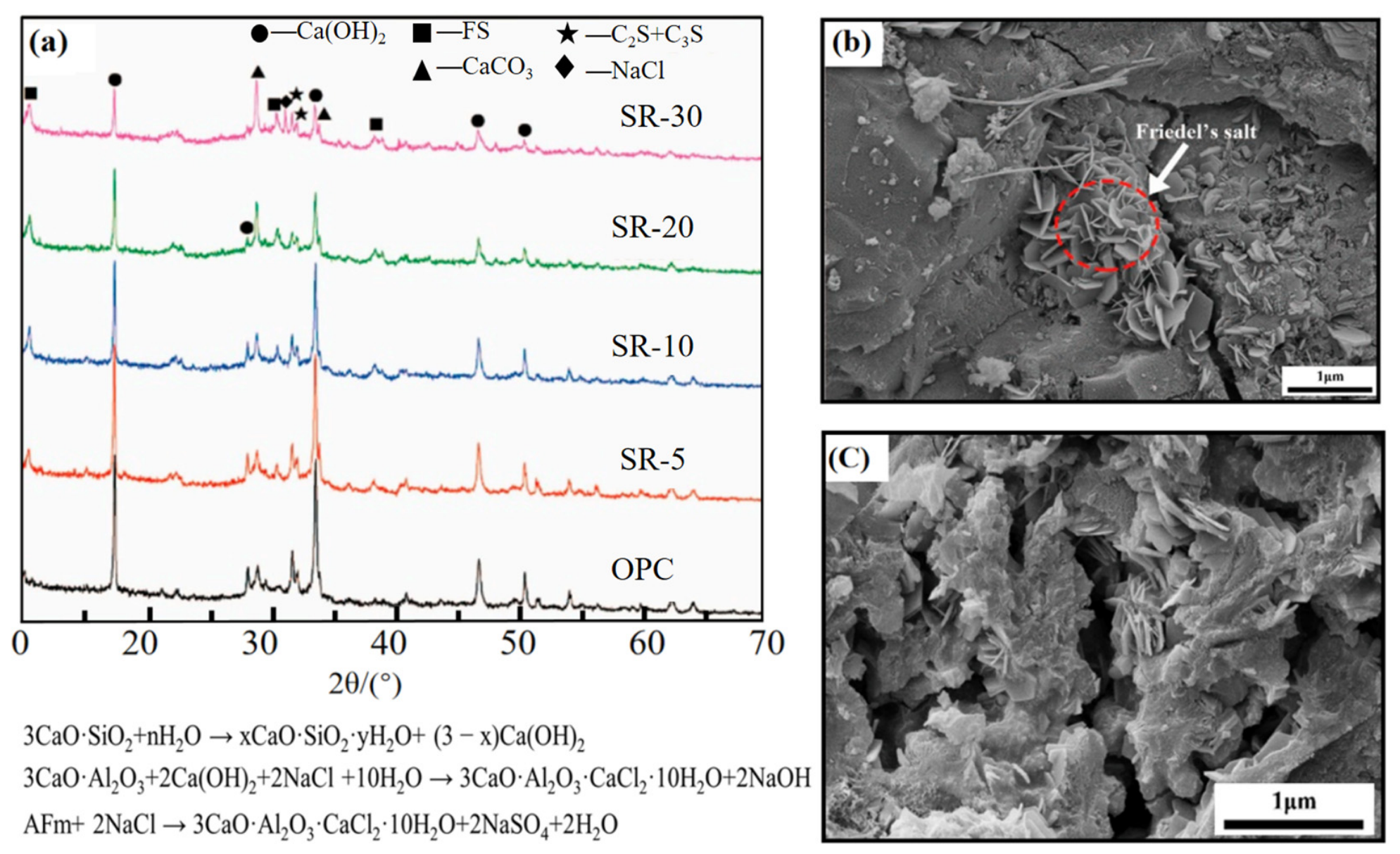
4.1. Cement Hydration
4.1.1. Soda Residue–Cement Binary System
4.1.2. Soda Residue–Solid Waste Multi-Component System
4.2. Pore Structure
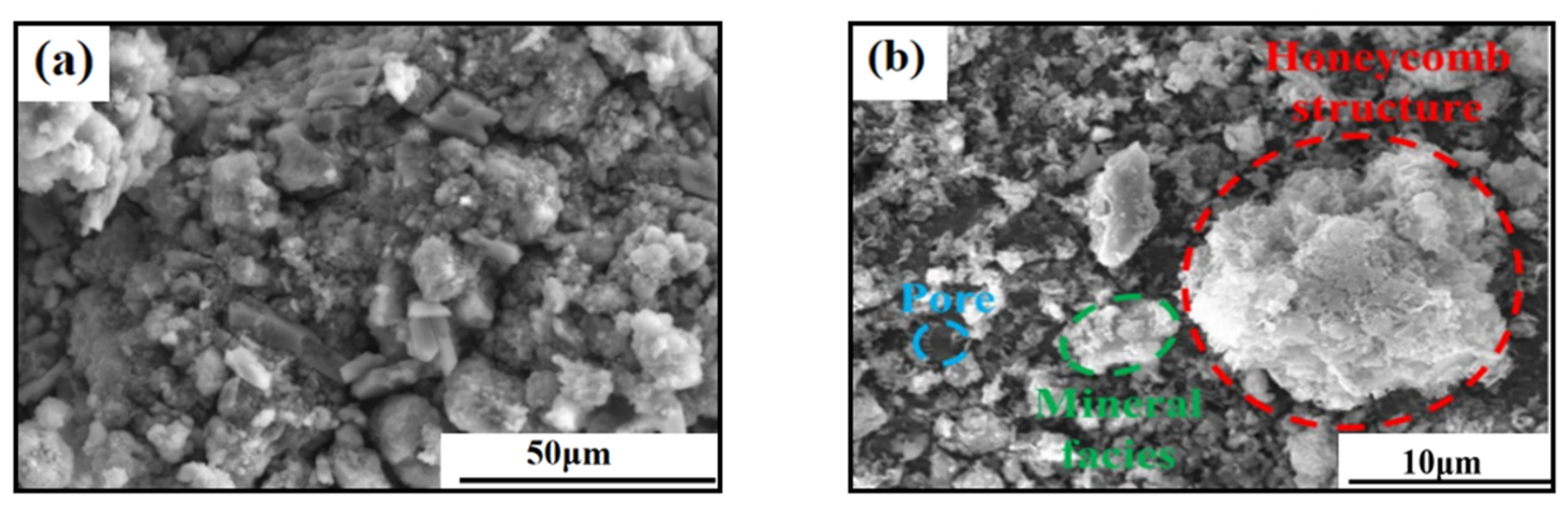
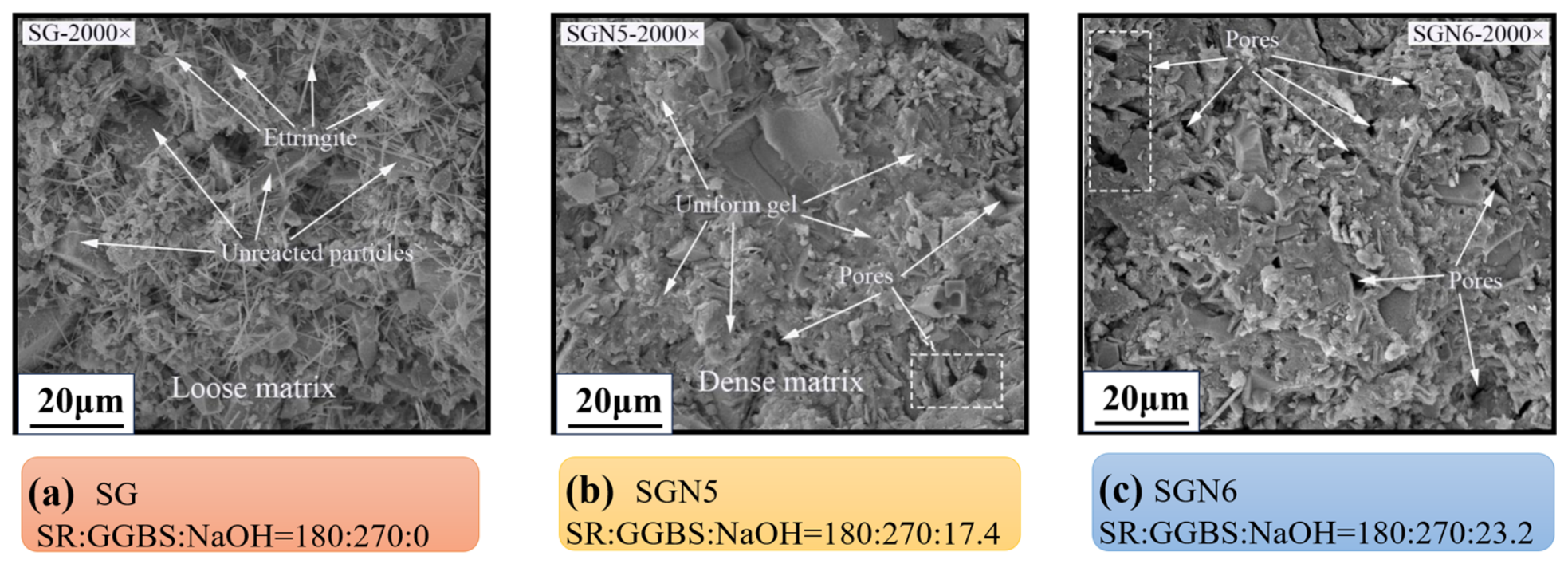
4.3. Microscopic Morphology
5. Soda Residue Effect on Concrete Macro Performance
5.1. Working Performance
5.2. Mechanical Properties
| Matrix Type | Soda Residue State | Replacement Level | Evaluated Properties | Reported Optimal Range |
|---|---|---|---|---|
| Autoclaved Sand Aerated Concrete (AAC) [120] | SR (Not specified) | SR replacing lime: 10–30% | Volumetric expansion, dry density, compressive strength | SR replacing lime: 20% |
| Autoclaved Aerated Concrete (AAC) [118] | Not specified | SR dosage: 0–30% | Compressive strength | Approx. 20–30% |
| Autoclaved Aerated Concrete (AAC) [117] | Not specified | SR: 20% (of total material) | Dry density, compressive strength | 20% (SR + construction waste + lime + cement + gypsum system) |
| Alkali-Activated Slag Geopolymer [86] | Not specified | SR: 70% (of total mass of precursor) | Compressive strength | 70% SR |
| Clinker-free composite cementitious material [63] | Not specified | SR: Slag = 1:4 (mass ratio) | Compressive strength, microstructure | SR: Slag = 1:4 (SR ≈ 20% of total binder) |
| Composite Portland cement [23] | Untreated (RSR) | SR: 5%, 10%, 20% (replacing cement) | Pore structure, setting time, compressive strength | <6% (pore structure); 5–10% acceptable; >10% reduces 28 d strength |
| Alkali-activated slag cement (AASC) [22] | Untreated (RSR) | SR: 8–34% (replacing GGBS) | Compressive strength | SR: GGBS ≈ 16:84 (SR ≈ 16%) |
| Clinker-free concrete (SR-GGBS-SS-FGD) [60] | Untreated (RSR) | SR: 6% (of total binder) | Compressive strength (up to 360 d) | 6% SR (360 d strength 66.31 MPa) |
| Portland cement concrete [49] | Washed (WSR) | WSR: 10% (replacing cement or fly ash) | Compressive strength, Cl− content | 10% WSR when Cl− < 0.3% |
| Portland cement [64] | Wet-milled (WMSR) | WMSR: 6% (as nucleation seeding additive) | 12 h compressive strength, hydration heat | 6% WMSR (12 h strength increased by 1.69 times) |
| Alkali-activated slag geopolymer [121] | Chemically modified (SR + CS) | SR + CS as composite activator | 28 days compressive strength | ≥27 MPa at 28 days (specific proportion depends on system) |
| Geopolymer [68] | Chemically modified (SR + PG) | SR + PG as composite activator | Compressive strength, Microstructure Compressive strength, microstructure | Significant synergistic enhancement (AFt + C–S–H) |
5.3. Chloride-Related Risks
5.3.1. Steel Corrosion
5.3.2. Free Versus Bound Chloride Thresholds
5.3.3. Limitations of Chloride Binding and Long-Term Stability Concerns
5.3.4. Limitations for Structural Applications
5.4. Durability
5.4.1. Chloride Penetration Resistance Performance
5.4.2. Sulfate Corrosion Resistance Performance
5.4.3. Efflorescence
5.4.4. Long-Term Performance
5.5. Shrinkage Properties
5.5.1. Self-Shrinkage
5.5.2. Chemical Shrinkage
5.5.3. Drying Shrinkage
6. Research Gaps and Priority Directions
6.1. Long-Term Stability of Friedel’s Salt
6.2. Behavior of Free Chloride Versus Bound Chloride
6.3. Performance in Reinforced Concrete (RC)
6.4. Desalination Strategies and Pretreatment Processes
6.5. Environmental Assessment of Pre-Treatment Processes
6.6. Techno-Economic Feasibility at Scale
7. Conclusions and Prospects
Author Contributions
Funding
Data Availability Statement
Conflicts of Interest
References
- Junaid, M.F.; Rehman, Z.U.; Kuruc, M.; Medved, I.; Bacinskas, D.; Curpek, J.; Cekon, M.; Ijaz, N. Lightweight concrete from a perspective of sustainable reuse of waste byproducts. Constr. Build. Mater. 2022, 319, 126061. [Google Scholar] [CrossRef] [Scilit]
- Luo, J.; Huang, R.; Zhang, Y.; Wang, J.J. Carbon sequestration by preparing recycled cement, recycled aggregates and recycled concrete from construction and demolition (C&D) wastes. Materials 2024, 17, 5020. [Google Scholar] [CrossRef] [Scilit]
- Kriskova, L.; Ducman, V.; Loncnar, M.; Tesovnik, A.; Zibret, G.; Skentzou, D. Alkali-Activated mineral residues in construction: Case studies on bauxite residue and steel slag pavement tiles. Materials 2025, 18, 257. [Google Scholar] [CrossRef] [Scilit]
- Mosquera, E.M.; Cifuentes, S.; Obando, J.C.; Monteiro, S.N.; Colorado, H.A. Concrete obtained with the viterbo O’reilly method for aggregate gradation: A potential model for sustainable design and reducing development costs. Materials 2025, 18, 3558. [Google Scholar] [CrossRef] [Scilit]
- Tang, J.; Yu, Y.; Bu, Y.Q.; Ma, B.; Zhou, H.; Zhou, R.; Wang, J.Q.; Zhang, H.H. The synergistic effect of calcained coal-series kaolinite and limestone on the hydration of portland cement. Materials 2024, 17, 4512. [Google Scholar] [CrossRef] [Scilit] [PubMed]
- Zou, C.N.; Xue, H.Q.; Xiong, B.; Zhang, G.S.; Pan, S.Q.; Jia, C.Y.; Wang, Y.; Ma, F.; Sun, Q.; Guan, C.X.; et al. Connotation, Innovation and Vision of “carbon Neutrality”. Nat. Gas Ind. B 2021, 8, 523–537. [Google Scholar] [CrossRef] [Scilit]
- Niu, X.X.; Ma, Z.; Ma, W.J.; Yang, J.J.; Ma, T. The Spatial Spillover Effects and Equity of Carbon Emissions of Digital Economy in China. J. Clean. Prod. 2024, 434, 139885. [Google Scholar] [CrossRef] [Scilit]
- Dos Anjos, M.A.S.; Camoes, A.; Malheiro, R.; Pederneiras, C.M.; Peixoto, L.K.S. Experimental study of carbonation and chloride resistance of self-compacting concretes with a high content of fly ash and metakaolin, with and without hydrated lime. Materials 2025, 18, 422. [Google Scholar] [CrossRef] [Scilit] [PubMed]
- Li, K.X.; Li, X.L.; Yao, J.; Xue, H.W.; Du, C.Y. Innovative synthesis of low-carbon cemented backfill materials through synergistic activation of solid wastes: An integrated assessment of economic and environmental impacts. Case Stud. Constr. Mater. 2024, 20, e03203. [Google Scholar] [CrossRef] [Scilit]
- Zong, Y.L.; Gong, J.T.; Zhang, J.L.; Su, Y.B.; Hu, C.L.; Li, T.G.; Wu, Y.L.; Jiang, M. Research status of soda residue in the field of environmental pollution control. RSC Adv. 2023, 13, 28975–28983. [Google Scholar] [CrossRef] [Scilit]
- Zhao, X.H.; Zhang, G.Q.; Wang, H.Y.; Ynag, H.Q.; Zhao, X.E.; Zhao, R.L. Integrating Fe2O3-rich soda residue into alkali-activated materials:Evaluation of mechanical and structural propertiese. Cem. Concr. Compos. 2025, 162, 106151. [Google Scholar] [CrossRef] [Scilit]
- Wei, W.; Ding, Y.J.; Wang, H.M.; Cao, X.X. Effect of soda residue on Skeleton formation and strength development in soil stabilization. Eng. Geol. 2026, 362, 108518. [Google Scholar] [CrossRef] [Scilit]
- Zhao, X.H.; Liu, C.Y.; Zuo, L.M. Synthesis and Characterization of fly ash geopolymer paste for goaf backfill: Reuse of soda residue. J. Clean. Prod. 2020, 260, 121045. [Google Scholar] [CrossRef] [Scilit]
- Hodgins, G.; Robinson, C.E.; Power, C.; Roy, J.W. Road salt chloride exposure in urban streambeds and links to groundwater-Surface Water Interactions and Salt Source. Sci. Total Environ. 2024, 957, 177488. [Google Scholar] [CrossRef] [Scilit] [PubMed]
- Szklarek, S.; Gorecka, A.; Wojtal-Frankiewicz, A. The effects of road salt on freshwater ecosystems and solutions for mitigating chloride pollution—A Review. Sci. Total Environ. 2022, 805, 150289. [Google Scholar] [CrossRef] [Scilit] [PubMed]
- Li, C.B.; Liang, Y.H.; Jiang, L.F.; Zhang, C.M.; Wang, Q. Characteristics of ammonia-soda residue and its reuse in magnesium oxychloride cement pastes. Constr. Build. Mater. 2021, 300, 123981. [Google Scholar] [CrossRef] [Scilit]
- Yu, D.; Deng, J.Y.; Jiang, Q.; Liu, H.S.; Yu, C.L.; Ma, H.; Pu, S.Y. Evaluation of groundwater quality with multi-source pollution based on source identification and health risks. Sci. Total Environ. 2024, 949, 175064. [Google Scholar] [CrossRef] [Scilit]
- Wang, Z.M.; Lyu, X.J.; Yao, G.; Wu, P.; Wang, J.X.; Wei, J. Preparation of Ca-Si-Al-Mg porous ceramics by Co-operation of Ca&Mg-contained soda residue and altered rock gold tailings. J. Clean. Prod. 2020, 262, 121345. [Google Scholar] [CrossRef] [Scilit]
- Yang, Y.B.; Yue, X.D.; Chen, B.X.; Yang, W.; Guo, W.T.; Wang, H.C. Autogenous shrinkage and cracking of ultra-high-performance concrete with soda residue as an internal curing agent. Mater. Struct. 2024, 57, 216. [Google Scholar] [CrossRef] [Scilit]
- Guo, W.C.; Zhao, Q.X.; Sun, Y.J.; Xue, C.H.; Bai, Y.Y.; Shi, Y.X. Effects of various curing methods on the compressive strength and microstructure of blast furnace slag-fly ash-based cementitious material activated by alkaline solid wastes. Constr. Build. Mater. 2022, 357, 129397. [Google Scholar] [CrossRef] [Scilit]
- Guo, W.C.; Zhang, Z.Y.; Zhao, Q.X.; Song, R.J.; Liu, J.Z. Mechanical properties and microstructure of binding material using slag-fly ash synergistically activated by wet-basis soda residue-carbide slag. Constr. Build. Mater. 2020, 269, 121301. [Google Scholar] [CrossRef] [Scilit]
- Lin, Y.H.; Xu, D.Q.; Zhao, X.H. Properties and hydration mechanism of soda residue-activated ground granulated blast furnace slag cementitious materials. Materials 2021, 14, 2883. [Google Scholar] [CrossRef] [Scilit]
- Xu, D.; Fu, P.; Ni, W.; Wang, Q.H.; Li, K.Q. Characterization and hydration mechanism of ammonia soda residue and portland cement composite cementitious material. Materials 2021, 14, 4794. [Google Scholar] [CrossRef] [Scilit]
- Yang, T.F.; Huang, B.; Zhan, C.N.; Jiang, C.; Zhang, L.P.; Zhao, X.Q.; Zhao, M.R. Mechanical properties and mechanisms of soda residue and fly ash stabilized soil. Sci. Rep. 2025, 15, 1103. [Google Scholar] [CrossRef] [Scilit] [PubMed]
- Zhang, Z.; Xie, C.; Sang, Z.; Li, D.J. Optimizing the mechanical performance and microstructure of alkali-activated soda residue-slag composite cementing materials by various curing methods. Sustainability 2022, 14, 13661. [Google Scholar] [CrossRef] [Scilit]
- Zhang, Z.Y.; Xie, C.; Sang, Z.H.; Li, D.J. Mechanical properties and microstructure of alkali-activated soda residue-blast furnace slag composite binder. Sustainability 2022, 14, 11751. [Google Scholar] [CrossRef] [Scilit]
- Zhao, X.H.; Liu, C.Y.; Zuo, L.M.; Zhu, Q.; Wang, M.; Liu, Y.C. Preparation and characterization of press-formed fly ash cement Incorporating soda residue. Mater. Lett. 2020, 259, 126852. [Google Scholar] [CrossRef] [Scilit]
- Zhao, X.Q.; Yang, T.F.; Liang, T.; Zong, Z.L.; Li, J.W. Mechanical properties and dry–wet stability of soda residue soil. Buildings 2023, 13, 2407. [Google Scholar] [CrossRef] [Scilit]
- Zhao, X.Q.; Yang, T.F.; Xiao, J.Z.; Xie, Q.H.; Zong, Z.L.; Yu, Z.L. Mechanical properties and field test of lime-soda residue stabilized soil for subgrade. Constr. Build. Mater. 2024, 419, 135489. [Google Scholar] [CrossRef] [Scilit]
- Lin, Y.; Xu, D.; Zhao, X. Effect of soda residue addition and its chemical composition on physical properties and hydration products of soda residue-activated slag cementitious materials. Materials 2020, 13, 1789. [Google Scholar] [CrossRef] [Scilit]
- Wang, H.Y.; Zhao, X.H.; Gao, H.; Yuan, T.B.; Zhang, X.J. The effects of salt-loss soda residue and oxalate acid on property and structure of fly ash-based geopolymer. Constr. Build. Mater. 2023, 366, 130214. [Google Scholar] [CrossRef] [Scilit]
- Gan, D.Q.; Sun, H.K.; Xue, Z.L.; Liu, Z.Y.; Yang, X. Damage evolution and strength prediction model of soda residue modified cemented tailings backfill under uniaxial compression. Constr. Build. Mater. 2023, 408, 133709. [Google Scholar] [CrossRef] [Scilit]
- Feng, Y.B.; Qi, W.Y.; Zhao, Q.X.; Huang, Y.L.; Ren, Q.S.; Qi, W.Y.; Kong, F.K. Synthesis and characterization of cemented paste backfill: Reuse of multiple solid wastes. J. Clean. Prod. 2023, 383, 135376. [Google Scholar] [CrossRef] [Scilit]
- Guo, W.C.; Xu, Z.H.; Zhang, Z.Y.; Zhang, Z.Y.; Zhang, C.W.; Bai, Y.Y.; Zhao, Q.X. Mechanical performance and microstructure improvement of soda residue–carbide slag–ground granulated blast furnace slag binder by optimizing Its preparation process and curing method. Constr. Build. Mater. 2021, 302, 124403. [Google Scholar] [CrossRef] [Scilit]
- Pu, Y.Q. Research of Dechlorination Soda Residue Used as Internal Curing Materials on Concrete Performance Influence and Mechanism. Master’s Thesis, South China University of Technology, Guangzhou, China, 2017. [Google Scholar]
- Cao, J.; Zhang, Y. Study on the fundamental physical properties of industrial soda residue. Energy Environ. 2013, 13–14+20. [Google Scholar] [CrossRef]
- Wang, Q.; Li, J.J.; Yao, G.; Zhu, X.T.; Hu, S.G.; Qiu, J.; Chen, P.; Lv, X.J. Characterization of the Mechanical Properties and Microcosmic Mechanism of Portland Cement Prepared with Soda Residue. Constr. Build. Mater. 2020, 241, 117994. [Google Scholar] [CrossRef] [Scilit]
- Wu, P.; Zhang, T.; Geng, Y.; Huang, S.B.; Wang, W.X.; Lv, X.J. Research progress on the physical and chemical properties and applications of soda residue. China Powder Sci. Technol. 2022, 28, 35–42. [Google Scholar]
- Yang, Y.B.; Pu, Y.Q.; Yan, W.J.; Guo, W.Y.; Wang, H.C. Microstructure and chloride ion dissolution characteristics of soda residue. J. South China Univ. Technol. (Nat. Sci. Ed.) 2017, 45, 82–89. [Google Scholar]
- Cao, J.; Jiang, H.; Zhang, Y. Study on basic physical and chemical properties and its engineering characteristic of caustic. J. Salt Sci. Chem. Ind. 2016, 45, 37–40. [Google Scholar]
- Ma, J.X.; Yan, N.; Zhang, M.Y.; Liu, J.W.; Bai, X.Y.; Wang, Y.H. Mechanical characteristics of soda residue soil incorporating different admixture: Reuse of soda residue. Sustainability 2020, 12, 5852. [Google Scholar] [CrossRef] [Scilit]
- Yin, W.; Zhang, K.; Ouyang, S.; Bai, X.M.; Sun, W.J.; Zhao, J.R. Experimental study on gangue backfilling materials improved by soda residue and field measurement of surface subsidence. Front. Earth Sci. 2021, 9, 747675. [Google Scholar] [CrossRef] [Scilit]
- Zhao, X.H.; Wang, H.Y.; Zhou, B.Y.; Gao, H.; Lin, Y.H. Resistance of soda residue–fly ash based geopolymer mortar to acid and sulfate environments. Materials 2021, 14, 785. [Google Scholar] [CrossRef] [Scilit]
- Bai, X.Y.; Ma, J.X.; Liu, J.W.; Zhang, M.Y.; Yan, N.; Wang, Y.H. Field experimental investigation on filling the soda residue soil with liquid soda residue and liquid fly ash. Int. J. Damage Mech. 2021, 30, 502–517. [Google Scholar] [CrossRef] [Scilit]
- Yang, L.Z.; Li, Y.D.; Li, Y.D.; Zhang, L.H. The treatment and utilization of soda slag. Environ. Prot. Sci. 2008, 34, 70–73. [Google Scholar]
- GB 175-2023; Common Portland Cement. Standards Press of China: Beijing, China, 2023.
- Babu, U.R.; Kondraivendhan, B. Corrosion performance of steel reinforcement in concrete admixed with magnesium chloride and sulphate. Anti-Corros. Methods Mater. 2020, 67, 106–118. [Google Scholar] [CrossRef] [Scilit]
- Ministry of Housing and Urban-Rural Development of the People’s Republic of China. Code for Durability Design of Concrete Structures; China Architecture & Building Press: Beijing, China, 2008. [Google Scholar]
- Yang, Y.B.; Pu, Y.Q.; Yan, W.J.; Guo, W.Y.; Wang, H.C. Experimental study on the performance of concrete using soda residue used as mineral admixture. Concrete 2017, 80–83+88. [Google Scholar] [CrossRef]
- Guo, Y.; Wang, X.P.; Zhu, Y.F.; Zhang, J.; Gao, Y.B.; Yang, Z.Y.; Du, R.G.; Lin, C.J. Electrochemical and XPS study on effect of Cl− on corrosion behavior of reinforcing steel in simulated concrete pore solutions. Int. J. Electrochem. Sci. 2013, 8, 12769–12779. [Google Scholar] [CrossRef] [Scilit]
- Wu, Y.J.; Xue, S.G.; Liu, L.P.; Li, F.; Millar, G.J.; Ge, F.; Tian, J. Enhanced dealkalization of bauxite residue through calcium-activated desulfurization gypsum. Trans. Nonferrous Met. Soc. China 2024, 34, 3412–3424. [Google Scholar] [CrossRef] [Scilit]
- Oey, T.; Stoian, J.; Li, J.L.; Balonis, M.; Kumar, A. Comparison of Ca(NO3)(2) and CaCl2 admixtures on reaction, setting, and strength evolutions in plain and blended cementing formulations. J. Mater. Civ. Eng. 2015, 27, 04014267. [Google Scholar] [CrossRef] [Scilit]
- Xu, L.L.; Wang, P.M.; Zhang, G.F. Formation of ettringite in Portland cement/calcium aluminate cement/calcium sulfate ternary system hydrates at lower temperatures. Constr. Build. Mater. 2012, 31, 347–352. [Google Scholar] [CrossRef] [Scilit]
- Zhang, S.P.; Xu, X.X.; Memon, S.A.; Dong, Z.J.; Li, D.X.; Cui, H.Z. Effect of calcium sulfate type and dosage on properties of calcium aluminate cement-based self-leveling mortar. Constr. Build. Mater. 2018, 167, 253–262. [Google Scholar] [CrossRef] [Scilit]
- Chen, H.L.; Li, Z.H.; Ying, G.B. Improvement of the negative-temperature properties of calcium sulphoaluminate cement by three multifunctional chemical admixtures. Dev. Built Environ. 2024, 20, 100537. [Google Scholar] [CrossRef] [Scilit]
- An, Q.; Pan, H.M.; Zhao, Q.X.; Du, S.; Wang, D.L. Strength development and microstructure of recycled gypsum-soda residue-GGBS based geopolymer. Constr. Build. Mater. 2022, 331, 127312. [Google Scholar] [CrossRef] [Scilit]
- Qi, W.Y.; Ren, Q.S.; Zhao, Q.X.; Feng, Y.B.; Qi, W.Y.; Han, Y.J.; Huang, Y.L. Effectiveness of soda residue-activated GGBS as alternative binder on compressive strength and workability of cemented paste backfills: Reuse of multi-source solid wastes. Constr. Build. Mater. 2022, 348, 128594. [Google Scholar] [CrossRef] [Scilit]
- Cheng, W.B.; Yin, W.; Wang, X.Y.; Xu, Q.; Wang, G.D.; Cao, J.; Zhu, S.X. Multi-factor orthogonal experiments and enhancement mechanisms of unconfined compressive strength of soda residue cement lime soil. Buildings 2024, 14, 2189. [Google Scholar] [CrossRef] [Scilit]
- Pang, H.T.; Qi, W.Y.; Huang, Y.L.; Zhao, Q.X.; Zhang, J.H.; Zhao, Z.D.; Yu, J.C. Investigation of mechanical, microscopic, and leaching properties of coal-based solid waste geopolymer mortar activated by soda residue and phosphogypsum. Sci. Total Environ. 2024, 947, 174459. [Google Scholar] [CrossRef] [Scilit]
- Xu, D.; Ni, W.; Wang, Q.H.; Xu, C.W.; Li, K.Q. Ammonia-soda residue and metallurgical slags from iron and steel industries as cementitious materials for clinker-free concretes. J. Clean. Prod. 2021, 307, 127262. [Google Scholar] [CrossRef] [Scilit]
- Li, H.; Li, M.H.; Guo, W.C.; Zhao, Q.X.; Zhang, H.J. Bond behavior between steel and solid waste concrete activated by soda residue and carbide slag in concrete-filled steel tubes (CFSTs). Case Stud. Constr. Mater. 2025, 22, e04383. [Google Scholar] [CrossRef] [Scilit]
- Chen, H.Z.; Zhang, Z.Y.; Li, J.Y.; Guo, W.C.; Li, Y.; Zhao, Q.X. Impact of curing conditions on the mechanical properties and micro characteristics of alkali-activated material synthesized from industrial waste soda residue. Case Stud. Constr. Mater. 2024, 21, e03675. [Google Scholar] [CrossRef] [Scilit]
- Song, R.J.; Zhao, Q.X.; Zhang, J.R.; Liu, J.Z. Microstructure and composition of hardened paste of soda residue-slag-cement binding material system. Front. Mater. 2019, 6, 211. [Google Scholar] [CrossRef] [Scilit]
- Yang, J.; Lu, S.Y.; He, X.Y.; Su, Y.; Zeng, J.Y.; Tian, C.; Tang, D.K.; Wang, Y.F.; Li, Y.B. Nano-micron soda residue as green nucleation seeding additive for silicate cement. Constr. Build. Mater. 2024, 419, 135563. [Google Scholar] [CrossRef] [Scilit]
- Zhang, Y.; Liu, X.; Cao, J.; Chen, B.H.; Dong, Y.; Zhang, Y.; Zong, R. Experimental research on abrasion resistance of alkaline residue concrete. China Concr. Cem. Prod. 2013, 81–84. [Google Scholar] [CrossRef] [Scilit]
- Gu, W.F.; Diao, J.; Tao, H.R.; Deng, J.Y.; Yu, H.F.; Iwma, T.; Elizaveta, C.; Li, H.Y.; Xie, B.; Ueda, S. Effects of Cooling Methods on Phase Evolution, Microstructure, and Stability of Steelmaking Slag. Metall. Mater. Trans. B 2025, 56, 3970–3979. [Google Scholar] [CrossRef] [Scilit]
- Tanaçan, L.; Ersoy, H.Y.; Arpacioglu, Ü. Effect of high temperature and cooling conditions on aerated concrete properties. Constr. Build. Mater. 2009, 23, 1240–1248. [Google Scholar] [CrossRef] [Scilit]
- Wang, D.; Zhang, Z.Y.; Guo, W.C.; Li, J.Y.; Li, X.W.; Zhao, Q.X. A novel all-solid-waste binder prepared by salt-alkali synergistic activation system constructed from phosphogypsum, soda residue and calcium carbide slag. Cem. Concr. Compos. 2025, 155, 105841. [Google Scholar] [CrossRef] [Scilit]
- Zhang, Y.; Cao, J.; Dong, Y.; Chen, B.H.; Zhang, Y.; Zong, R. Experimental investigation of influence of temperature on microstructure of alkaline residue. J. Lanzhou Univ. Technol. 2013, 39, 126–129. [Google Scholar]
- Wang, D.L.; Na, Q.; Liu, Y.K.; Feng, Y.; Zhang, Q.L.; Chen, Q.S. Hydration process and fluoride solidification mechanism of multi-source solid waste-based phosphogypsum cemented paste backfill under CaO modification. Cem. Concr. Compos. 2024, 154, 105804. [Google Scholar] [CrossRef] [Scilit]
- Lin, Y.H.; Xu, D.Q.; Ji, W.G.; Zhao, X.H. Experiment on the Properties of soda residue-activated ground granulated blast furnace slag mortars with different activators. Materials 2022, 15, 3578. [Google Scholar] [CrossRef] [Scilit]
- Zhang, H.Y.; Li, Y.C.; Wei, D.B.; Wu, X.; Wang, Y.P. Mechanistic Insights into Full Solid-Waste Activators for Enhancing the Performance of Blast Furnace Slag-Fly Ash Cementitious Composites. Materials 2025, 18, 3275. [Google Scholar] [CrossRef] [Scilit]
- Li, X.; Qin, X.L.; Wei, Y.C.; Yang, T.; Gao, X.; Zhu, H.J.; Wu, Q.S. Hydration Kinetics and Microstructural Evolution of Soda Residue-Blended Cement Binders: From Synergistic Acceleration to the Barrier Effect. Constr. Build. Mater. 2026, 520, 146006. [Google Scholar] [CrossRef] [Scilit]
- Jupe, A.C.; Wilkinson, A.P.; Luke, K.; Funkhouser, G.P. Slurry consistency and in situ synchrotron X-Ray diffraction during the early hydration of portland cements with calcium chloride. J. Am. Ceram. Soc. 2007, 90, 2595–2602. [Google Scholar] [CrossRef] [Scilit]
- Ouyang, X.W.; Koleva, D.A.; Ye, G.; Van Breugel, K. Insights into the mechanisms of nucleation and growth of C–S–H on fillers. Mater. Struct. 2017, 50, 213. [Google Scholar] [CrossRef] [Scilit]
- Zhao, X.Q.; Zhang, L.P.; Huang, B.; Yang, T.F.; Zhou, Z.M.; Xie, Q.H. Physical and Mechanical Properties and Microscopic Mechanisms of Soda Residue-Fly Ash-Based Geopolymer Filling Paste. Powder Technol. 2026, 469, 3. [Google Scholar] [CrossRef] [Scilit]
- Pang, H.W.; Huang, Y.L.; Qi, W.Y.; Zhao, Q.X.; Wang, Y.Y.; Zhao, D.Z.; Kong, F.K.; Han, J.Y. Preparation of sustainable backfill cementitious materials: Mix proportion optimization, hydration mechanism, and sustainability assessment. Green Smart Min. Eng. 2026, 3, 41–53. [Google Scholar] [CrossRef] [Scilit]
- Guo, W.C.; Bai, Y.Y.; Xu, Z.H.; Zhang, J.R.; Zhao, Q.X.; Wang, D.L. Stress-strain behavior of low-carbon concrete activated by soda residue-calcium carbide slag under uniaxial and triaxial compression. J. Build. Eng. 2022, 55, 104678. [Google Scholar] [CrossRef] [Scilit]
- Zhao, X.H.; Liu, C.Y.; Wang, L.; Zuo, L.M.; Ma, W. Physical and mechanical properties and micro characteristics of fly ash-based geopolymers incorporating soda residue. Cem. Concr. Compos. 2019, 98, 125–136. [Google Scholar] [CrossRef] [Scilit]
- Wu, J.; Jiang, J.P.; Ding, S.; Duan, P. Hydration and microstructure of steel slag as cementitious material and fine aggregate in mortar. Molecules 2020, 25, 4456. [Google Scholar] [CrossRef] [Scilit]
- Wang, M.Q.; Qian, B.B.; Jiang, J.; Liu, H.C.; Cai, Q.; Ma, B.; Hu, Y.Y.; Wang, L.M. The reaction between Ca2+ from steel slag and granulated blast-furnace slag system: A unique perspective. Chem. Pap. 2020, 74, 4401–4410. [Google Scholar] [CrossRef] [Scilit]
- Liu, J.P.; Hu, Z.Y.; Liu, P.; Wang, S.Y.; Wang, Y.S.; Zhang, W.X.; Li, X.H.; Pang, S.Y. Properties of alkali-activated furnace slag/steel slag cementitious materials mixed with silica fume and soda residue. J. Shenyang Univ. Technol. 2023, 45, 594–600. [Google Scholar]
- Bai, Y.Y.; Guo, W.C.; Zhao, Q.X.; Shen, H.Y.; Qiu, Y.X. Strength formation mechanism and curing system optimization of low-carbon cementitious materials prepared by synergistic activation of multiple alkaline solid wastes. Constr. Build. Mater. 2023, 402, 132931. [Google Scholar] [CrossRef] [Scilit]
- Lin, Y.H.; Xu, D.Q.; Zhao, X.H. Experimental research on mechanical property and microstructure of blast furnace slag cementitious materials activated by soda residue. Bull. Chin. Ceram. Soc. 2019, 38, 2876–2881+2889. [Google Scholar]
- Wang, M.Q.; Xu, J.; Zhang, X.J.; Tan, L.Z.; Mei, Y. Mechanical performance optimization and microstructural mechanism study of alkali-activated steel slag–slag cementitious materials. Buildings 2024, 14, 1204. [Google Scholar] [CrossRef] [Scilit]
- Wang, Q.; Zhang, T.; Wu, P.; Lv, X.J. Recovered soda residue as alkaline activator of furnace slag: Geopolymer prepared from furnace slag incorporated with soda residue and its reuse in composite cement. Clean Technol. Environ. Policy 2022, 25, 1525–1537. [Google Scholar] [CrossRef] [Scilit]
- Duan, W.W.; Zhuge, Y.; Chow, C.W.K.; Keegan, A.; Liu, Y.; Merta, I. Mitigation of alkali-silica reaction in blast-furnace slag-based alkaline activated material through incorporation of alum water treatment residue. Constr. Build. Mater. 2023, 406, 133383. [Google Scholar] [CrossRef] [Scilit]
- Vishavkarma, A.; Venkatanarayanan, H.K. Assessment of pore structure of foam concrete containing slag for improved durability performance in reinforced concrete applications. J. Build. Eng. 2024, 86, 108939. [Google Scholar] [CrossRef] [Scilit]
- Das, B.B.; Kondraivendhan, B. Implication of pore size distribution parameters on compressive strength, permeability and hydraulic diffusivity of concrete. Constr. Build. Mater. 2012, 28, 382–386. [Google Scholar] [CrossRef] [Scilit]
- Zhang, M.H.; Li, H. Pore structure and chloride permeability of concrete containing nano-particles for pavement. Constr. Build. Mater. 2011, 25, 608–616. [Google Scholar] [CrossRef] [Scilit]
- Li, L.J.; Liu, Q.F.; Tang, L.P.; Hu, Z.; Wen, Y.; Zhang, P. Chloride penetration in freeze–thaw Induced cracking concrete: A numerical study. Constr. Build. Mater. 2021, 302, 124291. [Google Scholar] [CrossRef] [Scilit]
- Ma, Y.; Gong, J.; Ouyang, X.W.; Li, Z.J.; Wang, H.; Fu, J.Y. Roles of recycled concrete powder on the properties of alkali-activated slag: Reaction products and microstructure development. Compos. B Eng. 2025, 301, 112493. [Google Scholar] [CrossRef] [Scilit]
- Liang, G.; Liu, T.; Li, H. Shrinkage mitigation, strength enhancement and microstructure improvement of alkali-activated slag/fly ash binders by ultrafine waste concrete powder. Compos. B Eng. 2022, 231, 109570. [Google Scholar] [CrossRef] [Scilit]
- Xu, C.W.; Ni, W.; Li, K.Q. Effect of ammonia-soda residue on the strength and chloride-resistance performance of steel slag-granulated blast furnace slag-based concrete after immersion in artificial seawater. Materials 2021, 14, 6048. [Google Scholar] [CrossRef] [Scilit]
- Snellings, R. Assessing, Understanding and unlocking supplementary cementitious materials. RILEM Tech. Lett. 2016, 1, 50–55. [Google Scholar] [CrossRef] [Scilit]
- Al-Saffar, F.Y.; Wong, L.S.; Paul, S.C. An elucidative review of the nanomaterial effect on the durability and calcium-silicate-hydrate (C-S-H) gel development of concrete. Gels 2023, 9, 613. [Google Scholar] [CrossRef] [Scilit] [PubMed]
- Altawaiha, H.; Alhomaidat, F.; Eljufout, T. A review of the effect of nano-Silica on the mechanical and durability properties of cementitious composites. Infrastructures 2023, 8, 132. [Google Scholar] [CrossRef] [Scilit]
- Shen, Q.; Li, B.X.; He, W.; Meng, X.; Shen, Y.L. Associated effects of sodium chloride and dihydrate gypsum on the mechanical performance and hydration properties of slag-based geopolymer. Buildings 2023, 13, 1285. [Google Scholar] [CrossRef] [Scilit]
- Peterson, V.K.; Whitten, A.E. Hydration Processes in Tricalcium Silicate: Application of the Boundary Nucleation Model to Quasielastic Neutron Scattering Data. J. Phys. Chem. C 2009, 113, 2347–2351. [Google Scholar] [CrossRef] [Scilit]
- Ding, W.; Liu, X.; Hu, F.; Zhu, H.L.; Luo, Y.X.; Li, S.; Li, H. How the Particle Interaction Forces Determine Soil Water Infiltration: Specific Ion Effects. J. Hydrol. 2019, 568, 492–500. [Google Scholar] [CrossRef] [Scilit]
- Mutisya, S.M.; Almeida, J.M.D.; Miranda, C.R. Probing the dynamics of water over multiple pore scales in cement by atomistic simulations. Appl. Surf. Sci. 2021, 565, 150426. [Google Scholar] [CrossRef] [Scilit]
- Chen, J.J.; Sorelli, L.; Vandamme, M.; Ulm, F.J.; Chanvillard, G. A coupled nanoindentation/SEM-EDS study on low water/cement ratio portland cement paste: Evidence for C-S-H/Ca(OH)2 nanocomposites. J. Am. Ceram. Soc. 2010, 93, 1484–1493. [Google Scholar] [CrossRef] [Scilit]
- Walker, C.S.; Sutou, S.; Oda, C.; Mihara, M.; Honda, A. Calcium silicate hydrate (C-S-H) gel solubility data and a discrete solid phase model at 25 °C based on two binary non-Ideal solid solutions. Cem. Concr. Res. 2015, 79, 1–30. [Google Scholar] [CrossRef] [Scilit]
- Jiang, Q.; Zhan, Q.; Hu, H.; Wang, X.Y. Solid waste-based cementitious material for ground granulated blast furnace slag based on soda residue activation: Preparation, properties and mechanism. J. Environ. Chem. Eng. 2025, 13, 120302. [Google Scholar] [CrossRef] [Scilit]
- Fu, Q.; Bu, M.X.; Zhang, Z.R.; Xu, W.R.; Yuan, Q.; Niu, D.T. Hydration characteristics and microstructure of alkali-activated slag concrete: A review. Engineering 2023, 20, 162–179. [Google Scholar] [CrossRef] [Scilit]
- Ren, Q.S.; Qi, W.Y.; Zhao, Q.X.; Jia, Y.L.; Feng, Y.B.; Han, Y.J. Preparation and characterization of low-carbon cementitious materials based on soda-residue-activated ground granulated blast-furnace slag: A case study on cemented paste backfills. Metals 2023, 13, 694. [Google Scholar] [CrossRef] [Scilit]
- Liu, J.J.; Zha, F.S.; Xu, L.; Kang, B.; Yang, C.B.; Feng, Q.; Zhang, W.; Zhang, J.W. Strength and microstructure characteristics of cement-soda residue solidified/stabilized zinc contaminated soil subjected to freezing-thawing cycles. Cold Reg. Sci. Technol. 2020, 172, 102992. [Google Scholar] [CrossRef] [Scilit]
- Guo, W.C.; Zhang, Z.Y.; Bai, Y.Y.; Zhao, G.Q.; Sang, Z.H.; Zhao, Q.X. Development and characterization of a new multi-strength level binder system using soda residue-carbide slag as composite activator. Constr. Build. Mater. 2021, 291, 123367. [Google Scholar] [CrossRef] [Scilit]
- Han, Y.J.; Qi, W.Y.; Pang, H.T.; Zhao, Q.X.; Huang, Y.L.; Zhao, D.Z.; Zhu, W.H.; Zhang, J.H. A novel coal gasification coarse slag-based geopolymer: Influences of physico-chemical coupling activation on its properties, microstructure, and hazardous material immobilization. Constr. Build. Mater. 2024, 420, 135591. [Google Scholar] [CrossRef] [Scilit]
- Qi, W.Y.; Duan, G.; Han, Y.J.; Zhao, Q.X.; Huang, Y.L.; Zhu, W.H.; Pang, H.T.; Zhang, J.H. Comparison of mechanical properties and microstructure of GGBS-based cementitious materials activated by different combined alkaline wastes. Constr. Build. Mater. 2024, 422, 135784. [Google Scholar] [CrossRef] [Scilit]
- Xu, S.S.; Yang, Q.; Wei, J.J.; Du, X.S. Study on the Effect of Distiller Waste Mud Content on the Properties of Cementitious Materials. Soda Ind. 2024, 13–16. [Google Scholar] [CrossRef]
- Qing, L.; Li, X.C.; Li, C.M.; Wang, J.X.; Lyu, X.J. Synthesis and optimization of green one-part geopolymer from mine tailings and slag: Calcium carbide residue and soda residue as supplementary alkali sources. Constr. Build. Mater. 2022, 353, 129013. [Google Scholar] [CrossRef] [Scilit]
- Liu, X.; Hou, P.; Chen, H. Effects of nanosilica on the hydration and hardening properties of slag cement. Constr. Build. Mater. 2021, 282, 122705. [Google Scholar] [CrossRef] [Scilit]
- Li, B.J.; Lou, D.L.; Zhang, L.; Li, G.Z. Study on the mechanical properties of soda residue/fly ash composite cementitious materials. Brick-Tile 2009, 35–37. [Google Scholar] [CrossRef] [Scilit]
- Liu, Y.F.; Liu, C.Y.; Zuo, M.L.; Pang, Y.Z.; Zhao, X.H. Preparation of soda residue-fly ash-based grouting surry and its influencing factors. Bull. Chin. Ceram. Soc. 2017, 36, 1518–1523. [Google Scholar]
- Guo, W.C.; Zhang, Z.Y.; Xu, Z.H.; Zhang, J.R.; Bai, Y.Y.; Zhao, Q.X.; Qiu, Y.X. Mechanical properties and compressive constitutive relation of solid waste-based concrete activated by soda residue-carbide slag. Constr. Build. Mater. 2022, 333, 127352. [Google Scholar] [CrossRef] [Scilit]
- Zhong, L.M.; Yang, Y.S.; Sheng, P.C. Influence of alkali residue content and autoclaved aeration parameters on compressive strength of building concrete. Contemp. Chem. Ind. 2021, 50, 812–815. [Google Scholar] [CrossRef]
- Zhang, H.L.; Xu, K.M.; Chen, Y.L. Preparation of autoclaved aerated concrete with construction waste and alkali residue. Chin. J. Environ. Eng. 2019, 13, 441–448. [Google Scholar]
- Xu, D.; Ni, W.; Wang, Q.H.; Xu, C.W.; Jiang, Y.Q. Preparation of clinker-free concrete by using soda residue composite cementitious material. J. Harbin Inst. Technol. (New Ser.) 2020, 52, 151–160. [Google Scholar]
- Liang, Y.N.; Xu, C.C.; Ji, T.; Shi, Y.Y. Performance study of neutral Sodium salt alkali slag cement autoclaved aerated concrete blocks. Constr. Wall Innov. Build. Energy-Sav. 2019, 25–30. [Google Scholar] [CrossRef]
- Song, H.; Qi, W.; Cao, L.Q.; Wu, Q.; Huang, Y.L.; Zhao, Q.X.; Kong, F.D.; Zhang, I.H. Effects of compounding soda residue with high-calcium activators on the performance of coal gasification coarse slag-based cementitious materials. Energy 2026, 342, 139531. [Google Scholar] [CrossRef] [Scilit]
- Tian, Y.; Xu, J.C.; Shao, Y.Z.; Zhang, G.Y.; Yan, D.M.; Liu, Y. Dynamic analysis of chloride-induced passive film breakdown mechanisms in carbon steel within simulated concrete pore solution. Case Stud. Constr. Mater. 2025, 22, e04409. [Google Scholar] [CrossRef] [Scilit]
- Gao, Y.N.; Yu, H.F.; Ma, H.Y.; Feng, T.T.; Xu, M.; Song, S.S.; Li, L.Y. Electrochemical characters of chloride induced reinforcement corrosion in concrete structures: Initial pitting criterion and the law of mass transfer resistance of concrete cover. Structures 2025, 74, 108635. [Google Scholar] [CrossRef] [Scilit]
- Jiang, H.S.; Jin, Z.Q.; Chen, Y.H.; Liu, Y.; Zhang, X.Y. The Influence of passivation temperature on the corrosion Resistance of passivation film for Q235 steel in simulated pore solution of concrete with chloride or/and sulfate ions. J. Sustain. Cem.-Based Mater. 2024, 13, 1362–1375. [Google Scholar] [CrossRef] [Scilit]
- Kenny, A.; Katz, A. Steel-concrete interface influence on chloride threshold for corrosion–empirical reinforcement to theory. Constr. Build. Mater. 2020, 244, 118376. [Google Scholar] [CrossRef] [Scilit]
- Wu, L.J.; Jiang, H.; Ju, X.L.; Liu, M.W.; Di, Y.T.; Zhao, Y.; Xiang, Z.Y. Service life evaluation of marine reinforced concrete structures in coastal soda residue soil subjected to chloride attack. Constr. Build. Mater. 2024, 455, 139222. [Google Scholar] [CrossRef] [Scilit]
- GB 50010-2010; Code for Design of Concrete Structures. China Architecture & Building Press: Beijing, China, 2011.
- ACI 318-25; Building Code Requirements for Structural Concrete (ACI 318-25): An ACI Standard: Commentary on Building Code Requirements for Structural Concrete (ACI 318R-25), an ACI Report. American Concrete Institute: Farmington Hills, MI, USA, 2025.
- EN 1992-1-1:2023; Eurocode 2: Design of Concrete Structures—Part 1-1: General Rules and Rules for Buildings, Bridges and Civil Engineering Structures. European Committee for Standardization (CEN): Brussels, Belgium, 2023.
- Fakhri, H.; Fishman, K.L.; Ranade, R. Rapid determination of critical chloride content in cement-based composites. Constr. Build. Mater. 2021, 268, 121148. [Google Scholar] [CrossRef] [Scilit]
- Zhang, M.H.; Sun, S.H.; Liu, K.; Li, T.; Yang, H.X. Research on the critical chloride content of reinforcement corrosion in marine concrete—A review. J. Build. Eng. 2023, 79, 107838. [Google Scholar] [CrossRef] [Scilit]
- Zhou, H.; Zhang, Q.; Liu, J. Study of chloride threshold level for corrosion of steel in concrete. Concrete 2015, 13–16,20. [Google Scholar] [CrossRef]
- Li, C.Z.; Jiang, L.H. Effect of flue gas desulfurization gypsumaddition on critical chloride content for rebar corrosion in fly ash concrete. Constr. Build. Mater. 2021, 286, 122963. [Google Scholar] [CrossRef] [Scilit]
- Long, W.J.; Zhang, X.H.; Feng, G.L.; Xie, J.; Xing, F.; Dong, B.Q.; Zhang, J.R.; Khayat, K.H. Investigation on chloride binding capacity and stability of Friedel’s salt in graphene oxide reinforced cement paste. Cem. Concr. Compos. 2022, 132, 104603. [Google Scholar] [CrossRef] [Scilit]
- Shen, F.M.; Liu, G.J.; Zhang, Y.S.; Liu, C. Molecular insights into sulfate-induced chloride release from Friedel’s salt. Cem. Concr. Res. 2026, 199, 108042. [Google Scholar] [CrossRef] [Scilit]
- Teymouri, M.; Shakouri, M.; Vaddey, N.P. Ph-Dependent chloride desorption isotherms of portland cement paste. Constr. Build. Mater. 2021, 312, 125415. [Google Scholar] [CrossRef] [Scilit]
- Machner, A.; Hemstad, P.; Weerdt, K.D. Towards the understanding of the Ph dependency of the chloride binding of portland cement pastes. Nord. Concr. Res. 2018, 58, 143–162. [Google Scholar] [CrossRef] [Scilit]
- Avet, F.; Scrivener, K. Influence of Ph on the chloride binding capacity of limestone calcined clay cements (LC3). Cem. Concr. Res. 2020, 131, 106031. [Google Scholar] [CrossRef] [Scilit]
- Pu, Q.; Jiang, L.H.; Xu, J.X.; Chu, H.Q.; Xu, Y.; Zhang, Y. Evolution of Ph and chemical composition of pore solution in carbonated concrete. Constr. Build. Mater. 2012, 28, 519–524. [Google Scholar] [CrossRef] [Scilit]
- Wan, X.M.; Wittmann, F.H.; Zhao, T.J.; Fan, H. Chloride content and pH value in the pore solution of concrete under carbonation. J. Zhejiang Univ.-Sci. A 2013, 14, 71–78. [Google Scholar] [CrossRef] [Scilit]
- Wang, Y.; Nanukuttan, S.; Bai, Y.; Basheer, P.A.M. Influence of combined carbonation and chloride ingress regimes on rate of ingress and redistribution of chlorides in concretes. Constr. Build. Mater. 2017, 140, 173–183. [Google Scholar] [CrossRef] [Scilit]
- Mahdikhani, M.; Bamshad, O.; Shirvani, M.F. Mechanical properties and durability of concrete specimens containing nano silica in sulfuric acid rain condition. Constr. Build. Mater. 2018, 167, 929–935. [Google Scholar] [CrossRef] [Scilit]
- Jin, Z.Q.; Zhao, X.; Zhao, T.J.; Li, J.Q. Chloride ions transportation behavior and binding capacity of concrete exposed to different marine corrosion zones. Constr. Build. Mater. 2018, 177, 170–183. [Google Scholar] [CrossRef] [Scilit]
- Wang, Z.C.; Liu, S.Y.; Tang, G.L.; Wu, K.; Du, G.Y.; Chen, J.F.; Jiang, S.E.; Wang, J.B. Field investigation of ammonia alkali soda residue-based foamed concrete as a subgrade filler. Acta Geotech. 2026, 1–19. [Google Scholar] [CrossRef] [Scilit]
- Runci, A.; Provis, J.; Serdar, M. Microstructure as a key parameter for understanding chloride ingress in alkali-activated mortars. Cem. Concr. Compos. 2022, 134, 104818. [Google Scholar] [CrossRef] [Scilit]
- Xu, C.; Tian, W.; Gao, J.F.; Gao, Y. Performance evaluation and lifetime prediction of steel slag coarse aggregate concrete under sulfate attack. Constr. Build. Mater. 2022, 344, 128203. [Google Scholar] [CrossRef] [Scilit]
- Zhao, X.H.; Liu, C.Y.; Zuo, L.M.; Pang, Y.Z.; Liu, Y.F. Experimental research on durability of new grouting materials with soda residue and fly ash matrix. Ind. Constr. 2018, 48, 31–36. [Google Scholar]
- Tosun, K.; Felekoglu, B.; Baradan, B.; Altun, A. Effects of limestone replacement ratio on the sulfate resistance of portland limestone cement mortars exposed to extraordinary high sulfate concentrations. Constr. Build. Mater. 2009, 23, 2534–2544. [Google Scholar] [CrossRef] [Scilit]
- Broekmans, A.T.M. Deleterious reactions of aggregate with alkalis in concrete. Rev. Mineral. Geochem. 2012, 74, 279–364. [Google Scholar] [CrossRef] [Scilit]
- Salim, M.U.; Mosaberpanah, M.A. The mechanism of alkali-aggregate reaction in concrete/mortar and its mitigation by using geopolymer materials and mineral admixtures: A comprehensive review. Eur. J. Environ. Civ. Eng. 2022, 26, 6766–6806. [Google Scholar] [CrossRef] [Scilit]
- Huang, X.F.; Zhang, Q.; Wang, W.; Pan, J.D.; Yang, Y. Effect of carbide slag on removal of Na+/K+ from red mud based on water leaching. ACS Omega 2022, 7, 4101–4109. [Google Scholar] [CrossRef] [Scilit]
- CHhen, X.F.; Bi, Y.F.; Zhang, H.B.; Wang, J. Chlorides removal and control through Water-washing process on MSWI Fly Ash. Procedia Environ. Sci. 2016, 31, 560–566. [Google Scholar] [CrossRef] [Scilit]
- Wu, Y.J.; Li, M.; Fu, D.; Santini, T.C.; Iiang, J.; Hartley, W.; Xue, S.G. Simulation study for the formation of alkaline efflorescence on bauxite residue disposal areas following the phosphogypsum addition. J. Clean. Prod. 2020, 262, 121266. [Google Scholar] [CrossRef] [Scilit]
- Nanayakkara, O.; Gunasekara, C.; Law, D.W.; Xia, J.; Setunge, S. Alkali-activated slag concrete with recycled aggregate: Long-term performance. J. Mater. Civ. Eng. 2021, 33, 04021167. [Google Scholar] [CrossRef] [Scilit]
- Wardhono, A.; Law, D.W.; Molyneaux, T.C.K. Long term performance of alkali activated slag concrete. J. Adv. Concr. Technol. 2015, 13, 187–192. [Google Scholar] [CrossRef] [Scilit]
- Menu, B.; Jacob-Vaillancourt, T.; Jolin, M.; Bissonnette, B. Influence of curing methods on moisture loss and drying shrinkage of shotcrete at early age. ACI Mater. J. 2020, 117, 95–103. [Google Scholar] [CrossRef] [Scilit]
- Zielinski, A.; Schindler, A.K.; Kaszynska, M. Cracking risk of high-performance cement composites due to restrained autogenous shrinkage with and without soaked lightweight aggregate. Arch. Civ. Eng. 2023, 69, 603–618. [Google Scholar] [CrossRef] [Scilit]
- Liu, K.Z.; Yu, R.; Shui, Z.H.; Yi, S.Q.; Li, X.S.; Ling, G.; He, Y.J. Influence of external water introduced by coral sand on autogenous shrinkage and microstructure development of Ultra-High Strength Concrete (UHSC). Constr. Build. Mater. 2020, 252, 119111. [Google Scholar] [CrossRef] [Scilit]
- Yang, J.; Wang, F.L.; He, X.Y.; Su, Y.; Wang, T.; Ma, M.Y. Potential usage of porous autoclaved aerated concrete waste as eco-friendly internal curing agent for shrinkage compensatio. J. Clean. Prod. 2021, 320, 128894. [Google Scholar] [CrossRef] [Scilit]
- Song, N.N.; Xia, D.T.; Li, B.; Zheng, Y.; Yao, Y.M.; Mou, B.; Yan, W.; Li, S.H. Synergetic shrinkage mitigation and anti-cracking mechanism of SAP and expansive agent in alkali-activated slag/fly ash-based concrete. J. Build. Eng. 2025, 104, 112238. [Google Scholar] [CrossRef] [Scilit]
- Liu, J.H.; Shi, C.J.; Ma, X.W.; Khayat, K.H.; Zhang, J.; Wang, D.H. An overview on the effect of internal curing on shrinkage of high performance cement-based materials. Constr. Build. Mater. 2017, 146, 702–712. [Google Scholar] [CrossRef] [Scilit]
- Al Saffar, D.M. Effect of internal curing on behavior of high performance concrete: An overview. Case Stud. Constr. Mater. 2019, 10, e00229. [Google Scholar] [CrossRef] [Scilit]
- Yang, Y.B.; Yue, X.D.; Yao, D.Y.; Zhang, D.; Guo, W.Y.; Wang, H.C. Effect of soda residue internal curing agent on autogenous shrinkage and early crack resistance of high-strength and high-performance concrete and tts mechanism analysis. Mater. Rep. 2022, 36, 91–96. [Google Scholar]
- Mounanga, P.; Khelidj, A.; Loukili, A.; Baroghel-Bouny, W. Predicting Ca(OH)2 content and chemical shrinkage of hydrating cement pastes using analytical approach. Cem. Concr. Res. 2004, 34, 255–265. [Google Scholar] [CrossRef] [Scilit]
- Pang, X.Y.; Bentz, D.P.; Meyer, C.; Funkhouser, G.P.; Darbe, R. A comparison study of portland cement hydration kinetics as measured by chemical shrinkage and isothermal calorimetry. Cem. Concr. Compos. 2013, 39, 23–32. [Google Scholar] [CrossRef] [Scilit]
- Beltzung, F.; Wittmann, F.H. Early chemical shrinkage due to dissolution and hydration of cement. Mater. Struct. 2001, 34, 279–283. [Google Scholar] [CrossRef] [Scilit]
- Zhao, H.T.; Li, X.L.; Xie, D.S.; Di, Y.F.; Huang, J.; Xu, W.; Wang, P.G.; Zuo, J.Q. Influence of CaO-based expansive agent, superabsorbent polymers and curing temperature on pore structure evolution of early-age cement paste. J. Cent. South Univ. 2022, 29, 1663–1673. [Google Scholar] [CrossRef] [Scilit]
- Gong, J.; Zhang, W.; Zhou, Z. Foam concrete pore structure effect on drying shrinkage and frost resistance. J. Test. Eval. 2021, 49, 3431–3443. [Google Scholar] [CrossRef] [Scilit]
- Xie, Y.D.; He, Z.H.; Tao, H.Y.; Rong, H. Screening binary supplementary cementitious materials for alite-ye’elimite cement: Unveiling diverging synergistic effects on the microstructure and properties. Carbon 2026, 248, 121184. [Google Scholar] [CrossRef] [Scilit]
- Zhu, X.H.; Tang, D.S.; Yang, K.; Zhang, Z.L.; Li, Q.; Pan, Q.; Yang, C.H. Effect of Ca(OH)2 on shrinkage characteristics and microstructures of alkali-activated slag concrete. Constr. Build. Mater. 2018, 175, 467–482. [Google Scholar] [CrossRef] [Scilit]
- Sun, C.; Zhu, Y.; Guo, J.; Zhang, Y.M.; Sun, G.X. Effects of foaming agent type on the workability, drying shrinkage, frost resistance and pore distribution of foamed concrete. Constr. Build. Mater. 2018, 186, 833–839. [Google Scholar] [CrossRef] [Scilit]
- Ning, S.K.; Jiang, X.D.; Li, B.; Shan, L.; Li, H.B. Research on mechanical and shrinkage characteristics of a resource-based cement solid-Waste concrete. Materials 2024, 17, 177. [Google Scholar] [CrossRef] [Scilit]
- Zhang, Y.D.; Liu, X.Y.; Xu, Z.Y.; Yuan, W.G.; Xu, Y.; Yao, Z.B.; Liu, Z.H.; Si, R.Z. Early-age cracking of fly ash and GGBFS concrete due to shrinkage, creep, and thermal effects: A review. Materials 2024, 17, 2288. [Google Scholar] [CrossRef] [Scilit]
- Grishchenko, R.O.; Emelina, A.L.; Makarov, P.Y. Thermodynamic properties and thermal behavior of Friedel’s salt. Thermochim. Acta 2013, 570, 74–79. [Google Scholar] [CrossRef] [Scilit]
- Balonis, M. Thermodynamic Modelling of Temperature Effects on the Mineralogy of Portland Cement Systems Containing Chloride. Cem. Concr. Res. 2019, 120, 66–76. [Google Scholar] [CrossRef] [Scilit]
- Tran, V.Q. Temperature-dependent Reactive-Transport Simulation of Chloride Binding in Cementitious Materials with Kinetic Friedel Salt Formation. Mater. Des. 2026, 265, 116041. [Google Scholar] [CrossRef] [Scilit]
- Marty, N.C.M.; Grangeon, S.; Lerouge, C.; Warmont, F.; Rozenbaum, O.; Conte, T.; Claret, F. Dissolution Kinetics of Hydrated Calcium Aluminates (Afm-Cl) As A Function of Ph and at Room Temperature. Mineral. Mag. 2017, 8, 1245–1259. [Google Scholar] [CrossRef] [Scilit]
- Shi, Z.G.; Geiker, M.R.; Lothenbach, B.; De Weerdt, K.; Garzón, S.F.; Enemark-Rasmussen, K.; Skibsted, J. Friedel’s Salt Profiles from Thermogravimetric Analysis and Thermodynamic Modelling of Portland Cement-Based Mortars Exposed to Sodium Chloride Solution. Cem. Concr. Compos. 2017, 78, 73–83. [Google Scholar] [CrossRef] [Scilit]
- Li, C.Z. Chloride Permeability and Chloride Binding Capacity of Nano-Modified Concrete. J. Build. Eng. 2021, 41, 102419. [Google Scholar] [CrossRef] [Scilit]
- Mien, T.V.; Nawa, T.; Stitmannaithum, B. Chloride Binding Isotherms of Various Cements Basing on Binding Capacity of Hydrates. Comput. Concr. 2014, 13, 695–707. [Google Scholar] [CrossRef] [Scilit]
- Chang, H.L.; Fan, S.Y.; Guo, Z.K.; Ma, Y.; Li, Z.F.; Zuo, Z.W.; Liu, J.; Yang, L. Chloride binding behavior of calcium silicate hydrates and Friedel’s salt of pastes. J. Build. Eng. 2023, 76, 107318. [Google Scholar] [CrossRef] [Scilit]
- Shakouri, M.; Teymouri, M. Investigating the Effects of Testing Protocol Factors on Chloride Binding Capacity in Cementitious Materials. Constr. Build. Mater. 2023, 409, 134067. [Google Scholar] [CrossRef] [Scilit]
- Das, C.S.; Ahmad, M.R.; Zhao, X.L.; Dai, J.G. Influences of Temperatures on the Physical and Chemical Chloride Binding of Calcium Silicate Hydrate and Friedel Salt at Different Chloride Concentrations. Constr. Build. Mater. 2025, 476, 141303. [Google Scholar] [CrossRef] [Scilit]
- Geng, J.; Easterbrook, D.; Liu, Q.F.; Li, L.Y. Effect of Carbonation on Release of Bound Chlorides in Chloride-Contaminated Concrete. Mag. Concr. Res. 2016, 68, 353–363. [Google Scholar] [CrossRef] [Scilit]
- Xu, J.X.; Zhang, C.K.; Jiang, L.H.; Tang, L.; Gao, G.F.; Xu, Y.P. Releases of Bound Chlorides from Chloride-Admixed Plain and Blended Cement Pastes Subjected to Sulfate Attacks. Constr. Build. Mater. 2013, 45, 53–59. [Google Scholar] [CrossRef] [Scilit]
- Yang, C.; Wang, S.G.; Tan, Y.W.; Zhang, C.Q. Influence ofnon-linear chloride binding on the determination of apparent chloride diffusion coefficient for cement iaste with mineral additives. Constr. Build. Mater. 2021, 308, 104603. [Google Scholar] [CrossRef] [Scilit]
- Wu, L.J.; Xiang, Z.Y.; Jiang, H.; Liu, M.W.; Ju, X.L.; Zhang, W.X. A Review of Durability Issues of Reinforced Concrete Structures Due to Coastal Soda Residue Soil in China. J. Mar. Sci. Eng. 2022, 10, 1740. [Google Scholar] [CrossRef] [Scilit]
- Zuo, W.; Zhao, R.B.; Dong, G.H.; Ma, G.L.; Zhou, H.Y.; Song, T.; Tu, Y.; Xie, H.; Wang, X.Y. CO2-Assisted water-washing process of municipal solid waste incineration fly ash for chloride removal. Energy Fuels 2022, 36, 13732–13742. [Google Scholar] [CrossRef] [Scilit]
- Bouteiller, V.; Tissier, Y.; Marie-Victoire, E.; Chaussadent, T.; Joiret, S. The Application of Electrochemical Chloride Extraction to Reinforced Concrete–A Review. Constr. Build. Mater. 2022, 351, 128931. [Google Scholar] [CrossRef] [Scilit]
- Li, H.; Zhu, S.X.; Yin, W.; Zhu, Z.L.; Zhang, K.; Bai, X.M.; Liu, D.D.; Tang, Y.T. Study on Strength Test and Application of Lime Soil in Pavement Base Modified by Soda Residue. Adv. Civ. Eng. 2022, 2022, 4887647. [Google Scholar] [CrossRef] [Scilit]





| ρ (g/cm3) | SSA (m2/kg) | Moisture Content (%) | Plastic Limit (%) | Liquid Limit (%) | Particle Size (μm) |
|---|---|---|---|---|---|
| 2.25~2.35 [16,22,25,26,27] | 200~600 [16,21,23,25] | 40~60 [16,21,23,25,29] | 38~54 [24,28,29] | 60~90 [24,28,29] | ≤25 μm [21,25,26,29] |
| Type | Regulatory Mechanism | Key Property Changes | Typical Application Scenarios |
|---|---|---|---|
| Raw | Bone | High Cl−, low reactivity; Complex composition; Low cost, simple process. | Clinker-free binder activator; S/S solidifying agent. |
| Washed | Dissolution– separation | Cl− content significantly reduced; pH decreased; Effectively removes harmful ions. | Mineral admixture for cement concrete. |
| Wet-Milled | Mechanical comminution | Reduced particle size; Increased SSA; Enhanced reactivity; Uniform dispersion. | Cement early–strength agent; seeding, high-performance concrete. |
| Calcined | Thermal decomposition –phase transition | Formation of reactive CaO/Ca(OH)2; loosened structure; Greatly enhanced pozzolanic activity. | High–activity cementitious material component. |
| Chemically Modified | Chemical reaction, synergistic effect | Composition reconstruction; Multiple activation; Strongly designable performance; synergistic enhancement. | Alkali–calcium synergistically activated binders, specialty functional materials. |
| Binary System | Synergistic Reaction with Soda Residue |
|---|---|
| SR–Fly ash | Pozzolanic effect: The inherent alkalinity of the soda residue effectively activates the reactive SiO2 within fly ash, facilitating the formation of cementitious hydration products [29]. Ion exchange reaction: In alkaline conditions, Ca2+ from soda residue participates in ion exchange with alkali metal ions (Na+, K+) on fly ash particle surfaces. This exchange facilitates depolymerization and dissolution of the fly ash vitreous matrix, releasing reactive Si4+ and Al3+ that form precursors for polymerization reactions [78]. Gel polymerization reaction: The released reactive ions undergo polycondensation to form oligomeric gels, which further polymerize into three–dimensional network gel phases (C–A–S–H, Sodium Aluminosilicate Hydrate(N–A–S–H). As key strength contributing phases, these gels densify the microstructure by pore filling, thereby enhancing overall compactness [79]. |
| SR–GGBS | Alkali-activated reaction: Alkali activators (Na2O, K2O) derived from soda residue react with reactive SiO2 and Al2O3 in slag, generating hydraulic cementitious phases [30]. Cl− solidification: Slag can combine with Cl− from soda residues to form Fs, effectively immobilizing chloride. This process not only addresses the issues caused by high chloride concentration in soda residue but also improves the performance of the material [63]. Hydration promotion: Soda residue activates slag hydration, facilitating the formation of C–S–H, C–A–S–H, and Fs. Supplementary Ca(OH)2 and CaCl2 from soda residue elevate Ca2+ concentration in the system, accelerating hydration kinetics and promoting C–S–H gel nucleation and growth [62]. |
| SR–SS | Complexation reaction: During later hydration stages, Calcium (Alumino–) Silicate Hydrate(C–(A)–S–H) gels integrate with soda residue, undergoing microstructural densification that refines pore networks. This cohesive transformation enhances compactness and structural integrity, ultimately elevating mechanical performance and durability [80]. AFt Formation: Calcium species from soda residue enable early–stage AFt formation. Deposited on steel slag particles, AFt concurrently modulates hydration kinetics through surface inhibition while functioning as a structural framework to densify the matrix. This dual mechanism refines pore architecture and significantly reduces drying shrinkage [81]. Alkali-activated reaction: The inherent alkalinity of soda residue provides OH− ions that effectively activate latent reactive minerals in steel slag (C3S, C2S). This activation accelerates mineral dissolution and subsequent hydration, generating strength-enhancing C–S–H gel to optimize cementitious performance [82]. |
| Multi-Component System | Synergistic Reaction with Soda Residue |
|---|---|
| SR-Slag-Gypsum | The hydration products, including C–S–H, AFt, and Fs, form a dense three-dimensional network structure. Concurrently, gel phases cohesively integrate unreacted particles within this network while infilling interstitial spaces, inducing microstructural densification that elevates concrete compressive strength [56]. |
| SR-GGBS-iron tailings | Primary cementitious phases C–S–H, C–A–S–H, and Fs exhibit progressive accumulation with extended curing, ensuring strength development from early to mature stages in the binder system [57]. |
| SR-Carbide slag-red mud–Fly ash | The alkaline environment derived from carbide slag, soda residue, and red mud drives congruent dissolution of reactive phases in fly ash and red mud. This process facilitates the formation of a cohesive three-dimensional network comprising N–A–S–H, C–(A)–S–H, and Fs, significantly enhancing early strength development. Concurrently, Cl− from soda residue is chemically immobilized by red mud components, mitigating permeability risks through chloride penetration [83]. |
| Code/Standard | Exposure Class | Chloride Limit (%) |
|---|---|---|
| China Code for Design of Concrete Structures (GB 50010 [127]) | Class I (Indoor dry environment) | ≤0.30% |
| Class IIa (Humid outdoor environment) | ≤0.20% | |
| Class IIIa (Marine salt spray zone) | ≤0.10% | |
| USA Building Code Requirements for Structural Concrete (ACI 318 [128]) | – | ≤0.07% (Prestressed) /0.15% (Non-prestressed) |
| Europe Design of Concrete Structures (EN 1992-1-1 [129]) | XD1/XC4 (Moderate corrosion) | ≤0.40% |
| Concrete Type | CCTL (% by Weight of Cement) | Test Method |
|---|---|---|
| Conventional concrete (normal) [130] | 0.44% | RCI accelerated test |
| High-volume fly ash concrete [130] | 0.069% | RCI accelerated test |
| Marine concrete (marine environment) [131] | 0.07–0.70% | Review, influenced by multiple factors |
| Conventional concrete (literature values) [131] | 0.20–1.0% | Review, wide fluctuation range |
| Concrete affected by sulfates [133] | Reduced | Chloride threshold lowered due to sulfate presence |
Disclaimer/Publisher’s Note: The statements, opinions and data contained in all publications are solely those of the individual author(s) and contributor(s) and not of MDPI and/or the editor(s). MDPI and/or the editor(s) disclaim responsibility for any injury to people or property resulting from any ideas, methods, instructions or products referred to in the content. |
© 2026 by the authors. Licensee MDPI, Basel, Switzerland. This article is an open access article distributed under the terms and conditions of the Creative Commons Attribution (CC BY) license.
Share and Cite
Gong, Y.; Zhao, K.; Liu, G.; Ba, Y.; Wu, Y.; Liu, Z.; Yang, Y. Research Progress on the Application of Soda Residue in Cementitious Materials. Materials 2026, 19, 2228. https://doi.org/10.3390/ma19112228
Gong Y, Zhao K, Liu G, Ba Y, Wu Y, Liu Z, Yang Y. Research Progress on the Application of Soda Residue in Cementitious Materials. Materials. 2026; 19(11):2228. https://doi.org/10.3390/ma19112228
Chicago/Turabian StyleGong, Ying, Kaiyue Zhao, Gang Liu, Ying Ba, Yaoyao Wu, Zijian Liu, and Yong Yang. 2026. "Research Progress on the Application of Soda Residue in Cementitious Materials" Materials 19, no. 11: 2228. https://doi.org/10.3390/ma19112228
APA StyleGong, Y., Zhao, K., Liu, G., Ba, Y., Wu, Y., Liu, Z., & Yang, Y. (2026). Research Progress on the Application of Soda Residue in Cementitious Materials. Materials, 19(11), 2228. https://doi.org/10.3390/ma19112228