Review

Ag-Doped Phosphate Glass: Structure, Radio-Photoluminescence and Applications

1
School of Materials Science and Engineering, Guilin University of Electronic Technology, Guilin 541004, China
2
State Key Laboratory of Advanced Refractories & School of Materials Science and Engineering, Shanghai University, Shanghai 200444, China
3
National Key Laboratory of Plasma Physics, Laser Fusion Research Center, China Academy of Engineering Physics, Mianyang 621900, China
*
Authors to whom correspondence should be addressed.
Materials 2026, 19(11), 2204; https://doi.org/10.3390/ma19112204 (registering DOI)
Submission received: 9 April 2026 / Revised: 5 May 2026 / Accepted: 18 May 2026 / Published: 23 May 2026

Abstract

Radiation detection technology is critical in medical diagnosis, high-energy physics experiments, nuclear environmental monitoring, and radiation safety protection. Its technological iteration stems from innovations in high-performance radiation detection materials. Traditional materials often have narrow dose–response intervals, insufficient high-precision measurement capability, low spatial resolution, and poor stability, failing to meet high-precision detection requirements. Ag-doped phosphate glass (Ag-PG), based on radio-photoluminescence (RPL), effectively addresses these limitations with its comprehensive advantages: high radiation sensitivity, a wide linear dose–response range, submicron spatial resolution for radiation imaging, write-erase-rewrite capability, and visualized dose monitoring potential, and it also boasts significant fundamental research value and engineering application prospects. Specifically, while existing RPL reviews mainly provide a comprehensive analysis from the perspective of RPL and present typical RPL material systems, this paper systematically analyzes the structural characteristics of the Ag-PG matrix and the coordination configuration and site occupation of Ag ions. It clarifies RPL luminescence properties, dose–response mechanisms, and the evolution of luminescence centers, while reviewing advancements in applications such as radiation dose detection and high-resolution X-ray imaging. By summarizing the current research status, technical advantages and existing challenges of Ag-PG, this study provides theoretical references and conceptual insights to promote breakthroughs in its fundamental research and practical applications in high-precision radiation dose detection, advanced medical imaging, micro-nano-scale radiation detection, and nuclear industry non-destructive testing.

1. Introduction

High-energy particles or radiation possess high energy and strong penetration capability. They can interact with matter to generate electron-hole pairs, thereby inducing significant radiation responses [1]. Based on this mechanism, radiation detection technologies have been widely applied in security inspection, radiation monitoring, medical diagnosis, and environmental monitoring. With the continuous development and iteration of radiation detection technologies, there is an increasing demand for detector materials with high sensitivity, high stability, and high spatial resolution [2,3]. Halide perovskite materials, as representative imaging materials, exhibit excellent performance in real-time X-ray imaging. However, their poor environmental stability and limited ability to store accumulated radiation dose hinder long-term applications [4,5]. Therefore, radiophotoluminescence (RPL) materials have become a research focus [6,7]. RPL refers to the formation of stable luminescence centers in materials after high-energy irradiation. Under ultraviolet excitation, these centers emit visible light, with the radiation energy stored in the form of electron–hole pairs. Compared with conventional optically stimulated luminescence (OSL) and thermally stimulated luminescence (TSL) materials, RPL materials exhibit higher sensitivity, more stable information storage, and re-readability [8,9,10,11]. The stored information can also be erased by high-temperature annealing, enabling reuse. OSL and TSL materials rely on the release of charge carriers from trap levels through thermal or optical stimulation [12]. Their readout process typically consumes the stored radiation information, leading to gradual signal attenuation or even irreversible loss [7]. This limits their application in high-precision repeated measurements. In contrast, RPL materials form stable defect centers after irradiation, such as Ag0 and Ag2+ centers in Ag-doped phosphate glass. Their readout process is based on photoexcitation rather than trap release, so the stored radiation information is not destroyed. This enables non-destructive readout and allows repeated measurements with nearly unchanged signal intensity [13].
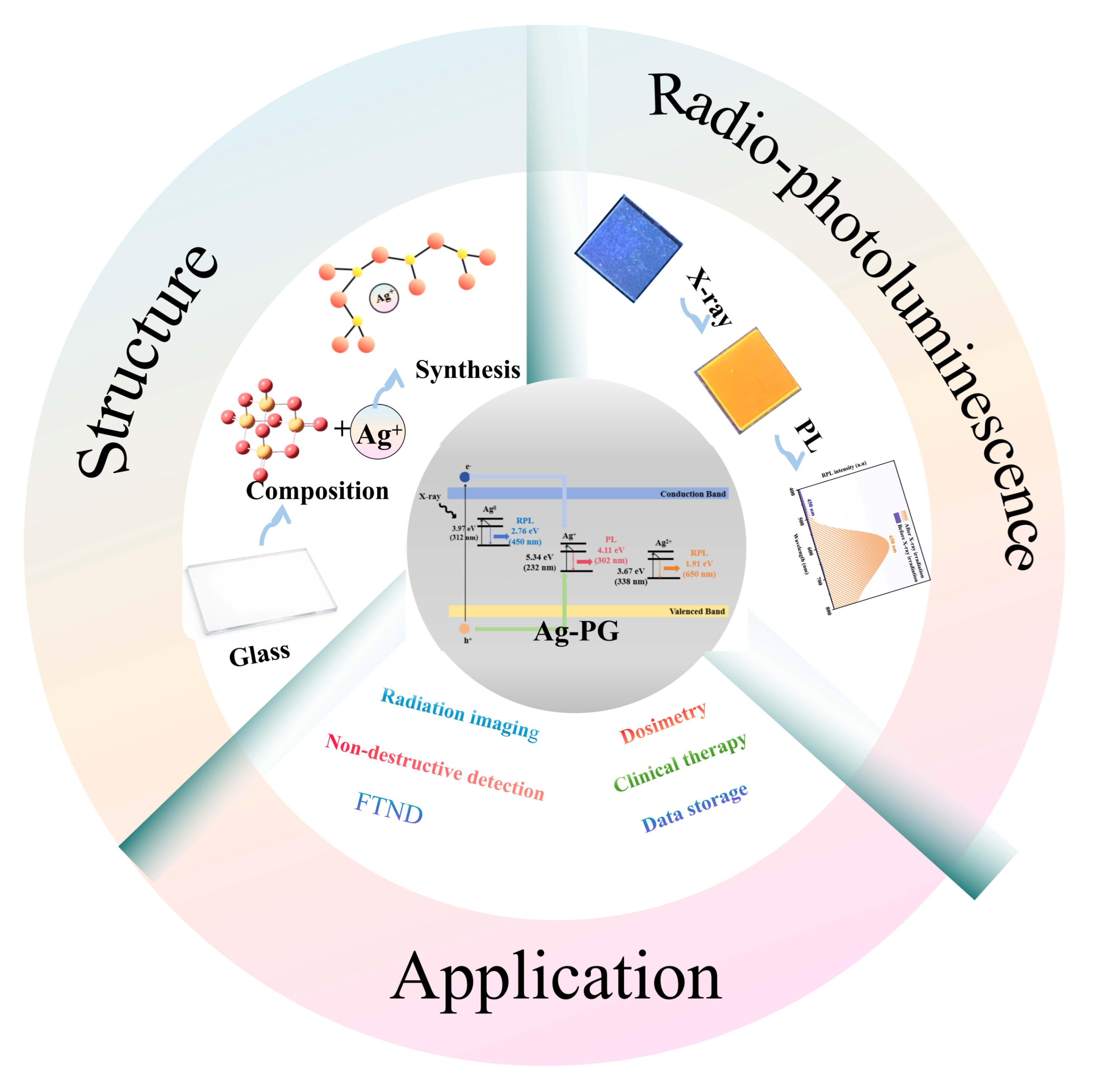
Ag-doped phosphate glass (Ag-PG) [14] is a typical RPL material. It uses a phosphate network as the host, with P–O–P linkages as the basic structural units. Silver ions are introduced to form luminescence centers, enabling radiation detection and imaging. As shown in Figure 1, Ag-PG exhibits excellent RPL performance. In recent studies, Ag-PG has demonstrated superior radiation sensitivity and high spatial resolution. It shows high sensitivity, a wide dose–response range, and submicron-resolution imaging capability. It also exhibits excellent thermal stability and tunable optical properties. These features make Ag-PG a promising candidate for high-dose radiation monitoring, submicron-resolution imaging, and rewritable radiation information storage. It provides a solid basis for the development of next-generation RPL materials [11].
Compared with Ag-PG, other reported RPL materials also show good radiation response, but clear gaps still remain in performance and applications. Among them, SrF2:Eu [15] is a representative RPL material. It exhibits excellent high-dose detection and imaging capability. The luminescent signal remains stable even above 5000 Gy, indicating strong radiation tolerance and high signal reliability. Its spatial resolution can reach 16.6 lp/mm [16]. However, it does not achieve the submicron resolution of Ag-PG. The Ca2BO3Cl:Eu [17] system shows a wide dose–response range of 1–3000 Gy and good linearity. Its borate chloride structure, composed of [BO3] units and Cl coordination, provides high chemical stability and mechanical strength. This ensures structural integrity and signal reproducibility under complex radiation conditions. However, its sensitivity and spatial resolution are still lower than those of Ag-PG. Silicate-based RPL materials, such as (Ba1−xSrx)2SiO4:Eu, also exhibit good dose linearity and stable information storage. In the range of 0–60 Gy, the signal shows a linear dependence on dose. The spatial resolution is about 4 lp/mm. The radiation-induced signal can be completely erased under 420 nm laser irradiation, enabling reversible readout and repeated use [12]. However, its dose range, sensitivity, and spatial resolution are inferior to those of Ag-PG. Its thermal stability and optical tunability are also weaker.
The research on this type of RPL glass can be traced back to the mid-20th century. Schulman J. H. et al. first reported the radiophotoluminescence phenomenon in silver-activated phosphate glass in 1951 and provided an initial dose–response range of 0.1–10 Gy [18]. On this basis, the Japanese industry promoted the engineering development of this material system. Nippon Electric Glass developed the SAPANS series RPL glasses and carried out systematic studies [19,20]. Subsequently, AGC (originating from early research at Toshiba) introduced the FD-7 glass dosimeter, enabling the commercialization of Ag-PG [21]. With the suppression of background noise and improvements in fabrication processes, the dose–response range of Ag-PG has been extended to 10 μGy–106 Gy. It has been widely applied in radiation imaging, neutron detection, fluorescent nuclear track detection, and medical irradiation [21]. At present, the most widely used Ag-PG system is commercial Ag-doped Na–Al phosphate glass (e.g., FD-7/GD450). Therefore, this work focuses on the structure and RPL properties of Na–Al/Ag phosphate glass. It also compares other Ag-PG systems, such as Li–Al/Ag compositions, to further demonstrate the broad application potential of Ag-PG in radiation detection.
This paper reviews the structure, physicochemical properties, RPL characteristics, and applications of Ag-PG, with particular emphasis on the differences in experimental results related to luminescence centers and fluorescence decay lifetimes. Finally, the advantages and limitations of Ag-PG in the RPL field are summarized, existing challenges and possible solutions are discussed, and future development prospects are outlined, providing insights for the advancement and application of Ag-PG in radiation detection and radiation imaging.

2. Preparation of Ag-PG

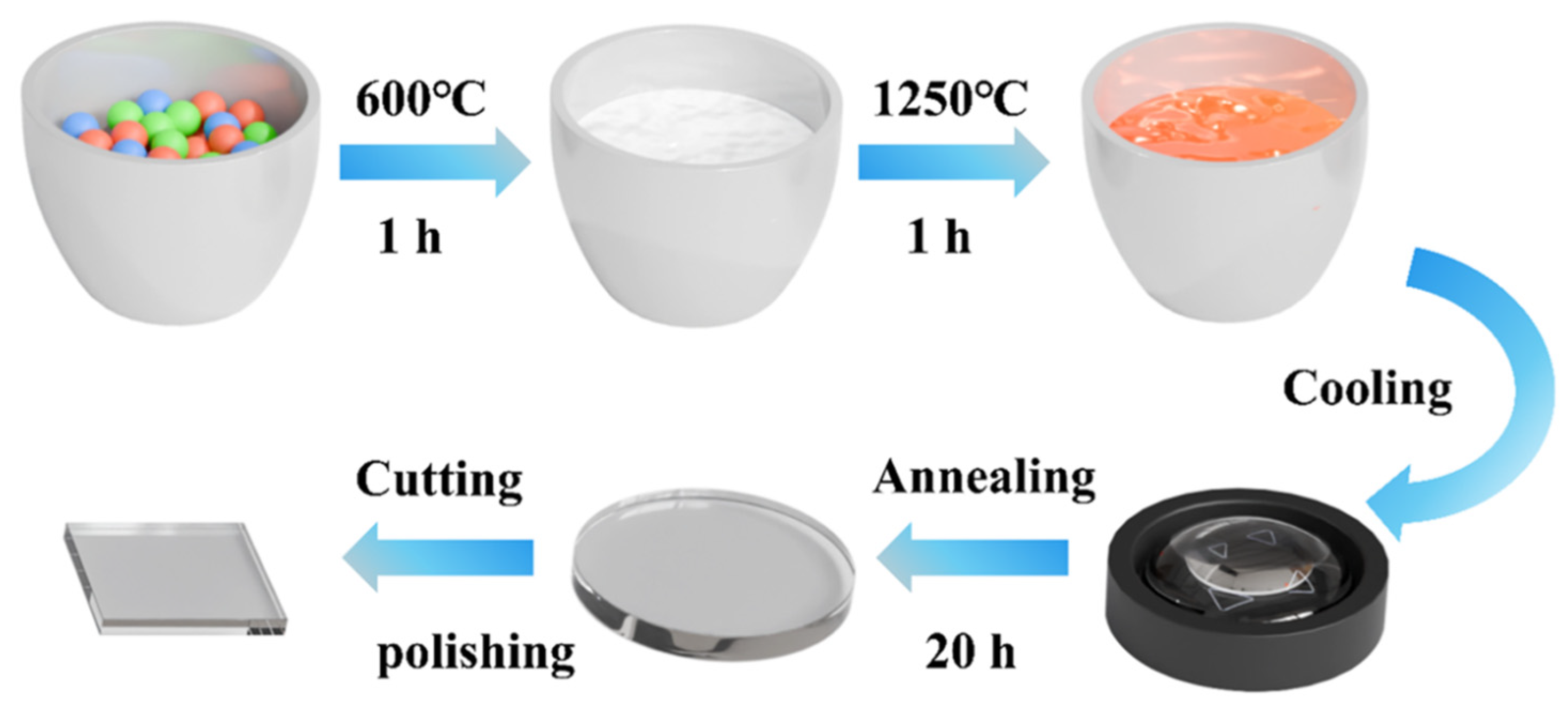
Ag-PG is typically based on phosphate networks such as NaPO3 and Al(PO3)3, with Ag ions acting as luminescence centers. Its preparation has evolved from melt–slow cooling to high-temperature melt quenching (Figure 2), and these methods lead to different material properties [11,22].
Melt-slow cooling is closer to thermodynamic equilibrium and allows the glass structure to relax. However, it may cause local ordering or even crystallization, which reduces optical uniformity and affects the radiation response [23]. In contrast, melt quenching is more widely used. It rapidly freezes the melt structure, suppresses crystallization, and forms a stable amorphous network. The defects retained during quenching can be converted into luminescence centers (Ag0 and Ag2+) under irradiation, which helps improve RPL sensitivity and signal stability [24]. A post-annealing process is usually applied to release internal stress.
In terms of composition, monovalent cations such as Na+ and Li+ are important for stable RPL performance [25]. The Na–Al/Ag system has good glass-forming ability, high structural stability, and strong luminescence efficiency. It also shows reliable signal storage and is widely used in commercial dosimeters such as FD-7 and GD450. The Li–Al/Ag system can improve carrier mobility, is beneficial for high-energy particle detection and has good RPL properties [26]. However, the high field strength and mobility of Li+ may increase internal stress and reduce structural stability [27]. It can also decrease the stability of luminescence centers, leading to lower luminescence efficiency compared with the Na–Al system.
Furthermore, the performance of Ag-PG can be tuned through composition modification. For example, adding Na2O or NaCl can adjust radiation sensitivity [28], introducing SiO2 can improve thermal stability [6], B doping enables neutron detection [29], and using a borate glass matrix can enhance stability under high radiation doses [30].

3. Results

3.1. Properties of Ag-PG

3.1.1. Structure of Phosphate Glass

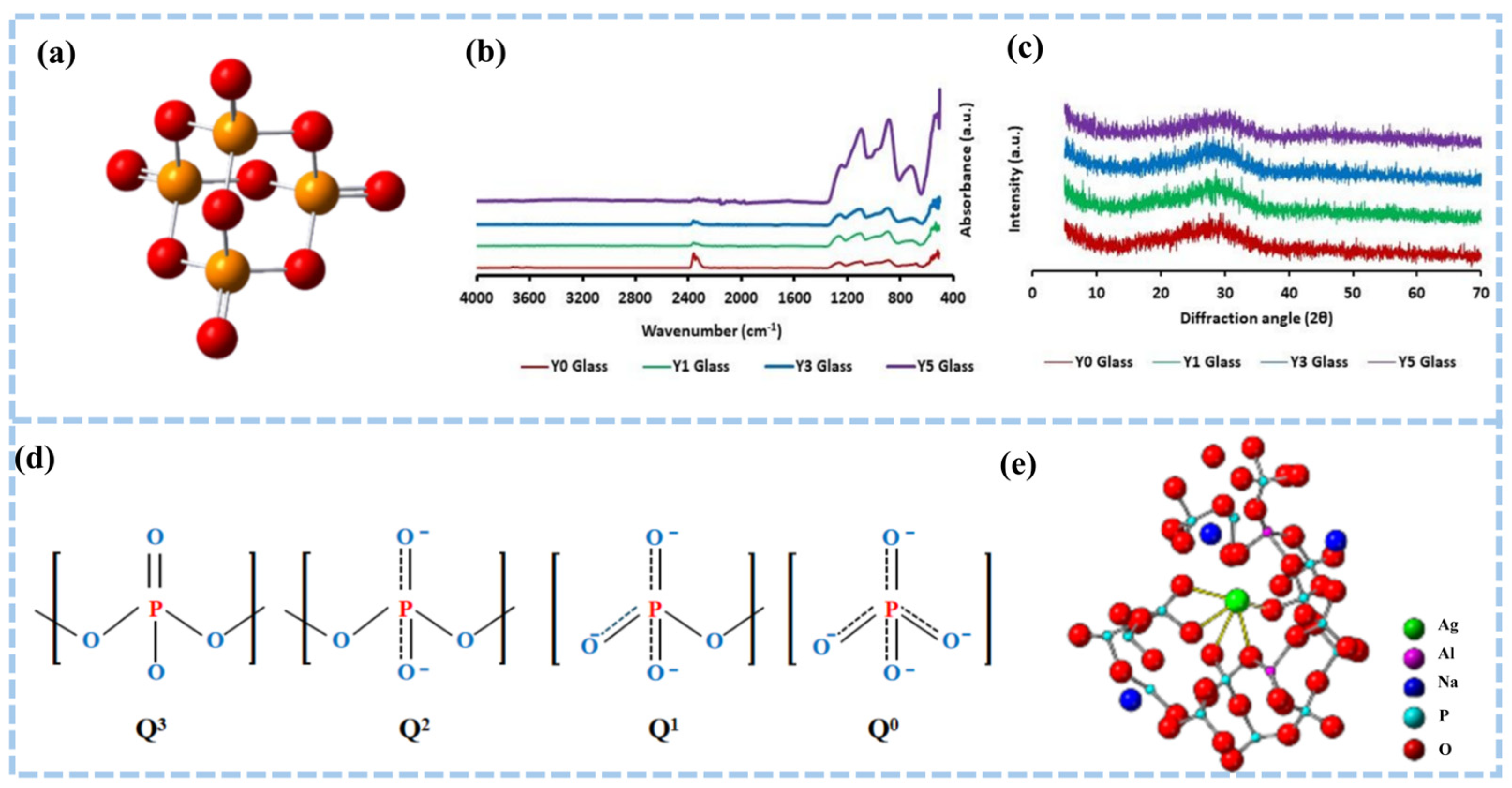
Phosphate glasses exhibit moderate glass transition temperature, low optical scattering, high refractive index and high thermal expansion coefficient [31,32,33,34]. They have wide application prospects in basic research and industrial production [34]. The structural unit of pure P2O5 glass is the P4O10 molecule [35]. Its network shows chain or layered structures, which are similar to the crystal structure of P4O10, but its stability is insufficient. The basic structural unit of phosphate glass is the [PO4]. The P=O double bond is the main reason for the chain or layered structure. Figure 3a shows the structure of P4O10 [36] (adapted from Molecular and biological activities of metal oxide-modified bioactive glass, by Tiama, T.M.; Elhaes, H.; Ibrahim, M.A.; et al., 2023. Licensed under CC BY 4.0.), the model molecule of phosphate glass. Its connection mode can be described by Qn units (n = 0–3). It is more important to focus on the polymerization degree of the glass network, rather than repeating traditional structural classification. The polymerization degree directly determines the content of non-bridging oxygen (NBO). NBO plays a key role in the formation of luminescence centers. Changing the NBO ratio and local structure can affect the formation efficiency of Ag-PG defect centers, and thus control the RPL intensity [28].
Figure 3b,c only illustrate the intrinsic structural characteristics of phosphate glass [37] (Reprinted from Yttrium-doped phosphate-based glasses: structural and degradation analyses, by Arafat, A.; Samad, S.A.; Titman, J.J.; et al., 2020. Licensed under CC BY 4.0.). Figure 3b shows the FTIR spectrum of phosphate glass [33]. These findings prove the coexistence of Q2 and Q1 units in phosphate glass, indicating a partially depolymerized network structure. Such a structure achieves a balanced performance between network rigidity and flexibility, which is conducive to the stabilization of defect states and the capture of charge carriers. Accordingly, these structural characteristics are essential for the formation and stabilization of Ag0 and Ag2+ luminescence centers in Ag-PG. Figure 3c presents the XRD patterns of phosphate glass [33]. Only broad diffuse diffraction peaks can be observed in the spectrum, with no sharp crystalline diffraction peaks. This result verifies the amorphous structure of Ag-PG. The intrinsic network structure of phosphate glass plays a vital regulatory role in the RPL properties of Ag-PG. The glass network exhibits excellent flexibility and is susceptible to structural polymerization. It can produce abundant non-bridging oxygen and adjustable local coordination environments, creating favorable conditions for the generation of RPL luminescence centers. Meanwhile, the introduction of alkali metal ions (Na+, Li+) can effectively adjust the charge compensation mechanism of the system and facilitate the uniform distribution of multivalent silver luminescence centers. Moreover, phosphate glass has high density and effective atomic number. It can enhance the absorption of radiation energy and further improve the capture efficiency of electron-hole pairs. Also, with increasing Al2O3 content, the proportion of Q3 units increases rapidly, while the concentration of Q2 units also increases initially and then gradually decreases after reaching a maximum value. This variation may be attributed to the significant reduction of Q1 groups with increasing Al2O3 content, thereby confirming the formation of new P-O-Al structural units.
The incorporation of modifying oxides (e.g., Na2O) into amorphous P2O5 disrupts bridging oxygens (BO) and generates NBO. This depolymerization of the phosphate network is as follows [38]:
2Qn + R2O → 2Qn−1
The variation law of Qn tetrahedron composition is presented in Figure 3d.
In Ag-PG, Ag exists in a distorted local coordination environment with an average Ag-O bond length of ~2.5 Å, and the first coordination shell exhibits considerable disorder. This local structure is recognized as a distorted octahedral or trigonal bipyramidal geometry. The Ag-O coordination numbers determined by first-principles calculations and classical methods are 5.42 and 5.54–5.71, respectively. Figure 3e (adapted from Combinatorial characterization of metastable luminous silver cations, by Masai, H.; Koshimizu, M.; Kawamoto, H.; et al., 2024. Licensed under CC BY 4.0.) [39] illustrates the atomic configuration surrounding Ag+ cations in FD-7 glass, where Ag+ is primarily coordinated with oxygen atoms in Q2 phosphate units.
Figure 3. Basic structure of Ag-PG: (a) Molecular structural model of phosphate glass represented by P4O10 [36]; (b) FTIR spectrum identifying Q1 and Q2 structural units and P–O–P/P=O vibration bands [37]; (c) XRD pattern showing broad diffuse peaks and the amorphous nature of Ag-PG [37]; (d) Schematic of Qn tetrahedral connection modes in phosphate glass networks; (e) Local atomic configuration around Ag+ cations in Ag-PG [39].
Materials 19 02204 g003

3.1.2. RPL Properties of Ag-PG

As the most widely used RPL material, Ag-PG has been applied since the 20th century and has undergone more than 50 years of development; in recent years, it has attracted extensive attention in the fields of high-sensitivity, high-dose radiation detection and radiation imaging.
Upon exposure to high-energy rays (X-rays, β-rays) and high-energy particle irradiation, Ag-PG can emit orange light in the range of 600–700 nm under ultraviolet excitation at 310–385 nm. The typical Ag content in the Na–Al/Ag system of Ag-PG is approximately 0.1 wt%. At this doping concentration, silver ions are mainly dispersed in the glass network in the form of free Ag+. Under X-ray irradiation, abundant electron-hole pairs are generated. The released electrons are captured by Ag+ to form Ag0 luminescence centers. Meanwhile, the holes are initially trapped by PO43− to form phosphorus oxygen hole centers (PHOCs), which further migrate and combine with Ag+ to produce Ag2+ centers. Consequently, both Ag0 and Ag2+ act as the dominant luminescence centers of Ag-PG. Among them, Ag2+ contributes much stronger luminescence intensity, which fundamentally accounts for the orange emission of Ag-PG under excitation [40].
As summarized in Table 1, after X-ray irradiation, most Ag-PG samples exhibit two typical emission bands in the range of 400–800 nm under excitation at 310–390 nm. The blue emission peak near 450 nm corresponds to Ag0 centers, with characteristic excitation peaks around 270 nm and 340 nm. The broad orange emission band located at 630 ± 35 nm is assigned to Ag cluster-like centers, whose excitation bands are mainly concentrated in the 310–385 nm. In terms of the inconsistent emission peaks at 560 nm and 650 nm reported in previous studies, it should be emphasized that the Ag-PG systems adopted in this work are based on commercially standardized compositions. Their main network components and Ag doping concentrations are confined within a stable processing window, which greatly reduces the possibility of systematic peak shifts caused by intrinsic material composition. In this context, the obvious spectral difference between 560 nm and 650 nm is primarily attributed to the comprehensive response deviation of different spectral measurement systems, including the non-uniform wavelength dependence of grating diffraction efficiency, the uneven quantum efficiency distribution of detectors (PMT, CCD and other devices), and the differences in optical filters and integral modes in various experimental setups [40]. Without systematic correction of spectral response functions, these factors will induce significant offsets and apparent shape reconstruction of emission peaks.
In addition, Table 1 also confirms the existence of Ag ion polymers in the glass matrix, among which Ag2+ dimers serve as critical luminescence centers. The combination of Ag+ and Ag0 can form Ag2+ orange luminescence centers at 650 nm and further evolve into Agmn+ polymer centers. In summary, the emission peak at 450 nm originates from Ag0 centers, while the luminescence signal near 650 nm is jointly contributed by Ag2+ and partial Agmn+ polymer centers.
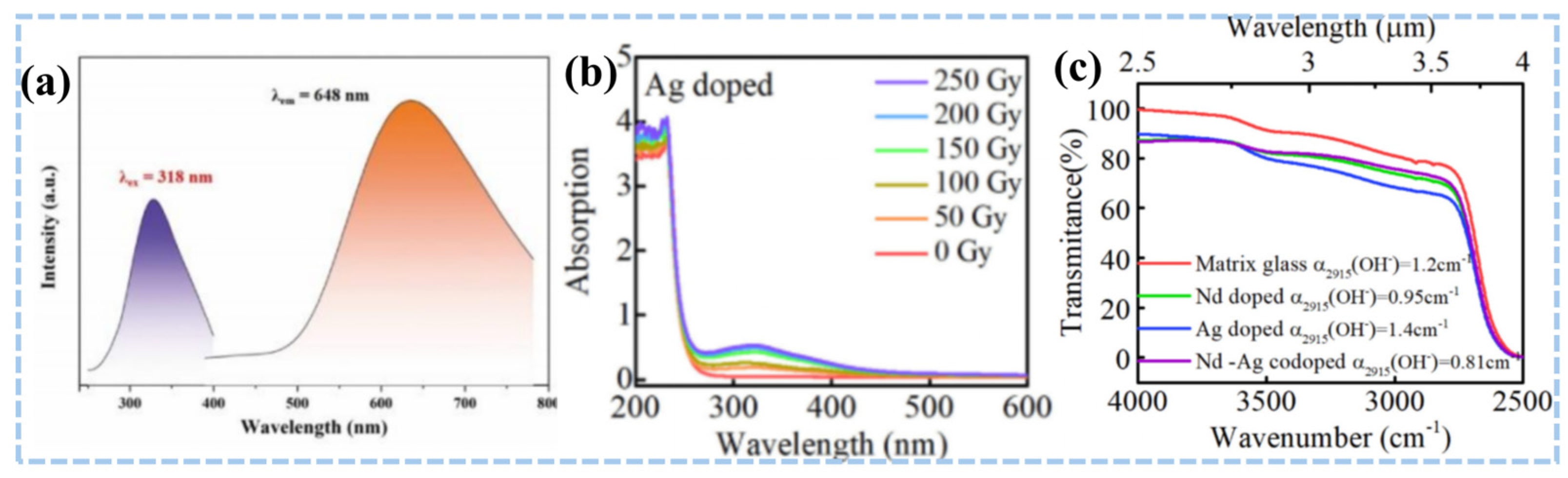
As shown in Figure 4a [50] (reprinted from Large-size flexible X-ray imaging and information encryption storage based on radio-photoluminescence, by Meng, G.; Li, N.; Wei, Y.; et al., 2026. Licensed under CC BY 4.0.), the emission spectrum of Ag-PG exhibits a blue emission peak at 450 nm attributed to Ag0 centers and an orange emission peak at 648 nm attributed to Ag2+ centers. As shown in Figure 4b [2], irradiated Ag-PG exhibits a distinct absorption peak centered at 310 nm, and its intensity gradually increases with the radiation dose, confirming the formation of UV-absorbing luminescence centers induced by irradiation. After Gaussian fitting, the induced absorption spectrum mainly contains three peaks: the band near 3.35 eV (370 nm) is assigned to Ag0 centers, while the bands at about 3.87 eV (320 nm) and 4.30 eV (288 nm) correspond to Ag2+ centers. Under irradiation, Ag+ ions capture electrons or holes to form stable Ag0 and Ag2+ luminescence centers, which can be eliminated only by annealing at 400 °C for 1 h. Figure 4c presents the infrared transmittance spectra of unirradiated Ag-PG [2]. Characteristic absorption bands near 3500 and 3000 cm−1 correspond to OH stretching vibrations. The OH absorption coefficient α(OH) was calculated using α(OH) = log(T0/T)/L. The α(OH) values of the four samples are 1.2, 0.95, 1.4, and 0.81 cm−1, all below 1.5 cm−1, demonstrating efficient dehydration and negligible nonradiative quenching. Thus, the measured fluorescence lifetimes of Ag-related defect centers reliably reflect the intrinsic matrix effect. Figure 4b,c are reprinted from Silver-Neodymium Codoped Lithium Aluminum Metaphosphate Glasses for Radio-Photoluminescence Dosimeter, by Ma, X.; Cheng, J.; Fan, S.; et al., 2022. Licensed under CC BY 4.0.
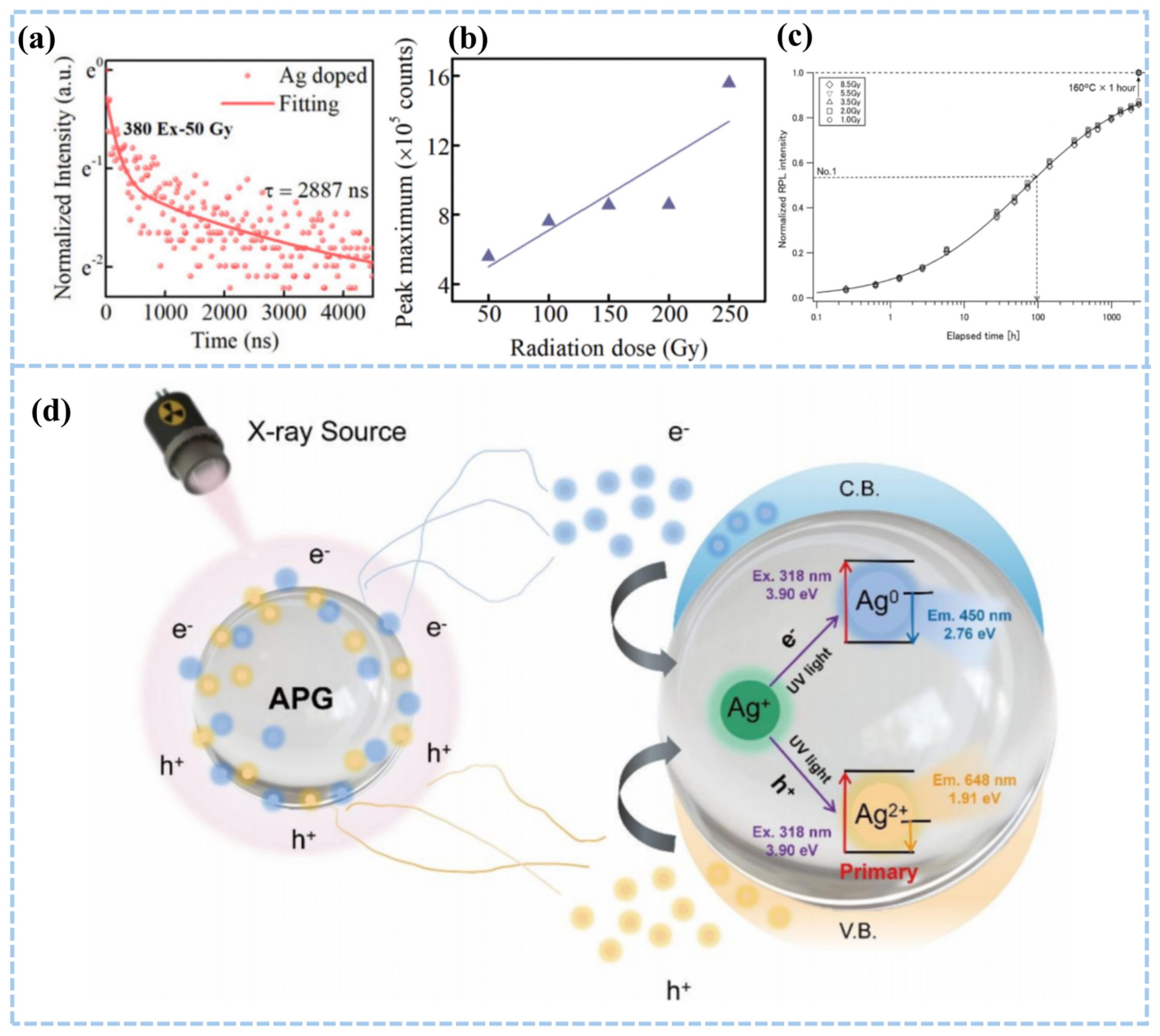
Figure 5a shows the photoluminescence decay curves [2] (reprinted from Silver-Neodymium Codoped Lithium Aluminum Metaphosphate Glasses for Radio-Photoluminescence Dosimeter, by Ma, X.; Cheng, J.; Fan, S.; et al., 2022. Licensed under CC BY 4.0.). After irradiation, the decay lifetime corresponding to emissions at 650 nm is 2887 ns. Figure 5b presents the correlation between the maximum RPL intensity of Ag-related defect centers at 650 nm and the radiation dose in Ag-doped phosphate glasses [2] (reprinted from Silver-Neodymium Codoped Lithium Aluminum Metaphosphate Glasses for Radio-Photoluminescence Dosimeter, by Ma, X.; Cheng, J.; Fan, S.; et al., 2022. Licensed under CC BY 4.0.). As observed, the RPL peak intensity exhibits a weak dose-dependent fluorescence response. A good linear relationship between RPL intensity and dose is obtained in the range of 0–100 Gy. This linearity degrades at higher doses owing to the variation of the optical absorption coefficient, which requires signal correction in the high-dose region. The luminescence center intensity gradually increases with radiation exposure and finally reaches saturation under certain conditions, demonstrating a typical buildup effect [22]. At room temperature, this effect usually lasts for several hours [51] and can be accelerated by thermal treatment. As shown in Figure 5c, heating at 160 °C for 1 h promotes the saturation of RPL intensity [52] (reprinted from Estimation of elapsed time after an unnoticed radiation exposure using weathering-resistant RPL glass (SAPANS), by Yasuda, H.; Gonzales, C.A.B.; Aghabaklooei, S., 2023. Licensed under CC BY 4.0.). Figure 5d schematically illustrates the RPL process of Ag-PG [51] (reprinted from Large-size flexible X-ray imaging and information encryption storage based on radio-photoluminescence, by Meng, G.; Li, N.; Wei, Y.; et al., 2026. Licensed under CC BY 4.0.). When the incident ionizing radiation energy exceeds the bandgap of Ag-PG, electrons are excited from the valence band to the conduction band, generating electron-hole pairs. Electrons are captured by Ag+ to form Ag0, while holes are initially trapped by PO43− tetrahedra and then transferred to Ag0 through thermal release to form Ag2+. Under ultraviolet excitation, Ag0 and Ag2+ centers emit blue light (~450 nm) and orange light (~648 nm), respectively.
Table 2 shows that the decay times of Ag-PG are systematically analyzed. The decay time of Ag0 centers is generally shorter than 4.5 ns, typically ranging from 1 to 4.5 ns [47]. In contrast, the decay time of Ag2+ centers is more complex and strongly dependent on the local coordination environment and host glass structure. Previous studies have classified Ag2+ related emission lifetimes into three categories: a fast component (<2 μs), an intermediate component (2–10 μs), and a long-lived component (>20 μs) [42]. This result suggests that Ag2+ does not correspond to a single uniform luminescence center, but a group of structurally distinct species. Some studies assign a dominant lifetime of ~2 μs to isolated Ag2+ ions [53] ions in orange-emitting centers with stronger interactions with the glass network [44]. These differences are mainly caused by variations in glass composition, Ag concentration, defect structures, and local coordination symmetry, all of which significantly affect the radiative relaxation pathways of Ag2+ centers. In this work, Ag2+ emission is therefore regarded as a multi-component decay process rather than a single fixed lifetime.

3.2. Applications of Ag-PG

3.2.1. Radiation Dose

A radiation dosimeter [56] is an instrument for measuring and evaluating ionizing radiation dose. Based on the response mode, dosimeters are divided into active [57] and passive types [58]. Active dosimeters convert radiation into electrical signal pulses, allowing the determination of radiation type and intensity from signal characteristics. In contrast, passive dosimeters store radiation information through interactions with sensitive media, which is then read out via physical stimulation; they are widely used for cumulative dose monitoring. According to luminescence mechanisms, luminescence-based dosimeters include thermally stimulated dosimeters (TLD), optically stimulated luminescence dosimeters (OSLD), and RPL glass dosimeters (RPLGD). In these systems, part of the absorbed radiation energy is stored in metastable states and later released as visible emission under external stimuli (e.g., heating or optical excitation). RPLGD is an integrating solid-state dosimeter based on Ag-PG. After ionizing radiation exposure, dose information is read out through orange emission under UV excitation.
Ag-PG exhibits favorable annealing recyclability. Annealing at 400 °C for 2 h can eliminate luminescence centers and restore it to the initial state, which enables recycled use without irreversible damage. Ag-PG exhibits excellent dose–response behavior at high doses. A linear response is observed from low to medium doses (<~4 kGy), followed by saturation and nonlinear/decay behavior in the ~4–10 kGy range due to competition between center formation and annihilation [49].
Ag-PG can be fabricated into a 3D-printed ear model [13]; its irradiated regions emit visible orange light under UV excitation, which enables spatial dose mapping. The RPL signal is visually detectable at doses as low as 500 mGy, and approximate dose distributions can be extracted via image processing even for complex geometries. Microspherical glass dosimeters (~0.1 mm) fabricated from Ag-PG can be dispersed over contaminated surfaces, and their spatial RPL distribution under UV illumination allows rapid visualization of radiation fields, providing a practical method for post-accident monitoring. Under a constant γ-ray dose, the RPL intensity of Ag-PG depends on the content of natural LiPO3, and it is found that the Ag-PG response to γ-rays degrades with increasing Li content [59]. In contrast, under a constant neutron fluence, the RPL intensity increases with increasing natural LiPO3 content, which significantly enhances the sensitivity to thermal neutrons. These results confirm the potential of Ag-PG for neutron detection [59]. Studies on the response of Ag-PG to α-particle irradiation demonstrate that its luminescence properties vary significantly with radiation types, including low-LET X-rays and high-LET α-particles. Such differences are reflected in the varied intensity ratio between blue and orange emission, which reveals the distinct LET dependence of the Ag-PG system. This finding provides a fundamental reference for the application of Ag-PG in radiation type discrimination and high-energy particle detection [60].

3.2.2. Radiation Imaging

The mainstream X-ray imaging materials currently include films and scintillators. Although both can achieve micrometer-scale spatial resolution, each has inherent limitations. While films can provide high spatial resolution, their discontinuous structure arising from emulsion grains leads to a nonlinear response and inconsistent quantitative calibration, making precise data analysis difficult; moreover, the offline readout process further reduces experimental efficiency [61,62]. Scintillation materials generate visible light signals instantaneously under irradiation, which can be read out in real time through optical systems. The scintillation emission originates directly from radiation energy deposition within the material, and the emission distribution is closely correlated with the energy deposition region. However, in practical imaging processes, carrier diffusion within the scintillator and lateral propagation of scintillation photons are unavoidable, often leading to optical crosstalk between adjacent regions and thereby degrading spatial resolution [63]. Owing to its excellent radiation stability and visible emission under ultraviolet excitation, Ag-PG has been further explored for applications in radiation imaging. Compared with conventional scintillator materials, Ag-PG, as a typical storage-type RPL material, is limited by its inability to realize real-time X-ray imaging. This is because signal readout requires subsequent optical stimulation instead of immediate light emission upon irradiation, so it lacks the instantaneous response of scintillators. In addition, its imaging process depends on a scanning-based readout system. This increases system complexity and leads to poor temporal resolution, rendering Ag-PG unsuitable for dynamic or high-speed imaging applications.
Yucheng Li et al. [11] applied Ag-PG to biological imaging and industrial non-destructive testing. Specifically, Ag-PG was used to obtain the X-ray image of a small fish (~70 mm in length), where the head, thorax, and tail structures are clearly resolved. Benefiting from the excellent microscale spatial resolution of Ag-PG, fine features including cranial bones, spine, and dorsal fin are distinctly visualized. Even subtle differences between soft tissues and bones, as well as low-contrast tail fin structures, can be clearly distinguished, demonstrating the great potential of Ag-PG for biological imaging. In addition, radiation images recorded in Ag-PG can be stably stored at room temperature for more than 300 days and erased by annealing at 400 °C for 2 h, allowing repeated use of the material. A disk-type X-ray imaging detector composed of Ag-PG and a LiF film was developed by Kurobori et al. [43] for diagnostic dosimetry and radiotherapy. The detector exhibits high spatial resolution, a wide dynamic range of eight orders of magnitude, and non-destructive readout capability, enabling dose imaging from low to high radiation levels, especially for X-ray and γ-ray imaging in clinical and diagnostic scenarios. A two-dimensional reconstructed dose distribution can be obtained using this rotating disk detector (2400 rpm) under 3 Gy X-ray irradiation with the same mask [64]. By integrating images collected at different depths (surface, 100, 200, 300, and 400 μm) with a confocal detection system equipped with a 0.90 NA objective (working distance: 1 mm), the three-dimensional dose distribution stored in the transparent detector can be reconstructed. In terms of industrial non-destructive testing, Nanto et al. [65] realized X-ray visualization of internal structures in integrated circuits (ICs) based on the RPL effect of Ag-PG.
The X-ray imaging setup for Ag-PG involves X-rays passing through a square-hole metal mesh and irradiating the Ag-PG, which records the corresponding structural image [11]. The stored image is then read out by a fluorescence microscope under 355 nm UV excitation and detected by a CCD with a physical pixel size of 15.6 μm [11]. Post-irradiation imaging results and spatial resolution measurements indicate that Ag-PG achieves a resolution of 10 lp/mm [66]. Furthermore, the modulation transfer function (MTF) curve shows that the spatial frequency reaches 730 lp/mm at MTF = 0.2 [11]. To further verify its high-resolution performance, Ag-PG has been shown to realize submicron spatial resolution (~0.7 μm) [11], confirming its superior ability in high-resolution imaging and promising potential in precision medical imaging. In addition, Ag-PG exhibits excellent stability: X-ray image information can still be read repeatedly after 300 days without degradation in spatial resolution [11].

4. Conclusions

Ag-PG, as one part of RPL materials, displays outstanding competitiveness in high-precision radiation detection and high-resolution imaging. The phosphate network provides flexible coordination environments and abundant non-bridging oxygen sites, which favor the generation and stabilization of Ag0 and Ag2+ luminescence centers. Benefiting from its unique structure, Ag-PG achieves a wide linear dose–response range, high radiation sensitivity, submicron spatial resolution, and repeatable write-erase-rewrite performance through thermal annealing. These merits enable its practical applications in radiation dosimetry, 2D/3D dose mapping, biological imaging, and industrial non-destructive testing, filling the application gaps of traditional scintillators, OSL, and TSL materials in stable storage and non-destructive repeated readout.
To address these limitations, future research should focus on four key directions: (i) optimization of fabrication processes, including melt–quenching and atmosphere control, as well as the introduction of gradient annealing and flux doping to eliminate bubble defects, reduce internal stress, and improve yield and mechanical stability; (ii) matrix modification through metal oxide doping and network modifier engineering to enhance chemical durability and suppress Ag ion aggregation and signal degradation; (iii) advanced characterization using synchrotron radiation and time-resolved spectroscopy, combined with first-principles simulations, to elucidate the evolution of luminescence centers and RPL mechanisms; (iv) expansion toward application-oriented developments, including integration into miniaturized and flexible detector platforms; and (v) exploring composition tuning and multi-element co-doping strategies to further enhance radiation sensitivity, extend the linear dose range, and realize multi-type radiation discrimination. With continued advances, high-performance Ag-PG is expected to be further developed and widely applied in advanced medical imaging, micro/nanoscale radiation detection, and non-destructive testing in the nuclear industry, thereby promoting the evolution of radiation detection technologies toward higher precision, reusability, and visualization.

Author Contributions

Conceptualization, M.G. and Y.P.; writing, M.G.; methodology, X.Y. and Y.H.; formal analysis, D.Z. and Y.C.; investigation, N.L.; Editing, K.R., Q.L. and J.Z.; supervision, Q.L. and J.Z. All authors have read and agreed to the published version of the manuscript.

Funding

This work was financially supported by the National Natural Science Foundation of China (Grant Nos. 12475311, 12375209, 12075221, 12035002, 11905122, and 23-GJRC-01-02), the Innovation and Development Fund of China Academy of Engineering Physics (Grant No. CX20210019), the National Natural Science Foundation Major Scientific Research Instrument Development Project (Grant No. 12127810), and the Central Government Guided Local Science and Technology Development Fund Project (Grant No. ZY22096009). This work was supported by Taizhou Baoduo Perception Technology Co., Ltd.

Data Availability Statement

No new data were created or analyzed in this study. Data sharing is not applicable to this article.

Conflicts of Interest

The authors declare that this study received funding from Taizhou Baoduo Company. The funder was not involved in the study design, collection, analysis, or interpretation of data, the writing of this article, or the decision to submit it for publication.

References

  1. Ren, J.R.; Deng, Z.G.; Qi, W.; Chen, B.Z.; Ma, B.B.; Wang, X.; Yin, S.; Feng, J.H.; Liu, W.; Xu, Z.F.; et al. Observation of a high degree of stopping for laser-accelerated intense proton beams in dense ionized matter. Nat. Commun. 2020, 11, 5157. [Google Scholar] [CrossRef]
  2. Ma, X.; Cheng, J.; Fan, S.; Wang, X.; Chen, W.; Chen, S.; Hu, L. Silver-neodymium codoped lithium aluminum metaphosphate glasses for radio-photoluminescence dosimeter. Materials 2022, 15, 5527. [Google Scholar] [CrossRef]
  3. Koshimizu, M. Tissue-equivalent radiophotoluminescence dosimetry materials based on production of luminescent molecules via radiation chemical reactions. Radiat. Meas. 2024, 176, 107222. [Google Scholar] [CrossRef]
  4. Tie, S.; Dong, S.; Yuan, R.; Cai, B.; Zhu, J.; Zheng, X. Halide perovskites for sensitive, stable and scalable X-ray detection and imaging. Chem. Commun. 2023, 59, 5016–5029. [Google Scholar] [CrossRef]
  5. Li, S.; Xie, X.; Xiong, J.; Wang, F.; Liu, J.; Jiang, M. Review: Perovskite X-ray detectors (1997–present). Crystals 2022, 12, 1563. [Google Scholar] [CrossRef]
  6. Yasuda, H.; Kawamoto, H.; Asai, K.; Koguchi, Y. Preliminary analyses of radiophotoluminescence centers in a recently developed Ag-doped alkali-phosphate glass (SAPANS). Radiat. Meas. 2024, 174, 107049. [Google Scholar] [CrossRef]
  7. Li, Q.L.; Li, N.X.; Li, Y.C.; Liu, S.Y.; Cheng, S.; Yang, G.; Ren, K.; Wang, F.; Zhao, J.T. Research progress of radio-photoluminescence materials and their applications. J. Inorg. Mater. 2023, 38, 731–749. [Google Scholar] [CrossRef]
  8. Christensen, J.B.; Bossin, L.; Muñoz, I.D.; Stengl, C.; Vedelago, J.; Yukihara, E.G. Optically stimulated luminescence detectors for LET determination and dosimetry in ion beam therapy. Radiat. Meas. 2024, 177, 107240. [Google Scholar] [CrossRef]
  9. Rim, S.Y.; Nishikawa, A.; Kato, T.; Nakauchi, D.; Kawaguchi, N.; Yanagida, T. Photoluminescence and thermally stimulated luminescence properties of Tb-doped Li2O–B2O3–SiO2 glasses. Radiat. Phys. Chem. 2025, 229, 111073. [Google Scholar] [CrossRef]
  10. Yukihara, E.G.; Assenmacher, F. Performance of a radiophotoluminescence (RPL) system in environmental and area monitoring. Radiat. Meas. 2021, 140, 106503. [Google Scholar] [CrossRef]
  11. Li, Y.C.; Ren, K.; Cheng, S.; Hu, Y.; Yang, X.C.; Hao, S.; Liu, S.Y.; Li, N.X.; Xu, Z.; Feng, H.; et al. Storage and encryption of submicron spatial resolution X-ray images based on Ag-doped phosphate glass. J. Alloys Compd. 2023, 958, 170388. [Google Scholar] [CrossRef]
  12. Yang, Z.T.; Hu, J.Q.; van der Heggen, D.; Feng, A.; Hu, H.; Vrielinck, H.; Smet, P.F.; Poelman, D. Realizing simultaneous X-ray imaging and dosimetry using phosphor-based detectors with high memory stability and convenient readout process. Adv. Funct. Mater. 2022, 32, 2201684. [Google Scholar] [CrossRef]
  13. Yamamoto, T.; Yanagida-Miyamoto, Y.; Iida, T.; Nanto, H. Current status and future prospect of RPL glass dosimeter. Radiat. Meas. 2020, 136, 106386. [Google Scholar] [CrossRef]
  14. Kurobori, T.; Miyamoto, Y.; Takashima, N.; Kitagawa, Y.; Koguchi, Y. Characterisation and unique behaviours of radiophotoluminescence Ag-activated phosphate glass under high-dose gamma and high-LET particle irradiation. Radiat. Meas. 2025, 181, 107376. [Google Scholar] [CrossRef]
  15. Li, Y.C.; Yang, X.C.; Ren, K.; Liu, Y.L.; Xu, Z.; Feng, H.; Deng, K.L.; Deng, B.; Shang, W.L.; Dong, J.J.; et al. Flexible X-ray imaging and stable information storage of SrF2:Eu based on radio-photoluminescence. ACS Appl. Mater. Interfaces 2024, 16, 58827–58837. [Google Scholar] [CrossRef]
  16. Zhang, J.; Li, X.; Zeng, W.; Liu, D.Y.; Lu, L.; Dai, H.; Yuan, J.H.; Shao, J.X.; Liu, Z.C.; Yu, J.; et al. Valence regulation in europium-doped fluoride phosphor for high-resolution X-ray time-lapse imaging. J. Mater. Chem. C 2024, 12, 7580–7587. [Google Scholar] [CrossRef]
  17. Wauke, T.; Kawano, N.; Kato, T.; Takebuchi, Y.; Fukushima, H.; Okada, G.; Yanagida, T. Dosimetric properties of Eu-doped Ca2BO3Cl. Nucl. Instrum. Methods Phys. Res. B 2024, 548, 165123. [Google Scholar] [CrossRef]
  18. Schulman, J.H.; Ginther, R.J.; Klick, C.C.; Alger, R.S.; Levy, R.A. Dosimetry of X-rays and gamma-rays by radiophotoluminescence. J. Appl. Phys. 1951, 22, 1749–1787. [Google Scholar] [CrossRef]
  19. Iwao, M.; Takase, H.; Shiratori, D.; Nakauchi, D.; Kato, T.; Kawaguchi, N.; Yanagida, T. Ag-doped phosphate glass with high weathering resistance for RPL dosimeter. Radiat. Meas. 2020, 134, 106315. [Google Scholar] [CrossRef]
  20. Nippon Electric Glass Co., Ltd. SAPANS RPL Glass Dosimeter Technical Report; Nippon Electric Glass Co., Ltd.: Otsu, Japan, 2021. [Google Scholar]
  21. Yokota, Y.; Nakajima, T. Radiophotoluminescence of silver-activated phosphate glass and its application to dosimetry. Health Phys. 1965, 11, 593–600. [Google Scholar]
  22. Sato, F.; Zushi, N.; Maekawa, T.; Kato, Y.; Murata, I.; Shimizu, K.; Yamamoto, T.; Iida, T. Visualization of high radiation field by radiophotoluminescence photography. Radiat. Meas. 2014, 68, 23–30. [Google Scholar] [CrossRef][Green Version]
  23. Zanotto, E.D.; Mauro, J.C. The glassy state of matter: Its definition and ultimate fate. J. Non-Cryst. Solids 2017, 471, 490–495. [Google Scholar] [CrossRef]
  24. Greaves, G.N.; Sen, S. Inorganic glasses, glass-forming liquids and amorphizing solids. Adv. Phys. 2007, 56, 1–166. [Google Scholar] [CrossRef]
  25. Tanaka, H.; Fujimoto, Y.; Koshimizu, M.; Yanagida, T.; Yahaba, T.; Saeki, K.; Asai, K. Radiophotoluminescence properties of Ag-doped phosphate glasses. Radiat. Meas. 2016, 94, 73–77. [Google Scholar] [CrossRef]
  26. Miyamoto, Y.; Takei, Y.; Nanto, H.; Koguchi, Y.; Kurobori, T. Radiophotoluminescence and thermally-stimulated luminescence of Ag-doped Li3PO4-Al(PO3)3 glass. Radiat. Meas. 2011, 46, 1480–1483. [Google Scholar] [CrossRef]
  27. Rim, Y.H.; Baek, C.G.; Yang, Y.S. Characterization of ionic transport in Li2O–P2O5-based glasses. Materials 2022, 15, 8176. [Google Scholar] [CrossRef]
  28. Cho, J.Y.; Jeong, D.W.; Anjum, F.; Kothan, S.; Kaewkhao, J.; Kim, H.J. Enhanced radiophotoluminescence in silver-doped phosphate glasses with glass network modifiers. J. Lumin. 2025, 288, 121515. [Google Scholar] [CrossRef]
  29. Yamamoto, T.; Maki, D.; Sato, F.; Miyamoto, Y.; Nanto, H.; Iida, T. The recent investigations of radiophotoluminescence and its application. Radiat. Meas. 2011, 46, 1554–1559. [Google Scholar] [CrossRef]
  30. Kawamoto, H.; Fujimoto, Y.; Asai, K. Ag concentration dependence of the radiophotoluminescence properties in Ag-doped Na–Al borate glasses. Radiat. Phys. Chem. 2025, 234, 112769. [Google Scholar] [CrossRef]
  31. Kaser, S.; Guérineau, T.; Strutynski, C.; Zaki, R.; Dussauze, M.; Durand, E.; Messaddeq, S.H.; Danto, S.; Messaddeq, Y.; Cardinal, T. Novel optical amorphous phosphate materials with a low melting temperature. Mater. Adv. 2022, 3, 4600–4607. [Google Scholar] [CrossRef]
  32. Liu, Z.; Xu, X.; Zhao, J.; Zheng, T.; Guo, Y.; Lv, J. Optical properties of CuO-doped phosphate glass for near-infrared cut filters. Ceram. Int. 2025, 51, 9713–9721. [Google Scholar] [CrossRef]
  33. Li, B.Y.; Zhou, G.D. Preparation of phosphate glass by the conventional and microwave melt-quenching methods and research on its performance. Materials 2025, 18, 1079. [Google Scholar] [CrossRef] [PubMed]
  34. Li, H.J.; Yi, J.H.; Qin, Z.; Sun, Z.H.; Xu, Y.; Wang, C.J.; Zhao, F.Q.; Hao, Y.C.; Liang, X.F. Structures, thermal expansion, chemical stability and crystallization behavior of phosphate-based glasses influenced by rare earths. J. Non-Cryst. Solids 2019, 522, 119602. [Google Scholar] [CrossRef]
  35. Liang, J.Y.; Ma, K.; Zhao, X.; Lu, G.Y.; Riffle, J.; Andrei, C.M.; Dong, C.Y.; Furkan, T.; Rajabpour, S.; Prabhakar, R.R.; et al. Elucidating the mechanism of large phosphate molecule intercalation through graphene-substrate heterointerfaces. ACS Appl. Mater. Interfaces 2023, 15, 47649–47660. [Google Scholar] [CrossRef]
  36. Tiama, T.M.; Elhaes, H.; Ibrahim, M.A.; Refaat, A.; El-Mansy, M.A.M.; Sabry, N.M. Molecular and biological activities of metal oxide-modified bioactive glass. Sci. Rep. 2023, 13, 11652. [Google Scholar] [CrossRef]
  37. Arafat, A.; Samad, S.A.; Titman, J.J.; Lewis, A.L.; Barney, E.R.; Ahmed, I. Yttrium doped phosphate-based glasses: Structural and degradation analyses. Biomed. Glas. 2020, 6, 34–49. [Google Scholar] [CrossRef]
  38. Brow, R.K. Review: The structure of simple phosphate glasses. J. Non-Cryst. Solids 2000, 263–264, 1–28. [Google Scholar] [CrossRef]
  39. Masai, H.; Koshimizu, M.; Kawamoto, H.; Ono, Y.; Naito, T.; Asakura, K. Combinatorial characterization of metastable luminous silver cations. Sci. Rep. 2024, 14, 4638. [Google Scholar] [CrossRef]
  40. McKeever, S.W.S.; Sholom, S.; Shrestha, N. Observations regarding the build-up effect in radiophotoluminescence of silver-doped phosphate glasses. Radiat. Meas. 2019, 123, 13–20. [Google Scholar] [CrossRef]
  41. Sholom, S.; McKeever, S.W.S. Silver molecular clusters and the properties of radiophotoluminescence of alkali-phosphate glasses at high dose. Radiat. Meas. 2023, 163, 106768. [Google Scholar] [CrossRef]
  42. Sato, F.; Zushi, N.; Sakiyama, T.; Murata, I.; Kato, Y. Radiophotoluminescence light scope for high-dose dosimetry. Radiat. Meas. 2015, 82, 88–92. [Google Scholar] [CrossRef][Green Version]
  43. Kurobori, T.; Matoba, A. Development of accurate two-dimensional dose-imaging detectors using atomic-scale color centers in Ag-activated phosphate glass and LiF thin films. Jpn. J. Appl. Phys. 2014, 53, 020302. [Google Scholar] [CrossRef]
  44. Kurobori, T.; Zheng, W.; Zhao, C. Silver-activated radiophotoluminescent glass: Band assignments and a novel readout system using a modulated UV laser diode. Radiat. Meas. 2010, 45, 1234–1238. [Google Scholar] [CrossRef]
  45. Kurobori, T. Performance characterisation of a real-time fiber dosimetry system using radiophotoluminescent glasses. Jpn. J. Appl. Phys. 2018, 57, 106402. [Google Scholar] [CrossRef]
  46. Kurobori, T.; Itoi, H.; Yanagida, Y.; Koguchi, Y. Time-resolved dose evaluation in an X- and gamma-ray irradiated silver-activated glass detector for three-dimensional imaging applications. Nucl. Instrum. Methods Phys. Res. A 2015, 793, 6–11. [Google Scholar] [CrossRef]
  47. Kawamoto, H.; Koshimizu, M.; Fujimoto, Y.; Asai, K. Radiophotoluminescence behavior in Ag-doped phosphate glasses. Jpn. J. Appl. Phys. 2023, 62, 012001. [Google Scholar] [CrossRef]
  48. Shiratori, D.; Isokawa, Y.; Samizo; HKawaguchi, N.; Yanagida, T. Evaluation of optical and radio-photoluminescence properties in Ag-doped 30KPO3–70Al(PO3)3 glasses. J. Ceram. Soc. Jpn. 2019, 127, 455–461. [Google Scholar] [CrossRef]
  49. Sholom, S.; McKeever, S.W.S. High-dose dosimetry with Ag-doped phosphate glass: Applicability test with different techniques. Radiat. Meas. 2020, 132, 106278. [Google Scholar] [CrossRef]
  50. Meng, G.C.; Li, N.X.; Wei, Y.M.; Feng, J.; Yang, X.; Feng, Q.; Han, Y.S.; Zhao, D.Y.; Xu, Z.; Feng, H.; et al. Large-size flexible X-ray imaging and information encryption storage based on radio-photoluminescence. Mater. Des. 2026, 261, 115334. [Google Scholar]
  51. McKeever, S.W.S.; Sholom, S.; Shrestha, N.; Klein, D.M. Build-up of radiophotoluminescence in Ag-doped phosphate glass in real time both during and after exposure to ionizing radiation: A proposed model. Radiat. Meas. 2020, 132, 106246. [Google Scholar] [CrossRef]
  52. Yasuda, H.; Gonzales, C.A.B.; Aghabaklooei, S. Estimation of elapsed time after an unnoticed radiation exposure using weathering-resistant RPL glass (SAPANS). Radiat. Meas. 2023, 166, 106964. [Google Scholar] [CrossRef]
  53. Kurobori, T.; Nakamura, S. A novel disk-type X-ray area imaging detector using radiophotoluminescence in silver-activated phosphate glass. Radiat. Meas. 2012, 47, 1009–1013. [Google Scholar] [CrossRef]
  54. Feng, J.; Li, N.X.; Yang, X.; Ren, K.; Wang, Y.F.; Lu, B.Q.; Li, Q.L.; Feng, H. X-ray storage tracks characteristics for Ag-doped phosphate glass based on radio-photoluminescence. Radiat. Meas. 2024, 175, 107178. [Google Scholar] [CrossRef]
  55. Kurobori, T.; Yanagida, Y.; Koguchi, Y.; Yamamoto, T. Variable periodic time operated fibre-coupled dosimetry system using Ag-activated RPL glasses with build-up. Radiat. Meas. 2020, 133, 106297. [Google Scholar] [CrossRef]
  56. Kim, J.; Park, J.; Park, B.; Kim, Y.; Park, S.H. Compact and real-time radiation dosimeter using silicon photomultipliers for in vivo dosimetry in radiation therapy. Sensors 2025, 25, 857. [Google Scholar] [CrossRef]
  57. Asahara, T.; Hayashi, H.; Maeda, T.; Goto, S.; Kobayashi, D.; Nishigami, R.; Lee, C.; Ando, M.; Kanazawa, Y.; Imajo, S.; et al. A wearable active-type X-ray dosimeter having novel functions to derive both incident direction and absolute exposure dose. Radiat. Phys. Chem. 2023, 208, 110873. [Google Scholar] [CrossRef]
  58. Yang, Z.T.; Vrielinck, H.; Jacobsohn, L.G.; Smet, P.F.; Poelman, D. Passive dosimeters for radiation dosimetry: Materials, mechanisms, and applications. Adv. Funct. Mater. 2024, 34, 2405678. [Google Scholar] [CrossRef]
  59. Maki, D.; Kobayashi, H.; Sato, F.; Murata, I.; Kato, Y.; Tanaka, T.; Yamamoto, T.; Iida, T. Development of thermal neutron-sensitive glass dosemeter containing lithium. Radiat. Prot. Dosim. 2011, 144, 226–230. [Google Scholar] [CrossRef]
  60. Miyamoto, Y.; Nanto, H.; Kinoshita, K.; Koyama, S.; Takei, Y.; Taniguchi, S.; Kurobori, T.; Yamamoto, T. Radiophotoluminescence in α-particle irradiated Ag+-doped phosphate glass. Radiat. Meas. 2014, 71, 529–532. [Google Scholar] [CrossRef]
  61. Turner, R.E.; Landen, O.L.; Bradley, D.K.; Alvarez, S.S.; Bell, P.M.; Costa, R.; Moody, J.D.; Lee, D. Comparison of charge coupled device vs film readouts for gated micro-channel plate cameras. Rev. Sci. Instrum. 2001, 72, 706–708. [Google Scholar] [CrossRef]
  62. Ren, K.; Ji, B.; Liu, Y.; Deng, K.; Zhai, G.; Feng, J.; Deng, B.; Chen, T.; Che, X.; Li, C.; et al. Application of high-spatial resolution quantitative X-ray image recording and reading technology in inertial confinement fusion. IEEE Trans. Nucl. Sci. 2025, 73, 607–613. [Google Scholar] [CrossRef]
  63. Wollesen, L.; Douissard, P.-A.; Cook, P.; Loiko, P.; Brasse, G.; Margueritat, J.; Camy, P.; Martin, T.; Dujardin, C. Growth of ultimate high-density scintillating films for high-resolution X-ray imaging at synchrotrons. Opt. Mater. X 2024, 22, 100309. [Google Scholar] [CrossRef]
  64. Kurobori, T.; Takemura, A.; Miyamoto, Y.; Maki, D.; Koguchi, Y.; Takeuchi, N.; Yamamoto, T.; Chen, Y.Q. A disk-type dose imaging detector based on blue and orange RPL in Ag-activated phosphate glass for 2D and 3D dose imaging applications. Radiat. Meas. 2015, 83, 51–55. [Google Scholar] [CrossRef]
  65. Nanto, H.; Okada, G.; Hirasawa, K.; Koguchi, Y.; Shinozaki, W.; Ueno, S.; Yanagida, Y.; d’Errico, F.; Yamamoto, T. Radiophotoluminescence imaging reader for passive dosimetry. Sens. Mater. 2022, 34, 757–764. [Google Scholar] [CrossRef]
  66. Nishikawa, A.; Shiratori, D.; Kato, T.; Nakauchi, D.; Kawaguchi, N.; Yanagida, T. Radio-photoluminescence phenomenon in Ag-doped Cs2O–CaO–Al2O3–P2O5 glasses. Jpn. J. Appl. Phys. 2023, 62, 042001. [Google Scholar] [CrossRef]
Figure 1. Schematic illustration of the structure, RPL mechanism, and typical applications of Ag-PG.
Materials 19 02204 g001
Figure 2. Schematic illustration of the preparation process of Ag-PG via high-temperature melt quenching.
Materials 19 02204 g002
Figure 4. Basic RPL characteristics of Ag-PG: (a) The emission spectrum of luminescence centers [50]; (b) The absorption spectra before and after X-ray irradiation of luminescence centers [2]; (c) Optical transmittance spectra showing slight reduction after irradiation due to color center formation [2].
Materials 19 02204 g004
Figure 5. RPL properties and mechanism of Ag-PG: (a) Photoluminescence decay curves and lifetime evolution before and after irradiation [2]; (b) Linear dose–response relationship of orange RPL intensity [2]; (c) Build-up effect of RPL intensity and acceleration by thermal treatment [52]; (d) Schematic of the complete RPL process including carrier generation, trapping, and radiative transition [50].
Materials 19 02204 g005
Table 1. Excitation and emission peaks of Ag-PG.
Ag-PGRPL Centreλex/nmλem/nmc (Ag+)Ref.
GD-450Ag0,
Ag2+, Ag2+ … Agmn+
350470
630
0.17 wt%[41]
GD-450Ag0,
Ag2+
375
/
460
630
0.17 wt%[42]
GD-450Ag0,
Ag2+
270/340
310
460
560
0.17 wt%[43]
GD-450Ag0,
Ag2+
270
354
460
560
0.17 wt%[44]
GD-302MAg0,
Ag2+
349
/
400–500
600–700
0.17 wt%[45]
FD-7Ag0,
Ag2+
/
360/390
460 ± 35
650 ± 35
0.17 wt%[46]
Na–Al/AgAg0,
Ag2+
/
365
/
635
0.1 wt%[47]
K–Al/AgAg0,
Ag2+
/
340
460
620
0.17 wt%[48]
GD450/GD302MAg0,
Ag2+, Ag2+
/
350
450
650
0.17 wt%[49]
Table 2. Decay time of Ag-PG.
MaterialsRPL Centreλem/nmDecay TimeRef.
Na–Al/AgAg0
Ag2+
450
650
τ1 = 1.74 μs, τ2 = 19.74 μs,
τ1 = 4.15 μs, τ2 = 13.09 μs
[54]
Na–Al/AgAg0
Ag2+
/
635
/
τ1 < 2 μs, τ2 > 20 μs
[22]
Na–Al/AgAg0
Ag2+
460 ± 35
635 ± 35
<τ> = 4.5–30 × 10−3 μs,
<τ> = 20 μs
[55]
Na–Al/AgAg0
Ag2+, Ag2+
450
650
<τ> = 4.5 × 10⁻³ μs,
<τ> = 2.3 μs
[46]
Na–Al/AgAg0
Ag2+
450
650
<τ> = 25.29 μs,
<τ> = 19.83 μs
[11]
Na–Al/AgAg0
Ag2+
/
635
/
τ1 < 2 μs,τ2 = 2–20 μs τ3 > 20 μs
[42]
Disclaimer/Publisher’s Note: The statements, opinions and data contained in all publications are solely those of the individual author(s) and contributor(s) and not of MDPI and/or the editor(s). MDPI and/or the editor(s) disclaim responsibility for any injury to people or property resulting from any ideas, methods, instructions or products referred to in the content.