Review

Nickel-Based Catalysts for CO2 Methanation Supported on Plant Biomass-Based Activated Carbons—A Comprehensive Review

Faculty of Non-Ferrous Metals, AGH University of Science and Technology, Mickiewicz Avenue 30, 30-059 Cracow, Poland
*
Author to whom correspondence should be addressed.
Materials 2026, 19(11), 2194; https://doi.org/10.3390/ma19112194
Submission received: 23 April 2026 / Revised: 14 May 2026 / Accepted: 16 May 2026 / Published: 22 May 2026
(This article belongs to the Special Issue Advanced Carbon-Based Materials for Catalytic Applications)

Abstract

The catalytic hydrogenation of carbon dioxide (CO2) to methane (CH4), commonly known as the Sabatier reaction, is a promising pathway for carbon capture and utilization (CCU). Nickel-based catalysts are cost-effective alternatives to noble metal systems, especially when supported on activated carbons derived from plant biomass. This review critically examines the basics of CO2 methanation, the role of catalyst composition and support materials, and the growing interest in biomass-derived activated carbons. Special emphasis is placed on synthesis routes, physicochemical properties, catalytic performance, and sustainability aspects. A comparative assessment of catalysts derived from different biomass sources is included, pointing out the most important factors influencing activity, durability, and economic feasibility.

Graphical Abstract

1. Introduction to CO2 Methanation: Definition, Applications, and Significance

The upcoming energetic crisis is inevitable, and firm actions must be taken to avoid negative consequences connected with this event [1,2,3,4,5]. Moreover, international organizations, including the European Union and the United Nations, establish restrictions for CO2 emissions (Montreal and Kyoto protocols, Paris Agreement) [6,7,8]. Consequently, the modern industry has to modify its strategy to meet all the challenging laws and requirements and maintain productivity at a decent level. The answer to these challenges is a CO2 methanation reaction [9,10,11,12,13], which is an essential part of Power-to-Gas systems [14,15,16] that considers the conversion of surplus electricity from renewable sources (solar, wind, and water) to methane, a low-emission, clean fuel. There are already developed storage and transportation systems for methane, as it is the main component of natural gas. Thus, it is a convenient energy carrier. In addition, methanation makes it possible to utilize useless and abundant CO2. Hence, methane is strongly integrated into circular carbon economy frameworks. It is compatible with global decarbonization strategies, allowing the reduction of greenhouse gases in the atmosphere, and the utilization of the captured carbon dioxide at the same time. There is a possibility of combining CO2-capturing systems [17,18,19,20] with renewable hydrogen production facilities [21,22,23,24,25] and CO2 methanation reactors to create complete methane sourcing stations that are entirely based on renewable sources.
CO2 methanation relies on catalytic hydrogenation of carbon dioxide with hydrogen to produce methane and water:
CO 2 + 4 H 2 CH 4 + 2 H 2 O       Δ H = 165 kJ / mol
The most frequently proposed reaction mechanism is a two-step model that considers the formation of CO and water in the first stage, which is basically a reversed water gas shift:
C O 2 + H 2 C O + H 2 O                                 Δ H = 41   k J / m o l ,
which is an endothermic reaction. The second stage is exothermic and results in methane formation with water as a byproduct:
3 H 2 + C O C H 4 + H 2 O                           Δ H = 206   k J / m o l
This highly exothermic reaction is thermodynamically favored at low temperatures and high pressures, although kinetic limitations necessitate the use of efficient catalysts [26]. The exothermic nature of this reaction demands very precise heat management. According to the literature [27], the optimal operating temperature is relatively low, ranging from 200 to 400 °C, resulting in nearly 100% methane selectivity, but raising the temperature up to 500 °C increases the reaction rate. Above this limit, a reversed water gas shift is likely to occur, and the methane yield drops rapidly. Lower methanation temperatures are also preferred because of catalyst deactivation risk due to carbon deposition at the material’s surface, but the detrimental influence of temperature increasing can be mitigated at a certain point by increasing the reaction pressure. For example, the experimental results have shown that increasing the pressure 11 times moves the carbon deposition temperature up by 40% [28]. Moreover, at higher pressures, a better methane selectivity is observed. Therefore, although the key factor deciding about methane yield is the reaction temperature, careful pressure adjustments can greatly contribute to optimization of the catalyst’s working conditions.
Gas hourly space velocity (GHSV) is a ratio between the volumetric flow of the reactants at 25 °C and 1 MPa pressure, and the total volume of used catalyst. It is another parameter determining catalysis’ effectiveness. As shown in the study conducted with the use of Ni-based catalyst supported on mixed metal oxides [29] at the temperatures exceeding 350 °C, changing GHSV does not affect methane yield significantly. However, below this temperature, higher CH4 yields are observed at lower GHSV, as the reaction runs under thermodynamic equilibrium. The CO selectivity is also dependent on GHSV and rises at higher rates, as CO molecules are moving faster and are less likely to be hydrogenated.
The reagents’ ratio is a parameter that affects both catalytic performance and the economy of CO2 methanation. Minimization of H2 amount in the feed mixture reduces expenses, as supplying the methanation system with this gas generates the main costs. On the other hand, increasing the H2/CO2 ratio improves both CH4 yield and selectivity. Furthermore, a low H2/CO2 ratio means high risk of carbon deposit formation—for instance, if the ratio is 2, a broad coke deposition is observed under 500 °C [30]. In contrast, if the hydrogen to carbon dioxide ratio is 4 or above, coke deposition is minimal and does not affect the catalyst performance significantly. Decreasing the ratio below 4 causes unavoidable carbon deposition, even when increasing the reaction pressure up to 30 MPa. A proper management of Gibbs free energy allows even total CH4 selectivity under 500 °C, when the H2/CO2 ratio is held at 4 [31].

2. Catalysts for CO2 Methanation

Catalysts for this particular reaction are mostly based on highly dispersed particles of transition metals. Ru and Ni are especially valuable, as they give exceptionally high CH4 selectivity [32].
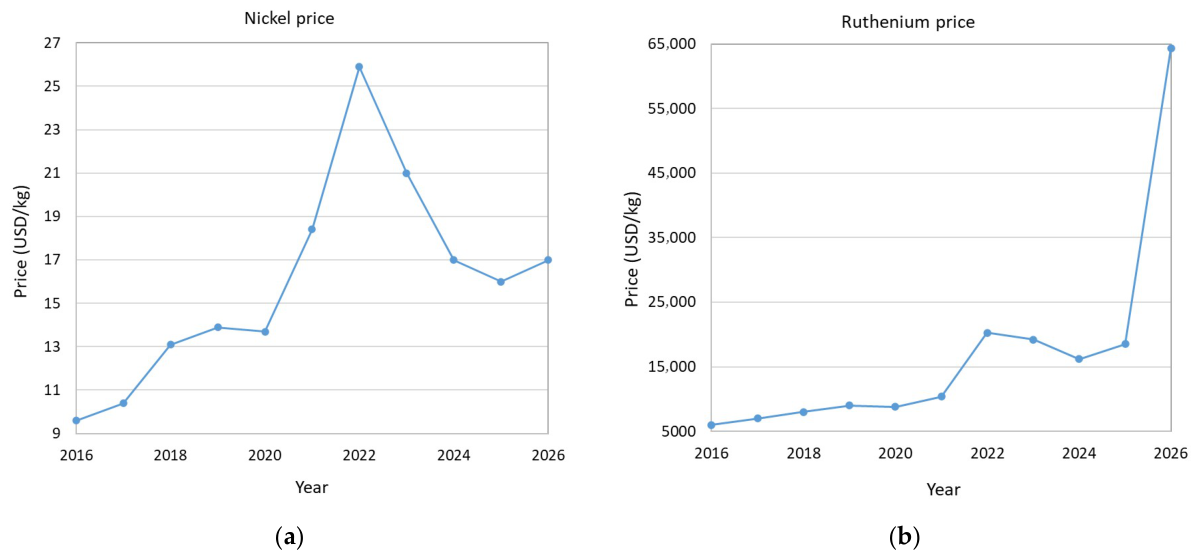
The prices of Ni and Ru in the years 2016–2026 are presented in Figure 1. For Ni (a), average annual global prices were considered. A significant Ni value growth occurred up to 2022—it stems from supply shock and a high demand for resources from the battery sector. It was also connected to the start of the Russo-Ukrainian war, when the main supply chains were broken. Afterwards, a correction and stabilization were observed. In the case of Ru (b), data from the 2020–2026 period and careful estimates for 2016–2019 were used, as the Ru market is largely opaque and its historical data are limited. The Ru prices were relatively stable until 2020 (COVID pandemic), then the rapid growth was observed, and in 2026, a giant leap occurred as a consequence of technological demand connected to the Russo-Ukrainian war.
In the case of Re, Mo, Rh, Pt, Au, and Pd-based catalysts, significant amounts of CH3OH and CO are also observed in post-reaction mixtures. Furthermore, Cu and Ag-based catalysts offer CH3OH as the main CO2 methanation product [36].
Transition elements are divided into noble and common metals. Despite their very good performance and durability, noble metals are rarely used for large-scale synthesis due to high precursor prices and limited availability, making them unsuitable for industrial-scale production. Common metals, such as Ni, Co, and Fe, are relatively cheap and abundant. These features make a strong potential for their large-scale, industrial application in CO2 methanation. Due to its high activity and low cost, nickel is the most widely used element in this group [37], but its disadvantage is a high sensitivity to sulfur presence in the starting gases mixture, so it requires reactants’ desulfurization to avoid quick catalyst deactivation [38].
CO2 methanation catalysts can be supported on various materials, and among them, metal oxides (e.g., Al2O3, SiO2, TiO2, CeO2, ZrO2) are the most commonly applied group. Al2O3 and SiO2 are particularly interesting regarding their strong early performance. Unfortunately, these materials are prone to sintering and carbon deposition at elevated temperatures [39], yet the Al2O3-supported systems are widely distributed for commercial use (e.g., by BASF, Evonik, Clariant, Topsoe, and Johnson Matthey). Composite supports for Ni-based CO2 methanation catalysts are gaining strong attention as well, as they significantly improve catalytic activity. These systems are based on at least two commonly used oxides. For example, Ni supported on ZrO2-Al2O3 composite exhibits better dispersion and higher reducibility, as the ZrO2 blocks the immersion of Ni species into the lattice of γ-Al2O3. These interactions result in higher CO2 conversion and improved CH4 selectivity [40]. Mixed oxide supports and composites with carbon materials create synergistic effects that improve catalytic performance [41,42]. Components like TiO2 or CeO2 can introduce electronic effects, such as Ti3+ ions and oxygen vacancies, enhancing metal dispersion and reducibility [43,44]. Moreover, it is possible to choose a preferred CO2 methanation route by changing the support composition, as the reaction typically follows three pathways: the CO pathway, the RWGS + CO-hydro pathway, or the formate pathway [45,46]. This opens the possibility for further catalyst customization and adjustments. The quality of support can be further improved by incorporating promoters in catalytic systems. Fe works as the H2 adsorber, as the polycrystalline iron shows a higher affinity to hydrogen compared to Ni, thereby improving the catalyst’s performance [47]. Alkaline earth metals, such as Mg, can stabilize the structure of catalyst support, as shown in a study by Shen et al. [48]. Mg addition eliminated acid sites from the obtained material’s surface and enhanced rates of CO2 activation, improving methane yield. The La addition increases Ni reducibility, as it compromises bonds between nickel and the matrix. Additionally, this element creates medium-strength basic sites, improving carbon dioxide adsorption rates. This results in obtaining higher CH4 yields at lower temperatures [49]. All in all, increasing support’s basicity helps to form a monodentate species of formate, significantly improving the catalyst’s selectivity [50,51]. Cerium accelerates Ni reduction by incorporating Ni2+ into the ceria lattice, which results in the replacement of Ce4+ ions and nickel-ceria solid solution formation [52]. Consequently, saturated oxygen vacancies are generated. Thus, the highly reactive oxygenated species are formed, which can be easily reduced even at low temperatures [53]. Magnesium introduces weak or moderate (depending on support) basic sites to the catalyst’s surface. These sites enhance the adsorption of carbon dioxide as carbonate or bicarbonate species, which are subsequently hydrogenated to methane through intermediate species such as formates [54,55,56]. Manganese improves catalyst reducibility, enhances CO2 adsorption, and increases the surface area, thereby improving catalytic performance and selectivity. Mn-doped catalysts often follow the intermediate route for CO2 methanation. Such a pathway considers the formation of Ni0 or Ni2+ species and oxygen vacancies, facilitating carbon dioxide methanation [57,58,59]. Nitrogen stabilizes key intermediates on carbonic supports. For example, pyridinic nitrogen in nitrogen-doped carbon nanotubes makes it easier to bind CO2 molecules and reduces the overpotential for carbon dioxide reduction, improving both selectivity and catalytic activity. Pyridinic nitrogen is particularly effective because its free electron pair can bind CO2 [60,61].

3. Activated Carbon

Activated carbon (AC) is a material with various applications. Its large specific surface area (above 1000 m2/g) and great adsorption capabilities make it useful in many industrial sectors, including petroleum, agriculture, pharmacy, cosmetics, automotive, textiles, and more [62]. Nowadays, a broader spectrum of AC applications is studied by researchers. ACs are considered to be used as energy storage system components [63,64,65,66,67,68], pollutant removal [69,70,71], CO2 capture systems [72], etc. Moreover, ACs’ tunable physicochemical properties allow using them as catalyst supports for the oxygen reduction reaction (ORR) [73,74,75,76,77], hydrogen evolution reaction (HER) [24,64,78,79], biofuel production [80,81,82], methane reforming [83], tetracycline degradation [84], methane production from syngas [85], furfural hydrogenation [86], lipid feedstocks hydroprocessing [87], lignin-type compounds conversion [88,89], lactic acid production [90], hydrogen peroxide sensing [91], steam reforming of pyrolytic oil [92], CO2 reduction [93], and more.
The first step of an activated carbon (AC) preparation is making a biochar, an initially carbonized organic material. The International Biochar Initiative defines biochar as “a solid material produced from the thermochemical conversion of biomass in an oxygen-limited environment.” [94]. Biochar is mainly made of solid biological waste or simply biomass. It is cheap and commonly accessible, being an abundant renewable energy source [95,96].
Pyrolysis is the most popular method of biochar production, relying on thermal decomposition of organic matter without access to oxygen at temperatures of 300–900 °C. Most of the biochar precursors consist of wood-like biomass, and its main components are cellulose, hemicellulose, and the hardest component to pyrolyze—lignin [97]. Pyrolysis consists of three stages [98,99,100]; the first one is the loss of free moisture and some percent of volatiles. In the second one (which occurs at 200–500 °C), the organic matter decomposes, including cellulose, hemicellulose, and a part of lignin—this is the primary pyrolysis. When the temperature still rises, lignin finally decomposes, closing the pyrolysis process. Pyrolysis can be fast or slow; the slow variant takes from a few minutes to several days, and the yield of biochar is typically 15–89%. Fast pyrolysis is conducted at a very high heating rate, typically from 10 to 1000 °C/min, and the residence time is very short, ranging from 0.5 to 2 s. Bio oil is the main product of such pyrolysis, and its maximum yield is reached at 500 °C [101,102], but the biochar yield is significantly reduced—it reaches 12–37% [103]. Fast pyrolysis also requires high raw material fragmentation (grains smaller than 3 mm in diameter) due to the weak biomass’s thermal conductivity and the necessity of rapid heat transfer. Alkali or alkaline earth metals can support pyrolysis by secondary cracking promotion of volatiles, resulting in additional gas product formation and enhancing the biochar formation [104,105].
Partial gasification is another method of biochar production, which relies on endothermic decomposition of organic matter into gaseous products and biochar, conducted in oxygen-containing gases, such as air, steam, or pure oxygen, at temperatures ranging from 700 to 1500 °C. Steam gasification is particularly interesting, as it allows obtaining renewable hydrogen along with high-quality biochar [106], but its yield is relatively low. On the other hand, such biochar contains large amounts of alkaline earth metals, e.g., Na, K, Mg, Ca, etc., as well as polycyclic aromatic hydrocarbons, especially beneficial for catalytic applications [107].
Hydrothermal carbonization is the thermochemical decomposition of biomass, performed at relatively low temperatures, ranging from 180 to 250 °C. It utilizes anoxic conditions and high pressure (14–22 MPa), along with subcritical water as a decomposing agent. Because of that, hydrothermal carbonization’s performance is not dependent on the water content of the raw material. During the process, gaseous (mostly CO2), liquid (bio oil + water), and solid (biochar) products are formed. In comparison with pyrolysis and partial gasification, hydrothermal carbonization is cheaper, as it does not require biomass drying. It can be conducted in milder conditions and generates fewer detrimental byproducts [108,109]. Unfortunately, using this method also means obtaining a less stable biochar, due to its lower aromatic compound content compared to biochars produced by other methods [110].
The quality of biochar is assessed by its physicochemical properties. Pore volume, pore size, and specific surface area (SSA) are the key physical parameters of biochars. During pyrolysis, the release of volatile compounds and dehydration causes porosity development [111], improving SSA and enhancing metal ion adsorption. Biochar catalyst support forces the flow of reactant gases through pore channels, increasing their diffusion and improving heat distribution, making the catalyst more resistant to sintering and poisoning [112]. The structure of biochar strongly depends on the type of biomass utilized as a carbon source. Biochar can be obtained from diverse sources, such as forestry residues [113,114,115,116], algae [117,118,119], agricultural wastes [120,121], or even animal manure [122]. Material derived from plant biomass exhibits higher porosity than animal-originated material, which is connected to lignocellulosic matter’s tubular structure, resulting in a larger number of micropores. The higher amount of micropores translates into larger SSA, while the total pore volume is determined by macro- and mesopores incorporation. Pyrolysis temperature strongly impacts the character of the resulting biochar. The material obtained at lower temperatures exhibits an amorphous carbon structure, but increasing decomposition temperature causes the loss of hydrogen- and oxygen-containing functional groups and improves graphitization. Up to a certain level (mostly 900 °C), there is a positive correlation between pyrolysis temperature and the level of porosity, along with the size of SSA. Increasing decomposition temperature above this value results in collapsing, blocking, or even fusion of the micropores, which reduces the SSA [123,124,125,126].
Chemical properties of biochar are equally important. The first parameter is the alkali or alkaline earth metals content. Incorporation of light metals like Na, K, Mg, or Ca improves support basicity and causes the formation of basic active centers, greatly contributing to CO2 activation during the methanation. Alkaline earth metals also strengthen the metal–support interaction, preventing active phase sintering [127], as well as induce additional oxygen deposits to the support’s surface, increasing its oxidizing properties, thus protecting the active phase from carbon deposition and deactivation [128,129]. The common problem with biochars is the presence of sulfur, phosphorus, and chlorine, occurring naturally in biomass. P and S form strong bonds with active centers, blocking their access to reagents and excluding them from catalytic reaction [130,131]. The sulfur is particularly detrimental, as only a few ppm of this element is enough to cause a significant drop in catalytic activity [132]. Chlorine is less dangerous, because its adsorption to Ni is reversible [133], yet it still decreases the catalytic performance. To ensure long-term operation of a catalyst supported on AC, an additional purification step should be considered to exclude the possibility of catalyst poisoning. Removing poisons (e.g., by strong acid or base treatment) can significantly improve the catalyst’s activity and stability [134].
Biochar’s surface is covered with various oxygen-containing functional groups, including lactone, phenolic hydroxyl, carbonyl, hydroxyl, or carboxyl [135,136,137]. The groups that provide good adsorption capabilities are lactone, carbonyl, carboxyl, and phenolic hydroxyl. These functionalities also allow adjustment of surface charge, pH, and hydrophobicity or basicity [138,139,140,141,142,143,144]. Moreover, a large number of these functionalities affect the support’s hydrophilicity, thus improving its affinity towards metal ions, enhancing the impregnation efficiency [145]. In addition, their displacement determines active metal phase dispersion, as they act as the anchoring sites, chelating metal ions [146] by forming coordinating bonds between oxygen’s free electron pairs and empty d orbitals of transition metal atoms. Thus, the exposure of oxygen-containing functional groups (especially hydroxyl) strongly impacts the availability of anchoring sites [147]. It increases the complexation of metal ions, not only improving active phase dispersion, but also strengthening the metal–support interaction [148,149].
Consequently, properly tailoring the number of certain functional groups provides a potential to adjust the support to particular applications and, in the case of catalysts’ support, to specific conditions of catalyzed chemical reaction.
When the biochar is obtained, the next processing stage is activation. It can be conducted via physical or chemical methods. Activation is necessary to obtain a high-quality functional material, as the raw biochar generally exhibits poor porosity and modest SSA. These parameters are especially important if the carbon is meant to be used as a catalyst support, as the grade of this support will determine the nature of its interactions with the active phase.
Physical activation relies on heating the biochar in an oxidizing atmosphere, such as CO2, H2O, or O2. This type of activation requires high operating temperatures (500–1000 °C) [150]. It changes biochar’s porosity and its surface chemistry (polarity, functional groups, etc.). Another purpose of such activation is the further development of biochar’s SSA and pore structure [151]. The most popular activators are steam and carbon dioxide.
During the steam activation, oxygen from water molecules is attached to active sites on biochar’s surface, resulting in H2 evolution. This hydrogen forms complexes in reaction with surficial carbon atoms. Such a process causes SSA augmentation through the release of volatiles, which block the pores, and results in the implementation of additional functional groups along with surface modifications [150].
CO2 activation is easier to adjust due to the lower activity of this gas at high temperatures, and the tendency to micropore formation [152,153]. In contrast to steam activation, the CO2 variant favors microporosity development and SSA extension. It stems from comparable rates of CO2 diffusion speed through biochar structure and the reaction with its specific surface. Steam’s diffusion speed is lower than its reaction rate, so it does not penetrate biochar, but reacts only with its most accessible areas on the surface. Consequently, biochar activated with CO2 shows higher microporosity and larger SSA than its steam-activated counterpart [154].
Chemical activation considers the use of reagents, which decrease the activation temperature. It can be performed as a one-or two-step process. One-step chemical activation relies on raw material carbonization and its activation at the same time, while the two-step variant considers mixing the previously obtained biochar with chemicals to activate it [155]. The activators can be acids or alkali, and the most commonly used agents are KMnO4, ZnCl2, K2CO3, KOH, H2O2, or H3PO4 [156,157,158,159,160,161,162]. Most of these chemicals are caustic, so they are able to enhance porosity through carbon atom removal from the support, counteract the formation of tar, and cause the release of volatile compounds.
Acid activation is performed with the use of strong acids, such as HNO3 or H3PO4. It increases the number of surficial functional groups and changes pore structure. For example, phosphoric acid can degrade aromatic and aliphatic compounds, as well as lignocellulose, simultaneously creating phosphate and polyphosphate bridges. This process prevents constriction during pore spreading [163].
Alkali activation of biochar is related to the acid process, but it is more favorable towards SSA enlargement and pore structure development. Compared to acid activation, it is more frequently applied for biochar-based catalyst carriers synthesis, and the most commonly used alkaline activators are K2CO3, NaOH, and KOH [164]. The last one is labeled as the most efficient alkali activator of biochar, which is going to be applied as a catalytic support. This is due to its low activation temperature, large SSA, and beneficial micropores distribution of the activated carbon. Such material can adsorb a higher amount of well-dispersed active metals, providing an excellent contact between the catalyst’s active sites and reagents.
The optional modification of biochar is the heteroatom doping. It can be conducted via an in situ or post-treatment process [165]. The in situ option considers adding the dopant(s) during biochar preparation via high-temperature carbonization. Such heteroatoms, incorporated into the carbon lattice, can significantly increase charge delocalization, breaking the inertia of sp2-hybridized carbon structures and resulting in better catalytic performance. Post-treatment doping, implementing solid mixing and impregnation methods, can increase the number of heteroatomic functional groups on the surface of the catalyst, while not changing its other properties.

4. Biomass-Derived Activated Carbon-Supported Ni Catalysts

Although this specific group of catalysts for CO2 methanation is still a niche, it develops rapidly and is expected to become an important branch of a large family of CO2 reduction catalysts. Particular interest is observed in catalysts supported on waste materials, especially from the agricultural and timber industries.
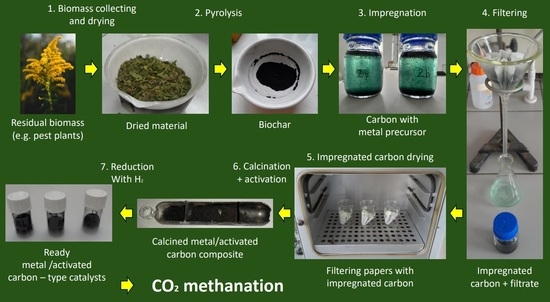
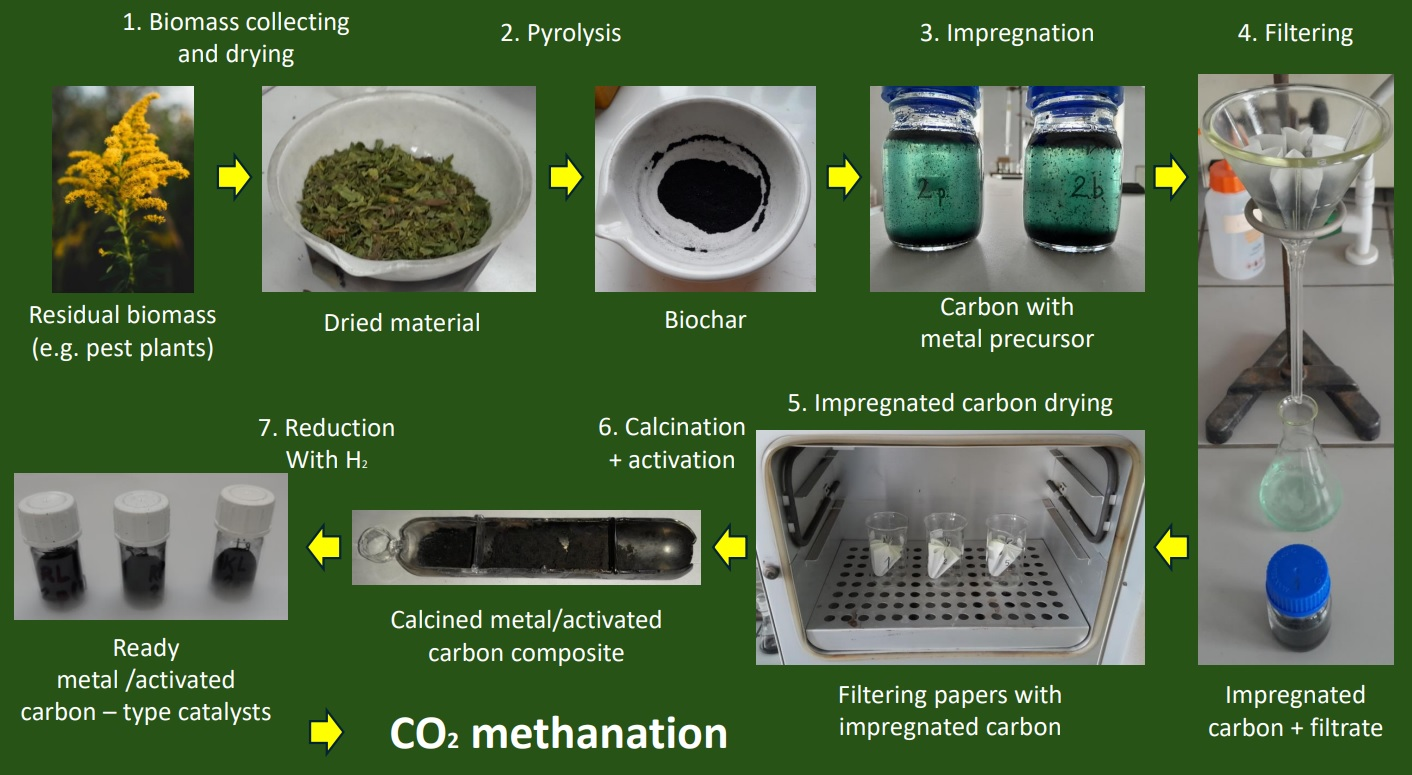
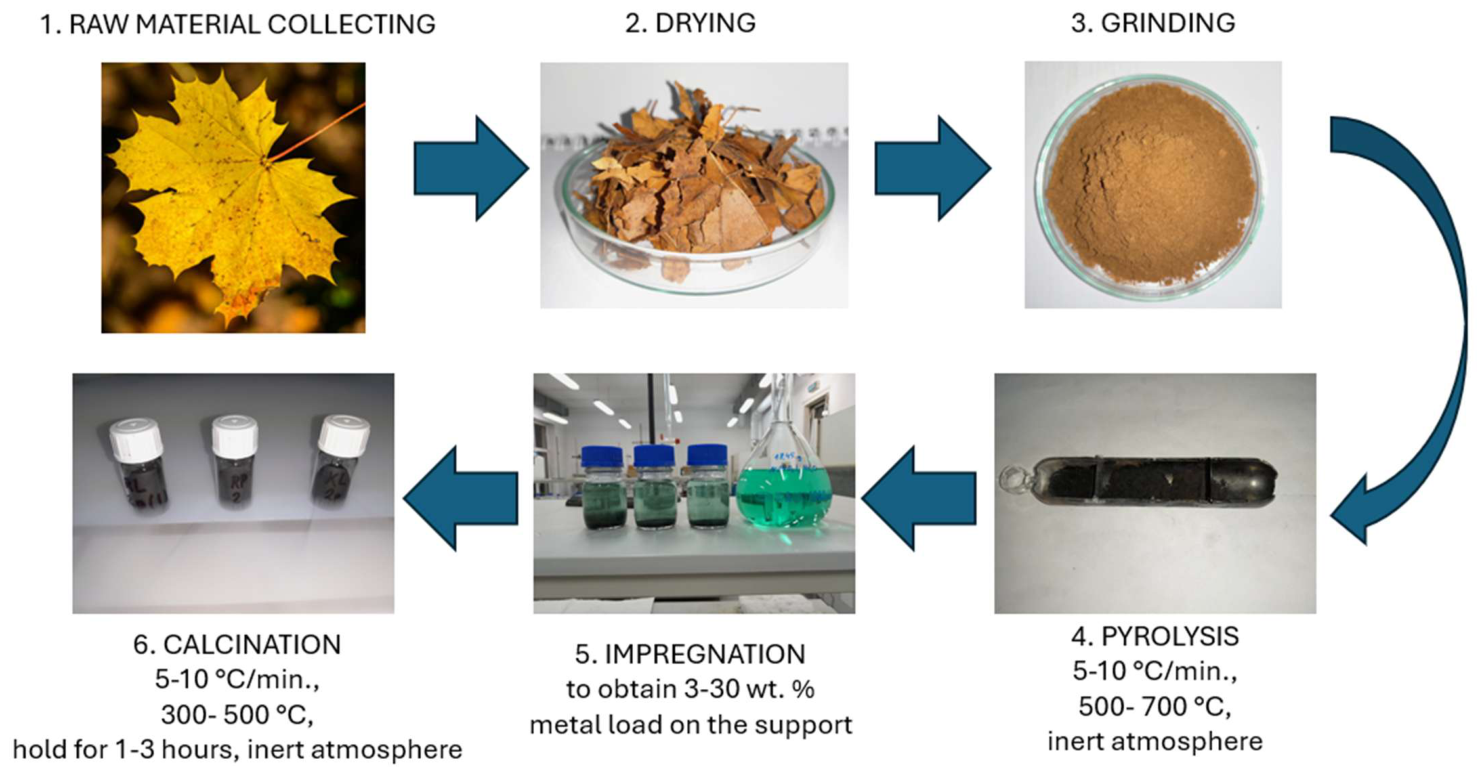
As shown in Figure 2, a standard synthetic procedure of biomass-derived AC-supported, metal-based catalyst consists of a few basic steps. However, numerous variations can occur, depending on the type of biomass used as a carbon source, the method of metal deposition, the incorporation of promoters, the type of carbon activation, etc. Utilizing AC as the catalyst support has a very strong asset. Such a catalyst can be recycled according to a very simple end-of-life strategy. The composite, which has undergone structural degradation and cannot be activated for use as a catalyst, can be burned as a fuel. The ashes remaining after composite combustion will still contain remains of an active phase. Next, these ashes can be treated with strong acids to convert the oxides of Ni, Ru, and their dopants (Ce, Ca, Mg, etc.) into ions, which can then be dissolved in water. Such a solution can be utilized for fresh support impregnation to obtain a catalyst again. In this way, the catalyst’s life cycle is closed, preventing waste generation [166,167]. In contrast, metal oxide-supported catalysts cannot be utilized as a fuel, and require more complex recycling procedures [168,169].

4.1. The Type of the Carbon Source

A particular interest is observed in agricultural waste biomass utilization. To begin with, Renda et al. [171] obtained a biochar from wheat straw through slow pyrolysis in a nitrogen atmosphere [172], and activated it with CO2 at 1 MPa, 700 °C [150]. This AC was further doped with CeO2 via wet impregnation (different concentrations of nickel nitrate hexahydrate were used to obtain 10, 30, and 50 wt. % Ce loads), and calcinated at 500 °C in an Ar atmosphere. Then, the doped biochar was analogically impregnated with nickel nitrate hexahydrate to deposit nickel on the support. The best-performing variant was the one with a 30 wt. % Ce load—it exhibited a 60% CH4 yield at 450 °C and 0.1 MPa. In the durability test conducted at the same operating conditions, the methane yield dropped from 60 to 30% after 14 h of constant methanation. The authors stated that the excessive Ce load causes pore plugging in the AC, which reduces the size of the specific surface area, consequently decreasing Ni dispersion. Since the catalyst with 50 wt. % The Ce load showed worse performance than the optimal variant with 30 wt. % Ce load. After aging tests, various sintering intensities were observed on different catalyst variants. The sintering intensity order was directly connected to the Ce load: 0 wt. % Ce > 10 wt. % Ce = 30 wt. % Ce > 50 wt. % Ce. This shows how important the Ce role is in active phase immobilization. It is crucial for sintering prevention and maintaining good catalyst performance.
A similar approach is visible in the study made by Di Stasi et al. [173], but aside from ceria, in this case, urea-doping is also considered. Wheat straw pellets were pyrolyzed at the same parameters as in [171]. Also, the experimental setup for pyrolysis was analogical as in their other study. Physical activation with CO2 of the obtained biochar was conducted under the same conditions as in [150], which appeared to be highly effective and provided a hierarchical pore size distribution in the resulting material. As above, the catalysts in this study were prepared with a wet impregnation method with cerium nitrate and urea as Ce and N precursors. Calcination was conducted at 550 °C for 3 h in a nitrogen atmosphere, and the wet impregnation was applied again for Ni implementation with nickel nitrate as the precursor of the active phase. Analogically to [171], different Ce and N loads were applied. The variant of the catalyst with 30 wt. % Ce and 20% wt. Ni showed the highest catalytic activity with 62% CH4 yield. The authors stated that this performance comes from the Ce doping effect by introducing oxygen vacancies, which have a significant affinity towards oxygen atoms in CO2 molecules [174]. Moreover, CeO2 addition causes the formation of basic sites, enhancing CO2 adsorption [175]. This dopant stabilizes and improves Ni dispersion as well, enhancing interaction between the active phase and the support. On the other hand, too high Ce load results in ceria shell formation, encapsulating the support and minimizing specific surface area, thereby reducing Ni dispersion [176] and decreasing the CO2 conversion level. Considering Ni load changes, decreasing it from 40 to 20 wt. % caused an improvement in CH4 selectivity from 25 to 100% at 350 °C, 1 MPa. Such a result is said by the authors to be connected to particle metal agglomeration [177], which means worse Ni dispersion across the support. N-doping increases support basicity, causing a beneficial effect of stronger CO2 adsorption [178].
Another agricultural waste biomass, which is a promising raw material for obtaining AC as a support for CO2 methanation catalysts, is rice husk. Chernyak et al. [134] developed a set of catalysts based on Ni, promoted with Mn, and supported on rice husk-derived AC. Their oxidized carbon-supported catalyst achieved 65% methane yield at 350 °C. In their work, an unusual approach to support synthesis was applied, as they developed a hybrid silica-carbon material by calcinating a rice husk-based biochar (obtained by pyrolysis at 600 °C) in nitrogen or air flow. In this way, it was possible to develop a unique SiO2/C-ox support structure. Ni and Mn were deposited on the support via the classic wet impregnation method, obtaining a Ni loading of 17 wt. %, and the Mn:Ni molar ratio of 1:10. Samples were annealed at 350 °C for 1.5 h in a nitrogen flow of 60 mL/min. A series of catalytic tests was conducted at 200–375 °C, 1 MPa for 4 to 8 h, with a volume H2:CO2 ratio of 4:1. Comparing the activity of synthesized materials, the authors have found that oxidizing the carbonaceous support hinders catalytic performance, which is connected to the presence of ultramicropores that interrupt reagents diffusion to and from the active sites. A beneficial effect on materials activity was observed after support purification with acids and bases in order to remove sulfur, phosphorus, alkali, and alkaline earth metals. Consequently, NaOH, HNO3, and HCl treatments lead to obtaining supports that allow achieving better CO2 conversion and methane selectivity.
Catalysts supported on AC obtained from whole plants or their parts are also widely studied. Yue et al. [179] decided to utilize both freshwater and seawater reed as the support precursors. The mowed straws were pyrolyzed at a 500–700 °C temperature range [180], with a 10 °C/min heating rate. It was proven that the higher the pyrolysis temperature, the better the stability of the resulting biochar [181], but on the other hand, the used calcination temperature should not exceed the temperature of the raw material’s pyrolysis due to the possibility of support damage. Thus, the obtained biochars were ground, calcinated at 500 °C for 3 h under N2 atmosphere, and reduced at a modest temperature of 300 °C, as the reduction temperature is not the main parameter determining the catalytic performance [182]. During pyrolysis, a significant amount of volatiles was released, including hydrogen that was directed to the catalyst bed and used as a CO2 methanation reagent. Among the other combustible gases, 33% CH4 yield was achieved during the one-stage conversion (T = 500 °C), and 40% methane yield occurred on a two-stage setup (T1 = 400 °C, T2 = 500 °C) with the use of Ni/600FWB catalyst. The authors have found that the produced methane-rich gas meets the requirements of gas turbines and internal combustion engines [183]. Their approach considers an interesting strategy of using the same raw material both as the source of an activated carbon (which serves as a catalyst support) and also the source of hydrogen required for CO2 methanation.
A set of Ni-based composites, supported on ACs derived from the biomass of three different plant species—maple, knotweed, and willow [180] was synthesized and investigated. The study has shown how the choice of raw material determines the properties of the resulting biochar. Among all three materials, the maple leaves-derived biochar exhibited the largest SSA and Ni adsorption capability at the same time, reaching the values of 266 m2/g and 165 mg of Ni per 1 g of carbon, respectively. Willow leaves and knotweed leaves-based biochars have shown 40 and 7 m2/g SSA, as well as 117 and 105 mg of Ni per 1 g of carbon, respectively. Thus, maple leaves appear to be the best source of biochar among the studied biomass variants. A very important feature of all the obtained biochars is a certain content of alkali metals (mainly Mg and Ca), occurring in the collected biomass samples. It is connected to the place of biomass origin, which was a suburban, post-industrial area, and the alkali metals came from the residues of construction sites. This means that these biochars do not require artificial doping, which generates savings of energy and resources, simplifying the synthetic procedure. Alkali metal contents were measured with the MP-AES technique, and their presence was additionally confirmed by XRD and SEM-EDS results.
Cellulose can be utilized as a source of AC suitable for supporting CO2 methanation catalysts as well. Svidersky et al. [184] synthesized Fe-, Co-, and mixed metals-based catalysts. First, the authors obtained a biochar by hydrothermal carbonization of cellulose in a steel autoclave at 190 °C for 24 h. The resulting carbonizate was filtered, dried at 105 °C for 24 h, and calcined in a muffle furnace at 400 °C for 1 h. Fe and Co were deposited on the support from the ethanolic-aqueous solution, and then subjected to an elevated temperature (400 °C) in an inert atmosphere for 1 h. Every catalyst obtained this way had a 20 wt. % metal amount. After activation, the materials were tested in CO2 hydrogenation. During the catalytic tests, not only does methane appear in the post-reaction mixture, but higher (up to C5) hydrocarbons were also detected, and their content was dependent on the applied Co:Fe ratio. Overall, the higher Fe content favored the formation of longer C-C chains. The pure Co-based composite achieved 48% methane yield at 300 °C and 1 MPa. In comparison, the mixed Co-Fe (1:1) catalyst exhibited only 11% CH4 yield at analogous reaction conditions, but it achieved 26% yield of C5 hydrocarbons. The authors explain such performance by in situ formation of metallic cobalt (active in CO2 hydrogenation) or Co-Fe alloy from carbides during the hydrogenation reaction, which cannot happen when applying metal oxide as a support.

4.2. Synthesis Methods

Apart from the classic wet impregnation, scientists apply other, more or less sophisticated synthetic methods to obtain catalysts. Gamal et al. synthesized a set of catalysts supported on sugarcane bagasse-sourced AC [185]. It was prepared according to a very simple one-pot strategy, starting with impregnation of dried sugarcane bagasse with nickel nitrate solution, followed by drying and pyrolysis at 500 °C with a heating rate of 20 °C/min. Next, it was cooled down to room temperature under N2 flow. The catalysts had different Ni loadings, depending on the concentration of nickel nitrate solution used for impregnation: 0.1, 0.3, 0.5, 0.8, and 1.2 mmol of nickel per 1 g of sugarcane bagasse powder. The best-performing material from this study, with 0.5 mmol/g Ni, achieved a CH4 yield of 33% at 400 °C under atmospheric pressure. At the durability test, it was capable of maintaining its full catalytic potential for 12 h. The authors claim that such activity comes from the high porosity of their materials, resulting in a well-developed specific surface area, and also from the high Ni dispersion observed under SEM and TEM microscopes.
Wang et al. synthesized and characterized Ni-based catalysts supported on Ce-doped ACs, obtained via in situ pyrolysis and activation of pine sawdust [186]. They added pine sawdust to cerium nitrate solution with a biomass:CeO2 ratio of 6:1. After ultrasonic treatment, stirring the suspension at elevated temperature, and drying, the authors ground the resulting powder with NaHCO3 at a 1:3 mass ratio in a mortar. The next synthesis step was a pyrolysis of activated biomass at 600 °C under a nitrogen flow for 1 h. The product of pyrolysis was subsequently mixed with 0.5 M HNO3 and stirred for 4 h at the ambient temperature. Then, the resulting sample was dried at 80 °C overnight to give Ce-doped AC, which was covered with nickel using a modified wet impregnation procedure. The previously prepared support was added to the nickel nitrate solution in ethanol, resulting in a suspension that was ultrasonically dispersed for 20 min, and stirred overnight at ambient temperature. The last step was calcination at 500 °C for 4 h. The synthesis led to obtaining a Ni/Ce-ABC catalyst with a theoretical Ni loading of 15 wt. %. The authors made an interesting assumption that syngas and biochar were the two main products of pine sawdust pyrolysis, and the syngas produced during the process was estimated to provide the amount of heat required for the biochar-based process [187]. Such material was tested in CO2 methanation at 200–460 °C, 1 MPa, and a 4:1 H2 to CO2 molar ratio. As a result, the Ni/Ce-ABC catalyst exhibited 82% methane yield at 360 °C. Moreover, at lower temperatures, the cerium-modified AC-supported catalyst provided even better catalytic performance than the pure CeO2-deposited nickel. Cerium improved the stability and dispersion of Ni particles, increasing CO2 adsorption at the same time. According to LCA analysis, the preparation of biochar-supported catalyst was more environmentally friendly than the synthesis of its CeO2-supported counterpart. Moreover, replacing pure metal-based catalysts with a cheap biochar-based system improved the economic efficiency of CO2 methanation.
The same authors developed similar catalytic systems, also supported on pine sawdust-derived ACs, but based on Ru instead of Ni [188]. Also, a different dopant was used in this case—pyridinic nitrogen was implemented into the support structure, utilizing urea as a precursor. The synthetic approach utilized an in situ pyrolysis, combined with nitrogen modification and NaHCO3 activation. Various pyrolysis temperatures were used by the authors to produce supports with different physicochemical properties. Mixing pine powder, urea, and sodium bicarbonate at a 1:4:3 mass ratio resulted in obtaining Ru/N-ABC-x (x = 500/600/700) catalysts. According to the results of catalytic tests, the highest methane yield was achieved with the use of the catalyst supported on AC obtained through pyrolysis at 600 °C, meaning that this temperature is optimal for sufficient decomposition of biomass structure and proper porosity development. This catalyst also exhibited the highest content of pyridinic N (38%). The methane yield reached 94% at 380 °C, 1 MPa, and a 4:1 H2 to CO2 molar ratio. The catalyst was tested at higher temperatures as well, but after reaching the optimum, further increase in temperature resulted in a slight CO2 conversion drop due to the exothermic character of CO2 methanation. It was proven in another study [189], that if the reaction temperature was increased from 400 to 580 °C, resulting in a change in Gibbs free energy from −40 to 0 kJ/mol, inhibiting the CO2 conversion. Another consequence of temperature elevation to such a high level was decreasing CH4 selectivity with a simultaneous increase in CO yield due to the occurrence of the methane steam reforming reaction [190].
Li et al. [191] prepared a series of Ni-based catalysts for CO2 methanation supported on coconut shell-derived, Mg-doped AC. Composites were synthesized using a co-impregnation method and exhibited better catalytic performance than Al2O3- and ZrO-supported catalysts. The authors used a fixed-bed tubular flow reactor for catalytic tests conducted under atmospheric pressure and a 4:1 H2 to CO2 molar ratio. At 450 °C, the catalyst exhibited 89% methane yield. The Ni-Mg0.26/coconut shell carbon composite was subjected to a 50 h stability test, and showed no decrease in catalytic performance throughout the entire reaction course.

4.3. Doping Elements

The properties of an active phase can be significantly improved by utilizing the doping agents. A highly interesting, Ce-doped material was produced by Mateus et al. [192] from cork wastes. These wastes were physically activated under N2-H2O (7:3 ratio) atmosphere at 800 °C for 1 h, with 10 °C/min heating rate, reaching 10% yield. The procedure was optimized according to another study made by Mestre et al. [193]. Ni catalyst was prepared by incipient wetness impregnation, and the Ni-CeO2 catalyst was synthesized with the use of the co-impregnation method, utilizing respective nitrates as precursors, and isopropanol as a solvent. Both metals’ loadings were established at 15 wt. %, considering the authors’ previous experience with zeolite-supported catalysts, also applied for CO2 methanation [194,195]. Next, the samples were dried at 80 °C and heated at 500 °C in a hydrogen flow for 1 h for the purpose of precursor decomposition and obtaining nickel at zero oxidation state. The resulting cork-derived AC-supported catalysts exhibited better affinity toward CO2 than composites supported on commercially available ACs. Incorporating CeO2 as a dopant for cork-derived AC-supported systems slightly decreased hydrophobicity and caused a further improvement in CO2 affinity. The metallic dispersion was also enhanced, resulting in better catalytic performance—the NiCe/ACN catalyst exhibited 69% methane yield at 360 °C.
Tarifa et al. [196] developed a group of Mg-, and/or Ce- doped Ni-based catalysts for CO2 methanation, supported on cellulose-derived ACs. The materials were prepared by the incipient wetness impregnation, utilizing nitrates as metal precursors. Ni loading reached 3.5% respectively to unprocessed cellulose. Mg and Ce were applied at various ratios. Samples were thermally decomposed at 600 °C for 3 h under a reducing atmosphere, at a fixed heating rate. The cooldown was performed in an inert gas, followed by passivation with a CO2/N2 mixture for 1 h. The highest methane yield (80%) was observed in the case of Ni-Mg-Ce/CDC catalyst, at 370 °C and 1 MPa. The authors stated that such performance is a result of the Ce-Mg synergetic doping effect. The beneficial influence of Ce stems from the right combination of Ni reducibility, proper concentration, and basic sites’ strength, uniform size of metal particles, and intensive interactions between Ni and its promoters.

4.4. Support Preparation

Support preparation method is another key factor determining the properties of the catalyst. Coconut shell-sourced AC was chosen as a CO2 methanation catalyst support also by Le et al. [197]. The authors made a 7 wt. % Ni catalyst supported on biochar doped with ZrO2 and CeO2 solid solution. At first, the mixed Ce-Zr oxide was obtained following the hydrothermal method scheme, designed by Pham et al. [88]. Cerium nitrate, zirconium chloride, and urea were added to distilled water and stirred to give a complete solution, which was subsequently heated at 160 °C in an autoclave. An obtained product was washed with distilled water until pH stabilization, dried at 80 °C, and calcined at 500 °C for 4 h. The resulting Ce-Zr oxide was deposited on AC using the suspension method: the carbon was mixed with Ce-Zr aqueous slurry, molten surfactant (70 °C, Brij 56), and nitric acid, followed by drying. The as-described procedure was repeated 4 times, and then calcinated at 200 °C for 4 h. The resulting hybrid support was designated as Ce0.2Zr0.8O2/AC. Next, a wet impregnation method was utilized for Ni deposition on the support, which was immersed in nickel nitrate aqueous solution and then dried. The immersing-drying scheme was repeated until running out of nickel nitrate solution. The last step of synthesis was heating at 3 °C/min. rate to 200 °C, and holding this temperature for 4 h. The resulting catalyst was named 7 Ni/CeZrAC. Ce and Zr oxides dispersed and stabilized nickel particles and strengthened the interaction between this metal and the carbonic support. Moreover, these dopants improved Ni reducibility. This resulted in reaching 85% methane yield at 350 °C and atmospheric pressure. The authors claim that these results stem from the interaction between Ni and the doping phase, as well as from the high CO2 adsorption capabilities, which come from synergy between three phases: Ni, mixed Ce-Zr oxide phase, and the AC.
The set of Ni/AC composites was synthesized using goldenrod leaves as a carbon source [198]. The results of the study have shown how the pyrolysis time, temperature, pre- and post-treatment of biochar affect the specific surface area of resulting biochars obtained from dried goldenrod leaves. The highest SSA (4 m2/g) was achieved on the biochar obtained at 700 °C in nitrogen flow, heating ramp 10 °C/min, held at maximum temperature for 1 h. This biochar was labeled as “2”. Biochars obtained at 600 and 800 °C exhibited smaller SSA, pointing out that 700 °C is an optimal temperature for goldenrod leaves pyrolysis. However, the highest Ni impregnation capacity was not achieved by biochar no. 2, but the “2p” (“p” stands for “powder”, as in the case of this biochar, the dried goldenrod leaves were ground before pyrolysis). Moreover, the SEM-EDS analysis presented an excellent Ni dispersion across the 2p’s surface. The authors claim that the fragmentation of biomass before pyrolysis allows for the uncovering of a larger number of specific functional groups during the heat treatment, resulting in better metal ion adsorption at the biochar’s surface.

5. Comparative Assessment of CO2 Methanation Catalysts Supported on Biomass-Derived ACs

To evaluate catalysts for CO2 methanation, certain criteria must be considered. The first aspect is the catalyst’s performance. It is evaluated by CH4 yield, as it is the most important product of CO2 methanation. Another key feature is the catalytic system’s durability: the catalysts with higher thermal stability are less prone to deactivation during long-time synthesis and rarely need to be replaced. This means additional savings in resources, energy, waste, and money. Highly durable catalysts are especially valued in industrial synthesis, as large-scale processing systems require a larger catalyst charge per working cycle, and their replacement is often financially unacceptable. The level of the catalyst’s synthesis complexity matters as well, as the fewer steps the catalyst production procedure consists of, the fewer solvents and other chemical agents need to be used during the entire process, including lower energy consumption. The costs of raw materials and their processing are important, as they influence the catalysts’ economic balance. Ecology—for this matter, the material’s renewability and carbon footprint must be considered. The possibility of catalyst recycling raises not only ecological, but also economic value, as material recovery means less waste and no need to consume additional resources.
According to Table 1, among the best-performing catalysts for CO2 methanation, three types of systems are exceptionally promising. The first type consists of Ni or Ru particles deposited on cerium- or nitrogen-promoted, pinewood-derived ACs (Ni/Ce-ABC and Ru/N-ABC-600). Such a setup features excellent durability (96% starting catalytic activity after 120 h of methanation in case of Ni/Ce-ABC composite), which makes it perfect for long-term synthesis due to enhanced oxygen mobility, effectively preventing coke deposits formation. The best catalytic performance is exhibited by the Ru/N-ABC-600 catalyst—94% methane yield, definitely outclassing most of the other materials presented in this work. Moderate optimal operating conditions (380 °C, 1 MPa) are also a noteworthy detail, as it provides energy savings. However, the main disadvantage of these catalysts is their synthesis complexity (10 steps), which raises the overall production costs, and in the case of the Ru-based system, the price of the precursor also seems to be repulsive. Multistep synthesis means generating a high amount of waste and extensive energy consumption, but these drawbacks are, at some point, mitigated due to these catalysts’ sturdy structure and impressive thermal stability, making them long-lasting.
The second type of catalysts are Ni-based composites supported on coconut shell-derived ACs (Ni-Mg0.26/coconut shell carbon and 7%Ni/Ce0.2Zr0.8O2/AC). Their high methane yield (85–89%) is a very attractive feature, which, combined with the outstanding durability, make them another promising candidate for industrial catalysis. Compared to pine sawdust-derived catalysts, their synthesis is much simpler (3–4 steps), and also the cost of materials is more reasonable by replacing the expensive Ru with Ni. In addition, the 7%Ni/Ce0.2Zr0.8O2/AC shows its best performance at a relatively low temperature (350 °C), requiring less intensive heating and lower energy consumption during methane production.
The third very well-performing and interesting catalytic system is Ni-Mg-Ce/CDC—a Ni-based, Mg and Ce-doped catalyst, supported on cellulose-derived AC. Providing 80% methane yield at 370 °C and 1 MPa, being very durable and relatively simple in production, this material perfectly fits into the idea of a sustainable and eco-friendly catalytic system for CO2 methanation. Its synthetic route takes only 5 stages, thus it requires a reasonable amount of energy and solvents, generating a low amount of waste at the same time.
NiCe/ACN is another noteworthy material. It uses Ce- and N- doped AC produced from industrial cork wastes as a support, and Ni as the catalytic active phase. It shows 70% methane yield, while being synthesized from cheap precursors (Ce and Ni nitrates, urea). It was produced in a 5-step synthesis, which makes this material eco-friendly—its preparation does not consume a high amount of energy; also, a large amount of solvents is not necessary. It exhibits an incredible durability as well—during a 24 h catalytic test, it lost only 7% of its initial activity. Moreover, it reaches its peak performance at mild conditions (360 °C, 1 MPa), which helps to save an additional amount of energy for reactor heating and sealing.
An equally interesting composite is a Ni-based, Mn-doped catalyst supported on rice husk-derived, partially oxidized AC (Ni/SiO2@C-ox). Its uniqueness lies in applying manganese as a dopant. This relatively cheap transition metal, in interaction with Ni, allows obtaining 68% methane yield at low operating temperature and pressure (350 °C, 1 MPa). Furthermore, the Mn-doped catalyst maintained 100% of its initial activity throughout the whole 24 h durability test. To sum up, Ni/SiO2@C-ox is a low-cost catalyst with a decent performance and excellent durability, which can operate at mild conditions. However, the drawback of this material is its synthesis complexity—it consists of eight stages, meaning a significant energy and solvent consumption, along with chemical waste generation. This feature does not disqualify the catalyst in terms of industrial application, but it downgrades its value at a certain point.
Wheat straw-derived AC-supported catalysts, the BCNiCe30 and BCCe30Ni40, are Ni-based, Ce-supported catalysts that show an average catalytic performance (54 and 60% CH4 yield, respectively). Their durability is rather mediocre—the BCNiCe30 had lost most of its starting activity after 14 h of non-stop catalysis at its optimal working conditions. This significant drawback makes this catalyst inapplicable in industrial methane synthesis through CO2 reduction. A specific feature of this system is that it prefers relatively high operating temperatures—the optimal value for this particular catalyst is 450 °C—but on the other hand, it can work at very low pressure—only 0.1 MPa. Its synthesis route has a standard complexity (five stages), and the precursor costs are average. BCCe30Ni40’s durability is unknown at this moment, It operates at a milder temperature (350 °C) than BCNiCe30, but at 10 times higher pressure (1 MPa). Also, its preparation process is more complicated—7 stages instead of 5—which means higher production costs and greater resource consumption.
A set of parameters opposite to that of pine sawdust-derived AC-supported catalysts can be observed for reed-, cellulose-, and sugarcane bagasse-derived AC-supported catalysts. Their production costs are very low because they utilize Ni as the active phase; their supports are based on waste and highly abundant, low-value materials; no dopants are incorporated into their structures; and their synthetic procedures are straightforward. Unfortunately, the catalytic performance of these materials is very low, and because of this feature, their industrial application is strongly questionable.
To begin with, the catalyst supported on cellulose-derived AC (Co/biochar) shows a mediocre yield of methane(only 48%). Also, its long-term stability remains unknown. In comparison with a similar system, the Ni-Mg-Ce/CDC, a clear conclusion can be made: Co is not the right element to serve as an active phase of a catalyst dedicated to CO2 methanation. This comparison shows the meaning of dopant elements as well—Mg and Ce used as promoters greatly enhanced Ni deposits’ catalytic performance. The most important assets of Co/biochar catalyst are its low production cost (no dopants, no significant modifications made to the support, relatively cheap active phase metal precursor), and low operating temperature (300 °C). However, they are not significant enough to balance the catalyst’s poor performance.
The activity of the reed-derived AC-supported, Ni-based catalyst (Ni/FWB-600) is even worse. This catalyst presents a low methane yield (40%), Its optimal operating pressure does not seem optimistic as well—it reaches a high 500 °C value, resulting in extensive energy consumption during methane synthesis. These parameters disqualify this catalytic system in terms of industrial application. The only positive side of this material is a low preparation cost, which stems from the absence of support modifications, applying Ni as the active phase, no activation done to the biochar, and the use of a cheap and abundant carbon precursor.
0.3Ni/SCBB—this sugarcane bagasse-derived, AC-supported, Ni-based catalyst stands as a total opposite to the Ru/N-ABC-600 catalyst. 0.3Ni/SCBB’s catalytic performance is exceptionally low, as it exhibits 33% methane yield. It operates at a moderate temperature of 400 °C and low pressure—1 MPa. Its synthetic procedure is simple, consisting only of four steps. Combined with the low price of both support and active phase precursors, this catalyst appears to be the cheapest among all presented in this review. Moreover, the 0.3Ni/SCBB is surprisingly durable—it maintained its full activity during the whole 12 h CO2 methanation test. Considering these assets, this material also seems to be the most eco-friendly of all the catalysts described above.
All in all, Ni-Mg0.26/coconut shell carbon seems to be the best catalyst among all compared in this work. Its excellent performance-to-cost ratio, as well as its eco-friendly character due to high durability and three-step synthesis, make this material highly applicable for a large-scale, industrial CO2 methanation.

6. Conclusions

To conclude, nickel-based catalysts supported on biomass-derived activated carbons are a very promising class of materials for CO2 methanation. Their advantages include mostly low-cost, tunable properties, and compatibility with renewable feedstocks. Currently, an increasing focus on waste biomass utilization can be observed. Scientists put a lot of effort into the development of hierarchical pore structures that can be applied as advanced, customizable catalyst supports, allowing greater dispersion of transition metals and better heat distribution during CO2 methanation. A very important aspect of modern catalyst development is also the incorporation of promoters into the metal/AC composites to enhance their stability and catalytic activity. The key challenge in catalyst design is the optimization of metal–support interactions, as they are the essential factor influencing the durability of catalysts. High pressure is applied to large-scale AC production from various types of biomass.

7. Future Perspectives

Recently, strong attention has been paid to the exploration of hybrid catalysts’ supports, mainly considering carbon + metal oxide-type materials. Also, synergy between catalysts’ promoters is studied, especially considering interactions between alkali earth metals and heteroatoms (mainly N). After optimization of CO2 methanation catalysts, the next important step is their incorporation into industrial Power-to-Gas systems, which is going to be their main application in the near future, and the main studied topics are going to be the convergence of catalysis, materials science, and circular economy principles. These prospects reveal biomass-derived Ni/AC catalysts as key contributors to future low-carbon energy systems.

Author Contributions

Conceptualization, K.D. and P.Ż.; writing—original draft preparation, K.D.; writing—review and editing, P.Ż.; visualization, K.D.; supervision, P.Ż.; funding acquisition, K.D. All authors have read and agreed to the published version of the manuscript.

Funding

This research was funded by AGH University of Science and Technology, The Excellence Initiative—Research University, grant number D4-16851.

Data Availability Statement

No new data were created or analyzed in this study. Data sharing is not applicable to this article.

Conflicts of Interest

The authors declare no conflicts of interest.

Abbreviations

The following abbreviations are used in this manuscript:
ACActivated Carbon
ORROxygen Reduction Reaction
HERHydrogen Evolution Reaction
GHSVGas Hourly Space Velocity
CCUCarbon Capture and Utilization

References

  1. Kharecha, P.A.; Hansen, J.E. Implications of “Peak Oil” for Atmospheric CO2 and Climate. Glob. Biogeochem. Cycles 2008, 22, 1–10. [Google Scholar] [CrossRef]
  2. Peñuelas, J.; Carnicer, J. Climate Change and Peak Oil: The Urgent Need for a Transition to a Non-Carbon-Emitting Society. Ambio 2010, 39, 85–90. [Google Scholar] [CrossRef]
  3. Höök, M.; Tang, X. Depletion of Fossil Fuels and Anthropogenic Climate Change—A Review. Energy Policy 2013, 52, 797–809. [Google Scholar] [CrossRef]
  4. Bentley, R.; Boyle, G. Global Oil Production: Forecasts and Methodologies. Environ. Plan. B Plan. Des. 2008, 35, 609–626. [Google Scholar] [CrossRef]
  5. Okullo, S.J.; Reynès, F.; Hofkes, M.W. Modeling Peak Oil and the Geological Constraints on Oil Production. Resour. Energy Econ. 2015, 40, 36–56. [Google Scholar] [CrossRef]
  6. US Government Printing Office. Multilateral Montreal Protocol on Substances That Deplete the Ozone Layer (with Annex); Concluded at Montreal on 16 September; US Government Printing Office: Washington, DC, USA, 1987. [Google Scholar]
  7. United Nations. Kyoto Protocol of the United Nations Framework Convention on Climate Change; United Nations: New York, NY, USA, 1998. [Google Scholar]
  8. United Nations. Unfccc Adoption of the Paris Agreement—Paris Agreement Text English; United Nations: New York, NY, USA, 2015. [Google Scholar]
  9. Ullah, S.; Gao, Y.; Dou, L.; Liu, Y.; Shao, T.; Yang, Y.; Murphy, A.B. Recent Trends in Plasma-Assisted CO2 Methanation: A Critical Review of Recent Studies. Plasma Chem. Plasma Process. 2023, 43, 1335–1383. [Google Scholar] [CrossRef]
  10. Stangeland, K.; Kalai, D.; Li, H.; Yu, Z. CO2 Methanation: The Effect of Catalysts and Reaction Conditions. Energy Procedia 2017, 105, 2022–2027. [Google Scholar] [CrossRef]
  11. Kempi, A.; Verma, R.; Sharma, A.K.; Mauss, F. CO2 Methanation: A Review on Optimizing Catalysts and Conditions. React. Kinet. Mech. Catal. 2026, 139, 867–925. [Google Scholar] [CrossRef]
  12. Tommasi, M.; Degerli, S.N.; Ramis, G.; Rossetti, I. Advancements in CO2 Methanation: A Comprehensive Review of Catalysis, Reactor Design and Process Optimization. Chem. Eng. Res. Des. 2024, 201, 457–482. [Google Scholar] [CrossRef]
  13. Kwawu, C.R.; Aniagyei, A.; Tia, R.; Adei, E. A DFT Investigation of the Mechanisms of CO2 and CO Methanation on Fe (111). Mater. Renew. Sustain. Energy 2020, 9, 4. [Google Scholar] [CrossRef]
  14. Liu, W.; Wen, F.; Xue, Y. Power-to-Gas Technology in Energy Systems: Current Status and Prospects of Potential Operation Strategies. J. Mod. Power Syst. Clean. Energy 2017, 5, 439–450. [Google Scholar] [CrossRef]
  15. Fambri, G.; Diaz-Londono, C.; Mazza, A.; Badami, M.; Sihvonen, T.; Weiss, R. Techno-Economic Analysis of Power-to-Gas Plants in a Gas and Electricity Distribution Network System with High Renewable Energy Penetration. Appl. Energy 2022, 312, 118743. [Google Scholar] [CrossRef]
  16. Maroufmashat, A.; Fowler, M. Transition of Future Energy System Infrastructure; through Power-to-Gas Pathways. Energies 2017, 10, 1089. [Google Scholar] [CrossRef]
  17. Zhu, J.; Zhang, H.; Li, T.; Deng, T.; Zou, H.; Li, Y.; Yang, D. Liquid CO2-Capture Technologies: A Review. Nanomaterials 2024, 14, 1910. [Google Scholar] [CrossRef]
  18. Shyam, A.; Ahmed, K.R.A.; Kumar, J.P.N.; Iniyan, S.; Goic, R. Path of Carbon Dioxide Capture Technologies: An Overview. Next Sustain. 2025, 6, 100118. [Google Scholar] [CrossRef]
  19. Wu, C.; Huang, Q.; Xu, Z.; Sipra, A.T.; Gao, N.; Vandenberghe, L.P.d.S.; Vieira, S.; Soccol, C.R.; Zhao, R.; Deng, S.; et al. A Comprehensive Review of Carbon Capture Science and Technologies. Carbon Capture Sci. Technol. 2024, 11, 100178. [Google Scholar] [CrossRef]
  20. Vaz, S.; Rodrigues de Souza, A.P.; Lobo Baeta, B.E. Technologies for Carbon Dioxide Capture: A Review Applied to Energy Sectors. Clean. Eng. Technol. 2022, 8, 100456. [Google Scholar] [CrossRef]
  21. Qadeer, M.A.; Zhang, X.; Farid, M.A.; Tanveer, M.; Yan, Y.; Du, S.; Huang, Z.-F.; Tahir, M.; Zou, J.-J. A Review on Fundamentals for Designing Hydrogen Evolution Electrocatalyst. J. Power Sources 2024, 613, 234856. [Google Scholar] [CrossRef]
  22. Kumar, S.; Kaur, R.; Sharma, S. Recent Reports on Hydrogen Evolution Reactions and Catalysis. Results Chem. 2022, 4, 100613. [Google Scholar] [CrossRef]
  23. Pu, Z.; Amiinu, I.S.; Cheng, R.; Wang, P.; Zhang, C.; Mu, S.; Zhao, W.; Su, F.; Zhang, G.; Liao, S.; et al. Single-Atom Catalysts for Electrochemical Hydrogen Evolution Reaction: Recent Advances and Future Perspectives. Nanomicro Lett. 2020, 12, 21. [Google Scholar] [CrossRef]
  24. Ahmed, K.; Hameed, S.; Patchigolla, K.; Dawood, N.; Ghouri, Z.K. Carbon-Based Electrocatalysts for Hydrogen Evolution Reaction. Energy Convers. Manag. X 2025, 26, 100892. [Google Scholar] [CrossRef]
  25. Chen, Z.; Gong, W.; Wang, J.; Hou, S.; Yang, G.; Zhu, C.; Fan, X.; Li, Y.; Gao, R.; Cui, Y. Metallic W/WO2 Solid-Acid Catalyst Boosts Hydrogen Evolution Reaction in Alkaline Electrolyte. Nat. Commun. 2023, 14, 5363. [Google Scholar] [CrossRef]
  26. Brooks, K.P.; Hu, J.; Zhu, H.; Kee, R.J. Methanation of Carbon Dioxide by Hydrogen Reduction Using the Sabatier Process in Microchannel Reactors. Chem. Eng. Sci. 2007, 62, 1161–1170. [Google Scholar] [CrossRef]
  27. Gao, J.; Wang, Y.; Ping, Y.; Hu, D.; Xu, G.; Gu, F.; Su, F. A Thermodynamic Analysis of Methanation Reactions of Carbon Oxides for the Production of Synthetic Natural Gas. RSC Adv. 2012, 2, 2358. [Google Scholar] [CrossRef]
  28. Jürgensen, L.; Ehimen, E.A.; Born, J.; Holm-Nielsen, J.B. Dynamic Biogas Upgrading Based on the Sabatier Process: Thermodynamic and Dynamic Process Simulation. Bioresour. Technol. 2015, 178, 323–329. [Google Scholar] [CrossRef] [PubMed]
  29. Abate, S.; Mebrahtu, C.; Giglio, E.; Deorsola, F.; Bensaid, S.; Perathoner, S.; Pirone, R.; Centi, G. Catalytic Performance of γ-Al2O3–ZrO2–TiO2–CeO2 Composite Oxide Supported Ni-Based Catalysts for CO2 Methanation. Ind. Eng. Chem. Res. 2016, 55, 4451–4460. [Google Scholar] [CrossRef]
  30. Chen, J.; Arandiyan, H.; Gao, X.; Li, J. Recent Advances in Catalysts for Methane Combustion. Catal. Surv. Asia 2015, 19, 140–171. [Google Scholar] [CrossRef]
  31. Gaikwad, R.; Villadsen, S.N.B.; Rasmussen, J.P.; Grumsen, F.B.; Nielsen, L.P.; Gildert, G.; Møller, P.; Fosbøl, P.L. Container-Sized CO2 to Methane: Design, Construction and Catalytic Tests Using Raw Biogas to Biomethane. Catalysts 2020, 10, 1428. [Google Scholar] [CrossRef]
  32. Stangeland, K.; Kalai, D.Y.; Li, H.; Yu, Z. Active and Stable Ni Based Catalysts and Processes for Biogas Upgrading: The Effect of Temperature and Initial Methane Concentration on CO2 Methanation. Appl. Energy 2018, 227, 206–212. [Google Scholar] [CrossRef]
  33. Macrotrends. Global Nickel Prices (1990–2026). Available online: https://www.macrotrends.net/3299/global-nickel-prices (accessed on 15 May 2026).
  34. Statista Average Nickel Prices from 1980 to 2024 with Forecasts to 2027. Available online: https://www.statista.com/statistics/236578/average-nickel-prices/ (accessed on 15 May 2026).
  35. Daily Metal Prices. Metal Price Charts. Ruthenium Price (USD/Metric Ton) for the Last 10 Years. Available online: https://www.dailymetalprice.com/metalpricecharts.php?c=ru&u=t&d=2400&x=USD (accessed on 15 May 2026).
  36. Wambach, J.; Baiker, A.; Wokaun, A. CO2 Hydrogenation over Metal/Zirconia Catalysts. Phys. Chem. Chem. Phys. 1999, 1, 5071–5080. [Google Scholar] [CrossRef]
  37. Fan, W.K.; Tahir, M. Recent Trends in Developments of Active Metals and Heterogenous Materials for Catalytic CO2 Hydrogenation to Renewable Methane: A Review. J. Environ. Chem. Eng. 2021, 9, 105460. [Google Scholar] [CrossRef]
  38. Rabou, L.P.L.M.; Bos, L. High Efficiency Production of Substitute Natural Gas from Biomass. Appl. Catal. B 2012, 111–112, 456–460. [Google Scholar] [CrossRef]
  39. Tan, Y.; Han, Y. Methanation of Syngas over Coral Reef-like Ni/Al2O3 Catalysts. J. Nat. Gas. Chem. 2011, 20, 435–440. [Google Scholar] [CrossRef]
  40. Cai, M.; Wen, J.; Chu, W.; Cheng, X.; Li, Z. Methanation of Carbon Dioxide on Ni/ZrO2-Al2O3 Catalysts: Effects of ZrO2 Promoter and Preparation Method of Novel ZrO2-Al2O3 Carrier. J. Nat. Gas. Chem. 2011, 20, 318–324. [Google Scholar] [CrossRef]
  41. Quatorze, I.F.; Gonçalves, L.P.L.; Kolen’ko, Y.V.; Soares, O.S.G.P.; Pereira, M.F.R. CO2 Methanation over Ni Supported on Carbon–ZrO2: An Optimization of the Composite Composition. Catal. Today 2023, 422, 114215. [Google Scholar] [CrossRef]
  42. Kaydouh, M.-N.; El Hassan, N.; Osman, A.I.; Ahmed, H.; Alarifi, N.; Fakeeha, A.H.; Bin Jumah, A.; Al-Fatesh, A.S. Optimizing CO2 Methanation: Effect of Surface Basicity and Active Phase Reducibility on Ni-Based Catalysts. React. Chem. Eng. 2024, 9, 1933–1946. [Google Scholar] [CrossRef]
  43. Lee, Y.H.; Ahn, J.Y.; Nguyen, D.D.; Chang, S.W.; Kim, S.S.; Lee, S.M. Role of Oxide Support in Ni Based Catalysts for CO2 Methanation. RSC Adv. 2021, 11, 17648–17657. [Google Scholar] [CrossRef] [PubMed]
  44. Jiang, Y.; Lang, J.; Wu, X.; Hu, Y.H. Electronic Structure Modulating for Supported Rh Catalysts toward CO2 Methanation. Catal. Today 2020, 356, 570–578. [Google Scholar] [CrossRef]
  45. Völs, P.; Hilbert, S.; Störr, B.; Bette, N.; Lißner, A.; Seidel, J.; Mertens, F. Methanation of CO2 and CO by (Ni,Mg,Al)-Hydrotalcite-Derived and Related Catalysts with Varied Magnesium and Aluminum Oxide Contents. Ind. Eng. Chem. Res. 2021, 60, 5114–5123. [Google Scholar] [CrossRef]
  46. Andérez-Fernández, M.; Urueña-Leal, A.; Díez-Rodríguez, D.; Casares, J.Á. Catalysis for Methane Synthesis. In Hydrogen Production, Storage and Utilization Technologies; De Gruyter: Berlin, Germany, 2025; pp. 111–152. [Google Scholar] [CrossRef]
  47. Wang, X.; Zhen, T.; Yu, C. Application of Ni–Al-Hydrotalcite-Derived Catalyst Modified with Fe or Mg in CO2 Methanation. Appl. Petrochem. Res. 2016, 6, 217–223. [Google Scholar] [CrossRef]
  48. Shen, J.; Kobe, J.M.; Chen, Y.; Dumesic, J.A. Synthesis and Surface Acid/Base Properties of Magnesium-Aluminum Mixed Oxides Obtained from Hydrotalcites. Langmuir 1994, 10, 3902–3908. [Google Scholar] [CrossRef]
  49. Wierzbicki, D.; Debek, R.; Motak, M.; Grzybek, T.; Gálvez, M.E.; Da Costa, P. Novel Ni-La-Hydrotalcite Derived Catalysts for CO2 Methanation. Catal. Commun. 2016, 83, 5–8. [Google Scholar] [CrossRef]
  50. Mohd Ridzuan, N.D.; Shaharun, M.S.; Anawar, M.A.; Ud-Din, I. Ni-Based Catalyst for Carbon Dioxide Methanation: A Review on Performance and Progress. Catalysts 2022, 12, 469. [Google Scholar] [CrossRef]
  51. He, L.; Lin, Q.; Liu, Y.; Huang, Y. Unique Catalysis of Ni-Al Hydrotalcite Derived Catalyst in CO2 Methanation: Cooperative Effect between Ni Nanoparticles and a Basic Support. J. Energy Chem. 2014, 23, 587–592. [Google Scholar] [CrossRef]
  52. Pan, Q.; Peng, J.; Sun, T.; Gao, D.; Wang, S.; Wang, S. CO2 Methanation on Ni/Ce0.5Zr0.5O2 Catalysts for the Production of Synthetic Natural Gas. Fuel Process. Technol. 2014, 123, 166–171. [Google Scholar] [CrossRef]
  53. Shan, W. Reduction Property and Catalytic Activity of Ce1−XNiXO2 Mixed Oxide Catalysts for CH4 Oxidation. Appl. Catal. A Gen. 2003, 246, 1–9. [Google Scholar] [CrossRef]
  54. Italiano, C.; Pino, L.; Maccarrone, D.; Vita, A. Enhanced Low-Temperature Activity of CO2 Methanation: Effect of Metal Oxide Support on the Performance of Ni-Based Catalysts. Appl. Catal. A Gen. 2025, 707, 120529. [Google Scholar] [CrossRef]
  55. Sun, H.; Choudhary, N.; Srivastava, N.; Casale, S.; Launay, F.; Da Costa, P. Ni- and MgO-Based Catalysts Derived from Mixed Carbonates of Magnesium and Nickel for CO2 Methanation. Appl. Mater. Today 2026, 48, 103101. [Google Scholar] [CrossRef]
  56. Nasser, G.A.; Bakare, A.I.; Sanhoob, M.A.; Kopyscinski, J. CO2 Methanation over BEA Zeolite Catalysts: Effect of MgO and in-Situ Ni Incorporation. Catal. Today 2026, 462, 115572. [Google Scholar] [CrossRef]
  57. Prabhakar, J.K.; Kumar, R.; Ray, K.; Apte, P.A.; Deo, G. Understanding the Role of Mn in Ni-Mn/Al2O3 and Ni3Fe-Mn/Al2O3 Catalysts for Enhanced CO2 Methanation Activity. J. Environ. Chem. Eng. 2025, 13, 115233. [Google Scholar] [CrossRef]
  58. Qiang, D.; Mei, T.; Liu, Y.; Jin, H.; Ye, Z.; Li, Z.; Zhao, S. Enhanced Low-Temperature Activity for CO2 Methanation over N-Doped NiMn-LDO. Chem. Eng. J. 2025, 507, 160839. [Google Scholar] [CrossRef]
  59. Tamimi, K.; Alavi, S.M.; Rezaei, M.; Akbari, E. Preparation of the Mn-Promoted NiO–Al2O3 Nanocatalysts for Low Temperature CO2 Methanation. J. Energy Inst. 2021, 99, 48–58. [Google Scholar] [CrossRef]
  60. Sharma, P.P.; Wu, J.; Yadav, R.M.; Liu, M.; Wright, C.J.; Tiwary, C.S.; Yakobson, B.I.; Lou, J.; Ajayan, P.M.; Zhou, X. Nitrogen-Doped Carbon Nanotube Arrays for High-Efficiency Electrochemical Reduction of CO2: On the Understanding of Defects, Defect Density, and Selectivity. Angew. Chem. Int. Ed. 2015, 54, 13701–13705. [Google Scholar] [CrossRef]
  61. Xu, J.; Kan, Y.; Huang, R.; Zhang, B.; Wang, B.; Wu, K.; Lin, Y.; Sun, X.; Li, Q.; Centi, G.; et al. Revealing the Origin of Activity in Nitrogen-Doped Nanocarbons towards Electrocatalytic Reduction of Carbon Dioxide. ChemSusChem 2016, 9, 1085–1089. [Google Scholar] [CrossRef]
  62. Ioannidou, O.; Zabaniotou, A. Agricultural Residues as Precursors for Activated Carbon Production—A Review. Renew. Sustain. Energy Rev. 2007, 11, 1966–2005. [Google Scholar] [CrossRef]
  63. Asare, K.; Mali, A.; Hasan, M.F.; Agbo, P.; Shahbazi, A.; Zhang, L. Algae Derived Carbon from Hydrothermal Liquefaction as Sustainable Carbon Electrode Material for Supercapacitor. C-J. Carbon Res. 2024, 10, 51. [Google Scholar] [CrossRef]
  64. Pan, H.; Zheng, K.; Chen, Z.; Wang, Y.; Tan, Y.; Wang, J.; Yao, L.; Wang, L.; Sun, C.; Yang, J. Tuning the Electronic Structures of Mo-Based Sulfides/Selenides with Biomass-Derived Carbon for Hydrogen Evolution Reaction and Sodium-Ion Batteries. Catalysts 2024, 14, 627. [Google Scholar] [CrossRef]
  65. Buaki-Sogó, M.; Zubizarreta, L.; García-Pellicer, M.; Quijano-López, A. Sustainable Carbon as Efficient Support for Metal-Based Nanocatalyst: Applications in Energy Harvesting and Storage. Molecules 2020, 25, 3123. [Google Scholar] [CrossRef]
  66. Wang, Z.; Liu, L.; Cao, H. Multistage Porous Carbon Derived from Enzyme-Treated Waste Walnut Green Husk and Polyethylene Glycol for Phase Change Energy Storage. Materials 2024, 17, 1379. [Google Scholar] [CrossRef]
  67. Soursos, N.; Kottis, T.; Premeti, V.; Zafeiropoulos, J.; Govatsi, K.; Sygellou, L.; Vakros, J.; Manariotis, I.D.; Mantzavinos, D.; Lianos, P. Study of the Suitability of Corncob Biochar as Electrocatalyst for Zn–Air Batteries. Batteries 2024, 10, 209. [Google Scholar] [CrossRef]
  68. Somyanonthanakun, W.; Greszta, A.; Roberts, A.J.; Thongmee, S. Sugarcane Bagasse-Derived Activated Carbon as a Potential Material for Lead Ions Removal from Aqueous Solution and Supercapacitor Energy Storage Application. Sustainability 2023, 15, 5566. [Google Scholar] [CrossRef]
  69. Subramaniam, M.N.; Zheng, J.; Wu, Z.; Goh, P.S.; Zhang, G. Visible Light-Driven Organic Pollutant Removal Using Fe-Based Photocatalysts Supported by Wheat Straw Biochar. Catalysts 2024, 14, 43. [Google Scholar] [CrossRef]
  70. Boukoussa, B.; Cherdouane, K.R.; Zegai, R.; Mokhtar, A.; Hachemaoui, M.; Issam, I.; Iqbal, J.; Patole, S.P.; Zeggai, F.Z.; Hamacha, R.; et al. Preparation of Activated Carbon-Metal Nanoparticle Composite Materials for the Catalytic Reduction of Organic Pollutants. Surf. Interfaces 2024, 44, 103622. [Google Scholar] [CrossRef]
  71. Tang, M.; Snoussi, Y.; Bhakta, A.K.; El Garah, M.; Khalil, A.M.; Ammar, S.; Chehimi, M.M. Unusual, Hierarchically Structured Composite of Sugarcane Pulp Bagasse Biochar Loaded with Cu/Ni Bimetallic Nanoparticles for Dye Removal. Environ. Res. 2023, 232, 116232. [Google Scholar] [CrossRef]
  72. Sreńscek-Nazzal, J.; Kamińska, A.; Serafin, J.; Michalkiewicz, B. Chemical Activation of Banana Peel Waste-Derived Biochar Using KOH and Urea for CO2 Capture. Materials 2024, 17, 872. [Google Scholar] [CrossRef]
  73. Plavniece, A.; Kaare, K.; Simkunaitė, D.; Balciunaite, A.; Jasulaitiene, V.; Niaura, G.; Volperts, A.; Dobele, G.; Colmenares-Rausseo, L.C.; Kruusenberg, I.; et al. Manganese- and Nitrogen-Doped Biomass-Based Carbons as Catalysts for the Oxygen Reduction Reaction. Catalysts 2024, 14, 92. [Google Scholar] [CrossRef]
  74. Chen, X.; Ma, J.; Sun, X.; Zhao, C.; Li, J.; Li, H. Pyrolysis Enzymolysis-Treated Pomelo Peel: Porous Carbon Materials with Fe−Nx Sites for High-Performance Supercapacitor and Efficient Oxygen Reduction Applications. Polymers 2023, 15, 3879. [Google Scholar] [CrossRef] [PubMed]
  75. Dobele, G.; Volperts, A.; Plavniece, A.; Zhurinsh, A.; Upskuviene, D.; Balciunaite, A.; Niaura, G.; Colmenares-Rausseo, L.C.; Tamasauskaite-Tamasiunaite, L.; Norkus, E. Thermochemical Activation of Wood with NaOH, KOH and H3PO4 for the Synthesis of Nitrogen-Doped Nanoporous Carbon for Oxygen Reduction Reaction. Molecules 2024, 29, 2238. [Google Scholar] [CrossRef]
  76. Wu, Y.; Hou, Q.; Li, F.; Sang, Y.; Hao, M.; Tang, X.; Qiu, F.; Zhang, H. Mitigating Co Metal Particle Agglomeration and Enhancing ORR Catalytic Activity through Nitrogen-Enriched Porous Carbon Derived from Biomass. Catalysts 2023, 13, 1118. [Google Scholar] [CrossRef]
  77. Schmies, H.; Bengen, N.; Müller-Hülstede, J.; Ibitowa, O.A.; Wagner, P.; Wark, M. How Effective Is Graphitization of Biomasses for the Carbon Stability of Pt/C ORR Catalysts? Catalysts 2023, 13, 343. [Google Scholar] [CrossRef]
  78. Atchudan, R.; Perumal, S.; Jebakumar Immanuel Edison, T.N.; Sundramoorthy, A.K.; Karthik, N.; Sangaraju, S.; Choi, S.T.; Lee, Y.R. Biowaste-Derived Heteroatom-Doped Porous Carbon as a Sustainable Electrocatalyst for Hydrogen Evolution Reaction. Catalysts 2023, 13, 542. [Google Scholar] [CrossRef]
  79. Chai, D.-F.; Han, Y.; Zhang, W.; Dong, G.; Zhang, Z.; Bai, L.; Guo, D. Ni Nanoparticles Assembled on the Surface of Biomass-Derived Porous Carbon as Competitive Candidates for the Hydrogen Evolution Reaction. CrystEngComm 2023, 25, 2298–2306. [Google Scholar] [CrossRef]
  80. Ibrahim, A.; Elsayed, I.; Hassan, E.B. Upgrading of Rice Straw Bio-Oil Using 1-Butanol over ZrO2-Fe3O4 Bimetallic Nanocatalyst Supported on Activated Rice Straw Biochar to Butyl Esters. Catalysts 2024, 14, 666. [Google Scholar] [CrossRef]
  81. Murillo, H.A.; Juiña, E.; Vizuete, K.; Debut, A.; Echeverría, D.; Taco-Vasquez, S.; Ponce, S. Rapid Waste Motor Oil Conversion into Diesel-Range Hydrocarbons Using Hydrochar as Catalyst: Kinetic Study and Product Characterization. Recycling 2024, 9, 39. [Google Scholar] [CrossRef]
  82. Trisunaryanti, W.; Wijaya, K.; Triyono, T.; Wahyuningtyas, N.; Utami, S.P.; Larasati, S. Characteristics of Coconut Shell-Based Activated Carbon as Ni and Pt Catalyst Supports for Hydrotreating Calophyllum Inophyllum Oil into Hydrocarbon-Based Biofuel. J. Environ. Chem. Eng. 2022, 10, 108209. [Google Scholar] [CrossRef]
  83. Li, R.; Shahbazi, A.; Wang, L.; Zhang, B.; Chung, C.C.; Dayton, D.; Yan, Q. Nanostructured Molybdenum Carbide on Biochar for CO2 Reforming of CH4. Fuel 2018, 225, 403–410. [Google Scholar] [CrossRef]
  84. Dhiman, P.; Dhiman, M.; Sharma, A.; Selvaraj, M.; Assiri, M.A.; Kumar, A. Synergistically Engineered Magnetic Biochar-Supported (BiO)2CO3/Co2P-BN Ternary Photocatalyst for Solar-Assisted Degradation of Tetracycline and Real Effluent Treatment. J. Environ. Manag. 2025, 392, 126676. [Google Scholar] [CrossRef] [PubMed]
  85. Ren, J.; Liu, Y.L. Direct Conversion of Syngas Produced from Steam Reforming of Toluene into Methane over a Ni/Biochar Catalyst. ACS Sustain. Chem. Eng. 2021, 9, 11212–11222. [Google Scholar] [CrossRef]
  86. Ding, Z.; Gao, Y.; Hu, L.; Yang, X. Highly Efficient and Selective Hydrogenation of Biomass-Derived Furfural Using Interface-Active Rice Husk-Based Porous Carbon-Supported NiCu Alloy Catalysts. Molecules 2024, 29, 2638. [Google Scholar] [CrossRef]
  87. Brandão, R.D.; de Freitas Júnior, A.M.; Linares, J.J.; Suarez, P.A.Z.; Dutra, R.C.; Garnier, J.; Tonhá, M.S.; Ballesteros-Plata, D.; Rodríguez-Castellón, E.; Prauchner, M.J. Activated Carbon-Supported Pt Catalysts Intended for the Hydroprocessing of Lipid Feedstocks: Effects of Support Surface Composition and Impregnation Protocol. Molecules 2025, 30, 2862. [Google Scholar] [CrossRef]
  88. Pham, X.T.; Tran, V.A.; Tran, L.T.T.; Nguyen, T.N.P.; Le, T.H.; Hoang, H.; Nguyen, T.H.; Vu, K.B.; Phung, T.K. Hierarchical Porous Activated Carbon-Supported Ruthenium Catalysts for Catalytic Cleavage of Lignin Model Compounds. Energies 2022, 15, 8611. [Google Scholar] [CrossRef]
  89. Qiu, Y.; Ai, Y.; Luo, W.; Li, S.; Chen, Y.; Yi, S.; Li, K.; Min, Y. Biomass Waste-Derived Biochar Catalysts with Ru Loading for Selective and Efficient Transformation of Lignin and Its Model Compound. Fuel 2025, 383, 133835. [Google Scholar] [CrossRef]
  90. Kupila, R.; Lappalainen, K.; Hu, T.; Romar, H.; Lassi, U. Lignin-Based Activated Carbon-Supported Metal Oxide Catalysts in Lactic Acid Production from Glucose. Appl. Catal. A Gen. 2021, 612, 118011. [Google Scholar] [CrossRef]
  91. Wang, M.; Cai, J.; Jiao, L.; Bu, Q. Biomass-Derived Co/MPC Nanocomposites for Effective Sensing of Hydrogen Peroxide via Electrocatalysis Reduction. Catalysts 2024, 14, 624. [Google Scholar] [CrossRef]
  92. Di Stasi, C.; Cortese, M.; Greco, G.; Renda, S.; González, B.; Palma, V.; Manyà, J.J. Optimization of the Operating Conditions for Steam Reforming of Slow Pyrolysis Oil over an Activated Biochar-Supported Ni–Co Catalyst. Int. J. Hydrogen Energy 2021, 46, 26915–26929. [Google Scholar] [CrossRef]
  93. Lourenco, M.A.O.; Zeng, J.; Jagdale, P.; Castellino, M.; Sacco, A.; Farkhondehfal, M.A.; Pirri, C.F. Biochar/Zinc Oxide Composites as Effective Catalysts for Electrochemical CO2Reduction. ACS Sustain. Chem. Eng. 2021, 9, 5445–5453. [Google Scholar] [CrossRef]
  94. Qian, K.; Kumar, A.; Zhang, H.; Bellmer, D.; Huhnke, R. Recent Advances in Utilization of Biochar. Renew. Sustain. Energy Rev. 2015, 42, 1055–1064. [Google Scholar] [CrossRef]
  95. Balahmar, N.; Mitchell, A.C.; Mokaya, R. Generalized Mechanochemical Synthesis of Biomass-Derived Sustainable Carbons for High Performance CO2 Storage. Adv. Energy Mater. 2015, 5, 1500867. [Google Scholar] [CrossRef]
  96. Tan, X.; Liu, Y.; Zeng, G.; Wang, X.; Hu, X.; Gu, Y.; Yang, Z. Application of Biochar for the Removal of Pollutants from Aqueous Solutions. Chemosphere 2015, 125, 70–85. [Google Scholar] [CrossRef]
  97. Rutherford, D.W.; Wershaw, R.L.; Rostad, C.E.; Kelly, C.N. Effect of Formation Conditions on Biochars: Compositional and Structural Properties of Cellulose, Lignin, and Pine Biochars. Biomass Bioenergy 2012, 46, 693–701. [Google Scholar] [CrossRef]
  98. Kan, T.; Strezov, V.; Evans, T.J. Lignocellulosic Biomass Pyrolysis: A Review of Product Properties and Effects of Pyrolysis Parameters. Renew. Sustain. Energy Rev. 2016, 57, 1126–1140. [Google Scholar] [CrossRef]
  99. Ferrara, F.; Orsini, A.; Plaisant, A.; Pettinau, A. Pyrolysis of Coal, Biomass and Their Blends: Performance Assessment by Thermogravimetric Analysis. Bioresour. Technol. 2014, 171, 433–441. [Google Scholar] [CrossRef] [PubMed]
  100. Chen, Z.; Chen, B.; Chiou, C.T. Fast and Slow Rates of Naphthalene Sorption to Biochars Produced at Different Temperatures. Environ. Sci. Technol. 2012, 46, 11104–11111. [Google Scholar] [CrossRef] [PubMed]
  101. Kumar, A.; Saini, K.; Bhaskar, T. Hydochar and Biochar: Production, Physicochemical Properties and Techno-Economic Analysis. Bioresour. Technol. 2020, 310, 123442. [Google Scholar] [CrossRef]
  102. Lira, C.S.; Berruti, F.M.; Palmisano, P.; Berruti, F.; Briens, C.; Pécora, A.A.B. Fast Pyrolysis of Amazon Tucumã (Astrocaryum Aculeatum) Seeds in a Bubbling Fluidized Bed Reactor. J. Anal. Appl. Pyrolysis 2013, 99, 23–31. [Google Scholar] [CrossRef]
  103. Shah, A.; Darr, M.J.; Dalluge, D.; Medic, D.; Webster, K.; Brown, R.C. Physicochemical Properties of Bio-Oil and Biochar Produced by Fast Pyrolysis of Stored Single-Pass Corn Stover and Cobs. Bioresour. Technol. 2012, 125, 348–352. [Google Scholar] [CrossRef]
  104. Bridgwater, A.V. Review of Fast Pyrolysis of Biomass and Product Upgrading. Biomass Bioenergy 2012, 38, 68–94. [Google Scholar] [CrossRef]
  105. Yaman, S. Pyrolysis of Biomass to Produce Fuels and Chemical Feedstocks. Energy Convers. Manag. 2004, 45, 651–671. [Google Scholar] [CrossRef]
  106. Patra, B.R.; Mukherjee, A.; Nanda, S.; Dalai, A.K. Biochar Production, Activation and Adsorptive Applications: A Review. Environ. Chem. Lett. 2021, 19, 2237–2259. [Google Scholar] [CrossRef]
  107. Deal, C.; Brewer, C.E.; Brown, R.C.; Okure, M.A.E.; Amoding, A. Comparison of Kiln-Derived and Gasifier-Derived Biochars as Soil Amendments in the Humid Tropics. Biomass Bioenergy 2012, 37, 161–168. [Google Scholar] [CrossRef]
  108. Chen, X.; Lin, Q.; He, R.; Zhao, X.; Li, G. Hydrochar Production from Watermelon Peel by Hydrothermal Carbonization. Bioresour. Technol. 2017, 241, 236–243. [Google Scholar] [CrossRef] [PubMed]
  109. Kambo, H.S.; Dutta, A. A Comparative Review of Biochar and Hydrochar in Terms of Production, Physico-Chemical Properties and Applications. Renew. Sustain. Energy Rev. 2015, 45, 359–378. [Google Scholar] [CrossRef]
  110. Wiedner, K.; Rumpel, C.; Steiner, C.; Pozzi, A.; Maas, R.; Glaser, B. Chemical Evaluation of Chars Produced by Thermochemical Conversion (Gasification, Pyrolysis and Hydrothermal Carbonization) of Agro-Industrial Biomass on a Commercial Scale. Biomass Bioenergy 2013, 59, 264–278. [Google Scholar] [CrossRef]
  111. Bagreev, A.; Bandosz, T.J.; Locke, D.C. Pore Structure and Surface Chemistry of Adsorbents Obtained by Pyrolysis of Sewage Sludge-Derived Fertilizer. Carbon 2001, 39, 1971–1979. [Google Scholar] [CrossRef]
  112. Rodríguez-reinoso, F. The Role of Carbon Materials in Heterogeneous Catalysis. Carbon 1998, 36, 159–175. [Google Scholar] [CrossRef]
  113. Toloue Farrokh, N.; Suopajärvi, H.; Mattila, O.; Umeki, K.; Phounglamcheik, A.; Romar, H.; Sulasalmi, P.; Fabritius, T. Slow Pyrolysis of By-Product Lignin from Wood-Based Ethanol Production– A Detailed Analysis of the Produced Chars. Energy 2018, 164, 112–123. [Google Scholar] [CrossRef]
  114. Wang, D.; Jiang, P.; Zhang, H.; Yuan, W. Biochar Production and Applications in Agro and Forestry Systems: A Review. Sci. Total Environ. 2020, 723, 137775. [Google Scholar] [CrossRef]
  115. Yang, Z.; Kumar, A.; Huhnke, R.L.; Buser, M.; Capareda, S. Pyrolysis of Eastern Redcedar: Distribution and Characteristics of Fast and Slow Pyrolysis Products. Fuel 2016, 166, 157–165. [Google Scholar] [CrossRef]
  116. Halim, S.A.; Swithenbank, J. Characterisation of Malaysian Wood Pellets and Rubberwood Using Slow Pyrolysis and Microwave Technology. J. Anal. Appl. Pyrolysis 2016, 122, 64–75. [Google Scholar] [CrossRef]
  117. Kumar, M.; Sun, Y.; Rathour, R.; Pandey, A.; Thakur, I.S.; Tsang, D.C.W. Algae as Potential Feedstock for the Production of Biofuels and Value-Added Products: Opportunities and Challenges. Sci. Total Environ. 2020, 716, 137116. [Google Scholar] [CrossRef]
  118. Xu, S.; Uzoejinwa, B.B.; Wang, S.; Hu, Y.; Qian, L.; Liu, L.; Li, B.; He, Z.; Wang, Q.; Abomohra, A.E.-F.; et al. Study on Co-Pyrolysis Synergistic Mechanism of Seaweed and Rice Husk by Investigation of the Characteristics of Char/Coke. Renew. Energy 2019, 132, 527–542. [Google Scholar] [CrossRef]
  119. Hu, Z.; Zheng, Y.; Yan, F.; Xiao, B.; Liu, S. Bio-Oil Production through Pyrolysis of Blue-Green Algae Blooms (BGAB): Product Distribution and Bio-Oil Characterization. Energy 2013, 52, 119–125. [Google Scholar] [CrossRef]
  120. Colantoni, A.; Evic, N.; Lord, R.; Retschitzegger, S.; Proto, A.R.; Gallucci, F.; Monarca, D. Characterization of Biochars Produced from Pyrolysis of Pelletized Agricultural Residues. Renew. Sustain. Energy Rev. 2016, 64, 187–194. [Google Scholar] [CrossRef]
  121. Shen, Z.; Zhang, Y.; McMillan, O.; Jin, F.; Al-Tabbaa, A. Characteristics and Mechanisms of Nickel Adsorption on Biochars Produced from Wheat Straw Pellets and Rice Husk. Environ. Sci. Pollut. Res. 2017, 24, 12809–12819. [Google Scholar] [CrossRef] [PubMed]
  122. Zhang, P.; Li, Y.; Cao, Y.; Han, L. Characteristics of Tetracycline Adsorption by Cow Manure Biochar Prepared at Different Pyrolysis Temperatures. Bioresour. Technol. 2019, 285, 121348. [Google Scholar] [CrossRef] [PubMed]
  123. Zhao, B.; O’Connor, D.; Zhang, J.; Peng, T.; Shen, Z.; Tsang, D.C.W.; Hou, D. Effect of Pyrolysis Temperature, Heating Rate, and Residence Time on Rapeseed Stem Derived Biochar. J. Clean. Prod. 2018, 174, 977–987. [Google Scholar] [CrossRef]
  124. Kumar, U.; Maroufi, S.; Rajarao, R.; Mayyas, M.; Mansuri, I.; Joshi, R.K.; Sahajwalla, V. Cleaner Production of Iron by Using Waste Macadamia Biomass as a Carbon Resource. J. Clean. Prod. 2017, 158, 218–224. [Google Scholar] [CrossRef]
  125. Burhenne, L.; Damiani, M.; Aicher, T. Effect of Feedstock Water Content and Pyrolysis Temperature on the Structure and Reactivity of Spruce Wood Char Produced in Fixed Bed Pyrolysis. Fuel 2013, 107, 836–847. [Google Scholar] [CrossRef]
  126. Fu, P.; Hu, S.; Xiang, J.; Sun, L.; Li, P.; Zhang, J.; Zheng, C. Pyrolysis of Maize Stalk on the Characterization of Chars Formed under Different Devolatilization Conditions. Energy Fuels 2009, 23, 4605–4611. [Google Scholar] [CrossRef]
  127. Li, L.; Yang, Z.; Chen, J.; Qin, X.; Jiang, X.; Wang, F.; Song, Z.; Ma, C. Performance of Bio-Char and Energy Analysis on CH4 Combined Reforming by CO2 and H2O into Syngas Production with Assistance of Microwave. Fuel 2018, 215, 655–664. [Google Scholar] [CrossRef]
  128. Li, L.; Yan, K.; Chen, J.; Feng, T.; Wang, F.; Wang, J.; Song, Z.; Ma, C. Fe-Rich Biomass Derived Char for Microwave-Assisted Methane Reforming with Carbon Dioxide. Sci. Total Environ. 2019, 657, 1357–1367. [Google Scholar] [CrossRef]
  129. Zhang, Z.; Ou, Z.; Qin, C.; Ran, J.; Wu, C. Roles of Alkali/Alkaline Earth Metals in Steam Reforming of Biomass Tar for Hydrogen Production over Perovskite Supported Ni Catalysts. Fuel 2019, 257, 116032. [Google Scholar] [CrossRef]
  130. Wang, A.; Wang, J.; Sheti, S.; Dahlin, S.; Han, J.; Woo, J.; Xie, K.; Pettersson, L.J.; Olsson, L. A Deactivation Mechanism Study of Phosphorus-Poisoned Diesel Oxidation Catalysts: Model and Supplier Catalysts. Catal. Sci. Technol. 2020, 10, 5602–5617. [Google Scholar] [CrossRef]
  131. Irandoust, S.; Edvardsson, J. Poisoning of Nickel-based Catalysts in Fat Hydrogenation. J. Am. Oil Chem. Soc. 1993, 70, 1149–1156. [Google Scholar] [CrossRef]
  132. Bartholomew, C.H. Mechanisms of Nickel Catalyst Poisoning. In Studies in Surface Science and Catalysis; Elsevier: Amsterdam, The Netherlands, 1987; pp. 81–104. [Google Scholar] [CrossRef]
  133. Mortensen, P.M.; Gardini, D.; de Carvalho, H.W.P.; Damsgaard, C.D.; Grunwaldt, J.-D.; Jensen, P.A.; Wagner, J.B.; Jensen, A.D. Stability and Resistance of Nickel Catalysts for Hydrodeoxygenation: Carbon Deposition and Effects of Sulfur, Potassium, and Chlorine in the Feed. Catal. Sci. Technol. 2014, 4, 3672–3686. [Google Scholar] [CrossRef]
  134. Chernyak, S.; Rodin, V.; Novotortsev, R.; Kaplin, I.; Maslakov, K.; Savilov, S. Family of Biomass-Derived Ni and Ni–Mn Catalysts of CO2 Methanation. Catal. Today 2023, 424, 113846. [Google Scholar] [CrossRef]
  135. Xiao, X.; Chen, B.; Chen, Z.; Zhu, L.; Schnoor, J.L. Insight into Multiple and Multilevel Structures of Biochars and Their Potential Environmental Applications: A Critical Review. Environ. Sci. Technol. 2018, 52, 5027–5047. [Google Scholar] [CrossRef] [PubMed]
  136. Dissanayake, P.D.; You, S.; Igalavithana, A.D.; Xia, Y.; Bhatnagar, A.; Gupta, S.; Kua, H.W.; Kim, S.; Kwon, J.-H.; Tsang, D.C.W.; et al. Biochar-Based Adsorbents for Carbon Dioxide Capture: A Critical Review. Renew. Sustain. Energy Rev. 2020, 119, 109582. [Google Scholar] [CrossRef]
  137. Qambrani, N.A.; Rahman, M.d.M.; Won, S.; Shim, S.; Ra, C. Biochar Properties and Eco-Friendly Applications for Climate Change Mitigation, Waste Management, and Wastewater Treatment: A Review. Renew. Sustain. Energy Rev. 2017, 79, 255–273. [Google Scholar] [CrossRef]
  138. Liu, Y.; Lonappan, L.; Brar, S.K.; Yang, S. Impact of Biochar Amendment in Agricultural Soils on the Sorption, Desorption, and Degradation of Pesticides: A Review. Sci. Total Environ. 2018, 645, 60–70. [Google Scholar] [CrossRef]
  139. Li, X.; Su, Z.; Liang, P.; Zhang, J. Construction of Fungus Waste-Derived Porous Carbon as Electrode Materials for Electrochemical Supercapacitor. Biomass Convers. Biorefin. 2023, 13, 6237–6248. [Google Scholar] [CrossRef]
  140. Meiirkhanuly, Z.; Koziel, J.A.; Białowiec, A.; Banik, C.; Brown, R.C. The-Proof-of-Concept of Biochar Floating Cover Influence on Water PH. Water 2019, 11, 1802. [Google Scholar] [CrossRef]
  141. Wang, D.; Root, R.A.; Chorover, J. Biochar-Templated Surface Precipitation and Inner-Sphere Complexation Effectively Removes Arsenic from Acid Mine Drainage. Environ. Sci. Pollut. Res. 2021, 28, 45519–45533. [Google Scholar] [CrossRef]
  142. Durán-Jiménez, G.; Kostas, E.T.; Stevens, L.A.; Meredith, W.; Erans, M.; Hernández-Montoya, V.; Buttress, A.; Uguna, C.N.; Binner, E. Green and Simple Approach for Low-Cost Bioproducts Preparation and CO2 Capture. Chemosphere 2021, 279, 130512. [Google Scholar] [CrossRef]
  143. Fu, H.; Ma, S.; Xu, S.; Duan, R.; Cheng, G.; Zhao, P. Hierarchically Porous Magnetic Biochar as an Efficient Amendment for Cadmium in Water and Soil: Performance and Mechanism. Chemosphere 2021, 281, 130990. [Google Scholar] [CrossRef] [PubMed]
  144. Ajeng, A.A.; Abdullah, R.; Junia, A.; Lau, B.F.; Ling, T.C.; Ismail, S. Evaluation of Palm Kernel Shell Biochar for the Adsorption of Bacillus Cereus. Phys. Scr. 2021, 96, 105004. [Google Scholar] [CrossRef]
  145. Wang, Y.; Zhang, Z.; Zhang, S.; Wang, Y.; Hu, S.; Xiang, J.; Hu, X. Steam Reforming of Acetic Acid over Ni/Biochar Catalyst Treated with HNO3: Impacts of the Treatment on Surface Properties and Catalytic Behaviors. Fuel 2020, 278, 118341. [Google Scholar] [CrossRef]
  146. Saddawi, A.; Jones, J.M.; Williams, A. Influence of Alkali Metals on the Kinetics of the Thermal Decomposition of Biomass. Fuel Process. Technol. 2012, 104, 189–197. [Google Scholar] [CrossRef]
  147. Wang, Y.; Shao, Y.; Zhang, L.; Zhang, S.; Wang, Y.; Xiang, J.; Hu, S.; Hu, G.; Hu, X. Co-Presence of Hydrophilic and Hydrophobic Sites in Ni/Biochar Catalyst for Enhancing the Hydrogenation Activity. Fuel 2021, 293, 120426. [Google Scholar] [CrossRef]
  148. Fraga, M.A.; Jordão, E.; Mendes, M.J.; Freitas, M.M.A.; Faria, J.L.; Figueiredo, J.L. Properties of Carbon-Supported Platinum Catalysts: Role of Carbon Surface Sites. J. Catal. 2002, 209, 355–364. [Google Scholar] [CrossRef]
  149. Fan, M.; Li, C.; Shao, Y.; Zhang, S.; Gholizadeh, M.; Hu, X. Pyrolysis of Cellulose: Correlation of Hydrophilicity with Evolution of Functionality of Biochar. Sci. Total Environ. 2022, 825, 153959. [Google Scholar] [CrossRef]
  150. Di Stasi, C.; Greco, G.; Canevesi, R.L.S.; Izquierdo, M.T.; Fierro, V.; Celzard, A.; González, B.; Manyà, J.J. Influence of Activation Conditions on Textural Properties and Performance of Activated Biochars for Pyrolysis Vapors Upgrading. Fuel 2021, 289, 119759. [Google Scholar] [CrossRef]
  151. Tan, X.; Liu, S.; Liu, Y.; Gu, Y.; Zeng, G.; Hu, X.; Wang, X.; Liu, S.; Jiang, L. Biochar as Potential Sustainable Precursors for Activated Carbon Production: Multiple Applications in Environmental Protection and Energy Storage. Bioresour. Technol. 2017, 227, 359–372. [Google Scholar] [CrossRef]
  152. Pallarés, J.; González-Cencerrado, A.; Arauzo, I. Production and Characterization of Activated Carbon from Barley Straw by Physical Activation with Carbon Dioxide and Steam. Biomass Bioenergy 2018, 115, 64–73. [Google Scholar] [CrossRef]
  153. Molina-Sabio, M.; Gonzalez, M.T.; Rodriguez-Reinoso, F.; Sepúlveda-Escribano, A. Effect of Steam and Carbon Dioxide Activation in the Micropore Size Distribution of Activated Carbon. Carbon 1996, 34, 505–509. [Google Scholar] [CrossRef]
  154. Wang, J.; Nie, P.; Ding, B.; Dong, S.; Hao, X.; Dou, H.; Zhang, X. Biomass Derived Carbon for Energy Storage Devices. J. Mater. Chem. A Mater. 2017, 5, 2411–2428. [Google Scholar] [CrossRef]
  155. Rajapaksha, A.U.; Chen, S.S.; Tsang, D.C.W.; Zhang, M.; Vithanage, M.; Mandal, S.; Gao, B.; Bolan, N.S.; Ok, Y.S. Engineered/Designer Biochar for Contaminant Removal/Immobilization from Soil and Water: Potential and Implication of Biochar Modification. Chemosphere 2016, 148, 276–291. [Google Scholar] [CrossRef] [PubMed]
  156. Machado, L.M.M.; Lütke, S.F.; Perondi, D.; Godinho, M.; Oliveira, M.L.S.; Collazzo, G.C.; Dotto, G.L. Treatment of Effluents Containing 2-Chlorophenol by Adsorption onto Chemically and Physically Activated Biochars. J. Environ. Chem. Eng. 2020, 8, 104473. [Google Scholar] [CrossRef]
  157. Huang, H.; Tang, J.; Gao, K.; He, R.; Zhao, H.; Werner, D. Characterization of KOH Modified Biochars from Different Pyrolysis Temperatures and Enhanced Adsorption of Antibiotics. RSC Adv. 2017, 7, 14640–14648. [Google Scholar] [CrossRef]
  158. Guo, Y.; Tan, C.; Sun, J.; Li, W.; Zhang, J.; Zhao, C. Porous Activated Carbons Derived from Waste Sugarcane Bagasse for CO2 Adsorption. Chem. Eng. J. 2020, 381, 122736. [Google Scholar] [CrossRef]
  159. Wang, L.; Sun, F.; Hao, F.; Qu, Z.; Gao, J.; Liu, M.; Wang, K.; Zhao, G.; Qin, Y. A Green Trace K2CO3 Induced Catalytic Activation Strategy for Developing Coal-Converted Activated Carbon as Advanced Candidate for CO2 Adsorption and Supercapacitors. Chem. Eng. J. 2020, 383, 123205. [Google Scholar] [CrossRef]
  160. Wang, D.; Geng, Z.; Zhang, C.; Zhou, X.; Liu, X. Effects of Thermal Activation Conditions on the Microstructure Regulation of Corncob-Derived Activated Carbon for Hydrogen Storage. J. Energy Chem. 2014, 23, 601–608. [Google Scholar] [CrossRef]
  161. Qanytah, Q.; Syamsu, K.; Fahma, F.; Pari, d.G. Characterization of Ball-Milled Bamboo-Based Activated Carbon Treated with KMnO4 and KOH as Activating Agents. Bioresources 2020, 15, 8303–8322. [Google Scholar] [CrossRef]
  162. Sayğılı, H.; Sayğılı, G.A. Optimized Preparation for Bimodal Porous Carbon from Lentil Processing Waste by Microwave-Assisted K2CO3 Activation: Spectroscopic Characterization and Dye Decolorization Activity. J. Clean. Prod. 2019, 226, 968–976. [Google Scholar] [CrossRef]
  163. Yang, R.; Liu, G.; Xu, X.; Li, M.; Zhang, J.; Hao, X. Surface Texture, Chemistry and Adsorption Properties of Acid Blue 9 of Hemp (Cannabis Sativa L.) Bast-Based Activated Carbon Fibers Prepared by Phosphoric Acid Activation. Biomass Bioenergy 2011, 35, 437–445. [Google Scholar] [CrossRef]
  164. Qing, A.; De-zhen, C.; Pei, Q.; Xia, Y. Research Progress of Biochar Activation Technology and Biochar Catalyst. China Environ. Sci. 2021, 41, 4720–4735. [Google Scholar] [CrossRef]
  165. Yu, H.; Wu, L.; Ni, B.; Chen, T. Research Progress on Porous Carbon-Based Non-Precious Metal Electrocatalysts. Materials 2023, 16, 3283. [Google Scholar] [CrossRef]
  166. D’Aniello, M.J. Noble Metal Recovery from Spent Automotive Catalysts. In Proceedings of the SAE International Congress and Exposition; SAE International: Warrendale, PA, USA, 1982. [Google Scholar] [CrossRef]
  167. Sarioğlan, Ş. Recovery of Palladium from Spent Activated Carbon-Supported Palladium Catalysts. Platin. Met. Rev. 2013, 57, 289–296. [Google Scholar] [CrossRef]
  168. He, R.; Li, D.; Yang, K.; Yang, Z.; Li, T.; Ren, B. Process Optimization and Modeling of Recycling Mo (VI) from Spent Mo-Fe2O3/Al2O3 Catalyst by Roasting with Sodium Carbonate Using Response Surface Methodology (RSM). Int. J. Refract. Met. Hard Mater. 2020, 87, 105162. [Google Scholar] [CrossRef]
  169. Jeon, J.H.; Cueva Sola, A.B.; Lee, J.-Y.; Jyothi, R.K. Hydrometallurgical Process Development to Recycle Valuable Metals from Spent SCR DeNOX Catalyst. Sci. Rep. 2021, 11, 22131. [Google Scholar] [CrossRef] [PubMed]
  170. Ganaj Petr. Available online: https://www.pexels.com/photo/golden-yellow-maple-leaf-in-close-up-photography-4055749/ (accessed on 15 May 2026).
  171. Renda, S.; Di Stasi, C.; Manyà, J.J.; Palma, V. Biochar as Support in Catalytic CO2 Methanation: Enhancing Effect of CeO2 Addition. J. CO2 Util. 2021, 53, 101740. [Google Scholar] [CrossRef]
  172. Greco, G.; Di Stasi, C.; Rego, F.; González, B.; Manyà, J.J. Effects of Slow-Pyrolysis Conditions on the Products Yields and Properties and on Exergy Efficiency: A Comprehensive Assessment for Wheat Straw. Appl. Energy 2020, 279, 115842. [Google Scholar] [CrossRef]
  173. Di Stasi, C.; Renda, S.; Greco, G.; González, B.; Palma, V.; Manyà, J.J. Wheat-Straw-Derived Activated Biochar as a Renewable Support of Ni-Ceo2 Catalysts for Co2 Methanation. Sustainability 2021, 13, 8939. [Google Scholar] [CrossRef]
  174. Chen, Q.M.; Liu, D.W.; Lü, S.M.; Zhang, W.X.; Zhao, Q.P.; Zhang, N.; Xu, L.; Ma, X.X. Research Progress on the Preparation Process of Biochar-Based Catalyst Support for Dry Reforming of Methane. Ranliao Huaxue Xuebao/J. Fuel Chem. Technol. 2023, 51, 273–292. [Google Scholar] [CrossRef]
  175. Hu, F.; Tong, S.; Lu, K.; Chen, C.-M.; Su, F.-Y.; Zhou, J.; Lu, Z.-H.; Wang, X.; Feng, G.; Zhang, R. Reduced Graphene Oxide Supported Ni-Ce Catalysts for CO2 Methanation: The Support and Ceria Promotion Effects. J. CO2 Util. 2019, 34, 676–687. [Google Scholar] [CrossRef]
  176. Alarcón, A.; Guilera, J.; Díaz, J.A.; Andreu, T. Optimization of Nickel and Ceria Catalyst Content for Synthetic Natural Gas Production through CO2 Methanation. Fuel Process. Technol. 2019, 193, 114–122. [Google Scholar] [CrossRef]
  177. Gödde, J.; Merko, M.; Xia, W.; Muhler, M. Nickel Nanoparticles Supported on Nitrogen–Doped Carbon Nanotubes Are a Highly Active, Selective and Stable CO2 Methanation Catalyst. J. Energy Chem. 2021, 54, 323–331. [Google Scholar] [CrossRef]
  178. Gonçalves, L.P.L.; Sousa, J.P.S.; Soares, O.S.G.P.; Bondarchuk, O.; Lebedev, O.I.; Kolen’ko, Y.V.; Pereira, M.F.R. The Role of Surface Properties in CO2 Methanation over Carbon-Supported Ni Catalysts and Their Promotion by Fe. Catal. Sci. Technol. 2020, 10, 7217–7225. [Google Scholar] [CrossRef]
  179. Yue, X.; Chen, D.; Luo, J.; Huang, Z.; Hong, L.; Hu, Y. Direct Synthesis of Methane-Rich Gas from Reed Biomass Pyrolysis Volatiles over Its Biochar-Supported Ni Catalysts. Biomass Bioenergy 2021, 154, 106250. [Google Scholar] [CrossRef]
  180. Dudek, K.; Małecki, S.; Kornaus, K.; Żabiński, P. The Influence of Starting Plant Material on Ni@C-Type Composites’ Characteristics. Materials 2025, 18, 3784. [Google Scholar] [CrossRef] [PubMed]
  181. Aramouni, N.A.K.; Zeaiter, J.; Kwapinski, W.; Leahy, J.J.; Ahmad, M.N. Trimetallic Ni-Co-Ru Catalyst for the Dry Reforming of Methane: Effect of the Ni/Co Ratio and the Calcination Temperature. Fuel 2021, 300, 120950. [Google Scholar] [CrossRef]
  182. Luo, J.; Chen, D.; Yue, X.; Feng, Y.; Huang, Z. Study on Syngas Methanation over Municipal Solid Waste Char Supported Ni Catalyst. Fuel 2021, 303, 121222. [Google Scholar] [CrossRef]
  183. Richardson, Y.; Blin, J.; Julbe, A. A Short Overview on Purification and Conditioning of Syngas Produced by Biomass Gasification: Catalytic Strategies, Process Intensification and New Concepts. Prog. Energy Combust. Sci. 2012, 38, 765–781. [Google Scholar] [CrossRef]
  184. Svidersky, S.A.; Dement’eva, O.S.; Ivantsov, M.I.; Grabchak, A.A.; Kulikova, M.V.; Maximov, A.L. Hydrogenation of CO2 over Biochar-Supported Catalysts. Pet. Chem. 2023, 63, 443–452. [Google Scholar] [CrossRef]
  185. Gamal, A.; Tang, M.; Bhakta, A.K.; Snoussi, Y.; Khalil, A.M.; Jlassi, K.; Chehimi, M.M.; Abdullah Ali, A.M. CO2 Methanation Using Sugarcane Bagasse Biochar/Nickel Sustainable Catalysts. Mater. Today Sustain. 2024, 25, 100627. [Google Scholar] [CrossRef]
  186. Wang, X.; Yang, M.; Zhu, X.; Zhu, L.; Wang, S. Experimental Study and Life Cycle Assessment of CO2 Methanation over Biochar Supported Catalysts. Appl. Energy 2020, 280, 115919. [Google Scholar] [CrossRef]
  187. Zhang, X.; Bauer, C.; Mutel, C.L.; Volkart, K. Life Cycle Assessment of Power-to-Gas: Approaches, System Variations and Their Environmental Implications. Appl. Energy 2017, 190, 326–338. [Google Scholar] [CrossRef]
  188. Wang, X.; Liu, Y.; Zhu, L.; Li, Y.; Wang, K.; Qiu, K.; Tippayawong, N.; Aggarangsi, P.; Reubroycharoen, P.; Wang, S. Biomass Derived N-Doped Biochar as Efficient Catalyst Supports for CO2 Methanation. J. CO2 Util. 2019, 34, 733–741. [Google Scholar] [CrossRef]
  189. Zhou, L.; Wang, Q.; Ma, L.; Chen, J.; Ma, J.; Zi, Z. CeO2 Promoted Mesoporous Ni/γ-Al2O3 Catalyst and Its Reaction Conditions For CO2 Methanation. Catal. Lett. 2015, 145, 612–619. [Google Scholar] [CrossRef]
  190. Ding, M.; Tu, J.; Zhang, Q.; Wang, M.; Tsubaki, N.; Wang, T.; Ma, L. Enhancement of Methanation of Bio-Syngas over CeO2-Modified Ni/Al2O3 Catalysts. Biomass Bioenergy 2016, 85, 12–17. [Google Scholar] [CrossRef]
  191. Li, X.; Wang, Y.; Zhang, G.; Sun, W.; Bai, Y.; Zheng, L.; Han, X.; Wu, L. Influence of Mg-promoted Ni-based Catalyst Supported on Coconut Shell Carbon for CO2 Methanation. ChemistrySelect 2019, 4, 838–845. [Google Scholar] [CrossRef]
  192. Mateus, F.; Teixeira, P.; Lopes, J.M.; Henriques, C.; Bacariza, C. CO2 Methanation on Ni Catalysts Supported over Activated Carbons Derived from Cork Waste. Energy Fuels 2023, 37, 8552–8562. [Google Scholar] [CrossRef]
  193. Mestre, A.S.; Pires, R.A.; Aroso, I.; Fernandes, E.M.; Pinto, M.L.; Reis, R.L.; Andrade, M.A.; Pires, J.; Silva, S.P.; Carvalho, A.P. Activated Carbons Prepared from Industrial Pre-Treated Cork: Sustainable Adsorbents for Pharmaceutical Compounds Removal. Chem. Eng. J. 2014, 253, 408–417. [Google Scholar] [CrossRef]
  194. Rey, M.D.C.B. CO2 Conversion to CH4 Using Metallic Catalysts Supported on Zeolites. CO2 + 4H2 CH4 + 2H2O Ni0Ni0Ni0. Ph.D. Thesis, Universidade De Lisboa Instituto Superior Técnico, Lisbon, Portugal, 2018. [Google Scholar]
  195. Bacariza, M.C.; Graça, I.; Lopes, J.M.; Henriques, C. Tuning Zeolite Properties towards CO2 Methanation: An Overview. ChemCatChem 2019, 11, 2388–2400. [Google Scholar] [CrossRef]
  196. Tarifa, P.; Megías-Sayago, C.; Cazaña, F.; González-Martín, M.; Latorre, N.; Romeo, E.; Delgado, J.J.; Monzón, A. Highly Active Ce- And Mg-Promoted Ni Catalysts Supported on Cellulose-Derived Carbon for Low-Temperature CO2 Methanation. Energy Fuels 2021, 35, 17212–17224. [Google Scholar] [CrossRef] [PubMed]
  197. Le, M.C.; Van, K.L.; Nguyen, T.H.T.; Nguyen, N.H. The Impact of Ce-Zr Addition on Nickel Dispersion and Catalytic Behavior for CO2 Methanation of Ni/AC Catalyst at Low Temperature. J. Chem. 2017, 2017, 361056. [Google Scholar] [CrossRef]
  198. Dudek, K.; Wojtaszek, K.; Żabiński, P. Ni-Doped Activated Carbon from Invasive Plants as a Potential Catalyst. Metals 2024, 14, 790. [Google Scholar] [CrossRef]
Figure 1. Average Ni (a) [33,34] and Ru (b) [35] prices from 2016 to 2026.
Materials 19 02194 g001
Figure 2. A scheme of a typical synthetic path for a metal-based catalyst supported on biomass-derived AC [170].
Materials 19 02194 g002
Table 1. Comparison of the most important parameters of CO2 methanation catalysts supported on biomass-based ACs. In the 8th column, value 1 means the lowest production cost, while value 5 means the highest.
Catalyst NameBiomass SourceActive PhasePreparation StagesCH4 Yield [%]Operating
T and p
[°C, MPa]
Cost
(1–5 pts.)
Durability
[%, h]
BCNiCe30 [171]Wheat strawNi, Ce560450, 0.1230,14
BCCe30Ni40 [173]Wheat strawNi, Ce754350, 13unknown
Ni/SiO2@C-ox [134]Rice huskNi, Mn868350, 13100,24
0.3Ni/SCBB [185]Sugarcane bagasseNi433400, 11100,12
Ni/Ce-ABC [186]Pine
sawdust
Ni, Ce1082360, 1496, 120
Ru/N-ABC-600 [188]Pine
sawdust
Ru, N1094380, 15unknown
Ni-Mg0.26/
coconut shell carbon [191]
Coconut shellNi, Mg389450, 12100, 50
7%Ni/Ce0.2Zr0.8O2/AC [197]Coconut shellNi, Ce, Zr485350, 13unknown
NiCe/ACN [198]Cork wastesNi, Ce, N570360, 1393, 24
Ni/600FWB [179]ReedNi540500, 12unknown
Co/biochar [184]CelluloseCo548300, 11unknown
Ni-Mg-Ce/CDC [196]CelluloseNi, Mg, Ce580370, 1395, 17
Disclaimer/Publisher’s Note: The statements, opinions and data contained in all publications are solely those of the individual author(s) and contributor(s) and not of MDPI and/or the editor(s). MDPI and/or the editor(s) disclaim responsibility for any injury to people or property resulting from any ideas, methods, instructions or products referred to in the content.