Author Contributions
Conceptualization, M.S. and Y.W.; methodology, Y.W.; software, M.S.; validation, M.S., Y.W. and J.L.; formal analysis, M.S. and J.L.; investigation, M.S. and Y.W.; resources, J.L.; data curation, M.S.; writing—original draft preparation, M.S.; writing—review and editing, J.W.; visualization, M.S.; supervision, J.W.; project administration, Y.W.; funding acquisition, J.L. All authors have read and agreed to the published version of the manuscript.
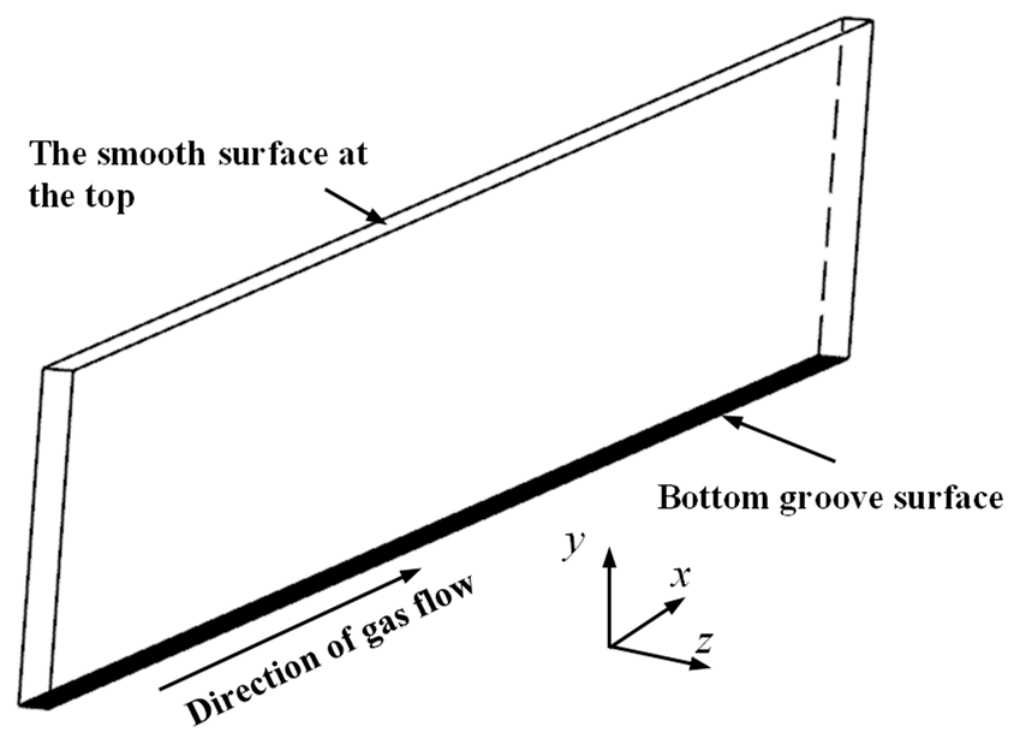
Figure 1.
Plate flow-around model.
Figure 1.
Plate flow-around model.
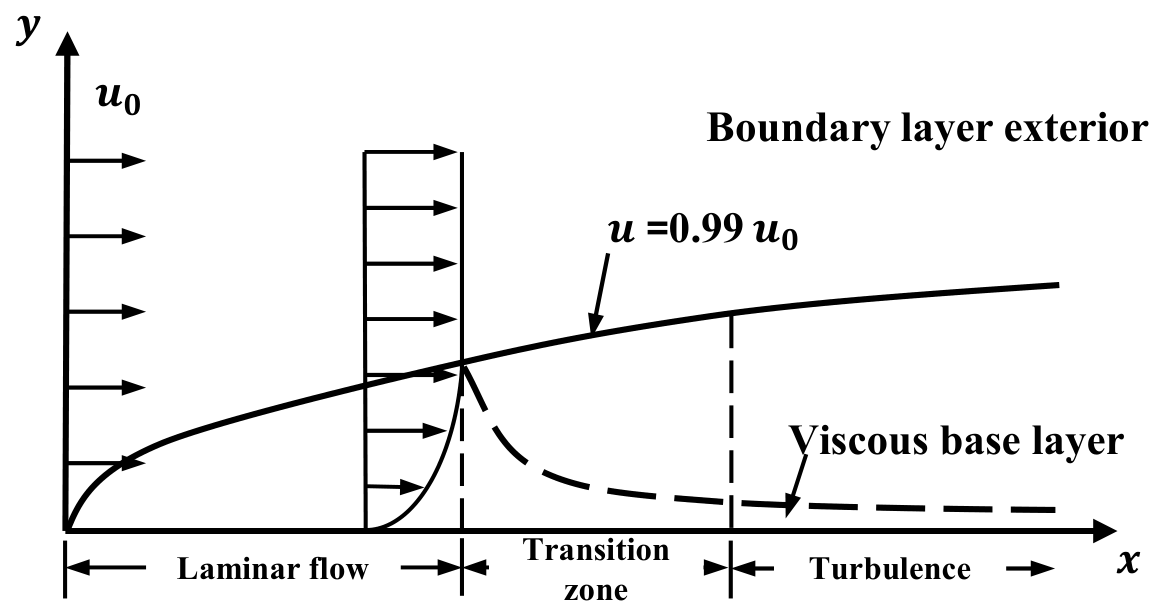
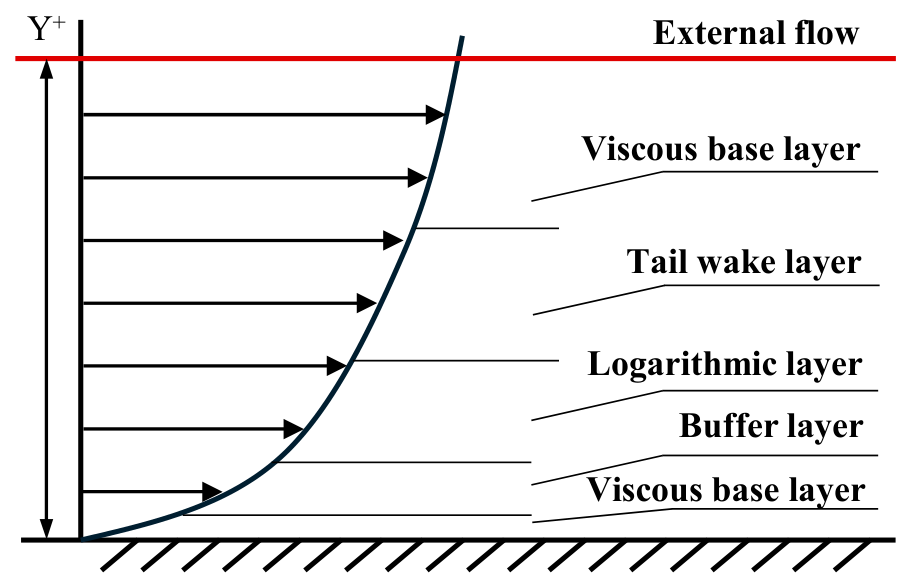
Figure 2.
Schematic diagram of the distribution within the turbulent boundary layer.
Figure 2.
Schematic diagram of the distribution within the turbulent boundary layer.
Figure 3.
Cross-section shape of the groove.
Figure 3.
Cross-section shape of the groove.
Figure 4.
Schematic diagram of the computational domain model.
Figure 4.
Schematic diagram of the computational domain model.
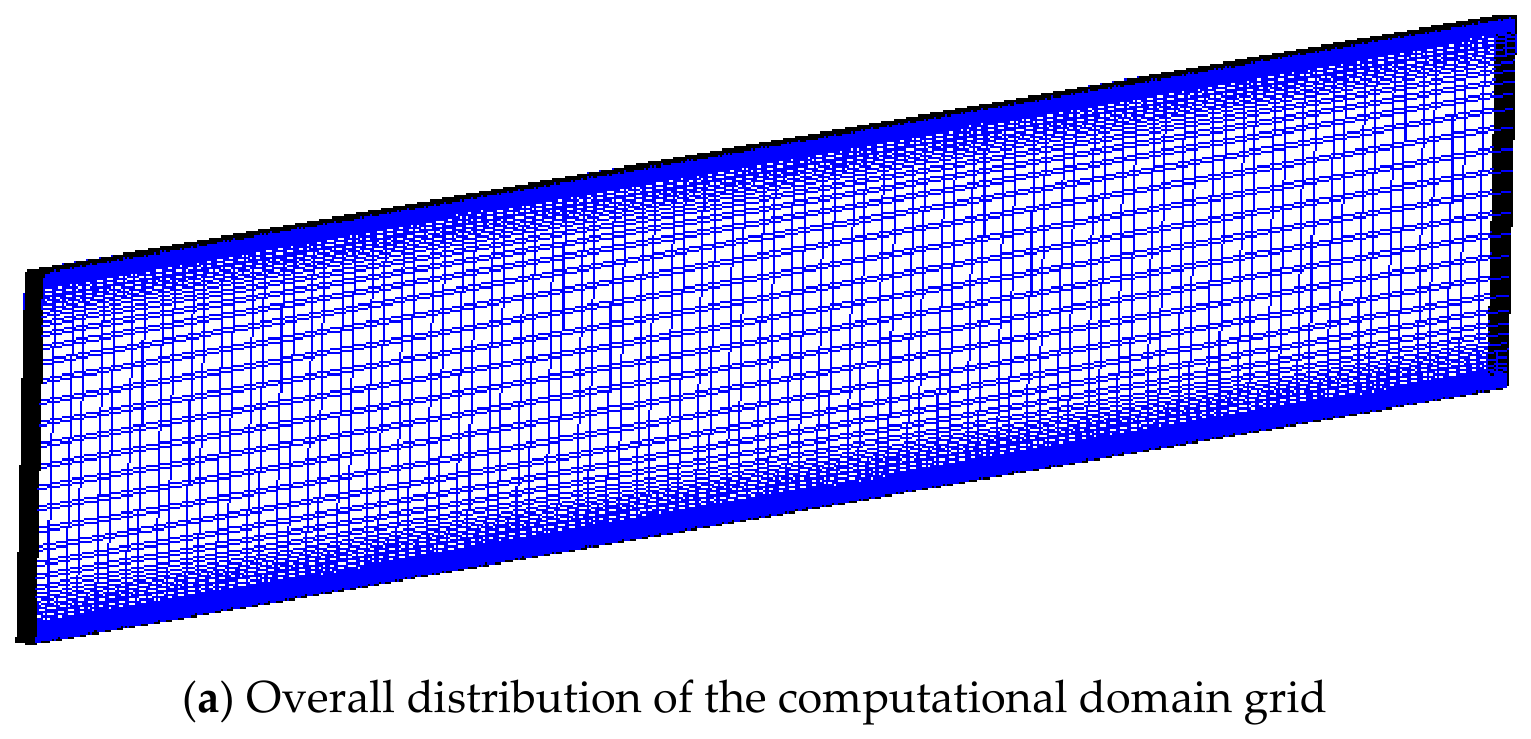
Figure 5.
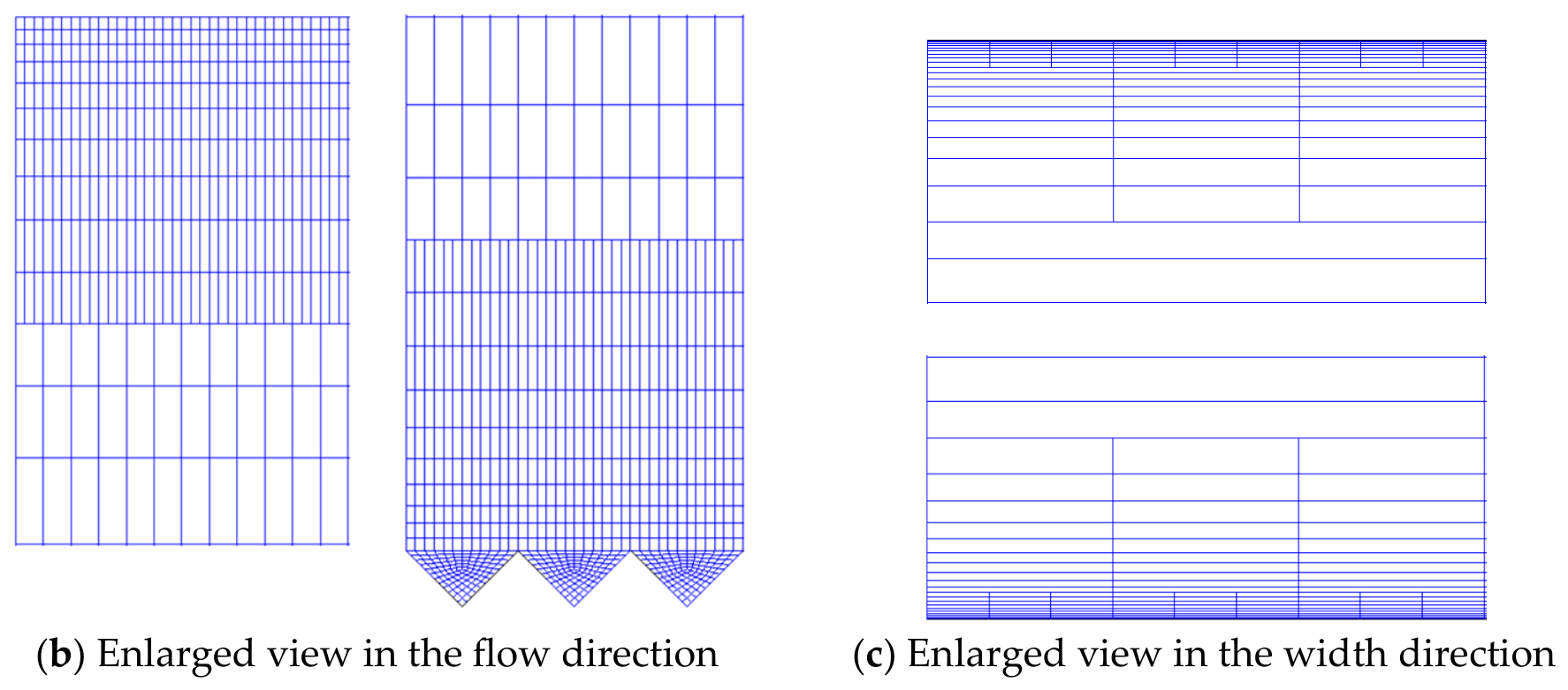
Computational domain grid.
Figure 5.
Computational domain grid.
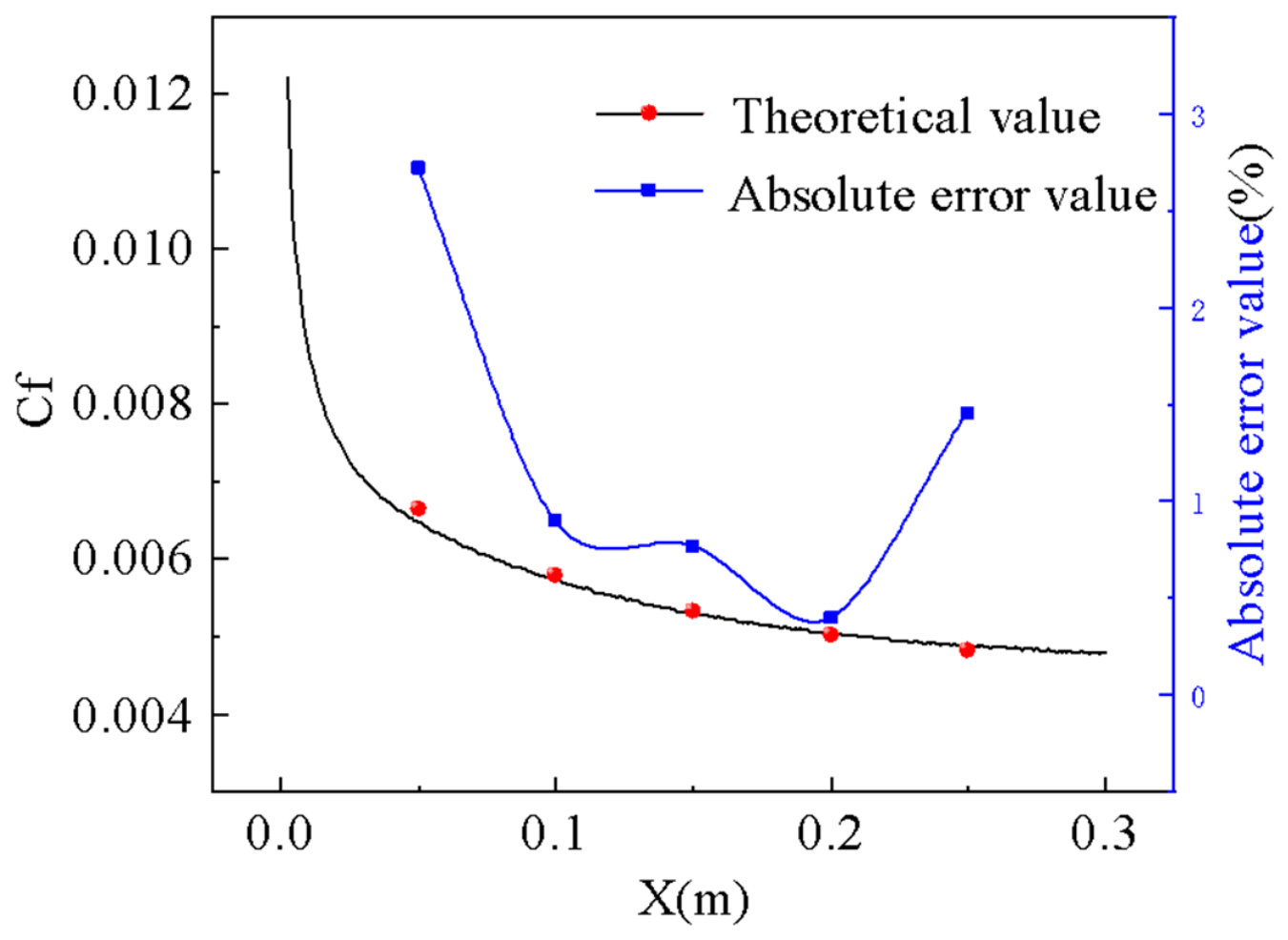
Figure 6.
Comparison between the simulated value and the theoretical value of the coefficient of friction resistance.
Figure 6.
Comparison between the simulated value and the theoretical value of the coefficient of friction resistance.
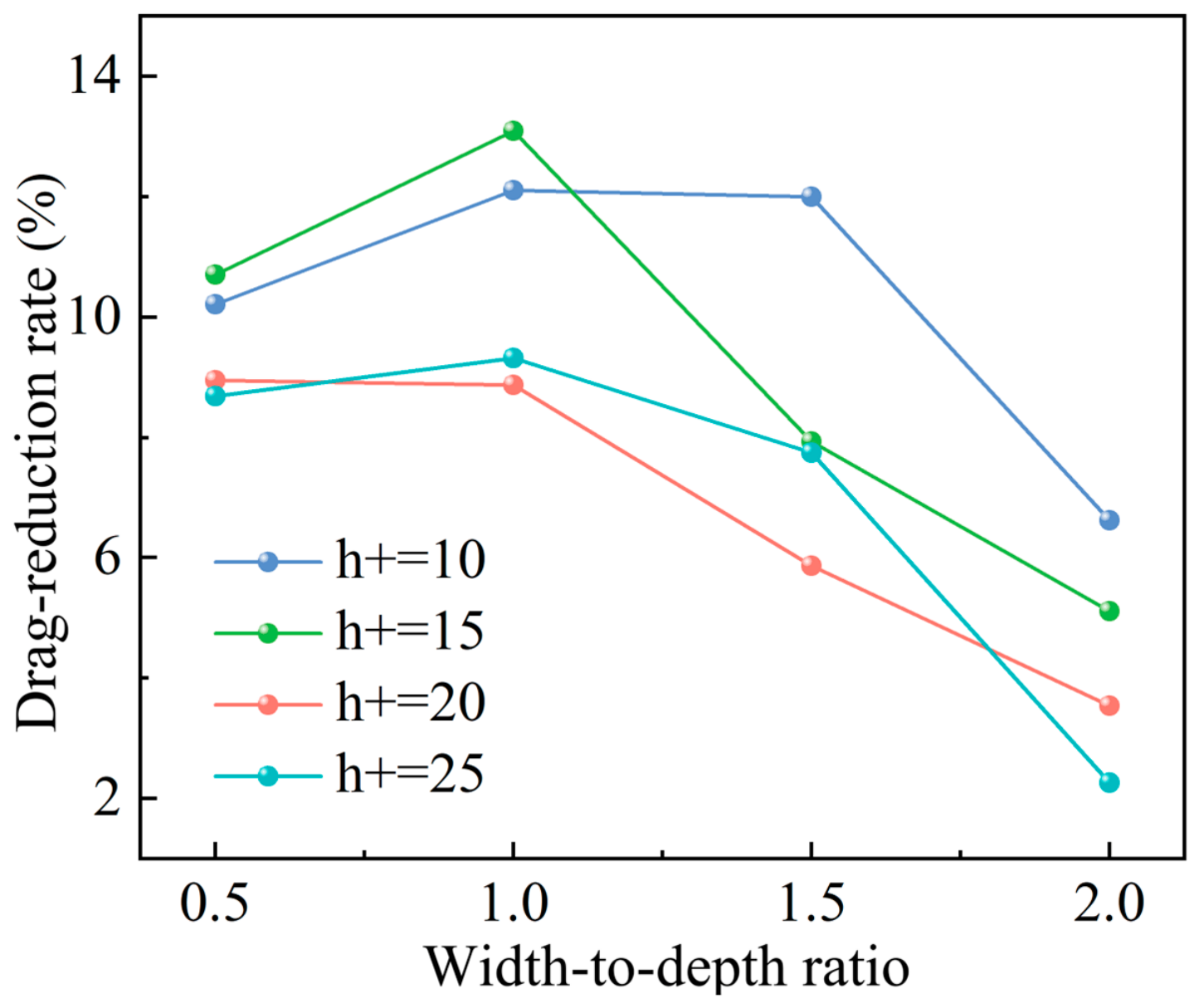
Figure 7.
The influence law of V-shaped groove structure parameters on the drag-reduction rate.
Figure 7.
The influence law of V-shaped groove structure parameters on the drag-reduction rate.
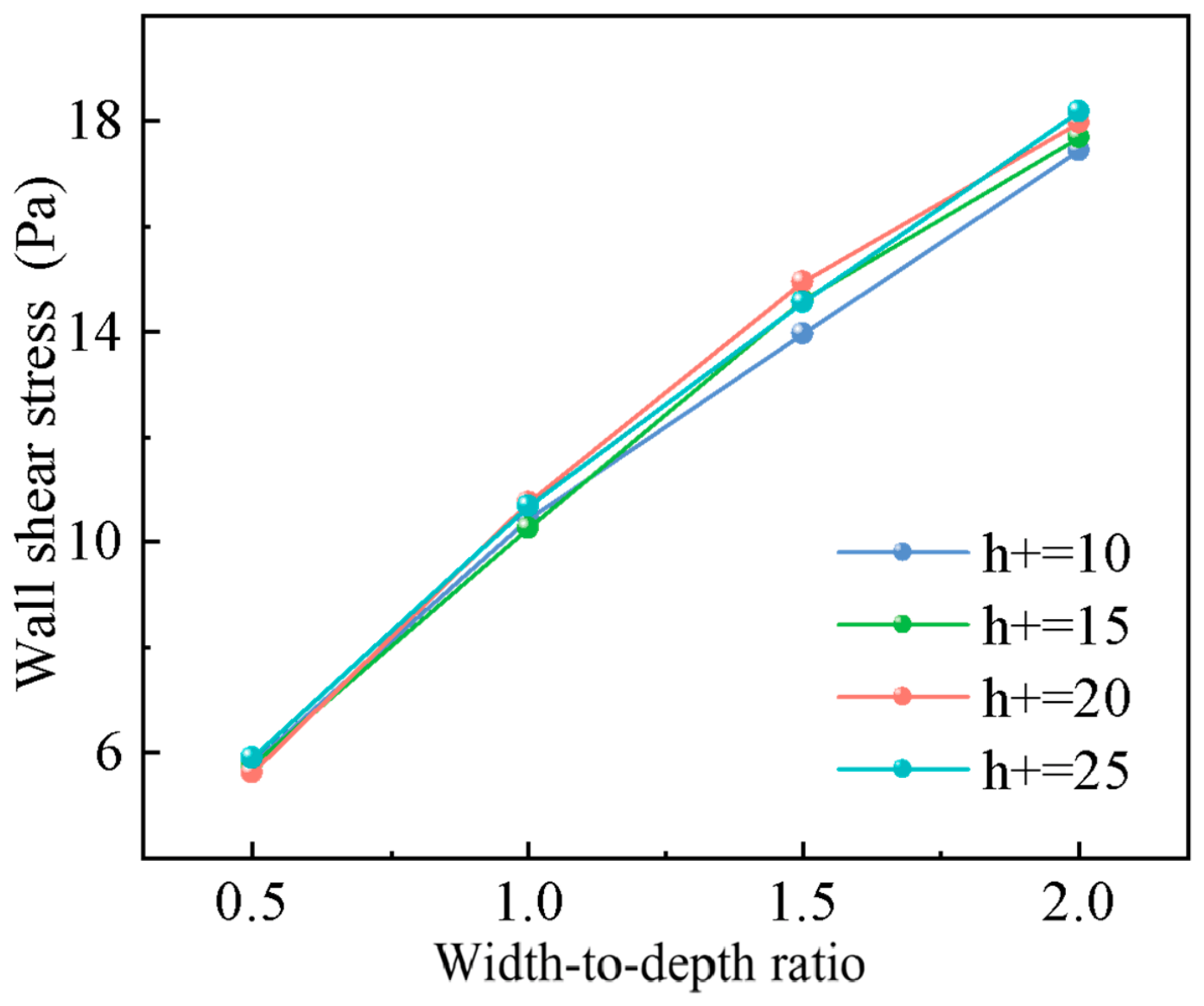
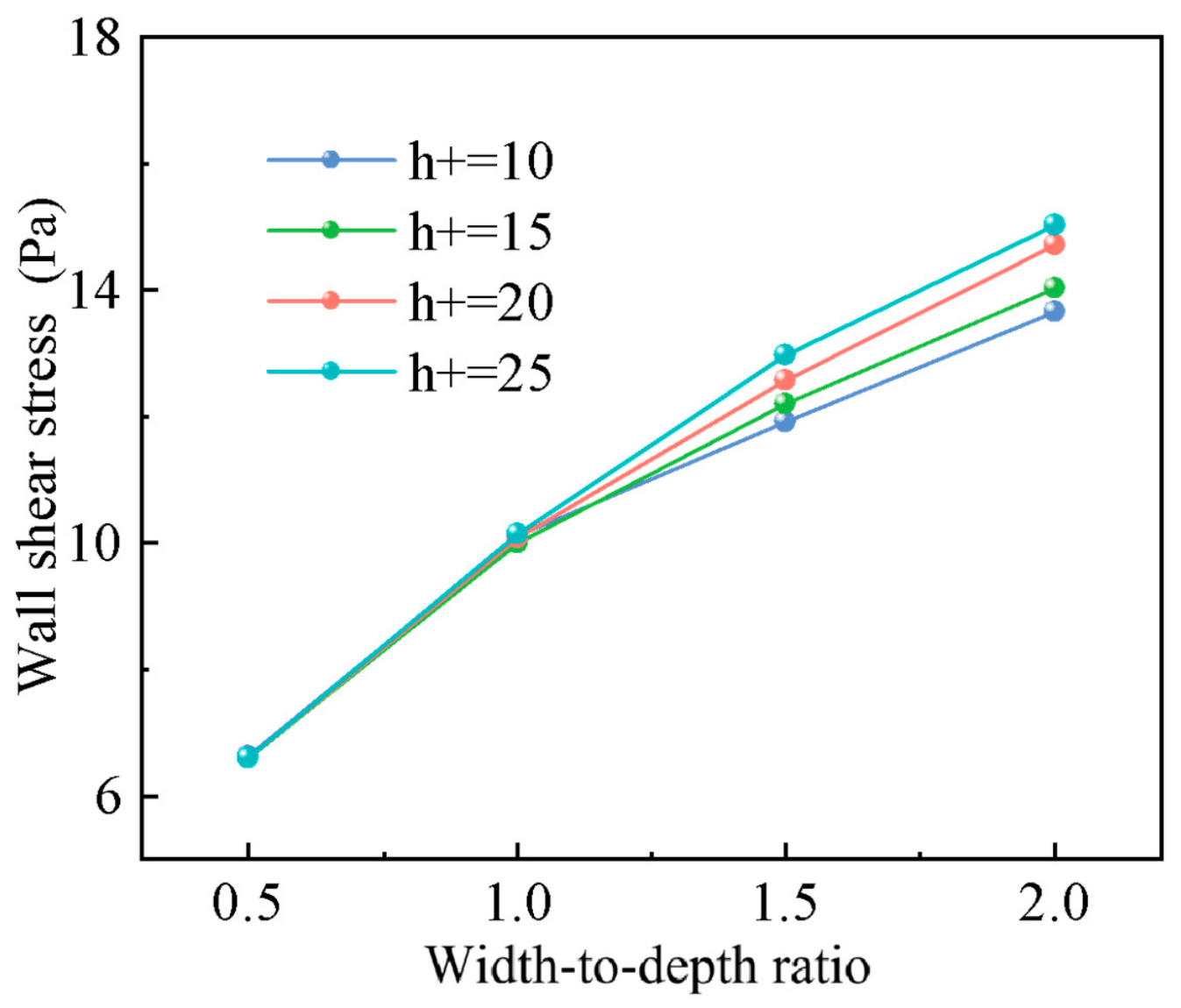
Figure 8.
Influence law of V-shaped groove structure parameters on wall shear stress.
Figure 8.
Influence law of V-shaped groove structure parameters on wall shear stress.
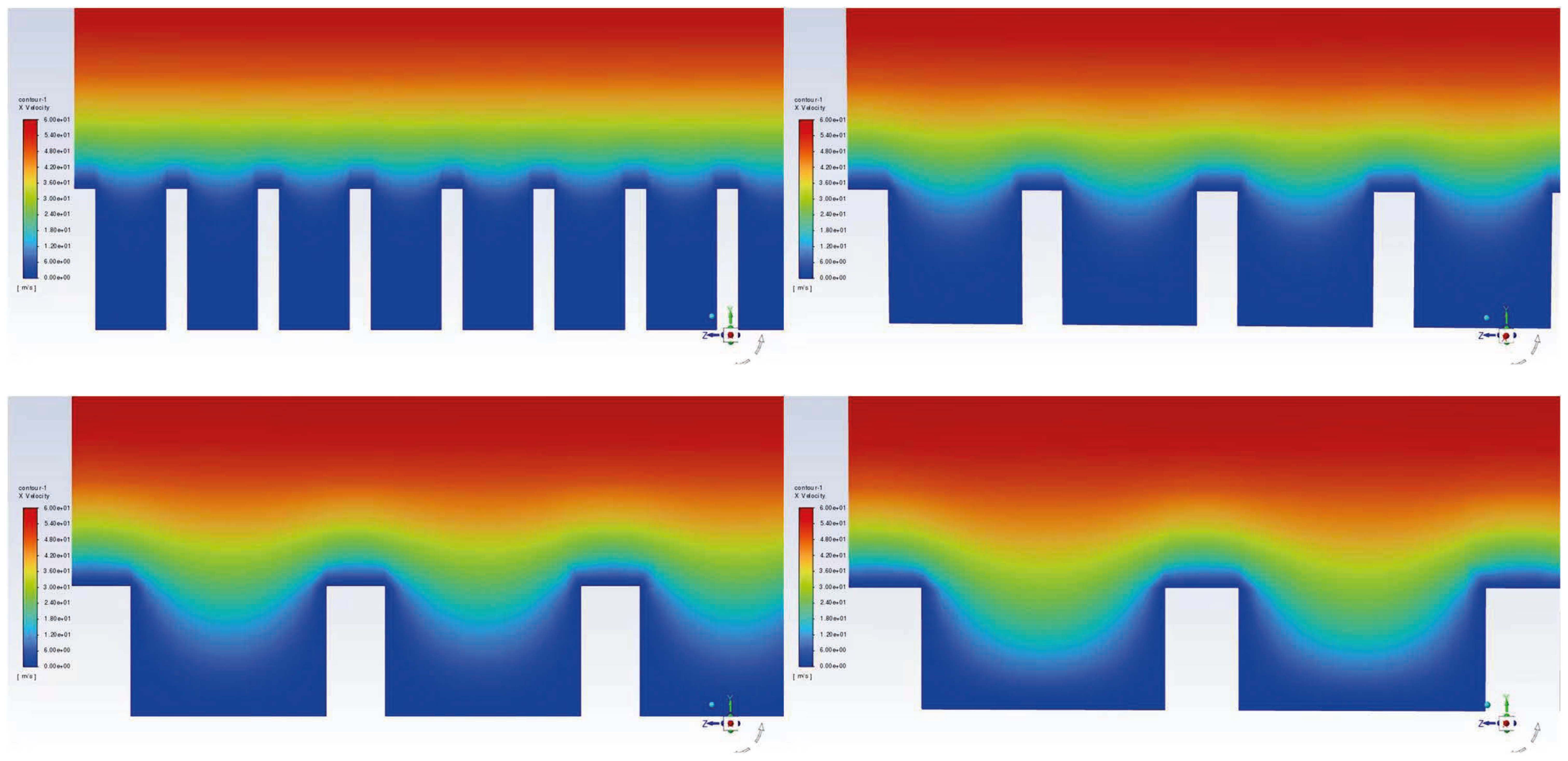
Figure 9.
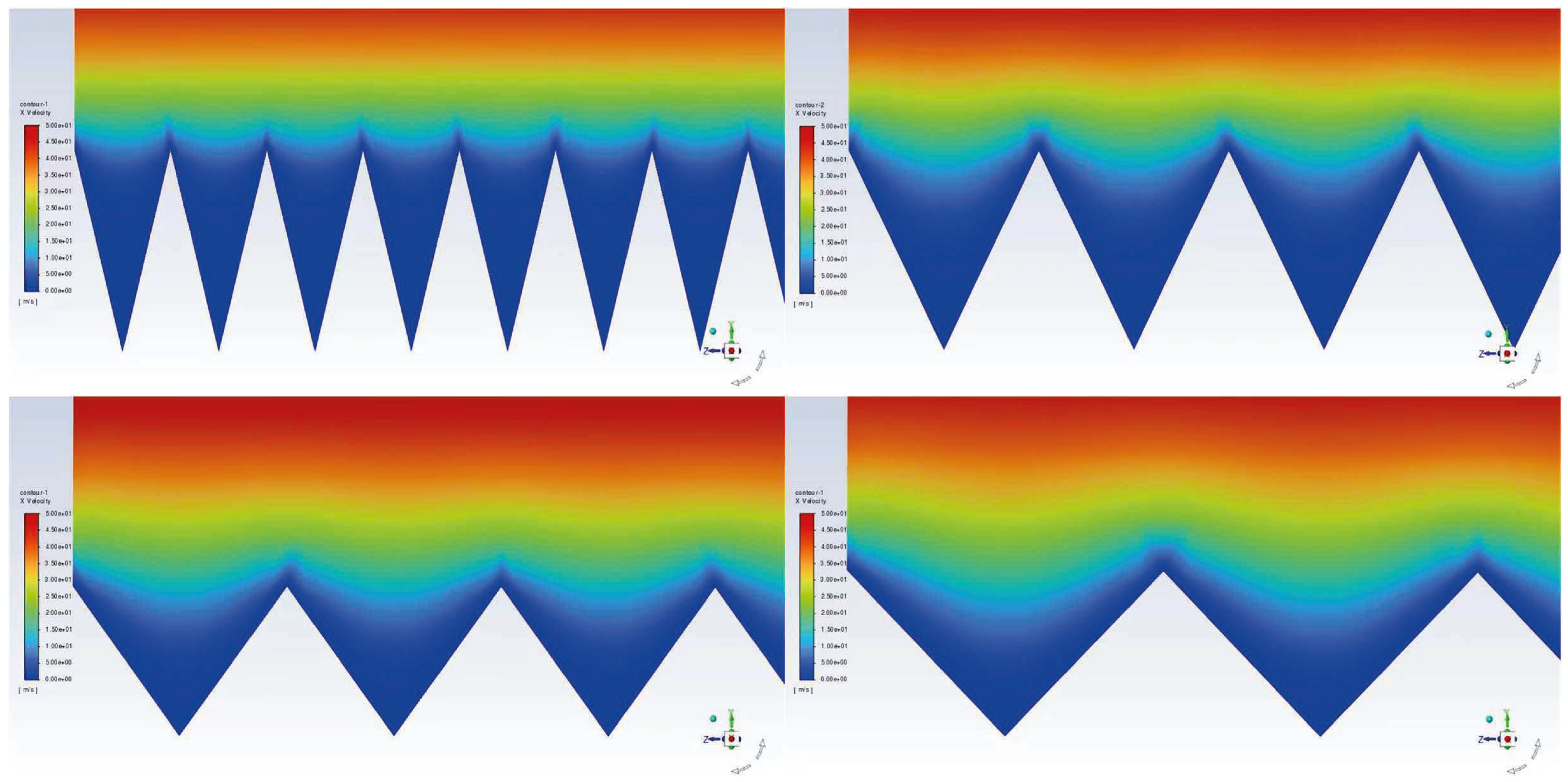
Surface velocity cloud diagrams of V-shaped grooves with different width-to-depth ratios.
Figure 9.
Surface velocity cloud diagrams of V-shaped grooves with different width-to-depth ratios.
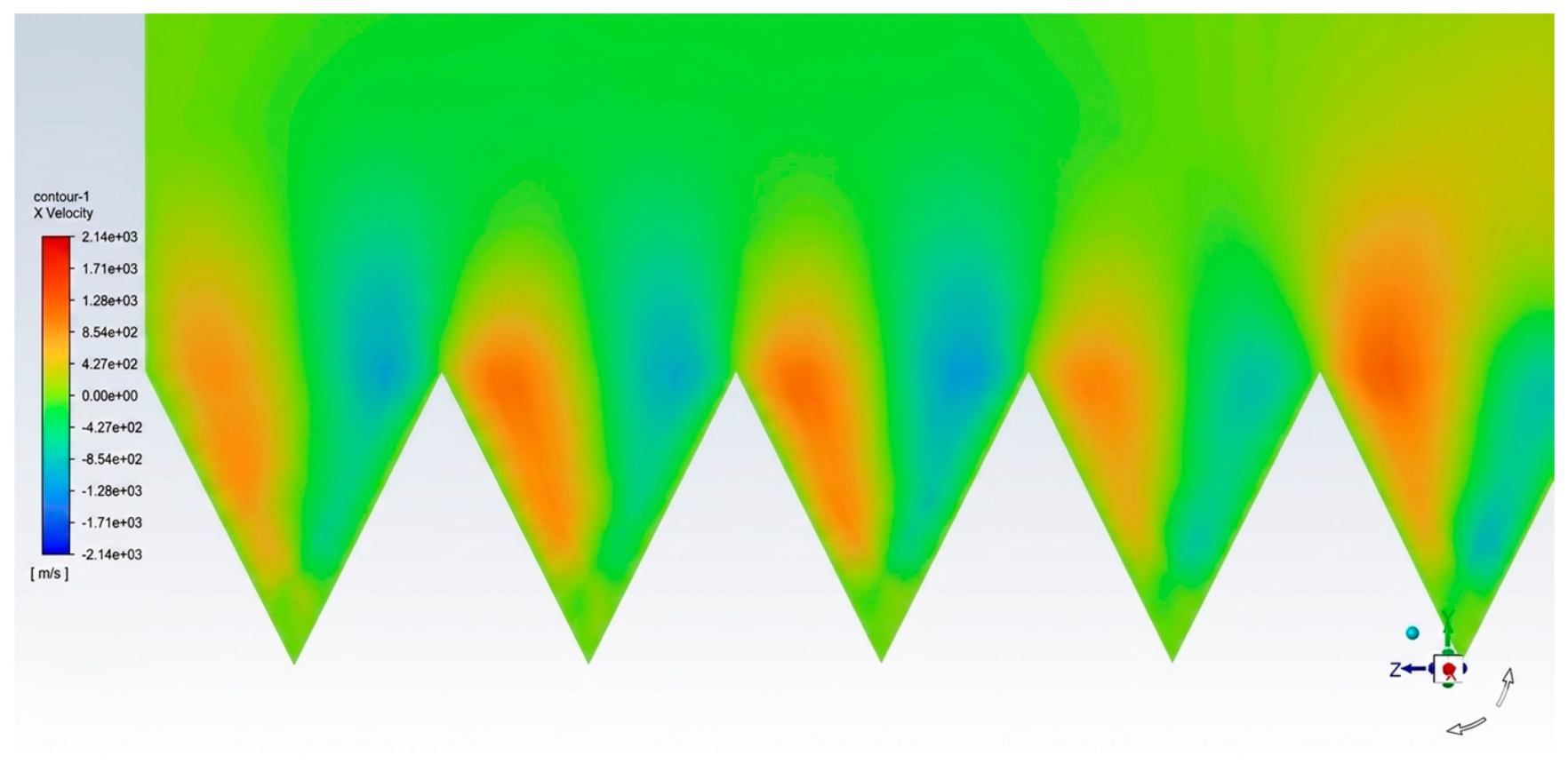
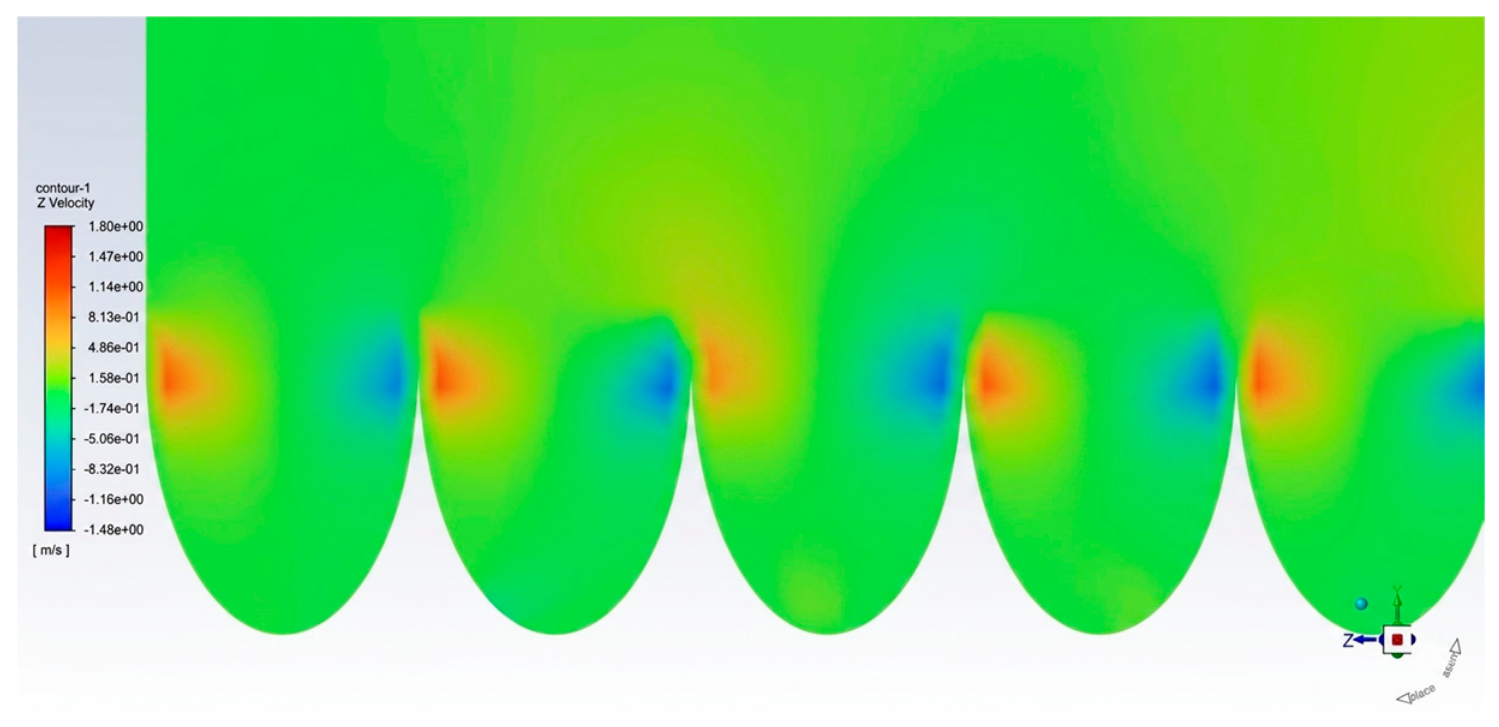
Figure 10.
Z—direction velocity cloud diagram of the V—shaped groove surface.
Figure 10.
Z—direction velocity cloud diagram of the V—shaped groove surface.
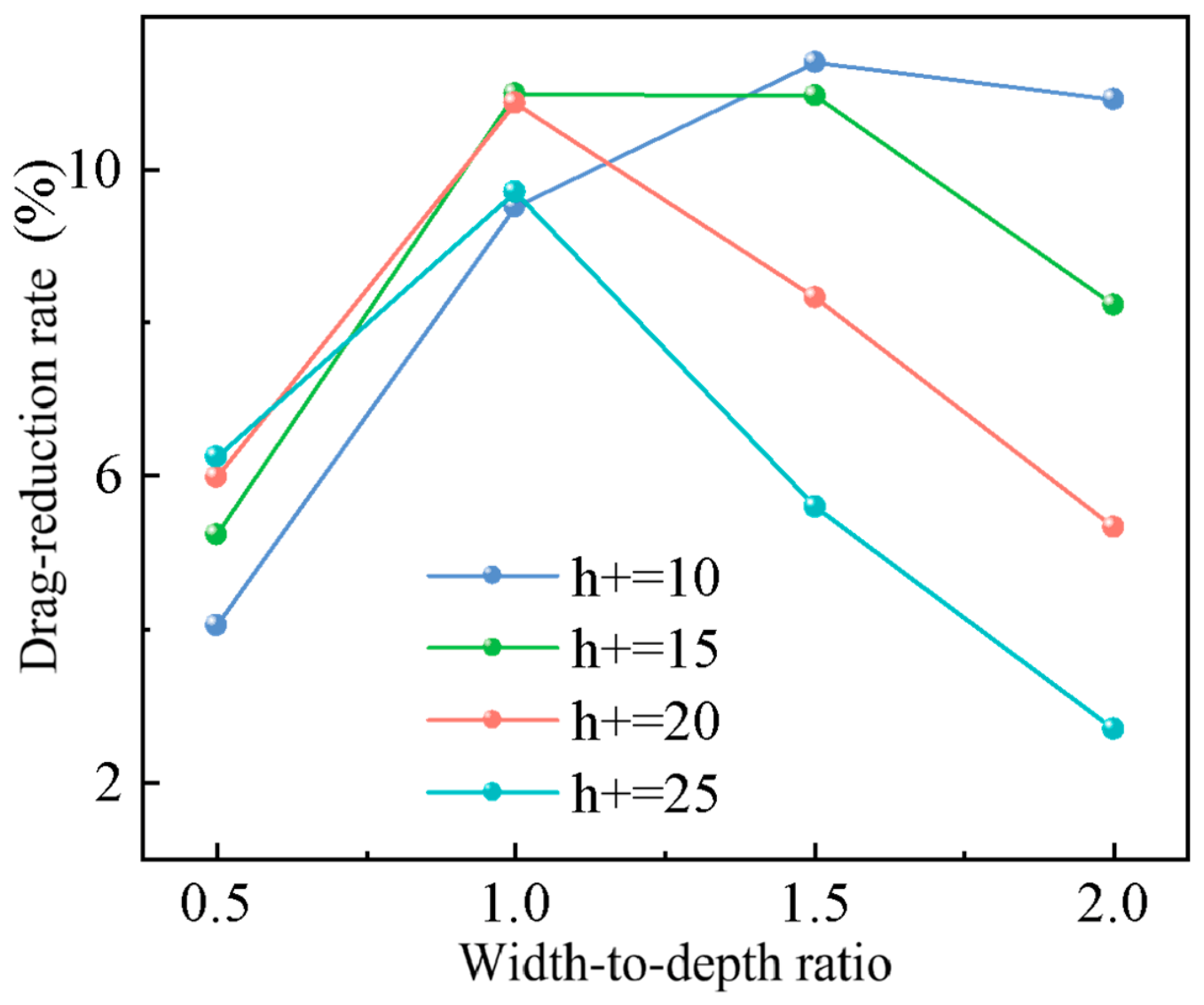
Figure 11.
The influence law of U-shaped groove structure parameters on the drag-reduction rate.
Figure 11.
The influence law of U-shaped groove structure parameters on the drag-reduction rate.
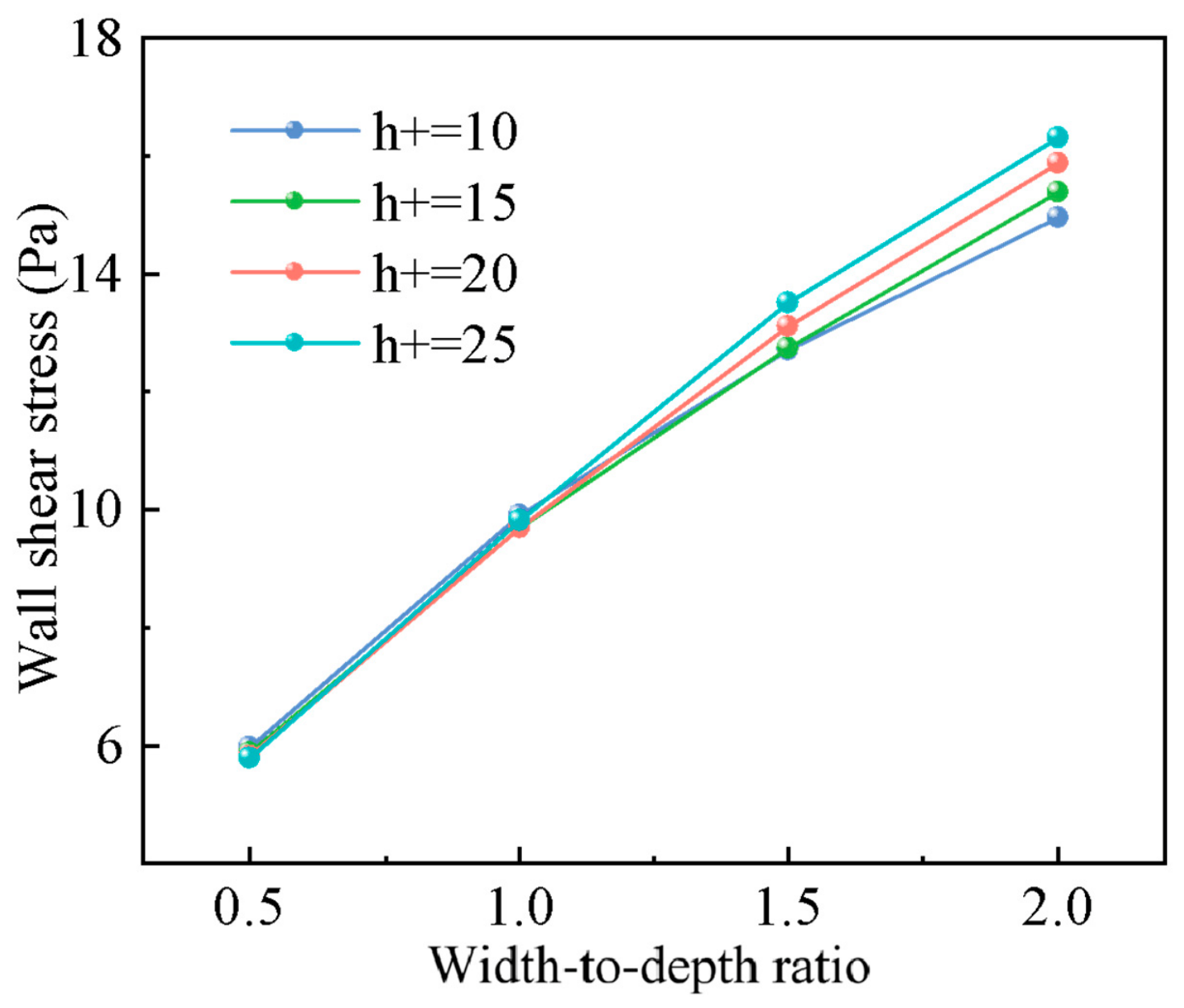
Figure 12.
The influence law of U-shaped groove structure parameters on wall shear stress.
Figure 12.
The influence law of U-shaped groove structure parameters on wall shear stress.
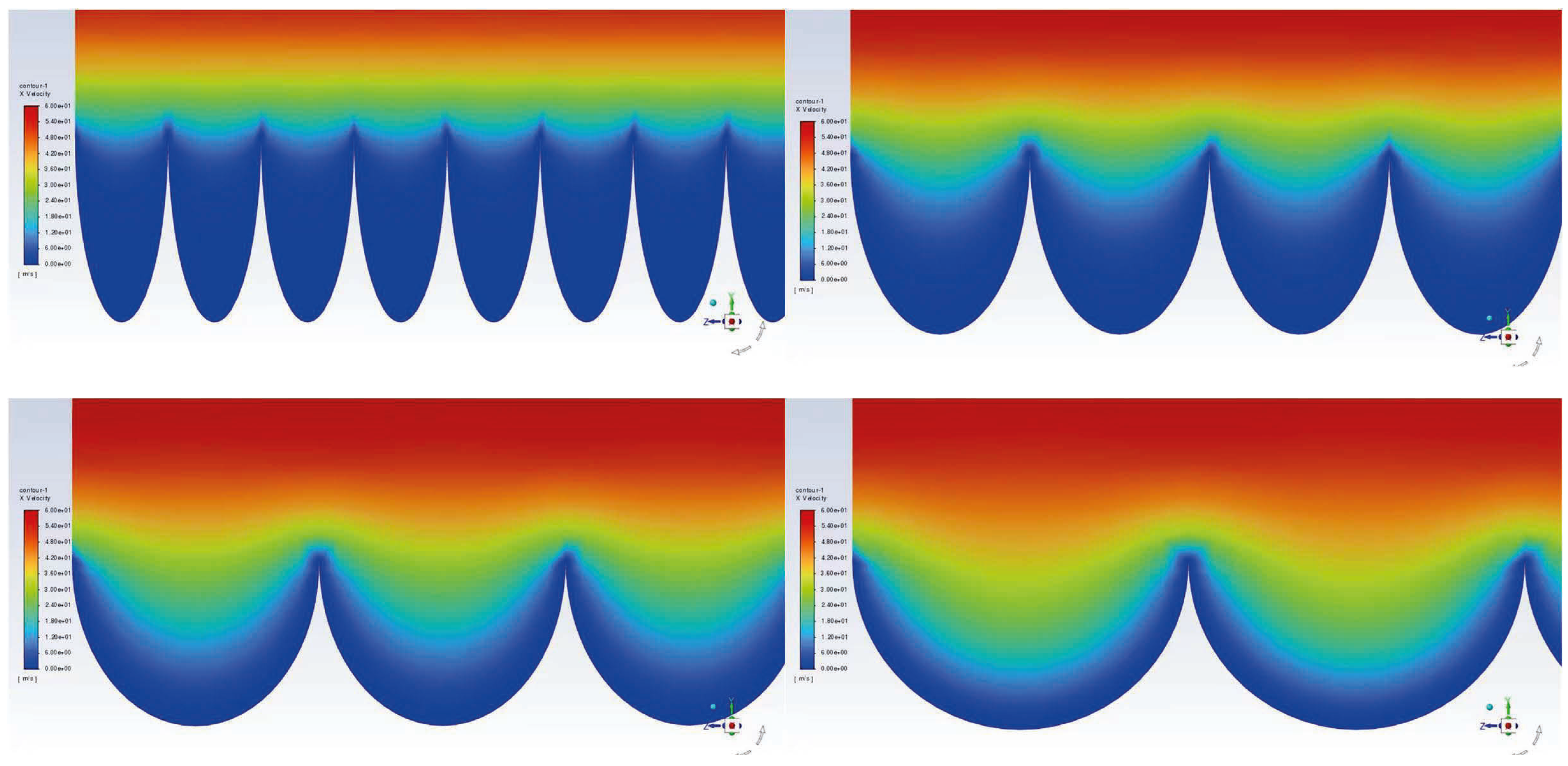
Figure 13.
Surface velocity cloud diagrams of U-shaped grooves with different width-to-depth ratios.
Figure 13.
Surface velocity cloud diagrams of U-shaped grooves with different width-to-depth ratios.
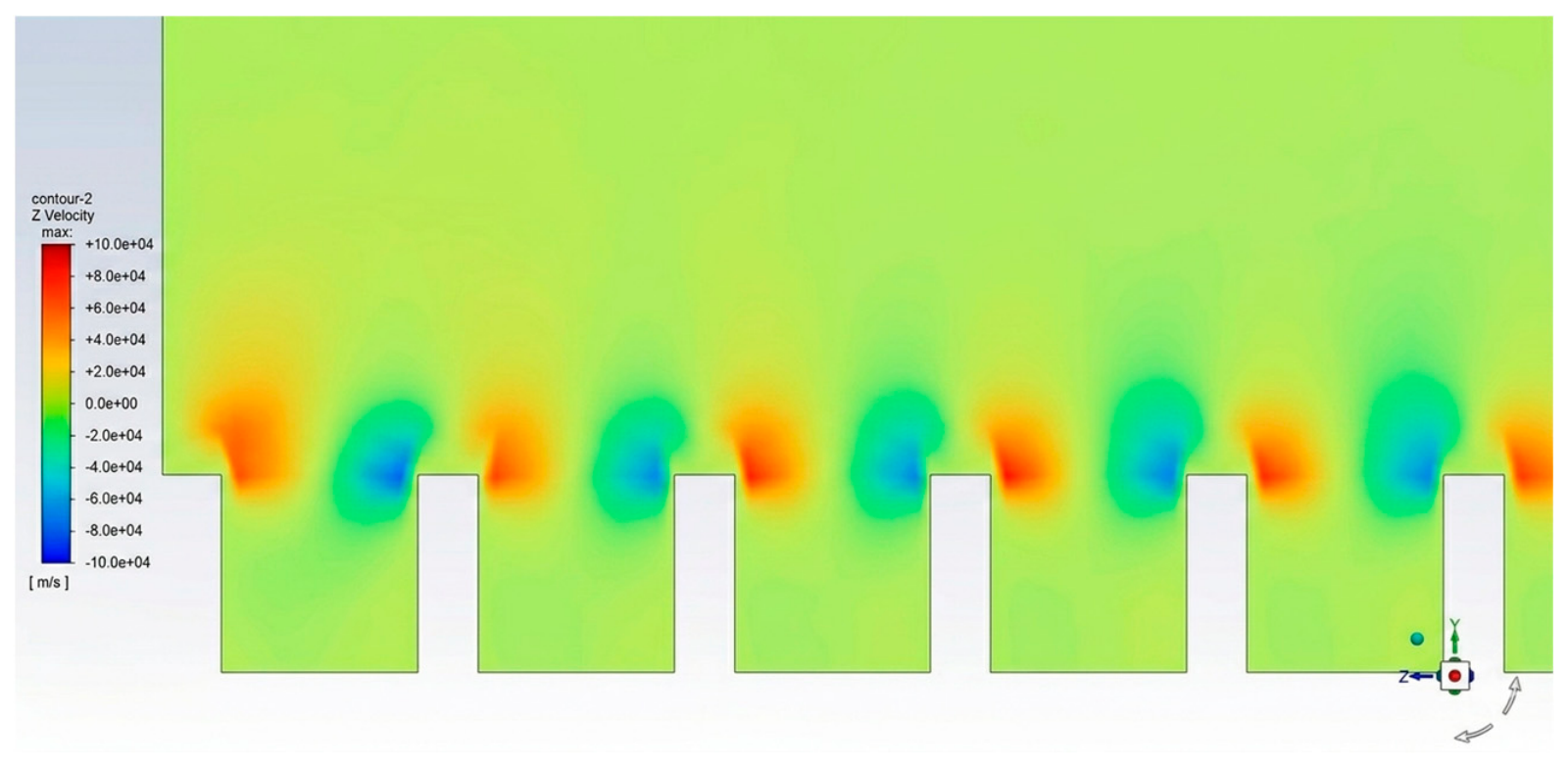
Figure 14.
Z—direction velocity cloud diagram of the U—shaped groove surface.
Figure 14.
Z—direction velocity cloud diagram of the U—shaped groove surface.
Figure 15.
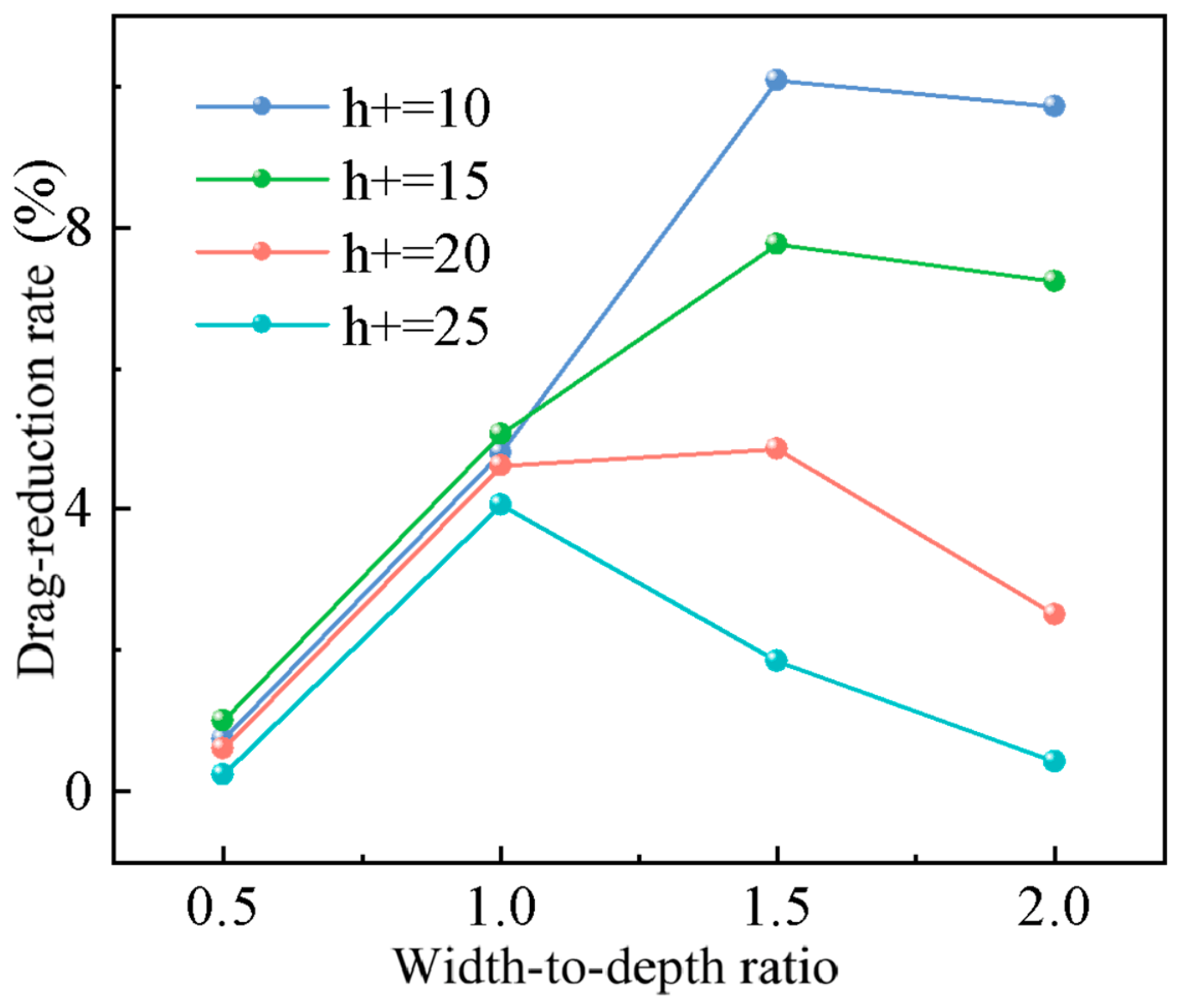
The influence law of rectangular groove structure parameters on drag reduction rate.
Figure 15.
The influence law of rectangular groove structure parameters on drag reduction rate.
Figure 16.
The influence law of rectangular groove structure parameters on wall shear stress.
Figure 16.
The influence law of rectangular groove structure parameters on wall shear stress.
Figure 17.
Surface velocity cloud map of rectangular grooves with different width-to-depth ratios.
Figure 17.
Surface velocity cloud map of rectangular grooves with different width-to-depth ratios.
Figure 18.
Z—direction velocity cloud map of the surface of the rectangular groove.
Figure 18.
Z—direction velocity cloud map of the surface of the rectangular groove.
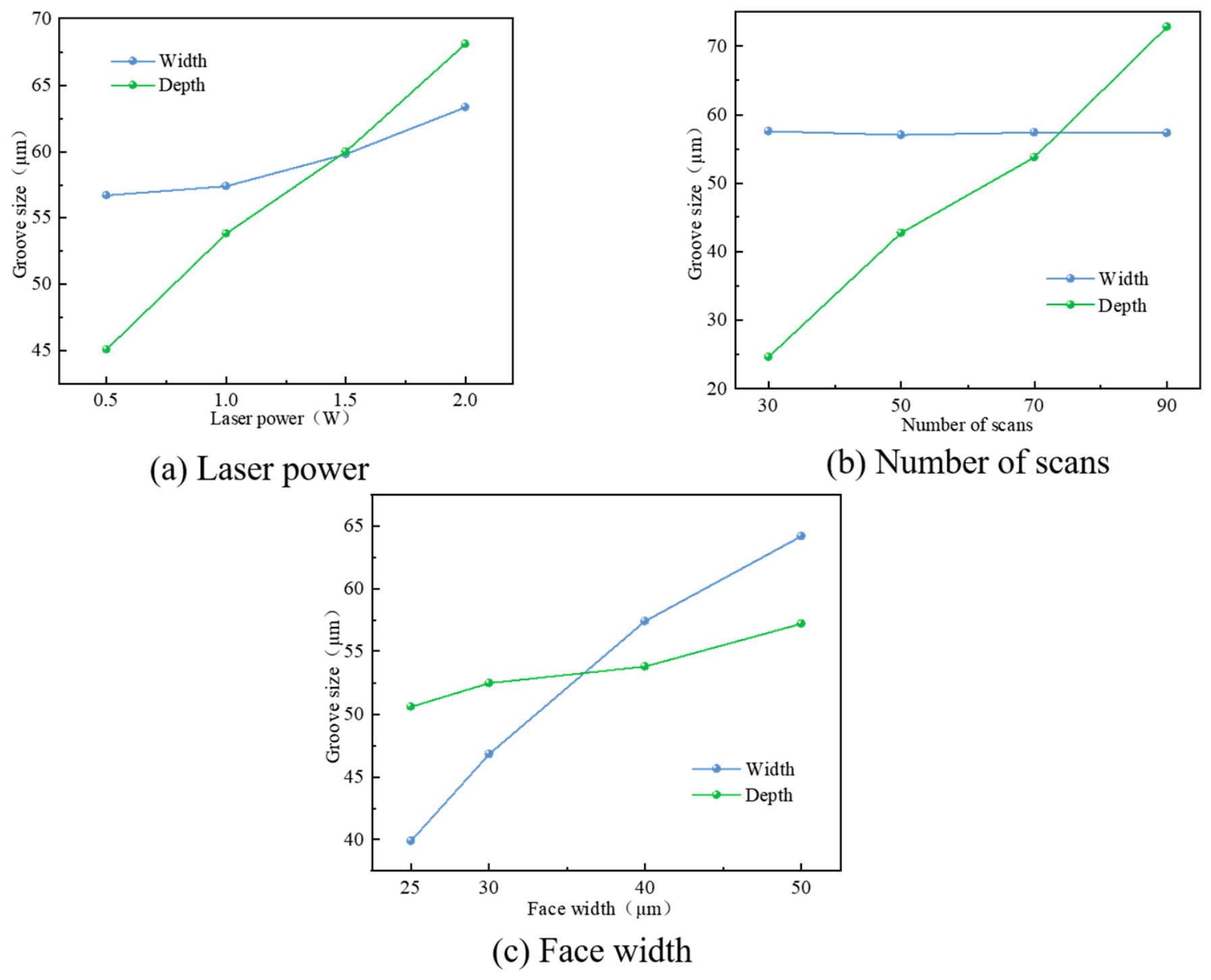
Figure 19.
The influence of a single factor on the size of the drag-reduction groove.
Figure 19.
The influence of a single factor on the size of the drag-reduction groove.
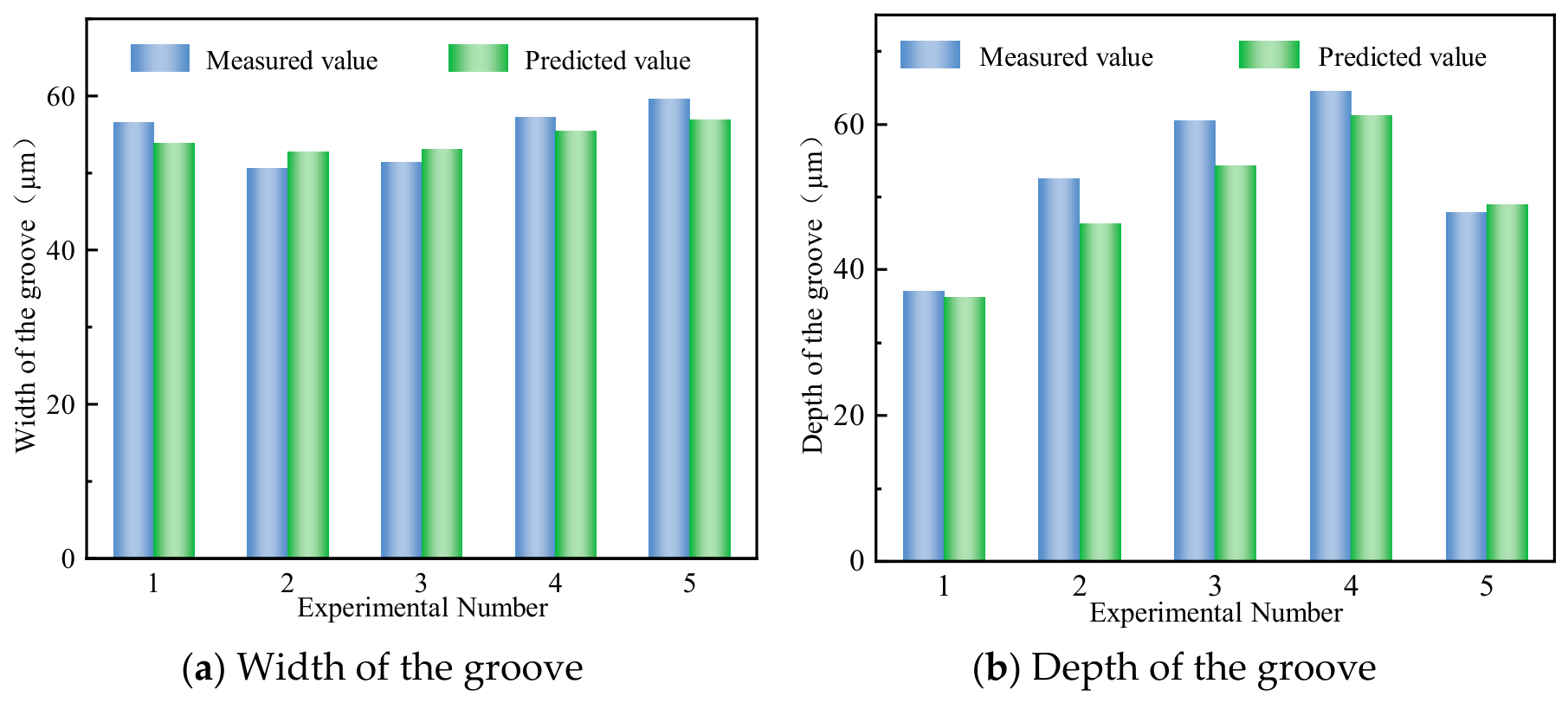
Figure 20.
Comparison of regression prediction results.
Figure 20.
Comparison of regression prediction results.
Figure 21.
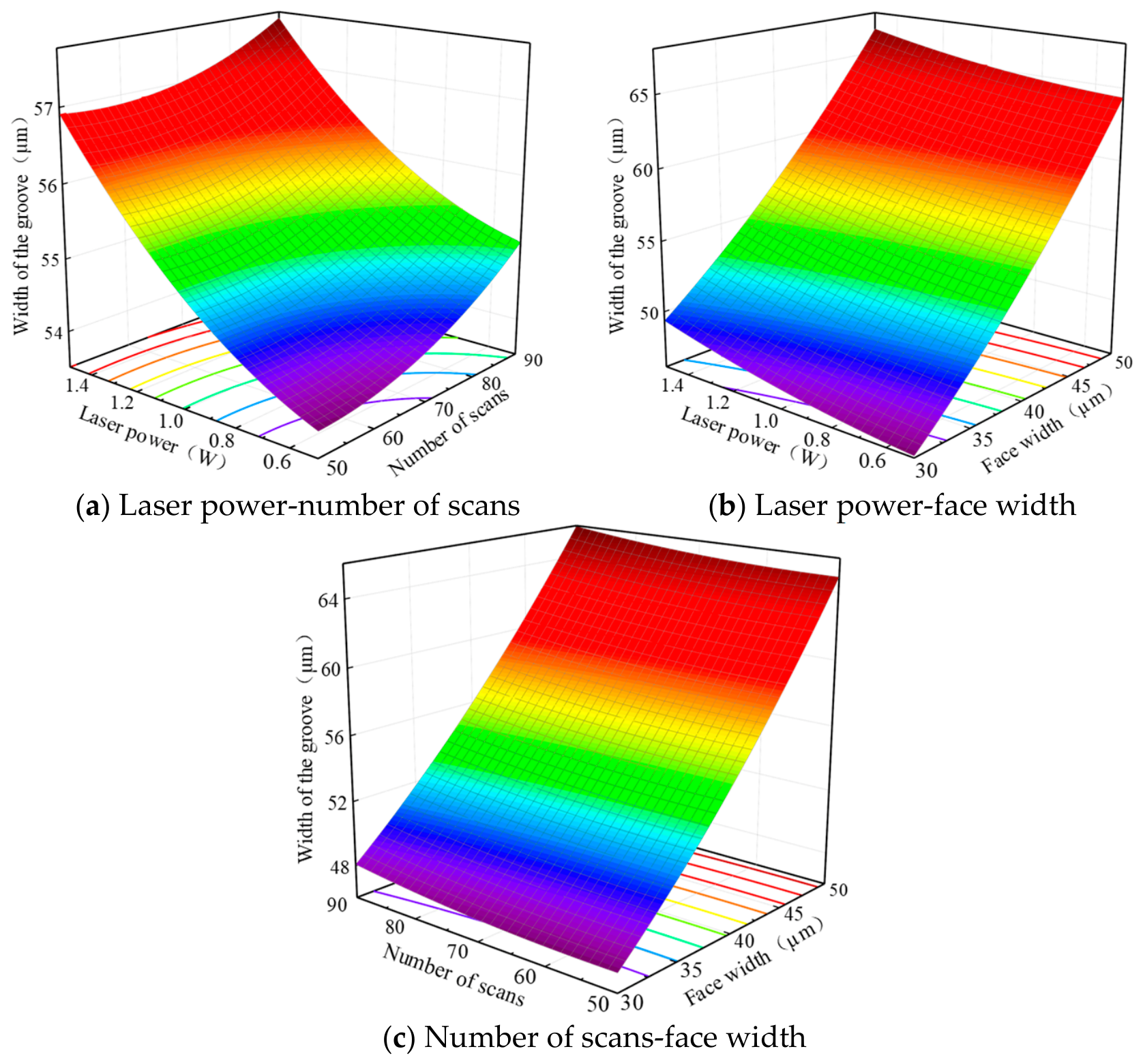
Analysis of the response surface of groove width.
Figure 21.
Analysis of the response surface of groove width.
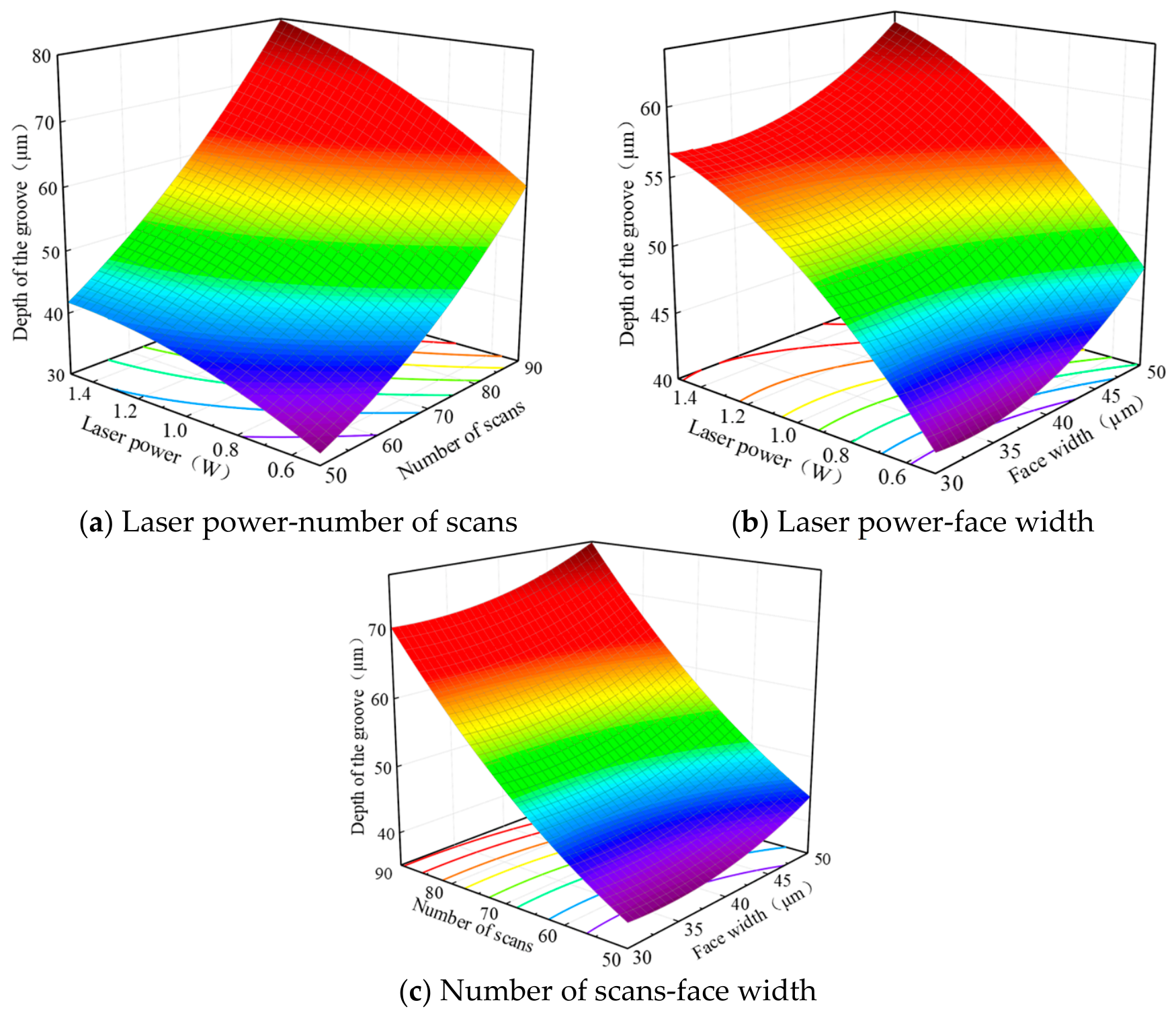
Figure 22.
Analysis of the groove depth response surface.
Figure 22.
Analysis of the groove depth response surface.
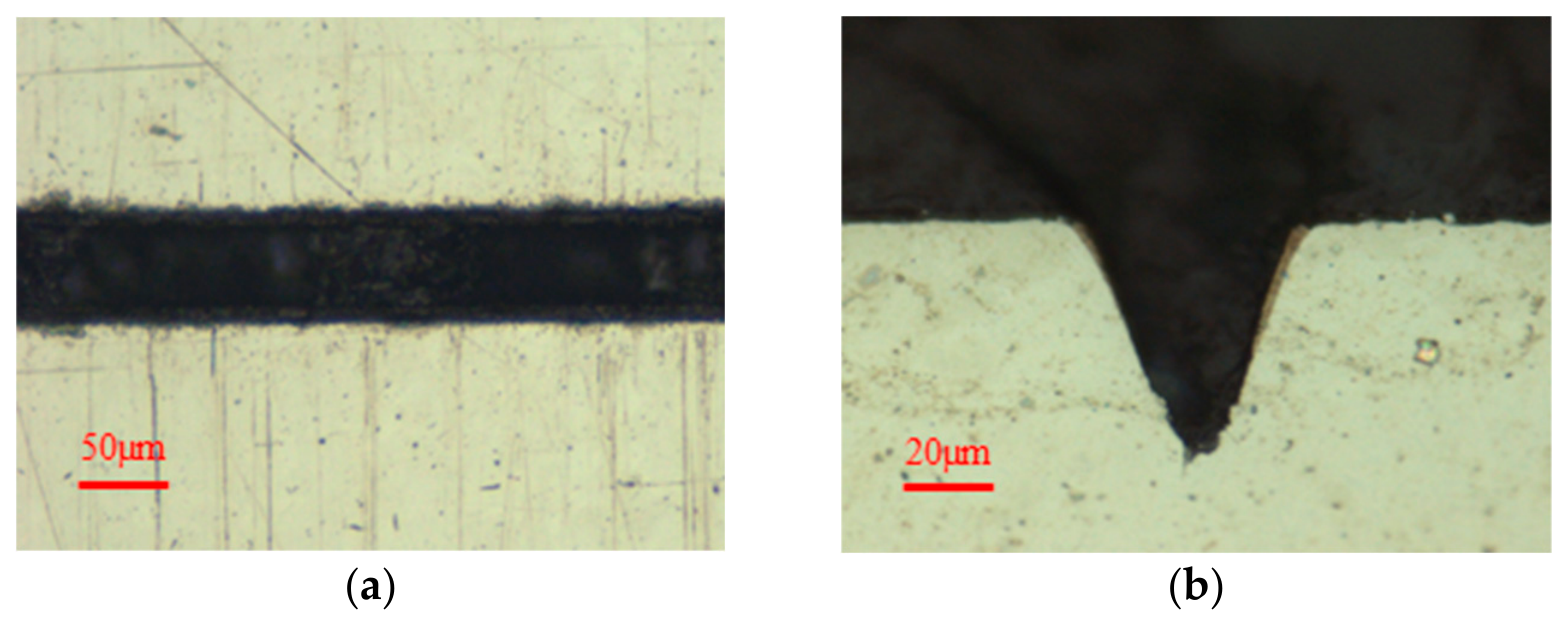
Figure 23.
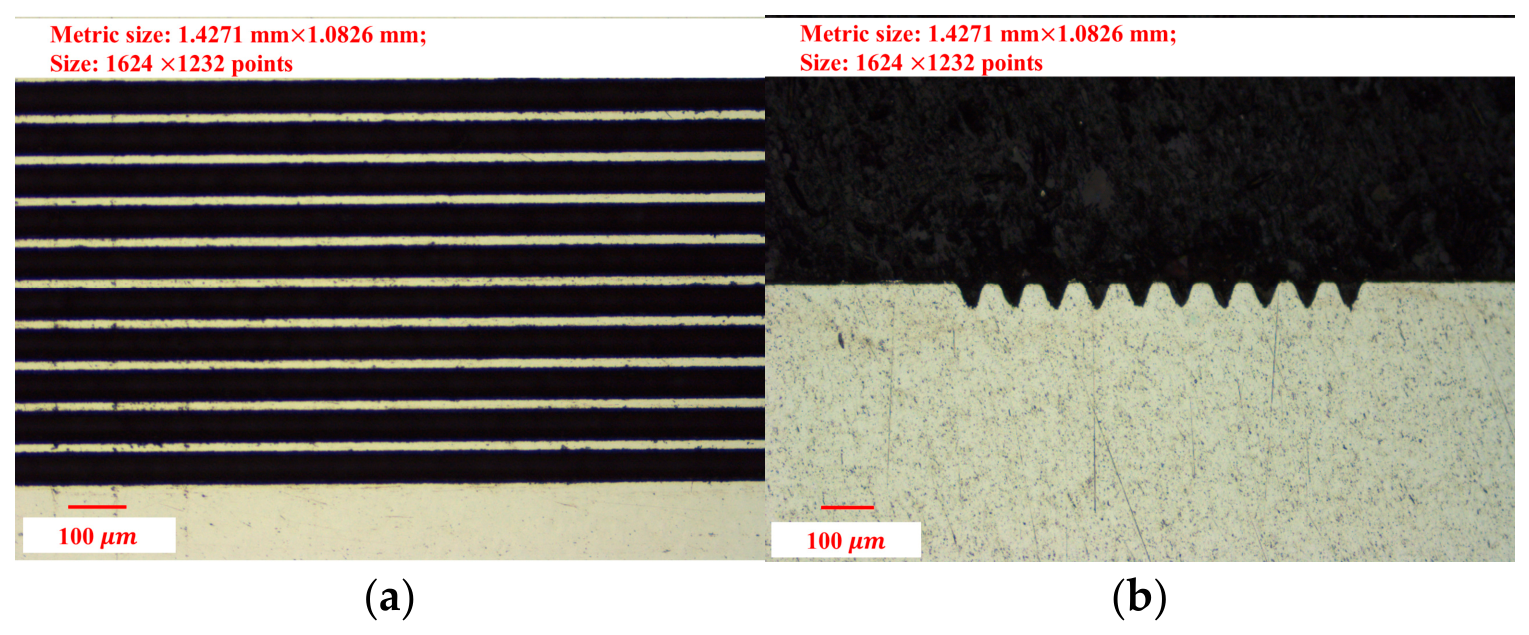
Surface morphology after optimization. (a) Surface morphology of the groove; (b) Cross-section morphology of the groove.
Figure 23.
Surface morphology after optimization. (a) Surface morphology of the groove; (b) Cross-section morphology of the groove.
Figure 24.
Surface morphology of the array drag-reduction structure. (a) Surface morphology of array grooves; (b) Cross-sectional morphology of the array groove.
Figure 24.
Surface morphology of the array drag-reduction structure. (a) Surface morphology of array grooves; (b) Cross-sectional morphology of the array groove.
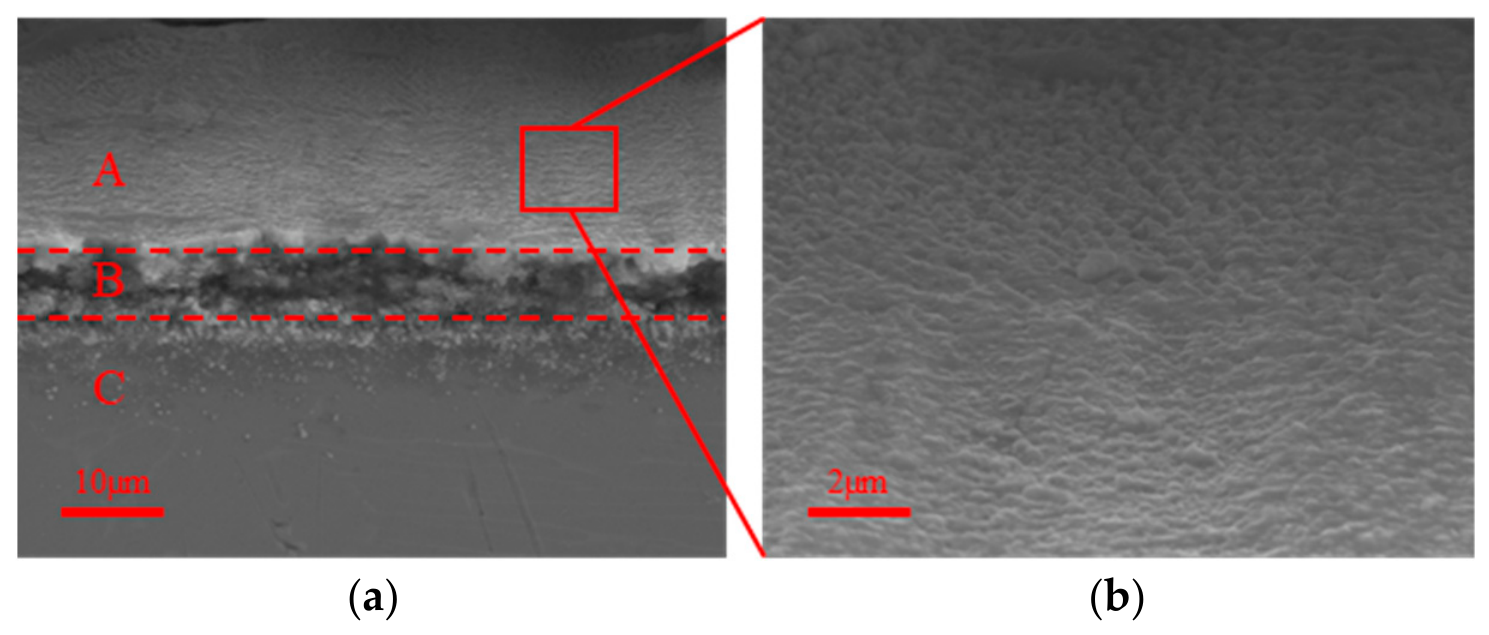
Figure 25.
SEM image of the inner wall of the groove. (a) Surface topography of the groove edge; (b) Local enlargement of the inner wall of the groove.
Figure 25.
SEM image of the inner wall of the groove. (a) Surface topography of the groove edge; (b) Local enlargement of the inner wall of the groove.
Table 1.
Characteristic parameters of air.
Table 1.
Characteristic parameters of air.
| Medium | kg/m3) | s/m2) | Kinematic Viscosity
(v, m/s2) |
|---|
| Air | 1.225 | 1.789 × 10⁻⁵ | 1.46 × 10⁻⁵ |
Table 2.
Simulation parameter table.
Table 2.
Simulation parameter table.
| Number | Groove Shape | Dimensionless Depth | Aspect Ratio |
|---|
| 1 | V-shaped/U-shaped/Rectangle | 10 | 0.5 |
| 2 | 15 | 1 |
| 3 | 20 | 1.5 |
| 4 | 25 | 2 |
Table 3.
Selection table of computational domain boundary conditions.
Table 3.
Selection table of computational domain boundary conditions.
| Boundary Name | Location | Boundary Conditions |
|---|
| Inlet | Entrance | Velocity-inlet |
| Out | exit | Pressure outlet |
| Side | sides | Symmetry |
| Up | Top surface | Wall |
| Down | Bottom surface | Wall |
Table 4.
Theoretical and simulated values of surface friction coefficients in different regions.
Table 4.
Theoretical and simulated values of surface friction coefficients in different regions.
| Location (m) | Theoretical Value | Simulation Value | Absolute Error Value (%) |
|---|
| 0.05 | 0.006645 | 0.006464 | 2.72 |
| 0.10 | 0.005785 | 0.005733 | 0.90 |
| 0.15 | 0.005334 | 0.005293 | 0.77 |
| 0.20 | 0.005036 | 0.005056 | 0.40 |
| 0.25 | 0.004816 | 0.004886 | 1.45 |
Table 5.
Simulation results of V-shaped groove drag-reduction rate.
Table 5.
Simulation results of V-shaped groove drag-reduction rate.
| Number | h/µm | Aspect Ratio | Drag-Reduction Rate |
|---|
| 1 | 90 | 0.5 | 8.68 |
| 2 | 90 | 1 | 9.32 |
| 3 | 90 | 1.5 | 7.75 |
| 4 | 90 | 2 | 2.27 |
| 5 | 72 | 0.5 | 8.95 |
| 6 | 72 | 1 | 8.87 |
| 7 | 72 | 1.5 | 5.87 |
| 8 | 72 | 2 | 3.55 |
| 9 | 54 | 0.5 | 10.70 |
| 10 | 54 | 1 | 13.10 |
| 11 | 54 | 1.5 | 7.93 |
| 12 | 54 | 2 | 5.11 |
| 13 | 36 | 0.5 | 10.21 |
| 14 | 36 | 1 | 12.10 |
| 15 | 36 | 1.5 | 12.00 |
| 16 | 36 | 2 | 6.63 |
Table 6.
Simulation results of drag-reduction rate in U-shaped grooves.
Table 6.
Simulation results of drag-reduction rate in U-shaped grooves.
| Number | h/µm | Aspect Ratio | Drag-Reduction Rate |
|---|
| 1 | 90 | 0.5 | 6.24 |
| 2 | 90 | 1 | 9.69 |
| 3 | 90 | 1.5 | 5.60 |
| 4 | 90 | 2 | 2.70 |
| 5 | 72 | 0.5 | 5.97 |
| 6 | 72 | 1 | 10.82 |
| 7 | 72 | 1.5 | 8.32 |
| 8 | 72 | 2 | 5.32 |
| 9 | 54 | 0.5 | 5.23 |
| 10 | 54 | 1 | 10.99 |
| 11 | 54 | 1.5 | 10.96 |
| 12 | 54 | 2 | 8.23 |
| 13 | 36 | 0.5 | 4.04 |
| 14 | 36 | 1 | 9.51 |
| 15 | 36 | 1.5 | 11.39 |
| 16 | 36 | 2 | 10.91 |
Table 7.
Simulation results of drag-reduction rate of rectangular grooves.
Table 7.
Simulation results of drag-reduction rate of rectangular grooves.
| Number | h/µm | Aspect Ratio | Drag-Reduction Rate |
|---|
| 1 | 90 | 0.5 | 0.24 |
| 2 | 90 | 1 | 4.07 |
| 3 | 90 | 1.5 | 1.86 |
| 4 | 90 | 2 | 0.44 |
| 5 | 72 | 0.5 | 0.60 |
| 6 | 72 | 1 | 4.61 |
| 7 | 72 | 1.5 | 4.85 |
| 8 | 72 | 2 | 2.51 |
| 9 | 54 | 0.5 | 1.01 |
| 10 | 54 | 1 | 5.07 |
| 11 | 54 | 1.5 | 7.74 |
| 12 | 54 | 2 | 7.24 |
| 13 | 36 | 0.5 | 0.75 |
| 14 | 36 | 1 | 4.80 |
| 15 | 36 | 1.5 | 10.08 |
| 16 | 36 | 2 | 9.72 |
Table 8.
Single-factor experimental protocol and results.
Table 8.
Single-factor experimental protocol and results.
| Number | Power (W) | Number of Scans | Face Width (µm) | Gutter Width (µm) | Depth of the Groove (µm) |
|---|
| 1 | 0.5 | 70 | 40 | 56.7 | 45.1 |
| 2 | 1.0 | 70 | 40 | 57.4 | 53.8 |
| 3 | 1.5 | 70 | 40 | 59.8 | 60.0 |
| 4 | 2.0 | 70 | 40 | 63.3 | 68.1 |
| 5 | 1.0 | 30 | 40 | 57.6 | 24.6 |
| 6 | 1.0 | 50 | 40 | 57.0 | 42.7 |
| 7 | 1.0 | 70 | 40 | 57.4 | 53.8 |
| 8 | 1.0 | 90 | 40 | 57.3 | 72.8 |
| 9 | 1.0 | 70 | 25 | 39.9 | 50.6 |
| 10 | 1.0 | 70 | 30 | 46.8 | 52.5 |
| 11 | 1.0 | 70 | 40 | 57.4 | 53.8 |
| 12 | 1.0 | 70 | 50 | 64.2 | 57.2 |
Table 9.
Factor level table of response surface method.
Table 9.
Factor level table of response surface method.
| Level | Power (W) | Number of Scans | Face Width (µm) |
|---|
| −1 | 0.5 | 50 | 30 |
| 0 | 1.0 | 70 | 40 |
| 1 | 1.5 | 90 | 50 |
Table 10.
Analysis of the regression results of groove width.
Table 10.
Analysis of the regression results of groove width.
| Project | Sum of Squares | Degree of Freedom | Mean Square | F Value | p Value | Significance |
|---|
| Model | 660.03 | 9 | 73.34 | 220.37 | <0.0001 | Significant |
| A-Power | 15.96 | 1 | 15.96 | 47.96 | 0.0002 | |
| B-Number | 2.00 | 1 | 2.00 | 6.01 | 0.0440 | |
| C-Face width | 635.46 | 1 | 635.46 | 1909.52 | <0.0001 | |
| AB | 0.0625 | 1 | 0.0625 | 0.1878 | 0.6778 | |
| AC | 0.1600 | 1 | 0.1600 | 0.4808 | 0.5104 | |
| BC | 0.0025 | 1 | 0.0025 | 0.0075 | 0.9334 | |
| A2 | 0.7427 | 1 | 0.7427 | 2.23 | 0.1788 | |
| B2 | 0.3664 | 1 | 0.3664 | 1.10 | 0.3289 | |
| C2 | 4.82 | 1 | 4.82 | 14.49 | 0.0067 | |
| Residual | 2.33 | 7 | 0.3328 | | | |
| Misfitting item | 0.3575 | 3 | 0.1192 | 0.2417 | 0.8635 | Not significant |
| Pure error | 1.97 | 4 | 0.4930 | | | |
| Total sum | 662.36 | 16 | | | | |
| R2 = 0.9965, = 0.9920, = 0.9867, C.V. = 1.03% |
Table 11.
Analysis of trench depth regression results.
Table 11.
Analysis of trench depth regression results.
| Project | Sum of Squares | Degree of Freedom | Mean Square | F Value | p Value | Significance |
|---|
| Model | 2789.23 | 9 | 309.91 | 34.12 | <0.0001 | Significant |
| A-Power | 478.95 | 1 | 478.95 | 52.73 | 0.0002 | |
| B-Number | 2122.26 | 1 | 2122.26 | 233.64 | <0.0001 | |
| C-Face width | 79.38 | 1 | 79.38 | 8.74 | 0.0212 | |
| AB | 30.25 | 1 | 30.25 | 3.33 | 0.1108 | |
| AC | 0.0225 | 1 | 0.0225 | 0.0025 | 0.9617 | |
| BC | 0.9025 | 1 | 0.9025 | 0.0994 | 0.7618 | |
| A2 | 21.13 | 1 | 21.13 | 2.33 | 0.1711 | |
| B2 | 38.15 | 1 | 38.15 | 4.20 | 0.0796 | |
| C2 | 20.10 | 1 | 20.10 | 2.21 | 0.1805 | |
| Residual | 63.59 | 7 | 9.08 | | | |
| Misfitting item | 26.12 | 3 | 8.71 | 0.9294 | 0.5041 | Not significant |
| Pure error | 37.47 | 4 | 9.37 | | | |
| Total sum | 2852.82 | 16 | | | | |
| | R2 = 0.9777, = 0.9491, = 0.8830, C.V. = 5.62% | |
Table 12.
Experimental scheme for verification of regression prediction model.
Table 12.
Experimental scheme for verification of regression prediction model.
| Number | Power (W) | Number of Scans | Face Width (µm) |
|---|
| 1 | 0.5 | 60 | 40 |
| 2 | 0.7 | 70 | 38 |
| 3 | 0.7 | 80 | 38 |
| 4 | 1.0 | 80 | 40 |
| 5 | 1.5 | 60 | 40 |
Table 13.
Optimal combination of process parameters.
Table 13.
Optimal combination of process parameters.
| Objective | Power (W) | Number of Scans | Face Width (µm) | Optimization Results (µm) |
|---|
| Minimum slot width | 0.51 | 57 | 30 | 34.2 |
| Maximum slot width | 1.49 | 66 | 50 | 66.7 |
| Minimum slot depth | 0.50 | 50 | 34 | 31.0 |
| Maximum slot depth | 1.48 | 90 | 46 | 82.4 |
| (54 µm, 54 µm) | 0.77 | 77 | 39 | / |