Creep Characteristics and Damage Constitutive Model of White Sandstone Under Short-Term Freeze–Thaw Cycles


Abstract
1. Introduction
2. Experimental Introduction
2.1. Specimens Preparation
2.2. Main Experimental Equipment and Scheme
- (1)
- Freeze–Thaw Cycle Pre-Test
- (2)
- Experimental Scheme
3. Variation of Physical and Mechanical Properties in Sand
3.1. Characteristics of Physical Parameter Changes
- (1)
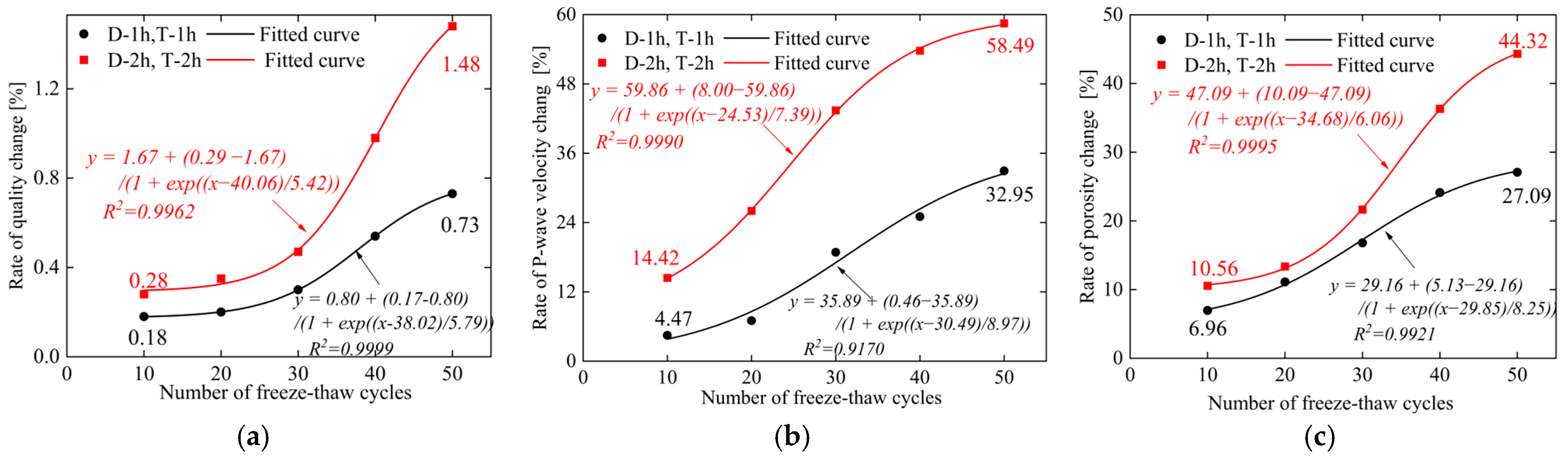
- It can be seen from Figure 4a. that the mass loss rate increases with the rise in the frequency of cyclic freeze–thaw (CFT) cycles, while the magnitude of change under the 2 h freezing/2 h thawing condition is significantly larger than that under the 1 h freezing/1 h thawing condition. Under the condition of 10 cycles, extending the freeze–thaw duration by 1 h increased the mass change rate of the specimens from 0.18% to 0.28%, a 1.56-fold increase. At 50 cycles, extending the freeze–thaw duration by 1 h raised the mass change rate from 0.73% to 1.48%, representing a 2.03-fold increase. This indicates that extending the freeze–thaw duration by 1 h exacerbates the surface damage of the specimens.
- (2)
- It can be seen from Figure 4b. that the P-wave velocity reduction rate increases with the increase in the frequency of cyclic freeze–thaw (CFT) cycles [20], while the magnitude of change under the 2 h freezing/2 h thawing condition is significantly larger than that under the 1 h freezing/1 h thawing condition. Under the condition of 10 cycles, extending the freeze–thaw duration by 1 h increased the P-wave velocity reduction rate of the specimens from 4.47% to 14.42%, a 3.23-fold increase. At 50 cycles, extending the freeze–thaw duration by 1 h raised the mass change rate from 32.95% to 58.49%, representing a 1.78-fold increase. This indicates that extending the freeze–thaw duration aggravates the internal structural damage of the specimens.
- (3)
- It can be seen from Figure 4c. that the porosity growth rate increases with the increase in the frequency of cyclic freeze–thaw (CFT) cycles, while the magnitude of change under the 2 h freezing/2 h thawing condition is significantly larger than that under the 1 h freezing/1 h thawing condition. Under the condition of 10 cycles, extending the freeze–thaw duration by 1 h increased the mass change rate of the specimens from 6.96% to 10.56%, a 1.52-fold increase. At 50 cycles, extending the freeze–thaw duration by 1 h raised the porosity change rate from 27.09% to 44.33%, representing a 1.64-fold increase. This indicates that extending the duration of a single freeze–thaw cycle significantly aggravates the internal structural damage of the specimens [21].
3.2. Creep Deformation Magnitude Characteristics
3.3. Long-Term Strength
4. Creep Acoustic Emission Characteristics of Sandstone
4.1. Stress Stage Evolution Characteristics of Acoustic Emission
4.1.1. Acoustic Emission Characteristics Under Different Freeze–Thaw Cycle Durations
4.1.2. Acoustic Emission Characteristics Under Different Freeze–Thaw Cycle Numbers
4.2. Evolution Characteristics of Ib Value in the Creep Acoustic Emission Failure Stage
5. Freeze–Thaw Creep Damage Constitutive Model
5.1. Model Establishment
5.2. Model Validation
6. Discussion
7. Conclusions
- (1)
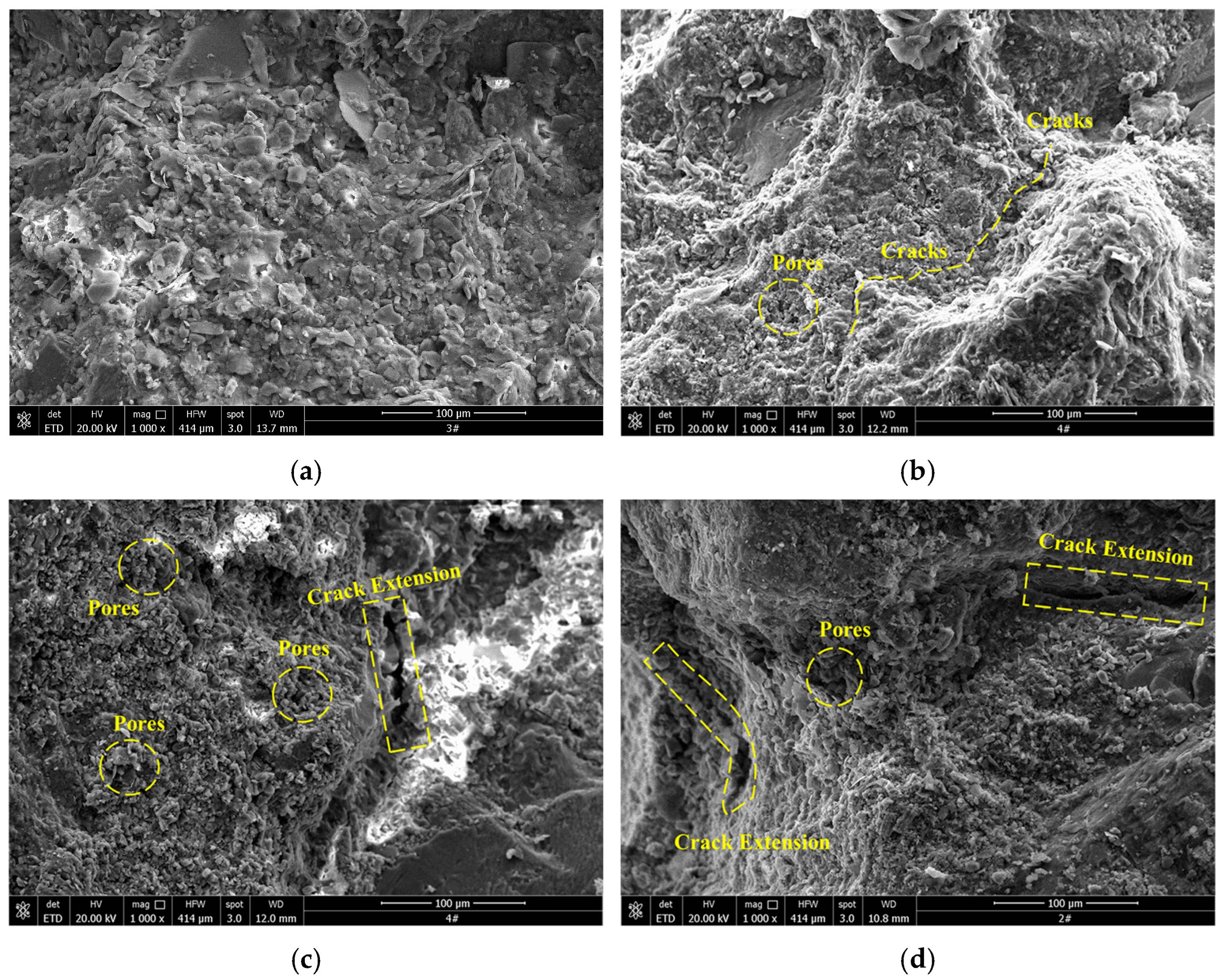
- The duration and frequency of short-term freeze–thaw cycles exert a significant aggravating effect on the damage of specimens. The mass loss rate, longitudinal wave velocity reduction rate, and porosity growth rate of sandstone all exhibit an increasing trend with the rise in freeze–thaw cycles. Moreover, when the freeze–thaw duration is extended by 1 h, the growth rate of the above damage indicators becomes more pronounced. After 50 freeze–thaw cycles, the mass loss rate of the 2 h freezing/2 h thawing specimens reaches 1.48%, corresponding to 2.03 times that of the 1 h freezing/1 h thawing specimens (0.73%); the longitudinal wave velocity reduction rate hits 58.49%, which is 1.78 times that of the 1 h freezing/1 h thawing specimens (32.95%); the porosity growth rate amounts to 44.32%, equivalent to 1.64 times that of the 1 h freezing/1 h thawing specimens (27.09%). This indicates that extending the duration of a single freeze–thaw cycle can accelerate the development of internal pores and the coalescence of fractures in rocks, significantly impairing their structural integrity.
- (2)
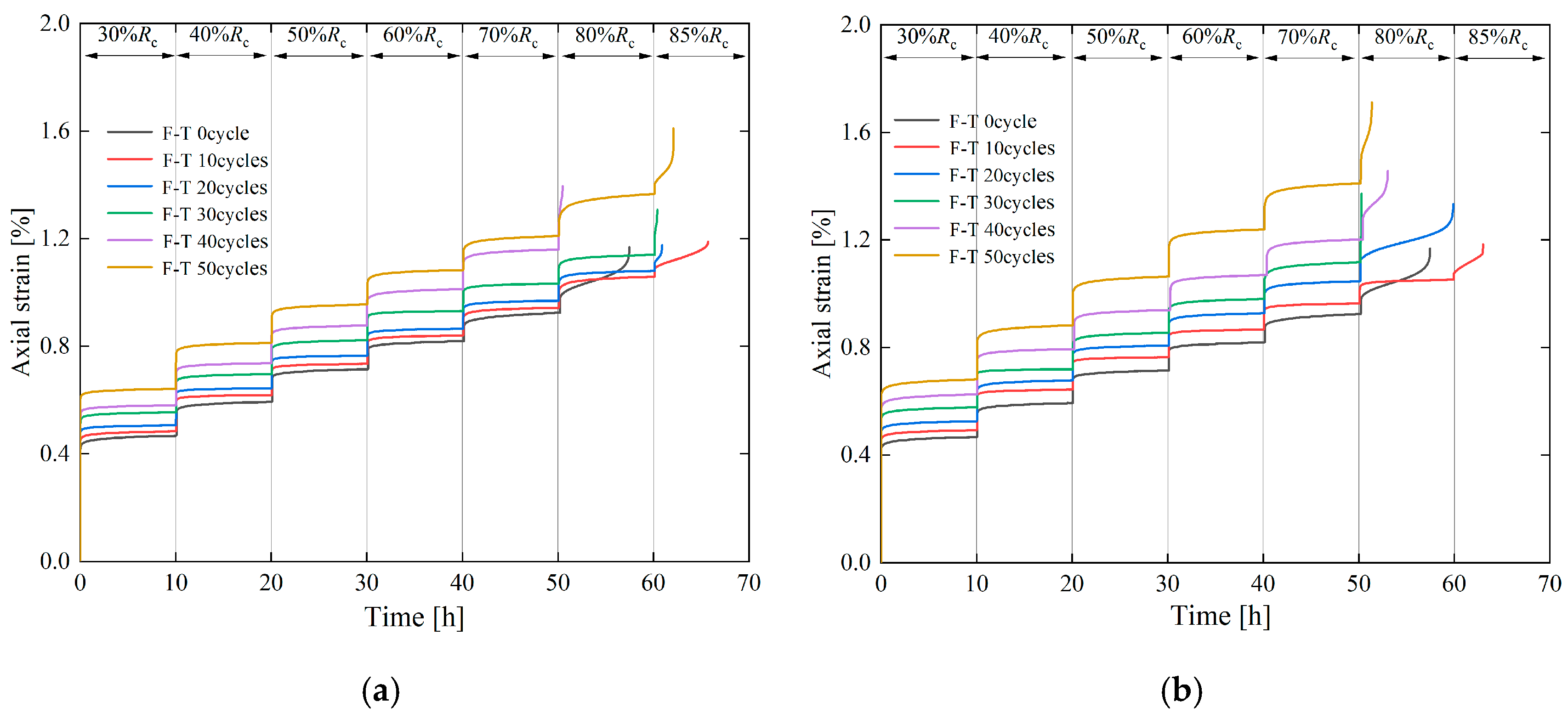
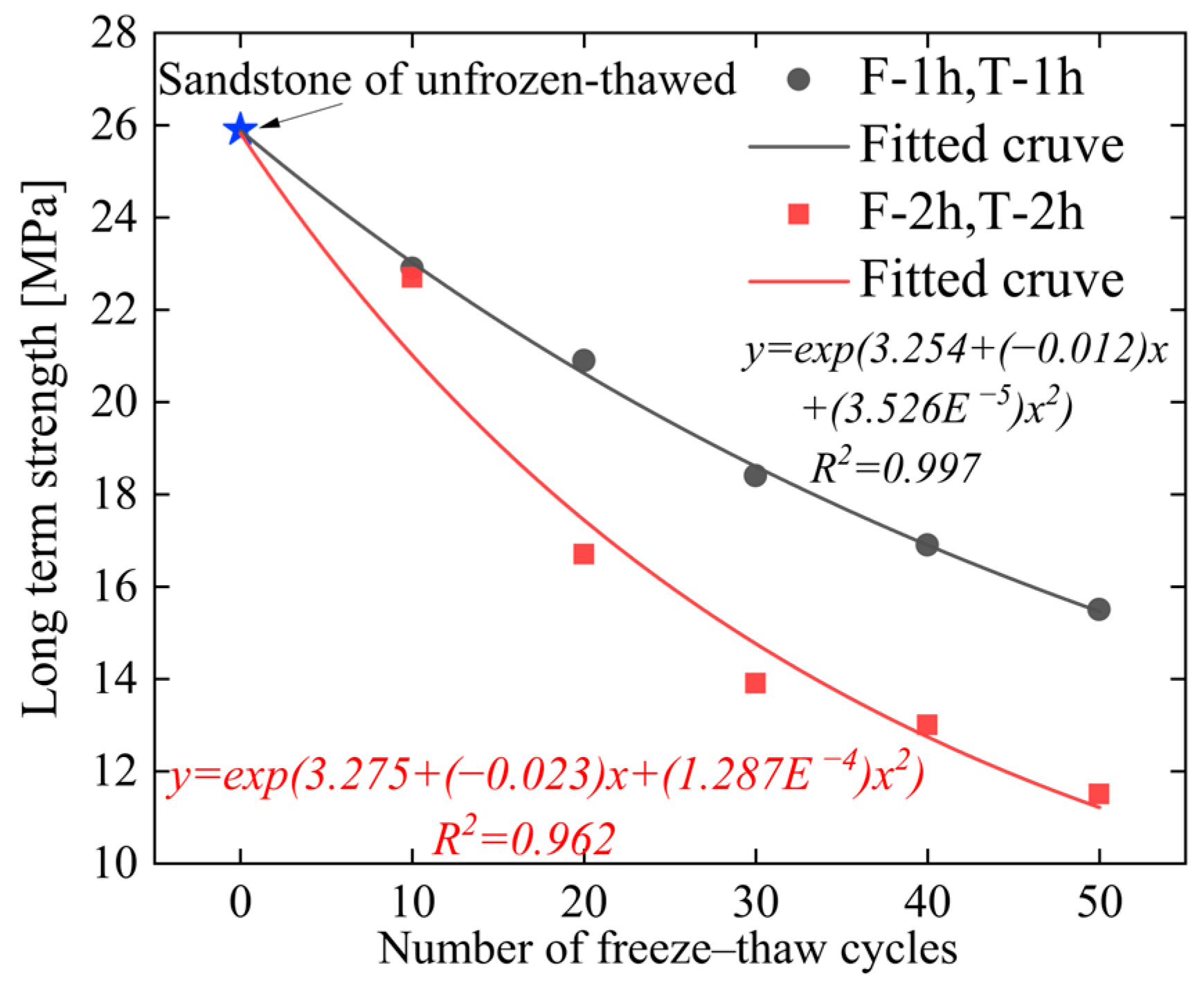
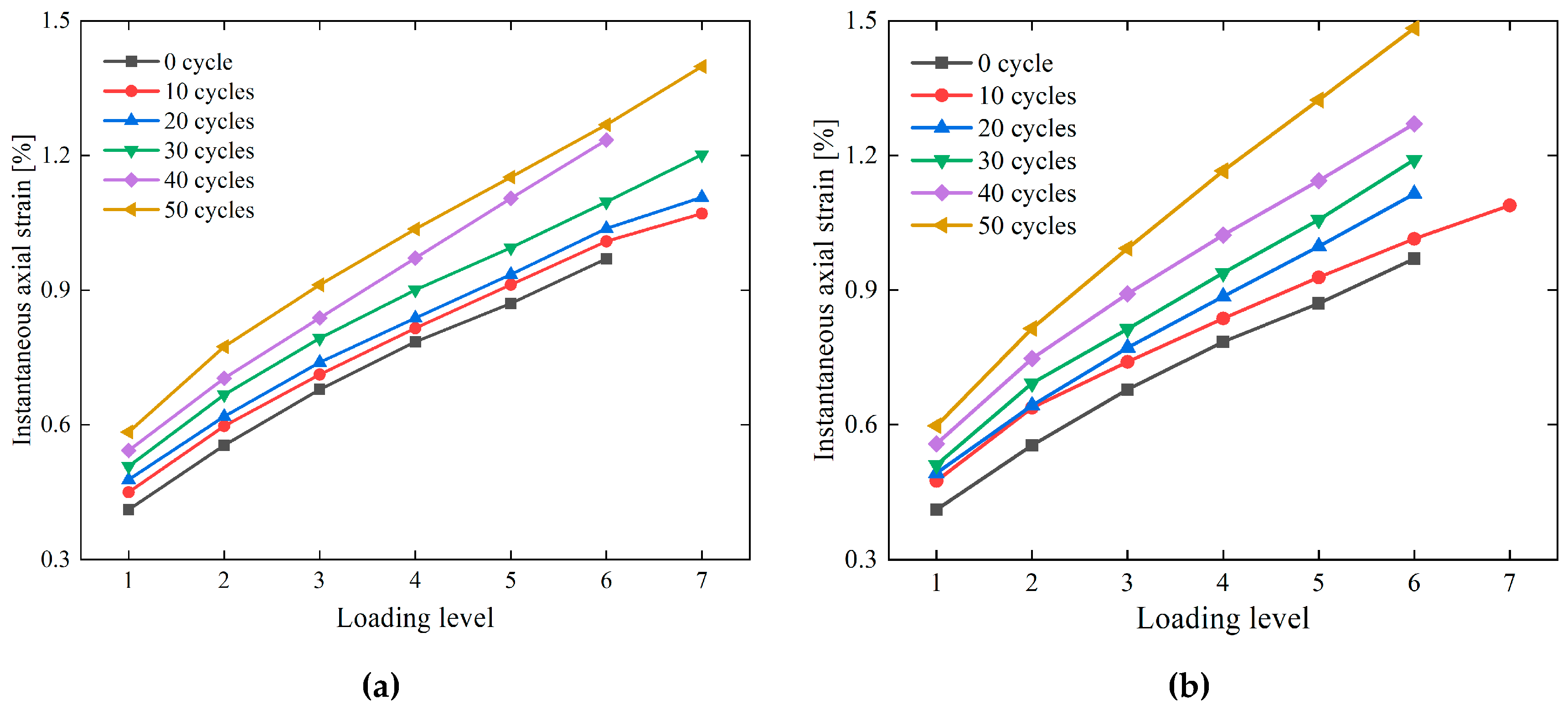
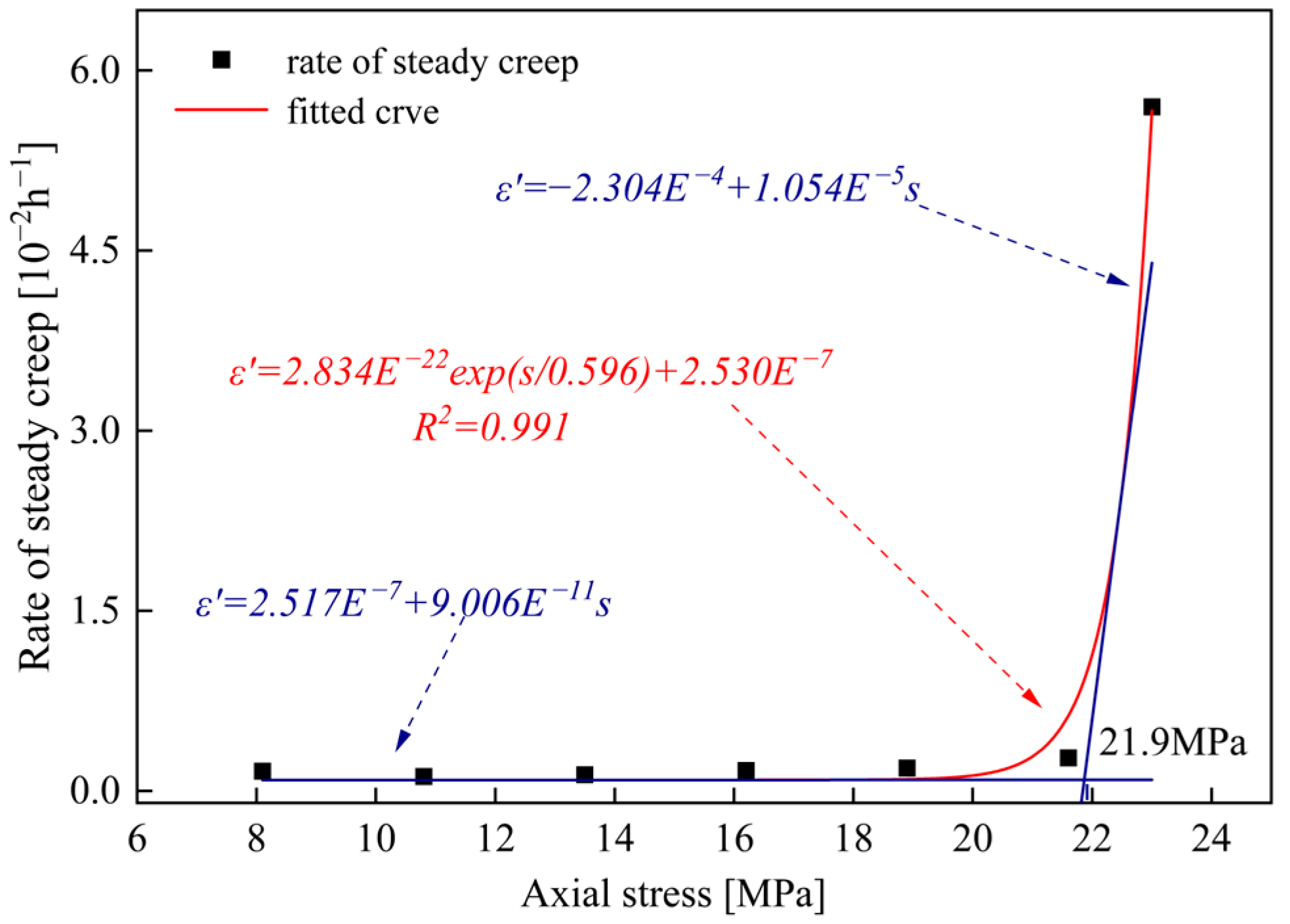
- The creep curves of all specimens exhibit the three-stage characteristic of deceleration–steady–acceleration. The non-failure stress stage (30–80% Rc) only involves the deceleration and steady creep stages, while the failure stress stage (≥80% Rc) undergoes the complete three-stage evolution. Under different freeze–thaw durations and cycle numbers, the instantaneous axial strain of the specimens increases with the elevation of stress levels. At the same cycle number, the instantaneous axial strain of the 2 h freezing/2 h thawing specimens is consistently larger than that of the 1 h freezing/1 h thawing specimens. For instance, after 50 cycles, the instantaneous axial strain of the 2 h freezing/2 h thawing specimens under the sixth stress level reaches 1.484%, which is 1.17 times that of the 1 h freezing/1 h thawing specimens (1.269%). The long-term strength of the specimens decreases with the increase in freeze–thaw cycle numbers and duration, and the freeze–thaw duration is the key controlling factor for strength attenuation. After 50 cycles, the long-term strength of the 1 h freezing/1 h thawing and 2 h freezing/2 h thawing specimens decreases by 40.15% and 55.60%, respectively, indicating that prolonged freeze–thaw promotes damage accumulation by extending the duration of crystalline expansion, resulting in a significant decline in the deformation resistance of rocks.
- (3)
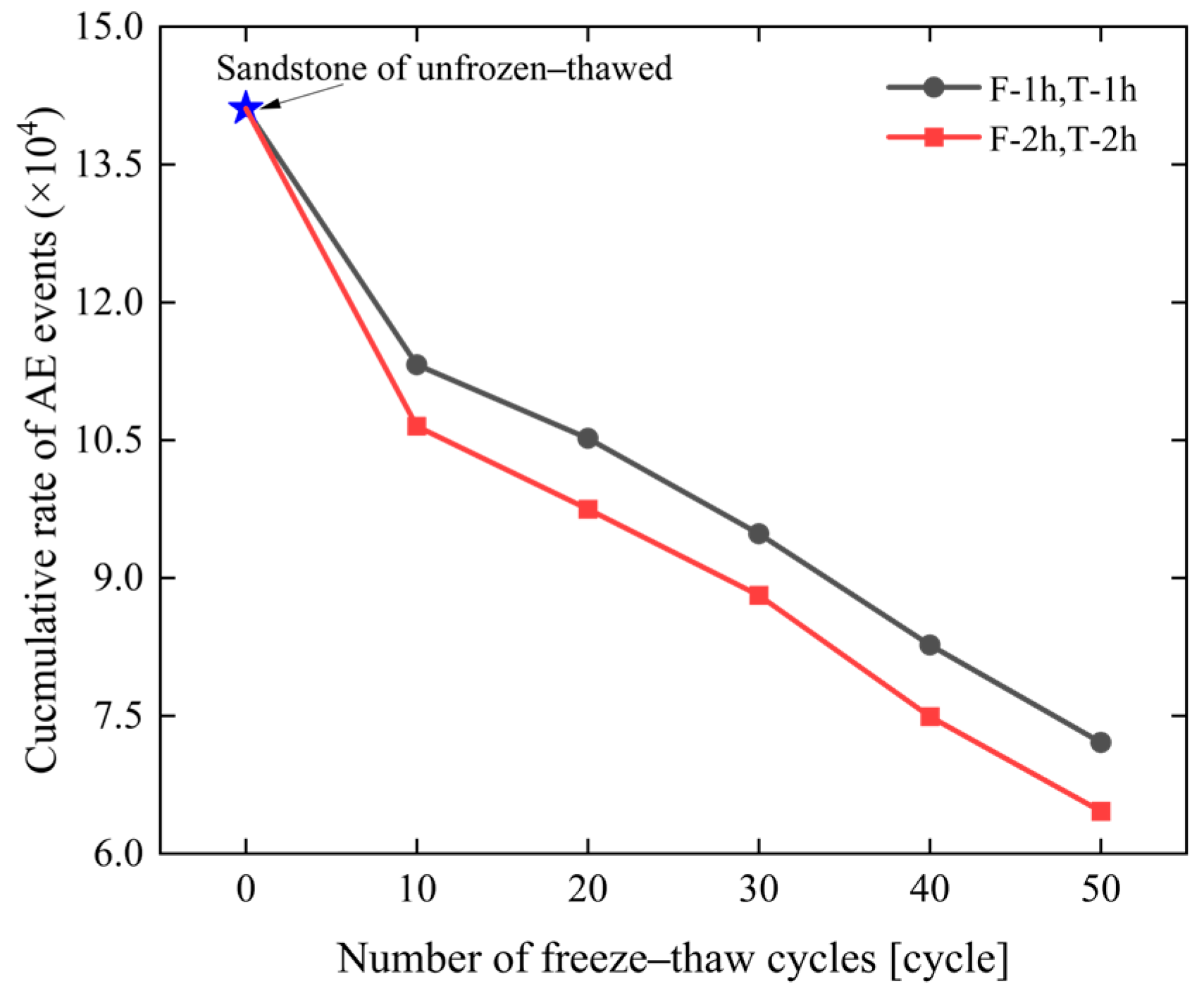
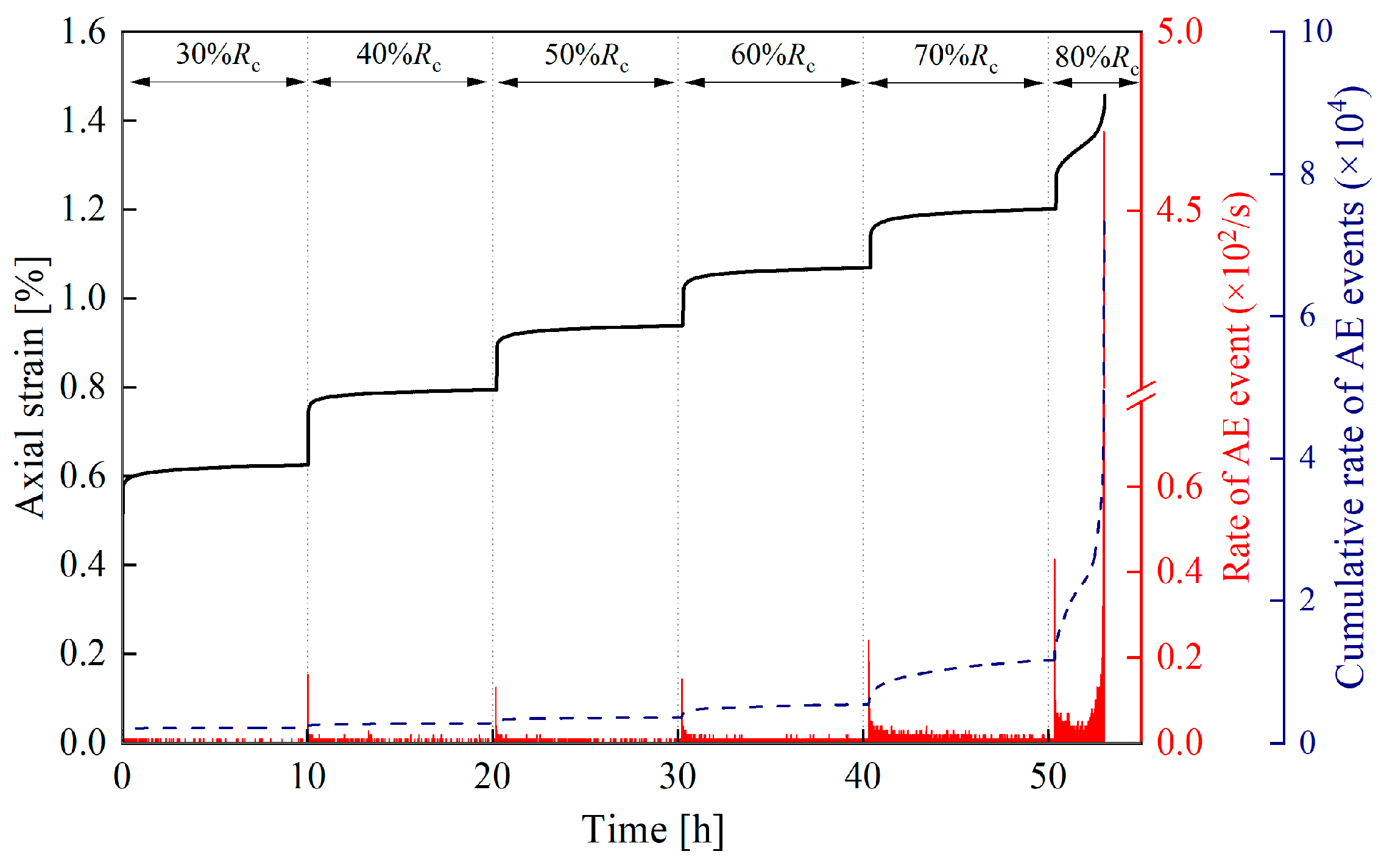
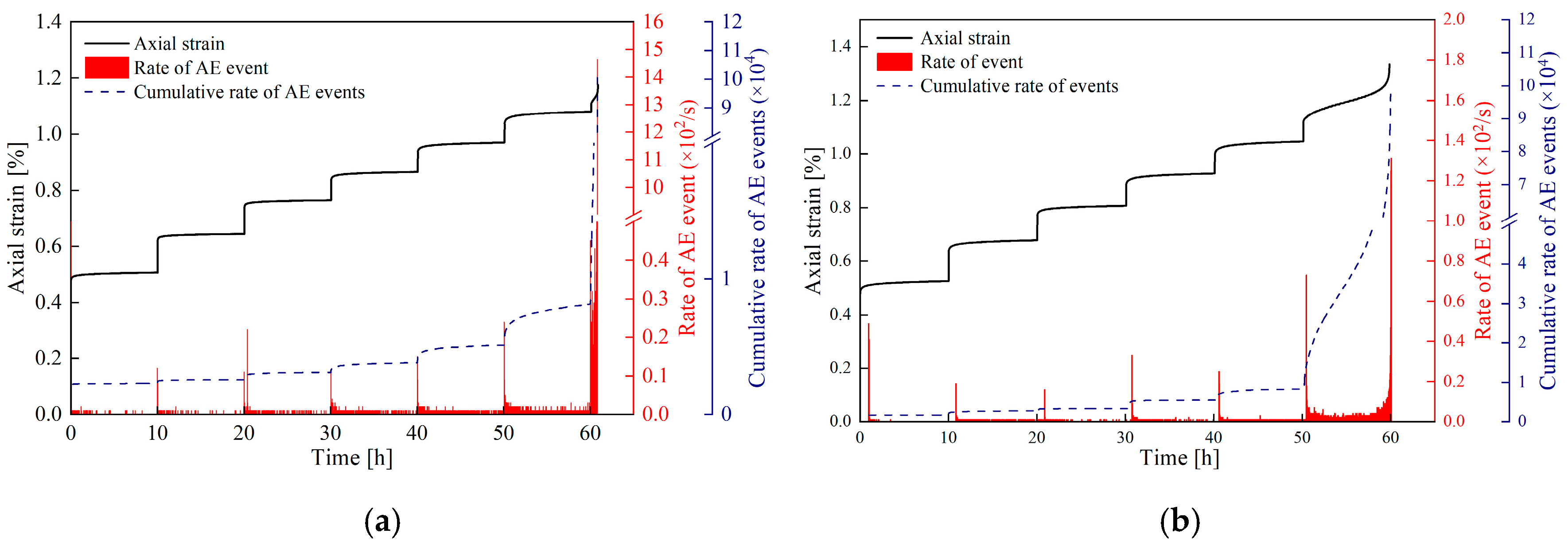
- The acoustic emission (AE) event rate is highly coupled with the creep stage. It exhibits a three-stage pattern of increase–decrease–stabilization in the non-failure stress stage and a typical U-shaped evolution characteristic in the failure stress stage. In the accelerating creep stage, due to the coalescence of macroscopic cracks, the AE event rate surges sharply to a peak value (up to more than 1000 events/s), providing a clear signal indicator for rock mass instability. The cumulative AE event rate decreases significantly with the increase in freeze–thaw cycle numbers and duration. After 50 cycles, the cumulative AE event rate of the 1 h freezing/1 h thawing specimens decreases by 35% compared with that of the control group of unfrozen–thawed specimens, while the rate of the 2 h freezing/2 h thawing specimens decreases by 70%. At the same cycle number, the AE activity intensity of the 2 h freezing/2 h thawing specimens is consistently lower than that of the 1 h freezing/1 h thawing specimens, and the moment of abrupt surge in the event rate in the failure stress stage occurs earlier. This reflects that prolonged freeze–thaw results in a more developed initial crack network in the rock, leading to fewer new crack initiations during subsequent loading, which indicates that substantial damage occurs at a lower stress level and the rate of damage evolution is faster.
- (4)
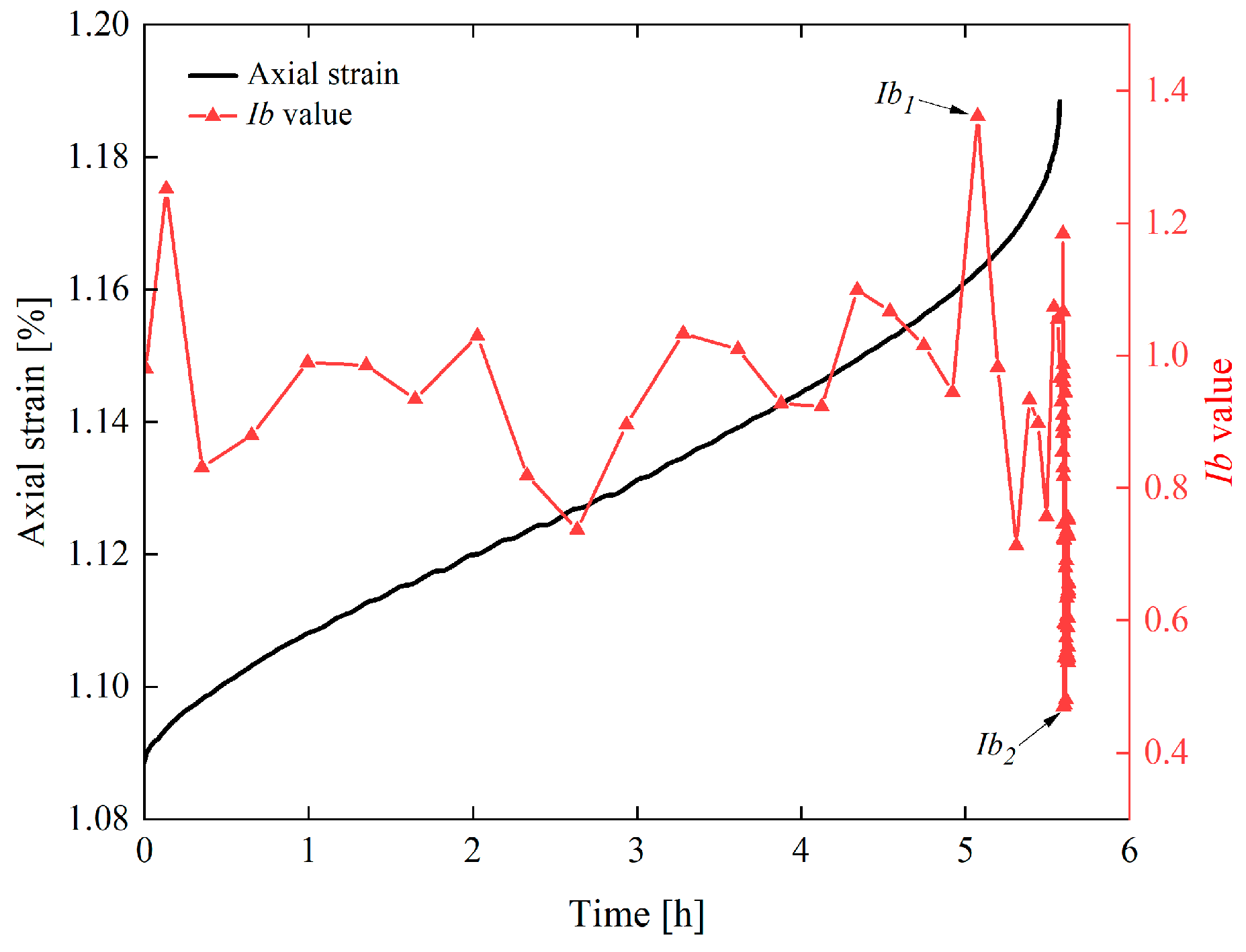
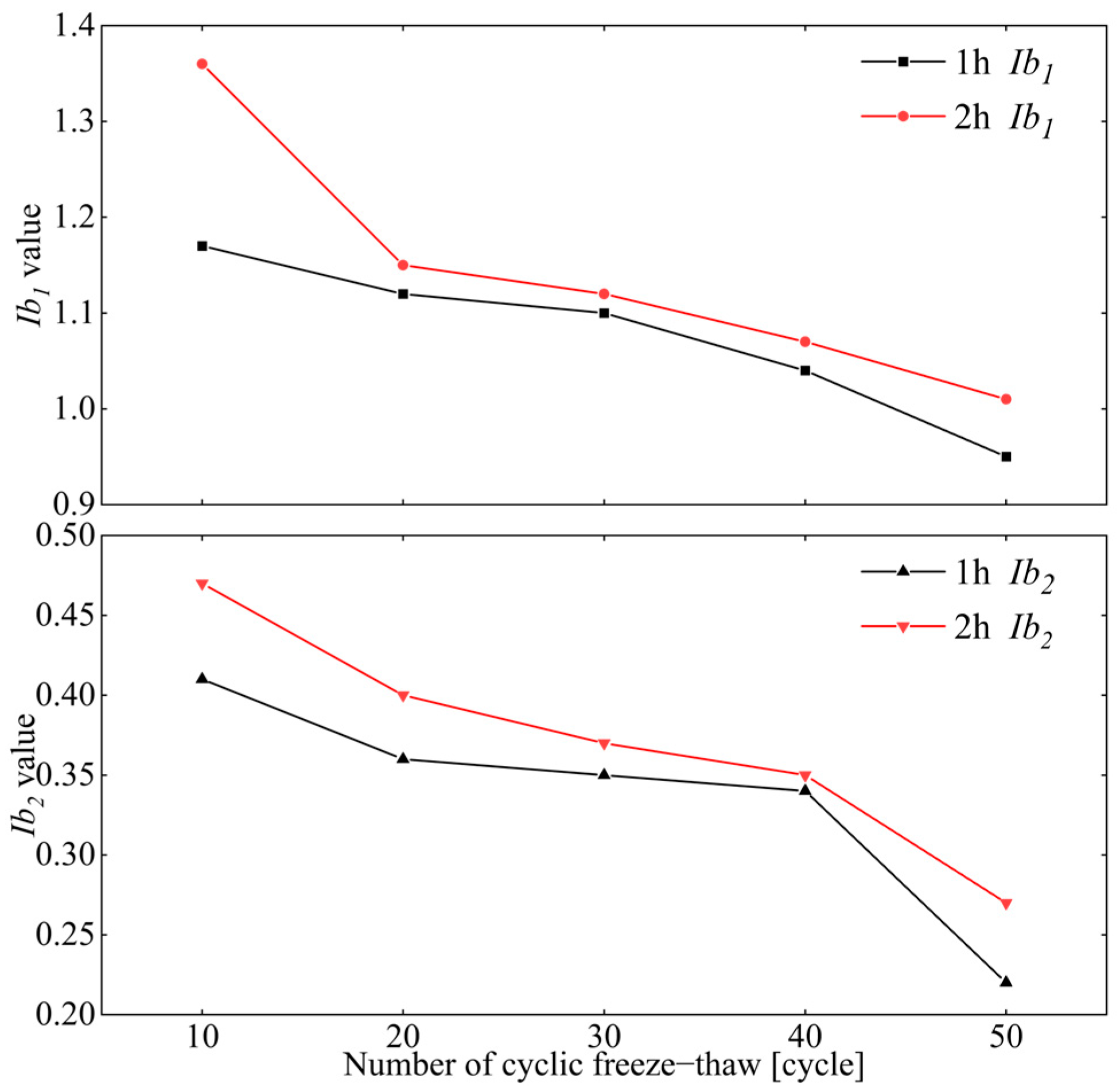
- The AE Ib value evolves regularly with freeze–thaw duration and the number of freeze–thaw cycles. Under the same freeze–thaw duration, the AE Ib1 and Ib2 values exhibit a continuous decreasing trend with the increase in the number of freeze–thaw cycles. Under the same number of freeze–thaw cycles, the AE Ib1 and Ib2 values of sandstone show an increasing trend when the freeze–thaw duration is extended by 1 h. This indicates that extending the freeze–thaw duration and increasing the number of freeze–thaw cycles aggravate the development of internal cracks in rocks and accelerate the rate of damage evolution.
- (5)
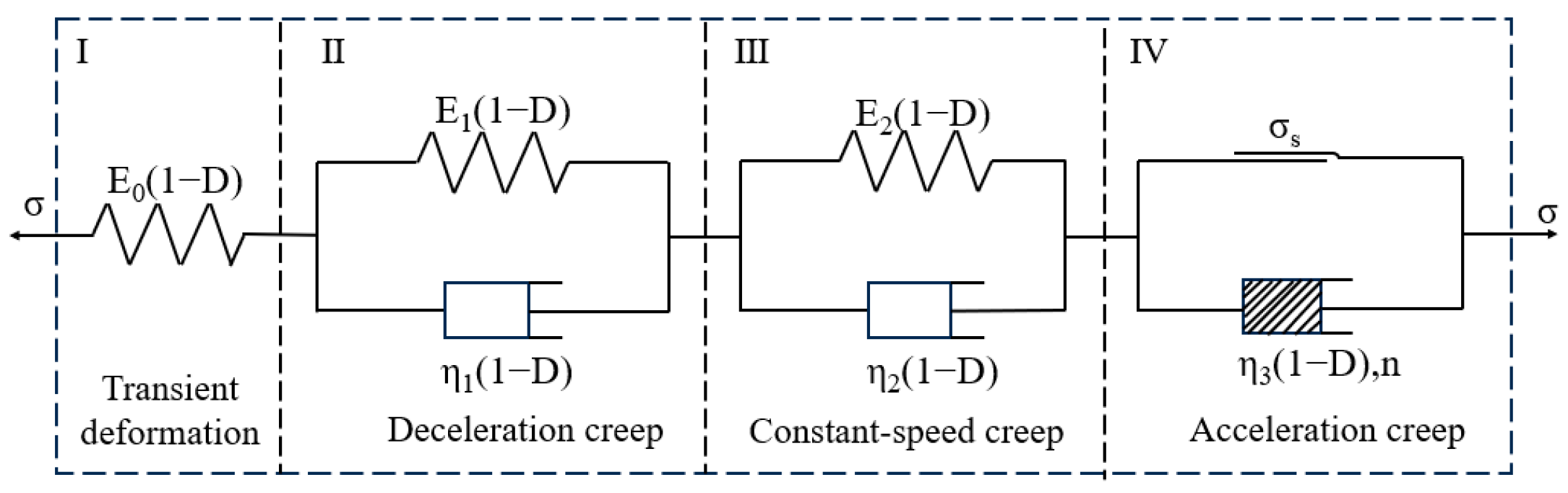
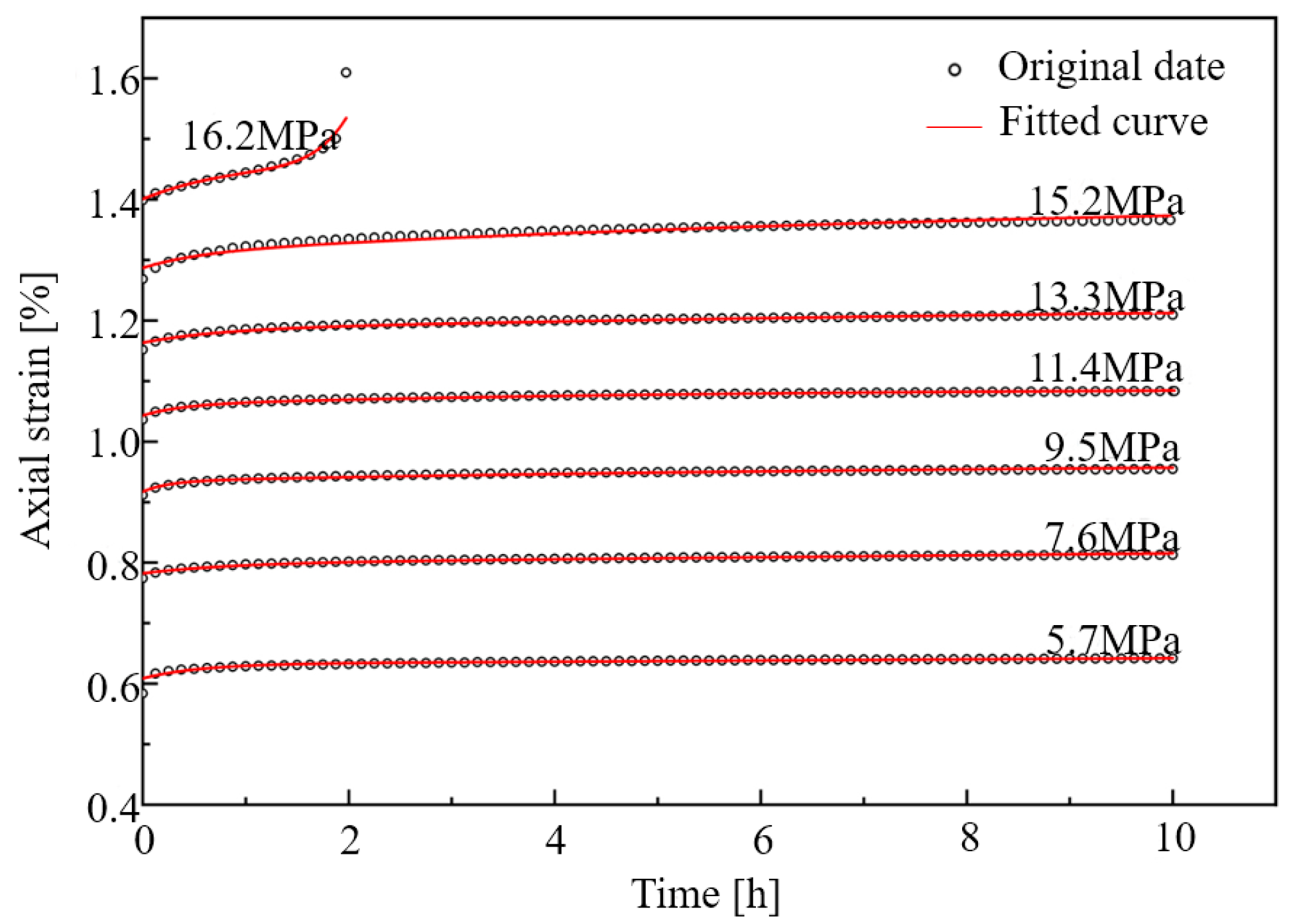
- Based on the seven-element viscoelastic model, a freeze–thaw damage factor D considering both freeze–thaw duration and number of cycles was introduced to construct a short-term freeze–thaw creep damage constitutive model. The average goodness-of-fit of the model reaches 0.964, and the strain prediction error is controlled within 3.19%. The maximum relative errors of sandstone after 50 cycles under 1 h freezing/1 h thawing and 2 h freezing/2 h thawing conditions are 2.55% and 3.19%, respectively. It can well characterize the full-stage creep mechanical behavior of sandstone after freeze–thaw degradation, providing a theoretical model reference for the long-term deformation prediction and stability assessment of geotechnical engineering in short-term freeze–thaw zones.
Author Contributions
Funding
Institutional Review Board Statement
Informed Consent Statement
Data Availability Statement
Acknowledgments
Conflicts of Interest
References
- Hu, T.; Yang, R.; Wang, T.; Yue, Z.; Connolly, D.P.; Liu, Y.; Yuan, Y. Field Evaluation of a Ground-Source Heat Pump System for Frost Heave Control in High-Speed Railway Subgrades. Energy 2026, 344, 139850. [Google Scholar] [CrossRef]
- Guo, Y.; Zhang, Z.; Dai, F. Investigation on Hydrothermal Behavior of Seasonally Frozen Ground in the Qinghai-Tibet Plateau Based on Dynamic Inverse Modelling Approach. Cold Reg. Sci. Technol. 2024, 217, 104015. [Google Scholar] [CrossRef]
- Zhou, B.; Gu, L.; Ding, Y.; Shao, L.; Wu, Z.; Yang, X.; Li, C.; Li, Z.; Wang, X.; Cao, Y.; et al. THE GREAT 2008 CHINESE ICE STORM: Its Socioeconomic–Ecological Impact and Sustainability Lessons Learned. Bull. Am. Meteorol. Soc. 2011, 92, 47–60. [Google Scholar] [CrossRef]
- Goff, J.; McFadgen, B.; Wells, A.; Hicks, M. Seismic Signals in Coastal Dune Systems. Earth Sci. Rev. 2008, 89, 73–77. [Google Scholar] [CrossRef]
- Liu, H.; Han, S.; Yang, G.; Zhang, Y.; Yu, J.; Feng, Z. Experimental Study on Mesostructural Damage Evolution of Sandstone Subjected to Freeze-Thaw Cycling under Uniaxial Compression. Res. Cold Arid. Reg. 2022, 14, 317–328. [Google Scholar] [CrossRef]
- Wang, Y.; Wang, D.; Li, G.; Wang, L.; Zhu, C.; Du, Y.; Zhou, Z. Three-Dimensional Nonlinear Model of Rock Creep under Freeze–Thaw Cycles. PLoS ONE 2023, 18, e0287605. [Google Scholar] [CrossRef]
- El-Garhy, B.; Galil, A.A.; Youssef, A.-F.; Raia, M.A. Behavior of Raft on Settlement Reducing Piles: Experimental Model Study. J. Rock Mech. Geotech. Eng. 2013, 5, 389–399. [Google Scholar] [CrossRef]
- Xue, L.; Qin, X.; Liu, Y.; Li, Y.; Jin, Z. Ice Thickness and Terrain Features of the Ningchan River Glacier No. 3 in the Qilian Mountains, Revealed by Ground Penetrating Radar. J. Glaciol. Geocryol. 2024, 47, 1–13. [Google Scholar]
- Shi, Z.; Li, J.; Wang, J. Effect of Creep Load on Fatigue Behavior and Acoustic Emission Characteristics of Sandstone Containing Pre-Existing Crack during Fatigue Loading. Theor. Appl. Fract. Mech. 2022, 119, 103296. [Google Scholar] [CrossRef]
- Zhang, X.; Luo, X.; He, X.; Niu, S. Pore Structure Expansion and Evolution in Sandstone with Prefabricated Crack under Freeze-Thaw Cycles Based on CT Scanning. Front. Earth Sci. 2024, 12, 1394731. [Google Scholar] [CrossRef]
- Li, H.; Xu, Z.; Wang, P.; Gong, X.; Jiang, S.; Tian, Y.; Qian, K.; Liu, Q. Study on the Failure Characteristics and Acoustic Emission Precursor Parameters of Concrete under Uniaxial Compression after Freeze-Thaw Damage. Eng. Fail. Anal. 2025, 181, 109981. [Google Scholar] [CrossRef]
- Zhao, Y.; Zhao, Q.; Yang, T.; Chen, Y.; Zhang, P.; Liu, H. Investigation of Crack Propagation and Acoustic Emission Characteristics in Jointed Rock under Freeze–Thaw Cycles Based on DEM. Int. J. Min. Sci. Technol. 2025, 35, 1171–1195. [Google Scholar] [CrossRef]
- Li, Z.; Huang, Y.; Wu, X.; Wang, X.; Su, H. Acoustic-Emission Study of Freeze-Thaw Damage of Hydraulic Concrete Due to Sustained Freezing at Minimum Temperature. Constr. Build. Mater. 2025, 498, 143950. [Google Scholar] [CrossRef]
- Zhang, L.; Zhang, Q.; Li, S.; Jiang, L.; Yuan, S.; Yang, S.; Yang, W. Unloading rheological tests of hard brittle rock and its long-termstrength analysis. J. China Coal Soc. 2015, 40, 2399–2407. [Google Scholar] [CrossRef]
- Li, H.; Liu, J.; Lei, X.; Ju, Y.; Bu, X.; Li, H. Quantitative Determination of Environmental Factors Governing the Snow Melting: A Geodetector Case Study in the Central Tienshan Mountains. Sci. Rep. 2022, 12, 11565. [Google Scholar] [CrossRef] [PubMed]
- Culshaw, M.G.; Ulusay, R. (Eds.) The ISRM Suggested Methods for Rock Characterization, Testing and Monitoring: 2007–2014; Springer: Cham, Switzerland, 2015. [Google Scholar] [CrossRef]
- Shen, Y.; Yang, G.; Rong, T.; Liu, H.; Lv, W. Proposed scheme for freeze-thaw cycle tests on rock. Chin. J. Geotech. Eng. 2015, 38, 1775–1782. [Google Scholar]
- Huang, Z.; Gu, Q.; Wu, Y.; Wu, Y.; Li, S.; Zhao, K.; Zhang, R. Effects of Confining Pressure on Acoustic Emission and Failure Characteristics of Sandstone. Int. J. Min. Sci. Technol. 2021, 31, 963–974. [Google Scholar] [CrossRef]
- Jiang, X.-Y.; Wu, D.; Zhao, Z.-X.; Yang, Y.; Tian, J.-W.; Wang, F.-L. Experimental and Numerical Study on the Damage Evolution and Acoustic Emission Multi-Parameter Responses of Single Flaw Sandstone under Uniaxial Compression. Theor. Appl. Fract. Mech. 2024, 133, 104535. [Google Scholar] [CrossRef]
- Chen, L.; Li, K.; Song, G.; Zhang, D.; Liu, C. Effect of Freeze-Thaw Cycle on Physical and Mechanical Properties and Damage Characteristics of Sandstone. Sci. Rep. 2021, 11, 12315. [Google Scholar] [CrossRef] [PubMed]
- Ding, S.; Jia, H.; Zi, F.; Dong, Y.; Yao, Y. Frost Damage in Tight Sandstone: Experimental Evaluation and Interpretation of Damage Mechanisms. Materials 2020, 13, 4617. [Google Scholar] [CrossRef]
- Ma, L.; Hu, B.; Liu, J.; Cui, K.; Wei, E.; Ding, J. Study on Shear Creep Damage Characteristics of Shale Block under Impact Disturba. Chin. J. Solid Mech. 2022, 43, 646–657. [Google Scholar] [CrossRef]
- Ru, W.; Hu, S.; Zhou, A.; Luo, P.; Gong, H.; Zhang, C.; Zhou, X. Study on Creep Characteristics and Nonlinear Fractional-Order Damage Constitutive Model of Weakly Cemented Soft Rock. Rock Mech. Rock Eng. 2023, 56, 8061–8082. [Google Scholar] [CrossRef]
- Sun, X.; Jiang, M.; Wang, X.; Zang, J.; Gao, X.; Miao, C. Experimental study on creep mechanical properties of sandstone with different water contents in Wanfu coal mine. Rock Soil Mech. 2023, 44, 624–636. [Google Scholar] [CrossRef]
- Bai, Y.; Xu, Z.; Dou, H.; Liu, N.; Zhao, Z.; Qiu, S.; Shan, R. Study on Mechanical Properties and Mesoscopic Damage Mechanism of Composite Jointed Rock Masses. Int. J. Min. Sci. Technol. 2025, 35, 1731–1751. [Google Scholar] [CrossRef]
- Alneasan, M.; Alzo’ubi, A.K. Shear Fracture Behavior in Dolomite: The Interplay of Thermal Cycles and Confining Pressure. Theor. Appl. Fract. Mech. 2025, 139, 105091. [Google Scholar] [CrossRef]
- Panesar, D.K.; Narneni, S.R.; Zhang, R. Mechanical Properties, and Microstructure of ASR-Affected Concrete Subjected to Freeze-Thaw Cycles. Constr. Build. Mater. 2025, 491, 142827. [Google Scholar] [CrossRef]
- Wang, Z.; Yu, M.; Zuo, J.; Xu, Y.; Ma, D.; Ge, J.; Wang, L. Fracture Characteristics and Evolution Mechanism of Freeze-Thaw Rock under Mixed Mode I/II Loading. Theor. Appl. Fract. Mech. 2025, 139, 105105. [Google Scholar] [CrossRef]
- Gong, C.; Bao, H.; Wang, W.; Zhong, W.; Xu, Y.; Zhao, K.; Zeng, P. Evolution law and dominant frequency characteristics of acoustic emission sources during red sandstone failure process. J. China Coal Soc. 2021, 47, 2326–2339. [Google Scholar] [CrossRef]
- Grgic, D.; Amitrano, D. Creep of a Porous Rock and Associated Acoustic Emission under Different Hydrous Conditions. J. Geophys. Res. Solid Earth 2009, 114, 2006JB004881. [Google Scholar] [CrossRef]
- Wang, C.; You, R.; Lv, W.; Sui, Q.; Yan, Y.; Zhu, H. Damage Evolution and Acoustic Emission Characteristics of Sandstone under Freeze–Thaw Cycles. ACS Omega 2024, 9, 4892–4904. [Google Scholar] [CrossRef] [PubMed]
- Fan, J.; Zhu, X. Systematic Detection and Evaluation of Cracking Behavior of Flawed Brittle Sandstones with AE and 3D-DIC Techniques. PLoS ONE 2024, 19, e0309381. [Google Scholar] [CrossRef] [PubMed]
- Zhang, X.; Liu, X.; Jin, J.; Wang, H.; Lv, Z.; Xiao, Y. Investigation of Damage Characteristics in Freeze-Thawed Grey-White Sandstone Using AE Multifractal Analysis. Geomech. Geophys. Geo-Energy Geo-Resour. 2025, 11, 93. [Google Scholar] [CrossRef]
- Gutenberg, B. Microseisms. In Advances in Geophysics Volume 5; Elsevier: Amsterdam, The Netherlands, 1958; Volume 5, pp. 53–92. [Google Scholar] [CrossRef]
- Rao, M.V.M.S.; Lakshmi, K.J.P. Analysis of B-Value and Improved b-Value of Acoustic Emissions Accompanying Rock Fracture. Curr. Sci. 2005, 89, 1577–1582. [Google Scholar]
- Guerrero, J.; Guerra, M.; Desir, G.; Serreta, A.; Thiery, Y.; Lucha, P. An Extended Kinematic Inventory, Magnitude-Frequency Curves, and Damage Assessment of Rock Slope Failures in the Central Spanish Pyrenees. Geomorphology 2026, 498, 110172. [Google Scholar] [CrossRef]
- Lemaitre, J. How to Use Damage Mechanics. Nucl. Eng. Des. 1984, 80, 233–245. [Google Scholar] [CrossRef]
- Cheng, Y.; Zhang, L. Study on a Concise and Unified Unstable Creep Model for Rocks. J. Theor. Appl. Mech. 2024, 62, 477–490. [Google Scholar] [CrossRef]
- Lemaitre, J. Phenomenological Aspects of Damage. In A Course on Damage Mechanics; Springer: Berlin/Heidelberg, Germany, 1992; pp. 1–37. [Google Scholar] [CrossRef]
- Wu, Q.; Ma, Q.; Duan, X.; Su, D. Mechanical Properties and Dynamic Constitutive Model of Concrete after Freeze-Thaw under Impact Load. J. Build. Eng. 2025, 108, 112835. [Google Scholar] [CrossRef]
- Yu, Y.; Guo, W.; Liu, J.; Wu, Z.; Dong, X. Experimental-Simulation Analysis on Mechanical Degradation and Energy Evolution Characteristics of Sandstone under Water-Rock Coupling Effects. Sci. Rep. 2025, 15, 18713. [Google Scholar] [CrossRef]
- Sun, K.; Jia, J.; Pan, B.; Wang, J.; Liu, G. Freeze-thaw Deterioration Mechanism and Damage Constitutive Model of Tunnel Surrounding Rock in Cold Region Based on Pore Evolution. China J. Highw. Transp. 2024, 37, 52–63. [Google Scholar] [CrossRef]
- Huang, W.; Wen, T.; Chen, N.; Yang, Y. Mechanical Properties and Microstructure Failure Mechanisms of Conglomerate with Prefabricated Fissures under Freeze–Thaw Cycles. Eng. Fract. Mech. 2025, 324, 111236. [Google Scholar] [CrossRef]
- Yu, M.; Wang, Z.; Xu, Y.; Wang, Y.; Wang, L.; Wen, J. Study on Mechanical Properties and Energy Evolution Characteristics of Excavation Unloading Rock under Freeze–Thaw Temperature Range. Eng. Fract. Mech. 2025, 325, 111293. [Google Scholar] [CrossRef]
- Song, Y.; Lu, Y.; Wang, S.; Xie, L.; Cao, J.; An, X. Evolution characteristics of unfrozen water content and its influence on mechanical properties of rock during freeze-thaw process. Rock Soil Mech. 2025, 46, 1049–1059+1121. [Google Scholar] [CrossRef]
- Lv, W.; You, R.; Wang, C.; Wang, Z.; Wu, Y.; Xie, P.; Lyu, C.; Luo, S.; Li, Y. Experimental Study on Instability and Failure Mechanism of Sandstone under Freeze-Thaw and Load. PLoS ONE 2025, 20, e0323484. [Google Scholar] [CrossRef] [PubMed]
- Mao, Y.; Li, M.; Wu, P.; Guo, S.; Zhu, F. Research on Damage and Degradation of Coal-Bearing Sandstone under Freeze-Thaw Cycles. Front. Earth Sci. 2025, 12, 1522502. [Google Scholar] [CrossRef]








| Freeze–Draw Duration | Cycles | Rc [MPa] | Loading Stress Level [MPa] | ||||||
|---|---|---|---|---|---|---|---|---|---|
| Level 1 | Level 2 | Level 3 | Level 4 | Level 5 | Level 6 | Level 7 | |||
| Unfreeze–thaw | 0 | 28.25 | 9 | 12 | 15 | 18 | 21 | 24 | 25.41 |
| F-1 h, T-1 h | 10 | 27.72 | 8.4 | 11.2 | 14.0 | 16.8 | 19.6 | 22.4 | 23.80 |
| 20 | 27.13 | 8.1 | 10.8 | 13.5 | 16.2 | 18.9 | 21.6 | 23.00 | |
| 30 | 24.16 | 7.5 | 10.0 | 12.5 | 15.0 | 17.5 | 20.0 | 21.30 | |
| 40 | 22.72 | 6.9 | 9.2 | 11.5 | 13.8 | 16.1 | 18.4 | 19.54 | |
| 50 | 18.76 | 5.7 | 7.6 | 9.5 | 11.4 | 13.3 | 15.2 | 16.20 | |
| F-2 h, T-2 h | 10 | 27.53 | 8.4 | 11.2 | 14.0 | 16.8 | 19.6 | 22.4 | 23.80 |
| 20 | 22.32 | 6.6 | 8.8 | 11.0 | 13.2 | 15.4 | 17.6 | 18.72 | |
| 30 | 18.18 | 5.4 | 7.2 | 9.0 | 10.8 | 12.6 | 14.4 | 15.45 | |
| 40 | 17.45 | 5.1 | 6.8 | 8.5 | 10.2 | 11.9 | 13.6 | 14.83 | |
| 50 | 14.34 | 4.5 | 6.0 | 7.5 | 9.0 | 10.5 | 12.0 | 12.19 | |
| Loading Level | Instantaneous Axial Instantaneous Strain [%] | Instantaneous Axial Strain Rate [%] | ||||||||||||||
|---|---|---|---|---|---|---|---|---|---|---|---|---|---|---|---|---|
| Unfrozen–Thawed | F-1 h, T-1 h | F-2 h, T-2 h | ||||||||||||||
| 0 | 10 | 20 | 30 | 40 | 50 | 10 | 20 | 30 | 40 | 50 | 10 | 20 | 30 | 40 | 50 | |
| 1 | 0.411 | 0.450 | 0.478 | 0.507 | 0.543 | 0.584 | 0.475 | 0.492 | 0.510 | 0.558 | 0.598 | 9.44 | 0.61 | 0.61 | 2.75 | 2.35 |
| 2 | 0.554 | 0.597 | 0.618 | 0.667 | 0.704 | 0.774 | 0.638 | 0.643 | 0.693 | 0.748 | 0.815 | 7.70 | 3.20 | 3.83 | 6.23 | 5.25 |
| 3 | 0.679 | 0.712 | 0.739 | 0.793 | 0.838 | 0.912 | 0.740 | 0.772 | 0.813 | 0.892 | 0.993 | 3.96 | 4.41 | 2.62 | 6.41 | 8.90 |
| 4 | 0.785 | 0.815 | 0.838 | 0.900 | 0.971 | 1.036 | 0.837 | 0.886 | 0.938 | 1.023 | 1.166 | 2.64 | 5.74 | 4.21 | 5.28 | 12.50 |
| 5 | 0.870 | 0.912 | 0.935 | 0.994 | 1.104 | 1.152 | 0.929 | 0.997 | 1.057 | 1.144 | 1.324 | 1.82 | 6.70 | 6.29 | 3.58 | 14.94 |
| 6 | 0.970 | 1.009 | 1.037 | 1.097 | 1.235 | 1.269 | 1.014 | 1.114 | 1.191 | 1.271 | 1.484 | 0.56 | 7.41 | 8.58 | 2.92 | 16.95 |
| 7 | 1.071 | 1.107 | 1.202 | 1.399 | 1.089 | 1.071 | 1.66 | |||||||||
| T/h | D | ||||
|---|---|---|---|---|---|
| N = 10 | N = 20 | N = 30 | N = 40 | N = 50 | |
| 1 | 0.091 | 0.016 | 0.036 | 0.042 | 0.054 |
| 2 | 0.083 | 0.024 | 0.051 | 0.057 | 0.068 |
| Freeze–Thaw Time | Stress Level [MPa] | Final Test Strain [%] | Model Prediction of Strain [%] | Absolute Error [%] | Relative Error [%] |
|---|---|---|---|---|---|
| F-1 h, T-1 h | 5.7 | 0.582 | 0.575 | 0.007 | 1.20 |
| 7.6 | 0.763 | 0.758 | 0.005 | 0.65 | |
| 11.4 | 1.153 | 1.142 | 0.011 | 0.95 | |
| 15.2 | 1.735 | 1.722 | 0.013 | 0.75 | |
| 16.2 | 3.056 | 2.978 | 0.078 | 2.55 | |
| F-2 h, T-2 h | 4.5 | 0.612 | 0.605 | 0.007 | 1.14 |
| 6.0 | 0.815 | 0.808 | 0.007 | 0.86 | |
| 9.0 | 1.326 | 1.314 | 0.012 | 0.90 | |
| 10.5 | 1.688 | 1.670 | 0.018 | 1.07 | |
| 12.0 | 2.885 | 2.793 | 0.092 | 3.19 |
| N | σ | E0 | E1 | E2 | η1 | η2 | η3 | n | R2 |
|---|---|---|---|---|---|---|---|---|---|
| 50 | 5.7 | 14.103 | 361.259 | 302.867 | 199.146 | 8820.083 | 0.866 | ||
| 7.6 | 14.632 | 117.105 | 679.859 | 7007.389 | 582.794 | 0.972 | |||
| 9.5 | 15.594 | 823.803 | 429.034 | 207.460 | 3873.028 | 0.949 | |||
| 11.4 | 16.455 | 615.166 | 968.365 | 3358.333 | 363.897 | 0.964 | |||
| 13.3 | 18.121 | 404.798 | 989.181 | 5284.667 | 705.779 | 0.992 | |||
| 15.2 | 17.785 | 232.664 | 948.275 | 2316.930 | 523.941 | 0.998 | |||
| 16.2 | 17.202 | 19.899 | 379.873 | 4734.643 | 338.549 | 4098.723 | 6.811 | 0.957 |
| N | σ | E0 | E1 | E2 | η1 | η2 | η3 | n | R2 |
|---|---|---|---|---|---|---|---|---|---|
| 50 | 4.5 | 15.100 | 270.479 | 245.412 | 37.392 | 1373.086 | 0.988 | ||
| 6.0 | 15.165 | 540.351 | 293.591 | 37.708 | 937.426 | 0.938 | |||
| 7.5 | 15.521 | 659.823 | 353.575 | 61.530 | 1312.753 | 0.994 | |||
| 9.0 | 15.708 | 570.754 | 379.907 | 415.903 | 6404.167 | 0.979 | |||
| 10.5 | 16.229 | 592.010 | 375.307 | 304.497 | 3562.389 | 0.984 | |||
| 12.0 | 17.048 | 154.656 | 999.999 | 280.624 | 957.324 | 3956.835 | 2.239 | 0.931 |
Disclaimer/Publisher’s Note: The statements, opinions and data contained in all publications are solely those of the individual author(s) and contributor(s) and not of MDPI and/or the editor(s). MDPI and/or the editor(s) disclaim responsibility for any injury to people or property resulting from any ideas, methods, instructions or products referred to in the content. |
© 2026 by the authors. Licensee MDPI, Basel, Switzerland. This article is an open access article distributed under the terms and conditions of the Creative Commons Attribution (CC BY) license.
Share and Cite
Zhang, H.; Li, Y.; Zeng, P.; Zhao, K.; Shen, D.; Yang, X. Creep Characteristics and Damage Constitutive Model of White Sandstone Under Short-Term Freeze–Thaw Cycles. Materials 2026, 19, 2150. https://doi.org/10.3390/ma19102150
Zhang H, Li Y, Zeng P, Zhao K, Shen D, Yang X. Creep Characteristics and Damage Constitutive Model of White Sandstone Under Short-Term Freeze–Thaw Cycles. Materials. 2026; 19(10):2150. https://doi.org/10.3390/ma19102150
Chicago/Turabian StyleZhang, Hepeng, Yanda Li, Peng Zeng, Kui Zhao, Dekang Shen, and Xianda Yang. 2026. "Creep Characteristics and Damage Constitutive Model of White Sandstone Under Short-Term Freeze–Thaw Cycles" Materials 19, no. 10: 2150. https://doi.org/10.3390/ma19102150
APA StyleZhang, H., Li, Y., Zeng, P., Zhao, K., Shen, D., & Yang, X. (2026). Creep Characteristics and Damage Constitutive Model of White Sandstone Under Short-Term Freeze–Thaw Cycles. Materials, 19(10), 2150. https://doi.org/10.3390/ma19102150