Study on Erosion Patterns of Cyclone Desanders at Shale Gas Wellheads

 , ,
, ,
Abstract
1. Introduction
2. Field Experimental Study of Cyclone Desanders
2.1. M Gas Field Wellsite Process
2.2. Gas–Solid Medium Properties
- ①
- Gas Properties
- ②
- Solid Properties
2.3. Wall Thickness Monitoring Experiment
3. CFD-Based Numerical Erosion Model for the Cyclone Desander
3.1. Governing Equations
- ①
- Continuity Equation
- ②
- Momentum Equation
3.2. Particle Motion Equation
3.3. Erosion Model
3.4. Turbulence Models
3.5. Boundary Conditions and Solution Strategy
3.6. Cyclone Desander Mesh Generation
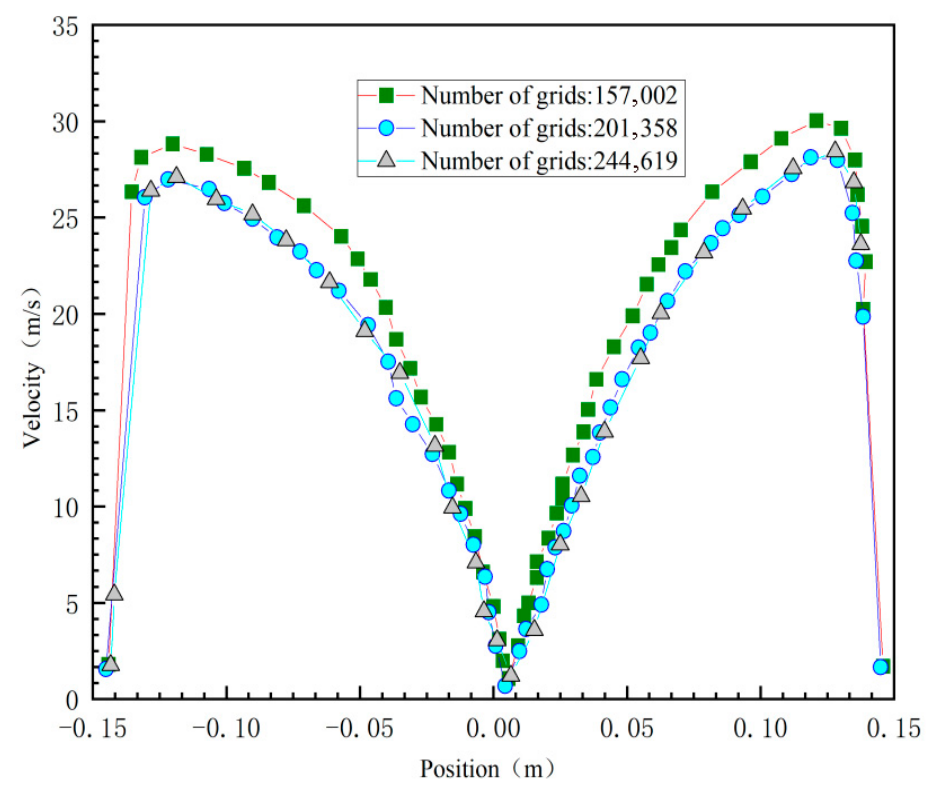
3.7. Verification of Sand Separator Model
3.8. Model Assumptions and Limitations
4. Analysis of Factors Affecting Erosion in Cyclone Desanders
4.1. Influence of Structural Parameters
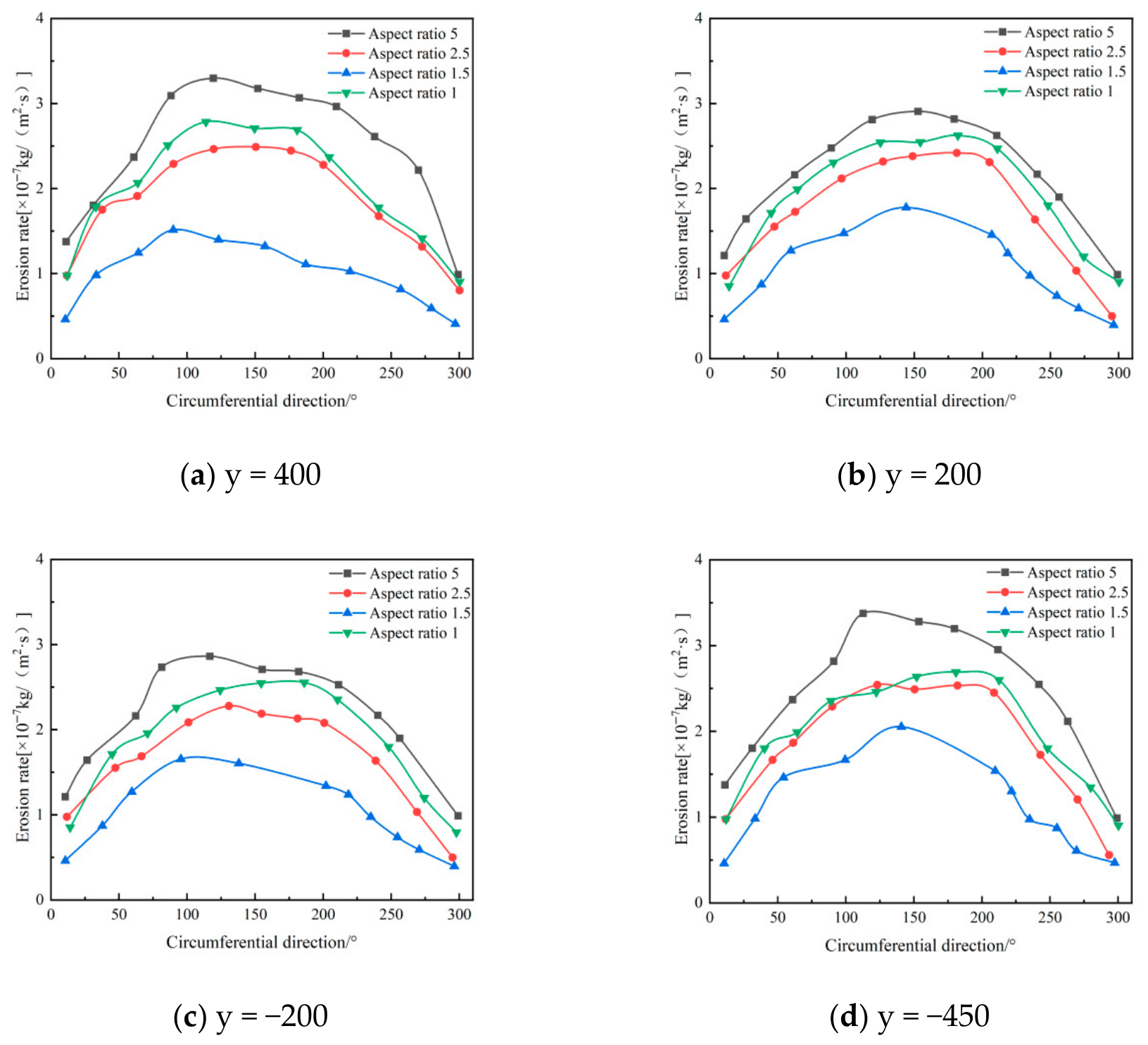
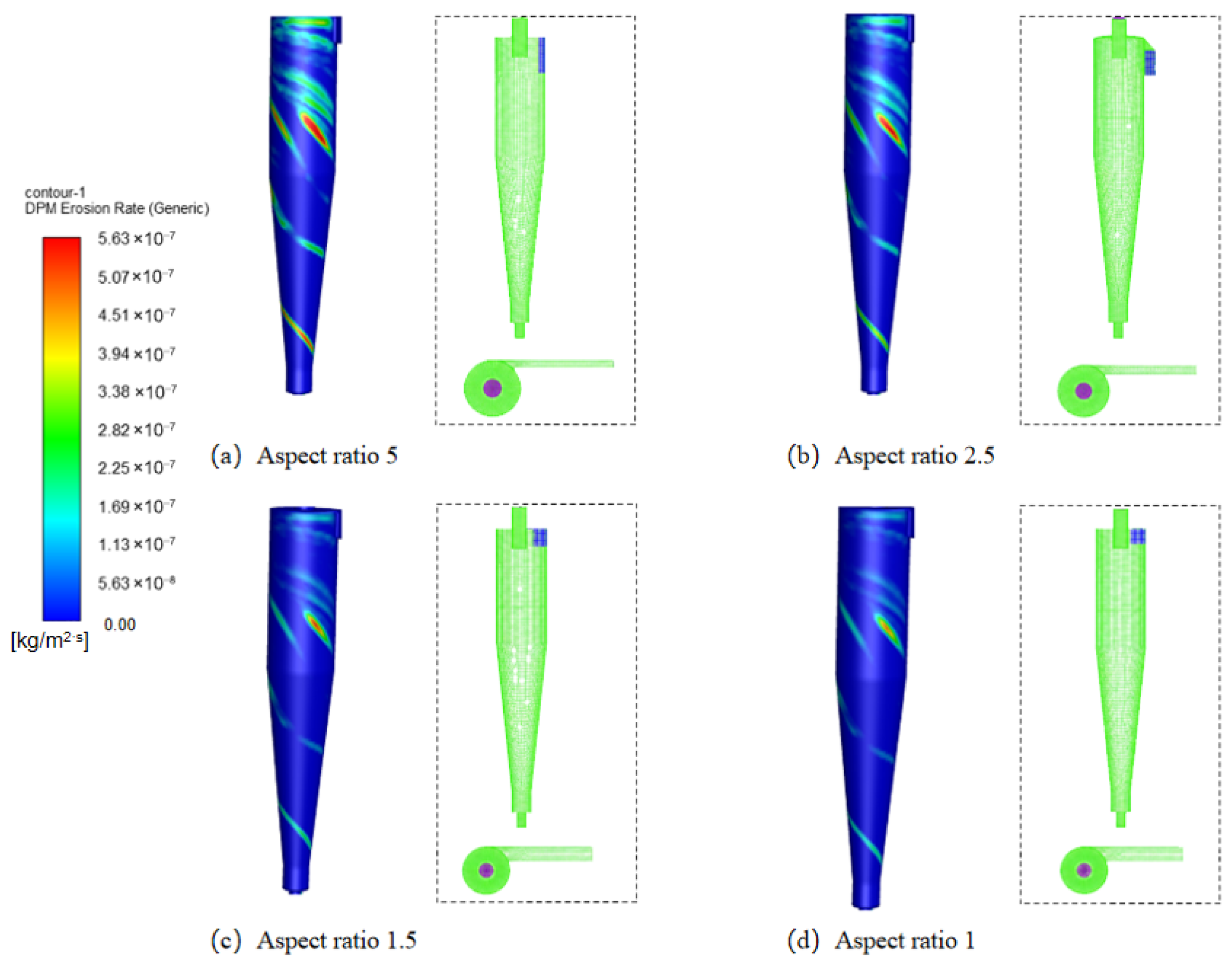
4.1.1. Effect of Inlet Aspect Ratio on Wall Erosion in Cyclone Desanders
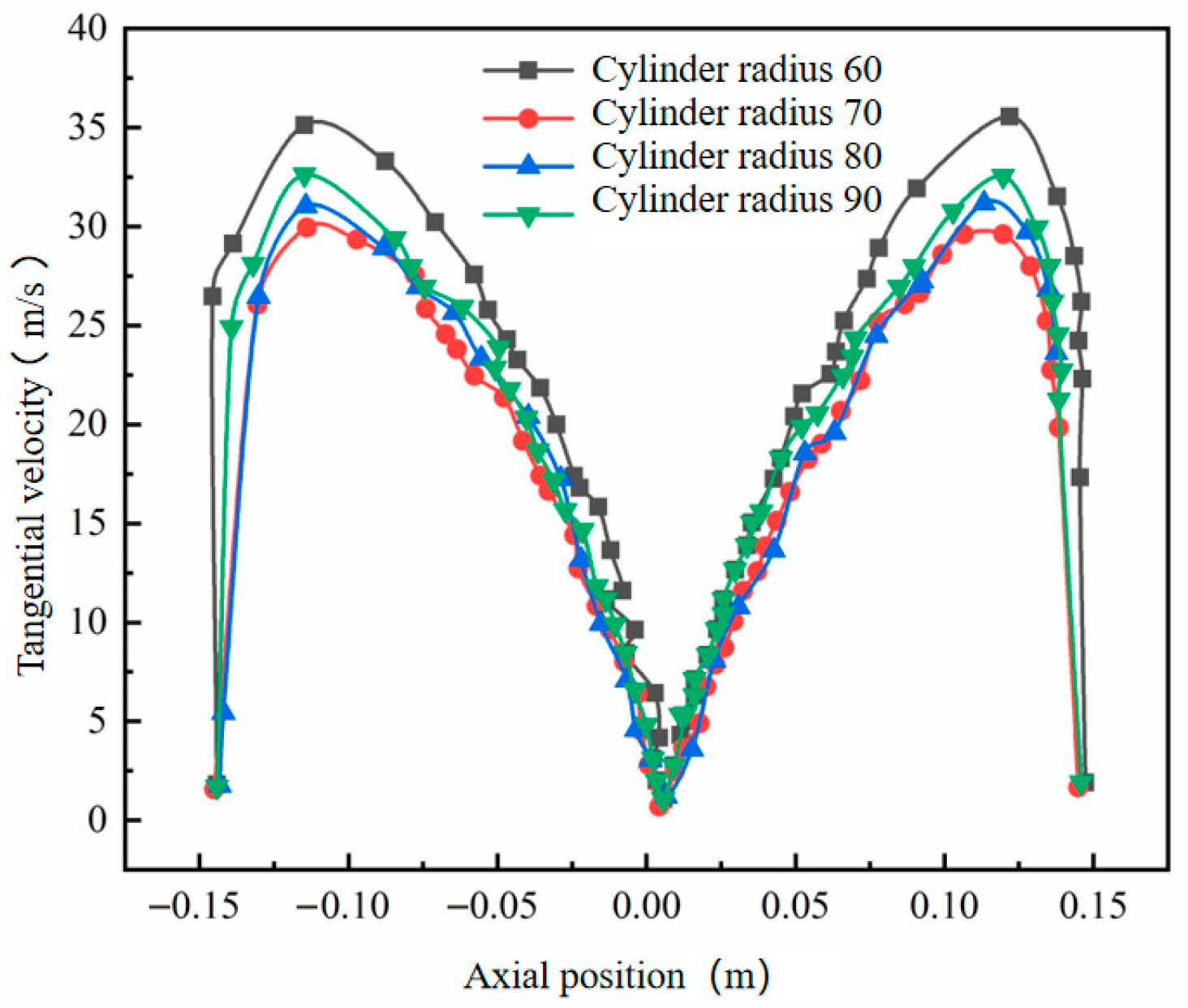
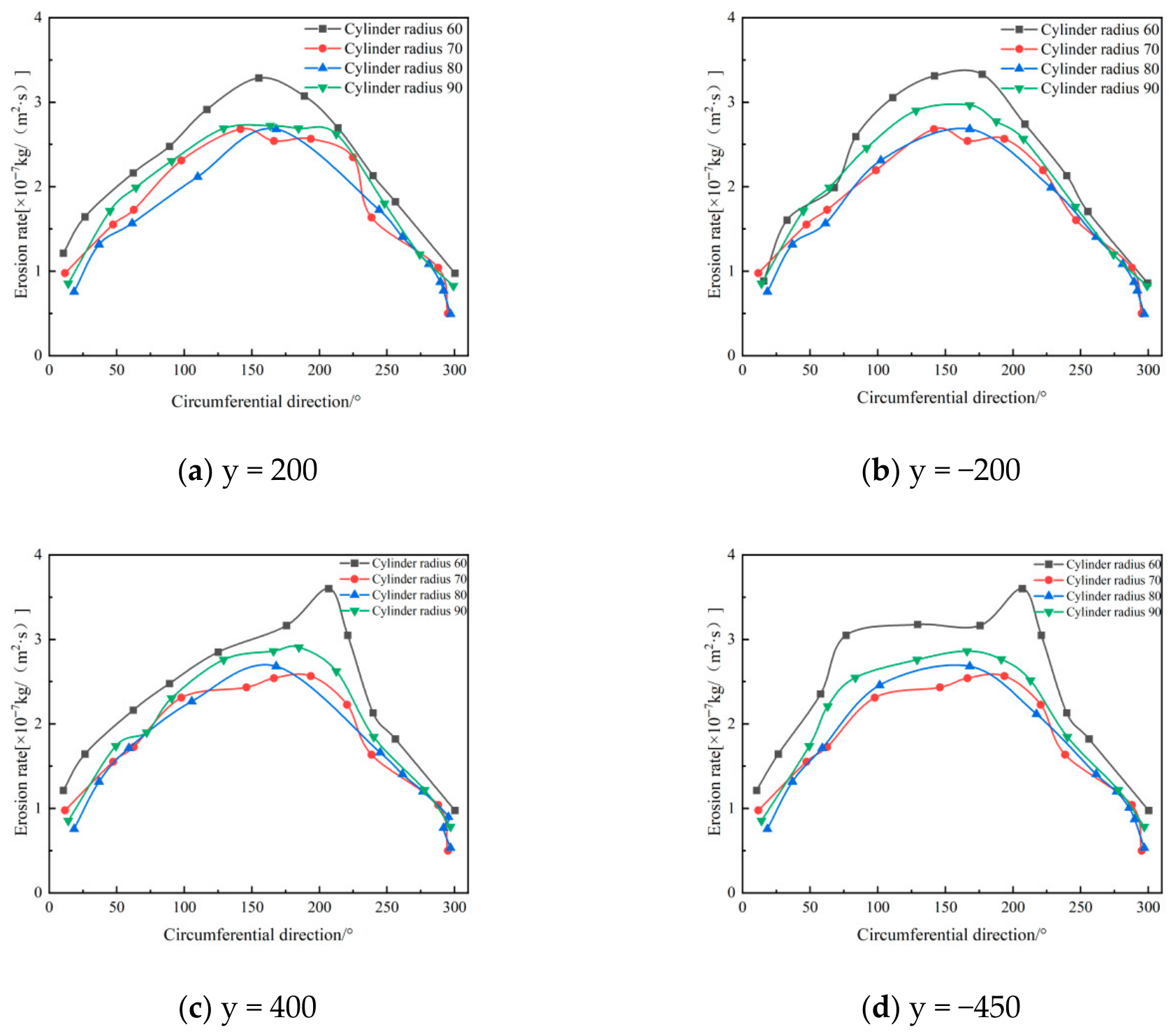
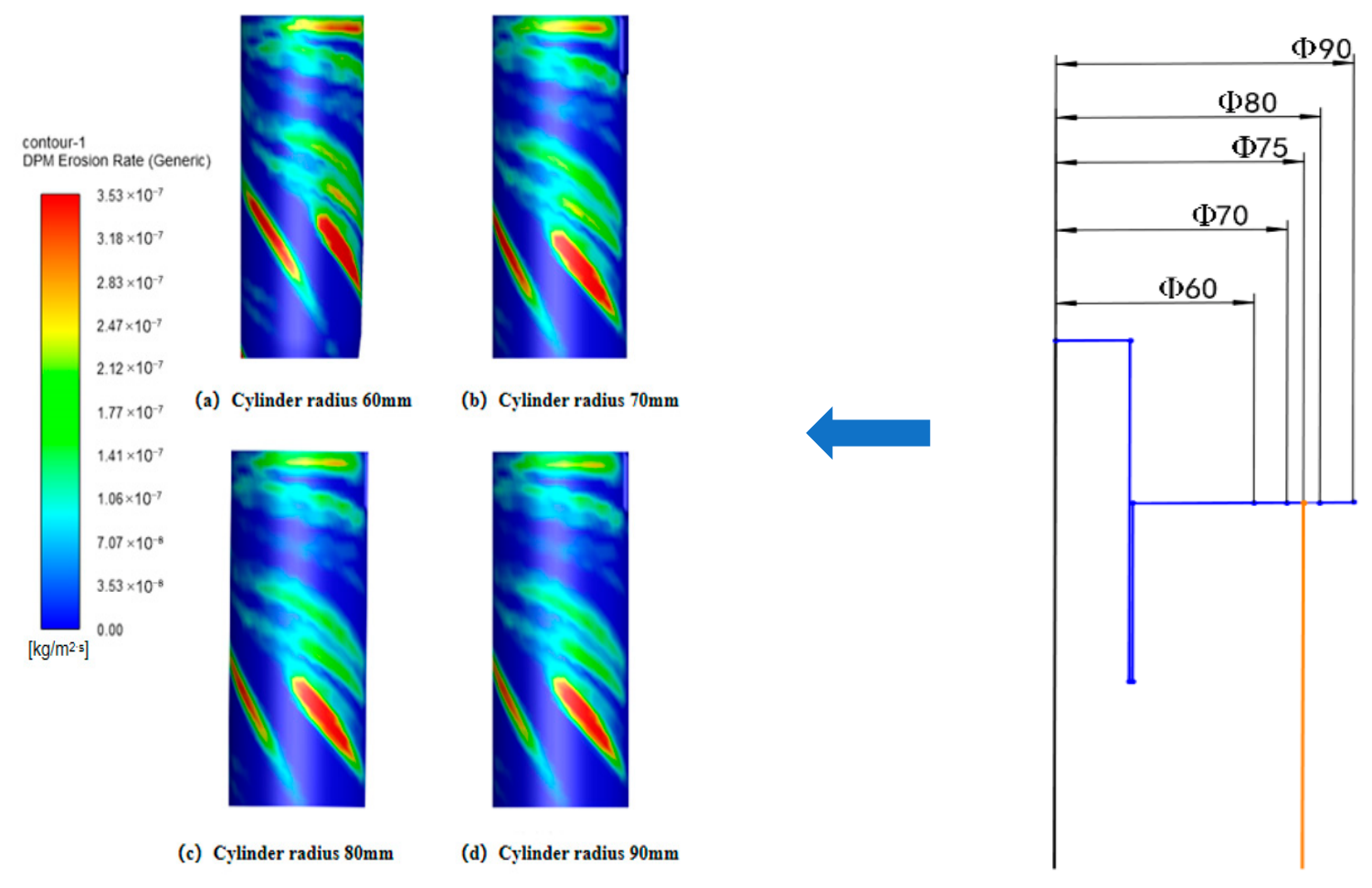
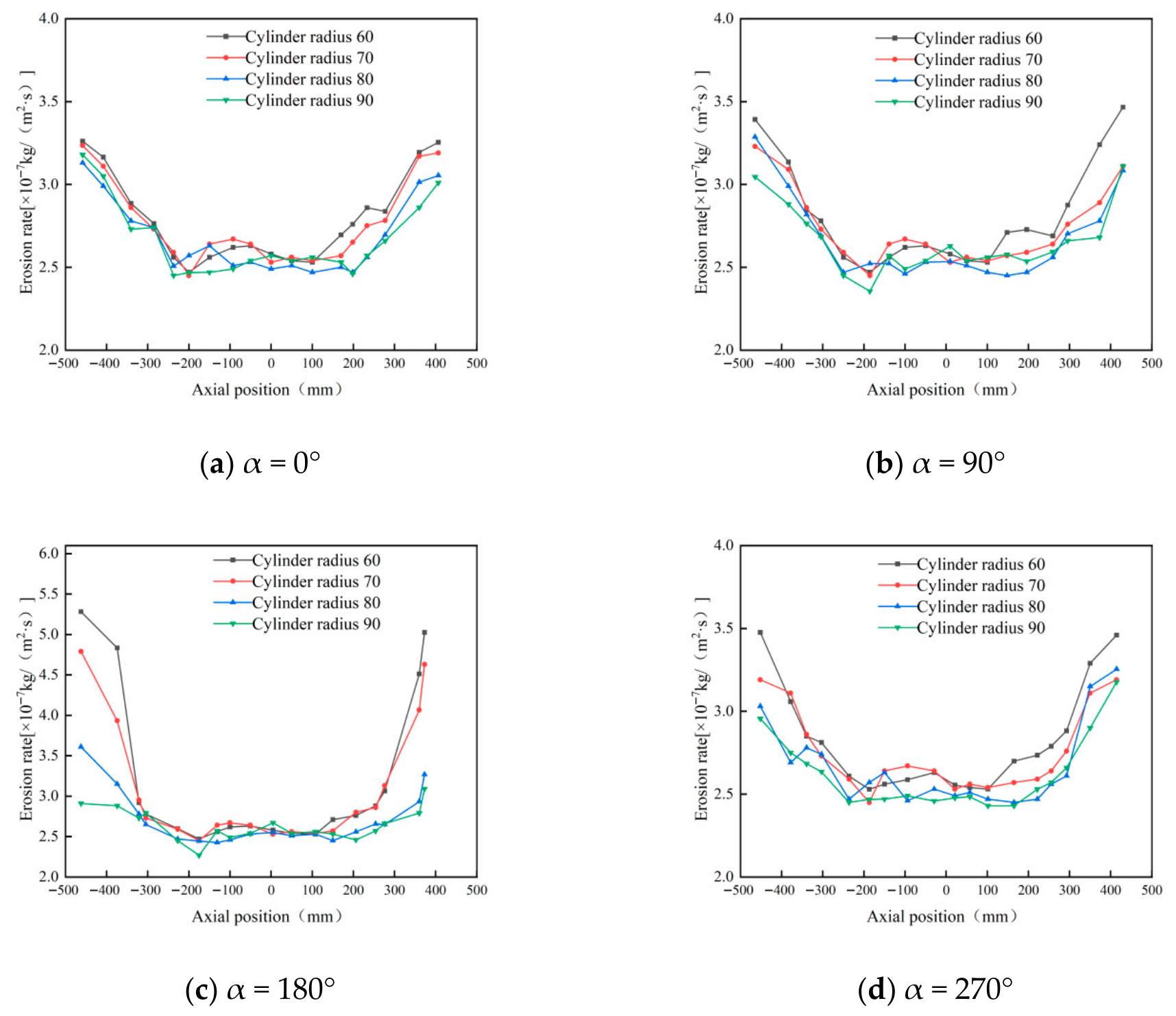
4.1.2. Effect of Cylinder Radius on Wall Erosion of Cyclone Desanders
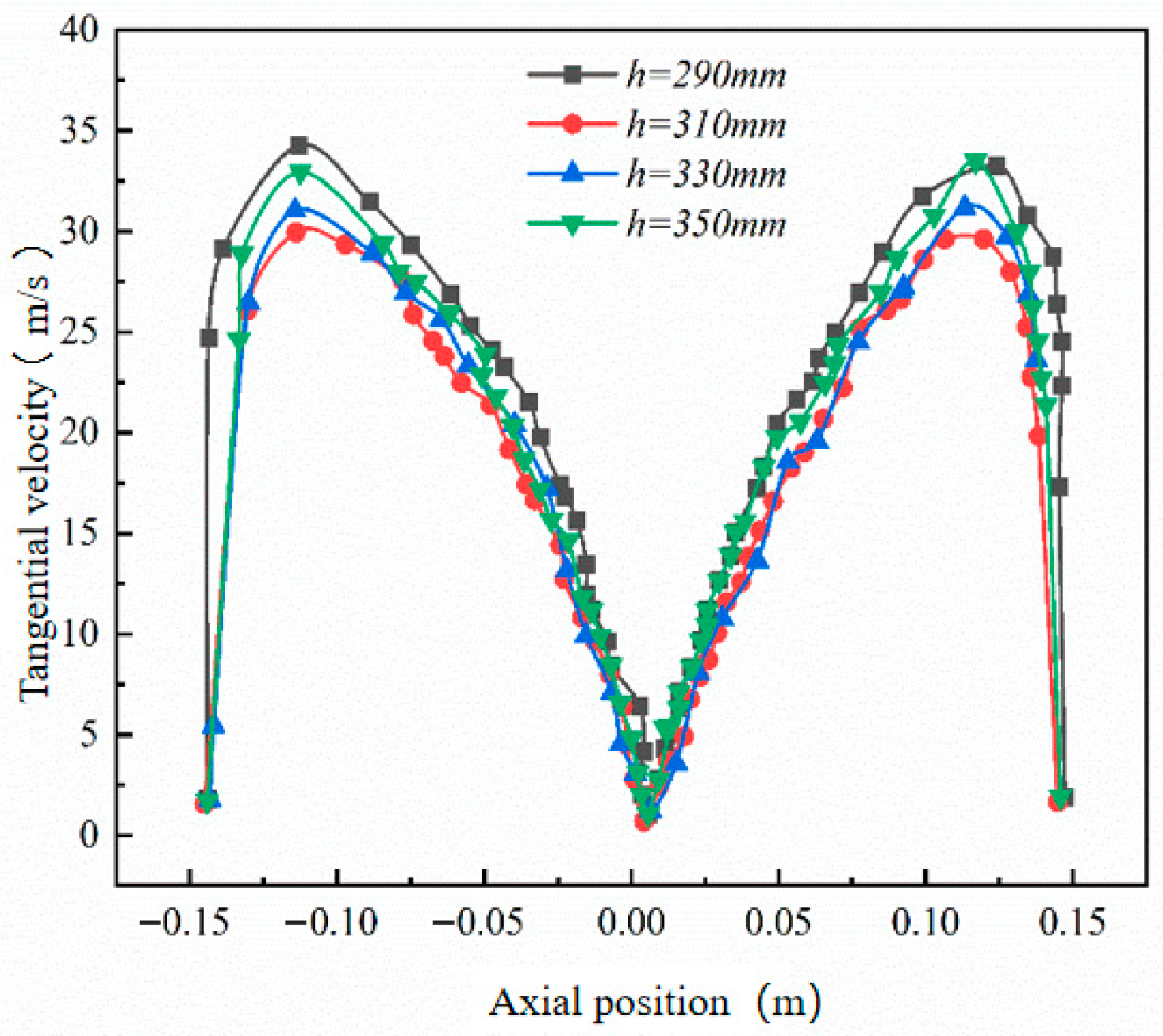
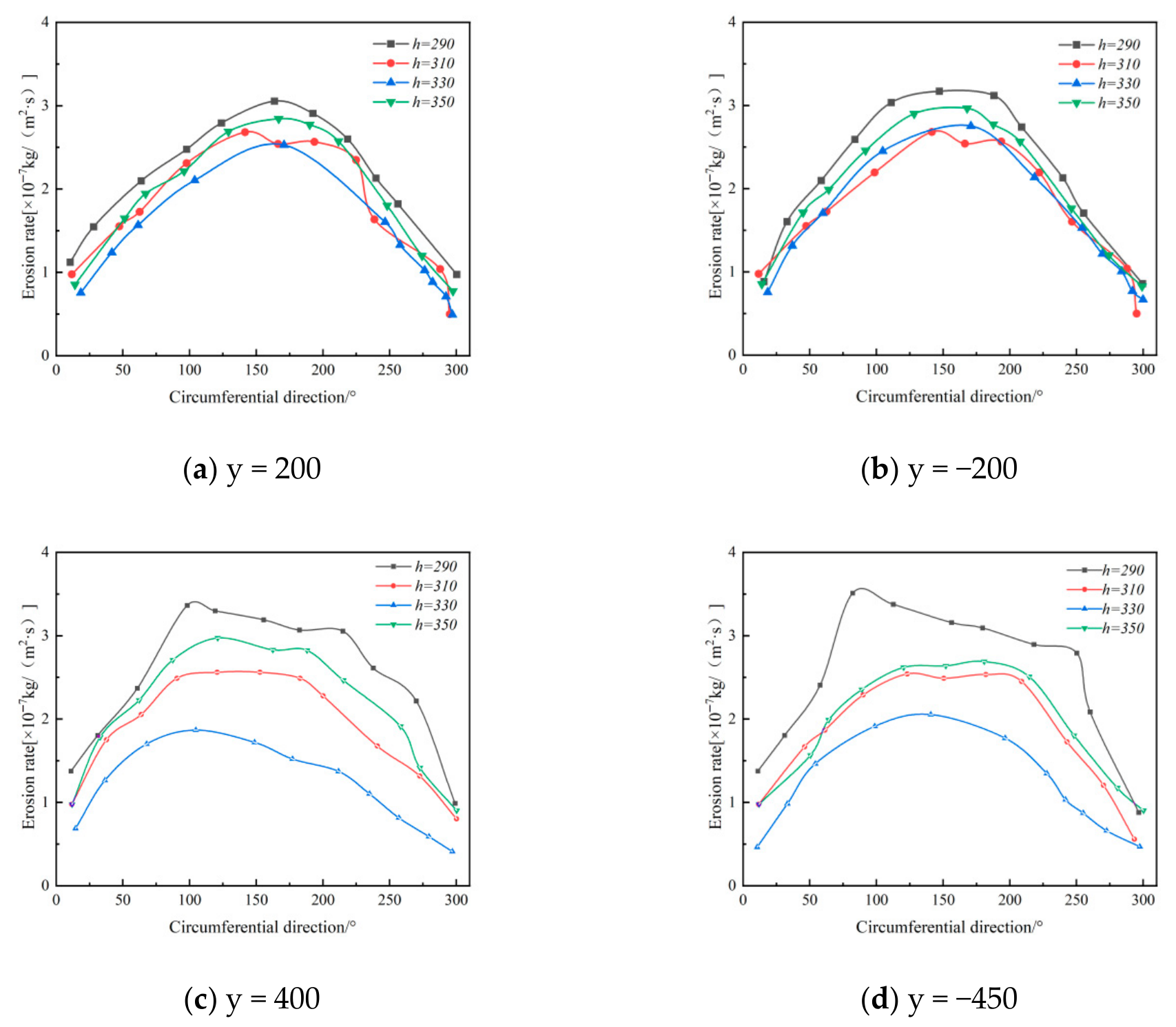
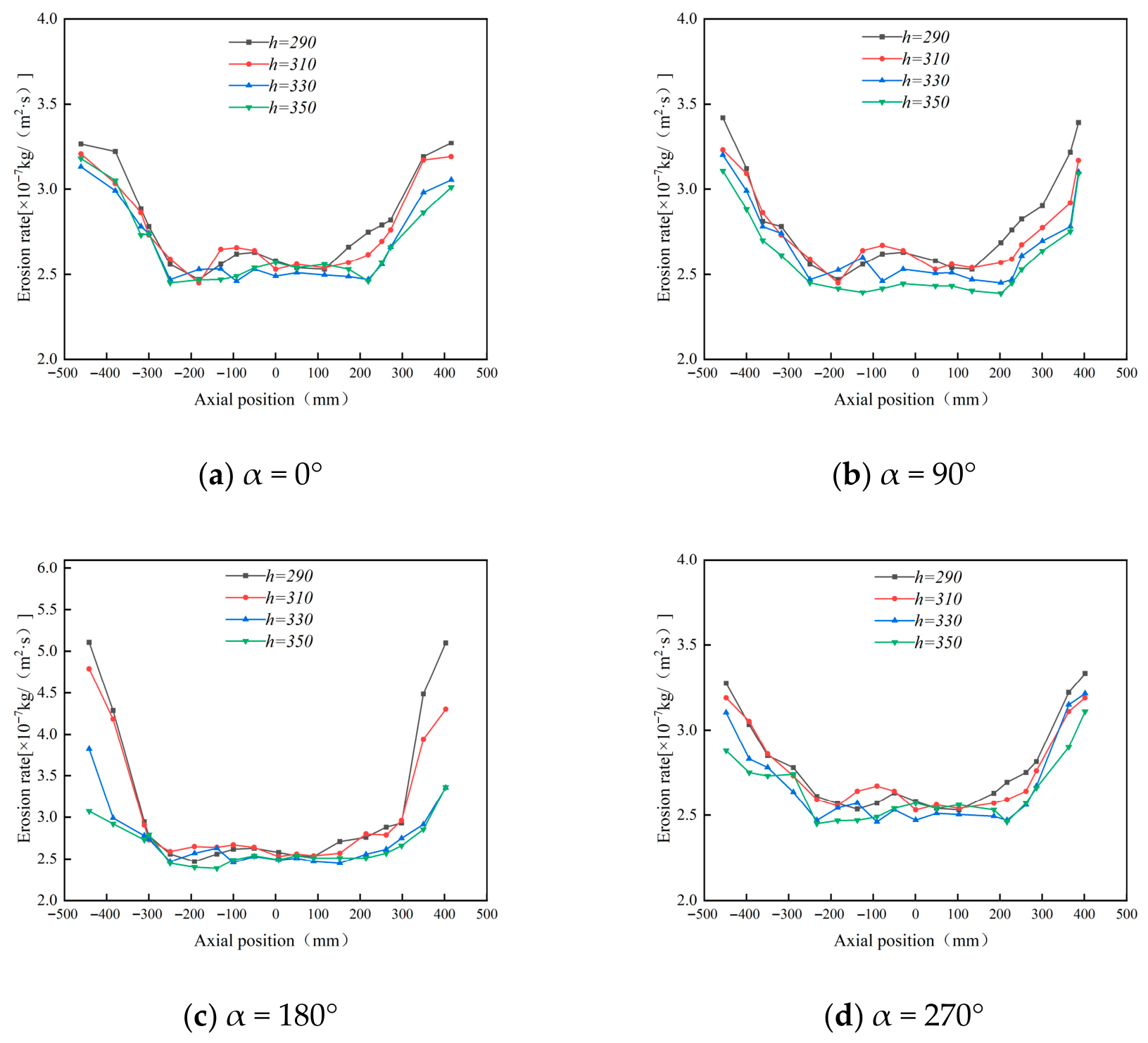
4.1.3. Effect of Cone Length on Wall Erosion of Cyclone Desanders
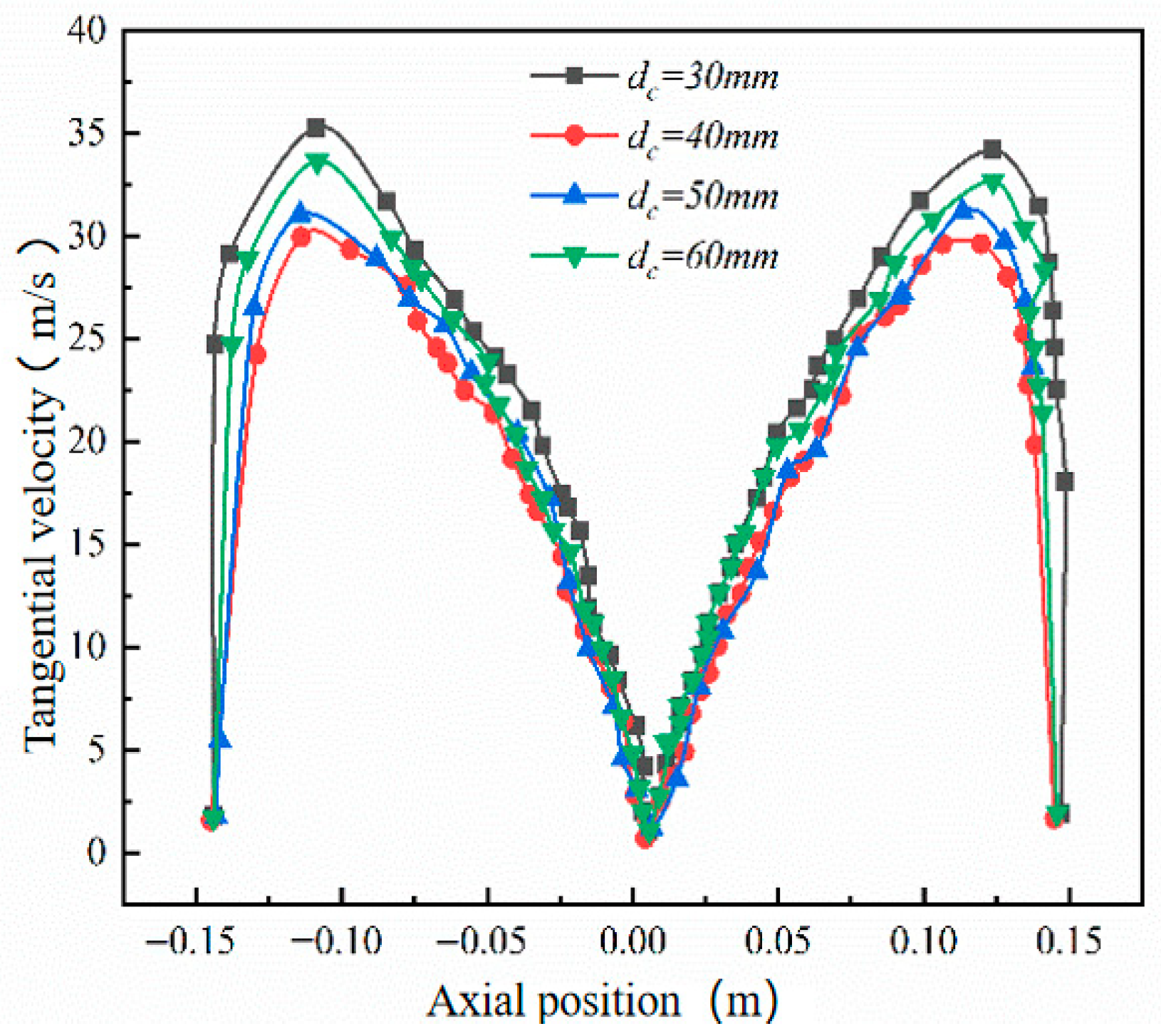
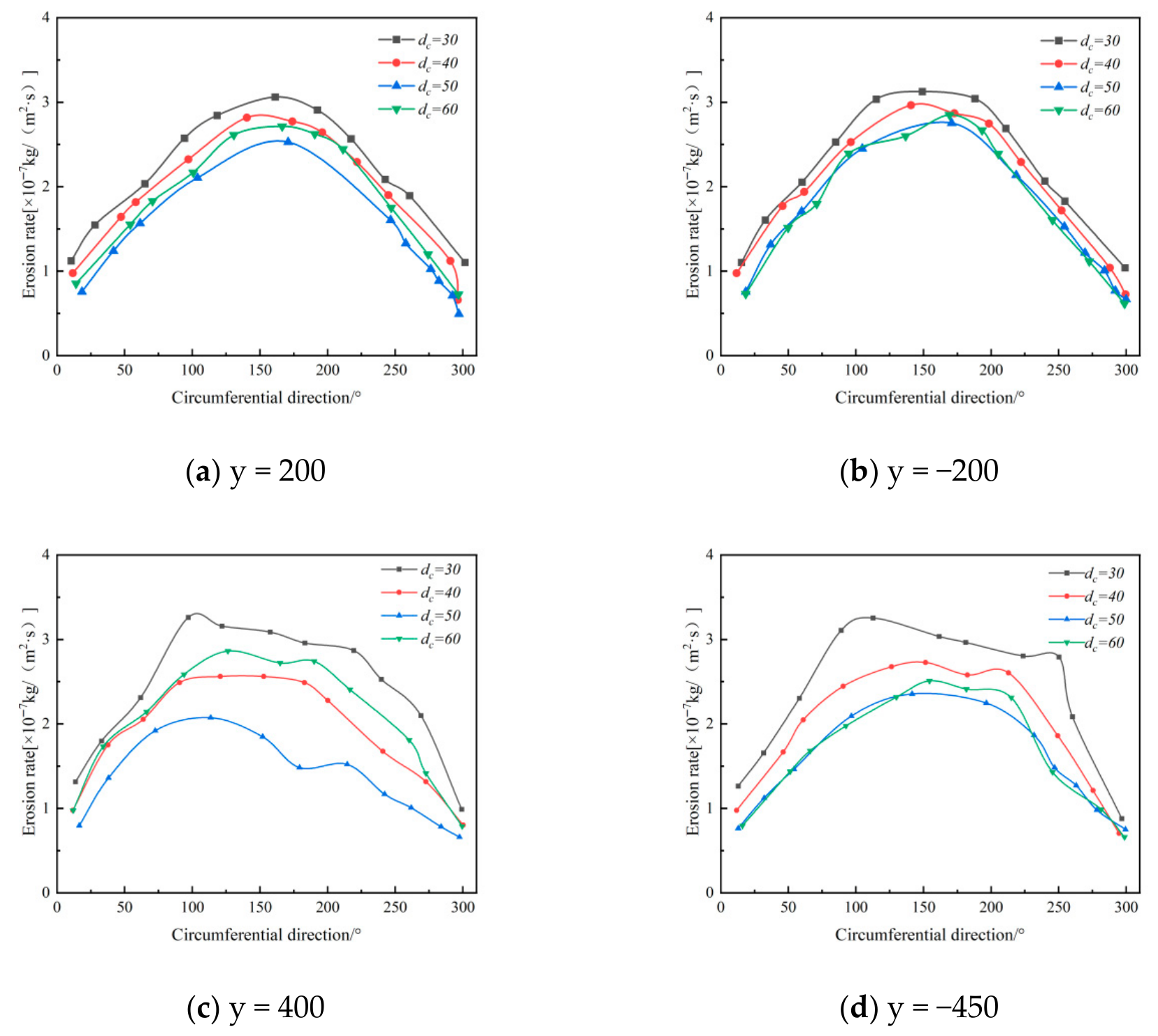
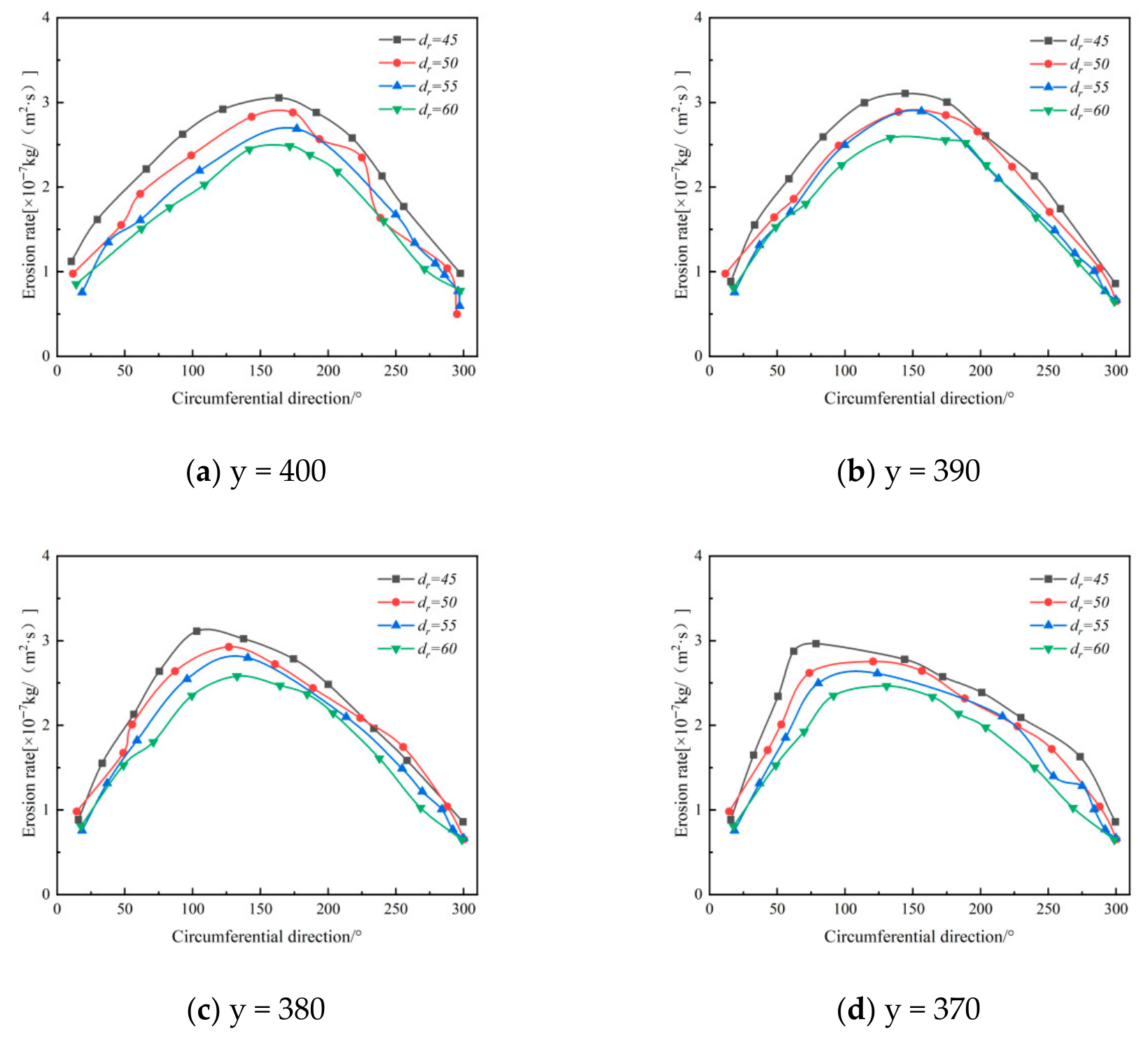
4.1.4. Effect of Dust Outlet Diameter on Wall Erosion in Cyclone Desanders
4.1.5. Effect of Exhaust Port Diameter on Wall Erosion of Cyclone Desanders
4.2. Influence of Medium Parameters
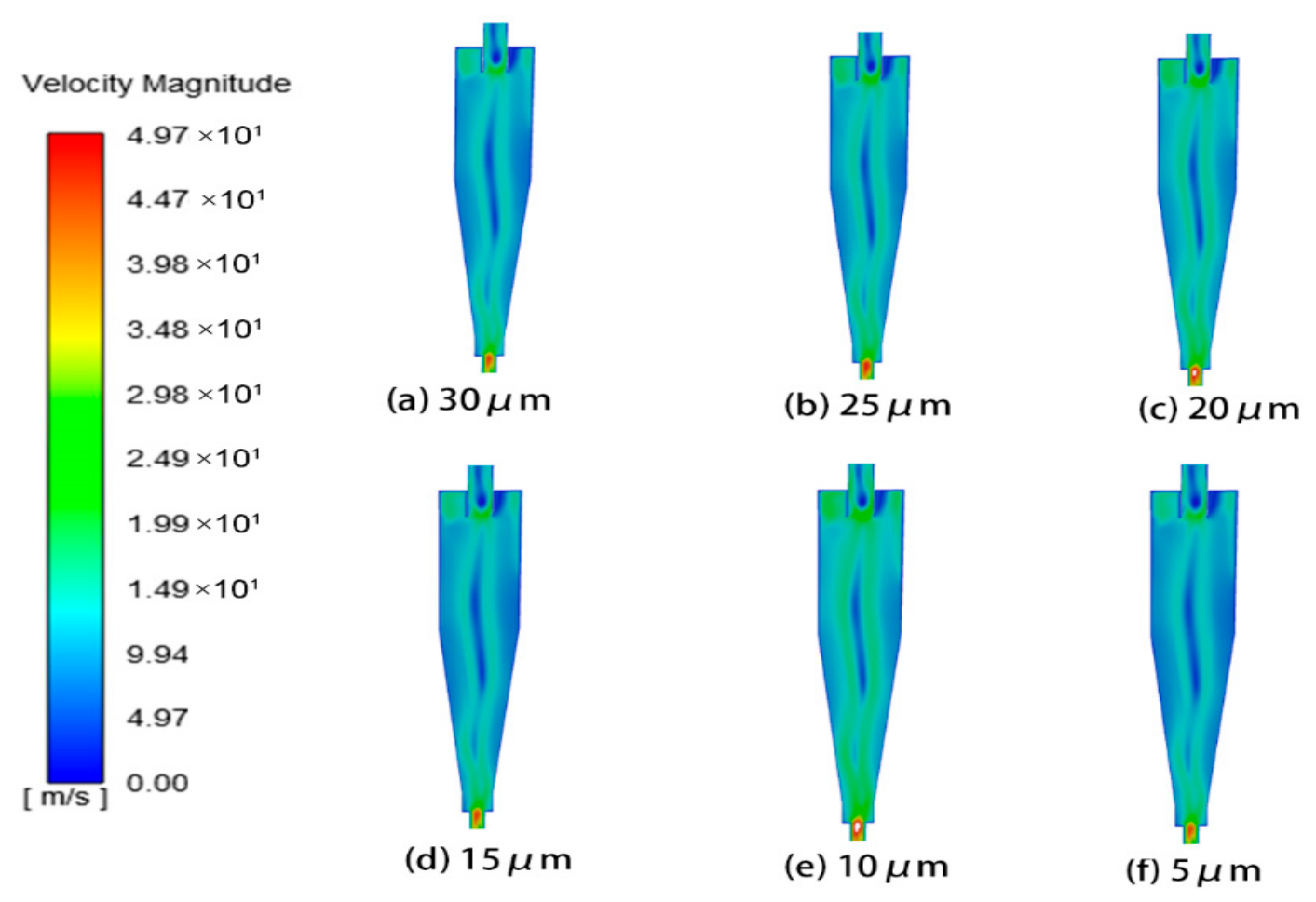
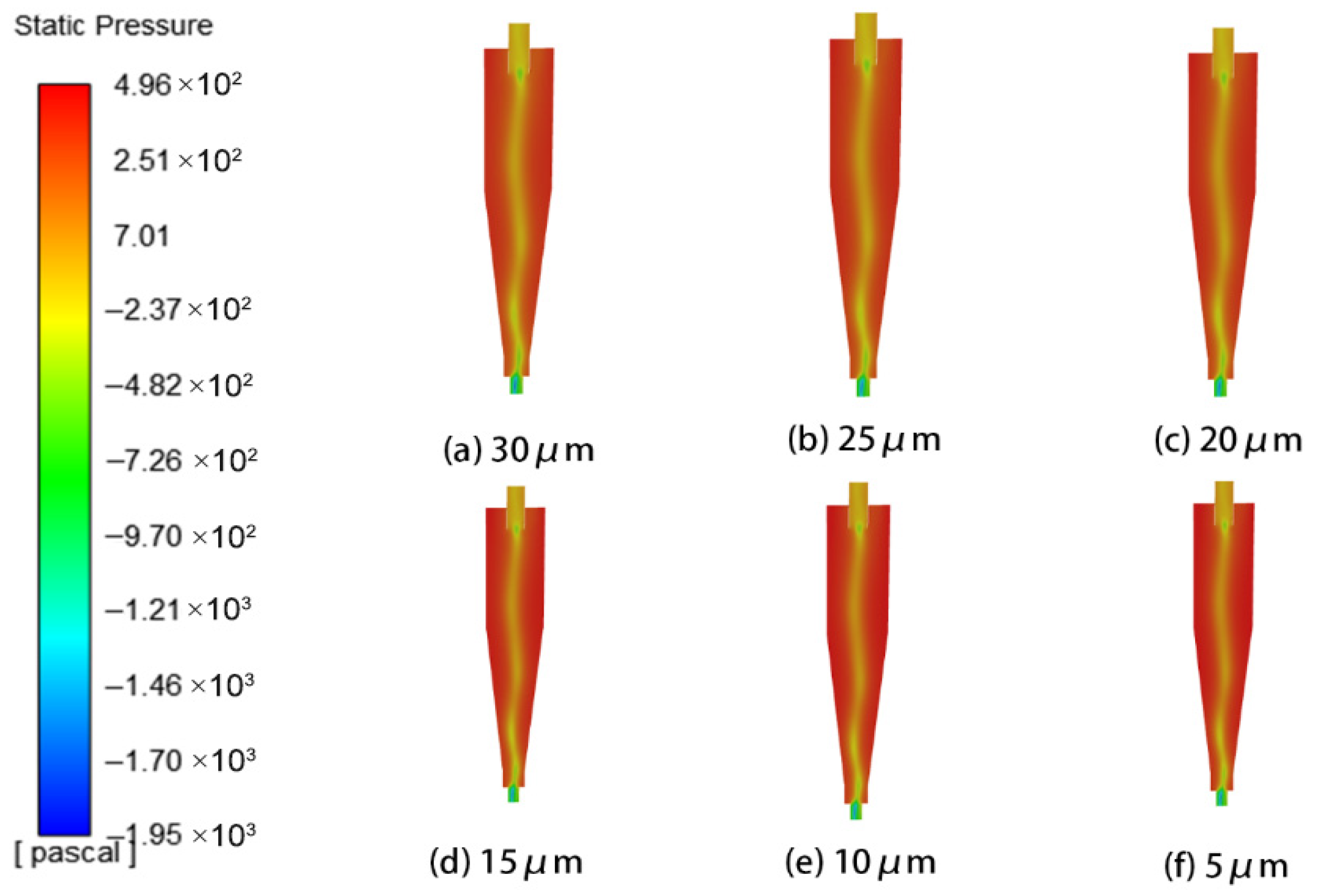
4.2.1. Effect of Particle Size on Wall Erosion in Cyclone Desanders
4.2.2. Effect of Particle Concentration on Wall Erosion in Cyclone Desanders
4.3. Influence of Operating Parameters
4.3.1. Effect of Inlet Velocity on Wall Erosion of Cyclone Desanders
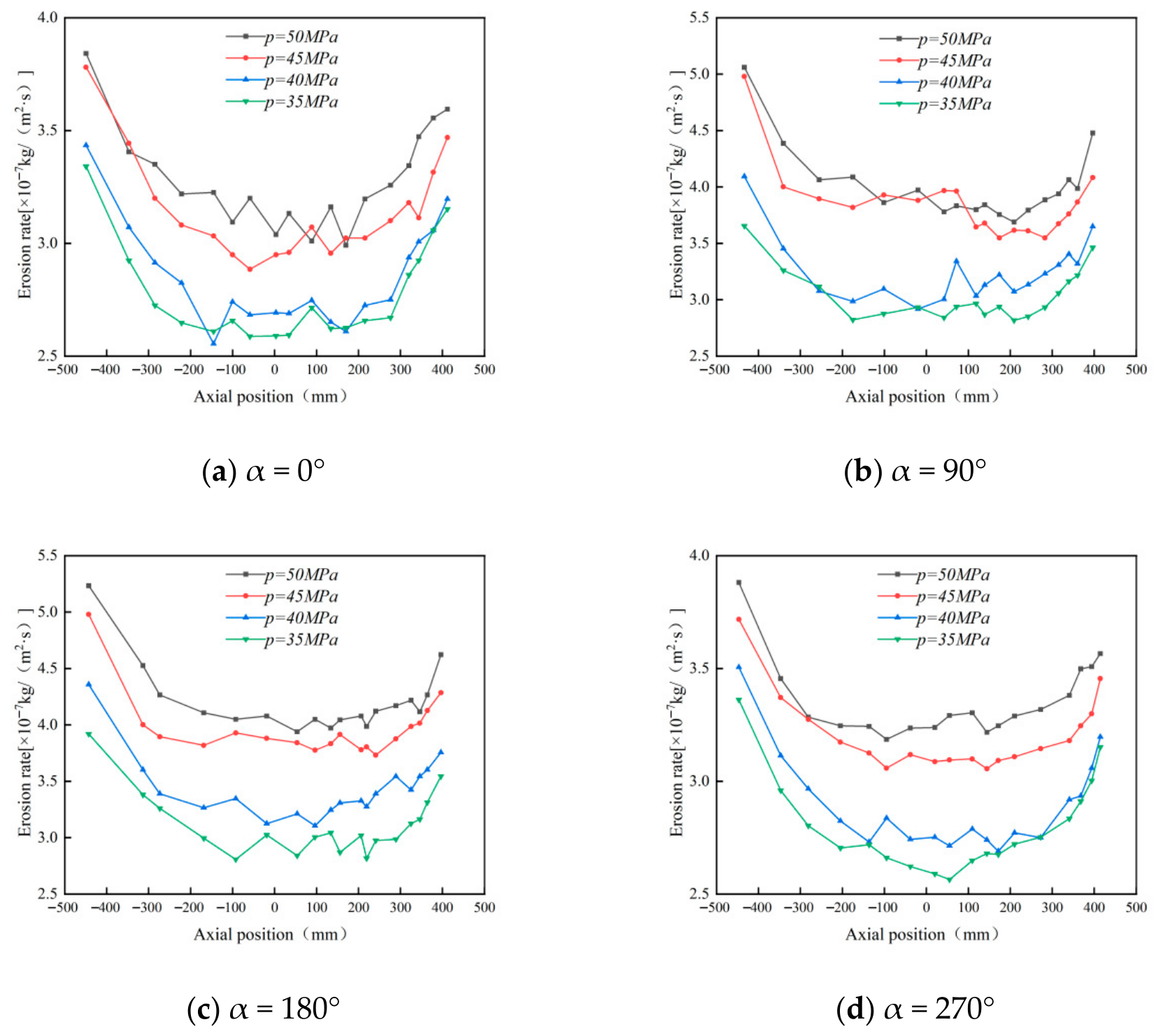
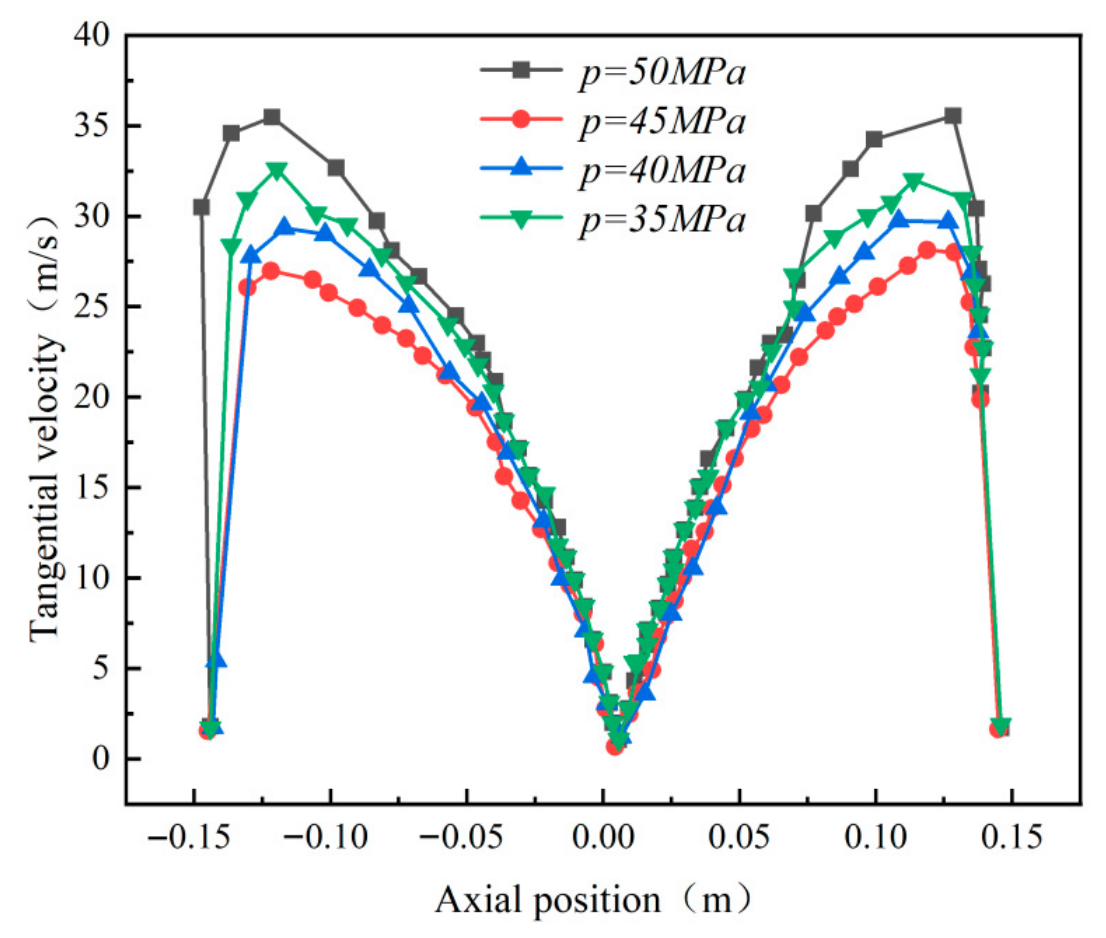
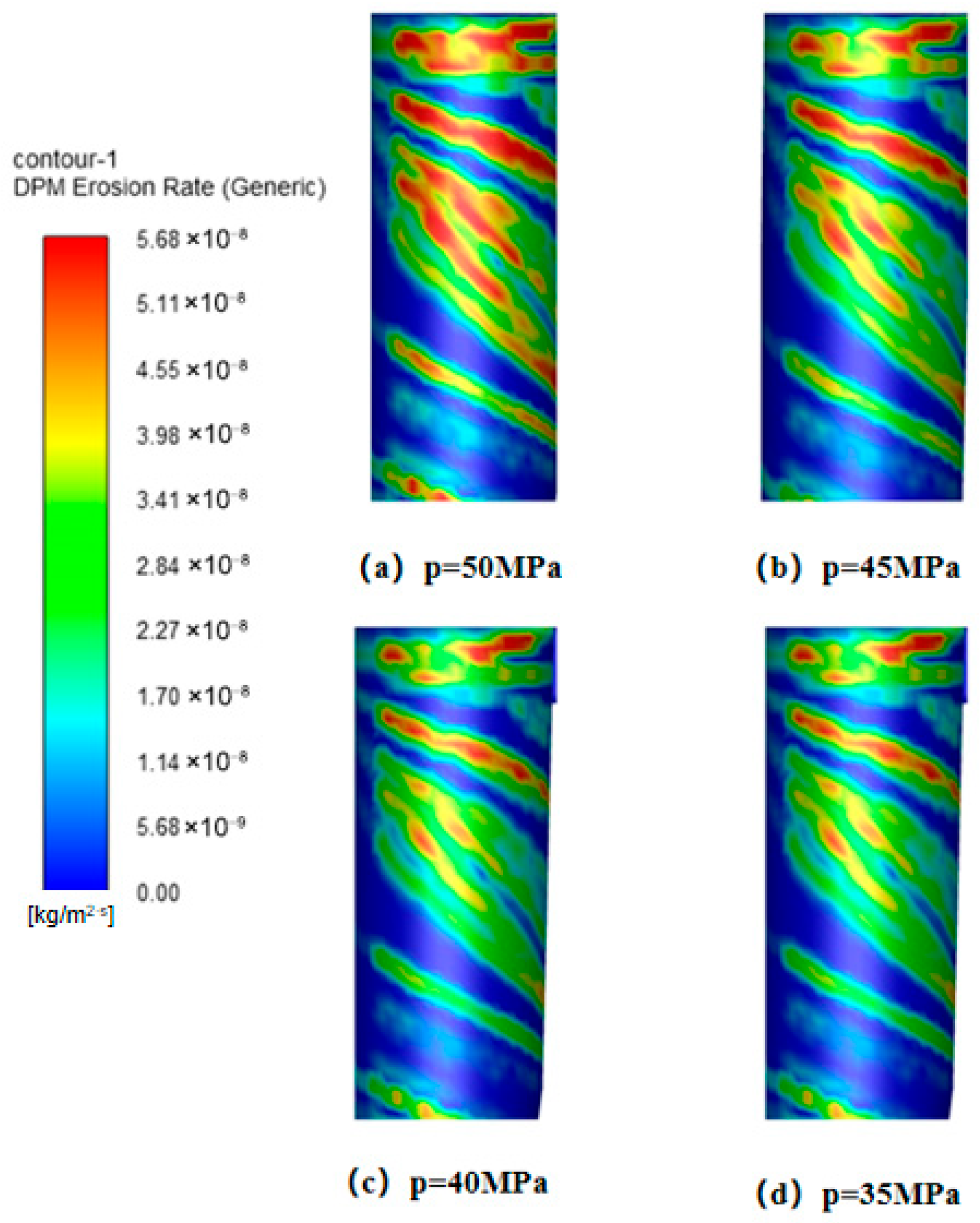
4.3.2. Effect of Operating Pressure on Wall Erosion in Cyclone Desanders
4.4. Synthesis of Erosion Mechanisms and Engineering Implications
5. Parameter Optimization Analysis of Cyclone Desander Based on Response Surface Methodology
5.1. Significance Analysis of Cyclone Desander Parameters
5.2. Box–Behnken Response Surface Methodology for Analyzing the Interactive Effects on Erosion Rate
5.2.1. Box–Behnken Experiment
5.2.2. Regression Equation Fitting and Analysis of Variance
6. Engineering Implications for Optimized Geometry and Material-Based Erosion Protection
6.1. Optimized Geometry and Erosion Reduction Mechanism
6.2. Material-Based Protection Strategies for Erosion-Prone Regions
7. Conclusions
- (1)
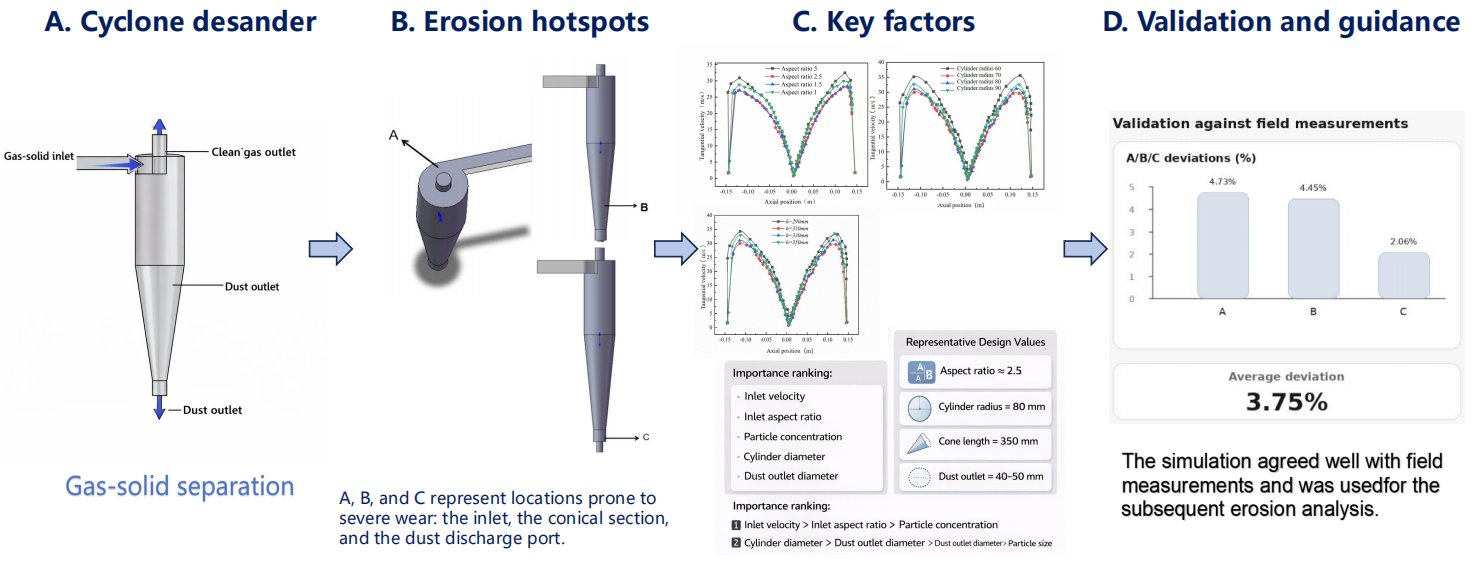
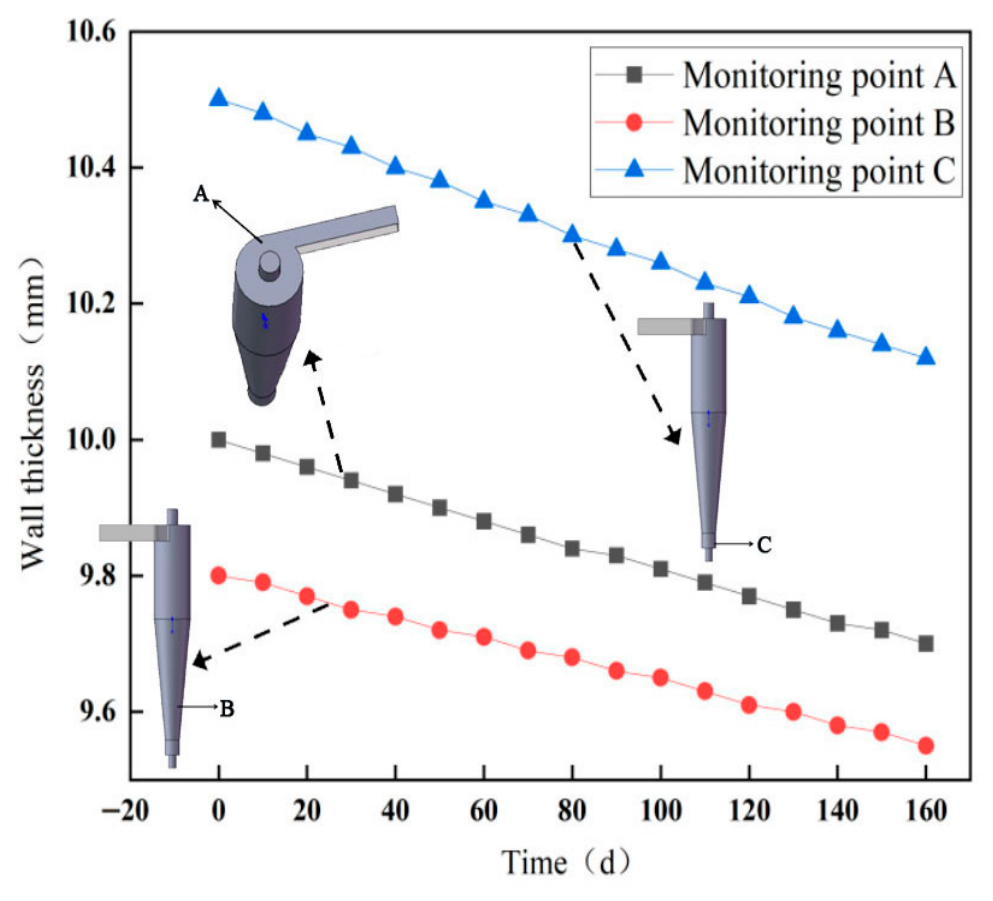
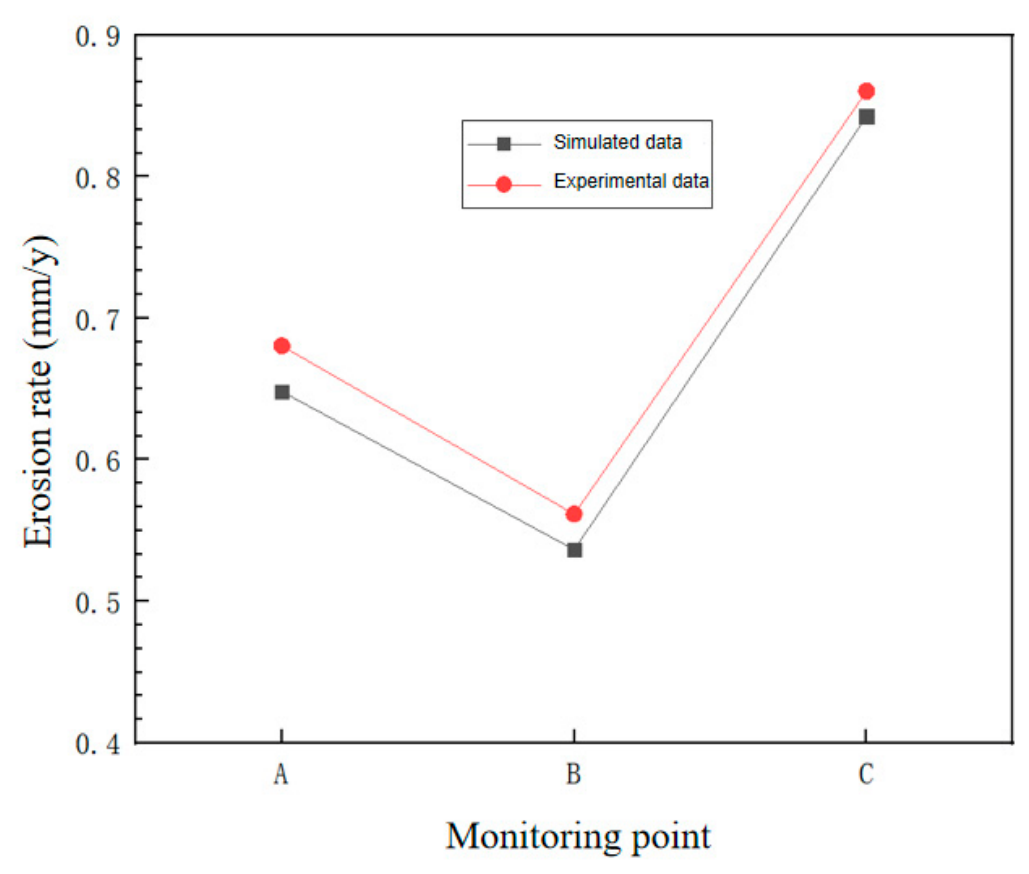
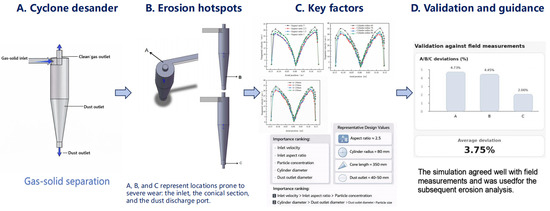
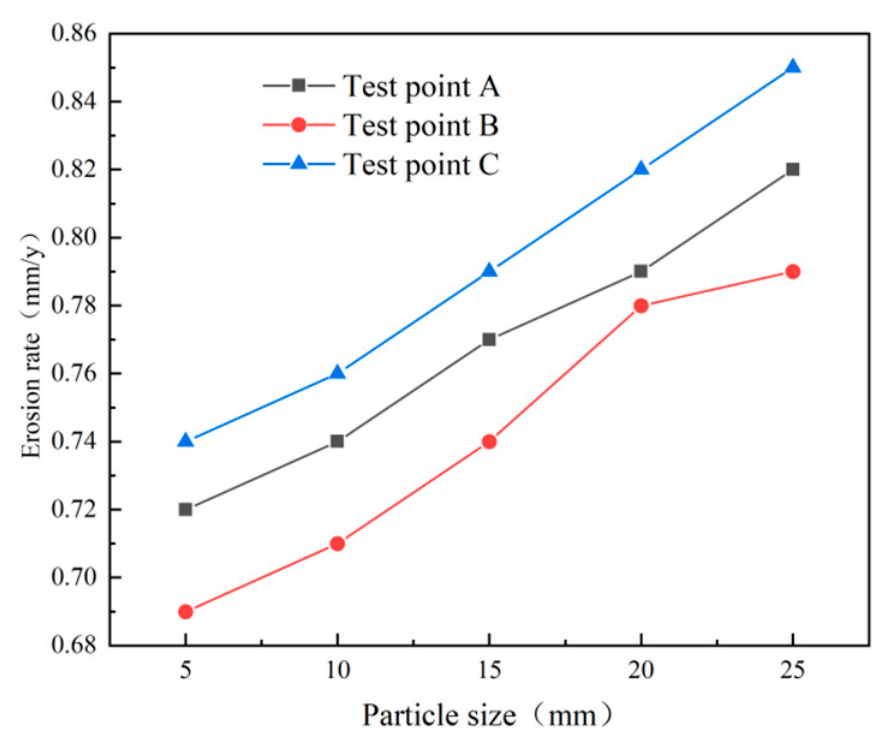
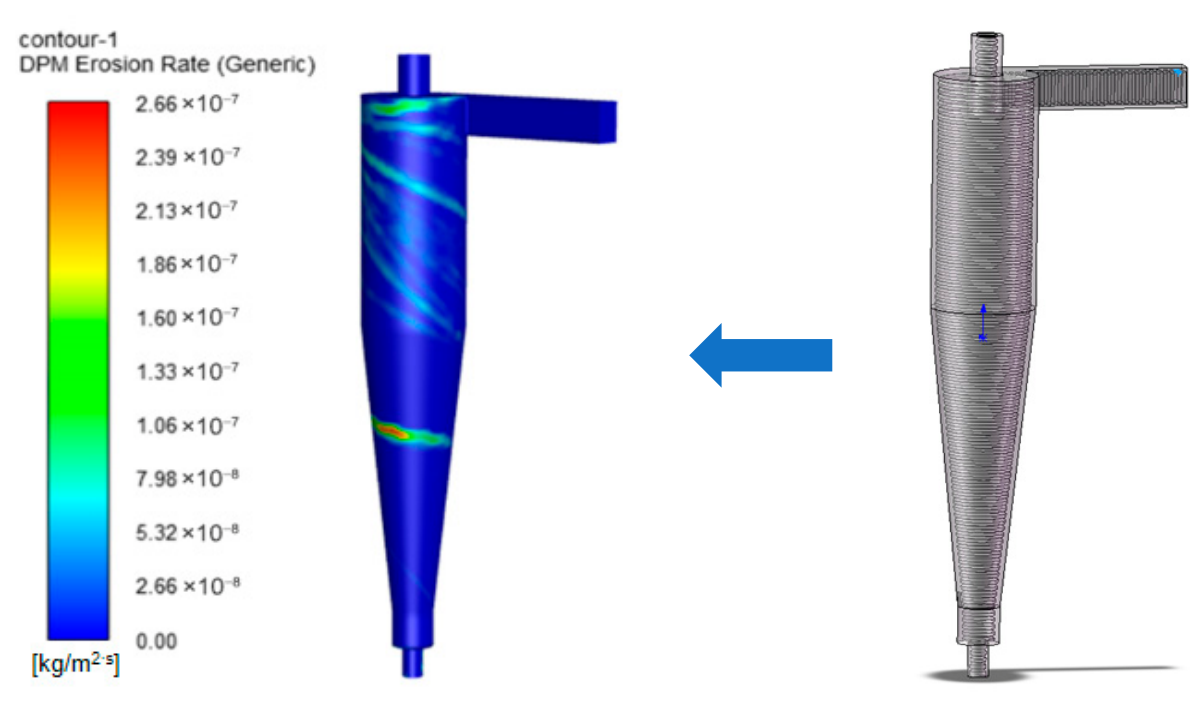
- A CFD-based erosion model of the cyclone desander was established and validated using field wall-thickness monitoring data. The relative simulation errors at monitoring points A, B, and C were 4.73%, 4.45%, and 2.06%, respectively, with an average relative error of 3.75%, indicating that the model can reasonably predict the main erosion-prone regions of the desander.
- (2)
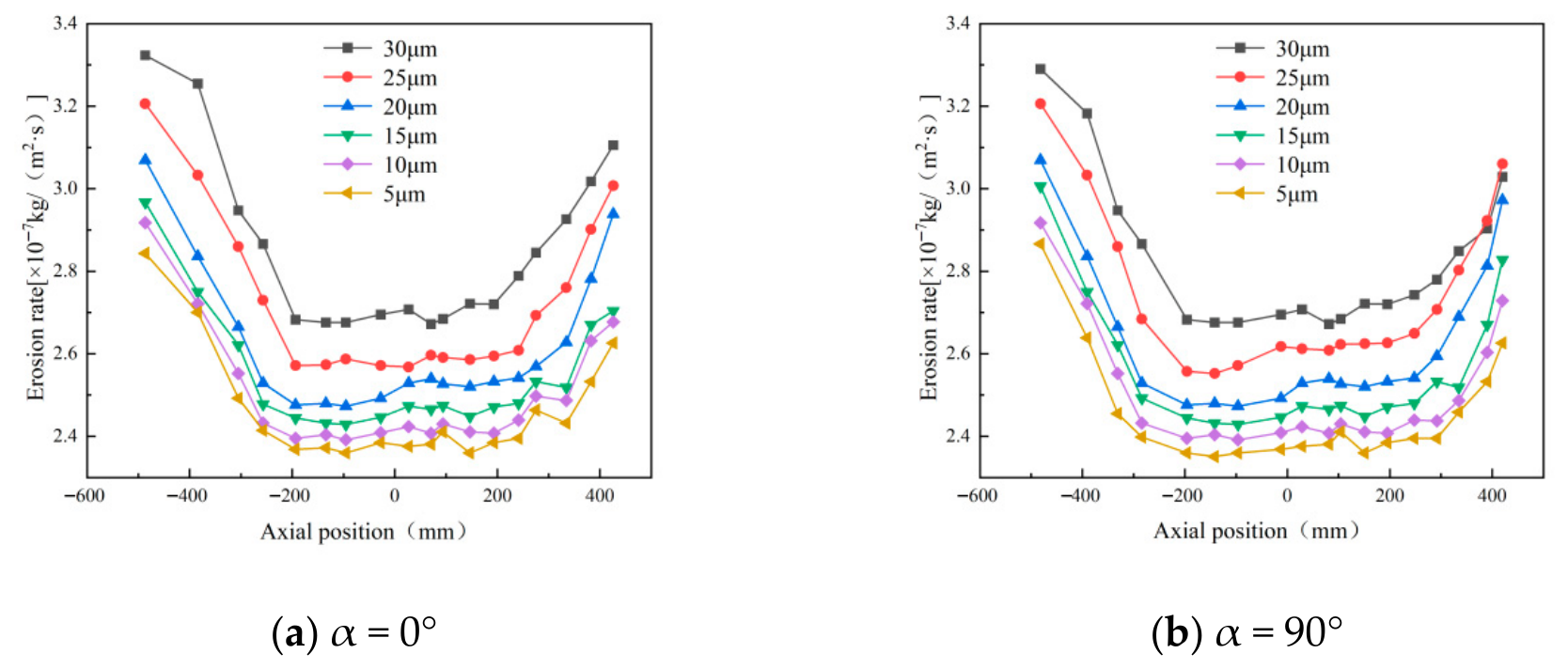
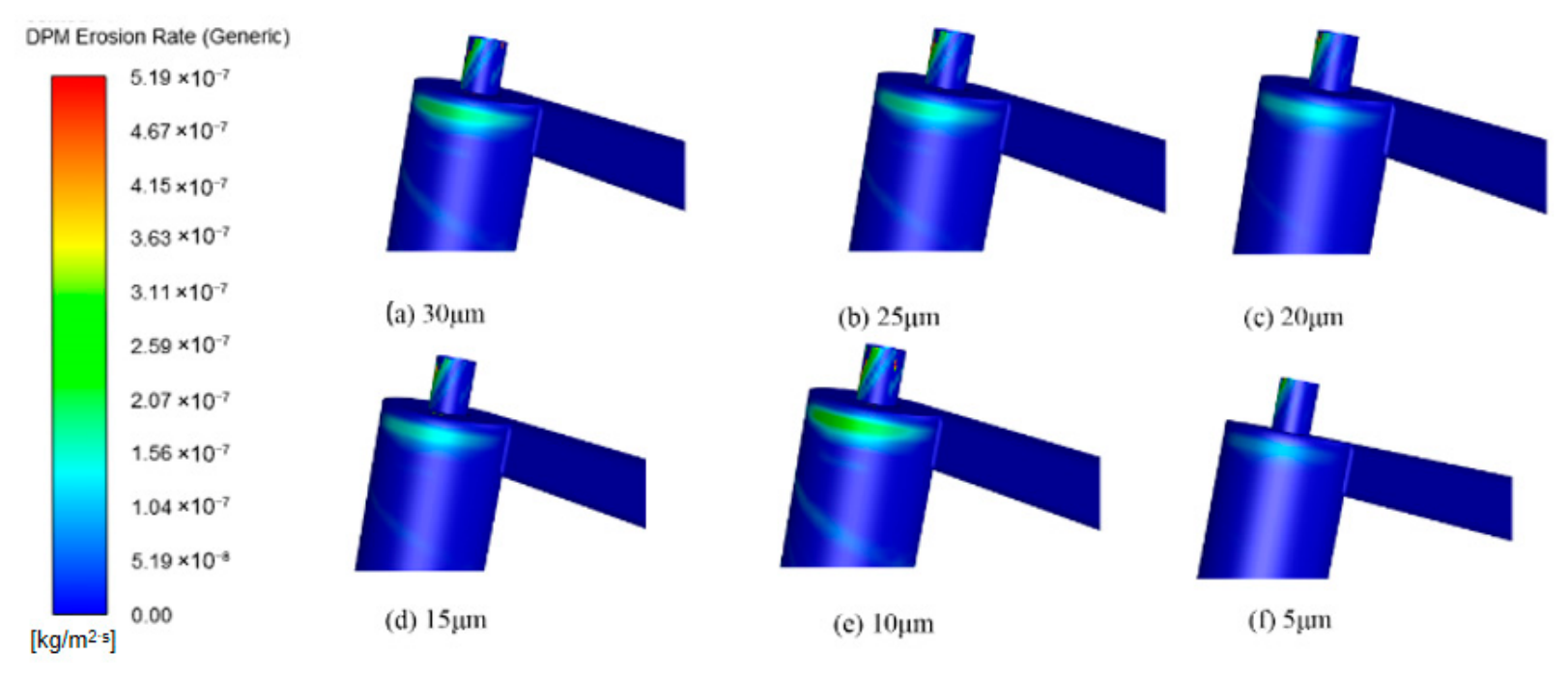
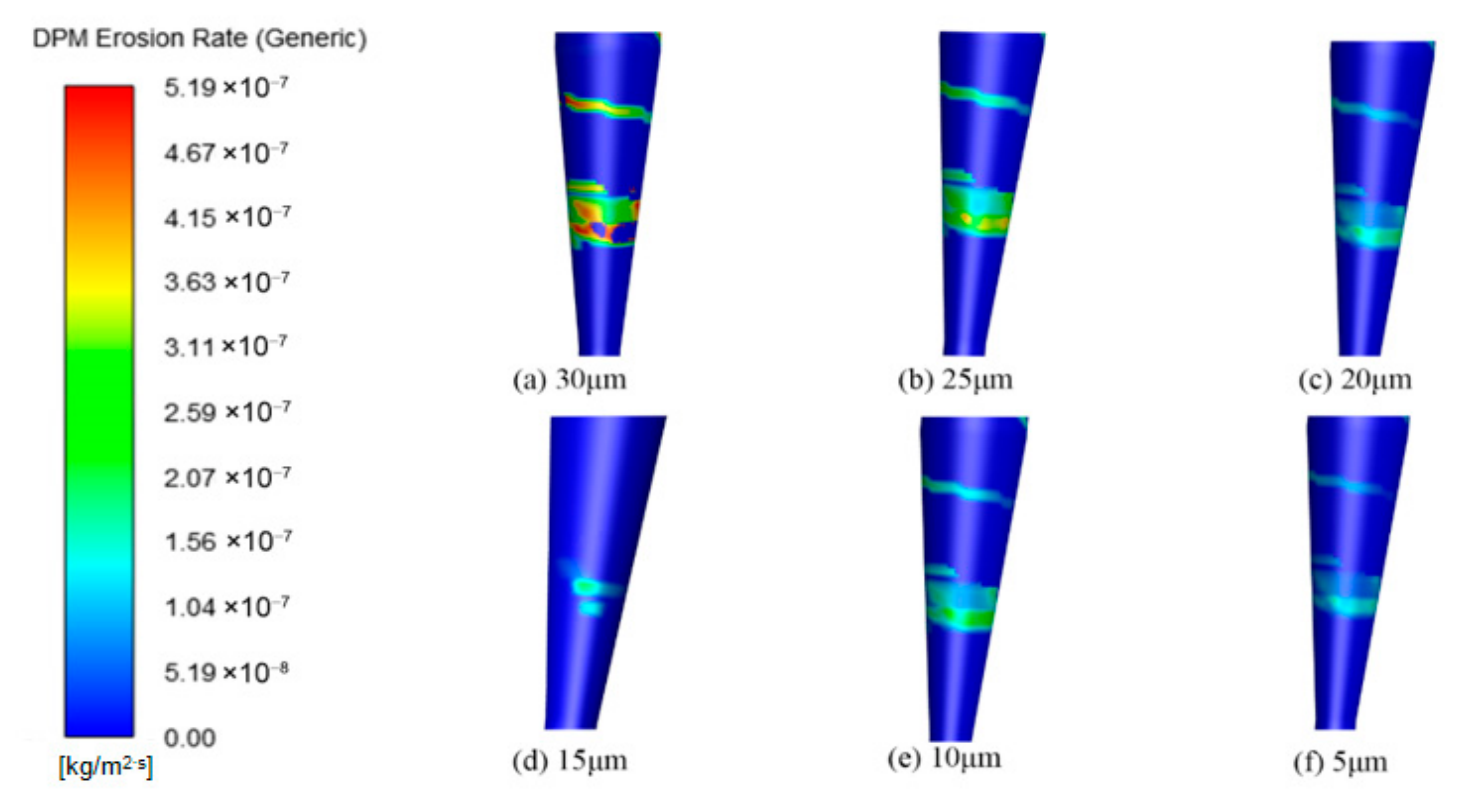
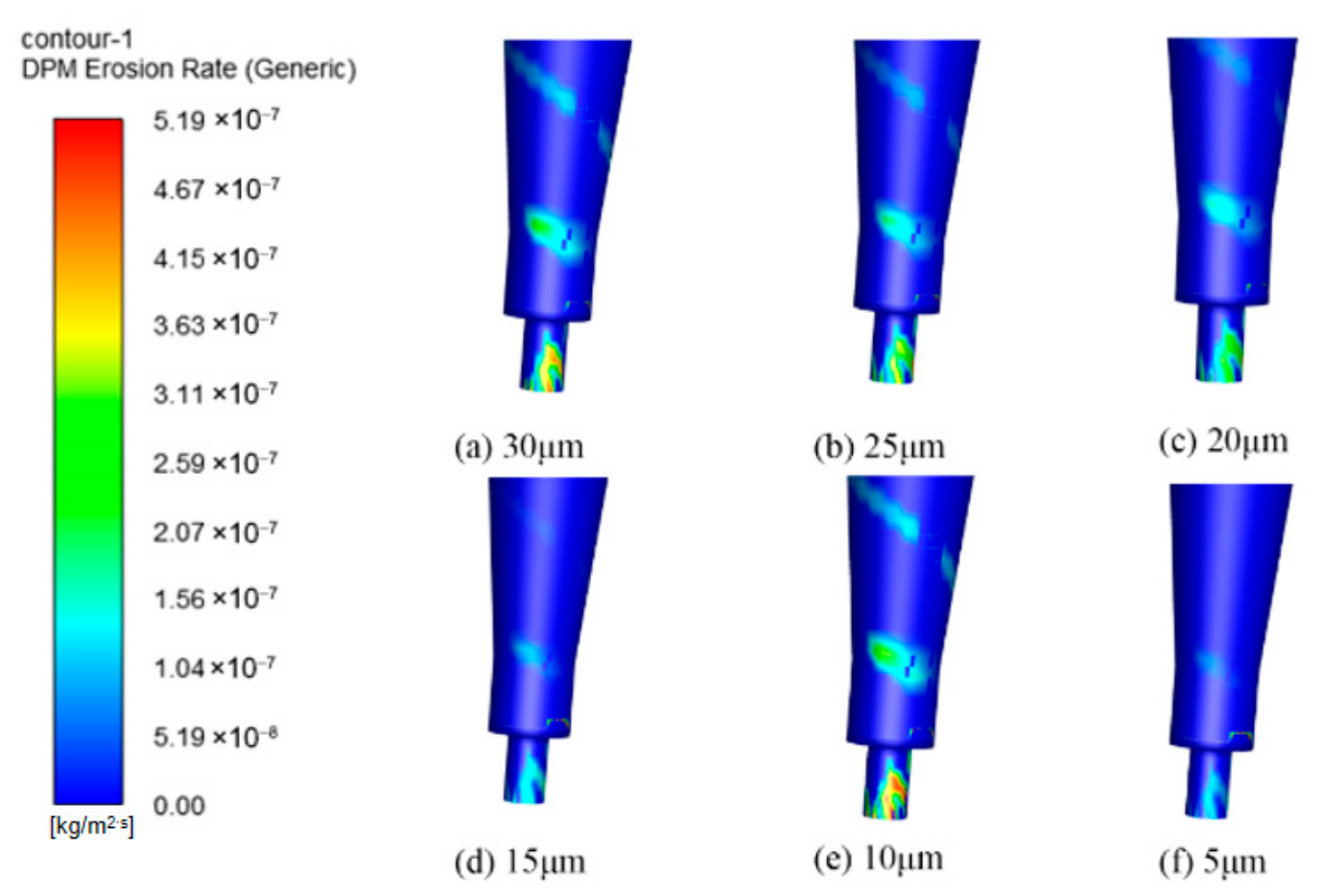
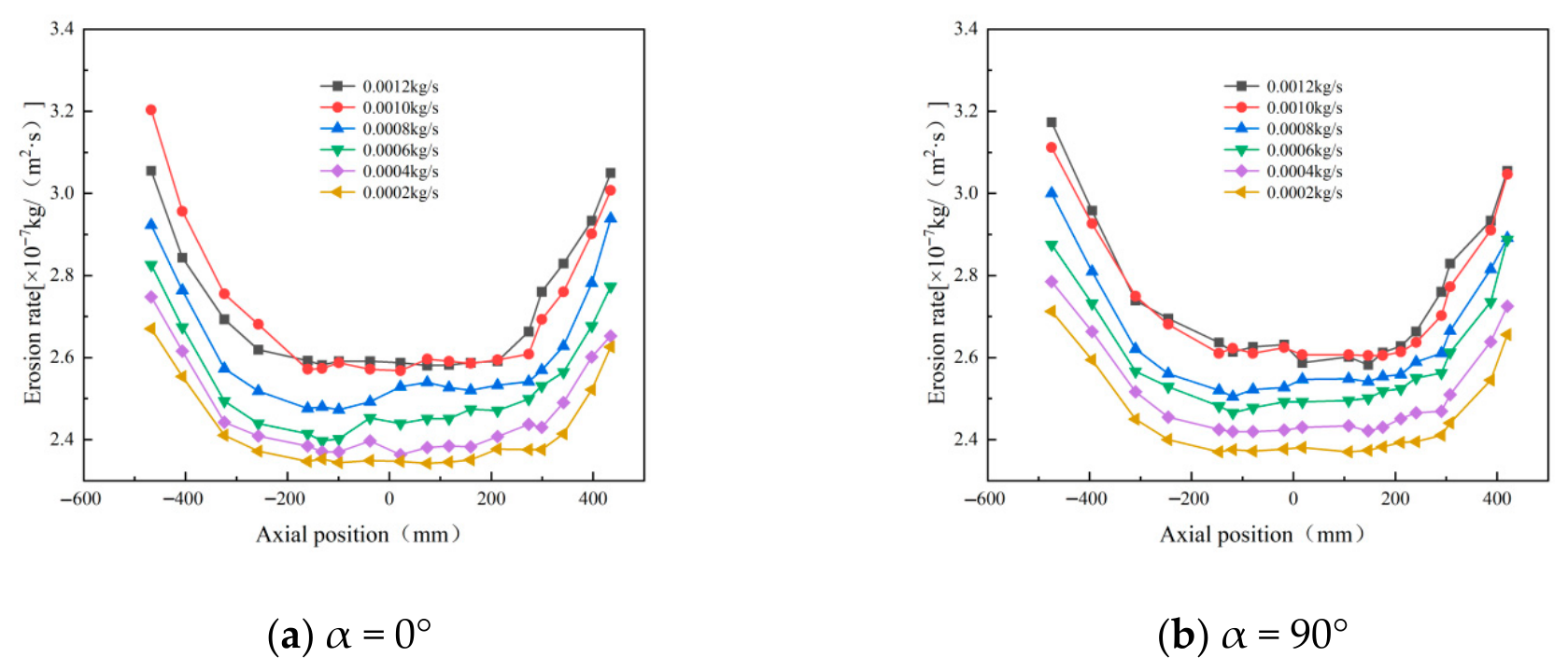
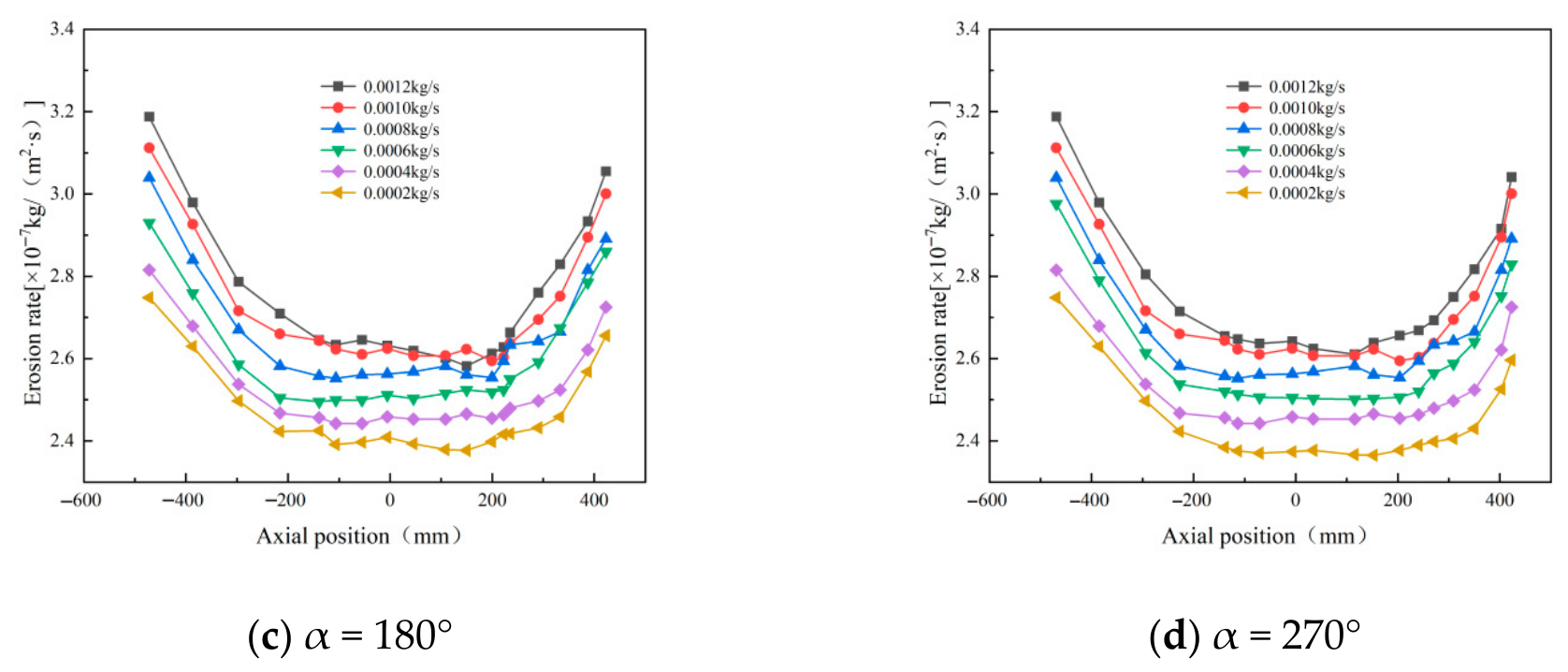
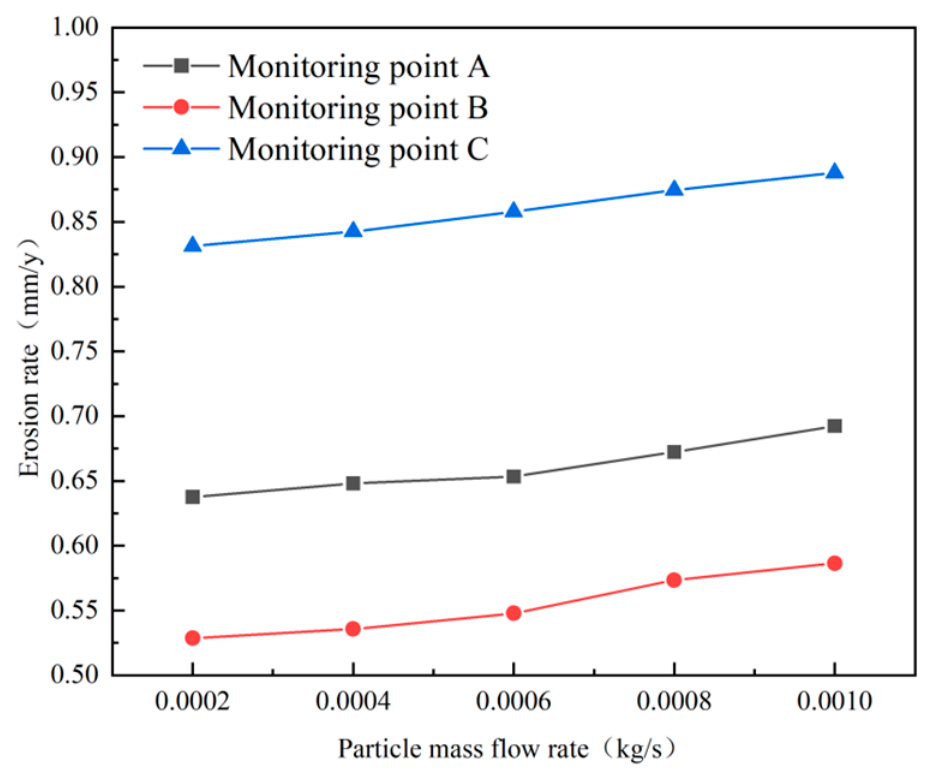
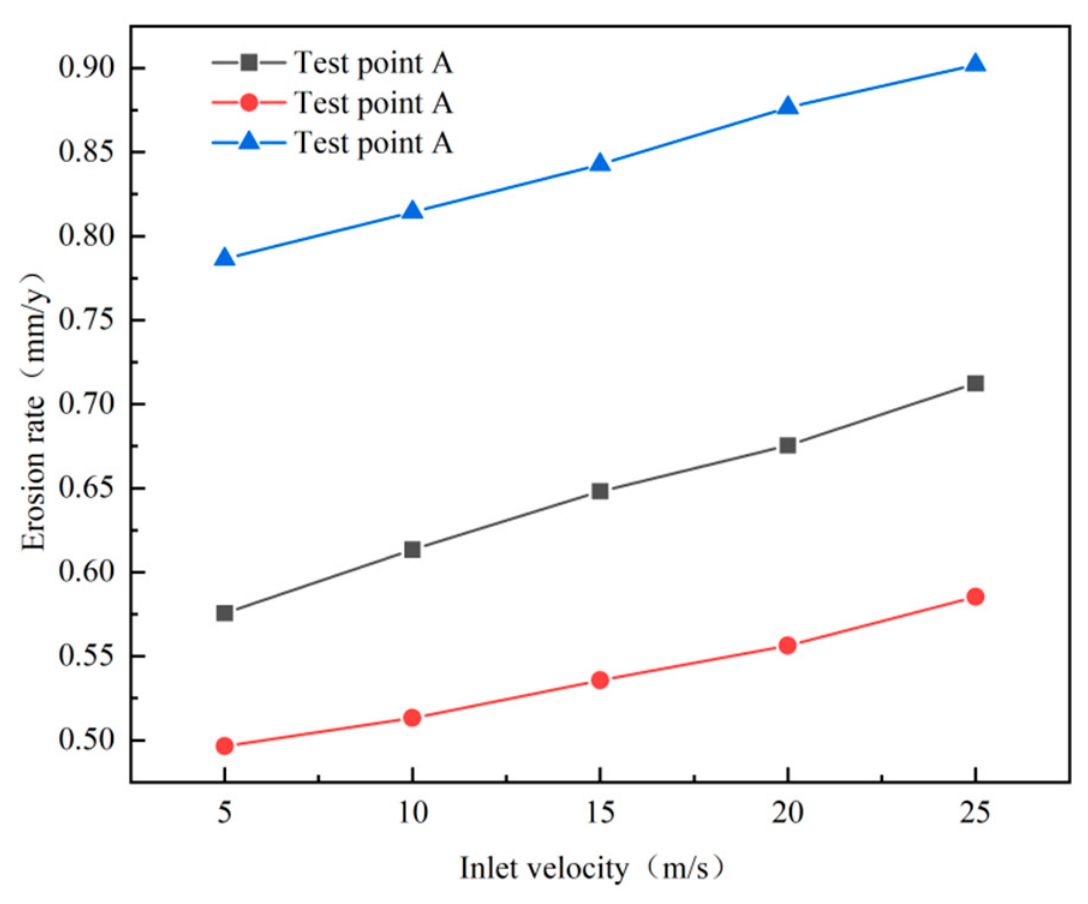
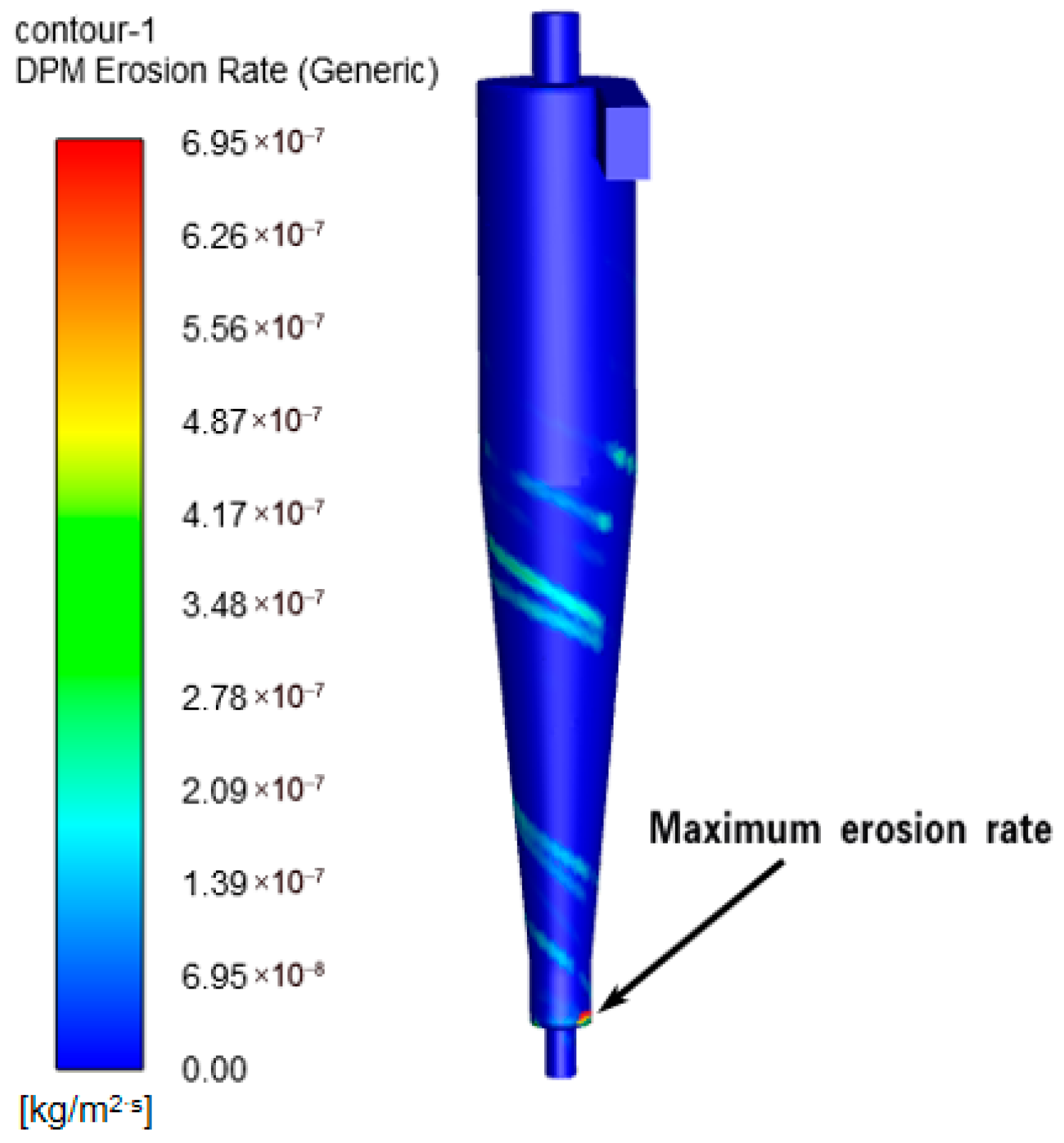
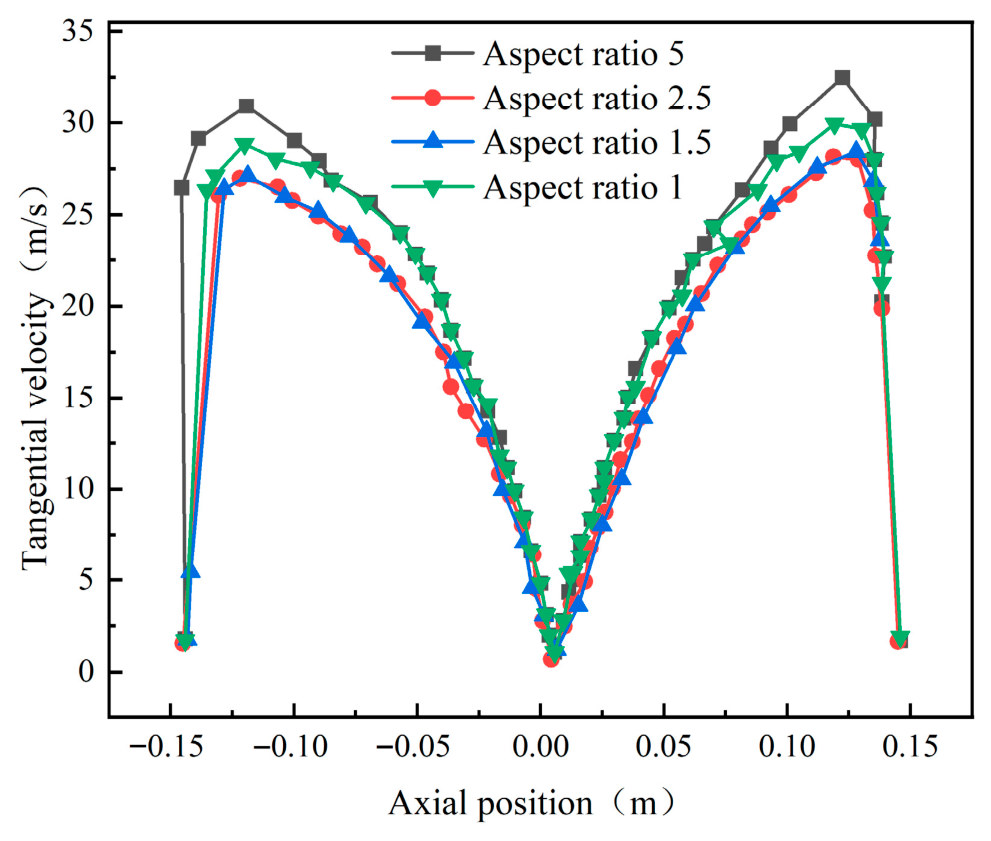
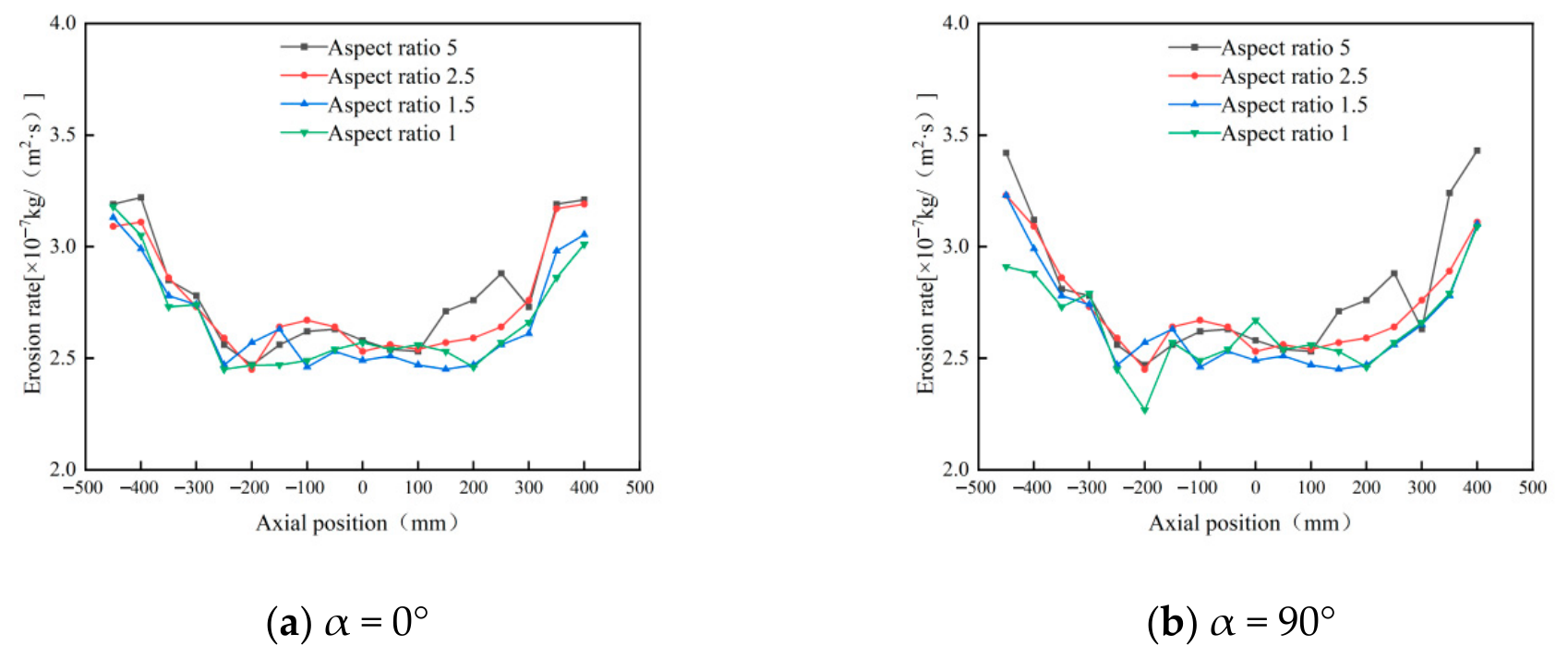
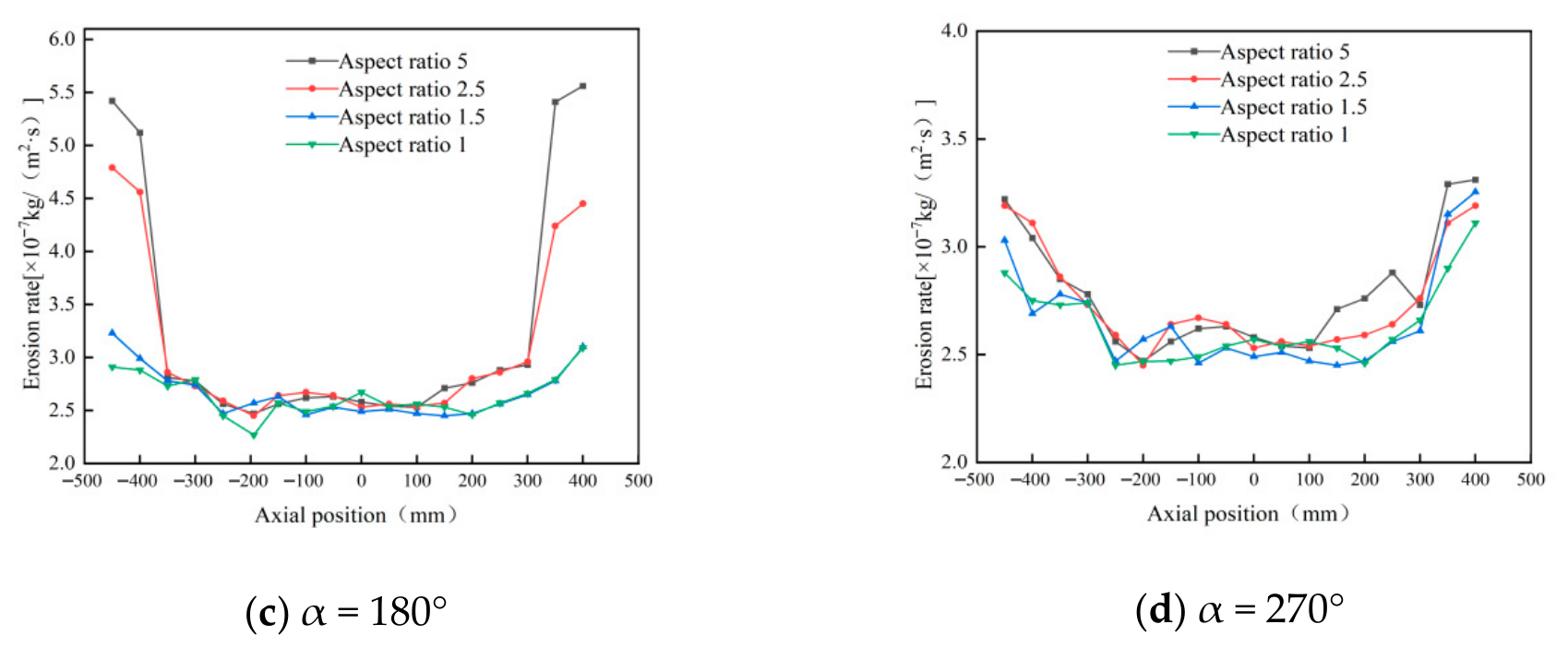
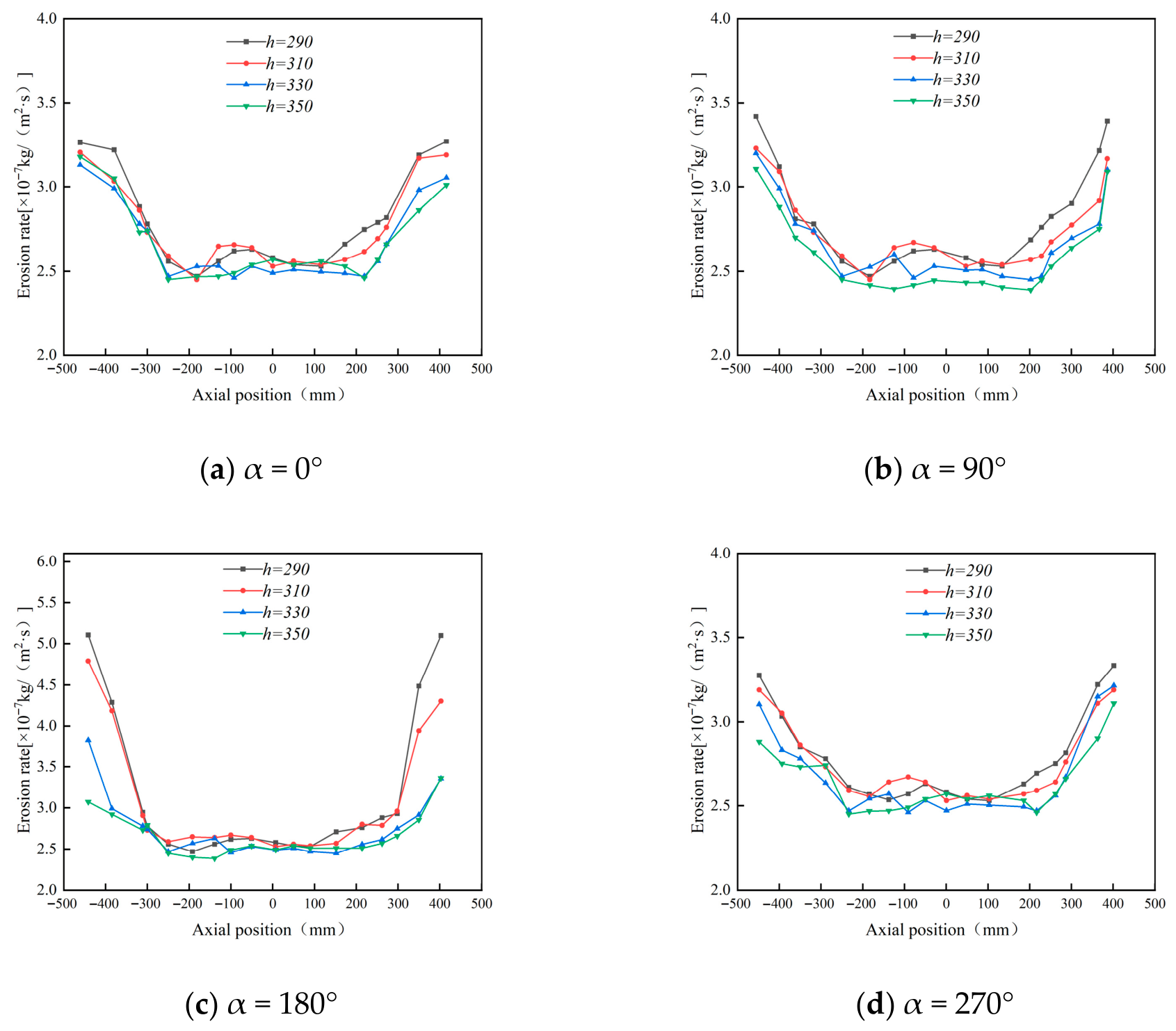
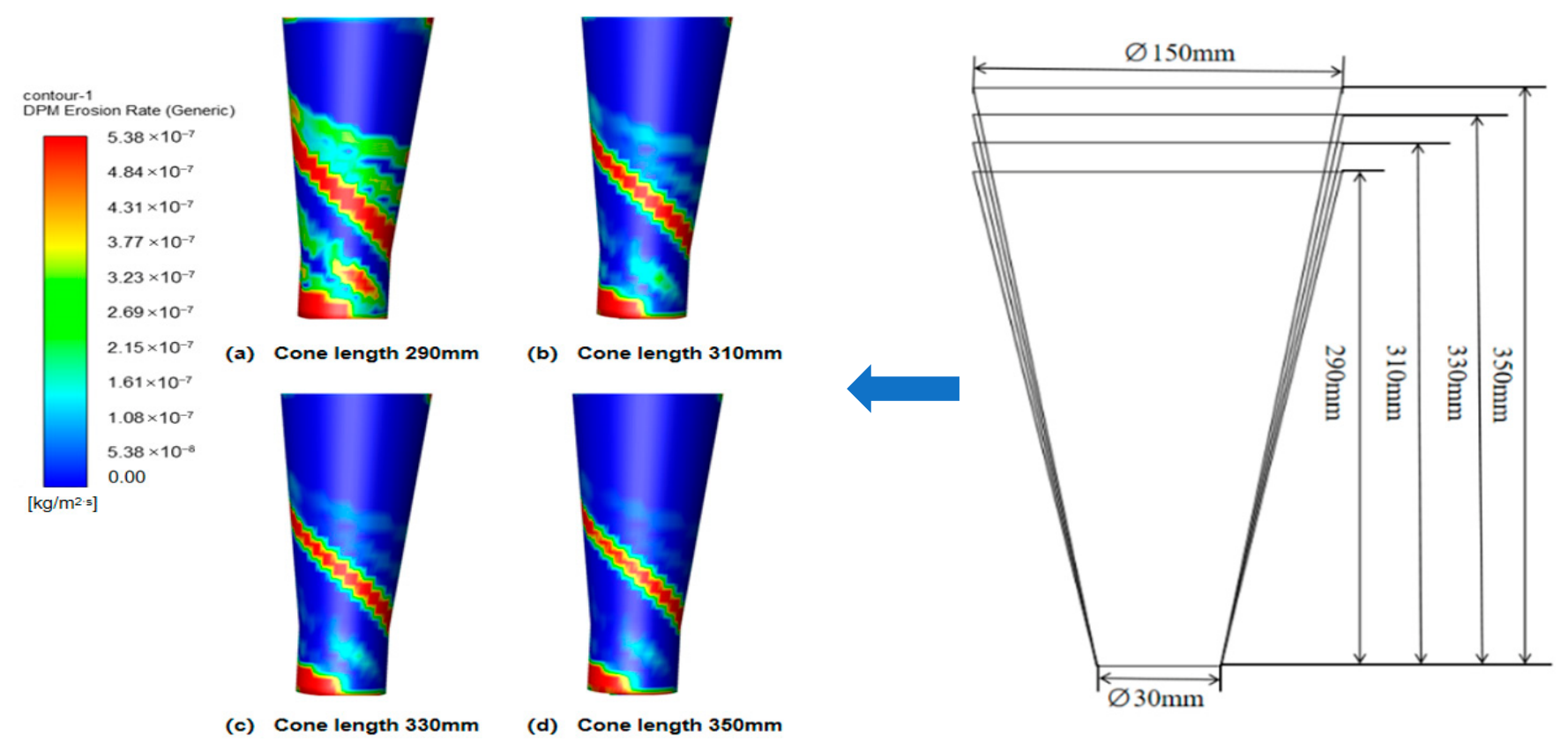
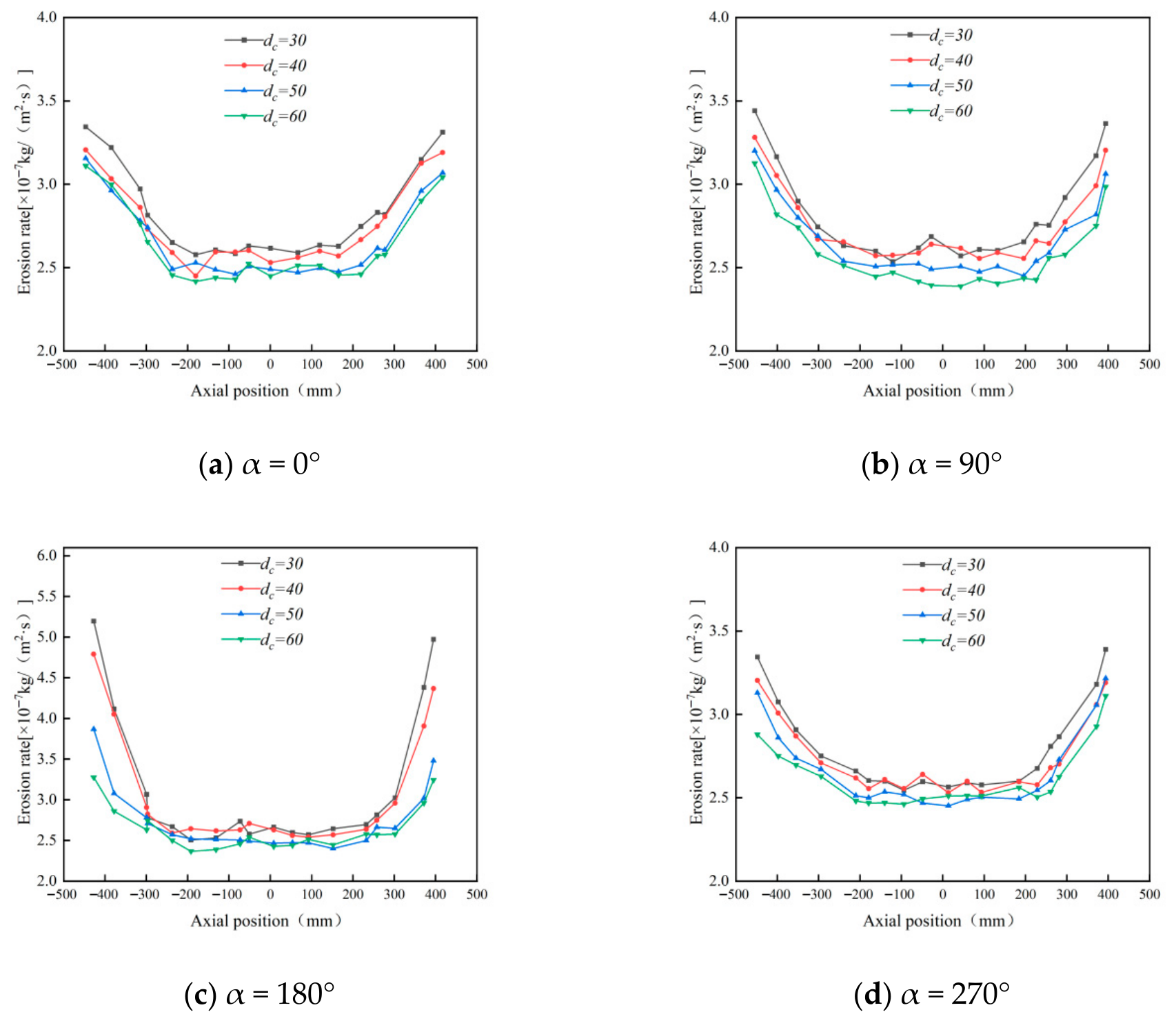
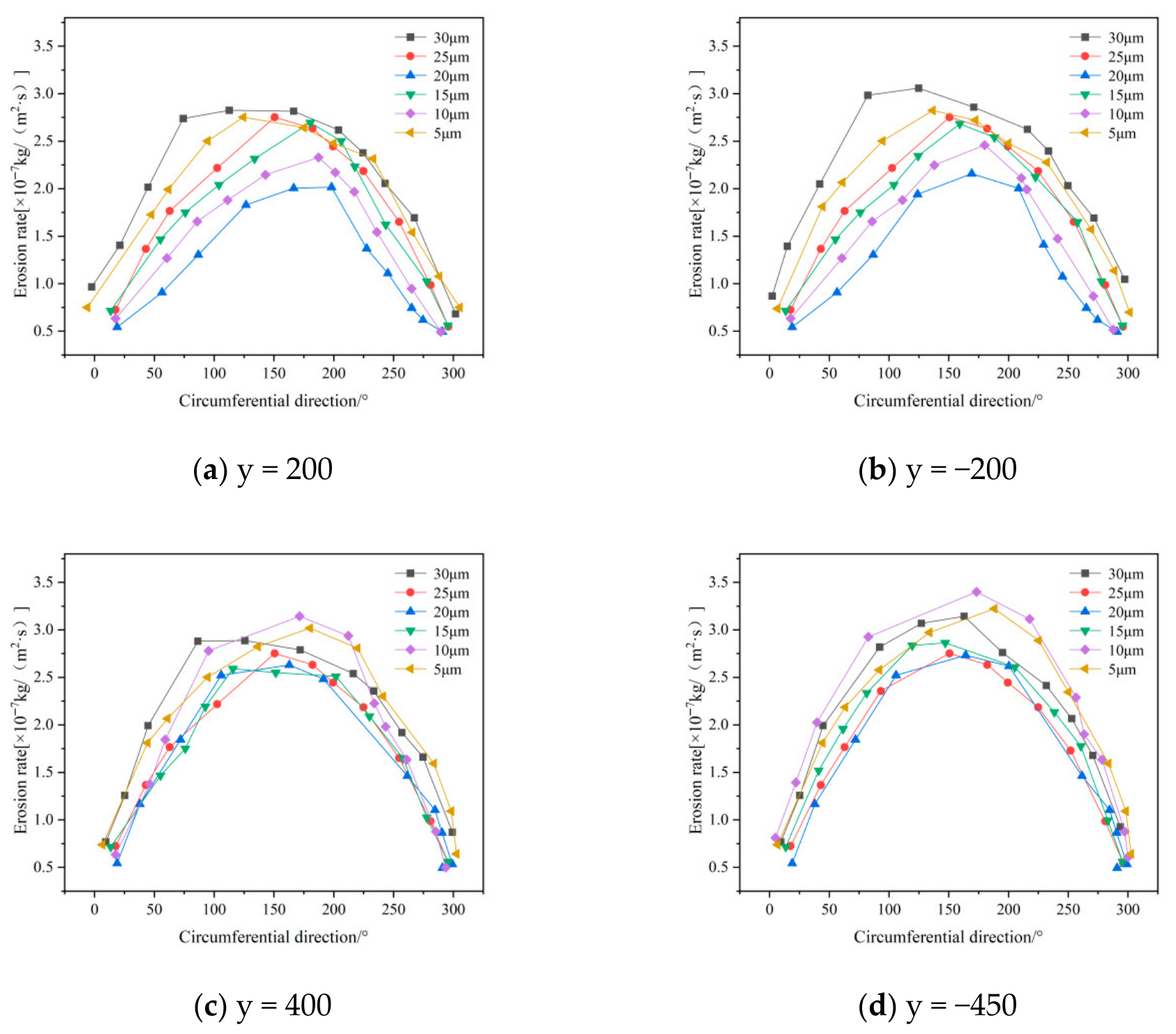
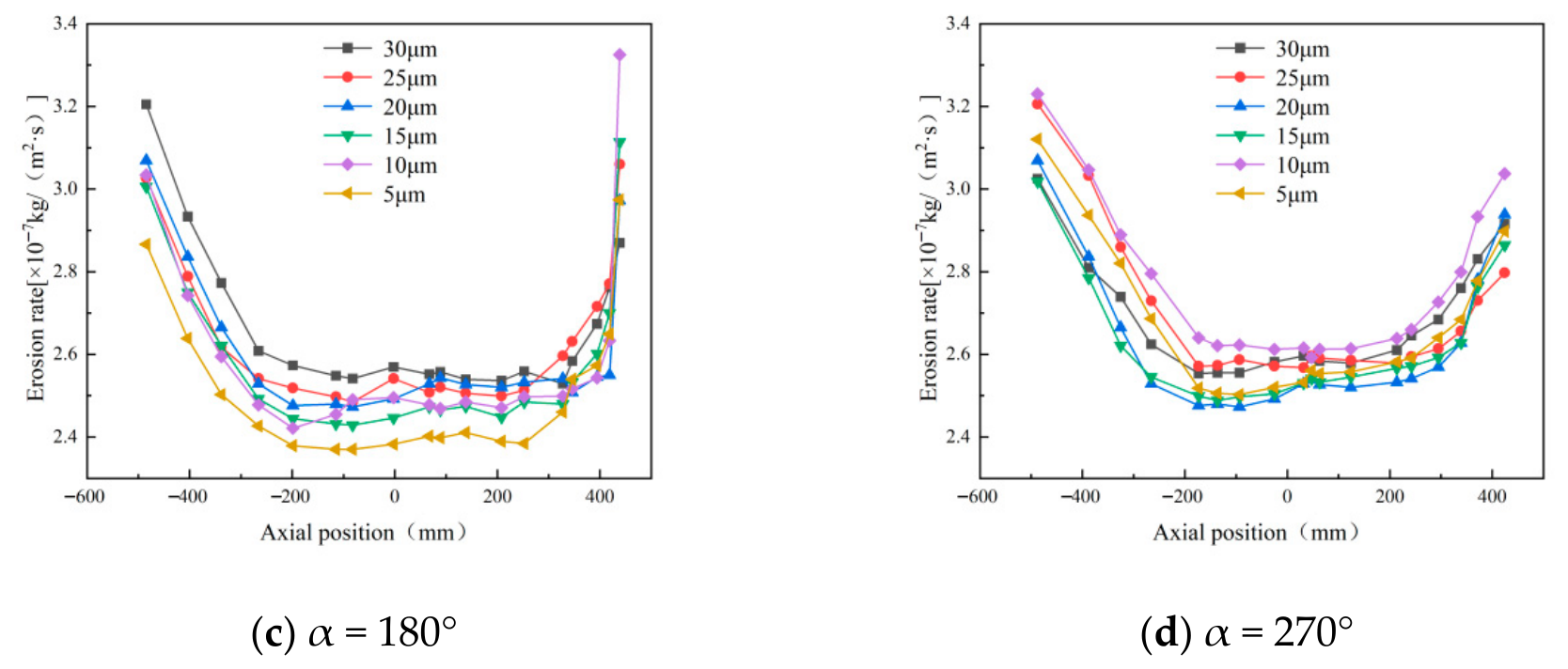
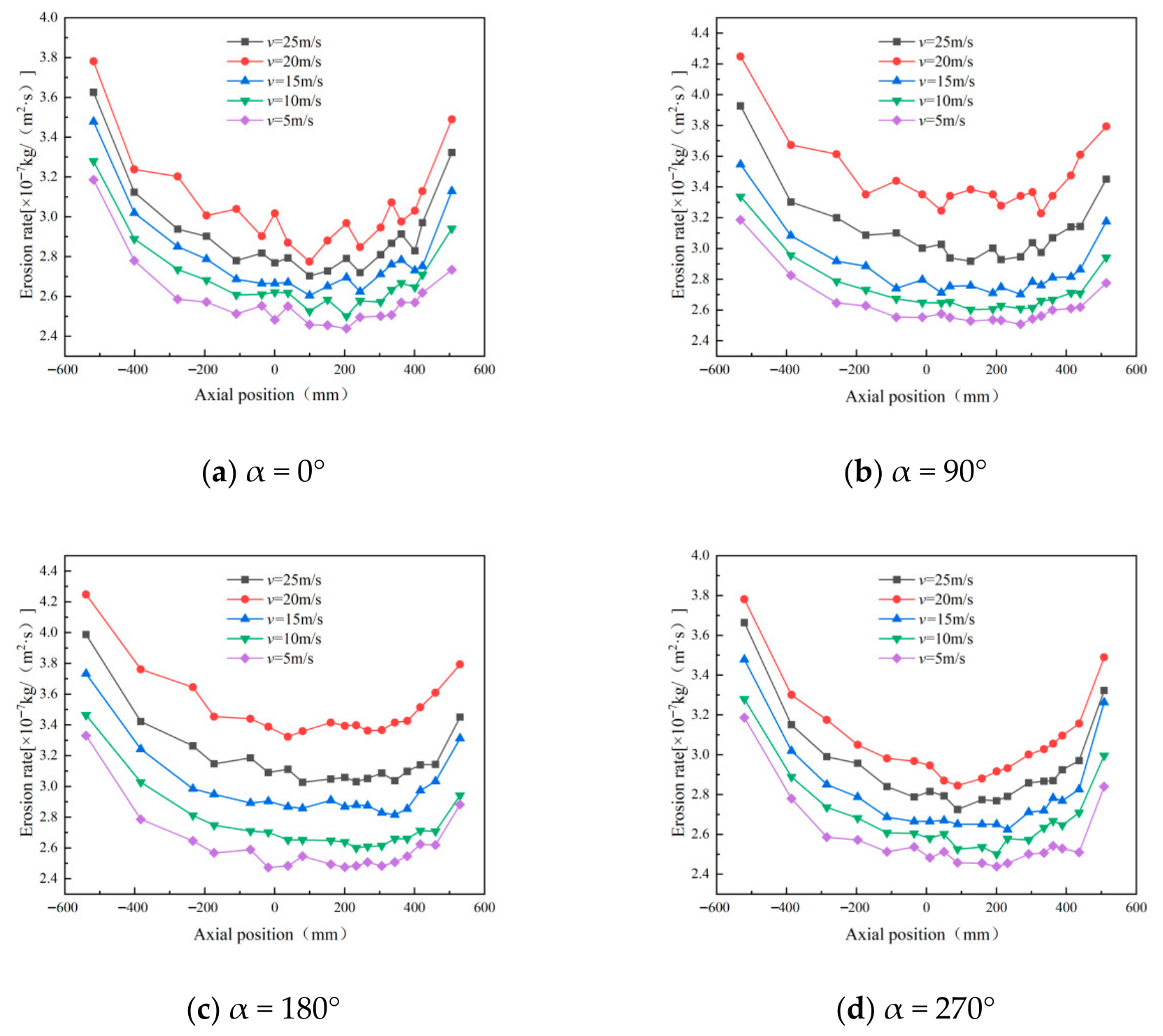
- The effects of structural parameters, particle properties, and operating conditions on wall erosion were systematically analyzed. The results showed that inlet aspect ratio, cylinder radius, cone length, dust discharge outlet diameter, particle size, particle concentration, inlet velocity, and operating pressure all affected the erosion intensity, while the inlet and dust discharge outlet remained the most vulnerable regions.
- (3)
- Significance analysis identified six key factors influencing the maximum erosion rate: inlet aspect ratio, cylinder radius, dust discharge outlet diameter, particle size, particle concentration, and inlet velocity. Based on the response surface optimization, the optimized structural parameters were determined as an inlet aspect ratio of 3, a cylinder radius of 75 mm, a cone length of 350 mm, a dust discharge outlet diameter of 45 mm, and an exhaust port diameter of 50 mm.
- (4)
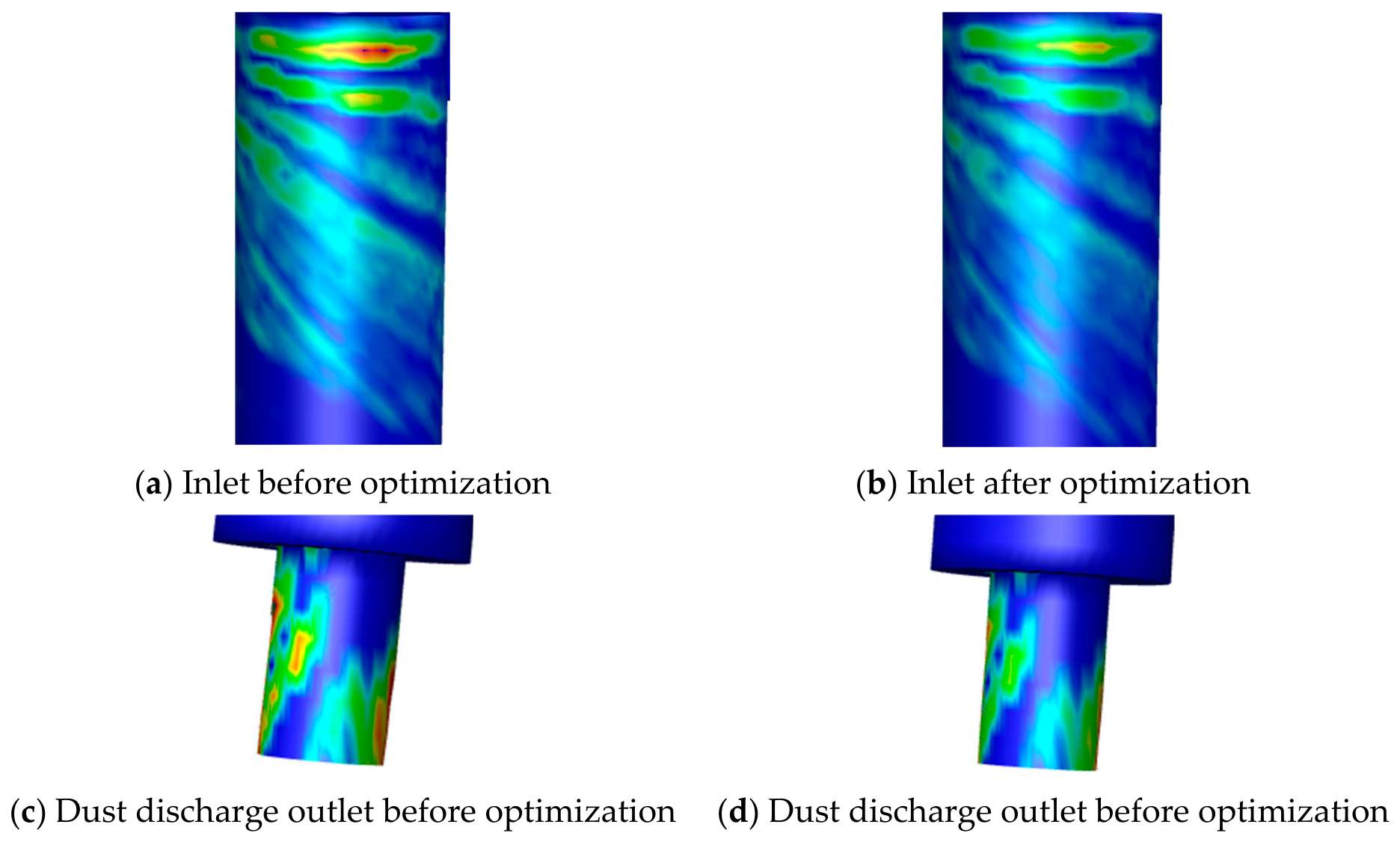
- Compared with the original geometry, the optimized desander reduced the maximum erosion rate from 5.34 × 10⁻⁷ to 4.25 × 10⁻⁷ kg/(m2·s) at the inlet and from 5.22 × 10⁻⁷ to 4.08 × 10⁻⁷ kg/(m2·s) at the dust discharge outlet, corresponding to reductions of 20.4% and 21.8%, respectively.
- (5)
- Local wall thickening at the inlet and dust discharge outlet was found to be beneficial for service-life improvement. Based on the calculated wall-thinning rate, the estimated service life of the desander could be extended by approximately 1.15 years.
- (6)
- A bionic-rib protection design was further evaluated. Under the same numerical operating conditions, the maximum erosion rate decreased to 2.23 × 10⁻⁷ kg/(m2·s), corresponding to a 58% reduction compared with the original structure. This indicates that combining geometry optimization with local structural protection is a promising strategy for improving the erosion resistance and service reliability of shale-gas wellhead cyclone desanders.
Author Contributions
Funding
Data Availability Statement
Conflicts of Interest
References
- Montagna, A.F.; Cafaro, D.C.; Grossmann, I.E. Surface facility optimization for combined shale oil and gas development strategies. Optim. Eng. 2023, 24, 2321–2355. [Google Scholar] [CrossRef]
- Song, B.; Zhang, T.; Chang, W. Study of Erosion Behavior of Shale-Gas Gathering Pipeline Elbow Based on Fluid–Solid Coupling. J. Pipeline Syst. Eng. Pract. 2025, 16, 04024054. [Google Scholar] [CrossRef]
- Xie, X. Research on Optimization of Surface Process Flow for Shale Gas Platforms. Oil-Gasfield Surf. Eng. 2024, 43, 30–35. [Google Scholar]
- Ii, K. Performance of Dust Removal Devices; China Machine Press: Beijing, China, 1981. [Google Scholar]
- Sproull, W.T. Air Pollution and Its Control; Exposition Press: New York, NY, USA, 1970. [Google Scholar]
- Leith, D.; Licht, W. The collection efficiency of cyclone type particle collectors—A new theoretical approach. AIChE Symp. Ser. 1972, 126, 196–206. [Google Scholar]
- Dietz, P.W. Collection efficiency of cyclone separator. AIChE J. 1981, 27, 888–892. [Google Scholar] [CrossRef]
- Niu, H.; Qiu, L.; Yang, J. Effect of cylinder diameter on the performance of cyclone separator and its flow field mechanism. J. Chem. Ind. Eng. 2025, 76, 2367–2376. [Google Scholar]
- Liu, B. Numerical simulation and experimental study on internal and external characteristics of novel Hydrocyclones. Heat Mass Transf. 2020, 56, 1875–1887. [Google Scholar]
- Misiulia, D. High-efficiency industrial cyclone separator: A CFD study. Powder Technol. 2020, 364, 943–953. [Google Scholar] [CrossRef]
- De Sa da Silva, D.P.; Morimoto, M.G. Effect of Operational and Geometric Variables in Hydrocyclones to Improve Separation Efficiency and Reduce Energy Consumption: A Review and New Insights. Miner. Process. Extr. Metall. Rev. 2026, 47, 39–70. [Google Scholar] [CrossRef]
- Pan, T. Numerical Simulation Study of Cyclone Separators Based on CFD Technology. Sino-Glob. Energy 2023, 28, 73–78. [Google Scholar]
- Liu, F.; Qi, Z. Reliability Analysis of CFD Technology Application in Internal Flow Fields of Cyclone Separators. Sci. Technol. Inf. 2014, 12, 92–93. [Google Scholar]
- Salas, V.F.; Pascual, M.G. Use of the fatigue index to study rolling contact wear. Wear 2019, 436–437, 203036. [Google Scholar] [CrossRef]
- Eman, Y.; Ling, Z.; El Emam, M.A. CFD–DEM analysis of erosion in 90° elbow pipe induced by different particle shapes. Powder Technol. 2025, 466, 121453. [Google Scholar] [CrossRef]
- Basan, R.; Marohnić, T. Multiaxial Fatigue Life Calculation Model for Engineering Components in Rolling-Sliding Contact. MATEC Web Conf. 2018, 188, 02016. [Google Scholar] [CrossRef][Green Version]
- Islam, M.A.; Alam, T.; Farhat, Z.N. Effect of microstructure on the erosion behavior of carbon steel. Wear 2015, 332, 1080–1089. [Google Scholar] [CrossRef]
- Abreu, M.; Fahlkrans, J.; Elfsberg, J. Attenuation of cavitation impact load of engine coolants and its effects on cracking mechanisms. Tribol. Trans. 2025, 12, 2582042. [Google Scholar] [CrossRef]
- Hua, C.; Wang, S. Simulation study on gas-liquid-solid multiphase flow characteristics and erosion mechanism in a natural gas bend. Particuology 2026, 108, 143–155. [Google Scholar]
- Zhou, H.; Ma, H.; Zhao, H. Experimental Study on the Erosion–Corrosion Synergism of Elbow in the Case of Liquid–Solid Swirling Flow. J. Mater. Eng. Perform. 2025, 34, 968–986. [Google Scholar] [CrossRef]
- An, W.; Yang, S.; Wen, Z. A Review: Factors Controlling Erosion Resistance in Metals Prioritizing the Influence of Material Mechanics and the Related Erosion Models. Metals 2025, 15, 1177. [Google Scholar] [CrossRef]
- Liu, Y.; Hu, X. Numerical simulation of bedform evolution on granular sediment beds via Eulerian–Lagrangian approach in low-flow-rate horizontal duct transport. Int. J. Multiph. Flow 2026, 194, 105463. [Google Scholar] [CrossRef]
- Messa, G.V.; Yang, Q. Computational Fluid Dynamics Modelling of Liquid–Solid Slurry Flows in Pipelines: State-of-the-Art and Future Perspectives. Processes 2021, 9, 1566. [Google Scholar] [CrossRef]
- Jin, H.; Liao, Z. Study on the Erosion Characteristics of Non-spherical Particles in Liquid-solid Two-phase Flow. J. Appl. Fluid Mech. 2023, 16, 1640–1653. [Google Scholar]
- Mahmoudi, O.; Shiri, Y. Impact of solid particle geometry, size, and intensity, coupled with fluid velocity, on erosion dynamics in elbow conduits. Sci. Rep. 2025, 15, 30880. [Google Scholar] [CrossRef]
- Zhang, J.; Yi, H.; Huang, Z. Erosion mechanism and sensitivity parameter analysis of natural gas bending pipeline. J. Press. Vessel Technol. 2019, 141, 031701. [Google Scholar] [CrossRef]
- Sauer, F.; Yu, H.; Ma, K. Trajectory-Based Flow Feature Tracking in Joint Particle/Volume Datasets. IEEE Trans. Vis. Comput. Graph. 2014, 20, 2565–2574. [Google Scholar] [CrossRef]
- Zhang, J.; Hao, X. Effect of local erosion on flow pattern and particle self-rotation in a cyclone separator. Adv. Powder Technol. 2025, 36, 104949. [Google Scholar] [CrossRef]
- Lu, X.; Chang, Z.; Zhao, L. Analysis of Solid Particle Erosion Effects at Bends in Large-Diameter Offshore Gas Pipelines. J. Mech. Des. 2019, 141, 031701. [Google Scholar]
- Wang, J. Numerical Simulation of Erosion Wear in Typical Pipeline Fittings of Gathering and Transportation Pipelines. Master’s Thesis, Liaoning Petrochemical University, Fushun, China, 2019. [Google Scholar]
- Zhang, L.; Fan, J.; Gao, F. Influence of Local Wear on the Inner Flow Field and Performance of Cyclone Separator Cones. J. Chem. Eng. Chin. Univ. 2023, 37, 717–728. [Google Scholar]
- Qian, Y.; Guo, X.; Qiu, T. Numerical Simulation Study on Gas-Solid Flow Characteristics in Cyclone Separators. Light Met. 2024, 1, 18–24,34. [Google Scholar]
- Dong, R. Numerical Simulation of Flow Field and Performance Testing of High-Pressure Cyclone Separators. Master’s Thesis, China University of Petroleum, Beijing, China, 2011. [Google Scholar]
- Dong, J.; Chen, G.; Zhang, P. Separation Performance Enhancement of Gas-Solid Cyclone Separators by Flow Control and Coupling Physical Fields. Sep. Purif. Rev. 2026, 55, 109–124. [Google Scholar] [CrossRef]
- Shakeel, M.R.; Mokheimer, E.M.A. Swirl flow in annular geometry with varying cross-section. Eng. Appl. Comput. Fluid Mech. 2022, 16, 1154–1172. [Google Scholar] [CrossRef]
- Gu, L. Study on Factors Affecting Wall Wear of Swirl Sand Separators in Gas-Solid Two-Phase Flow. Master’s Thesis, Xi’an Shiyou University, Xi’an, China, 2016. [Google Scholar]
- Wang, H. Numerical modeling and analysis of particle-fluid flow and wall erosion in centrifugal slurry pumps under different solid concentrations. Powder Technol. 2022, 410, 117861. [Google Scholar] [CrossRef]
- Zhang, R. Erosion Study of Counterflow Energy Dissipation Devices in High-Pressure Desanders. Master’s Thesis, Xi’an Shiyou University, Xi’an, China, 2023. [Google Scholar]
- Xiong, Z. A Study on the Erosion Mechanism of an Axial Cyclone Separator for Gas Purification. Separations 2022, 9, 409. [Google Scholar] [CrossRef]
- Zhang, L. Effect of local erosion on the flow field and separation performance of the cyclone separator. Powder Technol. 2023, 413, 118007. [Google Scholar] [CrossRef]
















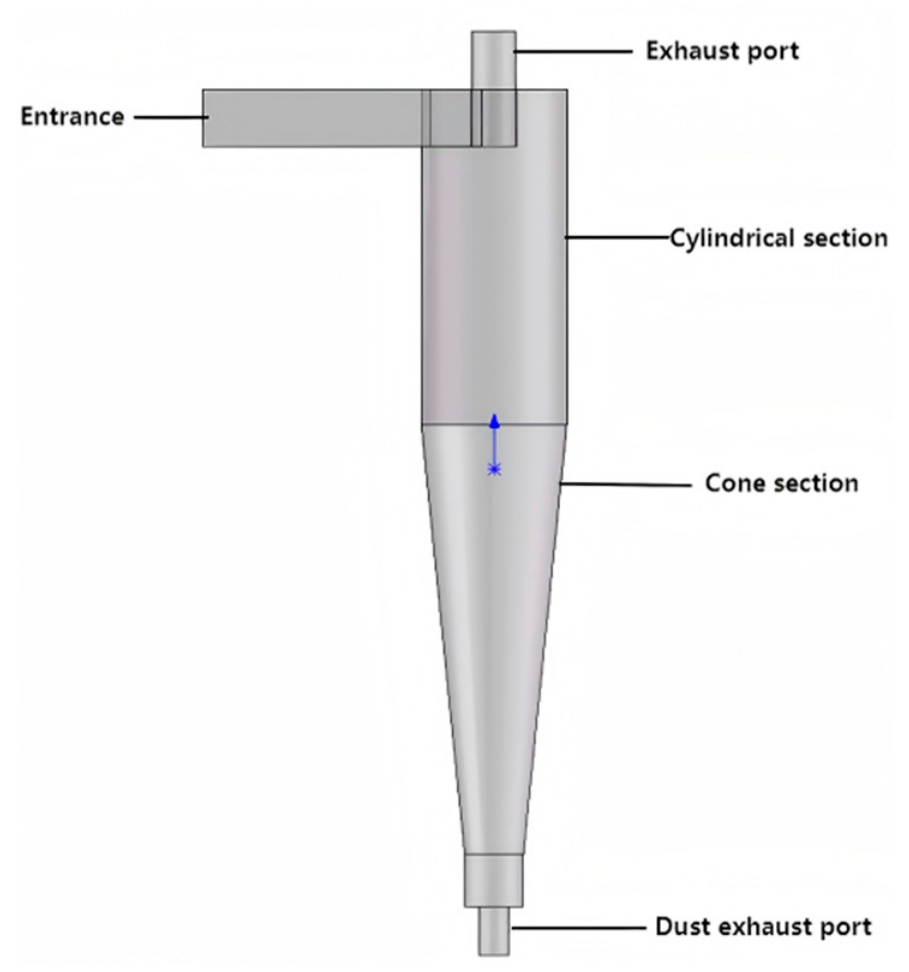
| Structure Name | Dimension (mm) | Structure Name | Dimension (mm) |
|---|---|---|---|
| Column Segment Diameter | 150 | Small Column Segment Diameter | 60 |
| Column Segment Length | 350 | Small Column Segment Length | 55 |
| Exhaust Port Diameter | 45 | Pipe Segment Height | 450 |
| Insertion Depth | 60 | Dust Port Diameter | 30 |
| Inlet Dimensions | (60, 38.82) |
| Component Name | Mole Fraction (%) |
|---|---|
| C1 | 98.02 |
| C2 | 0.2202 |
| N2 | 1.759 |
| Entrance Aspect Ratio (a/b) | a | b | Hydraulic Diameter |
|---|---|---|---|
| 1 | 48 mm | 48 mm | 48 |
| 1.5 | 60 mm | 38.82 mm | 47 |
| 2.5 | 76 mm | 30 mm | 43 |
| 5 | 105 mm | 21 mm | 35 |
| Factor | Sum of Squares | Degrees of Freedom | Mean Square | F | p |
|---|---|---|---|---|---|
| Inlet velocity | 100.00 | 2 | 50.00 | 25.00 | 0.001 |
| Entrance Aspect Ratio | 50.00 | 2 | 25.00 | 12.50 | 0.002 |
| Particle Concentration | 30.00 | 2 | 15.00 | 7.50 | 0.005 |
| Cylinder Diameter | 20.00 | 2 | 10.00 | 5.00 | 0.010 |
| Dust Outlet Diameter | 15.00 | 2 | 7.50 | 3.75 | 0.020 |
| Particle Size | 10.00 | 2 | 5.00 | 2.50 | 0.050 |
| Operating Pressure | 8.00 | 2 | 4.00 | 2.00 | 0.060 |
| Cone Diameter | 5.00 | 2 | 2.50 | 1.25 | 0.100 |
| Exhaust Port Diameter | 0.00 | 2 | 0.00 | 0.00 | 1.000 |
| Factor | Factor Name | Factor Unit | Level 1 | Level 2 | Level 3 |
|---|---|---|---|---|---|
| A | Dust Outlet Diameter | mm | 30 | 45 | 60 |
| B | Particle Size | μm | 5 | 7.5 | 10 |
| C | Inlet velocity | m/s | 5 | 15 | 25 |
| D | Cylinder Radius | mm | 60 | 75 | 90 |
| E | Entrance Aspect Ratio | — | 1 | 3 | 5 |
| F | Particle Concentration | Kg/s | 0.0002 | 0.0007 | 0.0012 |
| Serial Number | Factor: A | Factor: B | Factor: C | Factor: D | Factor: E | Factor: F | Response Value |
|---|---|---|---|---|---|---|---|
| Dust Outlet Diameter (mm) | Particle Size (μm) | Inlet Velocity (m/s) | Cylinder Radius (mm) | Entrance Aspect Ratio | Particle Concentration (Kg/s) | Erosion Rate 10−7 kg/ (m2·s) | |
| 1 | 45 | 7.5 | 25 | 60 | 3 | 0.0012 | 6.99 |
| 2 | 45 | 7.5 | 15 | 75 | 3 | 0.0007 | 2.12 |
| 3 | 30 | 7.5 | 15 | 90 | 5 | 0.0007 | 5.43 |
| 4 | 60 | 7.5 | 15 | 90 | 1 | 0.0007 | 4.39 |
| 5 | 45 | 7.5 | 25 | 60 | 3 | 0.0002 | 6.29 |
| 6 | 30 | 7.5 | 5 | 75 | 3 | 0.0002 | 4.28 |
| 7 | 45 | 10 | 25 | 75 | 1 | 0.0007 | 5.43 |
| 8 | 45 | 7.5 | 15 | 75 | 3 | 0.0007 | 2.15 |
| 9 | 60 | 5 | 15 | 90 | 3 | 0.0007 | 5.49 |
| 10 | 45 | 10 | 25 | 75 | 5 | 0.0007 | 6.41 |
| 11 | 30 | 10 | 15 | 90 | 3 | 0.0007 | 4.95 |
| 12 | 30 | 7.5 | 15 | 60 | 1 | 0.0007 | 3.89 |
| 13 | 30 | 10 | 15 | 60 | 3 | 0.0007 | 4.99 |
| 14 | 45 | 5 | 25 | 75 | 5 | 0.0007 | 6.18 |
| 15 | 45 | 7.5 | 5 | 60 | 3 | 0.0002 | 2.81 |
| 16 | 30 | 7.5 | 25 | 75 | 3 | 0.0012 | 6.73 |
| 17 | 45 | 5 | 15 | 75 | 1 | 0.0012 | 5.39 |
| 18 | 60 | 7.5 | 15 | 90 | 5 | 0.0007 | 5 |
| 19 | 30 | 7.5 | 25 | 75 | 3 | 0.0002 | 5.48 |
| 20 | 45 | 7.5 | 15 | 75 | 3 | 0.0007 | 2.31 |
| 21 | 60 | 5 | 15 | 60 | 3 | 0.0007 | 4.37 |
| 22 | 45 | 7.5 | 5 | 90 | 3 | 0.0012 | 6.04 |
| 23 | 30 | 7.5 | 15 | 90 | 1 | 0.0007 | 4.28 |
| 24 | 45 | 5 | 15 | 75 | 5 | 0.0012 | 5.85 |
| 25 | 60 | 10 | 15 | 90 | 3 | 0.0007 | 3.92 |
| 26 | 45 | 5 | 15 | 75 | 1 | 0.0002 | 4.01 |
| 27 | 30 | 5 | 15 | 90 | 3 | 0.0007 | 5.86 |
| 28 | 60 | 10 | 15 | 60 | 3 | 0.0007 | 5.52 |
| 29 | 45 | 10 | 15 | 75 | 1 | 0.0002 | 4.76 |
| 30 | 45 | 5 | 15 | 75 | 5 | 0.0002 | 5.86 |
| 31 | 30 | 5 | 15 | 60 | 3 | 0.0007 | 3.7 |
| 32 | 45 | 7.5 | 15 | 75 | 3 | 0.0007 | 2.45 |
| 33 | 45 | 5 | 5 | 75 | 1 | 0.0007 | 3.96 |
| 34 | 60 | 7.5 | 5 | 75 | 3 | 0.0002 | 4.99 |
| 35 | 30 | 7.5 | 5 | 75 | 3 | 0.0012 | 4.9 |
| 36 | 60 | 7.5 | 15 | 60 | 1 | 0.0007 | 4.39 |
| 37 | 60 | 7.5 | 15 | 60 | 5 | 0.0007 | 4.98 |
| 38 | 45 | 7.5 | 15 | 75 | 3 | 0.0007 | 2.37 |
| 39 | 60 | 7.5 | 25 | 75 | 3 | 0.0002 | 5.6 |
| 40 | 45 | 10 | 15 | 75 | 5 | 0.0012 | 4.99 |
| 41 | 45 | 5 | 25 | 75 | 1 | 0.0007 | 4.55 |
| 42 | 60 | 7.5 | 5 | 75 | 3 | 0.0012 | 5.5 |
| 43 | 60 | 7.5 | 25 | 75 | 3 | 0.0012 | 5.89 |
| 44 | 45 | 7.5 | 25 | 90 | 3 | 0.0012 | 4.52 |
| 45 | 45 | 10 | 5 | 75 | 5 | 0.0007 | 5.23 |
| 46 | 45 | 7.5 | 15 | 75 | 3 | 0.0007 | 2.34 |
| 47 | 45 | 5 | 5 | 75 | 5 | 0.0007 | 4.55 |
| 48 | 45 | 10 | 15 | 75 | 5 | 0.0002 | 6.37 |
| 49 | 45 | 7.5 | 5 | 60 | 3 | 0.0012 | 3.22 |
| 50 | 45 | 10 | 5 | 75 | 1 | 0.0007 | 5.03 |
| 51 | 30 | 7.5 | 15 | 60 | 5 | 0.0007 | 4.54 |
| 52 | 45 | 7.5 | 5 | 90 | 3 | 0.0002 | 5.69 |
| 53 | 45 | 10 | 15 | 75 | 1 | 0.0012 | 5.17 |
| 54 | 45 | 7.5 | 25 | 90 | 3 | 0.0002 | 4.16 |
Disclaimer/Publisher’s Note: The statements, opinions and data contained in all publications are solely those of the individual author(s) and contributor(s) and not of MDPI and/or the editor(s). MDPI and/or the editor(s) disclaim responsibility for any injury to people or property resulting from any ideas, methods, instructions or products referred to in the content. |
© 2026 by the authors. Licensee MDPI, Basel, Switzerland. This article is an open access article distributed under the terms and conditions of the Creative Commons Attribution (CC BY) license.
Share and Cite
Huang, Q.; Zhang, C.; Zou, P.; Hu, J.; Hou, Z.; Jiao, H.; Tian, Y.; Huang, H.; Meng, J.; Long, X. Study on Erosion Patterns of Cyclone Desanders at Shale Gas Wellheads. Materials 2026, 19, 2094. https://doi.org/10.3390/ma19102094
Huang Q, Zhang C, Zou P, Hu J, Hou Z, Jiao H, Tian Y, Huang H, Meng J, Long X. Study on Erosion Patterns of Cyclone Desanders at Shale Gas Wellheads. Materials. 2026; 19(10):2094. https://doi.org/10.3390/ma19102094
Chicago/Turabian StyleHuang, Qian, Chi Zhang, Peng Zou, Jingxi Hu, Zhitao Hou, Hao Jiao, Yuan Tian, Huirong Huang, Jiang Meng, and Xueyuan Long. 2026. "Study on Erosion Patterns of Cyclone Desanders at Shale Gas Wellheads" Materials 19, no. 10: 2094. https://doi.org/10.3390/ma19102094
APA StyleHuang, Q., Zhang, C., Zou, P., Hu, J., Hou, Z., Jiao, H., Tian, Y., Huang, H., Meng, J., & Long, X. (2026). Study on Erosion Patterns of Cyclone Desanders at Shale Gas Wellheads. Materials, 19(10), 2094. https://doi.org/10.3390/ma19102094