Dislocation-Based CPFEM and Phase-Field Study on the Stress Corrosion Cracking of Randomly Textured Magnesium Alloys



Abstract
1. Introduction
2. Methodology
2.1. Crystal Plasticity Model at Finite Strains
2.1.1. Kinematics and Constitutive Relationship
2.1.2. Dislocation Density-Based Model
2.2. Anodic Dissolution Phase-Field
2.3. Mass Transfer Field
2.4. RVE Configuration and Boundary Conditions
3. Results
3.1. Micromechanical State After Pre-Straining
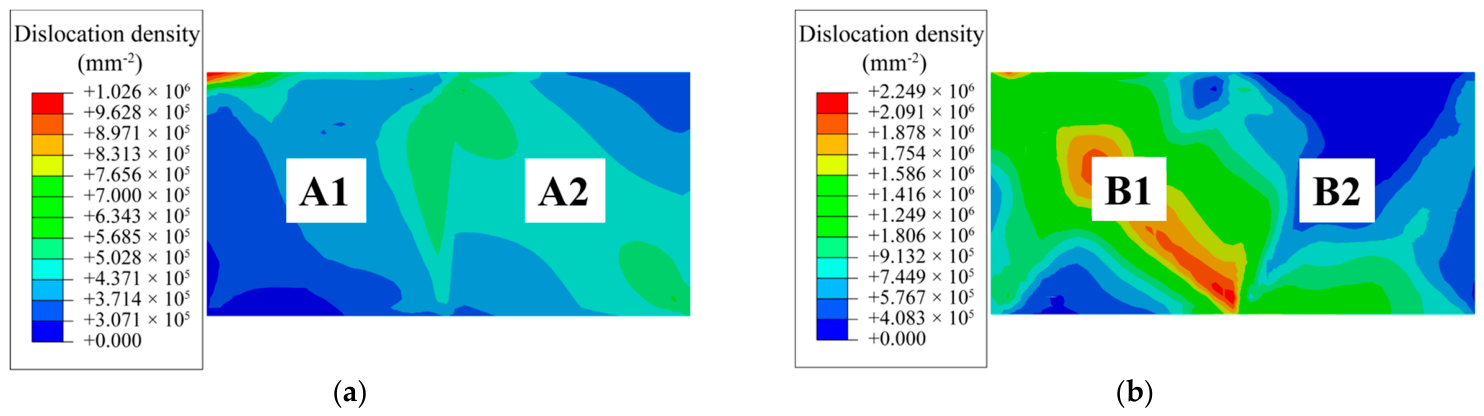
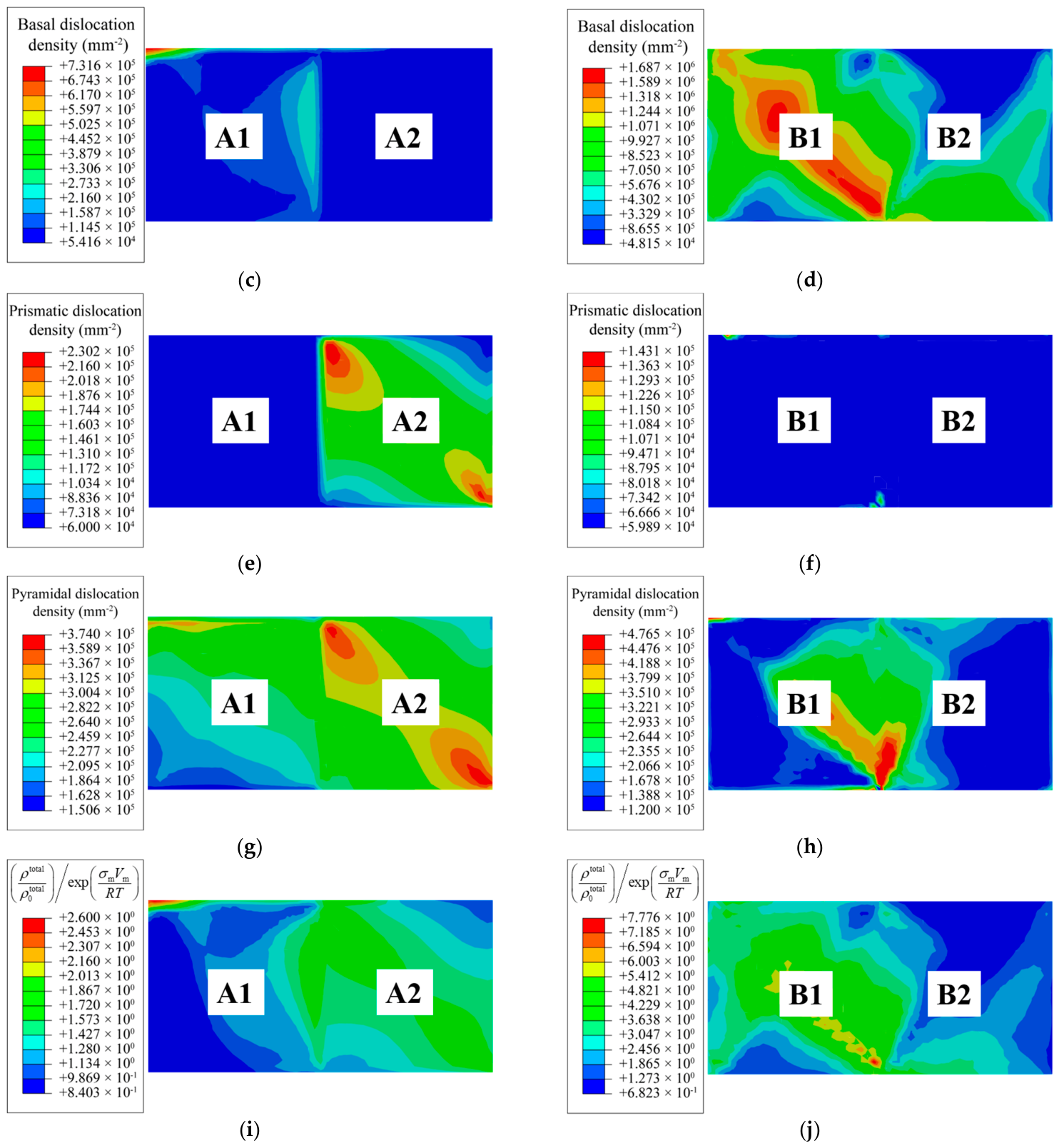
3.2. Dislocation Heterogeneity and Transgranular Corrosion Kinetics
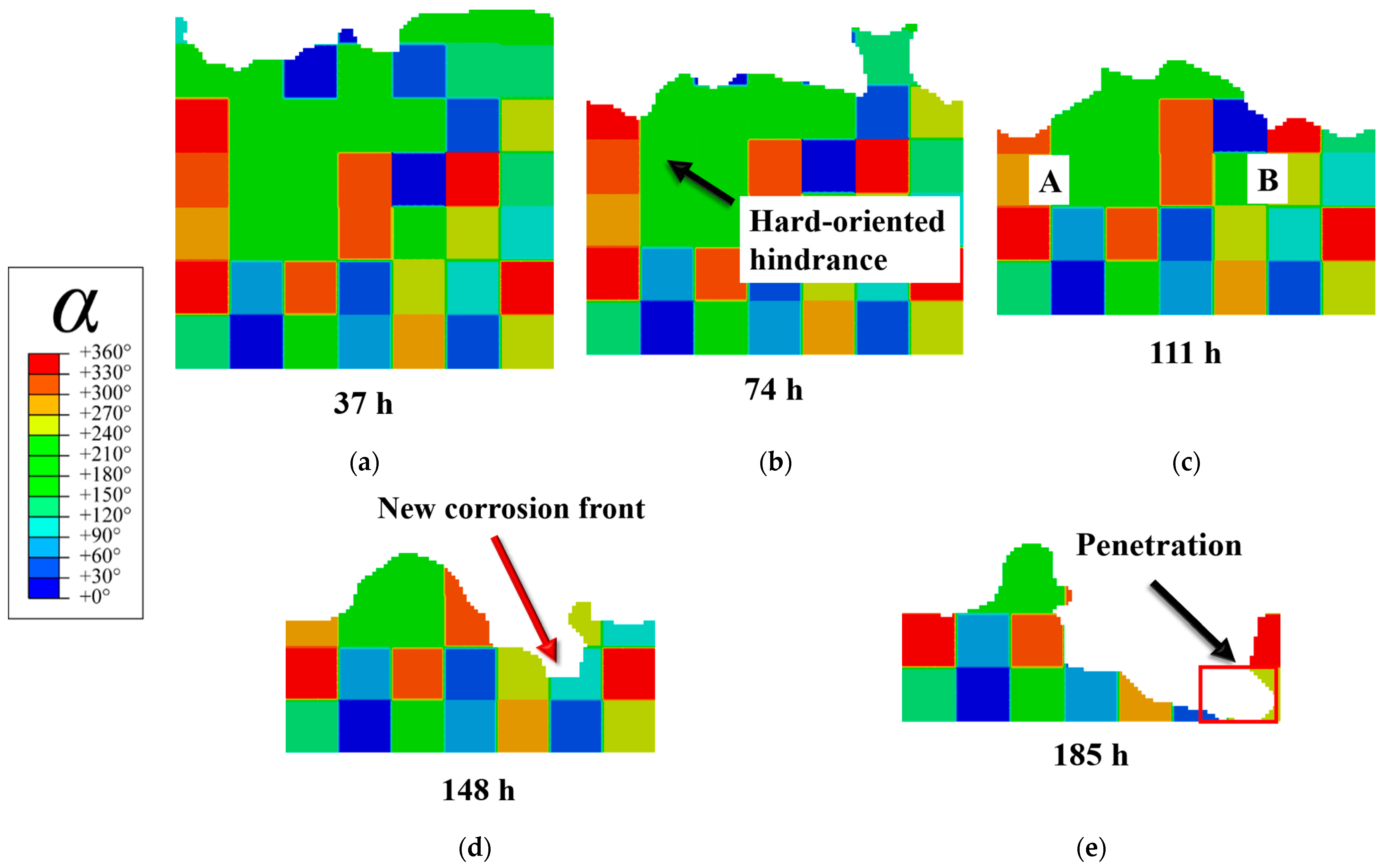
3.3. Corrosion Regulation via Dislocation Evolution
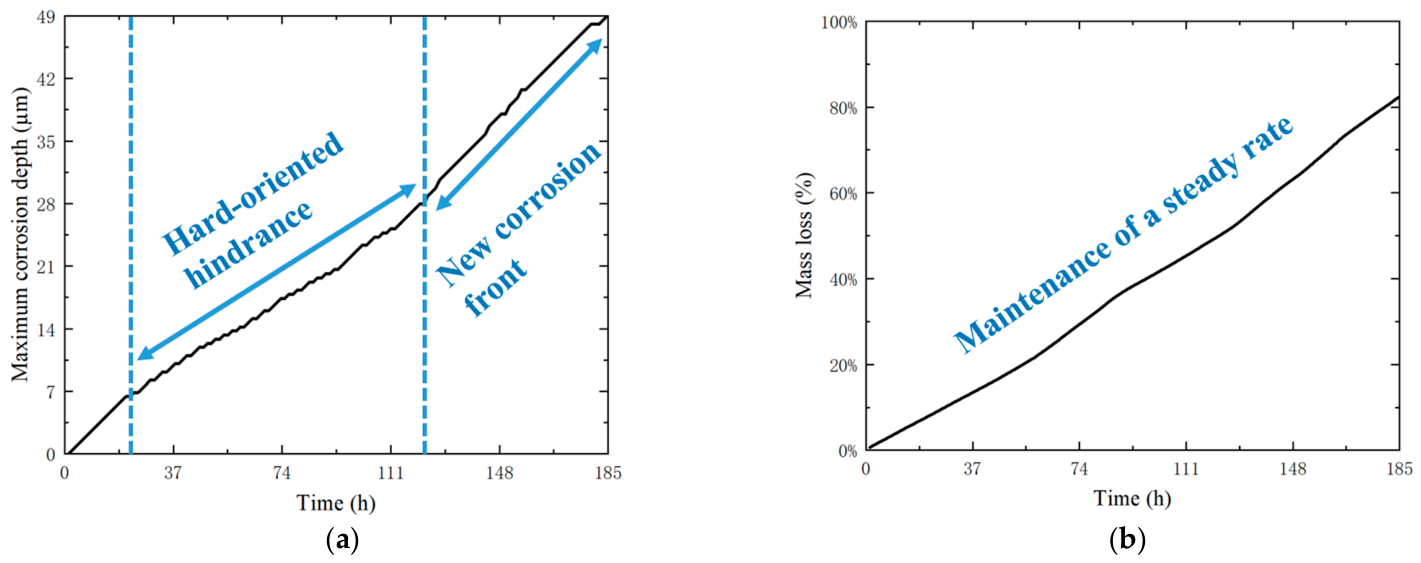
3.4. Mass Loss and Corrosion Depth Evolution
3.5. Comparison with Existing Models and Implications
4. Conclusions
- Heterogeneous dislocation multiplication induced by pre-deformation dictates the selection of transgranular corrosion paths. High-density dislocation zones within soft-oriented grains act as preferential dissolution sites, forming dominant transgranular corrosion paths. When dominant corrosion paths encounter hard-oriented grains, where dislocation is restricted, propagation is locally retarded. Although corrosion eventually circumvents these obstacles by initiating new channels in adjacent soft-oriented regions, the overall structural failure is delayed, reflecting a “weakest-link” characteristic.
- Dislocation density constitutes the dominant contributor to accelerated corrosion kinetics under the conditions examined. Analysis of the contribution ratio of the interfacial kinetic coefficient reveals that, within the soft-oriented grains analyzed (B1 and B2), the contribution of the dislocation density field to the local corrosion driving force is up to approximately 7.7 times that of the hydrostatic stress field. In the hard-oriented region (A1 and A2), the two contributions are of comparable magnitude, with a ratio of approximately 2.
- Soft-oriented grains exhibit a predominance of basal dislocations, which constitute approximately 70% and 63% of the total density in grains B1 and B2, respectively, and are associated with elevated overall dislocation densities and accelerated corrosion propagation. Conversely, grains dominated by non-basal dislocations display markedly lower total dislocation densities and correspondingly delayed corrosion. This correlation demonstrates that the differentiation of corrosion activity among grains is fundamentally governed by crystal orientation through its influence on the operative slip systems and the resulting disparities in accumulated lattice defects.
Author Contributions
Funding
Data Availability Statement
Conflicts of Interest
References
- Huang, Y.; Tolnai, D.; Hort, N. Research progress on magnesium materials for structural, biomedical and energy applications. J. Magnes. Alloys 2025, 13, 3487–3489. [Google Scholar] [CrossRef]
- Zhang, J.; Miao, J.; Balasubramani, N.; Cho, D.H.; Avey, T.; Chang, C.-Y.; Luo, A.A. Magnesium research and applications: Past, present and future. J. Magnes. Alloys 2023, 11, 3867–3895. [Google Scholar] [CrossRef]
- Easton, M.; Abbott, T. Research progress and application prospects of die cast magnesium alloys. J. Magnes. Alloys 2025, 13, 4685–4688. [Google Scholar] [CrossRef]
- Zhu, Z.; Ayoub, I.; He, J.; Yang, J.; Zhang, H.; Zhu, Z.; Hao, Q.; Cai, Z.; Ola, O.; Tiwari, S.K. Magnesium alloys with rare-earth elements: Research trends applications, and future prospect. J. Magnes. Alloys 2025, 13, 3524–3563. [Google Scholar] [CrossRef]
- Koç, E.; Kannan, M.; Ünal, M.; Candan, E. Influence of zinc on the microstructure, mechanical properties and in vitro corrosion behavior of magnesium–zinc binary alloys. J. Alloys Compd. 2015, 648, 291–296. [Google Scholar] [CrossRef]
- Chen, L.; Tseng, C.-M.; Qiu, Y.; Yang, J.; Chang, C.-L.; Wang, X.; Li, W. A layer-by-layer assembled coating for improved stress corrosion cracking on biomedical magnesium alloy in cell culture medium. Surf. Coat. Technol. 2020, 403, 126427. [Google Scholar] [CrossRef]
- Jiang, J.; Geng, X.; Zhang, X. Stress corrosion cracking of magnesium alloys: A review. J. Magnes. Alloys 2023, 11, 1906–1930. [Google Scholar] [CrossRef]
- Martínez-Pañeda, E. Phase-field simulations opening new horizons in corrosion research. MRS Bull. 2024, 49, 603–612. [Google Scholar] [CrossRef]
- Sofiani, F.M.; Chaudhuri, S.; Elahi, S.; Wallaert, E.; Depover, T.; De Waele, W. Accelerated laboratory simulation of corrosion pit evolution in low-carbon steel using phase-field guided overpotential application. Eng. Fail. Anal. 2025, 184, 110352. [Google Scholar] [CrossRef]
- Mai, W.; Soghrati, S. A phase field model for simulating the stress corrosion cracking initiated from pits. Corros. Sci. 2017, 125, 87–98. [Google Scholar] [CrossRef]
- Lin, C.; Ruan, H. Phase-field modeling of mechano–chemical-coupled stress-corrosion cracking. Electrochim. Acta 2021, 395, 139196. [Google Scholar] [CrossRef]
- Zhu, J.; Ben Bettaieb, M.; Zhou, S.; Abed-Meraim, F. Ductility limit prediction for polycrystalline aggregates using a CPFEM-based multiscale framework. Int. J. Plast. 2023, 167, 103671. [Google Scholar] [CrossRef]
- Jalili, M.; Soltani, B. Investigation the micromechanisms of strain localization formation in AZ31 Mg alloy: A mesoscale 3D full-field crystal plasticity computational homogenization study. Eur. J. Mech. A Solids 2020, 80, 103903. [Google Scholar] [CrossRef]
- Mathew, C.C.; Song, J.; Adu-Gyamfi, E.; Fu, Y. Phase field numerical model for simulating the diffusion controlled stress corrosion cracking phenomena in anisotropic material. Comput. Mater. Sci. 2025, 247, 113528. [Google Scholar] [CrossRef]
- Kandekar, C.; Ravikumar, A.; Höche, D.; Weber, W.E. Mastering the complex time-scale interaction during Stress Corrosion Cracking phenomena through an advanced coupling scheme. Comput. Methods Appl. Mech. Eng. 2024, 428, 117101. [Google Scholar] [CrossRef]
- Gutman, E.M. Mechanochemistry of Solid Surfaces; World Scientific Publishing Company: Singapore, 1994. [Google Scholar]
- Liu, L.; Jiang, H.; Shan, Q.; Zhang, J.; Chen, X.; Li, Z.; Wang, D.; Huang, G. The influence of pre-compression/tension induced deformation mechanisms on the corrosion behavior of AM60 Mg alloy. Corros. Sci. 2026, 261, 113596. [Google Scholar] [CrossRef]
- Zhao, P.; Wu, W.; Ma, Z.; Dan, Y. In situ study on the effect of stress on corrosion behavior of AZ91 magnesium alloy. Anti-Corros. Methods Mater. 2022, 69, 204–213. [Google Scholar] [CrossRef]
- Li, L.; Li, Z.; Okonkwo, B.O.; You, W.; Zhang, Z.; Zhang, L.; Wang, J.; Han, E.-H. Stress corrosion cracking susceptibility and propagation behavior of TC4 titanium alloy in simulated deep-sea environment. Corros. Sci. 2025, 256, 113201. [Google Scholar] [CrossRef]
- Liu, C.; Roters, F.; Raabe, D. Finite strain crystal plasticity-phase field modeling of twin, dislocation, and grain boundary interaction in hexagonal materials. Acta Mater. 2023, 242, 118444. [Google Scholar] [CrossRef]
- Westermann, H.; Mahnken, R. Thermodynamically consistent phase-field modeling for polycrystalline multi-phase continua. Int. J. Solids Struct. 2025, 320, 113465. [Google Scholar] [CrossRef]
- Zamolo, R.; Bacer, L.; Bayona, V. Adaptive RBF-FD meshless simulation of two-phase flows with phase-field approach. Comput. Fluids 2026, 314, 17087. [Google Scholar] [CrossRef]
- Xie, C.; Bai, S.; Liu, X.; Zhang, M.; Du, J. Stress-corrosion coupled damage localization induced by secondary phases in bio-degradable Mg alloys: Phase-field modeling. J. Magnes. Alloys 2024, 12, 361–383. [Google Scholar] [CrossRef]




Disclaimer/Publisher’s Note: The statements, opinions and data contained in all publications are solely those of the individual author(s) and contributor(s) and not of MDPI and/or the editor(s). MDPI and/or the editor(s) disclaim responsibility for any injury to people or property resulting from any ideas, methods, instructions or products referred to in the content. |
© 2026 by the authors. Licensee MDPI, Basel, Switzerland. This article is an open access article distributed under the terms and conditions of the Creative Commons Attribution (CC BY) license.
Share and Cite
Zhai, X.; Xie, C.; Shu, X.; Liu, Y. Dislocation-Based CPFEM and Phase-Field Study on the Stress Corrosion Cracking of Randomly Textured Magnesium Alloys. Materials 2026, 19, 2051. https://doi.org/10.3390/ma19102051
Zhai X, Xie C, Shu X, Liu Y. Dislocation-Based CPFEM and Phase-Field Study on the Stress Corrosion Cracking of Randomly Textured Magnesium Alloys. Materials. 2026; 19(10):2051. https://doi.org/10.3390/ma19102051
Chicago/Turabian StyleZhai, Xu, Chao Xie, Xuedao Shu, and Yupeng Liu. 2026. "Dislocation-Based CPFEM and Phase-Field Study on the Stress Corrosion Cracking of Randomly Textured Magnesium Alloys" Materials 19, no. 10: 2051. https://doi.org/10.3390/ma19102051
APA StyleZhai, X., Xie, C., Shu, X., & Liu, Y. (2026). Dislocation-Based CPFEM and Phase-Field Study on the Stress Corrosion Cracking of Randomly Textured Magnesium Alloys. Materials, 19(10), 2051. https://doi.org/10.3390/ma19102051