Coupled Effect of Interfacial Grit Particles and TGO Amplitude on Bond-Coat Crack Propagation in Thermal Barrier Coatings

Abstract
1. Introduction
2. Model Description
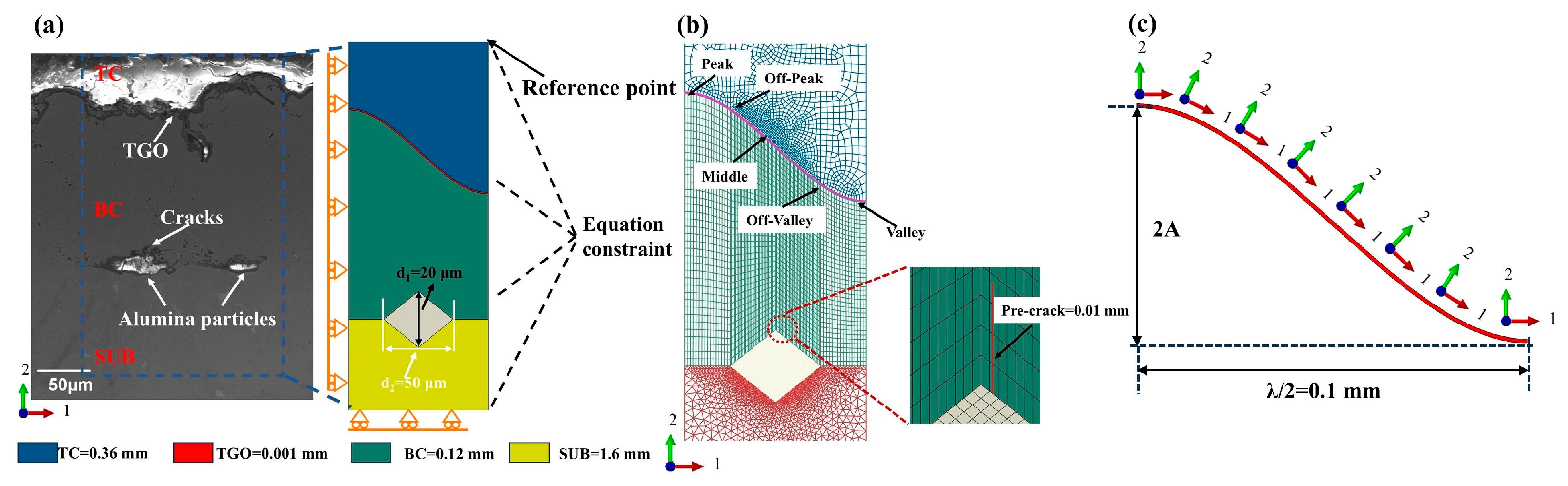
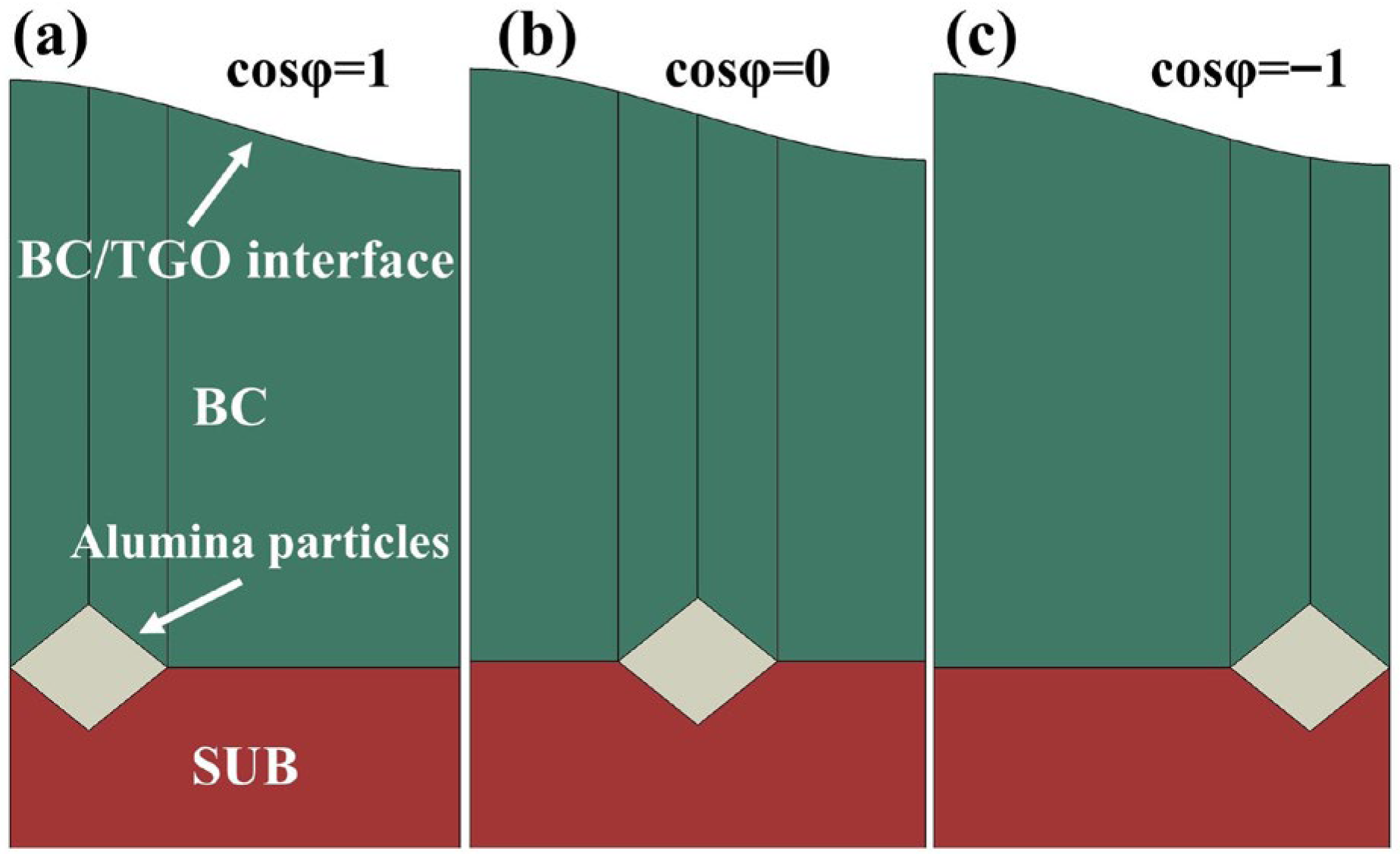
2.1. Geometry Model
2.2. Boundary Condition and Meshing
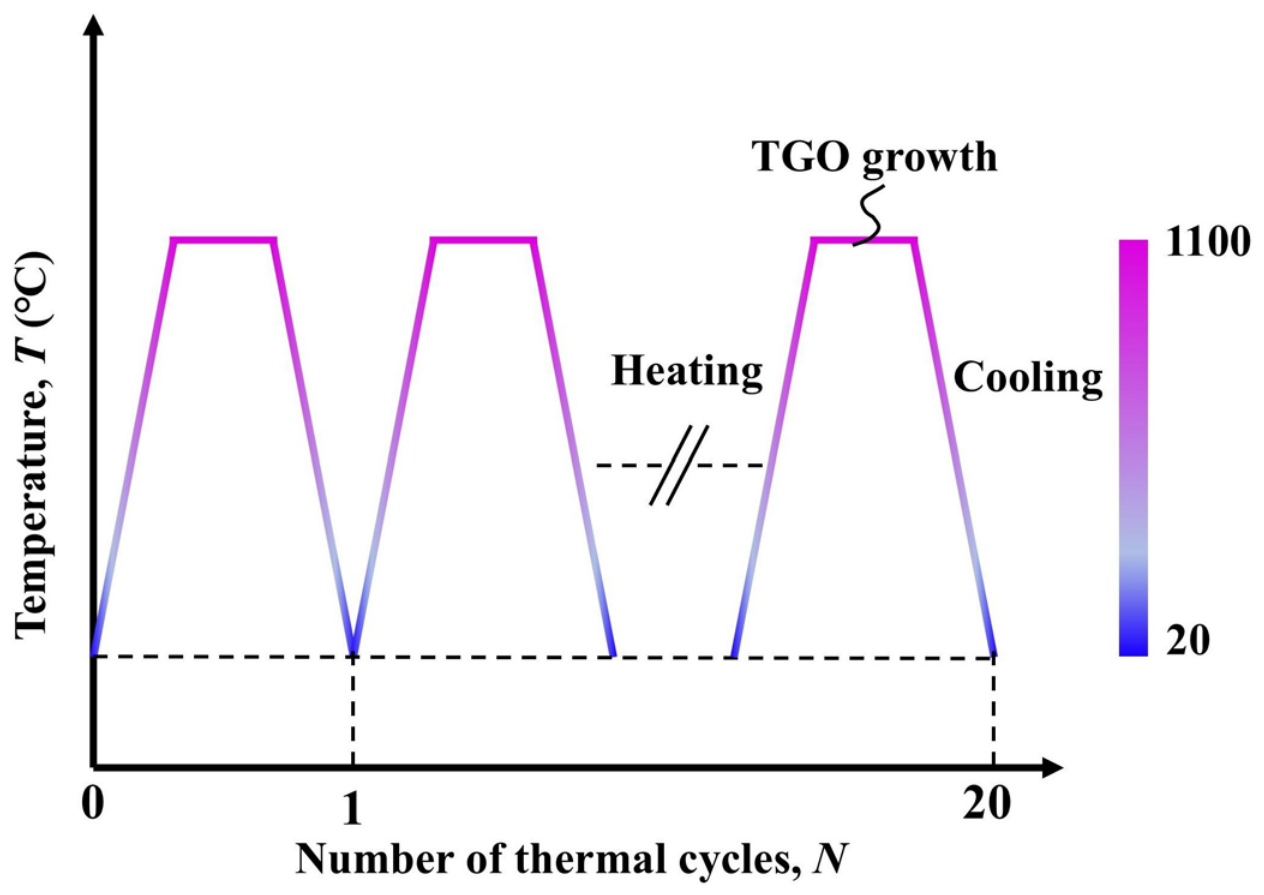
2.3. Thermal Cycling History
2.4. Material Property
2.5. Crack Initiation and Growth Criterion
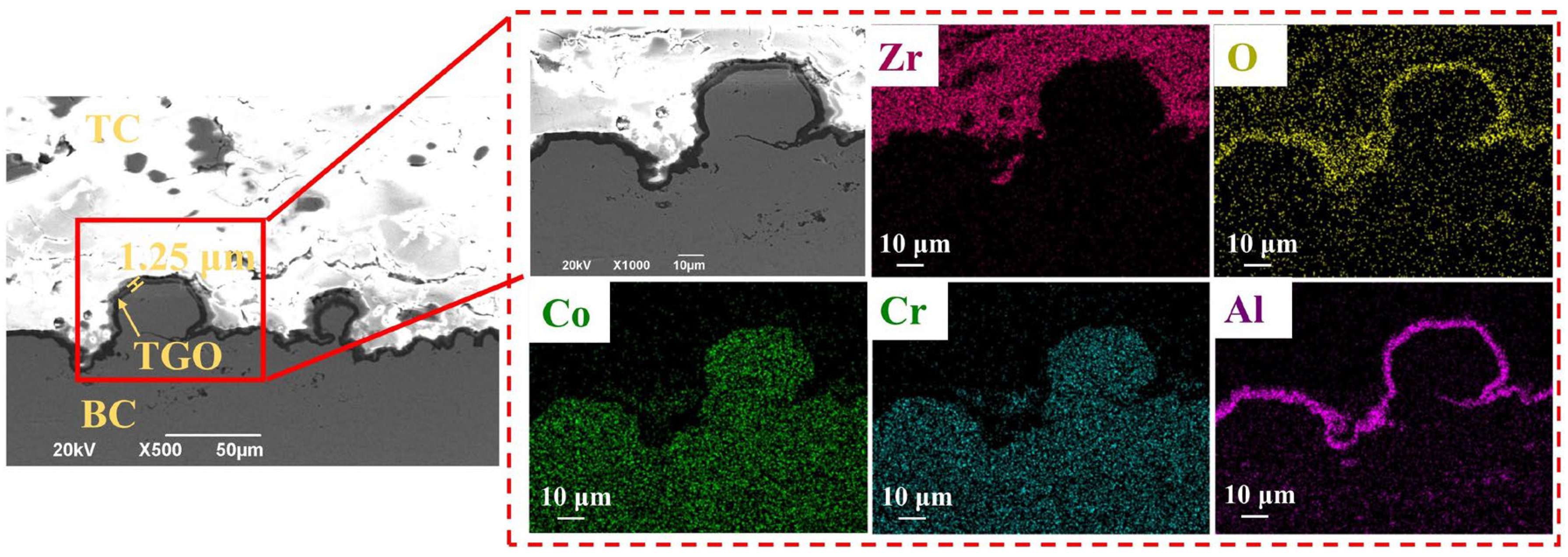
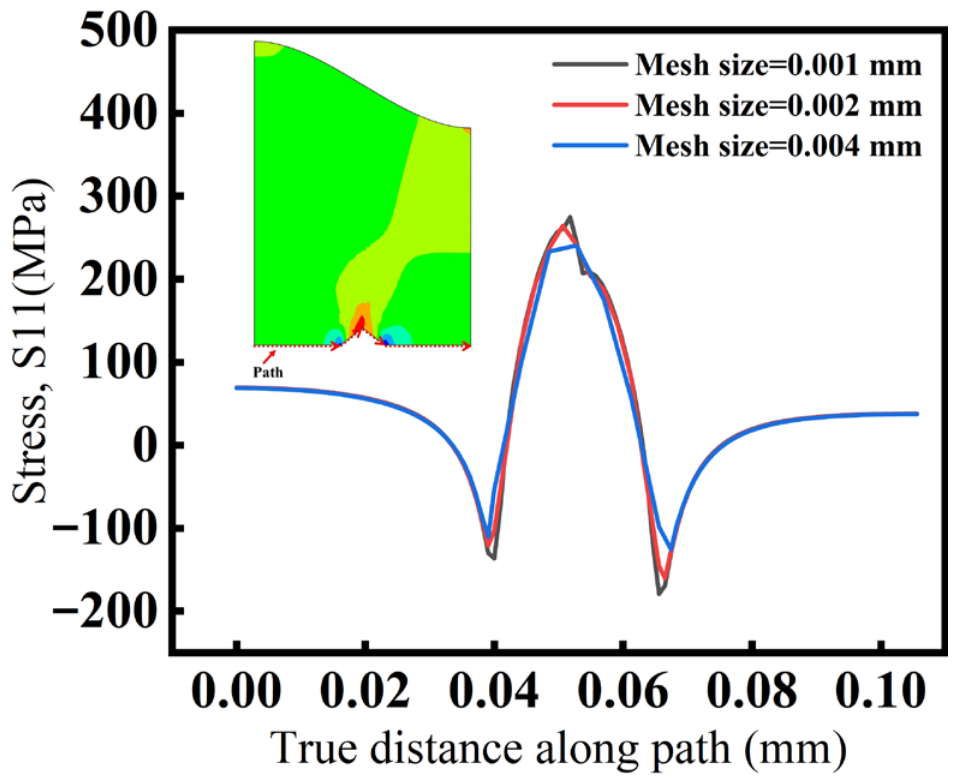
2.6. Model Reliability Validation
3. Results and Discussion
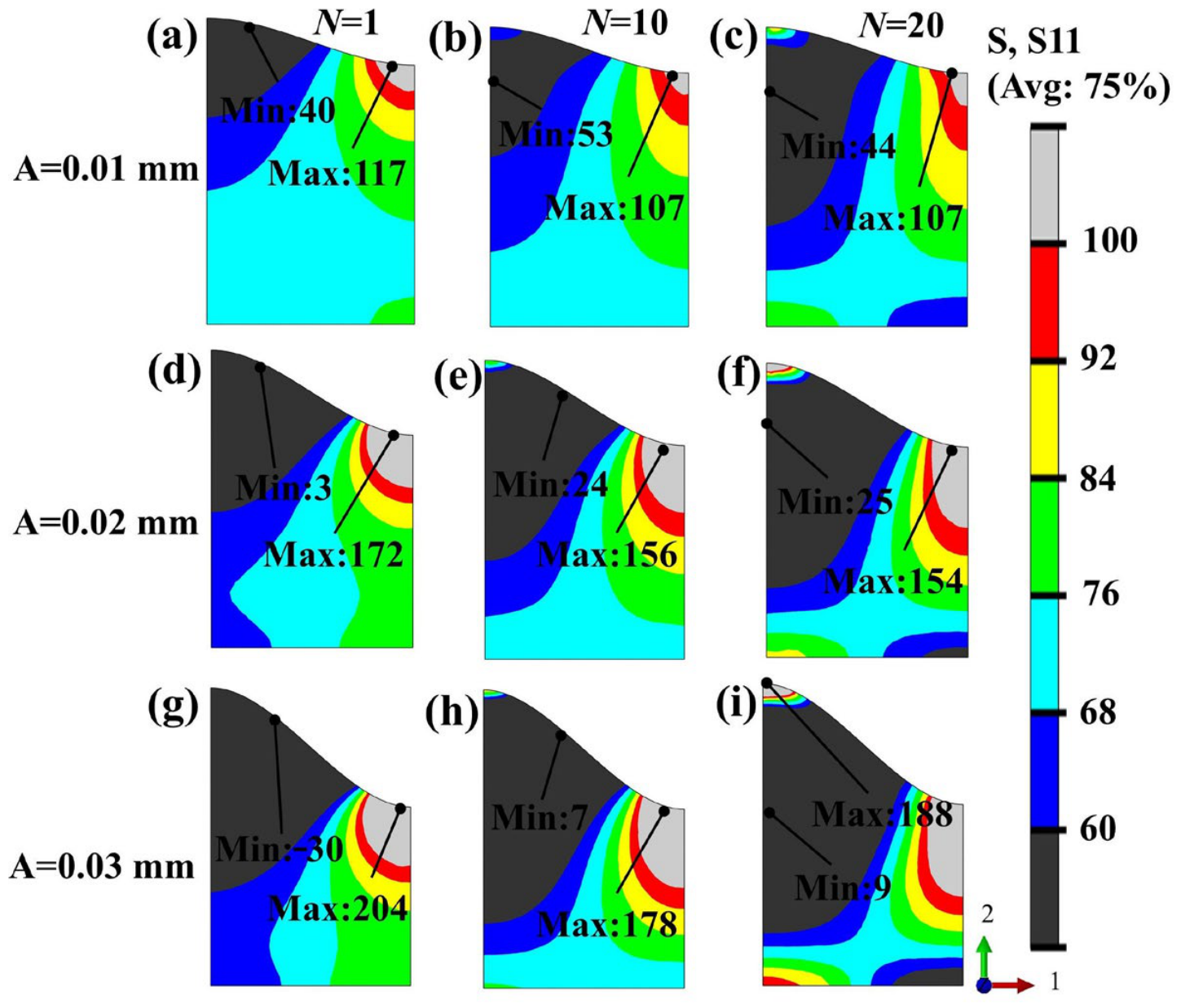
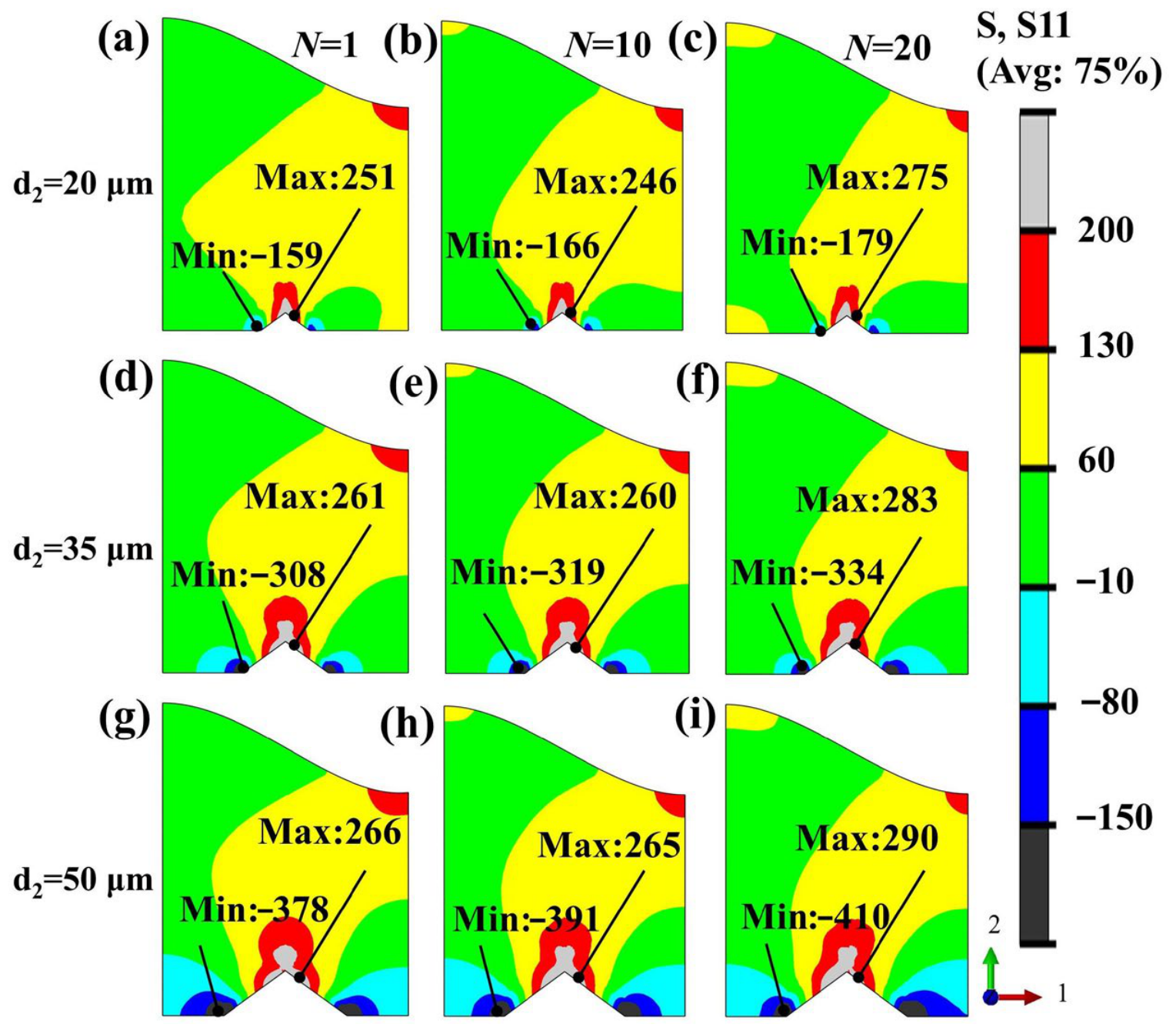
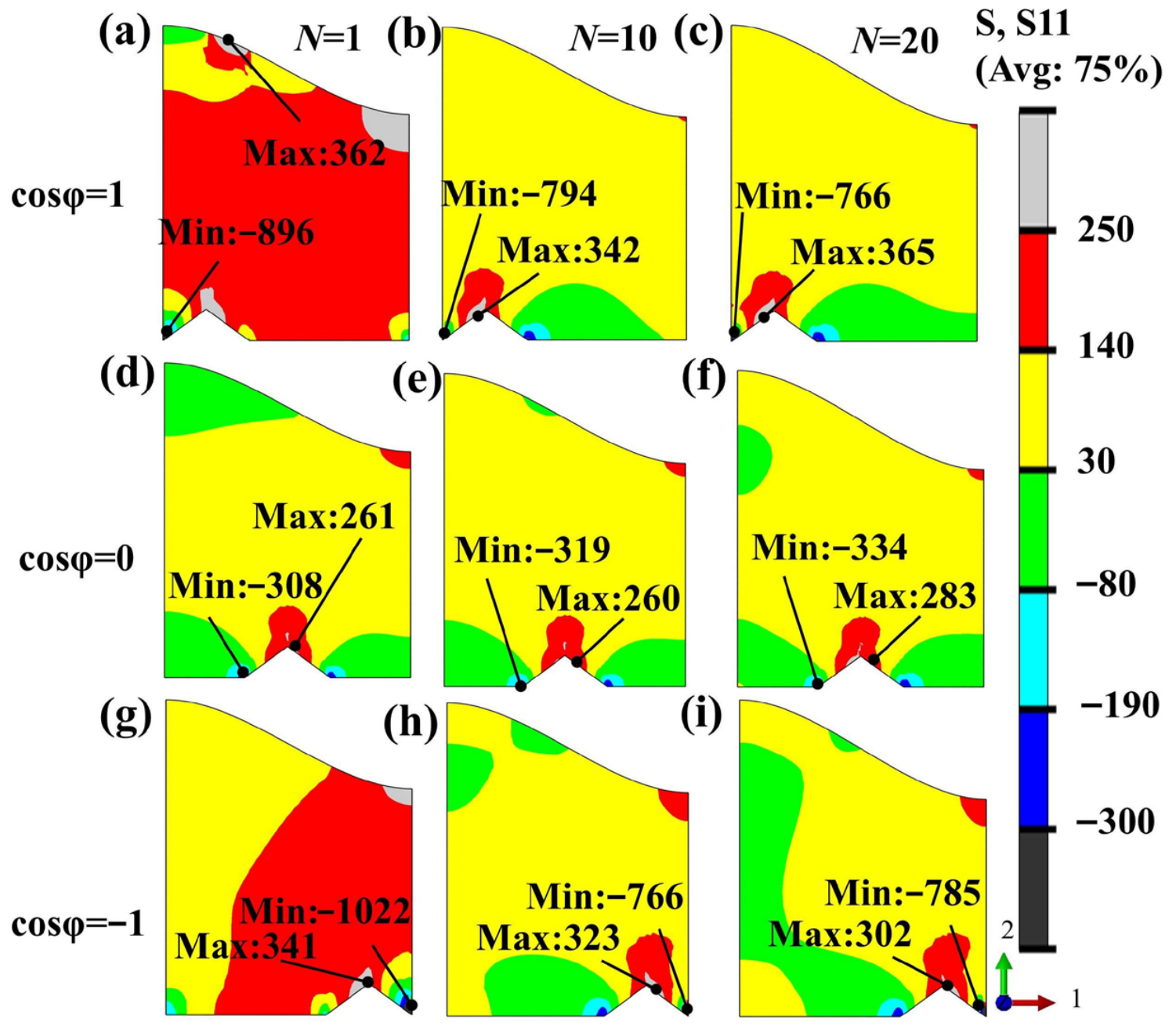
3.1. Stress Distribution Inside the BC Layer Under Single-Factor Conditions
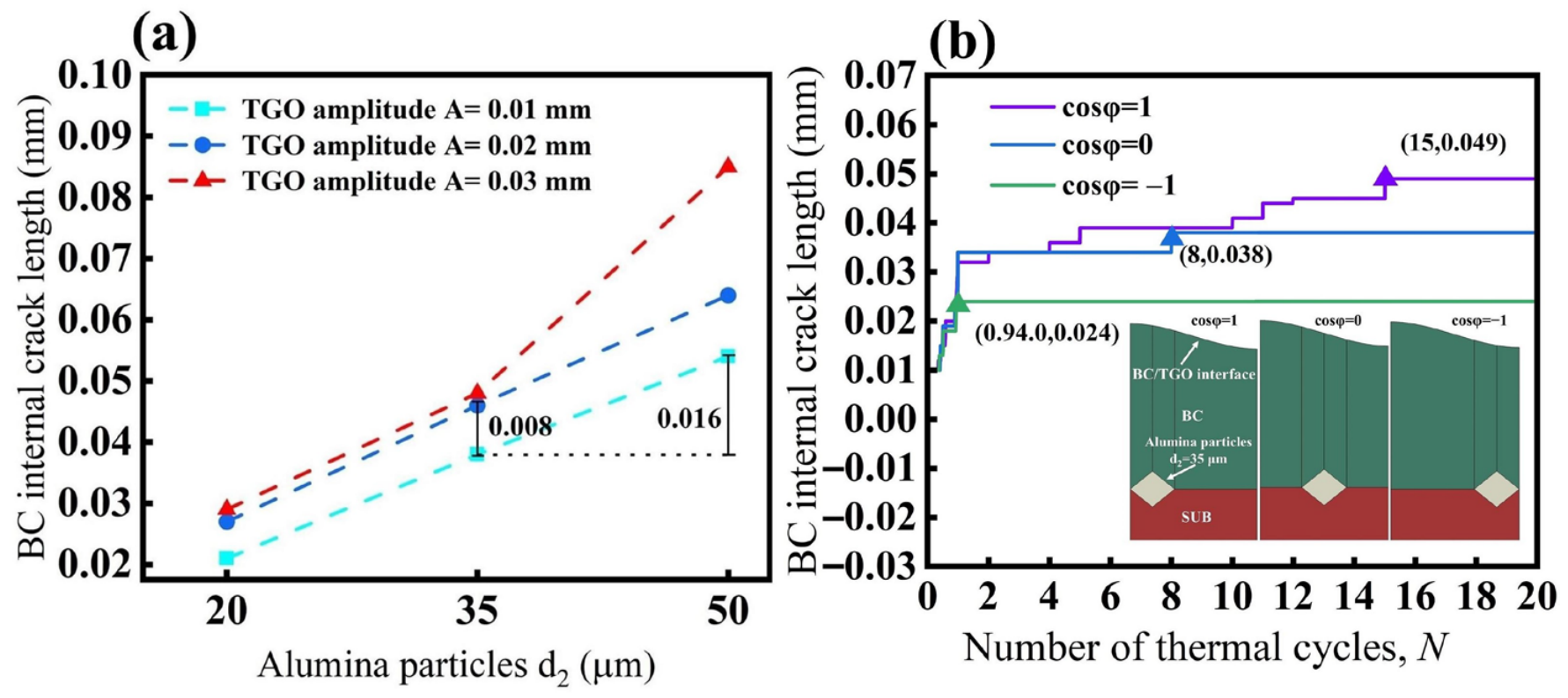
3.2. Crack Propagation Analysis Inside the BC Layer Under Single-Factor Conditions
3.3. Coupling Effects of TGO Amplitude and Grit Size/Position on Crack Propagation Inside the BC Layer
4. Conclusions
- Residual grit particles significantly modify the local stress distribution in the BC layer and promote crack propagation. Tensile stress is mainly concentrated in the region above the grit particle, making this area the critical site for crack development. Larger grit particles and unfavorable grit locations further intensify local stress concentration and increase crack propagation in the BC layer.
- Although TGO amplitude affects the stress evolution in the BC layer, the crack propagation behavior is more strongly governed by grit-related factors. Among the three variables considered, the influence of grit size is the greatest, followed by grit position, while the effect of TGO amplitude is relatively weaker.
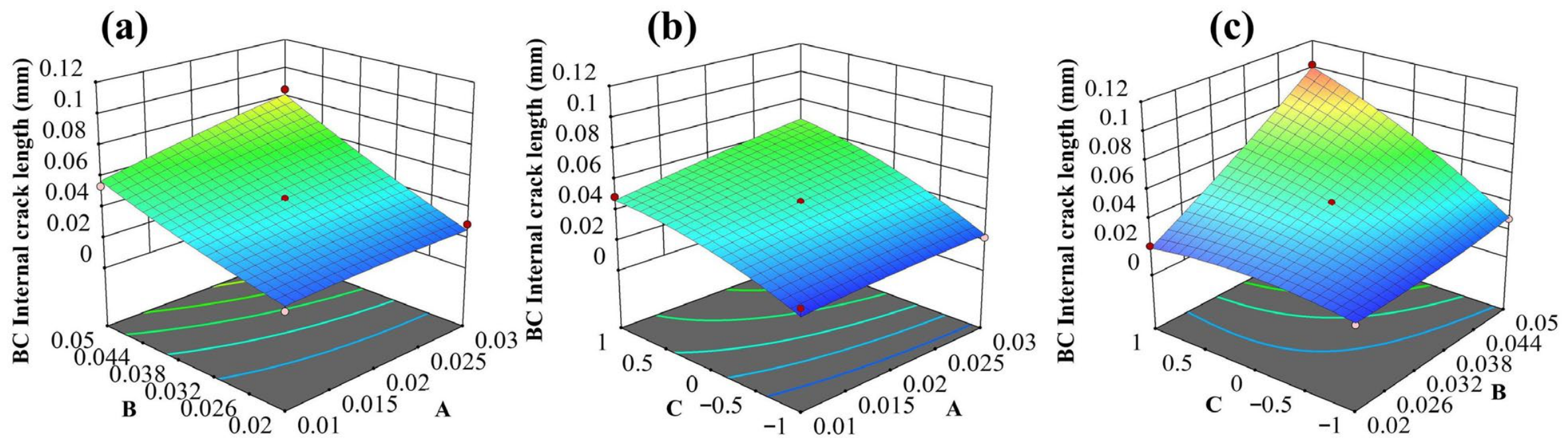
- Response surface analysis shows that the interaction between grit size and grit position is the most significant among all factor combinations. A quadratic regression model for BC crack length was established based on the Box–Behnken design, and the optimized parameter combination for minimizing BC crack propagation was successfully obtained. The predicted result agrees reasonably well with the FE verification, indicating that the regression model provides supportive numerical verification within the investigated parameter range.
Author Contributions
Funding
Data Availability Statement
Conflicts of Interest
References
- Sezavar, A.; Sajjadi, S.A. A review on the performance and lifetime improvement of thermal barrier coatings. J. Eur. Ceram. Soc. 2025, 45, 117274. [Google Scholar] [CrossRef]
- Padture, N.P.; Gell, M.; Jordan, E.H. Thermal Barrier Coatings for Gas-Turbine Engine Applications. Science 2002, 296, 280–284. [Google Scholar] [CrossRef]
- Vagge, S.T.; Ghogare, S. Thermal barrier coatings: Review. Mater. Today Proc. 2022, 56, 1201–1216. [Google Scholar] [CrossRef]
- Cen, L.; Qin, W.; Yu, Q. A three-dimensional finite element model for the oxide growth mechanism and growth-induced stress within thermal barrier system. Mater. Today Commun. 2021, 29, 102790. [Google Scholar] [CrossRef]
- Evans, H.E. Oxidation failure of TBC systems: An assessment of mechanisms. Surf. Coat. Technol. 2011, 206, 1512–1521. [Google Scholar] [CrossRef]
- Bäker, M.; Seiler, P. A guide to finite element simulations of thermal barrier coatings. J. Therm. Spray Technol. 2017, 26, 1146–1160. [Google Scholar] [CrossRef]
- Ranjbar-Far, M.; Absi, J.; Mariaux, G.; Dubois, F. Simulation of the effect of material properties and interface roughness on the stress distribution in thermal barrier coatings using finite element method. Mater. Des. 2010, 31, 772–781. [Google Scholar] [CrossRef]
- Zhang, W.X.; Fan, X.L.; Wang, T.J. The surface cracking behavior in air plasma sprayed thermal barrier coating system incorporating interface roughness effect. Appl. Surf. Sci. 2011, 258, 811–817. [Google Scholar] [CrossRef]
- Wei, Z.; Cai, H.; Feng, R.; Zhang, H. The Combined Effect of Creep and TGO Growth on the Cracking Driving Force in a Plasma-Sprayed Thermal Barrier System. J. Therm. Spray Technol. 2019, 28, 1000–1016. [Google Scholar] [CrossRef]
- Zhang, L.; Chen, S.; Yu, C.; Yu, Z.; Jiang, C.; Li, S.; Bao, Z.; Quan, G.; Zhu, S.; Wang, F. Effect of the non-uniformed growth of TGO on dynamic stress evolution in realistic TC/TGO interface of MCrAlY-YSZ TBCs during thermal cycling. Surf. Coat. Technol. 2025, 511, 132319. [Google Scholar] [CrossRef]
- Hu, Z.C.; Wang, L.; Zhuang, M.X.; Zhang, H.Y.; Li, G.S.; Liu, Y.; Wang, Y.; Yang, Y. Influence of internal oxidation of the bond-coat on the residual stress around the TGO and failure modes of the APS-TBCs: A finite element simulation study. Ceram. Int. 2021, 47, 5364–5373. [Google Scholar] [CrossRef]
- Varacalle, D.J.; Guillen, D.P.; Deason, D.M.; Rhodaberger, W.; Sampson, E. Effect of grit-blasting on substrate roughness and coating adhesion. J. Therm. Spray Technol. 2006, 15, 348–355. [Google Scholar] [CrossRef]
- Sen, D.; Chavan, N.M.; Rao, D.S.; Sundararajan, G. Influence of Grit Blasting on the Roughness and the Bond Strength of Detonation Sprayed Coating. J. Therm. Spray Technol. 2010, 19, 805–815. [Google Scholar] [CrossRef]
- Kim, A.; Kainuma, S.; Yang, M. Surface Characteristics and Corrosion Behavior of Carbon Steel Treated by Abrasive Blasting. Metals 2021, 11, 2065. [Google Scholar] [CrossRef]
- Giouse, J.B.; White, K.; Tromas, C. Nanoindentation characterization of the surface mechanical properties of a 17-4PH stainless steel substrate treated with grit blasting and coated with a Cr3C2-NiCr coating. Surf. Coat. Technol. 2019, 368, 119–125. [Google Scholar] [CrossRef]
- Antoš, J.; Duliškovič, J.; Bejblíková, S. Aluminium oxide grid blasting: Grid size and blasting pressure influence on the substrate surface contamination, roughness and ceramic plasma spray coating adhesion strength. J. Phys. Conf. Ser. 2023, 2572, 012009. [Google Scholar] [CrossRef]
- Dassault Systèmes. ABAQUS Analysis User’s Guide, Version 6.22; Dassault Systèmes Simulia Corp.: Providence, RI, USA, 2022. Available online: https://help.3ds.com/HelpProductsDS.aspx (accessed on 10 May 2026).
- Zhu, J.; Chen, W.; Xie, H. Simulation of residual stresses and their effects on thermal barrier coating systems using finite element method. Sci. China Phys. Mech. Astron. 2015, 58, 1–10. [Google Scholar] [CrossRef]
- Ranjbar-far, M.; Absi, J.; Mariaux, G.; Smith, D.S. Crack propagation modeling on the interfaces of thermal barrier coating system with different thickness of the oxide layer and different interface morphologies. Mater. Des. 2011, 32, 4961–4969. [Google Scholar] [CrossRef]
- Wang, L.; Deng, C.; Ding, K.; Guo, S.; Li, Z.; Lin, X. Model construction and effect of thermally grown oxide dynamic growth on distribution of thermal barrier coatings. Ceram. Int. 2021, 47, 18385–18396. [Google Scholar] [CrossRef]
- Zhu, Y.; Yan, B.; Cai, D.; Wu, K.; Zhang, X. Structural parameter study on stress intensity factors of interfacial crack in thermal barrier coatings. Ceram. Int. 2021, 47, 14354–14365. [Google Scholar] [CrossRef]
- Abdelgawad, A.; Al-Athel, K.; Albinmousa, J. Analysis of crack initiation and propagation in Thermal Barrier Coatings using SEM-Based geometrical model with extended finite element method. Ceram. Int. 2021, 47, 33140–33151. [Google Scholar] [CrossRef]
- Fan, X.L.; Xu, R.; Zhang, W.X.; Wang, T.J. Effect of periodic surface cracks on the interfacial fracture of thermal barrier coating system. Appl. Surf. Sci. 2012, 258, 9816–9823. [Google Scholar] [CrossRef]
- Al-Athel, K.; Loeffel, K.; Liu, H.; Anand, L. Modeling decohesion of a top-coat from a thermally-growing oxide in a thermal barrier coating. Surf. Coat. Technol. 2013, 222, 68–78. [Google Scholar] [CrossRef]
- He, M.Y.; Hutchinson, J.W.; Evans, A.G. Simulation of stresses and delamination in a plasma-sprayed thermal barrier system upon thermal cycling. Mater. Sci. Eng. A 2003, 345, 172–178. [Google Scholar] [CrossRef]
- Shi, D.Q.; Song, J.N.; Li, S.L.; Qi, H.; Yang, X. Cracking behaviors of EB-PVD thermal barrier coating under temperature gradient. Ceram. Int. 2019, 45, 18518–18528. [Google Scholar] [CrossRef]
- Aktaa, J.; Sfar, K.; Munz, D. Assessment of TBC systems failure mechanisms using a fracture mechanics approach. Acta Mater. 2005, 53, 4399–4413. [Google Scholar] [CrossRef]
- Shen, X.; Wei, Z.; Jiang, Z.; Zhang, J.; Li, D.; Gong, X.; Li, Q.; Zhao, F.; Lai, J.; Yu, J. Crack Propagation Mechanism in Thermal Barrier Coatings Containing Different Residual Grit Particles Under Thermal Cycling. Coatings 2025, 15, 747. [Google Scholar] [CrossRef]
- Białas, M. Finite element analysis of stress distribution in thermal barrier coatings. Surf. Coat. Technol. 2008, 202, 6002–6010. [Google Scholar] [CrossRef]
- Jiang, J.; Wang, W.; Zhao, X.; Liu, Y.; Cao, Z.; Xiao, P. Numerical analyses of the residual stress and top coat cracking behavior in thermal barrier coatings under cyclic thermal loading. Eng. Fract. Mech. 2018, 196, 191–205. [Google Scholar] [CrossRef]
- Wei, Z.Y.; Cai, H.N.; Li, C.J. Comprehensive dynamic failure mechanism of thermal barrier coatings based on a novel crack propagation and TGO growth coupling model. Ceram. Int. 2018, 44, 22556–22566. [Google Scholar] [CrossRef]
- Wang, L.; Li, D.C.; Yang, J.S.; Shao, F.; Zhong, X.H.; Zhao, H.Y.; Yang, K.; Tao, S.Y.; Wang, Y. Modeling of thermal properties and failure of thermal barrier coatings with the use of finite element methods: A review. J. Eur. Ceram. Soc. 2016, 36, 1313–1331. [Google Scholar] [CrossRef]
- Belytschko, T.; A Black, T. Elastic crack growth in finite elements with minimal remeshing. Int. J. Numer. Methods Eng. 1999, 45, 601–620. [Google Scholar] [CrossRef]
- Zhou, Q.Q.; Yang, L.; Luo, C.; Chen, F.W.; Zhou, Y.C.; Wei, Y.G. Thermal barrier coatings failure mechanism during the interfacial oxidation process under the interaction between interface by cohesive zone model and brittle fracture by phase-field. Int. J. Solids Struct. 2021, 214-215, 18–34. [Google Scholar] [CrossRef]
- Li, B.; Fan, X.L.; Okada, H.; Wang, T. Mechanisms governing the failure modes of dense vertically cracked thermal barrier coatings. Eng. Fract. Mech. 2018, 189, 451–480. [Google Scholar] [CrossRef]
- Ranjbar-Far, M.; Absi, J.; Shahidi, S.; Mariaux, G. Impact of the non-homogenous temperature distribution and the coatings process modeling on the thermal barrier coatings system. Mater. Des. 2011, 32, 728–735. [Google Scholar] [CrossRef]
- Wei, Z.; Cai, H.; Zhao, S. Comprehensive understanding of horizontal and vertical crack effects on failure mechanism of lamellar structured thermal barrier coatings. Ceram. Int. 2022, 48, 8143–8154. [Google Scholar] [CrossRef]
- Rösler, J.; Bäker, M.; Aufzug, K. A parametric study of the stress state of thermal barrier coatings: Part I: Creep relaxation. Acta Mater. 2004, 52, 4809–4817. [Google Scholar] [CrossRef]
- Bäker, M.; Rösler, J.; Heinze, G. A parametric study of the stress state of thermal barrier coatings Part II: Cooling stresses. Acta Mater. 2005, 53, 469–476. [Google Scholar] [CrossRef]









| Plastic Parameters | Temperature/(°C) | |||||||||
|---|---|---|---|---|---|---|---|---|---|---|
| 400 | 600 | 800 | 900 | 1000 | ||||||
| σ/(Mpa) | 1100 | 2500 | 1100 | 2200 | 300 | 380 | 45 | 60 | 10 | 15 |
| ɛp | 0 | 0.23 | 0 | 0.30 | 0 | 0.02 | 0 | 0.02 | 0 | 0.01 |
| Material | Temperature/ (°C) | Elastic Modulus/ (GPa) | μ | Density/ (kg∙m−3) | CTE/ 10−6∙°C−1 |
|---|---|---|---|---|---|
| TC (8YSZ) | 20 | 48 | 0.10 | 5280 | 9.0 |
| 200 | 47 | 0.10 | 5280 | 9.2 | |
| 600 | 40 | 0.10 | 5280 | 10.1 | |
| 800 | 34 | 0.11 | 5280 | 10.8 | |
| 1100 | 22 | 0.12 | 5280 | 12.2 | |
| BC (MCrAlY) | 20 | 200 | 0.30 | 8100 | 13.6 |
| 200 | 190 | 0.30 | 8100 | 14.2 | |
| 600 | 160 | 0.31 | 8100 | 15.2 | |
| 800 | 145 | 0.32 | 8100 | 16.1 | |
| 1100 | 110 | 0.35 | 8100 | 17.6 | |
| TGO (α-Al2O3) | 20 | 400 | 0.23 | 4000 | 8.0 |
| 200 | 390 | 0.23 | 4000 | 8.2 | |
| 600 | 370 | 0.32 | 4000 | 8.7 | |
| 800 | 355 | 0.32 | 4000 | 9.0 | |
| 1100 | 320 | 0.33 | 4000 | 9.6 | |
| SUB (Inconel DZ125) | 20 | 220 | 0.31 | 8200 | 14.8 |
| 200 | 210 | 0.32 | 8200 | 15.2 | |
| 600 | 170 | 0.33 | 8200 | 16.2 | |
| 800 | 155 | 0.34 | 8200 | 16.9 | |
| 1100 | 120 | 0.35 | 8200 | 18.0 | |
| Alumina particle (Al2O3) | 20 | 380 | 0.27 | 38,700 | 5.08 |
| 220 | 369 | 0.27 | 38,700 | 5.90 | |
| 420 | 370 | 0.27 | 38,700 | 6.73 | |
| 620 | 355 | 0.27 | 38,700 | 7.55 | |
| 1020 | 320 | 0.27 | 38,700 | 9.20 |
| Number | A | B | C | BC Internal Crack Length (mm) |
|---|---|---|---|---|
| 1 | 0.01 | 20 | 0 | 0.021 |
| 2 | 0.03 | 20 | 0 | 0.029 |
| 3 | 0.01 | 50 | 0 | 0.054 |
| 4 | 0.03 | 50 | 0 | 0.085 |
| 5 | 0.01 | 35 | −1 | 0.024 |
| 6 | 0.03 | 35 | −1 | 0.022 |
| 7 | 0.03 | 35 | 1 | 0.062 |
| 8 | 0.01 | 35 | 1 | 0.049 |
| 9 | 0.02 | 20 | −1 | 0.019 |
| 10 | 0.02 | 50 | −1 | 0.028 |
| 11 | 0.02 | 20 | 1 | 0.021 |
| 12 | 0.02 | 50 | 1 | 0.102 |
| 13 | 0.02 | 35 | 0 | 0.046 |
| 14 | 0.02 | 35 | 0 | 0.046 |
| 15 | 0.02 | 35 | 0 | 0.046 |
| 16 | 0.02 | 35 | 0 | 0.046 |
| 17 | 0.02 | 35 | 0 | 0.046 |
Disclaimer/Publisher’s Note: The statements, opinions and data contained in all publications are solely those of the individual author(s) and contributor(s) and not of MDPI and/or the editor(s). MDPI and/or the editor(s) disclaim responsibility for any injury to people or property resulting from any ideas, methods, instructions or products referred to in the content. |
© 2026 by the authors. Licensee MDPI, Basel, Switzerland. This article is an open access article distributed under the terms and conditions of the Creative Commons Attribution (CC BY) license.
Share and Cite
Lai, J.; Shen, X.; Yuan, X.; Gao, Z.; Gong, X.; Zhang, Y.; Liu, M.; Yu, J.; Li, Q.; Wei, Z.; et al. Coupled Effect of Interfacial Grit Particles and TGO Amplitude on Bond-Coat Crack Propagation in Thermal Barrier Coatings. Materials 2026, 19, 2025. https://doi.org/10.3390/ma19102025
Lai J, Shen X, Yuan X, Gao Z, Gong X, Zhang Y, Liu M, Yu J, Li Q, Wei Z, et al. Coupled Effect of Interfacial Grit Particles and TGO Amplitude on Bond-Coat Crack Propagation in Thermal Barrier Coatings. Materials. 2026; 19(10):2025. https://doi.org/10.3390/ma19102025
Chicago/Turabian StyleLai, Jianping, Xin Shen, Xiaohu Yuan, Zhiming Gao, Xiufang Gong, Yuhang Zhang, Mengli Liu, Jiaxin Yu, Qiyuan Li, Zhiyuan Wei, and et al. 2026. "Coupled Effect of Interfacial Grit Particles and TGO Amplitude on Bond-Coat Crack Propagation in Thermal Barrier Coatings" Materials 19, no. 10: 2025. https://doi.org/10.3390/ma19102025
APA StyleLai, J., Shen, X., Yuan, X., Gao, Z., Gong, X., Zhang, Y., Liu, M., Yu, J., Li, Q., Wei, Z., & Liu, B. (2026). Coupled Effect of Interfacial Grit Particles and TGO Amplitude on Bond-Coat Crack Propagation in Thermal Barrier Coatings. Materials, 19(10), 2025. https://doi.org/10.3390/ma19102025