Article

Integrating NSGA-II and TOPSIS for Stacking Model Optimization in Pursuit of Halide Double Perovskite Screening


1
College of Information and Communication, Guilin University of Electronic Technology, Guilin 541004, China
2
College of Physics and Electronic Information Engineering, Guilin University of Technology, Guilin 541004, China
3
College of Materials Science and Engineering, Guilin University of Electronic Technology, Guilin 541004, China
4
Guangxi Key Laboratory of Information Materials, Guangxi Collaborative Innovation Center of Structure and Property for New Energy and Materials, Guilin 541004, China
*
Authors to whom correspondence should be addressed.
Materials 2026, 19(10), 2018; https://doi.org/10.3390/ma19102018
Submission received: 9 April 2026 / Revised: 23 April 2026 / Accepted: 9 May 2026 / Published: 12 May 2026
(This article belongs to the Section Energy Materials)

Abstract

Halide double perovskite materials have been used for various applications; their bandgap (Eg) and heat of formation (ΔHf) are their key properties. They can be obtained through calculations based on high-throughput density functional theory (DFT), but such calculations are computationally expensive and time-consuming. Machine learning (ML) has proved to be an effective tool for screening potential materials. The prediction accuracy of ML models strongly depends on both input features and ML algorithms. However, there is no unified feature set with which ML models can effectively distinguish halide double perovskite materials. Although it has been proven that stacking ML models can achieve higher prediction accuracy than individual ML models, little attention has been paid to the optimization of stacking models. To solve these problems, we constructed a new feature set obtained from periodic tables for predicting the Eg and ΔHf of halide double perovskites, and we further proposed a method integrating the nondominated sorting genetic algorithm (NSGA-II) and the Technique for Order Preference by Similarity to Ideal Solution (TOPSIS) decision-making tool for stacking model optimization to predict the Eg and ΔHf of 540 compounds of halide double perovskites. Experimental results from 40 runs of 5-fold cross-validation demonstrate that our proposed new feature set enables ML models to achieve better performance than the original feature set. Moreover, the stacking model optimized by our proposed method yields better predicting performance than that of any individual single model and stacking regression models without optimization, with average improvements of 5.02%, 2.70%, 3.72% and 0.28% in MSE, RMSE, MAE and R2, respectively, in Eg prediction, thus providing more effective guidance for screening potential compounds for solar cells from a large quantity of materials.

1. Introduction

Recently, machine learning (ML) has enabled significant progress in material design and discovery, including hybrid organic–inorganic perovskites [1,2] and inorganic double perovskites [3,4]. Halide double perovskite materials have been applied to various fields, including solar cells, light-emitting diodes, catalysts, batteries, and photodetectors, which are mainly categorized by their bandgap (Eg) [5,6]. Recent experimental efforts have further advanced perovskite photovoltaic performance through optimized fabrication and device architecture [7,8]. For instance, Barar et al. employed a two-diode model combined with the Lambert W function to extract the key performance parameters of perovskite solar cells [9]. In addition, the stability of compounds can also be taken into consideration and is indicated by the heat of formation (ΔHf) [10].
Traditionally, Eg and ΔHf are usually obtained from calculations based on DFT in a traditional way, which is computationally expensive and time-consuming [11,12], making it impossible to apply to a large database. To solve this problem, an ML technique driven by data has been employed to extract potential materials from databases, accelerating the process of material design [5,13,14,15]. The identification of an accurate input feature set strongly correlates with the performance of ML models, and different feature sets have an influence on the accuracy of ML models to some extent [16,17,18]. Furthermore, the feature sets mentioned in previous works were constructed randomly by researchers.
Agiorgousis et al. [16] selected only three features from the periodic table—ionization potential (IP), Pauling electronegativity (EN), and atomic radius (AR)—as input features for bandgap prediction. However, the average bandgap errors were as high as 0.457 eV for the training set and 0.514 eV for the testing set based on Random Forest regression. Such prediction accuracy is insufficient for reliably identifying suitable materials based on bandgap values. Although Im et al. [10] predicted the Eg and ΔHf of halide double perovskite with 32 input features, achieving an average RMSE as low as 0.221 eV for Eg and 0.023 eV/atom for ΔHf, input features (e.g., distance between cations at A-, B + -, and B 3 + -site, and anions at the X-site) with top feature importance scores need to be obtained from DFT modeling, which requires significant computational cost and enormous computation time [19], making it difficult to apply to screening a large amount of new materials. The desire to easily apply ML models for property prediction based on a new database with high performance accuracy calls for a more proper and convenient input feature set.
Additionally, the selection of an appropriate ML algorithm also has a significant impact on predictive performance. Most previous studies [10,16,20,21,22,23,24] utilized single regression models to predict the properties of perovskite materials, and the prediction accuracy needs to be further improved. Ensemble learning is a common approach for improving overall prediction performance, and it can be implemented by integrating multiple base learners in a certain way to achieve higher prediction accuracy and effectively reduce overfitting risks associated with individual models [25]. Chen et al. [26] proposed an integrated model called R-X-S by combining ridge regression (RR), eXtreme Gradient Boosting (XGBR), and support vector regression (SVR) to predict the melting point of low-melting-point alloys with a low root mean squared error (RMSE) and high correlation coefficient (R) calculated from the simple average results of three models, and it achieved better performance than individual models. Lu et al. [27] developed a weighted voting regressor model to predict the bandgap of hybrid organic–inorganic perovskites (HOIPs) with lower RMSE, which included four sub-models: CATBoost, XGBoost, LightGBM and Gradient Boosting (GBT).
Moreover, ensemble ML models with stacking methods can achieve better prediction results than other ensemble methods (viz. voting, boosting and bagging) and have been widely used in various applications due to their excellent performance [28,29,30]. It has been found that stacking ensemble learning algorithms can achieve better prediction performance than individual ML models. Meharie et al. [31] proposed a stacking ensemble model with a combination of three models, including linear regression (LR), SVR, and artificial neural networks (ANNs) as base models and GBT as a meta-regressor for predicting the final project cost. Comparison results revealed that the stacking ensemble model outperforms single models. Asante-Okyere et al. [32] developed a stacking model composed of multivariate adaptive regression spline (MARS), GBT, and a Random Forest Regressor (RFR) as base learners and MARS as a meta-learner for total organic carbon (TOC) prediction; they were able to generate more accurate and reliable TOC predictions than other single models. Wang et al. [33] also proposed a stacking machine learning model with ten individual models as its base models to predict Eg for 3896 inorganic compounds in E-AFLOW, achieving the best performance among other individual models evaluated by RMSE, MAE, MAPE, and R2 with 5-fold cross-validation, which demonstrates the excellent performance of the stacking approach to Eg prediction.
Chen et al. [34] applied six individual ML models for estimating the changes in mechanical properties in coals under CO2, including ANN, SVR, K-nearest neighbors (KNN), RFR and GBT, and then compared their performance with the ensemble stacking model with all six individual ML models as base models and linear regression as its meta-learner. The experimental result proved stacking model can perform better than other ML models. Deng et al. [35] developed a physics-informed machine learning (PIML) framework to model the creep-fatigue interaction behavior of a Ni-based superalloy, which also proves stacking ensemble learning algorithm can perform better, and they clearly pointed out that the assessment and selection of potential base models are critical for the proposed stacking model. However, all of these reported works only indicate that the performances of stacking models can be superior to those of single models used as the base models of the stacking models. None of them have discussed the performances of different stacking models with different combinations of base models and meta-learners, as well as the optimization methods for obtaining the most optimal stacking model. And few studies have been conducted stacking models with optimal methods for predicting properties of halide double perovskite, which has play import role in various fields.
It is meaningful to find out an effective optimization method to obtain the optimal stacking model, which simultaneously considers three indicators during the optimization process for the stacking model, including RMSE, MAE and R2. Nondominated sorting genetic algorithm (NSGA-II), proposed by Kalyanmoy Deb et al. [36], has become one of the most famous and widely used multi-objective evolutionary algorithms (MOEAs). Lee et al. [37] propose a computational strategy for perovskite discovery with few computing resources, considering both band gap and effective mass. Etghani et al. [38] employed NSGA-II for optimizing the process of perovskite solar cells with optimum conditions with multiple parameters to achieve PVSCs with high efficiency. However, the optimization results of the NSGA-II algorithm are presented as Pareto-optimal solution sets, which still need further sorting and optimization. TOPSIS is an ideal solution approximation ranking method based on distance, combined with the entropy weight method to achieve objective weight allocation, which has been widely applied in various fields [39,40,41], including the selection of ML models with optimal performance [42,43].
In this study, we proposed a method integrating TOPSIS with NSGA-II (TOPSIS- NSGA-II) to obtain the best combination of base models and meta-learner for constructing the optimal stacking regression model, which simultaneously considered four regression performance metrics(MSE, RMSE, MAE and R2) and the number of base models in the stacking models (Nbase) during the optimization process, achieving more efficient and reasonable decisions in multi-objective optimization for stacking model optimization. And the proposed method was utilized to predict the Eg and ΔHf for 540 compounds of lead-free double halide perovskite with a feature set obtained from high-throughput calculations based on DFT in previous work [10]. The main contributions of our study are as follows:
(1)
Construction of a new feature set easily obtained from the periodic table as input for ML models and utilization of Shapley Additive exPlanations (SHAP) in feature selection engineering for predicting Eg and ΔHf of halide double perovskites were implemented.
(2)
A method integrated NSGA-II and TOPSIS for stacking regression model optimization, simultaneously considering four regression metrics (MSE, MAE, RMSE and R2) and the number of base models constructed in the stacking models in the Pareto front was proposed.
(3)
The optimal stacking regression model with high predicting accuracy was validated by a new dataset, providing guidance for discovering potential compounds for solar cells from a large quantity of materials.
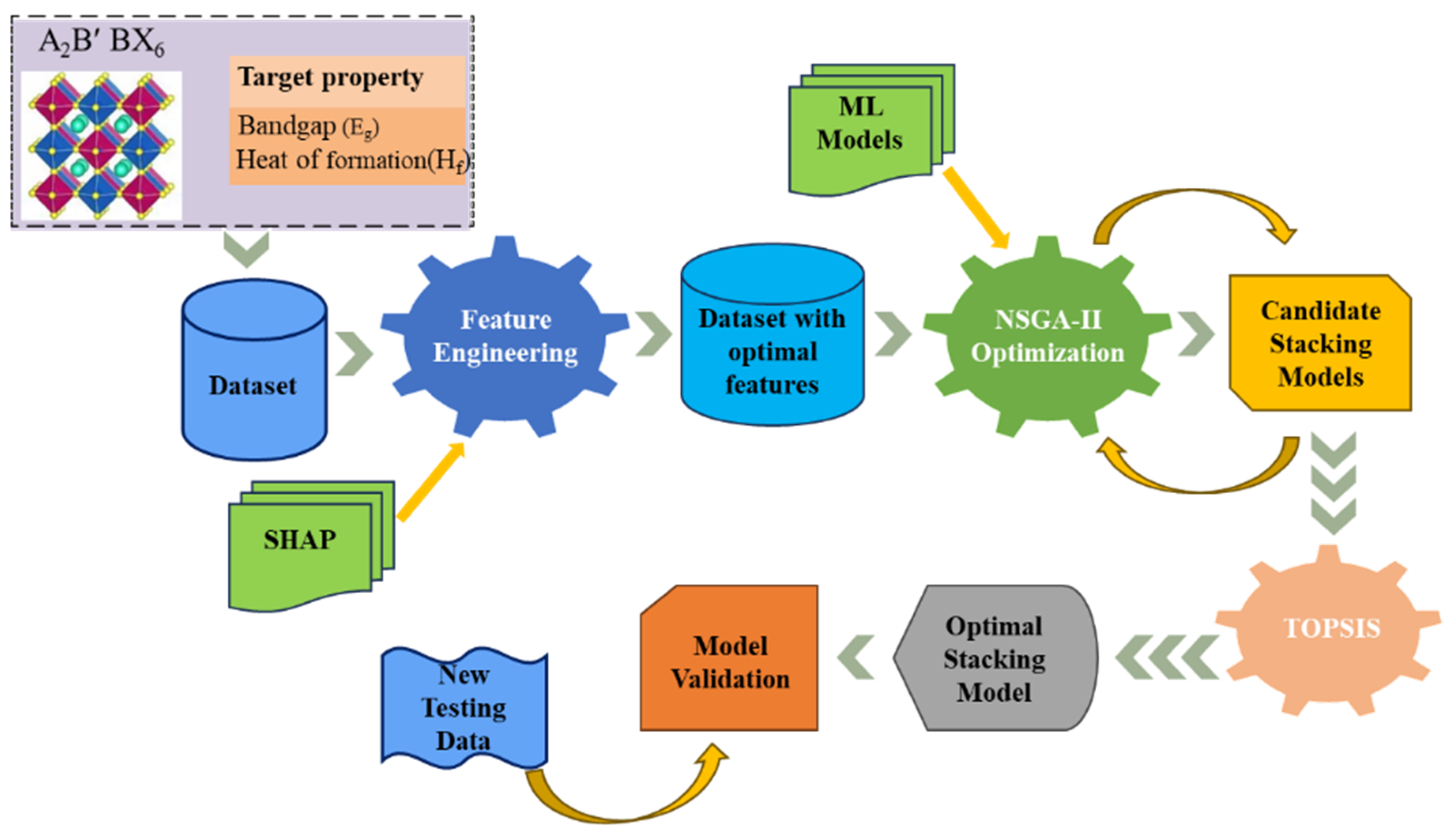
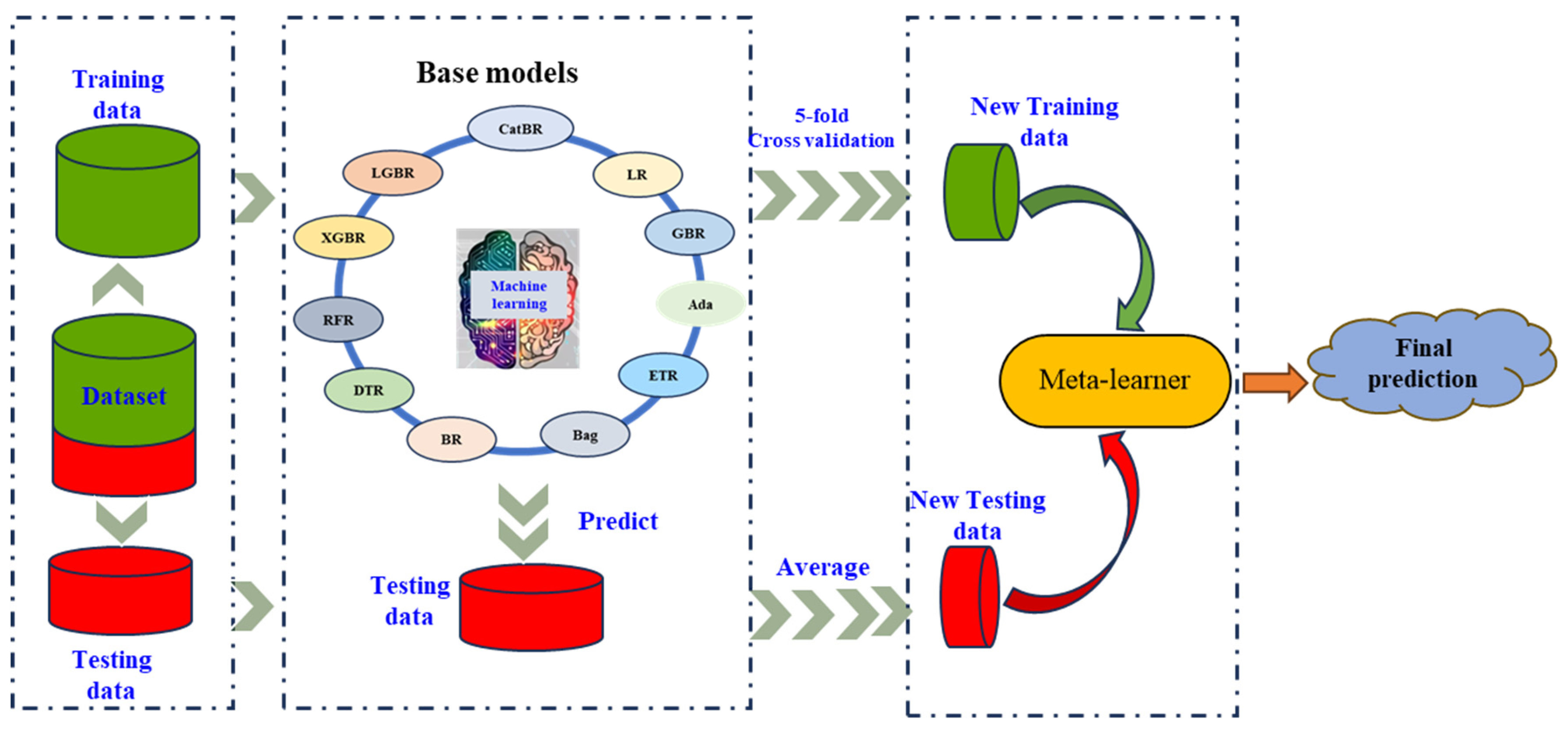
The remainder of this paper is organized as follows. Section 2 presents the methodology, including feature selection using SHAP (Section 2.1), model evaluation metrics (Section 2.2), stacking model optimization using NSGA-II (Section 2.3), and optimal model selection using TOPSIS (Section 2.4). Section 3 describes the experimental setup, covering the dataset (Section 3.1), input features and feature selection (Section 3.2), and the configuration of stacking ensemble regression models (Section 3.3). Section 4 provides the results and discussion, including performance comparisons between single and stacking models (Section 4.1), stacking models with different base model combinations (Section 4.2), stacking model optimization using NSGA-II and TOPSIS (Section 4.3), and model validation on a completely new test dataset (Section 4.4). Finally, Section 5 concludes the study with a summary of key findings and its limitations. And the optimal stacking model selected from the Pareto solutions by TOPSIS was validated on a new test dataset. Finally, a brief conclusion is given. The overall workflow of the proposed method is shown in Figure 1.

2. Methodology

2.1. Feature Selection with Shapley Additive exPlanations (SHAP)

SHAP proposed by Lundberg et al. [44], has been a popular tool used to interpret ML models with Shapley values in material science [45,46,47], including perovskites [48,49,50]. Unlike traditional feature selection methods [51,52,53], the SHAP method can deal with two strongly correlated features [10], and feature importance evaluated by SHAP value can satisfy consistency for each prediction process [4]. And the SHAP value can be used as a reliable property for feature attribution value comparison, making comparisons meaningful [54].
To identify the most predictive features for halide double perovskite properties, we applied the SHAP method following the approach established in our prior work [49]. As described in [49], SHAP is an additive feature attribution approach that decomposes the output of a ML model into the sum of contributions from each input feature, and it is approximated by a linear explanation model g formulated in Equation (1):
g z =   φ 0 + i = 1 M φ i z i
where z { 0,1 } M , indicates whether a feature is included ( z i = 1 ) or excluded ( z i = 0 ) from the model, M is the total number of input features, φ 0   represents the expected value when all inputs are missing, and φ i is the contribution value of a given feature i to the model presented in Equation (2).
φ i = S F i S ! F S 1 ! F ! f S i x S i f S x S
where F is the set of all features, x S represents the values of the input features in the set S. f is the original prediction model to be explained.
In this study, SHAP values were computed based on the optimal stacking models for Eg and ΔHf prediction. Features (shown in Figure 2a) were ranked based on their feature importance values measured by their SHAP values, and the selected features were retained for subsequent experiments. The global feature importance rankings and local SHAP are visualized in Figure 3a–d.

2.2. Model Evaluation

The performance of the regression models was evaluated using four metrics: mean squared error (MSE), root mean squared error (RMSE), mean absolute error (MAE), and coefficient of determination(R2). These metrics are defined in Equations (3)–(6), respectively.
M S E = 1 n i = 1 n ( y ^ i y i ) 2
R M S E = 1 n i = 1 n ( y ^ i y i ) 2
M A E = 1 n i = 1 n | y i y ^ i | 2
R 2 = 1 i = 1 n | y i y ^ i | 2 i = 1 n | y i y ¯ | 2
where n is the number of samples, y ¯ is the averaged value of actual values, y ^ i and y i   represent the predicted value and the actual value of the i t h sample, respectively. The regression performance of the models was evaluated using MSE, RMSE, MAE, and R2. These metrics served as the optimization objectives for the NSGA-II algorithm to identify the optimal meta-learner and combination of base models for constructing an ensemble stacking model with high performance. NSGA-II generates a Pareto front of non-dominated solutions, from which the final solution was selected using the Technique for Order Preference by Similarity to Ideal Solution (TOPSIS).

2.3. NSGA-II for Stacking Model Optimization with

The optimization objectives of NSGA-II are defined with the averaged values of MSE, RMSE, MAE, and R2, which are obtained from the stacking models through 40 iterations of five-fold cross-validation, along with the number of base models (Nbase) contained in each stacking model. Accordingly, the five optimization objectives of NSGA-II are expressed as:
                                                  M i n i m i z e             f 1 = M S E ¯ = 1 40 i = 1 40 M S E i                                                               M i n i m i z e             f 2 = R M S E ¯ = 1 40 i = 1 40 R M S E i                                                   M i n i m i z e             f 3 = M A E ¯ = 1 40 i = 1 40 R M S E i                                                   M a x i m i z e           f 4 =   R 2 ¯ = 1 40 i = 1 40 R 2 i                 M i n i m i z e             f 5 = N b a s e                  
The output of NSGA-II is a Pareto front, which contains a set of candidate solutions consisting of different stacking models. And it is difficult to directly determine the optimal solution.

2.4. TOPSIS for Optimal Stacking Model Selection

To effectively select the optimal stacking model for the candidate solutions in the Pareto front generated by NSGA-II, the entropy-weighted TOPSIS method was employed [55]. The decision criteria consisted of Nbase in the stacking ensemble, along with the average values of MSE, RMSE, MAE, and R2. Among these, Nbase, MSE, RMSE, and MAE were designated as cost criteria (lower is better), while R2 was designated as a benefit criterion (higher is better). The implementation strictly adhered to the standard TOPSIS procedure detailed in [55], and the model with the maximum relative closeness to the ideal solution was selected as the optimal solution for constructing the optimal stacking ensemble model, which defines the optimal meta-learner and base model combination, thereby constructing the final stacking ensemble model.
Assuming that the Pareto front comprises m candidate stacking models, and NSGA-II is formulated with n optimization objectives. As illustrated in [55], the decision matrix is constructed as follows:
X = x 11 x 12 x 1 n x 21 x 22 x 2 n x m 1 x m 2 x m n
where x i j denotes the value of the i-th model with respect to the j-th objective. And the normalized decision matrix Z = ( z i j )m×n can be constructed from matrix X = ( x i j )m×n using Equation (9):
z i j = x i j i = 1 m x i j 2
The weights of the objectives are calculated with the entropy weight method. Specifically, the weight w j of the j-th objective is derived from the proportion p i j of the i-th model with respect to the j-th objective and the information entropy e j   of the j-th objective. They can be determined by Equation (10) as follows:
p i j = z i j i = 1 m z i j ,     e j = 1 l n m i = 1 m p i j l n p i j ,       w j = 1 e j j = 1 n d j
Subsequently, the weighted normalized decision matrix V = (vij)m×n is constructed, where vij = wjzij, as presented below:
V = Z · W = w 1 z 11 w 2 z 12 w n z 1 n w 1 z 21 w 2 z 22 w n z 2 n w 1 z m 1 w 2 z m 2 w n z m n
The positive ideal solution V + and the negative ideal solution V were subsequently determined as the best and worst values across all candidate solutions for each objective, respectively. Specifically, V + = v 1 + , v 2 + , , v n + , where v j + = m a x v 1 j , v 2 j , , v m j . And V = v 1 , v 2 , , v n , where v j = m i n v 1 j , v 2 j , , v m j . The Euclidean distances from each solution to the positive and negative ideal solutions, denoted as D i + and D i , respectively, were then calculated using Equations (12) and (13).
D i + = j = 1 n v i j v j + 2
D i = j = 1 n v i j v j 2
The closeness degree of each solution is calculated with D i + and D i expressed in Equation (14):
C i = D i D i + + D i ,   C i   [ 0 ,   1 ]
The solution in the Parato front with higher closeness indicates it has better performance. The candidate stacking models are then ranked in descending order of Ci, and the model with the highest Ci is selected as the optimal stacking model.

3. Experimental Data and Model Construction

3.1. Dataset

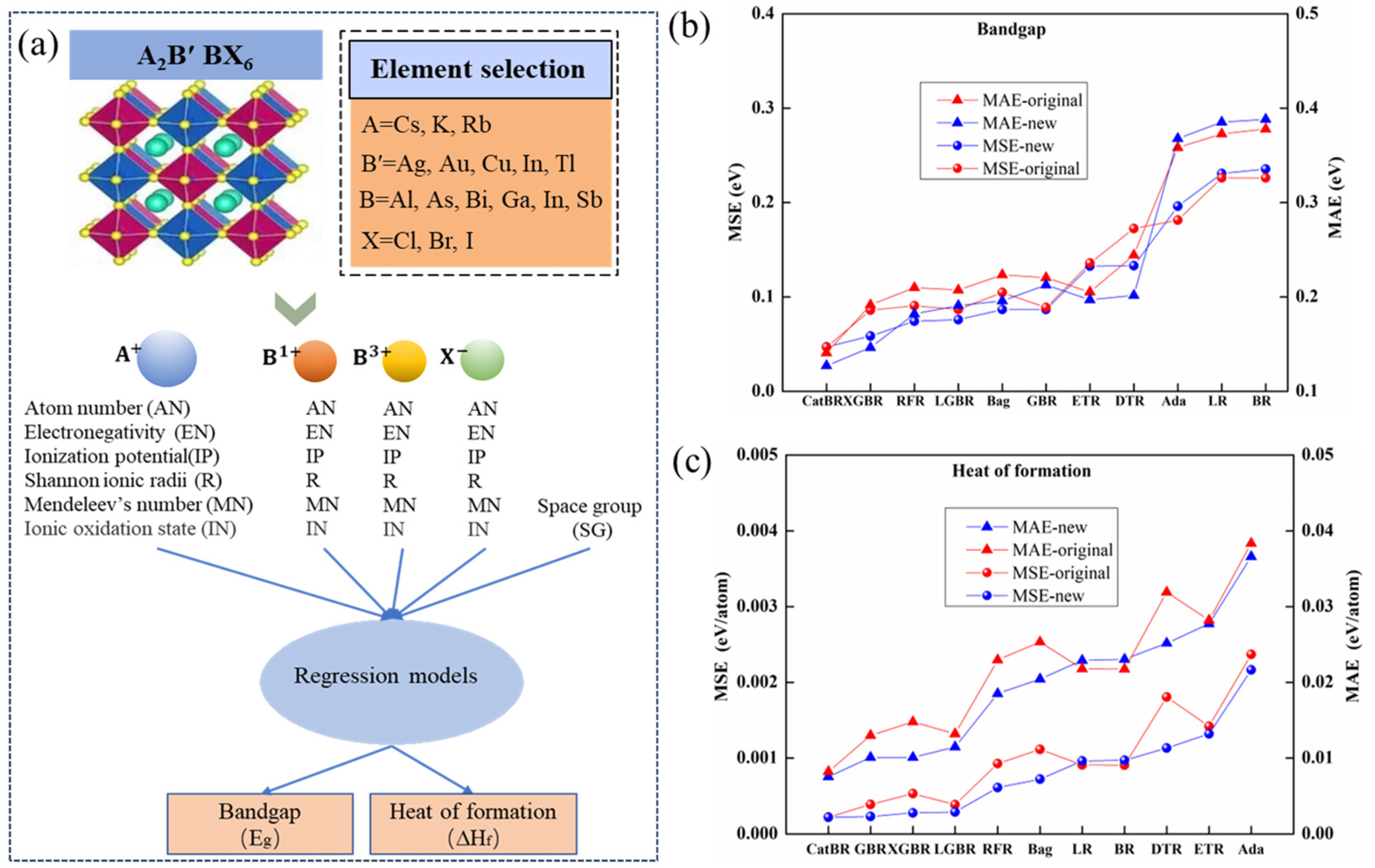
The dataset for ML models in this study comprised 540 compounds of Pb-free double halide perovskites in the Supporting Information of earlier work [10], which were generated by high-throughput calculations based on DFT with the crystal structure of A2B′ BX6. Each compound contains 32 features named the original feature set, and some of them are obtained from DFT, making it difficult to apply to a new dataset of halide double perovskites. The heat of formation (ΔHf) values in this dataset are taken directly from [7] and reported in eV/atom—a common unit in DFT calculations (1 eV/atom = 96.485 kJ/mol).To overcome this difficulty, we constructed a new feature set that can be easily collected from accessible existing accessible tables (e.g., periodic table, Shannon ionic radii table and Mendeleev number table), which are shown in Figure 2a.

3.2. Input Features and Feature Selection

3.2.1. Original Feature Set and New Constructed Feature Set

The accuracy of ML models partly depends on the input features [10,17,18,56,57]. Each perovskite compound in the dataset can be described by both elemental and structural features [19]. For halide double halide perovskites with A2B′ BX6 structure, it is known that input features consisting of Shannon ionic radii, atomic number, Mendeleev number, Pauling electronegativity, and ionization potential of A+, B′+, B3+, X site atoms have excellent performance on predicting thermodynamic stability of A2B′ BX6 double halide perovskites [49]. Since the space group (SG) information of the crystal is significant for bandgap and heat of formation, we continued to use SG from the dataset provided in the previous work [10], which only considers two crystal space groups, including cubic and orthorhombic. All input features used for prediction, named as the new feature set here, are shown in Figure 2a.
It is well known that the non-linear model generally achieves better performance than the linear model, and the tree-based model can provide more accurate predictions than other traditional models [58]. To compare performance of the newly proposed feature set with that of the original feature set, here we employed nine tree-base ML models for predicting bandgap (Eg) and heat of information (ΔHf) based on original feature set and new proposed feature set, which includes Cat Boosting Regressor (CatBR) [59,60], eXtreme Gradient Boosting Regression (XGBR) [61], Random Forest Regressor (RFR) [62], Bagging Regressor (Bag) [63], Extra-Tree Regressor (ETR) [64], Gradient-Boosting Regressor (GBR) [60], Light Gradient Boosting Machine Regression (LGBR) [65], Decision Tree Regressor (DTR) [66], and AdaBoost (Ada) [67]. Together with another two simpler models, including Linear Regression (LR) and Bayesian Ridge (BR), simpler models have better ability to prevent overfitting [30]. The prediction results for Eg and ΔHf from eleven individual regression models based on different feature sets can also be presented in Figure 2b and Figure 2c, respectively.
As shown in Figure 2b,c, most of the regression models with the new feature set can reach better performance for both Eg and ΔHf, in terms of averaged MAE and averaged MSE on the testing set via five-fold cross-validation repeated 40 times with different random states for dataset splitting. For Eg prediction (Figure 2b), there are notable differences in MSE and MAE between the original feature set and the new feature set. Taking CatBR, the best-performing model, as an example, the MSE and MAE based on the original feature set are 0.0470 eV and 0.1407 eV, respectively, while those based on the new proposed feature set were 0.0468 eV and 0.1272 eV, respectively. For ΔHf prediction (Figure 2c), although the error gaps between the two feature sets are narrower, the new feature set still yielded improvements: the MAE decreased from 0.008217 eV/atom to 0.007549 eV/atom, and the MSE decreased from 0.000221 eV/atom to 0.000219 eV/atom. These results consistently demonstrate the superiority of the new feature set over the original one. Therefore, all subsequent experiments and discussions in this study are based on the proposed new feature set.

3.2.2. Feature Selection by SHAP

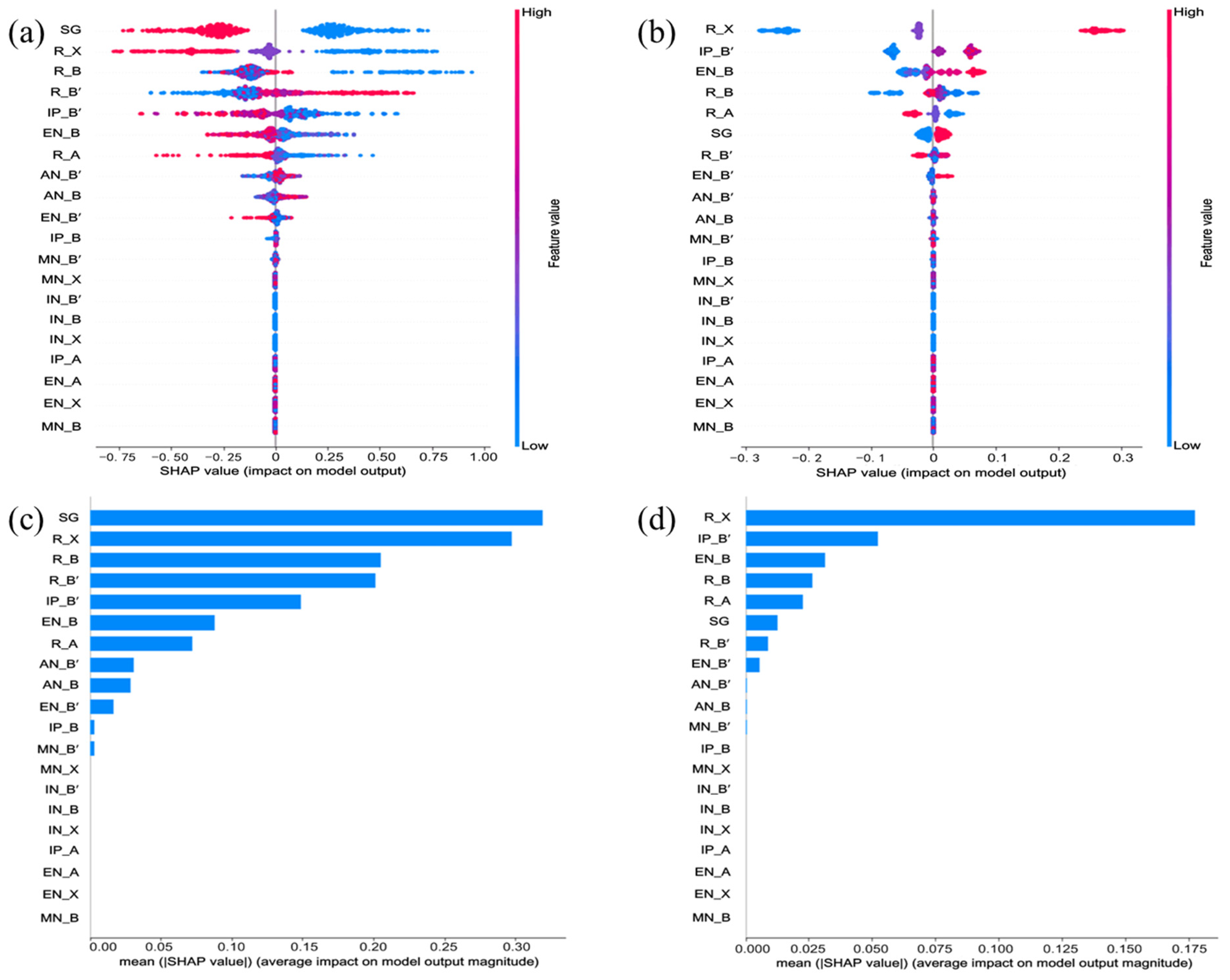
In this study, we employed the SHAP value to evaluate the importance of features in the original feature set and the new feature set, respectively. The top 20 features ranked by SHAP values of the new feature set to predict Eg and ΔHf are shown in Figure 3.
As shown in Figure 3, the top five features for Eg prediction are space group (SG) of crystal, R_X, R_B, R_B’ and IP_B’, while those for ΔHf prediction are R_X, IP_B’, EN_B, R_B and R_A. Notably, SG ranks as the most important feature for Eg prediction but drops to sixth place for ΔHf prediction. In contrast, several features—IN_A, IN_B’, IN_B and IN_X exhibit no importance for either target property, as they take constant values across all compounds in the dataset. Furthermore, SG emerges as the most import features for predicting Eg for halide double perovskites. In contrast to predicting ΔHf, the Shannon ionic radii of halogen anion (R_X) attain the highest importance score, followed by the ionization potential for B’+ (IP_B’) and electronegativity for B3+ (EN_B).
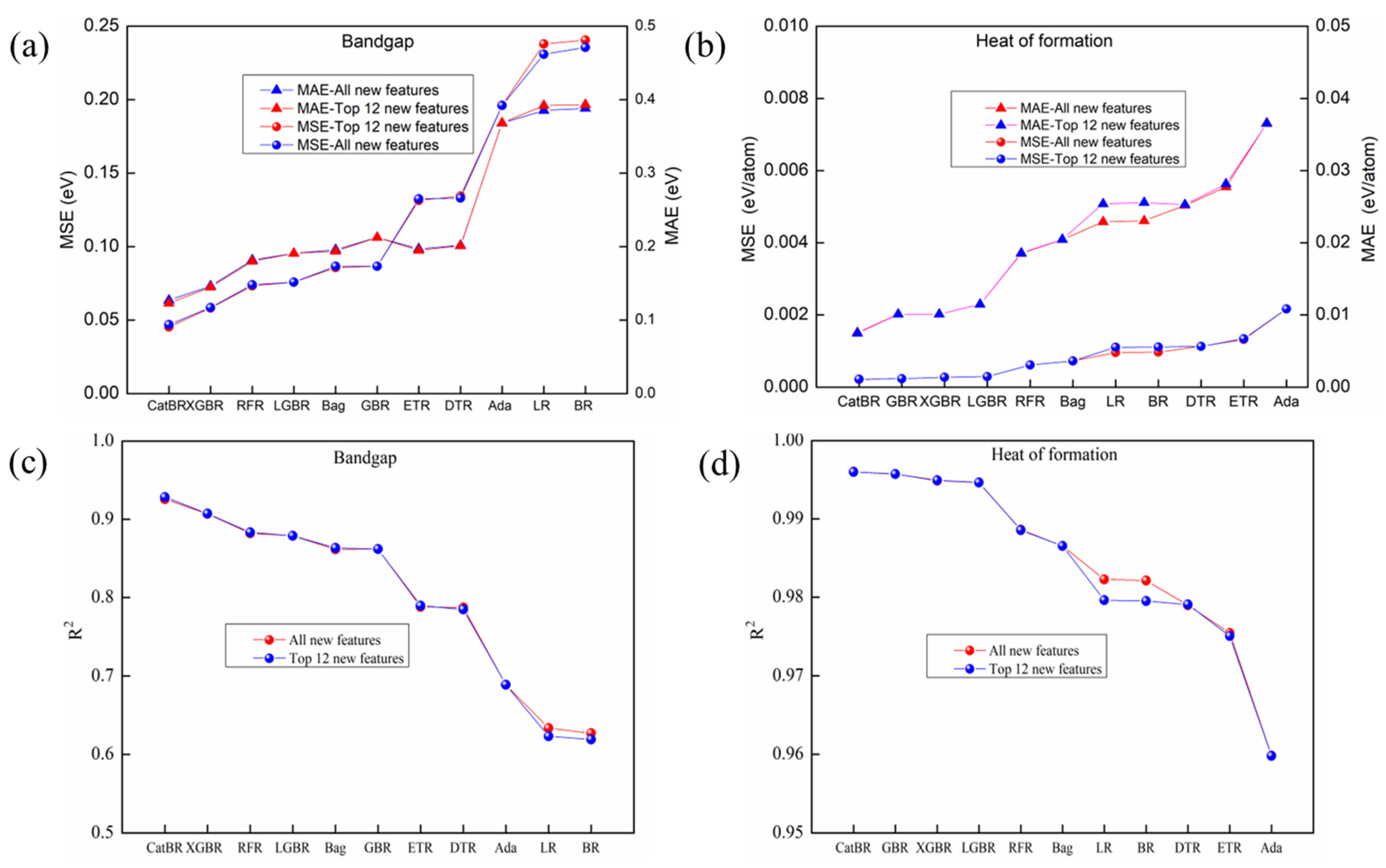
The prediction results, shown in Figure 4, show almost no degradation in performance for either Eg or ΔHf prediction when using the top 12 features selected by SHAP values compared to using all 25 features. This finding provides strong evidence that SHAP values serve as an effective method for feature selection.
Furthermore, except for the input features, the abilities of different ML models are different, with a significant influence on the prediction results. That ML model with higher prediction for Eg and ΔHf can greatly improve the capabilities of screening the most potential stable double halide perovskite from large chemical space for suitable applications. It is necessary to explore more accurate, effective hybrid models to achieve this goal. Since it has been proven that ensemble stacking models can generate better predictive performances, which has been widely used in various applications [28,29,30,68,69]. Therefore, we further employed an ensemble stacking model for predicting Eg and ΔHf of halide double perovskites in the following sections.

3.3. Stacking Ensemble Regression Model

Ensemble stacking is an advanced meta-learning algorithm designed to enhance predictive performance by combining multiple heterogeneous regression models, which consists of two layers. In the first layer, a diverse set of base models (e.g., CatBR, XGBR, RFR, LGBR) is trained independently on the original dataset to capture complementary patterns and relationships within the data. The predictions generated by these base models are then used as input features for the meta-learner in the second layer. Except for 11 models mentioned above, including CatBR, XGBR, RFR, LGBR, Bag, GBR, ETR, DTR, Ada, LR, BR, SVR model with the kernel of Radial Basis Function (SVR) usually performs well in the regression case, and it has also been widely used in perovskite material [70,71,72]. Hence, we also applied SVR in this work. In order to facilitate use and modeling, default parameters are used for both the single model and the combined model [73]. All single regression models used in this study are listed in Table 1. These single models have become candidate models for base models and a meta-learner used to construct a stacking model. The stacking model optimization is used to select the optimal combination of base models and a meta-learner to construct the optimal stacking model for higher prediction accuracy. The workflow of stacking model optimization with 5-fold cross-validation for predicting Eg and ΔHf for halide double perovskite is shown in Figure 5.
In Figure 5, the dataset with input features optimized by the SHAP value employed in feature engineering was randomly split into two parts, including a training dataset and a testing dataset, both of which consisted of input features (viz. training data and testing data) and outputs (viz. training data label and testing data label). The training data was used to train twelve base models of the stacking model under 5-fold cross-validation to avoid overfitting [30]. The outputs of single models were used to construct new features from new training data as input to train the meta-learner, and the well-trained meta-learner was applied to predict new testing data with new features consisting of the averaged prediction results of the testing data. The final prediction was generated by the trained meta-leaner. And performances of different stacking models were measured by four metrics discussed in Equations (3)–(6) in Section 2.2.

4. Results and Discussion

In our study, all single ML models were implemented using the scikit-learn library in Python [74] (version 3.9.5). The test platform was a laptop equipped with Intel (R) Core (TM) i7-1165G7 CPU and 16G RAM. It also needs to be noted that all the results discussed below were measured by the averaged MAE, MSE and R2 according to 40 runs of 5-fold cross validation with 80% as training set and the rest of dataset as the testing set based on the 40 different random state, taking top 12 features selected by SHAP value as input, which were showed in Figure 4a for Eg prediction and Figure 4b for ΔHf prediction.

4.1. Performance Comparisons Between Single Models and Stacking Models

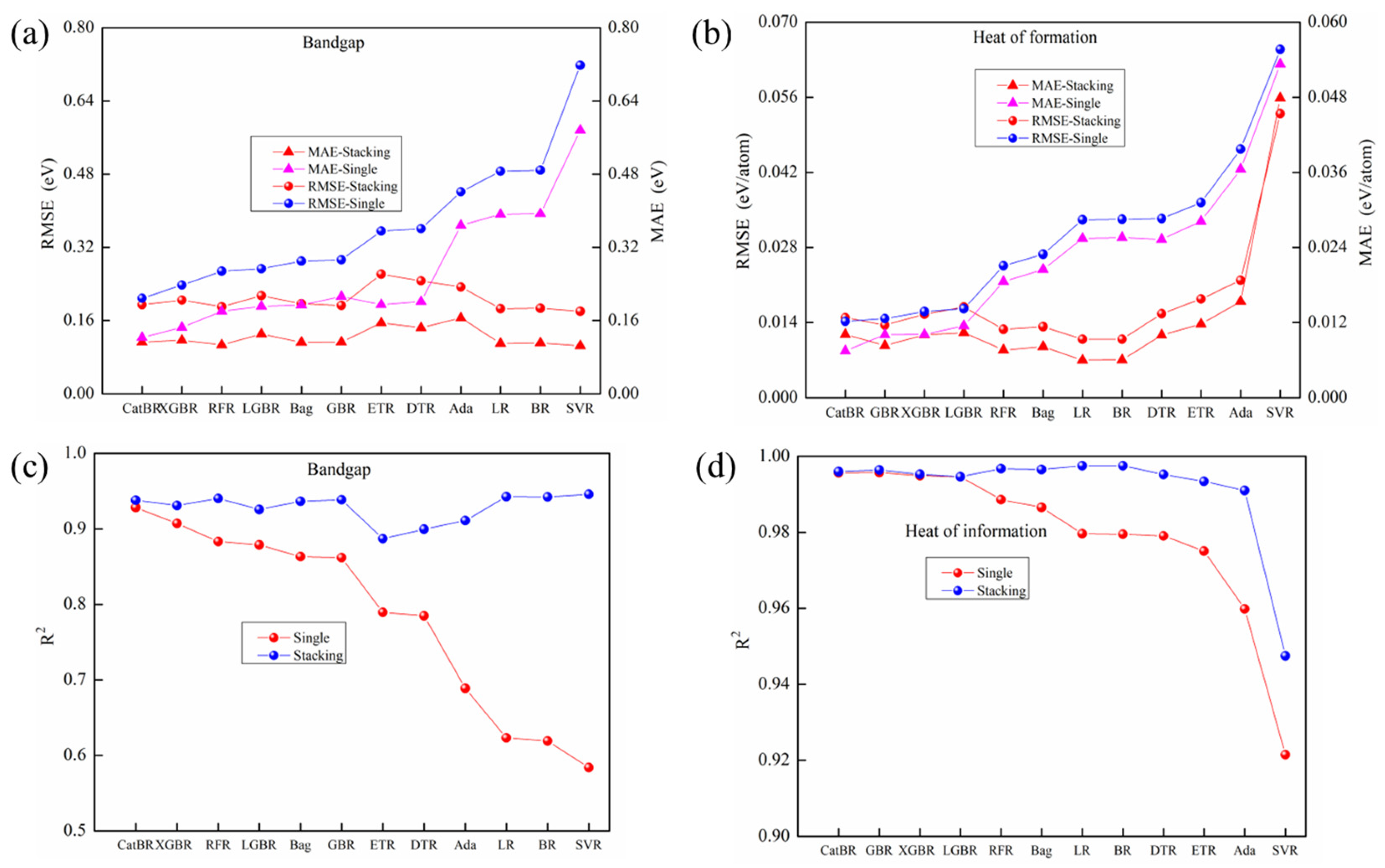
The results of regression models were averaged from 40 runs of 5-fold cross-validation for twelve single models (CatBR, XGBR, RFR, LGBR Bag, GBR, ETR, DTR, Ada, LR, BR and SVR) and twelve stacking models with twelve single models as base models with different meta-learners, which are marked on the horizontal axis shown in Figure 6. CatBR model yields the lowest values of MAE and RMSE among all the single models for both Eg (MAE with 0.1230 eV, RMSE with 0.2091 eV and R2 with 0.9282) and ΔHf (MAE with 0.0075 eV/atom, RMSE with 0.0142 eV/atom and R2 with 0.9957), which is much lower than that reported in [10] calculated by the GBR model with 32 features obtained from DFT, with an averaged RMSE of 0.223 eV for Eg prediction, and an averaged RMSE of 0.021 eV/atom for ΔHf prediction, achieving an improvement with 6.65% and 47.89%, respectively. However, they are inferior to almost all stacking models except for the stacking model with the LGBR model as the meta-learner, with slightly worse RMSE and R2 for ΔHf prediction.
Furthermore, although the difference between different stacking models lies only in the meta model, there are significant differences in the performance of different stacking models. For Eg prediction, the stacking models with SVR as meta-learner can achieve the best performance in Eg prediction with the smallest MAE (0.1050 eV) and RMSE (0.1803 eV), highest R2 (0.9459), while the stacking model with the worst performance is the one with ETR as its meta-learner, with the highest MAE (0.1551 eV) and RMSE (0.2614 eV), lowest R2 (0.8871). Compared to CatBR, the best single model, the improvement percentage in RMSE and MAE of the stacking model with SVR as the meta-learner can reach 13.76% and 14.62%, while the improvement percentage in R2 is only 1.91%. More details concerning the performance comparison in Eg prediction can be seen in Table 2.
For ΔHf prediction, stacking models with LR as the meta-learner can achieve the best performance with the smallest MAE (0.0060 eV/atom) and RMSE (0.0109 eV/atom) and the highest R2 (0.9975). Meanwhile, the worst stacking model is the one with Ada as its meta-learner, with the highest MAE (0.01569 eV/atom) and RMSE (0.02223 eV/atom), lowest R2 (0.99074). Compared to the best single model CatBR, the improvement percentage in RMSE and MAE to the stacking model with LR as the meta-learner can reach 23.35% and 19.79%, while the improvement percentage in R2 is only 0.17%. More details concerning the performance comparison in ΔHf prediction can be seen in Table 3.
In summary, in both Eg prediction and ΔHf prediction, the selection of the meta-learner for stacking models has a significant impact on the prediction performances of the stacking model. Although CatBR can achieve the best performance in both Eg and ΔHf prediction among other single models, when using CatBR as the meta-learner for the stacking model in Eg prediction, its predictive performance is not as good as the stacking models with RFR, BR, LR, and SVR as the meta-models, respectively. This phenomenon also exists in ΔHf prediction; when CatBR is used as the meta-learner of the stacking model, its predictive performance is not as good as the stacking models with RFR, BR, LR, and Bag as the meta-learners, respectively.
Furthermore, the predictive performance of the best stacking model with 12 single models as its base models is significantly improved compared to the best single model. It is still necessary to explore whether the combination of base models has an impact on predictive performance.

4.2. Stacking Model with Different Combinations of Base Models

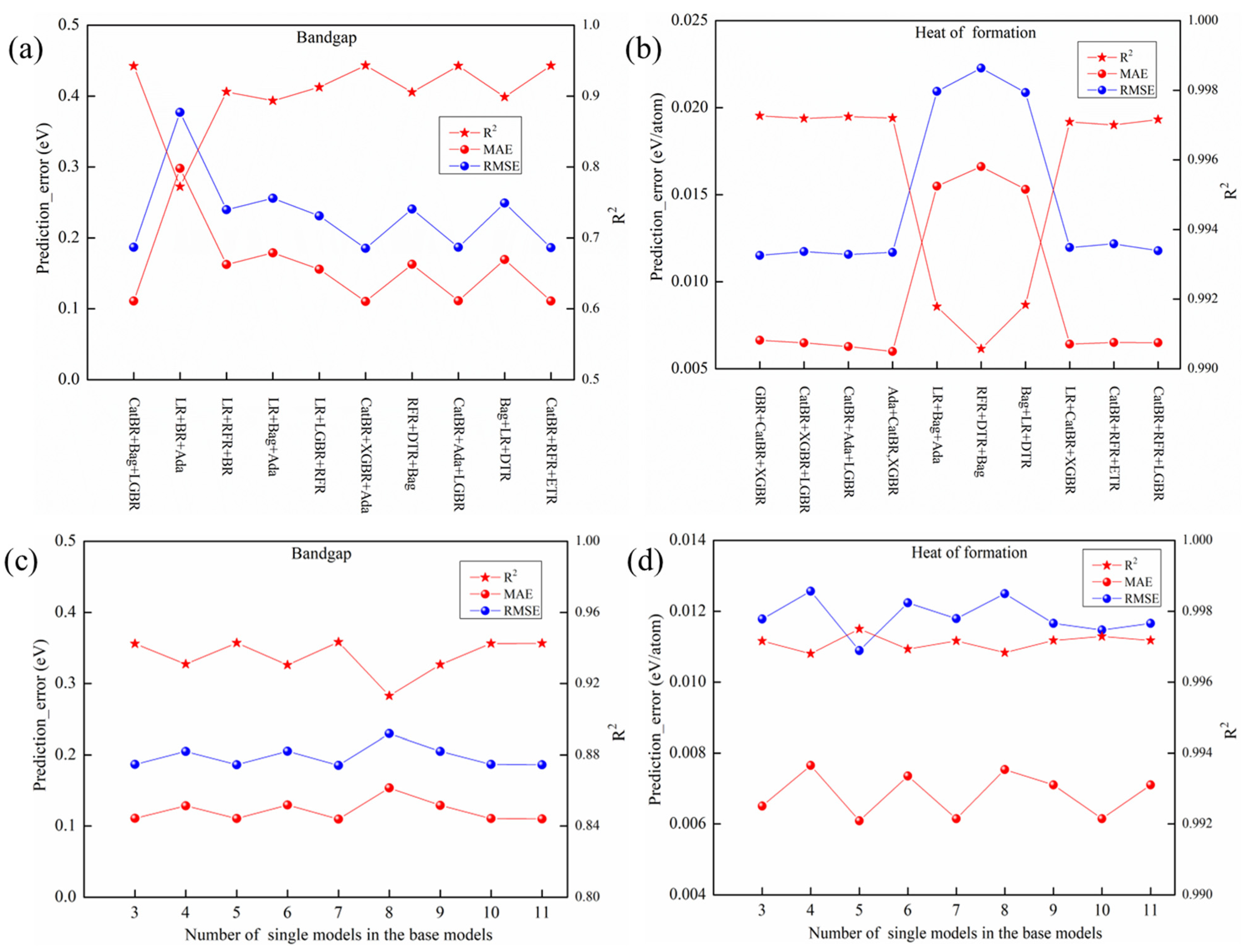
It can draw conclusions from Figure 7, which illustrates that the performances of stacking models with the same base model combination but different meta-learners vary significantly. And it clearly points out that the stacking model with twelve single models as base model and SVR as meta-learner can achieve the best performance in Eg prediction, while the stacking model with twelve single models as base model and LR as meta-learner can achieve the best performance in ΔHf prediction. Furthermore, it is essential to investigate whether stacking models with different combinations of base models exhibit performance differences, providing guidance for subsequent optimization of stacking models.
Figure 7a illustrates that the stacking models for Eg prediction with the same number of single models, while different combinations as base models also perform differently, and all of them take SVR as their meta-learner. As the number of single models used to make up the base model of the stacking models increases, the regression performances of the stacking models do not improve accordingly. The performance of the stacking models formed by the same number of base models and meta models varies depending on the combination of base models. And there are significant differences in the prediction performance of the stacking model with SVR as its meta-learner and the same number of single models, while different combinations as its base models, the value of RMSE can be varied from 0.1788 eV to 0.3694 eV, the value of MAE can be varied from 0.1039 eV to 0.2739 eV, and the value of R2 can be varied from 0.7807 to 0.9468. The stacking model, which employs only CatBoost, Bagging, and LightGBM (marked as CatBR + Bag + LGBR) as base learners with SVR as meta-learner, achieved slightly superior performance to the full ensemble of twelve base models. Specifically, it reduced the MAE from 0.1050 eV to 0.1039 eV and the RMSE from 0.1803 eV to 0.1788 eV, while increasing R2 from 0.9459 to 0.9468. Critically, this near-equivalent performance was attained using only three base models instead of twelve. This dramatic reduction in model complexity, coupled with the observed marginal performance gains, underscores the necessity and potential value of systematically optimizing the combination of both base learners and the meta-learner in stacking frameworks.
For ΔHf prediction (Figure 7b), a contrasting yet insightful trend is observed: a stacking model with only three base models (marked as GBR + CatBR + XGBR) and an LR meta-learner delivers nearly equivalent performance (MAE = 0.00664 eV/atom, RMSE = 0.01151 eV/atom, R2 = 0.99727) to the all twelve-model ensemble (MAE = 0.00600 eV/atom, RMSE = 0.01090 eV/atom, R2 = 0.99750), despite a 75% reduction in base models. This demonstrates it needs further research into optimal base-model and meta-model composition strategies.
Furthermore, to systematically investigate the relationship between the number of base learners and the regression performance of the stacking ensemble, we constructed multiple stacking variants by incrementally increasing the count of constituent base models. For the Eg prediction task (Figure 7c), SVR served as the meta-learner, while Linear Regression (LR) was used for the ΔHf prediction task (Figure 7d). The experimental results clearly demonstrate that predictive performance does not monotonically improve with an increase in the number of base models.
This trend is explicitly illustrated in Figure 7c,d. For the Eg prediction (Figure 7c), as the number of single models used to construct the base models of stacking ensembles increases—through random combinations of the single models listed in Table 1—the predictive performance of the stacking models does not improve correspondingly. Instead, it exhibits irregular fluctuations. Similarly, for the ΔHf prediction (Figure 7d), increasing the ensemble size leads to fluctuating performance without a clear positive trend. The complete specifications of the base model combinations for each stacking configuration and their associated test set performance (based on 40 runs of 5-fold cross-validation) are provided in Supplementary Tables S1 and S2.

4.3. Stacking Model Optimization with NSGA-II +TOPSIS

Due to the limited combinations of base models considered, it is difficult to identify the optimal stacking model using conventional approaches. Therefore, a more convenient optimization method is required that can incorporate a broad range of combinations of base models and meta-models. In this study, NSGA-II implemented via the DEAP library was employed for stacking model optimization, which simultaneously considers the number of base models (Nbase) in stacking models and the averaged values of MSE, RMSE, MAE, and R2 through 40 iterations of five-fold cross-validation, and it yields optimal results in the form of a Pareto front containing multiple non-dominated solutions. Subsequently, TOPSIS was utilized to select the best solution from the Pareto front, and the optimal stacking model was identified based on the closeness degree calculated using Equation (14).
The NSGA-II algorithm is executed with a specific set of parameters to evolve a population of solutions, as shown in Table 4. The population is initialized with 20 individuals, and the algorithm runs for 20 generations to iteratively improve this population. The evolutionary process is guided by a crossover probability of 0.8, and the mutation probability is set to 0.2. The performance of the individual stacking model is evaluated with the averaged MSE, RMSE, MAE and R2, which are obtained from 40 runs of 5-fold validation, and they are treated as fitness values during the evaluation process. After the evolutionary process completes, the best-performing individual is selected from the final population, decoded into its constituent base models and meta-model. The NSGA-II algorithm is employed to identify a set of Pareto-optimal solutions, known as the Pareto front, rather than a single optimum.
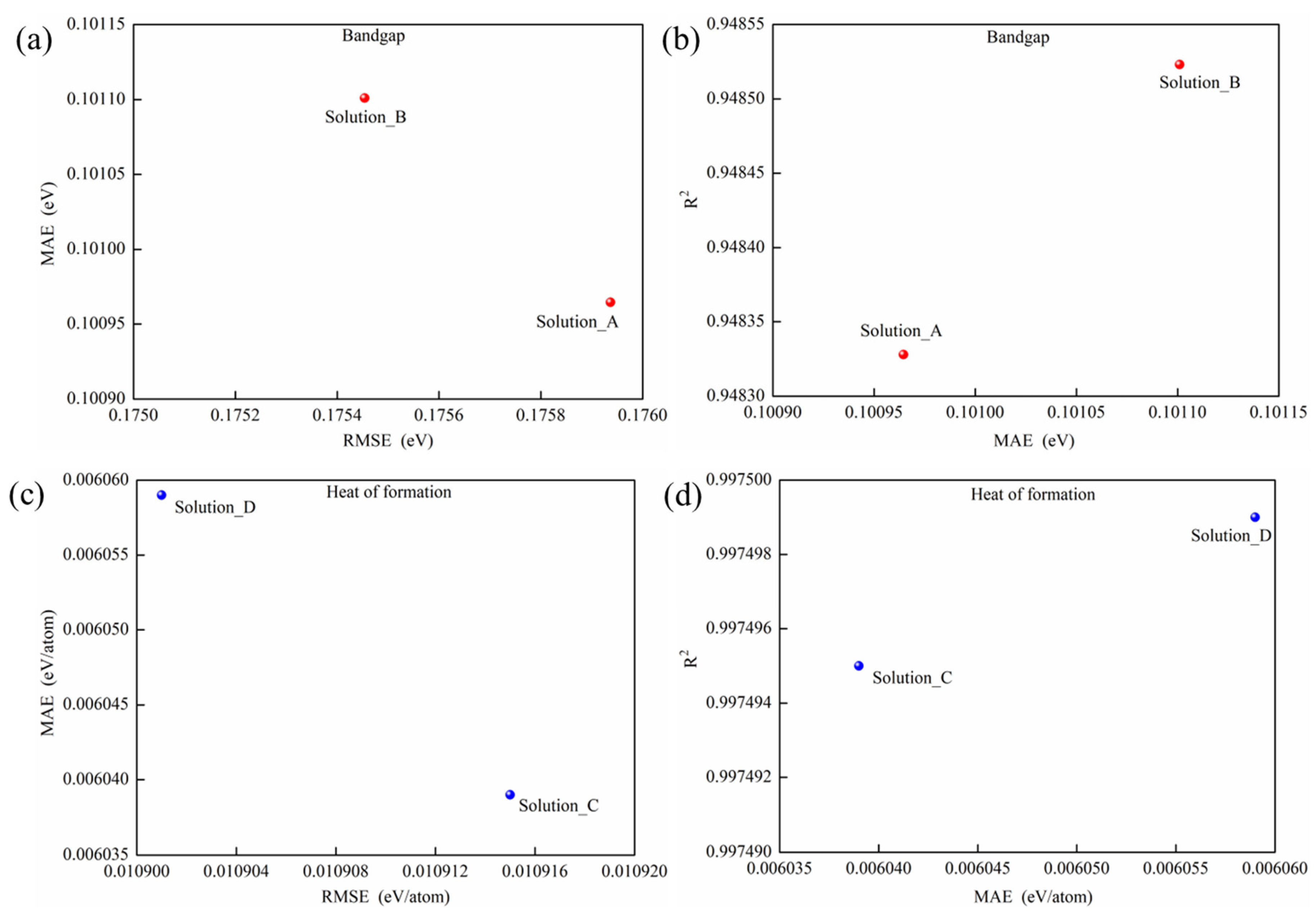
It is well known that the optimization results obtained from the NSGA-II algorithm constitute a set of Pareto-optimal solutions rather than a single optimum. In this study, separate NSGA-II runs were configured with 20 generations to optimize the stacking ensembles for bandgap (Eg) and heat of formation (ΔHf) prediction, respectively. Each optimization yielded a set of 20 Pareto-optimal solutions, and the consistent convergence behavior observed in the NSGA-II optimizations is illustrated in Figure 8.
As shown in Figure 8, the Pareto solutions for both Eg and ΔHf prediction are heavily concentrated on two stacking models. For Eg prediction, the averaged RMSE of Solution_B is lower than that of Solution_A, whereas the MAE of Solution_A is lower than that of Solution_B (Figure 8a), and the R2 of Solution_B is higher than that of Solution_A (Figure 8b). For ΔHf prediction, the averaged RMSE of Solution_D is lower than that of Solution_C, whereas the MAE of Solution_C is lower than that of Solution_D (Figure 8c), and the R2 of Solution_D is higher than that of Solution_C (Figure 8d). More detailed information on the Pareto solutions is presented in Table 5.
As shown in Figure 8 and Table 5, it is difficult to distinguish which solution is the optimal one. Thereby, TOPSIS is employed for selecting the optimal stacking model from the Pareto solutions by calculating the closeness degree (C_I) of each solution, which simultaneously takes five metrics (averaged MSE, RMSE, MAE, R2 and the number of base models) into consideration, and considers the number of individual models that comprise the base model of the stacking model. And the weights of them can be calculated with Equation (10), respectively. And the results calculated by TOPSIS can also be seen in Table 5.
As summarized in Table 5a, the optimal stacking model selected by TOPSIS for Eg prediction is the Solution_B with a closeness degree of 0.6441, which consists of four base models—CatBR, RFR, GBR, ETR, and employs SVR with a radial basis function (RBF) kernel as the meta-learner. The optimized model achieved the lowest averaged MSE of 0.0323 eV2, RMSE of 0.1755 eV, MAE of 0.1011 eV, and R2 of 0.9485. Compared to the best unoptimized stacking model (comprising 12 base models), the optimized model yielded improvements of 5.02%, 2.70%, 3.72% and 0.28% in MSE, RMSE, MAE and R2, respectively. Notably, the number of base models was substantially reduced from 12 to 4 after optimization. A detailed performance comparison between unoptimized and optimized stacking models for Eg prediction is presented in Table 6.
In terms of ΔHf prediction in Table 5b, Solution_D was identified as the optimal stacking model by TOPSIS with a closeness degree of 0.9553. This model consists of six base models—CatBR, XGBR, Bag, GBR, Ada and LGBR and uses BR as the meta-learner. Compared to the unoptimized model, the optimized model achieved averaged values of 0.000136, 0.010901, 0.006059 and 0.997499 for MSE, RMSE, MAE and R2, respectively, exhibiting improvements of 0%, 0.06%, 0.8% and 0.0005% in the respective metrics. Furthermore, the number of base models decreased sharply from 12 to 6. Performance comparison of unoptimized and optimized stacking models for ΔHf prediction is also summarized in Table 7.
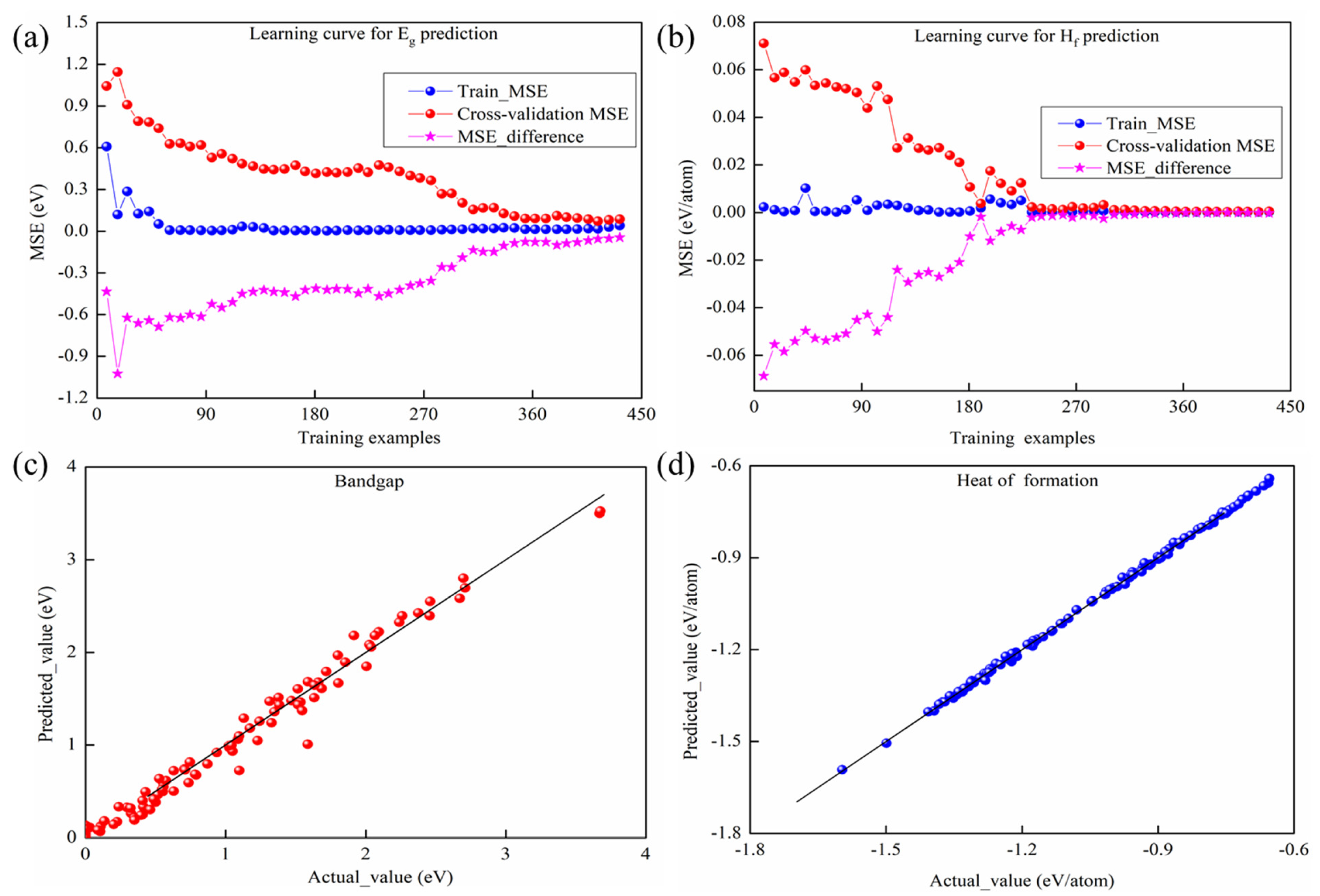
In addition, it is necessary to verify whether an overfitting problem exists in the optimal stacking prediction models determined by learning curves [20]. Figure 9 illustrates the learning curves of the optimal stacking models for Eg prediction (Figure 9a) and for ΔHf prediction (Figure 9b), depicting the relationship between the number of training samples and the proposed model’s performance. With the increase in training samples, both the Train-MSE and Cross-validation MSE show a decreasing trend and converge to their minimum values when the training size is approximate to 80%, and the gap between them narrows to near zero, as shown by the MSE_difference curve, confirming the proposed models’ strong generalization ability and high predictive accuracy without overfitting.
To further validate the predictive performance of the proposed stacking models, we compared their predicted values with the actual values for Eg and ΔHf, respectively. The comparison was based on 108 compounds randomly selected from the dataset, using the top 12 features from the new feature set. For Eg prediction, the optimal stacking model employed CatBR, RFR, GBR, and ETR as base models, with SVR (RBF kernel) as the meta-learner. The predicted results are presented in Figure 9c, which are highly consistent with the actual values. In the ΔHf prediction, the predicted ΔHf values from the optimal stacking model show excellent agreement with the actual values, as shown in Figure 9d. This model employed CatBR, XGBR, Bag, GBR, Ada and LGBR as base models and LR as the meta-learner. The small deviations observed across all test samples provide compelling evidence of the model’s strong generalization capability and high predictive accuracy.

4.4. Comparison of the Optimal Stacking Model Selected by TOPSIS Versus the Optimal Model Identified by Random Search

To further validate the effectiveness of the NSGA-II optimization combined with TOPSIS selection, we compared the optimal stacking model selected by TOPSIS against the optimal model identified by 400 random searches under the same evaluation budget (each model evaluated with 40 runs of 5-fold cross-validation). Table 8 presents the comparison results for both prediction targets, split into two sub-tables for clarity due to the different units (eV for Eg, eV/atom for ΔHf).
Table 8a shows the results for Eg prediction. The TOPSIS-selected model achieves an RMSE of 0.1755 eV using only 4 base models (CatBoost, RandomForest, GradientBoosting, and ExtraTree) with SVR as the meta-learner. In contrast, the optimal model identified by random search achieves an RMSE of 0.1783 eV using 6 base models (CatBoost, XGBoost, GradientBoosting, ExtraTree, AdaBoost, and LinearRegression), also with SVR as the meta-learner. The TOPSIS-selected model yields relative improvements of 1.59% in RMSE, 2.47% in MSE, and 2.91% in MAE, while reducing the base model size by 33.33% (from 6 to 4 models).
Table 8b presents the results for ΔHf prediction. The TOPSIS-selected model achieves an RMSE of 0.010901 eV/atom using 6 base models (CatBoost, Bagging, XGBoost, GradientBoosting, AdaBoost, and LightGBM) with Bayesian Ridge as the meta-learner. The optimal random search model achieves an RMSE of 0.011119 eV/atom using 7 base models (CatBoost, Bagging, GradientBoosting, ExtraTree, AdaBoost, LightGBM, and LinearRegression) with Bayesian Ridge as the meta-learner. The TOPSIS-selected model demonstrates relative improvements of 1.96% in RMSE, 3.49% in MSE, and 5.76% in MAE, with a 14.29% reduction in base model size (from 7 to 6 models).
To confirm that the proposed NSGA-II+TOPSIS method does not lead to performance degradation, we performed one-tailed paired t-tests comparing its RMSE values against those of the optimal random search model over 40 independent cross-validation runs. For Eg prediction (Table 8a), the test yields a p-value of 0.0603; for ΔHf prediction (Table 8b), the p-value is 0.2791. Both p-values exceed the conventional significance level of 0.05, statistically confirming no performance degradation for either prediction target. These results demonstrate that NSGA-II with TOPSIS selection effectively identifies more compact stacking ensembles without sacrificing predictive performance.

4.5. Model Validation on Completely New Test Data

The training dataset contains three different A-site cations (viz. Cs, K, and Rb), five B1-site cations (viz. Tl, In, Ag, Au, and Cu) and six B2-site cations (viz. Al, Ga, Bi, In, Sb, and As). It appears on either B1- or B2-sites. The X-site has four different possible choices of F, Cl, Br, and I. And two kinds of the crystal group space were taken into consideration, which consisted of a total of 540 unique A2B′ BX6 compounds in the chemical space. Since all possible compounds in the chemical space are included in the training dataset, we needed to find other data for model validation.
To conform the predicting ability of our proposed hybrid stacking model, we applied it to 24 new compounds in cubic crystal space excluded from the training dataset, six compounds of which contained 3 completely new elements (viz. Na+, K+, and Rb+) in B-site never appeared in the training process, and their values used in the comparison for Eg and decomposition enthalpy (ΔH) were calculated by DFT obtained from the work of Zhao et al. [75], which contains 64 compounds, of which 40 already exist in the dataset used for stacking model optimization, and the remaining 24 compounds are used as a new dataset to validate the proposed optimal stacking model. The average predicted results were depicted in Table 9.
There are 2 out of 24 compounds (viz. Cs2NaBiBr6 with 0.7174 eV, and Cs2NaBiI6 with 0.7065 eV) in the classified criteria from Im [10] within the range of [0.3 eV, 0.8 eV] according to the predicted Eg from the proposed model, indicating that they are suitable to be material for solar cells, which is not in line with the results calculated by Zhao [75], where the classified criteria for solar cells are within the range of [0.8 eV, 2 eV]. It needs to be noted that they are all within the averaged MAE of 0.1011 eV obtained by our proposed method.
In addition, the stability is also another significant property for solar cells, and they can be evaluated to be stable with negative values of ΔHf [10] or positive decomposition enthalpy [75]. From Table 9, it shows all of them are stable due to their negative values in predicting ΔHf. 4 out of 24 compounds are classified to be unstable according to the negative decomposition enthalpy (viz. Cs2KSbI6 with −3 meV/atom, Cs2KBiI6 with −4 meV/atom, Cs2RbSbI6 with −14 meV/atom, and Cs2RbBiI6 with −15 meV/atom), and the calculated values of decomposition enthalpy (ΔH) of Cs2KSbI6 and Cs2KBiI6 are very close to the stable criterions of positive decomposition enthalpy. These results proved that the proposed model can be an effective method for quickly predicting Eg and ΔHf for halide double perovskites to identify compounds with elements appearing frequently in the training dataset, obtaining compounds with suitable Eg and ΔHf for solar cells. However, it may probably not be effective for compounds with elements that are contained in the training dataset, which can lead to a conclusion consistent with that mentioned in [76]. It is worth noting that it took only a few seconds to predict all test compounds with the trained stacking model on the laptop with Intel(R) Core (TM) i7-1165G7 CPU.
The few discrepancies in Table 9 (2 for band gap, 4 for stability) are predominantly observed in compounds containing the new alkali metal ions (Na+, K+, Rb+), specifically Cs2NaBiBr6 and Cs2NaBiI6 for band gap and Cs2KSbI6, Cs2RbSbI6, Cs2KBiI6, and Cs2RbBiI6 for stability. These Bi/I-containing systems are particularly sensitive to DFT computational settings. Critically, as noted in Zhao et al. [75], their DFT calculations included spin–orbit coupling (SOC), whereas our training data from Im et al. [10] were computed using the PBE functional without SOC. It is well-established that SOC can reduce the band gaps of Bi/I-containing perovskites by 0.5–1.5 eV and alter their formation energies by 0.3–0.7 eV/atom. Consequently, the observed discrepancies are more likely attributable to these differences in DFT benchmarks rather than to a fundamental error in our model.

4.6. Generalizability to Other Perovskite Families

To evaluate the generalizability of our proposed feature set and stacking-based classification methodology, we applied them to the expanded double perovskite dataset compiled by Bartel et al. [51], which contains 918 A2B′BX6 materials including both halide and oxide compositions. This classification task enables a direct benchmark against Bartel‘s τ descriptor (91% accuracy).
As shown in Table 10, our proposed feature set combined with the optimal stacking configuration (CatBoost Classifier, Random Forest Classifier, Bagging Classifier, AdaBoost Classifier + CatBoost Classifier) identified by our framework—achieves superior performance, with an accuracy of 96.22% (±1.01%), an F1 score of 98.03% (±0.53%), and a precision of 96.89% (±0.83%) under 40 runs of 5-fold cross-validation, surpassing the 91% baseline.
These results demonstrate: (1) our feature set generalizes across perovskite families; (2) our feature selection and stacking optimization framework is versatile, effectively handling both regression and classification tasks; and (3) extension to Ruddlesden–Popper phases requires additional layer-specific descriptors (future work).

5. Conclusions

In this study, we aimed to developed a method integrated NSGA-II and TOPSIS for stacking regression model optimization, which simultaneously considered four regression metrics (MSE, MAE, RMSE and R2) and the number of base models constructed the stacking models as the five optimization targets, and it was utilized for the quantitative determination of Eg and ΔHf of 540 Pb-free halide double perovskites with new constructed feature set obtained from easily accessible tables. The experimental results have demonstrated that the newly constructed feature set has better performance than the original feature set. It indicated that the SHAP value can be an effective tool for feature selection as well. Furthermore, it also proved that the ensemble stacking model can perform better than any individual ML model in both Eg and ΔHf prediction with lower MSE and MAE for double halide perovskites with the top 12 features from the new feature set selection by SHAP values. The combination of NSGA-II and TOPSIS has performed well in the ensemble stacking model optimization. The stacking model optimized by our proposed method yields better predicting performance than the stacking regression models without optimization, with improvements in averaged MSE, RMSE, MAE and R2 with 5.02%, 2.70%, 3.72% and 0.28% in Eg prediction, respectively. And for ΔHf prediction, as its predictive accuracy was inherently high, despite only a minor performance improvement after optimization, the number of base models for the stacking model dropped sharply from 12 to 6. Finally, the proposed models were validated on completely new test data. The limitations of our study are that the prediction performance of compounds in the testing dataset with elements not contained in the training dataset will be degraded. The training dataset should be extended to contain more elements consisting of compounds in the whole chemistry space to improve the predictive ability. In addition, multi-objective optimization should be introduced to take key properties of halide double perovskite into account simultaneously for screening suitable materials for solar cells more quickly and conveniently. These will be the focus of our research in the future.

Supplementary Materials

The following supporting information can be downloaded at: https://www.mdpi.com/article/10.3390/ma19102018/s1, Table S1: The specific information of the base models of the stacking models and its corresponding performance on the test set with 40 runs of 5-fold cross-validation for Eg prediction. Table S2: The specific information of the base models of the stacking models and its corresponding performance on the test set with 40 runs of 5-fold cross-validation for Hf prediction.

Author Contributions

Conceptualization, G.L. and J.Z.; methodology, G.L.; software, G.L.; validation, G.L. and J.Z.; formal analysis, G.L.; investigation, G.L. and J.Z.; resources, G.L.; data curation, G.L.; writing—original draft preparation, G.L.; writing—review and editing, G.L.; visualization, G.L. and J.Z.; supervision, J.Z.; project administration, J.Z.; funding acquisition, G.L. and J.Z. All authors have read and agreed to the published version of the manuscript.

Funding

The authors thank the financial sponsorship from the National Natural Science Foundation of China [22439001, 22169006], the Guangxi Natural Science Foundation Program [2023AB01273], and the Guangxi Basic Ability Promotion Project for Young and Middle-Aged Teachers [2023KY0266]. The authors are grateful to the Guangxi Collaborative Innovation Center for New Energy and Materials Structure and Properties, Guilin University of Electronic Science and Technology, for its assistance in characterization and measurement.

Data Availability Statement

The original contributions presented in the study are included in the article, further inquiries can be directed to the corresponding authors.

Conflicts of Interest

The authors declare no conflicts of interest.

References

  1. Shi, Y.; Wen, J.; Wen, C.; Jiang, L.; Wu, B.; Qiu, Y.; Sa, B. Interpretable machine learning insights of power conversion efficiency for hybrid perovskites solar cells. Sol. Energy 2025, 290, 113373. [Google Scholar] [CrossRef]
  2. Cai, Y.; Bai, Z.; Chen, C.; Sun, M.; Wang, Z.; Wang, S.; Zhang, Z.; Xie, J.; Li, D.; Guan, X.; et al. Machine learning prediction of small molecule passivators and their impacts on the passivation and photocatalytic performance of organic-inorganic hybrid perovskite interfaces. Energy Mater. 2025, 5, 500043. [Google Scholar] [CrossRef]
  3. Feng, H.-J.; Wu, K.; Deng, Z.-Y. Predicting Inorganic Photovoltaic Materials with Efficiencies >26% via Structure-Relevant Machine Learning and Density Functional Calculations. Cell Rep. Phys. Sci. 2020, 1, 100179. [Google Scholar] [CrossRef]
  4. Yan, F.; Song, K.; Liu, Y.; Chen, S.; Chen, J. Predictions and mechanism analyses of the fatigue strength of steel based on machine learning. J. Mater. Sci. 2020, 55, 15334–15349. [Google Scholar] [CrossRef]
  5. Maddah, H.A.; Berry, V.; Behura, S.K. Cuboctahedral stability in Titanium halide perovskites via machine learning. Comput. Mater. Sci. 2020, 173, 109415. [Google Scholar] [CrossRef]
  6. Bayon, A.; de la Calle, A.; Ghose, K.K.; Page, A.; McNaughton, R. Experimental, computational and thermodynamic studies in perovskites metal oxides for thermochemical fuel production: A review. Int. J. Hydrogen Energy 2020, 45, 12653–12679. [Google Scholar] [CrossRef]
  7. Li, C.; Chen, Z.; Zhou, C.; Hong, S.; Yang, S. Mixed Antisolvent Strategy Enables Synergistic Crystallization Control and Defect Passivation in Perovskite Solar Cells. ACS Appl. Mater. Interfaces 2025, 17, 29639–29648. [Google Scholar] [CrossRef]
  8. Farias-Basulto, G.; Mehlhop, T.; Otto, N.J.; Bertram, T.; Jäger, K.; Gall, S.; Weinberger, N.; Schlatmann, R.; Lauermann, I.; Klenk, R.; et al. Improving Perovskite/CIGS Tandem Solar Cells for Higher Power Conversion Efficiency through Light Management and Bandgap Engineering. ACS Appl. Mater. Interfaces 2025, 17, 56250–56255. [Google Scholar] [CrossRef]
  9. Bărar, A.; Boscornea, C.; Bălăşoiu, M.; Mănănăilă-Maximean, D. Two-diode modelling of perovskite solar cells and parameter extraction using the lambert w function. UPB Sci. Bull. Ser. A Appl. Math. Phys. 2021, 83, 217–225. [Google Scholar]
  10. Im, J.; Lee, S.; Ko, T.W.; Kim, H.W.; Hyon, Y.K.; Chang, H. Identifying Pb-free perovskites for solar cells by machine learning. npj Comput. Mater. 2019, 5, 37. [Google Scholar] [CrossRef]
  11. Himanen, L.; Geurts, A.; Foster, A.S.; Rinke, P. Data-Driven Materials Science: Status, Challenges, and Perspectives. Adv. Sci. 2019, 6, 1900808. [Google Scholar] [CrossRef]
  12. Li, Z.; Xu, Q.; Sun, Q.; Hou, Z.; Yin, W.J. Thermodynamic Stability Landscape of Halide Double Perovskites via High-Throughput Computing and Machine Learning. Adv. Funct. Mater. 2019, 29, 1807280. [Google Scholar] [CrossRef]
  13. Brown, K.A.; Brittman, S.; Maccaferri, N.; Jariwala, D.; Celano, U. Machine Learning in Nanoscience: Big Data at Small Scales. Nano Lett. 2020, 20, 2–10. [Google Scholar] [CrossRef] [PubMed]
  14. Ma, X.-Y.; Lyu, H.-Y.; Hao, K.-R.; Zhao, Y.-M.; Qian, X.; Yan, Q.-B.; Su, G. Large family of two-dimensional ferroelectric metals discovered via machine learning. Sci. Bull. 2020, 66, 233–242. [Google Scholar] [CrossRef]
  15. Wang, T.; Zhang, C.; Snoussi, H.; Zhang, G. Machine Learning Approaches for Thermoelectric Materials Research. Adv. Funct. Mater. 2020, 30, 1906041. [Google Scholar] [CrossRef]
  16. Agiorgousis, M.L.; Sun, Y.; Choe, D.; West, D.; Zhang, S. Machine learning augmented discovery of chalcogenide double perovskites for photovoltaics. Adv. Theory Simul. 2019, 2, 1800173. [Google Scholar] [CrossRef]
  17. Wang, J.; Xu, P.; Ji, X.; Li, M.; Lu, W. Feature Selection in Machine Learning for Perovskite Materials Design and Discovery. Materials 2023, 16, 3134. [Google Scholar] [CrossRef] [PubMed]
  18. Kusuma, F.J.; Widianto, E.; Wahyono; Santoso, I.; Sholihun; Absor, M.A.U.; Sakti, S.P.; Triyana, K. Multi-Properties prediction of perovskite materials using Machine learning and Meta-Heuristic feature selection. Sol. Energy 2025, 286, 113189. [Google Scholar] [CrossRef]
  19. Park, H.; Mall, R.; Ali, A.; Sanvito, S.; Bensmail, H.; El-Mellouhi, F. Importance of structural deformation features in the prediction of hybrid perovskite bandgaps. Comput. Mater. Sci. 2020, 184, 109858. [Google Scholar] [CrossRef]
  20. Guo, Z.; Lin, B. Machine learning stability and band gap of lead-free halide double perovskite materials for perovskite solar cells. Sol. Energy 2021, 228, 689–699. [Google Scholar] [CrossRef]
  21. Yang, X.; Li, L.; Tao, Q.; Lu, W.; Li, M. Rapid discovery of narrow bandgap oxide double perovskites using machine learning. Comput. Mater. Sci. 2021, 196, 110528. [Google Scholar] [CrossRef]
  22. Yang, Z.; Liu, Y.; Zhang, Y.; Wang, L.; Lin, C.; Lv, Y.; Ma, Y.; Shao, C. Machine Learning Accelerates the Discovery of Light-Absorbing Materials for Double Perovskite Solar Cells. J. Phys. Chem. C 2021, 125, 22483–22492. [Google Scholar] [CrossRef]
  23. Kim, J.; Kim, E.; Min, K. Synthesizable Double Perovskite Oxide Search via Machine Learning and High-Throughput Computational Screening. Adv. Theory Simul. 2021, 4, 2100263. [Google Scholar] [CrossRef]
  24. Gao, Z.; Zhang, H.; Mao, G.; Ren, J.; Chen, Z.; Wu, C.; Gates, I.D.; Yang, W.; Ding, X.; Yao, J. Screening for lead-free inorganic double perovskites with suitable band gaps and high stability using combined machine learning and DFT calculation. Appl. Surf. Sci. 2021, 568, 150916. [Google Scholar] [CrossRef]
  25. Tian, G.; Zhao, P.; Wang, Y.; Zhang, H.; Xing, L.; Cheng, X. Research on Performance Prediction Method of Refractory High-Entropy Alloy Based on Ensemble Learning. Metals 2025, 15, 371. [Google Scholar] [CrossRef]
  26. Chen, H.; Shang, Z.; Lu, W.; Li, M.; Tan, F. A Property-Driven Stepwise Design Strategy for Multiple Low-Melting Alloys via Machine Learning. Adv. Eng. Mater. 2021, 23, 2100612. [Google Scholar] [CrossRef]
  27. Lu, T.; Li, H.; Li, M.; Wang, S.; Lu, W. Inverse Design of Hybrid Organic—Inorganic Perovskites with Suitable Bandgaps via Proactive Searching Progress. ACS Omega 2022, 7, 21583–21594. [Google Scholar] [CrossRef] [PubMed]
  28. Oriola, O. A Stacked Generalization Ensemble Approach for Improved Intrusion Detection. Int. J. Comput. Sci. Inf. Secur. 2020, 18, 62–67. [Google Scholar]
  29. R., S.; M., S.; Hasan, M.K.; Saeed, R.A.; Alsuhibany, S.A.; Abdel-Khalek, S. An Empirical Model to Predict the Diabetic Positive Using Stacked Ensemble Approach. Front. Public Health 2021, 9, 792124. [Google Scholar] [CrossRef]
  30. Liu, R.; Liu, Y.; Duan, J.; Hou, F.; Wang, L.; Zhang, X.; Li, G. Ensemble learning directed classification and regression of hydrocarbon fuels. Fuel 2022, 324, 124520. [Google Scholar] [CrossRef]
  31. Meharie, M.G.; Mengesha, W.J.; Gariy, Z.A.; Mutuku, R.N.N. Application of stacking ensemble machine learning algorithm in predicting the cost of highway construction projects. Eng. Constr. Archit. Manag. 2022, 29, 2836–2853. [Google Scholar] [CrossRef]
  32. Asante-Okyere, S.; Marfo, S.A.; Ziggah, Y.Y. Estimating total organic carbon (TOC) of shale rocks from their mineral composition using stacking generalization approach of machine learning. Upstream Oil Gas Technol. 2023, 11, 100089. [Google Scholar] [CrossRef]
  33. Wang, T.; Zhang, K.; Thé, J.; Yu, H. Accurate prediction of band gap of materials using stacking machine learning model. Comput. Mater. Sci. 2022, 201, 110899. [Google Scholar] [CrossRef]
  34. Chen, R.; Zhou, S.; Liu, X.; Zhang, W.; Cheng, Q.; Jiang, N.; Zhang, Y.; Liu, D.; Yan, D. Application of Stacking machine learning model with SHapley Additive explanation (SHAP) in estimating the changes of mechanical properties in coals under CO2. Fuel 2026, 405, 136461. [Google Scholar] [CrossRef]
  35. Deng, X.; Zhu, S.P.; Zhang, S.; Zhang, X.; Xiong, R.; Dong, Y.; Yan, D. Physics-informed machine learning framework for creep-fatigue life prediction of a Ni-based superalloy using ensemble learning. Mater. Today Commun. 2024, 41, 110260. [Google Scholar] [CrossRef]
  36. Deb, K.; Pratap, A.; Agarwal, S.; Meyarivan, T. A fast and elitist multiobjective genetic algorithm: NSGA-II. IEEE Trans. Evol. Comput. 2002, 6, 182–197. [Google Scholar] [CrossRef]
  37. Do Lee, B.; Lee, J. Discovery of Pb-free hybrid organic–inorganic 2D perovskites using a stepwise optimization strategy. npj Comput. Mater. 2022, 8, 83. [Google Scholar] [CrossRef]
  38. Etghani, M.M.; Shojaeefard, M.H.; Khalkhali, A.; Akbari, M. A hybrid method of modified NSGA-II and TOPSIS to optimize performance and emissions of a diesel engine using biodiesel. Appl. Therm. Eng. 2013, 59, 309–315. [Google Scholar] [CrossRef]
  39. Zhou, Z.; Lin, Z.; Ma, Y.; Niu, J.R.; Liu, J.; Wang, X. Optimal design of colour formulation prediction for cotton fabrics based on NSGA-II and TOPSIS. Color. Technol. 2025, 141, 63–79. [Google Scholar] [CrossRef]
  40. Kocaturk, A.; Orkcu, H.H.; Altunkaynak, B. Parameter optimization in biclustering algorithms for large datasets using a combined approach of NSGA-II and TOPSIS. Int. J. Data Sci. Anal. 2025, 20, 5499–5516. [Google Scholar] [CrossRef]
  41. Sadni, F.E.; Salhi, I.; Belhora, F.; Hajjaji, A. Multi-objective optimization of energy and exergy efficiencies in ORC configurations using NSGA-II and TOPSIS. Therm. Sci. Eng. Prog. 2025, 63, 103606. [Google Scholar] [CrossRef]
  42. Welchowski, T.; Schmid, M. A framework for parameter estimation and model selection in kernel deep stacking networks. Artif. Intell. Med. 2016, 70, 31–40. [Google Scholar] [CrossRef]
  43. Tandon, S.; Kumar, V.; Singh, V.B. Empirical Analysis of Machine Learning Classifiers for Architectural Smells Using Critic-Topsis Approach. In Proceedings of the 2024 3rd Edition of IEEE Delhi Section Flagship Conference (DELCON), New Delhi, India, 21–23 November 2024. [Google Scholar] [CrossRef]
  44. Lundberg, S.M.; Erion, G.G.; Lee, S.-I. Consistent individualized feature attribution for tree ensembles. arXiv 2018, arXiv:1802.03888. [Google Scholar]
  45. Lyngdoh, G.A.; Li, H.; Zaki, M.; Krishnan, N.M.A.; Das, S. Elucidating the constitutive relationship of calcium–silicate–hydrate gel using high throughput reactive molecular simulations and machine learning. Sci. Rep. 2020, 10, 21336. [Google Scholar] [CrossRef]
  46. Kusdhany, M.I.M.; Lyth, S.M. New insights into hydrogen uptake on porous carbon materials via explainable machine learning. Carbon 2021, 179, 190–201. [Google Scholar] [CrossRef]
  47. Wang, G.; Fearn, T.; Wang, T.; Choy, K.L. Machine-Learning Approach for Predicting the Discharging Capacities of Doped Lithium Nickel-Cobalt-Manganese Cathode Materials in Li-Ion Batteries. ACS Cent. Sci. 2021, 7, 1551–1560. [Google Scholar] [CrossRef]
  48. Lu, T.; Li, H.; Li, M.; Wang, S.; Lu, W. Predicting Experimental Formability of Hybrid Organic-Inorganic Perovskites via Imbalanced Learning. J. Phys. Chem. Lett. 2022, 13, 3032–3038. [Google Scholar] [CrossRef]
  49. Liang, G.Q.; Zhang, J. A machine learning model for screening thermodynamic stable lead-free halide double perovskites. Comput. Mater. Sci. 2022, 204, 111172. [Google Scholar] [CrossRef]
  50. Grojean, C.; Paul, A.; Qian, Z.N.; Strumke, I. Lessons on interpretable machine learning from particle physics. Nat. Rev. Phys. 2022, 4, 284–286. [Google Scholar] [CrossRef]
  51. Bartel, C.J.; Sutton, C.; Goldsmith, B.R.; Ouyang, R.; Musgrave, C.B.; Ghiringhelli, L.M.; Scheffler, M. New tolerance factor to predict the stability of perovskite oxides and halides. Sci. Adv. 2019, 5, eaav0693. [Google Scholar] [CrossRef]
  52. Breiman, L.; Friedman, J.H.; Olshen, R.A.; Stone, C.J. Classification and Regression Trees; Routledge: Abingdon, UK, 2017. [Google Scholar]
  53. Huynh-Thu, V.A.; Irrthum, A.; Wehenkel, L.; Geurts, P. Inferring regulatory networks from expression data using tree-based methods. PLoS ONE 2010, 5, e12776. [Google Scholar] [CrossRef] [PubMed]
  54. Lundberg, S.M.; Erion, G.; Chen, H.; DeGrave, A.; Prutkin, J.M.; Nair, B.; Katz, R.; Himmelfarb, J.; Bansal, N.; Lee, S.-I. From local explanations to global understanding with explainable AI for trees. Nat. Mach. Intell. 2020, 2, 56–67. [Google Scholar] [CrossRef]
  55. Li, Y.; Tie, W.; Hu, X.; Duan, B.; Shao, Y.; Meng, Y.; Fang, J. Optimization of Beamline Optical Systems Using NSGA-II and TOPSIS Algorithms. In Proceedings of the 2025 4th International Conference on Advanced Manufacturing Technology and Manufacturing System (ICAMTMS), Wuhu, China, 8–10 August 2025. [Google Scholar] [CrossRef]
  56. Liu, H.; Cheng, J.; Dong, H.; Feng, J.; Pang, B.; Tian, Z.; Ma, S.; Xia, F.; Zhang, C.; Dong, L. Screening stable and metastable ABO3 perovskites using machine learning and the materials project. Comput. Mater. Sci. 2020, 177, 109614. [Google Scholar] [CrossRef]
  57. Zhai, X.; Chen, M. Accelerated Design for Perovskite-Oxide-Based Photocatalysts Using Machine Learning Techniques. Materials 2024, 17, 3026. [Google Scholar] [CrossRef]
  58. Song, K.; Yan, F.; Ding, T.; Gao, L.; Lu, S. A steel property optimization model based on the XGBoost algorithm and improved PSO. Comput. Mater. Sci. 2020, 174, 109472. [Google Scholar] [CrossRef]
  59. Hancock, J.T.; Khoshgoftaar, T.M. CatBoost for big data: An interdisciplinary review. J. Big Data 2020, 7, 94. [Google Scholar] [CrossRef] [PubMed]
  60. Degtyarev, V.V.; Naser, M.Z. Boosting machines for predicting shear strength of CFS channels with staggered web perforations. Structures 2021, 34, 3391–3403. [Google Scholar] [CrossRef]
  61. Chen, T.; Guestrin, C. Xgboost: A scalable tree boosting system. In Proceedings of the 22nd ACM SIGKDD International Conference on Knowledge Discovery and Data Mining, San Francisco, CA, USA, 13–17 August 2016; pp. 785–794. [Google Scholar]
  62. Liaw, A.; Wiener, M. Classification and regression by randomForest. R News 2002, 2, 18–22. [Google Scholar]
  63. Song, Z.; Chen, X.; Meng, F.; Cheng, G.; Wang, C.; Sun, Z.; Yin, W.-J. Machine learning in materials design: Algorithm and application. Chin. Phys. B 2020, 29, 116103. [Google Scholar] [CrossRef]
  64. Xu, Y.; Zhao, X.; Chen, Y.; Yang, Z. Research on a mixed gas classification algorithm based on extreme random tree. Appl. Sci. 2019, 9, 1728. [Google Scholar] [CrossRef]
  65. Ke, G.; Meng, Q.; Finley, T.; Wang, T.; Chen, W.; Ma, W.; Ye, Q.; Liu, T.Y. LightGBM: A highly efficient gradient boosting decision tree. In Proceedings of the 31st International Conference on Neural Information Processing Systems, Long Beach, CA, USA, 4–9 December 2017. [Google Scholar]
  66. Quinlan, J.R. Induction of decision trees. Mach. Learn. 1986, 1, 81–106. [Google Scholar] [CrossRef]
  67. Bartlett, P.; Freund, Y.; Lee, W.S.; Schapire, R.E. Boosting the margin: A new explanation for the effectiveness of voting methods. Ann. Stat. 1998, 26, 1651–1686. [Google Scholar] [CrossRef]
  68. Blum, L.C.; Reymond, J.L. 970 Million druglike small molecules for virtual screening in the chemical universe database GDB-13. J. Am. Chem. Soc. 2009, 131, 8732–8733. [Google Scholar] [CrossRef] [PubMed]
  69. Bengio, Y.; Courville, A.; Vincent, P. Representation learning: A review and new perspectives. IEEE Trans. Pattern Anal. Mach. Intell. 2013, 35, 1798–1828. [Google Scholar] [CrossRef]
  70. Zhai, X.; Chen, M.; Lu, W. Accelerated search for perovskite materials with higher Curie temperature based on the machine learning methods. Comput. Mater. Sci. 2018, 151, 41–48. [Google Scholar] [CrossRef]
  71. Li, C.; Hao, H.; Xu, B.; Shen, Z.; Zhou, E.; Jiang, D.; Liu, H. Improved physics-based structural descriptors of perovskite materials enable higher accuracy of machine learning. Comput. Mater. Sci. 2021, 198, 110714. [Google Scholar] [CrossRef]
  72. Rajan, A.C.; Mishra, A.; Satsangi, S.; Vaish, R.; Mizuseki, H.; Lee, K.R.; Singh, A.K. Machine-learning-assisted accurate band gap predictions of functionalized mxene. Chem. Mater. 2018, 30, 4031–4038. [Google Scholar] [CrossRef]
  73. Chou, J.S.; Tsai, C.F.; Pham, A.D.; Lu, Y.H. Machine learning in concrete strength simulations: Multi-nation data analytics. Constr. Build. Mater. 2014, 73, 771–780. [Google Scholar] [CrossRef]
  74. Pedregosa, F.; Varoquaux, G.; Gramfort, A.; Michel, V.; Thirion, B.; Grisel, O.; Blondel, M.; Prettenhofer, P.; Weiss, R.; Dubourg, V. Scikit-learn: Machine learning in Python. J. Mach. Learn. Res. 2011, 12, 2825–2830. [Google Scholar]
  75. Zhao, X.G.; Yang, J.H.; Fu, Y.; Yang, D.; Xu, Q.; Yu, L.; Wei, S.H.; Zhang, L. Design of Lead-Free Inorganic Halide Perovskites for Solar Cells via Cation-Transmutation. J. Am. Chem. Soc. 2017, 139, 2630–2638. [Google Scholar] [CrossRef]
  76. Li, W.; Jacobs, R.; Morgan, D. Predicting the thermodynamic stability of perovskite oxides using machine learning models. Comput. Mater. Sci. 2018, 150, 454–463. [Google Scholar] [CrossRef]
Figure 1. The overall workflow of the proposed method.
Materials 19 02018 g001
Figure 2. (a) The proposed new feature set for predicting bandgap and heat of formation. (b) Performance comparison between the original feature set in Ref. [10] and the proposed new feature set was measured by MAE and MSE from the averaged values of the testing set under 40 runs of five-fold cross-validation based on different regression models for predicting (b) bandgap and (c) heat of formation, respectively.
Materials 19 02018 g002
Figure 3. The summarized Sharpley values for the top 20 most important features presented with (a,b) global feature importance and (c,d) local explanation summary based on the XGBR model for bandgap (a,c) and heat of formation (b,d), respectively.
Materials 19 02018 g003
Figure 4. Predicting results of different regression models with the top 12 features selected by SHAP value and all 25 features as input, (a,b) for Eg prediction, (c,d) for ΔHf prediction.
Materials 19 02018 g004
Figure 5. The workflow of the stacking model with 5-fold cross-validation for predicting Eg and ΔHf for halide double perovskite.
Materials 19 02018 g005
Figure 6. Performance comparison between 11 single models (CatBR, XGBR, RFR, LGBR Bag, GBR, ETR, DTR, Ada, LR and BR and stacking models with 11 single models as base models with different meta-learners. (a,c) for Eg prediction, (b,d) for ΔHf prediction.
Materials 19 02018 g006
Figure 7. Performances of stacking model with LR as meta-learner and different combinations of base models randomly selected from twelve single models (CatBR, XGBR, RFR, LGBR, Bag, GBR, ETR, DTR, Ada, LR and BR). Base model combinations with three different single models for (a) Eg prediction and (b) ΔHf prediction. Base model combinations with three to eleven single models for (c) Eg prediction and (d) ΔHf prediction.
Materials 19 02018 g007
Figure 8. Pareto-optimal solutions from NSGA-II for optimizing the stacking model evaluated with averaged MAE, RMSE and R2 over 40 runs of 5-fold cross-validation. (a) MAE vs. RMSE and (b) R2 vs. MAE for predicting Eg; (c) MAE vs. RMSE and (d) R2 vs. MAE for predicting ΔHf.
Materials 19 02018 g008
Figure 9. Performances of the optimal stacking models. (a) Learning curves for Eg prediction; (b) Learning curves for ΔHf prediction; (c) Parity plot of predicted vs. actual Eg values; (d) Parity plot of predicted vs. actual ΔHf values. In (a,b), Train-MSE, Cross-validation MSE, and their difference (MSE_difference, calculated as Train-MSE minus Cross-validation MSE) are shown. In (c,d), the ideal matchup between predicted and actual values is shown as the 45° dashed line.
Materials 19 02018 g009
Table 1. Index for single ML models used as a meta-learner in hybrid stacking models to select the optimal model.
Model IDModel NameNote
1CatBRGradient Boosting with categorical feature support
2XGBRExtreme Gradient Boosting Regressor
3RFRRandom Forest Regressor
4LGBRLight Gradient Boosting Machine Regression
5BagBagging Regressor
6GBRGradient Boosting Regressor
7ETRExtra-Tree Regressor
8DTRDecision Tree Regressor
9AdaAdaBoost Regressor
10LRLinear regressor
11BRBayesian Ridge
12SVRSVR with RBF kernel
Table 2. Performance comparison between stacking models and single models in Eg prediction.
Stacking ModelsSingle Models
Meta-LearnerRMSE
(eV)
MAE
(eV)
R2Model NameRMSE
(eV)
MAE
(eV)
R2
CatBR0.19440.11310.9381CatBR0.20910.12300.9282
XGBR0.20470.11730.9308XGBR0.23750.14500.9073
RFR0.19030.10700.9402RFR0.26810.18010.8833
LGBR0.21450.13070.9256LGBR0.27300.19090.8788
Bag0.19650.11240.9364Bag0.28990.19390.8632
GBR0.19320.11290.9384GBR0.29270.21260.8619
ETR0.26140.15510.8871ETR0.35570.19490.7895
DTR0.24690.14420.8997DTR0.36070.20120.7848
Ada0.23340.16590.9110Ada0.44190.36840.6887
LR0.18620.11020.9427LR0.48650.39200.6231
BR0.18680.11080.9423BR0.48910.39330.6192
SVR0.18030.10500.9459SVR0.71820.57590.5841
Notes: All stacking models consist of the 12 base models detailed in Table 1, with the meta-learner for each model listed in the “Meta-learner” column. The best-performing single model and the best-performing stacking model, along with their respective performance metrics, are highlighted in bold.
Table 3. Performance comparison between stacking models and single models in ΔHf prediction.
Stacking ModelsSingle Models
Meta-LearnerRMSE
(eV/atom)
MAE
(eV/atom)
R2Model NameRMSE
(eV/atom)
MAE
(eV/atom)
R2
CatBR0.014600.009850.99598CatBR0.014220.007480.99585
GBR0.013440.008300.99642GBR0.014750.010100.99572
XGBR0.015430.009730.99536XGBR0.016080.010110.99493
LGBR0.018270.010900.99370LGBR0.016620.011480.99464
RFR0.012690.007610.99675RFR0.024600.018560.98857
Bag0.013250.008070.99649Bag0.026720.020460.98654
LR0.010900.006000.99750LR0.033140.025420.97962
BR0.010920.006010.99749BR0.033240.025580.97950
DTR0.016940.010180.99425DTR0.033360.025290.97907
ETR0.018170.011500.99348ETR0.036390.028160.97506
Ada0.022230.015690.99074Ada0.046370.036540.95982
SVR0.052970.047870.94750SVR0.064940.053280.92149
Notes: All stacking models consist of the 12 base models detailed in Table 1, with the meta-learner for each model listed in the “Meta-learner” column. The best-performing single model and the best-performing stacking model, along with their respective performance metrics, are highlighted in bold.
Table 4. Parameters of NAGA-II for stacking model optimization in Eg and ΔHf prediction.
ParameterValueDescription
Population Size20Number of candidate stacking model configurations in each generation.
Generations20Total iterations of the evolutionary process.
Crossover Probability0.8Probability of performing crossover between two parent solutions.
Mutation Probability0.2The probability that an individual will undergo mutation.
Number of fitness evaluations40 runs × 5-fold CVEach stacking model evaluated by 40 repeated runs of five-fold cross-validation.
Fitness metricsMSE, RMSE, MAE, R2, NbaseFive regression metrics used as multi-objective optimization criteria.
Table 5. Performance of Pareto solutions and the optimal stacking model selected with TOPSIS. (a) Band gap (Eg) prediction. (b) Heat of formation (ΔHf) prediction.
(a)
Pareto SolutionsBase_Model_SizeBase_ModelMeta-LearnerMSE (eV2)RMSE (eV)MAE (eV)R2C_IOptimal Model
Solution_A4CatBR, GBR, ETR, AdaSVR0.03240.17590.10100.94830.3559N
Solution_B4CatBR, RFR,
GBR, ETR
SVR0.03230.17550.10110.94850.6441Y
(b)
Pareto SolutionsBase_Model_SizeBase_ModelMeta-LearnerMSE (eV2/atom2)RMSE (eV/atom)MAE (eV/atom)R2C_IOptimal Model
Solution_C8CatBR, RFR, XGBR, Bag, GBR, ETR, Ada, LGBRBR0.0001360.0109150.0060390.997495 0.0447N
Solution_D6CatBR, Bag, XGBR, GBR, Ada, LGBRBR0.0001360.0109010.0060590.997499 0.9553Y
Table 6. Performance comparison of unoptimized and optimized stacking models for Eg prediction.
MetricBest Stacking Model (Unoptimized)Optimal Stacking Model
(Optimized)
Improvement
MSE (eV2)0.03400.0323↓ 5.02%
RMSE (eV))0.18030.1755↓ 2.70%
MAE (eV)0.10500.1011↓ 3.72%
R20.94590.9485↑ 0.28%
Base Model Size12 base models4 base models↓ 66.7%
Meta-learnerSVRSVR
Note: ↑ indicates improvement after optimization; ↓ indicates degradation after optimization; — indicates not applicable. The direction of improvement (↑ or ↓) is defined based on the desirability of each metric (e.g., for R2, ↑ is better; for RMSE, MSE, MAE and the Base Model Size, ↓ is better).
Table 7. Performance comparison of unoptimized and optimized stacking models in ΔHf prediction.
MetricBest Stacking Model (Unoptimized)Optimal Stacking Model
(Optimized)
Improvement
MSE (eV2/atom2)0.0001360.0001360%
RMSE (eV/atom)0.0109070.010901↓ 0.06%
MAE (eV/atom)0.0060110.006059↓ 0.8%
R20.9974940.997499↑ 0.0005%
Base Model Size12 base models6 base models↓ 50%
Meta-learnerLRBR
Note: ↑ indicates improvement after optimization; ↓ indicates degradation after optimization; — indicates not applicable. The direction of improvement (↑ or ↓) is defined based on the desirability of each metric (e.g., for R2, ↑ is better; for RMSE, MSE, MAE and the Base Model Size, ↓ is better).
Table 8. Performance comparison between the optimal stacking model selected by TOPSIS and the best stacking model identified by 400 random searches. (a) Band gap (Eg) prediction; (b) heat of formation (ΔHf) prediction.
(a)
ModelBase_Model_SizeBase_ModelMeta-LearnerMSE
(eV2)
RMSE
(eV)
MAE
(eV)
R2
TOPSIS-selected4CatBR, RFR,
GBR, ETR
SVR0.0323
(±0.0134)
0.1755
(±0.0375)
0.1011
(±0.0139)
0.9485
(±0.0223)
Optimal from 400 RS6CatBR, XGBR, LR, GBR, ETR, Ada,SVR0.0331
(±0.0135)
0.17834
(±0.0382)
0.1041
(±0.0142)
0.9472
(±0.0225)
Improvement (%)+33.33%+2.47%+1.59%+2.91%+0.14%
(b)
ModelBase_Model_SizeBase_ModelMeta-LearnerMSE
(eV2/atom2)
RMSE
(eV/atom)
MAE
(eV/atom)
R2
TOPSIS-selected6CatBR, Bag, XGBR, GBR, Ada, LGBRBR0.000136
(±0.000111)
0.010901
(±0.004134)
0.006059
(±0.000932)
0.997499
(±0.002038)
Optimal from 400 RS7CatBR, Bag, GBR, ETR, Ada, LGBM, LRBR0.000141
(±0.000113)
0.011119
(±0.004181)
0.006430
(±0.000928)
0.997406
(±0.002081)
Improvement (%)14.29%+3.49%+1.96%+5.76%+0.01%
Note: “Optimal from 400 RS” refers to the stacking model with the lowest RMSE among 400 randomly sampled combinations. Values in parentheses represent standard deviations over 40 independent cross-validation runs. One-tailed paired t-tests (TOPSIS-selected vs. Optimal from 400 RS) on RMSE values yield p = 0.0603 for Eg and p = 0.2791 for ΔHf, confirming no statistical degradation for either target. Improvement (%) = (RS − TOPSIS)/RS × 100% for MSE, RMSE, MAE; for R2, improvement = (TOPSIS − RS)/|RS| × 100%. Conversion: 1 eV/atom = 96.485 kJ/mol.
Table 9. Predicting results of Eg and ΔHf for 24 new compounds by the proposed hybrid stacking model.
Nos.CompoundsPredicted Eg
(eV)
Classified with Predicted EgaClassified with Calculated EgbPredicted ΔHf
(eV/atom)
Stability   Classified   with   Predicted   Hfa Stability   Classified   with   Calculated   Hb
1Cs2NaSbBr61.2198NN−0.7630YY
2Cs2KSbBr60.9398NN−0.8058YY
3Cs2RbSbBr61.2994NN−0.8484YY
4Cs2NaBiBr60.7174YN−0.8432YY
5Cs2KBiBr60.9142NN−0.8860YY
6Cs2RbBiBr61.0474NN−0.9317YY
7Cs2NaSbCl61.3333NN−1.0036YY
8Cs2KSbCl61.3671NN−1.0817YY
9Cs2RbSbCl61.7458NN−1.1066YY
10Cs2NaBiCl61.1677NN−1.0937YY
11Cs2KBiCl61.3577NN−1.1813YY
12Cs2RbBiCl61.9255NN−1.2019YY
13Cs2NaSbI61.2048NN−0.7630YY
14Cs2KSbI60.9420NN−0.8058YN
15Cs2RbSbI61.2464NN−0.8484YN
16Cs2NaBiI60.7065YN−0.8432YY
17Cs2KBiI60.8835NN−0.8860YN
18Cs2RbBiI60.9172NN−0.9317YN
19Cs2NaSbF61.3905NN−1.1677YY
20Cs2NaBiF61.3297NN−1.2771YY
21Cs2KBiF62.0333NN−1.4035YY
22Cs2KSbF61.9047NN−1.2915YY
23Cs2RbSbF62.1867NN−1.3060YY
24Cs2RbBiF62.5132NN−1.4065YY
Notes: Ega and ΔHfa denote the classified criteria for solar cells from Ref. [10], Egb  a n d   Hb denote the classified criteria for solar cells from Ref. [75]. Comparisons with DFT-calculated results are made to determine whether the classified results are solar cells (Y) or not (N), based on different criteria for stability and bandgap properties due to different calculation methods in the dataset. The different classified results were highlighted in bold.
Table 10. Classification performance comparison on the 918 double perovskite dataset.
MethodAccuracy (%)F1 Score (%)Precision
Bartel’s τ descriptor91.00
Our method96.22 (±1.01)98.03 (±0.53)96.89 (±0.83)
Improvement+5.22%
Note: Values are reported as mean (± standard deviation) over 40 runs of 5-fold cross-validation. Bartel et al. [51] reported only accuracy for their τ descriptor.
Disclaimer/Publisher’s Note: The statements, opinions and data contained in all publications are solely those of the individual author(s) and contributor(s) and not of MDPI and/or the editor(s). MDPI and/or the editor(s) disclaim responsibility for any injury to people or property resulting from any ideas, methods, instructions or products referred to in the content.