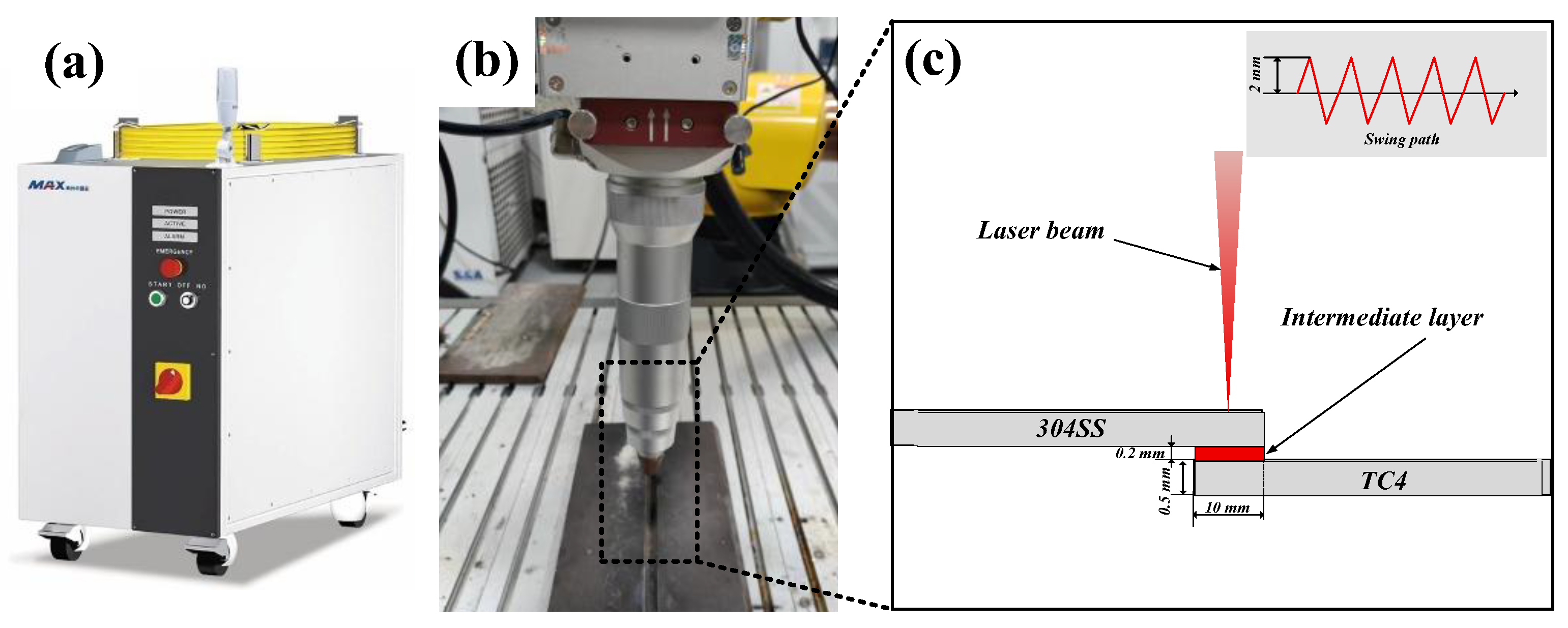
Figure 1.
(a) MFSC-12000W laser welding equipment; (b) laser welding torch; (c) titanium-steel joint assembly diagram.
Figure 1.
(a) MFSC-12000W laser welding equipment; (b) laser welding torch; (c) titanium-steel joint assembly diagram.
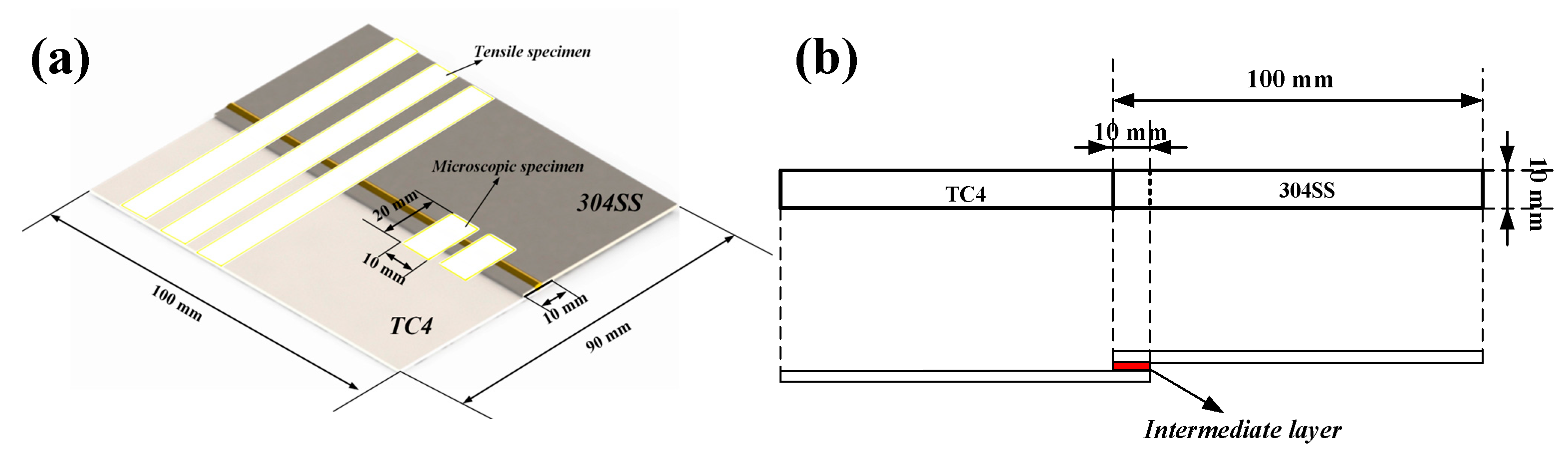
Figure 2.
(a) Schematic diagram of swing laser welding structure; (b) schematic diagram of tensile specimen.
Figure 2.
(a) Schematic diagram of swing laser welding structure; (b) schematic diagram of tensile specimen.
Figure 3.
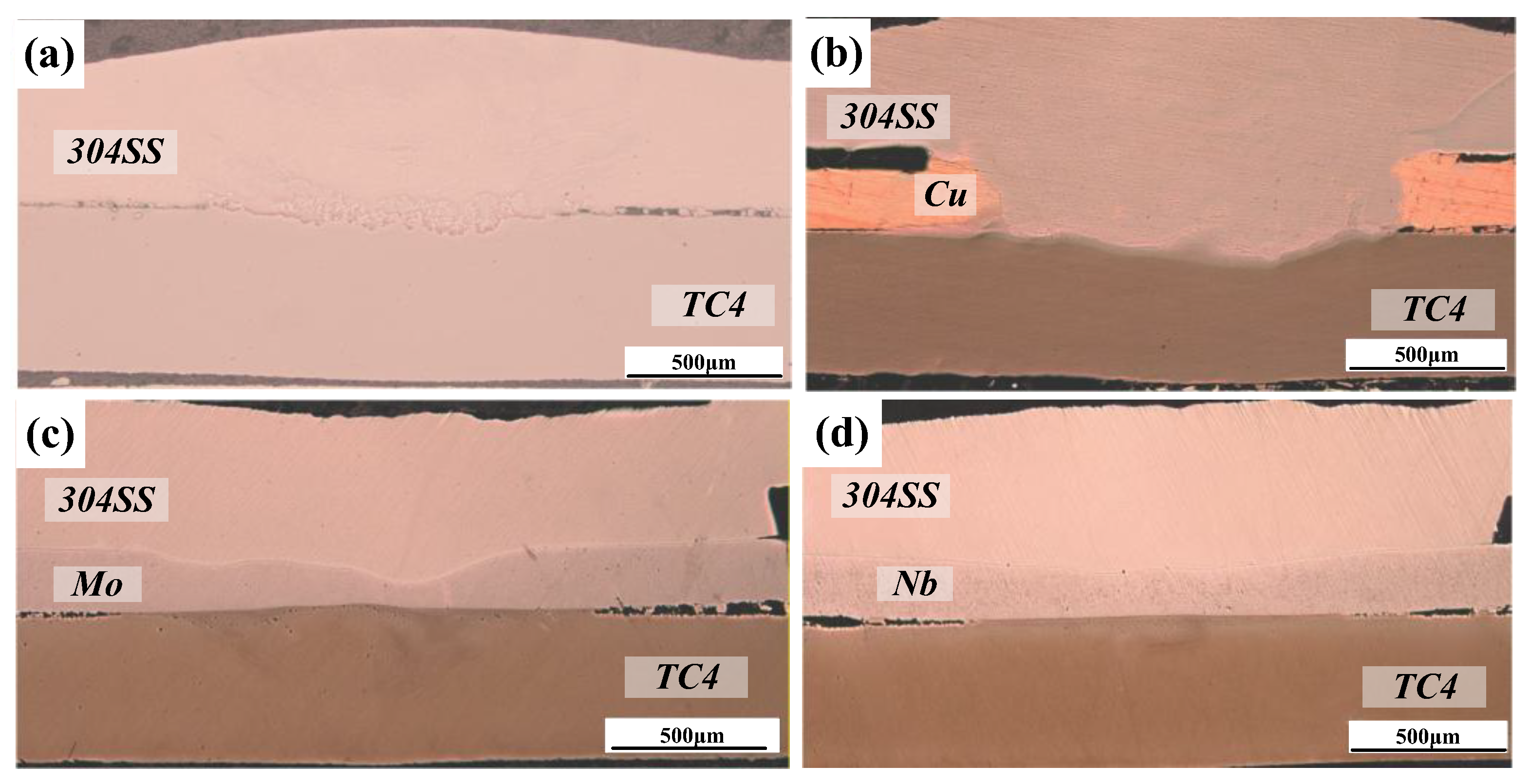
Cross-sectional micrographs of different welded joints under optical microscopy. (a) Direct joining; (b) Cu interlayer; (c) Mo interlayer; (d) Nb interlayer.
Figure 3.
Cross-sectional micrographs of different welded joints under optical microscopy. (a) Direct joining; (b) Cu interlayer; (c) Mo interlayer; (d) Nb interlayer.
Figure 4.
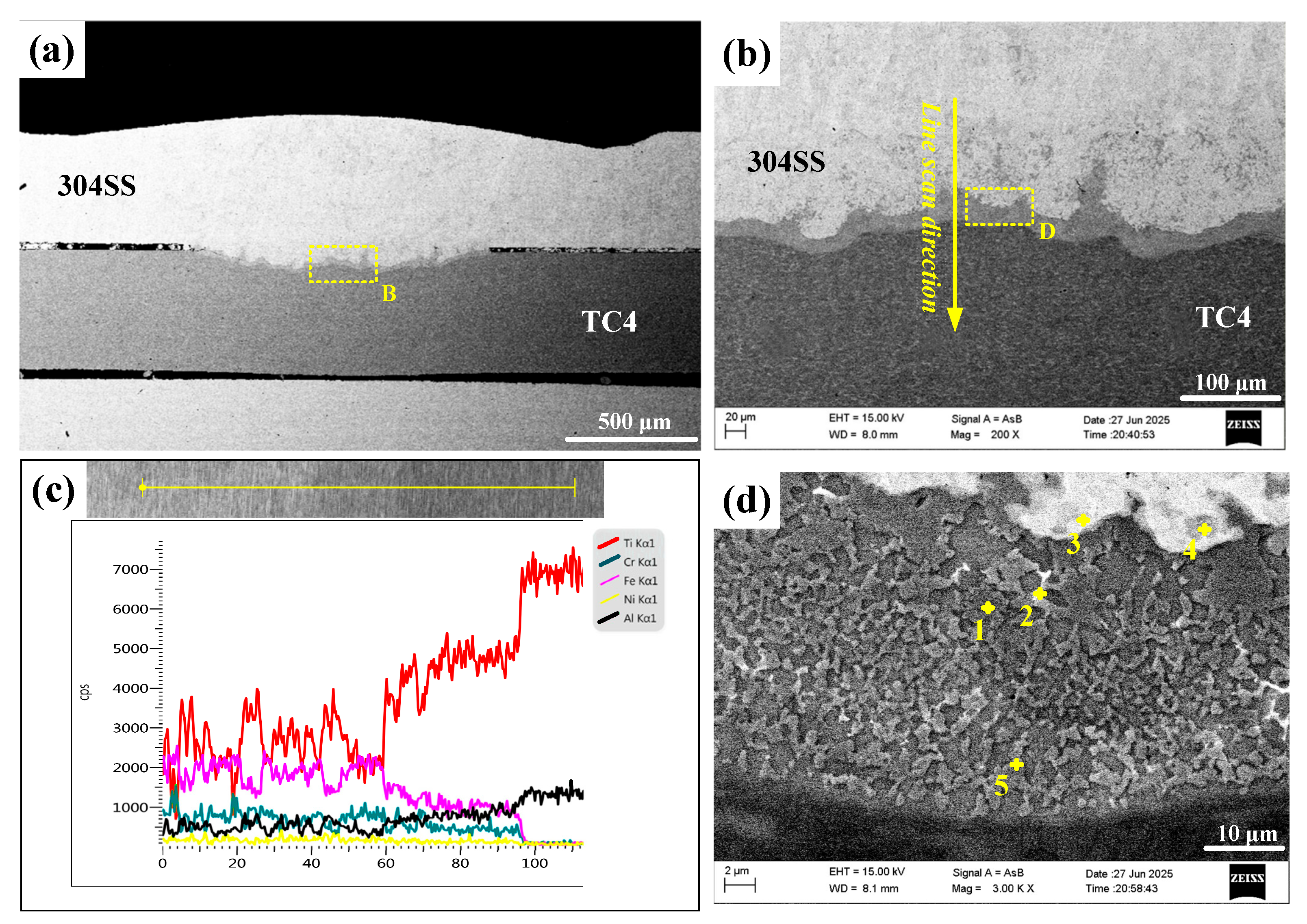
SEM micrographs of direct laser-welded TC4-304SS joints. (a) Cross-section of the joint; (b) enlarged view of area B in region (a) and schematic of the line scan path; (c) line scanning results; (d) enlarged image of region D in (b).
Figure 4.
SEM micrographs of direct laser-welded TC4-304SS joints. (a) Cross-section of the joint; (b) enlarged view of area B in region (a) and schematic of the line scan path; (c) line scanning results; (d) enlarged image of region D in (b).
Figure 5.
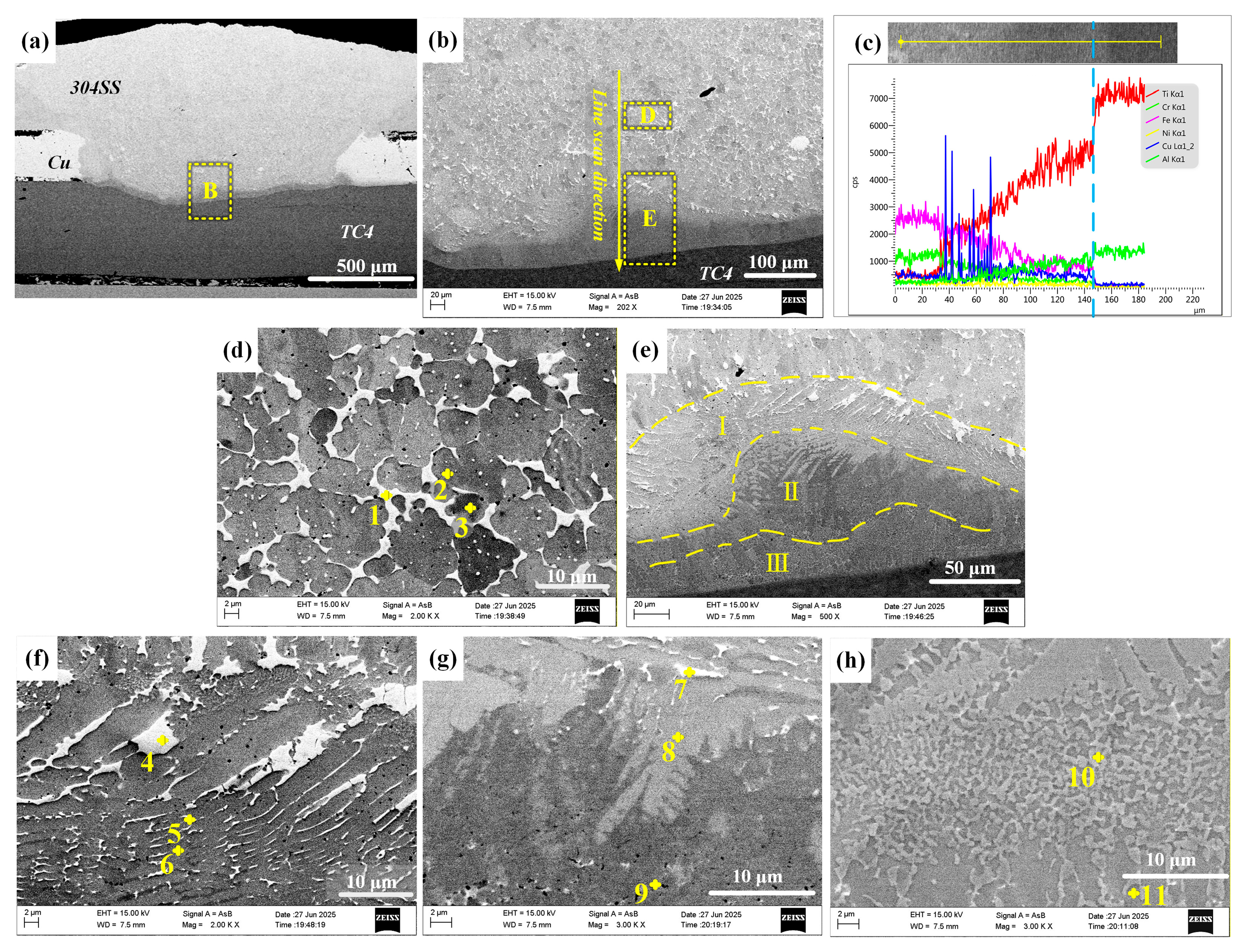
SEM images of Cu-interlayer-assisted TC4/304SS laser-welded joints. (a) Cross-section of the joint; (b) enlarged view of area B in region (a) and schematic of the line scan path; (c) line scanning analysis data corresponding to path in (b); (d) magnified image of area D in (b); (e) magnified image of area E in (b); (f) magnified image of area I in (e); (g) magnified image of area II in (e); (h) magnified image of area III in (e).
Figure 5.
SEM images of Cu-interlayer-assisted TC4/304SS laser-welded joints. (a) Cross-section of the joint; (b) enlarged view of area B in region (a) and schematic of the line scan path; (c) line scanning analysis data corresponding to path in (b); (d) magnified image of area D in (b); (e) magnified image of area E in (b); (f) magnified image of area I in (e); (g) magnified image of area II in (e); (h) magnified image of area III in (e).
Figure 6.
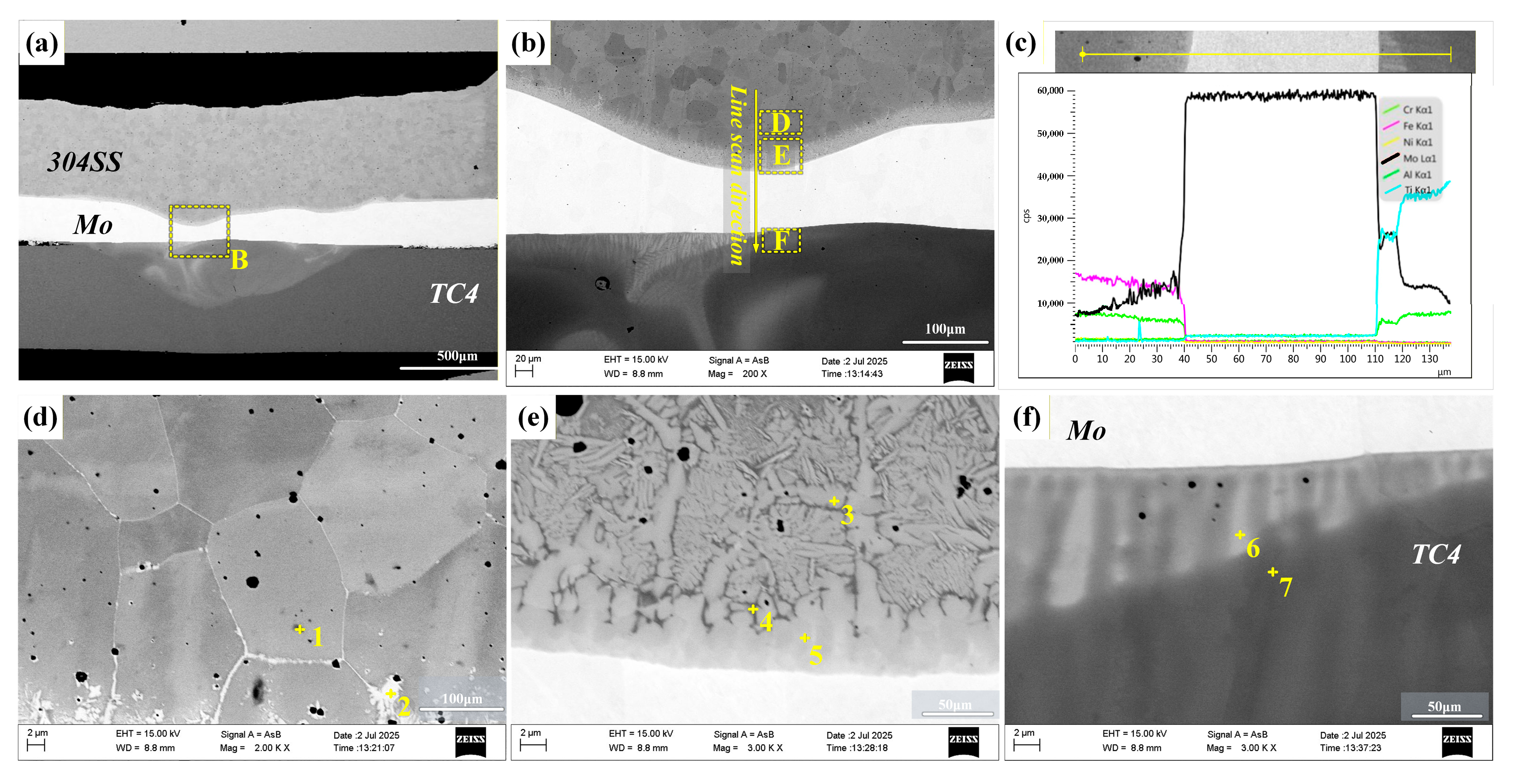
SEM images of Mo-interlayer-assisted TC4/304SS laser-welded joints. (a) Cross-section of the joint; (b) enlarged view of area B in region (a) and schematic of the line scan path; (c) line scanning analysis data corresponding to (b); (d) enlarged image of area D in (b); (e) enlarged image of area E in (b); (f) enlarged image of area F in (b).
Figure 6.
SEM images of Mo-interlayer-assisted TC4/304SS laser-welded joints. (a) Cross-section of the joint; (b) enlarged view of area B in region (a) and schematic of the line scan path; (c) line scanning analysis data corresponding to (b); (d) enlarged image of area D in (b); (e) enlarged image of area E in (b); (f) enlarged image of area F in (b).
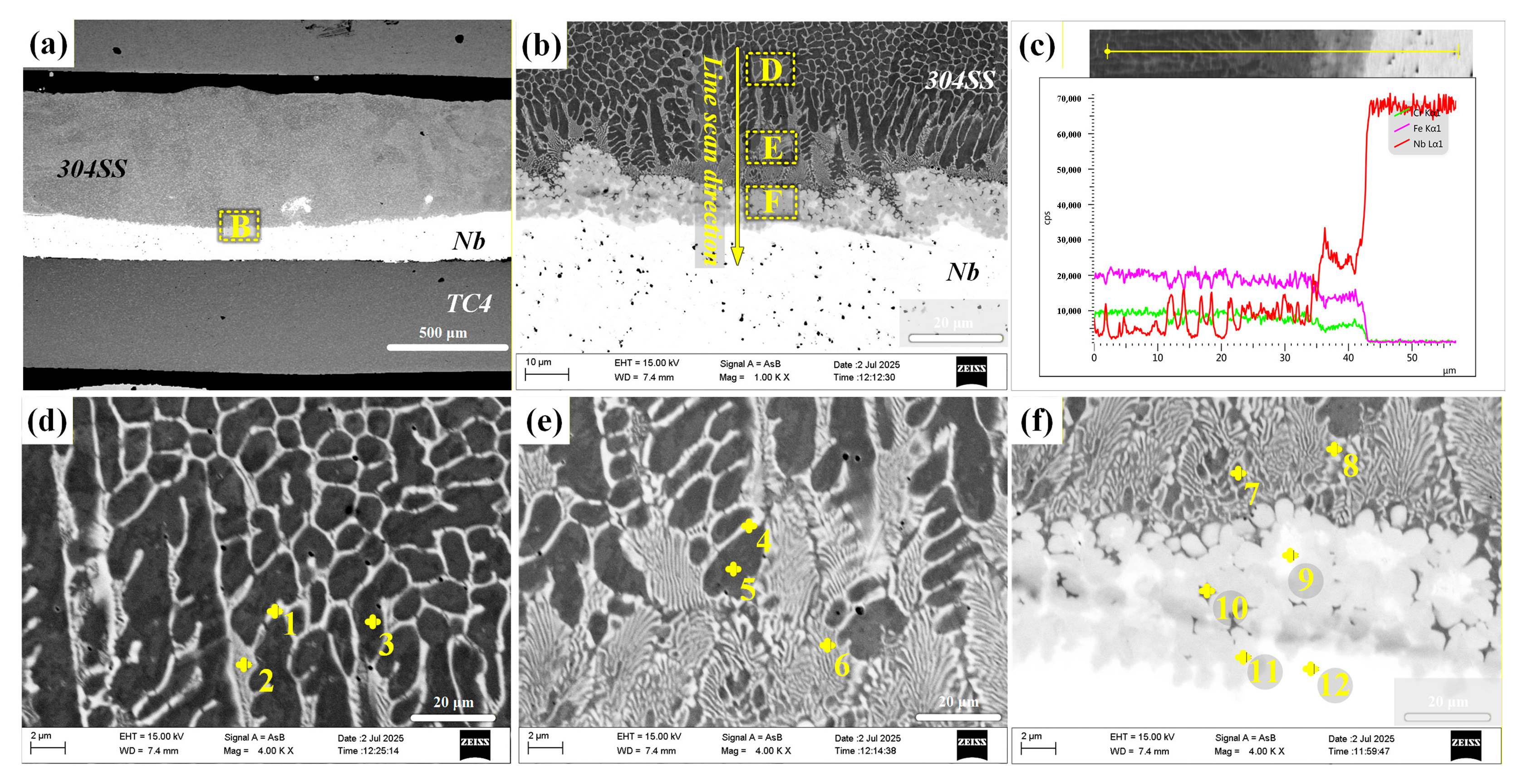
Figure 7.
SEM images of Nb-interlayer-assisted TC4/304SS laser-welded joints. (a) Overall cross-sectional image of the weld; (b) enlarged view of area B in region (a) and schematic of the line scan path; (c) line scan analysis data corresponding to (b); (d) enlarged image of area D in (b); (e) enlarged image of area E in (b); (f) enlarged image of area F in (b).
Figure 7.
SEM images of Nb-interlayer-assisted TC4/304SS laser-welded joints. (a) Overall cross-sectional image of the weld; (b) enlarged view of area B in region (a) and schematic of the line scan path; (c) line scan analysis data corresponding to (b); (d) enlarged image of area D in (b); (e) enlarged image of area E in (b); (f) enlarged image of area F in (b).
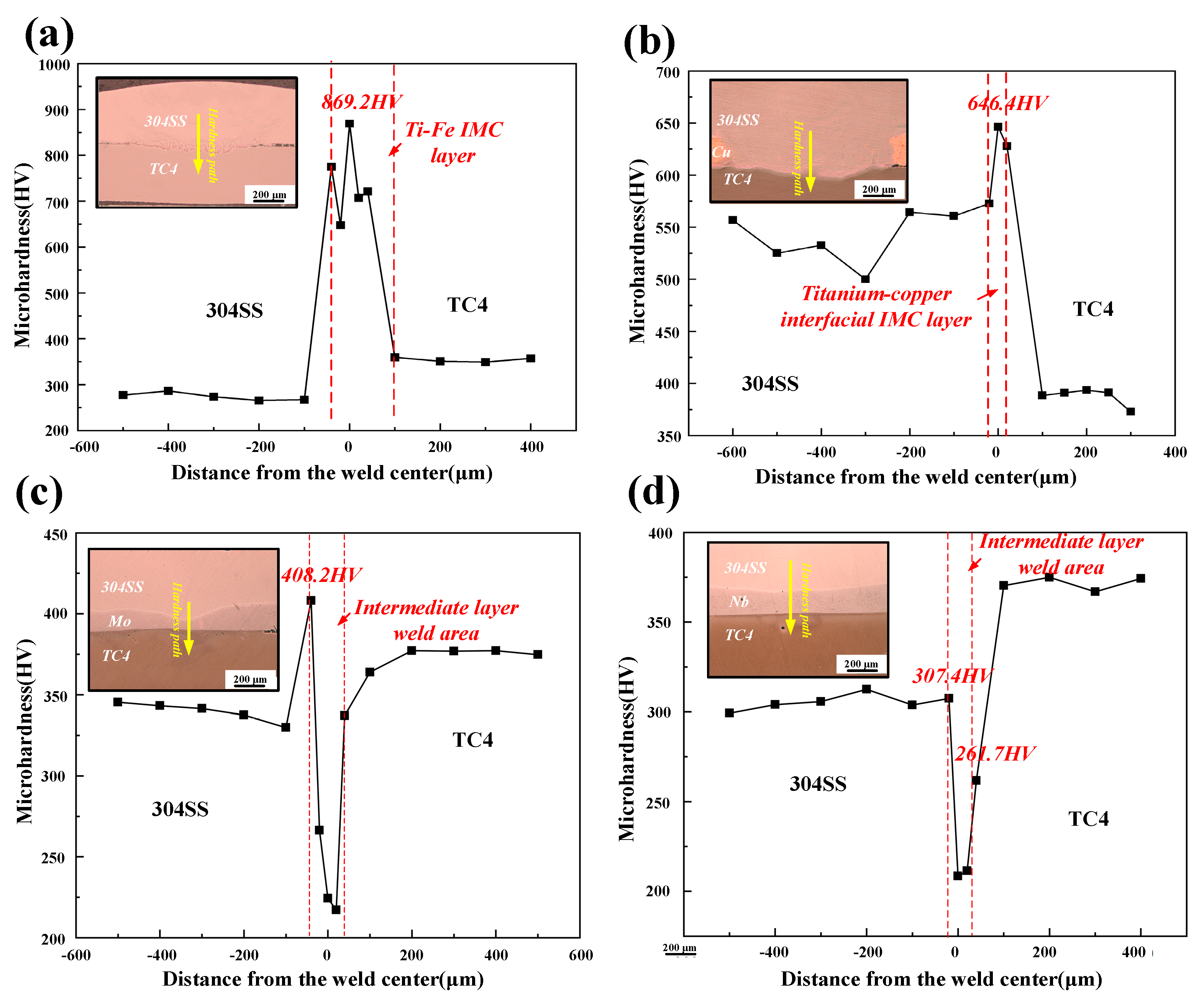
Figure 8.
Microhardness images of weld joints with different intermediate layers. (a) Microhardness curve of directly joined joints; (b) microhardness curve of joints with Cu as the intermediate layer; (c) microhardness curve of joints with Mo as the intermediate layer; (d) microhardness curve of joints with Nb as the intermediate layer.
Figure 8.
Microhardness images of weld joints with different intermediate layers. (a) Microhardness curve of directly joined joints; (b) microhardness curve of joints with Cu as the intermediate layer; (c) microhardness curve of joints with Mo as the intermediate layer; (d) microhardness curve of joints with Nb as the intermediate layer.
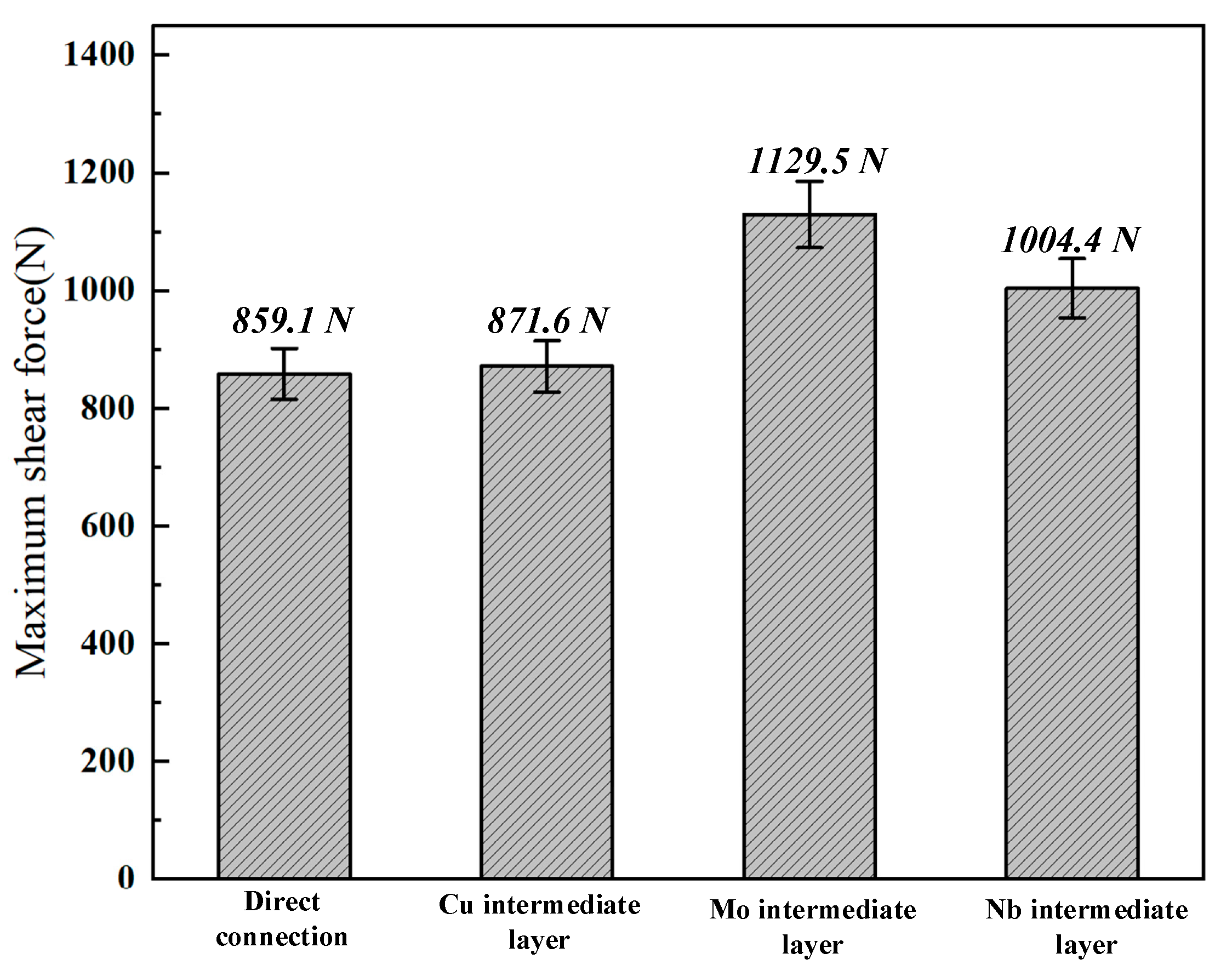
Figure 9.
Shear performance of welded joints with different interlayers.
Figure 9.
Shear performance of welded joints with different interlayers.
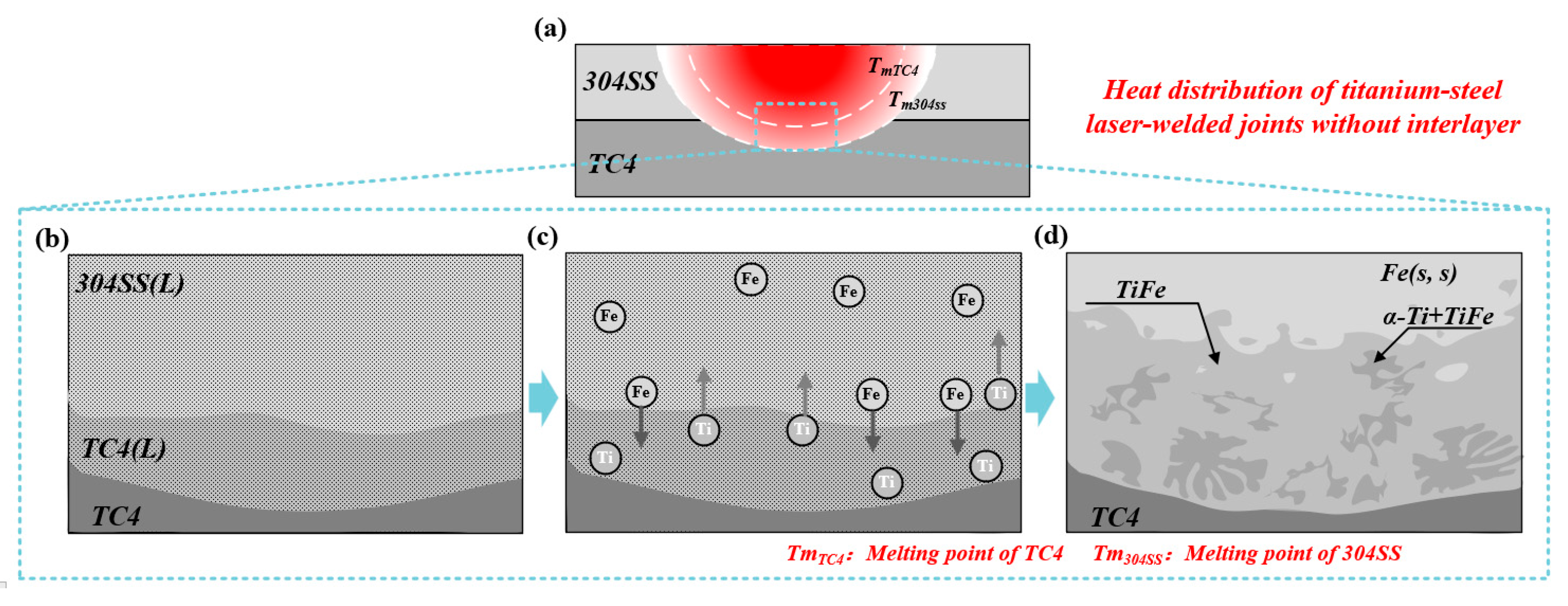
Figure 10.
Formation Process of the Direct Titanium-Steel Joint. (a) Schematic Diagram of Hypothetical Overall Thermal Distribution Inside the Welded Joint; (b) melting and intermixing of Ti and Fe atoms; (c) formation sequence of Ti-Fe intermetallic compounds (IMCs); (d) phase composition and distribution within the weld zone at room temperature.
Figure 10.
Formation Process of the Direct Titanium-Steel Joint. (a) Schematic Diagram of Hypothetical Overall Thermal Distribution Inside the Welded Joint; (b) melting and intermixing of Ti and Fe atoms; (c) formation sequence of Ti-Fe intermetallic compounds (IMCs); (d) phase composition and distribution within the weld zone at room temperature.
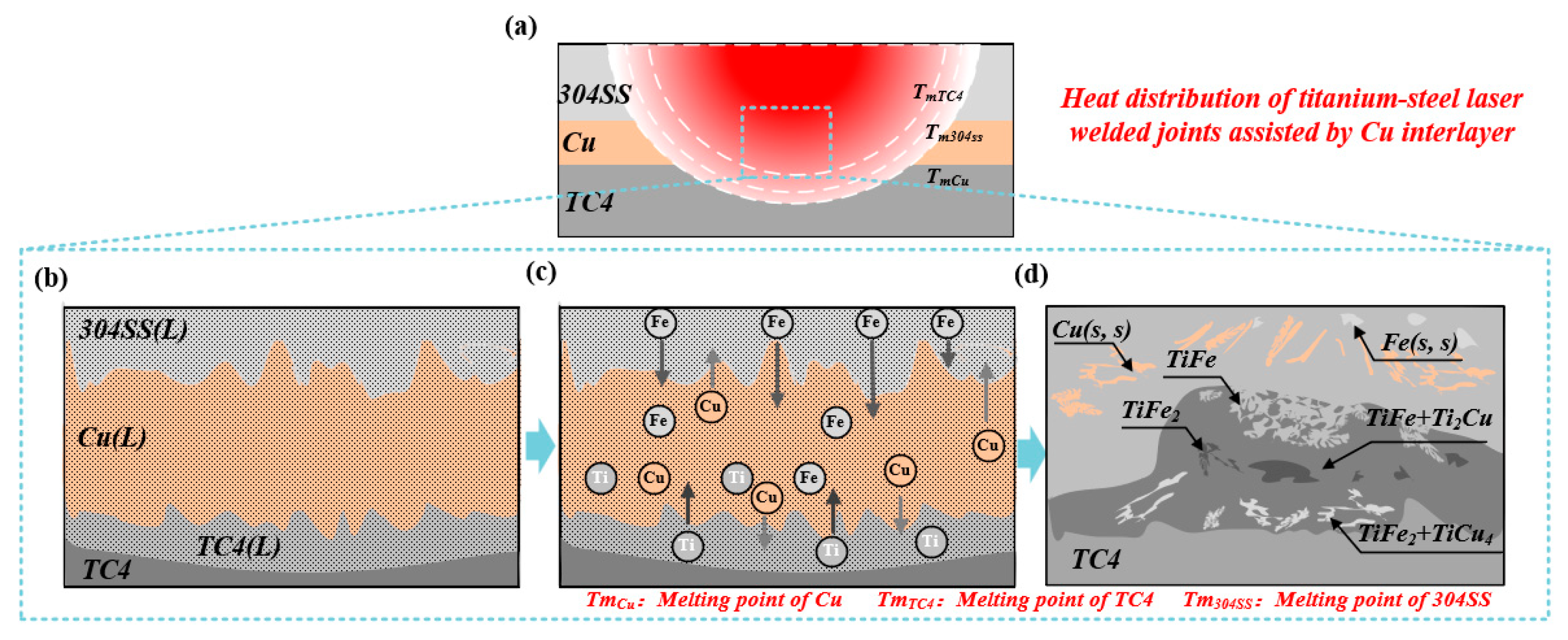
Figure 11.
Formation process of titanium-steel dissimilar metal laser welded joints with Cu as the filler metal. (a) Schematic Diagram of Hypothetical Overall Thermal Distribution Inside the Welded Joint; (b) melting and mixing of Cu, Ti, and Fe atoms; (c) formation of Ti-Fe and Ti-Cu intermetallic compound phases; (d) phase composition and distribution in the weld zone of the joint at room temperature.
Figure 11.
Formation process of titanium-steel dissimilar metal laser welded joints with Cu as the filler metal. (a) Schematic Diagram of Hypothetical Overall Thermal Distribution Inside the Welded Joint; (b) melting and mixing of Cu, Ti, and Fe atoms; (c) formation of Ti-Fe and Ti-Cu intermetallic compound phases; (d) phase composition and distribution in the weld zone of the joint at room temperature.
Figure 12.
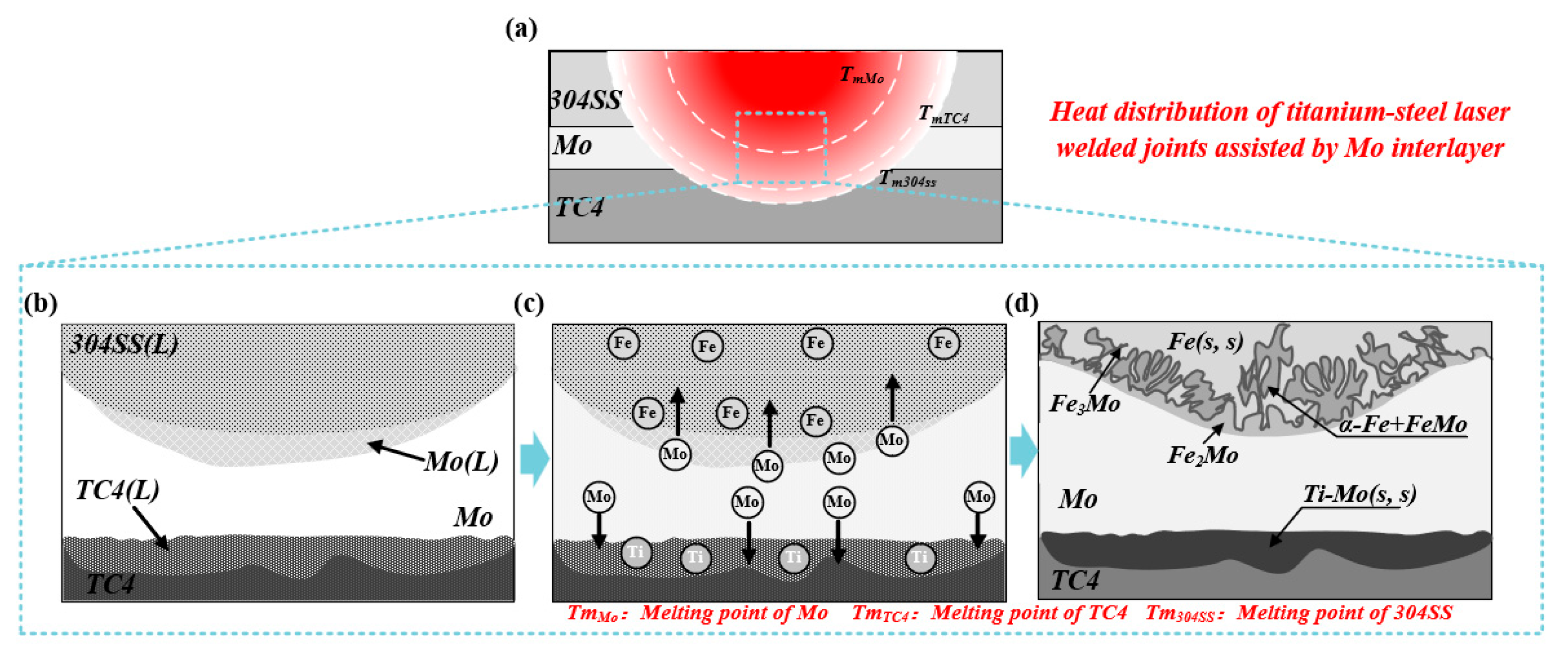
Formation process of titanium-steel dissimilar metal laser welded joints with Mo as the filler metal. (a) Schematic Diagram of Hypothetical Overall Thermal Distribution Inside the Welded Joint; (b) melting and mixing of Mo, Ti, and Fe atoms; (c) formation of Fe-Mo intermetallic compounds and Mo-based solid solution; (d) phase composition and distribution in the weld area of the joint at room temperature.
Figure 12.
Formation process of titanium-steel dissimilar metal laser welded joints with Mo as the filler metal. (a) Schematic Diagram of Hypothetical Overall Thermal Distribution Inside the Welded Joint; (b) melting and mixing of Mo, Ti, and Fe atoms; (c) formation of Fe-Mo intermetallic compounds and Mo-based solid solution; (d) phase composition and distribution in the weld area of the joint at room temperature.
Figure 13.
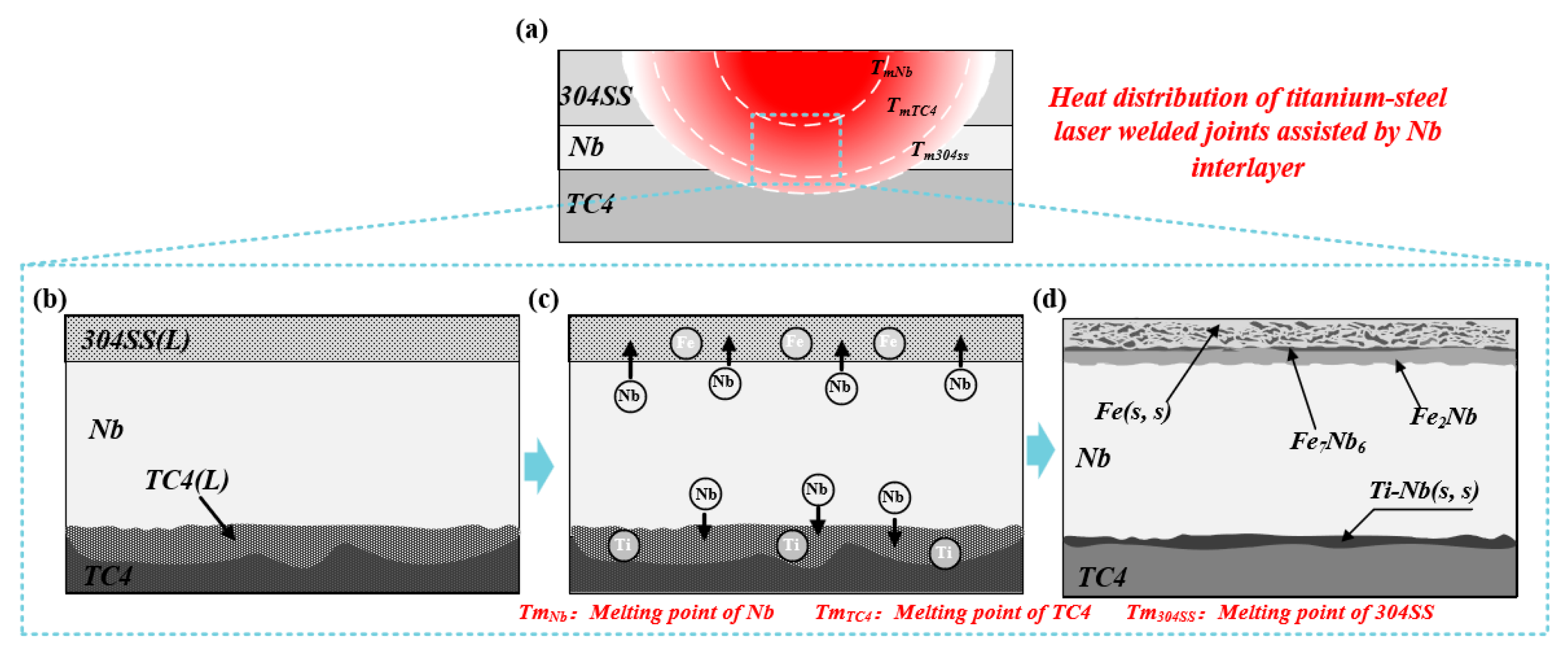
Formation process of titanium-steel dissimilar metal laser welded joints with Nb as the filler metal. (a) Schematic Diagram of Hypothetical Overall Thermal Distribution Inside the Welded Joint; (b) melting and mixing of Cu, Ti, and Fe atoms; (c) formation of Fe-Nb intermetallic compounds and Nb-based solid solution; (d) phase composition and distribution in the weld zone of the joint at room temperature.
Figure 13.
Formation process of titanium-steel dissimilar metal laser welded joints with Nb as the filler metal. (a) Schematic Diagram of Hypothetical Overall Thermal Distribution Inside the Welded Joint; (b) melting and mixing of Cu, Ti, and Fe atoms; (c) formation of Fe-Nb intermetallic compounds and Nb-based solid solution; (d) phase composition and distribution in the weld zone of the joint at room temperature.
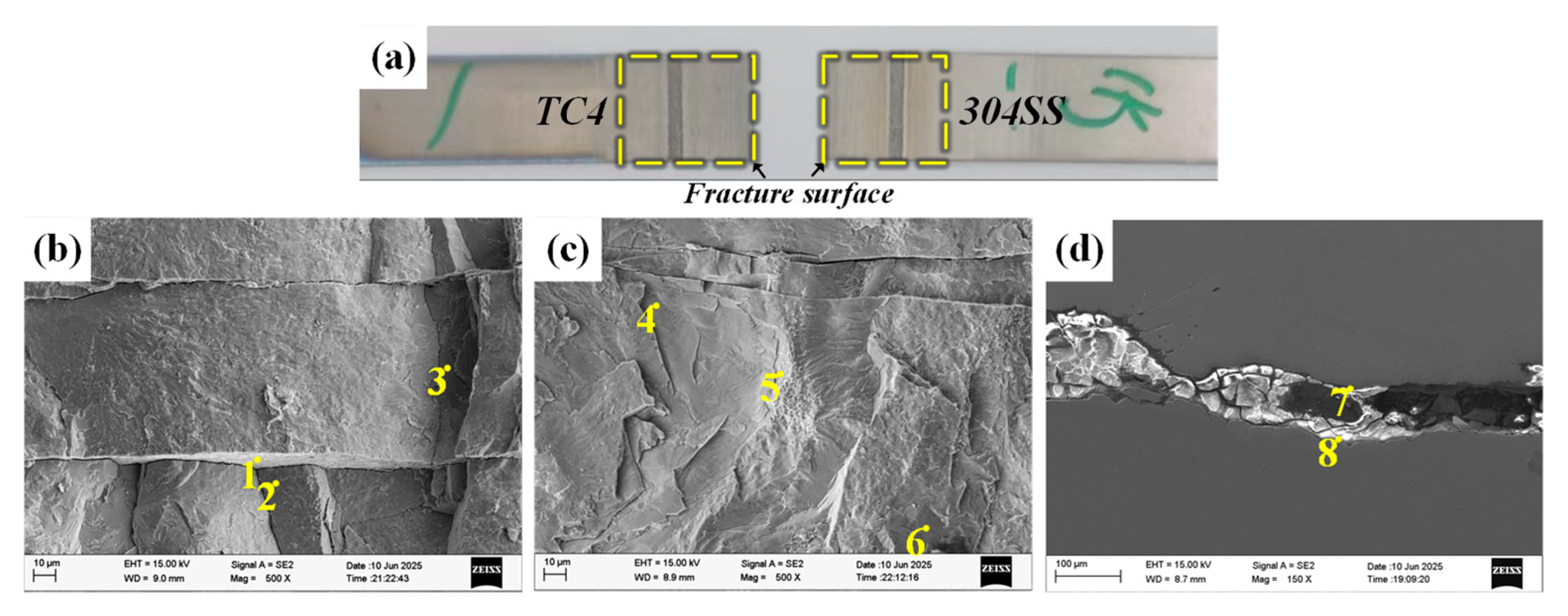
Figure 14.
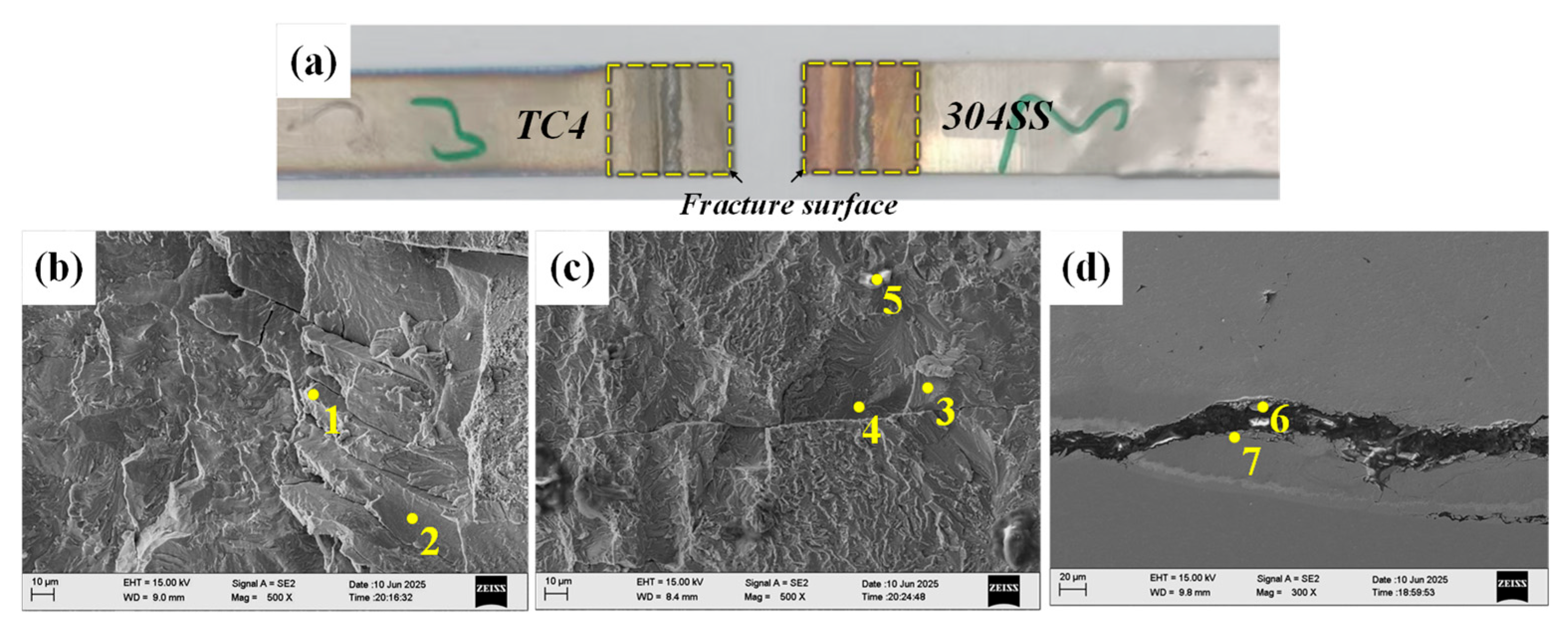
Images of the tensile fracture cross-section of directly connected joints and the fracture path. (a) Macroscopic image of the fracture; (b) fracture image on the TC4 side; (c) fracture image on the 304SS side; (d) fracture path.
Figure 14.
Images of the tensile fracture cross-section of directly connected joints and the fracture path. (a) Macroscopic image of the fracture; (b) fracture image on the TC4 side; (c) fracture image on the 304SS side; (d) fracture path.
Figure 15.
Tensile fracture cross-sectional images and fracture path of the Cu intermediate layer. (a) Macroscopic image of the fracture; (b) fracture surface on the Ti side; (c) fracture surface on the Fe side; (d) fracture path.
Figure 15.
Tensile fracture cross-sectional images and fracture path of the Cu intermediate layer. (a) Macroscopic image of the fracture; (b) fracture surface on the Ti side; (c) fracture surface on the Fe side; (d) fracture path.
Figure 16.
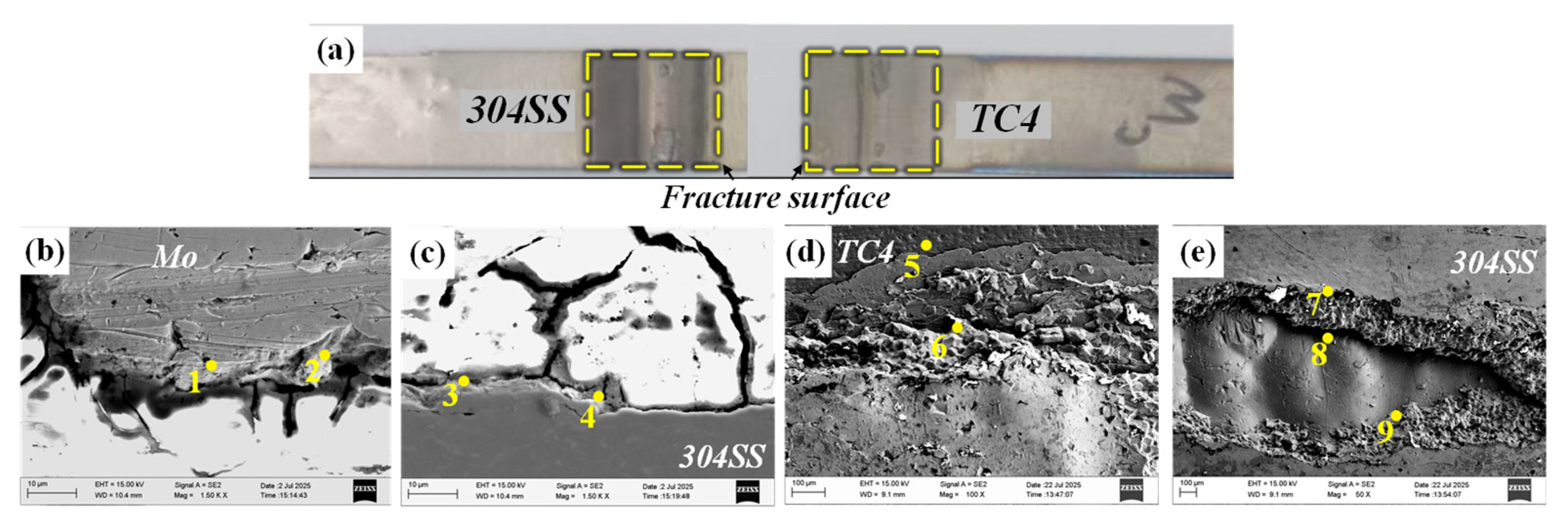
Tensile fracture cross-sectional images and fracture path of the joint with Mo intermediate layer. (a) Macroscopic image of the fracture sample; (b) fracture path; (c) fracture path; (d) fracture surface on the Ti side; (e) fracture surface on the Fe side;.
Figure 16.
Tensile fracture cross-sectional images and fracture path of the joint with Mo intermediate layer. (a) Macroscopic image of the fracture sample; (b) fracture path; (c) fracture path; (d) fracture surface on the Ti side; (e) fracture surface on the Fe side;.
Figure 17.
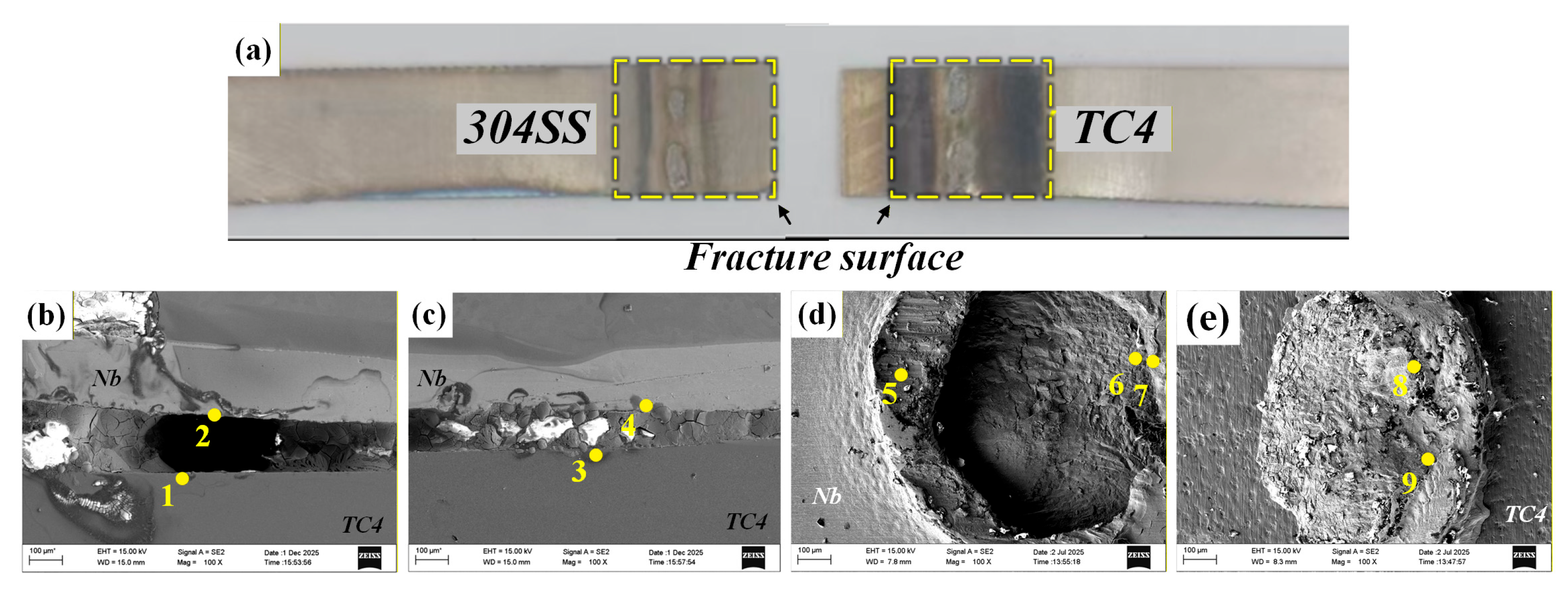
Tensile fracture cross-sectional images and fracture paths of Nb intermediate layer joints. (a) Macroscopic fracture image; (b) fracture path; (c) fracture path; (d) fracture surface on the 304SS/Nb side; (e) fracture surface on the TC4/Nb side.
Figure 17.
Tensile fracture cross-sectional images and fracture paths of Nb intermediate layer joints. (a) Macroscopic fracture image; (b) fracture path; (c) fracture path; (d) fracture surface on the 304SS/Nb side; (e) fracture surface on the TC4/Nb side.
Table 1.
Chemical composition of TC4 titanium alloy (wt.%).
Table 1.
Chemical composition of TC4 titanium alloy (wt.%).
| Element | Al | V | C | Fe | N | H | O | Ti |
|---|
| Content | 5.5–6.8 | 3.5–4.5 | 0.1 | 0.3 | 0.05 | 0.01 | 0.2 | Bal. |
Table 2.
Chemical composition of 304 stainless steel (wt.%).
Table 2.
Chemical composition of 304 stainless steel (wt.%).
| Element | C | Cr | Ni | Mn | Si | S | P | Fe |
|---|
| Content | 0.08 | 19.93 | 7.71 | 1.45 | 0.62 | 0.014 | 0.032 | Bal. |
Table 3.
Laser welding parameters used for different interlayers.
Table 3.
Laser welding parameters used for different interlayers.
| Intermediate Layer Material | Laser Power (kW) | Welding Speed (mm/s) | Oscillating Frequency (Hz) | Oscillating Width (mm) |
|---|
| No intermediate layer | 2.4 | 30 | 50 | 2 |
| Mo | 3 | 28 | 300 | 2 |
| Cu | 2.76 | 28 | 300 | 2 |
| Nb | 2.76 | 28 | 300 | 2 |
Table 4.
Phase composition analysis of the directly laser-welded TC4-304SS joint (at.%).
Table 4.
Phase composition analysis of the directly laser-welded TC4-304SS joint (at.%).
| Number | Al | Ti | Cr | Fe | Ni | Possible Phases |
|---|
| 1 | 8.61 | 64.10 | 6.47 | 18.94 | 1.88 | α-Ti + TiFe |
| 2 | 7.59 | 65.09 | 4.55 | 18.54 | 4.23 | α-Ti + TiFe |
| 3 | 5.66 | 42.65 | 13.63 | 35.75 | 2.31 | TiFe |
| 4 | 5.99 | 45.94 | 14.09 | 31.98 | 2.00 | TiFe |
| 5 | 8.64 | 64.42 | 5.41 | 19.18 | 2.35 | α-Ti + TiFe |
Table 5.
Phase composition analysis of the TC4-304SS joint with Cu interlayer (at.%).
Table 5.
Phase composition analysis of the TC4-304SS joint with Cu interlayer (at.%).
| Number | Ti | Cr | Fe | Ni | Cu | Possible Phases |
|---|
| 1 | 0.97 | 5.31 | 18.30 | 3.56 | 71.15 | Cu(s.s.) |
| 2 | 1.68 | 14.29 | 47.94 | 4.44 | 31.22 | (Fe, Cu)s.s |
| 3 | 2.61 | 16.74 | 62.00 | 7.59 | 10.56 | Fe(s.s.) |
| 4 | 4.85 | 2.57 | 9.53 | 4.86 | 78.19 | Cu(s.s.) |
| 5 | 34.18 | 7.39 | 32.27 | 10.35 | 15.82 | TiFe |
| 6 | 26.91 | 14.45 | 52.71 | 3.67 | 2.26 | TiFe2 |
| 7 | 27.42 | 8.43 | 31.00 | 2.72 | 8.21 | TiFe |
| 8 | 38.85 | 12.85 | 42.57 | 2.38 | 3.55 | TiFe |
| 9 | 55.32 | 4.98 | 22.97 | 3.87 | 12.85 | TiFe + Ti2Cu |
| 10 | 68.36 | 2.67 | 17.30 | 3.43 | 8.24 | TiFe2 + TiCu4 |
| 11 | 73.27 | 2.52 | 14.86 | 2.46 | 6.44 | TiFe2 + TiCu4 |
Table 6.
Phase composition analysis of the TC4/304SS joint with Mo interlayer (at.%).
Table 6.
Phase composition analysis of the TC4/304SS joint with Mo interlayer (at.%).
| Number | Ti | Cr | Fe | Ni | Mo | Possible Phases |
|---|
| 1 | 0.36 | 18.56 | 65.46 | 7.01 | 8.60 | α-Fe + FeMo |
| 2 | 0.71 | 18.39 | 58.34 | 6.31 | 16.27 | Fe3Mo |
| 3 | 0.49 | 16.35 | 56.98 | 6.33 | 19.86 | Fe3Mo |
| 4 | 0.35 | 14.44 | 64.81 | 7.78 | 12.62 | α-Fe + FeMo |
| 5 | - | 11.42 | 57.26 | 3.52 | 27.80 | Fe2Mo |
| 6 | 63.04 | 1.00 | 0.09 | - | 29.15 | (Ti, Mo)s.s |
| 7 | 73.62 | 1.16 | 0.10 | - | 16.28 | (Ti, Mo)s.s |
Table 7.
Phase composition analysis of the TC4-304SS joint with Nb interlayer (at.%).
Table 7.
Phase composition analysis of the TC4-304SS joint with Nb interlayer (at.%).
| Number | Cr | Fe | Ni | Nb | Possible Phases |
|---|
| 1 | 17.01 | 61.73 | 7.67 | 13.59 | Fe2Nb + α-Fe |
| 2 | 17.10 | 63.44 | 6.79 | 12.67 | Fe2Nb + α-Fe |
| 3 | 20.68 | 71.33 | 6.93 | 1.06 | α-Fe |
| 4 | 18.02 | 64.81 | 7.24 | 9.93 | Fe2Nb + α-Fe |
| 5 | 20.75 | 70.50 | 7.49 | 1.26 | α-Fe |
| 6 | 17.97 | 64.94 | 6.89 | 10.20 | Fe2Nb + α-Fe |
| 7 | 20.45 | 69.74 | 6.79 | 3.02 | α-Fe |
| 8 | 16.60 | 62.09 | 7.84 | 13.47 | Fe2Nb + α-Fe |
| 9 | 8.19 | 37.70 | 5.05 | 49.06 | Fe7Nb6 + Nb |
| 10 | 15.06 | 56.32 | 5.32 | 23.31 | Fe2Nb |
| 11 | 2.42 | 7.22 | 0.69 | 89.67 | Fe7Nb6 + Nb |
| 12 | 0.20 | 0.74 | 0.07 | 98.99 | Nb |
Table 8.
Phase composition analysis of the fracture surface of the direct joint (at.%).
Table 8.
Phase composition analysis of the fracture surface of the direct joint (at.%).
| Number | Al | Ti | Cr | Fe |
|---|
| 1 | 5.00 | 40.57 | 12.10 | 38.78 |
| 2 | 3.62 | 47.17 | 12.69 | 36.53 |
| 3 | 10.89 | 87.23 | 0.54 | 1.34 |
| 4 | 9.69 | 14.55 | 6.06 | 69.69 |
| 5 | 2.32 | 11.55 | 20.33 | 65.80 |
| 6 | 2.29 | 21.29 | 16.95 | 59.46 |
| 7 | 2.30 | 22.65 | - | 68.21 |
| 8 | - | 33.46 | - | 66.54 |
Table 9.
Phase composition analysis of the fracture surface of the joint with Cu interlayer (at.%).
Table 9.
Phase composition analysis of the fracture surface of the joint with Cu interlayer (at.%).
| Number | Al | Ti | Fe | Cu |
|---|
| 1 | 3.33 | 31.09 | 54.14 | 11.43 |
| 2 | 5.97 | 50.45 | 40.10 | 3.49 |
| 3 | 9.37 | 58.67 | 17.25 | 14.71 |
| 4 | 3.22 | 76.45 | 13.89 | 6.43 |
| 5 | 18.48 | 67.00 | 14.52 | 0.00 |
| 6 | 6.20 | 45.59 | 42.48 | 5.74 |
| 7 | 5.40 | 44.14 | 46.92 | 3.54 |
Table 10.
Phase composition analysis of the fracture surface of the joint with Mo interlayer (at.%).
Table 10.
Phase composition analysis of the fracture surface of the joint with Mo interlayer (at.%).
| Number | Ni | Ti | Cr | Fe | Mo | Al |
|---|
| 1 | 0.07 | 0.00 | 0.07 | 0.44 | 99.43 | - |
| 2 | 0.29 | 1.53 | 0.02 | 0.43 | 97.74 | - |
| 3 | 0.05 | 98.89 | 0.41 | - | 0.65 | - |
| 4 | 0.07 | 97.94 | 0.53 | - | 1.46 | - |
| 5 | 0.00 | 69.77 | 0.00 | 0.11 | 22.16 | 6.85 |
| 6 | 0.50 | 0.21 | 0.02 | 0.97 | 97.88 | 0.43 |
| 7 | 0.46 | - | 0.00 | 1.87 | 97.10 | 0.57 |
| 8 | 5.11 | - | 16.37 | 53.21 | 25.17 | 0.14 |
| 9 | 0.00 | - | 0.20 | 1.38 | 98.33 | 0.09 |
Table 11.
Phase composition analysis of the fracture surface of the joint with Nb interlayer (at.%).
Table 11.
Phase composition analysis of the fracture surface of the joint with Nb interlayer (at.%).
| Number | Ti | Cr | Fe | Ni | Nb |
|---|
| 1 | 77.49 | 5.84 | 1.23 | 2.81 | 18.47 |
| 2 | 0.00 | 0.00 | 0.16 | 0.00 | 99.83 |
| 3 | 80.37 | 3.74 | 0.37 | 4.86 | 10.66 |
| 4 | 3.45 | 8.88 | 0.28 | 2.23 | 85.16 |
| 5 | 16.57 | 1.54 | 5.04 | 6.23 | 70.62 |
| 6 | - | 15.50 | 52.92 | 5.39 | 14.89 |
| 7 | 0.00 | 0.04 | 0.44 | 0.10 | 99.42 |
| 8 | 0.00 | 8.46 | 33.60 | 4.56 | 53.26 |
| 9 | 0.07 | 13.89 | 51.13 | 4.85 | 30.06 |




 ,
,