Influence of Film Thickness on the Structure and Properties of Copper Thin Films Deposited on BaTiO3 Ceramics by DCMS and HiPIMS
Abstract
1. Introduction
2. Materials and Methods
2.1. Sample Preparation
2.2. Characterization
3. Results and Discussion
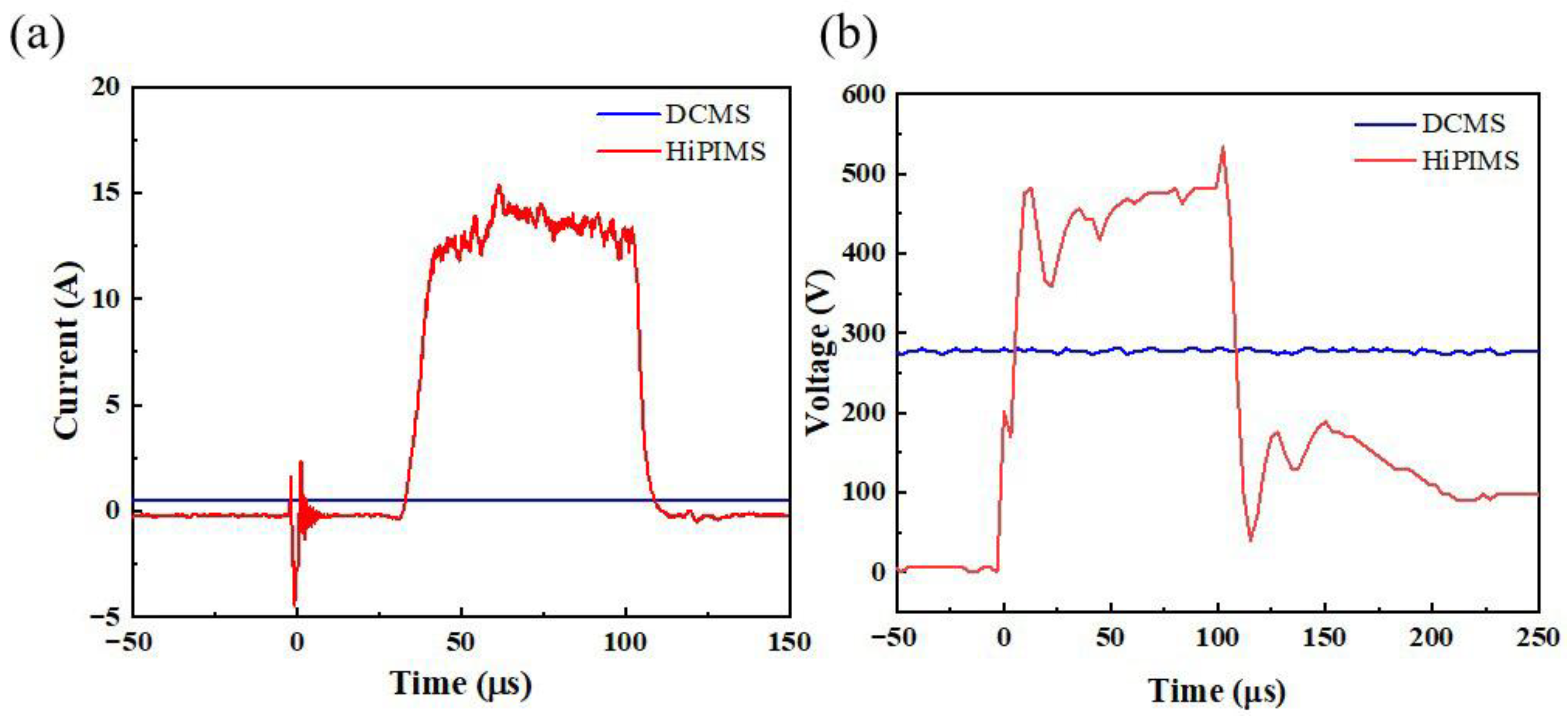
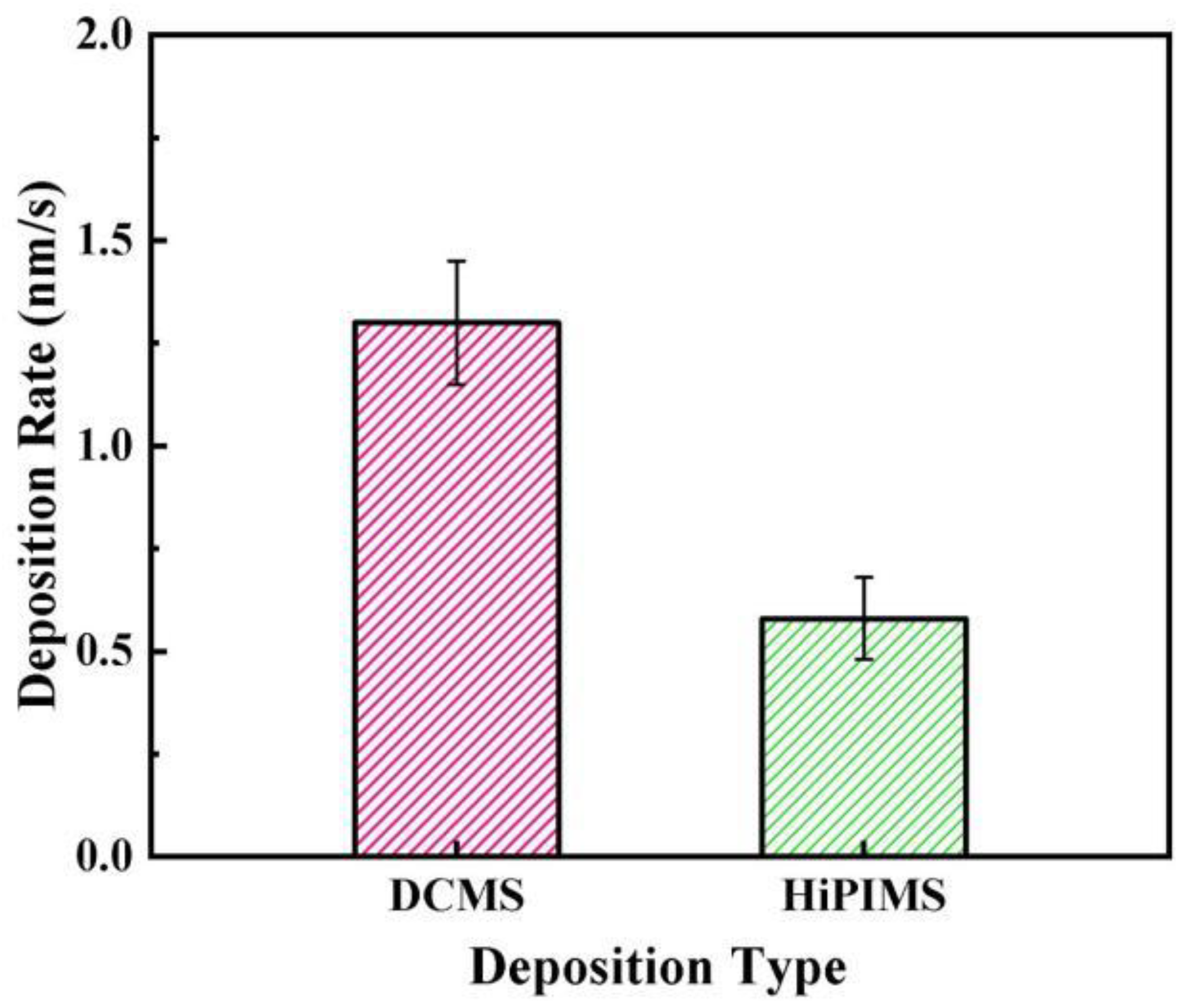
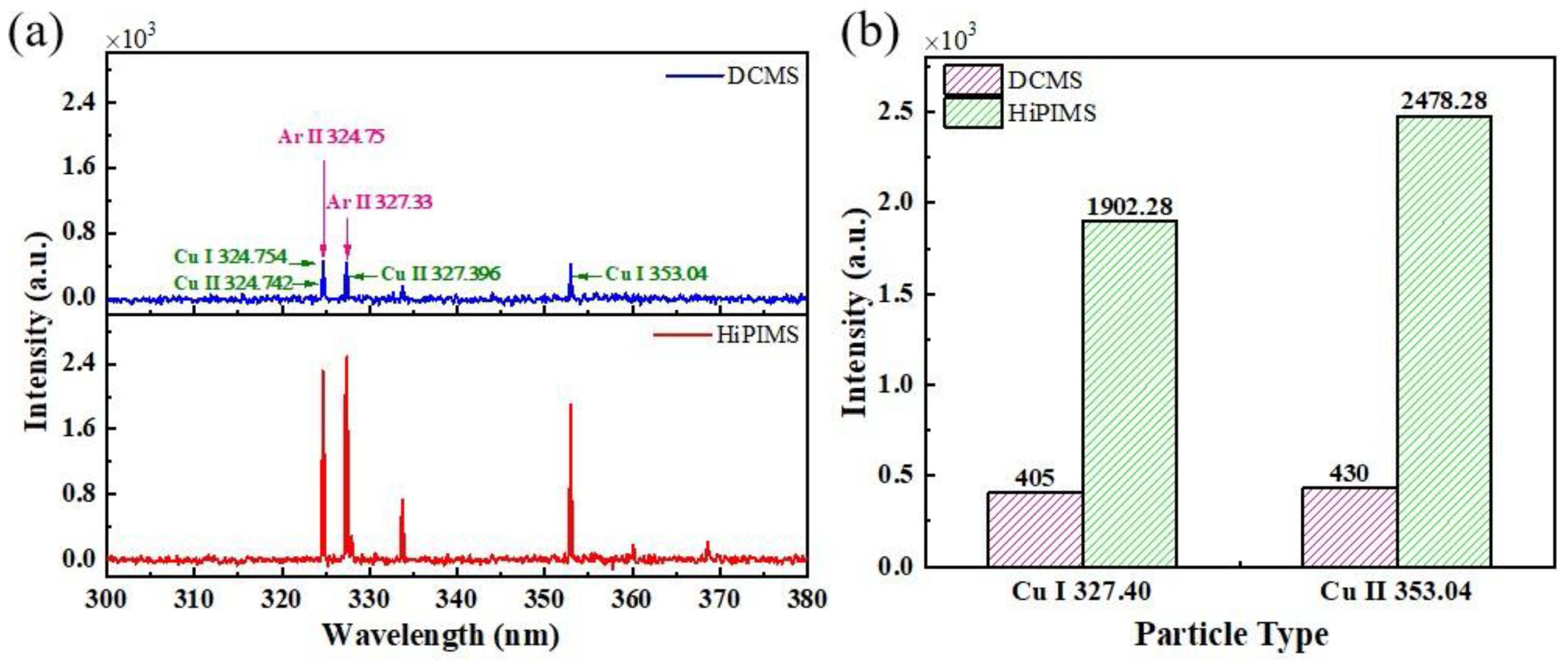
3.1. DCMS and HiPIMS Deposited Copper Film Features
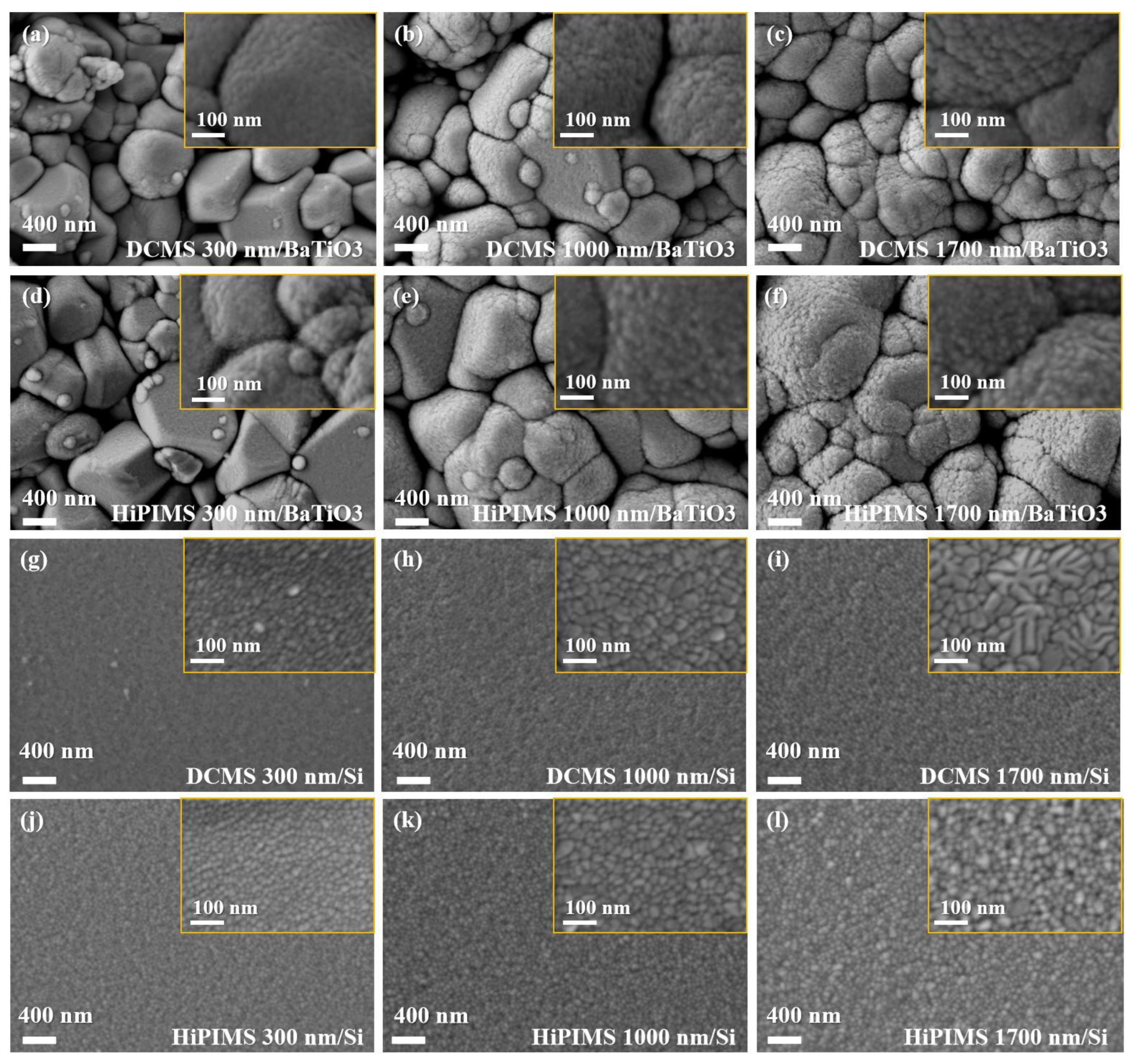
3.2. Morphology and Microstructure
3.3. Performance
4. Conclusions
- (1)
- HiPIMS films exhibit square waveform target current and voltage characteristics during the deposition process, and the ionization rate is significantly higher than that of DCMS, although the deposition rate was lower.
- (2)
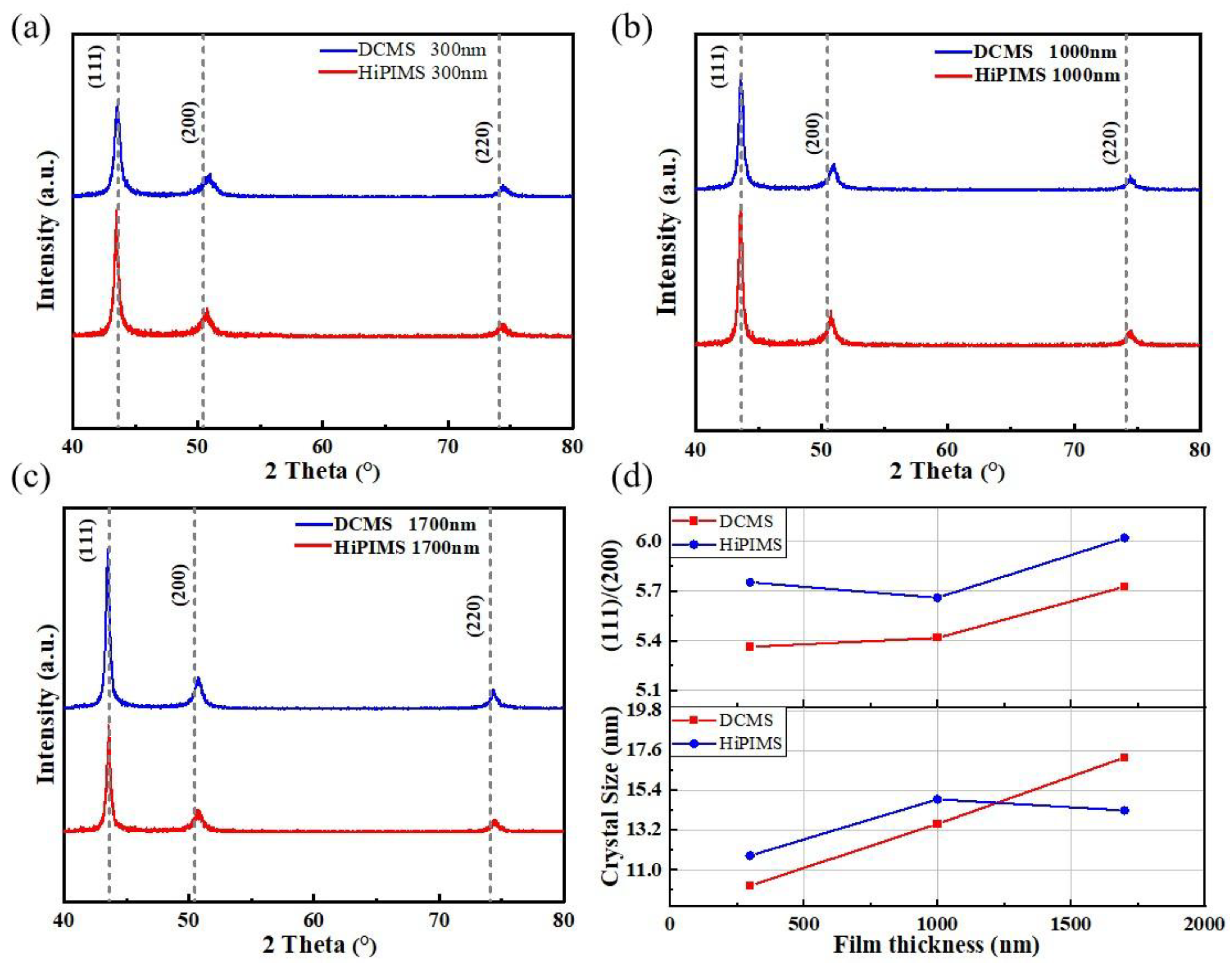
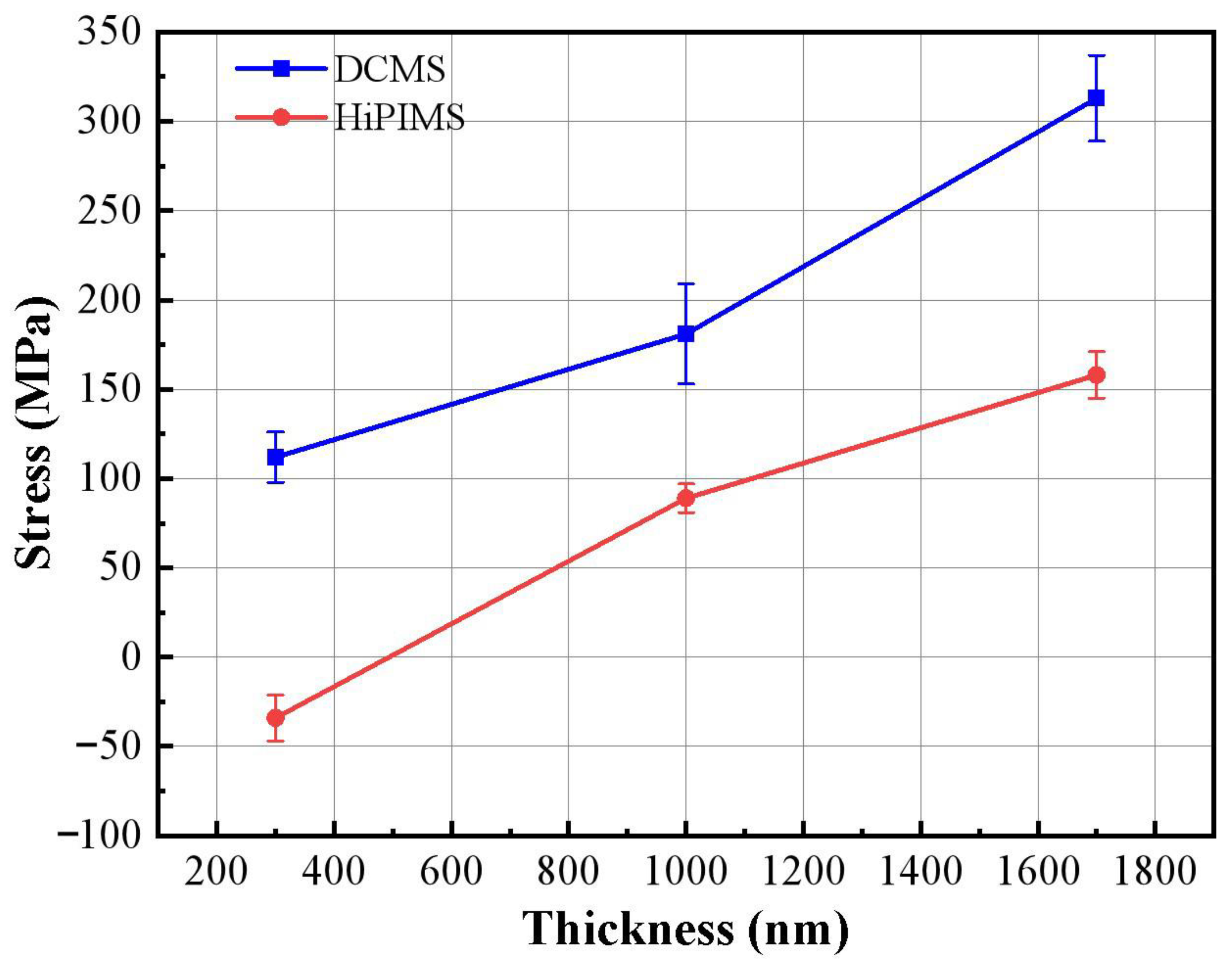
- The Cu films deposited by both processes presented (111) texture, and the HiPIMS films showed compressive stress at 300 nm, which gradually changes to tensile stress with the increase in thickness, while the DCMS film is always tensile, indicating that HiPIMS is more suitable for thin-layer stress modulation.
- (3)
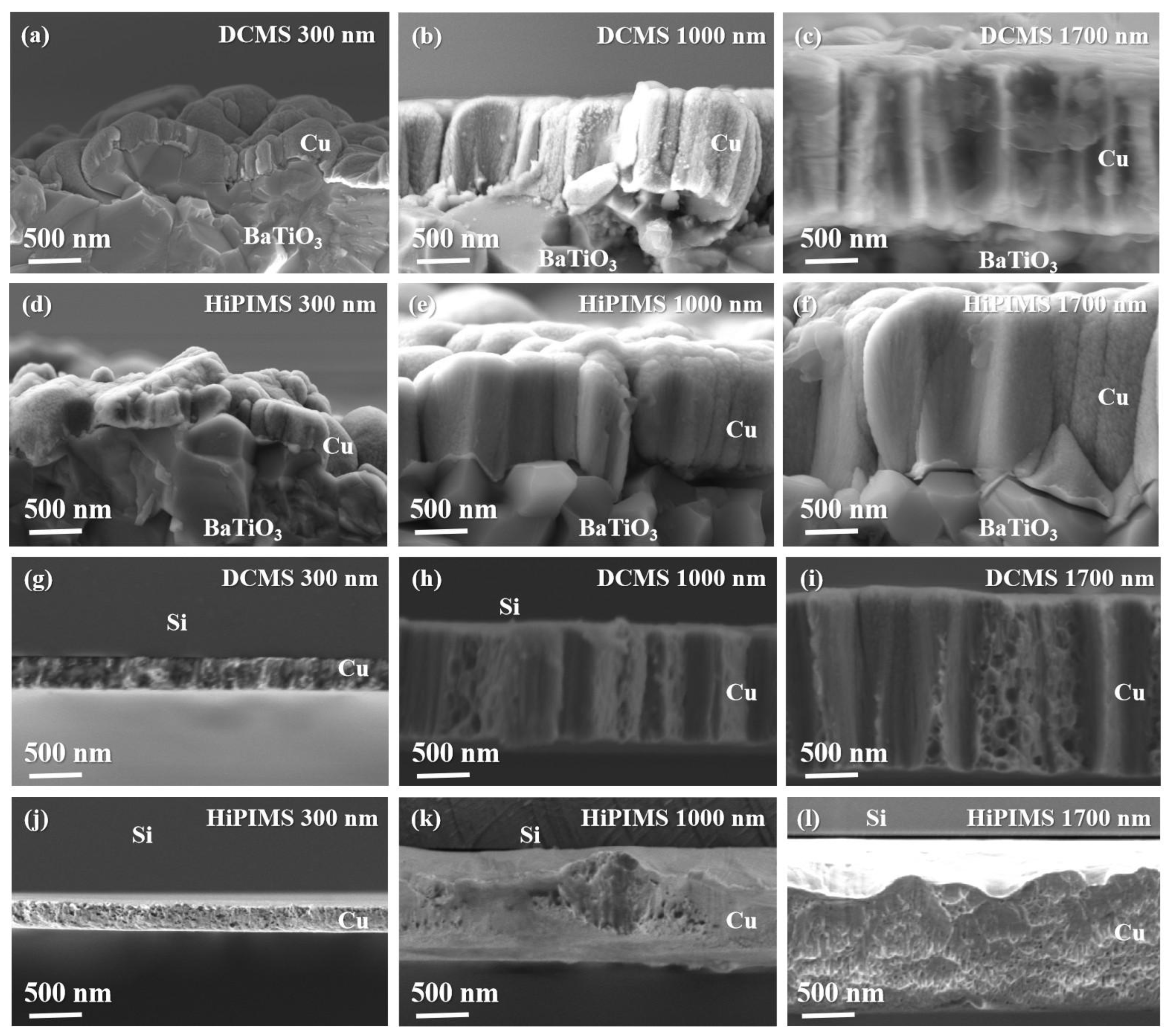
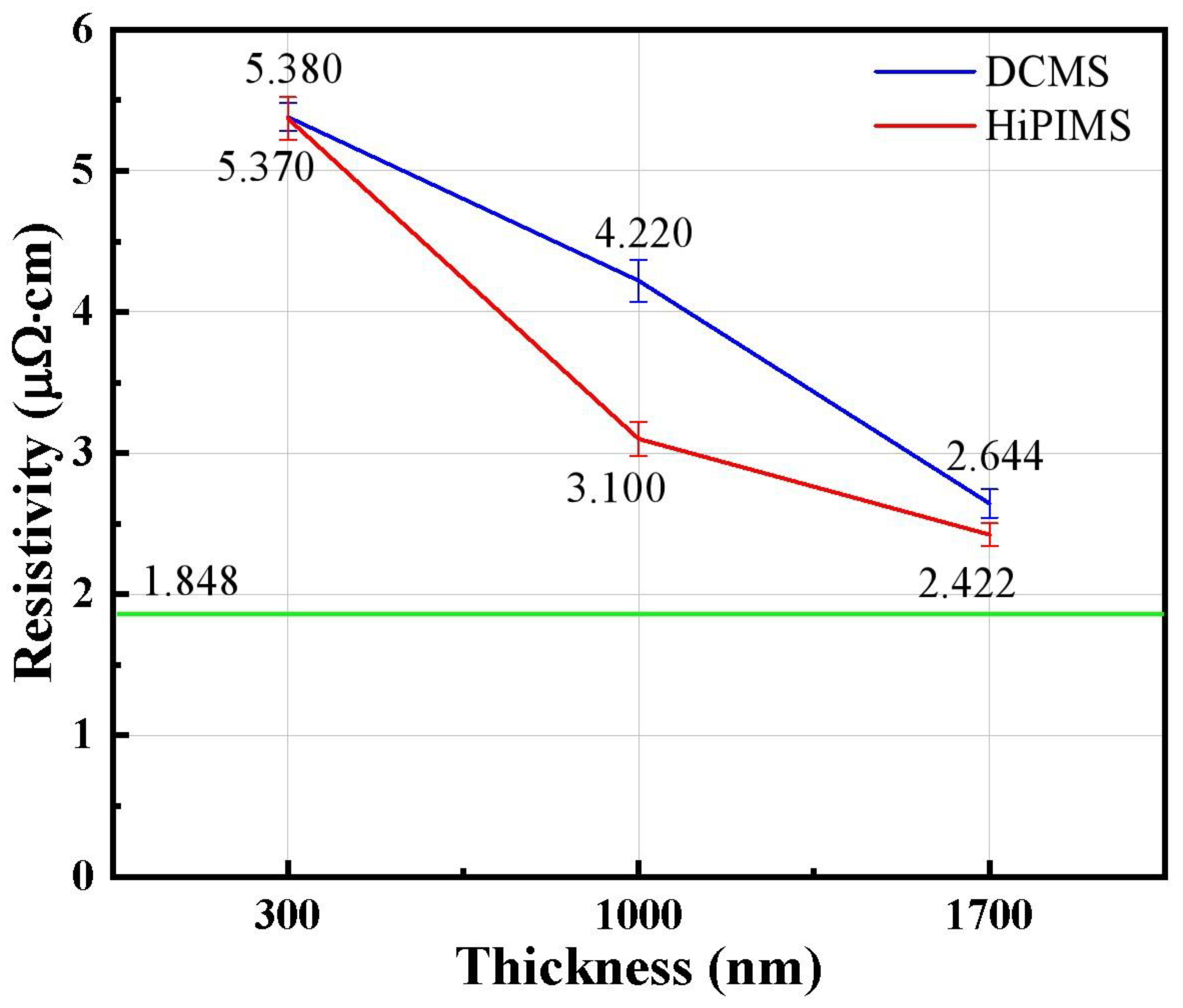
- Compared with DCMS films, HiPIMS films possessed finer and denser grains, and showed reduced resistivity, with the most pronounced differences observed at a thickness of 1000 nm.
- (4)
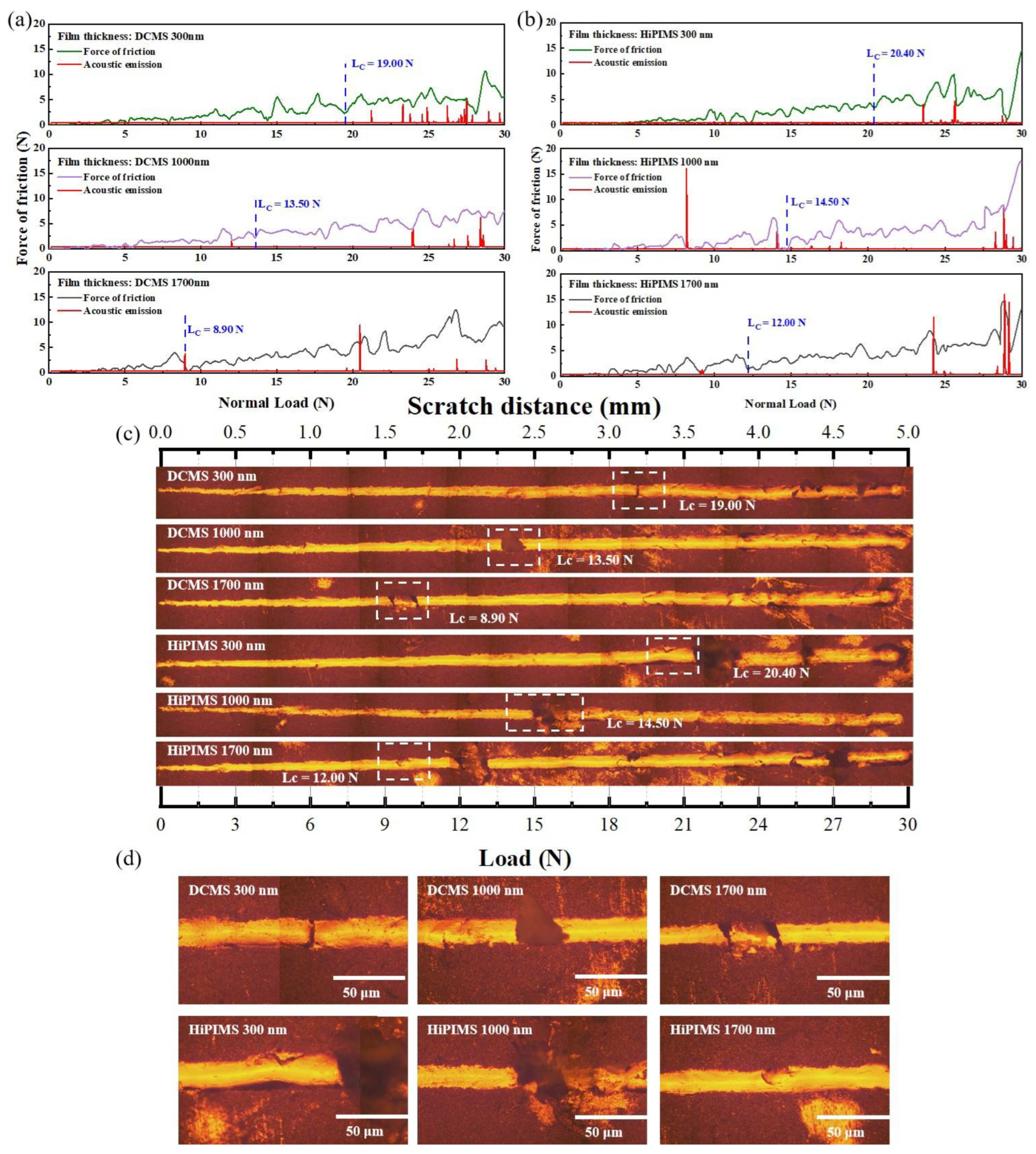
- The film bonding decreased with thickness, but HiPIMS showed better bonding in the range of 300–1000 nm, which is mainly due to the compressive stress introduced by ion bombardment in the early deposition stage.
Author Contributions
Funding
Institutional Review Board Statement
Informed Consent Statement
Data Availability Statement
Conflicts of Interest
References
- Romankov, S.; Park, Y.C.; Umetsu, R.Y.; Komarov, S.V.; Louzguine-Luzgin, D.V. Solid-state methods for ceramic metallization: Unlocking structural complexity, quantum effects, and multifunctionality. Mater. Today 2025, 88, 155–167. [Google Scholar] [CrossRef]
- Xiang, Y.; Xiong, X. Research progress of ceramic metallization technology. Res. Appl. Mater. Sci. 2020, 2, 12–19. [Google Scholar] [CrossRef]
- Zhang, G.; Yu, Z.; Song, D.; Fu, Z.; Zhu, X.; Li, H.; Duan, P.; Qian, L.; Zhao, J.; Xu, Q.; et al. Directly printed standing ceramic circuit boards for rapid prototyping of miniaturization and high-power of electronics. Nat. Commun. 2025, 16, 5258. [Google Scholar] [CrossRef] [PubMed]
- Ramlow, H.; Ghasemi-Tabasi, H.; Burn, A.; Bayer, M.H.; Blugan, G. Joining alumina to metals: Technologies, challenges, and future prospects for high-performance structures. J. Eur. Ceram. Soc 2025, 45, 117464. [Google Scholar] [CrossRef]
- Guo, L.; Li, S.; He, Z.; Fu, Y.; Qiu, F.; Liu, R.; Yang, G. Electroplated copper additives for advanced packaging: A review. ACS Omega 2024, 9, 20637–20647. [Google Scholar] [CrossRef]
- Li, X.; Fu, R.; Lu, R.; Hu, Y.; Huang, W.; Bei, G.; Liu, G.; Xie, B.; Liu, X. Laser-Induced Surface Texturing Enables Selective Copper Metallization on Alumina via Precise Ligand Adsorption. Ceram. Int. 2025, in press.
- Wang, L.; Gong, J.; Long, T.; Blaabjerg, F.; Hu, B.; Wang, Y.; Zeng, Z. Direct metallization-based DBC-free power modules for near-junction water cooling: Analysis and experimental comparison. IEEE Trans. Power Electron. 2024, 39, 7052–7063. [Google Scholar] [CrossRef]
- Roberts, S. Dielectric and piezoelectric properties of barium titanate. Phys. Rev. 1947, 71, 890. [Google Scholar] [CrossRef]
- Wadhwa, A.; Saadati, M.; Benavides-Guerrero, J.; Bolduc, M.; Cloutier, S.G. Grain structure engineering in screen-printed silver flake-based inks for high-temperature printed electronics applications. Materials 2024, 17, 4966. [Google Scholar] [CrossRef]
- Lv, M.; Liu, J.; Wang, S.; Ai, J.; Zeng, X. Higher-resolution selective metallization on alumina substrate by laser direct writing and electroless plating. Appl. Surf. Sci. 2016, 366, 227–232. [Google Scholar] [CrossRef]
- Kaziev, A.V.; Kolodko, D.V.; Lisenkov, V.Y.; Tumarkin, A.V.; Kharkov, M.M.; Samotaev, N.N.; Oblov, K.Y. Cu Metallization of Al2O3 Ceramic by Coating Deposition from Cooled-and Hot-Target Magnetrons. Coatings 2023, 13, 238. [Google Scholar] [CrossRef]
- Kiele, P.; Čvančara, P.; Langenmair, M.; Mueller, M.; Stieglitz, T. Thin film metallization stacks serve as reliable conductors on ceramic-based substrates for active implants. IEEE Trans. Compon. Packag. Manuf. Technol. 2020, 10, 1803–1813. [Google Scholar] [CrossRef]
- Borowski, P.; Myśliwiec, J. Recent Advances in Magnetron Sputtering: From Fundamentals to Industrial Applications. Coatings 2025, 15, 922. [Google Scholar] [CrossRef]
- Altaf, S.F.; Rahman, A.; Wani, M.F. Nanostructured Thermal Barrier Coatings via Magnetron Sputtering: A Review of Enhanced Performance and Durability. Int. J. Ceram. Eng. Sci. 2025, 7, e70018. [Google Scholar] [CrossRef]
- Ouyang, L.; Gao, Y.; Zheng, H. Research on the improvement of the adhesion strength of the Cu films deposited on the Al2O3 films. J. Vac. Sci. Technol. B 2024, 42, 044203. [Google Scholar] [CrossRef]
- Garg, R.; Gonuguntla, S.; Sk, S.; Iqbal, M.S.; Dada, A.O.; Pal, U.; Ahmadipour, M. Sputtering thin films: Materials, applications, challenges and future directions. Adv. Colloid Interface Sci. 2024, 330, 103203. [Google Scholar] [CrossRef]
- Sarakinos, K.; Alami, J.; Konstantinidis, S. High power pulsed magnetron sputtering: A review on scientific and engineering state of the art. Surf. Coat. Technol. 2010, 204, 1661–1684. [Google Scholar] [CrossRef]
- Anders, A. Tutorial: Reactive high power impulse magnetron sputtering (R-HiPIMS). J. Appl. Phys. 2017, 121, 171101. [Google Scholar] [CrossRef]
- Vetter, J.; Shimizu, T.; Kurapov, D.; Sasaki, T.; Mueller, J.; Stangier, D.; Esselbach, M. Industrial application potential of high power impulse magnetron sputtering for wear and corrosion protection coatings. J. Appl. Phys. 2023, 134, 160701. [Google Scholar] [CrossRef]
- Gudmundsson, J.T.; Brenning, N.; Lundin, D.; Helmersson, U. High power impulse magnetron sputtering discharge. J. Vac. Sci. Technol. A 2012, 30, 030801. [Google Scholar] [CrossRef]
- Gudmundsson, J.T.; Alami, J.; Helmersson, U. Spatial and temporal behavior of the plasma parameters in a pulsed magnetron discharge. Surf. Coat. Technol. 2002, 161, 249–256. [Google Scholar] [CrossRef]
- Bohlmark, J.; Ostbye, M.; Lattemann, M.; Blom, H.; Persson, P.Å.O.; Helmersson, U.; Gudmundsson, J.T. Spatial electron density distribution in a high-power pulsed magnetron discharge. IEEE Trans. Plasma Sci. 2005, 33, 346–347. [Google Scholar] [CrossRef]
- Sun, X.; Hong, R.; Hou, H.; Fan, Z.; Shao, J. Thickness dependence of structure and optical properties of silver films deposited by magnetron sputtering. Thin Solid Films 2007, 515, 6962–6966. [Google Scholar] [CrossRef]
- Amalathas, A.; Peter, A.; Alkaisi, M.M. Effects of film thickness and sputtering power on properties of ITO thin films deposited by RF magnetron sputtering without oxygen. J. Mater. Sci. Mater. Electron. 2016, 27, 11064–11071. [Google Scholar] [CrossRef]
- Yu, X.; Ma, J.; Ji, F.; Wang, Y.; Zhang, X.J.; Cheng, C.F.; Ma, H.L. Thickness dependence of properties of ZnO: Ga films deposited by rf magnetron sputtering. Appl. Surf. Sci. 2005, 245, 310–315. [Google Scholar] [CrossRef]
- Kushwaha, A.K.; Khadka, R.; Keblinski, P. Surface-Induced effects in ferroelectric BaTiO3 thin films. Surf. Interfaces 2025, 56, 105589. [Google Scholar] [CrossRef]
- Bakken, K.; Blichfeld, A.B.; Chernyshov, D.; Grande, T.; Glaum, J.; Einarsrud, M.A. Mechanisms for texture in BaTiO3 thin films from aqueous chemical solution deposition. J. Sol-Gel Sci. Technol. 2020, 95, 562–572. [Google Scholar] [CrossRef]
- Tanaka, Y.; Okamoto, S.; Hashimoto, K.; Takayama, R.; Harigai, T.; Adachi, H.; Fujii, E. High electromechanical strain and enhanced temperature characteristics in lead-free (Na, Bi) TiO3–BaTiO3 thin films on Si substrates. Sci. Rep. 2018, 8, 7847. [Google Scholar] [CrossRef] [PubMed]
- Cullity, B.D.; Stock, S.R. Elements of X-Ray Diffraction, 3rd ed.; Prentice Hall: Upper Saddle River, NJ, USA, 2001; ISBN 9780470446478. [Google Scholar]
- Noyan, I.C.; Cohen, J.B. Residual Stress: Measurement by Diffraction and Interpretation; Springer: New York, NY, USA, 1987; ISBN 978-1-4613-9570-6. [Google Scholar]
- Randall, C.A.; Yousefian, P. Fundamentals and practical dielectric implications of stoichiometry and chemical design in a high-performance ferroelectric oxide: BaTiO3. J. Eur. Ceram. Soc. 2022, 42, 1445–1473. [Google Scholar] [CrossRef]
- Kubart, T.; Gudmundsson, J.T.; Lundin, D. Reactive High Power Impulse Magnetron Sputtering. In High Power Impulse Magnetron Sputtering: Fundamentals, Technologies, Challenges and Applications; Lundin, D., Gudmundsson, J.T., Helmersson, U., Eds.; Elsevier: Amsterdam, The Netherlands, 2020; pp. 223–263. ISBN 978-0-12-818623-4. [Google Scholar]
- Anders, A. Self-sputtering runaway in high power impulse magnetron sputtering: The role of secondary electrons and multiply charged metal ions. Appl. Phys. Lett. 2008, 92, 201503. [Google Scholar] [CrossRef]
- Wang, Z.; Zhao, S.; Zhang, Y.; Guo, W.; Zhang, Y.; Liu, X. Effect of deposition rate on the microstructure and properties of sputtered Zr–Cr thin films. J. Alloys Compd. 2023, 936, 168258. [Google Scholar]
- Mahieu, S.; Van Aeken, K.; Depla, D. Transport of Sputtered Particles Through the Gas Phase. In Reactive Sputter Deposition; Depla, D., Mahieu, S., Eds.; Springer: Berlin/Heidelberg, Germany, 2008; pp. 199–227. ISBN 978-3-540-76664-3. [Google Scholar]
- Venables, J.A.; Spiller, G.D.T.; Hanbücken, M. Nucleation and growth of thin films. Rep. Prog. Phys. 1984, 47, 399–459. [Google Scholar] [CrossRef]
- Anders, A. Discharge physics of high power impulse magnetron sputtering. Surf. Coat. Technol. 2011, 205, S1–S9. [Google Scholar] [CrossRef]
- Hajihoseini, H.; Čada, M.; Hubička, Z.; Ünaldi, S.; Raadu, M.A.; Brenning, N.; Gudmundsson, J.T.; Lundin, D. Sideways deposition rate and ionized flux fraction in DC and high power impulse magnetron sputtering. J. Vac. Sci. Technol. A 2020, 38, 033009. [Google Scholar] [CrossRef]
- Atmane, S.; Maroussiak, A.; Caillard, A.; Claye, M.; Dufresne, J.F.R.P. Role of sputtered atom and ion energy distribution in films deposited by physical vapor deposition: A molecular dynamics approach. J. Vac. Sci. Technol. A 2024, 42, 063201. [Google Scholar] [CrossRef]
- Barajas-Valdés, U.; Suárez, O.M. Morphological and Structural Characterization of Magnetron-Sputtered Aluminum and Aluminum-Boron Thin Films. Crystals 2021, 11, 492. [Google Scholar] [CrossRef]
- Hu, C.K.; Harper, J.M.E. Copper interconnections and reliability. Mater. Chem. Phys. 1998, 52, 5–16. [Google Scholar] [CrossRef]
- Turkin, A.A.; Habraken, F.H.P.M.; van de Sanden, M.C.M.; Kessels, W.M.M. On the evolution of film roughness during magnetron sputtering deposition. J. Appl. Phys. 2010, 108, 093502. [Google Scholar] [CrossRef]
- Cemin, F.; Abadias, G.; Minea, T.; Lundin, D. Tuning high power impulse magnetron sputtering discharge and substrate bias conditions to reduce the intrinsic stress of TiN thin films. Thin Solid Films 2019, 688, 137270. [Google Scholar] [CrossRef]
- Thompson, C.V. Coarsening of particles on a planar substrate: Interface energy anisotropy and application to grain growth in thin films. Acta Metall. 1988, 36, 2929–2934. [Google Scholar] [CrossRef]
- Langford, J.I.; Wilson, A.J.C. Scherrer after sixty years: A survey and some new results in the determination of crystallite size. Appl. Crystallogr. 1978, 11, 102–113. [Google Scholar] [CrossRef]
- Manova, D.; Gerlach, J.W.; Mändl, S. Thin film deposition using energetic ions. Materials 2010, 3, 4109–4141. [Google Scholar] [CrossRef]
- Luo, Q. A modified X-ray diffraction method to measure residual normal and shear stresses of machined surfaces. Int. J. Adv. Manuf. Technol. 2022, 120, 6453–6466. [Google Scholar] [CrossRef]
- Schafnitzel, M.; Voigt, A.; Schmidt, R. Micromechanical analysis of metal-ceramic thin-films on steel substrates. JOM 2024, 76, 1234–1245. [Google Scholar]
- Ren, Y.; Bai, H.; Liu, X.; Li, J.; Liu, X. Effects of HiPIMS Duty Cycle on Plasma Discharge and the Properties of Cu Film. Materials 2024, 17, 2311. [Google Scholar] [CrossRef]
- Liu, X.; Bai, H.; Ren, Y.; Li, J.; Liu, X. Influence of HiPIMS Pulse Widths on the Structure and Properties of Copper Films. Materials 2024, 17, 2342. [Google Scholar] [CrossRef]
- Abadias, G.; Chason, E.; Keckes, J.; Martin, P.M.; Barboza-Flores, M.R.; Register, R.A.; Cahill, D.G.; Andriotis, M.R.S.D.; Lousada, A.M.L. Stress in thin films and coatings: Current status, challenges, and prospects. J. Vac. Sci. Technol. A 2018, 36, 020801. [Google Scholar] [CrossRef]
- Windischmann, H. Intrinsic stress in sputter-deposited thin films. Crit. Rev. Solid State 1992, 17, 547–596. [Google Scholar] [CrossRef]
- Mayadas, A.F.; Shatzkes, M. Electrical-resistivity model for polycrystalline films: The case of arbitrary reflection at external surfaces. Phys. Rev. B 1970, 1, 1382. [Google Scholar] [CrossRef]
- Patidar, J.; Thorwarth, K.; Schmitz-Kempen, T.; Kessels, R.; Siol, S. Deposition of highly crystalline AlScN thin films using synchronized high-power impulse magnetron sputtering: From combinatorial screening to piezoelectric devices. Phys. Rev. Mater. 2024, 8, 095001. [Google Scholar] [CrossRef]
- Bull, S.J. Failure mode maps in the thin film scratch adhesion test. Tribol. Int. 1997, 30, 491–498. [Google Scholar] [CrossRef]
- Bull, S.J.; Berasetegui, E.G. An overview of the potential of quantitative coating adhesion measurement by scratch testing. Tribol. Int. 2006, 39, 99–114. [Google Scholar] [CrossRef]
- Meng, D.; Li, Y.G.; Jiang, Z.T.; Zheng, H.W.; Wen, L.S.; Bai, X.D. Scratch behavior and FEM modelling of Cu/Si (100) thin films deposited by modulated pulsed power magnetron sputtering. Surf. Coat. Technol. 2019, 363, 25–33. [Google Scholar] [CrossRef]
- Beegan, D.; Laugier, M.T.; Arshak, A. The Effect of Ti And TiN Barrier Layers on The Stress And Adhesion of Cu Thin Films Deposited on Si. WIT Trans. Eng. Sci. 2001, 33, 291–300. [Google Scholar]



| Power Mode | Pressure (Pa) | Average Power (W) | Duty Cycle | Thickness (nm) | Temperature (°C) | |
|---|---|---|---|---|---|---|
| 1 | DCMS | 0.6 | 143 | 100% | 300 | 23 |
| 2 | 1000 | |||||
| 3 | 1700 | |||||
| 4 | HiPIMS | 180 | 3% | 300 | ||
| 5 | 1000 | |||||
| 6 | 1700 |
Disclaimer/Publisher’s Note: The statements, opinions and data contained in all publications are solely those of the individual author(s) and contributor(s) and not of MDPI and/or the editor(s). MDPI and/or the editor(s) disclaim responsibility for any injury to people or property resulting from any ideas, methods, instructions or products referred to in the content. |
© 2025 by the authors. Licensee MDPI, Basel, Switzerland. This article is an open access article distributed under the terms and conditions of the Creative Commons Attribution (CC BY) license (https://creativecommons.org/licenses/by/4.0/).
Share and Cite
Liao, Y.; Bai, H.; Shi, F.; Li, J.; Liu, X. Influence of Film Thickness on the Structure and Properties of Copper Thin Films Deposited on BaTiO3 Ceramics by DCMS and HiPIMS. Materials 2025, 18, 5333. https://doi.org/10.3390/ma18235333
Liao Y, Bai H, Shi F, Li J, Liu X. Influence of Film Thickness on the Structure and Properties of Copper Thin Films Deposited on BaTiO3 Ceramics by DCMS and HiPIMS. Materials. 2025; 18(23):5333. https://doi.org/10.3390/ma18235333
Chicago/Turabian StyleLiao, Yuanhao, Heda Bai, Fengtian Shi, Jin Li, and Xiangli Liu. 2025. "Influence of Film Thickness on the Structure and Properties of Copper Thin Films Deposited on BaTiO3 Ceramics by DCMS and HiPIMS" Materials 18, no. 23: 5333. https://doi.org/10.3390/ma18235333
APA StyleLiao, Y., Bai, H., Shi, F., Li, J., & Liu, X. (2025). Influence of Film Thickness on the Structure and Properties of Copper Thin Films Deposited on BaTiO3 Ceramics by DCMS and HiPIMS. Materials, 18(23), 5333. https://doi.org/10.3390/ma18235333