
Laser Technologies of Welding, Surfacing and Regeneration of Metals with HCP Structure (Mg, Ti, Zr): State of the Art, Challenges and Prospects


Abstract
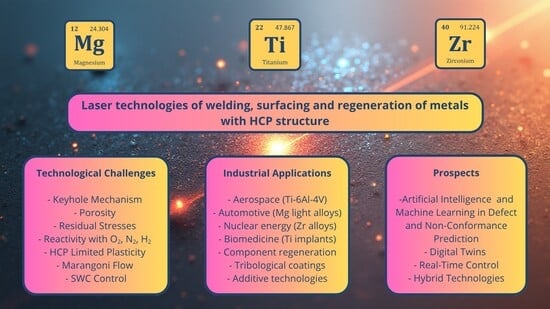
1. Introduction
2. Characteristics of HCP Materials and Their Welding Challenges
3. Physical Mechanisms of Laser Beam Interaction with HCP Metals
4. Microstructure and Properties of Laser Beam Welded Joints in HCP Metals
5. Laser Cladding and Surface Regeneration of HCP Metals
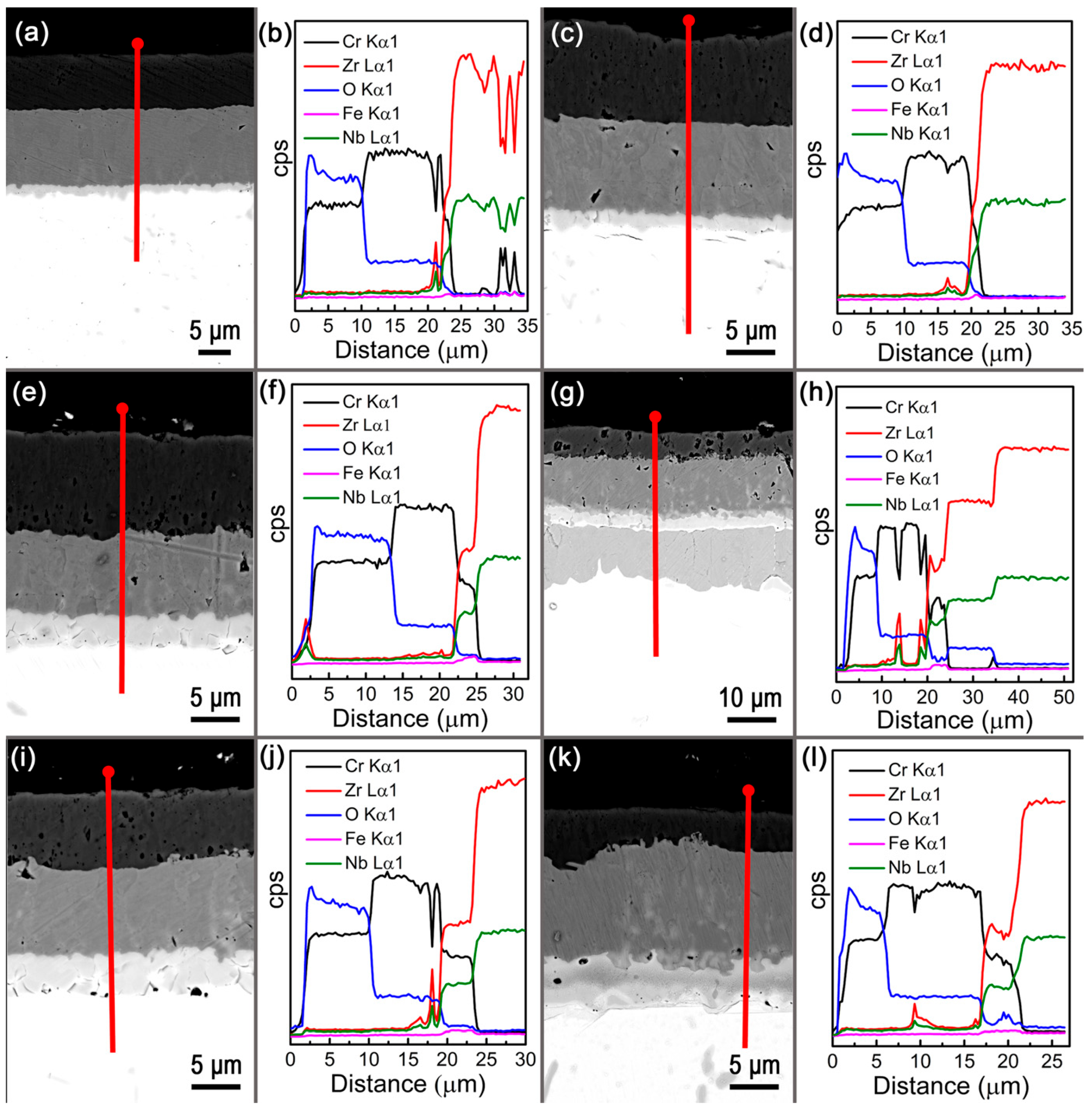
- Chromium coatings (Cr, Cr-Al)—chromium coatings with thicknesses of 10–50 μm are currently the most advanced commercial solution. They are produced by laser cladding using Cr powder or CrAl wire [159,160]. Figure 2 shows Cross-sectional SEM images and corresponding EDS line scans of the outer surface of the Cr-coated Zr tube oxidized at different conditions. The main technical challenge is the elimination of microcracks at the Cr/Zr interface caused by differences in thermal expansion coefficients [161,162].
- Composite coatings Zr-Al2O3 and Zr-MAX phases—the latest direction involves composite coatings containing hard ceramic phases Al2O3, SiC or MAX phases (e.g., Ti3SiC2, Cr2AlC) [164,165]. Zr-Al2O3 coatings exhibit hardness of 400–550 HV and wear resistance comparable to that of tool steels, while maintaining good substrate adhesion [166].
6. Residual Stresses, Deformations and Cracking in Laser Processes of HCP Metals
7. Numerical Modeling and Simulation of Laser Processes in HCP Metals
8. Summary and Development Perspectives of Laser Technologies for HCP Metals
Author Contributions
Funding
Conflicts of Interest
References
- Cao, X.; Jahazi, M.; Immarigeon, J.P.; Wallace, W. A Review of Laser Welding Techniques for Magnesium Alloys. J. Mater. Process. Technol. 2006, 171, 188–204. [Google Scholar] [CrossRef]
- Akman, E.; Demir, A.; Canel, T.; Sınmazçelik, T. Laser Welding of Ti6Al4V Titanium Alloys. J. Mater. Process. Technol. 2009, 209, 3705–3713. [Google Scholar] [CrossRef]
- Kautz, E.; Gwalani, B.; Yu, Z.; Varga, T.; Geelhood, K.; Devaraj, A.; Senor, D. Investigating Zirconium Alloy Corrosion with Advanced Experimental Techniques: A Review. J. Nucl. Mater. 2023, 585, 154586. [Google Scholar] [CrossRef]
- Skrzekut, T.; Jaworska, L.; Noga, P.; Jeleń, P.; Cempura, G. Research on the Consolidation and Strengthening of Ti6Al4V-GO Sinters. J. Alloys Compd. 2023, 958, 170435. [Google Scholar] [CrossRef]
- Tang, C.; Stueber, M.; Seifert, H.J.; Steinbrueck, M. Protective Coatings on Zirconium-Based Alloys as Accident-Tolerant Fuel (ATF) Claddings. Corros. Rev. 2017, 35, 141–165. [Google Scholar] [CrossRef]
- Baqer, Y.M.; Ramesh, S.; Yusof, F.; Manladan, S.M. Challenges and Advances in Laser Welding of Dissimilar Light Alloys: Al/Mg, Al/Ti, and Mg/Ti Alloys. Int. J. Adv. Manuf. Technol. 2018, 95, 4353–4369. [Google Scholar] [CrossRef]
- Jiang, Y.; Jiang, M.; Chen, X.; Chen, A.; Ma, S.; Jiang, N.; Zhang, S.; Wang, Z.; Lei, Z.; Chen, Y. Vacuum Laser Beam Welding of AZ31 Magnesium Alloy: Weld Formability, Microstructure and Mechanical Properties. Opt. Laser Technol. 2024, 169, 110115. [Google Scholar] [CrossRef]
- Vilar, R. Laser Cladding. J. Laser Appl. 1999, 11, 64–79. [Google Scholar] [CrossRef]
- Terrani, K.A.; Zinkle, S.J.; Snead, L.L. Advanced Oxidation-Resistant Iron-Based Alloys for LWR Fuel Cladding. J. Nucl. Mater. 2014, 448, 420–435. [Google Scholar] [CrossRef]
- Steen, W.M.; Mazumder, J. Laser Material Processing; Springer: London, UK, 2010; ISBN 978-1-84996-061-8. [Google Scholar]
- Zhao, C.; Fezzaa, K.; Cunningham, R.W.; Wen, H.; De Carlo, F.; Chen, L.; Rollett, A.D.; Sun, T. Real-Time Monitoring of Laser Powder Bed Fusion Process Using High-Speed X-ray Imaging and Diffraction. Sci. Rep. 2017, 7, 3602. [Google Scholar] [CrossRef]
- Fabbro, R. Melt Pool and Keyhole Behaviour Analysis for Deep Penetration Laser Welding. J. Phys. D Appl. Phys. 2010, 43, 445501. [Google Scholar] [CrossRef]
- Wei, W.; Liu, Y.; Deng, H.; Wei, Z.; Wang, T.; Li, G. Monitoring of the Weld Pool, Keyhole Morphology and Material Penetration State in Near-Infrared and Blue Composite Laser Welding of Magnesium Alloy. J. Manuf. Mater. Process. 2024, 8, 150. [Google Scholar] [CrossRef]
- Cunningham, R.; Zhao, C.; Parab, N.; Kantzos, C.; Pauza, J.; Fezzaa, K.; Sun, T.; Rollett, A.D. Keyhole Threshold and Morphology in Laser Melting Revealed by Ultrahigh-Speed X-ray Imaging. Science 2019, 363, 849–852. [Google Scholar] [CrossRef] [PubMed]
- Lin, R.; Wang, H.; Lu, F.; Solomon, J.; Carlson, B.E. Numerical Study of Keyhole Dynamics and Keyhole-Induced Porosity Formation in Remote Laser Welding of Al Alloys. Int. J. Heat Mass Transf. 2017, 108, 244–256. [Google Scholar] [CrossRef]
- Ning, J.; Na, S.-J.; Zhang, L.-J.; Wang, X.; Long, J.; Cho, W.-I. Improving Thermal Efficiency and Stability of Laser Welding Process for Magnesium Alloy by Combining Power Modulation and Subatmospheric Pressure Environment. J. Magnes. Alloys 2022, 10, 2788–2800. [Google Scholar] [CrossRef]
- Jiang, P.; Dong, H.; Cai, Y.; Gao, M. Effects of Laser Power Modulation on Keyhole Behavior and Energy Absorptivity for Laser Welding of Magnesium Alloy AZ31. Int. J. Adv. Manuf. Technol. 2023, 125, 563–576. [Google Scholar] [CrossRef]
- Yin, Q.; Yang, Z.; Li, H.; Du, H. Mechanism of Keyhole Evolution and Welding Quality of Electron Beam Welded Magnesium Alloy with Scanning Path Variation via Modeling and Numerical Study. J. Magnes. Alloys 2025, 13, 3166–3185. [Google Scholar] [CrossRef]
- Yunlian, Q.; Ju, D.; Quan, H.; Liying, Z. Electron Beam Welding, Laser Beam Welding and Gas Tungsten Arc Welding of Titanium Sheet. Mater. Sci. Eng. A 2000, 280, 177–181. [Google Scholar] [CrossRef]
- Casalino, G.; Mortello, M. Modeling and Experimental Analysis of Fiber Laser Offset Welding of Al-Ti Butt Joints. Int. J. Adv. Manuf. Technol. 2016, 83, 89–98. [Google Scholar] [CrossRef]
- Gao, X.-L.; Zhang, L.-J.; Liu, J.; Zhang, J.-X. Effects of Weld Cross-Section Profiles and Microstructure on Properties of Pulsed Nd:YAG Laser Welding of Ti6Al4V Sheet. Int. J. Adv. Manuf. Technol. 2014, 72, 895–903. [Google Scholar] [CrossRef]
- Xu, W.; Sun, S.; Elambasseril, J.; Liu, Q.; Brandt, M.; Qian, M. Ti-6Al-4V Additively Manufactured by Selective Laser Melting with Superior Mechanical Properties. JOM 2015, 67, 668–673. [Google Scholar] [CrossRef]
- Baufeld, B.; Brandl, E.; Van Der Biest, O. Wire Based Additive Layer Manufacturing: Comparison of Microstructure and Mechanical Properties of Ti–6Al–4V Components Fabricated by Laser-Beam Deposition and Shaped Metal Deposition. J. Mater. Process. Technol. 2011, 211, 1146–1158. [Google Scholar] [CrossRef]
- Yang, J.; Yu, H.; Yin, J.; Gao, M.; Wang, Z.; Zeng, X. Formation and Control of Martensite in Ti-6Al-4V Alloy Produced by Selective Laser Melting. Mater. Des. 2016, 108, 308–318. [Google Scholar] [CrossRef]
- Kim, J.; Lee, C.Y.; Rho, H.; Kim, D.; Lee, J.; Jang, H.; Lee, Y. Elucidating Changes in Thermal Creep Strain Rate of Cr-Coated Zr-Nb Alloy Accident Tolerant Fuel (ATF) Cladding via Experiment and Mechanical Analysis. J. Nucl. Mater. 2024, 592, 154947. [Google Scholar] [CrossRef]
- Ma, H.-B.; Yan, J.; Zhao, Y.-H.; Liu, T.; Ren, Q.-S.; Liao, Y.-H.; Zuo, J.-D.; Liu, G.; Yao, M.-Y. Oxidation Behavior of Cr-Coated Zirconium Alloy Cladding in High-Temperature Steam above 1200 °C. npj Mater. Degrad. 2021, 5, 7. [Google Scholar] [CrossRef]
- Ko, J.; Kim, J.W.; Min, H.W.; Kim, Y.; Yoon, Y.S. Review of Manufacturing Technologies for Coated Accident Tolerant Fuel Cladding. J. Nucl. Mater. 2022, 561, 153562. [Google Scholar] [CrossRef]
- Gu, D.D.; Meiners, W.; Wissenbach, K.; Poprawe, R. Laser Additive Manufacturing of Metallic Components: Materials, Processes and Mechanisms. Int. Mater. Rev. 2012, 57, 133–164. [Google Scholar] [CrossRef]
- Toyserkani, E.; Khajepour, A.; Corbin, S.F. Laser Cladding, 1st ed.; CRC Press: Boca Raton, FL, USA, 2004; ISBN 978-0-429-12189-0. [Google Scholar]
- Gong, N.; Meng, T.L.; Cao, J.; Wang, Y.; Karyappa, R.; Ivan Tan, C.K.; Suwardi, A.; Zhu, Q.; Ngo, A.C.Y.; Misra, K.P.; et al. Laser-Cladding of High Entropy Alloy Coatings: An Overview. Mater. Technol. 2023, 38, 2151696. [Google Scholar] [CrossRef]
- Ma, D.; Jiang, P.; Shu, L.; Qiu, Y.; Zhang, Y.; Geng, S. DBN-Based Online Identification of Porosity Regions during Laser Welding of Aluminum Alloys Using Coherent Optical Diagnosis. Opt. Laser Technol. 2023, 165, 109597. [Google Scholar] [CrossRef]
- Wang, C.; Chandra, S.; Huang, S.; Tor, S.B.; Tan, X. Unraveling Process-Microstructure-Property Correlations in Powder-Bed Fusion Additive Manufacturing through Information-Rich Surface Features with Deep Learning. J. Mater. Process. Technol. 2023, 311, 117804. [Google Scholar] [CrossRef]
- Lütjering, G.; Williams, J.C. Titanium; Engineering Materials and Processes; Springer: Berlin/Heidelberg, Germany, 2003; ISBN 978-3-662-13222-7. [Google Scholar]
- Banerjee, D.; Williams, J.C. Perspectives on Titanium Science and Technology. Acta Mater. 2013, 61, 844–879. [Google Scholar] [CrossRef]
- Gray, J.E.; Luan, B. Protective Coatings on Magnesium and Its Alloys—A Critical Review. J. Alloys Compd. 2002, 336, 88–113. [Google Scholar] [CrossRef]
- Abbas, G.; Li, L.; Ghazanfar, U.; Liu, Z. Effect of High Power Diode Laser Surface Melting on Wear Resistance of Magnesium Alloys. Wear 2006, 260, 175–180. [Google Scholar] [CrossRef]
- Ahmadi, N.; Naffakh-Moosavy, H.; Hadavi, S.M.M.; Bagheri, F. The Effect of Nd:YAG Laser Parameters on the Microstructure, Hot Cracking Susceptibility and Elemental Evaporation of Surface Melted AZ80 Magnesium-Based Alloy. J. Mater. Res. Technol. 2023, 27, 2459–2474. [Google Scholar] [CrossRef]
- Wang, B.; Cheng, Z.; Xu, H.; Wang, Y.; Luo, L.; Wang, S.; Long, W.; Wei, S. Study on the Properties and Mechanism of Magnesium Alloy and Ni-Plating Stainless-Steel by Ultrasonic-Laser Welding-Brazing. Sci. Rep. 2025, 15, 13588. [Google Scholar] [CrossRef] [PubMed]
- Klenam, D.E.P.; Ogunwande, G.S.; Omotosho, T.; Ozah, B.; Maledi, N.B.; Hango, S.I.; Fabuyide, A.A.; Mohlala, L.; Van Der Merwe, J.W.; Bodunrin, M.O. Welding of Magnesium and Its Alloys: An Overview of Methods and Process Parameters and Their Effects on Mechanical Behaviour and Structural Integrity of the Welds. Manuf. Rev. 2021, 8, 29. [Google Scholar] [CrossRef]
- Quan, Y.J.; Chen, Z.H.; Gong, X.S.; Yu, Z.H. Effects of Heat Input on Microstructure and Tensile Properties of Laser Welded Magnesium Alloy AZ31. Mater. Charact. 2008, 59, 1491–1497. [Google Scholar] [CrossRef]
- Cui, Z.; Yang, H.; Wang, W.; Wu, H.; Xu, B. Laser Cladding Al-Si/Al2O3-TiO2 Composite Coatings on AZ31B Magnesium Alloy. J. Wuhan Univ. Technol. Mat. Sci. Edit. 2012, 27, 1042–1047. [Google Scholar] [CrossRef]
- Yue, T.M.; Li, T. Laser Cladding of Ni/Cu/Al Functionally Graded Coating on Magnesium Substrate. Surf. Coat. Technol. 2008, 202, 3043–3049. [Google Scholar] [CrossRef]
- Leyens, C.; Peters, M. (Eds.) Titanium and Titanium Alloys: Fundamentals and Applications, 1st ed.; Wiley-VCH: Weinheim, Germany, 2003; ISBN 978-3-527-30534-6. [Google Scholar]
- Welsch, G.; Boyer, R.; Collings, E.W. Materials Properties Handbook: Titanium Alloys; ASM International: Materials Park, OH, USA, 1993. [Google Scholar]
- ASM International Handbook Committee. ASM Handbook, Volume 2: Properties and Selection: Nonferrous Alloys and Special-Purpose Materials; ASM International: Materials Park, OH, USA, 1990. [Google Scholar]
- Ahmed, T.; Rack, H.J. Phase Transformations during Cooling in A+β Titanium Alloys. Mater. Sci. Eng. A 1998, 243, 206–211. [Google Scholar] [CrossRef]
- Masubuchi, K. Analysis of Welded Structures; Pergamon Press: Oxford, UK, 1980. [Google Scholar]
- Kelly, S.M.; Kampe, S.L. Microstructural Evolution in Laser-Deposited Multilayer Ti-6Al-4V Builds: Part II. Thermal Modeling. Metall. Mater. Trans. A 2004, 35, 1869–1879. [Google Scholar] [CrossRef]
- Sabol, G. Zirconium in the Nuclear Industry: Twelfth International Symposium; ASTM International: Barr Harbor, PA, USA, 2000. [Google Scholar]
- Steinbrück, M. Prototypical Experiments Relating to Air Oxidation of Zircaloy-4 at High Temperatures. J. Nucl. Mater. 2009, 392, 531–544. [Google Scholar] [CrossRef]
- Kim, H.-G.; Kim, I.-H.; Park, J.-Y.; Koo, Y.-H. Application of Coating Technology on Zirconium-Based Alloy to Decrease High-Temperature Oxidation. In Zirconium in the Nuclear Industry: 17th Volume; ASTM International: Barr Harbor, PA, USA, 2015; pp. 346–369. ISBN 978-0-8031-7529-7. [Google Scholar]
- Kashkarov, E.; Afornu, B.; Sidelev, D.; Krinitcyn, M.; Gouws, V.; Lider, A. Recent Advances in Protective Coatings for Accident Tolerant Zr-Based Fuel Claddings. Coatings 2021, 11, 557. [Google Scholar] [CrossRef]
- Maier, B.; Yeom, H.; Johnson, G.; Dabney, T.; Walters, J.; Xu, P.; Romero, J.; Shah, H.; Sridharan, K. Development of Cold Spray Chromium Coatings for Improved Accident Tolerant Zirconium-Alloy Cladding. J. Nucl. Mater. 2019, 519, 247–254. [Google Scholar] [CrossRef]
- Brachet, J.-C.; Idarraga-Trujillo, I.; Flem, M.L.; Saux, M.L.; Vandenberghe, V.; Urvoy, S.; Rouesne, E.; Guilbert, T.; Toffolon-Masclet, C.; Tupin, M.; et al. Early Studies on Cr-Coated Zircaloy-4 as Enhanced Accident Tolerant Nuclear Fuel Claddings for Light Water Reactors. J. Nucl. Mater. 2019, 517, 268–285. [Google Scholar] [CrossRef]
- Bharadwaj, V.; Rai, A.K.; Upadhyaya, B.N.; Singh, R.; Rai, S.K.; Bindra, K.S. A Study on Effect of Heat Input on Mode of Welding, Microstructure and Mechanical Strength in Pulsed Laser Welding of Zr-2.5 Wt.%Nb Alloy. J. Nucl. Mater. 2022, 564, 153685. [Google Scholar] [CrossRef]
- Elkin, M.A.; Kiselev, A.S.; Slobodyan, M.S. Pulsed Laser Welding of Zr 1%Nb Alloy. Nucl. Eng. Technol. 2019, 51, 776–783. [Google Scholar] [CrossRef]
- Slobodyan, M. Resistance, Electron- and Laser-Beam Welding of Zirconium Alloys for Nuclear Applications: A Review. Nucl. Eng. Technol. 2021, 53, 1049–1078. [Google Scholar] [CrossRef]
- Kuprin, A.S.; Belous, V.A.; Voyevodin, V.N.; Bryk, V.V.; Vasilenko, R.L.; Ovcharenko, V.D.; Reshetnyak, E.N.; Tolmachova, G.N.; V’yugov, P.N. Vacuum-Arc Chromium-Based Coatings for Protection of Zirconium Alloys from the High-Temperature Oxidation in Air. J. Nucl. Mater. 2015, 465, 400–406. [Google Scholar] [CrossRef]
- Maier, B.R.; Garcia-Diaz, B.L.; Hauch, B.; Olson, L.C.; Sindelar, R.L.; Sridharan, K. Cold Spray Deposition of Ti2AlC Coatings for Improved Nuclear Fuel Cladding. J. Nucl. Mater. 2015, 466, 712–717. [Google Scholar] [CrossRef]
- Daub, K.; Van Nieuwenhove, R.; Nordin, H. Investigation of the Impact of Coatings on Corrosion and Hydrogen Uptake of Zircaloy-4. J. Nucl. Mater. 2015, 467, 260–270. [Google Scholar] [CrossRef]
- Zwolinski, A.; Letocha, A.; Cyboron, J.; Noga, P.; Skrzekut, T.; Podsiadlo, M.; Lis, L.; Jaworska, L.; Boczkal, G. Influence of the High-Pressure ω–Zr Phase on Selected Properties of Sintered Zirconium Powder Materials. Int. J. Refract. Met. Hard Mater. 2023, 110, 106036. [Google Scholar] [CrossRef]
- Jaworska, L.; Panasiuk, J.; Putyra, P.; Stępień, M.; Noga, P.; Pałka, P.; Zwoliński, A. The Influence of Powder Characteristics on the Sintering Behaviour and Impurity Content of Spark-Plasma-Sintered Zirconium. Int. J. Refract. Met. Hard Mater. 2019, 82, 259–267. [Google Scholar] [CrossRef]
- Terrani, K.A. Accident Tolerant Fuel Cladding Development: Promise, Status, and Challenges. J. Nucl. Mater. 2018, 501, 13–30. [Google Scholar] [CrossRef]
- Zinkle, S.J.; Terrani, K.A.; Gehin, J.C.; Ott, L.J.; Snead, L.L. Accident Tolerant Fuels for LWRs: A Perspective. J. Nucl. Mater. 2014, 448, 374–379. [Google Scholar] [CrossRef]
- Skrzekut, T.; Boczkal, G.; Zwoliński, A.; Noga, P.; Jaworska, L.; Pałka, P.; Podsiadło, M. The Extrusion and SPS of Zirconium–Copper Powders and Studies of Selected Mechanical Properties. Materials 2021, 14, 3560. [Google Scholar] [CrossRef]
- Jaworska, L.; Skrzekut, T.; Stępień, M.; Pałka, P.; Boczkal, G.; Zwoliński, A.; Noga, P.; Podsiadło, M.; Wnuk, R.; Ostachowski, P. The Pressure Compaction of Zr-Nb Powder Mixtures and Selected Properties of Sintered and KOBO-Extruded Zr-xNb Materials. Materials 2021, 14, 3172. [Google Scholar] [CrossRef]
- Rani, S.U.; Kesavan, D.; Kamaraj, M. Evaluation of Influence of Microstructural Features of LPBF Ti-6Al-4 V on Mechanical Properties for an Optimal Strength and Ductility. J. Alloys Compd. 2023, 960, 170575. [Google Scholar] [CrossRef]
- Steinbrück, M. Hydrogen Absorption by Zirconium Alloys at High Temperatures. J. Nucl. Mater. 2004, 334, 58–64. [Google Scholar] [CrossRef]
- DebRoy, T.; Wei, H.L.; Zuback, J.S.; Mukherjee, T.; Elmer, J.W.; Milewski, J.O.; Beese, A.M.; Wilson-Heid, A.; De, A.; Zhang, W. Additive Manufacturing of Metallic Components—Process, Structure and Properties. Prog. Mater. Sci. 2018, 92, 112–224. [Google Scholar] [CrossRef]
- Tsukamoto, S.; Kawaguchi, I.; Arakane, G.; Honda, H. Keyhole Behavior in High Power Laser Welding. In Proceedings of the First International Symposium on High-Power Laser Macroprocessing, Osaka, Japan, 27–31 May 2002; Miyamoto, I., Kobayashi, K.F., Sugioka, K., Poprawe, R., Helvajian, H., Eds.; SPIE: Bellingham, WA, USA, 2003. 251p. [Google Scholar]
- Dowden, J.; Kapadia, P.; Postacioglu, N. An Analysis of the Laser-Plasma Interaction in Laser Keyhole Welding. J. Phys. D Appl. Phys. 1989, 22, 741–749. [Google Scholar] [CrossRef]
- Meng, W.; Li, Z.; Lu, F.; Wu, Y.; Chen, J.; Katayama, S. Porosity Formation Mechanism and Its Prevention in Laser Lap Welding for T-Joints. J. Mater. Process. Technol. 2014, 214, 1658–1664. [Google Scholar] [CrossRef]
- Dakka, J.; Wang, H.P.; Yang, B.; Ma, J.; Carlson, B.; Oswald, J. Influence of Beam Oscillation on Keyhole Stability and Porosity in Aluminum Laser Welding. J. Mater. Process. Technol. 2025, 342, 118945. [Google Scholar] [CrossRef]
- Fetzer, F.; Sommer, M.; Weber, R.; Weberpals, J.-P.; Graf, T. Reduction of Pores by Means of Laser Beam Oscillation during Remote Welding of AlMgSi. Opt. Lasers Eng. 2018, 108, 68–77. [Google Scholar] [CrossRef]
- Mills, K.C.; Keene, B.J.; Brooks, R.F.; Shirali, A. Marangoni Effects in Welding. Philos. Trans. R. Soc. London. Ser. A Math. Phys. Eng. Sci. 1998, 356, 911–925. [Google Scholar] [CrossRef]
- Sahoo, P.; Debroy, T.; McNallan, M.J. Surface Tension of Binary Metal—Surface Active Solute Systems under Conditions Relevant to Welding Metallurgy. Met. Trans. B 1988, 19, 483–491. [Google Scholar] [CrossRef]
- Tsai, M.C.; Kou, S. Marangoni Convection in Weld Pools with a Free Surface. Numer. Methods Fluids 1989, 9, 1503–1516. [Google Scholar] [CrossRef]
- Zhao, C.X.; Kwakernaak, C.; Pan, Y.; Richardson, I.M.; Saldi, Z.; Kenjeres, S.; Kleijn, C.R. The Effect of Oxygen on Transitional Marangoni Flow in Laser Spot Welding. Acta Mater. 2010, 58, 6345–6357. [Google Scholar] [CrossRef]
- Saldi, Z.S.; Kidess, A.; Kenjereš, S.; Zhao, C.; Richardson, I.M.; Kleijn, C.R. Effect of Enhanced Heat and Mass Transport and Flow Reversal during Cool down on Weld Pool Shapes in Laser Spot Welding of Steel. Int. J. Heat Mass Transf. 2013, 66, 879–888. [Google Scholar] [CrossRef]
- Tanaka, M.; Lowke, J.J. Predictions of Weld Pool Profiles Using Plasma Physics. J. Phys. D Appl. Phys. 2007, 40, R1–R23. [Google Scholar] [CrossRef]
- Kidess, A.; Kenjereš, S.; Righolt, B.W.; Kleijn, C.R. Marangoni Driven Turbulence in High Energy Surface Melting Processes. Int. J. Therm. Sci. 2016, 104, 412–422. [Google Scholar] [CrossRef]
- Le, T.-N.; Lo, Y.-L. Effects of Sulfur Concentration and Marangoni Convection on Melt-Pool Formation in Transition Mode of Selective Laser Melting Process. Mater. Des. 2019, 179, 107866. [Google Scholar] [CrossRef]
- Wei, P.S.; Ting, C.N.; Yeh, J.S.; DebRoy, T.; Chung, F.K.; Yan, G.H. Origin of Wavy Weld Boundary. J. Appl. Phys. 2009, 105, 053508. [Google Scholar] [CrossRef]
- Kumar, A.; DebRoy, T. Calculation of Three-Dimensional Electromagnetic Force Field during Arc Welding. J. Appl. Phys. 2003, 94, 1267–1277. [Google Scholar] [CrossRef]
- Heiple, C.; Roper, J. Mechanism for Minor Element Effect on GTA Fusion Zone Geometry. Weld. J. 1982, 61, 97S–102S. [Google Scholar]
- Kou, S.; Wei, P.S.; Limmaneevichitr, C. Oscillatory Marangoni Flow: A Fundamental Study by Conduction-Mode Laser Spot Welding. Weld. J. 2011, 90, 229s–240s. [Google Scholar]
- Siao, Y.-H.; Wen, C.-D. Examination of Molten Pool with Marangoni Flow and Evaporation Effect by Simulation and Experiment in Selective Laser Melting. Int. Commun. Heat Mass Transf. 2021, 125, 105325. [Google Scholar] [CrossRef]
- Pang, S.; Chen, W.; Zhou, J.; Liao, D. Self-Consistent Modeling of Keyhole and Weld Pool Dynamics in Tandem Dual Beam Laser Welding of Aluminum Alloy. J. Mater. Process. Technol. 2015, 217, 131–143. [Google Scholar] [CrossRef]
- Zhao, Y.; Zhang, Y.; Hu, W.; Lai, X. Optimization of Laser Welding Thin-Gage Galvanized Steel via Response Surface Methodology. Opt. Lasers Eng. 2012, 50, 1267–1273. [Google Scholar] [CrossRef]
- Amara, E.H.; Bendib, A. Modelling of Vapour Flow in Deep Penetration Laser Welding. J. Phys. D Appl. Phys. 2002, 35, 272–280. [Google Scholar] [CrossRef]
- Semak, V.; Matsunawa, A. The Role of Recoil Pressure in Energy Balance during Laser Materials Processing. J. Phys. D Appl. Phys. 1997, 30, 2541–2552. [Google Scholar] [CrossRef]
- Panwisawas, C.; Qiu, C.; Anderson, M.J.; Sovani, Y.; Turner, R.P.; Attallah, M.M.; Brooks, J.W.; Basoalto, H.C. Mesoscale Modelling of Selective Laser Melting: Thermal Fluid Dynamics and Microstructural Evolution. Comput. Mater. Sci. 2017, 126, 479–490. [Google Scholar] [CrossRef]
- Tan, W.; Shin, Y.C. Multi-Scale Modeling of Solidification and Microstructure Development in Laser Keyhole Welding Process for Austenitic Stainless Steel. Comput. Mater. Sci. 2015, 98, 446–458. [Google Scholar] [CrossRef]
- Matsunawa, A.; Mizutani, M.; Katayama, S.; Seto, N. Porosity Formation Mechanism and Its Prevention in Laser Welding. Weld. Int. 2003, 17, 431–437. [Google Scholar] [CrossRef]
- Khairallah, S.A.; Martin, A.A.; Lee, J.R.I.; Guss, G.; Calta, N.P.; Hammons, J.A.; Nielsen, M.H.; Chaput, K.; Schwalbach, E.; Shah, M.N.; et al. Controlling Interdependent Meso-Nanosecond Dynamics and Defect Generation in Metal 3D Printing. Science 2020, 368, 660–665. [Google Scholar] [CrossRef]
- Wang, L.; Zhang, Y.; Yan, W. Evaporation Model for Keyhole Dynamics During Additive Manufacturing of Metal. Phys. Rev. Appl. 2020, 14, 064039. [Google Scholar] [CrossRef]
- Li, X.; Zhao, C.; Sun, T.; Tan, W. Revealing Transient Powder-Gas Interaction in Laser Powder Bed Fusion Process through Multi-Physics Modeling and High-Speed Synchrotron X-ray Imaging. Addit. Manuf. 2020, 35, 101362. [Google Scholar] [CrossRef]
- Bayat, M.; Thanki, A.; Mohanty, S.; Witvrouw, A.; Yang, S.; Thorborg, J.; Tiedje, N.S.; Hattel, J.H. Keyhole-Induced Porosities in Laser-Based Powder Bed Fusion (L-PBF) of Ti6Al4V: High-Fidelity Modelling and Experimental Validation. Addit. Manuf. 2019, 30, 100835. [Google Scholar] [CrossRef]
- Hojjatzadeh, S.M.H.; Parab, N.D.; Yan, W.; Guo, Q.; Xiong, L.; Zhao, C.; Qu, M.; Escano, L.I.; Xiao, X.; Fezzaa, K.; et al. Pore Elimination Mechanisms during 3D Printing of Metals. Nat. Commun. 2019, 10, 3088. [Google Scholar] [CrossRef]
- Leung, C.L.A.; Marussi, S.; Towrie, M.; Atwood, R.C.; Withers, P.J.; Lee, P.D. The Effect of Powder Oxidation on Defect Formation in Laser Additive Manufacturing. Acta Mater. 2019, 166, 294–305. [Google Scholar] [CrossRef]
- Guo, Q.; Zhao, C.; Qu, M.; Xiong, L.; Hojjatzadeh, S.M.H.; Escano, L.I.; Parab, N.D.; Fezzaa, K.; Sun, T.; Chen, L. In-Situ Full-Field Mapping of Melt Flow Dynamics in Laser Metal Additive Manufacturing. Addit. Manuf. 2020, 31, 100939. [Google Scholar] [CrossRef]
- Zhang, Y.; Chen, G.; Wei, H.; Zhang, J. A Novel “Sandwich” Method for Observation of the Keyhole in Deep Penetration Laser Welding. Opt. Lasers Eng. 2008, 46, 133–139. [Google Scholar] [CrossRef]
- Zhang, M.; Wang, Y.; Wang, D.; Hassan Mohsan, A.U.; Yang, X.; Gao, X.; Xu, J.; Cheng, D.; Zhang, G. Grain Refinement and Mechanical Properties Improvement of AlCuFeCoNi High-Entropy Alloy Coatings Fabricated by Resonant Ultrasonic Assisted Laser Cladding. Opt. Laser Technol. 2025, 182, 112233. [Google Scholar] [CrossRef]
- Donachie, M.L. Titanium: A Technical Guide, 2nd ed.; ASM International: Materials Park, OH, USA, 2000. [Google Scholar]
- Filip, R.; Kubiak, K.; Ziaja, W.; Sieniawski, J. The Effect of Microstructure on the Mechanical Properties of Two-Phase Titanium Alloys. J. Mater. Process. Technol. 2003, 133, 84–89. [Google Scholar] [CrossRef]
- Quan, Y.; Chen, Z.; Gong, X.; Yu, Z. CO2 Laser Beam Welding of Dissimilar Magnesium-Based Alloys. Mater. Sci. Eng. A 2008, 496, 45–51. [Google Scholar] [CrossRef]
- Shen, J.; Li, B.; Hu, S.; Zhang, H.; Bu, X. Comparison of Single-Beam and Dual-Beam Laser Welding of Ti–22Al–25Nb/TA15 Dissimilar Titanium Alloys. Opt. Laser Technol. 2017, 93, 118–126. [Google Scholar] [CrossRef]
- Beal, R.; Salehi, S.; Kingstedt, O.T. Additively Manufactured Ti-6Al-4V Microstructure Tailoring for Improved Fatigue Life Performance. Fatigue Fract. Eng. Mat. Struct. 2024, 47, 2599–2615. [Google Scholar] [CrossRef]
- Tanrikulu, A.A.; Ganesh-Ram, A.; Hekmatjou, H.; Durlov, S.H.; Salehin, M.N.; Amerinatanzi, A. Microstructure Tailoring for High Strength Ti-6Al-4V without Alloying Elements through Optimized Preheating and Post-Heating Laser Scanning in Laser Powder Bed Fusion. Metals 2024, 14, 629. [Google Scholar] [CrossRef]
- Tanrikulu, A.A.; Farhang, B.; Ganesh-Ram, A.; Hekmatjou, H.; Durlov, S.H.; Amerinatanzi, A. In Situ Microstructure Modification Using a Layerwise Surface-Preheating Laser Scan of Ti-6Al-4V during Laser Powder Bed Fusion. Materials 2024, 17, 1929. [Google Scholar] [CrossRef]
- Lee, J.A.; Park, J.; Sagong, M.J.; Ahn, S.Y.; Cho, J.-W.; Lee, S.; Kim, H.S. Active Learning Framework to Optimize Process Parameters for Additive-Manufactured Ti-6Al-4V with High Strength and Ductility. Nat. Commun. 2025, 16, 931. [Google Scholar] [CrossRef]
- Gong, X.; Zeng, D.; Groeneveld-Meijer, W.; Manogharan, G. Additive Manufacturing: A Machine Learning Model of Process-Structure-Property Linkages for Machining Behavior of Ti-6Al-4V. Mater. Sci. Add. Manuf. 2022, 1, 6. [Google Scholar] [CrossRef]
- Babu, N.K.; Raman, S.G.S.; Murthy, C.V.S.; Reddy, G.M. Effect of Beam Oscillation on Fatigue Life of Ti–6Al–4V Electron Beam Weldments. Mater. Sci. Eng. A 2007, 471, 113–119. [Google Scholar] [CrossRef]
- Liu, J.; Zheng, J.; Fu, B.; Bu, L.; Li, R.; Liu, S. Thermo-Mechanical Study of TIG Welding of Ti-6Al-4V for Residual Stresses Considering Solid State Phase Transformation. Metals 2023, 13, 1001. [Google Scholar] [CrossRef]
- Vrancken, B.; Thijs, L.; Kruth, J.-P.; Van Humbeeck, J. Heat Treatment of Ti6Al4V Produced by Selective Laser Melting: Microstructure and Mechanical Properties. J. Alloys Compd. 2012, 541, 177–185. [Google Scholar] [CrossRef]
- Vilaro, T.; Colin, C.; Bartout, J.D. As-Fabricated and Heat-Treated Microstructures of the Ti-6Al-4V Alloy Processed by Selective Laser Melting. Metall. Mater. Trans. A 2011, 42, 3190–3199. [Google Scholar] [CrossRef]
- Xu, W.; Lui, E.W.; Pateras, A.; Qian, M.; Brandt, M. In Situ Tailoring Microstructure in Additively Manufactured Ti-6Al-4V for Superior Mechanical Performance. Acta Mater. 2017, 125, 390–400. [Google Scholar] [CrossRef]
- Cao, S.; Chu, R.; Zhou, X.; Yang, K.; Jia, Q.; Lim, C.V.S.; Huang, A.; Wu, X. Role of Martensite Decomposition in Tensile Properties of Selective Laser Melted Ti-6Al-4V. J. Alloys Compd. 2018, 744, 357–363. [Google Scholar] [CrossRef]
- Cox, B. Pellet-Clad Interaction (PCI) Failures of Zirconium Alloy Fuel Cladding—A Review. J. Nucl. Mater. 1990, 172, 249–292. [Google Scholar] [CrossRef]
- Yang, Y.; Li, Z.; Luo, H.; Zhang, Y.; Dong, J.; Luo, Z. In-Depth Study on Laser Welding of Zirconium Alloy: Unraveling Microstructure, Corrosion Resistance, and Mechanical Properties. Adv. Eng. Mater. 2025, 27, 2402841. [Google Scholar] [CrossRef]
- Brachet, J.-C.; Rouesne, E.; Ribis, J.; Guilbert, T.; Urvoy, S.; Nony, G.; Toffolon-Masclet, C.; Le Saux, M.; Chaabane, N.; Palancher, H.; et al. High Temperature Steam Oxidation of Chromium-Coated Zirconium-Based Alloys: Kinetics and Process. Corros. Sci. 2020, 167, 108537. [Google Scholar] [CrossRef]
- Wang, L.; Sun, D.; Li, H.; Gu, X.; Shen, C. Microstructures and Mechanical Properties of a Laser-Welded Joint of Ti3Al-Nb Alloy Using Pure Nb Filler Metal. Metals 2018, 8, 785. [Google Scholar] [CrossRef]
- Lee, C.M.; Sohn, D.-S. Enhanced High-Temperature Oxidation Resistance of a Zirconium Alloy Cladding by High-Temperature Preformed Oxide on the Cladding. Corros. Sci. 2018, 131, 116–125. [Google Scholar] [CrossRef]
- Blackwell, P.L. The Mechanical and Microstructural Characteristics of Laser-Deposited IN718. J. Mater. Process. Technol. 2005, 170, 240–246. [Google Scholar] [CrossRef]
- Deng, D.; Murakawa, H. Numerical Simulation of Temperature Field and Residual Stress in Multi-Pass Welds in Stainless Steel Pipe and Comparison with Experimental Measurements. Comput. Mater. Sci. 2006, 37, 269–277. [Google Scholar] [CrossRef]
- Goldak, J.; Chakravarti, A.; Bibby, M. A New Finite Element Model for Welding Heat Sources. Metall. Trans. B 1984, 15, 299–305. [Google Scholar] [CrossRef]
- Gandin, C.-A.; Rappaz, M. A Coupled Finite Element-Cellular Automaton Model for the Prediction of Dendritic Grain Structures in Solidification Processes. Acta Metall. Mater. 1994, 42, 2233–2246. [Google Scholar] [CrossRef]
- Dutta Majumdar, J.; Manna, I. Laser Material Processing. Int. Mater. Rev. 2011, 56, 341–388. [Google Scholar] [CrossRef]
- Sexton, L.; Lavin, S.; Byrne, G.; Kennedy, A. Laser Cladding of Aerospace Materials. J. Mater. Process. Technol. 2002, 122, 63–68. [Google Scholar] [CrossRef]
- Lindgren, L.-E. Numerical Modelling of Welding. Comput. Methods Appl. Mech. Eng. 2006, 195, 6710–6736. [Google Scholar] [CrossRef]
- Farahmand, P.; Kovacevic, R. An Experimental–Numerical Investigation of Heat Distribution and Stress Field in Single- and Multi-Track Laser Cladding by a High-Power Direct Diode Laser. Opt. Laser Technol. 2014, 63, 154–168. [Google Scholar] [CrossRef]
- Gao, Q.; Liu, H.; Chen, P.; Liu, X.; Yang, H.; Hao, J. Multi-Objective Optimization for Laser Cladding Refractory MoNbTiZr High-Entropy Alloy Coating on Ti6Al4V. Opt. Laser Technol. 2023, 161, 109220. [Google Scholar] [CrossRef]
- Zhao, H.; Zhao, C.; Xie, W.; Wu, D.; Du, B.; Zhang, X.; Wen, M.; Ma, R.; Li, R.; Jiao, J.; et al. Research Progress of Laser Cladding on the Surface of Titanium and Its Alloys. Materials 2023, 16, 3250. [Google Scholar] [CrossRef] [PubMed]
- Muvvala, G.; Patra Karmakar, D.; Nath, A.K. Online Monitoring of Thermo-Cycles and Its Correlation with Microstructure in Laser Cladding of Nickel Based Super Alloy. Opt. Lasers Eng. 2017, 88, 139–152. [Google Scholar] [CrossRef]
- Mohsan, A.U.H.; Shu, X.; Mina, Z.; Su, Z. Synergistic Enhancement in Laser Manufacturing: A Review of Ultrasonic Vibration Assisted Laser Manufacturing (UVA-LM). J. Alloys Compd. 2025, 1045, 184743. [Google Scholar] [CrossRef]
- Manakari, V.; Parande, G.; Gupta, M. Selective Laser Melting of Magnesium and Magnesium Alloy Powders: A Review. Metals 2016, 7, 2. [Google Scholar] [CrossRef]
- Suchy, J.; Horynová, M.; Klakurková, L.; Palousek, D.; Koutny, D.; Celko, L. Effect of Laser Parameters on Processing of Biodegradable Magnesium Alloy WE43 via Selective Laser Melting Method. Materials 2020, 13, 2623. [Google Scholar] [CrossRef]
- Riquelme, A.; Rodrigo, P. An Introduction on the Laser Cladding Coatings on Magnesium Alloys. Metals 2021, 11, 1993. [Google Scholar] [CrossRef]
- Das, A.K. Recent Trends in Laser Cladding and Alloying on Magnesium Alloys: A Review. Mater. Today Proc. 2022, 51, 723–727. [Google Scholar] [CrossRef]
- Yang, Y.; Wu, H. Improving the Wear Resistance of AZ91D Magnesium Alloys by Laser Cladding with Al–Si Powders. Mater. Lett. 2009, 63, 19–21. [Google Scholar] [CrossRef]
- Liu, H.; Hao, J.; Han, Z.; Yu, G.; He, X.; Yang, H. Microstructural Evolution and Bonding Characteristic in Multi-Layer Laser Cladding of NiCoCr Alloy on Compacted Graphite Cast Iron. J. Mater. Process. Technol. 2016, 232, 153–164. [Google Scholar] [CrossRef]
- Sundaraselvan, S.; Senthilkumar, N.; Tamizharasan, T.; Sait, A.N. Surface Modification of AZ61 Magnesium Alloy with Nano TiO2/Al2O3 Using Laser Cladding Technique. Mater. Today Proc. 2020, 21, 717–721. [Google Scholar] [CrossRef]
- Li, C.; Wang, Y.; Guo, L.; He, J.; Pan, Z.; Wang, L. Laser Remelting of Plasma-Sprayed Conventional and Nanostructured Al2O3–13wt.%TiO2 Coatings on Titanium Alloy. J. Alloys Compd. 2010, 506, 356–363. [Google Scholar] [CrossRef]
- Yue, T.M.; Xie, H.; Lin, X.; Yang, H.O.; Meng, G.H. Solidification Behaviour in Laser Cladding of AlCoCrCuFeNi High-Entropy Alloy on Magnesium Substrates. J. Alloys Compd. 2014, 587, 588–593. [Google Scholar] [CrossRef]
- Zhong, M.; Liu, W. Laser Surface Cladding: The State of the Art and Challenges. Proc. Inst. Mech. Eng. Part C J. Mech. Eng. Sci. 2010, 224, 1041–1060. [Google Scholar] [CrossRef]
- Syed, W.U.H.; Pinkerton, A.J.; Li, L. A Comparative Study of Wire Feeding and Powder Feeding in Direct Diode Laser Deposition for Rapid Prototyping. Appl. Surf. Sci. 2005, 247, 268–276. [Google Scholar] [CrossRef]
- Liu, W.; DuPont, J.N. Fabrication of Functionally Graded TiC/Ti Composites by Laser Engineered Net Shaping. Scr. Mater. 2003, 48, 1337–1342. [Google Scholar] [CrossRef]
- Gao, Y.; Wang, C.; Lin, Q.; Liu, H.; Yao, M. Broad-Beam Laser Cladding of Al–Si Alloy Coating on AZ91HP Magnesium Alloy. Surf. Coat. Technol. 2006, 201, 2701–2706. [Google Scholar] [CrossRef]
- Singh, A.; Harimkar, S.P. Laser Surface Engineering of Magnesium Alloys: A Review. JOM 2012, 64, 716–733. [Google Scholar] [CrossRef]
- Ng, C.H.; Bermingham, M.J.; Yuan, L.; Dargusch, M.S. Towards β-Fleck Defect Free Additively Manufactured Titanium Alloys by Promoting the Columnar to Equiaxed Transition and Grain Refinement. Acta Mater. 2022, 224, 117511. [Google Scholar] [CrossRef]
- Li, B.; Li, X.; Yin, J.; Ren, Y.; Wang, Y.; Yang, G. Influence of Scanning Strategies on Microstructure, Texture and Mechanical Properties of Ti65 High-Temperature Titanium Alloy by Laser Deposition Manufacturing. J. Manuf. Process. 2025, 136, 162–176. [Google Scholar] [CrossRef]
- Li, Y.-X.; Zhang, P.-F.; Bai, P.-K.; Zhao, Z.-Y.; Liu, B. Analysis of Geometrical Characteristics and Properties of Laser Cladding 85 Wt.% Ti + 15 Wt.% TiBCN Powder on 7075 Aluminum Alloy Substrate. Materials 2018, 11, 1551. [Google Scholar] [CrossRef]
- Gao, H.; Zhu, W.; Guo, C.; Chen, W.; Jiang, F. Microstructure and Dry Wear Property of the 65 wt%TiC-10 wt%B4C-Ti Coating Prepared by Laser Directed Energy Deposition. Tribol. Int. 2026, 214, 111189. [Google Scholar] [CrossRef]
- Ramkumar, T.; VishnuRameshKumar, R.; Selvakumar, M.; Thiruramanathan, P. Investigation of Microstructural and Mechanical Performance of HEA Alloy Coated over Titanium Processed by Laser Cladding. J. Alloys Compd. 2025, 1031, 181086. [Google Scholar] [CrossRef]
- Liang, J.; Yin, X.; Lin, Z.; Chen, S.; Liu, C.; Yan, S.; Dong, S. Effects of LaB6 on Microstructure Evolution and Properties of In-Situ Synthetic TiC+TiBx Reinforced Titanium Matrix Composite Coatings Prepared by Laser Cladding. Surf. Coat. Technol. 2020, 403, 126409. [Google Scholar] [CrossRef]
- Pinkerton, A.J.; Li, L. Direct Additive Laser Manufacturing Using Gas- and Water-Atomised H13 Tool Steel Powders. Int. J. Adv. Manuf. Technol. 2005, 25, 471–479. [Google Scholar] [CrossRef]
- Wang, K.; Chang, B.; Lei, Y.; Fu, H.; Lin, Y. Effect of Cobalt on Microstructure and Wear Resistance of Ni-Based Alloy Coating Fabricated by Laser Cladding. Metals 2017, 7, 551. [Google Scholar] [CrossRef]
- Huang, K.; Lin, X.; Xie, C.; Yue, T.M. Laser Cladding of Zr-Based Coating on AZ91D Magnesium Alloy for Improvement of Wear and Corrosion Resistance. Bull. Mater. Sci. 2013, 36, 99–105. [Google Scholar] [CrossRef]
- Park, J.-H.; Kim, H.-G.; Park, J.; Jung, Y.-I.; Park, D.-J.; Koo, Y.-H. High Temperature Steam-Oxidation Behavior of Arc Ion Plated Cr Coatings for Accident Tolerant Fuel Claddings. Surf. Coat. Technol. 2015, 280, 256–259. [Google Scholar] [CrossRef]
- Kim, H.-G.; Kim, I.-H.; Jung, Y.-I.; Park, D.-J.; Park, J.-Y.; Koo, Y.-H. Adhesion Property and High-Temperature Oxidation Behavior of Cr-Coated Zircaloy-4 Cladding Tube Prepared by 3D Laser Coating. J. Nucl. Mater. 2015, 465, 531–539. [Google Scholar] [CrossRef]
- Wei, T.; Zhang, R.; Yang, H.; Liu, H.; Qiu, S.; Wang, Y.; Du, P.; He, K.; Hu, X.; Dong, C. Microstructure, Corrosion Resistance and Oxidation Behavior of Cr-Coatings on Zircaloy-4 Prepared by Vacuum Arc Plasma Deposition. Corros. Sci. 2019, 158, 108077. [Google Scholar] [CrossRef]
- Yeom, H.; Hauch, B.; Cao, G.; Garcia-Diaz, B.; Martinez-Rodriguez, M.; Colon-Mercado, H.; Olson, L.; Sridharan, K. Laser Surface Annealing and Characterization of Ti2AlC Plasma Vapor Deposition Coating on Zirconium-Alloy Substrate. Thin Solid Film. 2016, 615, 202–209. [Google Scholar] [CrossRef]
- Zeng, S.; Li, J.-F.; Chen, C.; Meng, Y.; Zhu, C.-W.; Han, X.-C.; Bao, Y.-W.; Zhang, H.-B. Improved Oxidation Resistance of Cr-Si Coated Zircaloy with an in-Situ Formed Zr2Si Diffusion Barrier. npj Mater. Degrad. 2023, 7, 56. [Google Scholar] [CrossRef]
- Zhu, H.; Huang, J.; Gong, Y.; Zhao, D.; Zhang, H.; Chen, D.; Wang, M.; Wang, H. Insight into Continuous Growth Mechanisms of ZrO2-Al2O3 Composite PEO Coatings with Superior Cavitation Erosion Resistance. Surf. Coat. Technol. 2024, 477, 130355. [Google Scholar] [CrossRef]
- Li, Z.; Wang, Z.; Ma, G.; Chen, R.; Yang, W.; Wang, K.; Ke, P.; Wang, A. High-Performance Cr2AlC MAX Phase Coatings for ATF Application: Interface Design and Oxidation Mechanism. Corros. Commun. 2024, 13, 27–36. [Google Scholar] [CrossRef]
- Huang, J.; Zou, S.; Xiao, W.; Liu, X.; Chen, H.; Tang, D.; Deng, H.; Zhou, X.; Lei, M. Microstructural, Mechanical Properties and High Temperature Oxidation of Cr, Al-Coated Zr-4 Alloy. Nucl. Mater. Energy 2020, 25, 100810. [Google Scholar] [CrossRef]
- Yi, H.-J.; Kim, J.-W.; Kim, Y.-L.; Shin, S. Effects of Cooling Rate on the Microstructure and Tensile Properties of Wire-Arc Additive Manufactured Ti–6Al–4V Alloy. Met. Mater. Int. 2020, 26, 1235–1246. [Google Scholar] [CrossRef]
- Toyserkani, E.; Khajepour, A.; Corbin, S. 3-D Finite Element Modeling of Laser Cladding by Powder Injection: Effects of Laser Pulse Shaping on the Process. Opt. Lasers Eng. 2004, 41, 849–867. [Google Scholar] [CrossRef]
- Huang, Y.-L.; Liang, G.-Y.; Su, J.-Y.; Li, J.-G. Interaction between Laser Beam and Powder Stream in the Process of Laser Cladding with Powder Feeding. Model. Simul. Mater. Sci. Eng. 2005, 13, 47–56. [Google Scholar] [CrossRef]
- Ma, X.; Zhang, W.; Chen, Z.; Yang, D.; Jiang, J.; Song, L.; Tu, J.; Zhai, H. Elastoplastic Deformation and Fracture Behavior of Cr-Coated Zr-4 Alloys for Accident Tolerant Fuel Claddings. Front. Energy Res. 2021, 9, 655176. [Google Scholar] [CrossRef]
- Pei, Y.T.; De Hosson, J.T.M. Functionally Graded Materials Produced by Laser Cladding. Acta Mater. 2000, 48, 2617–2624. [Google Scholar] [CrossRef]
- Xin, B.; Zhou, X.; Cheng, G.; Yao, J.; Gong, Y. Microstructure and Mechanical Properties of Thin-Wall Structure by Hybrid Laser Metal Deposition and Laser Remelting Process. Opt. Laser Technol. 2020, 127, 106087. [Google Scholar] [CrossRef]
- Ding, Y.; Liu, R.; Yao, J.; Zhang, Q.; Wang, L. Stellite Alloy Mixture Hardfacing via Laser Cladding for Control Valve Seat Sealing Surfaces. Surf. Coat. Technol. 2017, 329, 97–108. [Google Scholar] [CrossRef]
- Mazzarisi, M.; Campanelli, S.L.; Angelastro, A.; Palano, F.; Dassisti, M. In Situ Monitoring of Direct Laser Metal Deposition of a Nickel-Based Superalloy Using Infrared Thermography. Int. J. Adv. Manuf. Technol. 2021, 112, 157–173. [Google Scholar] [CrossRef]
- Wen, P.; Feng, Z.; Zheng, S. Formation Quality Optimization of Laser Hot Wire Cladding for Repairing Martensite Precipitation Hardening Stainless Steel. Opt. Laser Technol. 2015, 65, 180–188. [Google Scholar] [CrossRef]
- Thompson, S.M.; Bian, L.; Shamsaei, N.; Yadollahi, A. An Overview of Direct Laser Deposition for Additive Manufacturing; Part I: Transport Phenomena, Modeling and Diagnostics. Addit. Manuf. 2015, 8, 36–62. [Google Scholar] [CrossRef]
- Ding, J.; Colegrove, P.; Mehnen, J.; Ganguly, S.; Sequeira Almeida, P.M.; Wang, F.; Williams, S. Thermo-Mechanical Analysis of Wire and Arc Additive Layer Manufacturing Process on Large Multi-Layer Parts. Comput. Mater. Sci. 2011, 50, 3315–3322. [Google Scholar] [CrossRef]
- Denlinger, E.R.; Heigel, J.C.; Michaleris, P.; Palmer, T.A. Effect of Inter-Layer Dwell Time on Distortion and Residual Stress in Additive Manufacturing of Titanium and Nickel Alloys. J. Mater. Process. Technol. 2015, 215, 123–131. [Google Scholar] [CrossRef]
- Colegrove, P.A.; Coules, H.E.; Fairman, J.; Martina, F.; Kashoob, T.; Mamash, H.; Cozzolino, L.D. Microstructure and Residual Stress Improvement in Wire and Arc Additively Manufactured Parts through High-Pressure Rolling. J. Mater. Process. Technol. 2013, 213, 1782–1791. [Google Scholar] [CrossRef]
- Vrancken, B.; Cain, V.; Knutsen, R.; Van Humbeeck, J. Residual Stress via the Contour Method in Compact Tension Specimens Produced via Selective Laser Melting. Scr. Mater. 2014, 87, 29–32. [Google Scholar] [CrossRef]
- Liu, L.; Ding, H. Study of the Plastic Flow Behaviors of AZ91 Magnesium Alloy during Thermomechanical Processes. J. Alloys Compd. 2009, 484, 949–956. [Google Scholar] [CrossRef]
- Guoqing, C.; Binggang, Z.; Wei, L.; Jicai, F. Crack Formation and Control upon the Electron Beam Welding of TiAl-Based Alloys. Intermetallics 2011, 19, 1857–1863. [Google Scholar] [CrossRef]
- Salmi, A.; Atzeni, E. Residual Stress Analysis of Thin AlSi10Mg Parts Produced by Laser Powder Bed Fusion. Virtual Phys. Prototyp. 2020, 15, 49–61. [Google Scholar] [CrossRef]
- Wang, Y.M.; Voisin, T.; McKeown, J.T.; Ye, J.; Calta, N.P.; Li, Z.; Zeng, Z.; Zhang, Y.; Chen, W.; Roehling, T.T.; et al. Additively Manufactured Hierarchical Stainless Steels with High Strength and Ductility. Nat. Mater. 2018, 17, 63–71. [Google Scholar] [CrossRef]
- Xu, F.; Lv, Y.; Liu, Y.; Shu, F.; He, P.; Xu, B. Microstructural Evolution and Mechanical Properties of Inconel 625 Alloy during Pulsed Plasma Arc Deposition Process. J. Mater. Sci. Technol. 2013, 29, 480–488. [Google Scholar] [CrossRef]
- Brandl, E.; Palm, F.; Michailov, V.; Viehweger, B.; Leyens, C. Mechanical Properties of Additive Manufactured Titanium (Ti–6Al–4V) Blocks Deposited by a Solid-State Laser and Wire. Mater. Des. 2011, 32, 4665–4675. [Google Scholar] [CrossRef]
- Prime, M.B. Cross-Sectional Mapping of Residual Stresses by Measuring the Surface Contour After a Cut. J. Eng. Mater. Technol. 2001, 123, 162–168. [Google Scholar] [CrossRef]
- Withers, P.J.; Bhadeshia, H.K.D.H. Residual Stress. Part 1—Measurement techniques. Mater. Sci. Technol. 2001, 17, 355–365. [Google Scholar] [CrossRef]
- Withers, P.J.; Bhadeshia, H.K.D.H. Residual Stress. Part 2—Nature and Origins. Mater. Sci. Technol. 2001, 17, 366–375. [Google Scholar] [CrossRef]
- Bartlett, J.L.; Li, X. An Overview of Residual Stresses in Metal Powder Bed Fusion. Addit. Manuf. 2019, 27, 131–149. [Google Scholar] [CrossRef]
- Mukherjee, T.; Zuback, J.S.; De, A.; DebRoy, T. Printability of Alloys for Additive Manufacturing. Sci. Rep. 2016, 6, 19717. [Google Scholar] [CrossRef]
- Chiumenti, M.; Neiva, E.; Salsi, E.; Cervera, M.; Badia, S.; Moya, J.; Chen, Z.; Lee, C.; Davies, C. Numerical Modelling and Experimental Validation in Selective Laser Melting. Addit. Manuf. 2017, 18, 171–185. [Google Scholar] [CrossRef]
- Han, S.-W.; Cho, W.-I.; Zhang, L.-J.; Na, S.-J. Coupled Simulation of Thermal-Metallurgical-Mechanical Behavior in Laser Keyhole Welding of AH36 Steel. Mater. Des. 2021, 212, 110275. [Google Scholar] [CrossRef]
- Rae, W.; Lomas, Z.; Jackson, M.; Rahimi, S. Measurements of Residual Stress and Microstructural Evolution in Electron Beam Welded Ti-6Al-4V Using Multiple Techniques. Mater. Charact. 2017, 132, 10–19. [Google Scholar] [CrossRef]
- Mehdi, B.; Badji, R.; Ji, V.; Allili, B.; Bradai, D.; Deschaux-Beaume, F.; Soulié, F. Microstructure and Residual Stresses in Ti-6Al-4V Alloy Pulsed and Unpulsed TIG Welds. J. Mater. Process. Technol. 2016, 231, 441–448. [Google Scholar] [CrossRef]
- Mac Ardghail, P.; Harrison, N.; Leen, S.B. A Through-Process, Thermomechanical Model for Predicting Welding-Induced Microstructure Evolution and Post-Weld High-Temperature Fatigue Response. Int. J. Fatigue 2018, 112, 216–232. [Google Scholar] [CrossRef]
- Williams, R.J.; Davies, C.M.; Hooper, P.A. A Pragmatic Part Scale Model for Residual Stress and Distortion Prediction in Powder Bed Fusion. Addit. Manuf. 2018, 22, 416–425. [Google Scholar] [CrossRef]
- Liu, T.; Zheng, P.; Bao, J. Deep Learning-Based Welding Image Recognition: A Comprehensive Review. J. Manuf. Syst. 2023, 68, 601–625. [Google Scholar] [CrossRef]
- Cao, L.; Li, J.; Zhang, L.; Luo, S.; Li, M.; Huang, X. Cross-Attention-Based Multi-Sensing Signals Fusion for Penetration State Monitoring during Laser Welding of Aluminum Alloy. Knowl. Based Syst. 2023, 261, 110212. [Google Scholar] [CrossRef]
- Cox, B. Some Thoughts on the Mechanisms of In-Reactor Corrosion of Zirconium Alloys. J. Nucl. Mater. 2005, 336, 331–368. [Google Scholar] [CrossRef]
- Heigel, J.C.; Michaleris, P.; Reutzel, E.W. Thermo-Mechanical Model Development and Validation of Directed Energy Deposition Additive Manufacturing of Ti–6Al–4V. Addit. Manuf. 2015, 5, 9–19. [Google Scholar] [CrossRef]
- Han, Y. Multiphysics Study of Thermal Profiles and Residual Stress in Welding. Materials 2024, 17, 886. [Google Scholar] [CrossRef] [PubMed]
- Reda, R.; Magdy, M.; Rady, M. Ti–6Al–4V TIG Weld Analysis Using FEM Simulation and Experimental Characterization. Iran J. Sci. Technol. Trans. Mech. Eng. 2020, 44, 765–782. [Google Scholar] [CrossRef]
- Li, Y.; Hou, J.-Y.; Zheng, W.-J.; Wan, Z.-Q.; Tang, W.-Y. A Numerical Simulation Method Considering Solid Phase Transformation and the Experimental Verification of Ti6Al4V Titanium Alloy Sheet Welding Processes. Materials 2022, 15, 2882. [Google Scholar] [CrossRef] [PubMed]
- Mercelis, P.; Kruth, J. Residual Stresses in Selective Laser Sintering and Selective Laser Melting. Rapid Prototyp. J. 2006, 12, 254–265. [Google Scholar] [CrossRef]
- Dunbar, A.J.; Denlinger, E.R.; Heigel, J.; Michaleris, P.; Guerrier, P.; Martukanitz, R.; Simpson, T.W. Development of Experimental Method for in Situ Distortion and Temperature Measurements during the Laser Powder Bed Fusion Additive Manufacturing Process. Addit. Manuf. 2016, 12, 25–30. [Google Scholar] [CrossRef]
- Kruth, J.-P.; Deckers, J.; Yasa, E.; Wauthlé, R. Assessing and Comparing Influencing Factors of Residual Stresses in Selective Laser Melting Using a Novel Analysis Method. Proc. Inst. Mech. Eng. Part B J. Eng. Manuf. 2012, 226, 980–991. [Google Scholar] [CrossRef]
- Ali, H.; Ghadbeigi, H.; Mumtaz, K. Effect of Scanning Strategies on Residual Stress and Mechanical Properties of Selective Laser Melted Ti6Al4V. Mater. Sci. Eng. A 2018, 712, 175–187. [Google Scholar] [CrossRef]
- Robinson, J.; Ashton, I.; Fox, P.; Jones, E.; Sutcliffe, C. Determination of the Effect of Scan Strategy on Residual Stress in Laser Powder Bed Fusion Additive Manufacturing. Addit. Manuf. 2018, 23, 13–24. [Google Scholar] [CrossRef]
- Rath, B.B.; Imam, M.A.; Damkroger, B.K.; Edwards, G.R. High Temperature Ductility Loss in Titanium Alloys—A Review; SAND-94-0283C; CONF-940221-3; 10124556; Sandia National Labs.: Albuquerque, NM, USA, 1994. [Google Scholar]
- Courty, O.; Motta, A.T.; Hales, J.D. Modeling and Simulation of Hydrogen Behavior in Zircaloy-4 Fuel Cladding. J. Nucl. Mater. 2014, 452, 311–320. [Google Scholar] [CrossRef]
- Mugwagwa, L.; Dimitrov, D.; Matope, S.; Yadroitsev, I. Influence of Process Parameters on Residual Stress Related Distortions in Selective Laser Melting. Procedia Manuf. 2018, 21, 92–99. [Google Scholar] [CrossRef]
- Mishurova, T. An Assessment of Subsurface Residual Stress Analysis in SLM Ti-6Al-4V. Materials 2017, 10, 348. [Google Scholar] [CrossRef] [PubMed]
- Parry, L.; Ashcroft, I.A.; Wildman, R.D. Understanding the Effect of Laser Scan Strategy on Residual Stress in Selective Laser Melting through Thermo-Mechanical Simulation. Addit. Manuf. 2016, 12, 1–15. [Google Scholar] [CrossRef]
- Dyer, K.; Ghadar, S.; Zulić, S.; Rostohar, D.; Asadi, E.; Molaei, R. The Effect of Laser Shock Peening (LSP) on the Surface Roughness and Fatigue Behavior of Additively Manufactured Ti-6Al-4V Alloy. Coatings 2024, 14, 110. [Google Scholar] [CrossRef]
- Dilshad Alam Digonta, H.M.; Fatemi, A. Laser Shock Peening and Its Effects and Modeling on Fatigue Performance of Additive Manufactured Metallic Materials. Theor. Appl. Fract. Mech. 2024, 130, 104281. [Google Scholar] [CrossRef]
- Flores-García, S.; Martínez-Pérez, C.E.; Rubio-González, C.; Banderas-Hernández, J.A.; Félix-Martínez, C.; Jiménez, S.M.A. Fatigue Life and Residual Stress of Flat Stainless Steel Specimens Laser-Cladded with a Cobalt-Based Alloy and Postprocessed with Laser Shock Peening. J. Manuf. Mater. Process. 2024, 8, 45. [Google Scholar] [CrossRef]
- Biddlecom, J.; Li, Y.; Zhao, X.; Berfield, T.A.; Pataky, G.J. Femtosecond Laser Shock Peening Residual Stress and Fatigue Life of Additive Manufactured AlSi10Mg. JOM 2023, 75, 1964–1974. [Google Scholar] [CrossRef]
- Jiang, Q.; Li, S.; Zhou, C.; Zhang, B.; Zhang, Y. Effects of Laser Shock Peening on the Ultra-High Cycle Fatigue Performance of Additively Manufactured Ti6Al4V Alloy. Opt. Laser Technol. 2021, 144, 107391. [Google Scholar] [CrossRef]
- Kalentics, N.; De Seijas, M.O.V.; Griffiths, S.; Leinenbach, C.; Logé, R.E. 3D Laser Shock Peening—A New Method for Improving Fatigue Properties of Selective Laser Melted Parts. Addit. Manuf. 2020, 33, 101112. [Google Scholar] [CrossRef]
- Sandmann, P.; Keller, S.; Kashaev, N.; Ghouse, S.; Hooper, P.A.; Klusemann, B.; Davies, C.M. Influence of Laser Shock Peening on the Residual Stresses in Additively Manufactured 316L by Laser Powder Bed Fusion: A Combined Experimental–Numerical Study. Addit. Manuf. 2022, 60, 103204. [Google Scholar] [CrossRef]
- Guo, W.; Sun, R.; Song, B.; Zhu, Y.; Li, F.; Che, Z.; Li, B.; Guo, C.; Liu, L.; Peng, P. Laser Shock Peening of Laser Additive Manufactured Ti6Al4V Titanium Alloy. Surf. Coat. Technol. 2018, 349, 503–510. [Google Scholar] [CrossRef]
- Siddiq, A.; Sayed, T.E. A Thermomechanical Crystal Plasticity Constitutive Model for Ultrasonic Consolidation. Comput. Mater. Sci. 2012, 51, 241–251. [Google Scholar] [CrossRef]
- Yao, C.; Wang, T.; Xiao, W.; Huang, X.; Ren, J. Experimental Study on Grinding Force and Grinding Temperature of Aermet 100 Steel in Surface Grinding. J. Mater. Process. Technol. 2014, 214, 2191–2199. [Google Scholar] [CrossRef]
- Chianese, G.; Hayat, Q.; Jabar, S.; Franciosa, P.; Ceglarek, D.; Patalano, S. A Multi-Physics CFD Study to Investigate the Impact of Laser Beam Shaping on Metal Mixing and Molten Pool Dynamics during Laser Welding of Copper to Steel for Battery Terminal-to-Casing Connections. J. Mater. Process. Technol. 2023, 322, 118202. [Google Scholar] [CrossRef]
- Ai, Y.; Han, S.; Yan, Y. An Interpolation-Based Transient Solidification Conditions Model for Numerical Calculation of Grain Growth during Laser Welding. Therm. Sci. Eng. Prog. 2024, 47, 102259. [Google Scholar] [CrossRef]
- Huang, L.; Wu, D.; Hua, X.; Liu, S.; Jiang, Z.; Li, F.; Wang, H.; Shi, S. Effect of the Welding Direction on the Microstructural Characterization in Fiber Laser-GMAW Hybrid Welding of 5083 Aluminum Alloy. J. Manuf. Process. 2018, 31, 514–522. [Google Scholar] [CrossRef]
- Jiménez-Xamán, M.; Hernández-Hernández, M.; Tariq, R.; Landa-Damas, S.; Rodríguez-Vázquez, M.; Aranda-Arizmendi, A.; Cruz-Alcantar, P. Numerical Simulations and Mathematical Models in Laser Welding: A Review Based on Physics and Heat Source Models. Front. Mech. Eng. 2024, 10, 1325623. [Google Scholar] [CrossRef]
- Zhou, Y.; Wang, J.; Zhao, Y.; Cheng, L.; Zhan, X. Numerical Analysis of Coupling Dynamics of Keyhole and Molten Pool in Vertical-up Laser Mirror Welding of 2219 Aluminum Alloy. Int. J. Therm. Sci. 2023, 192, 108390. [Google Scholar] [CrossRef]
- Ai, Y.; Dong, G.; Yuan, P.; Liu, X.; Yan, Y. The Influence of Keyhole Dynamic Behaviors on the Asymmetry Characteristics of Weld during Dissimilar Materials Laser Keyhole Welding by Experimental and Numerical Simulation Methods. Int. J. Therm. Sci. 2023, 190, 108289. [Google Scholar] [CrossRef]
- Parimi, L.L.; Ravi, G.A.; Clark, D.; Attallah, M.M. Microstructural and Texture Development in Direct Laser Fabricated IN718. Mater. Charact. 2014, 89, 102–111. [Google Scholar] [CrossRef]
- Promoppatum, P.; Yao, S.-C.; Pistorius, P.C.; Rollett, A.D. A Comprehensive Comparison of the Analytical and Numerical Prediction of the Thermal History and Solidification Microstructure of Inconel 718 Products Made by Laser Powder-Bed Fusion. Engineering 2017, 3, 685–694. [Google Scholar] [CrossRef]
- Nie, P.; Ojo, O.A.; Li, Z. Numerical Modeling of Microstructure Evolution during Laser Additive Manufacturing of a Nickel-Based Superalloy. Acta Mater. 2014, 77, 85–95. [Google Scholar] [CrossRef]
- Raghavan, N.; Dehoff, R.; Pannala, S.; Simunovic, S.; Kirka, M.; Turner, J.; Carlson, N.; Babu, S.S. Numerical Modeling of Heat-Transfer and the Influence of Process Parameters on Tailoring the Grain Morphology of IN718 in Electron Beam Additive Manufacturing. Acta Mater. 2016, 112, 303–314. [Google Scholar] [CrossRef]
- Qin, Y.; Ma, C.; Mei, L. Prediction of Weld Residual Stresses Based on Numerical Simulation and Machine Learning: A Review. Int. J. Adv. Manuf. Technol. 2025, 138, 2731–2779. [Google Scholar] [CrossRef]
- Vikram, M.; Uppalapati, S.; Battula, A.; Kasturi, S.B.; Vemanaboina, H.; Kumar, S. Virtual Prédiction of Residual Stresses in Laser Welding Process Using Machine Learning Technique an Industry 4.0 Approach. J. Eur. Systèmes Autom. 2025, 58, 983–990. [Google Scholar] [CrossRef]
- Cai, W.; Jiang, P.; Shu, L.; Geng, S.; Zhou, Q. Real-Time Identification of Molten Pool and Keyhole Using a Deep Learning-Based Semantic Segmentation Approach in Penetration Status Monitoring. J. Manuf. Process. 2022, 76, 695–707. [Google Scholar] [CrossRef]
- Xia, J.; Jin, H. Numerical Modeling of Coupling Thermal–Metallurgical Transformation Phenomena of Structural Steel in the Welding Process. Adv. Eng. Softw. 2018, 115, 66–74. [Google Scholar] [CrossRef]
- Ren, K.; Wang, G.; Di, Y.; Liu, X.; Wang, L.; Rong, Y. A Comprehensive Transformation-Thermomechanical Model on Deformation History in Directed Energy Deposition of High-Speed Steel. Virtual Phys. Prototyp. 2024, 19, e2382164. [Google Scholar] [CrossRef]
- Ozkat, E.C. Photodiode Signal Patterns: Unsupervised Learning for Laser Weld Defect Analysis. Processes 2025, 13, 121. [Google Scholar] [CrossRef]
- Cheng, Z.; Lang, Q.; Zhang, Z.; Song, G.; Liu, L. Study on Microstructure and Stress Distribution of Laser-GTA Narrow Gap Welding Joint of Ti-6Al-4V Titanium Alloy in Medium Plate. Materials 2025, 18, 2937. [Google Scholar] [CrossRef]
- Zinoviev, A.; Zinovieva, O.; Ploshikhin, V.; Romanova, V.; Balokhonov, R. Evolution of Grain Structure during Laser Additive Manufacturing. Simulation by a Cellular Automata Method. Mater. Des. 2016, 106, 321–329. [Google Scholar] [CrossRef]
- Rappaz, M.; Gandin, C.-A. Probabilistic Modelling of Microstructure Formation in Solidification Processes. Acta Metall. Mater. 1993, 41, 345–360. [Google Scholar] [CrossRef]
- Steinbach, I.; Pezzolla, F.; Nestler, B.; Seeßelberg, M.; Prieler, R.; Schmitz, G.J.; Rezende, J.L.L. A Phase Field Concept for Multiphase Systems. Phys. D Nonlinear Phenom. 1996, 94, 135–147. [Google Scholar] [CrossRef]
- Boettinger, W.J.; Warren, J.A.; Beckermann, C.; Karma, A. Phase-Field Simulation of Solidification. Annu. Rev. Mater. Res. 2002, 32, 163–194. [Google Scholar] [CrossRef]
- Takaki, T.; Sakane, S.; Ohno, M.; Shibuta, Y.; Shimokawabe, T.; Aoki, T. Primary Arm Array during Directional Solidification of a Single-Crystal Binary Alloy: Large-Scale Phase-Field Study. Acta Mater. 2016, 118, 230–243. [Google Scholar] [CrossRef]
- Denlinger, E.R.; Irwin, J.; Michaleris, P. Thermomechanical Modeling of Additive Manufacturing Large Parts. J. Manuf. Sci. Eng. 2014, 136, 061007. [Google Scholar] [CrossRef]
- Smith, J.; Xiong, W.; Yan, W.; Lin, S.; Cheng, P.; Kafka, O.L.; Wagner, G.J.; Cao, J.; Liu, W.K. Linking Process, Structure, Property, and Performance for Metal-Based Additive Manufacturing: Computational Approaches with Experimental Support. Comput. Mech. 2016, 57, 583–610. [Google Scholar] [CrossRef]
- Gunasegaram, D.R.; Murphy, A.B.; Matthews, M.J.; DebRoy, T. The Case for Digital Twins in Metal Additive Manufacturing. J. Phys. Mater. 2021, 4, 040401. [Google Scholar] [CrossRef]
- Liu, C.; Le Roux, L.; Körner, C.; Tabaste, O.; Lacan, F.; Bigot, S. Digital Twin-Enabled Collaborative Data Management for Metal Additive Manufacturing Systems. J. Manuf. Syst. 2022, 62, 857–874. [Google Scholar] [CrossRef]
- Schweichhart, K. Reference Architectural Model Industrie 4.0 (RAMI 4.0). Available online: https://www.google.com.hk/url?sa=t&source=web&rct=j&opi=89978449&url=https://ec.europa.eu/futurium/en/system/files/ged/a2-schweichhart-reference_architectural_model_industrie_4.0_rami_4.0.pdf&ved=2ahUKEwjZg6Xc3vqQAxWdh1YBHURMMh0QFnoECAwQAQ&usg=AOvVaw1yVPf1jZxQ693aw0BuUEQE (accessed on 16 November 2025).
- Herzog, D.; Seyda, V.; Wycisk, E.; Emmelmann, C. Additive Manufacturing of Metals. Acta Mater. 2016, 117, 371–392. [Google Scholar] [CrossRef]
- Brandl, E.; Heckenberger, U.; Holzinger, V.; Buchbinder, D. Additive Manufactured AlSi10Mg Samples Using Selective Laser Melting (SLM): Microstructure, High Cycle Fatigue, and Fracture Behavior. Mater. Des. 2012, 34, 159–169. [Google Scholar] [CrossRef]
- Liu, S.; Shin, Y.C. Additive Manufacturing of Ti6Al4V Alloy: A Review. Mater. Des. 2019, 164, 107552. [Google Scholar] [CrossRef]
- Murr, L.E.; Gaytan, S.M.; Ramirez, D.A.; Martinez, E.; Hernandez, J.; Amato, K.N.; Shindo, P.W.; Medina, F.R.; Wicker, R.B. Metal Fabrication by Additive Manufacturing Using Laser and Electron Beam Melting Technologies. J. Mater. Sci. Technol. 2012, 28, 1–14. [Google Scholar] [CrossRef]
- Lee, S.; Park, C.; Lim, Y.; Kwon, H. Influences of Laser Surface Alloying with Niobium (Nb) on the Corrosion Resistance of Zircaloy-4. J. Nucl. Mater. 2003, 321, 177–183. [Google Scholar] [CrossRef]
- Xie, S.; Meng, R.; Shi, T.; Yu, Y.; Liu, J.; Guo, Y.; Qiu, J.; Liu, W.; Yun, D. Effect of Laser Surface Treatment on the Corrosion Resistance of Zircaloy-4 at High Temperature. Appl. Sci. 2024, 14, 4977. [Google Scholar] [CrossRef]
- Collins, P.C.; Brice, D.A.; Samimi, P.; Ghamarian, I.; Fraser, H.L. Microstructural Control of Additively Manufactured Metallic Materials. Annu. Rev. Mater. Res. 2016, 46, 63–91. [Google Scholar] [CrossRef]
- Frazier, W.E. Metal Additive Manufacturing: A Review. J. Mater. Eng. Perform. 2014, 23, 1917–1928. [Google Scholar] [CrossRef]
- Sames, W.J.; List, F.A.; Pannala, S.; Dehoff, R.R.; Babu, S.S. The Metallurgy and Processing Science of Metal Additive Manufacturing. Int. Mater. Rev. 2016, 61, 315–360. [Google Scholar] [CrossRef]
- Reisch, R.T.; Janisch, L.; Tresselt, J.; Kamps, T.; Knoll, A. Prescriptive Analytics—A Smart Manufacturing System for First-Time-Right Printing in Wire Arc Additive Manufacturing Using a Digital Twin. Procedia CIRP 2023, 118, 759–764. [Google Scholar] [CrossRef]
- Bevans, B.D.; Carrington, A.; Riensche, A.; Tenequer, A.; Barrett, C.; Halliday, H.; Srinivasan, R.; Cole, K.D.; Rao, P. Digital Twins for Rapid In-Situ Qualification of Part Quality in Laser Powder Bed Fusion Additive Manufacturing. Addit. Manuf. 2024, 93, 104415. [Google Scholar] [CrossRef]
- Figueroa, B.S.; Araújo, L.; Alvares, A. Development of a Digital Twin for a Laser Metal Deposition (LMD) Additive Manufacturing Cell. In Advances in Automation and Robotics Research; Cardona, M.N., Baca, J., Garcia, C., Carrera, I.G., Martinez, C., Eds.; Lecture Notes in Networks and Systems; Springer Nature: Cham, Switzerland, 2024; Volume 940, pp. 68–76. ISBN 978-3-031-54762-1. [Google Scholar]
- Mukherjee, T.; DebRoy, T. A Digital Twin for Rapid Qualification of 3D Printed Metallic Components. Appl. Mater. Today 2019, 14, 59–65. [Google Scholar] [CrossRef]
- Ion, J. Laser Processing of Engineering Materials; Elsevier: Oxford, UK, 2005. [Google Scholar]
- Rachmawati, S.M.; Putra, M.A.P.; Lee, J.M.; Kim, D.S. Digital Twin-Enabled 3D Printer Fault Detection for Smart Additive Manufacturing. Eng. Appl. Artif. Intell. 2023, 124, 106430. [Google Scholar] [CrossRef]
- Gibson, I.; Rosen, D.; Stucker, B. Additive Manufacturing Technologies: 3D Printing, Rapid Prototyping, and Direct Digital Manufacturing; Springer: New York, NY, USA, 2015; ISBN 978-1-4939-2112-6. [Google Scholar]
- ISO 23704-3; Cyber-Physical Systems—Reference Architecture—Part 3: Digital Twin Manufacturing Framework. International Organization for Standardization: Geneva, Switzerland, 2023.
- ISO 23247; Framework for Digital Twin Manufacturing. International Organization for Standardization: Geneva, Switzerland, 2021.
- Kruth, J.-P.; Levy, G.; Klocke, F.; Childs, T.H.C. Consolidation Phenomena in Laser and Powder-Bed Based Layered Manufacturing. CIRP Ann. 2007, 56, 730–759. [Google Scholar] [CrossRef]
- Hann, D.B.; Iammi, J.; Folkes, J. A Simple Methodology for Predicting Laser-Weld Properties from Material and Laser Parameters. J. Phys. D Appl. Phys. 2011, 44, 445401. [Google Scholar] [CrossRef]
- Tian, Y.; McAllister, D.; Colijn, H.; Mills, M.; Farson, D.; Nordin, M.; Babu, S. Rationalization of Microstructure Heterogeneity in INCONEL 718 Builds Made by the Direct Laser Additive Manufacturing Process. Metall. Mater. Trans. A 2014, 45, 4470–4483. [Google Scholar] [CrossRef]
- Seifi, M.; Salem, A.; Beuth, J.; Harrysson, O.; Lewandowski, J.J. Overview of Materials Qualification Needs for Metal Additive Manufacturing. JOM 2016, 68, 747–764. [Google Scholar] [CrossRef]
- Lewandowski, J.J.; Seifi, M. Metal Additive Manufacturing: A Review of Mechanical Properties. Annu. Rev. Mater. Res. 2016, 46, 151–186. [Google Scholar] [CrossRef]



| Property | Magnesium (Mg) | Titanium (Ti) | Zirconium (Zr) |
|---|---|---|---|
| Crystal structure | HCP | HCP (α), BCC (β) | HCP (α), BCC (β), HCP (ω) [61] |
| Density [g/cm3] | 1.74 [35] | 4.51 [33,43] | 6.52 [49] |
| Melting point [°C] | 650 [35] | 1668 [33] | 1855 [3,49,62] |
| Boiling point [°C] | 1090 [1] | 3287 [43] | 4409 [49] |
| Thermal conductivity [W/m·K] | 156 [35] | 21.9 [33] | 22.7 [3] |
| Thermal expansion coefficient [10−6/K] | 25–27 [35] | 8.6 [33,44] | 5.7 [49] |
| Vapor pressure at melting temperature [Pa] | ~105 [1,7] | ~102 [2] | ~10−1 [3] |
| Main welding issues | Evaporation, oxidation, porosity, hot cracking [1,37,38] | Gas absorption, α′ martensite, residual stresses [2,6,45] | Hydride formation, oxidation, strict atmosphere purity requirements [3,25,49] |
| Typical shielding atmosphere | Ar, He, Ar + He, vaccum [16,39] | Ar, He, vaccum [2,45] | High-purity He, vacuum (<20 ppm O2, N2, H2) [3,50,51,52] |
| Minimum atmosphere purity [ppm] | <100 [39] | <50 [2,19] | <20 [52,54] |
| Main applications | Automotive, aerospace, electronics [35,36] | Aerospace, medical, chemical industry [43,44] | Nuclear energy, chemical industry [3,49,63,64,65,66] |
| Parameter | Magnesium (AZ31, AZ91) | Titanium (Ti-6Al-4V) | Zirconium (Zr-2, Zr-4) |
|---|---|---|---|
| Laser type | Nd:YAG, fiber, green (532 nm) [16,87,88,89] | Nd:YAG, fiber, disk [2,10] | Fiber, Nd:YAG [55,56] |
| Beam power [kW] | 1.5–4.0 [7,17] | 2.0–6.0 [2,19,21] | 2.5–5.0 [55,122] |
| Welding speed [mm/s] | 30–80 [16,39] | 10–40 [19,20,48] | 8–25 [55,57] |
| Linear energy [J/mm] | 20–80 [7,40] | 100–400 [2,21] | 150–500 [55,122] |
| Focal spot diameter [mm] | 0.2–0.6 [17] | 0.3–0.8 [19,21] | 0.4–0.9 [55] |
| Power density [MW/cm2] | 0.8–2.5 [10,13] | 1.5–4.0 [10,12] | 1.2–3.5 [55] |
| Focal position [mm] | 0 do +2 (above surface) [17,89] | −1 do +1 [21] | −2 do 0 [55] |
| Shielding gas flow rate [L/min] | 15–30 [16,39] | 20–40 [2,19] | 25–50 [52,54] |
| Vacuum chamber | Optional [7] | Recommended for high quality [2,45] | Mandatory (p < 10−2 mbar) [3,52] |
| Operating mode | Continuous Wave (CW), modulated [16,17] | Continuous Wave (CW), pulsed [2,19] | Continuous Wave (CW) [55,57] |
| Penetration depth [mm] | 1.5–4.0 [7,39] | 2.0–8.0 [2,48] | 1.5–5.0 [55,122] |
| Weld width [mm] | 2.0–5.0 [39,40] | 1.5–4.5 [19,21] | 1.8–4.0 [55] |
| Cooling rate [K/s] | 103–104 [39,80] | 103–105 [67,80] | 102–104 [122] |
| Weld hardness [HV] | 60–85 [39] | 350–450 [67,122] | 220–280 [122,123] |
| Defect Type | Magnesium | Titanium | Zirconium | Elimination Methods | Quantitative Effectiveness |
|---|---|---|---|---|---|
| Porosity | Very frequent (Mg evaporation, 5–15% without control) [7,73] | Moderate (dissolved gases, 2–8%) [92,95] | Rare (under pure atmosphere, <1%) [52] | Power reduction [12,14]. Beam modulation [16,17]. Beam oscillation [73,74]. Vacuum/low pressure [7,16]. Optimization of welding speed [13,15] | Power modulation: 60–80% porosity reduction in Mg [16,17]. Beam oscillation: 70–85% reduction in Ti [73,74]. Vacuum processing: 90–95% reduction in Mg [7]. Speed optimization: 40–60% reduction across HCP metals [13,15] |
| Hot cracking | Frequent (low solidus temperature, crack density 5–20 mm/m) [37,183] | Rare (<1 mm/m) [184] | Very rare (<0.5 mm/m) [122] | Preheating [211,212,213]. Control of linear energy [16,40]. Multipass welding [107]. Alloying additions [106] | Preheating (200–250 °C): 75–90% crack reduction in Mg [211]. Linear energy control: 50–70% reduction in Mg [16,40]. Multipass welding: 60–80% reduction in Ti [107]. Alloying (Al, Zn): 85–95% crack elimination in Mg [106] |
| Cold cracking | Rare | Moderate (α′ martensite, 2–8 mm/m) [67,184,185] | Possible (hydrides, 1–5 mm/m) [200,201] | Stress-relief annealing [114,115,211]. Cooling rate control [117]. Optimization of welding sequence [197,209] | Annealing (700–800 °C): 80–95% crack elimination in Ti [113,114]. Cooling rate control (50–200 K/s): 70–85% reduction in Ti [117] H2 control (<10 ppm): 90–98% reduction in Zr [50,51,52] |
| Oxidation/nitriding | Very intense (oxide 50–200 µm) [35,37] | Intense (10–50 µm) [43,45] | Critical (5–30 µm, embrittlement) [49,50] | Vacuum chamber [7,52]. High-purity He/Ar [2,39,52]. Additional gas shielding [19]. Ceramic backing plates [2] | Vacuum (<10−2 mbar): 95–99% reduction [7,52]. High-purity gas (99.999%): 85–95% reduction in Ti [2,45]. Shielding optimization: 60–80% reduction in Mg [39] |
| Hydride formation | Not observed | Possible (100–500 ppm H2 absorption) [95] | Highly critical (>50 ppm causes embrittlement) [68,120,200,201] | Minimization of H2O in atmosphere [52,54]. Material degassing [53]. Chamber purity < 20 ppm H2 [50,52] | Atmosphere control (<10 ppm H2O): 90–95% reduction in Zr [52,54]. Pre-weld degassing (400 °C, 2 h): 80–90% reduction in Zr [53]. Ultra-clean (<5 ppm H2): 95–99% elimination in Zr [50] |
| Nonuniform microstructure | Frequent (β-Mg17Al12 segregation, hardness variation 15–25 HV) [39,106] | Frequent (α′ and α + β, hardness variation 50–100 HV) [67,109,110] | Moderate (hardness variation 20–40 HV) [118,119] | Cooling rate control [80,117]. Post-weld heat treatment [114,115]. Multitrack scanning [197,215] | Controlled cooling: 50–70% uniformity improvement [80,117] PWHT (700 °C, 2 h): 80–90% homogenization in Ti [114,115]. Optimized scanning: 60–75% improvement [197,215] |
| Residual stresses | Moderate (80–150 MPa tensile) [180,181] | High (200–400 MPa tensile) [178,179,184] | High (150–300 MPa tensile) [122,201] | LSP (Laser Shock Peening) [216,217,218,219,220,221,222] Stress-relief annealing [211,212,213]. Sequence control [197,209]. Preheating [211] | LSP: 40–60% reduction, introduces 100–200 MPa compressive [216,217,218,219,220,221,222]. Annealing: 60–80% stress relief [211,212,213]. Sequence optimization: 30–50% reduction [197,209]. Preheating (200–400 °C): 40–60% reduction [211] |
| Low fatigue strength | Frequent (50–70% of base metal) [39] | Possible (60–80% of base metal) [113,185] | Rare (85–95% of base metal) [122] | Pore elimination [12,14,74] LSP [216,217,218,219,220,221,222]. Microstructure control [108,117] | Combined defect control: 80–95% fatigue recovery in Mg [12,39] LSP: 150–300% improvement in Ti [216,217,218,219,220,221,222]. Microstructure optimization: 100–150% improvement in Ti [108,117] |
| Aspect | Magnesium | Titanium | Zirconium | Mechanistic Correlation to Table 1 |
|---|---|---|---|---|
| Optimal laser power [kW] | 2.0–3.5 [7,16,17] | 3.0–5.0 [2,19,21] | 2.5–4.5 [55,56] | Scales with melting point (650 °C → 1668 °C → 1855 °C) and inversely with thermal conductivity (156 → 21.9 → 22.7 W/m·K) |
| Optimal welding speed [mm/s] | 40–60 [16,39,40] | 15–30 [19,20] | 10–20 [55,57] | Inversely correlates with melting temperature; governed by keyhole stability time |
| Linear energy [J/mm] | 30–60 [7,40] | 150–300 [2,21] | 200–400 [55] | Proportional to melting enthalpy and heat capacity; Mg lowest due to high thermal conductivity |
| Required atmosphere | Ar/He [16,39] | He/Ar/vacuum [2,19,45] | He (>99.999%)/vacuum [52,54] | Reactivity progression: Mg oxidation → Ti gas absorption → Zr hydride formation |
| Required purity [ppm O2, N2, H2] | <100 [39] | <50 [2,19] | <20 (H2 < 10) [50,51,52] | Driven by vapor pressure at melting temp (105 → 102 → 10−1 Pa) and interstitial reactivity |
| Main defect mechanism | Evaporation → porosity [7,73] | Gas absorption → brittle martensite [67,184] | Hydride formation → cracking [68,120,200,201] | Vapor pressure hierarchy + slip system limitations |
| Typical weld hardness [HV] | 60–85 [39] | 350–450 [67,122] | 220–280 [122,123] | Determined by phase transformation kinetics |
| Cooling rate [K/s] | 103–104 [39,80] | 103–105 [67,80] | 102–104 [121] | Inversely proportional to thermal conductivity (156 → 21.9 → 22.7 W/m·K) |
| HAZ thickness [mm] | 1.5–3.0 [39] | 2.0–5.0 [48,114] | 1.8–4.5 [55,122] | Proportional to √(κ/ρcp); Mg widest due to very high κ |
| Residual stresses [MPa] | 80–150 [180,181] | 200–400 [178,179] | 150–300 [122,201] | Governed by thermal expansion mismatch (25–27 → 8.6 → 5.7 ×10⁻⁶/K) and slip system scarcity |
| Process window width | Moderate [1,7] | Narrow [2,67] | Very narrow [3,50,51,52] | Mg (8–15 combos, ±50%) → Ti (4–6 combos, ±30%) → Zr (2–3 combos, ±10%) |
| Process window—mechanistic explanation | 250 °C evaporation buffer + high thermal conductivity | Low thermal conductivity + phase transformation sensitivity | Highest Tm + contamination limit (<20 ppm) + hydride risk >50 ppm H2 | - |
| Linear energy tolerance | ±50% (80–400 J/mm) [7,25] | ±30% (150–280 J/mm) | ±10% (100–200 J/mm) [25,51,52] | Tolerance inversely correlates with process criticality |
| Relative process cost | 1.0× [1] | 1.5–2.0× [2,10] | 3.0–5.0× [3,50,51,52] | Cost scales with atmosphere purity, monitoring, throughput |
| Technology readiness level (TRL) | 7–8 (production) [1,252] | 8–9 (mature) [2,252] | 6–7 (pre-commercial) [63,64] | Industrial maturity reflects window width + cost–benefit |
| Critical property from Table 1 | Vapor pressure 105 Pa → evaporation control | Thermal conductivity 21.9 W/m·K → gradients + gas absorption | Melting temperature = 1855 °C + H2 sensitivity < 10 ppm + α-Zr expansion 5.7 × 10⁻⁶/K | - |
Disclaimer/Publisher’s Note: The statements, opinions and data contained in all publications are solely those of the individual author(s) and contributor(s) and not of MDPI and/or the editor(s). MDPI and/or the editor(s) disclaim responsibility for any injury to people or property resulting from any ideas, methods, instructions or products referred to in the content. |
© 2025 by the authors. Licensee MDPI, Basel, Switzerland. This article is an open access article distributed under the terms and conditions of the Creative Commons Attribution (CC BY) license (https://creativecommons.org/licenses/by/4.0/).
Share and Cite
Zwoliński, A.; Samborski, S.; Rzeczkowski, J. Laser Technologies of Welding, Surfacing and Regeneration of Metals with HCP Structure (Mg, Ti, Zr): State of the Art, Challenges and Prospects. Materials 2025, 18, 5237. https://doi.org/10.3390/ma18225237
Zwoliński A, Samborski S, Rzeczkowski J. Laser Technologies of Welding, Surfacing and Regeneration of Metals with HCP Structure (Mg, Ti, Zr): State of the Art, Challenges and Prospects. Materials. 2025; 18(22):5237. https://doi.org/10.3390/ma18225237
Chicago/Turabian StyleZwoliński, Adam, Sylwester Samborski, and Jakub Rzeczkowski. 2025. "Laser Technologies of Welding, Surfacing and Regeneration of Metals with HCP Structure (Mg, Ti, Zr): State of the Art, Challenges and Prospects" Materials 18, no. 22: 5237. https://doi.org/10.3390/ma18225237
APA StyleZwoliński, A., Samborski, S., & Rzeczkowski, J. (2025). Laser Technologies of Welding, Surfacing and Regeneration of Metals with HCP Structure (Mg, Ti, Zr): State of the Art, Challenges and Prospects. Materials, 18(22), 5237. https://doi.org/10.3390/ma18225237