Article

Effects of Doping on Elastic Strain in Crystalline Ge-Sb-Te

1
Department of Materials Science and Engineering, Seoul National University, Seoul 08826, Republic of Korea
2
School of Materials Science and Engineering, Kumoh National Institute of Technology, Gumi 39177, Republic of Korea
*
Authors to whom correspondence should be addressed.
Materials 2025, 18(1), 132; https://doi.org/10.3390/ma18010132
Submission received: 27 October 2024 / Revised: 10 December 2024 / Accepted: 23 December 2024 / Published: 31 December 2024
(This article belongs to the Special Issue Advanced Semiconductor/Memory Materials and Devices)

Abstract

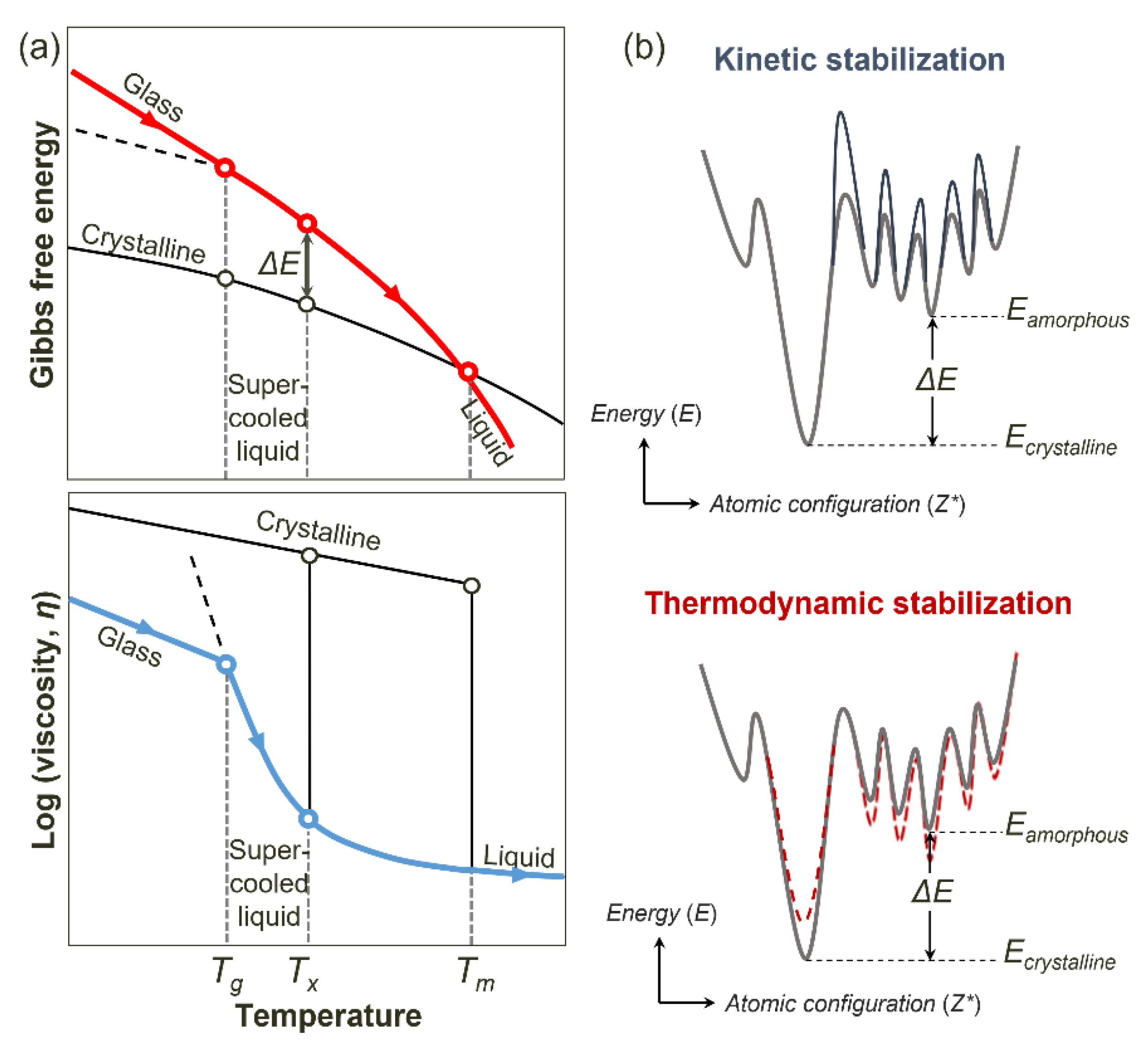
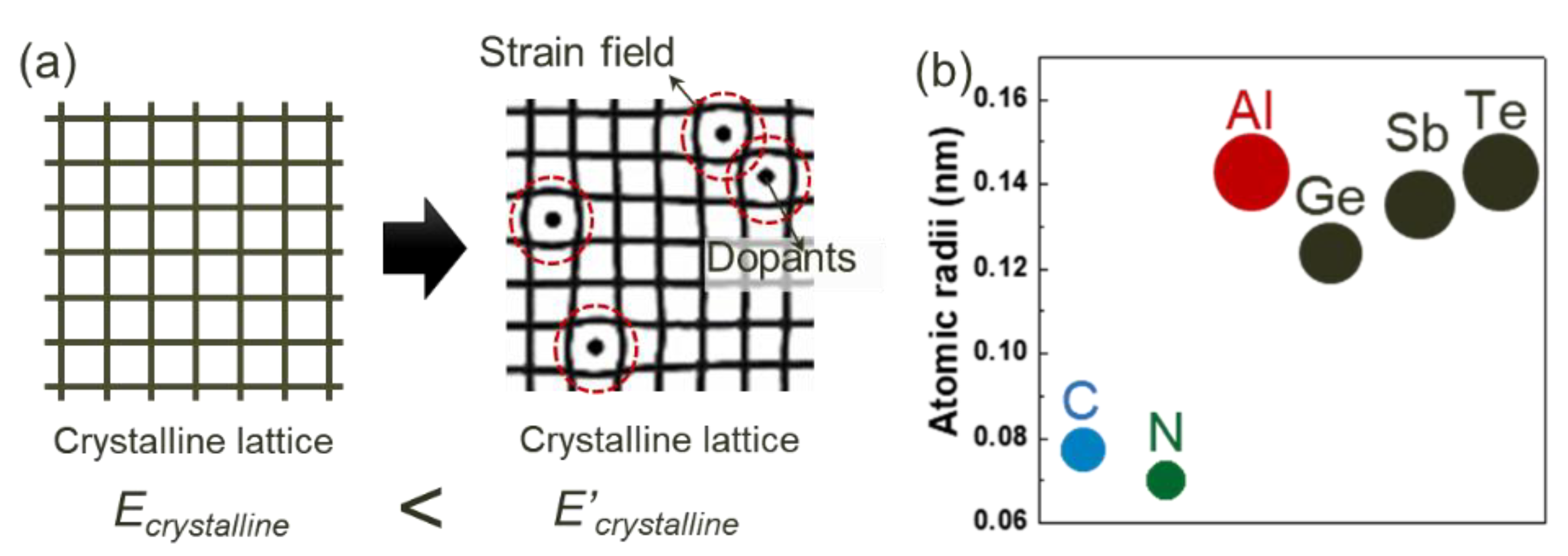
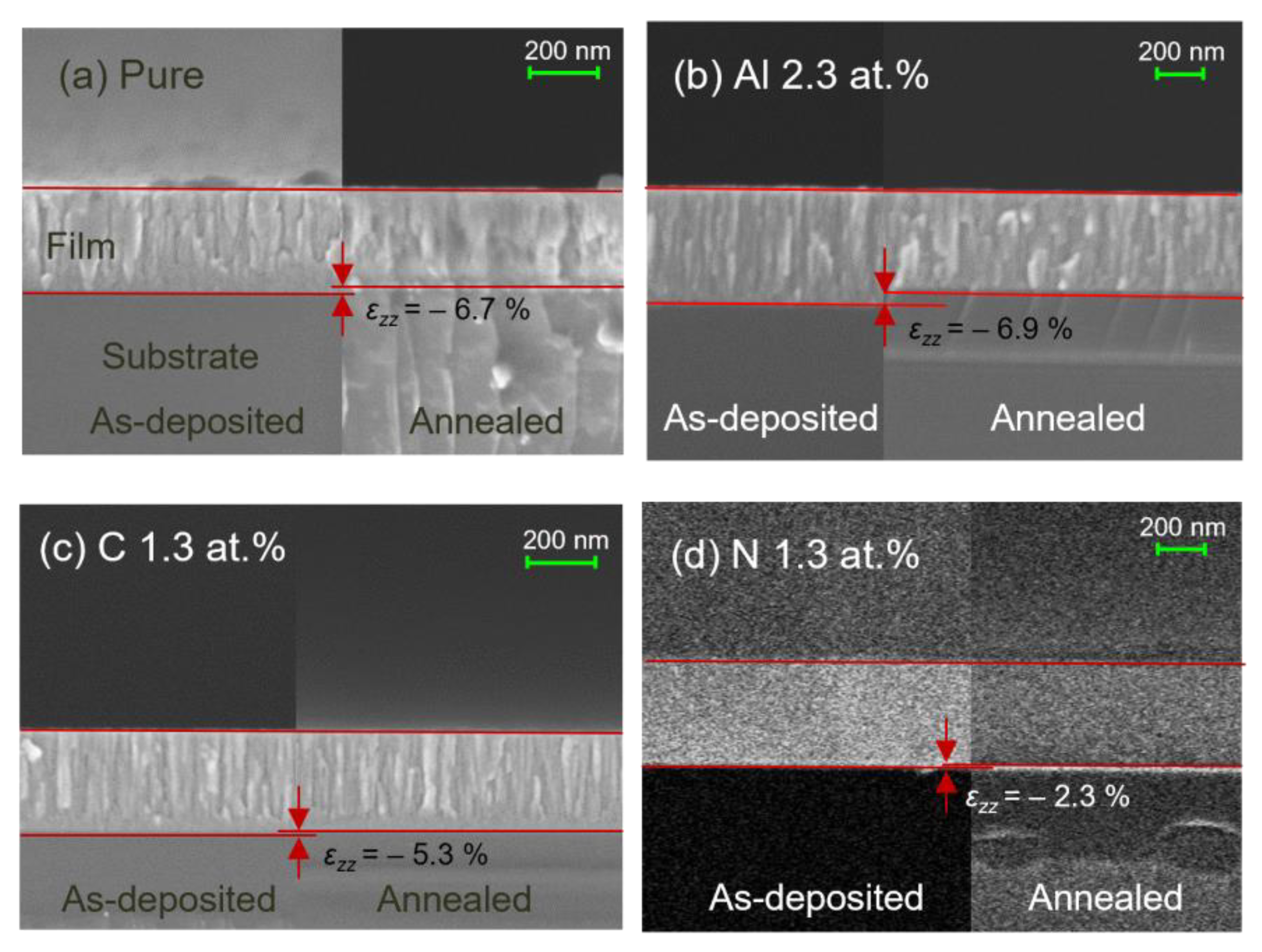
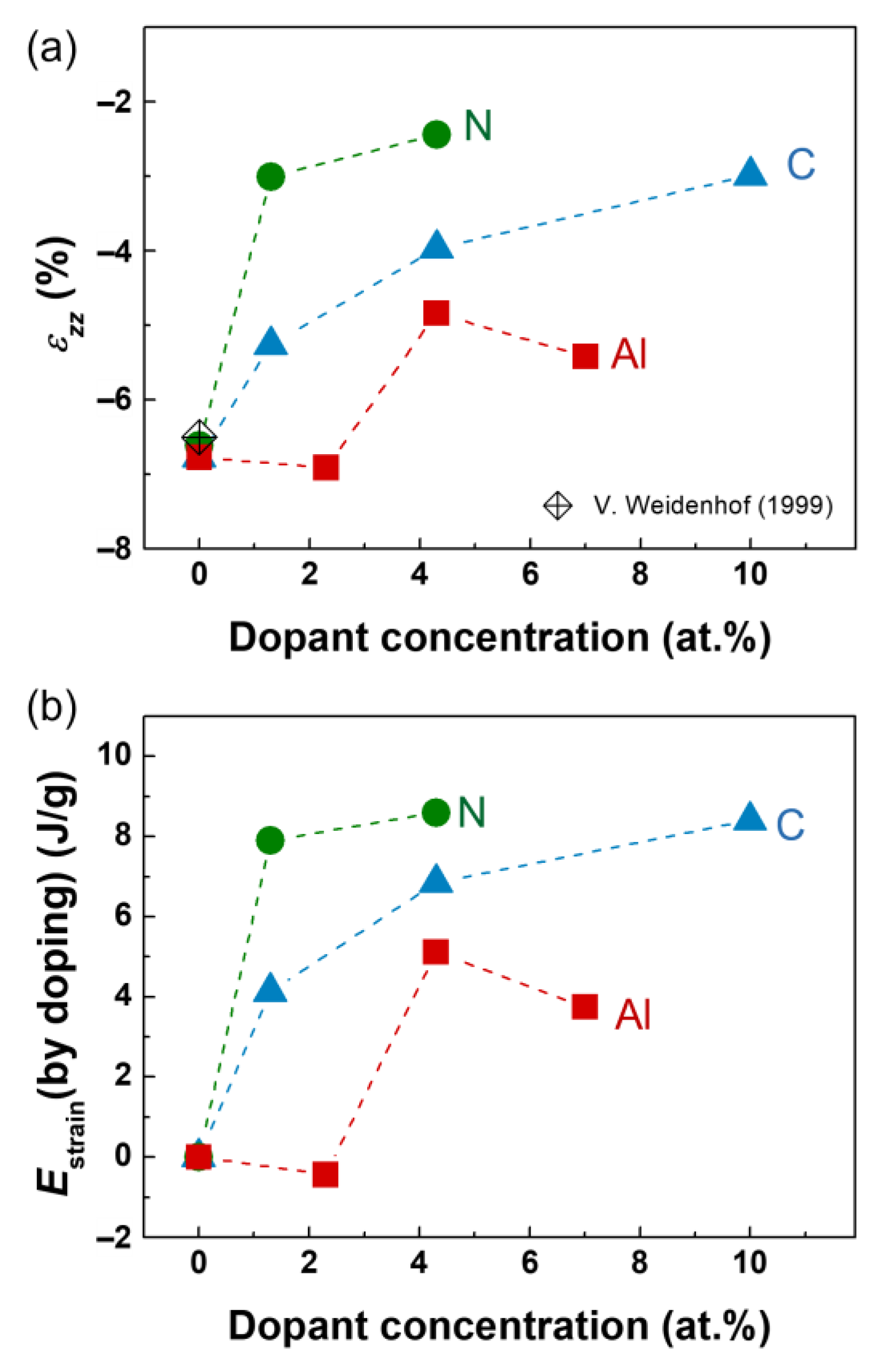
Phase-change random access memory (PcRAM) faces significant challenges due to the inherent instability of amorphous Ge2Sb2Te5 (GST). While doping has emerged as an effective method for amorphous stabilization, understanding the precise mechanisms of structural modification and their impact on material stability remains a critical challenge. This study provides a comprehensive investigation of elastic strain and stress in crystalline lattices induced by various dopants (C, N, and Al) through systematic measurements of film thickness changes during crystallization. Through detailed analysis of cross-sectional electron microscopy data and theoretical calculations, we reveal distinct behavior patterns between interstitial and substitutional dopants. Interstitial dopants (C and N) generate substantial elastic strain energy (~9 J/g) due to their smaller atomic radii (0.07–0.08 nm) and ability to occupy spaces between lattice sites. In contrast, substitutional dopants (Al) produce lower strain energy (~5 J/g) due to their similar atomic radius (0.14 nm) to host atoms. We demonstrate that N doping achieves higher elastic strain energy compared to C doping, attributed to its preferential formation of Ge-N bonds and resulting lattice distortions. The correlation between dopant properties, structural features, and induced strain energy provides quantitative insights for optimizing dopant selection. These findings establish a fundamental framework for understanding dopant-induced thermodynamic stabilization in GST materials, offering practical guidelines for enhancing the reliability and performance of next-generation PcRAM devices.
Keywords: PcRAM; Ge2Sb2Te5; amorphous phase; elastic strain energy; C-doping; N-doping; Al-doping PcRAM; Ge2Sb2Te5; amorphous phase; elastic strain energy; C-doping; N-doping; Al-doping