Article

Artificial Neural Network Prediction of Compliance Coefficients for Composite Shear Keys of Built-Up Timber Beams


Faculty of Civil Engineering, Warsaw University of Technology, 00-661 Warsaw, Poland
*
Author to whom correspondence should be addressed.
Materials 2024, 17(13), 3246; https://doi.org/10.3390/ma17133246
Submission received: 13 May 2024 / Revised: 27 June 2024 / Accepted: 28 June 2024 / Published: 2 July 2024
(This article belongs to the Section Construction and Building Materials)

Abstract

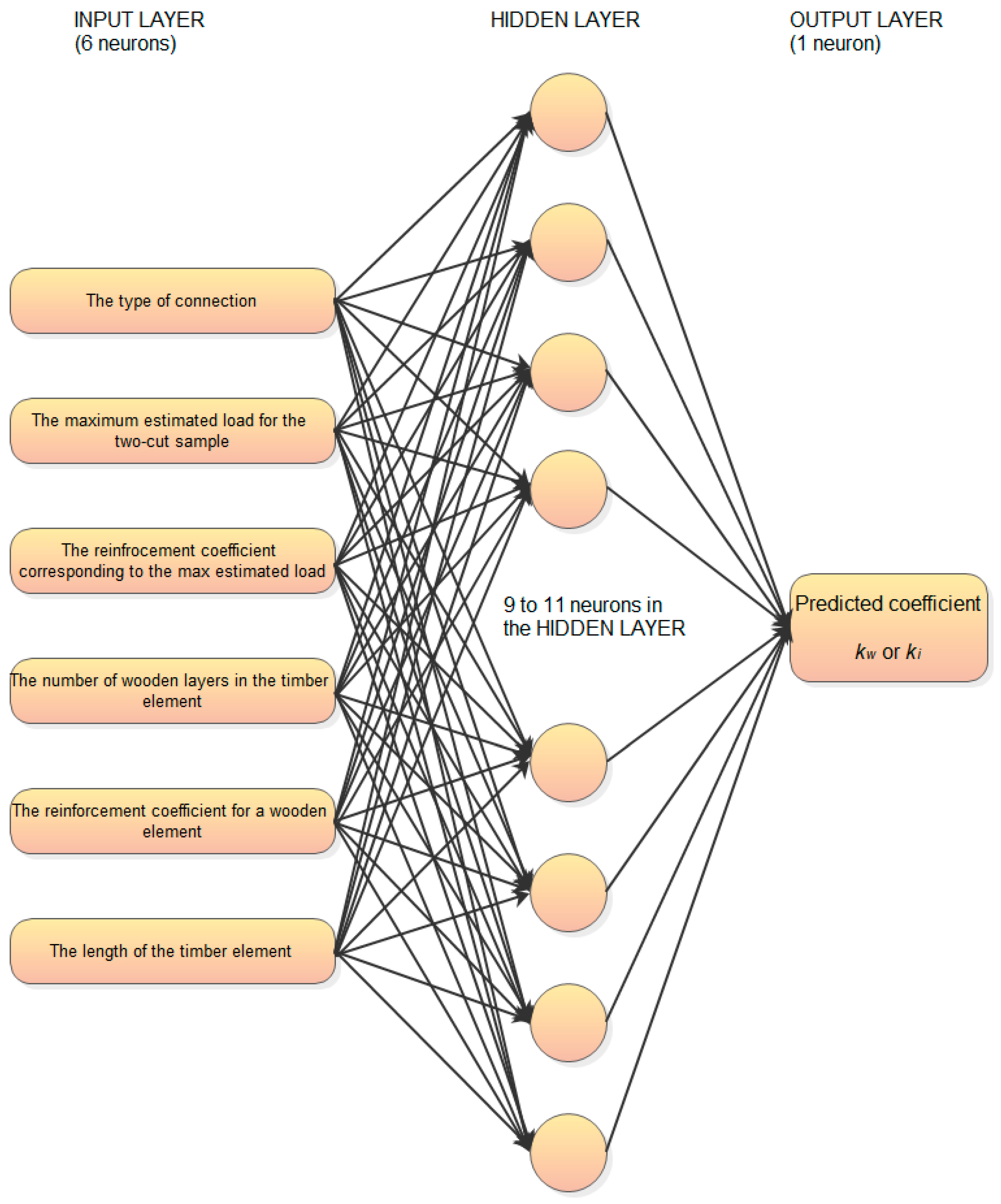
This article explores the possibility of predicting the compliance coefficients for composite shear keys of built-up timber beams using artificial neural networks. The compliance coefficients determine the stresses and deflections of built-up timber beams. The article analyzes current theoretical methods for designing wooden built-up timber beams with shear keys and possible ways of applying them in modern construction. One of the design methods, based on the use of the compliance coefficients, is also discussed in detail. The novelty of this research is that the authors of the article collected, analysed, and combined data on the experimental values of the compliance coefficient for composite shear keys of built-up timber beams obtained by different researchers and published in other studies. For the first time, the authors of this article generated a table of input and output data for predicting compliance coefficients based on the analysis of the literature and collected data by the authors. As a result of this research, the article’s authors proposed an artificial neural network (ANN) architecture and determined the mean absolute percentage error for the compliance coefficients kw and ki, which are equal to 0.054% and 0.052%, respectively. The proposed architecture can be used for practical application in designing built-up timber beams using various composite shear keys.
Keywords: built-up timber beam; composite materials; keyed timber beam; machine learning; mechanical malleable bonds; strengthening; timber structure built-up timber beam; composite materials; keyed timber beam; machine learning; mechanical malleable bonds; strengthening; timber structure