Article

Numerical and Experimental Study on Carbon Segregation in Shaped Billet of Medium Carbon Steel with Combined Electromagnetic Stirring

1
Faculty of Metallurgical and Energy Engineering, Kunming University of Science and Technology, Kunming 650093, China
2
Linyi Iron and Steel Investment Group Special Steel Co., Ltd., Linyi 276000, China
3
Key Laboratory of Clean Metallurgy for Complex Iron Resources in Colleges and Universities of Yunnan Province, Kunming University of Science and Technology, Kunming 650093, China
*
Authors to whom correspondence should be addressed.
Materials 2023, 16(23), 7464; https://doi.org/10.3390/ma16237464
Submission received: 30 October 2023 / Revised: 21 November 2023 / Accepted: 27 November 2023 / Published: 30 November 2023

Abstract

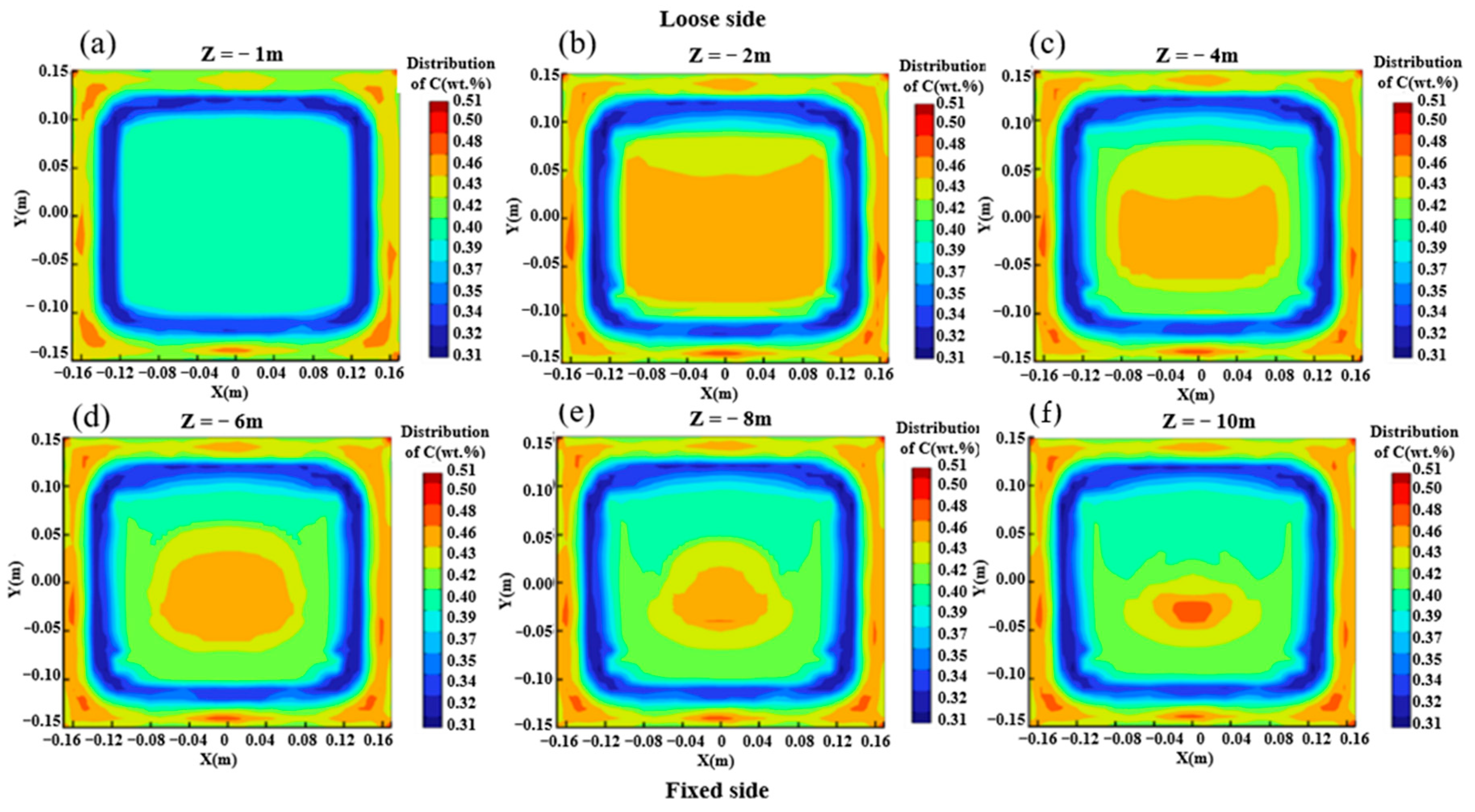
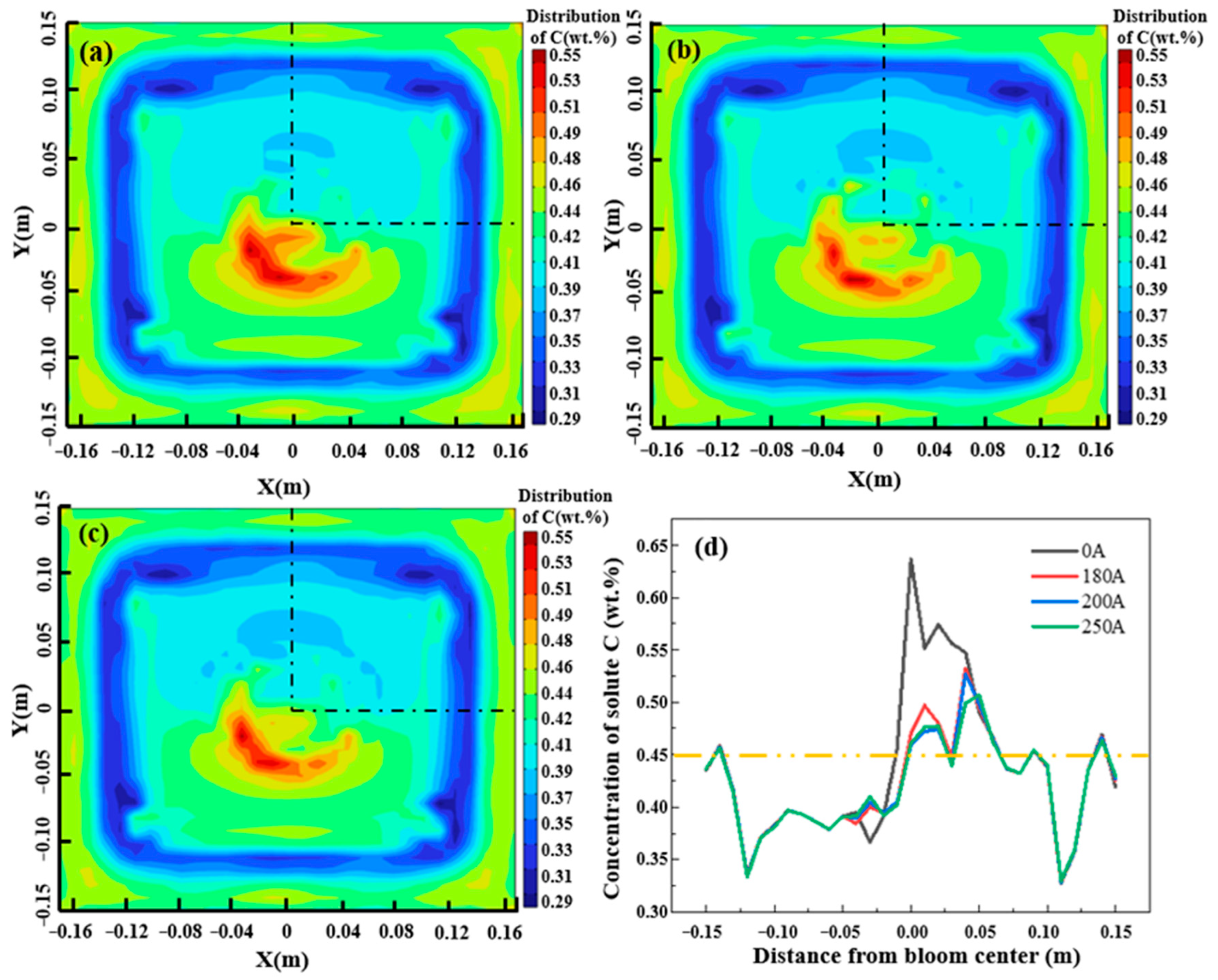
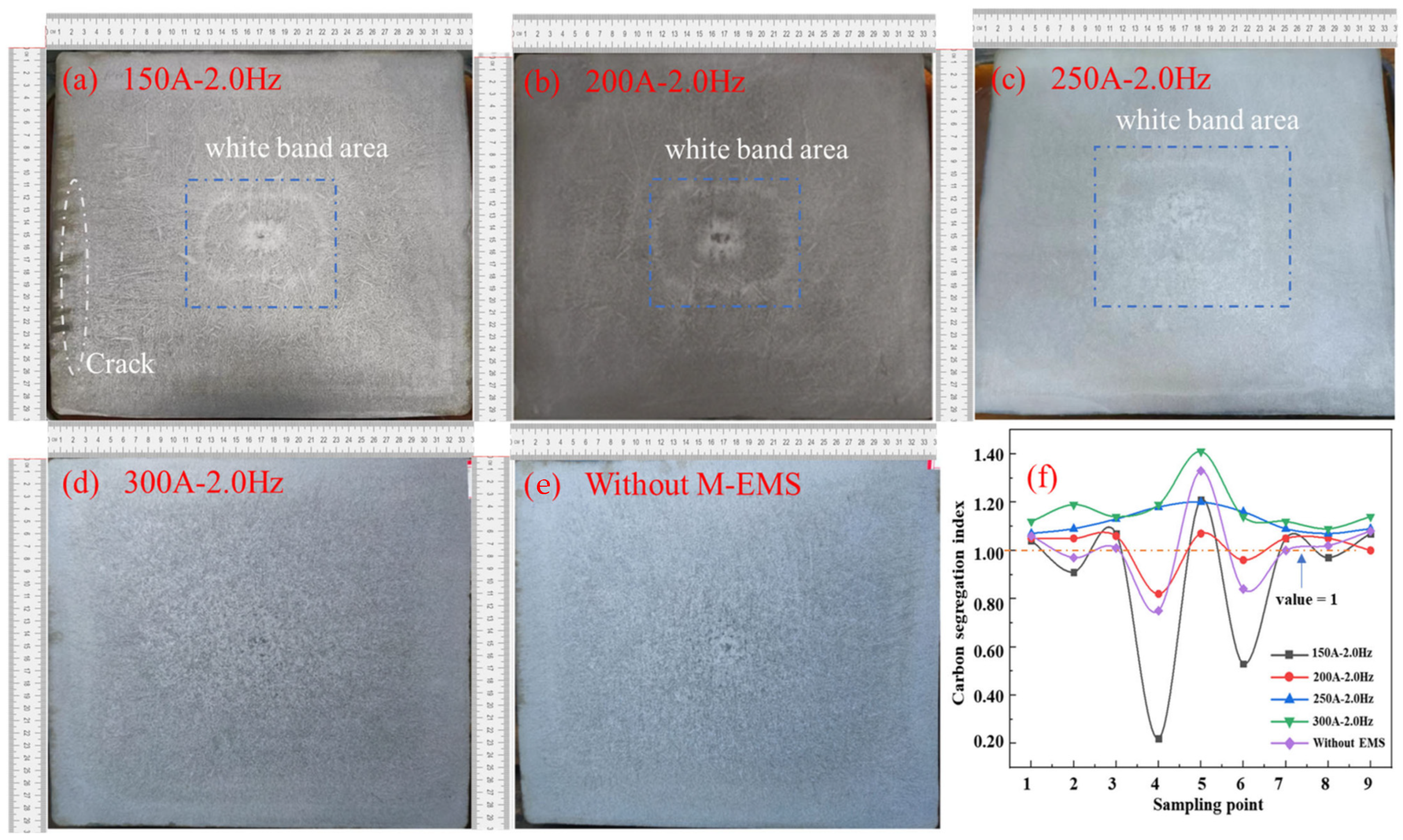
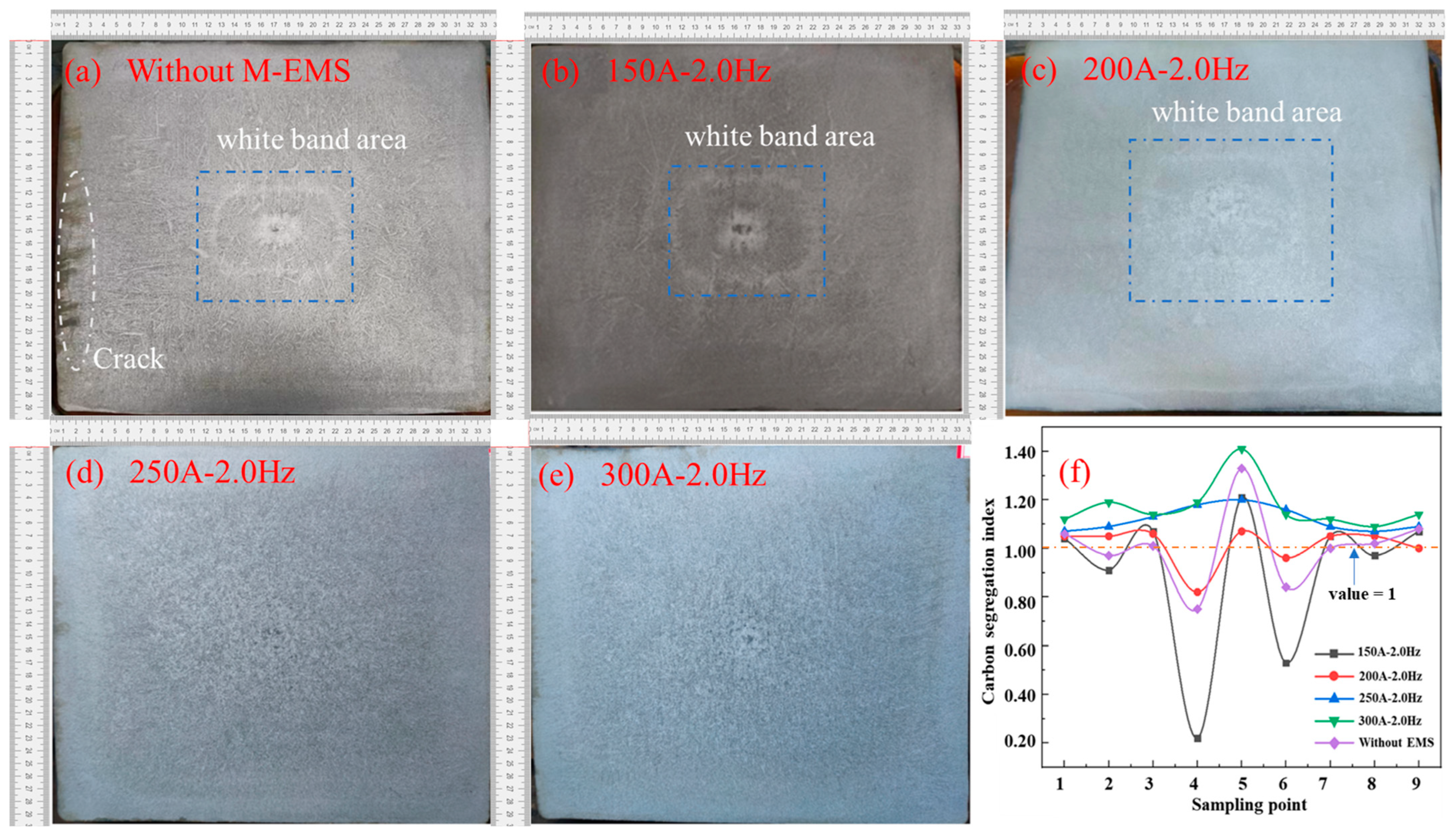
Carbon segregation is the major and classical internal defect in the continuous casting process of carbon steel. Based on the combined electromagnetic stirring equipment for new billet in a steel plant, China, the influence of combined electromagnetic stirring (M-EMS + F-EMS) on the carbon segregation of 300 mm × 340 mm special-shaped billet was studied via numerical simulation and on-site industrialization tests. The Lorentz force and carbon solute distribution were simulated under different EMS parameters. The formation mechanism of the carbon segregation of medium carbon steel with different combined electromagnetic stirring processes was analyzed. The results show that: (1) with the combined action of “solute flushing” effect and gravity, the carbon concentration in the loose side of the medium carbon steel casting billet is gradually lower than the fixed side, while the carbon concentration on the fixed side gradually accumulates more; and (2) under the action of combined electromagnetic stirring, the segregation index of casting billet could be controlled to remain between 0.96–1.05 and shows an increasing change in solidification from the skin to the center. When the current and frequency of M-EMS are 250 A and 2.0 Hz and the F-EMS are 180 A and 8.0 Hz, the carbon segregation defects in the special-shaped (300 mm × 340 mm) casting billet can be significantly improved.
Keywords: continuous casting; shaped billet; combined electromagnetic stirring; multi-physical field model; carbon segregation continuous casting; shaped billet; combined electromagnetic stirring; multi-physical field model; carbon segregation