Article

First-Principles Study of Adsorption of Pb Atoms on 3C-SiC
by
Michal Komorowicz
1,
Kazimierz Skrobas
1,2 and
Konrad Czerski
1,3,4,*
1
National Centre for Nuclear Research, ul. A. Soltana 7, 05-400 Otwock-Swierk, Poland
2
Institute of High-Pressure Physics of the Polish Academy of Sciences, ul. Sokolowska 29/37, 01-142 Warsaw, Poland
3
Institute of Physics, University of Szczecin, ul. Wielkopolska 15, 70-451 Szczecin, Poland
4
Institut für Festkörper-Kernphysik GmbH, Leistikowstraße 2, 14050 Berlin, Germany
*
Author to whom correspondence should be addressed.
Materials 2023, 16(20), 6700; https://doi.org/10.3390/ma16206700
Submission received: 7 September 2023 / Revised: 12 October 2023 / Accepted: 13 October 2023 / Published: 16 October 2023
(This article belongs to the Special Issue Advanced Materials under Extreme Environments)

Abstract

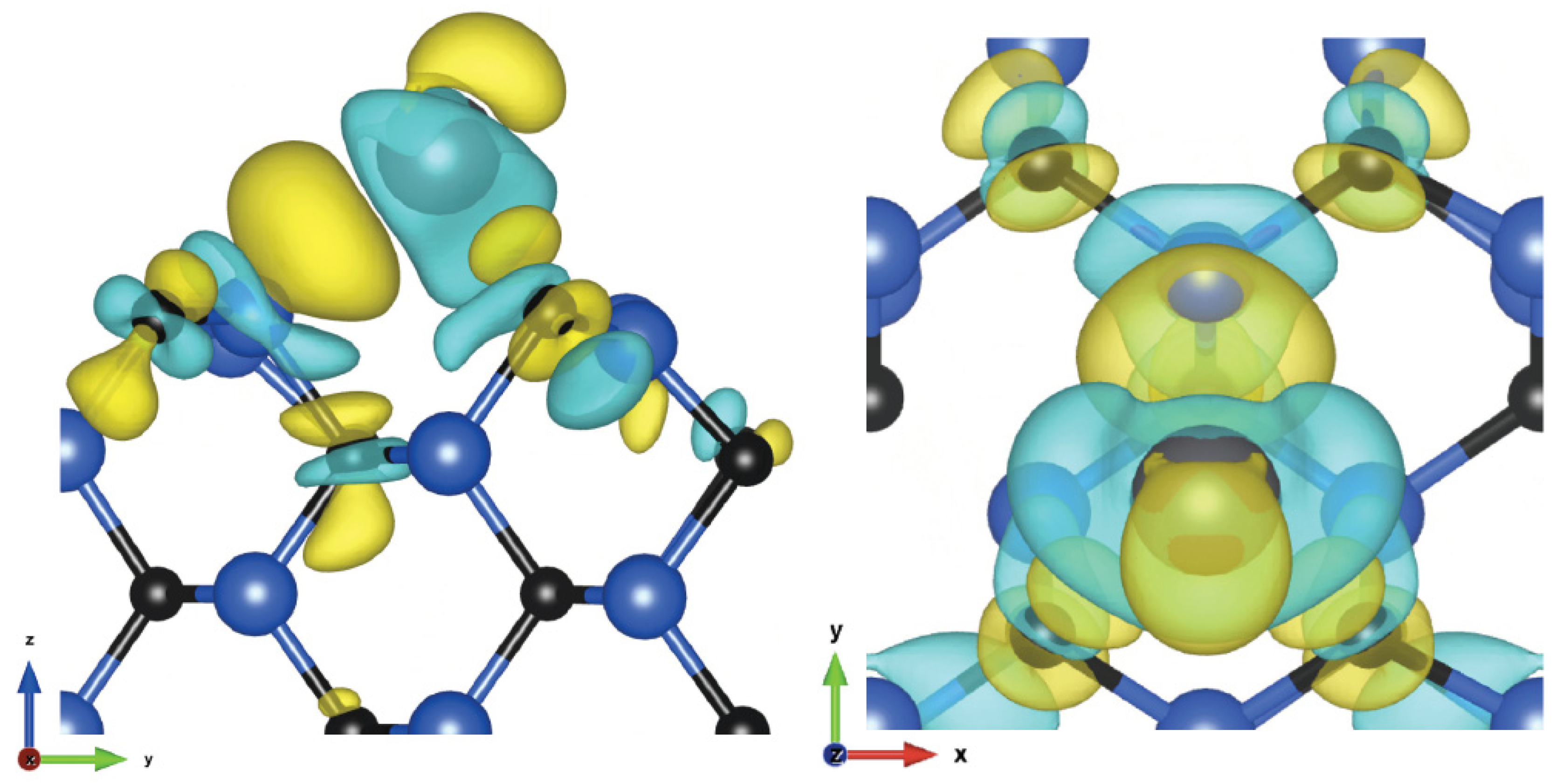
Changes in the atomic and electronic structure of silicon carbide 3C-SiC (β-SiC), resulting from lead adsorption, were studied within the density functional theory. The aim of the study was to analyze the main mechanisms occurring during the corrosion of this material. Therefore, the investigations focused on process-relevant parameters such as bond lengths, bond energies, Bader charges, and charge density differences. To compare the magnitude of the interactions, the calculations were conducted for three representative surfaces: (100, 110, and 111) with varying degrees of lead coverage. The results indicate that chemisorption occurs, with the strongest binding on the hexagonal surface (111) in interaction with three dangling bonds. The adsorption energy rises with increasing coverage, especially as the surface approaches saturation. As a result of these interactions, atomic bonds on the surface weaken, which affects the dissolution corrosion.
Keywords: first-principles study; density functional theory; adsorption of Pb atoms; 3C-SiC first-principles study; density functional theory; adsorption of Pb atoms; 3C-SiC