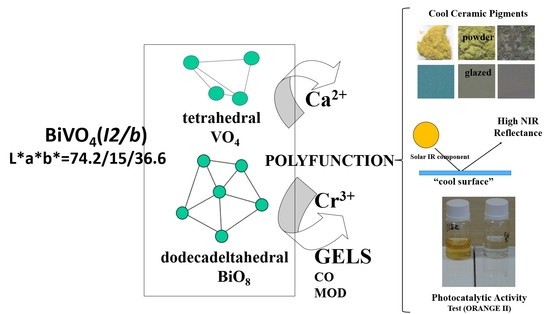
High NIR Reflectance and Photocatalytic Ceramic Pigments Based on M-Doped Clinobisvanite BiVO4 (M = Ca, Cr) from Gels


Abstract
Share and Cite
Monrós, G.; Llusar, M.; Badenes, J.A. High NIR Reflectance and Photocatalytic Ceramic Pigments Based on M-Doped Clinobisvanite BiVO4 (M = Ca, Cr) from Gels. Materials 2023, 16, 3722. https://doi.org/10.3390/ma16103722
Monrós G, Llusar M, Badenes JA. High NIR Reflectance and Photocatalytic Ceramic Pigments Based on M-Doped Clinobisvanite BiVO4 (M = Ca, Cr) from Gels. Materials. 2023; 16(10):3722. https://doi.org/10.3390/ma16103722
Chicago/Turabian StyleMonrós, Guillermo, Mario Llusar, and José A. Badenes. 2023. "High NIR Reflectance and Photocatalytic Ceramic Pigments Based on M-Doped Clinobisvanite BiVO4 (M = Ca, Cr) from Gels" Materials 16, no. 10: 3722. https://doi.org/10.3390/ma16103722
APA StyleMonrós, G., Llusar, M., & Badenes, J. A. (2023). High NIR Reflectance and Photocatalytic Ceramic Pigments Based on M-Doped Clinobisvanite BiVO4 (M = Ca, Cr) from Gels. Materials, 16(10), 3722. https://doi.org/10.3390/ma16103722