Synthesis of Nickel and Cobalt Ferrite-Doped Graphene as Efficient Catalysts for Improving the Hydrogen Storage Kinetics of Lithium Borohydride


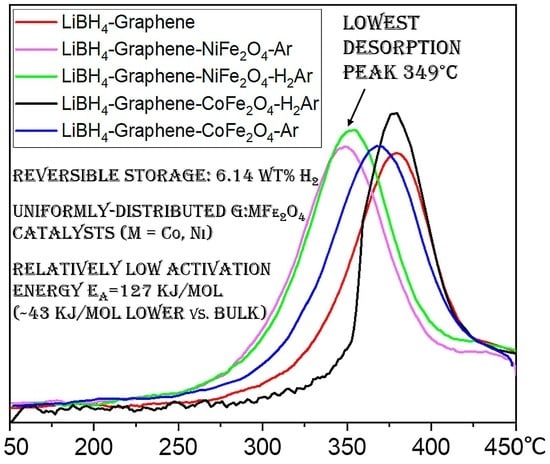
Abstract
Share and Cite
Palade, P.; Comanescu, C.; Radu, C. Synthesis of Nickel and Cobalt Ferrite-Doped Graphene as Efficient Catalysts for Improving the Hydrogen Storage Kinetics of Lithium Borohydride. Materials 2023, 16, 427. https://doi.org/10.3390/ma16010427
Palade P, Comanescu C, Radu C. Synthesis of Nickel and Cobalt Ferrite-Doped Graphene as Efficient Catalysts for Improving the Hydrogen Storage Kinetics of Lithium Borohydride. Materials. 2023; 16(1):427. https://doi.org/10.3390/ma16010427
Chicago/Turabian StylePalade, Petru, Cezar Comanescu, and Cristian Radu. 2023. "Synthesis of Nickel and Cobalt Ferrite-Doped Graphene as Efficient Catalysts for Improving the Hydrogen Storage Kinetics of Lithium Borohydride" Materials 16, no. 1: 427. https://doi.org/10.3390/ma16010427
APA StylePalade, P., Comanescu, C., & Radu, C. (2023). Synthesis of Nickel and Cobalt Ferrite-Doped Graphene as Efficient Catalysts for Improving the Hydrogen Storage Kinetics of Lithium Borohydride. Materials, 16(1), 427. https://doi.org/10.3390/ma16010427