


Fracture Resistance of CAD/CAM Implant-Supported 3Y-TZP-Zirconia Cantilevers: An In Vitro Study


 ,
,  , ,
, ,  and
and 
Abstract
1. Introduction
2. Materials and Methods
2.1. Materials
2.2. Methods
2.2.1. Preparation of the Sample
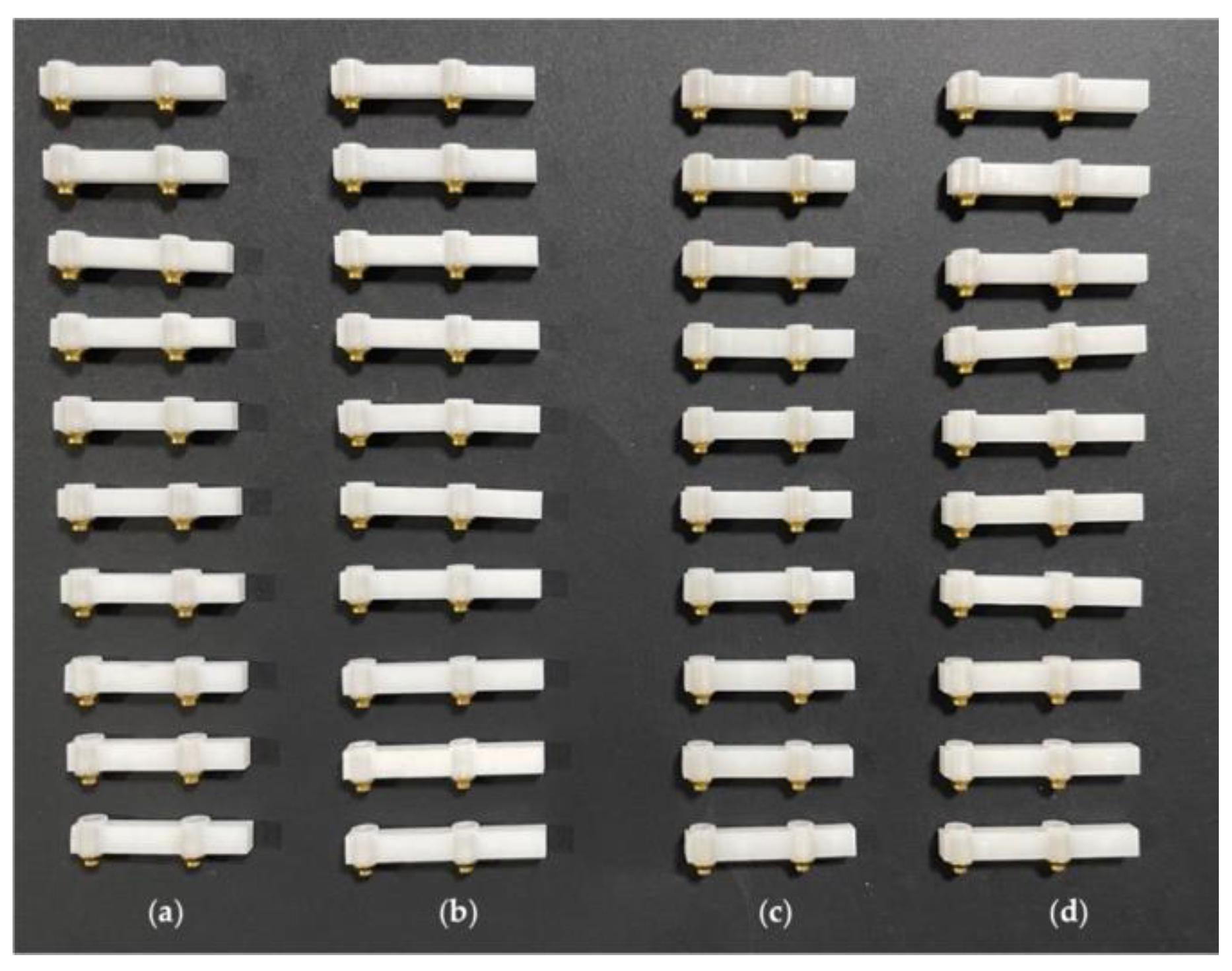
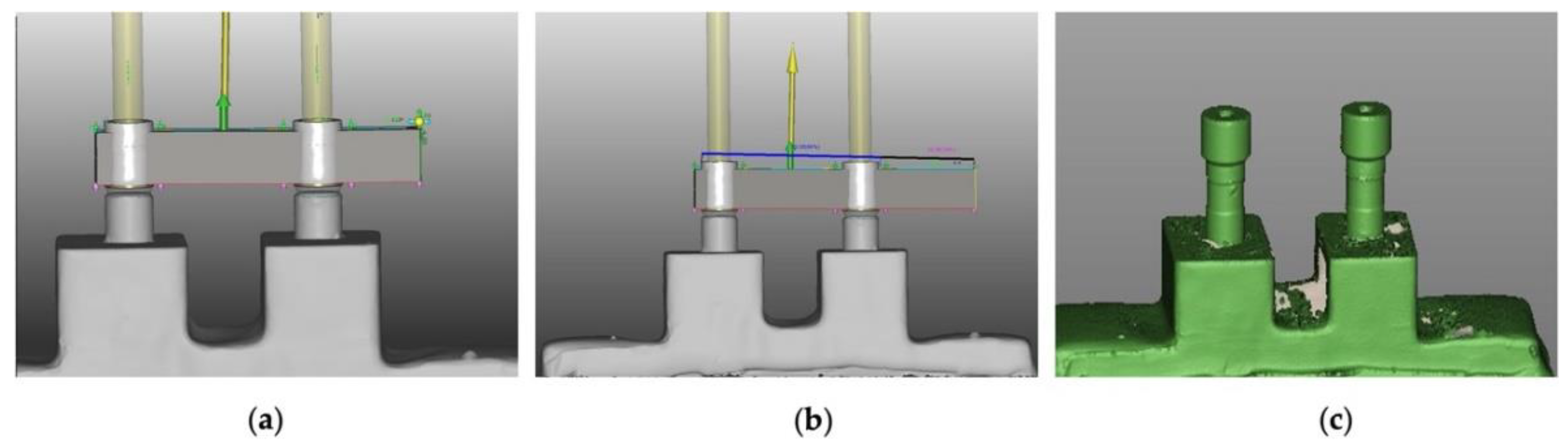
2.2.2. Elaboration of Zirconia Structures
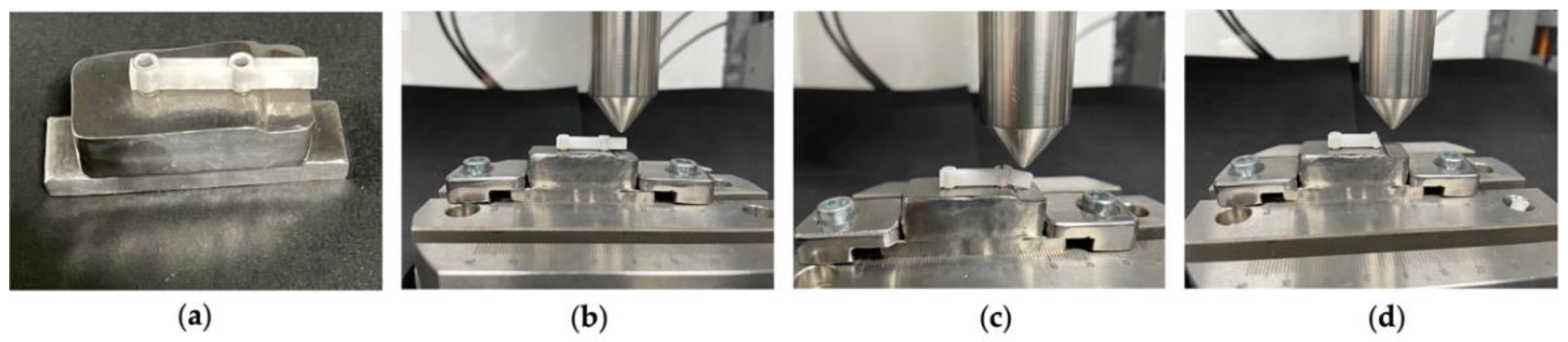
2.2.3. Compression Test to Measure the Fracture Resistance Strength of Different Cantilevers
2.3. Statistical Analysis
3. Results
4. Discussion
5. Conclusions
Author Contributions
Funding
Institutional Review Board Statement
Informed Consent Statement
Data Availability Statement
Acknowledgments
Conflicts of Interest
References
- Petersen, P.E.; Kandelman, D.; Arpin, S.; Ogawa, H. Global oral health of older people–call for public health action. Community Dent Health 2010, 27, 257–268. [Google Scholar] [PubMed]
- Minoretti, R.; Triaca, A.; Saulacic, N. Unconventional implants for distal cantilever fixed full-arch prostheses: A long-term evaluation of four cases. Int. J. Periodontics Restor. Dent. 2012, 32, e59–e67. [Google Scholar]
- Mendes, J.; Mendes, J.M.; Barreiros, P.; Aroso, C.; Silva, A.S. Retention Capacity of Original Denture Adhesives and White Brands for Conventional Complete Dentures: An In Vitro Study. Polymers 2022, 14, 1749. [Google Scholar] [CrossRef] [Scilit]
- Takaba, M.; Tanaka, S.; Ishiura, Y.; Baba, K. Implant-supported fixed dental prostheses with CAD/CAM-fabricated porcelain crown and zirconia-based framework. J. Prosthodont. 2013, 22, 402–407. [Google Scholar] [CrossRef] [Scilit] [PubMed]
- Gonçalves, F.C.P.; Amaral, M.; Borges, A.L.S.; Gonçalves, L.F.M.; Paes-Junior, T.J.A. Fracture load of complete-arch implant-supported prostheses reinforced with nylon-silica mesh: An in vitro study. J. Prosthet. Dent. 2018, 119, 606–610. [Google Scholar] [CrossRef] [Scilit] [PubMed]
- Valenti, C.; Isabella, F.M.; Masciotti, F.; Marinucci, L.; Xhimitiku, I.; Cianetti, S.; Pagano, S. Mechanical properties of 3D-printed prosthetic materials compared with milled and conventional processing: A systematic review and meta-analysis of in vitro studies [published online ahead of print, 2022 Aug 5]. J. Prosthet. Dent. 2022, S0022-3913, 00415-2. [Google Scholar] [CrossRef] [Scilit]
- Shackleton, J.L.; Carr, L.; Slabbert, J.C.; Becker, P.J. Survival of fixed implant-supported prostheses related to cantilever lengths. J. Prosthet. Dent. 1994, 71, 23–26. [Google Scholar] [CrossRef] [Scilit]
- Chong, K.K.; Palamara, J.; Wong, R.H.; Judge, R.B. Fracture force of cantilevered zirconia frameworks: An in vitro study. J. Prosthet. Dent. 2014, 112, 849–856. [Google Scholar] [CrossRef] [Scilit]
- Alshiddi, I.F.; Habib, S.R.; Zafar, M.S.; Bajunaid, S.; Labban, N.; Alsarhan, M. Fracture Load of CAD/CAM Fabricated Cantilever Implant-Supported Zirconia Framework: An In Vitro Study. Molecules 2021, 13, 2259. [Google Scholar] [CrossRef] [Scilit]
- Honda, J.; Komine, F.; Kusaba, K.; Kitani, J.; Matsushima, K.; Matsumura, H. Fracture loads of screw-retained implant-supported zirconia prostheses after thermal and mechanical stress. J. Prosthodont. Res. 2020, 3, 313–318. [Google Scholar] [CrossRef] [Scilit]
- Alraheam, I.A.; Donovan, T.; Boushell, L.; Cook, R.; Ritter, A.V.; Sulaiman, T.A. Fracture load of two thicknesses of different zirconia types after fatiguing and thermocycling. J. Prosthet. Dent. 2020, 123, 635–640. [Google Scholar] [CrossRef] [Scilit] [PubMed]
- Fischer, P.; Barbu, H.M.; Fischer, C.A.I.; Pantea, M.; Baciu, F.; Vranceanu, D.M.; Cotrut, C.M.; Spinu, T.C. Bending Fracture of Different Zirconia-Based Bioceramics for Dental Applications: A Comparative Study. Materials 2021, 14, 6887. [Google Scholar] [CrossRef] [Scilit]
- Bacchi, A.; Consani, R.L.; Mesquita, M.F.; Dos Santos, M.B. Effect of framework material and vertical misfit on stress distribution in implant-supported partial prosthesis under load application: 3-D finite element analysis. Acta Odontol. Scand. 2013, 71, 1243–1249. [Google Scholar] [CrossRef] [Scilit]
- Ferreira, M.B.; Barão, V.A.; Faverani, L.P.; Hipólito, A.C.; Assunção, W.G. The role of superstructure material on the stress distribution in mandibular full-arch implant-supported fixed dentures. A CT-based 3D-FEA. Mater. Sci. Eng. C Mater. Biol. Appl. 2014, 35, 92–99. [Google Scholar] [CrossRef] [Scilit]
- Hafezeqoran, A.; Koodaryan, R.; Hemmati, Y.; Akbarzadeh, A. Effect of connector size and design on the fracture resistance of monolithic zirconia fixed dental prosthesis. J. Dent. Res. Dent. Clin. Dent. Prospect. 2020, 14, 218–222. [Google Scholar] [CrossRef] [Scilit]
- Schriwer, C.; Skjold, A.; Gjerdet, N.R.; Øilo, M. Monolithic zirconia dental crowns. Internal fit, margin quality, fracture mode and load at fracture. Dent. Mater. 2017, 33, 1012–1020. [Google Scholar] [CrossRef] [Scilit] [PubMed]
- Chougule, K.J.; Wadkar, A.P. An In vitro Comparative Evaluation of Flexural Strength of Monolithic Zirconia after Surface Alteration Utilising Two Different Techniques. J. Clin. Diagn. Res. 2017, 11, ZC20–ZC23. [Google Scholar] [CrossRef] [Scilit] [PubMed]
- Juntavee, N.; Juntavee, A.; Phattharasophachai, T. Fracture toughness of different monolithic zirconia upon post-sintering processes. J. Clin. Exp. Dent. 2021, 13, e1006–e1014. [Google Scholar] [CrossRef] [Scilit]
- Chang, Y.T.; Wu, Y.L.; Chen, H.S.; Tsai, M.H.; Chang, C.C.; Wu, A.Y. Comparing the Fracture Resistance and Modes of Failure in Different Types of CAD/CAM Zirconia Abutments with Internal Hexagonal Implants: An In Vitro Study. Materials 2022, 15, 2656. [Google Scholar] [CrossRef] [Scilit]
- The R Development Core Team. A Language and Environment for Statistical Computing. 2021. Available online: http://softlibre.unizar.es/manuales/aplicaciones/r/fullrefman.pdf (accessed on 28 April 2022).
- Bidra, A.S.; Tischler, M.; Patch, C. Survival of 2039 complete arch fixed implantsupported zirconia prostheses: A retrospective study. J. Prosthet. Dent. 2018, 119, 220–224. [Google Scholar] [CrossRef] [Scilit]
- Tischler, M.; Patch, C.; Bidra, A.S. Rehabilitation of edentulous jaws with zirconia complete-arch fixed implant-supported prostheses: An up to 4-year retrospective clinical study. J. Prosthet. Dent. 2018, 120, 204–209. [Google Scholar] [CrossRef] [Scilit] [PubMed]
- Poggio, C.E.; Ercoli, C.; Rispoli, L.; Maiorana, C.; Esposito, M. Metal-free materials for fixed prosthodontic restorations. Cochrane Database Syst. Rev. 2017, 12, CD009606. [Google Scholar] [CrossRef] [Scilit]
- Bidra, A.S.; Rungruanganunt, P.; Gauthier, M. Clinical outcomes of full arch fixed implant-supported zirconia prostheses: A systematic review. Eur. J. Oral Implantol. 2017, 10, 35–45. [Google Scholar] [PubMed]
- Abdulmajeed, A.A.; Lim, K.G.; Närhi, T.O.; Cooper, L.F. Complete-arch implant-supported monolithic zirconia fixed dental prostheses: A systematic review. J. Prosthet. Dent. 2016, 115, 672–677. [Google Scholar] [CrossRef] [Scilit] [PubMed]
- Ozan, O.; Kurtulmus-Yilmaz, S. Biomechanical comparison of different implant inclinations and cantilever lengths in all-on-4 treatment concept by three-dimensional finite element analysis. Int. J. Oral Maxillofac. Implants 2018, 33, 64–71. [Google Scholar] [CrossRef] [Scilit]
- Alshahrani, F.A.; Yilmaz, B.; Seidt, J.D.; McGlumphy, E.A.; Brantley, W.A. A load-to-fracture and strain analysis of monolithic zirconia cantilevered frameworks. J. Prosthet. Dent. 2017, 118, 752–758. [Google Scholar] [CrossRef] [Scilit]
- Delucchi, F.; De Giovanni, E.; Pesce, P.; Bagnasco, F.; Pera, F.; Baldi, D.; Menini, M. Framework Materials for Full-Arch Implant-Supported Rehabilitations: A Systematic Review of Clinical Studies. Materials 2021, 14, 3251. [Google Scholar] [CrossRef] [Scilit]
- Tirone, F.; Salzano, S.; Rolando, E.; Pozzatti, L.; Rodi, D. Framework Fracture of Zirconia Supported Full Arch Implant Rehabilitation: A Retrospective Evaluation of Cantilever Length and Distal Cross-Sectional Connection Area in 140 Patients Over an Up-To-7 Year Follow-Up Period. J. Prosthodont. 2022, 31, 121–129. [Google Scholar] [CrossRef] [Scilit]
- Al-Omiri, M.K.; Sghaireen, M.G.; Alhijawi, M.M.; Alzoubi, I.A.; Lynch, C.D.; Lynch, E. Maximum bite force following unilateral implant-supported prosthetic treatment: Within-subject comparison to opposite dentate side. J. Oral Rehabil. 2014, 41, 624–629. [Google Scholar] [CrossRef] [Scilit]
- Takaki, P.; Vieira, M.; Bommarito, S. Maximum bite force analysis in different age groups. Int. Arch. Otorhinolaryngol. 2014, 18, 272–276. [Google Scholar] [CrossRef] [Scilit]
- Levartovsky, S.; Peleg, G.; Matalon, S.; Tsesis, I.; Rosen, E. Maximal Bite Force Measured via Digital Bite Force Transducer in Subjects with or without Dental Implants—A Pilot Study. Appl. Sci. 2022, 12, 1544. [Google Scholar] [CrossRef] [Scilit]
- van Vuuren, L.J.; Broadbent, J.; Duncan, W.; Waddell, J. Maximum voluntary bite force, occlusal contact points and associated stresses on posterior teeth. J. R. Soc. N. Z. 2020, 50, 132–143. [Google Scholar] [CrossRef] [Scilit]
- Schönhoff, L.M.; Lümkemann, N.; Buser, R.; Hampe, R.; Stawarczyk, B. Fatigue resistance of monolithic strength-gradient zirconia materials. J. Mech. Behav. Biomed. Mater. 2021, 119, 104504. [Google Scholar] [CrossRef] [Scilit]
- Zhang, Y.; Lawn, B.R. Novel Zirconia Materials in Dentistry. J. Dent. Res. 2018, 97, 140–147. [Google Scholar] [CrossRef] [Scilit]
- Tang, Z.; Zhao, X.; Wang, H.; Liu, B. Clinical evaluation of monolithic zirconia crowns for posterior teeth restorations. Medicine 2019, 98, e17385. [Google Scholar] [CrossRef] [Scilit]
- Pjetursson, B.E.; Sailer, I.; Latyshev, A.; Rabel, K.; Kohal, R.J.; Karasan, D. A systematic review and meta-analysis evaluating the survival, the failure, and the complication rates of veneered and monolithic all-ceramic implant-supported single crowns. Clin. Oral Implants Res. 2021, 32 (Suppl. S21), 254–288, Erratum in Clin. Oral Implants Res. 2021, 32, 1507. [Google Scholar] [CrossRef] [Scilit] [PubMed]
- Tsumita, M.; Kokubo, Y.; Steyern, P.V.; Fukushima, S. Effect of Framework Shape on the Fracture Strength of Implant-Supported All-Ceramic Fixed Partial Dentures in the Molar Region. J. Prosthodont. 2008, 17, 274–285. [Google Scholar] [CrossRef] [Scilit] [PubMed]

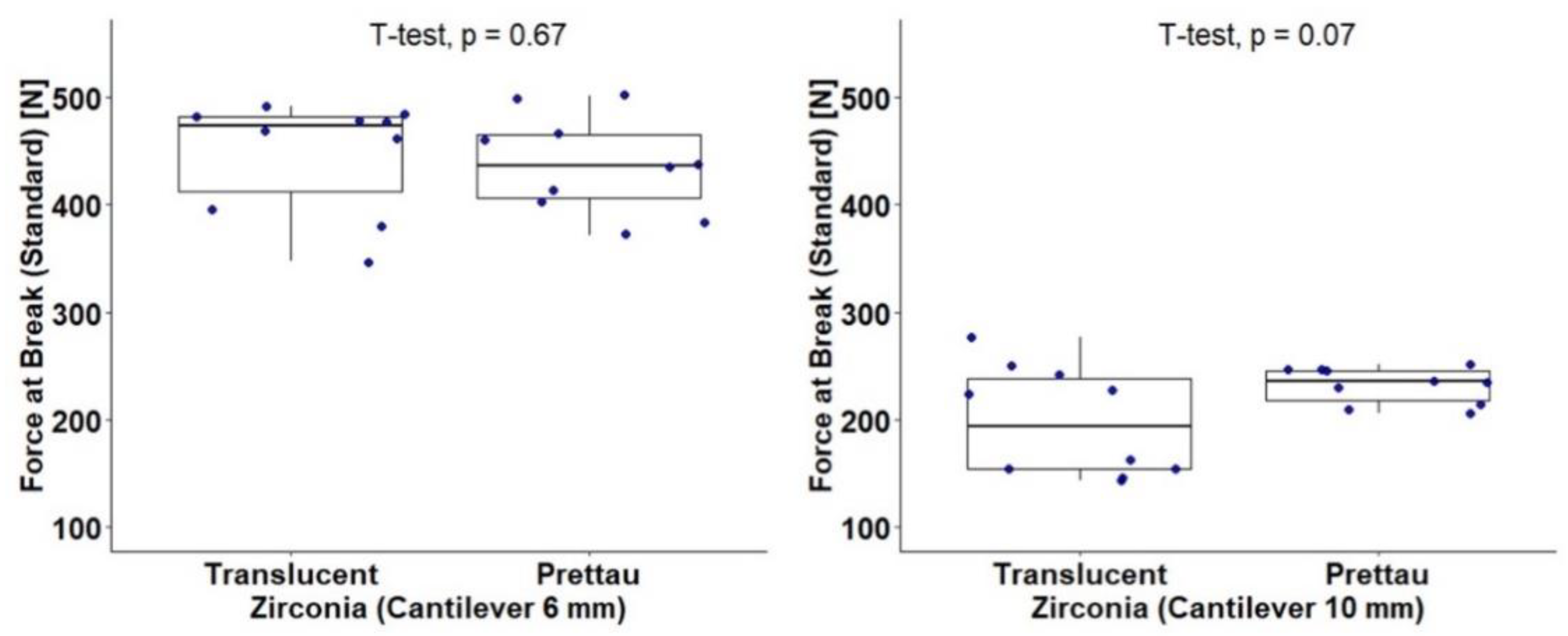
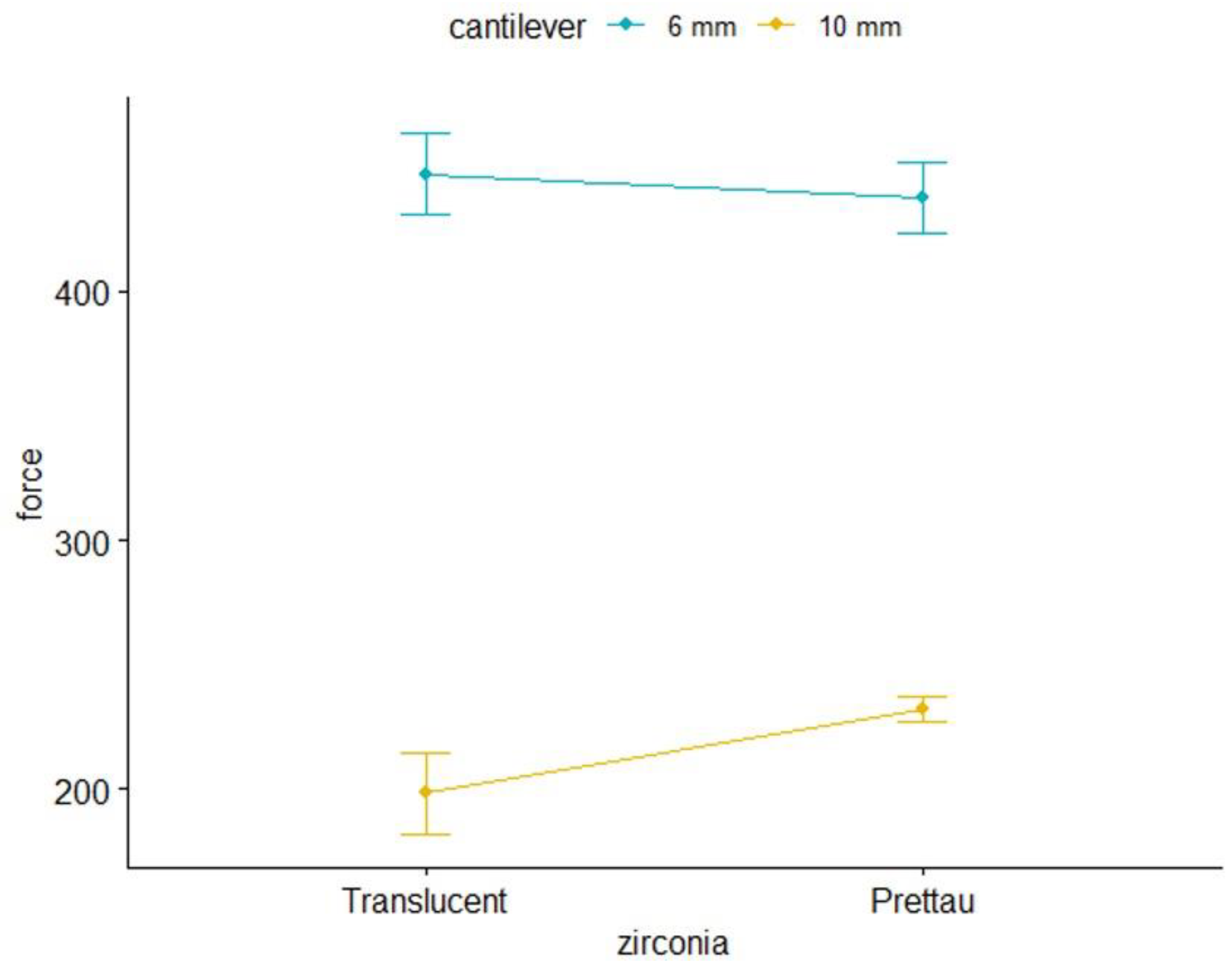


| Zirconia | Flexural Strength | Vickers Hardness (HV10) |
|---|---|---|
| Ice Zirkon Translucent | 1200–1400 MPa | 1250 HV10 |
| Prettau® Zirconia | 1000–1200 MPa | 1250 HV10 |
| Type of Zirconia | Cantilever Length | |||||
|---|---|---|---|---|---|---|
| Translucent (n = 20) | Prettau (n = 20) | t-Test | 6 mm (n = 20) | 10 mm (n = 20) | t-Test | |
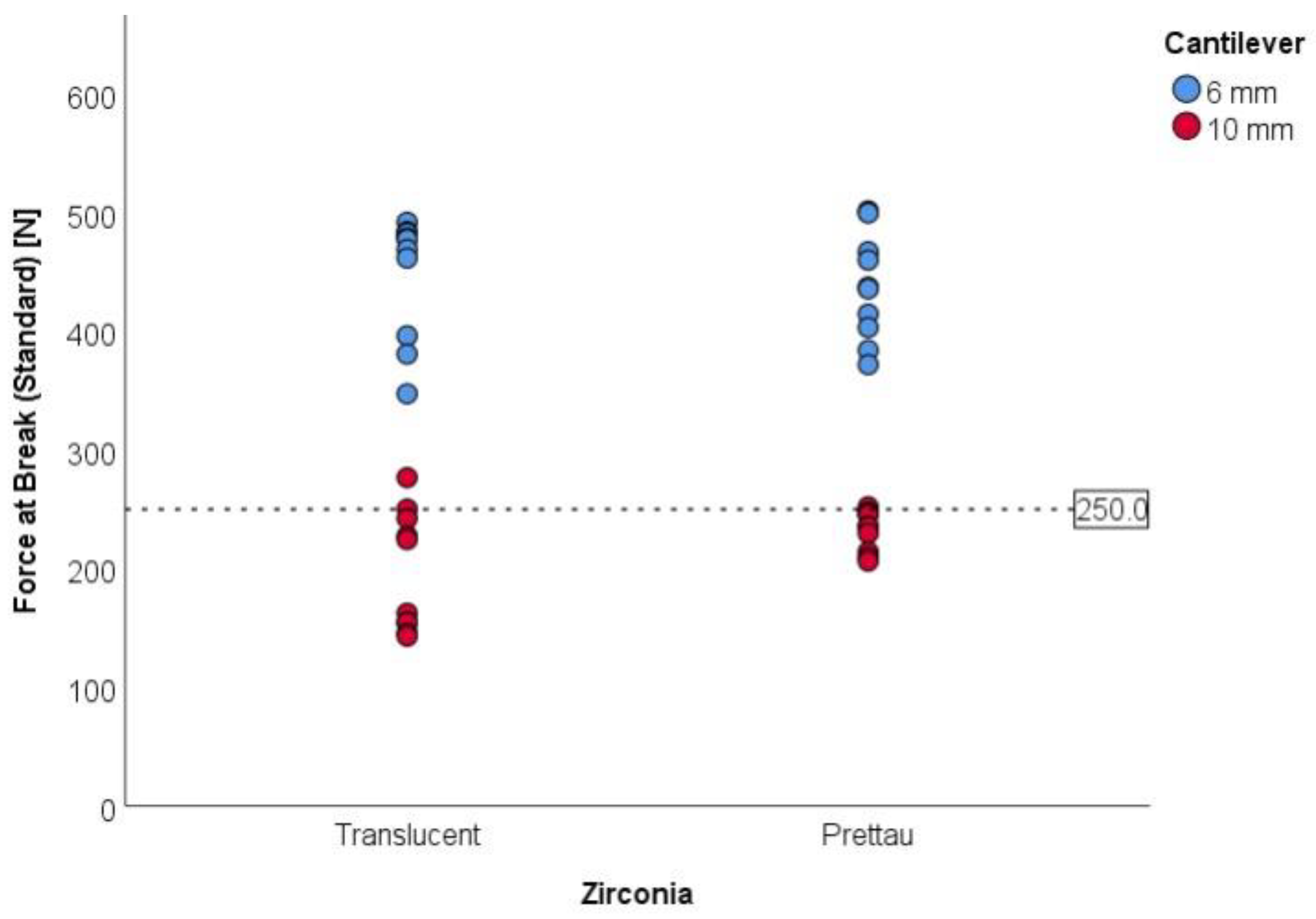
| Force at Break (Standard) (N) | 322.62 (137.09) | 334.86 (110.41) | t(38) = 0.31 (p = 0.757) d = 0.10 | 442.30 (47.49) | 215.18 (40.74) | t(38) = 16.23 (p < 0.001) d = 4.68 |
| Cantilever Length = 6 mm (n = 20) | Cantilever Length = 10 mm (n = 20) | |||||
|---|---|---|---|---|---|---|
| Translucent Zirconia (n = 10) | Prettau Zirconia (n = 10) | t-Test | Translucent Zirconia (n = 10) | Prettau Zirconia (n = 10) | t-Test | |
| Force at Break (Standard) (N) | 447.05 (51.84) | 437.54 (44.97) | t(18) = 0.44 (p = 0.667) d = 0.20 | 198.18 (50.79) | 232.18 (16.83) | t(18) = −2.01 (p = 0.070) ‡ d = 0.90 |
| n | M | SD | Factorial ANOVA | ||
|---|---|---|---|---|---|
| Zirconia | Cantilever | ||||
| Translucent | 6 mm | 10 | 447.05 | 51.84 | Zirconia effect F(1,36) = 0.79 (p = 0.379), ηp2 = 0.02 |
| 10 mm | 10 | 198.18 | 50.79 | ||
| Total | 20 | 322.62 | 137.09 | ||
| Prettau | 6 mm | 10 | 437.54 | 44.97 | Cantilever effect F(1,36) = 272.46 (p < 0.001), ηp2 = 0.88 |
| 10 mm | 10 | 232.18 | 16.83 | ||
| Total | 20 | 334.86 | 110.41 | ||
| Total | 6 mm | 20 | 442.30 | 47.49 | Zirconia x Cantilever effect F(1,36) = 2.50 (p = 0.273), ηp2 = 0.07 |
| 10 mm | 20 | 215.18 | 40.74 | ||
| Total | 40 | 328.74 | 123.02 |
| Tests for Mean > 250 N | Proportion of Components > 250 N | |||||
|---|---|---|---|---|---|---|
| n | M | SD | t-Tests | n (%) | ||
| Zirconia | Cantilever | |||||
| Translucent | 6 mm | 10 | 447.05 | 51.84 | t(9) = 12.02 (p < 0.001) | 10 (100%) |
| 10 mm | 10 | 198.18 | 50.79 | t(9) = −3.23 (p > 0.999) | 2 (20%) | |
| Total | 20 | 322.62 | 137.09 | t(19) = 2.37 (p = 0.015) | 12 (60.0%) | |
| Prettau | 6 mm | 10 | 437.54 | 44.97 | t(9) = 13.19 (p < 0.001) | 10 (100%) |
| 10 mm | 10 | 232.18 | 16.83 | t(9) = −3.35 (p > 0.999) | 1 (10%) | |
| Total | 20 | 334.86 | 110.41 | t(19) = 3.44 (p = 0.002) | 11 (55.0%) | |
| Total | 6 mm | 20 | 442.30 | 47.49 | t(19) = 18.11 (p < 0.001) | 20 (100%) |
| 10 mm | 20 | 215.18 | 40.74 | t(19) = −3.82 (p > 0.999) | 3 (15.0%) | |
| Total | 40 | 328.74 | 123.02 | t(39) = 4.05 (p < 0.001) | 23 (57.5%) | |
Publisher’s Note: MDPI stays neutral with regard to jurisdictional claims in published maps and institutional affiliations. |
© 2022 by the authors. Licensee MDPI, Basel, Switzerland. This article is an open access article distributed under the terms and conditions of the Creative Commons Attribution (CC BY) license (https://creativecommons.org/licenses/by/4.0/).
Share and Cite
Novais, M.; Silva, A.S.; Mendes, J.; Barreiros, P.; Aroso, C.; Mendes, J.M. Fracture Resistance of CAD/CAM Implant-Supported 3Y-TZP-Zirconia Cantilevers: An In Vitro Study. Materials 2022, 15, 6638. https://doi.org/10.3390/ma15196638
Novais M, Silva AS, Mendes J, Barreiros P, Aroso C, Mendes JM. Fracture Resistance of CAD/CAM Implant-Supported 3Y-TZP-Zirconia Cantilevers: An In Vitro Study. Materials. 2022; 15(19):6638. https://doi.org/10.3390/ma15196638
Chicago/Turabian StyleNovais, Mariana, António Sérgio Silva, Joana Mendes, Pedro Barreiros, Carlos Aroso, and José Manuel Mendes. 2022. "Fracture Resistance of CAD/CAM Implant-Supported 3Y-TZP-Zirconia Cantilevers: An In Vitro Study" Materials 15, no. 19: 6638. https://doi.org/10.3390/ma15196638
APA StyleNovais, M., Silva, A. S., Mendes, J., Barreiros, P., Aroso, C., & Mendes, J. M. (2022). Fracture Resistance of CAD/CAM Implant-Supported 3Y-TZP-Zirconia Cantilevers: An In Vitro Study. Materials, 15(19), 6638. https://doi.org/10.3390/ma15196638