Article

Effects of Mono-Vacancies and Co-Vacancies of Nitrogen and Boron on the Energetics and Electronic Properties of Heterobilayer h-BN/graphene

by
Gladys Casiano Jiménez
1,2,
Juan David Morinson-Negrete
1,3,
Franklin Peniche Blanquicett
1,
César Ortega-López
1,2 and
Miguel J. Espitia-Rico
4,*
1
Grupo Avanzado de Materiales y Sistemas Complejos GAMASCO, Universidad de Córdoba, Montería CP 230001, Colombia
2
Doctorado en Ciencias Física, Universidad de Córdoba, Montería CP 2030001, Colombia
3
Grupo de Investigación AMDAC, Institución Educativa José María Córdoba, Montería CP 2300001, Colombia
4
Grupo GEFEM, Universidad Distrital Francisco José de Caldas, Bogotá CP 110111, Colombia
*
Author to whom correspondence should be addressed.
Materials 2022, 15(18), 6369; https://doi.org/10.3390/ma15186369
Submission received: 9 August 2022 / Revised: 30 August 2022 / Accepted: 5 September 2022 / Published: 14 September 2022
(This article belongs to the Topic First-Principles Simulation—Nano-Theory)

Abstract

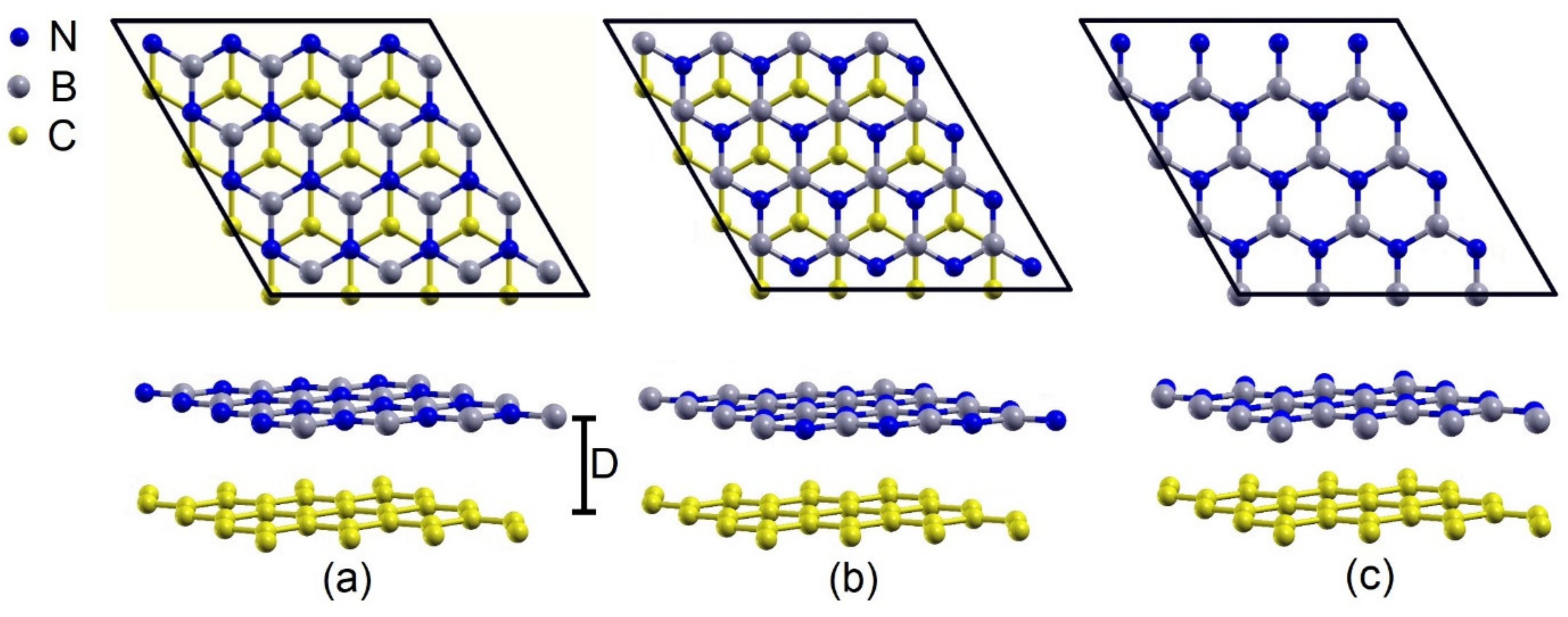
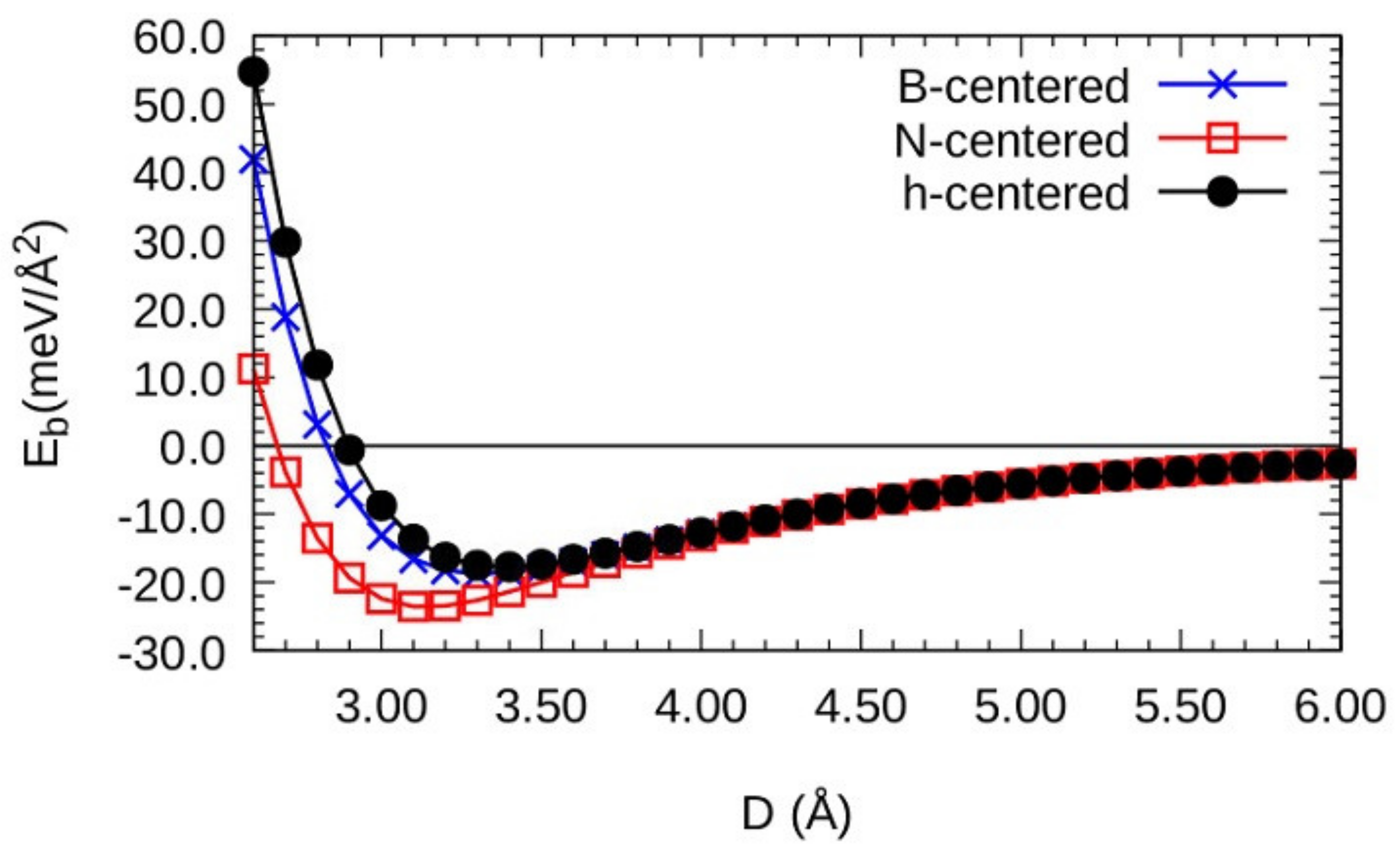
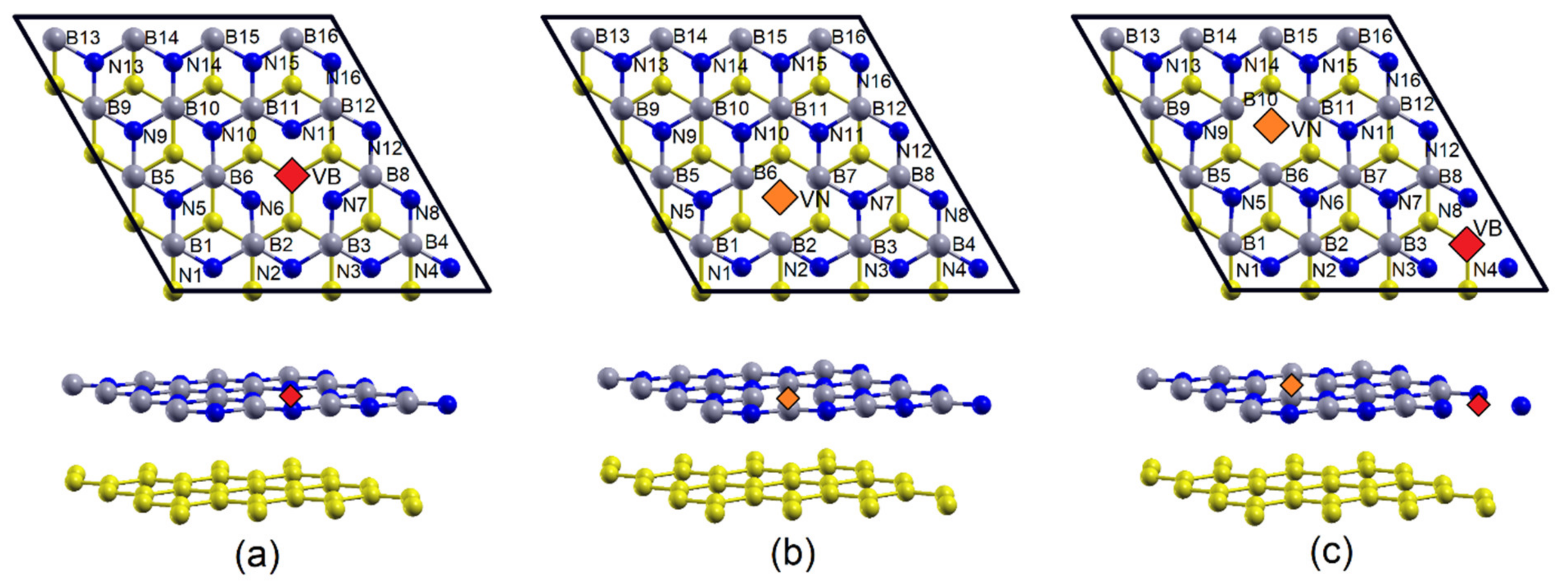
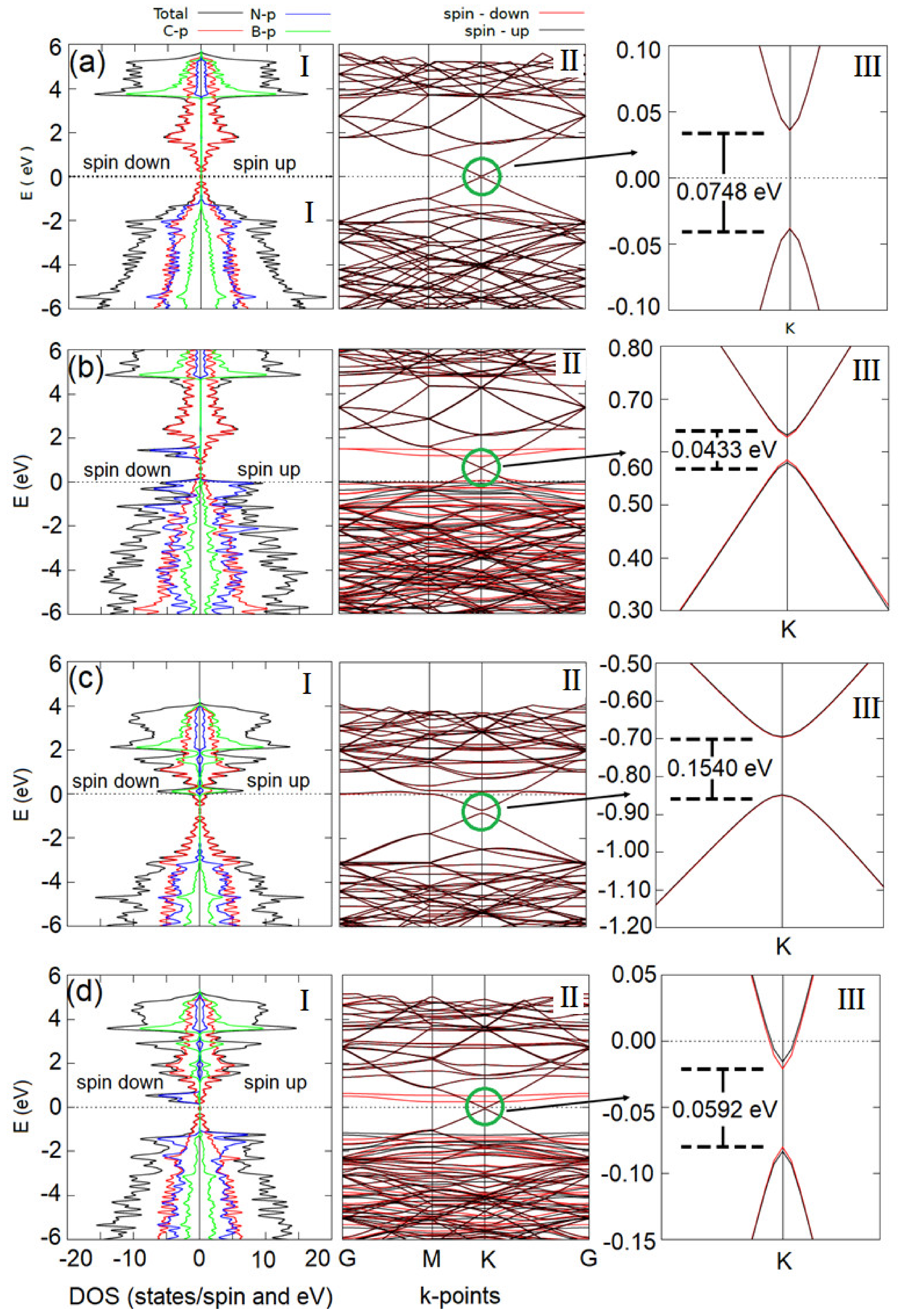
A study is carried out which investigates the effects of the mono-vacancies of boron (VB) and nitrogen (VN) and the co-vacancies of nitrogen (N), and boron (B) on the energetics and the structural, electronic, and magnetic properties of an h-BN/graphene heterobilayer using first-principles calculations within the framework of the density functional theory (DFT). The heterobilayer is modelled using the periodic slab scheme. In the present case, a 4 × 4-(h-BN) monolayer is coupled to a 4 × 4-graphene monolayer, with a mismatch of 1.40%. In this coupling, the surface of interest is the 4 × 4-(h-BN) monolayer; the 4 × 4-graphene only represents the substrate that supports the 4 × 4-(h-BN) monolayer. From the calculations of the energy of formation of the 4 × 4-(h-BN)/4 × 4-graphene heterobilayer, with and without defects, it is established that, in both cases, the heterobilayers are energetically stable, from which it is inferred that these heterobilayers can be grown in the experiment. The formation of a mono-vacancy of boron (1 VB), a mono-vacancy of nitrogen (1 VN), and co-vacancies of boron and nitrogen (VBN) induce, on the structural level: (a) for 1 VB, a contraction n of the B-N bond lengths of ~2.46% and a slight change in the interfacial distance D (~0.096%) with respect to the heterobilayer free of defects (FD) are observed; (b) for 1 VN, a slight contraction of the B-N of bond lengths of ~0.67% and an approach between the h-BN monolayer and the graphene of ~3.83% with respect to the FD heterobilayer are observed; (c) for VBN, it can be seen that the N-N and B-B bond lengths (in the 1 VB and 1 VN regions, respectively) undergo an increase of ~2.00% and a decrease of ~3.83%, respectively. The calculations of the Löwdin charge for the FD heterobilayer and for those with defects (1 VB, 1 VN, and VBN) show that the inclusion of this type of defect induces significant changes in the Löwdin charge redistribution of the neighboring atoms of VB and VN, causing chemically active regions that could favor the interaction of the heterobilayer with external atoms and/or molecules. On the basis of an analysis of the densities of states and the band structures, it is established that the heterobilayer with 1 VB and VBN take on a half-metallic and magnetic behavior. Due to all of these properties, the FD heterobilayer and those with 1 VB, 1 VN, and VBN are candidates for possible adsorbent materials and possible materials that could be used for different spintronic applications.
Keywords: h-BN/graphene heterobilayer; Löwdin charge; magnetic metal; DFT h-BN/graphene heterobilayer; Löwdin charge; magnetic metal; DFT