


Rheological and the Fresh State Properties of Alkali-Activated Mortars by Blast Furnace Slag

 ,
,  , ,
, ,  and
and
Abstract
1. Introduction

| Test | Standard | Parameters Obtained | Rheological Property |
|---|---|---|---|
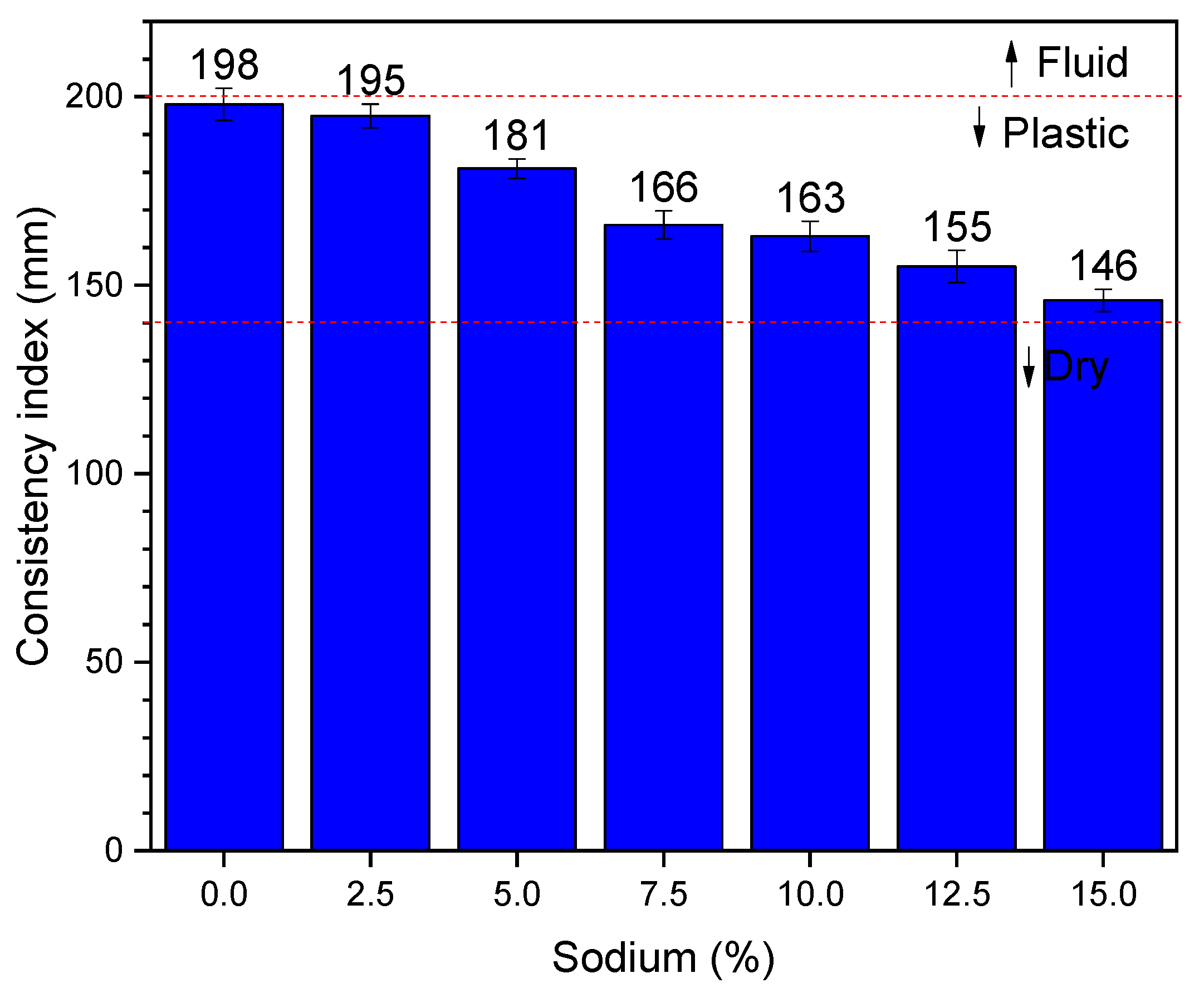
| Flow Table | NBR 13276 (ABNT, 2016) [38] | Consistency index | Dynamic viscosity |
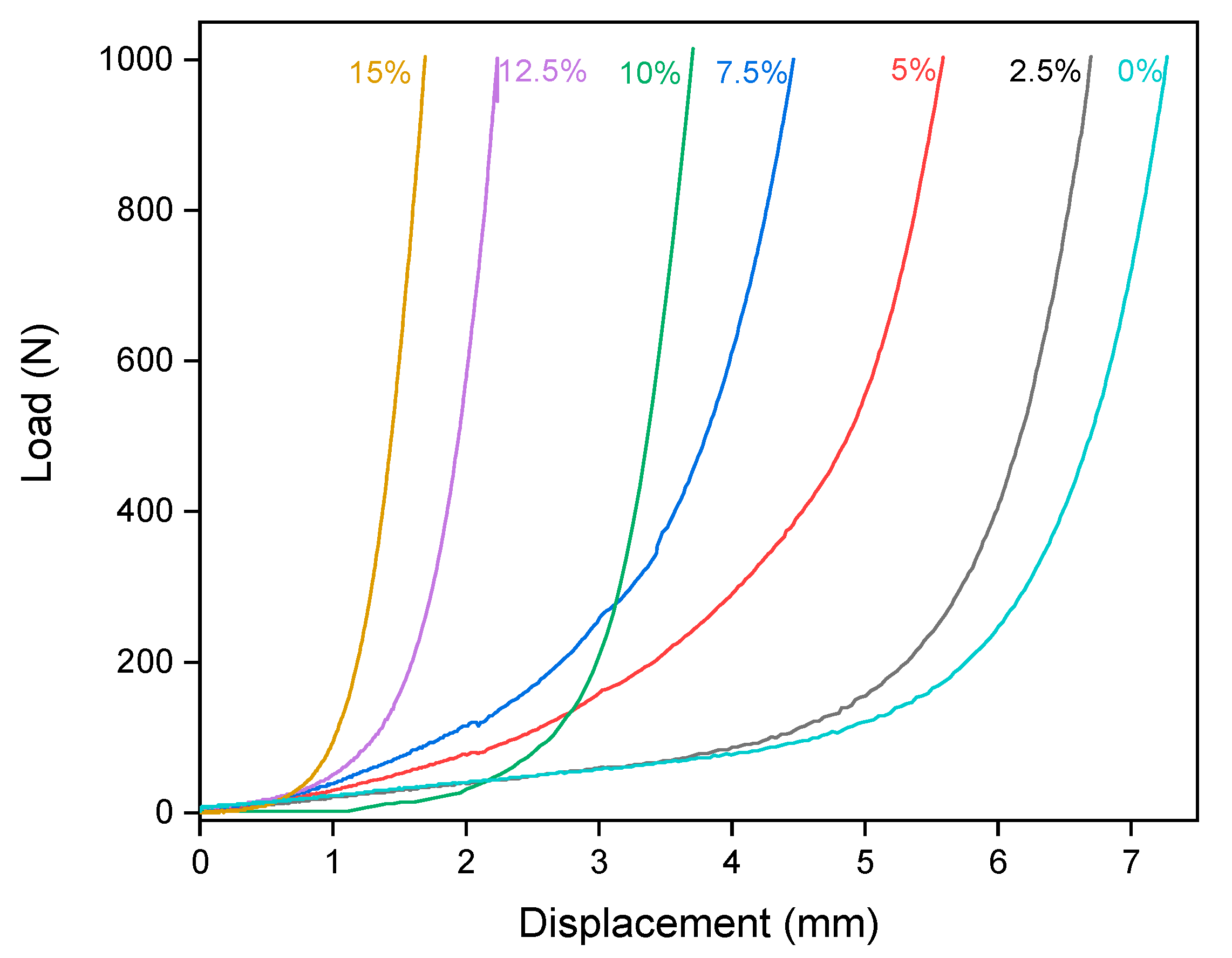
| Squeeze flow | NBR 15839 (ABNT, 2010) [39] | Load x displacement | Dynamic viscosity and yield stress |
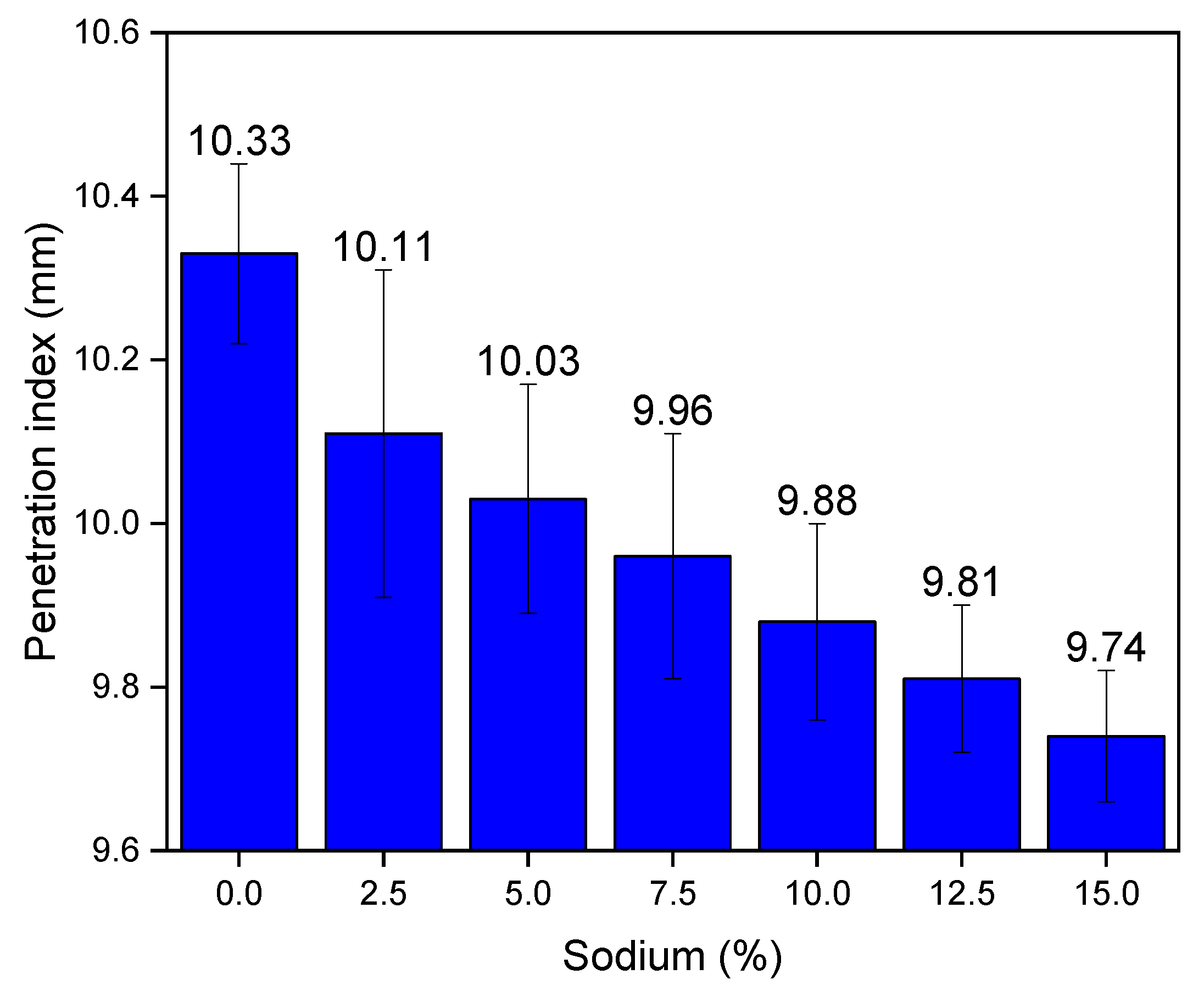
| Dropping Ball | BS 4551 (BS, 2005) [40] | Penetration index | Yield stress |
| Vane Test | D4648 (ASTM, 2000) [41] | Torque x angular speed | Dynamic viscosity and yield stress |
2. Materials and Methods
3. Results and Discussion
3.1. Rheological Behavior
- τ = shear stress;
- τ0 = initial yield stress;
- η = dynamic viscosity;
- γ = flow rate.
3.2. Fresh State Properties
3.3. Hardened State Properties
4. Conclusions
Author Contributions
Funding
Institutional Review Board Statement
Informed Consent Statement
Data Availability Statement
Acknowledgments
Conflicts of Interest
References
- Erofeev, V.; Rodin, A.; Yakunin, V.; Bogatov, A.; Bochkin, V.; Chegodajkin, A. Alkali-Activated Slag Binders from Rock-Wool Production Wastes. Mag. Civ. Eng. 2018, 82, 219–227. [Google Scholar] [CrossRef]
- Marvila, M.T.; Azevedo, A.R.G.; Delaqua, G.C.G.; Mendes, B.C.; Pedroti, L.G.; Vieira, C.M.F. Performance of Geopolymer Tiles in High Temperature and Saturation Conditions. Constr. Build. Mater. 2021, 286, 122994. [Google Scholar] [CrossRef]
- Azevedo, A.R.G.; Vieira, C.M.F.; Ferreira, W.M.; Faria, K.C.P.; Pedroti, L.G.; Mendes, B.C. Potential Use of Ceramic Waste as Precursor in the Geopolymerization Reaction for the Production of Ceramic Roof Tiles. J. Build. Eng. 2020, 29, 101156. [Google Scholar] [CrossRef]
- Provis, J.L.; Bernal, S.A. Geopolymers and Related Alkali-Activated Materials. Annu. Rev. Mater. Res. 2014, 44, 299–327. [Google Scholar] [CrossRef]
- Amran, M.; Murali, G.; Khalid, N.H.A.; Fediuk, R.; Ozbakkaloglu, T.; Lee, Y.H.; Haruna, S.; Lee, Y.Y. Slag Uses in Making an Ecofriendly and Sustainable Concrete: A Review. Constr. Build. Mater. 2021, 272, 121942. [Google Scholar] [CrossRef]
- Kathirvel, P.; Gunasekaran, M.; Sreekumaran, S.; Krishna, A. Effect of Partial Replacement of Ground Granulated Blast Furnace Slag with Sugarcane Bagasse Ash as Source Material in the Production of Geopolymer Concrete. Mater. Sci. 2020, 26, 477–481. [Google Scholar] [CrossRef]
- Abdulkareem, M.; Havukainen, J.; Nuortila-Jokinen, J.; Horttanainen, M. Environmental and Economic Perspective of Waste-Derived Activators on Alkali-Activated Mortars. J. Clean. Prod. 2021, 280, 124651. [Google Scholar] [CrossRef]
- Zhang, B.; Zhu, H.; Shah, K.W.; Feng, P.; Dong, Z. Optimization of Mix Proportion of Alkali-Activated Slag Mortars Prepared with Seawater and Coral Sand. Constr. Build. Mater. 2021, 284, 122805. [Google Scholar] [CrossRef]
- Ahmad, M.R.; Chen, B.; Shah, S.F.A. Influence of Different Admixtures on the Mechanical and Durability Properties of One-Part Alkali-Activated Mortars. Constr. Build. Mater. 2020, 265, 120320. [Google Scholar] [CrossRef]
- Sundhararasu, E.; Tuomikoski, S.; Runtti, H.; Hu, T.; Varila, T.; Kangas, T.; Lassi, U. Alkali-Activated Adsorbents from Slags: Column Adsorption and Regeneration Study for Nickel(II) Removal. ChemEngineering 2021, 5, 13. [Google Scholar] [CrossRef]
- Phoo-ngernkham, T.; Hanjitsuwan, S.; Damrongwiriyanupap, N.; Chindaprasirt, P. Effect of Sodium Hydroxide and Sodium Silicate Solutions on Strengths of Alkali Activated High Calcium Fly Ash Containing Portland Cement. KSCE J. Civ. Eng. 2017, 21, 2202–2210. [Google Scholar] [CrossRef]
- Bhardwaj, B.; Kumar, P. Comparative Study of Geopolymer and Alkali Activated Slag Concrete Comprising Waste Foundry Sand. Constr. Build. Mater. 2019, 209, 555–565. [Google Scholar] [CrossRef]
- Wang, W.C.; Wang, H.Y.; Tsai, H.C. Study on Engineering Properties of Alkali-Activated Ladle Furnace Slag Geopolymer. Constr. Build. Mater. 2016, 123, 800–805. [Google Scholar] [CrossRef]
- Jackson, M.D.; Mulcahy, S.R.; Chen, H.; Li, Y.; Li, Q.; Cappelletti, P.; Wenk, H.-R. Phillipsite and Al-Tobermorite Mineral Cements Produced through Low-Temperature Water-Rock Reactions in Roman Marine Concrete. Am. Mineral 2017, 102, 1435–1450. [Google Scholar] [CrossRef]
- Le, T.T.; Austin, S.A.; Lim, S.; Buswell, R.A.; Gibb, A.G.F.; Thorpe, T. Mix Design and Fresh Properties for High-Performance Printing Concrete. Mater. Struct. 2012, 45, 1221–1232. [Google Scholar] [CrossRef]
- Ghahari, S.; Assi, L.N.; Alsalman, A.; Alyamaç, K.E. Fracture Properties Evaluation of Cellulose Nanocrystals Cement Paste. Materials 2020, 13, 2507. [Google Scholar] [CrossRef] [PubMed]
- ABNT. NBR 13278: Argamassa Para Assentamento e Revestimento de Paredes e Tetos—Determinação Da Densidade de Massa e Do Teor de Ar Incorporado; Associação Brasileira de Normas Técnicas: Rio de Janeiro, Brazil, 2005. [Google Scholar]
- Marvila, M.T.; Azevedo, A.R.G.; Barroso, L.S.; Barbosa, M.Z.; de Brito, J. Gypsum Plaster Using Rock Waste: A Proposal to Repair the Renderings of Historical Buildings in Brazil. Constr. Build. Mater. 2020, 250, 118786. [Google Scholar] [CrossRef]
- Marvila, M.T.; Alexandre, J.; de Azevedo, A.R.G.; Zanelato, E.B. Evaluation of the Use of Marble Waste in Hydrated Lime Cement Mortar Based. J. Mater. Cycles Waste Manag. 2019, 21, 1250–1261. [Google Scholar] [CrossRef]
- Azevedo, A.R.; Marvila, M.T.; Zanelato, E.B.; Alexandre, J. Development of Mortar for Laying and Coating with Pineapple Fibers. Rev. Bras. Eng. Agrícola e Ambient. 2020, 24, 187–193. [Google Scholar] [CrossRef]
- de Azevedo, A.R.G.; Marvila, M.T.; Barroso, L.S.; Zanelato, E.B.; Alexandre, J.; Xavier, G.C.; Monteiro, S.N. Effect of Granite Residue Incorporation on the Behavior of Mortars. Materials 2019, 12, 1449. [Google Scholar] [CrossRef]
- Amaral, L.F.; Girondi Delaqua, G.C.; Nicolite, M.; Marvila, M.T.; de Azevedo, A.R.G.; Alexandre, J.; Fontes Vieira, C.M.; Monteiro, S.N. Eco-Friendly Mortars with Addition of Ornamental Stone Waste - A Mathematical Model Approach for Granulometric Optimization. J. Clean. Prod. 2020, 248, 119283. [Google Scholar] [CrossRef]
- Marvila, M.T.; Azevedo, A.R.G.; Alexandre, J.; Vieira, C.M.F.; Zanelato, E.B.; Delaqua, G.C.G.; Xavier, G.C.; Monteiro, S.N. Study of the Compressive Strength of Mortars as a Function of Material Composition, Workability, and Specimen Geometry. Model. Simul. Eng. 2020, 2020, 1–6. [Google Scholar] [CrossRef]
- de Azevedo, A.R.G.; Alexandre, J.; Marvila, M.T.; Xavier, G.C.; Monteiro, S.N.; Pedroti, L.G. Technological and Environmental Comparative of the Processing of Primary Sludge Waste from Paper Industry for Mortar. J. Clean. Prod. 2019, 249, 119336. [Google Scholar] [CrossRef]
- Shill, S.K.; Al-Deen, S.; Ashraf, M.; Hutchison, W. Resistance of Fly Ash Based Geopolymer Mortar to both Chemicals and High Thermal Cycles Simultaneously. Constr. Build. Mater. 2020, 239, 117886. [Google Scholar] [CrossRef]
- Qian, L.-P.; Wang, Y.-S.; Alrefaei, Y.; Dai, J.-G. Experimental Study on Full-Volume Fly Ash Geopolymer Mortars: Sintered Fly Ash versus Sand as Fine Aggregates. J. Clean. Prod. 2020, 263, 121445. [Google Scholar] [CrossRef]
- Longhi, M.A.; Rodríguez, E.D.; Walkley, B.; Zhang, Z.; Kirchheim, A.P. Metakaolin-Based Geopolymers: Relation between Formulation, Physicochemical Properties and Efflorescence Formation. Compos. Part B Eng. 2020, 182, 107671. [Google Scholar] [CrossRef]
- Marvila, M.T.; Alexandre, J.; Azevedo, A.R.G.; Zanelato, E.B.; Xavier, G.C.; Monteiro, S.N. Study on the Replacement of the Hydrated Lime by Kaolinitic Clay in Mortars. Adv. Appl. Ceram. 2019, 118, 373–380. [Google Scholar] [CrossRef]
- Zanelato, E.B.; Alexandre, J.; de Azevedo, A.R.G.; Marvila, M.T. Evaluation of Roughcast on the Adhesion Mechanisms of Mortars on Ceramic Substrates. Mater. Struct. Constr. 2019, 52, 1–13. [Google Scholar] [CrossRef]
- Muthu Kumar, E.; Ramamurthy, K. Influence of Production on the Strength, Density and Water Absorption of Aerated Geopolymer Paste and Mortar Using Class F Fly Ash. Constr. Build. Mater. 2017, 156, 1137–1149. [Google Scholar] [CrossRef]
- Oviedo-Sánchez, K.; Mejía de Gutiérrez, R. Mortero Geopolimérico Para Uso Potencial Como Recubrimiento En Concreto. Rev. EIA 2019, 16, 159. [Google Scholar] [CrossRef]
- Azevedo, A.R.G.; França, B.R.; Alexandre, J.; Marvila, M.T.; Zanelato, E.B.; Xavier, G.C. Influence of Sintering Temperature of a Ceramic Substrate in Mortar Adhesion for Civil Construction. J. Build. Eng. 2018, 19, 342–348. [Google Scholar] [CrossRef]
- Okada, K.; Ooyama, A.; Isobe, T.; Kameshima, Y.; Nakajima, A.; MacKenzie, K.J.D. Water Retention Properties of Porous Geopolymers for Use in Cooling Applications. J. Eur. Ceram. Soc. 2009, 29, 1917–1923. [Google Scholar] [CrossRef]
- Marvila, M.T.; Azevedo, A.R.G.; Alexandre, J.; Zanelato, E.B.; Azeredo, N.G.; Simonassi, N.T.; Monteiro, S.N. Correlation between the Properties of Structural Clay Blocks Obtained by Destructive Tests and Ultrasonic Pulse Tests. J. Build. Eng. 2019, 26, 100869. [Google Scholar] [CrossRef]
- Chougan, M.; Hamidreza Ghaffar, S.; Jahanzat, M.; Albar, A.; Mujaddedi, N.; Swash, R. The Influence of Nano-Additives in Strengthening Mechanical Performance of 3D Printed Multi-Binder Geopolymer Composites. Constr. Build. Mater. 2020, 250, 118928. [Google Scholar] [CrossRef]
- Sun, C.; Xiang, J.; Xu, M.; He, Y.; Tong, Z.; Cui, X. 3D Extrusion Free Forming of Geopolymer Composites: Materials Modification and Processing Optimization. J. Clean. Prod. 2020, 258, 120986. [Google Scholar] [CrossRef]
- de Azevedo, A.R.G.; Alexandre, J.; Zanelato, E.B.; Marvila, M.T. Influence of Incorporation of Glass Waste on the Rheological Properties of Adhesive Mortar. Constr. Build. Mater. 2017, 148, 359–368. [Google Scholar] [CrossRef]
- ABNT. NBR 13276 Argamassa Para Assentamento e Revestimento de Paredes e Tetos—Determinação Do Índice de Consistência; Associação Brasileira de Normas Técnicas: Rio de Janeiro, Brazil, 2016. [Google Scholar]
- ABNT. NBR 15839—Argamassa de Assentamento e Revestimento de Paredes e Tetos—Caracterização Reológica Pelo Método Squeeze-Flow; Associação Brasileira de Normas Técnicas: Rio de Janeiro, Brazil, 2010. [Google Scholar]
- British Standards Institution. British Standard BS 4551—Mortar. Methods of Test for Mortar and Screed. Chemical Analysis and Physical Testing; British Standards Institution: London, UK, 2005. [Google Scholar]
- ASTM. D4648/D4648M-12 Standard Test Method for Laboratory Miniature Vane Shear Test for Saturated Fine-Grained Clayey Soil; ASTM International: West Conshohocken, PA, USA, 2000; Available online: http://www.astm.org/ (accessed on 20 April 2021). [CrossRef]
- Cardoso, F.A.; Fujii, A.L.; Pileggi, R.G.; Chaouche, M. Parallel-Plate Rotational Rheometry of Cement Paste: Influence of the Squeeze Velocity during Gap Positioning. Cem. Concr. Res. 2015, 75, 66–74. [Google Scholar] [CrossRef]
- Cardoso, F.A.; John, V.M.; Pileggi, R.G. Rheological Behavior of Mortars under Different Squeezing Rates. Cem. Concr. Res. 2009, 39, 748–753. [Google Scholar] [CrossRef]
- Grandes, F.A.; Sakano, V.K.; Rego, A.C.A.; Cardoso, F.A.; Pileggi, R.G. Squeeze Flow Coupled with Dynamic Pressure Mapping for the Rheological Evaluation of Cement-Based Mortars. Cem. Concr. Compos. 2018, 92, 18–35. [Google Scholar] [CrossRef]
- Xie, J.; Kayali, O. Effect of Superplasticiser on Workability Enhancement of Class F and Class C Fly Ash-Based Geopolymers. Constr. Build. Mater. 2016, 122, 36–42. [Google Scholar] [CrossRef]
- Nikoloutsopoulos, N.; Sotiropoulou, A.; Kakali, G.; Tsivilis, S. The Effect of Solid/Liquid Ratio on Setting Time, Workability and Compressive Strength of Fly Ash Based Geopolymers. Mater. Today Proc. 2018, 5, 27441–27445. [Google Scholar] [CrossRef]
- Laskar, S.M.; Talukdar, S. Preparation and Tests for Workability, Compressive and Bond Strength of Ultra-Fine Slag Based Geopolymer as Concrete Repairing Agent. Constr. Build. Mater. 2017, 154, 176–190. [Google Scholar] [CrossRef]
- de Oliveira, A.M.A.; Dias, D.P.; França, F.C.C. Influência Da Viscosidade Da Solução Ativadora Alcalina Na Trabalhabilidade de Argamassas Geopoliméricas. Matéria 2018, 23. [Google Scholar] [CrossRef]
- Hadi, M.N.S.; Zhang, H.; Parkinson, S. Optimum Mix Design of Geopolymer Pastes and Concretes Cured in Ambient Condition Based on Compressive Strength, Setting Time and Workability. J. Build. Eng. 2019, 23, 301–313. [Google Scholar] [CrossRef]
- Marvila, M.T.; Azevedo, A.R.G.; Zanelato, E.B.; Lima, T.E.S.; Delaqua, G.C.G.; Vieira, C.M.F.; Pedroti, L.G.; Monteiro, S.N. Study of Pathologies in Alkali-Activated Materials Based on Slag. In Characterization of Minerals, Metals, and Materials; Springer International Publishing: Cham, Switzerland, 2021; pp. 523–531. [Google Scholar]
- Soriano, L.; Font, A.; Tashima, M.M.; Monzó, J.; Borrachero, M.V.; Payá, J. One-Part Blast Furnace Slag Mortars Activated with Almond-Shell Biomass Ash: A New 100% Waste-Based Material. Mater. Lett. 2020, 272, 127882. [Google Scholar] [CrossRef]
- Melo Neto, A.A.; Cincotto, M.A.; Repette, W. Drying and Autogenous Shrinkage of Pastes and Mortars with Activated Slag Cement. Cem. Concr. Res. 2008, 38, 565–574. [Google Scholar] [CrossRef]
- Neto, A.A.M.; Cincotto, M.A.; Repette, W. Mechanical Properties, Drying and Autogenous Shrinkage of Blast Furnace Slag Activated with Hydrated Lime and Gypsum. Cem. Concr. Compos. 2010, 32, 312–318. [Google Scholar] [CrossRef]
- ABNT. ABNT NBR 13277—Argamassa Para Assentamento e Revestimento de Paredes e Tetos—Determinação Da Retenção de Água; Associação Brasileira de Normas Técnicas: Rio de Janeiro, Brazil, 2005. [Google Scholar]
- ANBT. ABNT NBR 5739: Concreto—Ensaio de Compressão de Corpos de Prova Cilíndricos; Associação Brasileira de Normas Técnicas: Rio de Janeiro, Brazil, 2018. [Google Scholar]
- ABNT. NBR 9778—Argamassa e Concreto Endurecidos—Determinação Da Absorção de Água, Índice de Vazios e Massa Específica; Associação Brasileira de Normas Técnicas: Rio de Janeiro, Brazil, 2011. [Google Scholar]
- Marvila, M.T.; Azevedo, A.R.G.; Cecchin, D.; Costa, J.M.; Xavier, G.C.; de Fátima do Carmo, D.; Monteiro, S.N. Durability of Coating Mortars Containing Açaí Fibers. Case Stud. Constr. Mater. 2020, 13, e00406. [Google Scholar] [CrossRef]
- Alonso, M.M.; Gismera, S.; Blanco, M.T.; Lanzón, M.; Puertas, F. Alkali-Activated Mortars: Workability and Rheological Behaviour. Constr. Build. Mater. 2017, 145, 576–587. [Google Scholar] [CrossRef]
- Rajaei, S.; Shoaei, P.; Shariati, M.; Ameri, F.; Musaeei, H.R.; Behforouz, B.; de Brito, J. Rubberized Alkali-Activated Slag Mortar Reinforced with Polypropylene Fibres for Application in Lightweight Thermal Insulating Materials. Constr. Build. Mater. 2021, 270, 121430. [Google Scholar] [CrossRef]
- Palacios, M.; Alonso, M.M.; Varga, C.; Puertas, F. Influence of the Alkaline Solution and Temperature on the Rheology and Reactivity of Alkali-Activated Fly Ash Pastes. Cem. Concr. Compos. 2019, 95, 277–284. [Google Scholar] [CrossRef]
- Li, L.; Lu, J.-X.; Zhang, B.; Poon, C.-S. Rheology Behavior of One-Part Alkali Activated Slag/Glass Powder (AASG) Pastes. Constr. Build. Mater. 2020, 258, 120381. [Google Scholar] [CrossRef]
- Marvila, M.T.; de Azevedo, A.R.G.; Vieira, C.M. Reaction mechanisms of alkali-activated materials. Rev. IBRACON Estrut. Mater. 2021, 14, 14309. [Google Scholar] [CrossRef]
- Hosseinpoor, M.; Ouro Koura, B.-I.; Yahia, A.; Kadri, E.-H. Diphasic Investigation of the Visco-Elastoplastic Characteristics of Highly Flowable Fine Mortars. Constr. Build. Mater. 2021, 270, 121425. [Google Scholar] [CrossRef]
- Ramos, G.A.; de Matos, P.R.; Pelisser, F.; Gleize, P.J.P. Effect of Porcelain Tile Polishing Residue on Eco-Efficient Geopolymer: Rheological Performance of Pastes and Mortars. J. Build. Eng. 2020, 32, 101699. [Google Scholar] [CrossRef]
- Azevedo, A.; de Matos, P.; Marvila, M.; Sakata, R.; Silvestro, L.; Gleize, P.; Brito, J.d. Rheology, Hydration, and Microstructure of Portland Cement Pastes Produced with Ground Açaí Fibers. Appl. Sci. 2021, 11, 3036. [Google Scholar] [CrossRef]
- Baumert, C.; Garrecht, H. Minimization of the Influence of Shear-Induced Particle Migration in Determining the Rheological Characteristics of Self-Compacting Mortars and Concretes. Materials 2020, 13, 1542. [Google Scholar] [CrossRef]
- He, P.; Zhang, B.; Lu, J.-X.; Poon, C.S. ASR Expansion of Alkali-Activated Cement Glass Aggregate Mortars. Constr. Build. Mater. 2020, 261, 119925. [Google Scholar] [CrossRef]
- Azevedo, A.R.G.; Marvila, M.T.; Rocha, H.A.; Cruz, L.R.; Vieira, C.M.F. Use of Glass Polishing Waste in the Development of Ecological Ceramic Roof Tiles by the Geopolymerization Process. Int. J. Appl. Ceram. Technol. 2020, 17, 2649–2658. [Google Scholar] [CrossRef]
- de Azevedo, A.R.G.; Marvila, M.T.; Tayeh, B.A.; Cecchin, D.; Pereira, A.C.; Monteiro, S.N. Technological Performance of Açaí Natural Fibre Reinforced Cement-Based Mortars. J. Build. Eng. 2021, 33, 101675. [Google Scholar] [CrossRef]
- Park, S.; Park, H.M.; Yoon, H.N.; Seo, J.; Yang, C.-M.; Provis, J.L.; Yang, B. Hydration Kinetics and Products of MgO-Activated Blast Furnace Slag. Constr. Build. Mater. 2020, 249, 118700. [Google Scholar] [CrossRef]
- Zhang, Z.; Provis, J.L.; Ma, X.; Reid, A.; Wang, H. Efflorescence and Subflorescence Induced Microstructural and Mechanical Evolution in Fly Ash-Based Geopolymers. Cem. Concr. Compos. 2018, 92, 165–177. [Google Scholar] [CrossRef]
- Bernal, S.A.; Provis, J.L.; Walkley, B.; San Nicolas, R.; Gehman, J.D.; Brice, D.G.; Kilcullen, A.R.; Duxson, P.; van Deventer, J.S.J. Gel Nanostructure in Alkali-Activated Binders Based on Slag and Fly Ash, and Effects of Accelerated Carbonation. Cem. Concr. Res. 2013, 53, 127–144. [Google Scholar] [CrossRef]
- Amorim Júnior, N.S.; Andrade Neto, J.S.; Santana, H.A.; Cilla, M.S.; Ribeiro, D.V. Durability and Service Life Analysis of Metakaolin-Based Geopolymer Concretes with Respect to Chloride Penetration Using Chloride Migration Test and Corrosion Potential. Constr. Build. Mater. 2021, 287, 122970. [Google Scholar] [CrossRef]
- Wang, J.; Ge, Y.; He, Y.; Xu, M.; Cui, X. A Porous Gradient Geopolymer-Based Tube Membrane with High PM Removal Rate for Air Pollution. J. Clean. Prod. 2019, 217, 335–343. [Google Scholar] [CrossRef]
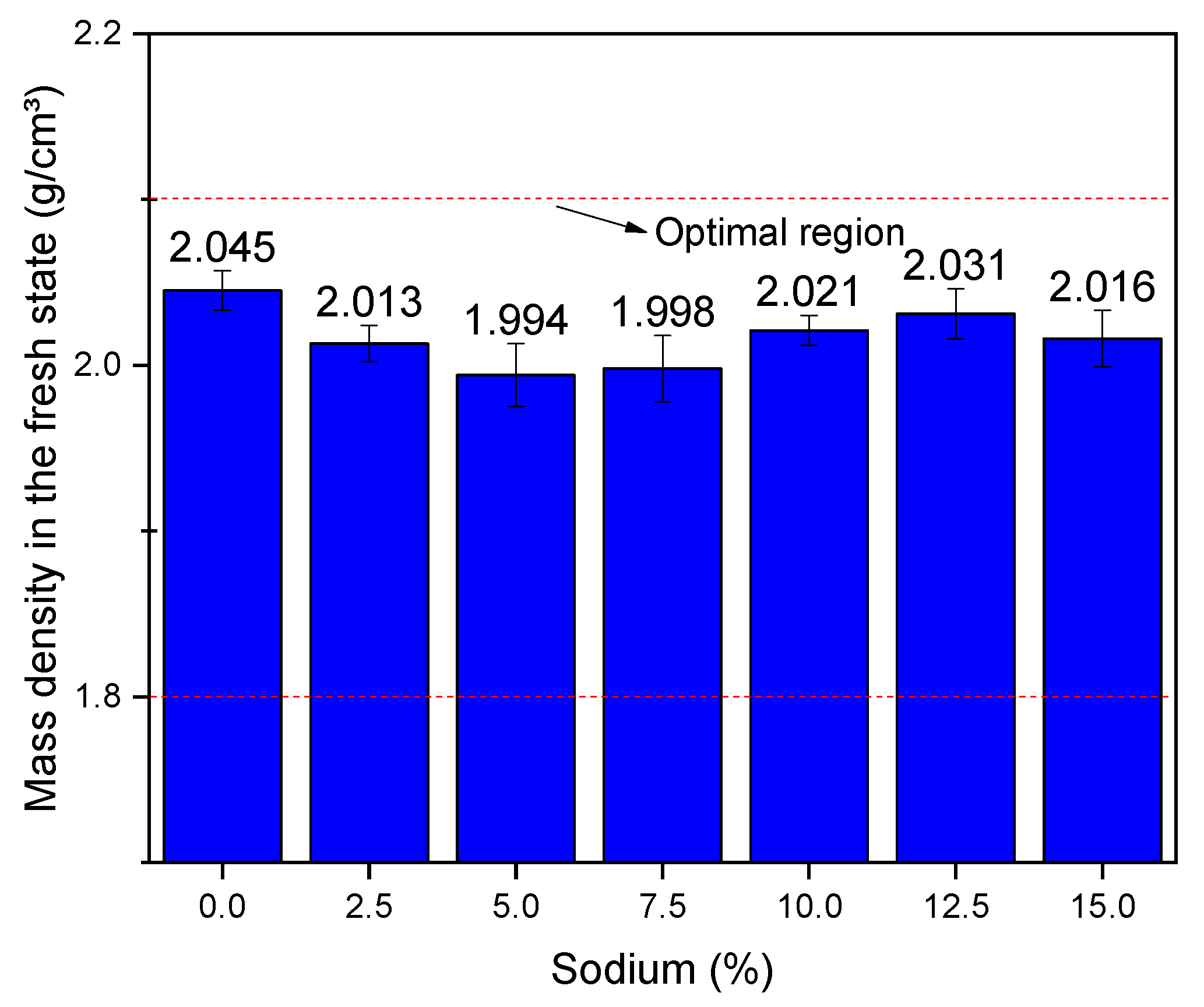
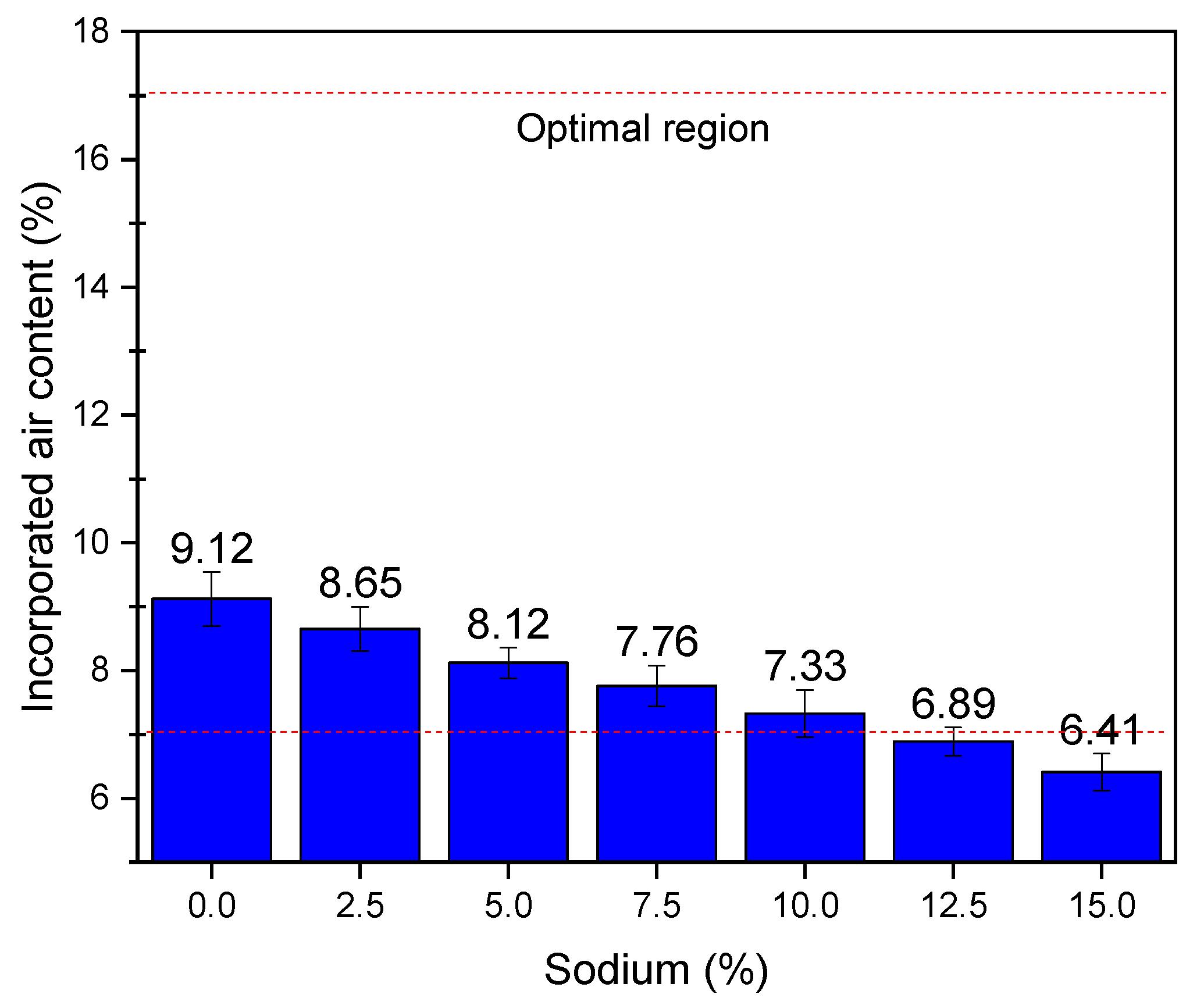
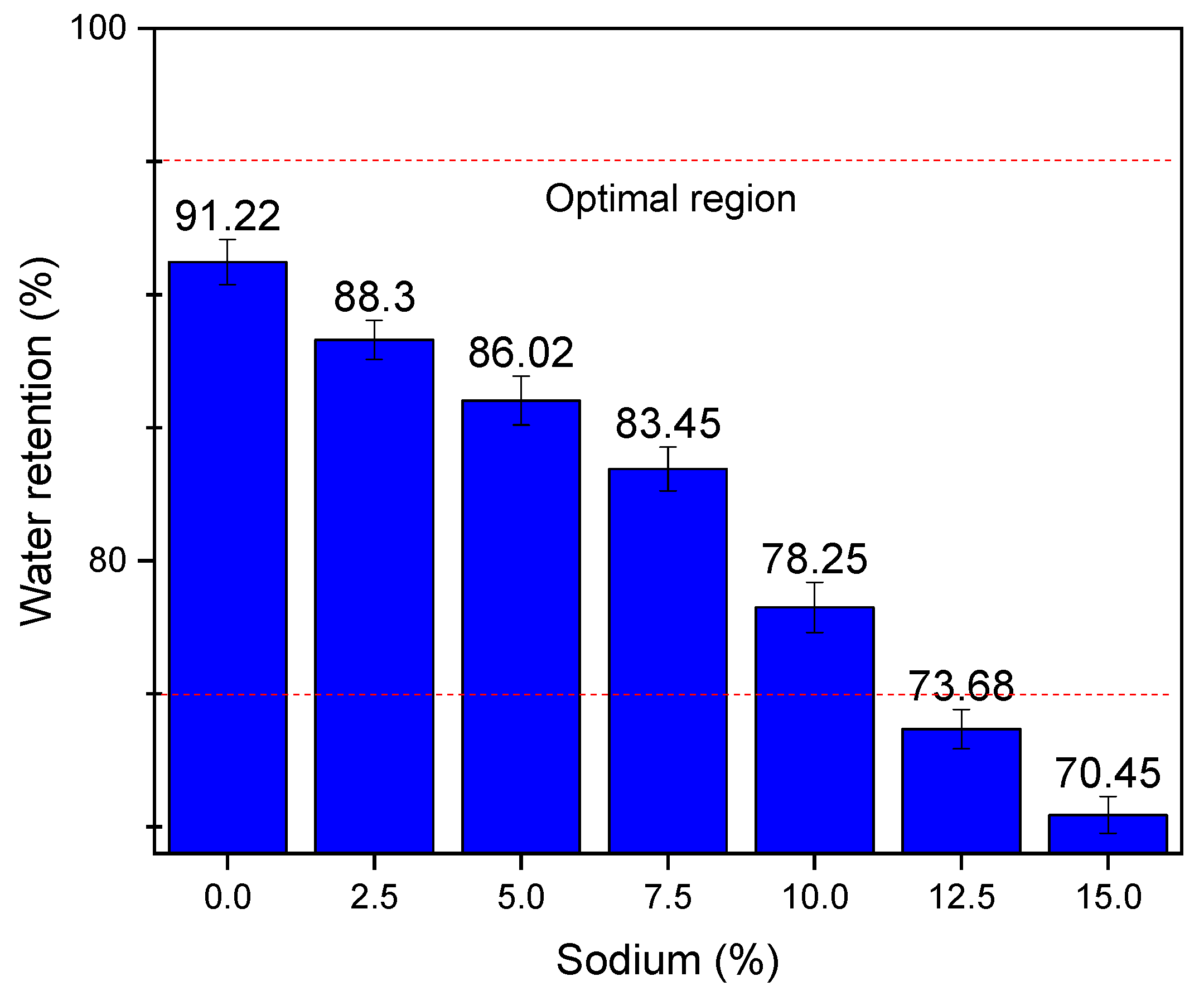
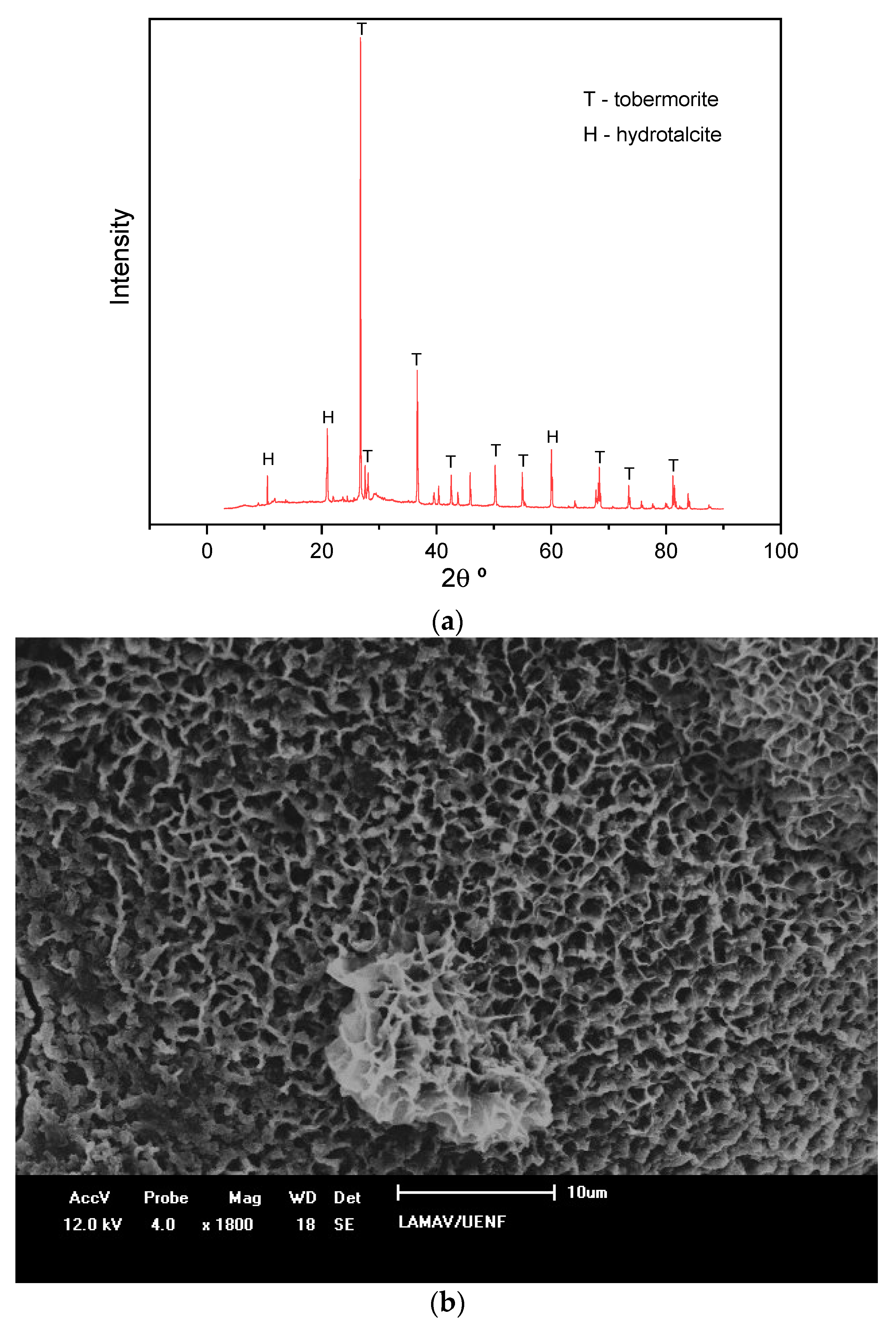
| %Na2O | OPC (g) | BFS (g) | Sand (g) | Sodium Hydroxide (g) | Water (g) |
|---|---|---|---|---|---|
| 0.0% | 300.00 | 0.00 | 600.00 | 0.00 | 135.00 |
| 2.5% | 0.00 | 281.10 | 580.93 | 9.37 | 128.60 |
| 5.0% | 0.00 | 272.30 | 582.16 | 18.78 | 126.76 |
| 7.5% | 0.00 | 263.47 | 583.39 | 28.23 | 124.91 |
| 10.0% | 0.00 | 254.60 | 584.63 | 37.72 | 123.06 |
| 12.5% | 0.00 | 245.69 | 585.87 | 47.25 | 121.19 |
| 15.0% | 0.00 | 236.74 | 587.12 | 56.82 | 119.32 |
| Composition | Quadratic Regression | Cubic Regression | ||
|---|---|---|---|---|
| 0% (OPC) | y = 24.95x² − 87.66x + 49.50 | R² = 0.97 | y = 8.78x³ − 64.90x² + 129.45x − 21.16 | R² = 0.90 |
| 2.5% | y = 26.66x² − 96.67x + 47.44 | R² = 0.98 | y = 11.15x³ − 75.71x² + 138.95x − 24.64 | R² = 0.91 |
| 5.0% | y = 38.16x² − 71.67x + 32.79 | R² = 0.97 | y = 11.13x³ − 49.60x² + 94.61x − 11.81 | R² = 0.95 |
| 7.5% | y = 61.64x² − 93.21x + 34.83 | R² = 0.97 | y = 22.32x³ − 78.36x² + 118.96x − 12.87 | R² = 0.95 |
| 10.0% | y = 112.62x² − 247.01x + 66.45 | R² = 0.85 | y = 66.55x³ − 256.38x² + 243.32x − 29.78 | R² = 0.97 |
| 12.5% | y = 318.38x² − 354.66x + 65.29 | R² = 0.86 | y = 237.60x³ − 451.71x² + 257.63x − 17.07 | R² = 0.99 |
| 15.0% | y = 578.10x² − 496.42x + 62.22 | R² = 0.88 | y = 496.38x³ − 628.24x² + 238.19x − 16.03 | R² = 0.99 |
| %Na2O | Compressive Strength (MPa) | Water Absorption (%) |
|---|---|---|
| 0.0% | 16.25 ± 0.74 | 6.95 ± 0.15 |
| 2.5% | 20.25 ± 0.85 | 6.58 ± 0.17 |
| 5.0% | 27.00 ± 0.34 | 6.52 ± 0.21 |
| 7.5% | 37.25 ± 0.53 | 6.47 ± 0.16 |
| 10.0% | 41.07 ± 0.62 | 6.32 ± 0.15 |
| 12.5% | 35.00 ± 0.42 | 6.21 ± 0.19 |
| 15.0% | 27.41 ± 0.41 | 6.15 ± 0.25 |
Publisher’s Note: MDPI stays neutral with regard to jurisdictional claims in published maps and institutional affiliations. |
© 2021 by the authors. Licensee MDPI, Basel, Switzerland. This article is an open access article distributed under the terms and conditions of the Creative Commons Attribution (CC BY) license (https://creativecommons.org/licenses/by/4.0/).
Share and Cite
Marvila, M.T.; Azevedo, A.R.G.d.; Matos, P.R.d.; Monteiro, S.N.; Vieira, C.M.F. Rheological and the Fresh State Properties of Alkali-Activated Mortars by Blast Furnace Slag. Materials 2021, 14, 2069. https://doi.org/10.3390/ma14082069
Marvila MT, Azevedo ARGd, Matos PRd, Monteiro SN, Vieira CMF. Rheological and the Fresh State Properties of Alkali-Activated Mortars by Blast Furnace Slag. Materials. 2021; 14(8):2069. https://doi.org/10.3390/ma14082069
Chicago/Turabian StyleMarvila, Markssuel Teixeira, Afonso Rangel Garcez de Azevedo, Paulo Ricardo de Matos, Sérgio Neves Monteiro, and Carlos Maurício Fontes Vieira. 2021. "Rheological and the Fresh State Properties of Alkali-Activated Mortars by Blast Furnace Slag" Materials 14, no. 8: 2069. https://doi.org/10.3390/ma14082069
APA StyleMarvila, M. T., Azevedo, A. R. G. d., Matos, P. R. d., Monteiro, S. N., & Vieira, C. M. F. (2021). Rheological and the Fresh State Properties of Alkali-Activated Mortars by Blast Furnace Slag. Materials, 14(8), 2069. https://doi.org/10.3390/ma14082069

