Article

Effect of Water-Based Disinfectants or Air-Drying on Dimensional Changes in a Thermoplastic Orthodontic Aligner

Orthodontic Unit, Dental Clinic, Department of Neurosciences, University of Padova, 35128 Padova, Italy
*
Author to whom correspondence should be addressed.
Materials 2021, 14(24), 7850; https://doi.org/10.3390/ma14247850
Submission received: 11 November 2021 / Revised: 14 December 2021 / Accepted: 16 December 2021 / Published: 18 December 2021
(This article belongs to the Special Issue Current and Future Trends in Orthodontic Materials)

Abstract

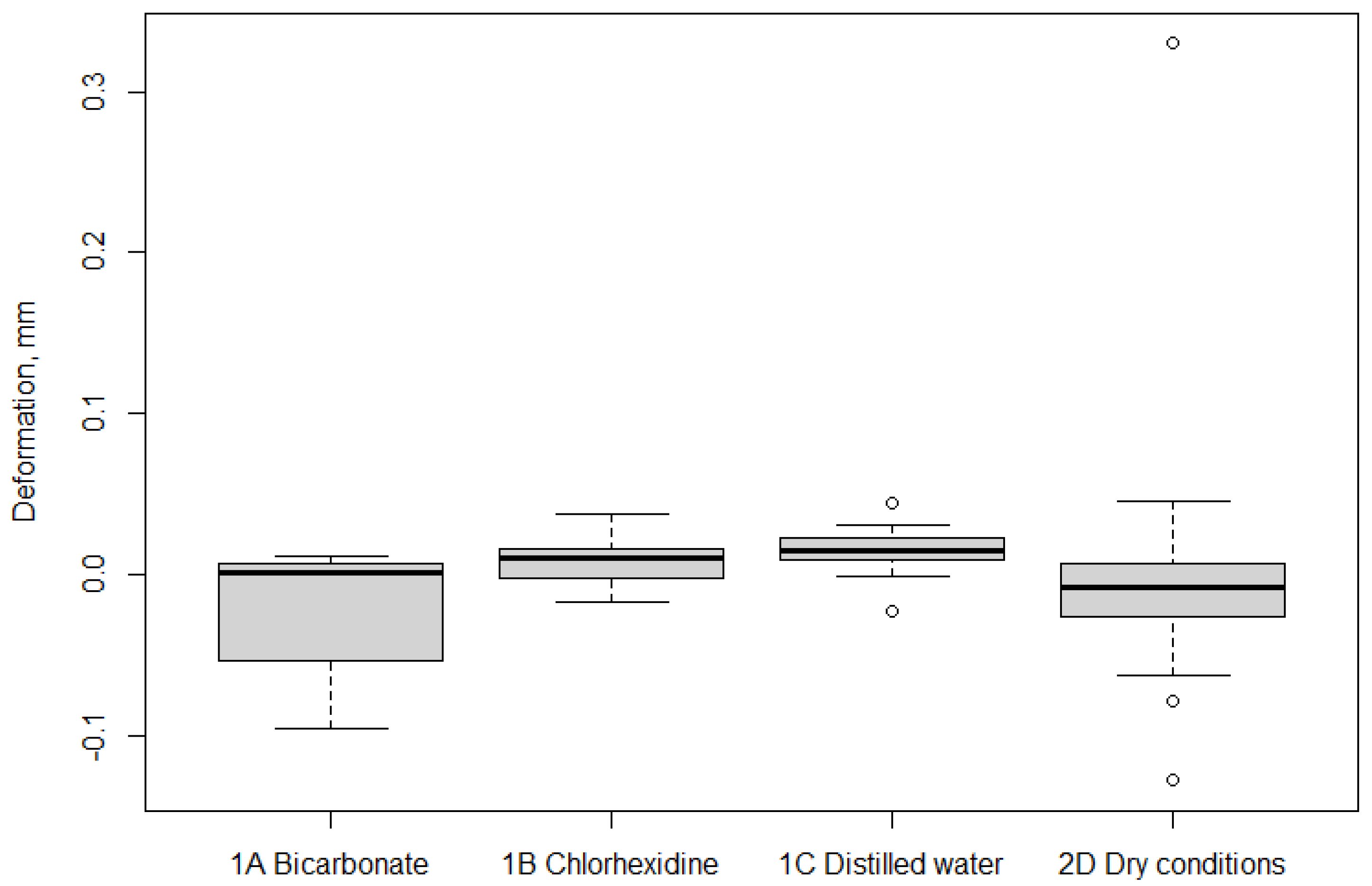
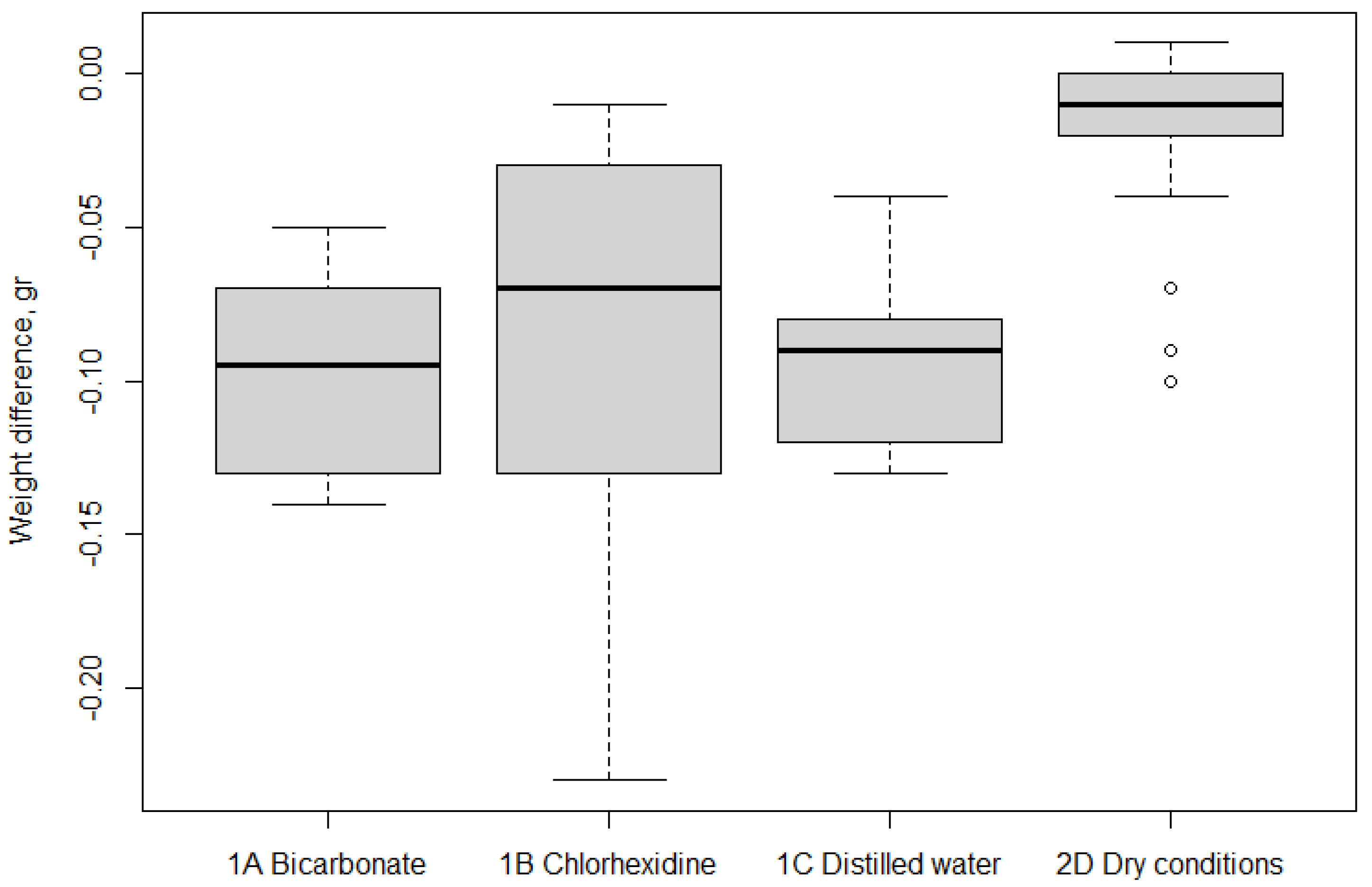
The polymer structure of thermoplastic materials currently used to make aligners is altered by the oral conditions and this negatively affects their capacity to move teeth. This study aimed to compare different options for storing aligners when not in use by superimposing successive 3D images to identify which storage method least affects material shape and weight. Fifty PET-G aligners, produced using the CA Digital method, were divided into four groups (1A, 1B, 1C, and 2D) and were stored for 18 h a day in artificial saliva at 37 °C. Then, to mimic their storage conditions when not in use, aligners in group 1A were immersed for the remaining 8 hours a day in bicarbonate solution, those in group 1B in chlorhexidine solution, those in group 1C in distilled water, and those in group 2D were stored dry. The samples were scanned at the baseline (before the immersion cycles began) and again two weeks later. The digital scans were superimposed and the median deformation, its variability, and weight differences were recorded for each group. Statistical analysis showed aligner deformation (expansion) in all three groups stored in wet conditions, with a statistically significant difference between groups 1A and 1C. Aligners in group 2D shrank slightly, and to a significantly greater degree with respect to group 1C. Variability in the degree of deformation was similar among the three groups stored in wet conditions, but significantly greater in group 2D. Weight gains were recorded in all four groups, the smallest in group 2D and the largest in group 1A. Storing aligners in dry conditions promoted lower deformation in the material, involving a slight shrinkage, whereas wet storage conditions caused an expansion of the aligner, especially when distilled water is used.
Keywords: aligners; PET-G; orthodontics aligners; PET-G; orthodontics