Article

Structure and Magnetic Properties of Thermodynamically Predicted Rapidly Quenched Fe85-xCuxB15 Alloys

1
Lukasiewicz Research Network-Institute of Non-Ferrous Metals, 5 Sowinskiego St., 44-121 Gliwice, Poland
2
PhD School, Faculty of Mechanical Engineering, Silesian University of Technology, Konarskiego 2a St., 44-100 Gliwice, Poland
3
Department of Measurement Science Electronics and Control, Silesian University of Technology, 10 Akademicka St., 44-100 Gliwice, Poland
4
Institute of Metallurgy and Materials Science Polish Academy of Sciences, 25 Reymonta St., 30-059 Krakow, Poland
5
A. Chelkowski Institute of Physics, University of Silesia, 1 75 Pulku Piechoty St., 41-500 Chorzow, Poland
*
Author to whom correspondence should be addressed.
Materials 2021, 14(24), 7807; https://doi.org/10.3390/ma14247807
Submission received: 5 November 2021 / Revised: 13 December 2021 / Accepted: 14 December 2021 / Published: 16 December 2021
(This article belongs to the Special Issue Nanocomposite Magnetic Materials for Energy Conversion)

Abstract

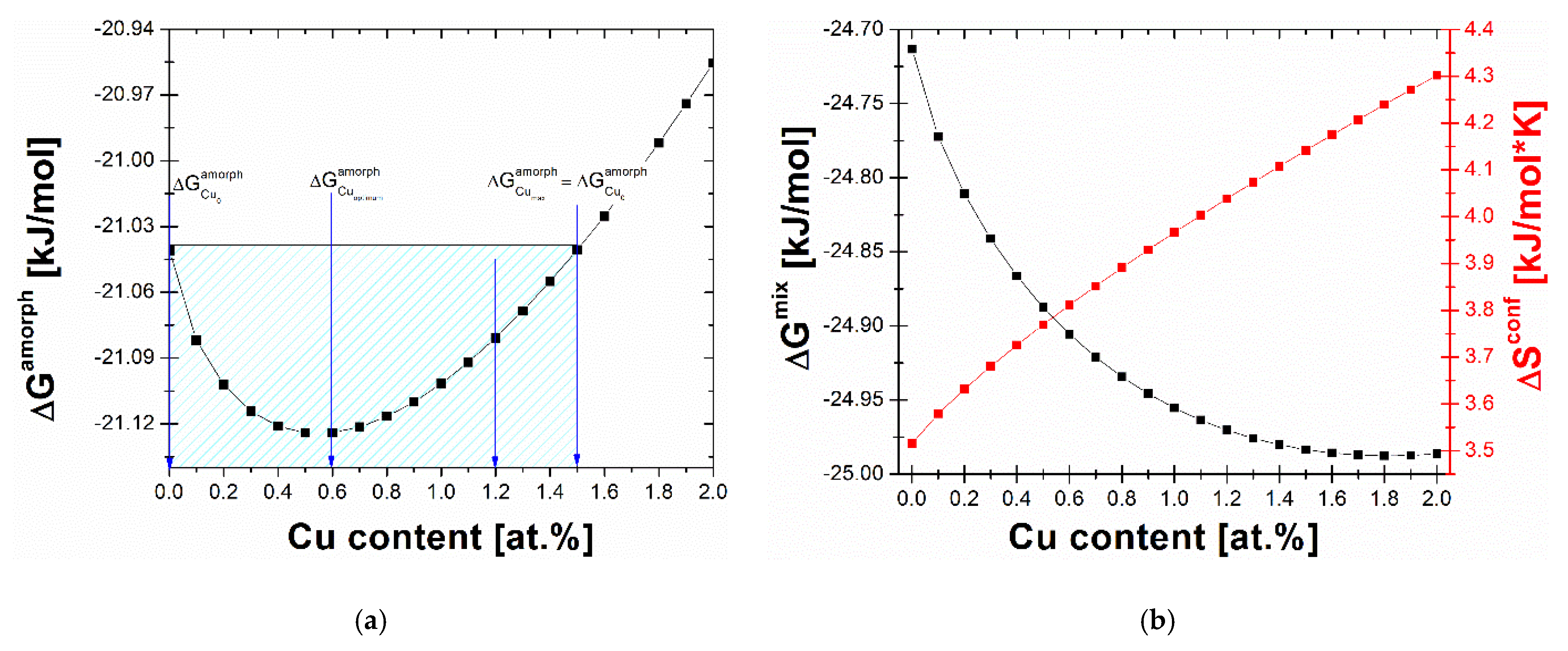
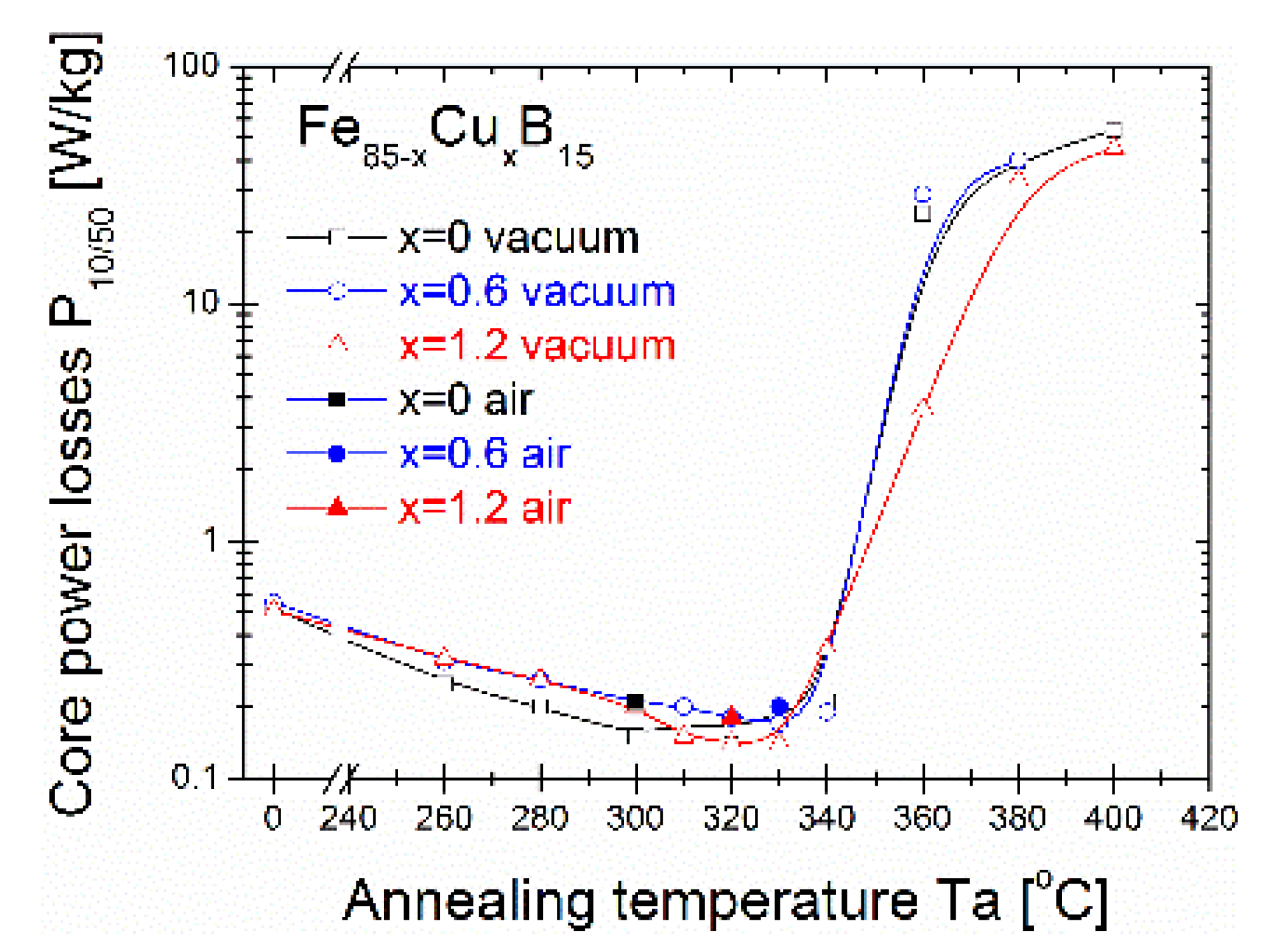
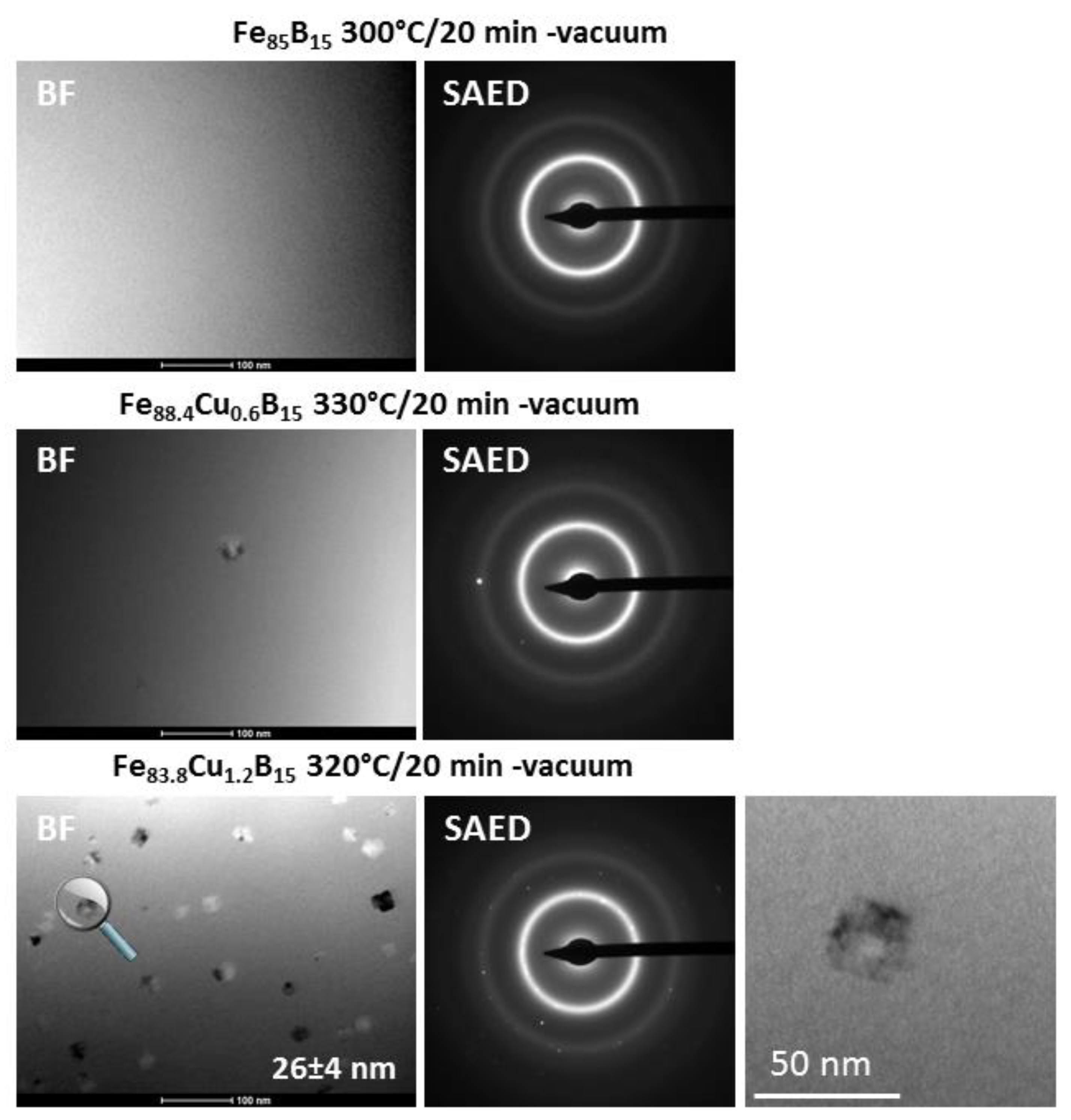
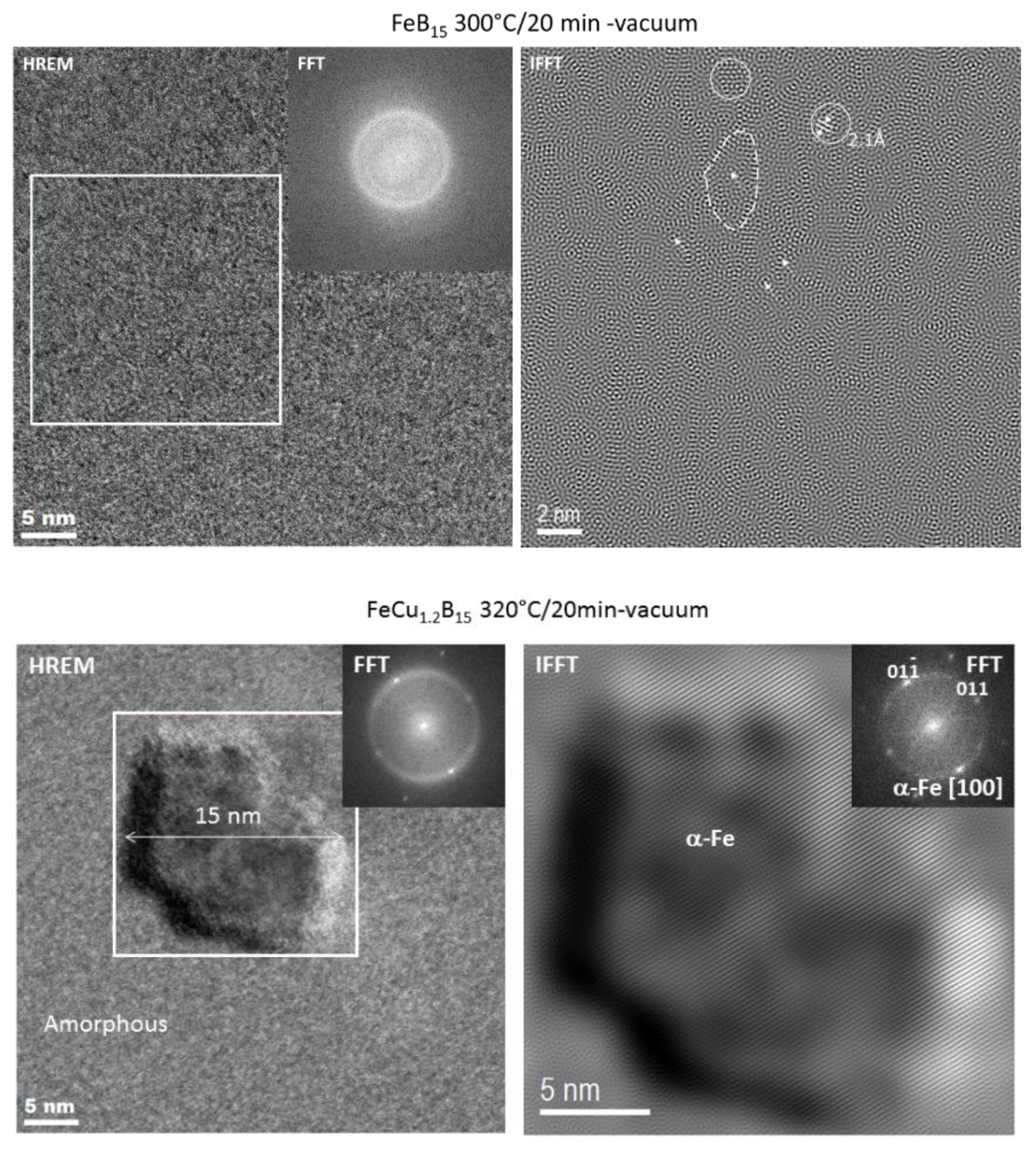
In this work, based on the thermodynamic prediction, the comprehensive studies of the influence of Cu for Fe substitution on the crystal structure and magnetic properties of the rapidly quenched Fe85B15 alloy in the ribbon form are performed. Using thermodynamic calculations, the parabolic shape dependence of the ΔGamoprh with a minimum value at 0.6% of Cu was predicted. The ΔGamoprh from the Cu content dependence shape is also asymmetric, and, for Cu = 0% and Cu = 1.5%, the same ΔGamoprh value is observed. The heat treatment optimization process of all alloys showed that the least lossy (with a minimum value of core power losses) is the nanocomposite state of nanocrystals immersed in an amorphous matrix obtained by annealing in the temperature range of 300–330 °C for 20 min. The minimum value of core power losses P10/50 (core power losses at 1T@50Hz) of optimally annealed Fe85-xCuxB15 x = 0,0.6,1.2% alloys come from completely different crystallization states of nanocomposite materials, but it strongly correlates with Cu content and, thus, a number of nucleation sites. The TEM observations showed that, for the Cu-free alloy, the least lossy crystal structure is related to 2–3 nm short-ordered clusters; for the Cu = 0.6% alloy, only the limited value of several α-Fe nanograins are found, while for the Cu-rich alloy with Cu = 1.2%, the average diameter of nanograins is about 26 nm, and they are randomly distributed in the amorphous matrix. The only high number of nucleation sites in the Cu = 1.2% alloy allows for a sufficient level of grains’ coarsening of the α-Fe phase that strongly enhances the ferromagnetic exchange between the α-Fe nanocrystals, which is clearly seen with the increasing value of saturation induction up to 1.7T. The air-annealing process tested on studied alloys for optimal annealing conditions proves the possibility of its use for this type of material.
Keywords: soft magnetic materials; materials characterization; toroidal cores; crystal structure; magnetic properties soft magnetic materials; materials characterization; toroidal cores; crystal structure; magnetic properties