Flexural Behaviour and Internal Forces Redistribution in LWAC Double-Span Beams

Abstract
1. Introduction
1.1. Research Significance
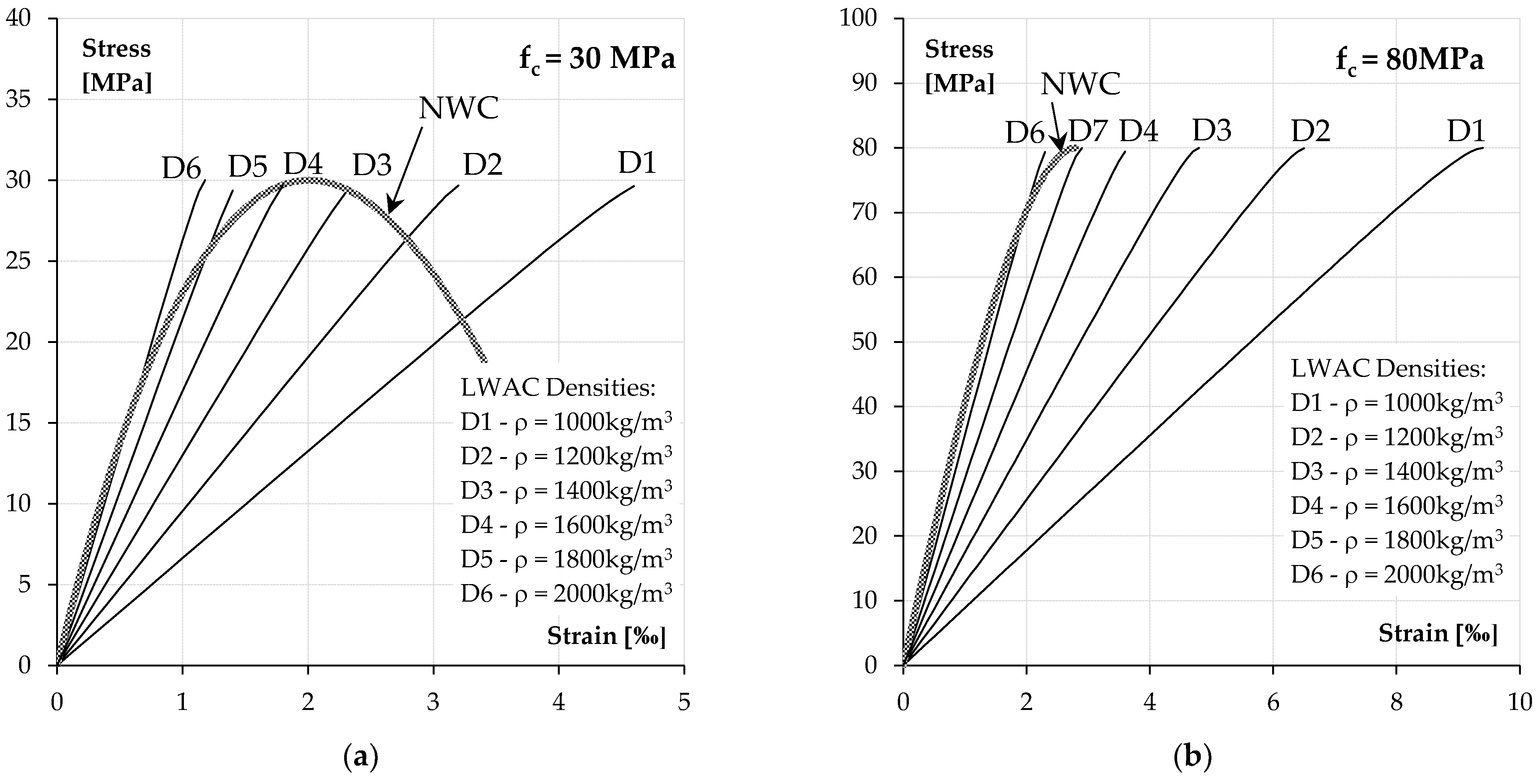
1.2. Lightweight Aggregate Concrete Characteristic According to Eurocode 2
2. Experimental Investigations
2.1. Test Programme
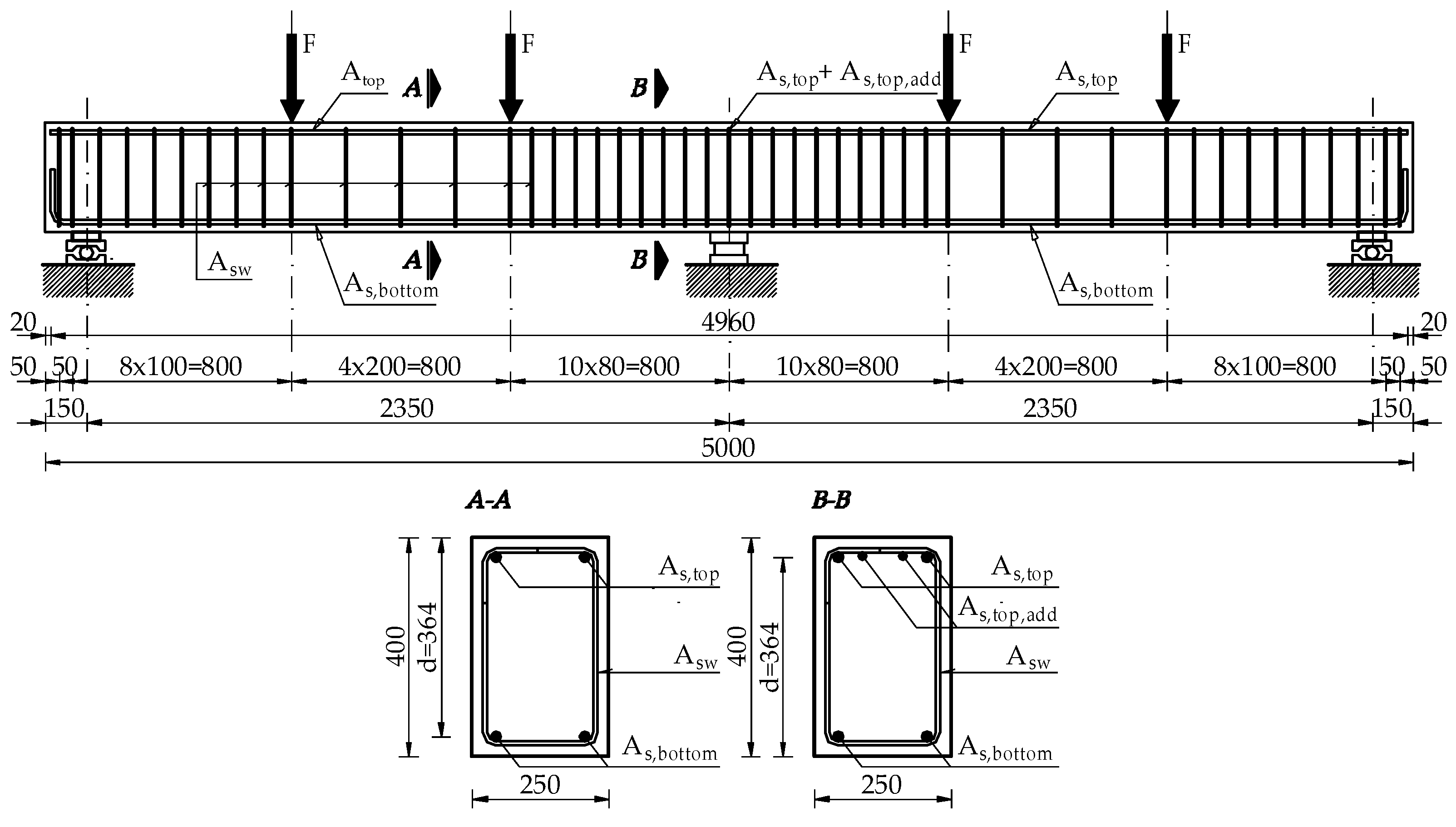
2.2. Geometry and Reinforcement
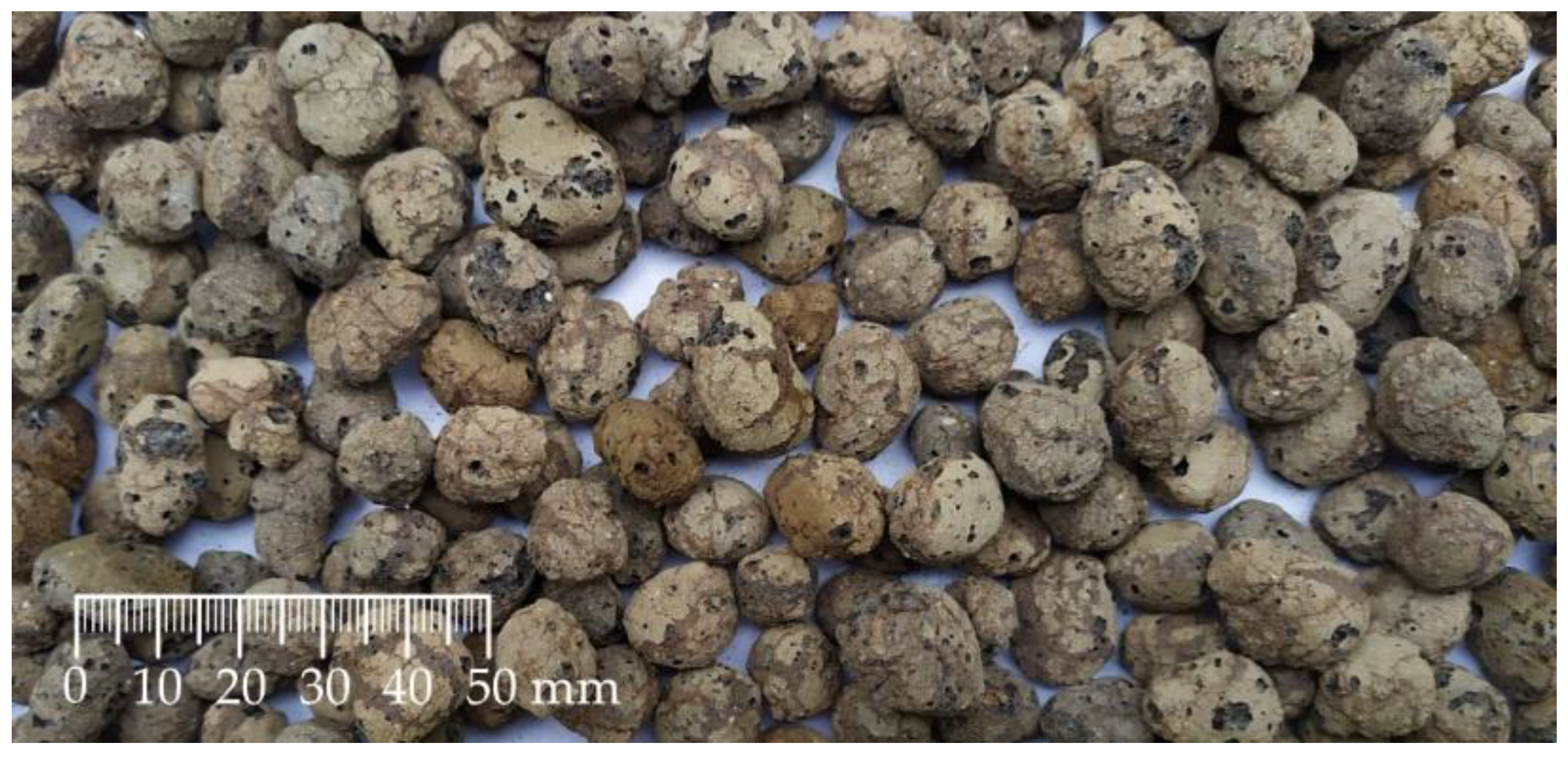
2.3. Materials
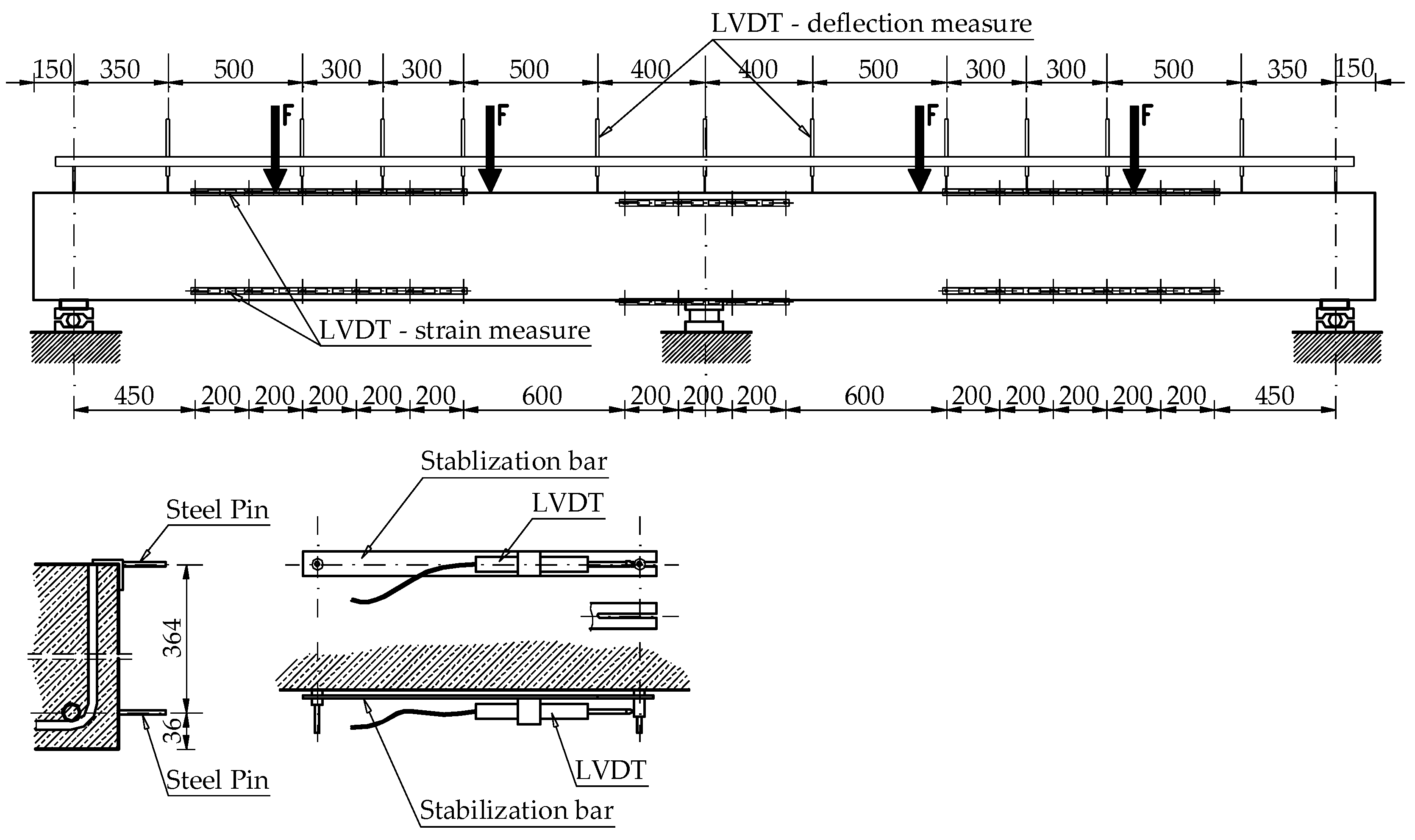
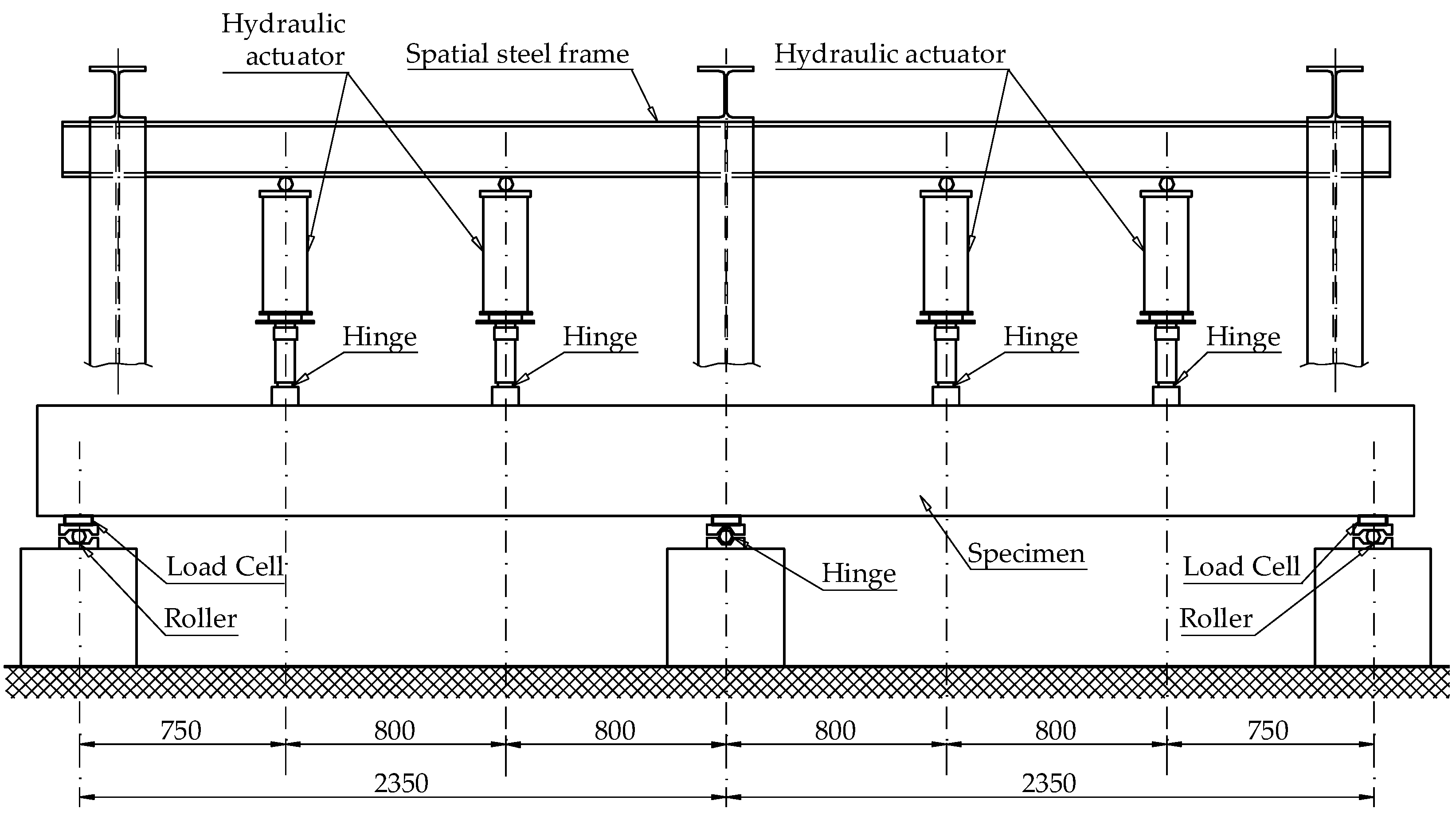
2.4. Test Setup and Instrumentation
3. Test Results
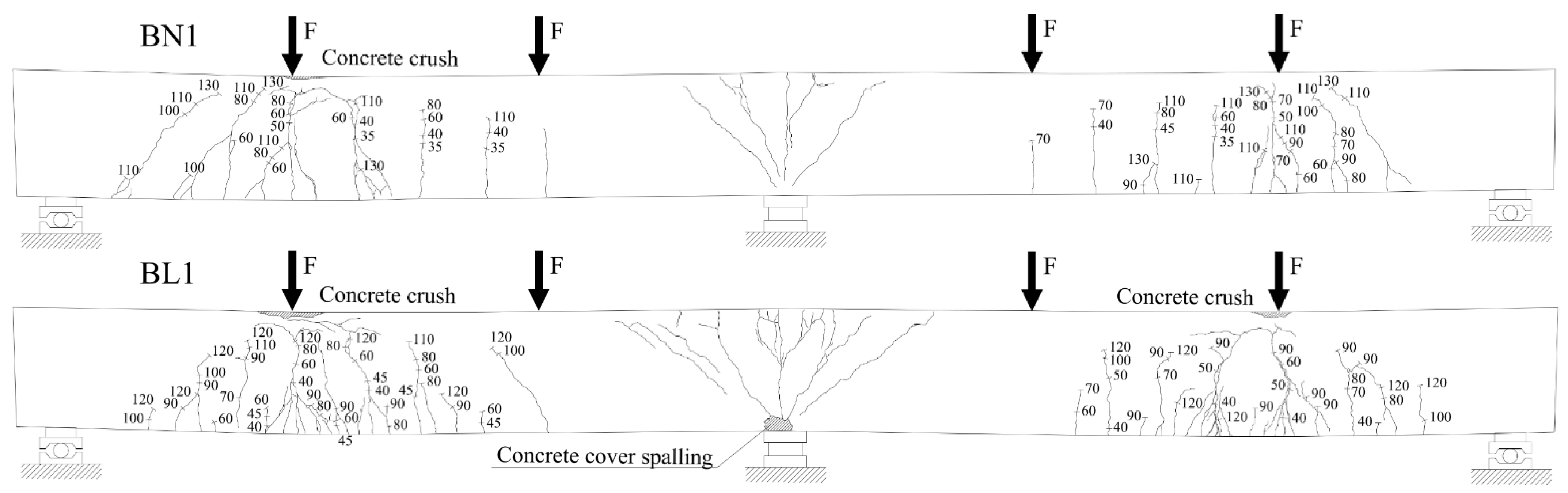
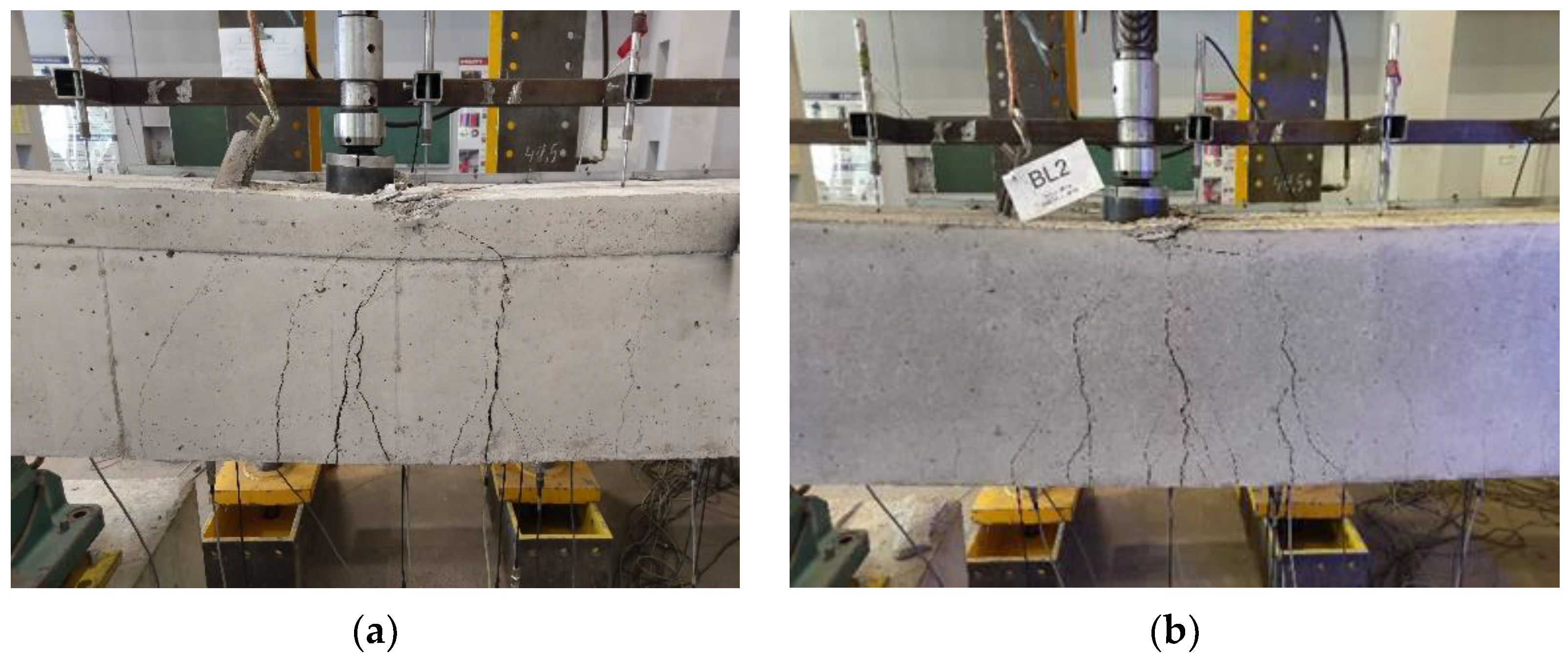
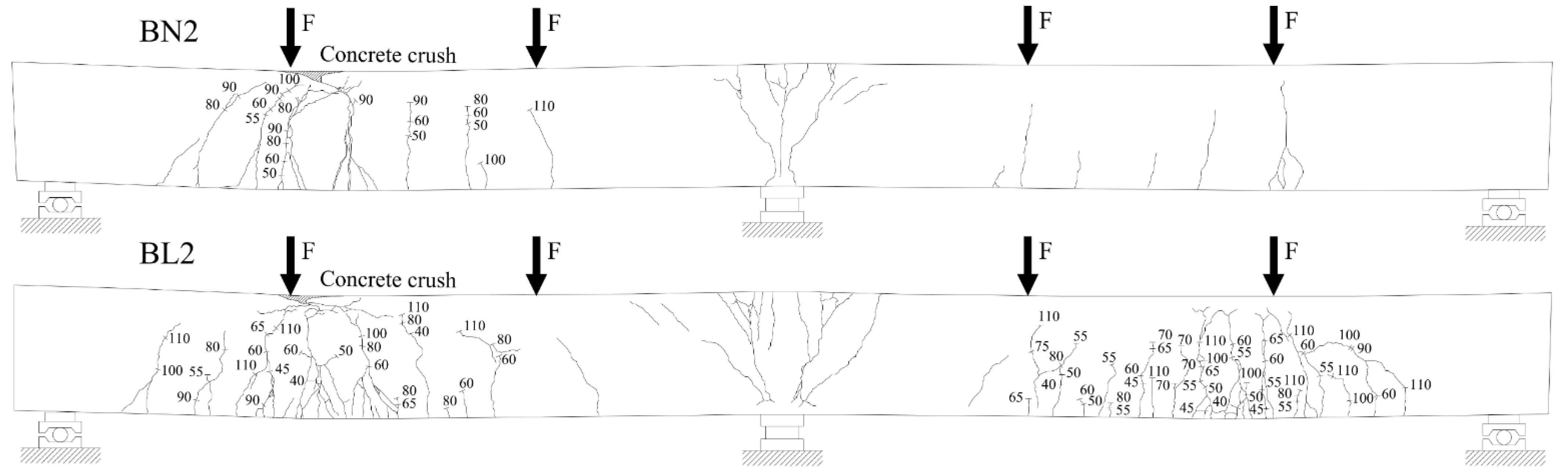
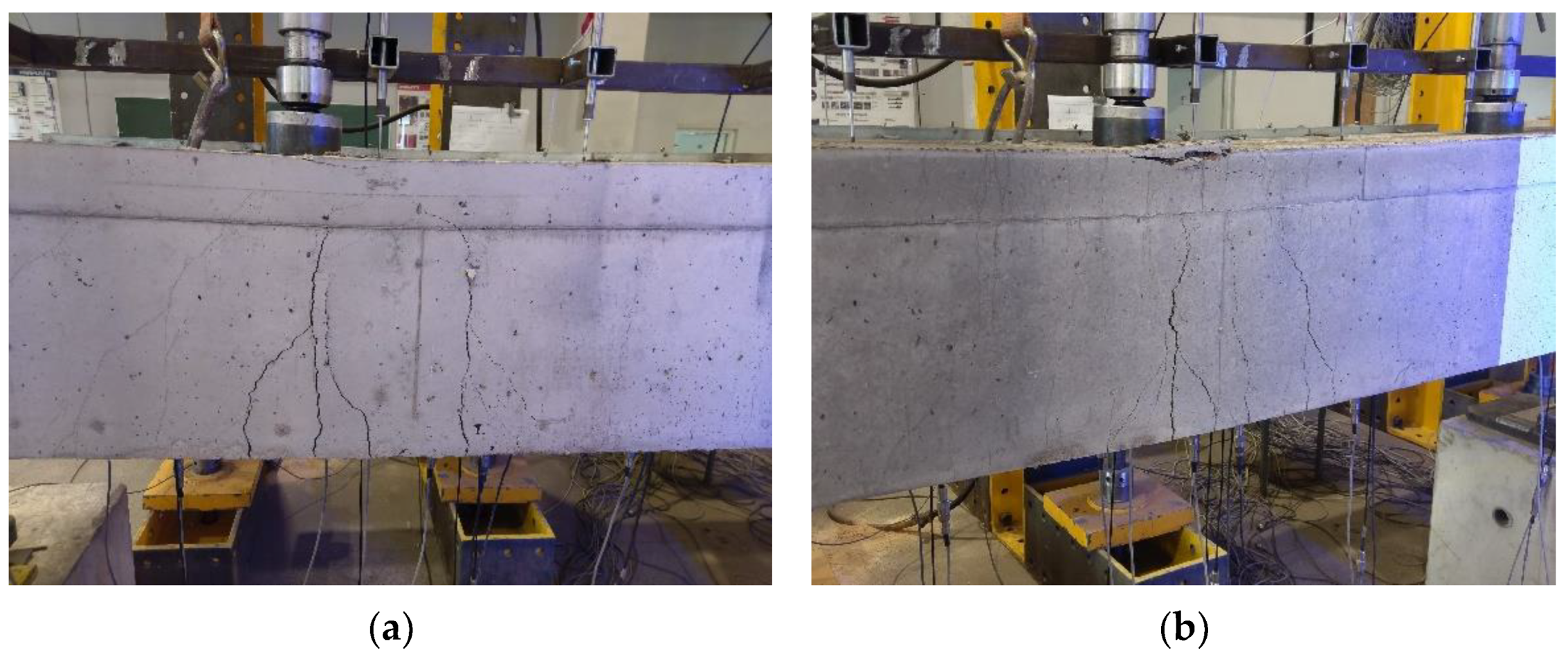
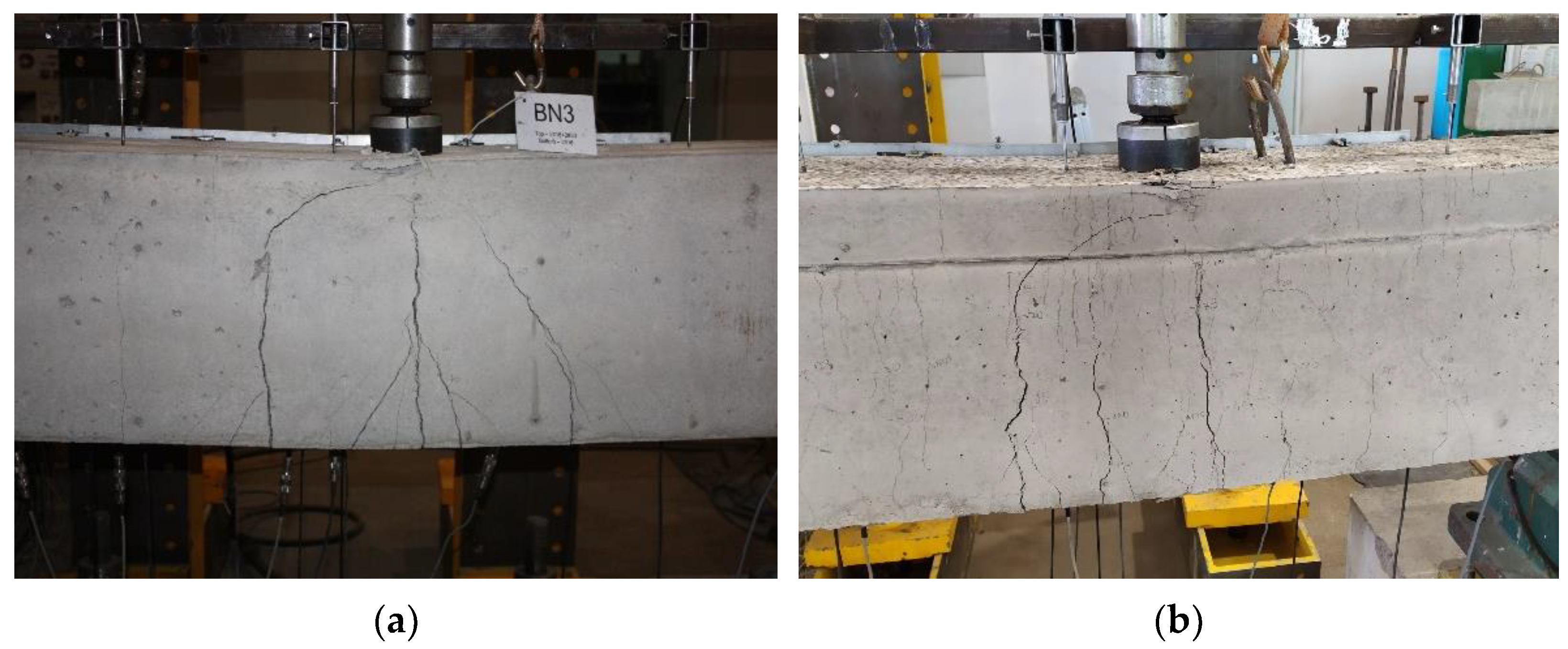
3.1. Crack Pattern and Failure Modes
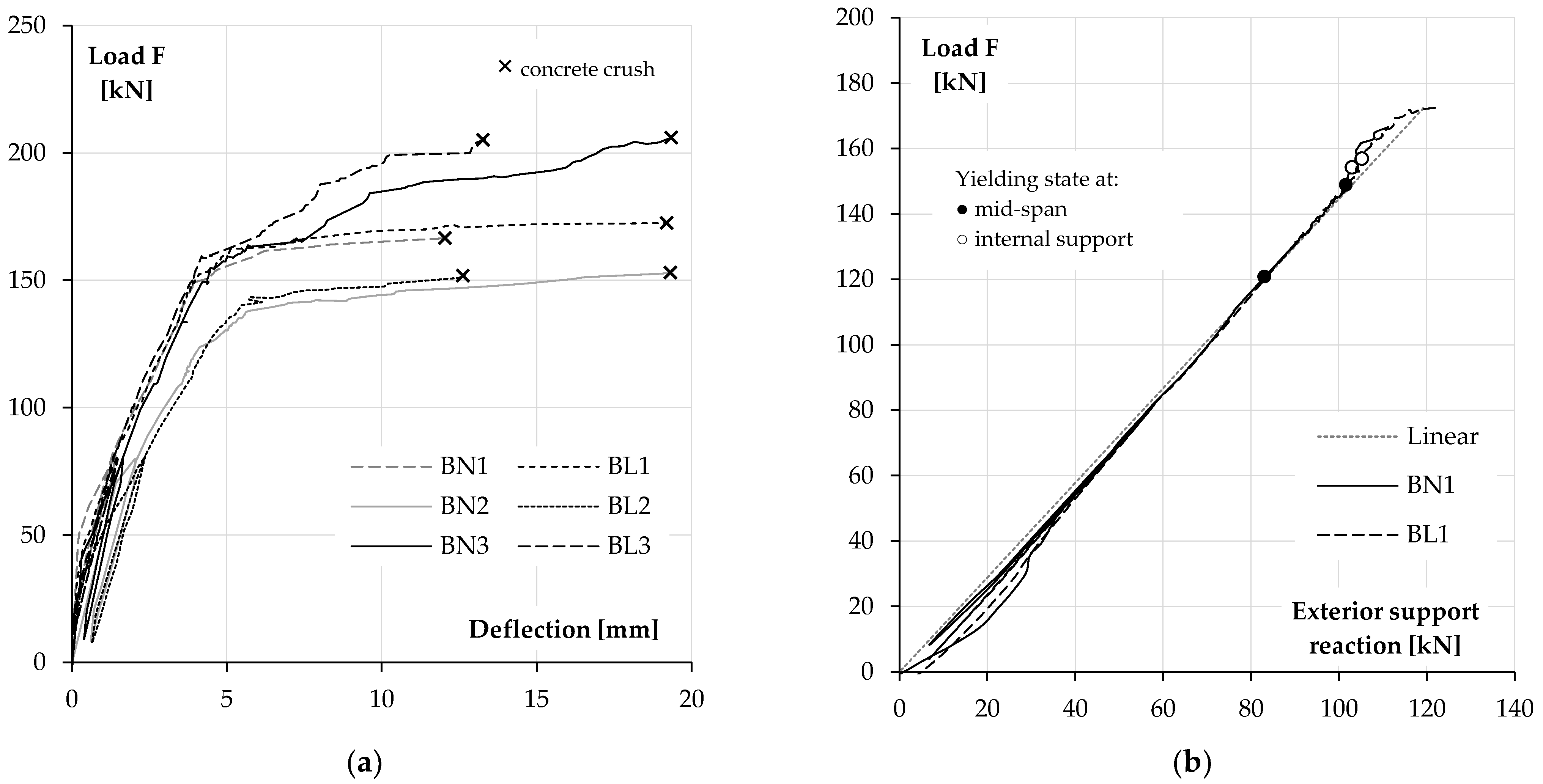
3.2. Load–Deflection Relationship
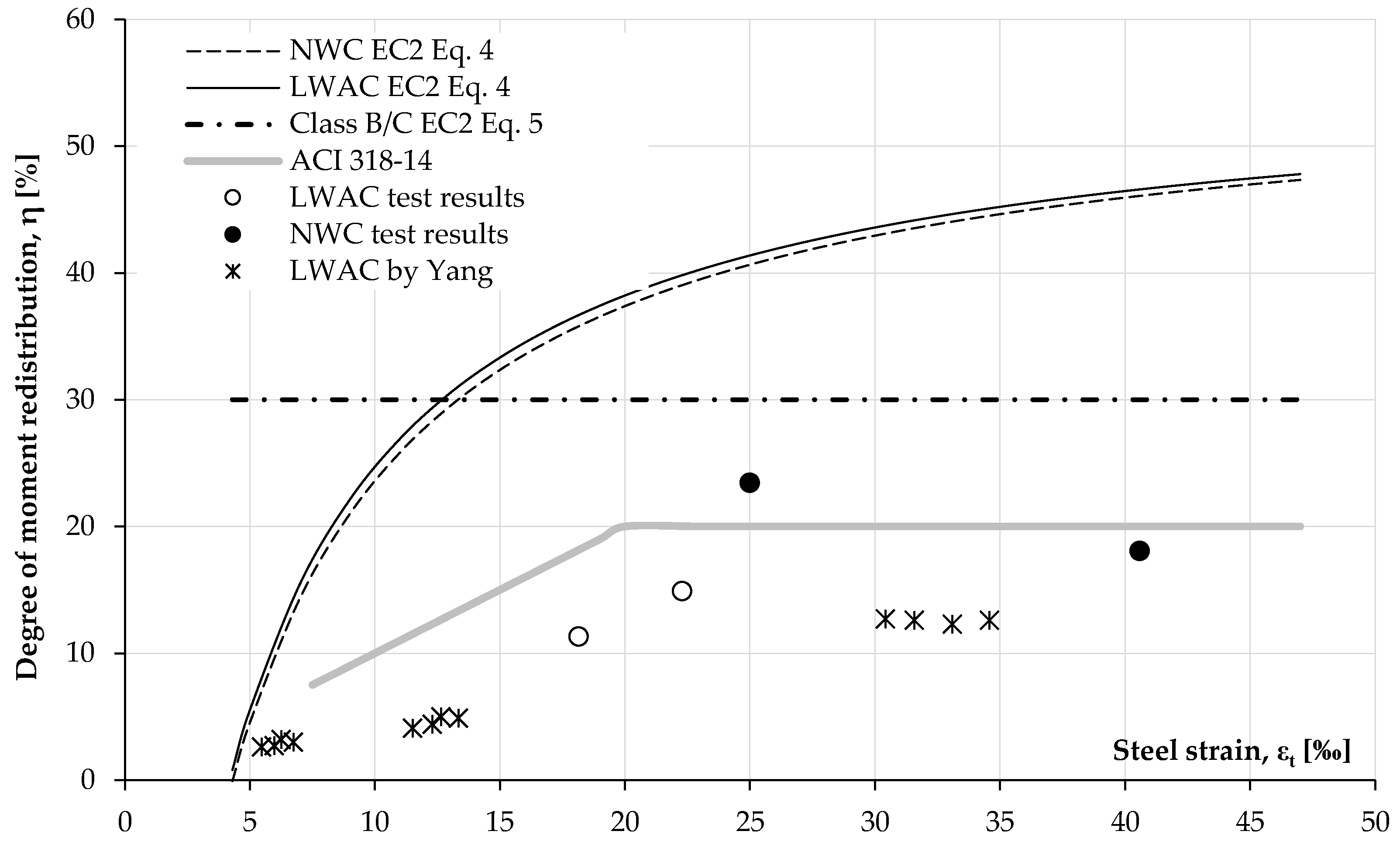
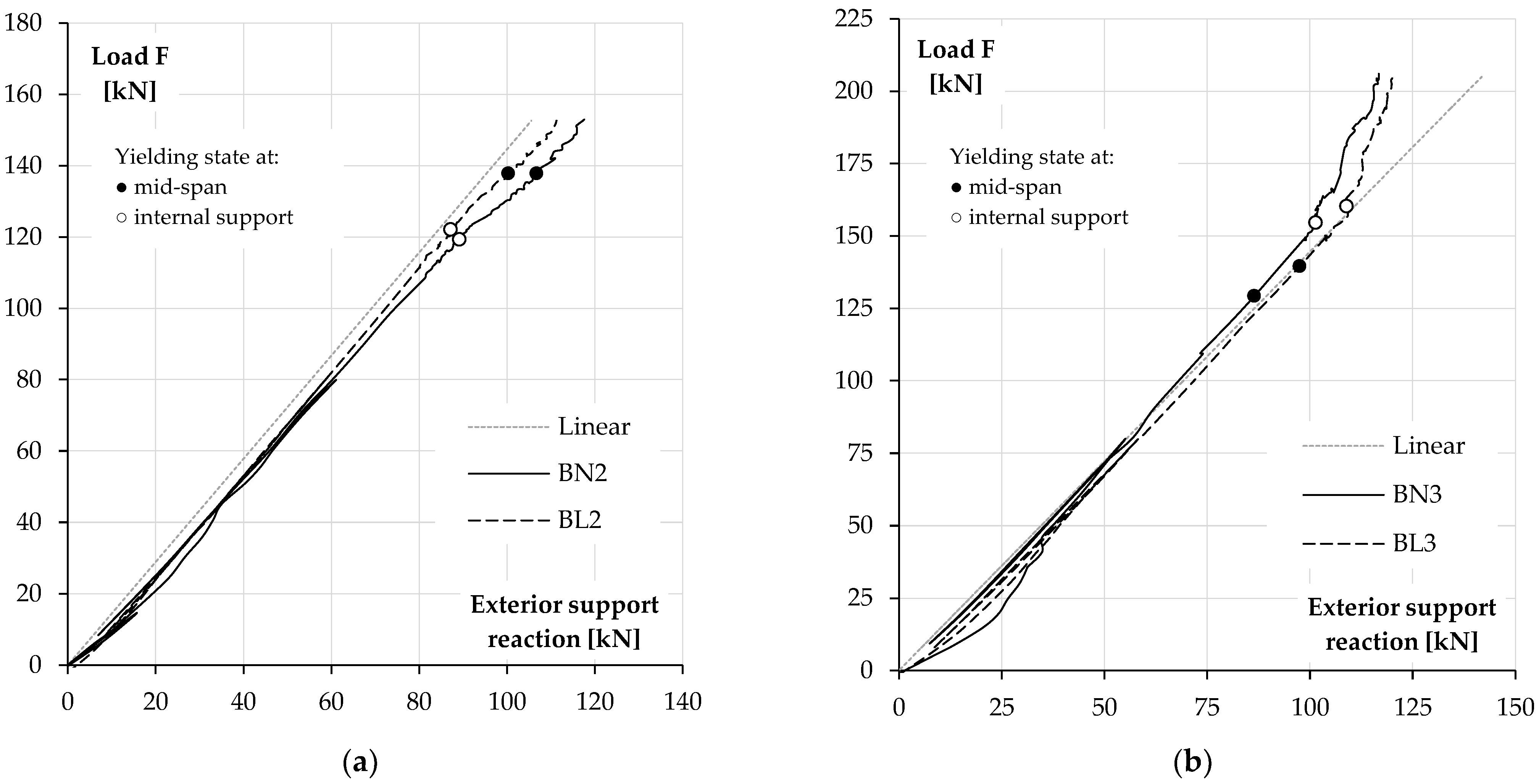
3.3. Support Reactions and Moment Redistribution
3.4. Ductility Ratio
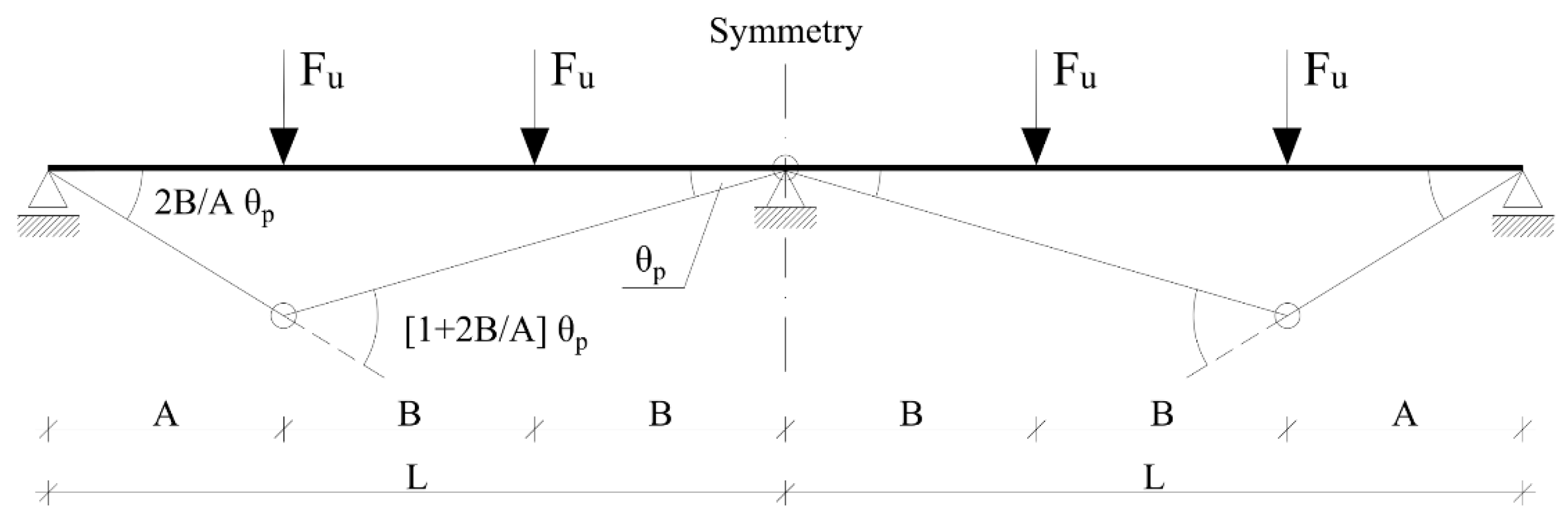
3.5. Ultimate Load Capacity
4. Conclusions
- All tested beams failed with the crushing of concrete in the compression zone in the mid-span section after the yielding of the reinforcement steel in this section. In beams with forced redistribution of bending moments, the ultimate flexural capacities are essentially the same in each pair, regardless of the concrete used, and the effect of compressive strength is negligible. The experimental loads for all beams are in very good agreement with the load-bearing capacity values calculated according to the method in [39]. The mean and standard deviation of the relation of the experimental and calculated values of the load are 1.03 and 0.01 for NWC beams (BN2 and BN3), and 1.02 and 0.01 for LWAC elements (BL2 and BL3). Thus, the nominal moment capacity based on the equivalent stress block model [39] coincides with the flexural strength of the LWAC beams, which is the same as for NWC beams.
- The crack morphology in the beams made of LWAC differs from that of the beams made of normal concrete. Cracks spacing in BL beams was smaller and the number of cracks was greater. The reason for this is the different fracture mechanism of both concretes as in LWAC and the spreading of cracks was almost unobstructed in the matrix, whereas in normal-weight concrete, natural course aggregate offers much higher resistance to their propagation.
- During the test, both the lightweight concrete beams and the normal concrete beams somehow showed ductile behaviour but clear differences in the results can be seen. In beams with a reinforcement system forcing significant redistribution, the yield deflections were always smaller in the beams made of normal concrete than in the beams made of LWAC, this is evident considering lightweight aggregate concrete has a lower modulus of elasticity. However, the ultimate deflections were consistently larger in beams made of normal concrete, indicating the greater ductility of sections made of normal concrete. This conclusion is confirmed by displacement ductility ratio values. In the second group, in which redistribution from the internal support to the spans was planned, the ratio was 5.03 for the NWC beam and 3.01 for the LWAC specimen, thus about 40% less. Similarly, in the third group, with the over-reinforced intermediate support, the ductility ratio was 5.71 and 3.90 for NWC and LWAC elements, respectively. Thus, the difference is about 30%. These significant differences in ductility were reflected also in the redistribution results.
- A redistribution of moments occurred in all the tested beams from groups two and three in a manner consistent with expectations. However, there was an influence of the concrete type on the load redistribution ratio. Although the redistribution of internal forces mainly depended on the longitudinal reinforcement ratio, the influence of the ultimate compressive strains of concrete was also noticeable; the ultimate compressive strains in LWAC were generally lower than those in NWC, which also means lower strain in the reinforcement at the ultimate stage as well as a lesser ability to redistribute the load before the crushing of concrete occurs. This effect is evident regardless of the direction of force redistribution. In the tested beams, the degree of moment redistribution was lower for beams with LWAC by 55% in the second pair and by 18% in the third pair.
- In beams with the forced redistribution of bending moments, the degrees of moment redistribution for LWAC beams were lower than those predicted according to that in [39,43], but the difference was much more significant regarding the comparison with the values calculated according to that in [39], which permits the higher value of the degree of moment redistribution without an explicit check on the rotation capacity.
Author Contributions
Funding
Institutional Review Board Statement
Informed Consent Statement
Data Availability Statement
Conflicts of Interest
References
- BubbleDeck BubbleDeck Voided Flat Slab Solutions Technical Manual & Documents. 2008, 91. Available online: http://www.bubbledeck-uk.com/pdf/2-BDTechManualv1a.pdf (accessed on 19 August 2021).
- Cobiax, H.; Gmbh, I.; Stra, E.; Germany, H. The Cobiax Trinity. Technology manual; Wiesbaden. 2018. Available online: https://www.cobiax.com/intl/en/downloads/ (accessed on 19 August 2021).
- Hossain, K.M.A.; Ahmed, S.; Lachemi, M. Lightweight concrete incorporating pumice based blended cement and aggregate: Mechanical and durability characteristics. Constr. Build. Mater. 2011, 25, 1186–1195. [Google Scholar] [CrossRef] [Scilit]
- LECA. Leca ® Technical Sheet; LECA: Gniew, Poland, 2021. [Google Scholar]
- LIAPOR. Innovation Out of Clay; Technical Sheet; LIAPOR: Hallerndorf, Germany, 2021. [Google Scholar]
- Sengul, O.; Azizi, S.; Karaosmanoglu, F.; Tasdemir, M.A. Effect of expanded perlite on the mechanical properties and thermal conductivity of lightweight concrete. Energy Build. 2011, 43, 671–676. [Google Scholar] [CrossRef] [Scilit]
- Ibrahim, M.; Ahmad, A.; Barry, M.S.; Alhems, L.M.; Mohamed Suhoothi, A.C. Durability of Structural Lightweight Concrete Containing Expanded Perlite Aggregate. Int. J. Concr. Struct. Mater. 2020, 14. [Google Scholar] [CrossRef] [Scilit]
- Domagała, L. The effect of lightweight aggregate water absorption on the reduction of water-cement ratio in fresh concrete. Procedia Eng. 2015, 108, 206–213. [Google Scholar] [CrossRef] [Scilit]
- Satpathy, H.P.; Patel, S.K.; Nayak, A.N. Development of sustainable lightweight concrete using fly ash cenosphere and sintered fly ash aggregate. Constr. Build. Mater. 2019, 202, 636–655. [Google Scholar] [CrossRef] [Scilit]
- Ranjbar, N.; Kuenzel, C. Cenospheres: A review. Fuel 2017, 207, 1–12. [Google Scholar] [CrossRef] [Scilit]
- Wang, J.Y.; Chia, K.S.; Liew, J.Y.R.; Zhang, M.H. Flexural performance of fiber-reinforced ultra lightweight cement composites with low fiber content. Cem. Concr. Compos. 2013, 43, 39–47. [Google Scholar] [CrossRef] [Scilit]
- Ceja Soto, F.R.; de Pérez Bueno, J.J.; Mendoza López, M.L.; Pérez Ramos, M.E.; Reyes Araiza, J.L.; Ramírez Jiménez, R.; Manzano-Ramírez, A. Evaluating the thermal behavior of a sustainable room and roof prototype using recycled waste materials. Recycling 2020, 5, 2. [Google Scholar] [CrossRef] [Scilit]
- Jes, D.; Luisa, M.; Mendoza, L.; Roberto, F.; Soto, C.; Reyes, L.; Elva, M.; Manzano-ram, A. applied sciences A Novel Green Alternative for a Room Prototype Constructed with Entire Recycled PET Bottles and a Green Roof Composed of Waste Materials. Appl. Sci. 2021, 11, 7901. [Google Scholar]
- Merlo, A.; Lavagna, L.; Suarez-Riera, D.; Pavese, M. Mechanical properties of mortar containing waste plastic (PVC) as aggregate partial replacement. Case Stud. Constr. Mater. 2020, 13, e00467. [Google Scholar] [CrossRef] [Scilit]
- Suwansaard, A.; Kongpun, T.; Khemkhao, M. Properties of mortar composites from plastic waste. J. Appl. Sci. Eng. 2021, 25, 59–70. [Google Scholar] [CrossRef]
- Wang, J.; Zheng, K.; Cui, N.; Cheng, X.; Ren, K.; Hou, P.; Feng, L.; Zhou, Z.; Xie, N. Green and Durable Lightweight Aggregate Concrete: The Role of Waste and Recycled Materials. Materials 2020, 13, 3041. [Google Scholar] [CrossRef] [Scilit] [PubMed]
- Shafigh, P.; Jumaat, M.Z.; Mahmud, H. Oil palm shell as a lightweight aggregate for production high strength lightweight concrete. Constr. Build. Mater. 2011, 25, 1848–1853. [Google Scholar] [CrossRef] [Scilit]
- Teo, D.C.L.; Mannan, M.A.; Kurian, V.J. Structural concrete using oil palm shell (OPS) as lightweight aggregate. Turkish, J. Eng. Environ. Sci. 2006, 30, 251–257. [Google Scholar]
- Gunasekaran, K.P.S.K. Lightweight Concrete Using Coconut Shells as Aggregate. Int. Conf. Adv. Concr. Constr. 2008, 1–11. [Google Scholar]
- Azunna, S.U.; Aziz, F.N.A.A.; Cun, P.M.; Elhibir, M.M.O. Characterization of lightweight cement concrete with partial replacement of coconut shell fine aggregate. SN Appl. Sci. 2019, 1, 649. [Google Scholar] [CrossRef] [Scilit]
- Formisano, A.; Chiumiento, G.; Lautieri, E. Experimental Tests on Cement Mortars Manufactured with Hemp Flour. Open Civ. Eng. J. 2020, 14, 302–313. [Google Scholar] [CrossRef] [Scilit]
- Formisano, A.; Chiumiento, G.; Dessì, E.J. Laboratory Tests on Hydraulic Lime Mortar Reinforced With Jute Fibres. Open Civ. Eng. J. 2020, 14, 152–162. [Google Scholar] [CrossRef] [Scilit]
- Oreshkin, D.; Semenov, V.; Rozovskaya, T. Properties of Light-weight Extruded Concrete with Hollow Glass Microspheres. Procedia Eng. 2016, 153, 638–643. [Google Scholar] [CrossRef] [Scilit]
- Shahidan, S.; Aminuddin, E.; Mohd Noor, K.; Ramzi hannan, N.I.R.; Saiful Bahari, N.A. Potential of Hollow Glass Microsphere as Cement Replacement for Lightweight Foam Concrete on Thermal Insulation Performance. MATEC Web Conf. 2017, 103, 01014. [Google Scholar] [CrossRef] [Scilit]
- Wang, S.; Lim, J.L.G.; Tan, K.H. Performance of lightweight cementitious composite incorporating carbon nanofibers. Cem. Concr. Compos. 2020, 109, 103561. [Google Scholar] [CrossRef] [Scilit]
- Federowicz, K.; Techman, M.; Sanytsky, M.; Sikora, P. Modification of lightweight aggregate concretes with silica nanoparticles-a review. Materials 2021, 14, 4242. [Google Scholar] [CrossRef] [Scilit] [PubMed]
- Adhikary, S.K.; Rudžionis, Ž.; Tučkutė, S.; Ashish, D.K. Effects of carbon nanotubes on expanded glass and silica aerogel based lightweight concrete. Sci. Rep. 2021, 11, 2104. [Google Scholar] [CrossRef] [Scilit] [PubMed]
- Gao, T.; Jelle, B.P.; Gustavsen, A.; Jacobsen, S. Aerogel-incorporated concrete: An experimental study. Constr. Build. Mater. 2014, 52, 130–136. [Google Scholar] [CrossRef] [Scilit]
- Øverli, J.A.; Jensen, T.M. Increasing ductility in heavily reinforced LWAC structures. Eng. Struct. 2014, 62, 11–22. [Google Scholar] [CrossRef] [Scilit]
- Øverli, J.A. Towards a better understanding of the ultimate behaviour of LWAC in compression and bending. Eng. Struct. 2017, 151, 821–838. [Google Scholar] [CrossRef] [Scilit]
- Carmo, R.N.F.; Dias-da-Costa, D. Tensile and flexural behaviour of LWAC members under short-term service loads. Eng. Struct. 2015, 92, 142–155. [Google Scholar] [CrossRef] [Scilit]
- Dias-da-Costa, D.; Carmo, R.N.F.; Graça-e-Costa, R.; Valença, J.; Alfaiate, J. Longitudinal reinforcement ratio in lightweight aggregate concrete beams. Eng. Struct. 2014, 81, 219–229. [Google Scholar] [CrossRef] [Scilit]
- Bernardo, L.F.A.; Nepomuceno, M.C.S.; Pinto, H.A.S. Flexural ductility of lightweight-aggregate concrete beams. J. Civ. Eng. Manag. 2016, 22, 622–633. [Google Scholar] [CrossRef] [Scilit]
- Bernardo, L.F.A.; Nepomuceno, M.C.S.; Pinto, H.A.S. Plastic rotation capacity of lightweight-aggregate concrete beams. J. Civ. Eng. Manag. 2016, 22, 1032–1041. [Google Scholar] [CrossRef] [Scilit]
- Sin, L.H.; Huan, W.T.; Islam, M.R.; Mansur, M.A. Reinforced lightweight concrete beams in flexure. ACI Struct. J. 2011, 108, 3–12. [Google Scholar] [CrossRef] [Scilit]
- Swamy, R.N.; Lambert, G.H. Flexural behaviour of reinforced concrete beams made with fly ash coarse aggregates. Int. J. Cem. Compos. Light. Concr. 1984, 6, 189–200. [Google Scholar] [CrossRef] [Scilit]
- Badar, S.A.; Rasheed, L.S.; Salih, S.A. The Structural Characteristics of Lightweight Aggregate Concrete Beams. J. Univ. Babylon Eng. Sci. 2019, 27, 64–73. [Google Scholar] [CrossRef] [Scilit]
- Wu, C.H.; Kan, Y.C.; Huang, C.H.; Yen, T.; Chen, L.H. Flexural behavior and size effect of full scale reinforced lightweight concrete beam. J. Mar. Sci. Technol. 2011, 19, 132–140. [Google Scholar] [CrossRef] [Scilit]
- European Committee of Standardization. Eurocode 2: Design of Concrete Structures—Part. 1-1: General Rules and Rules for Buildings, EN 1992-1-1 (2004); European Committee of Standardization: Brussels, Belgium, 2004. [Google Scholar]
- Yang, K.H.; Mun, J.H.; Kim, S.J.; Lee, H.J. Flexural behavior of two-span lightweight aggregate concrete T-beams. ACI Struct. J. 2020, 117, 267–276. [Google Scholar] [CrossRef] [Scilit]
- LSA sp. z o.o. Certyd Lightweight Sintered Aggregate. Prod. Folder 2021, 170, 82–93. [Google Scholar]
- Wille, K.; Dehn, F. Fracture mechanical behaviour of lightweight aggregate concrete. Role Cem. Sci. Sustain. Dev. Proc. Int. Symp. Celebr. Concr. People Pract. 2003, 527–535. [Google Scholar] [CrossRef] [Scilit]
- American Concrete Institute. Building Code Requirements for Structural Concrete and Commentary, ACI 318-14; American Concrete Institute: Farmington Hills, MI, USA, 2014. [Google Scholar]






| Specimen | Geometry | Longitudinal Reinforcement Details | ||||||
|---|---|---|---|---|---|---|---|---|
| Lspan | h | b | As,top | As,top,add | ρs,top + top,add | As,bottom | ρs,bottom | |
| mm | mm | mm | - | - | - | - | - | |
| BL1 | 2350 | 400 | 250 | 2#16 | 2#12 | 0.0069 | 2#16 | 0.0044 |
| BL2 | - | 0.0044 | ||||||
| BL3 | 2#20 | 0.0113 | ||||||
| BN1 | 2#12 | 0.0088 | ||||||
| BN2 | - | 0.0044 | ||||||
| BN3 | 2#20 | 0.0113 | ||||||
| Diameter | Net Area | Yield Strength fy | Tensile Strength fu | Yield Strain εy | Ultimate Strain εu | Modulus of Elasticity Es |
|---|---|---|---|---|---|---|
| mm | mm2 | MPa | MPa | ‰ | ‰ | GPa |
| 8 | 49.3 | 653.4 (3/5.%) 1 | 733.2 (3/5.5%) | 3.12 | 62.2 | 209.4 (3/4.2%) |
| 12 | 112.6 | 663.0 (3/0.3%) | 748.5 (3/0.2%) | 3.28 | 114.5 | 202.3 (3/0.8%) |
| 16 | 197.0 | 624.1 (3/0.2%) | 729.8 (3/0.2%) | 3.25 | 100.0 | 192.0 (3/2.8%) |
| 20 | 310.5 | 595.0 (3/0.1%) | 694.7 (3/0.2%) | 2.99 | 90.0 | 198.4 (3/7.0%) |
| Type | w/c 1 | Content per 1 m3 | ||||||
|---|---|---|---|---|---|---|---|---|
| Cement | Ash | Zeolit | Sand 0/2 | Certyd 4/9 | Gravel 2/8 | Water | ||
| kg | kg | kg | kg | kg | kg | kg | ||
| LWAC | 0.69 | 270 (15.2%) 2 | 70 (3.9%) | 15 (0.85%) | 605 (34.1%) | 620 (34.9%) | - | 185 (10.4%) |
| NWC | 0.66 | 280 (11.9%) | - | - | 800 (34.2%) | - | 1070 (45.7%) | 185 (7.9%) |
| Specimen | Concrete Properties on the Day of the Test | |||||
|---|---|---|---|---|---|---|
| Age | fc/flc | fc,cube/flc,cube | fct,sp/flct,sp | ρ | Ec/Elc | |
| days | MPa | MPa | kg/m3 | kg/m3 | GPa | |
| BL1 | 147 | 50.0 (3/2.0%) 1 | 57.2 (3/3.8%) | 4.25 (3/5.9%) | 1840 | 19.5 |
| BL2 | 138 | 50.0 (3/1.6%) | 53.4 (3/3.5%) | 4.20 (3/2.4%) | 1840 | 19.8 |
| BL3 | 158 | 50.0 (3/0.8%) | 57.3 (3/4.6%) | 4.40 (3/9.1%) | 1850 | 20.6 |
| BN1 | 152 | 40.0 (3/1.2%) | 51.3 (3/6.4%) | 4.60 (3/13.0%) | 2280 | 28.3 |
| BN2 | 143 | 42.4 (3/1.2%) | 49.6 (3/3.8%) | 4.35 (3/6.9%) | 2270 | 29.0 |
| BN3 | 161 | 45.0 (3/6.0%) | 45.7 (3/3.1%) | 3.75 (3/10.7%) | 2250 | 29.4 |
| Specimen | At the Initial Flexural Crack 3 | At the Yielding State | At the Ultimate State | |||
|---|---|---|---|---|---|---|
| Fcr, kN | Fy, kN | Load | Exterior Support Reactions | |||
| Mid-Span 1 | Internal Support | Mid-Span 1 | Internal Support | Fu, kN | Ru, kN | |
| BN1 | 35 | 50 | 120.7 2 (~150) 4 | 154.1 | 166.6 | 108.7; 113.8 |
| BL1 | 40 | 45 | 151.2 | 156.5 | 172.4 | 119.8; 124.3 |
| BN2 | 50 | 50 | 138.2 | 118.5 | 153.0 | 116.6; 118.7 |
| BL2 | 40 | 30 | 137.5 | 122.0 | 152.6 | 110.8; 111.7 |
| BN3 | 25 | 50 | 129.3 | 153.4 | 206.0 | 117.4; 116.0 |
| BL3 | 35 | 45 | 139.5 | ~159 2 | 205.1 | 121.1; 120.1 |
| Specimen | Ultimate Load, Fu | Strain at the Ultimate State | |||||
|---|---|---|---|---|---|---|---|
| Under Exterior Force (Span 1) | Internal Support | Under Exterior Force (Span 2) | |||||
| kN | εs1, ‰ | εcu, ‰ | εs1, ‰ | εcu, ‰ | εs1, ‰ | εcu, ‰ | |
| BN1 | 166.6 | −19.7 | 2.2 | −11.9 (−11.7) | 2.5 (2.2) | −31.8 | 2.4 |
| BL1 | 172.4 | −21.5 | 4.0 | −27.52 (−29.3) | 1.2 (3.2) | −28.9 | 3.5 |
| BN2 | 153.0 | −21.0 | 2.7 | −25.0 (−26.0) | 2.7 (2.9) | −34.4 | 9.0 |
| BL2 | 152.6 | −21.2 | 1.9 | −18.1 (−23.2) | −(3.7) | −23.0 | - |
| BN3 | 206.0 | −36.0 | 5.4 | −31.4 | - | −45.2 (−43.4) | 4.3 (3.2) |
| BL3 | 205.1 | −23.6 | 2.4 | −9.0 | 2.44 | −21.0 (−24.2) | 2.7 (2.6) |
| Specimen | Load Redistribution Ratio, η 1 | Deflection 4 | Ductility Ratio, µΔ 3 | ||
|---|---|---|---|---|---|
| Span | Support | Yield State, Δy | Ultimate State, Δu | ||
| % | mm | - | |||
| BN1 | 3.44 | −7.21 | 2.91 (4.46) 2 | 12.05 | 4.14 (2.70) 2 |
| BL1 | −2.31 | 4.84 | 4.01 | 19.19 | 4.78 |
| BN2 | −11.18 | 23.45 | 3.84 | 19.32 | 5.03 |
| BL2 | −5.40 | 11.33 | 4.23 | 12.74 | 3.01 |
| BN3 | 18.09 | −37.98 | 3.39 | 19.34 | 5.71 |
| BL3 | 14.92 | −31.27 | 3.42 | 13.34 | 3.90 |
| Specimen | Experimental Load | Calculations According to EC2 | Comparison | ||
|---|---|---|---|---|---|
| Fu, kN | MRd+, kNm | MRd−, kNm | FuEC2, kN | Fu/FuEC2, - | |
| BN1 | 166.6 | 86.7 | 136.4 | 170.0 | 0.98 |
| BL1 | 172.4 | 87.8 | 137.8 | 172.1 | 1.00 |
| BN2 | 153.0 | 87.0 | 87.0 | 149.8 | 1.02 |
| BL2 | 152.6 | 87.8 | 87.8 | 151.2 | 1.01 |
| BN3 | 206.0 | 87.3 | 207.8 | 200.6 | 1.03 |
| BL3 | 205.1 | 87.8 | 208.9 | 201.7 | 1.02 |
Publisher’s Note: MDPI stays neutral with regard to jurisdictional claims in published maps and institutional affiliations. |
© 2021 by the authors. Licensee MDPI, Basel, Switzerland. This article is an open access article distributed under the terms and conditions of the Creative Commons Attribution (CC BY) license (https://creativecommons.org/licenses/by/4.0/).
Share and Cite
Kołodziejczyk, E.; Waśniewski, T. Flexural Behaviour and Internal Forces Redistribution in LWAC Double-Span Beams. Materials 2021, 14, 5614. https://doi.org/10.3390/ma14195614
Kołodziejczyk E, Waśniewski T. Flexural Behaviour and Internal Forces Redistribution in LWAC Double-Span Beams. Materials. 2021; 14(19):5614. https://doi.org/10.3390/ma14195614
Chicago/Turabian StyleKołodziejczyk, Ewelina, and Tomasz Waśniewski. 2021. "Flexural Behaviour and Internal Forces Redistribution in LWAC Double-Span Beams" Materials 14, no. 19: 5614. https://doi.org/10.3390/ma14195614
APA StyleKołodziejczyk, E., & Waśniewski, T. (2021). Flexural Behaviour and Internal Forces Redistribution in LWAC Double-Span Beams. Materials, 14(19), 5614. https://doi.org/10.3390/ma14195614