Mesoscale Mechanisms in Viscoplastic Deformation of Metals and Their Applications to Constitutive Models

Abstract
1. Introduction
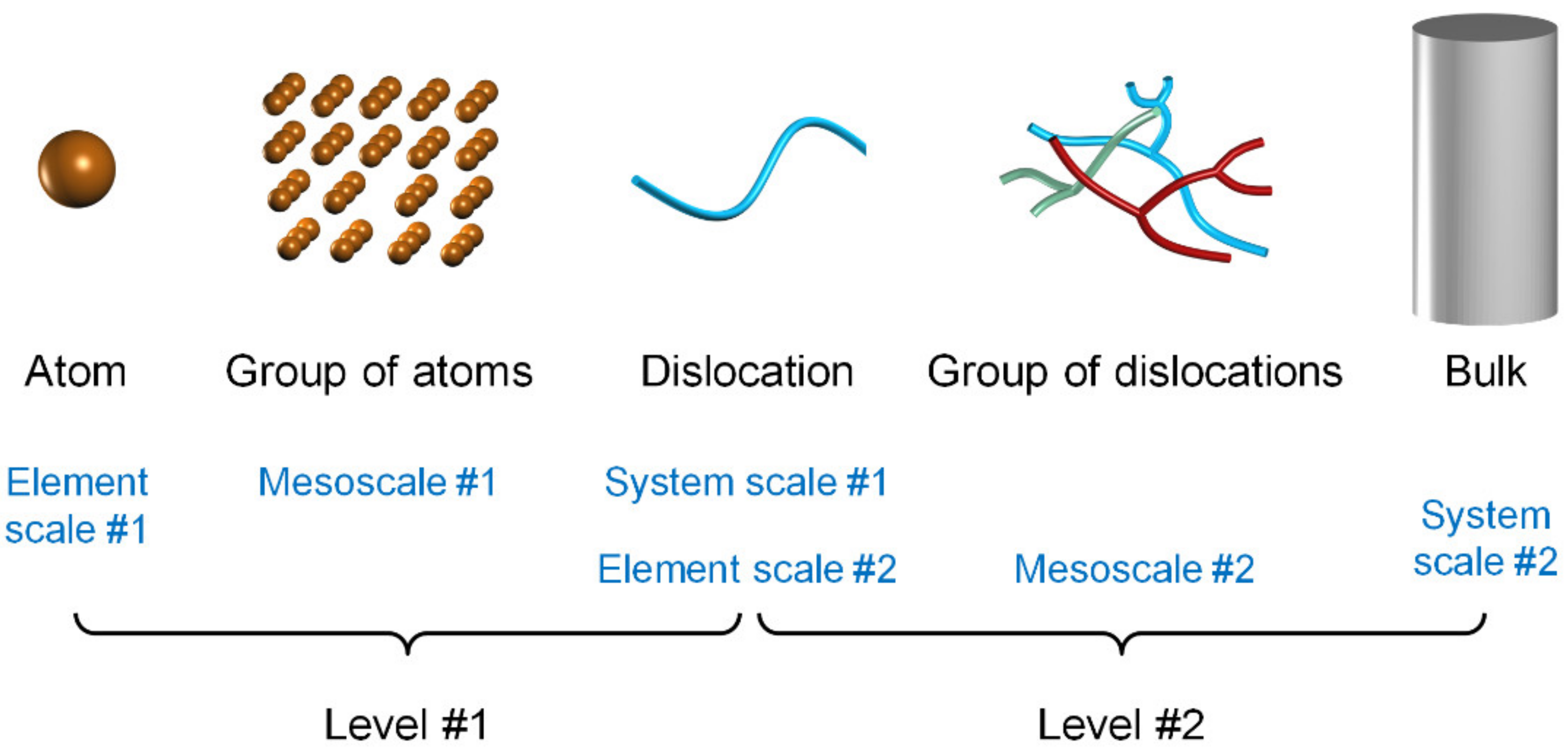
2. Two Levels of Mesoscales
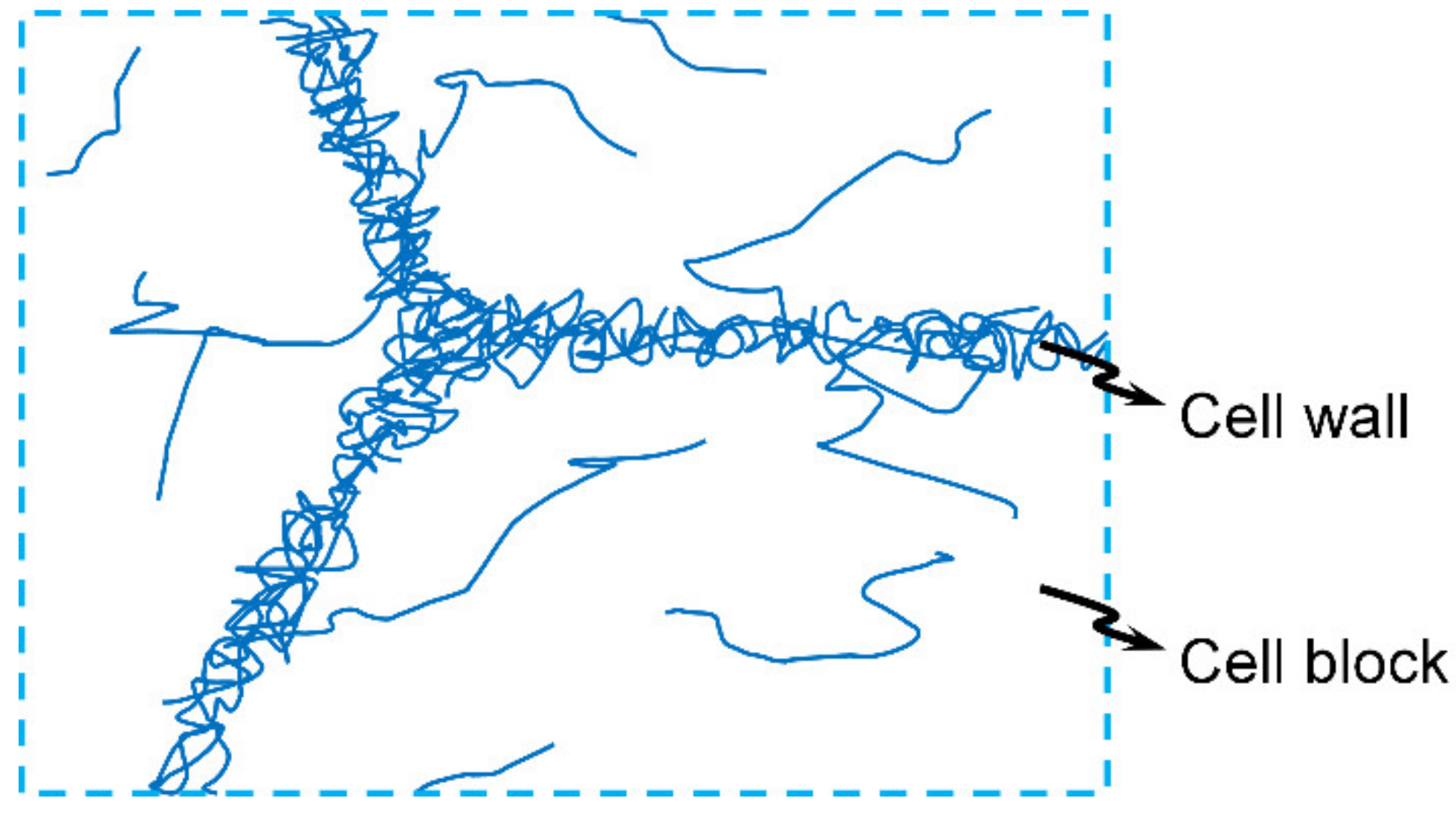
3. Mesoscale Structures and Relevant Processes
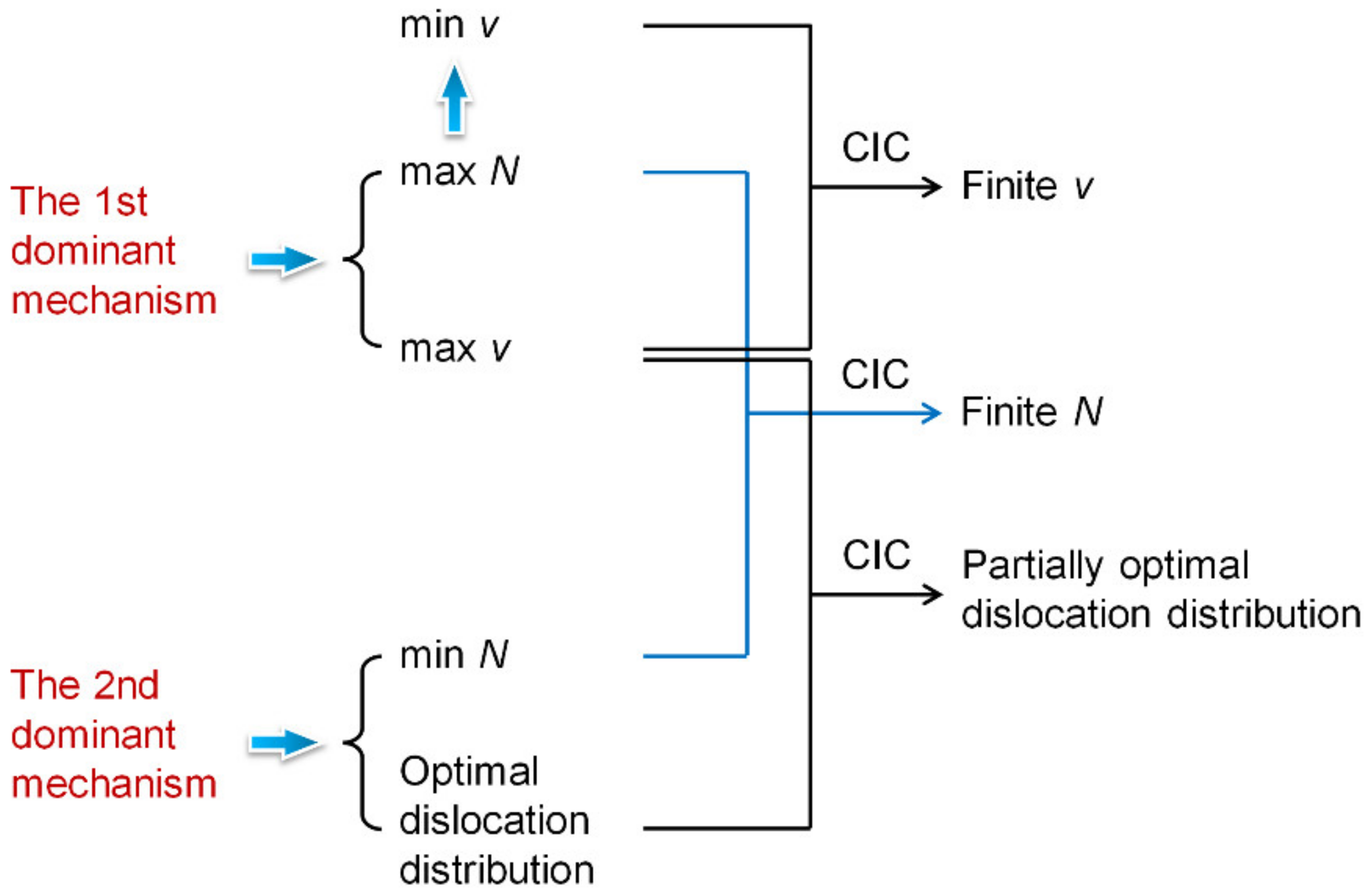
4. Dominant Mechanisms and Their Compromise in Competition
5. Applications to Constitutive Models
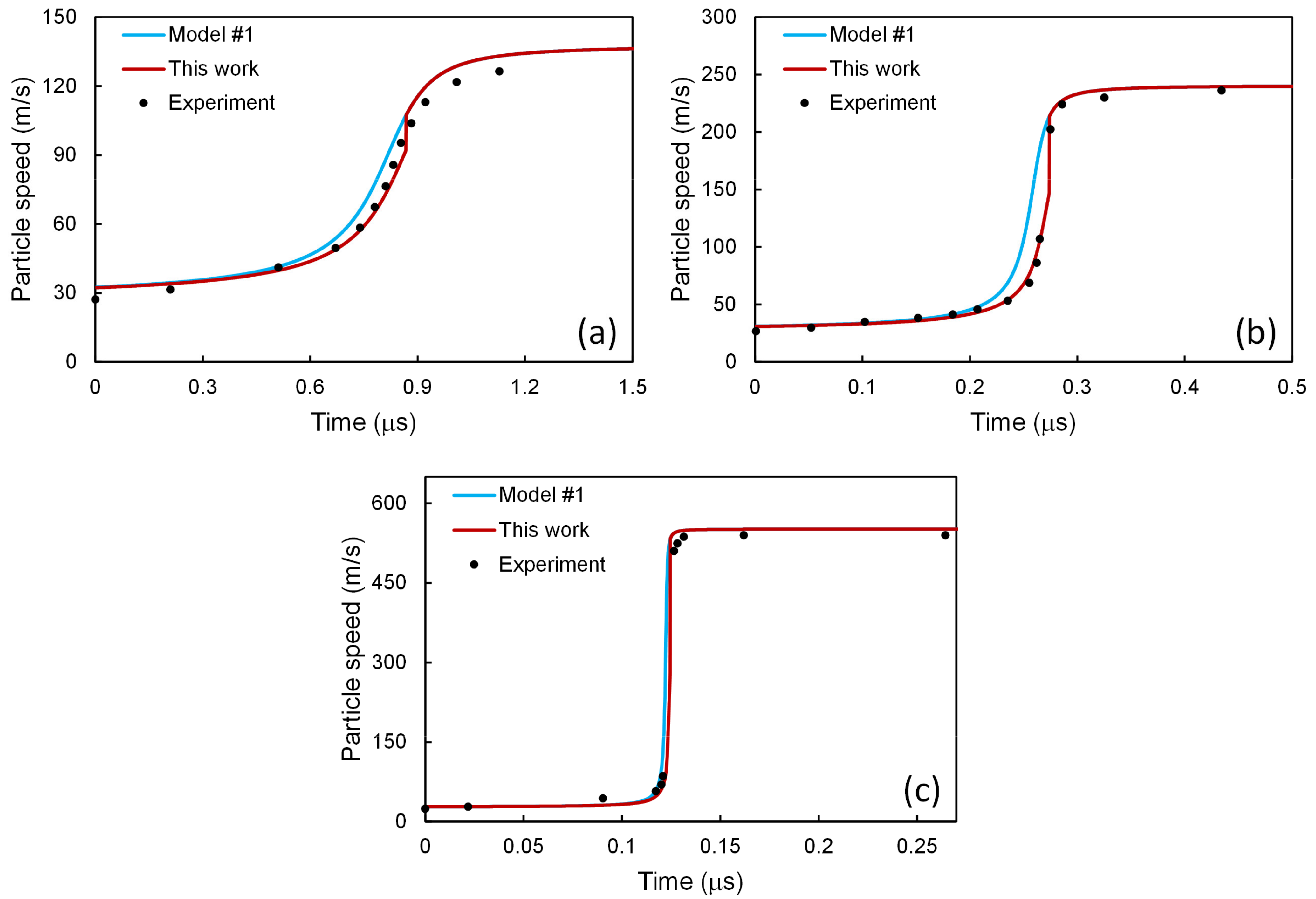
5.1. Application to Model #1
5.2. Application to Model #2
5.3. Application to Model #3
5.4. Summary
6. Conclusions
Author Contributions
Funding
Institutional Review Board Statement
Informed Consent Statement
Data Availability Statement
Conflicts of Interest
References
- Vogler, T.J. On measuring the strength of metals at ultrahigh strain rates. J. Appl. Phys. 2009, 106, 053530. [Google Scholar] [CrossRef] [Scilit]
- Austin, R.A.; McDowell, D.L. A dislocation-based constitutive model for viscoplastic deformation of fcc metals at very high strain rates. Int. J. Plast. 2011, 27, 1–24. [Google Scholar] [CrossRef] [Scilit]
- Brown, J.L.; Alexander, C.S.; Asay, J.R.; Vogler, T.J.; Dolan, D.H.; Belof, J.L. Flow strength of tantalum under ramp compression to 250 GPa. J. Appl. Phys. 2014, 115, 043530. [Google Scholar] [CrossRef] [Scilit]
- Austin, R.A.; McDowell, D.L. Parameterization of a rate-dependent model of shock-induced plasticity for copper, nickel, and aluminum. Int. J. Plast. 2012, 32–33, 134–154. [Google Scholar] [CrossRef] [Scilit]
- Johnson, G.R.; Cook, W.H. A constitutive model and data for metals subjected to large strain, high strain rates and high temperatures. In: Proceedings of the 7th international symposium on ballistics. Hague 1983, 19–21, 541–547. [Google Scholar]
- Johnson, G.R.; Cook, W.H. Fracture characteristics of three metals subjected to various strains, strain rates, temperatures and pressures. Eng. Fract. Mech. 1985, 21, 31–48. [Google Scholar] [CrossRef] [Scilit]
- Steinberg, D.J.; Guinan, M.W. Constitutive Relations for the KOSPALL Code; Lawrence Livermore National Laboratory: Livermore, CA, USA, 1973. [Google Scholar]
- Steinberg, D.J.; Cochran, S.G.; Guinan, M.W. A constitutive model for metals applicable at high-strain rate. J. Appl. Phys. 1980, 51, 1498–1504. [Google Scholar] [CrossRef] [Scilit]
- Zerilli, F.J.; Armstrong, R.W. Dislocation-mechanics-based constitutive relations for material dynamics calculations. J. Appl. Phys. 1987, 61, 1816–1825. [Google Scholar] [CrossRef] [Scilit]
- Zerilli, F.J.; Armstrong, R.W. Description of tantalum deformation behavior by dislocation mechanics based constitutive relations. J. Appl. Phys. 1990, 68, 1580–1591. [Google Scholar] [CrossRef] [Scilit]
- Klepaczko, J. Thermally activated flow and strain rate history effects for some polycrystalline f.c.c. metals. Mater. Sci. Eng. 1975, 18, 121–135. [Google Scholar] [CrossRef] [Scilit]
- Follansbee, P.S.; Kocks, U.F. A constitutive description of the deformation of copper based on the use of the mechanical threshold stress as an internal state variable. Acta Metall. 1988, 36, 81–93. [Google Scholar] [CrossRef] [Scilit]
- Preston, D.L.; Tonks, D.L.; Wallace, D.C. Model of plastic deformation for extreme loading condtions. J. Appl. Phys. 2003, 93, 211–220. [Google Scholar] [CrossRef] [Scilit]
- Barton, N.R.; Bernier, J.V.; Becker, R.; Arsenlis, A.; Cavallo, R.; Marian, J.; Rhee, M.; Park, H.-S.; Remington, B.A.; Olson, R.T. A multiscale strength model for extreme loading conditions. J. Appl. Phys. 2011, 109, 073501. [Google Scholar] [CrossRef] [Scilit]
- Sandfeld, S.; Hochrainer, T.; Zaiser, M.; Gumbsch, P. Continuum modeling of dislocation plasticity: Theory, numerical implementation, and validation by discrete dislocation simulations. J. Mater. Res. 2011, 26, 623–632. [Google Scholar] [CrossRef] [Scilit]
- Li, J.; Ge, W.; Wang, W.; Yang, N.; Liu, X.; Wang, L.; He, X.; Wang, X.; Wang, J.; Kwauk, M. From Multiscale Modeling to Meso-Science: A Chemical Engineering Perspective; Springer: Berlin, Germany, 2013. [Google Scholar]
- Li, J.; Huang, W. Towards Mesoscience: The Principle of Compromise in Competition; Springer: Berlin, Germany, 2014. [Google Scholar]
- Li, J. Exploring the logic and landscape of the knowledge system: Multilevel structures, each multiscaled with complexity at the mesoscale. Engineering 2016, 2, 276–285. [Google Scholar] [CrossRef] [Scilit]
- Huang, W.; Li, J.; Edwards, P.P. Mesoscience: Exploring the common principle at mesoscales. Natl. Sci. Rev. 2018, 5, 321–326. [Google Scholar] [CrossRef] [Scilit]
- Li, J.; Huang, W. From multiscale to mesoscience: Addressing mesoscales in mesoregimes of different levels. Annu. Rev. Chem. Biomol. Eng. 2018, 9, 41–60. [Google Scholar] [CrossRef] [Scilit] [PubMed]
- Huang, W.L.; Li, J.; Chen, X. 110th Anniversary: Mesoscale complexity—To dodge or to confront? Ind. Eng. Chem. Res. 2019, 58, 12478–12484. [Google Scholar] [CrossRef] [Scilit]
- Molinari, A.; Ravichandran, G. Fundamental structure of steady plastic shock waves in metals. J. Appl. Phys. 2004, 95, 1718–1732. [Google Scholar] [CrossRef] [Scilit]
- Bader, S. Emergent physics at the mesoscale: Report from the special Kavli session at the 2012 APS March meeting. APSNews, 15 May 2012; p. p. 8.
- BESAC Subcommittee on Mesoscale Science. From Quanta to the Continuum: Opportunities for Mesoscale Science. A Report from the Basic Energy Sciences Advisory Committee; BESAC Subcommittee on Mesoscale Science: Washington, DC, USA, 2012. [Google Scholar]
- Zepeda-Ruiz, L.A.; Stukowski, A.; Oppelstrup, T.; Bulatov, V.V. Probing the limits of metal plasticity with molecular dynamics simulations. Nature 2017, 550, 492–495. [Google Scholar] [CrossRef] [Scilit]
- Llorca, F. Modeling of post shock mechanical behaviour of copper in hydrocode calculations. J. Phys. IV 2006, 134, 29–35. [Google Scholar] [CrossRef] [Scilit]
- Bourne, N.K.; Gray, G.T., III; Millett, J.C.F. On the shock response of cubic metals. J. Appl. Phys. 2009, 106, 091301. [Google Scholar] [CrossRef] [Scilit]
- Bourne, N.K.; Millett, J.C.F.; Gray, G.T., III. On the shock compression of polycrystalline metals. J. Mater. Sci. 2009, 44, 3319–3343. [Google Scholar] [CrossRef] [Scilit]
- Roters, F.; Raabe, D.; Gottstein, G. Work hardening in heterogeneous alloys—A microstructural approach based on three internal state variables. Acta Mater. 2000, 48, 4181–4189. [Google Scholar] [CrossRef] [Scilit]
- Bay, B.; Hansen, N.; Hughes, D.A.; Kuhlmann-Wilsdorf, D. Evolution of FCC deformation structures in polyslip. Acta Metall. Mater. 1992, 40, 205–219. [Google Scholar] [CrossRef] [Scilit]
- Ma, A.; Roters, F. A constitutive model for fcc single crystals based on dislocation densities and its application to uniaxial compression of aluminium single crystals. Acta Mater. 2004, 52, 3603–3612. [Google Scholar] [CrossRef] [Scilit]
- Ziegler, H. An Introduction to Thermomechanics, 1st ed.; North-Holland: New York, NY, USA, 1983. [Google Scholar]
- Nicolis, G.; Prigogine, I. Self-Organization in Nonequilibrium Systems: From Dissipative Structures to Order through Fluctuations; Wiley: New York, NY, USA, 1977. [Google Scholar]
- Li, J.; Huang, W.; Chen, J.; Ge, W.; Hou, C. Mesoscience based on the EMMS principle of compromise in competition. Chem. Eng. J. 2018, 333, 327–335. [Google Scholar] [CrossRef] [Scilit]
- Grady, D.E. Strain-rate dependence of the effective viscosity under steady-wave shock compression. Appl. Phys. Lett. 1981, 38, 825–826. [Google Scholar] [CrossRef] [Scilit]
- Grady, D.E. Structured shock waves and the fourth-power law. J. Appl. Phys. 2010, 107, 013506. [Google Scholar] [CrossRef] [Scilit]
- Crowhurst, J.C.; Armstrong, M.R.; Knight, K.B.; Zaug, J.M.; Behymer, E.M. Invariance of the dissipative action at ultrahigh strain rates above the strong shock threshold. Phys. Rev. Lett. 2011, 107, 144302. [Google Scholar] [CrossRef] [Scilit]
- Taylor, J.C. Hidden Unity in Nature’s Law; Cambridge University Press: Cambridge, UK, 2001. [Google Scholar]
- Kröner, E. Benefits and shortcomings of the continuous theory of dislocations. Int. J. Solids Struct. 2001, 38, 1115–1134. [Google Scholar] [CrossRef] [Scilit]
- Houlsby, G.T.; Puzrin, A.M. Principles of Hyperplasticity: An Approach to Plasticity Theory Based on Thermodynamic Principles; Springer: London, UK, 2006. [Google Scholar]
- Swegle, J.W.; Grady, D.E. Shock viscosity and the prediction of shock wave rise times. J. Appl. Phys. 1985, 58, 692–701. [Google Scholar] [CrossRef] [Scilit]
- Zhang, L.; Chen, J.; Huang, W.; Li, J. A direct solution to multi-objective optimization: Validation in solving the EMMS model for gas-solid fluidization. Chem. Eng. Sci. 2018, 192, 499–506. [Google Scholar] [CrossRef] [Scilit]
- Johnson, J.N.; Barker, L.M. Dislocation dynamics and steady plastic wave profiles in 6061-T6 aluminum. J. Appl. Phys. 1969, 40, 4321–4334. [Google Scholar] [CrossRef] [Scilit]

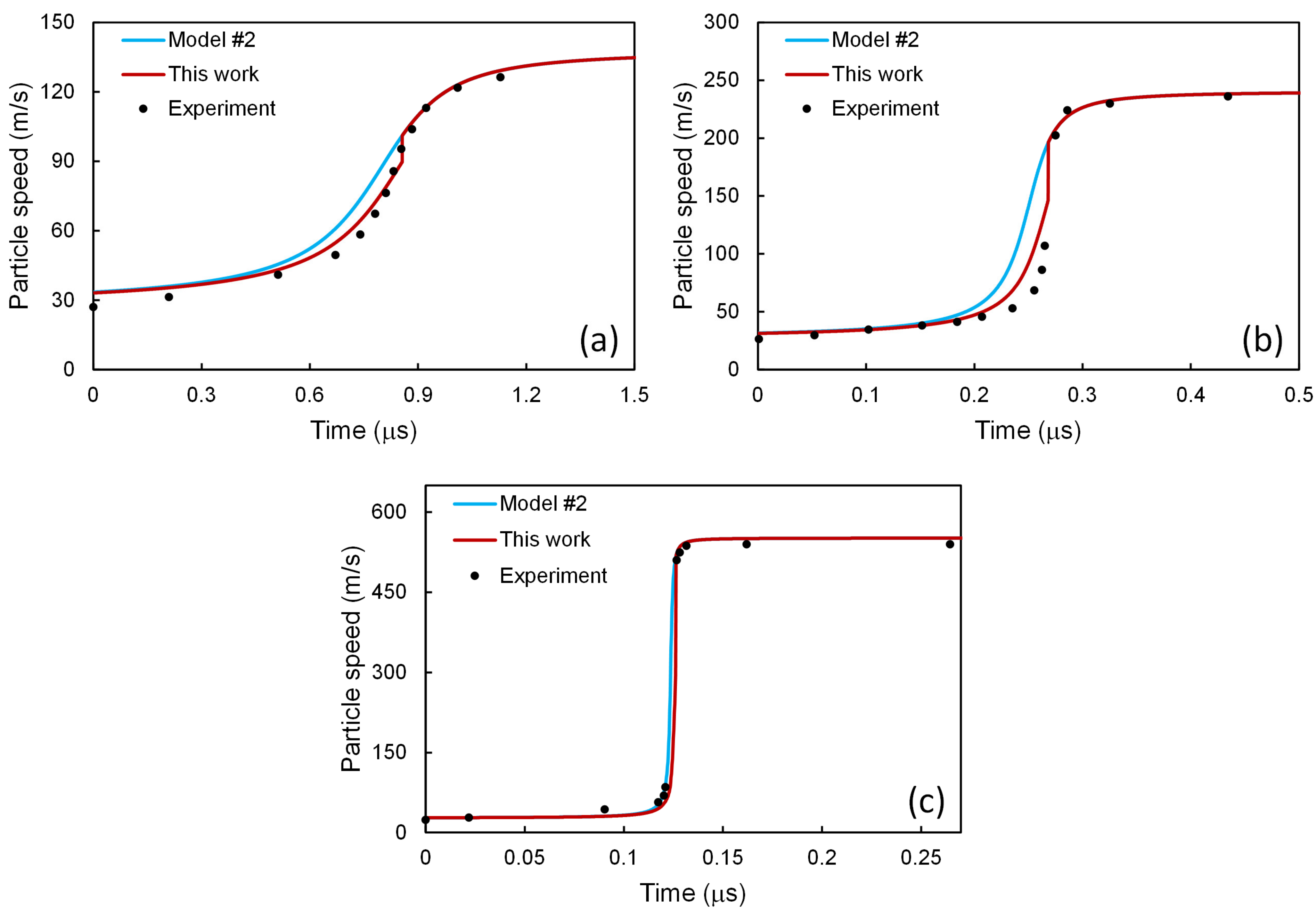
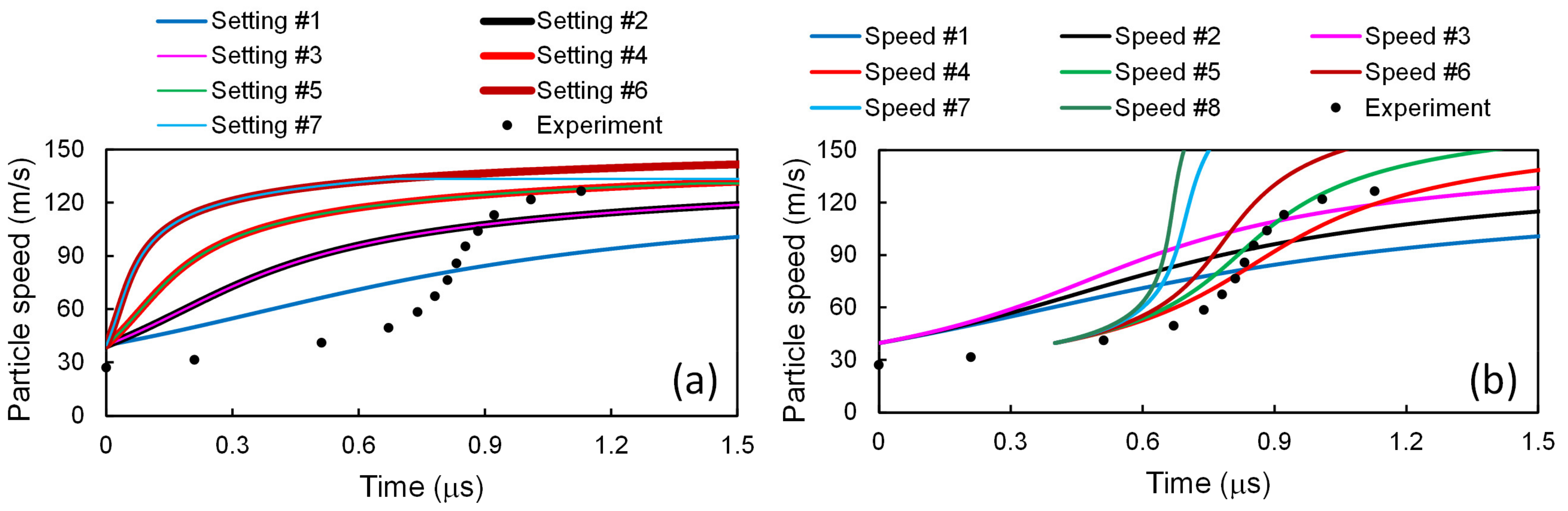
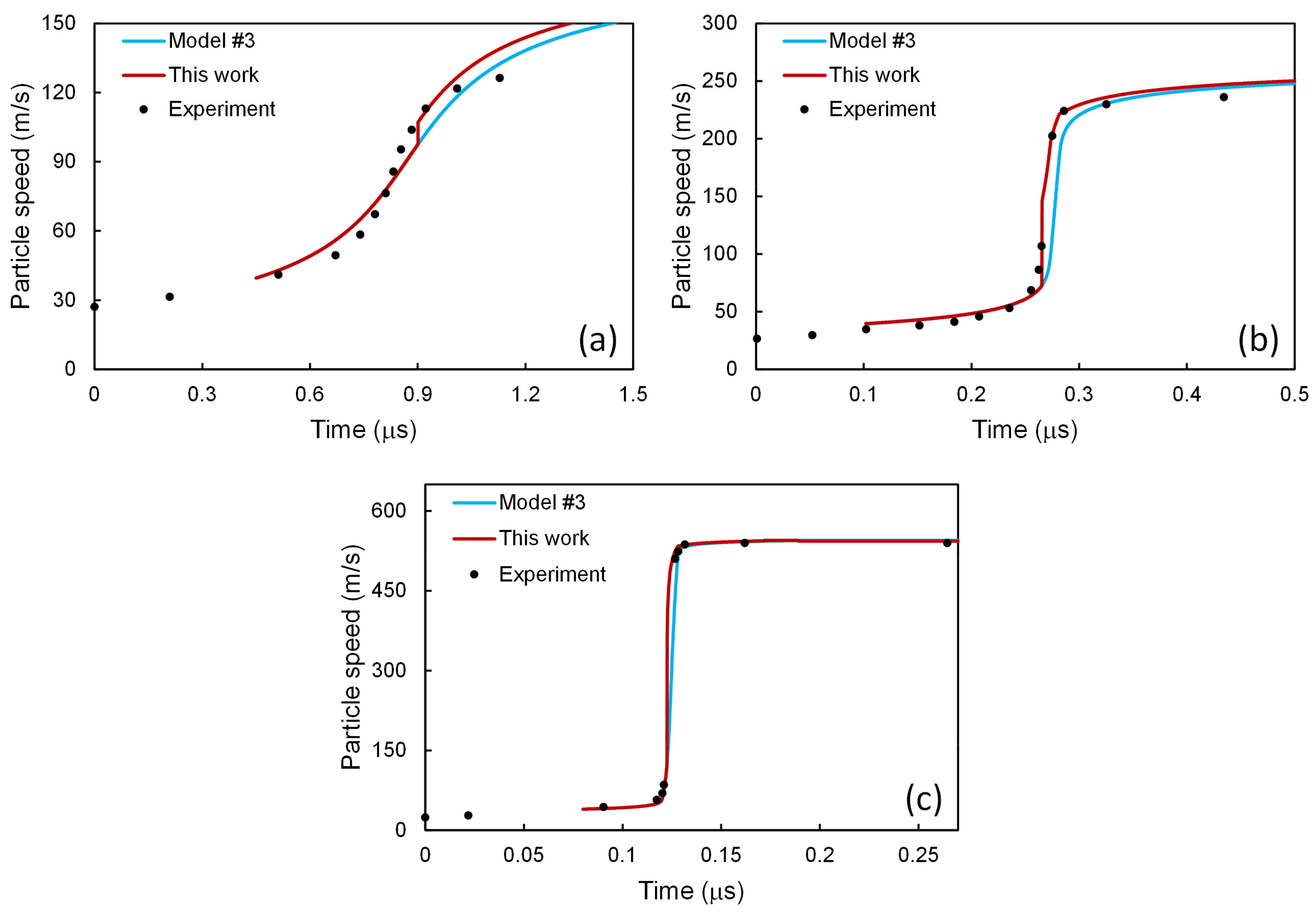
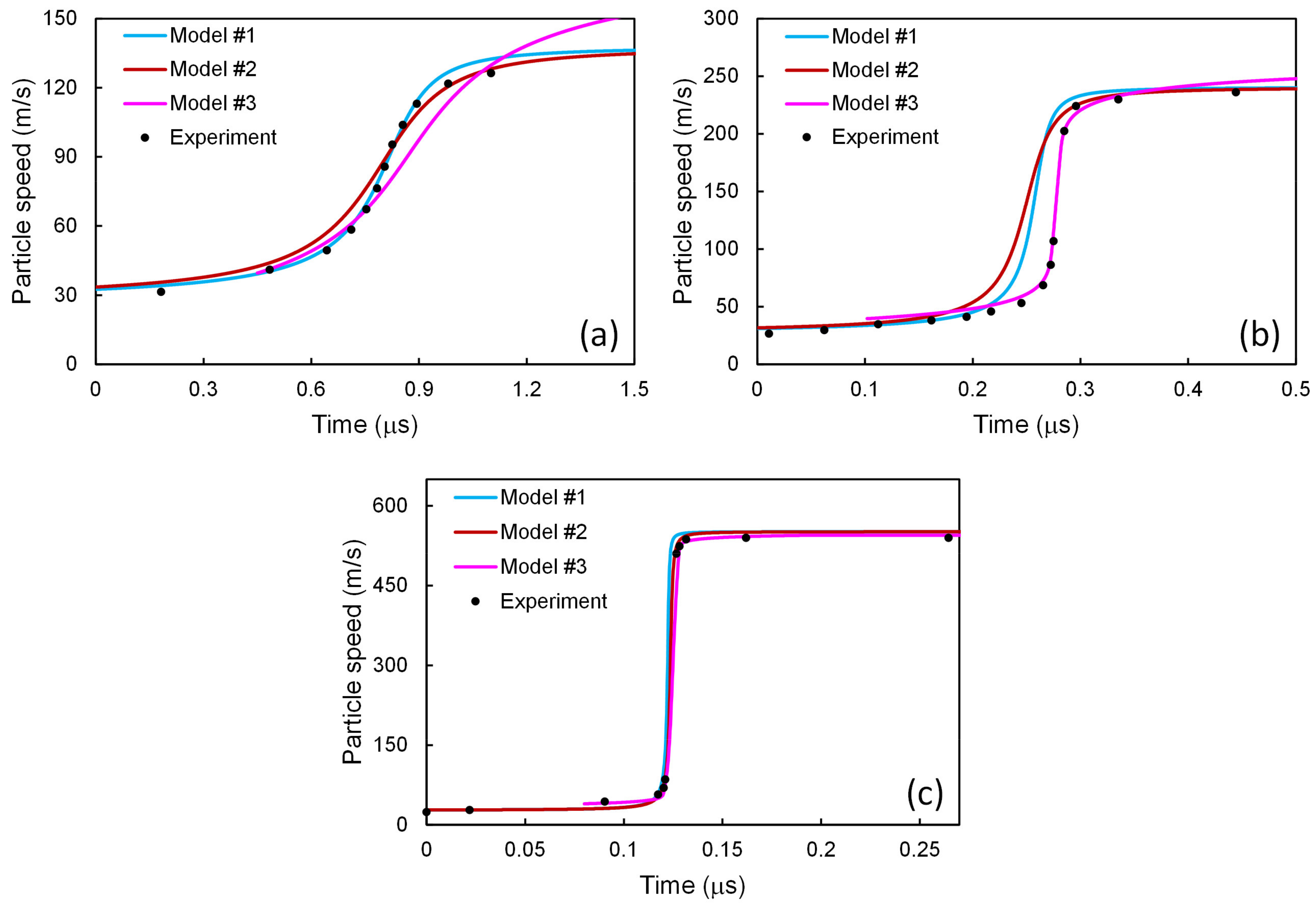

| Quantity | Definition |
|---|---|
| λ1,p | longitudinal plastic stretch |
| ξ | coordinate moving with C |
| Nm | mobile dislocation density |
| γp | plastic shear strain |
| τa | yield shear stress |
| T1 | longitudinal Piola-Kirchhoff stress |
| T2 | transverse Piola-Kirchhoff stress |
| F1 | function for elastic deformation |
| F2 | function for elastic deformation |
| ε1,e | longitudinal elastic strain |
| ε2,e | transverse elastic strain |
| A1, A2, B1, B2, D | intermediate parameters |
| A1n, A2n, B1n, B2n, Dn | intermediate parameters |
| B, G | intermediate parameters |
| up | particle speed |
| Parameter | Value | Unit | Definition |
|---|---|---|---|
| ρ0 | 2703 | kg/m3 | initial density |
| b | 2.86 × 10⁻¹⁰ | m | Burgers’ vector magnitude |
| a1 | 0 | m2/s2 | elastic constant |
| a1n | 0 | m2/s2 | elastic constant |
| a2 | 2.028 × 10⁷ | m2/s2 | elastic constant |
| a3 | −2.044 × 10⁷ | m2/s2 | elastic constant |
| a4 | −6.64 × 10⁷ | m2/s2 | elastic constant |
| a5 | 1.575 × 10⁸ | m2/s2 | elastic constant |
| a6 | −1.428 × 10⁸ | m2/s2 | elastic constant |
| c1 | 0.168 | m/s | fitting parameter |
| 1.6 | MPa | fitting parameter | |
| M | 1.78 | inverse of the strain rate sensitivity | |
| τa0 | 120 | MPa | initial back stress |
| γ0 | 0.52 | reference strain | |
| n | 1.55 | hardening parameter | |
| Nm,HEL,w | 8.18 × 10¹² | 1/m2 | initial mobile dislocation density in the cell wall |
| Nm,HEL,b | 8.00 × 10¹² | 1/m2 | initial mobile dislocation density in the cell block |
| αb | 3.5 × 10⁵ | 1/m | breeding coefficient |
| αt | 0 | trapping coefficient | |
| NHEL,w | 8.18 × 10¹² | 1/m2 | initial total dislocation density in the cell wall |
| NHEL,b | 8.00 × 10¹² | 1/m2 | initial total dislocation density in the cell block |
| λ1,HEL | 0.995758 | HEL longitudinal stretch | |
| T1,HEL | −475 | MPa | HEL longitudinal Piola-Kirchhoff stress |
| C | 5457.3146 | m/s | shock wave speed at σ1,– = 2.1 GPa |
| 5600.2774 | shock wave speed at σ1,– = 3.7 GPa | ||
| 6018.3672 | shock wave speed at σ1,– = 9.0 GPa | ||
| up,HEL | 27.295879 | m/s | HEL particle speed |
| Parameter | Value | Unit | Definition |
|---|---|---|---|
| αhet | 7.4 × 10¹³ | 1/m2 | heterogeneous nucleation coefficient |
| αann | 0.5 | annihilation coefficient | |
| αdis | 0.015 | network trapping coefficient | |
| αp | 0.02 | precipitate trapping coefficient | |
| dp | 1.0 × 10⁻⁸ | m | precipitate size |
| λp | 7.0 × 10⁻⁸ | m | precipitate spacing |
| d | 4.0 × 10⁻⁵ | m | mean grain size |
| m | 1.0 | shape constant | |
| fHEL | 1.0 | initial fraction of mobile dislocations | |
| δ | 3.5 × 10⁵ | 1/m | multiplication coefficient |
| τa | 106 | MPa | lower-bound shear stress for heterogeneous nucleation |
| τb | 920 | MPa | upper-bound shear stress for heterogeneous nucleation |
| Parameter | Value | Unit | Definition |
|---|---|---|---|
| k | 1.380649 × 10⁻²³ | J/K | Boltzmann’s constant |
| χ | 0.05 | scaling parameter | |
| νD | 8.0 × 10¹² | 1/s | Debye’s frequency |
| g0 | 0.65 | thermal activation parameter | |
| q | 0.5 | thermal activation parameter | |
| r | 2.0 | thermal activation parameter | |
| μ0 | 27.627 | GPa | initial shear modulus |
| 1/μ0 (∂μ/∂p) | 65 × 10−3 | 1/GPa | pressure coefficient of shear modulus |
| 1/μ0 (∂μ/∂θ) | −0.62 × 10⁻³ | 1/K | temperature coefficient of shear modulus |
| θ0 | 300.0 | K | initial temperature |
| p0 | 0.0 | Pa | initial pressure |
| z | 4.0 | number of atoms per unit cell | |
| α0 | 1.0 | dislocation interaction coefficient | |
| β0 | 0.0 | long-range interaction factor | |
| βp | 0.84 | Orowan looping factor | |
| C | 5457.3146 | m/s | shock wave speed at σ1,– = 2.1 GPa |
| 5606.2939 | shock wave speed at σ1,– = 3.7 GPa | ||
| 6011.1869 | shock wave speed at σ1,– = 9.0 GPa | ||
| c0 | 5350.0 | m/s | material constant |
| s1 | 1.34 | material constant | |
| N+,w | 2.0 × 10¹⁴ | 1/m2 | initial total dislocation density in the cell wall |
| N+,b | 1.9 × 10¹⁴ | 1/m2 | initial total dislocation density in the cell block |
| f+ | 0.006 | initial fraction of mobile dislocations | |
| λ1,+ | 0.993711 | initial longitudinal stretch | |
| T1,+ | −675 | MPa | HEL longitudinal Piola-Kirchhoff stress |
| λ1,p,+ | 0.9994002 | initial longitudinal plastic stretch | |
| up,+ | 39.629214 | m/s | initial particle speed |
| b1 | −593 | K | thermomechanical parameter |
| b2 | −130 | K | thermomechanical parameter |
| b3 | 1350 | K | thermomechanical parameter |
| β | 1.0 | Taylor-Quinney coefficient | |
| cη | 880.0 | J/(g K) | specific heat at constant configuration |
Publisher’s Note: MDPI stays neutral with regard to jurisdictional claims in published maps and institutional affiliations. |
© 2021 by the authors. Licensee MDPI, Basel, Switzerland. This article is an open access article distributed under the terms and conditions of the Creative Commons Attribution (CC BY) license (https://creativecommons.org/licenses/by/4.0/).
Share and Cite
Huang, W.L.; Zhang, L.; Chen, K.; Lu, G. Mesoscale Mechanisms in Viscoplastic Deformation of Metals and Their Applications to Constitutive Models. Materials 2021, 14, 4667. https://doi.org/10.3390/ma14164667
Huang WL, Zhang L, Chen K, Lu G. Mesoscale Mechanisms in Viscoplastic Deformation of Metals and Their Applications to Constitutive Models. Materials. 2021; 14(16):4667. https://doi.org/10.3390/ma14164667
Chicago/Turabian StyleHuang, Wen Lai, Lin Zhang, Kaiguo Chen, and Guo Lu. 2021. "Mesoscale Mechanisms in Viscoplastic Deformation of Metals and Their Applications to Constitutive Models" Materials 14, no. 16: 4667. https://doi.org/10.3390/ma14164667
APA StyleHuang, W. L., Zhang, L., Chen, K., & Lu, G. (2021). Mesoscale Mechanisms in Viscoplastic Deformation of Metals and Their Applications to Constitutive Models. Materials, 14(16), 4667. https://doi.org/10.3390/ma14164667