
Microstructure and Porosity Evolution of the Ti–35Zr Biomedical Alloy Produced by Elemental Powder Metallurgy

 ,
,  , , , ,
  and
and 
Abstract
1. Introduction
2. Materials and Methods
3. Results and Discussion
4. Conclusions
Author Contributions
Funding
Conflicts of Interest
References
- Niinomi, M. Recent research and development in titanium alloys for biomedical applications and healthcare goods. Sci. Technol. Adv. Mater. 2003, 4, 445–454. [Google Scholar] [CrossRef]
- Zhao, X.; Niinomi, M.; Nakai, M.; Ishimoto, T.; Nakano, T. Development of high Zr-containing Ti-based alloys with low Young’s modulus for use in removable implants. Mater. Sci. Eng. C 2011, 31, 1436–1444. [Google Scholar] [CrossRef]
- Domingo, J.L. Vanadium and Tungsten Derivatives as Antidiabetic Agents. Biol. Trace Elem. Res. 2002, 88, 97–112. [Google Scholar] [CrossRef]
- Steimann, S.G. Biomaterials; John Wiley & Sons, Inc.: New York, NY, USA, 1980. [Google Scholar]
- Okazaki, Y.; Nishimura, E. Effect of Metal Released from Ti Alloy Wear Powder on Cell Viability. Mater. Trans. 2000, 41, 1247–1255. [Google Scholar] [CrossRef]
- Okazaki, Y.; Rao, S.; Asao, S.; Tateishi, T.; Katsuda, S.; Furuki, Y. Effects of Ti, Al. and V concentrations on cell viability. Mater. Trans. 1998, 39, 1053–1062. [Google Scholar] [CrossRef]
- Khan, M.A.; Williams, R.L.; Williams, D.F. The corrosion behaviour of Ti–6Al–4V, Ti–6Al–7Nb and Ti–13Nb–13Zr in protein solutions. J. Biomed. Mater. Res. 1999, 20, 631–637. [Google Scholar] [CrossRef]
- Boyce, B.F.; Byars, J.; McWilliams, S.; Mocan, M.Z.; Elder, H.Y.; Boyle, I.T.; Junor, B.J. Histological and electron microprobe studies of mineralisation in aluminium-related osteomalacia. J. Clin. Pathol. 1992, 45, 502–508. [Google Scholar]
- Wang, K. The use of titanium for medical applications in the USA. Mater. Sci. Eng. A 1996, 213, 134–137. [Google Scholar] [CrossRef]
- Ho, W.F.; Ju, C.P.; Chern Lin, J.H. Structure and properties of cast binary Ti-Mo alloys. Biomaterials 1999, 20, 2115–2122. [Google Scholar] [CrossRef]
- Ho, W.F. A comparison of tensile properties and corrosion behaviour of cast Ti-7.5Mo with c. P. Ti, Ti–15Mo and Ti–6Al–4V alloys. J. Alloys Compd. 2008, 464, 580–583. [Google Scholar] [CrossRef]
- Dercz, G.; Matuła, I.; Zubko, M.; Kazek-Kęsik, A.; Maszybrocka, J.; Simka, W.; Dercz, J.; Świec, P.; Jendrzejewska, I. Synthesis of porous Ti–50Ta alloy by powder metallurgy. Mater. Charact. 2018, 142, 124–136. [Google Scholar] [CrossRef]
- Dercz, G.; Matuła, I.; Zubko, M.; Liberska, A. Structure Characterization of Biomedical Ti-Mo-Sn Alloy Prepared by Mechanical Alloying Method. Acta Phys. Pol. A 2016, 130, 1029–1032. [Google Scholar] [CrossRef]
- Collings, E.W. Alloying. In Introduction to Titanium Alloy Design; Water, J.L., Jackson, M.R., Sims, C.T., Eds.; ASM International: Metals Park, OH, USA, 1988; pp. 257–370. [Google Scholar]
- Cheng, C.H.; Hsu, H.C.; Wu, S.C.; Wang, H.W.; Ho, W.F. Effects of chromium addition on structure and mechanical properties of Ti-10Zr alloy. J. Alloys Compd. 2009, 484, 524–528. [Google Scholar] [CrossRef]
- Chen, C.J.; Huang, J.C.; Chou, H.S.; Lai, Y.H.; Chang, L.W.; Du, X.H.; Chu, J.P.; Nieh, T.G. On the amorphous and nanocrystalline Zr-Cu and Zr-Ti co-sputtered thin films. J. Alloys Compd. 2009, 483, 337–340. [Google Scholar] [CrossRef]
- Wang, W.; Zhan, P.; Xie, Z.; Li, Z.; Zhang, Z. Mechanical property improvement by texture control of magnetron co-sputtered Zr-Ti films. J. Appl. Phys. 2014, 115, 043524. [Google Scholar] [CrossRef]
- Oliveira, N.T.C.; Biaggio, S.R.; Rocha-Filho, R.C.; Bocchi, N. Electrochemical studies on zirconium and its biocompatible alloys Ti-50Zr at.% and Zr-2.5Nb wt.% in simulated physiologic media. J. Biomed. Mater. Res. Part A 2005, 74, 397–407. [Google Scholar] [CrossRef]
- Ho, W.F.; Chen, W.K.; Wu, S.C.; Hsu, H.C. Structure, mechanical properties, and grindability of dental Ti-Zr alloys. J. Mater. Sci. Mater. Med. 2008, 19, 3179–3186. [Google Scholar] [CrossRef]
- Matuła, I.; Dercz, G.; Barczyk, J. Titanium/Zirconium functionally graded materials with porosity gradients for potential biomedical applications. Mater. Sci. Technol. 2020, 36, 972–977. [Google Scholar] [CrossRef]
- Saldaña, L.; Méndez-Vilas, A.; Jiang, L.; Multigner, M.; González-Carrasco, J.L.; Pérez-Prado, M.T.; González-Martín, M.L.; Munuera, L.; Vilaboa, N. In vitro biocompatibility of an ultrafine grained zirconium. Biomaterials 2007, 28, 4343–4354. [Google Scholar] [CrossRef]
- Sherepo, K.M.; Red’ko, I.A. The use of zirconium for implants in traumatology and orthopedics. Med. Tekh. 2004, 2, 22–24. [Google Scholar]
- Gehrke, P.; Dhom, G.; Brunner, J.; Wolf, D.; Degidi, M.; Piattelli, A. Zirconium implant abutments: Fracture strength and influence of cyclic loading on retaining-screw loosening. Quintessence Int. 2006, 37, 19–26. [Google Scholar] [PubMed]
- Thomsen, P.; Larsson, C.; Ericson, L.E.; Sennerby, L.; Lausmaa, J.; Kasemo, B. Structure of the interface between rabbit cortical bone and implants of gold, zirconium and titanium. J. Mater. Sci. Mater. Med. 1997, 8, 653–665. [Google Scholar] [CrossRef] [PubMed]
- Cabrini, R.L.; Guglielmotti, M.B.; Almagro, J.C. Histomorphometry of initial bone healing around zirconium implants in rats. Implant Dent. 1993, 2, 264–267. [Google Scholar] [CrossRef] [PubMed]
- Guglielmotti, M.B.; Guerrero, C.; Cabrini, R.L. Chronodynamic evaluation of the stages of osseointegration in zirconium laminar implants. Acta Odontol. Latinoam. 1997, 10, 11–23. [Google Scholar]
- Kulakov, O.B.; Doktorov, A.A.; D’iakova, S.V.; Denisov-Nikol’skiĭ, I.I.; Grötz, K.A. Experimental study of osseointegration of zirconium and titanium dental implants. Morfologiia 2005, 127, 52–55. [Google Scholar]
- Massalski, T.B.; Okamoto, H.; Subramanian, P.R.; Massalski, B.; Thaddeus, L. Binary Alloy Phase Diagrams, 2nd ed.; Massalski, T.B., Okamoto, H., Subramanian, P.R., Massalski, B., Thaddeus, L., Eds.; ASM International: Metals Park, OH, USA, 1990. [Google Scholar]
- Hsu, H.C.; Wu, S.C.; Sung, Y.C.; Ho, W.F. The structure and mechanical properties of as-cast Zr-Ti alloys. J. Alloys Compd. 2009, 488, 279–283. [Google Scholar] [CrossRef]
- Correa, D.R.N.; Vicente, F.B.; Donato, T.A.G.; Arana-Chavez, V.E.; Buzalaf, M.A.R.; Grandini, C.R. The effect of the solute on the structure, selected mechanical properties, and biocompatibility of Ti-Zr system alloys for dental applications. Mater. Sci. Eng. C 2014, 34, 354–359. [Google Scholar] [CrossRef]
- Oh, I.H.; Nomura, N.; Hanada, S. Microstructures and mechanical properties of porous titanium compacts prepared by powder sintering. Mater. Trans. 2002, 43, 443–446. [Google Scholar] [CrossRef]
- Bobyn, J.D.; Pilliar, R.M.; Cameron, H.U.; Weatherly, G.C. The optimum pore size for the fixation of porous-surfaced metal implants by the ingrowth of bone. Clin. Orthop. Relat. Res. 1980, 150, 263–270. [Google Scholar] [CrossRef]
- Pavón, J.J.; Trueba, P.; Rodríguez-Ortiz, J.A.; Torres, Y. Development of new titanium implants with longitudinal gradient porosity by space-holder technique. J. Mater. Sci. 2015, 50, 6103–6112. [Google Scholar] [CrossRef]
- Karanjai, M.; Sundaresan, R.; Rao, G.V.N.; Mohan, T.R.R.; Kashyap, B.P. Development of titanium based biocomposite by powder metallurgy processing with in situ forming of Ca-P phases. Mater. Sci. Eng. A 2007, 447, 19–26. [Google Scholar] [CrossRef]
- Rietveld, H.M. A Profile Refinement Method for Nuclear and Magnetic Structure. J. Appl. Cryst. 1969, 3, 65–69. [Google Scholar] [CrossRef]
- Young, R.A.; Wiles, D.B. Application of the Rietveld method for structure refinement with powder diffraction data. Adv. X-ray Anal. 1980, 24, 1–23. [Google Scholar] [CrossRef]
- Hill, R.J.; Howard, C.J. Quantitative phase analysis from neutron powder diffraction data using the Rietveld method. J. Appl. Crystallogr. 1987, 20, 467–474. [Google Scholar] [CrossRef]
- Dercz, G.; Olszak, D.; Prusik, K.; Pająk, L. Rietveld-based quantitative analysis of multiphase powders with nanocrystalline NiAl and FeAl phase. Adv. Mater. Sci. 2008, 8, 764–768. [Google Scholar]
- Medvedev, A.E.; Molotnikov, A.; Lapovok, R.; Zeller, R.; Berner, S.; Habersetzer, P.; Dalla Torre, F. Microstructure and mechanical properties of Ti-15Zr alloy used as dental implant material. J. Mech. Behav. Biomed. Mater. 2016, 62, 384–398. [Google Scholar] [CrossRef]
- Han, M.-K.; Hwang, M.-J.; Yang, M.-S.; Yang, H.-S.; Song, H.-J.; Park, Y.-J. Effect of zirconium content on the microstructure, physical properties and corrosion behavior of Ti alloys. Mater. Sci. Eng. A 2014, 616, 268–274. [Google Scholar] [CrossRef]
- Marker, C.; Shang, S.L.; Zhao, J.C.; Liu, Z.K. Effects of alloying elements on the elastic properties of bcc Ti-X alloys from first-principles calculations. Comput. Mater. Sci. 2018, 142, 215–226. [Google Scholar] [CrossRef]
- Chen, Q.; Thouas, G.A. Metallic implant biomaterials. Mater. Sci. Eng. R Rep. 2015, 87, 1–57. [Google Scholar] [CrossRef]
- Li, Y.; Cui, Y.; Zhang, F.; Xu, H. Shape memory behavior in Ti-Zr alloys. Scr. Mater. 2011, 64, 584–587. [Google Scholar] [CrossRef]
- Gain, A.K.; Zhang, L.; Quadir, M.Z. Composites matching the properties of human cortical bones: The design of porous titanium-zirconia (Ti-ZrO2) nanocomposites using polymethyl methacrylate powders. Mater. Sci. Eng. A 2016, 662, 258–267. [Google Scholar]
- Nomura, N.; Kohama, T.; Oh, I.H.; Hanada, S.; Chiba, A.; Kanehira, M.; Sasaki, K. Mechanical properties of porous Ti–15Mo–5Zr–3Al compacts prepared by powder sintering. Mater. Sci. Eng. C 2005, 25, 330–335. [Google Scholar] [CrossRef]
- Thibon, I.; Ansel, D.; Gloriant, T. Interdiffusion in β-Ti-Zr binary alloys. J. Alloys Compd. 2009, 470, 127–133. [Google Scholar]
- Cordeiro, J.M.; Beline, T.; Ribeiro, A.L.R.; Rangel, E.C.; da Cruz, N.C.; Landers, R.; Faverani, L.P.; Vaz, L.G.; Fais, L.M.G.; Vicente, F.B.; et al. Development of binary and ternary titanium alloys for dental implants. Dent. Mater. 2017, 33, 1244–1257. [Google Scholar] [CrossRef] [PubMed]
- Cheng, M.; Qiao, Y.; Wang, Q.; Jin, G.; Qin, H.; Zhao, Y.; Peng, X.; Zhang, X.; Liu, X. Calcium Plasma Implanted Titanium Surface with Hierarchical Microstructure for Improving the Bone Formation. ACS Appl. Mater. Interfaces 2015, 7, 13053–13061. [Google Scholar] [CrossRef] [PubMed]
- Soboyejo, W.O.; Mercer, C.; Allameh, S.; Nemetski, B.; Marcantonio, N.; Ricci, J.L. Multi-scale microstructural characterization of micro-textured Ti-6Al-4V surfaces. Key Eng. Mater. 2001, 198, 203–230. [Google Scholar] [CrossRef]
- Xie, Y.; Zheng, X.; Huang, L.; Ding, C. Influence of hierarchical hybrid micro/nano-structured surface on biological performance of titanium coating. J. Mater. Sci. 2012, 47, 1411–1417. [Google Scholar]
- Michelle Grandin, H.; Berner, S.; Dard, M. A review of Titanium Zirconium (TiZr) alloys for use in endosseous dental implants. Materials 2012, 5, 1348–1360. [Google Scholar] [CrossRef]
- Tong, Y.X.; Guo, B.; Zheng, Y.F.; Chung, C.Y.; Ma, L.W. Effects of Sn and Zr on the Microstructure and Mechanical Properties of Ti-Ta-Based Shape Memory Alloys. J. Mater. Eng. Perform. 2011, 20, 762–766. [Google Scholar]
- Gerday, A.F.; Bettaieb, M.B.; Duchêne, L.; Clement, N.; Diarra, H.; Habraken, A.M. Material behavior of the hexagonal alpha phase of a titanium alloy identified from nanoindentation tests. Eur. J. Mech. A Solids 2011, 30, 248–255. [Google Scholar] [CrossRef]
- Xie, F.; He, X.; Cao, S.; Mei, M.; Qu, X. Influence of pore characteristics on microstructure, mechanical properties and corrosion resistance of selective laser sintered porous Ti–Mo alloys for biomedical applications. Electrochim. Acta 2013, 105, 121–129. [Google Scholar] [CrossRef]
- Xu, Q.; Gabbitas, B.; Matthews, S. Titanium compacts with controllable porosity by slip casting of binary powder mixtures. Powder Technol. 2014, 266, 396–406. [Google Scholar] [CrossRef]
- Saito, T.; Furuta, T. Sintered Powdered Titanium Alloy and Method of Producing the Same. U.S. Patent 5,520,879, 28 May 1996. [Google Scholar]
- Vasconcellos, L.M.R.d.; Leite, D.O.; Oliveira, F.N.d.; Carvalho, Y.R.; Cairo, C.A.A. Evaluation of bone ingrowth into porous titanium implant: Histomorphometric analysis in rabbits. Braz. Oral Res. 2010, 24, 399–405. [Google Scholar] [CrossRef] [PubMed]
- Itälä, A.I.; Ylänen, H.O.; Ekholm, C.; Karlsson, K.H.; Aro, H.T. Pore diameter of more than 100 µm is not requisite for bone ingrowth in rabbits. J. Biomed. Mater. Res. 2001, 58, 679–683. [Google Scholar] [CrossRef] [PubMed]
- Smith, L.N.; Midha, P.S. Computer simulation of morphology and packing behaviour of irregular particles, for predicting apparent powder densities. Comput. Mater. Sci. 1997, 7, 377–383. [Google Scholar] [CrossRef]
- Karlsson, K.; Spring, L. Packing of irregular particles. J. Mater. Sci. 1970, 5, 340–344. [Google Scholar] [CrossRef]
- Lees, S. A model for bone hardness. J. Biomech. 1981, 14, 561–567. [Google Scholar] [CrossRef]
- Wu, W.W.; Zhu, Y.B.; Chen, W.; Li, S.; Yin, B.; Wang, J.Z.; Zhang, X.J.; Liu, G.B.; Hu, Z.S.; Zhang, Y.Z. Bone Hardness of Different Anatomical Regions of Human Radius and its Impact on the Pullout Strength of Screws. Orthop. Surg. 2019, 11, 270–276. [Google Scholar] [CrossRef]
- Ogurkowska, M.B.; Błaszczyk, A. Distribution of Young’s modulus at various sampling points in a human lumbar spine vertebral body. Spine J. 2020, in press. [Google Scholar] [CrossRef]
- Ho, W.F.; Cheng, C.H.; Pan, C.H.; Wu, S.C.; Hsu, H.C. Structure, mechanical properties and grindability of dental Ti-10Zr-X alloys. Mater. Sci. Eng. C 2009, 29, 36–43. [Google Scholar] [CrossRef]
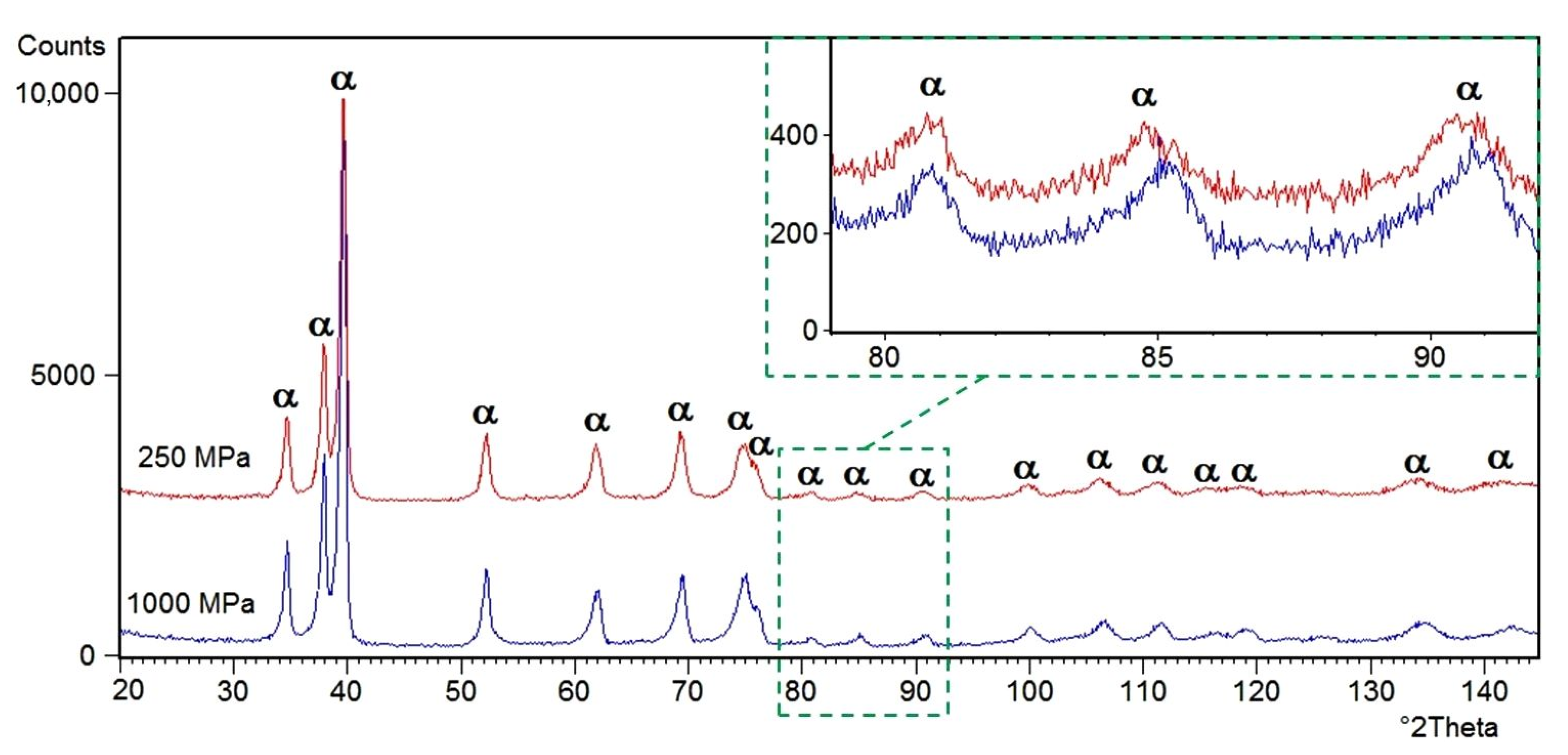

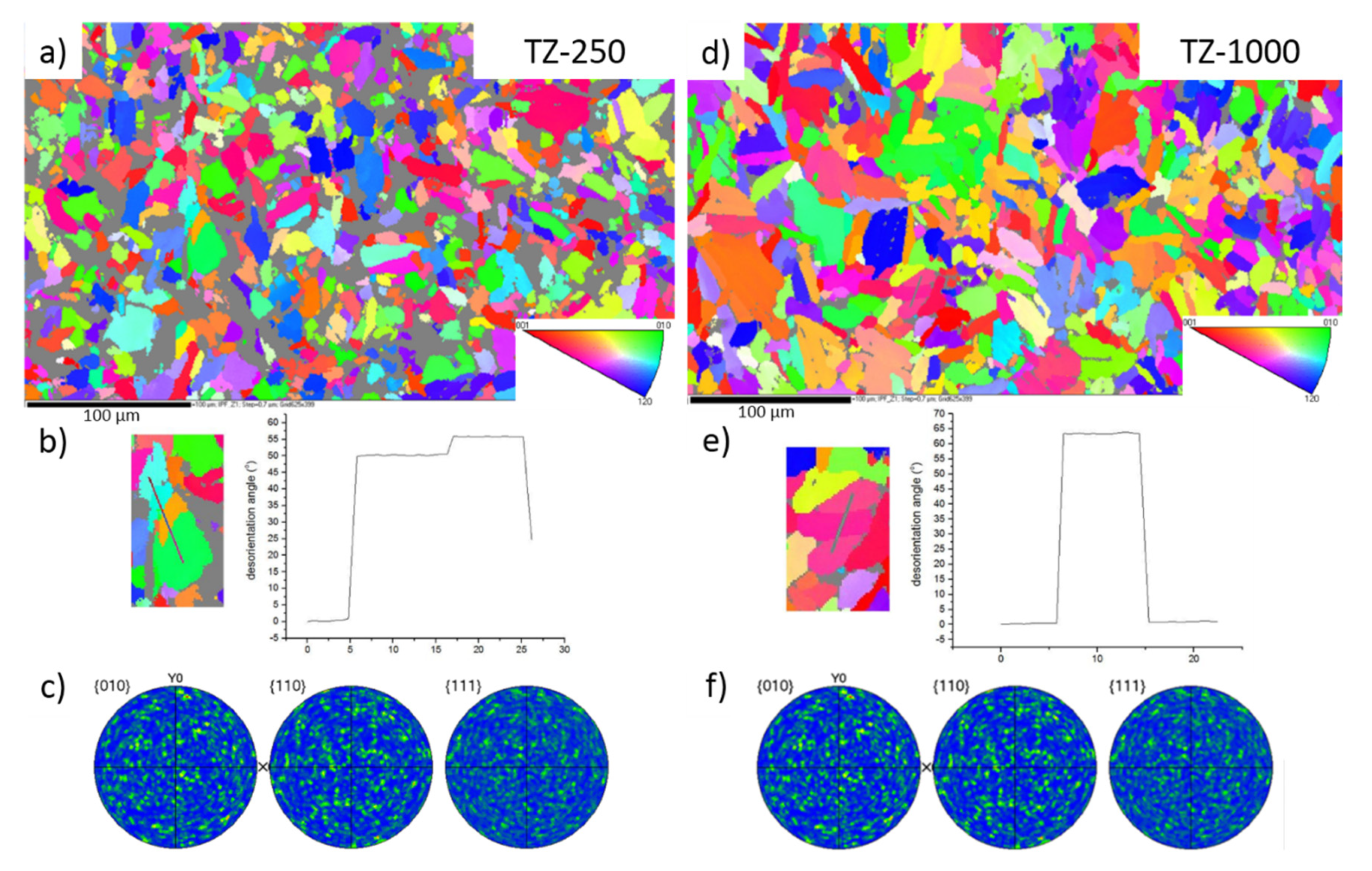

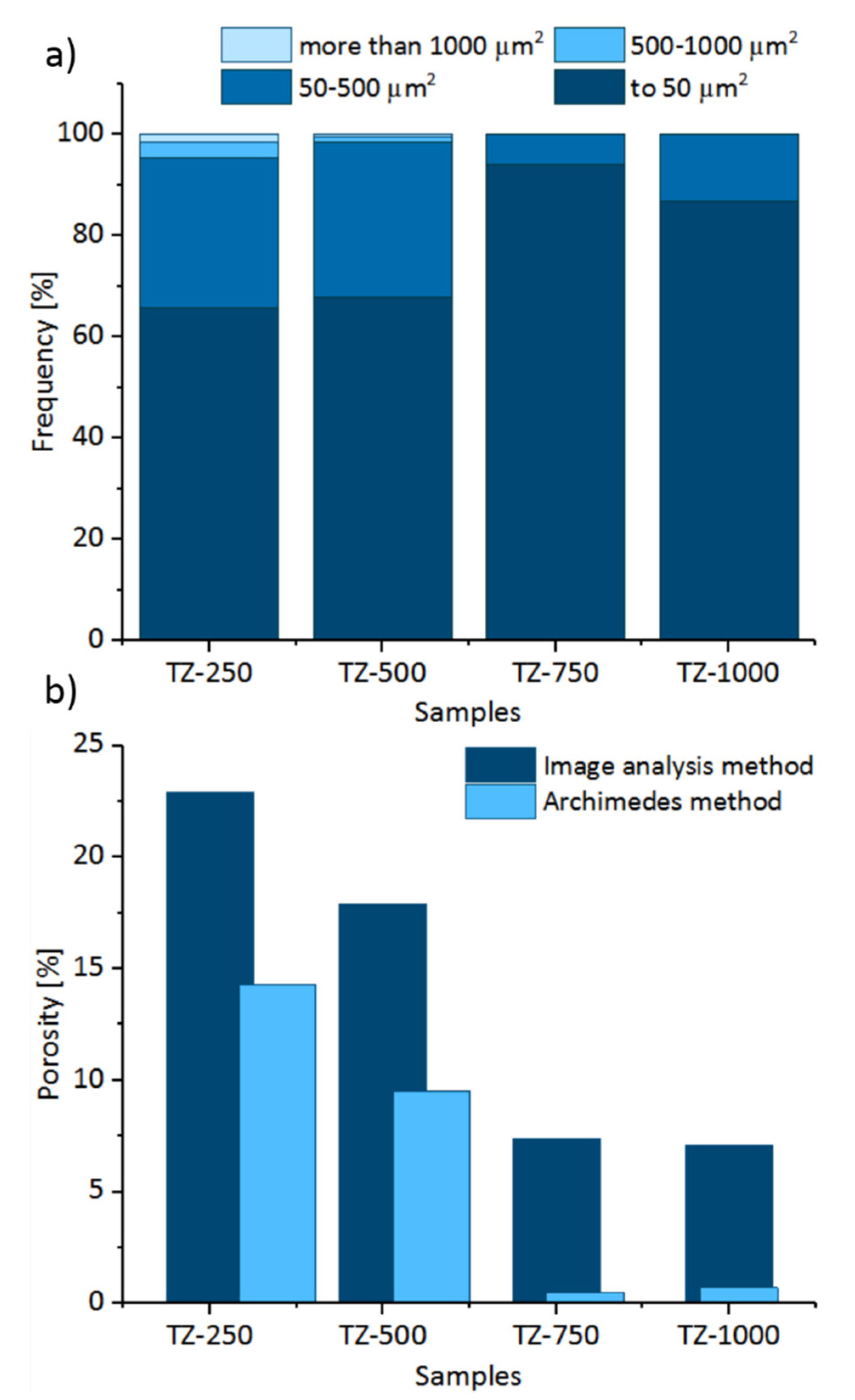


| Phase | Lattice Parameters | ICDD * | Samples | |||
|---|---|---|---|---|---|---|
| TZ-250 | TZ-500 | TZ-750 | TZ-1000 | |||
| α | a0 (nm) | 0.2951 ** | 0.3013(2) | 0.3011(2) | 0.3006(2) | 0.3005(3) |
| c0 (nm) | 0.4683 ** | 0.4783(5) | 0.4780(5) | 0.4773(5) | 0.4772(5) | |
| Sample | Feret’s Diameter (μm) | Circularity | |||
|---|---|---|---|---|---|
| Minimum Value | Maximum Value | Average Value | Standard Deviation | Average Value | |
| TZ-250 | 2.29 | 218.99 | 14.84 | 18.66 | 0.58 |
| TZ-500 | 2.17 | 169.00 | 12.69 | 13.10 | 0.61 |
| TZ-750 | 2.17 | 43.44 | 6.53 | 4.41 | 0.70 |
| TZ-1000 | 2.17 | 42.86 | 7.44 | 5.64 | 0.70 |
| Parameter | Sample | Minimum Value | Maximum Value | Average Value | Standard Deviation |
|---|---|---|---|---|---|
| ag (µm2) | TZ-250 | 2.03 | 492.58 | 35.06 | 40.99 |
| TZ-500 | 2.01 | 496.13 | 33.15 | 44.50 | |
| TZ-750 | 2.01 | 474.56 | 21.17 | 30.77 | |
| TZ-1000 | 2.03 | 492.58 | 34.85 | 41.04 |
© 2020 by the authors. Licensee MDPI, Basel, Switzerland. This article is an open access article distributed under the terms and conditions of the Creative Commons Attribution (CC BY) license (http://creativecommons.org/licenses/by/4.0/).
Share and Cite
Matuła, I.; Dercz, G.; Zubko, M.; Maszybrocka, J.; Jurek-Suliga, J.; Golba, S.; Jendrzejewska, I. Microstructure and Porosity Evolution of the Ti–35Zr Biomedical Alloy Produced by Elemental Powder Metallurgy. Materials 2020, 13, 4539. https://doi.org/10.3390/ma13204539
Matuła I, Dercz G, Zubko M, Maszybrocka J, Jurek-Suliga J, Golba S, Jendrzejewska I. Microstructure and Porosity Evolution of the Ti–35Zr Biomedical Alloy Produced by Elemental Powder Metallurgy. Materials. 2020; 13(20):4539. https://doi.org/10.3390/ma13204539
Chicago/Turabian StyleMatuła, Izabela, Grzegorz Dercz, Maciej Zubko, Joanna Maszybrocka, Justyna Jurek-Suliga, Sylwia Golba, and Izabela Jendrzejewska. 2020. "Microstructure and Porosity Evolution of the Ti–35Zr Biomedical Alloy Produced by Elemental Powder Metallurgy" Materials 13, no. 20: 4539. https://doi.org/10.3390/ma13204539
APA StyleMatuła, I., Dercz, G., Zubko, M., Maszybrocka, J., Jurek-Suliga, J., Golba, S., & Jendrzejewska, I. (2020). Microstructure and Porosity Evolution of the Ti–35Zr Biomedical Alloy Produced by Elemental Powder Metallurgy. Materials, 13(20), 4539. https://doi.org/10.3390/ma13204539