Article

A Complete CFD Methodology Based on Iterative Model Adjustment to Improve Wind Simulation Accuracy in Highly Dense Forest Area

1
Meteodyn France, 7 and 9 Rue Duguay Trouin, 44800 Saint-Herblain, France
2
EDF Power Solutions, 43 Bd des Bouvets, 92000 Nanterre, France
*
Author to whom correspondence should be addressed.
Energies 2026, 19(9), 2243; https://doi.org/10.3390/en19092243
Submission received: 23 March 2026 / Revised: 27 April 2026 / Accepted: 28 April 2026 / Published: 6 May 2026
(This article belongs to the Section A3: Wind, Wave and Tidal Energy)

Abstract

Wind resource assessment (WRA) in densely forested and complex terrain remains challenging due to strong canopy-induced turbulence and enhanced wind shear, which significantly affect wind flow characteristics and increase modeling uncertainties. Methods relying on Plant Area Density (PAD) or Leaf Area Density (LAD) estimation require costly airborne surveys and site-specific calibration, limiting their industrial applicability. Based on a scientific collaboration between Meteodyn and EDF Power, this study proposes a complete and reproducible Computational Fluid Dynamics (CFD) methodology built around an Iterative Model Adjustment (IMA) procedure implemented in Meteodyn WT™ to improve wind resource assessment accuracy in highly forested areas using standard industrial inputs. The IMA procedure iteratively calibrates the canopy drag coefficient and forest model parameters using wind speed profile measurements from a single reference mast until the simulated wind shear matches observations. The methodology was evaluated at three sites located in Finland, France, and Scotland, yielding six calibration and cross-prediction cases under heterogeneous forest and complex terrain conditions. Cross-prediction uncertainties were reduced significantly, with horizontal mean speed errors decreasing from the range [1.0–9.5%] to [0.5–2.2%] and a global mean absolute error of approximately 1.1%. The study provides new physical insight into the sensitivity of the canopy drag force term within RANS-based forest models, showing that both drag coefficient and canopy height have a comparable and jointly necessary influence on wind shear simulation. These findings demonstrate that robust and accurate wind resource assessment can be achieved in complex terrain and forested areas without relying on remote-sensing-derived canopy density datasets, providing a pragmatic and industrially scalable alternative.

1. Introduction

Due to favorable circumstances (fewer regulations and social resistance) and a shortage of space, wind farms are increasingly developed in densely forested areas. Developers of wind farms are encountering new difficulties in achieving high accuracy in wind speed simulations due to the significant impact of forests on wind flow. In the atmospheric boundary layer, perturbations induced by ground surfaces with high roughness values, such as forests, generate a high level of turbulence and strong wind shear, which have clearly an influence on the risk associated with wind farm development [1,2]. Numerous studies have recently examined a wide range of numerical models [3,4,5,6,7,8,9,10,11,12,13,14,15,16,17,18], such as linear models, RANS approaches using CFD or LES models, for simulating wind flow in wooded environments.
Several studies have showed that the linear model assumptions are insufficient to reproduce the vertical wind shear and flow dynamics characteristic of densely forested terrain [3,9,19].
LES correctly captures forest edge flow dynamics by representing the canopy as a distributed momentum sink with additional production and dissipation source terms in the turbulence equations, driven by PAD or LAD profiles. LES simulations have demonstrated accurate reproduction of turbulent flow structure above and within forest canopies [4,5,6] and are frequently used as benchmark references for validating simpler models [9,20]. However, LES remains impractical for industrial wind resource assessment for two reasons. First, the computational cost is prohibitive: Ivanell et al. [9] reported that LES simulations at a forested benchmark site required 50 to 100 times more computational resources than equivalent RANS simulations for the same domain. In contrast, the RANS approach used in this study achieves convergence in 13 to 18 min per sector on a standard four-core workstation, making a complete 20-sector assessment in under six hours.
Second, LES requires time-varying turbulent inflow boundary conditions that correctly reproduce the three-dimensional structure of the atmospheric boundary layer—typically generated through a separate precursor simulation—adding both computational overhead and methodological complexity that is incompatible with routine industrial practice. Despite recent computational advances such as GPU parallelization and pragmatic simulation strategies—including the PALM-based framework proposed by [19], which attempts to reduce computational cost by selecting a representative stable time period from met mast data and prescribing time-varying boundary conditions from mesoscale reanalysis data through offline nesting—LES remains significantly more complex and computationally demanding than the steady-state RANS for industrial WRA.
In light of these limitations, RANS CFD methods, using different turbulence closures, have emerged as the most widely adopted approach for wind resource assessment in forested and complex terrain, offering a practical balance between physical accuracy and computational efficiency [3,9,10,11,12,13,14,15,21,22,23,24,25]. Unlike linear models, RANS solves the full time-averaged momentum and turbulence transport equations, enabling the representation of flow separation, recirculation, and canopy-induced momentum absorption through a distributed volumetric drag force term [21,22]. Wind resource assessments in wooded and complex terrain have been frequently and successfully conducted using RANS CFD methods [3,9,10,11,12,13,14,15,21,22,23,24,25], and Barber et al. [19] confirmed across seven WRA workflows at five complex terrain sites that RANS CFD consistently outperforms linear models when forest and terrain complexity co-occur.
However, the application of RANS CFD to highly forested areas remains challenging. Several studies have identified that RANS accuracy degrades significantly when canopy density inputs are absent or poorly constrained [9,21]. Ivanell et al. [9] demonstrated at the Ryningsnäs forested benchmark site that RANS models using default or literature-based drag coefficients produced errors comparable to linear models.
As a consequence, most industrial RANS applications rely on default or empirically assigned drag coefficients C d , which introduces large and site-dependent uncertainties in wind shear prediction, particularly in dense and heterogeneous forest conditions [13,14]. The central role of C d in RANS forest model accuracy has been clearly established in Katul et al. [22]. It demonstrated that C d is the dominant source of modeling uncertainty in canopy flows—aggregating the combined effects of forest density, tree species, canopy porosity, and leaf angle distribution into a single volumetric parameter that cannot be measured directly. The same study showed that a first-order mixing-length closure performs comparably to second-order models for reproducing mean wind speed, shear stress, and turbulent kinetic energy profiles in canopy flows, and that the theoretical superiority of higher-order closures is negated by the large uncertainty associated with C d in routine applications. This finding establishes that accurately determining C d is more critical to RANS forest model performance than the choice of turbulence closure—a conclusion that directly motivates the calibration approach proposed in the present study. Site-specific C d determination has been achieved using PAD or LAD profiles derived from airborne laser scanning (ALS) campaigns [7,26,27], with Ivanell et al. [9] confirming that at the forested Ryningsnäs benchmark that ALS-derived PAD data yields reasonable agreement with measurements for RANS models. Unfortunately, acquiring PAD or LAD data requires dedicated airborne survey campaigns involving specialized aircraft, LiDAR sensors, and expert post-processing, which are costly, logistically demanding, and incompatible with standard industrial wind resource assessment workflows [7,8,27]. As a consequence, no practical method currently exists to determine site-specific C d for industrial RANS forest modeling without remote sensing data—a gap that the present study addresses directly.
Within this scope, this work has been initiated through a scientific collaboration between EDF Power and Meteodyn, with the objective of developing a clear and reproducible CFD methodology to improve wind simulation accuracy in highly forested areas using only standard industrial inputs. The materials used in this study are therefore limited to those typically available in operational wind resource assessment projects: publicly available orography and roughness maps, and wind speed profile measurements at a single meteorological mast.
This article proposes a novel approach to determine CFD forest model parameters using an iterative procedure based on in situ wind speed measurements at a single reference mast. Previous studies have addressed the C d determination problem through two main approaches: either by prescribing constant values taken from the literature or wind tunnel experiments [13,22,28], or by deriving spatially varying C d PAD products from airborne LiDAR surveys [7,9,21]. In contrast, the present study infers C d directly from wind speed profile measurements at several elevations on a single mast, without requiring any remote sensing data.
To the best of our knowledge, this is the first study in which a RANS-based forest canopy model is calibrated exclusively from wind speed profile measurements at a single meteorological mast and evaluated through systematic cross-predictions in complex terrain. Ivanell et al. [9] noted that the turbulence closure constants of Sogachev et al. [29] perform favourably for heterogeneous forested sites, while noting that C d determination from ALS-derived PAD data remains the standard approach. While Lopes et al. [30] emphasized that neither standard parameterizations nor universal coefficient values are appropriate for arbitrary site conditions—highlighting the fundamental site-dependence of C d that a fixed literature value cannot capture. The IMA procedure proposed here resolves this uncertainty directly by inferring C d from measurements that reflect the actual forest conditions at the site under assessment.
The methodology is evaluated across three sites located in Finland, France, and Scotland, each equipped with two meteorological masts, common measurement periods, and heterogeneous forest coverage under different terrain complexity conditions. This configuration yields six independent calibration and cross-prediction cases, spanning a wide range of forest densities, canopy heights, and inter-mast distances from 2 to 6.6 km, providing a robust basis for assessing the generalizability and industrial relevance of the proposed approach. The main contributions of this work are:
  • A complete and reproducible CFD methodology (IMA) for wind resource assessment in densely forested and complex terrain, requiring only standard industrial inputs—publicly available roughness and orography maps and wind speed profile measurements at a single meteorological mast—without relying on remote-sensing-derived canopy density data.
  • A systematic sensitivity analysis of the forest model parameters—canopy height and drag coefficient C d —demonstrating that both variables have a influence on wind shear simulation in dense forest conditions.
  • Validation of the spatial constant drag coefficient assumption across six cross-prediction cases under heterogeneous forest conditions and complex terrain, including the finding that forest-induced flow effects extend up to 1 km into surrounding clearing areas, demonstrating that IMA can be applied from masts located outside the forest boundary.

2. Site Description and Computational Setup

2.1. Site Description

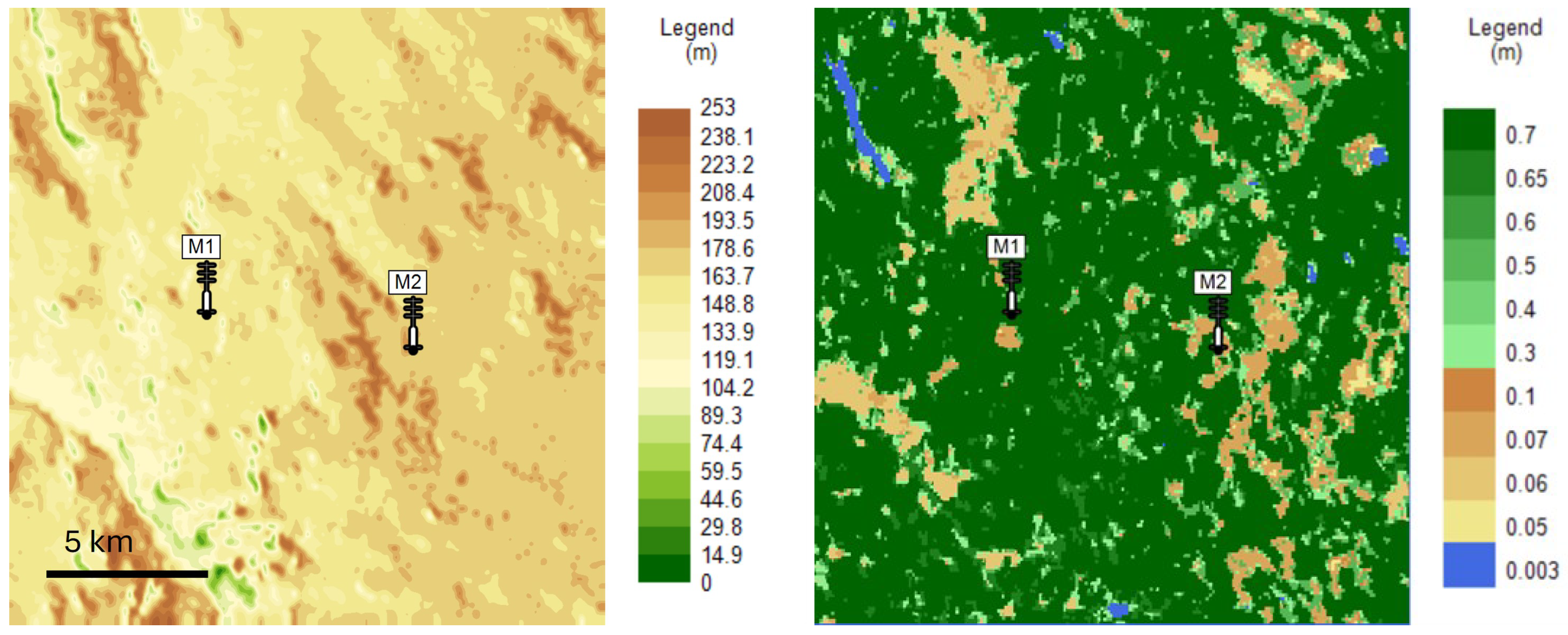
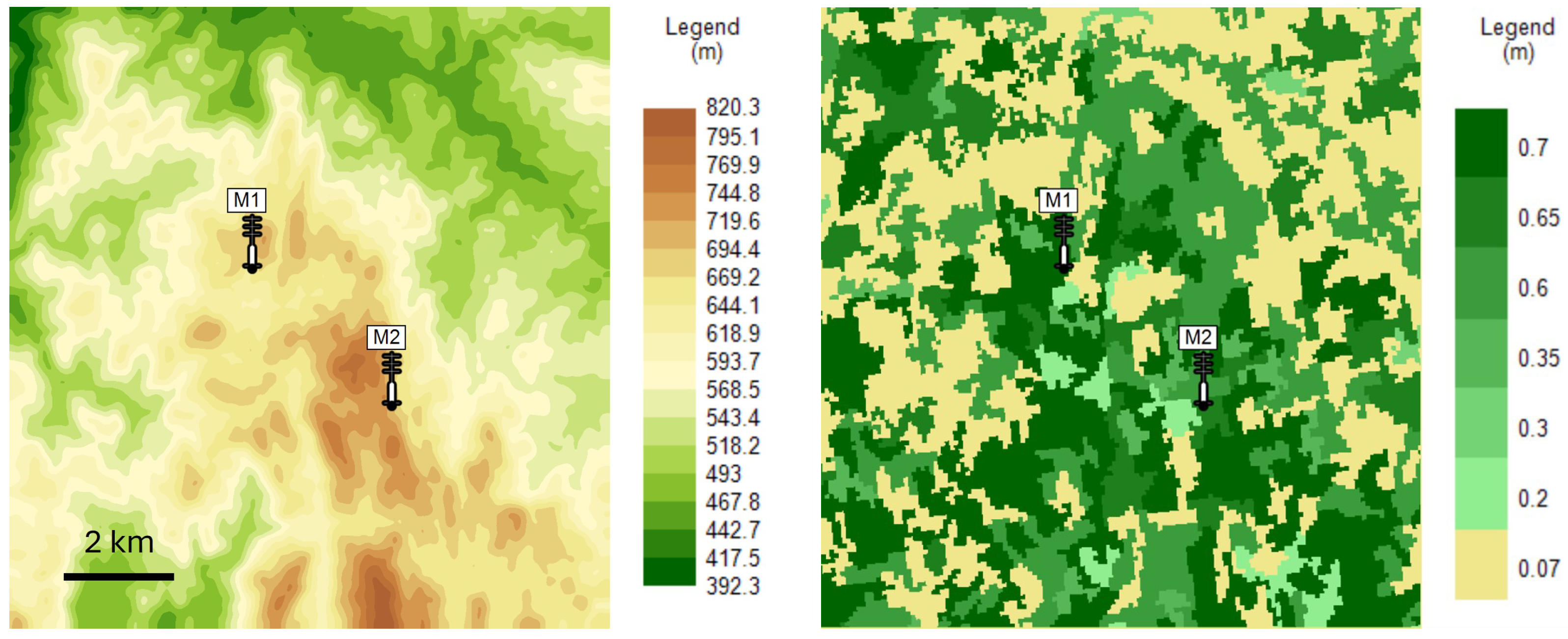
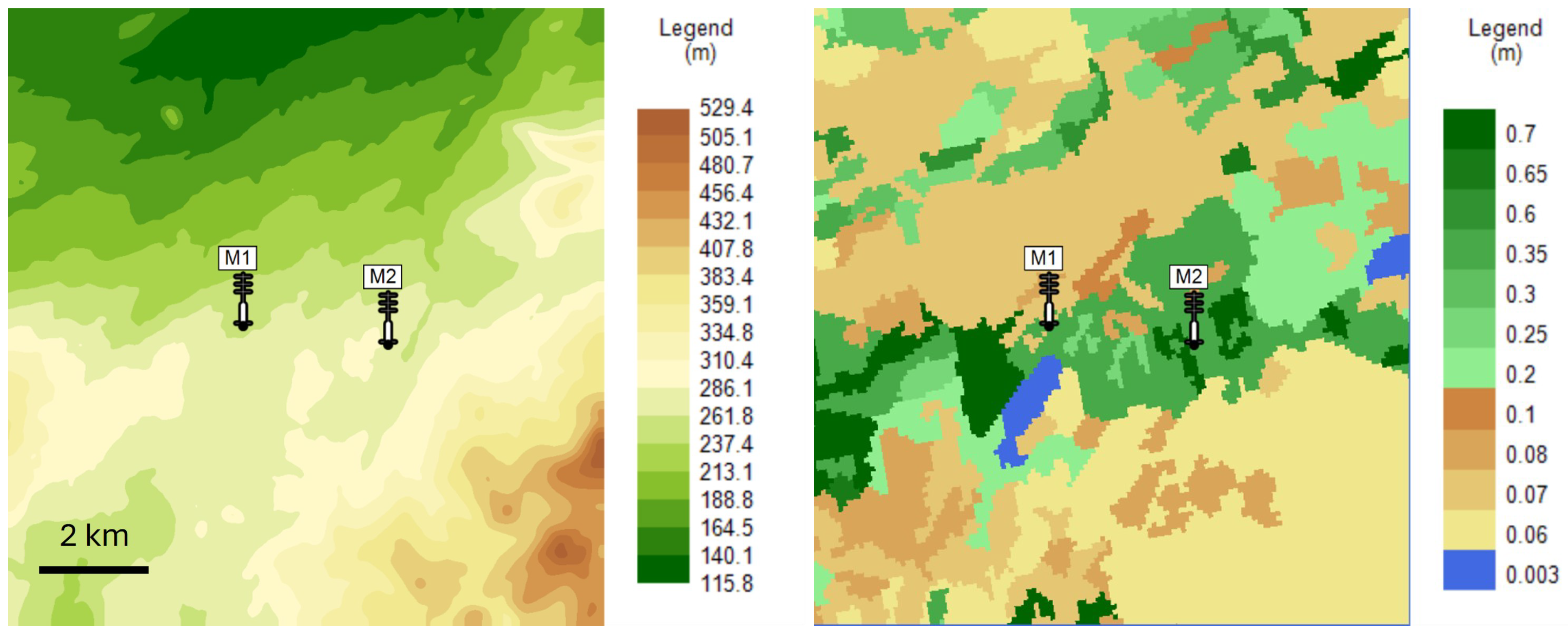
In this study, meteorological mast measurements at three sites were provided by EDF Power in different countries: Finland, France, and Scotland. These sites were specifically selected for their challenging conditions, combining dense forest coverage with varying levels of terrain complexity. The publicly available orography and land cover maps used for the terrain description and derived from satellite data, are presented in Table 1 and illustrated in Figure 1, Figure 2 and Figure 3. Two different land cover maps were used to match the measurement period and in situ observations as closely as possible. For sites 2 and 3, Corine Land Cover (CLC) roughness maps were chosen [31], while for Site 1, a Copernicus Land Cover (LC) roughness map was used [32].
All sites use the NASADEM orography map with a 30 m resolution [33] except for Site 1, which is based on the EU-DEM 1.1 [34] map because the NASADEM orography map is unavailable for Finland. Terrain conditions range from moderately complex terrain at Site 1 to complex terrain at Sites 2 and 3, with maximum altitude differences of approximately 100 m for Site 1, 500 m for Site 2 and 520 m for Site 3.
For wind engineering application, roughness length values are generally deduced from land cover maps using conversion tables [35,36,37,38,39]. These conversion tables provide useful roughness information but are recognized as uncertain and strongly depending of the geographical region of application, resulting in wind variety of proposed values for the same dataset. In Meteodyn WT, conversion tables have been determined using a global averaging approach based on several available sources [23]. For instance, the 0.7 m roughness length value corresponding to a coniferous forest area— displayed in Figure 1, Figure 2 and Figure 3—was determined from eight conversion table sources with roughness length values ranging from 0.5 m to 1.2 m.
The three sites exhibit a wide variety of forest covering conditions. A roughness length variation from 0.003 m to 0.7 m is observed across all sites on the 100 m-resolution roughness maps, showing heterogeneous forest cover with clearings. Canopy heights near Mast 1 (M1) and Mast 2 (M2) were estimated from on-site observations, photographs, and Google Earth imagery, based on a quarter-circle area of approximately 400 m radius centered at each mast position and oriented in the prevailing wind direction. These observations, presented in Table 1, are consistent with the roughness maps and show that forest conditions at Site 1 are nearly identical between M1 and M2 in the prevailing wind direction of approximately 200° to 230°. At Site 2 and 3, heterogeneous forest conditions are observed between M1 and M2. The uncertainty associated with these canopy height estimates is addressed in the sensitivity analysis of Section 4.1, which demonstrates that a canopy height mis-estimation of 7 m produces an average cross-prediction error of approximately 0.8%. According to on-site observations, the dominant tree species at all three sites are coniferous.
At each site, two meteorological masts are equipped with cup anemometers at three elevations as detailed in Table 1. All measurement data covers a common one-year period with high data quality and coverage exceeding 98%. A measurement uncertainty of 2.5% is assumed for wind speeds at all sites, consistent with wind engineering guidelines and comparable mast observations [40,41,42]. As displayed in Table 1, the inter-mast distances are 6.6 km, 4.4 km and 3.1 km for Sites 1, 2, and 3, respectively.

2.2. Computational Setup

All CFD parameters used in this study are presented in Table 2. Regarding mesh generation, minimal vertical and horizontal resolutions of 4 m and 25 m are used for modeling. A vertical expansion rate of 1.2 allows the cell size to progressively expand from the ground to the top. A horizontal expansion rate of 1.1 allows the horizontal cell size to grow from center to border. Furthermore, Meteodyn WT™ (version 1.10.1) provides the surface mesh refinement option, also called “the mesh mapping”, which ensures fine mesh resolution in any interesting area without the impact of horizontal expansion rate.
The wind direction is divided into 20 wind sectors. It means that, for example, in the first sector, the wind is binned from the 0° direction (true north) to the 18° direction (north-east) and in the second sector from 18° to 36°. CFD computations are launched for 20 wind sectors for each site. CFD computations for all sites and wind direction sectors achieved full numerical convergence, with residuals falling below the required tolerance, yielding reliable and consistent flow field solutions.
For all sites, the averaged CFD computation duration per sector ranges from 13 min to 18 min depending on the input land-cover maps and the computation time necessary to reach a suitable convergence. All computations have been launched using a standard performance computer and multiple core parallel computation (4 cores, 64 GB RAM).

3. Forest CFD Methodology and Validation Framework

This section presents the complete CFD methodology proposed in this study for wind resource assessment in densely forested areas. The methodology consists of four interconnected components described sequentially in the following subsections. Section 3.1 introduces the RANS governing equations implemented in Meteodyn WT™, including the turbulence closure model and boundary conditions. Section 3.2 describes the forest canopy model and establishes the volumetric drag coefficient C d as the dominant parameter governing wind shear simulation in forested terrain. Section 3.3 presents the Iterative Model Adjustment (IMA) procedure—the central contribution of this work—which determines C d from wind speed profile measurements at a single reference mast without requiring remote sensing data. Finally, Section 3.4 defines the cross-prediction validation framework and error metrics used to evaluate IMA performance in Section 4.
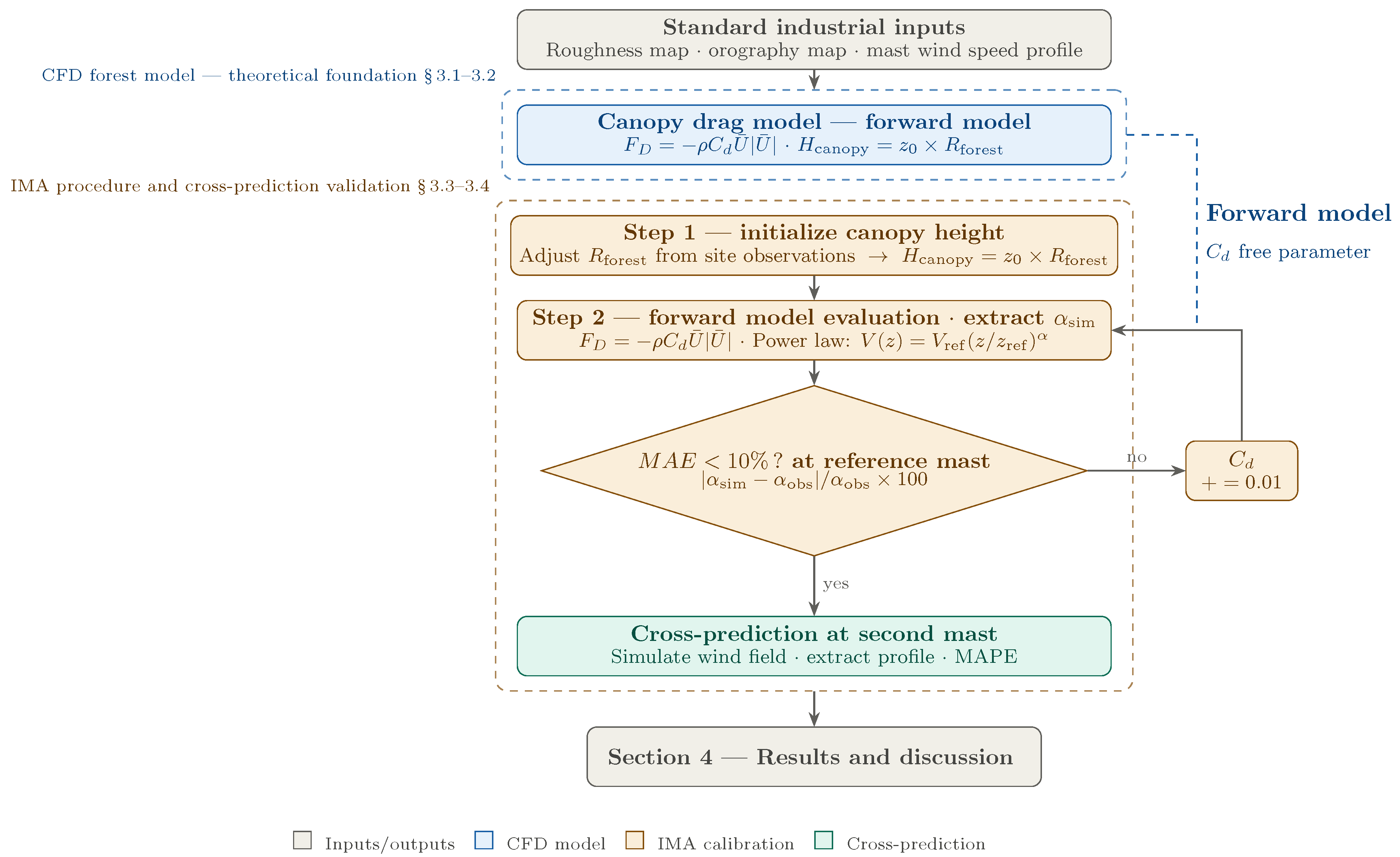
The logical relationship between these four components is summarized in Figure 4: the governing equations and canopy model form the physical foundation, IMA calibrates the key parameter C d using in situ measurements, and the cross-prediction framework provides the validation strategy applied across six independent cases at three international sites.

3.1. Forest Modeling

The Computational Fluid Dynamics (CFD) approach is based on solving the full Reynolds-Averaged Navier-Stokes equations (RANS), which enable the simulation of flow separation and recirculation phenomena over complex terrains. Meteodyn WT™ is a commercial site-assessment software designed to model the atmospheric boundary layer. The turbulence is represented using the turbulent-viscosity hypothesis through a mixing-length model [43]. By incorporating advanced numerical methods—a coupled multi-grid solver-Meteodyn WT™ achieves an efficient solution [44] validated in various cases [3,13,14,25,45]. In Meteodyn WT™, the incompressible atmospheric flow is described by the Reynolds-averaged Navier–Stokes equations, which are given by:
( ρ u i ) x i = 0
( ρ u ¯ j u ¯ i ) x j = P ¯ x i + x j [ μ ( u ¯ i x j + u ¯ j x i ) ] + F i
where ρ is the air density (assumed constant), u i ¯ the mean velocity components, P ¯ the mean pressure, and μ the effective viscosity. The term F i represents external forces, including canopy-induced drag.
The Reynolds stress tensor ρ u i u j ¯ arises from the averaging of the nonlinear advection term and represents the effect of turbulence on the mean flow. This term introduces additional unknowns and therefore requires a turbulence closure model. The Navier–Stokes equations are closed using the Boussinesq hypothesis:
ρ u i u j ¯ = ν T u ¯ i x j + u ¯ j x i = 2 ν T S i j
where S i j is the mean rate-of-strain tensor. The turbulence viscosity ν T is obtained using the Prandtl mixing-length model:
ν T = k L T
where k is turbulent kinetic energy, solved via the turbulent kinetic energy transport equation as below:
U j k x j = P k ϵ + x j ( ν T σ k k x j )
The turbulent production term P k can be expressed as:
P k ν T = 2 u x 2 + v y 2 + w z 2 + u y + v x 2 + v z + w y 2 + w x + u z 2
The dissipation term ϵ is written as:
ϵ = C μ ν T L T 2 k
where C μ is constant coefficient which depends on the thermal stability condition. The turbulence length L T is given by [46]:
L T = 2 S m 1.5 l
where the coefficient S m depends on the thermal stability [46]. And the mixing length l will be defined later in the Canopy model.
The turbulent fluxes are linked to the gradients of the mean variables via the concept of turbulent viscosity which can be modeled as the product of a wind speed scale, generally the square root of the turbulent kinetic energy k, and a turbulent length scale L T . k is solved via the transport equation.
At the inlet, the logarithmic wind speed profile U i n and the turbulent kinetic energy profile k depend on the thermal stability condition. A free outflow condition is applied at the outlet. At the bottom boundary, turbulent production is assumed to be balanced by dissipation. At the top boundary, a free outflow condition is applied; symmetric boundary conditions are imposed for k. Symmetric boundary conditions are also imposed at the lateral boundaries.

3.2. Canopy Model

In Meteodyn WT™, canopy area is considered as the momentum energy sink where drag forces are applied, and turbulence length scales are modified. Perturbations induced by forests are modeled by including a drag force term described below in momentum conservation equations:
F D = ρ C d ( z ) U ¯ | U |
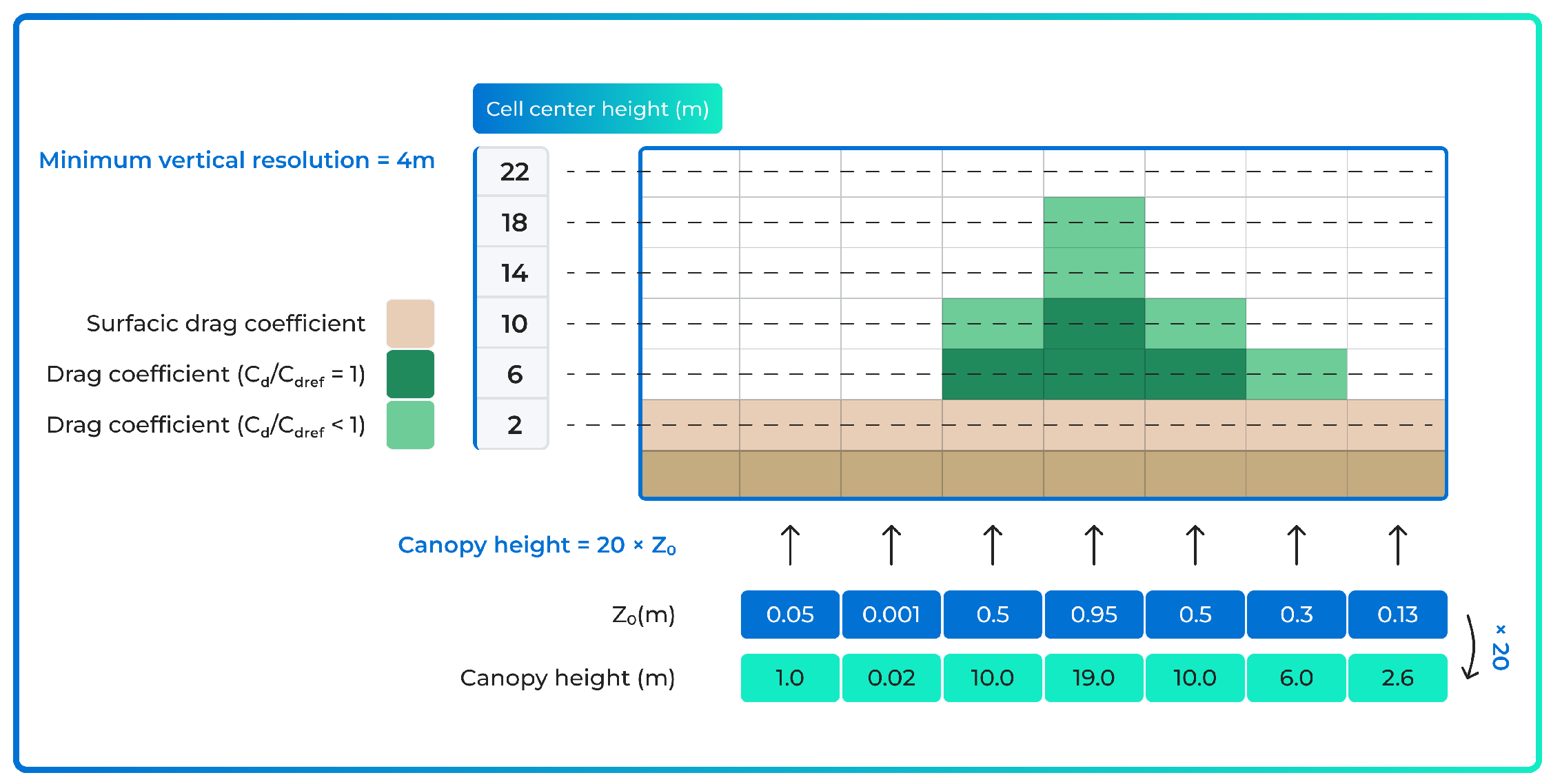
U ¯ is the wind speed in the main direction and C d ( z ) is a volumetric drag coefficient proportional to the forest density and a vertical leaf area profile. This leaf area profile is used to describe the tree shape by considering fewer leaves at the top of the trees. As a consequence, a linear reduction of the drag coefficient in the top 25% of the forest is considered as described in Figure 5. This linear reduction reflects the decrease in foliage density near the canopy top, consistent with observed LAD profiles in coniferous forests [7].
Following Liu et al. [28] and Katul et al. [22], the production and dissipation terms within the forest canopy are modified as follows:
P k = P k i n ( 6 ) , wo forest model β p C d ( z ) | U ¯ | 3 , w forest model
The dissipation rate for high Reynolds number is modeled as:
ϵ = m a x ( ϵ c c , ϵ f d ) ϵ c c = C μ ν T L T 2 k , wo forest model ϵ f d = β D C d ( z ) | U ¯ | k , w forest model
The values β p = 1.0 and β D = 4.0 are adopted following Liu et al. [28]. The volumetric drag coefficient C d ( z ) is the central parameter of the forest canopy model. As shown in Equation (9) and the production and dissipation terms above, C d ( z ) simultaneously governs three coupled physical processes: momentum absorption from the mean flow, turbulent kinetic energy production through canopy wake formation, and turbulent kinetic energy dissipation through viscous drag on canopy elements. This triple role explains why C d ( z ) is the dominant source of modeling uncertainty in RANS forest models, as demonstrated by Katul et al. [22]—its value aggregates the combined effects of forest density, tree species, canopy porosity, and leaf area distribution into a single volumetric parameter. The forest density is represented by the volumetric reference drag coefficient C d appearing in the definition of the volumetric drag coefficient C d ( z ) :
C d ( z ) = C d × f s h a p e ( z )
where C d is the reference drag coefficient prescribed by the user, and f s h a p e ( z ) is a vertical attenuation function describing the tree shape through a linear decay of canopy drag in the upper 25% of the forest height:
f s h a p e ( z ) = 1 , z 0.75 H c a n o p y , 1 z 0.75 H c a n o p y 0.25 H c a n o p y , 0.75 H c a n o p y < z < H c a n o p y , 0 , z H c a n o p y ,
where H c a n o p y = z 0 × R f o r e s t and z 0 correspond to the roughness length value of the map. The forest ratio R f o r e s t is set to 20 by default. This default value is obtained through the calibration of the wind speed profiles based on the analytical wind profiles in Eurocode 1 EC1 [24,47].
In the IMA procedure, C d is the quantity determined iteratively from mast measurements. The vertical profile f s h a p e ( z ) is prescribed by the model formulation and remains fixed throughout calibration. The canopy height H c a n o p y , which determines the vertical extent of the drag field, is derived from the roughness map z 0 through the forest ratio R f o r e s t and adjusted prior to the iterative C d calibration.
The canopy height H c a n o p y , and the depth of the roughness sublayer h R S L , where the forest canopy directly impinges on the flow, can be expressed as [21]:
h R S L = H c a n o p y + h a d d
where h a d d is the depth of the roughness sublayer set to 15 m by default [21].
The mixing length l is assumed to be a constant 2 m within the forest canopy and increases linearly for z h R S L . Within roughness sub-layer, a weighting factor c is introduced to attenuate the forest effect.
l 1 = l 0 1 + l f 1 , z < H c a n o p y ( 1 c ) ( l 0 1 + l f 1 ) + c l 0 1 + 1 κ z , h c z < h RSL l 0 1 + 1 κ z , z h RSL
where the dimensionless height with the canopy transition zone is defined as:
c = z H c a n o p y h a d d
The characteristic length scales are defined as l 0 = 100 m.

3.3. Iterative Model Adjustment (IMA) Methodology in Forested Areas

3.3.1. Physical Basis and Inverse Problem Formulation

The accurate determination of the volumetric drag coefficient C d is the central challenge in RANS-based forest wind modeling. C d simultaneously governs momentum absorption, turbulent kinetic energy production, and turbulent kinetic energy dissipation within the canopy zone—making it the dominant source of modeling uncertainty regardless of turbulence closure order [22]. However, C d is not a directly observable quantity: it aggregates the combined effects of forest density, tree species, canopy porosity, and leaf area distribution into a single volumetric parameter that cannot be measured directly in the field.
The IMA methodology proposed in this work addresses this challenge by treating C d as an unknown to be inferred from observable wind speed profile measurements at a single reference mast. Formally, IMA solves an inverse problem: given the observed wind shear exponent α o b s at the reference mast, the site-specific drag coefficient C d is determined such that the RANS simulation reproduces α o b s within a prescribed convergence tolerance. The wind shear exponent α describes the variation of wind speed with height according to the power law:
V ( z ) = V r e f z z r e f α
where V r e f is the reference wind speed measured at height z r e f and z is the height above ground. In this work, α is calculated from wind speed measurements at the highest and lowest anemometer elevations at each mast and used as the primary vertical profile validation metric throughout Section 3.4.
This inverse formulation is physically justified by the monotonic relationship between C d and the simulated shear exponent α s i m : increasing C d strengthens the momentum sink in the canopy zone, reducing wind speed at lower elevations while leaving wind speeds at hub height relatively unaffected, thereby increasing α s i m . Conversely, reducing C d weakens momentum absorption, producing a flatter vertical wind profile and a lower α s i m . This monotonic relationship is confirmed across all three sites in the sensitivity analysis.
The method is based on the hypothesis that C d remains spatially constant across the whole site area in forest environments. Although forest density is clearly heterogeneous at the meter scale, the IMA hypothesis proposes that at the scale of wind resource assessment (inter-mast distances of 2–6.6 km), the spatial variability of forest drag averages out and can be represented by a single effective site-averaged C d value. This hypothesis—analogous to the use of a single roughness length to represent a heterogeneous surface in large-scale models—is non-trivial and requires experimental validation.

3.3.2. Description of the IMA Procedure

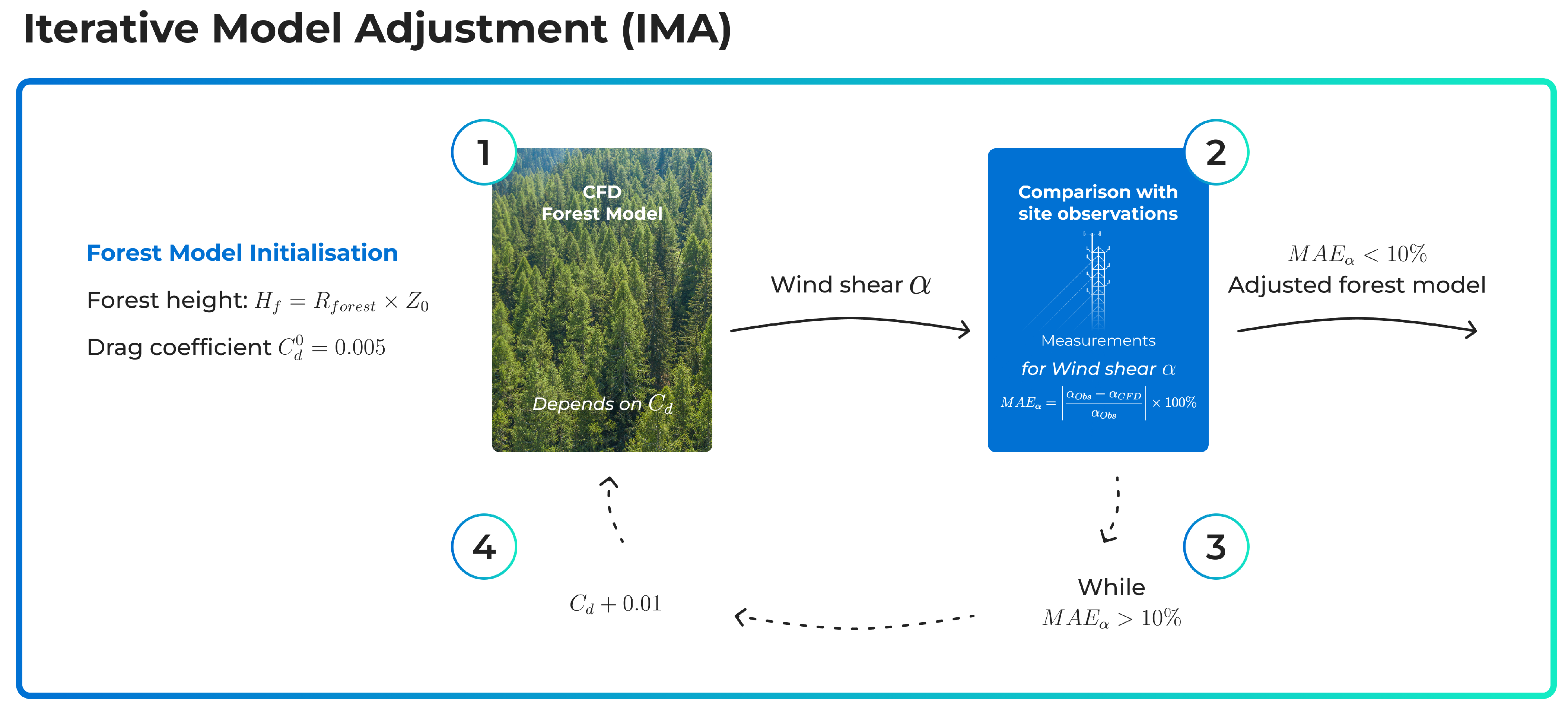
The IMA procedure is described in Figure 6 and consists of two sequential steps. The complete workflow is summarized below.
  • Step 1—Forest model initialization: canopy height and roughness length adjustment.
  • Canopy height is defined by the roughness length z 0 and the forest ratio R f o r e s t as H c a n o p y = z 0 × R f o r e s t . Starting from the default roughness map values and the default forest ratio R f o r e s t = 20 , these variables are first adjusted according to on-site observations. Roughness length values are provided by the land cover map, while the forest ratio is estimated from the approximate canopy height observed at the site using on-site visits, photographs, or Google Earth imagery [35,36,37,38].
  • When canopy height is systematically underestimated across the whole area, the forest ratio is rescaled accordingly. For example, for a site with dominant coniferous trees of approximately 30 m height and a roughness length of z 0 = 0.7 m, the appropriate forest ratio is R f o r e s t = 30 / 0.7 43 . Conversely, when local canopy height inconsistencies are observed, the roughness length values are corrected in the specific area by modifying the conversion table or by manually adjusting roughness length values in that region.
  • Step 2—Iterative drag coefficient adjustment.
  • The reference drag coefficient C d directly controls the strength of the canopy momentum sink and therefore the simulated wind shear exponent α s i m . C d is treated as a free parameter and determined iteratively as follows:
    0.
    Initialize C d = 0.005 (Meteodyn WT™ default value).
    1.
    Run the full CFD simulation for all 20 wind direction sectors using the current C d value. Extract the simulated mean wind speed profile at the reference mast location and compute the simulated shear exponent α s i m .
    2.
    Compute the shear convergence criterion:
    M A E α = 100 × α o b s α s i m α o b s < 10 %
    3.
    If M A E α < 10 % : the calibration is complete. Proceed to cross-prediction.
    4.
    If M A E α 10 % : increment C d C d + 0.01 and return to step (1).
The 10% convergence criterion in Equation (16) was defined as a practical threshold that is tighter than the default simulation errors observed at all six reference mast configurations, while remaining achievable in practice due to the monotonic relationship between C d and α sim , which guarantees convergence to a unique solution. Successful convergence was demonstrated at all six configurations across the three sites, requiring between 2 and 7 iterations (Table 3).
The increment of Δ C d = 0.01 was selected as a compromise between calibration precision and computational efficiency. The sensitivity analysis presented in Section 4 shows that a change of 0.01 in C d produces a mean shear exponent change of approximately 0.02–0.05 across the three sites—well below the 10% convergence threshold—ensuring that the iterative procedure does not overshoot the target. The maximum number of iterations required across all six calibration cases was seven (Site 2, Mast 1), with an average of approximately three to four iterations per case.

3.3.3. Scope and Assumptions of the IMA Procedure

Two assumptions underlie the IMA methodology, each of which is explicitly addressed in the results and discussion:
  • Spatial homogeneity of C d : The constant C d assumption does not require spatial uniformity of forest cover across the site. The spatial heterogeneity of the canopy—including variations in canopy height between forested patches, clearings, and areas of different vegetation density—is already represented through the spatially varying roughness length z 0 of the land cover map, which determines the local canopy height H c a n o p y at each computational cell. Forest model activation therefore varies spatially across the domain in a manner consistent with the roughness map. A single C d value is assumed to represent the forest drag properties across the entire site. While z 0 governs the spatial distribution and vertical extent of the drag field, C d governs its aerodynamic magnitude—specifically the drag per unit volume of canopy determined by tree species characteristics such as needle density, branch architecture, and crown shape. This assumption is validated across six cross-prediction cases in Section 4, including heterogeneous forest conditions and inter-mast distances from 2 to 6.6 km, yielding a global mean absolute error of approximately 1.1%.
  • Neutral atmospheric stability: CFD simulations are performed under neutral stability conditions only, based on the hypothesis that full-year averaging satisfies near-neutral conditions [27]. While atmospheric stability has been identified as a significant source of modeling uncertainty in forested terrain [16], the neutral assumption is consistent with standard industrial WRA practice. The influence of thermal stability on IMA calibration remains an open question identified for future work.
The adjusted forest model is finally used to simulate the wind flow across the full site domain using the reference mast as the inlet boundary condition. IMA can be applied to either the directional or the sector-averaged mean wind vertical profile. In this work, IMA is applied to the mean vertical profile including all wind sectors. To reduce CFD computation time, it is recommended to apply IMA on the prevailing wind sector only during the iterative calibration phase, then verify the result using the full multi-sector simulation before proceeding to cross-prediction.

3.4. Methodology for Cross-Predictions in WRA

In this work, the validation of the CFD simulation methodology is made using cross-prediction approach and comparison of the wind conditions based on measurement points as recommended by wind industry guidelines [48]. Specifically, for each site, a single mast location is used to estimate the wind speed in the area considered and more specifically at the other mast location for different elevations or using the wind shear exponent. This procedure simultaneously tests two aspects of model accuracy: horizontal extrapolation—the ability of the CFD model to correctly transfer wind information from the reference mast to the second mast location across 2 to 6.6 km of heterogeneous forested terrain—and vertical extrapolation—the accuracy of the simulated wind shear profile used to estimate wind speeds above the measurement heights toward wind turbine hub heights. Both the wind speed values at each elevation and the wind shear exponent α —defined in Equation (15)—are used as validation metrics.
This cross-prediction framework is particularly appropriate for validating the IMA methodology because it directly tests the central assumption that a C d value calibrated at the reference mast can be used to accurately predict wind conditions at a second location across the site. For each site, the procedure is applied twice—once with M1 as the reference mast predicting conditions at M2, and once with M2 as the reference mast predicting conditions at M1—yielding six independent cross-prediction cases across the three sites. This approach is consistent with standard industrial WRA practice, where wind conditions at a prospective wind turbine location are typically estimated from measurements at a single nearby mast [48].
Model accuracy is quantified using two complementary error metrics defined below. The Mean Absolute Error (MAE) is applied individually to wind speed at the highest mast elevation and to the wind shear exponent α , while the Mean Absolute Percentage Error (MAPE) characterizes the overall vertical profile accuracy across all three measurement heights.
  • Mean Absolute Error (MAE):
    M A E ( % ) = 100 × | X o b s X s i m X o b s |
    where X o b s is the measured variable value and X s i m is the simulated variable. The CFD simulation methodology is validated using a cross-prediction approach. The MAE is applied to mean speed and shear values ( α ).
  • Mean Absolute Percentage Error (MAPE):
  • The MAPE measures the average magnitude of error produced by the CFD model on one mast location at three different elevations.
    M A P E ( % ) = 100 × 1 3 i = 1 3 | V o b s i V s i m i V o b s i |
    where V o b s is the measured wind speed value and V s i m is the simulated wind speed value.

4. Results and Discussion

4.1. Forest Model Sensitivity

In this section, we propose to investigate the sensitivity influence of the CFD forest model. The model sensitivity has been studied on three sites using successively the first mast M1 and the second mast M2 as unique reference for each site and analyzing the cross predictions at the other mast. That means, for instance with Site 1, after selecting the reference mast M1, simulated wind speeds at mast M2 are compared to measurements and presented under the label “Site 1-M2” in Figure 7. For this purpose, two different scenarios are taken into account:
  • Influence of canopy height on wind flow: For the sensitivity analysis, the canopy height influence has been investigated through the forest ratio R f o r e s t for the three sites using values 10, 20, 30, 40, and 50, while applying a reference drag coefficient C d = 0.005 . This means that the canopy height on each mesh cell is calculated by multiplying the roughness length values by these ratios. For example, if considering roughness length value of 0.7 m corresponding to coniferous trees areas, the following canopy height influence are examined on the wind flow: 7 m, 14 m, 21 m, 28 m, and 35 m.
  • Influence of forest density represented by the reference drag coefficient C d :
  • The influence of forest density is investigated by varying the drag coefficient C d over the values 0.001, 0.005, 0.01, 0.02, and 0.05, while keeping the forest ratio fixed at R f o r e s t = 20 .
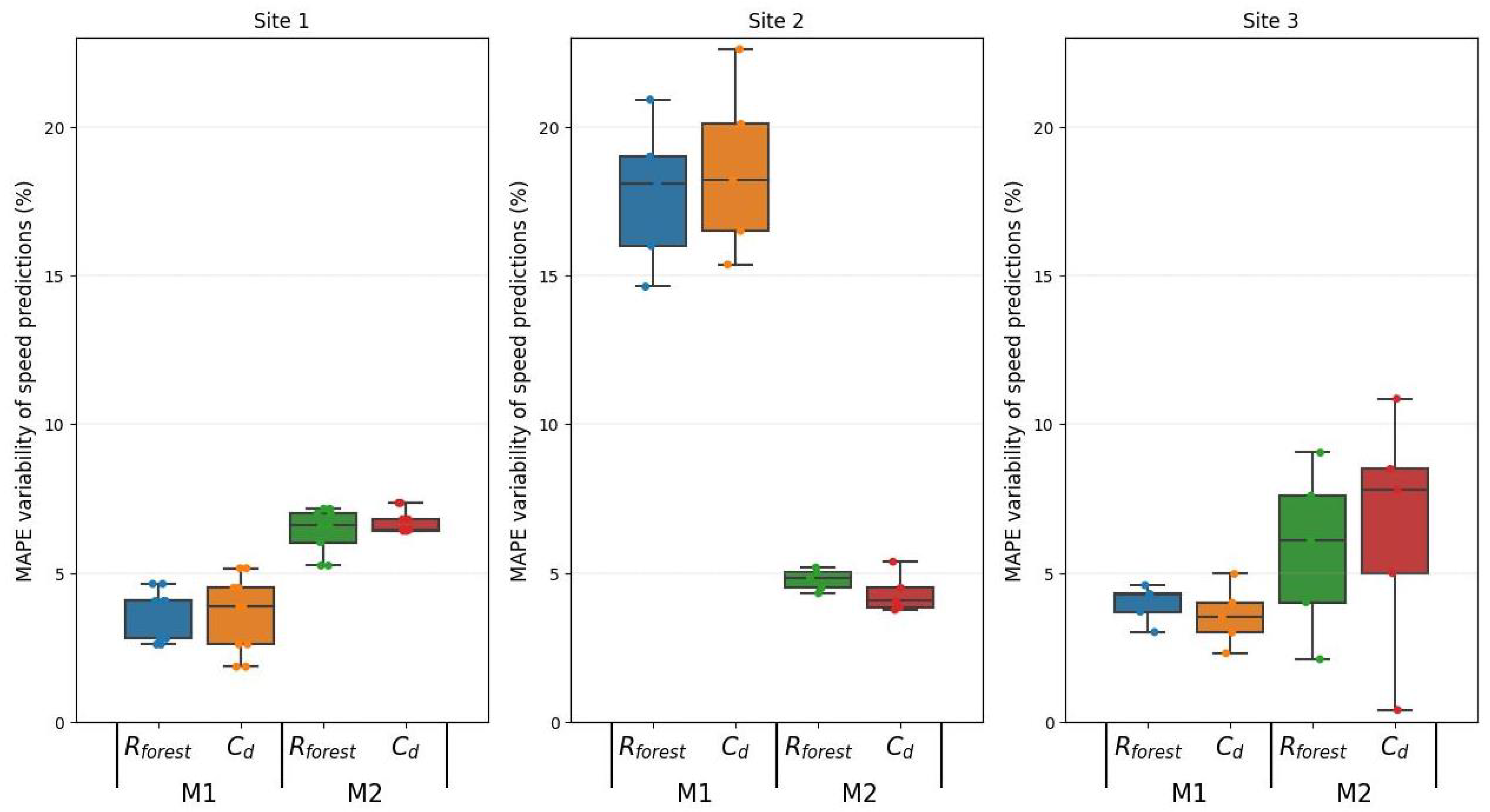
Figure 7 presents the sensitivity influence of input CFD forest model variables on wind speed cross-predictions using the Mean Absolute Percentage Error (MAPE) described in Equation (18). Results indicate that both variables have a similar impact on wind speed cross predictions. Result variability ranges from 1% to 7% in the range of forest ratio [10–50] while the forest density variability ranges from 1 to 10% in the range of drag coefficient [0.001–0.05]. The model variability is very different on each site and mast. The site-dependent variability reflects the heterogeneous forest conditions across the three sites. It can be noted that the maximum and minimum variability are observed on Site 2 respectively for M1 and M2 showing the most extreme forest conditions on this project. As described in Table 1 and later in this study, on this site, M1 is located in very high and dense forest conditions while for M2, the wind measured at this mast position, located close to a clearing area is less affected by forest.
This analysis is also interesting to estimate the sensitivity influence of canopy height estimation around each mast position. As presented in Table 1, these values are estimated from on-site observations, photographs and Google Earth imagery. As displayed on Figure 7, the MAPE variability due to a 7 m-canopy height variation is ranging between 0.04% to 2.3% with an averaged value of 0.8%. It is important to add that similar mean variability close to 1 % are also observed with higher drag coefficient values in the considered range. It means that a 7 m-mis-estimation of the canopy height only impacts cross-predicted MAPE by around 1% in average. A relative tolerance is thus observed on the forest height estimation around a mast.
As demonstrated by the sensitivity analysis of Section 4.1, neither adjusting R f o r e s t alone nor C d alone is sufficient to reproduce the observed wind shear exponent at densely forested sites—even prescribing unrealistically high canopy heights brings the simulated shear only marginally closer to observed values when C d remains at its default value. Both parameters must therefore be jointly calibrated, confirming the necessity of the two-step IMA procedure and consistent with previous studies [14,20,22]. This analysis highlights the necessity of a systematic methodology to jointly calibrate canopy height and drag coefficient—the IMA approach proposed in Section 3.3.
Several physically significant observations can be drawn from this sensitivity analysis.
  • The default values of both parameters— R f o r e s t = 20 and C d = 0.005 m 1 —are positioned at the lower end of the tested ranges, suggesting that the default configuration systematically underestimates forest-induced wind shear in dense coniferous conditions. This prediction is confirmed a posterior by the IMA calibration, where both parameters were consistently adjusted to higher values at all three sites.
  • C d produces a larger MAPE sensitivity range (1–10%) than R f o r e s t (1–7%) across the tested values, despite R f o r e s t spanning a proportionally larger relative range.
  • Both parameters exert a positive and non-compensatory influence on wind shear—increasing either R f o r e s t or C d increases the simulated wind shear exponent α s i m , and neither parameter can substitute for the other. This positive correlation ensures that the IMA two-step calibration procedure is well-posed: fixing H c a n o p y in Step 1 from site observations and then adjusting C d in Step 2 leads to a unique solution, since no combination of opposing parameter changes can produce an equivalent wind profile.

4.2. IMA Method Applied on Each Reference Mast

The objective of this section is to describe in detail the IMA methodology on each site and reference mast. The IMA calibration is evaluated at the reference mast for the reason that the reference mast is the only location within the domain where wind speed profile measurements are available to define the convergence criterion M A E α < 10 % —the iterative loop requires observed data to determine when calibration is complete. Evaluating the calibrated model at the reference mast confirms that the IMA procedure has correctly identified forest model parameters that reproduce the local wind profile.
However, reproducing conditions at the calibration point alone does not constitute validation—a model with sufficient free parameters can always fit its training data. The scientific value of IMA is demonstrated only through cross-prediction at the second mast in Section 4.3, where the calibrated C d is applied without further adjustment to predict wind conditions at a location the model has not been calibrated against.
Table 3 displays the model parameters used on every site for both masts taken into consideration separately. For each site, The IMA methodology described in Figure 6 has been applied (same setup for 20 wind CFD sectors at each site) to simulate the forest influence on the mean wind profile at each mast location. Starting from initial parameters, forest model parameters have then been modified with IMA procedure to reach a suitable adjustment between the measured wind vertical profile and CFD simulation at the reference mast. As described previously, the initial forest ratio is set to be R f o r e s t = 20 and the reference drag coefficient is set to be C d = 0.005 . These forest model parameters have then been modified to fit better the measured wind vertical profile. In this work, we consider that forest model parameters are acceptable when the shear difference between the simulated results and the measurements is lower than 10%. This final result has been, respectively, obtained after 2, 7, and 1 iterations of the IMA procedure for sites 1, 2, and 3. Here is the detailed Iterative model adjustment (IMA) procedure:
  • At Site 1 and Site 3, forest ratio has been deduced first from the tree height H c a n o p y presented in Table 1. For example, at Site 3, the forest ratio R f o r e s t = H c a n o p y z 0 = 20 0.7 30 .
  • At Site 2, forest ratio is set to default, the roughness map has been locally corrected according to on-site observations to increase the tree height from 14 m to 35 ± 5 m in coniferous forest areas. For this reason, the roughness length corresponding to coniferous forest areas has been modified from 0.7 m to 1.7 m in the roughness map conversion table.
  • Following the determination of the forest ratio R f o r e s t , the reference drag coefficient C d was iteratively adjusted until the simulated wind shear exponent matched the observed values within the 10% convergence criterion.
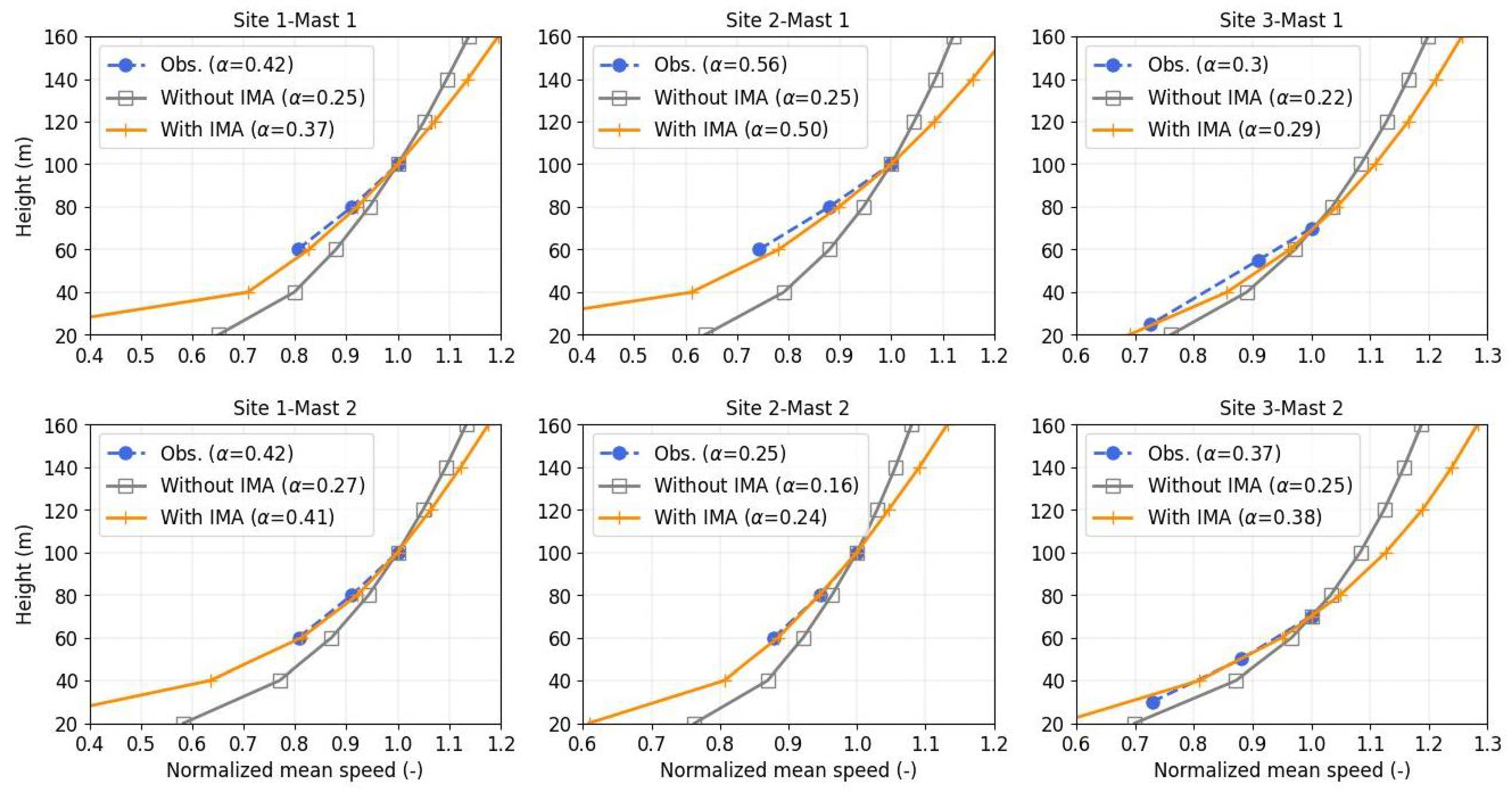
Effects of IMA method are examined through wind shear exponent comparisons in Figure 8 and vertical profile comparisons in the Figure 9. For each site, the highest mast elevation (100 m for Site 1 and 2 and 70 m for Site 3) is chosen as the reference height.
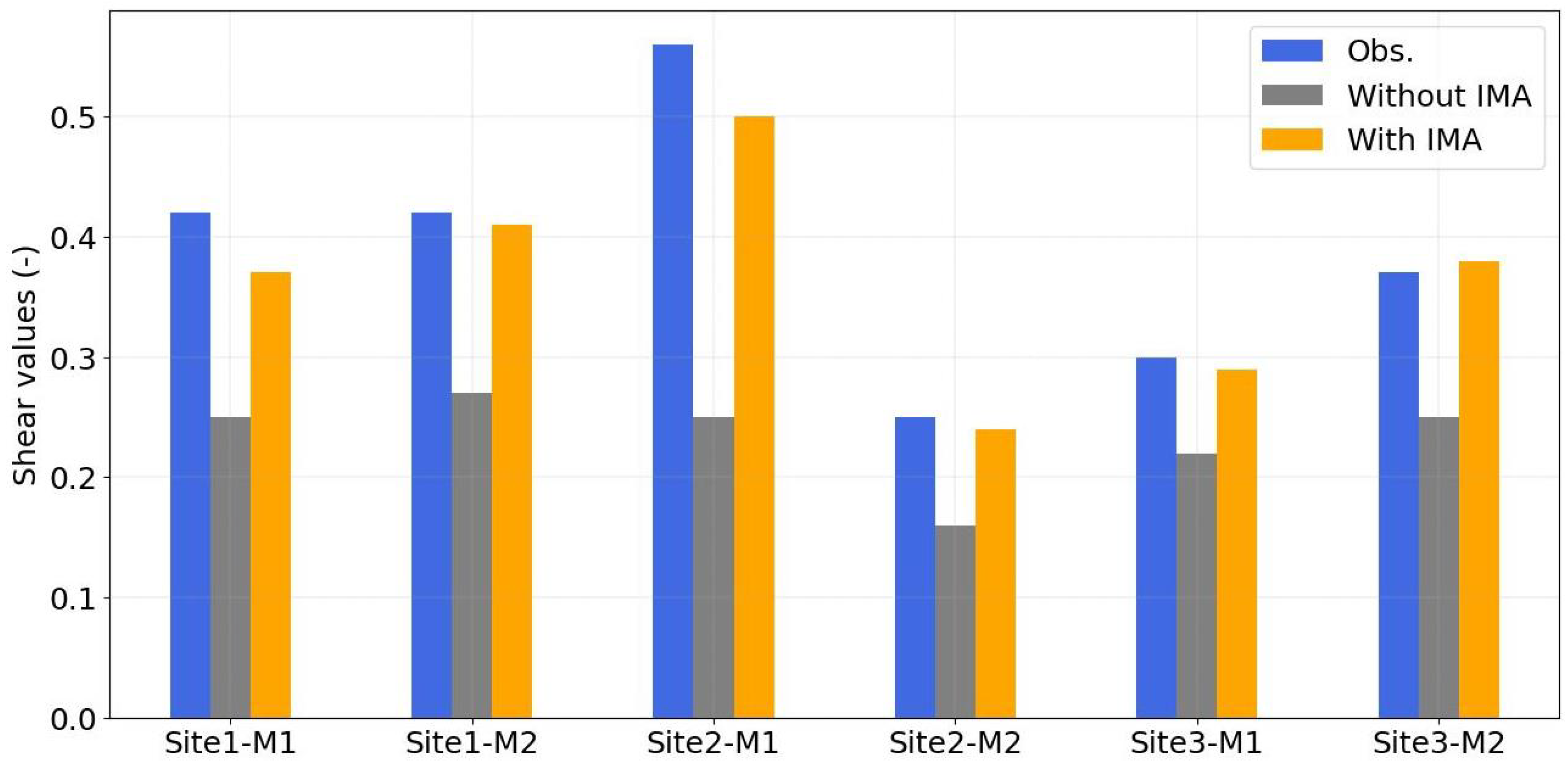
In Figure 8, the wind shears obtained by the default C d and R f o r e s t are systematically underestimated. The forest model parameters calibrated through the IMA procedure, presented in Table 3, provide a more physically accurate representation of the local canopy conditions at each site, bringing the simulated wind shear exponent into close agreement with observations across all site reference mast configurations. Site 2 M1 has the highest observed shear while Site 2 M2 has the lowest.
As displayed in Figure 9, the improvement in wind vertical profiles at the reference masts is most pronounced at low elevations. This improvement is most evident at Site 2 M1, the most densely forested configuration in this study, where the default simulation underestimates the observed shear exponent by 0.3—the largest discrepancy across all six cases.
The IMA procedure yields consistent forest model parameters regardless of which mast is selected as the reference, demonstrating that the calibrated C d is representative of the site as a whole rather than specific to the local forest conditions at the reference mast. This result is particularly significant at Site 2, where M1 and M2 are located in markedly different forest environments—M1 situated in very dense coniferous forest ( H c a n o p y 35 m, α o b s = 0.56 ) and M2 located near a clearing ( H c a n o p y 10 m, α o b s = 0.25 ). While M2, located near a clearing, measures a moderate shear exponent of 0.25, M1, surrounded by dense coniferous forest with an estimated canopy height of 35 m, exhibits the highest shear exponent in this study with a wind shear exponent value close to 0.6. It is also confirmed with pictures and google earth images (not presented here). The IMA procedure infers the same calibrated C d = 0.075 from both masts. This demonstrates that, although M2 is outside the forest and distant (>1 km) from very dense forest, the forest-induced momentum effects extend up to 1 km beyond the forest boundary in the prevailing wind direction. IMA is therefore applicable not only in the forest but also in the surrounding area. Although wind industry guidelines recommend using a representative mast with roughness conditions similar to the wind turbine site [48], the present results demonstrate that a mast located outside the forest boundary can provide reliable IMA calibration data, provided it lies within the range of forest-induced flow effects.

4.3. Influence of Iterative Model Adjustment (IMA) on Cross-Predictions

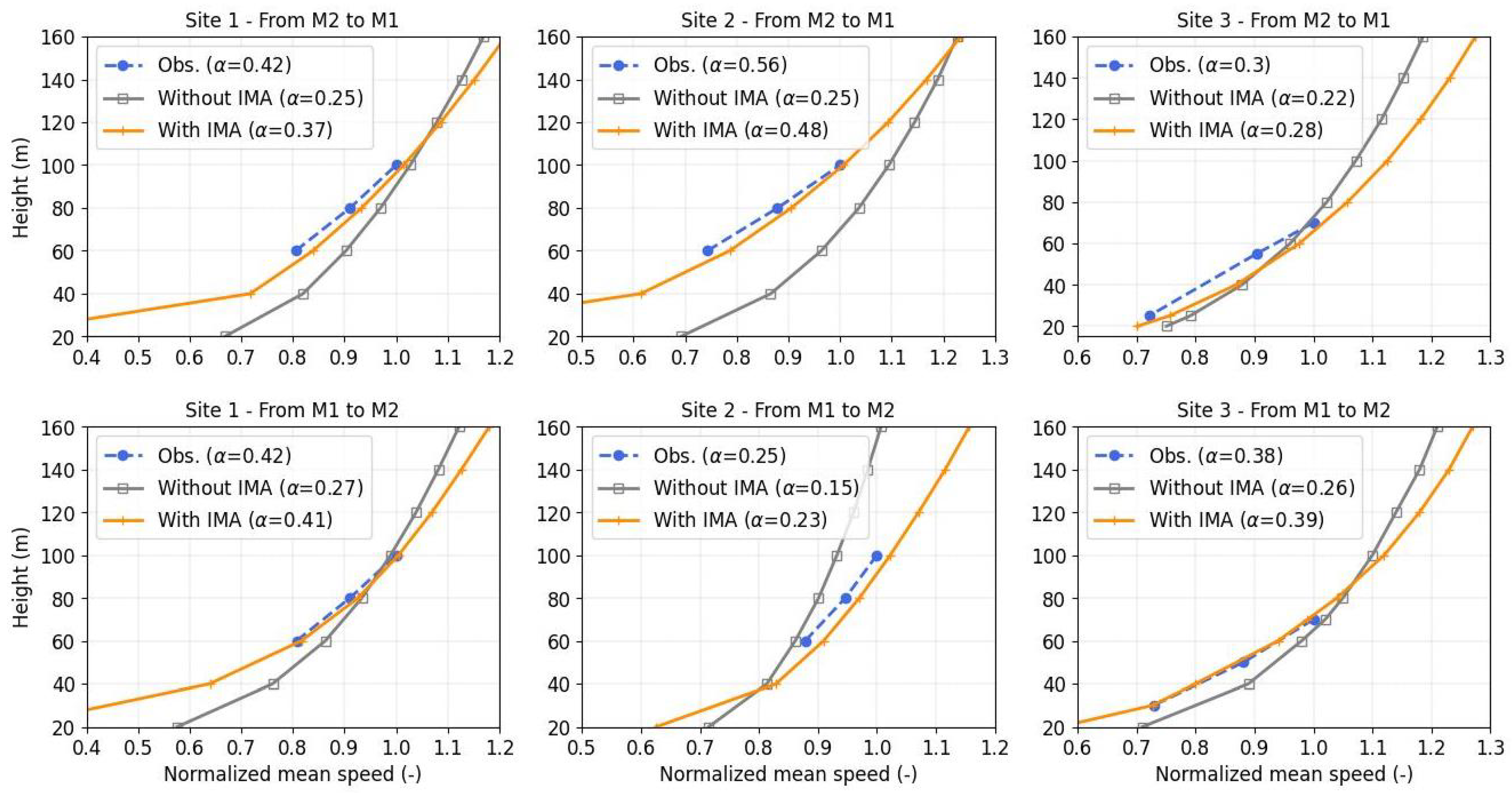
Cross-prediction results are presented in Figure 10, Figure 11 and Figure 12 for all sites and masts. For each site, the calibrated forest model obtained at the reference mast is applied to simulate the wind vertical profile at the second mast location, which is then compared with measurements across all three anemometer elevations.
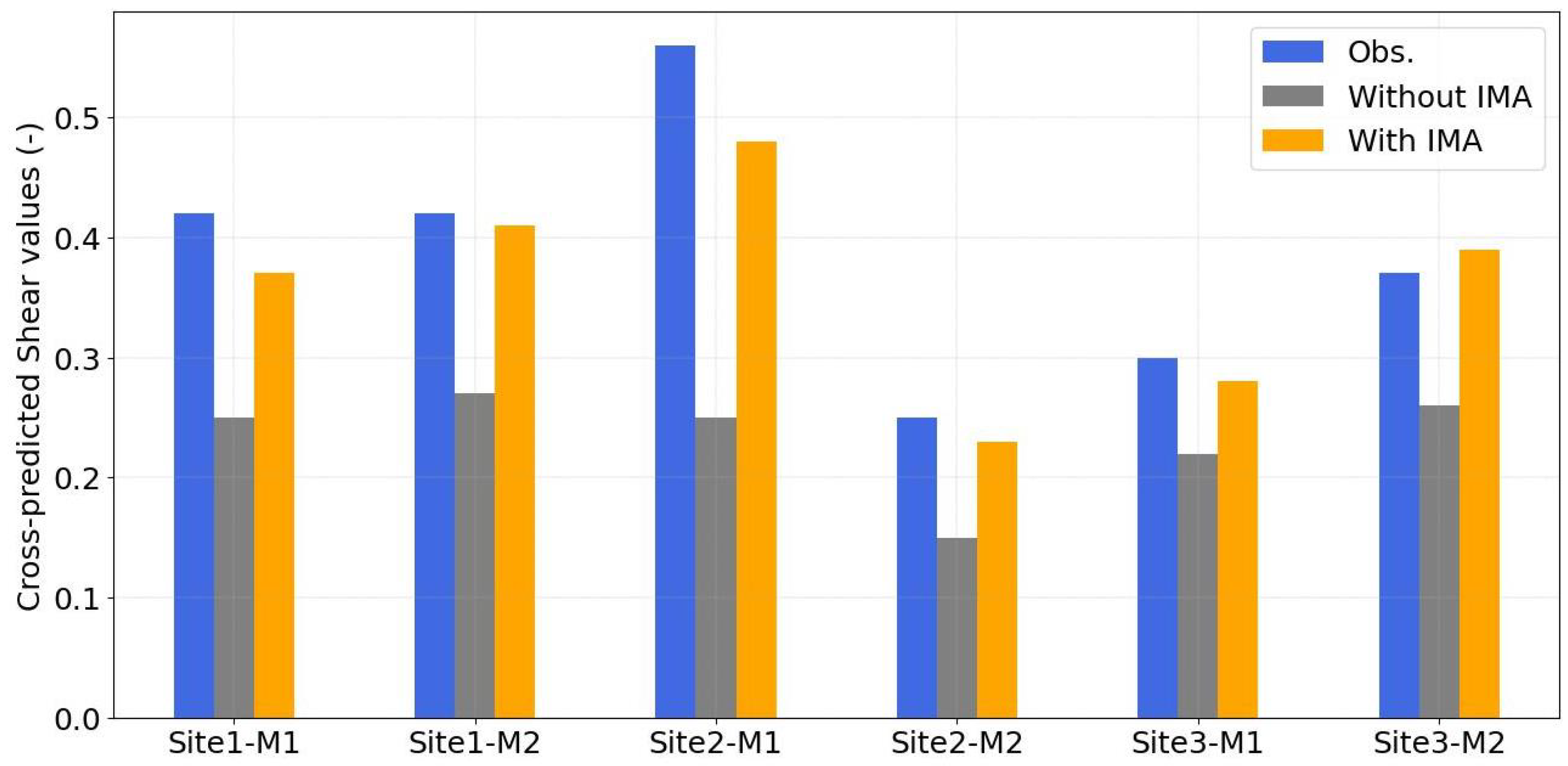
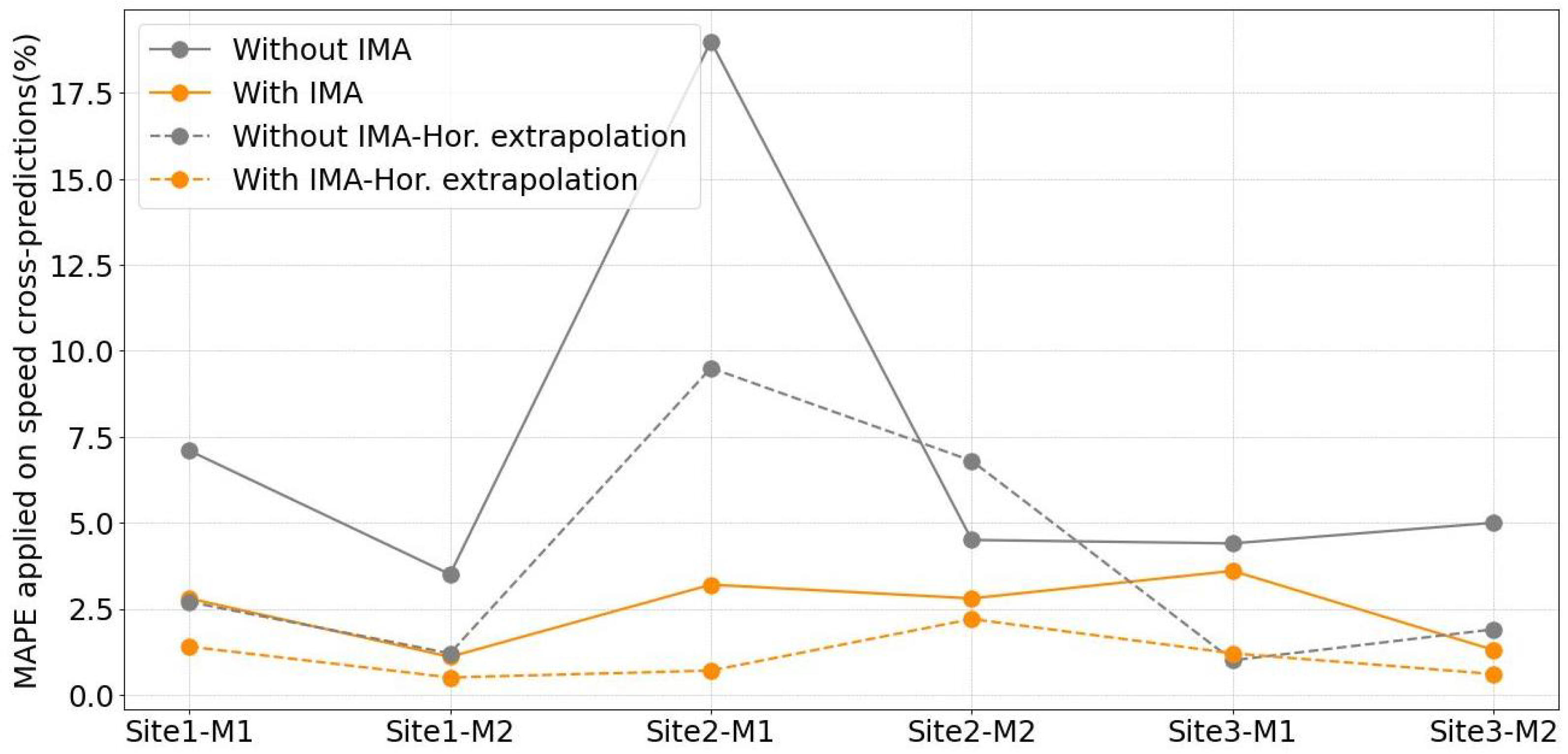
A noticeable impact of the IMA on the cross-predicted vertical profiles is observed also in all cases, clearly visible in both wind profile shapes in Figure 10 and the shear exponent values in Figure 11. When C d is increased, the wind speed decreases at lower elevations and increases above. As presented on Figure 12, MAPE is reduced in all cases, confirming that CFD model uncertainties are reduced using the IMA approach. In moderately forested conditions (Sites 1 and 3 and Site 2 M1), the MAPE reduction ranges from 0.8% to 4.4%. For the extreme forest conditions at Site 2 for M1, an improvement of 15.8% is observed. As expected, IMA methodology seems to be most relevant when the default forest parameters significantly underestimate the actual canopy height and density.
Shear differences between measurements and simulations are reduced significantly from the range [0.08–0.3] to [0.01–0.07], confirming that IMA method improves the vertical profile simulation. The comparable patterns observed in Figure 8 and Figure 11 confirm that the forest model parameters calibrated at the reference mast govern wind shear not only at the reference location but across the full site domain—validating the spatial transferability of the IMA calibration.
IMA also improves horizontal extrapolation accuracy at the highest measurement elevations (100 m for Sites 1 and 2, 70 m for Site 3). As shown in Figure 12, MAE applied to horizontally extrapolated wind speed is reduced in all cases except Site 3 M1. The largest improvement is observed at Site 2, where the wind speed error at 100 m decreases from 9.5% to 0.7%. Since wind turbine hub heights are typically above 80 m, this result is particularly relevant for wind farm energy yield estimation in forested terrain. At low elevations as well as above, near hub heights, the impact of IMA approach is evident.
Accurate cross-prediction results across all six cases validate the assumption of IMA approach—that the reference drag coefficient is spatially constant across the site. This assumption, commonly adopted in the literature, is physically justified because the form drag induced by tree canopies dominates over viscous drag [30]. However, cross predictions are limited to distances in range [2–6.6 km]. Whether IMA is applicable across longer distances (>7 km) or for deciduous and mixed forest types remains an open question for future work.
In contrast to previous work [7,9,12,15,21,22,26], these results show that accurate speed cross-predictions in highly forested areas can be carried out using a one-equation turbulence-closure RANS CFD without advanced PAD for LAD data from advanced remote sensing. This was made possible through careful site-specific estimation of the forest density using the IMA approach, based on full-year wind speed profile measurements at a single reference mast. While the IMA-RANS approach improves agreement with measured wind profiles, its inherent limitations should be acknowledged. RANS averages turbulence and cannot capture fine-scale turbulence structures or transient gusts within the canopy, and the canopy is represented by a bulk drag coefficient that neglects detailed tree geometry and local effects. Calibration from a single mast also limits spatial accuracy for sites with strong forest heterogeneity at scales smaller than the inter-mast distance. Despite these limitations, RANS remains computationally efficient and industrially applicable for wind assessment in dense forests, and LES could serve as a complementary tool in areas requiring high-resolution flow information.

5. Conclusions

This study proposes an innovative and reproducible CFD methodology based on an Iterative Model Adjustment (IMA) procedure to improve wind resource assessment accuracy in densely forested and complex terrain, requiring only standard industrial inputs—publicly available roughness and orography maps and wind speed profile measurements at a single meteorological mast. The methodology was validated across six calibration and cross-prediction cases at three international sites, provided by EDF Power, under heterogeneous forest and complex terrain conditions using Meteodyn WT™. The key findings are summarized as follows:
  • Accurate wind simulation based on IMA methodology: Wind speed estimation accuracy improved significantly when using appropriate forest height and drag coefficient values determined using the IMA procedure. Shear differences between simulations and measurements were reduced significantly from [0.08–0.3] to [0.01–0.07]. Horizontal mean speed errors have been reduced from [1.0–9.5%] to [0.5–2.2%] yielding a global mean absolute speed error of 1.1% based on six cases.
  • Physical understanding of forest modeling:
    The sensitivity analysis demonstrates that the drag coefficient C d and canopy height H c a n o p y both exert a comparable and jointly necessary influence on wind shear simulation—neither parameter alone is sufficient to reproduce observed wind profiles in dense forest conditions. Default parameter values systematically underestimate forest-induced wind shear, with IMA consistently calibrating to higher values at all three sites. The assumption of a spatially constant C d —representing consistent species-level aerodynamic properties across the site—was validated across all six cases including heterogeneous forest coverage, dominant coniferous forest, complex terrain, and cross-prediction distances of 2–6.6 km. Forest-induced flow effects were observed up to 1 km into surrounding clearing areas, demonstrating that IMA can be applied from nearby masts located outside the forest boundary—extending the standard recommendation of using a representative mast with similar roughness conditions [48]. While cross-prediction distances exceeding 7 km are outside of established guidelines in complex terrain [48], the applicability of IMA over longer distances and in different forest types (such as deciduous forests, mixed forests) would remain an open question.
  • Usage of land cover maps: Land cover maps based on satellite data provide a useful foundation for forest wind modeling. However, conversion tables and forest ratio corrections were required at all three sites to achieve more physically representative canopy heights. IMA results are robust to moderate canopy height estimation uncertainty—a 7 m error produces less than 1% average impact on cross-predicted MAPE, with a mean variability of 0.8%.
The results demonstrate that accurate CFD results can be obtained using only standard industrial inputs—public maps and measurements at single mast. This methodology has been validated across six cases spanning a wide variety of terrain and forest conditions. Observations presented here are considered applicable to other studies in wooded areas.
In contrast to previous work [9,21,22], the present results show that accurate cross-predictions in highly forested areas can be achieved without PAD or LAD data from airborne surveys, provided that forest density is carefully estimated through the IMA calibration procedure using full-year wind speed measurements.
However, several limitations should be acknowledged. The RANS approach cannot capture fine-scale turbulence structures, transient gusts, or detailed canopy geometry—LES would provide higher-resolution temporal and spatial flow information in areas where these features are critical. The constant C d assumption has been validated only for coniferous-dominated forests—applicability to deciduous or mixed forests, where LAD varies seasonally and species diversity introduces site-wide variation in canopy drag properties, remains an open question. Cross-prediction distances exceeding 7 km are outside established WRA guidelines [48] and have not been tested. Calibration from a single mast also limits spatial accuracy for sites with strong forest heterogeneity at scales smaller than the inter-mast distance.
Neutral atmospheric stability conditions were assumed throughout the CFD simulations, based on the hypothesis that full-year averaging integrates across all stability classes, yielding a mean wind profile representative of near-neutral conditions [27]. This assumption was necessary as a first approximation to isolate forest-induced flow effects from thermal stability effects and thereby facilitate the IMA calibration procedure. Although the neutral assumption is supported by the full-year measurement periods used at all three sites, the influence of atmospheric thermal stability on wind flow temporal variations is not explicitly accounted for in the present methodology. In particular, the applicability of IMA under non-neutral stability conditions—where stable stratification or convective instability may interact with canopy drag effects—has not yet been established and is identified as a priority for future work.

Author Contributions

Writing—original draft preparation, E.L.; writing—review and editing, R.L. and E.T.; Conceptualization, methodology, E.L., R.L. and E.T.; software, validation, formal analysis, and investigation, All; resources and data curation, M.D., A.G., G.M., S.K. and M.A. All authors have read and agreed to the published version of the manuscript.

Funding

This research received no external funding.

Data Availability Statement

The data presented in this study were provided by EDF Power and are not publicly available due to confidentiality restrictions.

Acknowledgments

The authors gratefully acknowledge the contribution of Alban Descamps and Lola Tessier for their support in the preparation of several figures presented in this work.

Conflicts of Interest

Authors Edouard Leonard, Ru Li and Eric Tromeur are employed by Meteodyn. Authors Marianne Dupont, Aurélien Gaussorgues, Gaetan Martellozzo, Stavros Koutsioumpas and Mustafa Akcakaya are employed by EDF Power. The authors declare no other conflicts of interest.

Abbreviations

The following abbreviations are used in this manuscript:
CFDComputational Fluid Dynamics
WRAWind Resource Assessment
RANSReynolds-Averaged Navier-Stokes
IMAIterative model adjustment
MAPEMean Absolute Percentage Error
MAEMean Absolute Error

References

  1. Alfredsson, P.H.; Segalini, A. Wind farms in complex terrains: An introduction. Philos. Trans. R. Soc. A Math. Phys. Eng. Sci. 2017, 375, 20160096. [Google Scholar] [CrossRef]
  2. Enevoldsen, P. Onshore wind energy in Northern European forests: Reviewing the risks. Renew. Sustain. Energy Rev. 2016, 60, 1251–1262. [Google Scholar] [CrossRef]
  3. Pereira, R.; Ricardo, G.; Silva Santos, C. Comparing WAsP and CFD wind resource estimates for the “regular” user. In Proceedings of the European Wind Energy Conference, Warsaw, Poland, 20–23 April 2010. [Google Scholar]
  4. Shaw, R.H.; Schumann, U. Large-eddy simulation of turbulent flow above and within a forest. Bound.-Layer Meteorol. 1992, 61, 47–64. [Google Scholar] [CrossRef]
  5. Kanani, F.; Träumner, K.; Ruck, B.; Raasch, S. What determines the differences found in forest edge flow between physical models and atmospheric measurements?—An LES study. Meteorol. Z. 2014, 23, 33–49. [Google Scholar] [CrossRef] [PubMed]
  6. Boudreault, L. Reynolds-Averaged Navier-Stokes and Large-Eddy Simulation over and Inside Inhomogeneous Forests. Ph.D. Thesis, Technical University of Denmark, Department of Mechanical Engineering, Lundtofte, Denmark, 2015. [Google Scholar]
  7. Boudreault, L.E.; Bechmann, A.; Tarvainen, L.; Klemedtsson, L.; Shendryk, I.; Dellwik, E. A LiDAR method of canopy structure retrieval for wind modeling of heterogeneous forests. Agric. For. Meteorol. 2015, 201, 86–97. [Google Scholar] [CrossRef]
  8. Chávez-Arroyo, R.; Sanz-Rodrigo, J.; Gancarski, P. Modelling of atmospheric boundary-layer flow in complex terrain with different forest parameterizations. J. Phys. Conf. Ser. 2014, 524, 012119. [Google Scholar] [CrossRef]
  9. Ivanell, S.; Arnqvist, J.; Avila, M.; Cavar, D.; Chavez-Arroyo, R.; Olivares Espinosa, H.; Peralta, C.; Adib, J.; Witha, B. Micro-Scale Model Comparison (Benchmark) at the Moderately Complex Forested Site Ryningsnäs. Wind Energy Sci. 2018, 3, 929–946. [Google Scholar] [CrossRef]
  10. Crasto, G. Forest Modeling, A Canopy Model for WindSim 4.5; University of Cagliari: Cagliari, Italy, 2006. [Google Scholar]
  11. Delaunay, D. Modelling the Stable Boundary Layer for Wind Resource Assessment; Technical Report; Meteodyn: Nantes, France, 2013. [Google Scholar]
  12. Monteiro, J.R.; Batista, V.T.P.; Palma, J.M.L.M. Assessing canopy models across forest edges on flat terrain. J. Phys. Conf. Ser. 2024, 2767, 092011. [Google Scholar] [CrossRef]
  13. Jiang, Z.; Bullido-Garcia, M.; Houbart, J.C.; Bezault, C. CFD modeling of forest canopy flows: Input parameters, calibration and validation. In Proceedings of the European Wind Energy Conference and Exhibition (EWEC 2013), Vienna, Austria, 4–7 February 2013; pp. 457–465. [Google Scholar]
  14. Sanquer, S.; Berthaut-Gérentes, J.; Cosculluela Soteras, L. Modelling wind flow in forested areas: A parametric study. In Proceedings of the AWEA Proceedings, Charleston, SC, USA, 22–23 March 2016. [Google Scholar]
  15. Melani, P.F.; Balduzzi, F.; Orlando, S.; Vitic, V.; Bianchini, A. Numerical analysis of the impact of forestry on the wind resource assessment in complex terrains. In Proceedings of the Wind Energy Science Conference, Nantes, France, 25–27 June 2025. [Google Scholar]
  16. Desmond, C.J.; Watson, S.; Montavon, C.; Murphy, J. Modelling Uncertainty in t-RANS Simulations of Thermally Stratified Forest Canopy Flows for Wind Energy Studies. Energies 2018, 11, 1703. [Google Scholar] [CrossRef]
  17. Li, Y.; Li, Z.; Zhou, Z.; Yang, X. Large-Eddy Simulation of Wind Turbine Wakes in Forest Terrain. Sustainability 2023, 15, 5139. [Google Scholar] [CrossRef]
  18. Orlova, S.; Dmitrijevs, N.; Mironova, M.; Kamolins, E.; Komasilovs, V. Assessing the Impact of Forests on Wind Flow Dynamics and Wind Turbine Energy Production. Wind 2026, 6, 10. [Google Scholar] [CrossRef]
  19. Barber, S.; Schubiger, A.; Koller, S.; Eggli, D.; Radi, A.; Rumpf, A.; Knaus, H. The wide range of factors contributing to wind resource assessment accuracy in complex terrain. Wind Energy Sci. 2022, 7, 1503–1526. [Google Scholar] [CrossRef]
  20. Chaudhari, A.; Ashu, T.; Vita, G.; Hellsten, A. Impact of forest density on atmospheric boundary-layer flow and turbulence for wind energy applications. Bound.-Layer Meteorol. 2026, 192, 91–106. [Google Scholar] [CrossRef]
  21. Lopes da Costa, J.; Castro, F.; Palma, J.M.L.M.; Stuart, P. Computer Simulation of Atmospheric Flows over Real Forests for Wind Energy Resource Evaluation. J. Wind Eng. Ind. Aerodyn. 2006, 94, 603–620. [Google Scholar] [CrossRef]
  22. Katul, G.G.; Mahrt, L.; Poggi, D.; Sanz, C. One and Two-Equation Models for Canopy Turbulence. Bound.-Layer Meteorol. 2004, 113, 81–109. [Google Scholar] [CrossRef]
  23. Meteodyn. Meteodyn WT User Manual Advanced Notes; Meteodyn: Saint-Herblain, France, 2026. [Google Scholar]
  24. Delaunay, D.; Li, W.; Bodéré, S. Calibrating a CFD canopy model with the EC1 vertical profiles of mean wind speed and turbulence. In Proceedings of the 13 International Conference on Wind Engineering, Amsterdam, The Netherlands, 10–15 July 2011. [Google Scholar]
  25. Konagaya, M.; Ohsawa, T.; Itoshima, Y.; Kambayashi, M.; Leonard, E.; Tromeur, E.; Misaki, T.; Shintaku, E.; Araki, R.; Hamada, K. Estimation of Wind Conditions in the Offshore Direction Using Multiple Numerical Models and In Situ Observations. Energies 2025, 18, 3000. [Google Scholar] [CrossRef]
  26. Queck, R.; Bienert, A.; Maas, H.G.; Harmansa, S.; Goldberg, V.; Bernhofer, C. Wind fields in heterogeneous conifer canopies: Parameterisation of momentum absorption using high-resolution 3D vegetation scans. Eur. J. For. Res. 2012, 131, 165–176. [Google Scholar] [CrossRef]
  27. Sogachev, A.; Cavar, D.; Kelly, M.; Dellwik, E.; Klaas, T.; Kühn, P. Numerical modelling of the wind over forests. Adv. Sci. Res. 2020, 17, 53–61. [Google Scholar] [CrossRef]
  28. Liu, J.; Chen, J.M.; Black, T.A.; Novak, M.D. E-ε Modelling of Turbulent Air-Flow Downwind of a Model Forest Edge. Bound.-Layer Meteorol. 1996, 77, 21–44. [Google Scholar] [CrossRef]
  29. Sogachev, A.; Panferov, O. Modification of Two-Equation Models to Account for Plant Drag. Bound.-Layer Meteorol. 2006, 121, 229–266. [Google Scholar] [CrossRef]
  30. Viana Parente Lopes, J.M.; Palma, J.M.L.M.; Silva Lopes, A. Modelling the flow within forests: The canopy-related terms in the Reynolds-averaged formulation. J. Fluid Mech. 2021, 910, A7. [Google Scholar] [CrossRef]
  31. Copernicus Land Monitoring Service. CORINE Land Cover 2018 (Raster 100 m). 2018. Available online: https://land.copernicus.eu/en/products/corine-land-cover/clc2018 (accessed on 27 April 2026).
  32. European Environment Agency (EEA). Land Cover 2015–2019 (Raster 100 m), Version 3; Copernicus Land Monitoring Service Dataset; European Environment Agency (EEA): Copenhagen, Denmark, 2019; Available online: https://sdi.eea.europa.eu/catalogue/srv/api/records/c6377c6e-76cc-4d03-8330-628a03693042?language=all (accessed on 10 April 2026).
  33. NASA JPL. NASADEM Global Digital Elevation Model, 2020. NASA EOSDIS Land Processes Distributed Active Archive Center (LP DAAC). Available online: https://portal.opentopography.org/datasetMetadata?otCollectionID=OT.032021.4326.2 (accessed on 10 April 2026).
  34. European Environment Agency (EEA). EU-DEM v1.1 (Raster Digital Elevation Model), Version 1.1; Released April 2016, Copernicus Land Monitoring Service; European Environment Agency (EEA): Copenhagen, Denmark, 2016. [Google Scholar]
  35. Dörenkämper, M.; Olsen, B.T.; Witha, B.; Hahmann, A.N.; Davis, N.N.; Barcons, J.; Ezber, Y.; García-Bustamante, E.; González-Rouco, J.F.; Navarro, J.; et al. The Making of the New European Wind Atlas—Part 2: Production and evaluation. Geosci. Model Dev. 2020, 13, 5079–5102. [Google Scholar] [CrossRef]
  36. Abbas, M.R.; Rasib, A.W.B.; Abbas, T.R.; Ahmad, B.B.; Dutsenwai, H.S. An overview of wind energy production prediction bias, losses, and uncertainties. IOP Conf. Ser. Earth Environ. Sci. 2021, 722, 012015. [Google Scholar] [CrossRef]
  37. Floors, R.; Enevoldsen, P.; Davis, N.; Arnqvist, J.; Dellwik, E. From lidar scans to roughness maps for wind resource modelling in forested areas. Wind Energy Sci. 2018, 3, 353–370. [Google Scholar] [CrossRef]
  38. Silva, J.; Ribeiro, C.; Ricardo, G.; Rua, M.C.; Ulrich, F. Roughness length classification of Corine Land Cover classes. In Proceedings of the EWEC 2007, Milan, Italy, 7–10 May 2007. [Google Scholar]
  39. Windpro. WIKI-Windpro. Available online: https://help.emd.dk/mediawiki/index.php?title=Main_Page (accessed on 10 April 2026).
  40. Lee, J.C.Y.; Fields, M.J. An overview of wind-energy-production prediction bias, losses, and uncertainties. Wind Energy Sci. 2021, 6, 311–365. [Google Scholar] [CrossRef]
  41. IEC 61400-12-1:2022; Wind Energy Generation Systems—Part 12-1: Power Performance Measurements of Electricity Producing Wind Turbines. IEC: Geneva, Switzerland, 2022.
  42. Cunha Pinheiro, J.; da Câmara, R.A. The uncertainties in the estimation of electricity production in the Brazilian onshore wind sector. E-Prime Adv. Electr. Eng. Electron. Energy 2025, 12, 100996. [Google Scholar] [CrossRef]
  43. Pope, S.B. Turbulent Flows; Cambridge University Press: Cambridge, UK, 2000. [Google Scholar]
  44. Ferry, M. New features of the MIGAL solver. In Proceedings of the 9th International PHOENICS User Conference, Moscow, Russia, 23–27 September 2002. [Google Scholar]
  45. Maldonado-Correa, J.; Vásquez, G.; Paccha-Herrera, E.; Cuenca, J.; Rojas, M.; Solano, J.; Valdiviezo, M.; Samaniego, C.; Valarezo, J. Analysis of the Annual Energy Production of the Villonaco Wind Farm. In Congress on Research, Development, and Innovation in Renewable Energies: Selected Papers from CIDiER 2022; Espinoza-Andaluz, M., Melo Vargas, E., Santana Villamar, J., Encalada-Dávila, Á., Eds.; Springer International Publishing: Cham, Switzerland, 2023; pp. 73–87. [Google Scholar] [CrossRef]
  46. Yamada, T. Simulations of nocturnal drainage flows by a q2l turbulence closure model. J. Atmos. Sci. 1983, 40, 91–106. [Google Scholar] [CrossRef]
  47. Garratt, J. The Atmospheric Boundary Layer; Cambridge Atmospheric and Spac Cambridge Atmospheric and Space Science Series; Cambridge University Press: Cambridge, UK, 1996. [Google Scholar]
  48. MEASNET Organisation. MEASNET Procedure: Evaluation of Site-Specific Wind Conditions; Version 3; MEASNET: Madrid, Spain, 2022. [Google Scholar]
Figure 1. Site 1 Orography map (left) and Roughness map (right). The measured wind prevailing direction is 230° on both masts.
Energies 19 02243 g001
Figure 2. Site 2 Orography map (left) and Roughness map (right). The measured wind prevailing direction is 225° on both masts.
Energies 19 02243 g002
Figure 3. Site 3 Orography map (left) and Roughness map (right).The measured wind prevailing direction is 210° on both masts.
Energies 19 02243 g003
Figure 4. Overview of the Forest CFD Methodology and Validation Framework. Standard industrial inputs (gray) feed the CFD forest model (blue, Section 3.1 and Section 3.2). The IMA procedure (orange, Section 3.3) iteratively calibrates the volumetric drag coefficient C d until the simulated wind shear exponent α sim matches the observed value α obs within a 10% tolerance. The calibrated model is then applied in the cross-prediction validation framework (teal, Section 3.4), with results evaluated using MAE and MAPE metrics in Section 4.
Energies 19 02243 g004
Figure 5. Description of Meteodyn WT forest model activation process on the CFD mesh ( C dref = 1 ). The forest model is automatically applied within the CFD computational domain, as indicated by the green cells, when the bottom of a mesh cell is located below the canopy height. Light green cells represent a linear reduction in the drag coefficient, accounting for the decrease in foliage density near the canopy top.
Energies 19 02243 g005
Figure 6. Description of the Iterative Model Adjustment (IMA) methodology. Starting from initial forest model parameters, the drag coefficient C d is iteratively adjusted until the simulated wind shear exponent α s i m matches the observed value α o b s within a 10% tolerance at the reference mast.
Energies 19 02243 g006
Figure 7. Sensitivity influence of input CFD forest model variables: Forest ratio R f o r e s t and drag force coefficient C d using MAPE variability. For each site, cross-predicted wind speed values are simulated using the other mast as a reference. It means that M1 is used as a reference mast to estimate M2 and M2 is used as reference mast to estimate M1.
Energies 19 02243 g007
Figure 8. Influence of Iterative model adjustment (IMA) method on each reference mast shear value.
Energies 19 02243 g008
Figure 9. Influence of IMA methodology on each site and reference mast. The corresponding shear values ( α ) are also displayed in the legend.
Energies 19 02243 g009
Figure 10. Influence of IMA methodology on cross-predicted wind profiles for each site and mast. For each site, cross-predicted wind speed values are simulated using the other mast as a reference. It means that M1 is used as a reference mast to estimate M2 and M2 is used as reference mast to estimate M1.
Energies 19 02243 g010
Figure 11. Influence of IMA methodology on cross-predicted wind shear values. For each site, cross-predicted wind speed values are simulated using the other mast as a reference. It means that M1 is used as a reference mast to estimate M2 and M2 is used as reference mast to estimate M1.
Energies 19 02243 g011
Figure 12. Influence of IMA methodology on Mean Absolute Percentage Errors applied on cross-predicted wind speed values. For each site, cross-predicted wind speed values are simulated using the other mast as a reference. It means that M1 is used as a reference mast to estimate M2 and M2 is used as reference mast to estimate M1.
Energies 19 02243 g012
Table 1. Site description.
SiteCountryRoughnessOrographyMast HeightsCanopy M1Canopy M2
1FinlandLC 2019 (100 m)EUDEM v1.1 (25 m)100; 80; 60 m30 ± 5 m30 ± 5 m
2FranceCLC 2018 (100 m)NASADEM (30 m)100; 80; 60 m35 ± 5 m10 ± 5 m
3ScotlandCLC 2018 (100 m)NASADEM (30 m)70; 50; 30 m15 ± 5 m20 ± 5 m
Table 2. Computation parameters and information.
SiteSite 1Site 2Site 3
Site radius8 km8 km8 km
Horizontal resolution25 m25 m25 m
Vertical resolution4 m4 m4 m
Averaged cell count8.5 million8.5 million8.5 million
Total computation time (all sectors)6 h and 5 min5 h and 20 min4 h and 30 min
Averaged computation time per sector18 min16 min13 min
Table 3. Forest model parameters used for IMA procedure.
Initial ParametersParameters with IMARoughness Map ModifiedIMA Iterations
Site 1 C d = 0.005 , R f o r e s t = 20 C d = 0.035 , R f o r e s t = 40 No3
Site 2 C d = 0.005 , R f o r e s t = 20 C d = 0.075 , R f o r e s t = 20 Yes7
Site 3 C d = 0.005 , R f o r e s t = 20 C d = 0.025 , R f o r e s t = 30 No2
Disclaimer/Publisher’s Note: The statements, opinions and data contained in all publications are solely those of the individual author(s) and contributor(s) and not of MDPI and/or the editor(s). MDPI and/or the editor(s) disclaim responsibility for any injury to people or property resulting from any ideas, methods, instructions or products referred to in the content.