A Complete CFD Methodology Based on Iterative Model Adjustment to Improve Wind Simulation Accuracy in Highly Dense Forest Area
Abstract
1. Introduction
- A complete and reproducible CFD methodology (IMA) for wind resource assessment in densely forested and complex terrain, requiring only standard industrial inputs—publicly available roughness and orography maps and wind speed profile measurements at a single meteorological mast—without relying on remote-sensing-derived canopy density data.
- A systematic sensitivity analysis of the forest model parameters—canopy height and drag coefficient —demonstrating that both variables have a influence on wind shear simulation in dense forest conditions.
- Validation of the spatial constant drag coefficient assumption across six cross-prediction cases under heterogeneous forest conditions and complex terrain, including the finding that forest-induced flow effects extend up to 1 km into surrounding clearing areas, demonstrating that IMA can be applied from masts located outside the forest boundary.
2. Site Description and Computational Setup
2.1. Site Description
2.2. Computational Setup
3. Forest CFD Methodology and Validation Framework
3.1. Forest Modeling
3.2. Canopy Model
3.3. Iterative Model Adjustment (IMA) Methodology in Forested Areas
3.3.1. Physical Basis and Inverse Problem Formulation
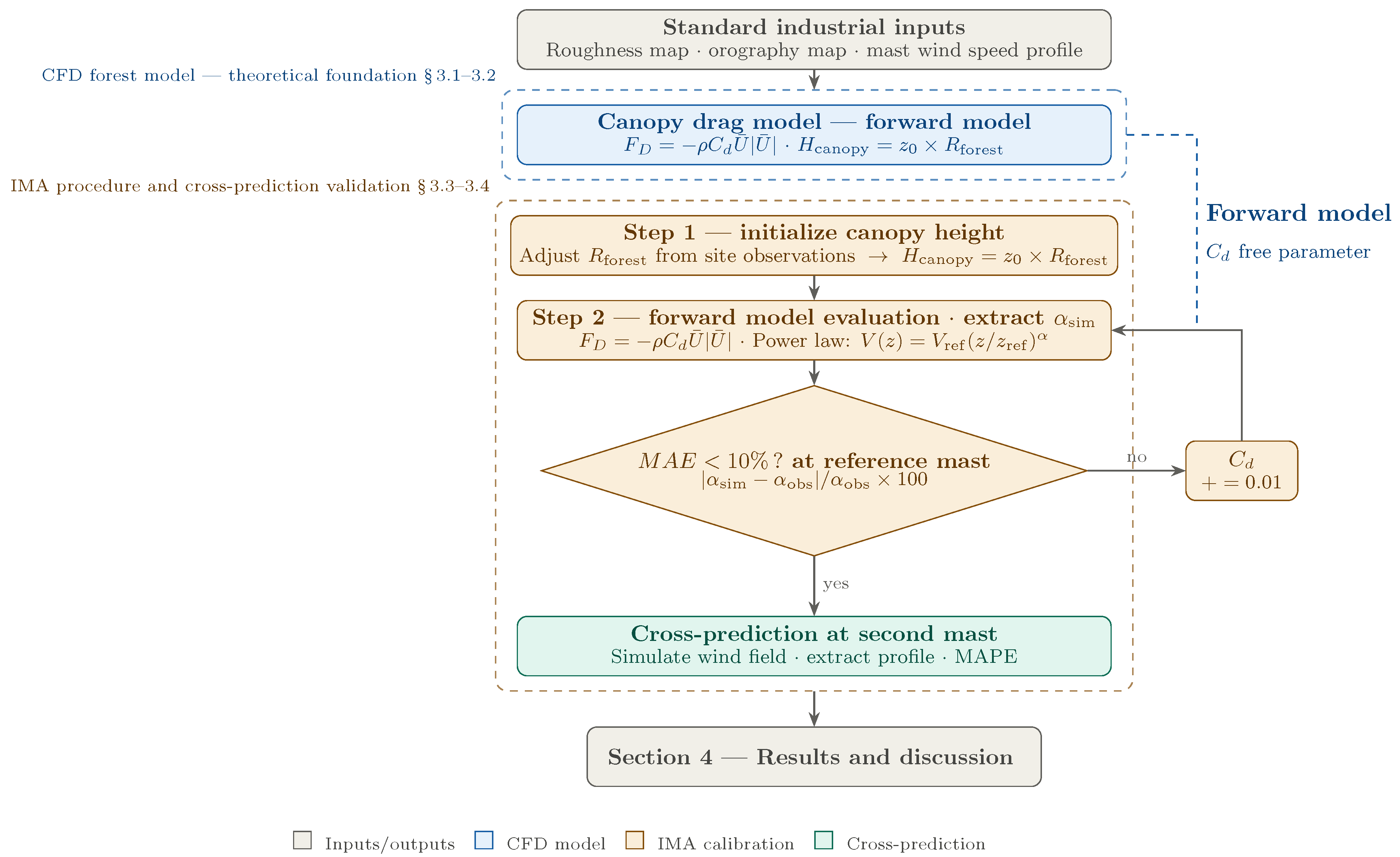
3.3.2. Description of the IMA Procedure
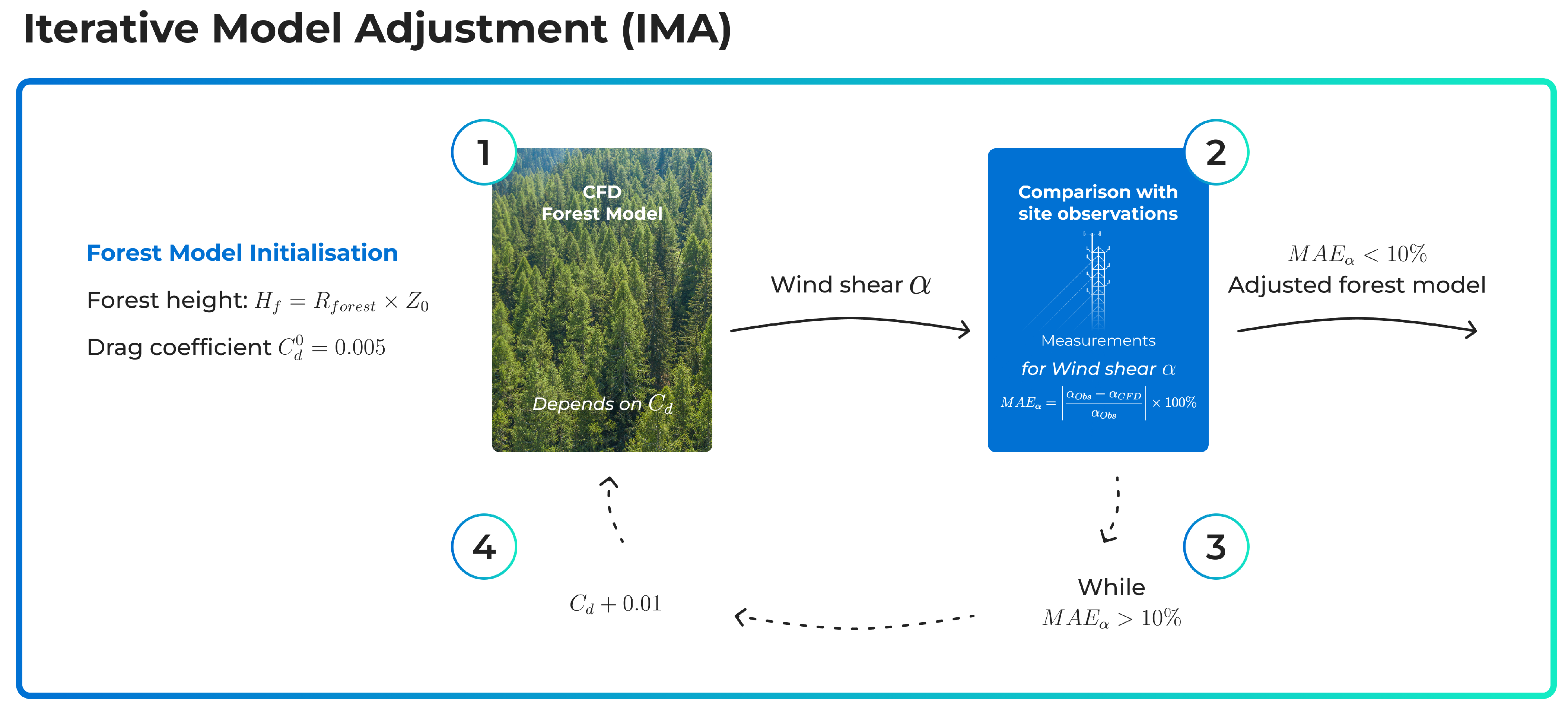
- Step 1—Forest model initialization: canopy height and roughness length adjustment.
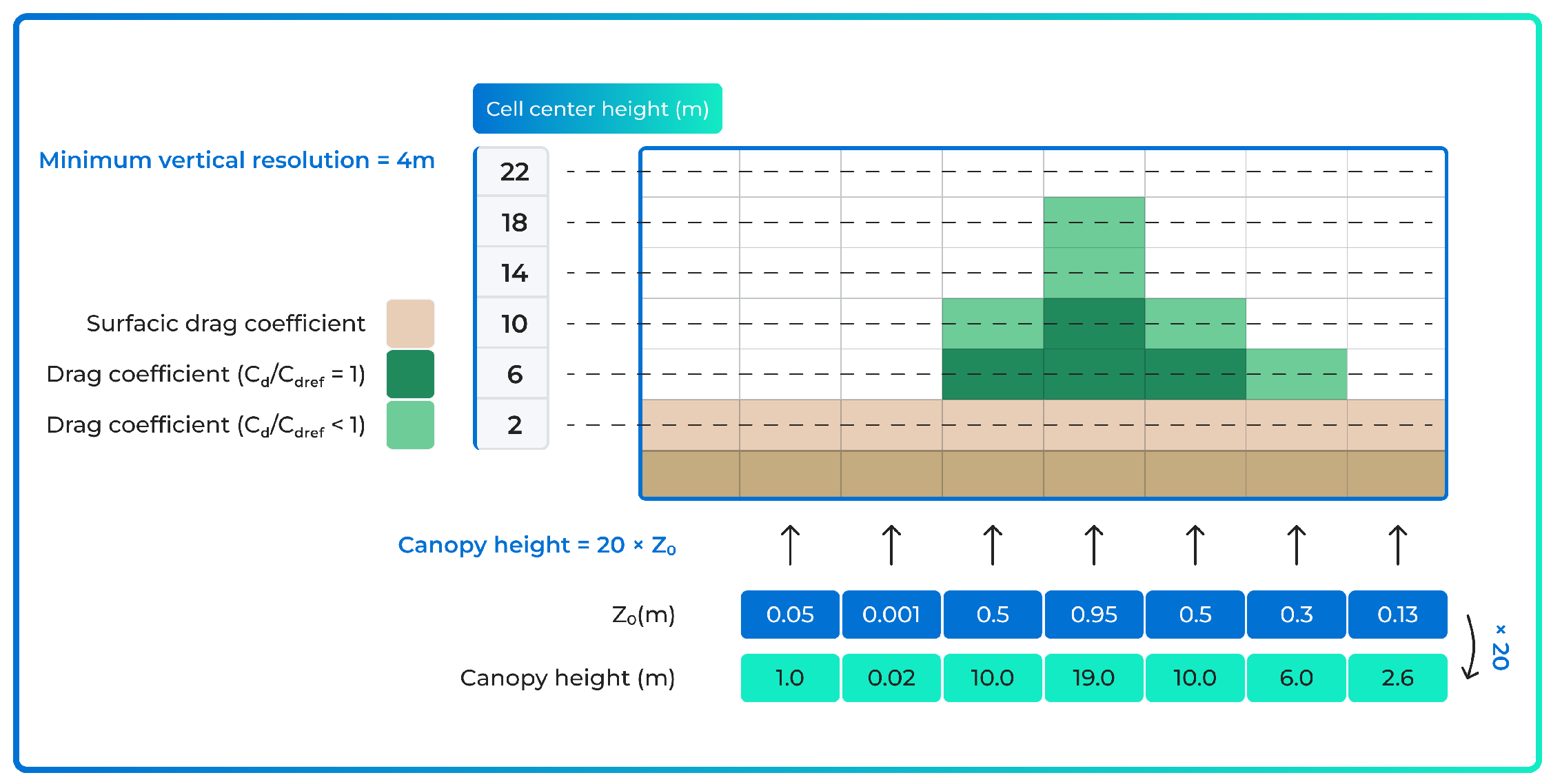
- Canopy height is defined by the roughness length and the forest ratio as . Starting from the default roughness map values and the default forest ratio , these variables are first adjusted according to on-site observations. Roughness length values are provided by the land cover map, while the forest ratio is estimated from the approximate canopy height observed at the site using on-site visits, photographs, or Google Earth imagery [35,36,37,38].
- When canopy height is systematically underestimated across the whole area, the forest ratio is rescaled accordingly. For example, for a site with dominant coniferous trees of approximately 30 m height and a roughness length of m, the appropriate forest ratio is . Conversely, when local canopy height inconsistencies are observed, the roughness length values are corrected in the specific area by modifying the conversion table or by manually adjusting roughness length values in that region.
- Step 2—Iterative drag coefficient adjustment.
- The reference drag coefficient directly controls the strength of the canopy momentum sink and therefore the simulated wind shear exponent . is treated as a free parameter and determined iteratively as follows:
- 0.
- Initialize (Meteodyn WT™ default value).
- 1.
- Run the full CFD simulation for all 20 wind direction sectors using the current value. Extract the simulated mean wind speed profile at the reference mast location and compute the simulated shear exponent .
- 2.
- Compute the shear convergence criterion:
- 3.
- If : the calibration is complete. Proceed to cross-prediction.
- 4.
- If : increment and return to step (1).
3.3.3. Scope and Assumptions of the IMA Procedure
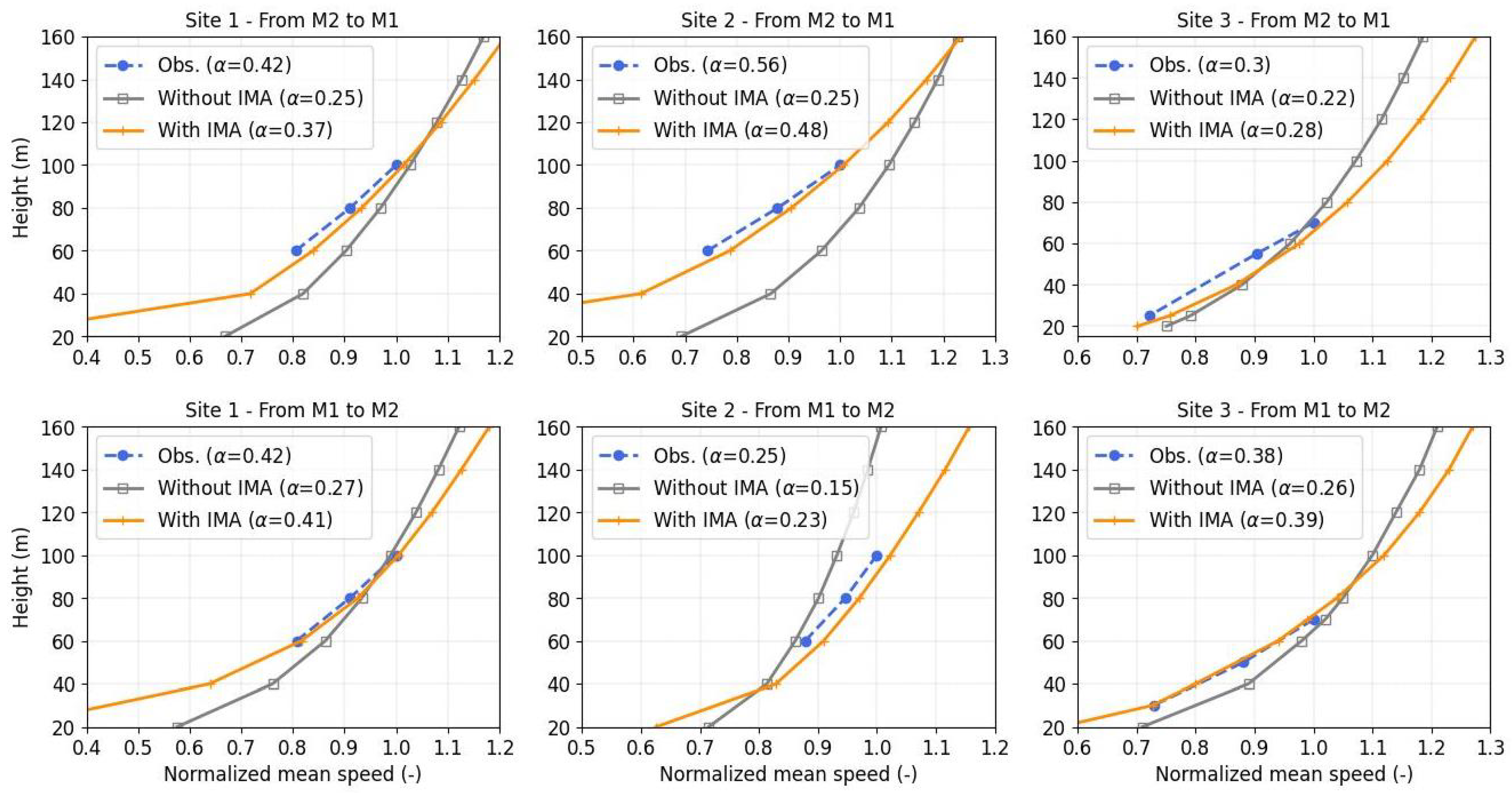
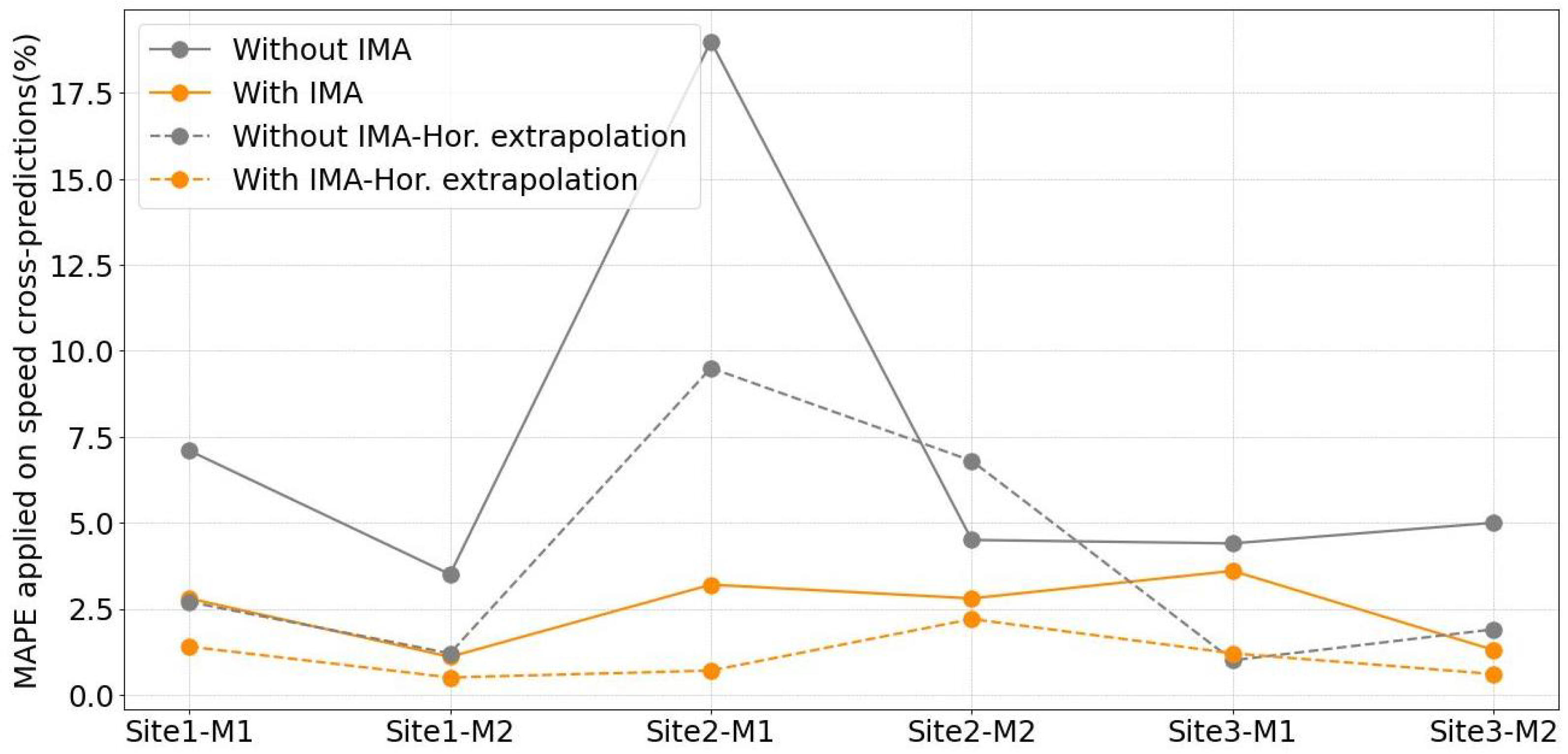
- Spatial homogeneity of : The constant assumption does not require spatial uniformity of forest cover across the site. The spatial heterogeneity of the canopy—including variations in canopy height between forested patches, clearings, and areas of different vegetation density—is already represented through the spatially varying roughness length of the land cover map, which determines the local canopy height at each computational cell. Forest model activation therefore varies spatially across the domain in a manner consistent with the roughness map. A single value is assumed to represent the forest drag properties across the entire site. While governs the spatial distribution and vertical extent of the drag field, governs its aerodynamic magnitude—specifically the drag per unit volume of canopy determined by tree species characteristics such as needle density, branch architecture, and crown shape. This assumption is validated across six cross-prediction cases in Section 4, including heterogeneous forest conditions and inter-mast distances from 2 to 6.6 km, yielding a global mean absolute error of approximately 1.1%.
- Neutral atmospheric stability: CFD simulations are performed under neutral stability conditions only, based on the hypothesis that full-year averaging satisfies near-neutral conditions [27]. While atmospheric stability has been identified as a significant source of modeling uncertainty in forested terrain [16], the neutral assumption is consistent with standard industrial WRA practice. The influence of thermal stability on IMA calibration remains an open question identified for future work.
3.4. Methodology for Cross-Predictions in WRA
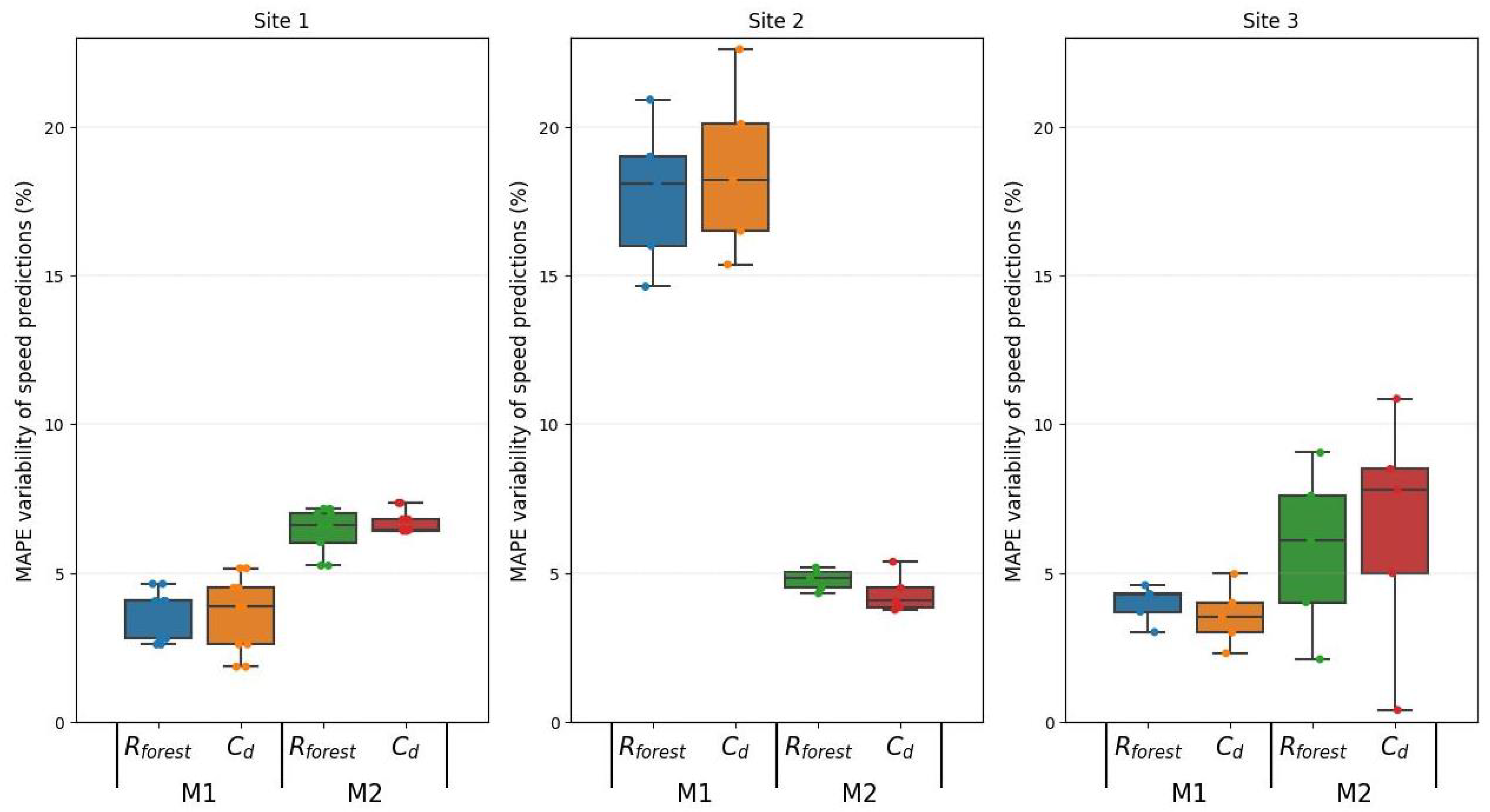
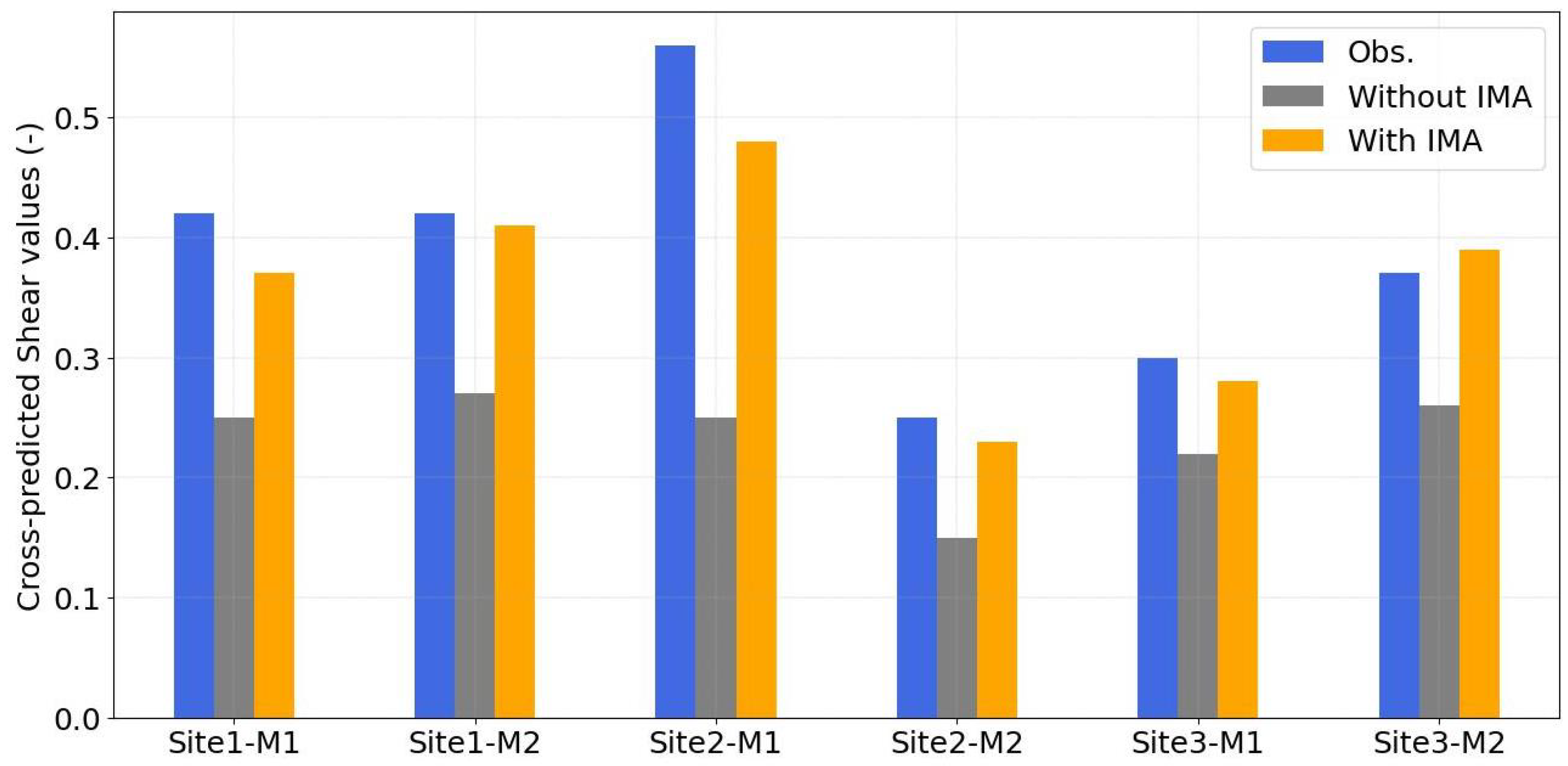
- Mean Absolute Error (MAE):where is the measured variable value and is the simulated variable. The CFD simulation methodology is validated using a cross-prediction approach. The MAE is applied to mean speed and shear values ().
- Mean Absolute Percentage Error (MAPE):
- The MAPE measures the average magnitude of error produced by the CFD model on one mast location at three different elevations.where is the measured wind speed value and is the simulated wind speed value.
4. Results and Discussion
4.1. Forest Model Sensitivity
- Influence of canopy height on wind flow: For the sensitivity analysis, the canopy height influence has been investigated through the forest ratio for the three sites using values 10, 20, 30, 40, and 50, while applying a reference drag coefficient . This means that the canopy height on each mesh cell is calculated by multiplying the roughness length values by these ratios. For example, if considering roughness length value of 0.7 m corresponding to coniferous trees areas, the following canopy height influence are examined on the wind flow: 7 m, 14 m, 21 m, 28 m, and 35 m.
- Influence of forest density represented by the reference drag coefficient :
- The influence of forest density is investigated by varying the drag coefficient over the values 0.001, 0.005, 0.01, 0.02, and 0.05, while keeping the forest ratio fixed at .
- The default values of both parameters— and —are positioned at the lower end of the tested ranges, suggesting that the default configuration systematically underestimates forest-induced wind shear in dense coniferous conditions. This prediction is confirmed a posterior by the IMA calibration, where both parameters were consistently adjusted to higher values at all three sites.
- produces a larger MAPE sensitivity range (1–10%) than (1–7%) across the tested values, despite spanning a proportionally larger relative range.
- Both parameters exert a positive and non-compensatory influence on wind shear—increasing either or increases the simulated wind shear exponent , and neither parameter can substitute for the other. This positive correlation ensures that the IMA two-step calibration procedure is well-posed: fixing in Step 1 from site observations and then adjusting in Step 2 leads to a unique solution, since no combination of opposing parameter changes can produce an equivalent wind profile.
4.2. IMA Method Applied on Each Reference Mast
- At Site 1 and Site 3, forest ratio has been deduced first from the tree height presented in Table 1. For example, at Site 3, the forest ratio .
- At Site 2, forest ratio is set to default, the roughness map has been locally corrected according to on-site observations to increase the tree height from 14 m to 35 ± 5 m in coniferous forest areas. For this reason, the roughness length corresponding to coniferous forest areas has been modified from 0.7 m to 1.7 m in the roughness map conversion table.
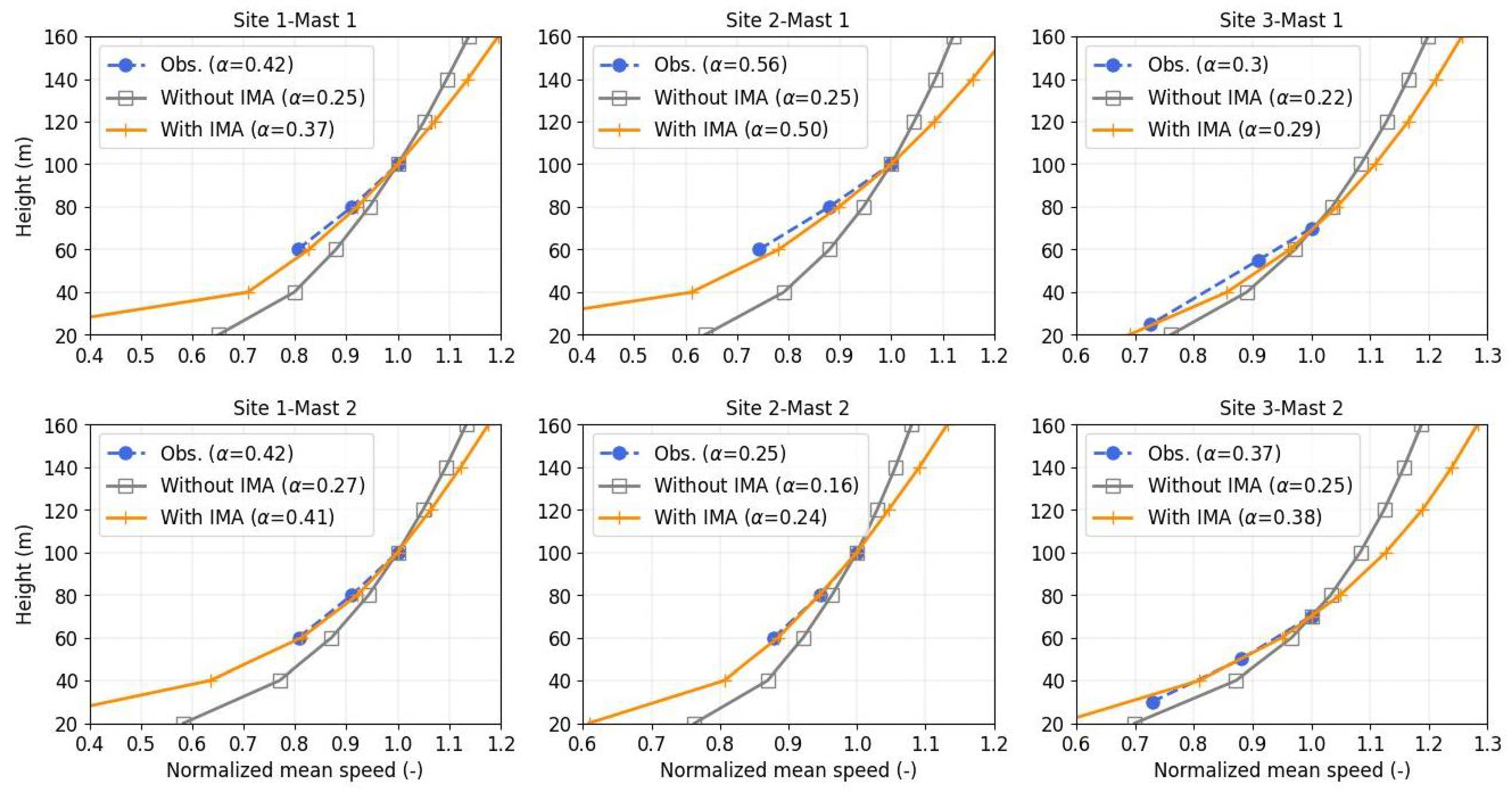
- Following the determination of the forest ratio , the reference drag coefficient was iteratively adjusted until the simulated wind shear exponent matched the observed values within the 10% convergence criterion.
4.3. Influence of Iterative Model Adjustment (IMA) on Cross-Predictions
5. Conclusions
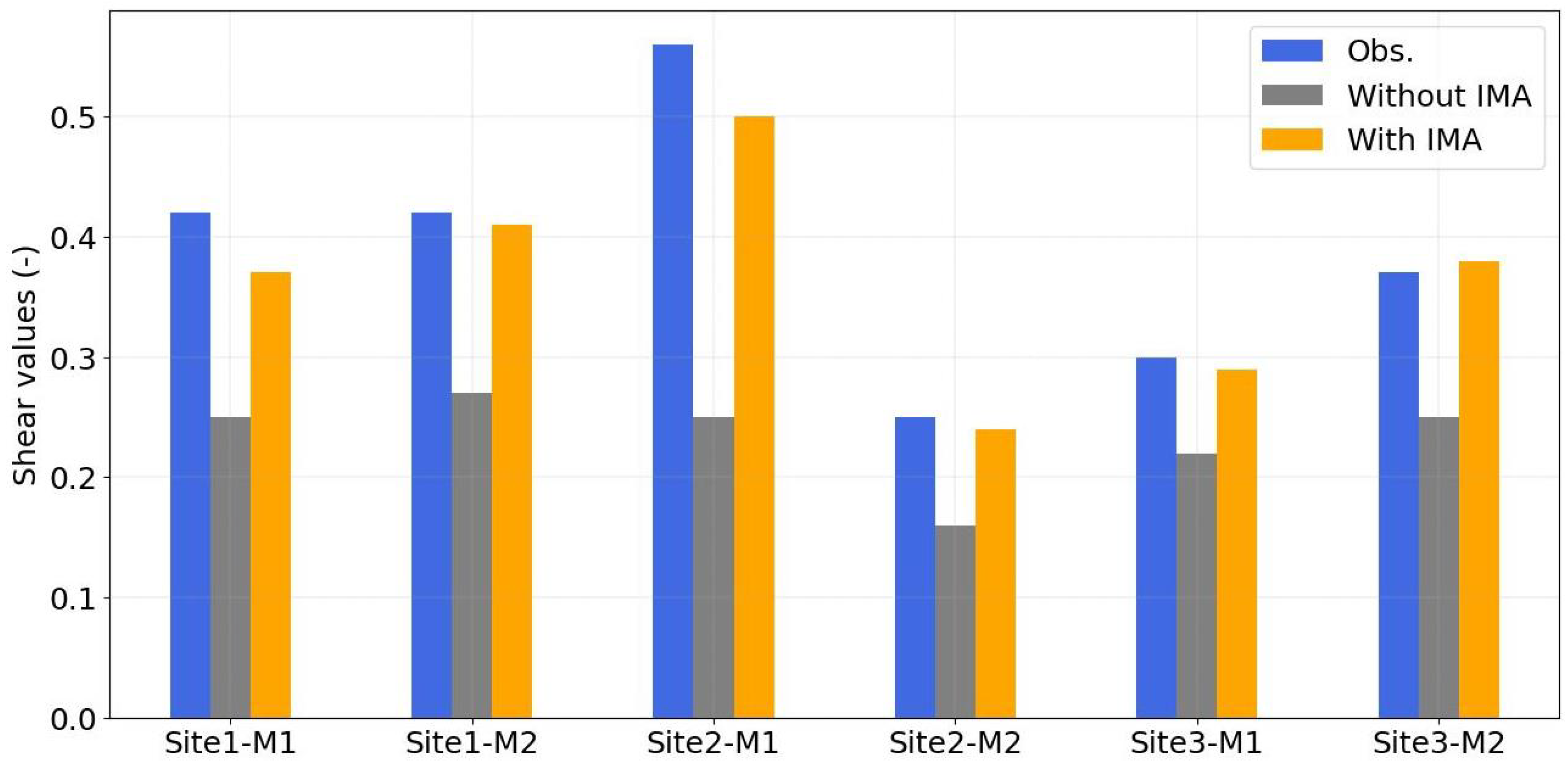
- Accurate wind simulation based on IMA methodology: Wind speed estimation accuracy improved significantly when using appropriate forest height and drag coefficient values determined using the IMA procedure. Shear differences between simulations and measurements were reduced significantly from [0.08–0.3] to [0.01–0.07]. Horizontal mean speed errors have been reduced from [1.0–9.5%] to [0.5–2.2%] yielding a global mean absolute speed error of 1.1% based on six cases.
- Physical understanding of forest modeling:The sensitivity analysis demonstrates that the drag coefficient and canopy height both exert a comparable and jointly necessary influence on wind shear simulation—neither parameter alone is sufficient to reproduce observed wind profiles in dense forest conditions. Default parameter values systematically underestimate forest-induced wind shear, with IMA consistently calibrating to higher values at all three sites. The assumption of a spatially constant —representing consistent species-level aerodynamic properties across the site—was validated across all six cases including heterogeneous forest coverage, dominant coniferous forest, complex terrain, and cross-prediction distances of 2–6.6 km. Forest-induced flow effects were observed up to 1 km into surrounding clearing areas, demonstrating that IMA can be applied from nearby masts located outside the forest boundary—extending the standard recommendation of using a representative mast with similar roughness conditions [48]. While cross-prediction distances exceeding 7 km are outside of established guidelines in complex terrain [48], the applicability of IMA over longer distances and in different forest types (such as deciduous forests, mixed forests) would remain an open question.
- Usage of land cover maps: Land cover maps based on satellite data provide a useful foundation for forest wind modeling. However, conversion tables and forest ratio corrections were required at all three sites to achieve more physically representative canopy heights. IMA results are robust to moderate canopy height estimation uncertainty—a 7 m error produces less than 1% average impact on cross-predicted MAPE, with a mean variability of 0.8%.
Author Contributions
Funding
Data Availability Statement
Acknowledgments
Conflicts of Interest
Abbreviations
| CFD | Computational Fluid Dynamics |
| WRA | Wind Resource Assessment |
| RANS | Reynolds-Averaged Navier-Stokes |
| IMA | Iterative model adjustment |
| MAPE | Mean Absolute Percentage Error |
| MAE | Mean Absolute Error |
References
- Alfredsson, P.H.; Segalini, A. Wind farms in complex terrains: An introduction. Philos. Trans. R. Soc. A Math. Phys. Eng. Sci. 2017, 375, 20160096. [Google Scholar] [CrossRef]
- Enevoldsen, P. Onshore wind energy in Northern European forests: Reviewing the risks. Renew. Sustain. Energy Rev. 2016, 60, 1251–1262. [Google Scholar] [CrossRef]
- Pereira, R.; Ricardo, G.; Silva Santos, C. Comparing WAsP and CFD wind resource estimates for the “regular” user. In Proceedings of the European Wind Energy Conference, Warsaw, Poland, 20–23 April 2010. [Google Scholar]
- Shaw, R.H.; Schumann, U. Large-eddy simulation of turbulent flow above and within a forest. Bound.-Layer Meteorol. 1992, 61, 47–64. [Google Scholar] [CrossRef]
- Kanani, F.; Träumner, K.; Ruck, B.; Raasch, S. What determines the differences found in forest edge flow between physical models and atmospheric measurements?—An LES study. Meteorol. Z. 2014, 23, 33–49. [Google Scholar] [CrossRef] [PubMed]
- Boudreault, L. Reynolds-Averaged Navier-Stokes and Large-Eddy Simulation over and Inside Inhomogeneous Forests. Ph.D. Thesis, Technical University of Denmark, Department of Mechanical Engineering, Lundtofte, Denmark, 2015. [Google Scholar]
- Boudreault, L.E.; Bechmann, A.; Tarvainen, L.; Klemedtsson, L.; Shendryk, I.; Dellwik, E. A LiDAR method of canopy structure retrieval for wind modeling of heterogeneous forests. Agric. For. Meteorol. 2015, 201, 86–97. [Google Scholar] [CrossRef]
- Chávez-Arroyo, R.; Sanz-Rodrigo, J.; Gancarski, P. Modelling of atmospheric boundary-layer flow in complex terrain with different forest parameterizations. J. Phys. Conf. Ser. 2014, 524, 012119. [Google Scholar] [CrossRef]
- Ivanell, S.; Arnqvist, J.; Avila, M.; Cavar, D.; Chavez-Arroyo, R.; Olivares Espinosa, H.; Peralta, C.; Adib, J.; Witha, B. Micro-Scale Model Comparison (Benchmark) at the Moderately Complex Forested Site Ryningsnäs. Wind Energy Sci. 2018, 3, 929–946. [Google Scholar] [CrossRef]
- Crasto, G. Forest Modeling, A Canopy Model for WindSim 4.5; University of Cagliari: Cagliari, Italy, 2006. [Google Scholar]
- Delaunay, D. Modelling the Stable Boundary Layer for Wind Resource Assessment; Technical Report; Meteodyn: Nantes, France, 2013. [Google Scholar]
- Monteiro, J.R.; Batista, V.T.P.; Palma, J.M.L.M. Assessing canopy models across forest edges on flat terrain. J. Phys. Conf. Ser. 2024, 2767, 092011. [Google Scholar] [CrossRef]
- Jiang, Z.; Bullido-Garcia, M.; Houbart, J.C.; Bezault, C. CFD modeling of forest canopy flows: Input parameters, calibration and validation. In Proceedings of the European Wind Energy Conference and Exhibition (EWEC 2013), Vienna, Austria, 4–7 February 2013; pp. 457–465. [Google Scholar]
- Sanquer, S.; Berthaut-Gérentes, J.; Cosculluela Soteras, L. Modelling wind flow in forested areas: A parametric study. In Proceedings of the AWEA Proceedings, Charleston, SC, USA, 22–23 March 2016. [Google Scholar]
- Melani, P.F.; Balduzzi, F.; Orlando, S.; Vitic, V.; Bianchini, A. Numerical analysis of the impact of forestry on the wind resource assessment in complex terrains. In Proceedings of the Wind Energy Science Conference, Nantes, France, 25–27 June 2025. [Google Scholar]
- Desmond, C.J.; Watson, S.; Montavon, C.; Murphy, J. Modelling Uncertainty in t-RANS Simulations of Thermally Stratified Forest Canopy Flows for Wind Energy Studies. Energies 2018, 11, 1703. [Google Scholar] [CrossRef]
- Li, Y.; Li, Z.; Zhou, Z.; Yang, X. Large-Eddy Simulation of Wind Turbine Wakes in Forest Terrain. Sustainability 2023, 15, 5139. [Google Scholar] [CrossRef]
- Orlova, S.; Dmitrijevs, N.; Mironova, M.; Kamolins, E.; Komasilovs, V. Assessing the Impact of Forests on Wind Flow Dynamics and Wind Turbine Energy Production. Wind 2026, 6, 10. [Google Scholar] [CrossRef]
- Barber, S.; Schubiger, A.; Koller, S.; Eggli, D.; Radi, A.; Rumpf, A.; Knaus, H. The wide range of factors contributing to wind resource assessment accuracy in complex terrain. Wind Energy Sci. 2022, 7, 1503–1526. [Google Scholar] [CrossRef]
- Chaudhari, A.; Ashu, T.; Vita, G.; Hellsten, A. Impact of forest density on atmospheric boundary-layer flow and turbulence for wind energy applications. Bound.-Layer Meteorol. 2026, 192, 91–106. [Google Scholar] [CrossRef]
- Lopes da Costa, J.; Castro, F.; Palma, J.M.L.M.; Stuart, P. Computer Simulation of Atmospheric Flows over Real Forests for Wind Energy Resource Evaluation. J. Wind Eng. Ind. Aerodyn. 2006, 94, 603–620. [Google Scholar] [CrossRef]
- Katul, G.G.; Mahrt, L.; Poggi, D.; Sanz, C. One and Two-Equation Models for Canopy Turbulence. Bound.-Layer Meteorol. 2004, 113, 81–109. [Google Scholar] [CrossRef]
- Meteodyn. Meteodyn WT User Manual Advanced Notes; Meteodyn: Saint-Herblain, France, 2026. [Google Scholar]
- Delaunay, D.; Li, W.; Bodéré, S. Calibrating a CFD canopy model with the EC1 vertical profiles of mean wind speed and turbulence. In Proceedings of the 13 International Conference on Wind Engineering, Amsterdam, The Netherlands, 10–15 July 2011. [Google Scholar]
- Konagaya, M.; Ohsawa, T.; Itoshima, Y.; Kambayashi, M.; Leonard, E.; Tromeur, E.; Misaki, T.; Shintaku, E.; Araki, R.; Hamada, K. Estimation of Wind Conditions in the Offshore Direction Using Multiple Numerical Models and In Situ Observations. Energies 2025, 18, 3000. [Google Scholar] [CrossRef]
- Queck, R.; Bienert, A.; Maas, H.G.; Harmansa, S.; Goldberg, V.; Bernhofer, C. Wind fields in heterogeneous conifer canopies: Parameterisation of momentum absorption using high-resolution 3D vegetation scans. Eur. J. For. Res. 2012, 131, 165–176. [Google Scholar] [CrossRef]
- Sogachev, A.; Cavar, D.; Kelly, M.; Dellwik, E.; Klaas, T.; Kühn, P. Numerical modelling of the wind over forests. Adv. Sci. Res. 2020, 17, 53–61. [Google Scholar] [CrossRef]
- Liu, J.; Chen, J.M.; Black, T.A.; Novak, M.D. E-ε Modelling of Turbulent Air-Flow Downwind of a Model Forest Edge. Bound.-Layer Meteorol. 1996, 77, 21–44. [Google Scholar] [CrossRef]
- Sogachev, A.; Panferov, O. Modification of Two-Equation Models to Account for Plant Drag. Bound.-Layer Meteorol. 2006, 121, 229–266. [Google Scholar] [CrossRef]
- Viana Parente Lopes, J.M.; Palma, J.M.L.M.; Silva Lopes, A. Modelling the flow within forests: The canopy-related terms in the Reynolds-averaged formulation. J. Fluid Mech. 2021, 910, A7. [Google Scholar] [CrossRef]
- Copernicus Land Monitoring Service. CORINE Land Cover 2018 (Raster 100 m). 2018. Available online: https://land.copernicus.eu/en/products/corine-land-cover/clc2018 (accessed on 27 April 2026).
- European Environment Agency (EEA). Land Cover 2015–2019 (Raster 100 m), Version 3; Copernicus Land Monitoring Service Dataset; European Environment Agency (EEA): Copenhagen, Denmark, 2019; Available online: https://sdi.eea.europa.eu/catalogue/srv/api/records/c6377c6e-76cc-4d03-8330-628a03693042?language=all (accessed on 10 April 2026).
- NASA JPL. NASADEM Global Digital Elevation Model, 2020. NASA EOSDIS Land Processes Distributed Active Archive Center (LP DAAC). Available online: https://portal.opentopography.org/datasetMetadata?otCollectionID=OT.032021.4326.2 (accessed on 10 April 2026).
- European Environment Agency (EEA). EU-DEM v1.1 (Raster Digital Elevation Model), Version 1.1; Released April 2016, Copernicus Land Monitoring Service; European Environment Agency (EEA): Copenhagen, Denmark, 2016. [Google Scholar]
- Dörenkämper, M.; Olsen, B.T.; Witha, B.; Hahmann, A.N.; Davis, N.N.; Barcons, J.; Ezber, Y.; García-Bustamante, E.; González-Rouco, J.F.; Navarro, J.; et al. The Making of the New European Wind Atlas—Part 2: Production and evaluation. Geosci. Model Dev. 2020, 13, 5079–5102. [Google Scholar] [CrossRef]
- Abbas, M.R.; Rasib, A.W.B.; Abbas, T.R.; Ahmad, B.B.; Dutsenwai, H.S. An overview of wind energy production prediction bias, losses, and uncertainties. IOP Conf. Ser. Earth Environ. Sci. 2021, 722, 012015. [Google Scholar] [CrossRef]
- Floors, R.; Enevoldsen, P.; Davis, N.; Arnqvist, J.; Dellwik, E. From lidar scans to roughness maps for wind resource modelling in forested areas. Wind Energy Sci. 2018, 3, 353–370. [Google Scholar] [CrossRef]
- Silva, J.; Ribeiro, C.; Ricardo, G.; Rua, M.C.; Ulrich, F. Roughness length classification of Corine Land Cover classes. In Proceedings of the EWEC 2007, Milan, Italy, 7–10 May 2007. [Google Scholar]
- Windpro. WIKI-Windpro. Available online: https://help.emd.dk/mediawiki/index.php?title=Main_Page (accessed on 10 April 2026).
- Lee, J.C.Y.; Fields, M.J. An overview of wind-energy-production prediction bias, losses, and uncertainties. Wind Energy Sci. 2021, 6, 311–365. [Google Scholar] [CrossRef]
- IEC 61400-12-1:2022; Wind Energy Generation Systems—Part 12-1: Power Performance Measurements of Electricity Producing Wind Turbines. IEC: Geneva, Switzerland, 2022.
- Cunha Pinheiro, J.; da Câmara, R.A. The uncertainties in the estimation of electricity production in the Brazilian onshore wind sector. E-Prime Adv. Electr. Eng. Electron. Energy 2025, 12, 100996. [Google Scholar] [CrossRef]
- Pope, S.B. Turbulent Flows; Cambridge University Press: Cambridge, UK, 2000. [Google Scholar]
- Ferry, M. New features of the MIGAL solver. In Proceedings of the 9th International PHOENICS User Conference, Moscow, Russia, 23–27 September 2002. [Google Scholar]
- Maldonado-Correa, J.; Vásquez, G.; Paccha-Herrera, E.; Cuenca, J.; Rojas, M.; Solano, J.; Valdiviezo, M.; Samaniego, C.; Valarezo, J. Analysis of the Annual Energy Production of the Villonaco Wind Farm. In Congress on Research, Development, and Innovation in Renewable Energies: Selected Papers from CIDiER 2022; Espinoza-Andaluz, M., Melo Vargas, E., Santana Villamar, J., Encalada-Dávila, Á., Eds.; Springer International Publishing: Cham, Switzerland, 2023; pp. 73–87. [Google Scholar] [CrossRef]
- Yamada, T. Simulations of nocturnal drainage flows by a q2–l turbulence closure model. J. Atmos. Sci. 1983, 40, 91–106. [Google Scholar] [CrossRef]
- Garratt, J. The Atmospheric Boundary Layer; Cambridge Atmospheric and Spac Cambridge Atmospheric and Space Science Series; Cambridge University Press: Cambridge, UK, 1996. [Google Scholar]
- MEASNET Organisation. MEASNET Procedure: Evaluation of Site-Specific Wind Conditions; Version 3; MEASNET: Madrid, Spain, 2022. [Google Scholar]



| Site | Country | Roughness | Orography | Mast Heights | Canopy M1 | Canopy M2 |
|---|---|---|---|---|---|---|
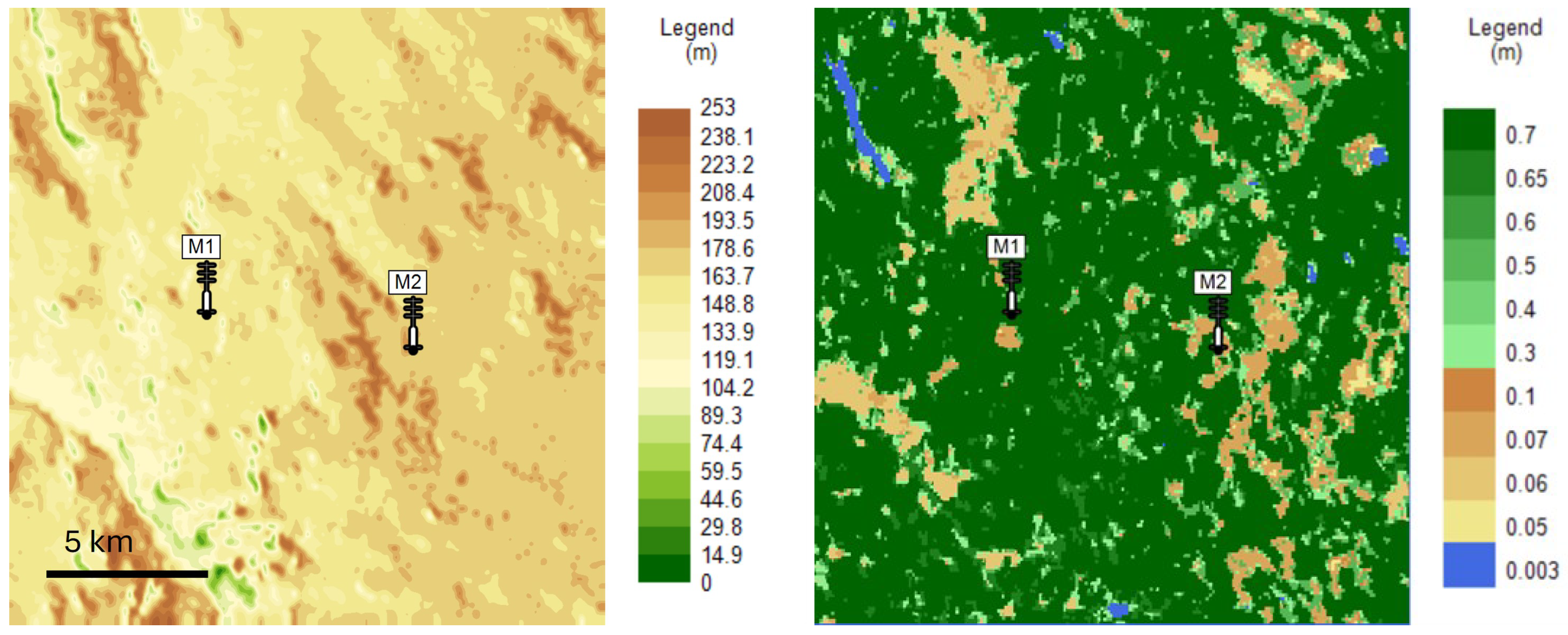
| 1 | Finland | LC 2019 (100 m) | EUDEM v1.1 (25 m) | 100; 80; 60 m | 30 ± 5 m | 30 ± 5 m |
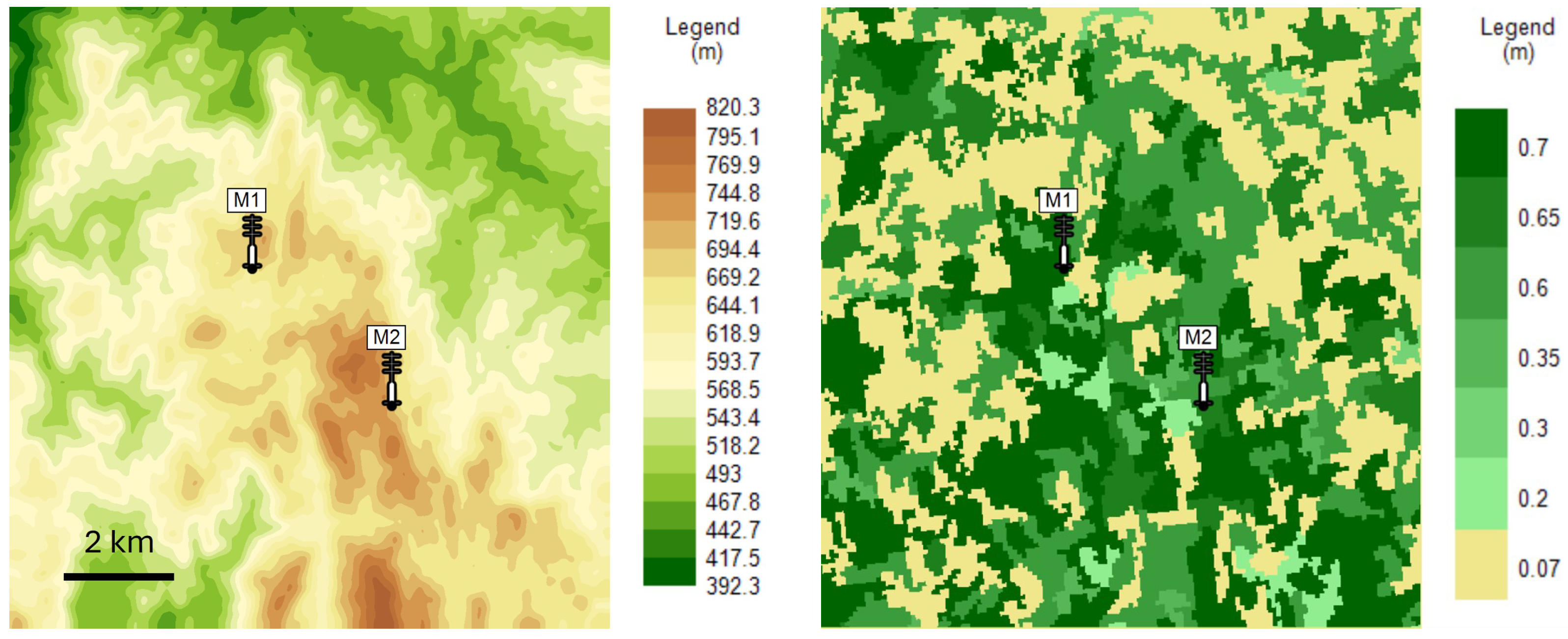
| 2 | France | CLC 2018 (100 m) | NASADEM (30 m) | 100; 80; 60 m | 35 ± 5 m | 10 ± 5 m |
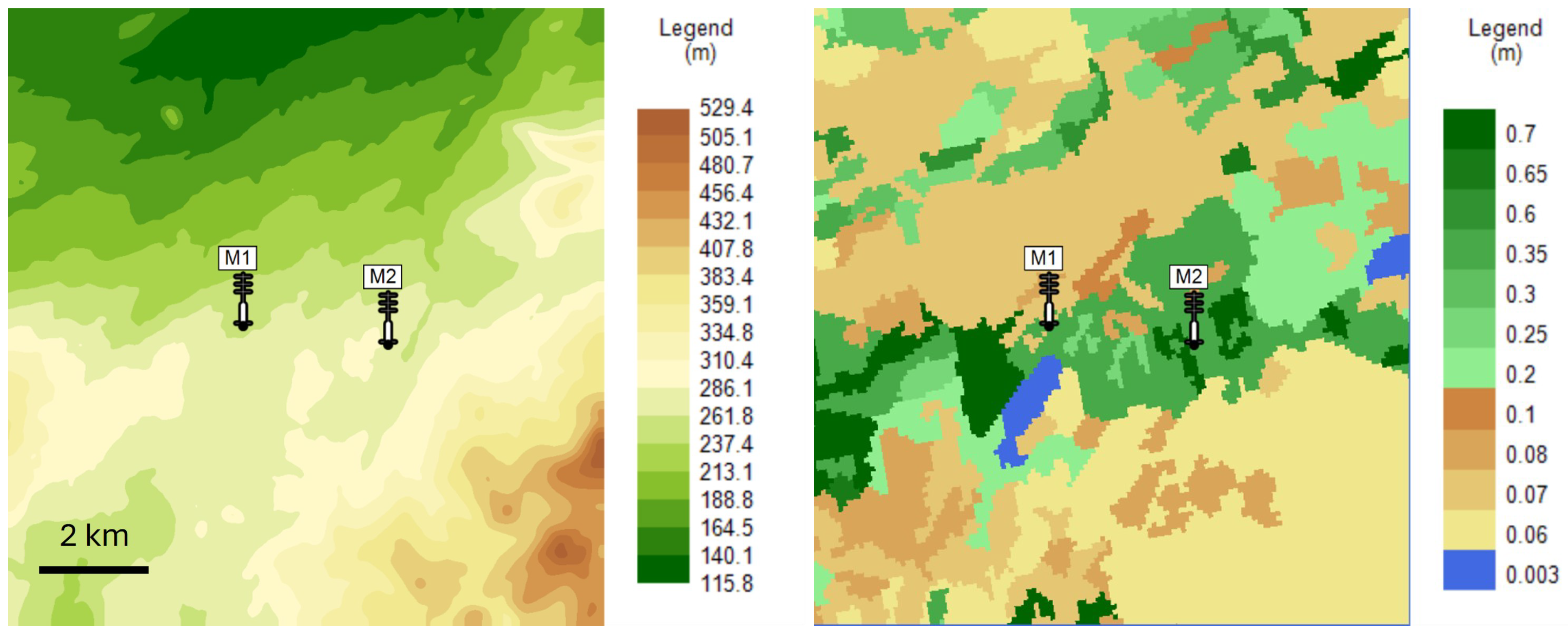
| 3 | Scotland | CLC 2018 (100 m) | NASADEM (30 m) | 70; 50; 30 m | 15 ± 5 m | 20 ± 5 m |
| Site | Site 1 | Site 2 | Site 3 |
|---|---|---|---|
| Site radius | 8 km | 8 km | 8 km |
| Horizontal resolution | 25 m | 25 m | 25 m |
| Vertical resolution | 4 m | 4 m | 4 m |
| Averaged cell count | 8.5 million | 8.5 million | 8.5 million |
| Total computation time (all sectors) | 6 h and 5 min | 5 h and 20 min | 4 h and 30 min |
| Averaged computation time per sector | 18 min | 16 min | 13 min |
| Initial Parameters | Parameters with IMA | Roughness Map Modified | IMA Iterations | |
|---|---|---|---|---|
| Site 1 | , | , | No | 3 |
| Site 2 | , | , | Yes | 7 |
| Site 3 | , | , | No | 2 |
Disclaimer/Publisher’s Note: The statements, opinions and data contained in all publications are solely those of the individual author(s) and contributor(s) and not of MDPI and/or the editor(s). MDPI and/or the editor(s) disclaim responsibility for any injury to people or property resulting from any ideas, methods, instructions or products referred to in the content. |
© 2026 by the authors. Licensee MDPI, Basel, Switzerland. This article is an open access article distributed under the terms and conditions of the Creative Commons Attribution (CC BY) license.
Share and Cite
Leonard, E.; Li, R.; Tromeur, E.; Dupont, M.; Gaussorgues, A.; Martellozzo, G.; Koutsioumpas, S.; Akcakaya, M. A Complete CFD Methodology Based on Iterative Model Adjustment to Improve Wind Simulation Accuracy in Highly Dense Forest Area. Energies 2026, 19, 2243. https://doi.org/10.3390/en19092243
Leonard E, Li R, Tromeur E, Dupont M, Gaussorgues A, Martellozzo G, Koutsioumpas S, Akcakaya M. A Complete CFD Methodology Based on Iterative Model Adjustment to Improve Wind Simulation Accuracy in Highly Dense Forest Area. Energies. 2026; 19(9):2243. https://doi.org/10.3390/en19092243
Chicago/Turabian StyleLeonard, Edouard, Ru Li, Eric Tromeur, Marianne Dupont, Aurélien Gaussorgues, Gaetan Martellozzo, Stavros Koutsioumpas, and Mustafa Akcakaya. 2026. "A Complete CFD Methodology Based on Iterative Model Adjustment to Improve Wind Simulation Accuracy in Highly Dense Forest Area" Energies 19, no. 9: 2243. https://doi.org/10.3390/en19092243
APA StyleLeonard, E., Li, R., Tromeur, E., Dupont, M., Gaussorgues, A., Martellozzo, G., Koutsioumpas, S., & Akcakaya, M. (2026). A Complete CFD Methodology Based on Iterative Model Adjustment to Improve Wind Simulation Accuracy in Highly Dense Forest Area. Energies, 19(9), 2243. https://doi.org/10.3390/en19092243