1. Introduction
The development and utilization of shallow geothermal energy is of great significance for building a resource-conserving and environment-friendly society, optimizing the energy structure, promoting energy conservation and emission reduction, and achieving the goals of carbon neutrality and carbon peak [
1]. The ground source heat pump (GSHP) system, as the main form of shallow geothermal energy utilization, extracts heat from the ground in winter and releases heat into the ground in summer through ground heat exchangers (GHEs), achieving heat exchange with buildings [
2]. The efficiency of GSHP system is influenced by multiple factors such as the structure of the heat exchanger, geology, climate, and the ground temperature field [
3]. Long-term operation studies have demonstrated that BHE fields with negligible groundwater movement may experience progressive ground temperature accumulation, leading to thermal saturation and performance degradation over seasonal cycles [
4]. Therefore, it is necessary to model and analyze the heat transfer process between the GHE and the surrounding medium.
Vertical borehole heat exchanger (BHE), as one commonly used type of GHE, is favored in applications due to its small space requirement and low sensitivity to seasonal temperature fluctuations from the surface, and plenty of research has been conducted on modeling heat transfer outside a single BHE [
5]. In multi-borehole fields, thermal interference between closely spaced BHEs significantly impacts overall system efficiency, necessitating advanced modeling approaches to optimize grout material properties and heat transfer performance [
6]. The existing heat transfer models are mostly designed for impermeable layers in which groundwater seepage is negligible. Under such conditions, heat transfer outside the borehole is primarily governed by conductive mechanisms within the solid skeleton. The heat conduction models can be generally classified into two types: analytical models and numerical models. The analytical models include Kelvin’s line-source model developed based on the heat source theory introduced by Kelvin in 1882 and later implemented by Ingersoll et al. [
7], Eskilson’s finite line-source model [
8], and the cylindrical-source model, etc.; the numerical models are based on numerical analysis and calculation, and the commonly used methods include the finite difference method, the finite element method [
9,
10], and the finite volume method [
11], etc.
However, when there is significant groundwater flow around a BHE, the thermal advection effect caused by groundwater seepage will significantly increase the heat exchange rate, thereby affecting the performance of the BHE and the surrounding geothermal field [
12]. Some studies indicated that once the horizontal groundwater velocity exceeds 1 × 10
−8 m/s or the Péclet number remains above 20 for a long period, the influence of groundwater seepage must be considered [
13]. At this point, the heat transfer outside the BHE is governed by the combined effects of conduction through the solid skeleton of the aquifer and advection due to groundwater movement. This heat transport process is extremely complex and is influenced by factors such as the aquifer medium and the state of groundwater movement. Therefore, the existing literature usually employs numerical methods for solutions. Based on the finite difference method, Antelmi et al. used MODFLOW to simulate the heat exchange of the GSHP system and the resulting thermal disturbance in the aquifer [
14]. Viesi et al. established a three-dimensional hydro-thermal coupling model based on the finite element method to evaluate the impact of a certain GSHP system in Italy on the geothermal field [
15]. Gong et al. established a heat transfer model of porous heat exchangers based on the finite volume method and proposed an empirical method for obtaining the total heat transmission coefficient in layered soil [
16].
However, when considering the groundwater seepage effect, the numerical method often exhibits numerical oscillations when solving the heat transfer problem outside the BHE, and this phenomenon becomes more pronounced under advection-dominated conditions [
17]. Three-dimensional numerical simulations have shown that standard numerical formulations may encounter stability issues and computational inefficiencies when resolving steep thermal gradients in the near-field region of BHEs, particularly during transient short-time operations [
18,
19]. Consequently, the analytical method for solving coupled heat advection–conduction problems has always attracted attention. The main advantage of analytical solutions lies in the fact that most of them are exact solutions, which enable them to verify the accuracy of numerical solutions. Moreover, analytical solutions provide explicit expressions for the temperature field, making it more convenient for theoretical analysis, calculation, and inverse problem research using these formulas [
20]. Owing to the fact that the length of a BHE far exceeds its diameter, it is commonly idealized as a line source in the existing literature, and analytical models are then developed on this basis. Taking into account the effects of groundwater flow and axial heat flux along a BHE, Molina-Giraldo et al. developed a moving finite line source model and derived a corresponding analytical solution. They further investigated the differences between this model and the moving infinite line source model [
5]. Hu accounted for the influence of groundwater flow across multiple geological strata and developed an improved analytical BHE model. Long-term temperature responses of the soil surrounding the BHE under seasonally varying loads were simulated and analyzed, and the impact of groundwater velocity on soil temperature around the borehole was systematically investigated [
21]. Zhou et al. incorporated the effects of advection from vertical water flow and convection at the ground surface, introduced a new variable, and derived an analytical solution for the external heat transfer problem of a single BHE using Green’s function method [
3]. Building on this work, they subsequently investigated the heat transfer process outside a single BHE under convective boundary conditions with incorporating the effect of horizontal and vertical groundwater flow. Three representative BHE models including the solid cylindrical source model, the ring coil source model, and the finite line source model were established, and the corresponding analytical solutions were presented [
2].
Although these models advance BHE analysis through varied geometric idealizations, they uniformly reduce the borehole to a source at the origin of a radially symmetric coordinate system with either Neumann or Robin boundary conditions imposed [
2,
5,
21]. The Dirichlet (prescribed-temperature) condition, which is more directly accessible in field monitoring, remains entirely absent from analytical treatments of BHE heat transfer with groundwater flow, as does any representation of an extended boundary capturing the collective thermal behavior of closely spaced borehole arrays.
These systematic constraints give rise to a specific research gap. In engineering practice, borehole wall temperature can be directly monitored via downhole sensors, whereas heat flux must be indirectly inferred from thermal response tests and energy balance calculations. This renders the Dirichlet boundary condition both more practical for field validation and more intuitively accessible for system operators. However, transitioning from Neumann or Robin to Dirichlet conditions fundamentally alters the mathematical structure of the problem, that is, the advection–conduction equation under a prescribed temperature constraint becomes a viscous Burgers equation, for which the line-source superposition methods employed in existing models are inapplicable. To date, no analytical solution has been reported for heat transfer outside BHEs under Dirichlet boundary conditions with groundwater flow, leaving a significant void in the analytical modeling toolkit for GSHP systems.
Based on an actual GSHP project, a closely spaced linear array of BHEs was conceptualized as a Dirichlet temperature boundary with vertical heat exchange neglected, which is a novel approach that distinguishes this work from existing line-source models employing Neumann or Robin conditions. A one-dimensional coupled heat advection–conduction model was then established for heat transfer in the semi-infinite aquifer surrounding the BHEs under groundwater flow. The analytical solution was derived via exponential transformation and Fourier transformation. It should be emphasized that this model is applicable to the aquifer region outside the BHE array, where thermal interference among multiple boreholes is negligible. Within the array, complex thermal interactions preclude the one-dimensional simplification. Subsequently, a three-dimensional hydrothermal coupling numerical model was built in FEFLOW using the regional hydrogeologic conditions and in situ temperature measurements to validate the analytical solution systematically. This represents a methodological advancement, as analytical solutions for the advection–conduction equation under Dirichlet conditions have been scarce due to the mathematical complexity associated with the governing equation. Moreover, it can provide a simple and efficient tool for quickly estimating the temperature variation process outside the BHEs for similar projects, and offer theoretical support for the analysis of the temperature field outside the BHEs in the GSHP system.
2. Materials and Methods
2.1. Case Study
The GSHP project is situated in Hefei, Anhui Province, China; the geographical and geological details are given in reference [
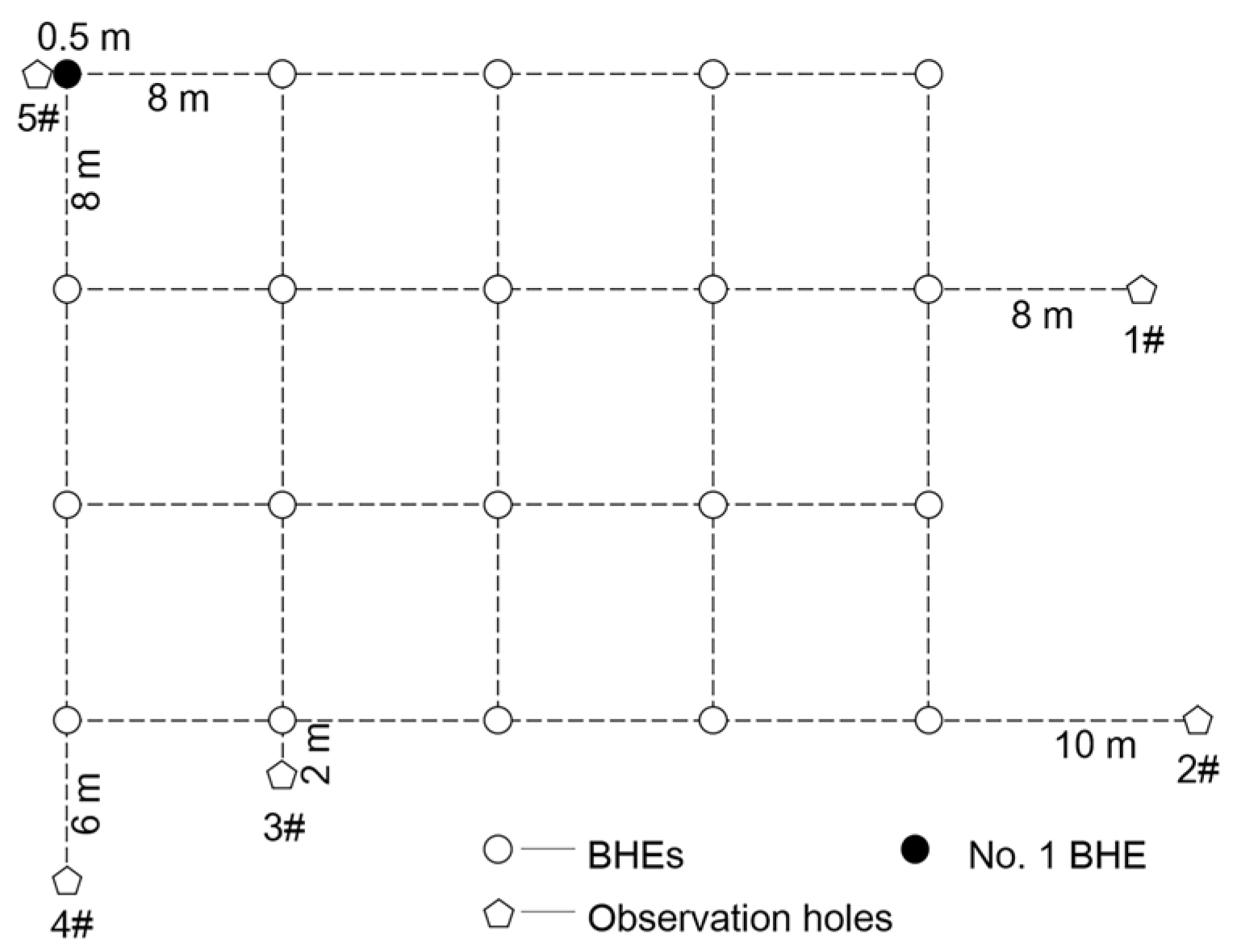
22]. The building demand is 170 kW for heating and 185 kW for cooling. Both the refrigeration period and the heating period last for three months. The project consists of 20 single U-tube BHEs; the boreholes are 150 mm in diameter, and their individual depths range from 150 m to 220 m (average depth: 200 m), giving a total drilled length of 4000 m. The boreholes are arranged in a 4 × 5 grid with an 8 m regular spacing, and the circulating water flow rate is 3.0 m
3/h.
To investigate the heat transfer process in the aquifer surrounding the BHE array under the operation of the GSHP system, five observation holes were installed: 1# and 2# were positioned 8 m and 10 m away from the outermost right-side borehole alignment, respectively; observation wells 3# and 4# were installed 2 m and 6 m from the outermost bottom borehole alignment; and observation well 5# was placed 0.5 m from the outermost left-side borehole alignment. The diameter, depth, and structural design of the observation holes are identical to those of the BHEs. Temperature sensors were installed in observation hole 5# at depths of 20 m, 30 m, 50 m, and 200 m, while the remaining observation holes were equipped with temperature sensors at a depth of 50 m. The planar layout and relative distances of the BHEs and observation holes are shown in
Figure 1.
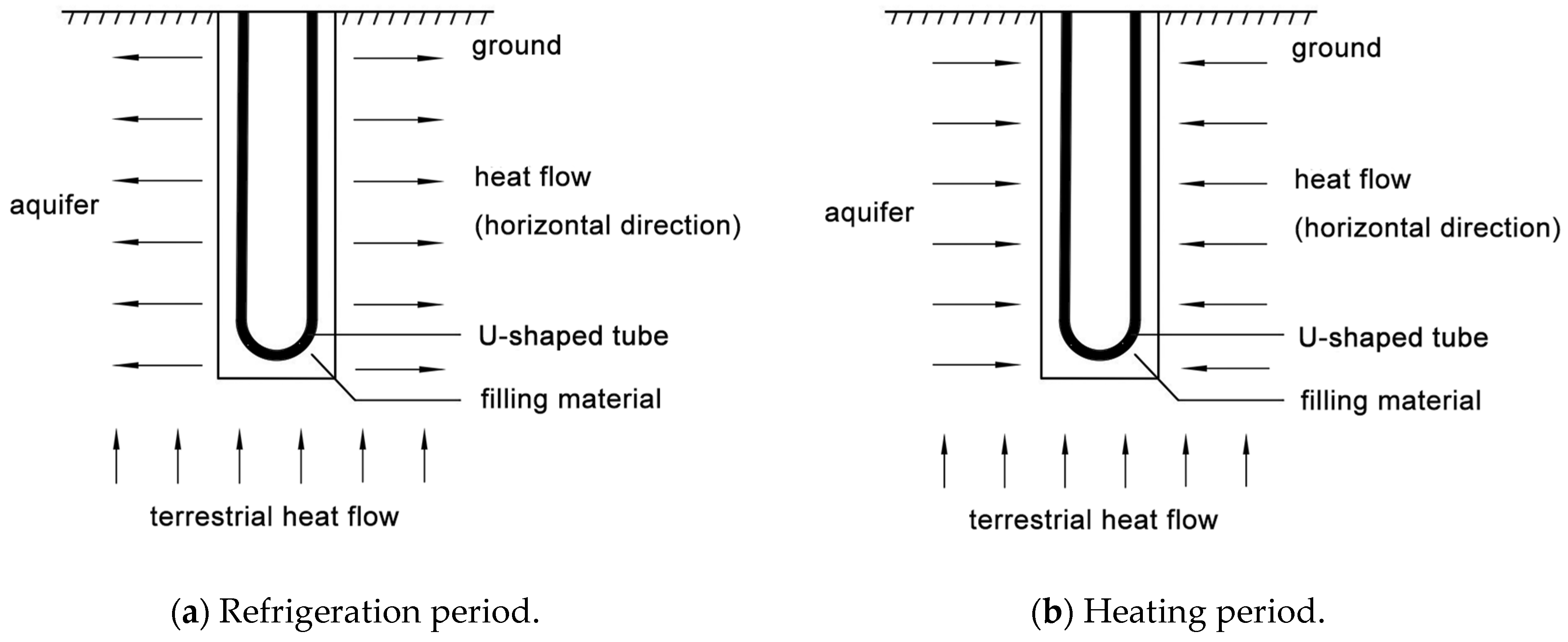
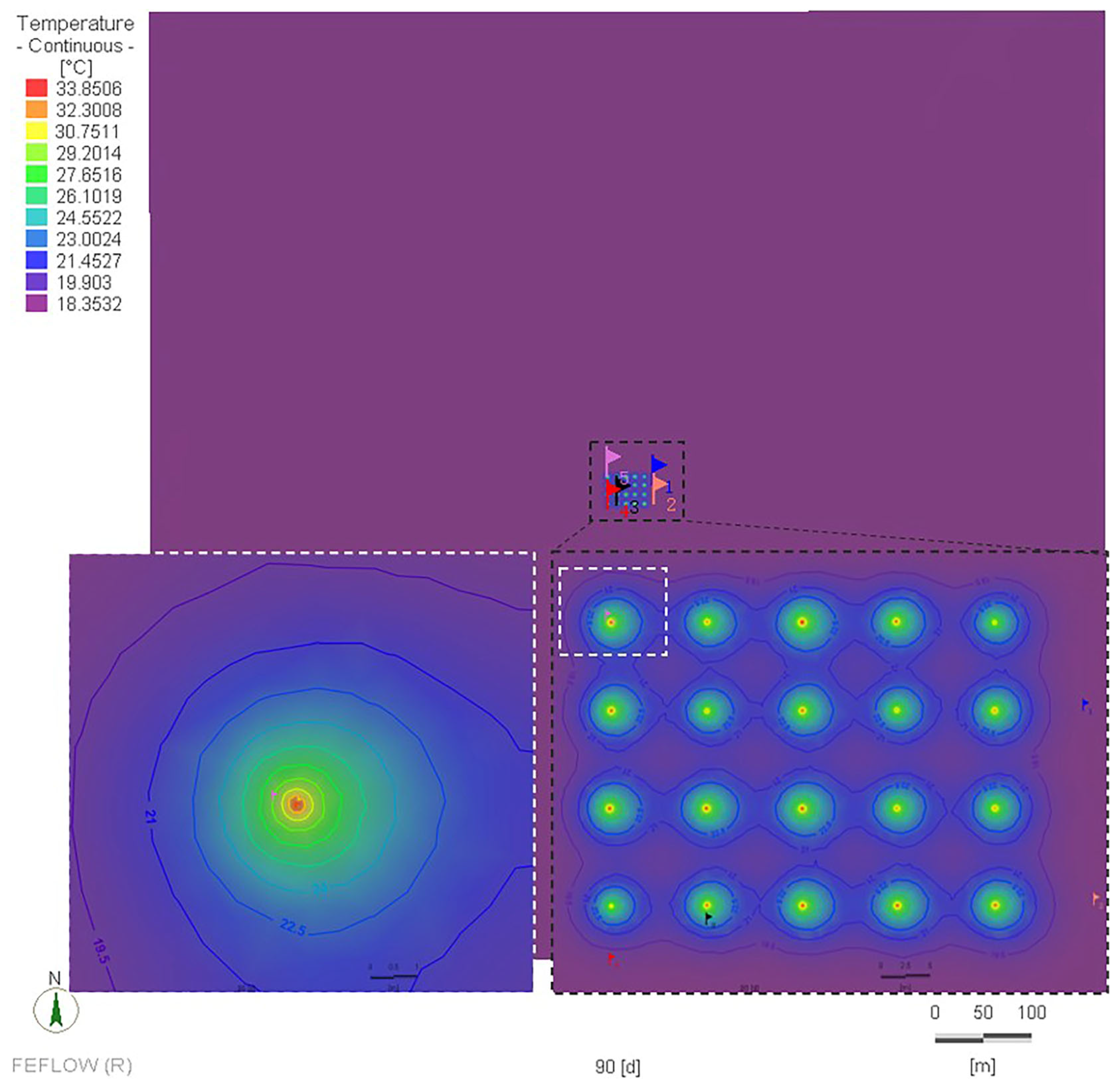
Although heat transfer outside the BHEs is inherently three-dimensional (see
Figure 2), vertical heat transfer is omitted in this study for the following reasons:
In this project, the ratio of vertical to horizontal heat flux was estimated to be less than 5% based on the thermal response test data, justifying the neglect of vertical conduction. Specifically, during the heating period, based on the thermal response test and heat exchange capacity calculation, the effective heat extraction capacity of a single BHE amounts to 9.44 kW. No thermal interference was observed at the 8 m spacing, so this distance is taken as the influence radius of a single BHE. Considering the average terrestrial heat flow in Anhui Province is 62 mW/m
2 [
23], the heat provided by the terrestrial heat flow is 12 W for a single BHE, accounting for only 0.13% of the total heat extraction capacity, which is much less than the heat obtained from the horizontal direction in the stratum. During the refrigeration period, based on the measured ground temperature data, under the operation of a single BHE, after the No. 1 BHE (with a depth of 200 m) had been running for one day, the ground temperature values at the depths of 20 m, 30 m, 50 m, and 200 m of the observation hole 5# (with a horizontal distance of 0.5 m from the No. 1 BHE) were 22.51 °C, 19.56 °C, 22.44 °C, and 23.26 °C respectively. Compared with the initial ground temperatures at each layer (17.97 °C, 18.26 °C, 18.40 °C, and 22.24 °C respectively), they increased by 25.26%, 7.12%, 21.96%, and 4.59%. Meanwhile, the ground temperature value at a vertical distance of 0.5 m from the bottom of the No. 1 BHE (i.e., at a depth of 200.5 m) was 22.29 °C, which increased by 0.18% compared with its initial ground temperature (22.25 °C). Therefore, the increase in ground temperature at a vertical distance of 0.5 m from the BHE was much smaller than that at a horizontal distance of 0.5 m, indicating that the heat dissipation in the vertical direction was much less than that in the horizontal direction. In conclusion, whether for heating or refrigeration, the heat transfer outside the BHEs in the area of this project mainly occurs in the horizontal direction.
Accounting for vertical heat transfer increases the difficulty of deriving analytical solutions, yet the resulting improvement in accuracy offers limited benefit for practical engineering applications. Most existing analytical GSHP models neglect vertical heat conduction, although some studies have addressed this issue. For example, Wu treated terrestrial heat flow as a source-sink term to derive an analytical solution for heat transfer outside BHEs without groundwater flow [
24]. In this study, terrestrial heat flow can be handled similarly when investigating heat transfer under groundwater flow conditions, but this would undoubtedly increase the difficulty of deriving the analytical solution. Furthermore, as noted earlier, heat transfer outside BHEs in practical cases is predominantly horizontal. Therefore, incorporating vertical heat transfer contributes little to enhancing the accuracy of analytical solutions.
Therefore, vertical heat transfer is neglected when its effect is far smaller than that of horizontal heat transfer, which simplifies the analytical solution.
In this case, after the GSHP system operates for an extended period, the circulating fluid temperature and borehole wall temperature stabilize. The shallow strata exhibit gradual temperature variations, and the power of the compressor in the GSHP system remains essentially constant, resulting in a relatively low sensitivity of the performance coefficient to the initial temperature. Furthermore, field measurements in this project showed that the borehole wall temperature varied by less than ±0.5 °C during stable operation periods. Consequently, the wall of the BHE pipe can be treated as a constant-temperature boundary [
25].
2.2. Mathematical Model
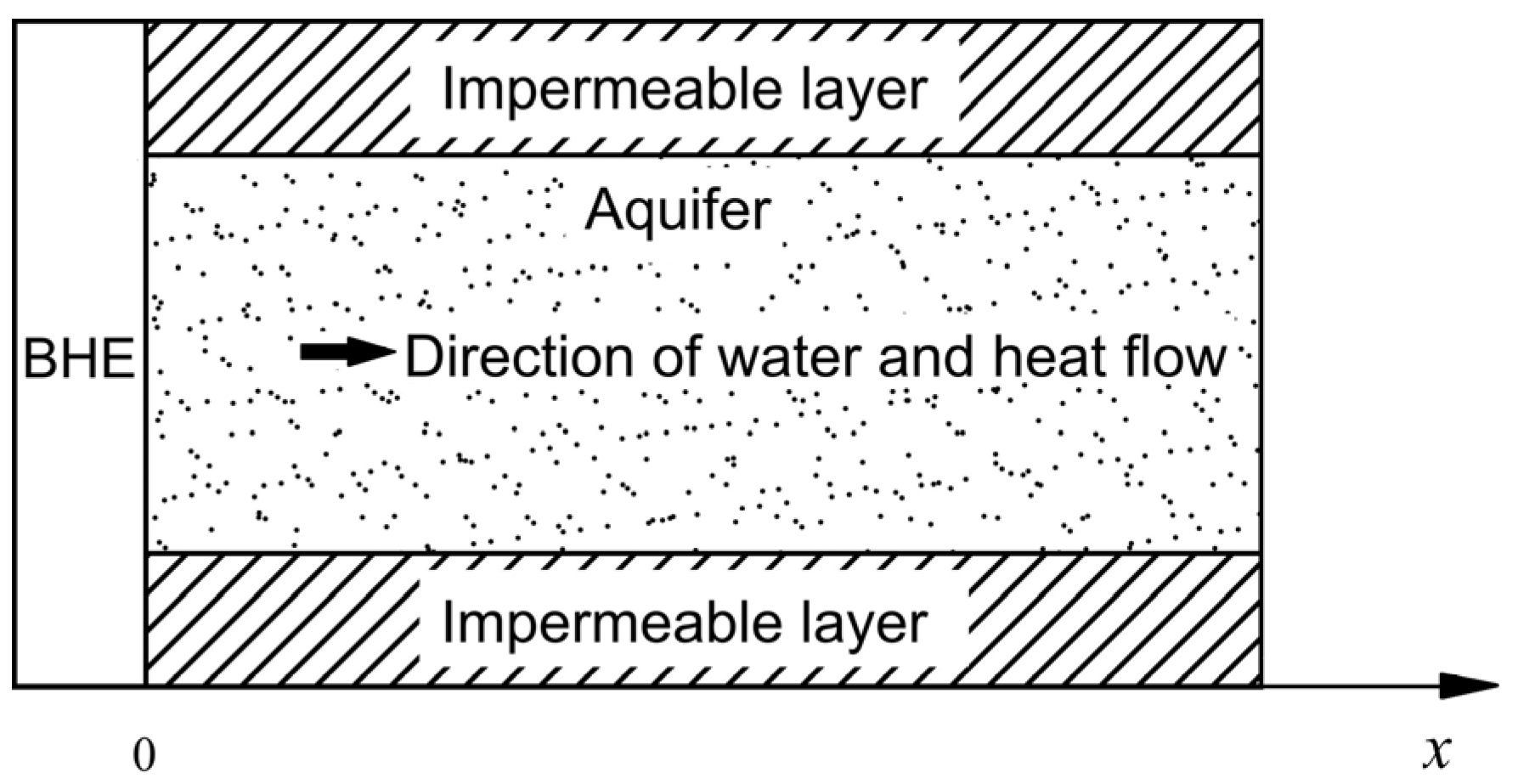
As previously noted, the heat transfer problem in the aquifer beyond the outer boundary of the BHE array can then be idealized as a one-dimensional horizontal heat advection–conduction model in rectangular Cartesian coordinates under constant-temperature boundary conditions (see
Figure 3).
It is assumed that the aquifer is homogeneous and isotropic, with constant water velocity
v and thermal diffusivity
α. The temperature in the aquifer at time
t and distance
x from the boundary is denoted as
Tb’(
x,
t), the initial temperature of the aquifer is
Tb’(∞,0), and the excess temperature at distance
x is defined as
Tb(
x,
t) =
Tb’(
x,
t) −
Tb’(∞,0). In addition, the excess temperature at the boundary is prescribed as a known function of time,
Tb(
t). Then the above one-dimensional advection–conduction model (I) under the constant-temperature boundary condition can be expressed mathematically as follows:
It should be noted that the model domain is the semi-infinite aquifer exterior to the BHE array (x ≥ 0), and x is the horizontal distance from the outer boundary of the array.
2.3. Analytical Solution
The governing Equation (1) is a second-order nonhomogeneous partial differential equation and is difficult to solve directly. Through the exponential transformation, a function
θ(
x,
t) = exp[(
vx/2
α) − (
v2t/4
α)] is constructed and
T(
x,
t) is defined as
Tb(
x,
t)/
θ(
x,
t) to convert the governing equation into Equation (5), giving [
26]
Model (I) is thus transformed into heat conduction model (II), expressed as follows [
27]:
where
f(
t) =
Tb(
t)/
θ(0,
t) =
Tb(
t)· exp(
v2t/4
α) [
26].
According to model (II), the variation range of
x is (0, +∞); thus, the Fourier sine transformation to
x can be applied. Similar to Reference [
28], a general theoretical solution based on the properties of Fourier transformation can be derived without relying on the process of integral and inverse transformation as follows:
where * is convolution operator.
According to the commutative property of convolution, Equation (10) can be written in integral form as
In combination with Equation (5), we get
Substituting
f(
t) =
Tb(
t)·exp(
v2t/4
α) into Equation (12) yields [
29]
Equation (13) is the solution for the one-dimensional heat advection–conduction model obtained without direct transformation of Tb(t), and it is valid for any boundary condition. In practical application, however, the actual boundary function must be substituted to obtain the analytical solution for the specific problem.
For the present constant-temperature boundary,
Tb(
t) remains constant, setting
Tb(
t) = Δ
T0 and substituting into Equation (13) yields
Equation (14) is the analytical solution for the one-dimensional advection–conduction model under constant-temperature boundary conditions, consistent with the analytical solution obtained via Laplace transform in Reference [
26].
Although Equation (14) is exact, it contains an integral that must be evaluated numerically in its present form. To obtain a closed-form analytical solution, the integral in Equation (14) can be evaluated exactly through integration by parts, yielding
where
I denotes the integral in Equation (14) and
η =
t −
ζ. The first term on the right-hand side of Equation (15) exactly cancels the complementary term
in Equation (14) when multiplied by the prefactor. The remaining integral in Equation (15) belongs to a class of Laplace-type integrals that can be evaluated analytically [
27], yielding
Substituting Equations (15) and (16) into Equation (14) gives the classical closed-form solution [
27]:
Therefore, Equation (14) is mathematically equivalent to Equation (17) for constant-temperature boundaries.
2.4. Numerical Simulation
To validate the accuracy of the derived analytical solution and the simplification of the heat-transfer problem in this case to a one-dimensional heat advection–conduction model, a three-dimensional coupled hydro-thermal numerical model was established using FEFLOW 7.0. The simulation domain was delineated based on local hydrogeological conditions, stratigraphic characteristics, groundwater flow patterns, and pumping test results. The study area was defined as a 1 km × 1 km square region centered on the BHE array, extending vertically through seven layers assumed to be homogeneous and isotropic. The aquifer corresponds to Layers 4–6 at depths of 26–50 m, while the BHEs penetrate Layers 2–7.
The computational mesh was locally refined around the BHE array, comprising 11,007 plane triangular elements with 5546 nodes per layer. Vertically, nonuniform discretization based on lithology and thickness yielded a total of 77,049 elements and 44,368 nodes. Groundwater flow was simulated under steady state conditions, whereas the thermal field was modeled as transient. Considering the predominant groundwater flow direction, given hydraulic head boundaries were assigned to the eastern and western sides, with zero flux boundaries on the northern and southern sides. The ground surface was prescribed as a constant temperature boundary modulated by daily variation time series, while the bottom plate was assigned a heat flux boundary of −0.062 W/m2. Initial temperatures for remaining layers were interpolated from measurements obtained by temperature monitoring boreholes installed prior to system operation.
Based on the practical engineering conditions, the refrigeration and heating periods were both 90 days, with heat exchanger inlet temperatures set at 36.4 °C for cooling and 7 °C for heating. Hydraulic and thermal parameters were initially estimated from pumping tests and thermal property experiments, then refined through inverse modeling. Model calibration was performed against thermal recovery data from single BHE operation, and validation was achieved using temperature recovery tests under simultaneous operation of all 20 BHEs. The detailed model settings, parameters and validation procedures can be found in Reference [
22].
4. Discussion
4.1. Comparison of Numerical Results with Analytical Results
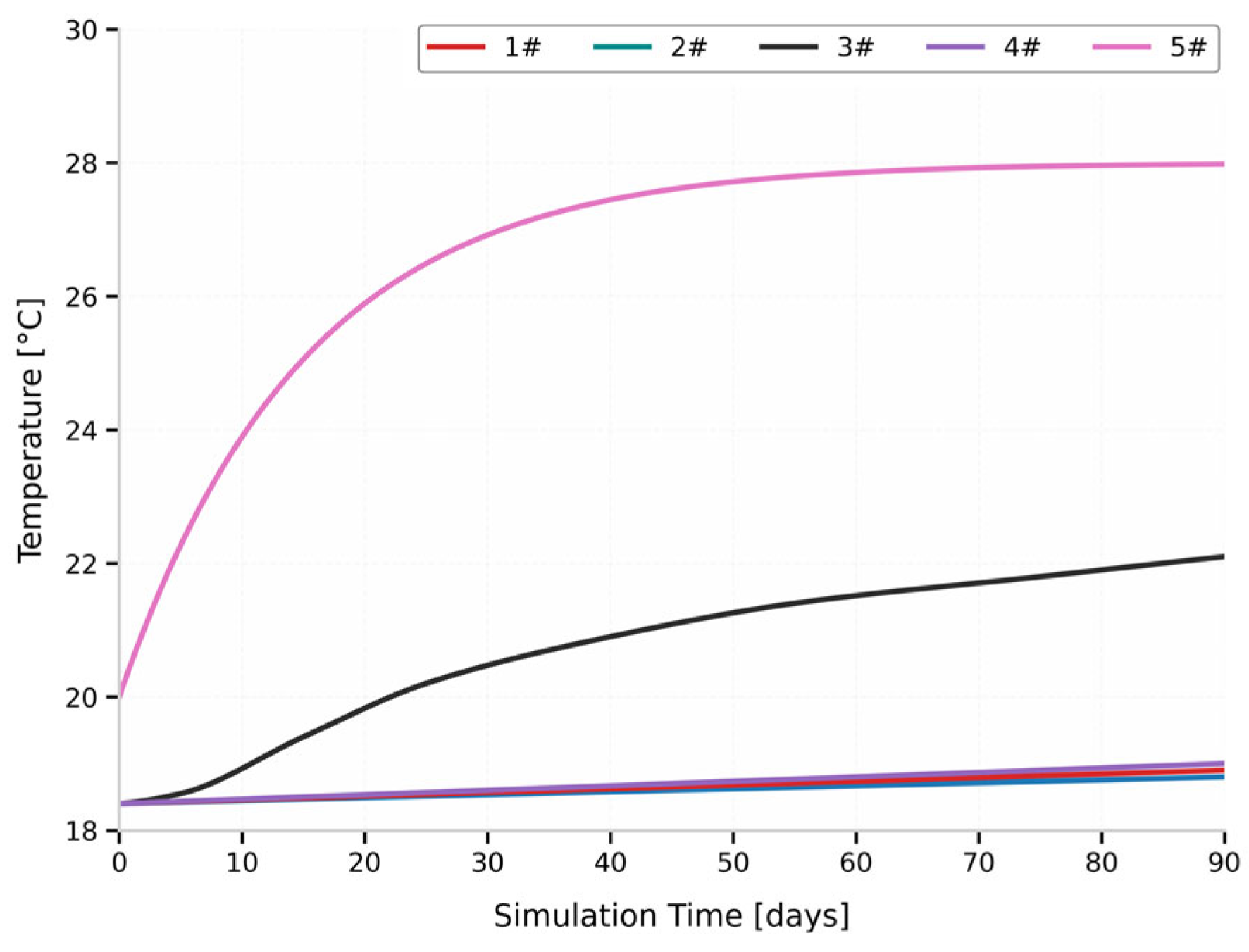
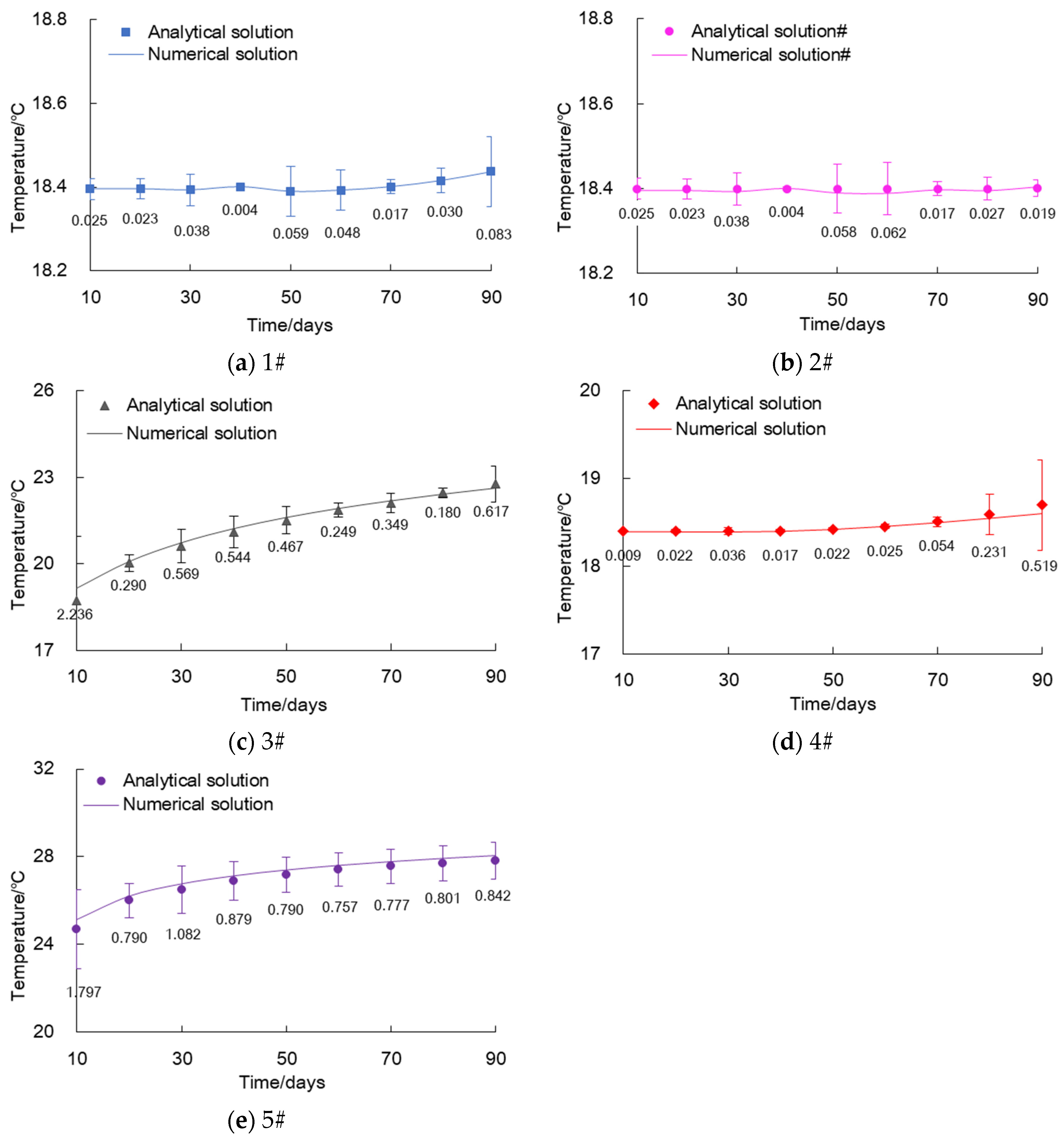
Temperatures in the observation holes on Slice 7 of the numerical model were recorded at 10, 20, 30, 40, 50, 60, 70, 80, and 90 days after cooling began and compared with the ground-temperature values obtained by the analytical model listed in
Table 1. The comparison is shown in
Figure 6, where the error bars represent the relative error, defined as follows:
As shown in
Figure 6, during the refrigeration period under the operation of the GSHP system, the ground temperature variations at observation holes 1#–5# outside the BHE array obtained by analytical and numerical methods show consistent trends, which are physically grounded in the dominance of horizontal heat transfer in the far-field region outside the BHE array. At distances greater than approximately one borehole spacing from the array boundary, thermal interference from individual boreholes has decayed sufficiently so that the temperature field becomes effectively one-dimensional, rendering the one-dimensional advection–conduction approximation highly accurate. The relative errors for all holes below 3% reflect the fact that both methods solve the same governing equation with equivalent boundary conditions in this asymptotic regime; the analytical solution captures the asymptotic long-time behavior exactly, while the numerical model additionally resolves the near-field three-dimensional structure that is irrelevant at these distances.
Moreover, the average relative errors for observation holes 1#–5# (located at distances of 8 m, 10 m, 2 m, 6 m, and 0.5 m from the outer boundary of the BHE array) are 0.036%, 0.030%, 0.618%, 0.104%, and 0.956%, respectively. Thus, the closer the observation holes are to the outer boundary of the BHE array, the larger the errors between analytical and numerical results tend to be. The increasing error with proximity to the BHE array boundary reflects the steeper temperature gradients in this region, where minor differences in boundary treatment between the analytical and numerical models become more significant. This discrepancy may stem from the idealized generalization of boundary conditions in the mathematical model. In actual engineering, BHEs are typically arranged as discrete, periodically distributed heat sources along a straight line, whereas the mathematical model idealizes these sources as a continuous, uniformly distributed heat flux along the line. Consequently, the closer to the BHEs, the greater the influence of this boundary idealization.
Based on the ground temperature field around the BHEs shown in
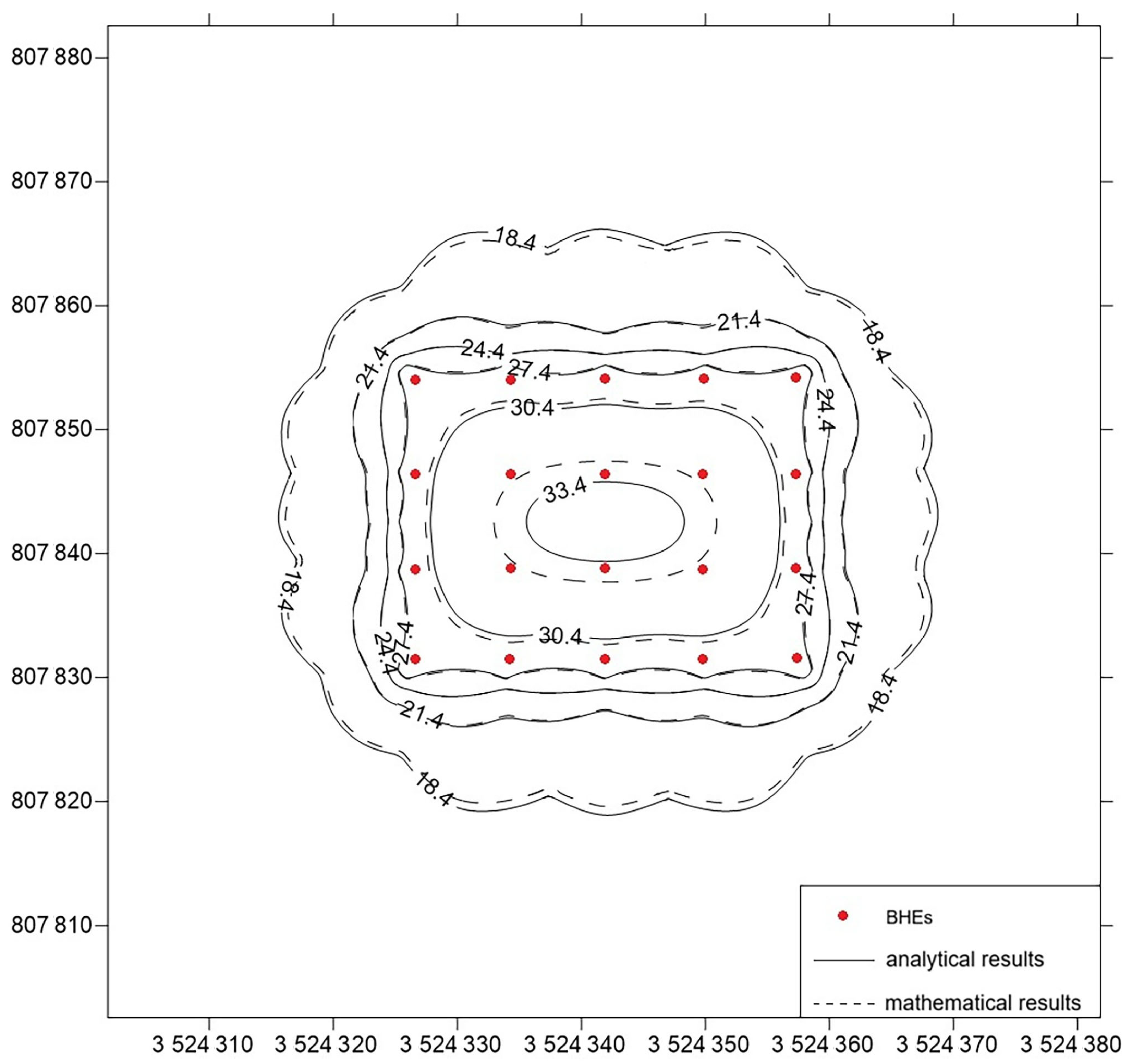
Figure 5, the temperatures at observation holes 1#–5# were regarded as representative of those at all corresponding points outside the BHE array at distances of 8 m, 10 m, 2 m, 6 m, and 0.5 m from the outer boundary, respectively. Therefore, by combining the geodetic coordinates of the BHEs with the ground temperatures obtained by analytical and numerical methods at the end of the refrigeration period (90 days), a number of points at distances of 8 m, 10 m, 2 m, 6 m, and 0.5 m from the outer boundary were selected and assigned the corresponding temperature values. Temperature contour maps at a depth of 50 m (Slice 7) in the simulation area at the end of the refrigeration period were generated using Surfer 29 software based on kriging interpolation (see
Figure 7).
From
Figure 7, outside the BHE array, the temperature contours become denser closer to the outer boundary of the BHEs. Within the temperature contour range of 18.4–27.4 °C, the contours of the analytical method and the numerical method are basically coincident. The slight deviations near the BHE array boundary (
x < 1 m) can be attributed to the local three-dimensional effects that are captured by the numerical model but neglected in the one-dimensional analytical formulation. Nevertheless, the overall agreement confirms that the one-dimensional approximation is excellent for engineering-scale predictions at distances greater than approximately one borehole spacing from the array boundary. Among them, for the contours of 18.4 °C, the overlap ratio of the areas enclosed by them from both methods is approximately 98.9%. The progressive densification of isotherms toward the array boundary is a direct consequence of the competing advection and conduction effects. Near the boundary (
x → 0), the temperature gradient ∂
T/∂
x must balance both conductive heat flux (proportional to
α) and advective heat flux (proportional to
v), producing steep gradients to satisfy the constant-temperature Dirichlet constraint. Further downstream, advection flattens the temperature profile and reduces ∂
T/∂
x, resulting in more widely spaced contours. The dimensionless Péclet number Pe =
vx/
α determines the transition between these regimes: for the present case with
v = 0.003 m/d and
α = 0.0372 m
2/d, Pe ranges from approximately 0.04 at
x = 0.5 m to 0.8 at
x = 10 m, indicating that conduction dominates throughout the observation domain but advection progressively distorts the symmetry as x increases. This Pe-dependent transition from steep near-boundary gradients to flat far-field profiles is captured consistently by both the analytical and numerical formulations, which explains the high contour overlap ratio of 98.9% for the 18.4 °C isotherm.
However, within the BHE array, the temperature contours obtained by the two methods begin to diverge, with larger discrepancies at higher temperatures. For the contours of 33.4 °C, the overlap ratio of the areas enclosed by the analytical and numerical contours is only 44.2%. This is because multiple BHEs interact within the array, so the analytical approach proposed in this study of idealizing the BHE array as a constant-temperature boundary is inapplicable.
In summary, the results obtained by numerical and analytical methods are essentially consistent, which verifies the accuracy of the derived analytical solution for the one-dimensional heat advection–conduction model considering the influence of groundwater seepage under constant-temperature boundary conditions and demonstrates the validity of idealizing heat transfer in the aquifer outside the array as such a process.
4.2. Application of Analytical Solution
Based on the verified analytical solution, the temperature variation laws of the aquifer can be analyzed. From Equation (14), it can be seen that the excess temperature
Tb(
x,
t) is related to the parameters
v,
x,
α, Δ
T0, and
t. Similarly, taking the refrigeration period of this project as an example, the temperature difference between the wall of the BHE pipe and the initial aquifer temperature, Δ
T0, is uncontrollable and remains set as 18 °C based on the case study. For parameters
v,
x, and
α, two of the parameters can be set as fixed values in turn, and the variation laws of
Tb(
x,
t) with
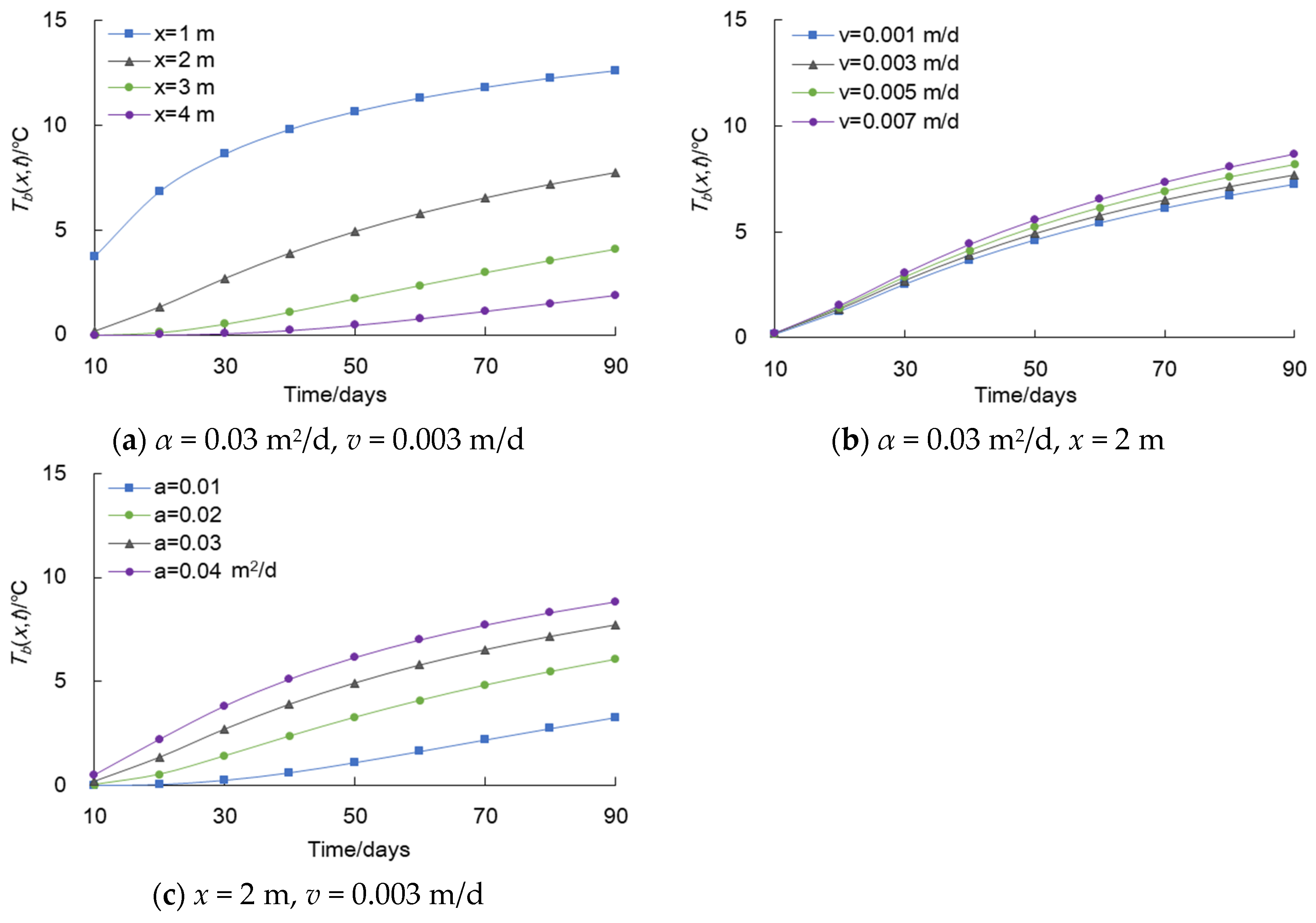
t caused by the variation in the other parameter can be studied (see
Figure 8).
Figure 8 illustrates that all
Tb(
x,
t)—
t curves exhibit similar shapes, with aquifer temperature increasing over time during the refrigeration period. The common functional form of these curves arises from the structure of Equation (17): for any fixed
x, the time dependence enters through the argument (
x −
vt)/
), which combines conductive spreading with advective translation. At early times, the denominator dominates and the solution behaves as pure conduction; at later times, the numerator dominates and the effective origin of the temperature profile shifts downstream at speed
v. This transition from conduction-dominated to advection-dominated regimes is quantified by the time-dependent Péclet number. For the parameter range in
Figure 8, Pe ranges from approximately 0.5 at
t = 1 day to 4.7 at
t = 90 days, confirming that the system evolves from a conduction-controlled regime at early times to an advection-influenced regime at late times. Physically, higher groundwater velocity enhances advective heat transport, causing the temperature disturbance to propagate faster downstream and resulting in steeper temperature gradients near the boundary. This explains why the curve for
v = 0.007 m/d rises more rapidly than that for
v = 0.001 m/d. The influence of the GSHP system on aquifer temperature and the rate of temperature variation depend on three factors: distance from the outer boundary, flow velocity, and thermal diffusivity. Specifically, aquifer temperature is less affected and varies more slowly when the distance from the boundary is larger, the flow velocity is lower, or the thermal diffusivity is smaller, with the other two parameters held constant. Therefore, GSHP systems should preferably be installed in formations with favorable thermal conductivity and groundwater mobility, such as loose aquifers, to enhance heat-exchange efficiency.
From a physical standpoint, the heat transfer process outside the BHE array is governed by the interplay between conductive heat diffusion and advective heat transport by groundwater flow. Conduction tends to smooth out temperature gradients in all directions, whereas advection preferentially transports heat along the flow direction, effectively accelerating heat dissipation downstream of the BHE array. The relative dominance of these two mechanisms is characterized by the Péclet number: at low Péclet numbers, conduction dominates and temperature disturbances propagate slowly and symmetrically; as Pe increases, advection becomes progressively more important, leading to faster propagation of thermal fronts and strongly asymmetric temperature fields. This has direct engineering implications for GSHP system design. In aquifers with high groundwater mobility (i.e., large Pe), the enhanced advective heat transport increases the effective heat exchange rate of the BHE array but also extends the thermal influence zone further downstream, which must be considered when planning the spacing between BHE arrays or assessing thermal interference with neighboring systems. Conversely, in low-permeability formations where conduction dominates, the thermal recovery of the aquifer may be slower, increasing the risk of long-term heat accumulation.
In practical applications of GSHP technology, issues such as thermal interference and heat accumulation are prone to occur. These not only affect the effective utilization of the system but also constrain its sustainable development, making them critical factors in assessing the feasibility of the system [
30,
31]. Analytical solutions offer fast computation and clear physical interpretation, enabling rapid analysis of soil temperature dynamics around BHEs with respect to time and space under constant temperature boundary conditions. They are well suited for preliminary screening and risk assessment during feasibility studies, and can also provide references for operational management of existing GSHP systems.
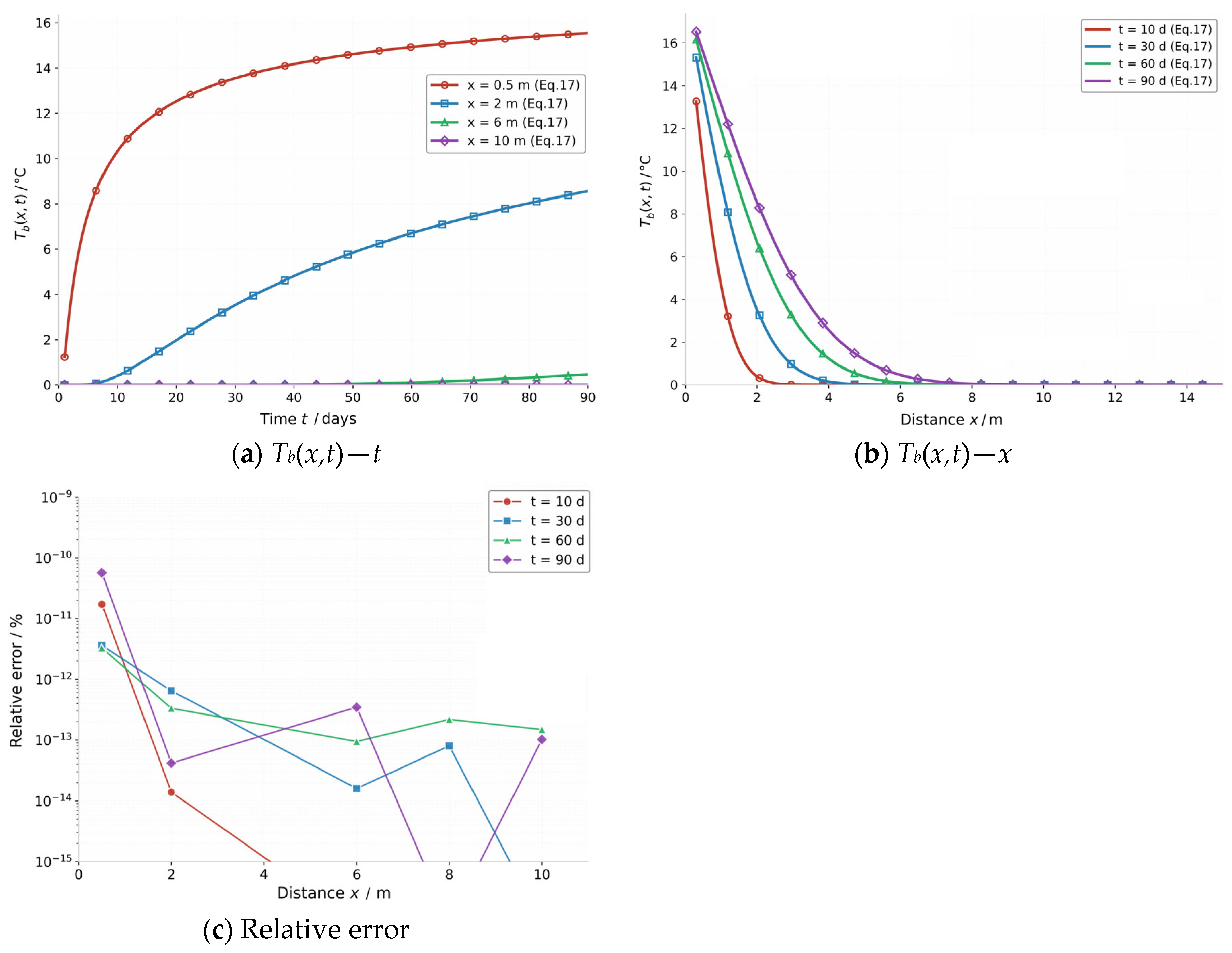
4.3. Error Analysis Between Proposed Solution and Classical Analytical Solution
To verify the equivalence between the integral form (Equation (14)) and the closed form (Equation (17)), numerical calculations were performed using Python 3.10 across the parameter range
x ∈ [0.5, 10] m,
t ∈ [1, 90] days, and
v ∈ [0.001, 0.01] m/d (covering the range of practical interest for GSHP applications), as shown in
Figure 9.
Figure 9 shows that the maximum relative error between the two expressions was found to be less than 1.0 × 10
−10%, which is attributable solely to numerical integration tolerances. This confirms that the transition from Equation (14) to Equation (17) introduces no mathematical approximation; the integral term in Equation (14) is contained exactly in the closed-form expression.
It should be emphasized that the transition from the integral form Equation (14) to the closed-form expression Equation (17) is a mathematically exact procedure rather than an approximation. The integral is first decomposed via integration by parts, where the boundary term exactly cancels the complementary term in Equation (14); the remaining integral belongs to a standard Laplace-type form that is evaluated analytically without introducing truncation or simplifying assumptions. Consequently, the equivalence between Equations (14) and (17) holds for all parameter combinations satisfying the governing equation and boundary conditions of the model. The numerical verification presented in
Figure 9 serves solely to confirm the computational correctness of the implementations.
From a physical standpoint, the closed-form solution is applicable under the following conditions: (i) the aquifer is homogeneous and isotropic with constant groundwater velocity and thermal diffusivity; (ii) heat transfer outside the BHE array can be idealized as one-dimensional horizontal advection–conduction, which requires that horizontal temperature gradients dominate over vertical gradients (as discussed in
Section 2.1); and (iii) the borehole wall temperature remains effectively constant over the time period of interest, so that the boundary can be treated as a Dirichlet condition with a fixed temperature difference Δ
T0. Within these model assumptions, the solution is valid for
x > 0,
t > 0, and
v > 0, with the relative magnitudes of conduction and advection characterized by the Péclet number. The closed-form expression applies uniformly across all Pe regimes.
4.4. Limitations of the Method
It should be noted that the proposed analytical solution is best validated against measured data from this case to further verify its accuracy. Unfortunately, thermal response tests and ground temperature recovery tests conducted before the system officially began operation have already affected the ground temperature field in the research area. Consequently, the initial temperature field required by the analytical model was no longer present, precluding direct validation against measured ground temperatures. This is a common challenge in GSHP research, where pre-operational testing inherently disturbs the baseline thermal state.
To facilitate the derivation of the analytical solution, the model assumes homogeneous and isotropic aquifer properties, as is common in most studies [
25], which deviates from actual conditions. Simultaneously, the one-dimensional simplification assumes horizontally isotropic heat transfer and is best suited for aquifers where horizontal temperature gradients dominate. In formations with significant vertical stratification or complex geology, full three-dimensional numerical simulation remains necessary.
Moreover, this study only addresses heat transfer in the aquifer outside the BHE array; within the array, thermal interference among BHEs intensifies local temperature variations, leading to complex ground temperature changes that render the proposed analytical method inapplicable. The constant-temperature boundary condition represents an idealization. In reality, borehole wall temperature may exhibit minor fluctuations due to varying heat pump loads and seasonal effects. Future work could extend the present analytical framework to time-dependent boundary conditions using Duhamel’s principle, as well as to scenarios involving complex boundary conditions and thermal disturbance effects among BHEs.
5. Conclusions
To investigate the heat transfer process outside BHEs in aquifers with groundwater seepage under the operation of the GSHP system, this study took a GSHP project in Hefei, Anhui Province, China, as its research object. Considering the engineering reality that vertical heat flow was much smaller than horizontal heat flow, vertical heat conduction was neglected, and the problem was idealized as a one-dimensional horizontal heat advection–conduction model under constant-temperature boundary conditions. Through exponential transformation, the advection term of the governing equation was removed, and the analytical solution was derived using properties of Fourier transformation. Subsequently, a three-dimensional coupled hydro-thermal numerical model was established using FEFLOW to validate the solution. The results show that the analytical and numerical results for the aquifer temperatures outside the BHE array at a burial depth of 50 m are essentially consistent, with relative errors below 3%, verifying the accuracy of the derived analytical solution and the rationality of idealizing such heat transfer problems as a one-dimensional advection–conduction process. However, this analytical method is only applicable outside the array; conversely, within the array, thermal interference among multiple BHEs precludes the application of this analytical approach. Furthermore, prior thermal testing had already disturbed the subsurface temperature field, precluding validation against measured data. Based on the analytical solution, parametric analysis was conducted to investigate ground temperature variations outside the BHEs. The analysis indicates that the influence of the GSHP system on aquifer temperature decreases with increasing distance from the outer boundary of the BHE array, decreasing groundwater flow velocity, or decreasing thermal diffusivity of the aquifer. Therefore, the GSHP system should preferably be installed in formations with favorable thermal conductivity and groundwater mobility to enhance heat-exchange efficiency. The proposed analytical solution features fast computation, clear physical interpretation, and ease of parametric analysis. Its purpose is not to replace refined numerical simulation, but to be used for rapid screening and risk assessment in preliminary feasibility studies for aquifer-dominated GSHP projects where horizontal heat transfer prevails, and to provide guidance for operational management of existing systems.