Article

Structural and Morphological Evaluation of Air-Processed Cs3Sb2I9 Perovskite Thin Film in Ambient Conditions


by
Pranta Barua
1,*,
Kannoorpatti Krishnan
1 and
Naveen Kumar Elumalai
1,2,*
1
Faculty of Science and Technology, Energy and Resources Institute, Advanced Manufacturing Alliance, Charles Darwin University, Darwin, NT 0909, Australia
2
School of Science, Technology & Engineering, University of the Sunshine Coast, Sippy Downs, QLD 4556, Australia
*
Authors to whom correspondence should be addressed.
Energies 2026, 19(9), 2196; https://doi.org/10.3390/en19092196
Submission received: 17 November 2025 / Revised: 19 April 2026 / Accepted: 24 April 2026 / Published: 1 May 2026
(This article belongs to the Section A2: Solar Energy and Photovoltaic Systems)

Abstract

The ambient stability of ambient-processed lead-free perovskite absorbers remains a critical challenge toward scalable, eco-friendly photovoltaics. Herein, we systematically investigate the time-dependent structural and morphological evolution of drop-cast ambient-processed Cs3Sb2I9 thin films, being a potential non-toxic and stable solar absorber candidate (energy bandgap ~2 eV) for solar cells, stored under uncontrolled ambient condition (~60% Relative humidity) for 28 days. Sequential X-ray diffraction (XRD) and surface morphology analyses using scanning electron microscope (SEM) reveal that the films preserve their trigonal P 3 ¯ m1 phase throughout aging, confirming phase stability. Moderate moisture exposure may induce partial recrystallization and subtle structural reorganization, possibly including minor c-axis realignment, leading to reduced lattice strain and improved crystallite coherence. Even after prolonged aging, no secondary phases or micro-cracks are detected, underscoring the slow degradation kinetics and robust Sb–I bonding that stabilize the layered [Sb2I9]3− dimers. The late-stage increase in diffraction intensity and partial recovery of crystallographic parameters could indicate transient structural reorganization, potentially associated with moisture-mediated reordering within an overall degradation pathway. These observations suggest some degree of morphological persistence and structural tolerance of Cs3Sb2I9 under ambient conditions, rather than complete stability. This behavior offers useful insights into ambient processing and the long-term reliability of lead-free perovskite photovoltaics.

1. Introduction

Metal halide perovskite solar cells (PSCs) have emerged as a transformative class of photovoltaic technology, driven by their remarkable optoelectronic attributes—including exceptionally high absorption coefficients, a high degree of defect tolerance [1], superior charge-carrier mobility, extended carrier diffusion lengths, and direct, compositionally tunable band gaps (1.4~1.6 eV) [2]. These features, coupled with low fabrication costs, have propelled PSCs to the forefront of next-generation photovoltaics, achieving a record power conversion efficiency (PCE) exceeding 27% in 2025 [3], a dramatic leap from the initial 3.8% reported in 2009 [4]. This nearly seven-fold enhancement within just one and a half decades underscores the extraordinary potential of PSCs as leading third-generation solar cell candidates. Beyond photovoltaic applications, metal halide perovskites have demonstrated broad technological relevance in diverse optoelectronic and electronic devices, including high-efficiency light-emitting diodes, X-ray scintillators and direct-conversion detectors, and photocatalysis/photoelectrochemical energy conversion. More recently, perovskite and perovskite-derived materials have also been explored for emerging memory and in-memory computing architectures (e.g., memristors and logic circuits), highlighting their versatility beyond solar energy conversion [5,6,7,8,9,10].
Nevertheless, despite this rapid advancement, their long-term operational stability remains a critical bottleneck. Intrinsic vulnerability to environmental barriers such as moisture, elevated temperature, and continuous illumination accelerates degradation, impeding large-scale production [11,12,13,14]. Moreover, the reliance on toxic lead (Pb)-based perovskites introduces serious environmental and health concerns, presenting an additional barrier to sustainable commercialization [15].
One of the primary factors driving the rapid degradation of lead-based perovskites (e.g., MAPbI3) under ambient conditions is the high mobility of iodide ions. These ions readily migrate into intrinsic vacancies with a relatively low activation barrier of ~0.4 eV [16]. Notably, the reported diffusivity of iodide ions in iodine-deficient perovskite lattices reaches as high as 4.3 × 10⁻⁶ cm2/s, which accelerates lattice instability and ultimately induces the breakdown of the perovskite structure [17]. Also, the iodine vacancy in MAPbI3 is occupied by oxygen, and oxygen captures photoexcited electrons to form superoxide ions, introducing further degradation in the system [18]. In ambient environments, MAPbI3 degrades rapidly because moisture and oxygen readily infiltrate the lattice; H2O intercalation lowers ion-migration barriers and lattice stability, while O2 (especially under illumination) drives oxidation of I to I2 and deprotonation of the MA+ cation, releasing volatile species and leaving behind PbI2 [19]. In humid environments, water molecules disrupt the hydrogen-bonding network in MAPbI3, forming hydrated perovskite phases that undermine structural integrity. At elevated temperatures, the organic MA+ component volatilizes due to its low binding energy and weak internal bonding, accelerating decomposition [20]. Although CsFAMA triple-cation perovskites show better resistance to thermal effect and moisture, they can still degrade under continuous illumination due to light-induced phase segregation driven by halide ion migration [20].
Degraded perovskite films release toxic Pb2+ ions, posing environmental and health risks. To address this issue, recent research has focused on replacing lead with less hazardous cations such as Sn, Ge, Bi, and Sb [21]. Tin-based halide perovskites (FASnI3, MASnI3, CsSnI3, Cs2SnI6, etc.) offer attractive features, including band gaps (Eg = 1.3~1.4 eV) close to the Shockley–Queisser limit, high carrier mobility, and low exciton binding energies, while avoiding the toxicity of lead counterparts. Nevertheless, their photovoltaic performance remains limited by intrinsic instability, particularly arising from Sn2+ oxidation, which hinders efficiency improvements compared to lead-based systems [22]. Likewise, Germanium (CsGeI3, RbGeI3, etc.) (Eg = 1.6~2.2 eV) suffers from severe oxidation issues (Ge2+–Ge4+) despite having a small ionic radius and improved ionic conductivity [23]. Bismuth-based perovskites (Cs3Bi2I9, MA3Bi2I9, Cs2AgBiBr6, etc.) (Eg = 2~2.2 eV) exhibit strong excitonic features with binding energies around 0.4 eV, which hinder efficient exciton dissociation and charge extraction, thereby limiting the short-circuit current density [24]. Antimony-based perovskites (Cs3Sb2I9, K3Sb2I9, MAxCs3−xSb2I9Cl6, etc.) (Eg of 1.9–2.1 eV) have attracted significant attention owing to their lower exciton binding energies compared to bismuth analogues. Among these candidates, inorganic Cs3Sb2I9 stands out as a promising photovoltaic material. It exhibits a high absorption coefficient (>105 cm−1) and a small effective mass. It also shows remarkable stability under harsh conditions. In addition, it shares the same ns2 outermost electron configuration as lead and has a suitable band gap of 1.9–2.1 eV [25,26].
Furthermore, though the wide bandgap of approximately 2.0 eV is reported for the layered P 3 ¯ m1 phase of Cs3Sb2I9, this bandgap is often viewed as a limitation for standard single-junction solar cells. But it offers unique advantages for indoor light harvesting and semi-transparent applications. Recent studies have highlighted its potential in suppressing non-radiative recombination under low-light conditions which makes it competitive for niche electronic power sources [27,28].
Beyond photovoltaics, lead-free halide perovskite and related materials have attracted interest for diverse optoelectronic applications, including photodetectors, photodiodes, and logic-gated image processing devices enabled by composition-tuned bismuth-antimony halide systems. A recent study [29] demonstrated multifunctional logic gate operation within a single Cs3Bi0.6Sb1.4I9 single-crystal photodiode, where Sb alloying enhanced crystal quality, tunable bandgap (~2 eV range), and photo response. Likewise, the excellent lattice match and band alignment at the Cs3Bi2I9/Si interface significantly improve charge separation and extraction, resulting in up to 10–200× enhanced photoelectric sensitivity compared with other substrates enhancing photodetection performance [30]. Recent work has demonstrated wafer-scale heterogeneous integration of self-powered, lead-free metal halide perovskite (CsCu2I3) UV photodetectors with high stability and uniformity which highlight the broader potential of Pb-free halide materials in scalable optoelectronic devices [31,32].
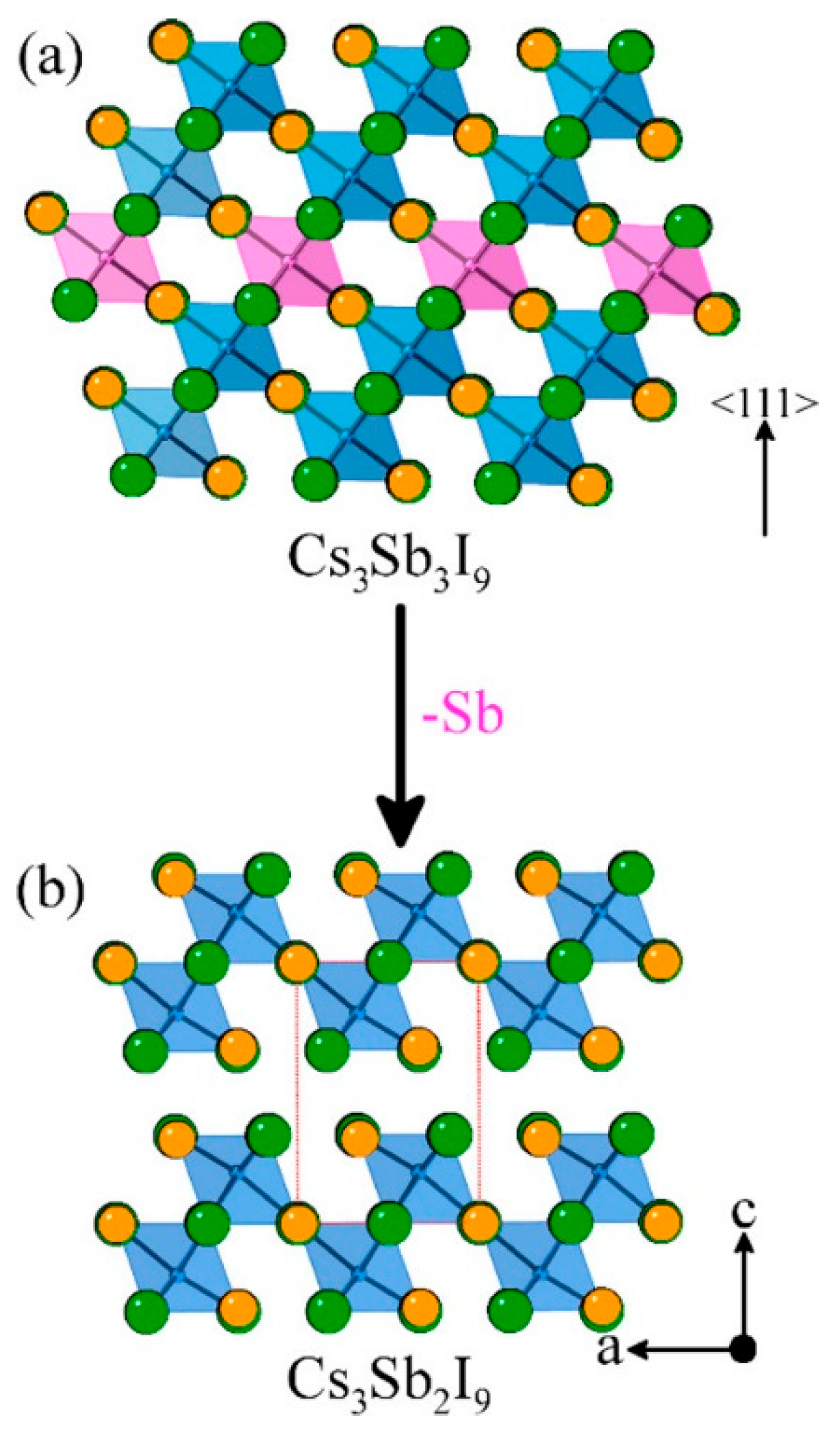
Among the diverse lead-free perovskite candidates, Cs3Sb2I9 was chosen for this degradation study due to its environmental benign nature, substantial visible-light absorption, and relatively superior intrinsic stability compared to many other lead-free halide absorbers. Cs3Sb2I9 perovskite is structured around bi-octahedral (Sb2I9)3− clusters, which are enclosed by Cs+ cations to maintain charge neutrality. The unit cell adopts a trigonal phase with the space group P 3 ¯ m1 (164). The lattice parameters are a = b = 8.42 Å, c = 10.386 Å, and angles α = β = 90°, γ = 120° [33]. Figure 1 demonstrates the structural relationship between the hypothetical three-dimensional perovskite CsSbI3 (formally Cs3Sb3I9) and the experimentally observed layered polymorph of Cs3Sb2I9 (space group P 3 ¯ m1, No. 164) [34]. In Figure 1a, the idealized 3D framework consists of corner-sharing SbI6 octahedra that extend continuously along the ⟨111⟩ direction, with Cs+ cations occupying the interstitial sites to maintain charge balance. As indicated by the downward arrow (~Sb), the layered Cs3Sb2I9 structure shown in Figure 1b is obtained by systematically removing every third Sb–I octahedral layer along the ⟨111⟩ direction. This ordered removal breaks the infinite three-dimensional corner-sharing connectivity and transforms the structure into a two-dimensional arrangement (n = 2), where the remaining SbI6 octahedra remain corner-sharing within the plane but are no longer connected along the stacking direction. The reduction in Sb content from Cs3Sb3I9 to Cs3Sb2I9 satisfies charge neutrality and stabilizes the layered polymorph, resulting in separated [Sb2I9]3− slabs interleaved by Cs+ cations, characteristic of the 2D layered structure [34].
Regarding photovoltaic performance, to date, the highest PCE for Cs3Sb2I9 is reported as 3.40% under AM 1.5G solar simulation [28], which is lagging far behind lead/tin-based PSCs. There is still room to search for different methods of improving PCE. The superior ambient stability of Cs3Sb2I9 arises from its unique crystal structure. The 0D dimeric or 2D layered Sb–I frameworks exhibit strong ionic–covalent bonding. They also provide limited ion migration pathways. In addition, the absence of volatile organic cations reduces moisture- and thermally induced degradation [35]. However, it is required to dig into the long-term ambient stability of Cs3Sb2I9 perovskite for further assessment in ambient conditions. In context of the degradation behavior of Cs3Sb2I9, it is instructive to compare its ambient stability with other lead-free perovskites. The layered form of Cs3Sb2I9 has been reported to degrade over extended durations (e.g., ~88 days in water or humidity exposure) that indicates relatively slower degradation kinetics compared to many organic–inorganic halide perovskites [24]. In contrast, Sn-based analogues such as CsSnI3 and FASnI3 suffer from rapid oxidation of Sn2+ to Sn4+ under ambient conditions, leading to structural and electronic collapse unless mitigated by additives or encapsulation [36]. Similarly germanium-based perovskites (e.g., CsGeI3) have struggled with volatility and instability due to rapid oxidation in ambient conditions [23]. For Sn/Ge-based perovskite systems, the degradation phenomena are dominated by irreversible chemical oxidation rather than partially reversible lattice adjustments. In contrast, Cs3Sb2I9 shows moderate recovery of microstructural coherence and partial reduction in microstrain, which likely stems from moisture-induced lattice relaxation, unlike the irreversible oxidative degradation observed in tin- or germanium-based perovskite materials.
Cs3Sb2I9 is known to exist in two low-dimensional structural polymorphs: a zero-dimensional (0D) dimer phase, in which disconnected Sb2I9 units are embedded in the lattice, and a two-dimensional (2D) layered phase composed of extended sheets of corner-sharing SbI6 octahedra. The 0D phase consists of discrete Sb2I9 octahedral dimers, whereas the 2D phase comprises extended sheets of corner-sharing octahedra stacked along the c-axis [26,34]. In the 0D dimer configuration, the electronic structure gives rise to a relatively wide and indirect optical bandgap (2.3~2.5 eV), which limits its light-harvesting capability and makes it less suitable for photovoltaic applications. In contrast, the 2D layered form exhibits a narrower and near-direct bandgap of approximately 2.05 eV, which enhances its optical absorption in the visible range and improves its potential as an active absorber in solar devices [37]. Furthermore, the 2D structure supports stronger orbital overlap and lower effective carrier masses compared with the 0D phase, contributing to increased absorption strength that can be comparable with that of MAPbI3 [26]. X-ray diffraction (XRD) is effective in distinguishing these polymorphs because the 2D layered structure produces characteristic basal reflections (00ℓ series) that are absent in the 0D dimer phase. A comparison of measured diffraction patterns with reference patterns (e.g., ICSD data) confirms the presence of the 2D layered phase in our films. Additional techniques such as Raman spectroscopy and electron microscopy can provide further confirmation of extended connectivity in the lattice.
Beyond structural stability, the optoelectronic properties of Cs3Sb2I9 are critical for photovoltaic applications. The 2D layered phase exhibits a direct bandgap of ~2.05 eV, while the 0D dimer phase shows a wider indirect bandgap (~2.30 eV), highlighting the importance of phase control [38]. Furthermore, Urbach energy values ranging from ~69 to 251 meV have been reported depending on synthesis conditions, indicating that defect density strongly influences optical disorder and sub-bandgap states. Time-resolved photoluminescence measurements reveal carrier lifetimes between 1 and 3 ns (fast component) and up to ~300 ns (slow component), with longer lifetimes correlated to lower defect densities [38]. These reported findings demonstrate that controlling structural order and defect formation in Cs3Sb2I9 is essential not only for stability but also for achieving improved charge carrier transport and reduced non-radiative recombination. Therefore, 2D layered Cs3Sb2I9 (Eg ~2.05 eV) has emerged as one of the most promising lead-free halide perovskite absorbers due to its favourable optoelectronic properties as solar absorber discussed above.
Furthermore, early studies demonstrated that solution-processed Cs3Sb2I9 thin films exhibit enhanced ambient air stability compared with methylammonium lead iodide perovskites, maintaining structural integrity and visible-range absorption under uncontrolled air exposure. For example, Saparov et al. [34] prepared large-grain, continuous Cs3Sb2I9 films that remained stable in ambient air and exhibited a direct optical bandgap of ~2.05 eV, highlighting the feasibility of ambient processing for this material. Similarly, antimony-based perovskite films with mixed halides have been investigated for improved morphology and optoelectronic performance, demonstrating that all-inorganic Cs3Sb2I9 structures can sustain ambient exposure with moderate performance retention [37].
While these prior reports confirm that Cs3Sb2I9 films can be fabricated in air and exhibit relative ambient resilience, most studies have evaluated stability either in controlled humidity conditions (e.g., 30–50% RH) or over relatively short periods. In contrast, the present work systematically investigates truly ambient air fabrication and extended uncontrolled humidity aging (RH ≥ 60%) following the ISOS-D-1 protocol [39], tracking morphological changes, crystallite size evolution, microstrain, and lattice parameters over 0–28 days. This detailed assessment under challenging ambient conditions is, to our knowledge, less explored in the literature which is essential for evaluating the practical viability of ambient-processed Cs3Sb2I9 films for scalable, low-cost optoelectronics. We are looking into answering the following questions: (1) the effect of moisture on the air-processed Cs3Sb2I9 perovskite thin films, (2) how the morphology of grains of perovskite thin films is changed over time, and (3) the changes in crystallite size, microstrain, and lattice parameters of perovskite thin films over time.

2. Experimental

2.1. Materials and Solvents

All chemicals were purchased from commercial suppliers and used as received: Antimony Iodide (SbI3), Cesium Iodide (CsI), chlorobenzene, N,N-dimethylformamide (DMF), dimethyl sulfoxide (DMSO), isopropyl alcohol (IPA, ≥99.7%), and acetone (≥99.5%) were purchased from Sigma-Aldrich, Sydney, NSW, Australia. Hellmanex III cleaning agent was from Ossila (Sheffield, UK), and hydrochloric acid (HCl, 32%) was supplied by ChemSupply (Gillman, SA, Australia). All solvents were of analytical grade.

2.2. Synthesis of Perovskite Precursor and Fabrication of Thin Film

For the fabrication of perovskite thin film, to remove the surface contaminants from the glass substrate, the glass substrates were cleaned with cleaning detergent (Hellmanex III) in hot water (2 mL in 200 mL of hot water), deionized water (DI water), acetone, and IPA to perform an organic solvent cleaning process in an ultrasonication process for 15 min. Then, the glass substrates were pre-heated in the hot plate at 60 °C for 10 min.
For the Cs3Sb2I9 perovskite precursor solution, 0.9 M of CsI and 0.6 M of SbI3 at 3:2 molar ratio were mixed in 0.9 mL of DMF and 0.1 mL of DMSO at 9:1 (v/v) ratio and then vigorously stirred overnight at 700–900 rpm at room temperature. Then, 40 μL of HCl was mixed with the solution 40 min before the deposition. The solution was filtered using a 0.22 μm PTFE filter (Biomed Scientific, Sydney, NSW, Australia) before deposition. A 50 µL precursor solution was drop-casted onto substrates (25 × 25 mm) pre-heated to 60 °C to initiate nucleation, followed by annealing at 80 °C for 10 min.
Drop-casting was intentionally selected over spin-coating to evaluate the intrinsic crystallization resilience of Cs3Sb2I9 under slow solvent evaporation. This approach better reflects scalable ambient fabrication techniques, where rapid centrifugal forces are absent [40]. In contrast, spin-coated films typically produce smaller and more uniform grains. Drop-cast films, however, enable thermodynamic self-organization of the layered phase. This often results in larger, plate-like crystalline domains, which help reduce grain boundary density.
X-ray diffraction (XRD) and scanning electron microscopy (SEM) analyses were performed to characterize the as-prepared samples. To investigate the influence of humidity on structural and morphological stability, freshly prepared films were placed inside a clean glass petri dish. The petri dish was sealed with parafilm to limit direct exchange with laboratory air allowing uniform exposure of the enclosed air volume to the film surfaces. Importantly, no active air exchange or flow was applied during storage. The films were left in the dark under static air conditions at room temperature (25 ± 1 °C) with only minor natural RH fluctuations (60 ± 1%), ensuring that the degradation behavior observed reflects ambient-relevant moisture stress rather than extreme or oscillatory conditions. A calibrated digital hygrometer was placed inside the sealed dish adjacent to the films to continuously monitor the internal humidity. No desiccants or humidity-control agents were used to ensure that the films experience the natural ambient moisture level.

2.3. Characterization

The surface morphology and structural evolution of the perovskite films during the degradation process were examined using a field emission scanning electron microscope (Phenom XL, Thermo Fisher Scientific, VIC, Australia). The crystallinity and phase stability of the films were analysed by X-ray diffraction (XRD) using a PANalytical X’Pert powder diffractometer (Malvern Panalytical, Sydney, NSW, Australia) equipped with a Cu Kα radiation source (λ = 1.5406 Å), scanning over a 2θ range of 10–80°. UV–Vis absorption spectroscopy was performed using a Thermo Scientific spectrophotometer (Thermo Fisher Scientific, Melbourne, VIC, Australia) to investigate the optical properties of the Cs3Sb2I9 films. The absorption spectra were recorded over the wavelength range of 900 nm.

3. Results and Discussion

3.1. Structural Analysis Using XRD

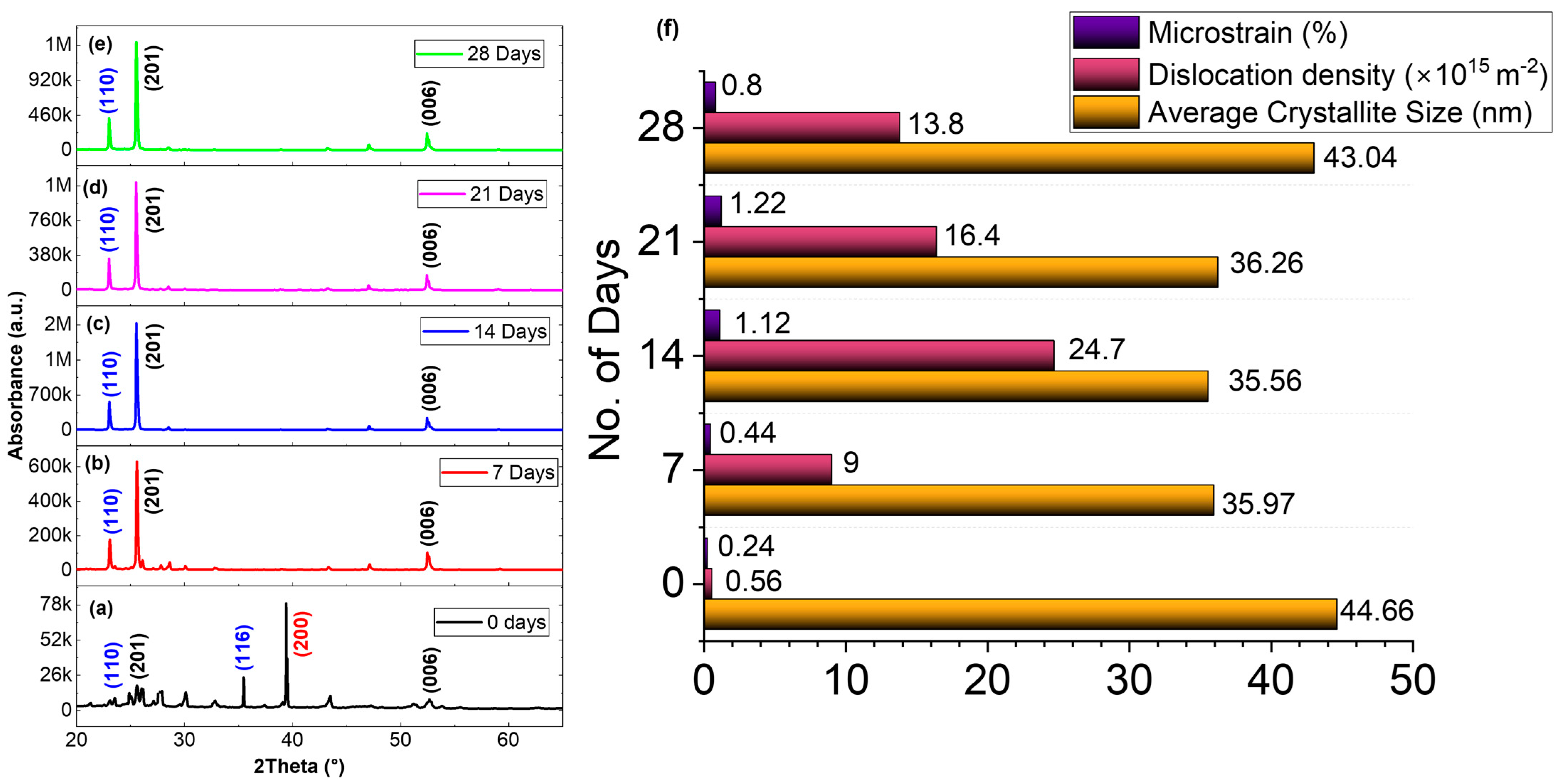
The ambient stability of Cs3Sb2I9 perovskite thin film at RH of 60% for the 0th, 7th, 14th, 21st and 28th days was investigated by tracking the phase variations, crystallographic changes using the powder XRD technique (Figure 2). In Figure 2a, major peaks are observed at 25.55° and 52.73° at (201) and (006) assigned to the layered trigonal phase of Cs3Sb2I9 perovskite (space group, P 3 ¯ m1, No. 164) [33,40,41,42]. The derived c-axis lattice parameter (~10.40 Å) is consistent with literature values for the 2D layered Cs3Sb2I9 structure, indicating strong c-axis texturing induced by slow solvent evaporation during drop-casting [34]. The XRD patterns of our Cs3Sb2I9 films show distinct peaks characteristic of the layered P 3 ¯ m1 phase, with observable peak broadening that reflects finite crystallite size and microstrain. Additional minor reflections are observed at ~23°, ~35° and ~40°, attributed to SbI3 (110), SbI3 (116) and CsI (200) (Figure S2) [43,44]. These reflections appear due to small fractions of unconverted CsI and SbI3 precursor arising from diffusion-limited conversion in the thick, slowly dried drop-cast films.
Compared to standard spin-coated films which often exhibit smaller, more uniform grains, the drop-cast films in this study demonstrate larger, plate-like crystalline domains characteristic of the layered phase. This morphology is beneficial for reducing grain boundary density, which is a primary site for moisture ingress and ionic migration [45].
On the 7th day, in Figure 2b, after 7 days of storage at 25 °C and RH > 60%, The XRD patterns show a progressive increase in the intensities of the (201) and (006) reflections, suggesting enhanced crystallinity and improved structural coherence across both in-plane and out-of-plane directions while several off-axis peaks (such as 116 and 200) diminish below the detection threshold except (110) plane, indicating dominant SbI3 residue with longer storage days. This behavior indicates an overall improvement in crystallinity and structural ordering of the layered Cs3Sb2I9 phase rather than a phase transformation [46]. It is noteworthy that the film retains the pure trigonal phase throughout the aging process. The XRD patterns recorded after 14 and 21 days (Figure 2c,d) exhibit similar features to those observed on the 7th day, confirming the structural stability of the layered Cs3Sb2I9. Up to 14 days, the diffraction peaks of the main trigonal reflections reached their maximum intensity, indicating enhanced crystallinity. However, by the 21st day, the intensities of the (201) and (006) peaks noticeably decreased, suggesting a gradual decline in the degree of crystallinity with prolonged exposure.
Interestingly, the 28-day XRD pattern (Figure 2e) exhibits higher diffraction intensities than the 21-day sample, even though extended humidity exposure would normally be expected to lower crystallinity. The observed increase in XRD peak intensity at 28 days may result from changes in preferred orientation, surface condition, and microstructural rearrangement rather than a genuine increase in bulk crystallinity; full quantification of crystallinity and texture effects would require quantitative profile analysis such as Rietveld refinement. Mild water adsorption may promote partial dissolution–reprecipitation of surface species, enabling plate-like grains to realign and form more coherent diffracting domains, thereby enhancing the intensities of the (201) and (006) reflections while preserving the overall crystallite structure. Moreover, temporary desorption of physically adsorbed moisture between the 21st and 28th day can reduce diffuse background scattering, artificially increasing apparent peak heights without necessarily indicating an intrinsic improvement in crystallinity [47]. This phenomenon of “intensity revival” under moderate humidity restacking has been previously reported for layered and 0D antimony-halide perovskites, where water-mediated ion rearrangement leads to stronger orientation texture but not to new phase formation [24,48]. Hence, the higher intensities observed at day 28 signify partial textural reorganization and enhanced diffraction coherence, rather than complete structural recovery, which is perturbed [34,49].
The crystal structure is significantly changed with prolonged exposure to ambient conditions. Figure 2f represents a bar chart of crystallographic parameters in ambient exposure at 0, 7, 14, 21 and 28 days. Average crystallite size was derived from the Debye-Scherrer equation (Equation (1)) [50]
Crystallite   size ,   D = k λ β c o s θ
where k is the shape factor, typically around 0.9; λ is X-ray wavelength, the wavelength of Cu is 0.154 nm; β is the peak full width of half maximum intensity (FWHM) in radians, and θ is Bragg’s diffraction angle.
Dislocation density, δ, is calculated using Equation (2) [51].
Dislocation   density ,   δ = 1 D 2
where D is the average crystallite size. The microstrain is extracted from the full width at half maximum β of (2θω) diffraction peaks from Equation (3) [52].
Microstrain ,   ε = β 4 t a n θ
The Debye–Scherrer equation is traditionally applied to randomly oriented powders and assumes that diffraction peak broadening arises primarily from finite coherent domain size. In textured thin films with significant preferred orientation, such as layered Cs3Sb2I9 with dominant 00ℓ alignment, this assumption does not apply directly. In such cases, peak broadening can also be influenced by preferred orientation, anisotropic strain, defects, and surface effects [53]. Consequently, Scherrer equations in this work are treated as qualitative indicators of changes in domain coherence along specific directions rather than precise crystallite sizes. Quantitative structural parameters would require more advanced profile analysis that explicitly accounts for texture.
For the (00ℓ) oriented films in this study, peak-broadening analysis using the Scherrer equation primarily estimates the vertical coherence length; these results are interpreted as relative indicators of structural evolution and strain relaxation, rather than providing absolute crystallite dimensions [27].
Ambient aging of drop-cast Cs3Sb2I9 drives an early reduction in average crystallite size from 44.7 nm to ~36 nm (0 → 21 days), accompanied by a ~5× increase in microstrain and ~10–40× rise in dislocation density, after which all three metrics plateau (7 → 21 days), indicating a humidity-assisted defect-accommodation mechanism without bulk phase change. The crystallographic metrics extracted from XRD peak broadening may indicate a rapid microstructural relaxation within the first week, followed by a quasi-steady state by day 21. The crystallite size, D, decreases sharply from ~44.7 nm (day 0) to ~36 nm (days 7–21), consistent with the formation of sub-grain boundaries and/or defect-decorated domains during exposure to humid air. The concurrent rise in microstrain (≈0.24% → 0.44% → 1.12–1.22%) signals increasing heterogeneous lattice distortion, which typically originates from point-defect accumulation and low-angle boundaries; this is the classic “size–strain” trade-off captured by Williamson–Hall analysis [54]. In parallel, the dislocation density rose by over an order of magnitude between day 0 (≈0.56 × 10¹⁵ m−2) and day 14 (≈24.7 × 10¹⁵ m−2), before moderating by day 21 (≈16.4 × 10¹⁵ m−2). The co-evolution of (i) crystallite size reduction, (ii) an increase in ε, and (iii) a rise in δ may indicate humidity-assisted reorganization of plate-like crystallites, such as restacking or edge-defect formation, rather than a bulk phase transition. This interpretation is broadly consistent with prior reports suggesting that layered or dimeric Cs3Sb2I9 frameworks can remain stable under ambient conditions. Such systems may accommodate strain through local defect formation and changes in preferred orientation, including variations in 00ℓ texture [34,42,55]. The apparent recovery of crystallite size at 28 days (43 nm, close to the initial value of 44 nm), along with a reduction in dislocation density (13.8 × 10¹⁵ m−2) and microstrain (0.8%) compared to 21 days, may indicate humidity-assisted lattice relaxation and partial re-alignment of crystallite orientation, rather than a true reversal of degradation. The Cs3Sb2I9 lattice may undergo partial reorganization in the presence of moderate moisture, possibly through ion-mediated reordering and stress relaxation of the layered [Sb2I9]3− dimers. This process could help restore some of the structural coherence lost at 21 days while maintaining overall phase stability [24,34,56]. The Day 7 state is viewed as a high-strain intermediate phase, and the subsequent improvement at Day 28 represents a thermodynamic restoration of the Cs3Sb2I9 lattice. Throughout Section 3, the discussion distinguishes between localized transient strain (0–14 days) and long-term structural recovery (14–28 days) to avoid conflating reversible relaxation with irreversible decomposition [56,57].
From a mechanistic point of view, moisture-induced H2O from ambient conditions can transiently solvate surface iodides and grain-edge species, promoting defect formation that increases peak breadth through microstrain while leaving the overall perovskite-derived backbone intact. The layered (2D) Sb–I motifs in Cs3Sb2I9 may restrict long-range ion migration pathways compared to 3D Pb-perovskites, which rationalizes the absence of catastrophic coarsening or phase loss despite rising microstrain [34,42,54,58]. The ~36 nm (from 44 nm) plateau in crystallite size by day 7, together with stabilized microstrain (≈1.1–1.2%), suggests an early-time equilibration to an ambient-condition microstructure. From a device standpoint, such strain or defect increases would be expected to elevate trap-assisted recombination at grain boundaries; however, the preserved average domain size and the known ambient robustness of Cs3Sb2I9 imply that optoelectronic degradation will likely be interface-limited [59,60,61] rather than driven by bulk phase decomposition—aligning with literature that reports superior air stability for Cs3Sb2I9 thin films and microplates [34,42,54,58].

3.1.1. Crystallinity and Lattice Parameters

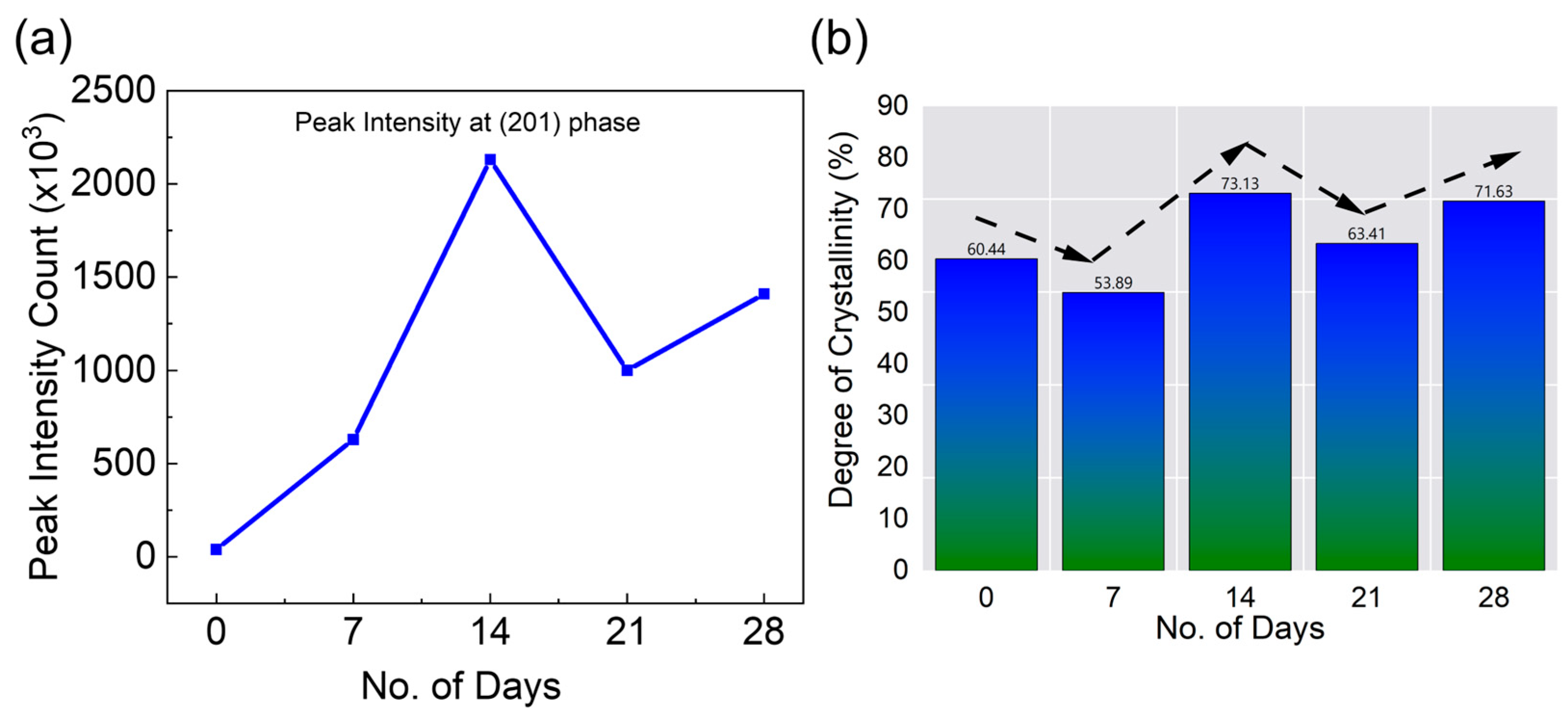
The crystallinity and XRD peak intensity of the Cs3Sb2I9 thin films (Figure 3a,b) exhibit a non-monotonic trend during 28 days of ambient aging, indicating a multi-stage structural evolution process. The degree of crystallinity (%) estimated from XRD peak intensities in this study is used as a relative metric to track temporal structural evolution, rather than an absolute quantification of crystalline fraction. It is acknowledged that, in strongly textured thin films such as Cs3Sb2I9, diffraction intensities are influenced not only by crystallinity but also by preferred orientation, anisotropic grain growth, and scattering geometry. Therefore, the calculated crystallinity values may incorporate contributions from texture effects and should be interpreted with caution.
To minimize misinterpretation, all films were prepared under identical conditions and measured using the same instrumental configuration, allowing meaningful comparative analysis across aging time. The observed non-monotonic variation in crystallinity is thus interpreted as reflecting relative changes in structural ordering and coherence, rather than absolute crystalline volume fraction.
The freshly deposited film (0 day) shows a moderate degree of crystallinity (≈60.4%), which decreases slightly after 7 days (≈53.9%). This initial reduction may be associated with moisture-induced lattice distortion and increased microstrain under >60% RH conditions. Water adsorption at grain boundaries can introduce transient disorder and disrupt local structural coherence, leading to reduced diffraction intensity [62]. Although the films were annealed at 80 °C, the use of DMF (boiling point ≈ 153 °C) may result in trace solvent species remaining within grain boundaries or intermediate coordination complexes. Such residual solvent, if present, could contribute to short-range structural rearrangement during early-stage humidity exposure [63,64]. The crystallinity change is therefore attributed to humidity-driven lattice distortion and transient grain-boundary disorder rather than irreversible decomposition, consistent with the continued detection of the trigonal P 3 ¯ m1 phase in XRD.
Additionally, the decrease in crystallinity at Day 7 may also be related to moisture-assisted dissociation of trapped intermediate solvated species. Even at an annealing temperature of 80 °C, high-boiling-point solvents such as DMSO (189 °C) may persist in intermediate complexes (e.g., SbI3·DMSO). Moisture exposure may facilitate their dissociation, potentially contributing to subsequent structural rearrangement [56,65].
A pronounced increase in crystallinity is observed after 14 days (≈73.1%), followed by a decrease at 21 days (≈63.4%) and a subsequent recovery to ≈71.6% at 28 days. The relative enhancement of the (201) and (006) peak intensities suggests improved crystallinity and possible changes in preferred orientation, with the (006) reflection indicating enhanced ordering along the c-axis. However, it is important to note that the films exhibit strong texture; therefore, variations in peak intensity and derived crystallinity values may partly reflect changes in preferred orientation rather than purely intrinsic crystallinity changes [34,66]. Beyond this stage, a minor reduction at 21 days (≈63.4%) suggests limited surface oxidation or moisture adsorption, whereas a subsequent recovery to 71.6% at 28 days indicates re-ordering and stabilization of the lattice under quasi-equilibrium ambient conditions [11,67]. The accompanying increase in (201) and (006) peak intensities confirms improved layer alignment and texture evolution.
Microstructural parameters such as crystallite size, microstrain, and dislocation density, estimated from peak broadening using the Scherrer equation, should likewise be interpreted with caution. In strongly textured thin films, peak broadening can be influenced by anisotropic strain, orientation effects, and instrumental factors, and thus these parameters are better considered as semi-quantitative indicators of relative trends rather than absolute values. Within this limitation, the observed evolution, initial increase in microstrain followed by partial relaxation and corresponding changes in apparent crystallite size is consistent with anisotropic strain accumulation and partial relaxation within the lattice, although the underlying mechanisms cannot be conclusively determined from XRD analysis alone.
The evolution of lattice parameters (Table 1) derived from XRD analysis indicates a gradual expansion of the Cs3Sb2I9 crystal lattice during ambient storage. The freshly deposited (0-day) film exhibits the smallest unit-cell dimensions (a ≈ 8.53 Å, c ≈ 10.40 Å), corresponding to a relatively compact layered framework immediately after annealing. Upon exposure to air, c subtly increases progressively reaching 10.46 Å by 28 days. This trend may be associated with slight lattice relaxation and possible interactions with ambient species; however, the exact origin of the expansion cannot be conclusively determined from XRD data alone. Similar lattice expansion behavior has been reported in Cs3Sb2I9 thin films under humidity exposure [56,67]. A subtle increment in unit cell volume is observed from 7 (~657.85 Å3) to 28 days (~660.53 Å3), followed by a slight expansion, indicating a dynamic balance between lattice relaxation and surface-mediated reorganization under ambient conditions. The apparent invariance of the unit-cell volume (~660.53 Å3) between 21 and 28 days may suggest a temporary stabilization of lattice parameters, although this should be interpreted cautiously, as uncertainties in peak position and fitting can influence calculated values. Likewise, changes in the intensity and broadening of the (201) and (006) reflections may indicate variations in preferred orientation or layer alignment, but such interpretations are influenced by the strong texture of the films and therefore are not strictly quantitative.

3.1.2. Underlying Mechanism of Moisture-Induced Structural Reorganization and Partial Recrystallization

Humidity exposure produces clear, quantifiable changes in X-ray diffraction and microstructural parameters. In aged films, the intensities of the major reflections (201), and (006) increase compared to the as-prepared sample, indicating improved crystallinity; the relatively stronger enhancement of the (006) reflection suggests possible preferential alignment along the c-axis under ambient humidity. Concurrently, microstructural metrics extracted from peak broadening show a decrease in microstrain (e.g., from ~1.2% to ~0.8%) and partial recovery of crystallite size (from ~36 nm at early aging to ~43 nm at 28 days).
While these combined trends are not consistent with random degradation or the formation of new crystalline phases within the detection limits of XRD, they may reflect a degree of structural reorganization, potentially influenced by moisture exposure. However, the underlying mechanisms cannot be conclusively established from the present data alone [68].
Moderate moisture can interact with perovskite surfaces and grain boundaries through adsorption and hydrogen bonding, which can transiently enhance ionic mobility and facilitate localized mass transport. Such moisture-induced interactions have been shown to influence crystallographic orientation and texture in perovskite films, where moisture exposure leads to preferential reorientation of crystallites and texture modification [68,69]. Mechanistically, water molecules at grain boundaries or defect sites can act as a softening agent that reduces local energy barriers for atom migration and defect annihilation, enabling partial reconfiguration of the layered lattice toward lower strain orientations [70]. This process may promote partial oriented attachment of plate-like grains and localized reprecipitation at defect sites, leading to improved microstructural coherence [68,71]. Notably, as no new crystalline phases are detected and the primary trigonal Cs3Sb2I9 structure persists, the observed changes may be consistent with lattice reorganization under humidity exposure rather than a chemical phase transition.
The structural evolution observed in Cs3Sb2I9 thin films under uncontrolled humidity follows a time-dependent degradation pathway rather than a single-step decomposition process. To clarify the previously described phenomena, the degradation behavior is unified into three distinct stages.

3.1.3. Stage I (0–7 Days): Early Moisture-Induced Structural Perturbation

During the first week of exposure, the slight reduction in crystallinity is attributed primarily to moisture adsorption at grain boundaries and increased lattice microstrain. This stage is characterized by transient disorder and partial disruption of diffraction coherence, without clear evidence of irreversible chemical decomposition.

3.1.4. Stage II (7–14 Days): Transient Structural Reorganization

Between 7 and 14 days, partial stabilization of diffraction intensity is observed. This does not necessarily indicate chemical healing but may reflect moisture-influenced structural rearrangement and local lattice relaxation within the layered Cs3Sb2I9 framework. Processes such as grain-boundary reorganization and stress redistribution could contribute to a temporary improvement in the apparent crystallographic coherence.

3.1.5. Stage III (14–28 Days): Irreversible Compositional and Structural Degradation

After prolonged humidity exposure, significant thickness reduction (1.0 µm → 0.7 µm), relative iodine enrichment, and bandgap narrowing (1.9 → 1.73 eV) indicate irreversible compositional imbalance. At this stage, structural destabilization dominates, leading to degradation of the perovskite framework rather than reversible reorganization. This staged interpretation reconciles the earlier discussion of transient structural stabilization with the later evidence of compositional depletion and structural degradation. The apparent contradiction arises from the coexistence of short-term lattice relaxation and long-term irreversible decomposition under sustained humidity exposure.
While the observed trends are consistent with surface compositional evolution, the present analysis is limited by the inherent depth-averaging nature of EDS. Therefore, the proposed iodine enrichment and cation redistribution should be considered tentative, and confirmation would require dedicated surface-sensitive techniques such as XPS depth profiling or ToF-SIMS.

3.2. Morphological Evaluation via SEM

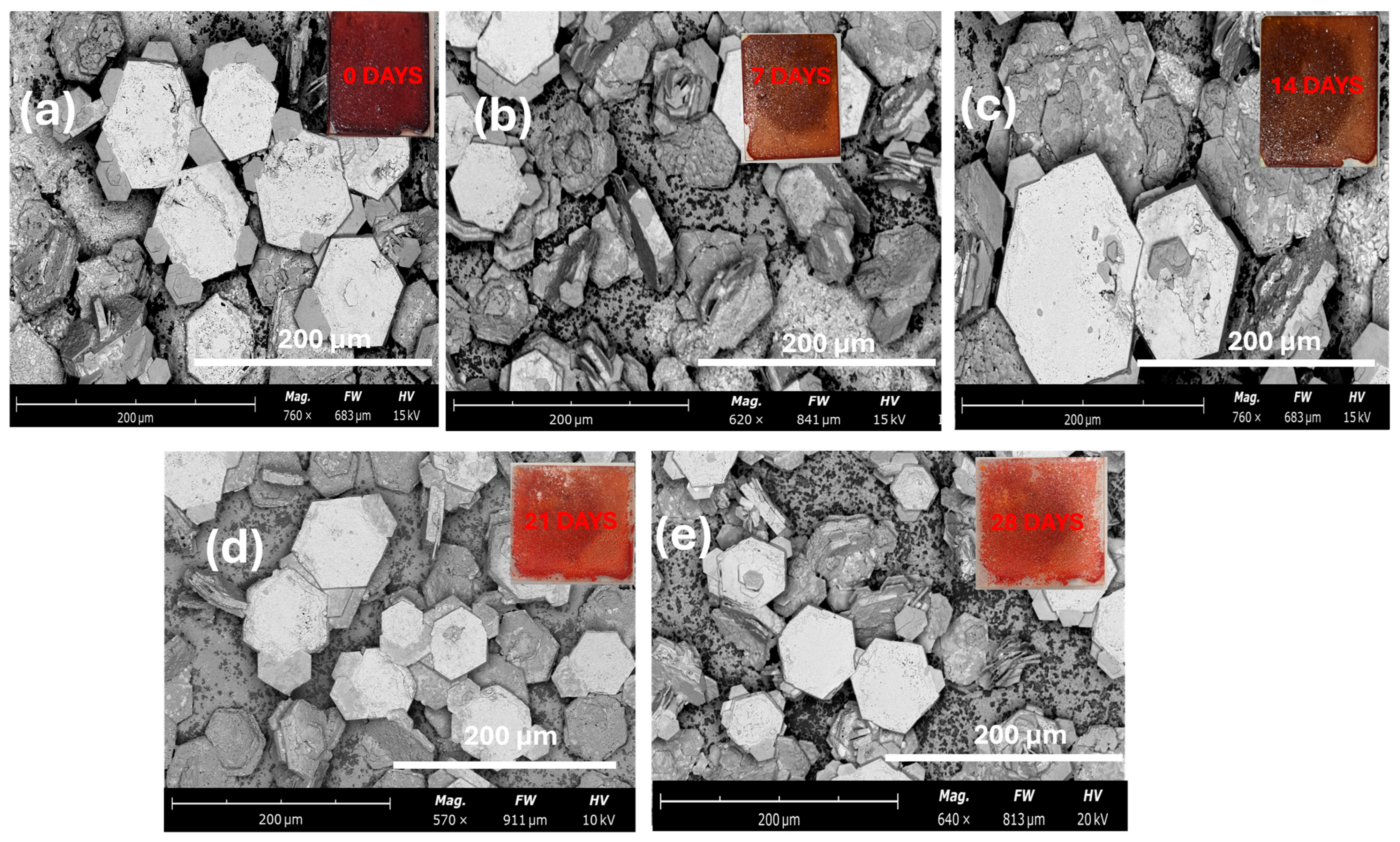
The SEM images of the drop-cast Cs3Sb2I9 thin films exhibit hexagonal platelet-like grains, consistent with the intrinsic hexagonal lattice symmetry of the layered trigonal phase (P 3 ¯ m1). Such morphology originates from the lateral extension of Cs–Sb–I layers along the a–b plane, while the periodic stacking along the c-axis is evidenced by the presence of the (006) reflection in the XRD pattern [58]. The slow solvent evaporation during drop-casting promotes oriented growth, leading to large, well-faceted hexagonal grains indicative of high crystallinity. In these SEM images, a fraction of hexagonal crystals appears brighter, whereas others are relatively darker and present distinct white speckling or spots on their surfaces. The bright grains are often large, well-faceted and appear intact; in contrast, the darker grains frequently show surface irregularities, such as white deposits or flecks, and appear less uniform in termination.
From live element identification in selected regions (Figure S1), it is found that Cs is deficient, while Sb and I are dominant in these darker grains. The white spots may represent precipitates or segregated phases rich in Sb or I (or their oxides) that form due to Cs deficiency or ambient degradation. A Cs-deficient composition can significantly alter band structure, defect density, and optical absorption. For example, a reduction in A-site cation may lead to increased trap states, altered exciton binding, or even a change in phase (0-D vs. 2-D), which can shift absorption edge/colour. Over time (28 days, Figure 4a–e), the change in film colour (e.g., from dark reddish to lighter brown/orange) may correlate with progressive Cs loss or segregation, enhancing Sb/I-rich phases that have different optical absorption properties [38].
The observed gradual colour change in the films during ambient aging may correlate with changes in optical absorption and electronic structure associated with defect formation and compositional evolution, rather than being attributed to a single dominant factor such as Cs depletion. In halide perovskites, colour variations have been reported to accompany bandgap shifts and the emergence of defect-related sub-gap states during degradation; however, such relationships are typically established through direct optical measurements such as absorption or photoluminescence spectroscopy [72,73]. The transition in film colour from dark red to orange-brown may also be influenced by changes in near-surface structure or local ordering within the Cs3Sb2I9 system. Previous studies have reported that different structural motifs (e.g., layered versus dimer-like arrangements) can exhibit distinct optical characteristics [24]. However, the present data do not directly confirm such phase transitions, and any association should be considered tentative.
Similarly, the colour change may be affected by factors such as surface reconfiguration, defect accumulation, or variations in optical scattering due to microstructural evolution. Possible contributions from surface states, including defect-related electronic states, cannot be excluded, but are not directly resolved in this study [38]. In addition, changes in grain structure or morphology during aging may influence light absorption and scattering behavior, thereby affecting the perceived colour without necessarily indicating a change in the underlying crystallographic phase [46], which alters the optical scattering and absorption onset without compromising the underlying trigonal framework. The macroscopic colour evolution is best interpreted as a qualitative indicator of ongoing structural and compositional changes during ambient exposure, rather than definitive evidence of specific phase transitions, defect mechanisms, or band structure modifications.
The morphological evolution of the ambient-processed Cs3Sb2I9 perovskite thin films, monitored over 28 days, reveals a gradual yet instructive transformation in microstructural features and film colouration (Figure 4a–e). The pristine film (0 days, Figure 4a) exhibits densely packed, well-defined hexagonal plate-like crystallites characteristic of the trigonal P 3 ¯ m1 phase of Cs3Sb2I9 [26]. The homogeneous morphology with smooth, faceted grains indicates efficient crystallization and minimal secondary phases, which is crucial for reduced grain boundary recombination in photovoltaic devices. The corresponding dark-red film [34] colour (inset) corroborates a direct bandgap around 2.0 eV evidenced from UV–Vis spectroscopy (Section 3.3), consistent with the absorption onset typically reported for 0D/2D hybrid Cs3Sb2I9 lattices [25,35]. Film thickness was determined from cross-sectional SEM images by directly measuring the vertical distance between the substrate and the film surface. The as-prepared Cs3Sb2I9 thin film exhibited an average thickness of approximately 1.0 µm. After 28 days of exposure to uncontrolled humidity (60 ± 1% RH), the thickness decreased to approximately 0.7 µm. This ~30% reduction in thickness indicates material loss through preferential depletion of volatile species and cationic components during prolonged moisture exposure, consistent with the degradation pathway reported by Chonamada et al. [24]. The observed thinning is consistent with the compositional changes detected by EDS and the structural evolution observed in XRD analysis.
After 7 days of ambient storage (Figure 4b), slight morphological coarsening and some surface roughening are observed. A subtle shift to a light orange colour is also noted. These changes may be associated with mild moisture adsorption and surface reconstruction, rather than significant compositional degradation. The persistence of hexagonal grains may indicate structural resilience of the layered [Sb2I9]3− units. The covalent character of the intra-dimer bonds could contribute to reduced susceptibility to hydrolysis compared to the Pb–I framework in conventional perovskites [34]. Such humidity-induced restacking or partial recrystallization may be associated with changes in preferred orientation and improved structural ordering, which could contribute to enhanced charge-transport anisotropy and reduced nonradiative recombination [49].
At 14 days (Figure 4c), the grain size distribution becomes broader, and larger platelets appear. The changes may be due to oriented attachment and Ostwald ripening effects. The surface compactness remains largely intact, proving improved crystallinity and reduced defect density. This observation is broadly consistent with prior findings that moderate humidity exposure can enhance crystallite ordering and electronic coupling in antimony-based halide perovskites [74,75]. The slightly intensified reddish-brown hue further supports enhanced light absorption through improved packing density.
Prolonged exposure (21 days, Figure 4d) initiates the onset of surface heterogeneity, with smaller polygonal fragments forming atop the larger hexagonal grains, possibly due to moisture-assisted re-dissolution and reprecipitation at grain boundaries [76]. Although no severe decomposition features such as pinholes or voids are visible, the increased surface texturing could scatter incident light and slightly compromise optical homogeneity [33]. Nonetheless, the morphological integrity remains sufficient for solar cell integration, suggesting that the intrinsic 0D–2D layered framework continues to buffer environmental stress [77].
By 28 days (Figure 4e), the films retain the hexagonal morphology but exhibit noticeable edge corrosion and a lighter brown colouration, indicative of possible partial surface oxidation or iodine loss (e.g., formation of Sb2O3 or CsI by-products). This gradual transition underlines the slow ambient degradation kinetics of Cs3Sb2I9, contrasting sharply with the rapid phase decomposition observed in MAPbI3 within hours under similar humidity [24]. Even after 4 weeks, the absence of obvious micro-cracking or severe grain collapse suggests good morphological stability in air-processed Cs3Sb2I9 thin films. This behavior can be related to the relatively robust ionic–covalent bonding and potentially limited ion-migration pathways within the Sb–I framework [33,38].
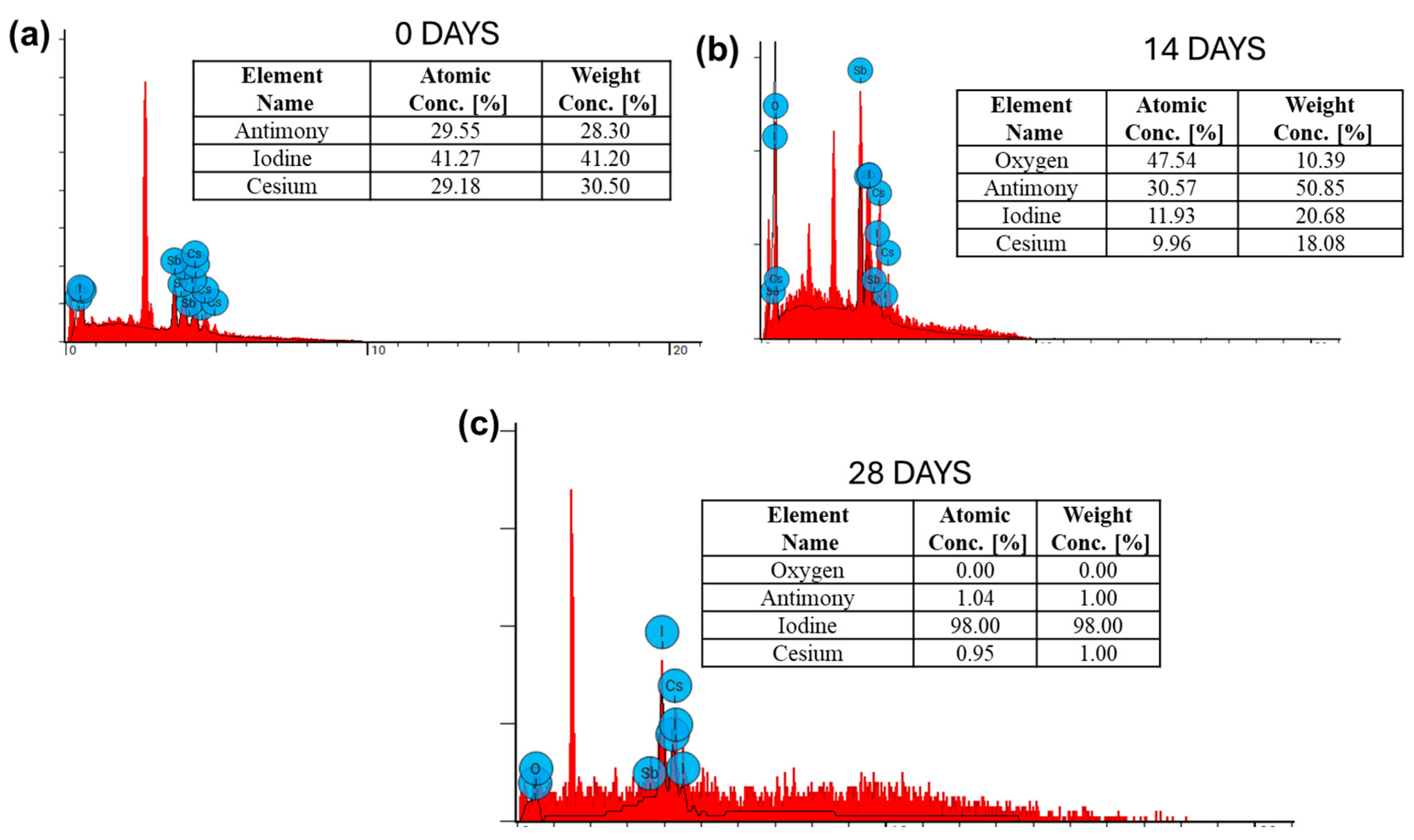
The EDS spectra (Figure 5) of Cs3Sb2I9 thin films stored under ambient conditions for 28 days reveal a clear compositional evolution associated with surface degradation and dominance of iodine/deficiency of Cs. In Figure 5, EDS spectra of perovskite thin films with two-week interval over 28 days of ambient storage (0–14–28 days) are demonstrated. At 0 days (Figure 5a), the as-prepared film exhibited an iodine-deficient composition with Cs:Sb:I ≈ 1:1:1.5, suggesting the presence of iodine vacancies (VI) within the Cs3Sb2I9 lattice, consistent with beam-induced halide depletion during EDS acquisition. After 14 days (Figure 5b), a significant oxygen peak emerges (~47%), accompanied by a sharp decrease in iodine and cesium contents. This trend suggests oxidative surface reactions, likely forming Sb–O or Cs–O species, and partial volatilization of iodine (e.g., sublimation of I2 or formation of CsIxOy). The strong Sb signal at this stage reflects the persistence of Sb-rich domains, possibly due to the initial breakdown of the perovskite network [24].
By 28 days of exposure, EDS analysis indicates a pronounced shift in the apparent surface composition, with a relative iodine content of ~98% of the detected atomic concentration, while the signals corresponding to Cs and Sb decrease to <1%. The oxygen signal, which was detectable at earlier stages, falls below the detection limit at 28 days. However, these values should be interpreted with caution. SEM-EDS probes a finite interaction volume extending approximately 1–2 µm in depth at typical accelerating voltages (10–20 kV), and the quantified composition represents an averaged near-surface response rather than a true bulk stoichiometry [78,79]. In addition, EDS quantification of heavy/light element ratios can be affected by matrix effects, surface roughness, local thickness variations, and measurement conditions, which may lead to overestimation of heavier halide species such as iodine. The apparent iodine-rich composition (~98%) combined with the significant reduction in Cs and Sb signals (<1%) is therefore unlikely to represent a fully transformed bulk phase. Instead, it more plausibly reflects surface-sensitive compositional redistribution, potentially amplified by measurement artefacts and signal attenuation from underlying regions. The concurrent thickness reduction from ~1.0 µm to ~0.7 µm supports the occurrence of material loss and restructuring during prolonged humidity exposure, which may further influence the effective interaction volume and elemental quantification.
These observations are consistent with preferential depletion or redistribution of cationic species (Cs and Sb) relative to iodine under extended ambient exposure, although the extent of this imbalance cannot be conclusively quantified by EDS alone. Similar surface iodide enrichment and altered halide/cation ratios under degradation have been reported, often as localized phenomena that require depth-resolved techniques for accurate interpretation [80].
The disappearance of the oxygen signal at Day 28 may similarly reflect changes in near-surface chemistry, such as reduced adsorption of oxygen/moisture or coverage by iodine-rich surface layers, rather than complete elimination of oxygen-containing species. Ionic migration and defect-driven redistribution processes in A3B2X9 systems can contribute to such surface reorganization, although their precise role remains to be clarified [81].
Overall, the EDS results at 28 days suggest significant surface and near-surface compositional evolution but should not be interpreted as definitive evidence of absolute elemental concentrations or complete compositional transformation. The high apparent iodine fraction is more appropriately considered an indicator of surface enrichment and degradation-driven redistribution, rather than bulk accumulation. Depth-sensitive techniques such as XPS depth profiling or ToF-SIMS would be required to resolve the true compositional gradients and validate the extent of cation depletion across the film thickness [81].
Although atomic force microscopy (AFM) measurements were not available in the present study, SEM analysis indicates relatively compact and continuous films without significant pinhole formation during initial aging stages. Surface roughness in perovskite thin films plays a crucial role in device performance, as excessive roughness can increase interfacial trap density and non-radiative recombination [82], whereas moderately smooth films facilitate efficient charge extraction and improved contact with transport layers. In the present system, optical disorder evolution (Urbach tail broadening) [83] and compositional redistribution can appear to dominate performance-relevant changes rather than large-scale morphological roughening. However, one previous study on Cs3Sb2I9 perovskite thin film indicate lower root-mean-square value (49~50 nm) compared to K3Sb2I9 and Rb3Sb2I9 which does not represent any obstacle in solar cell fabrication [84].
While XRD analysis indicates that the trigonal Cs3Sb2I9 phase remains discernible at 28 days, near-surface EDS suggests a relative depletion of Cs and Sb at the film surface. This apparent discrepancy may arise from the different sampling volumes and sensitivities of the two techniques. XRD primarily probes long-range crystalline order averaged over the film thickness and can therefore detect the persistence of the bulk phase even when local compositional or structural changes occur near the surface. In contrast, SEM-EDS at typical accelerating voltages samples a finite interaction volume on the order of ~1 µm in depth, with a signal that is weighted toward the near-surface region and influenced by local morphology and thickness variations [85].
However, it should be noted that the extent of this depth separation is not sharply defined, and both techniques may have overlapped sensitivity depending on film thickness and measurement conditions. Therefore, while the coexistence of bulk phase retention and near-surface compositional modification is a plausible interpretation, it cannot be conclusively established from the present measurements alone. Additional factors such as signal attenuation, surface roughness, and quantification uncertainties in EDS may also contribute to the observed differences. Similar apparent discrepancies between bulk-sensitive diffraction and surface-sensitive compositional analysis have been reported in degrading halide perovskite systems, where surface-localized changes occur without immediate loss of the underlying crystalline framework [85,86,87].
To rigorously resolve such depth-dependent behaviour, complementary depth-sensitive techniques (e.g., XPS depth profiling or cross-sectional analysis) would be required. The surface compositional evolution observed by EDS, showing iodine-dominant surface regions after prolonged ambient exposure, may be associated with preferential cation depletion and possible halide redistribution during degradation, whereas the retention of P 3 - m 1 diffraction in XRD reflects the continued long-range order of the bulk Cs3Sb2I9 lattice [24]. Overall, the results support a time-dependent degradation pathway: an initial stage (0–14 days) characterized by moisture-induced lattice distortion and partial cation depletion, followed by a later stage (14–28 days) dominated by irreversible compositional imbalance, surface iodine enrichment, and structural destabilization of the Cs3Sb2I9 framework. This staged degradation behavior is consistent with ambient-induced instability commonly reported in halide perovskite thin films.

3.3. Optical Evaluation via UV–Vis Spectroscopy

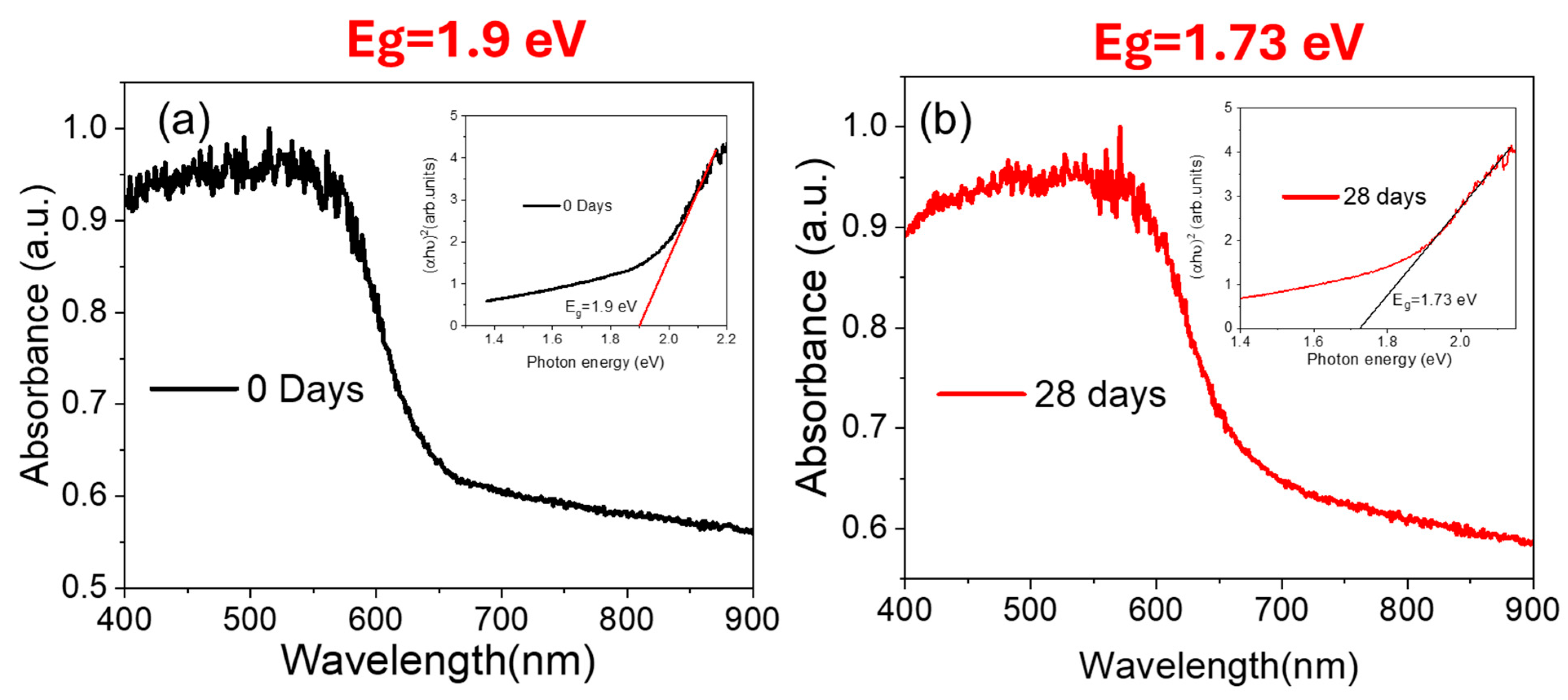
To further quantify the light absorption and optical bandgaps of the Cs3Sb2I9 perovskite thin film during chronological period of 28 days, UV–Vis absorption spectra were recorded as shown in Figure 6.
To support the visually observed colour change from dark red (0 days) to orange/brown (28 days), UV–Vis absorption spectra were recorded for the fresh and aged Cs3Sb2I9 films. A noticeable modification of the absorption edge is observed after prolonged humidity exposure, suggesting changes in the optical response of the material. However, as only two time points are presented, these results provide two measured time points representative of the initial and final states rather than a continuous kinetic trace.
The optical bandgap was estimated using the Tauc equation [88]:
]n = A(Eg)
where h ν   is the photon energy, A is a proportional constant, E g is the bandgap, and n depends on the nature of the transition. Using this approach, the estimated optical bandgap decreases from 1.9 ± 0.03 eV (fresh film) to 1.73 ± 0.03 eV after 28 days. The Tauc analysis was performed using n = 2 (direct-allowed transition). Although the transition character in Cs3Sb2I9 remains under discussion, this choice is justified for the layered polymorph, where Saparov et al. [34] reported that the energy difference between direct and indirect bandgaps is less than 0.02 eV, supporting the use of a direct-allowed approximation.
The observed optical changes may also correlate with the compositional and microstructural evolution indicated by EDS and thickness measurements, including possible cation redistribution and lattice distortion under prolonged humidity exposure. Nevertheless, the present UV–Vis data alone are not sufficient to establish a definitive link between compositional changes and electronic structure modification.
Overall, the UV–Vis results qualitatively support the occurrence of optical changes during ambient aging, consistent with the macroscopic colour variation, but a more comprehensive time-resolved optical analysis would be required to fully elucidate the degradation mechanism.

4. Conclusions

This systematic ambient-aging study quantitatively evaluates the structural, microstructural, compositional, and optical evolution of air-processed Cs3Sb2I9 thin films stored under uncontrolled humidity (60 ± 1% RH) for 28 days. XRD analysis confirms retention of the trigonal P 3 ¯ m1 phase throughout aging, with no detectable secondary crystalline phases, indicating crystallographic phase persistence under moderate humidity conditions.
However, this phase persistence does not imply complete material stability. Significant microstructural and compositional evolution is observed during aging. The average crystallite size decreases from 44.7 nm (0 day) to ~36 nm (7–21 days), accompanied by an increase in microstrain from 0.24% to ~1.12–1.22% and a rise in dislocation density from ~0.56 × 10¹⁵ m−2 to ~24.7 × 10¹⁵ m−2. At 28 days, partial relaxation occurs, with crystallite size recovering to ~43 nm, microstrain decreasing to ~0.8%, and dislocation density reducing to ~13.8 × 10¹⁵ m−2, suggesting stress redistribution rather than structural invariance. The degree of crystallinity exhibits a non-monotonic trend: 60.4% (0 day), 53.9% (7 days), 73.1% (14 days), 63.4% (21 days), and 71.6% (28 days). The lattice parameters show only minor variations, with the unit-cell volume exhibiting a slight increase from 7 (657.85 Å3) to 28 days (660.53 Å3), suggesting subtle structural relaxation and reorganization Cross-sectional SEM reveals a thickness reduction from ~1.0 µm to ~0.7 µm (~30%), while EDS indicates relative iodine enrichment at later stages, attributed to preferential depletion of Cs and Sb rather than net iodine accumulation. Optical characterization further reflects degradation, with the bandgap decreasing from 1.9 eV to 1.73 eV, indicating increased structural disorder and defect-state formation.
These results demonstrate a decoupled stability response, where crystallographic phase retention coexists with measurable microstructural, compositional, and optoelectronic degradation. The aging process follows a staged pathway: (i) early moisture-induced lattice distortion and strain accumulation (0–7 days), (ii) intermediate structural reorganization and texture evolution (7–14 days), and (iii) late-stage compositional redistribution with partial stress relaxation (14–28 days).
Cs3Sb2I9 retains the primary trigonal framework under ISOS-D-1 conditions despite measurable degradation in thickness, composition, and optical properties indicating phase-level but not functional-level stability. Future investigations incorporating depth-sensitive techniques such as XPS depth profiling or ToF-SIMS would further clarify iodine redistribution and cation depletion across the film thickness. Additionally, UV–Vis measurements at intermediate time points and AFM characterization would provide a more complete understanding of degradation kinetics and surface evolution [24,34].

Supplementary Materials

The following supporting information can be downloaded at: https://www.mdpi.com/article/10.3390/en19092196/s1, Figure S1: Element identification of dark region of Cs3Sb2I9 perovskite thin film via EDS mapping; Figure S2: (a) XRD diffraction pattern for CsI thin film [44] (b) commercial SbI3 [43] and (c) XRD diffraction pattern of Cs3Sb2I9 layered perovskite thin film.

Author Contributions

Conceptualization, P.B. and N.K.E.; Methodology, P.B.; Validation, K.K. and N.K.E.; Formal analysis, K.K. and N.K.E.; Investigation, P.B. and N.K.E.; Resources, P.B.; Data curation, P.B., K.K. and N.K.E.; Writing—original draft, P.B.; Writing—review & editing, N.K.E.; Visualization, P.B., K.K. and N.K.E.; Supervision, K.K. and N.K.E. All authors have read and agreed to the published version of the manuscript.

Funding

This research received no external funding. This work received a 100% article processing charge (APC) waiver from MDPI, awarded to Naveen Kumar Elumalai.

Data Availability Statement

The original contributions presented in this study are included in the article. Further inquiries can be directed to the corresponding authors.

Acknowledgments

This research was supported by the Australian Government Research Training Program Scholarship http://doi.org/10.82133/C42F-K220.

Conflicts of Interest

The authors declare no conflict of interest.

Correction Statement

This article has been republished with a minor correction to resolve a typo in Equation (4). This change does not affect the scientific content of the article.

References

  1. Siekmann, J.; Ravishankar, S.; Kirchartz, T. Apparent Defect Densities in Halide Perovskite Thin Films and Single Crystals. ACS Energy Lett. 2021, 6, 3244–3251. [Google Scholar] [CrossRef]
  2. Wang, S.; Wang, A.; Hao, F. Toward stable lead halide perovskite solar cells: A knob on the A/X sites components. iScience 2022, 25, 103599. [Google Scholar] [CrossRef]
  3. Best Research-Cell Efficiency Chart. Available online: https://www.nrel.gov/pv/cell-efficiency.html (accessed on 14 August 2025).
  4. Kojima, A.; Teshima, K.; Shirai, Y.; Miyasaka, T. Organometal Halide Perovskites as Visible-Light Sensitizers for Photovoltaic Cells. J. Am. Chem. Soc. 2009, 131, 6050–6051. [Google Scholar] [CrossRef]
  5. Zhou, Y.; Chen, J.; Bakr, O.M.; Mohammed, O.F. Metal Halide Perovskites for X-ray Imaging Scintillators and Detectors. ACS Energy Lett. 2021, 6, 739–768. [Google Scholar] [CrossRef]
  6. Liang, C.; Zhang, M.; Yang, Z.; Tian, J. Advancements in Metal Halide Perovskites and their Derivatives for Direct-Type X-Ray Detectors. Small 2025, 21, e07401. [Google Scholar] [CrossRef] [PubMed]
  7. Park, M.-H.; Kim, J.S.; Heo, J.-M.; Ahn, S.; Jeong, S.-H.; Lee, T.-W. Boosting Efficiency in Polycrystalline Metal Halide Perovskite Light-Emitting Diodes. ACS Energy Lett. 2019, 4, 1134–1149. [Google Scholar] [CrossRef]
  8. Ren, K.; Yue, S.; Li, C.; Fang, Z.; Gasem, K.A.M.; Leszczynski, J.; Qu, S.; Wang, Z.; Fan, M. Metal halide perovskites for photocatalysis applications. J. Mater. Chem. A 2022, 10, 407–429. [Google Scholar] [CrossRef]
  9. Bienkowski, K.; Solarska, R.; Trinh, L.; Widera-Kalinowska, J.; Al-Anesi, B.; Liu, M.; Grandhi, G.K.; Vivo, P.; Oral, B.; Yılmaz, B.; et al. Halide Perovskites for Photoelectrochemical Water Splitting and CO2 Reduction: Challenges and Opportunities. ACS Catal. 2024, 14, 6603–6622. [Google Scholar] [CrossRef] [PubMed]
  10. Shooshtari, M.; Kim, S.; Pahlavan, S.; Rivera-Sierra, G.; Través, M.J.; Serrano-Gotarredona, T.; Bisquert, J.; Linares-Barranco, B. Advancing Logic Circuits with Halide Perovskite Memristors for Next-Generation Digital Systems. SmartMat 2025, 6, e70032. [Google Scholar] [CrossRef]
  11. Kore, B.P.; Jamshidi, M.; Gardner, J.M. The impact of moisture on the stability and degradation of perovskites in solar cells. Mater. Adv. 2024, 5, 2200–2217. [Google Scholar] [CrossRef]
  12. Lee, S.-W.; Kim, S.; Bae, S.; Cho, K.; Chung, T.; Mundt, L.E.; Lee, S.; Park, S.; Park, H.; Schubert, M.C.; et al. UV Degradation and Recovery of Perovskite Solar Cells. Sci. Rep. 2016, 6, 38150. [Google Scholar] [CrossRef]
  13. Zhidkov, I.S.; Boukhvalov, D.W.; Akbulatov, A.F.; Frolova, L.A.; Finkelstein, L.D.; Kukharenko, A.I.; Cholakh, S.O.; Chueh, C.-C.; Troshin, P.A.; Kurmaev, E.Z. XPS spectra as a tool for studying photochemical and thermal degradation in APbX3 hybrid halide perovskites. Nano Energy 2021, 79, 105421. [Google Scholar] [CrossRef]
  14. Shahivandi, H.; Vaezzadeh, M.; Saeidi, M. Theory of light-induced degradation in perovskite solar cells. Sol. Energy Mater. Sol. Cells 2020, 208, 110383. [Google Scholar] [CrossRef]
  15. Kour, R.; Arya, S.; Verma, S.; Gupta, J.; Bandhoria, P.; Bharti, V.; Datt, R.; Gupta, V. Potential Substitutes for Replacement of Lead in Perovskite Solar Cells: A Review. Glob. Chall. 2019, 3, 1900050. [Google Scholar] [CrossRef]
  16. Haruyama, J.; Sodeyama, K.; Han, L.; Tateyama, Y. First-Principles Study of Ion Diffusion in Perovskite Solar Cell Sensitizers. J. Am. Chem. Soc. 2015, 137, 10048–10051. [Google Scholar] [CrossRef]
  17. Delugas, P.; Caddeo, C.; Filippetti, A.; Mattoni, A. Thermally Activated Point Defect Diffusion in Methylammonium Lead Trihalide: Anisotropic and Ultrahigh Mobility of Iodine. J. Phys. Chem. Lett. 2016, 7, 2356–2361. [Google Scholar] [CrossRef]
  18. Aristidou, N.; Sanchez-Molina, I.; Chotchuangchutchaval, T.; Brown, M.; Martinez, L.; Rath, T.; Haque, S.A. The Role of Oxygen in the Degradation of Methylammonium Lead Trihalide Perovskite Photoactive Layers. Angew. Chem. Int. Ed. 2015, 54, 8208–8212. [Google Scholar] [CrossRef]
  19. Nalini, V.; Nagy, G.N.; Rahaman, A.; Kalpathy, S.K.; Thomas, T.; P., S.T.; Kahaly, M.U. Unravelling the environmental degradation mechanism of perovskite thin films. Mater. Adv. 2024, 5, 6426–6439. [Google Scholar] [CrossRef]
  20. Kumar, A.; Ibrahium, H.A.; Awwad, N.S.; Gorai, D.K. Exploring the degradation pathways of methylammonium lead iodide and triple cation-based perovskite solar cells through defect density. J. Alloys Compd. 2025, 1041, 183732. [Google Scholar] [CrossRef]
  21. Abd Mutalib, M.; Ahmad Ludin, N.; Nik Ruzalman, N.A.A.; Barrioz, V.; Sepeai, S.; Mat Teridi, M.A.; Su’ait, M.S.; Ibrahim, M.A.; Sopian, K. Progress towards highly stable and lead-free perovskite solar cells. Mater. Renew. Sustain. Energy 2018, 7, 7. [Google Scholar] [CrossRef]
  22. Aktas, E.; Rajamanickam, N.; Pascual, J.; Hu, S.; Aldamasy, M.H.; Di Girolamo, D.; Li, W.; Nasti, G.; Martínez-Ferrero, E.; Wakamiya, A.; et al. Challenges and strategies toward long-term stability of lead-free tin-based perovskite solar cells. Commun. Mater. 2022, 3, 104. [Google Scholar] [CrossRef]
  23. Chiara, R.; Morana, M.; Malavasi, L. Germanium-Based Halide Perovskites: Materials, Properties, and Applications. ChemPlusChem 2021, 86, 879–888. [Google Scholar] [CrossRef]
  24. Chonamada, T.D.; Dey, A.B.; Santra, P.K. Degradation Studies of Cs3Sb2I9: A Lead-Free Perovskite. ACS Appl. Energy Mater. 2020, 3, 47–55. [Google Scholar] [CrossRef]
  25. Farooq, U.; Ishaq, M.; Shah, U.A.; Chen, S.; Zheng, Z.-H.; Azam, M.; Su, Z.-H.; Tang, R.; Fan, P.; Bai, Y.; et al. Bandgap engineering of lead-free ternary halide perovskites for photovoltaics and beyond: Recent progress and future prospects. Nano Energy 2022, 92, 106710. [Google Scholar] [CrossRef]
  26. Berri, S. Theoretical analysis of the structural, electronic, optical and thermodynamic properties of trigonal and hexagonal Cs3Sb2I9 compound. Eur. Phys. J. B 2020, 93, 191. [Google Scholar] [CrossRef]
  27. Sharma, B.; Pant, N.; Nath, P.; Saini, S.K.; Singh, R.K.; Satapathi, S. Efficiency and Transparency Enhancement in Environment-Friendly Lead-Free Cs3Sb2I9 Semi-Transparent Perovskite Solar Cells through Quantum Dot Passivation. Sol. RRL 2025, 9, e202500712. [Google Scholar] [CrossRef]
  28. Guo, Y.; Zhao, F.; Zhang, C.; Wu, P.; Jiang, J.; Tao, J.; Chu, J. Suppressing the Electron–Phonon Coupling in 2D Perovskite Cs3Sb2I9 for Lead-Free Indoor Photovoltaics. Adv. Sci. 2025, 12, e09281. [Google Scholar] [CrossRef]
  29. Wu, Y.; Hong, E.; Liang, Y.; Han, W.; Li, Z. Alloying Bismuth-Antimony Halide Photodiodes Enable Reconfigurable Logic Gates for Multifunctional Image Processing. Adv. Opt. Mater. 2025, 13, e02372. [Google Scholar] [CrossRef]
  30. Li, Z.; Liu, X.; Zuo, C.; Yang, W.; Fang, X. Supersaturation-Controlled Growth of Monolithically Integrated Lead-Free Halide Perovskite Single-Crystalline Thin Film for High-Sensitivity Photodetectors. Adv. Mater. 2021, 33, 2103010. [Google Scholar] [CrossRef] [PubMed]
  31. Deng, M.; Li, Z.; Deng, X.; Hu, Y.; Fang, X. Wafer-scale heterogeneous integration of self-powered lead-free metal halide UV photodetectors with ultrahigh stability and homogeneity. J. Mater. Sci. Technol. 2023, 164, 150–159. [Google Scholar] [CrossRef]
  32. Chen, J.; Liu, X.; Li, Z.; Cao, F.; Lu, X.; Fang, X. Work-Function-Tunable MXenes Electrodes to Optimize p-CsCu2I3/n-Ca2Nb3-xTaxO10 Junction Photodetectors for Image Sensing and Logic Electronics. Adv. Funct. Mater. 2022, 32, 2201066. [Google Scholar] [CrossRef]
  33. Shil, S.K.; Wang, F.; Lai, Z.; Meng, Y.; Wang, Y.; Zhao, D.; Hossain, M.K.; Egbo, K.O.; Wang, Y.; Yu, K.M.; et al. Crystalline all-inorganic lead-free Cs3Sb2I9 perovskite microplates with ultra-fast photoconductive response and robust thermal stability. Nano Res. 2021, 14, 4116–4124. [Google Scholar] [CrossRef]
  34. Saparov, B.; Hong, F.; Sun, J.-P.; Duan, H.-S.; Meng, W.; Cameron, S.; Hill, I.G.; Yan, Y.; Mitzi, D.B. Thin-Film Preparation and Characterization of Cs3Sb2I9: A Lead-Free Layered Perovskite Semiconductor. Chem. Mater. 2015, 27, 5622–5632. [Google Scholar] [CrossRef]
  35. Hui, Z. Density Functional Theory Study of Electronic and Optical Properties of Perovskite Derivative Cs3Sb2I9. Russ. J. Phys. Chem. A 2023, 97, 2181–2188. [Google Scholar] [CrossRef]
  36. Aftab, A.; Ahmad, M.I. A review of stability and progress in tin halide perovskite solar cell. Sol. Energy 2021, 216, 26–47. [Google Scholar] [CrossRef]
  37. Umar, F.; Zhang, J.; Jin, Z.; Muhammad, I.; Yang, X.; Deng, H.; Jahangeer, K.; Hu, Q.; Song, H.; Tang, J. Dimensionality Controlling of Cs3Sb2I9 for Efficient All-Inorganic Planar Thin Film Solar Cells by HCl-Assisted Solution Method. Adv. Opt. Mater. 2019, 7, 1801368. [Google Scholar] [CrossRef]
  38. Neguse, S.M.; Yoon, S.; Frebel, A.; Jöckel, D.M.; Widenmeyer, M.; Lange, S.; Rosspeintner, A.; Ebbinghaus, S.G.; Hagendorf, C.; Balke, B.; et al. Tunable Optical Properties and the Role of Defects on the Carrier Lifetimes of Cs3Sb2I9 Synthesized in Various Solvents. Adv. Photonics Res. 2023, 4, 2300184. [Google Scholar] [CrossRef]
  39. ISOS Protocols for Stability Analyses of Perovskite Solar Cells. Available online: https://www.fluxim.com/isos-protocols-stability-perovskite-solar-cells (accessed on 4 October 2024).
  40. Sasidharan, V.P.V.; Hernandez, M.U.R.; Shaji, S.; Avellaneda, D.A.; Chandran, S.K.; Méndez, M.G.; Krishnan, B. Cesium antimony iodide perovskite thin films by rapid iodization of Sb2S3-CsCl precursor under ambient conditions. J. Alloys Compd. 2024, 972, 172870. [Google Scholar] [CrossRef]
  41. Sheng, S.; Guo, X.; Li, X.; Wang, H.; Xu, M.; Shi, Y.; Li, B.; Zhang, Q.; Xiang, R. Spatial Confinement-Assisted Vapor-Phase Synthesis of Two-Dimensional Cs3Sb2I9 for Photodetection Application. ACS Appl. Opt. Mater. 2025, 3, 1315–1323. [Google Scholar] [CrossRef]
  42. Yuan, Y.; Wang, Y.; Zhang, W.; Qi, F.; Tang, X.; Wang, Z. Dimer-type Cs3Sb2I9: An efficient perovskite material for low operating voltage and high stability flexible resistive switching memory. J. Alloys Compd. 2023, 937, 168308. [Google Scholar] [CrossRef]
  43. Onodera, T.; Baba, K.; Hitomi, K. Evaluation of Antimony Tri-Iodide Crystals for Radiation Detectors. Sci. Technol. Nucl. Install. 2018, 2018, 1532742. [Google Scholar] [CrossRef]
  44. Farzaneh, A.; Abdi, M.R.; Saraee, K.R.E.; Mostajabaldaavati, M.; Quaranta, A. The preparation of cesium-iodide thin films via sol–gel method for the detection of ionizing radiation. J. Sol-Gel Sci. Technol. 2016, 78, 313–321. [Google Scholar] [CrossRef]
  45. Owuor, B.; Boschloo, G.; Ji, F.; Sadhukhan, P.; Nyongesa, F.; Aduda, B.; Waita, S. Enhanced Optoelectronic Properties of Cs3Sb2I9 Perovskite Solar Cells through Sulfonium-Based Treatment. ACS Appl. Energy Mater. 2025, 8, 9200–9208. [Google Scholar] [CrossRef]
  46. Shin, S.; Shin, H. Aging of perovskite solar cells: A mini review. Mater. Today Energy 2023, 37, 101381. [Google Scholar] [CrossRef]
  47. Leguy, A.M.A.; Frost, J.M.; McMahon, A.P.; Sakai, V.G.; Kockelmann, W.; Law, C.; Li, X.; Foglia, F.; Walsh, A.; O’Regan, B.C.; et al. The dynamics of methylammonium ions in hybrid organic–inorganic perovskite solar cells. Nat. Commun. 2015, 6, 7124. [Google Scholar] [CrossRef]
  48. Pramod, A.K.; Kushvaha, S.S.; Batabyal, S.K. Lead-free Cs3Bi2I9 perovskite hexagonal microplates: A promising material solution-processed for ultraviolet self-powered photodetectors. J. Alloys Compd. 2024, 1006, 176320. [Google Scholar] [CrossRef]
  49. Câmara, J.F.; Oliveira, Â.A.S.; Melo, D.M.A.; Maziviero, F.V.; Medeiros, R.L.B.A.; Silva, Y.K.R.O.; Sousa, L.H.N.; Brito, R.N.T.; Braga, R.M. Review of inorganic Sb perovskites and their applications. J. Solid State Chem. 2024, 339, 124943. [Google Scholar] [CrossRef]
  50. Samal, A.; Pouthika, K.; Rajesh, A.; Mohana Roopan, S.; Madhumitha, G. Photocatalytic degradation and kinetic investigations of ZnO-SnO2 heterostructures for treatment of methyl violet using non-conventional approach. Inorg. Chem. Commun. 2024, 159, 111809. [Google Scholar] [CrossRef]
  51. Sutapa, I.W.; Wahid Wahab, A.; Taba, P.; Nafie, N.L. Dislocation, crystallite size distribution and lattice strain of magnesium oxide nanoparticles. J. Phys. Conf. Ser. 2018, 979, 012021. [Google Scholar] [CrossRef]
  52. Yon, V.; Rochat, N.; Charles, M.; Nolot, E.; Gergaud, P. X-Ray Diffraction Microstrain Analysis for Extraction of Threading Dislocation Density of GaN Films Grown on Silicon, Sapphire, and SiC Substrates. Phys. Status Solidi B 2020, 257, 1900579. [Google Scholar] [CrossRef]
  53. Vinila, V.S.; Isac, J. Chapter 14—Synthesis and structural studies of superconducting perovskite GdBa2Ca3Cu4O10.5+δ nanosystems. In Design, Fabrication, and Characterization of Multifunctional Nanomaterials; Thomas, S., Kalarikkal, N., Abraham, A.R., Eds.; Elsevier: Amsterdam, The Netherlands, 2022; pp. 319–341. [Google Scholar]
  54. Himabindu, B.; Latha Devi, N.S.M.P.; Rajini Kanth, B. Microstructural parameters from X-ray peak profile analysis by Williamson-Hall models; A review. Mater. Today Proc. 2021, 47, 4891–4896. [Google Scholar] [CrossRef]
  55. Ahmad, K.; Raza, W.; Alsulmi, A.; Kim, H. Improved hydrogen production using lead-free and air stable perovskite-like Cs3Sb2I9. Mater. Chem. Phys. 2023, 307, 128159. [Google Scholar] [CrossRef]
  56. Jin, B.; Cao, J.; Yuan, R.; Cai, B.; Wu, C.; Zheng, X. Strain Relaxation for Perovskite Lattice Reconfiguration. Adv. Energy Sustain. Res. 2023, 4, 2200143. [Google Scholar] [CrossRef]
  57. Li, G.; Li, S.; Ahmed, J.; Tian, W.; Li, L. Flexible perovskite photodetector with room-temperature self-healing capability without external trigger. InfoMat 2024, 6, e12594. [Google Scholar] [CrossRef]
  58. Ciobotaru, I.C.; Ciobotaru, C.C.; Bartha, C.; Enculescu, M.; Secu, M.; Polosan, S.; Besleaga, C. Phase Transitions in Dimer/Layered Sb-Based Hybrid Halide Perovskites: An In-Depth Analysis of Structural and Spectroscopic Properties. Adv. Opt. Mater. 2025, 13, 2402242. [Google Scholar] [CrossRef]
  59. Nur-E-Alam, M.; Islam, M.S.; Abedin, T.; Islam, M.A.; Yap, B.K.; Kiong, T.S.; Das, N.; Rahman, M.R.; Khandaker, M.U. Current scenario and future trends on stability issues of perovskite solar cells: A mini review. Curr. Opin. Colloid Interface Sci. 2025, 76, 101895. [Google Scholar] [CrossRef]
  60. Baishya, H.; Adhikari, R.D.; Patel, M.J.; Yadav, D.; Sarmah, T.; Alam, M.; Kalita, M.; Iyer, P.K. Defect mediated losses and degradation of perovskite solar cells: Origin, impacts and reliable characterization techniques. J. Energy Chem. 2024, 94, 217–253. [Google Scholar] [CrossRef]
  61. Habib, H.; Rehman, S.U.; El Hyani, H.; Sharif, M.N.; Tan, F.; Wang, K.-F. Degradation Pathways in Perovskite Solar Cells: Strategies for Enhancing Stability. Energy Technol. 2025, 13, 2500137. [Google Scholar] [CrossRef]
  62. Niu, G.; Guo, X.; Wang, L. Review of recent progress in chemical stability of perovskite solar cells. J. Mater. Chem. A 2015, 3, 8970–8980. [Google Scholar] [CrossRef]
  63. Jeon, N.J.; Noh, J.H.; Kim, Y.C.; Yang, W.S.; Ryu, S.; Seok, S.I. Solvent engineering for high-performance inorganic–organic hybrid perovskite solar cells. Nat. Mater. 2014, 13, 897–903. [Google Scholar] [CrossRef]
  64. Zhou, Y.; Najar, A.; Zhang, J.; Feng, J.; Cao, Y.; Li, Z.; Zhu, X.; Yang, D.; Liu, S.F. Effect of Solvent Residue in the Thin-Film Fabrication on Perovskite Solar Cell Performance. ACS Appl. Mater. Interfaces 2022, 14, 28729–28737. [Google Scholar] [CrossRef]
  65. Bruening, K.; Tassone, C.J. Antisolvent processing of lead halide perovskite thin films studied by in situ X-ray diffraction. J. Mater. Chem. A 2018, 6, 18865–18870. [Google Scholar] [CrossRef]
  66. Niu, Y.; He, D.; Zhang, Z.; Zhu, J.; Gavin, T.; Falaras, P.; Hu, L. Improved crystallinity and self-healing effects in perovskite solar cells via functional incorporation of polyvinylpyrrolidone. J. Energy Chem. 2022, 68, 12–18. [Google Scholar] [CrossRef]
  67. Zhang, C.; Zhang, A.; Zhang, G.; Fang, Y.; Cheng, J.; Liang, L.; Shi, J.; Li, Z.; Meng, T.; Wang, D. Moisture-dependent room-temperature perovskite crystallization in vacuum flash-assisted solution processed intermediate phase films. Org. Electron. 2022, 111, 106652. [Google Scholar] [CrossRef]
  68. Hidalgo, J.; Perini, C.A.R.; Castro-Mendez, A.-F.; Jones, D.; Köbler, H.; Lai, B.; Li, R.; Sun, S.; Abate, A.; Correa-Baena, J.-P. Moisture-Induced Crystallographic Reorientations and Effects on Charge Carrier Extraction in Metal Halide Perovskite Solar Cells. ACS Energy Lett. 2020, 5, 3526–3534. [Google Scholar] [CrossRef]
  69. Sun, K.; Müller-Buschbaum, P. Shedding Light on the Moisture Stability of Halide Perovskite Thin Films. Energy Technol. 2023, 11, 2201475. [Google Scholar] [CrossRef]
  70. Jong, U.-G.; Yu, C.-J.; Ri, G.-C.; McMahon, A.P.; Harrison, N.M.; Barnes, P.R.F.; Walsh, A. Influence of water intercalation and hydration on chemical decomposition and ion transport in methylammonium lead halide perovskites. J. Mater. Chem. A 2018, 6, 1067–1074. [Google Scholar] [CrossRef]
  71. Ci, X.; Jiang, X.; Pan, G.; Sun, K.; Buyan-Arivjikh, A.; Li, Z.; Li, L.; Baier, T.; Schwartzkopf, M.; Koyiloth Vayalil, S.; et al. Reorientation-Driven Degradation in Oriented Perovskite Films: Shifting Facet Engineering to Thermodynamic Stability. Small 2026, 22, e13081. [Google Scholar] [CrossRef]
  72. Xue, H.; Chen, Z.; Tao, S.; Brocks, G. Defects in Halide Perovskites: Does It Help to Switch from 3D to 2D? ACS Energy Lett. 2024, 9, 2343–2350. [Google Scholar] [CrossRef] [PubMed]
  73. Wang, Z.; Zhang, Z.; Xie, L.; Wang, S.; Yang, C.; Fang, C.; Hao, F. Recent Advances and Perspectives of Photostability for Halide Perovskite Solar Cells. Adv. Opt. Mater. 2022, 10, 2101822. [Google Scholar] [CrossRef]
  74. Gouvêa, R.A.; Moreira, M.L.; Singh, C.V.; Santos, M.J.L. Lead-free cesium antimony halide perovskites: Halide alloying, surfaces, interfaces, and clusters. J. Mater. Sci. 2024, 59, 142–160. [Google Scholar] [CrossRef]
  75. Jin, Z.; Zhang, Z.; Xiu, J.; Song, H.; Gatti, T.; He, Z. A critical review on bismuth and antimony halide based perovskites and their derivatives for photovoltaic applications: Recent advances and challenges. J. Mater. Chem. A 2020, 8, 16166–16188. [Google Scholar] [CrossRef]
  76. Chen, B.; Wang, S.; Song, Y.; Li, C.; Hao, F. A critical review on the moisture stability of halide perovskite films and solar cells. Chem. Eng. J. 2022, 430, 132701. [Google Scholar] [CrossRef]
  77. Ahmad, K.; Mobin, S.M. Recent Progress and Challenges in A3Sb2X9-Based Perovskite Solar Cells. ACS Omega 2020, 5, 28404–28412. [Google Scholar] [CrossRef]
  78. Lee, M.; Vigil, J.A.; Jiang, Z.; Karunadasa, H.I. Evidence for I2 loss from the perovskite–gas interface upon light-induced halide segregation. Chem. Sci. 2025, 16, 9662–9668. [Google Scholar] [CrossRef]
  79. Song, Z.; Wang, C.; Phillips, A.B.; Grice, C.R.; Zhao, D.; Yu, Y.; Chen, C.; Li, C.; Yin, X.; Ellingson, R.J.; et al. Probing the origins of photodegradation in organic–inorganic metal halide perovskites with time-resolved mass spectrometry. Sustain. Energy Fuels 2018, 2, 2460–2467. [Google Scholar] [CrossRef]
  80. Wylie, Z.R.; Al Katrib, M.; Campagna, R.; Outen, J.E.; Smith, S.; Ruffolo, P.; Bérenguier, B.; Bouttemy, M.; Schulz, P.; Christians, J.A. Surface Iodide Defects Control the Kinetics of the CsPbI3 Perovskite Phase Transformation. ACS Energy Lett. 2024, 9, 4378–4385. [Google Scholar] [CrossRef]
  81. Kumar, R.; Rakheja, B.; Lamminen, N.; Fasulo, F.; Cachafeiro, M.A.T.; Hanmandlu, C.; Grandhi, G.K.; Bag, M.; Muñoz-García, A.B.; Boschloo, G.; et al. Mechanistic Insights into Ionic Conduction in Lead Halide Perovskites and Perovskite-Inspired Materials. Adv. Energy Mater. 2025, 15, e03331. [Google Scholar] [CrossRef]
  82. Xiao, Z.; Song, Z.; Yan, Y. From Lead Halide Perovskites to Lead-Free Metal Halide Perovskites and Perovskite Derivatives. Adv. Mater. 2019, 31, 1803792. [Google Scholar] [CrossRef]
  83. Zeiske, S.; Sandberg, O.J.; Zarrabi, N.; Wolff, C.M.; Raoufi, M.; Peña-Camargo, F.; Gutierrez-Partida, E.; Meredith, P.; Stolterfoht, M.; Armin, A. Static Disorder in Lead Halide Perovskites. J. Phys. Chem. Lett. 2022, 13, 7280–7285. [Google Scholar] [CrossRef] [PubMed]
  84. Correa-Baena, J.-P.; Nienhaus, L.; Kurchin, R.C.; Shin, S.S.; Wieghold, S.; Putri Hartono, N.T.; Layurova, M.; Klein, N.D.; Poindexter, J.R.; Polizzotti, A.; et al. A-Site Cation in Inorganic A3Sb2I9 Perovskite Influences Structural Dimensionality, Exciton Binding Energy, and Solar Cell Performance. Chem. Mater. 2018, 30, 3734–3742. [Google Scholar] [CrossRef]
  85. Cheng, F.; Wang, P.; Xu, C.; Liao, Q.; Zhang, S.; Sun, H.; Fan, W.; Liu, G.; Li, Z.; Kong, Y.; et al. The dynamic surface evolution of halide perovskites induced by external energy stimulation. Natl. Sci. Rev. 2024, 11, nwae042. [Google Scholar] [CrossRef] [PubMed]
  86. Ramadan, A.A.; Abd El-Mongy, A.A.; El-Shabiny, A.M.; Mater, A.T.; Mostafa, S.H.; El-Sheheedy, E.A.; Hashem, H.M. Addressing difficulties in using XRD intensity for structural study of thin films. Cryst. Res. Technol. 2009, 44, 111–116. [Google Scholar] [CrossRef]
  87. Whiteside, P.J.D.; Chininis, J.A.; Hunt, H.K. Techniques and Challenges for Characterizing Metal Thin Films with Applications in Photonics. Coatings 2016, 6, 35. [Google Scholar] [CrossRef]
  88. Gu, J.; Yan, G.; Lian, Y.; Mu, Q.; Jin, H.; Zhang, Z.; Deng, Z.; Peng, Y. Bandgap engineering of a lead-free defect perovskite Cs3Bi2I9 through trivalent doping of Ru3+. RSC Adv. 2018, 8, 25802–25807. [Google Scholar] [CrossRef]
Figure 1. Schematic illustration showing the structural evolution from (a) the ideal perovskite framework to (b) the 2D layered modification of Cs3Sb2I9, obtained by removing every third Sb layer along the ⟨111⟩ direction. Cs and I atoms are represented by orange and green spheres, respectively, while SbI6 coordination octahedra are depicted in blue and pink [34]. Reprinted with permission.
Energies 19 02196 g001
Figure 2. XRD pattern of Cs3Sb2I9 perovskite thin films at (a) 0 (b) 7 (c) 14 (d) 21 (e) 28 days in ambient conditions. The diffraction peaks indexed at (201) and (006) are attributed to the layered trigonal phase of Cs3Sb2I9, whereas minor reflections of the secondary phase of SbI3 (110), SbI3 (116) and CsI (200) reflections observed. (f) Bar chart of crystallographic parameters of Cs3Sb2I9 perovskite thin films derived from XRD patterns from 0, 7, 14, 21, and 28 days of ambient storage.
Energies 19 02196 g002
Figure 3. (a) Variations in Peak Intensity at (201) and (b) Degree of crystallinity with respect to storage days in ambient conditions derived from XRD peaks. The black dashed line with arrow markers highlights the upward and downward trend of crystallinity over time.
Energies 19 02196 g003
Figure 4. Top-view SEM images of air-processed Cs3Sb2I9 perovskite thin film stored in ambient conditions for (a) 0 (b) 7 (c) 14 (d) 21 and (e) 28 days (scale size 200 μm).
Energies 19 02196 g004
Figure 5. Quantification of element mapping of Cs3Sb2I9 perovskite thin film after (a) 0 (b) 14 (c) 28 days of ambient storage by Energy Dispersive Spectroscopy (EDS).The black curve represents the fitted background of the EDS spectrum, over which the characteristic elemental peaks are superimposed.
Energies 19 02196 g005
Figure 6. UV–Vis absorption spectra of Cs3Sb2I9 thin films at (a) 0 days and (b) 28 days of humidity exposure (RH = 60 ± 1%). The inset shows the corresponding Tauc plots used to estimate the optical bandgap, indicating a shift from 1.9 eV (fresh) to 1.73 eV (aged).
Energies 19 02196 g006
Table 1. Lattice parameters derived from dominant XRD reflections (201) and (006) planes.
Storage Days(hkl)2θ (°)d-Spacing (Å)a = b (Å)c (Å)Unit Cell Volume (Å3)
0(201)25.553.488.5310.40656.95
(006)52.731.73
7(201)25.583.488.5210.46657.85
(006)52.431.74
14(201)25.533.478.5410.45660
(006)52.511.74
21(201)25.533.488.5410.46660.53
(006)52.451.74
28(201)25.533.488.5410.46660.53
(006)52.451.74
Disclaimer/Publisher’s Note: The statements, opinions and data contained in all publications are solely those of the individual author(s) and contributor(s) and not of MDPI and/or the editor(s). MDPI and/or the editor(s) disclaim responsibility for any injury to people or property resulting from any ideas, methods, instructions or products referred to in the content.