1. Introduction
Buildings, being the largest consumers of electricity worldwide, play a crucial role in shaping how cities generate, distribute, and consume electricity, as well as in reducing greenhouse gas emissions [
1]. Based on International Energy Agency, buildings account for ~30% of global final energy consumption and a major share of electricity use and CO
2 emissions [
2]. Residential electricity consumption continues to rise due to the increasing number of electrical appliances, electric vehicles, and distributed renewable energy systems. This growth, combined with increasingly volatile electricity markets, has motivated research into advanced home energy management systems (HEMS) that can intelligently respond to time-varying price signals. Building an energy management system (BEMS) or household energy management system in the literature refers to systems that are designed for monitoring, scheduling, and controlling household main appliances [
3]. A well-designed HEMS allows prosumers to reach higher levels of energy management, which ensures optimal management of assets and appliances. The main aim of the HEMS is to try to shift in-building consumers’ operation to a later time when it is more efficient, leading to decreased payment for the grid electricity.
In liberalised electricity markets, day-ahead price forecasting provides a mechanism by which consumers can plan their energy usage to minimise cost while contributing to grid stability. Day-ahead electricity prices reflect expected supply and demand conditions for every 15 min of the next day, enabling predictive scheduling strategies that align consumption with periods of lower cost.
Smart HEMS architectures exploit these price signals to optimise the scheduling of household loads, including defined appliances (e.g., dishwashers, washing machines, boilers, and even smaller devices like teapots) and continuously operating devices, to reduce energy costs and peak demand. Prior work has demonstrated the efficacy of such strategies, including mixed-integer linear programming formulations for appliance scheduling under time-varying tariffs and demand response incentives [
4]. Furthermore, decentralised demand side management approaches leveraging day-ahead price forecasts have shown reductions in household energy bills and improved utilisation of local photovoltaic (PV) generation units [
5]. Optimal use of microgrids for efficient and economic management of energy resources is of special importance. At the residential level, energy costs can be reduced by implementing price-based intelligent control (demand response) [
6].
An increasingly important component of residential HEMS is the integration of energy storage systems (ESS), principally battery banks, which provide flexibility in when energy is drawn from or returned to the central power grid. Optimal control of battery charge and discharge in response to day-ahead prices can significantly reduce net electricity cost, smooth peak loads, and increase self-consumption of locally generated energy in case solar panels are installed [
7]. Research on ESS scheduling under dynamic electricity pricing highlights how battery state-of-charge (SOC) constraints and price arbitrage strategies can be jointly optimised to balance cost minimization with operational constraints [
7]. In addition, coordinated scheduling of electric vehicle charging, EV battery discharge, and stationary ESS operation has been studied to further enhance economic and technical performance in smart homes [
8,
9].
Beyond storage, effective HEMS must orchestrate diverse household loads with heterogeneous operational characteristics. Load scheduling approaches consider the flexibility and user preferences associated with appliances, distinguishing between shiftable, interruptible, and non-interruptible loads to achieve cost savings without unduly sacrificing resident comfort [
4]. Optimisation methods applied in the literature range from linear and mixed-integer formulations to heuristic and metaheuristic algorithms, each balancing computational tractability with the quality of the solution [
10].
The main interest of end-users who have a HEMS is to reduce the value of the electricity bill. In the next phase, in addition to reducing electricity costs, end consumers began to worry about energy efficiency and the possibility of producing their own energy, mainly from renewable sources. At present, HEMS can be considered as a complex energy hub, facilitating the management of both energy generation and consumption. To improve efficiency and sustainability, a home energy management system should respond to grid conditions and electricity price fluctuations.
Despite significant advancements, challenges remain in developing integrated methodologies that simultaneously optimise appliance schedules, ESS operation, and adherence to day-ahead price forecasts while incorporating resident comfort, load uncertainty, and renewable generation variability. This paper proposes a HEMS model that addresses these challenges by jointly optimising household appliance operation and battery charge/discharge schedules using publicly available day-ahead electricity price information. The objective is to minimise daily electricity cost subject to operational constraints of appliances and ESS, thereby enhancing both economic efficiency and grid-friendly behaviour.
Accurate forecasting of building energy demand plays an important role in improving the performance of home energy management systems. Recent studies have explored the application of artificial intelligence methods for predicting energy consumption in buildings. For example, there were developed multiple AI-based forecasting scenarios to model building energy demand, demonstrating the potential of data-driven approaches for improving prediction accuracy [
11]. In a related study, Salem et al. applied artificial neural networks (ANN) and random forest (RF) models to optimise energy forecasting for heating, ventilation, and air conditioning (HVAC) systems, achieving improved prediction performance compared to conventional methods [
12]. These forecasting approaches can support more informed scheduling decisions in HEMS by providing more accurate input data for optimisation models.
Despite extensive research on HEMS, several gaps remain in the existing literature. Most studies formulate the scheduling problem using mixed-integer linear programming (MILP) or heuristic approaches, which are well-suited for continuous optimisation but may be less efficient in handling discrete scheduling structures and complex logical constraints inherent to appliance operation. In contrast, constraint programming methods, particularly the constraint programming and satisfiability (CP-SAT) solver, have received limited attention in the context of residential HEMS optimisation. Furthermore, existing works often focus on single-horizon optimisation and do not explicitly address multi-day rolling optimisation scenarios, where scheduling decisions are updated as new electricity price information becomes available. In addition, the explicit modelling of appliance operation profiles with discrete time steps and strict non-interruptibility constraints is often simplified or approximated in traditional approaches. Therefore, there is a need for a flexible optimisation framework that can naturally represent combinatorial scheduling constraints, integrate energy storage operation, and support rolling optimisation under dynamic electricity pricing. This study addresses these gaps by applying a CP-SAT-based optimisation model to residential energy scheduling, incorporating detailed appliance modelling and a multi-day rolling optimisation framework.
2. Materials and Methods
2.1. Optimisation Problem Setup
The HEMS scheduling task is formulated as a composite optimisation problem combining two well-established classes: (i) a single-machine scheduling problem, representing the temporal allocation of appliance operation, and (ii) an assignment problem, representing the allocation of appliance loads and energy flows across discrete time intervals. Together, these components form a combinatorial optimisation framework for residential energy scheduling under time-varying electricity prices.
The primary objective of the optimisation is to minimise the total daily electricity cost incurred from energy exchanges with the power grid, based on day-ahead price signals. The optimisation horizon is discretised into fixed time slots (e.g., hourly), over which both appliance operation and energy storage system decisions are determined.
In this study, power (kW) represents the instantaneous rate of electricity consumption or production, while energy (kWh) denotes the total electricity consumed over a given time interval. The relationship between these quantities is defined by the duration of the time step used in the optimisation model.
The model accounts for heterogeneous appliance profiles. For each appliance, the rated power consumption and an admissible operating time window are specified. Appliances may differ in flexibility, allowing for the representation of shiftable, non-interruptible, and fixed loads. This enables realistic modelling of household energy consumption patterns while respecting user-defined operational constraints.
An energy storage system is integrated into the model to provide additional flexibility in managing electricity costs. The ESS is characterised by its maximum storage capacity, initial state of charge, and charge/discharge power limits. The optimisation coordinates ESS charging and discharging with appliance operation, enabling energy shifting in response to price variations. Constraints are imposed to ensure feasible ESS operation, including state-of-charge bounds, limits on charging and discharging rates, and, where applicable, a required minimum ESS capacity at the end of the scheduling horizon.
Multiple simulation scenarios are considered. These include scenarios with individual appliances and aggregated daily household consumption profiles. Additional system-level constraints can be incorporated, such as a maximum allowable household load at any time step, grid import limitations, or stricter ESS operational limits, enabling analysis of different residential and grid-interaction conditions.
The proposed optimisation model focuses on operational cost minimisation and therefore does not incorporate fixed or degradation-related costs associated with ESS operation, such as battery aging due to frequent charge–discharge cycling or switching losses. These aspects are acknowledged as important extensions and are left for future work, where more detailed electrochemical or lifecycle cost models could be integrated into the optimisation framework.
The proposed equation for the defined optimisation goal is as follows, where costs are the price at timestamp t multiplied by the sum of energy consumption or production by each device in the given timestamp.
where T—is a set of discrete time intervals in the optimisation horizon; D—is a set of devices (loads); P
t—is the electricity price (in EUR) at time t; E
d,t—is the electricity energy consumed (in kWh) by device
d at time
t.
For the model, authors defined an overall constraint, where the maximum power should not exceed the line capacity:
where P
max—is the maximum allowable power (5.2 kW in our case).
For the devices with shiftable operational schedules, additional constraints are defined. First, scheduled active period of the device should fit into the time horizon or narrower operational window if such is defined.
where—
,
—are the start and end timestamps of the period when the device D is active;
—is length of the active period for device D;—
,
—are operational window constraints, default to whole time horizon (0 and
T, respectively).
Also, the energy profile of the device for the whole time horizon should contain device specific energy profile of the active period exactly once.
where—
—is the energy consumed or produced at the i-th interval (timestamp) as defined in device d profile;
—is active period of the device.
The energy consumption is derived from the corresponding power profile as = · Δt, where Δt is the duration of the time step.
The battery (ESS) power profile is constrained by inflow (charging) and outflow (discharging) load constraints.
where—
—is battery power at timestamp t;
—is maximum outflow (discharging) power, specified as negative number;
—is maximum inflow (charging) power.
Battery charge level is constrained by its maximum capacity and charging/discharging activities in previous timestamps.
where—
—is battery charge level at timestamp t;—
—is battery charge level at start of modelling (i.e., current charge level);—
—is battery power at given timestamp i.
Optionally desired battery charge level can be specified for the last timestamp of time horizon (i.e., desired battery level for the next modelling period).
where—
—is desired battery capacity at the end of time horizon
T.
The time horizon for the optimisation problem is set to 36 h due to the peculiarities of the grid energy market. In Latvia, day-ahead prices are publicly available about noon for the next calendar day; thus, the energy prices are fixed for the rest of the current day (12 h) and the full next day (24 h). In particular, Nordpool power exchange platform offers a day-ahead market (
https://www.nordpoolgroup.com/ (accessed on 15 December 2025)), thus the energy prices are fixed only for the next day. We assume the optimisation and planning procedure is executed once per day when day-ahead prices are published. Consecutive model execution over a series of days implies that the plan from the previous day might be corrected according to the new price conditions. Additional input parameters are introduced in order to ensure continuity between subsequent model executions, such as costs and device states from previous days.
The following components used in the model are as follows:
ESS with the capacity of 50 kW is considered. Discharge rate is 5 kW, and charge rate is 3.5 kW. The start level of the battery is 20 kW, and the estimated level of the battery at the end of the time period should be 30 kW.
The power grid connection is considered as the main energy source. We are considering that power exchange with the grid is not limited, but it has fluctuating prices for each 15 min.
Maximal load for the HEMS is set to 5.2 kW, which is typical for one-phase connections in Latvia (corresponds to 24 A connection).
Profiles of the modelled individual appliances (can be adapted for specific user needs) are summarised in
Table 1 below.
These parameters were selected to illustrate the proposed optimisation methodology rather than to represent a specific household installation, and similar parameter ranges are commonly used in the HEMS literature.
The washing machine is modelled as a non-interruptible, shiftable household appliance with a predefined power consumption profile and user-specified operating time windows. Each washing cycle is represented by a fixed sequence of power demands corresponding to consecutive time slots, reflecting the different phases of the washing process (e.g., water heating, washing, rinsing, and spinning). In the considered model, the washing cycle consists of six consecutive time steps with power demands of 800 W, 2200 W, 1000 W, 1800 W, 800 W, and 1000 W, respectively. To account for user flexibility across multiple days, two independent washing tasks are defined: one for the current day and one for the following day. For each task, the washing machine may be scheduled to start at any time within a predefined admissible time window, ensuring that the full cycle is completed within user-acceptable hours. Once initiated, the washing process must run continuously without interruption until completion.
The computer is modelled as a shiftable, interruptible household load with a constant power demand over its operating period. Unlike non-interruptible appliances, the computer load is represented by a uniform power profile, reflecting typical usage patterns where the device can be turned on and off without violating technical constraints. In the proposed model, the computer consumes a constant power of 500 W during operation. Two independent computer usage tasks are considered to capture daily variability in user behaviour across consecutive days. For the current day, the computer is assumed to operate for a duration of five hours (20 time steps), while for the following day the operating duration is extended to 8 h (32 time steps). Each task may be scheduled within a predefined admissible time window reflecting user availability and comfort constraints.
The cooking device is modelled as a shiftable, non-interruptible household appliance with a fixed power demand during operation. The device represents high-power kitchen equipment, such as an electric stove or oven, whose operation must proceed continuously once initiated. In the proposed model, the cooking device draws a constant power of 2200 W throughout each cooking task. To reflect typical daily meal preparation patterns, three independent cooking tasks are defined over a two-day scheduling horizon. On the current day, a single cooking task with a duration of 1.5 h (6 time steps) is considered and may be scheduled within an admissible evening time window between 17:00 and 21:00. For the following day, two cooking tasks are modelled: a morning task with a duration of 45 min (3 time steps), permitted between 06:30 and 08:30, and an evening task with a duration of 1.5 h (6 time steps), allowed between 17:00 and 21:00. For each cooking task, the optimisation algorithm selects the optimal start time within the corresponding time window, subject to the constraint that the full cooking duration must be completed without interruption. These constraints ensure a realistic representation of user behaviour and appliance operation while allowing limited flexibility for cost optimisation.
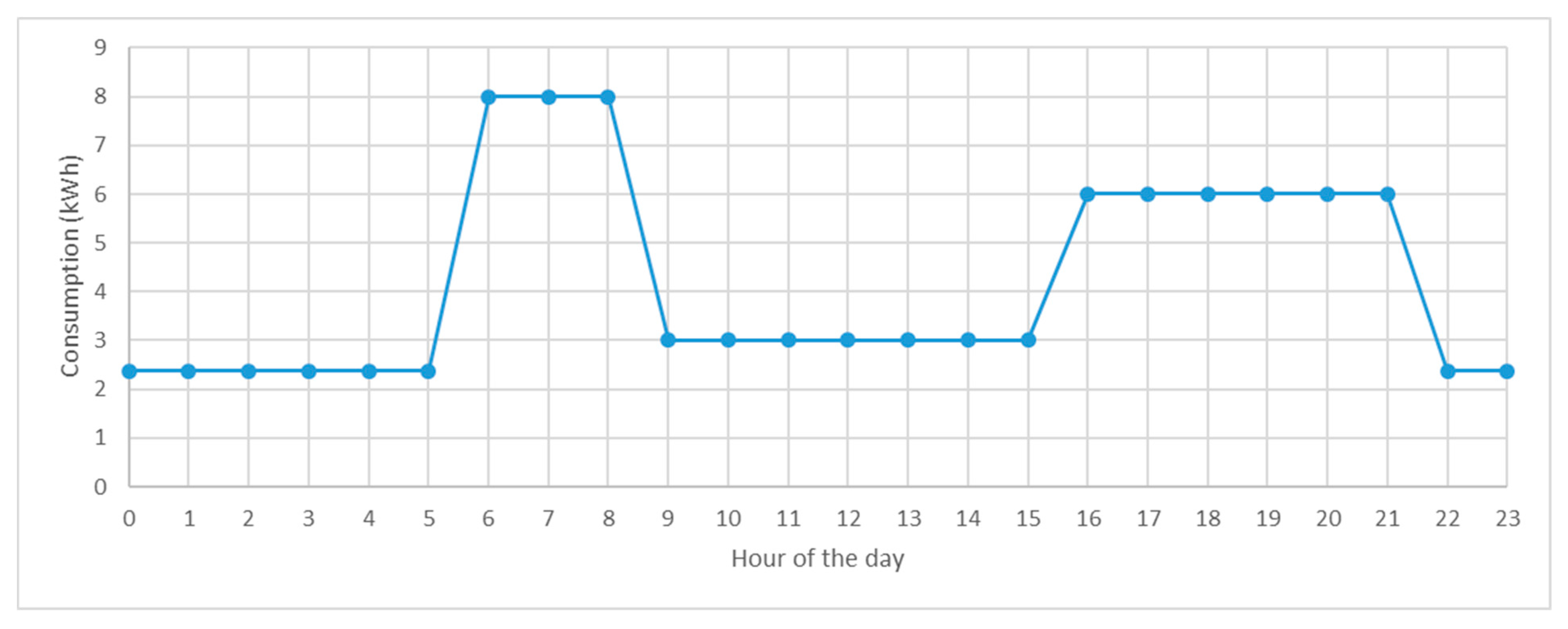
Averaged data for daily house consumption is based on the assumption of power usage:
Hour 0–5 account for 14.25% of the total energy consumption;
Hour 6–8 account for 24% of the total energy consumption;
Hour 9–15 account for 21% of the total energy consumption;
Hour 16–21 account for 36% of the total energy consumption;
Hour 22–23 account for 4.75% of the total energy consumption.
Daily averaged house energy consumption is shown in
Figure 1 below:
To improve interpretability, the optimisation model can be understood intuitively as a cost-minimisation scheduling problem. At each time step, the model decides when household appliances should operate and whether the energy storage system should charge or discharge. These decisions are made based on electricity price signals and system constraints. The objective function calculates the total electricity cost by multiplying the amount of energy consumed or supplied at each time interval by the corresponding electricity price. The constraints ensure that appliance operation follows user-defined schedules, that the total household power demand does not exceed the connection limit, and that the battery operates within its technical limits, including capacity and charge/discharge rates. In essence, the model shifts energy consumption to low-price periods and uses stored energy during high-price periods, while respecting all operational constraints.
2.2. Constraint Satisfaction Problem Optimisation Using OR-Tools
The defined optimisation problem is well-suited to constraint programming techniques and can be reformulated as a constraint satisfaction problem. We used an OR-Tools software suite ver. 9.14 for analysing the problem, in particular the CP-SAT solver [
13].
The open-source software suite OR-Tools, developed by Google’s Operations Research team, provides a collection of solvers designed to address a wide range of optimisation problems. One of these solvers is the aforementioned CP-SAT, which leverages satisfiability-based methods to solve constraint programming problems [
14]. The CP-SAT solver can be applied in many industries and for solving different scheduling problems. Ref. [
15] introduced PyJobShop, a Python library integrating OR-Tools’ CP-SAT for a variety of scheduling problems, such as flexible job shops and resource-constrained project scheduling. CP-SAT even can be used within a hybrid algorithm to solve satellite observation and download scheduling subproblems. The study shows that embedding CP-SAT in the solver improves solution quality for large constellations [
16]. Researchers applied CP-SAT to a variant of shortest path problems with arc conflict penalties [
17]. Authors if this research also applied CP-SAT for hydrogen production scheduling optimisation [
18].
In constraint programming, constraints are used to model relationships among the variables of a problem. They can be broadly classified into two categories: hard constraints and soft constraints. Hard constraints represent mandatory requirements, such as domain restrictions and precedence relationships. Soft constraints, by contrast, capture preferences, including resource utilisation preferences, cost-related conditions, and flexibility considerations.
The model and further calculations were implemented using Python 3.12 and corresponding interface for the OR-Tools library v9.15; specifically, we used CpModel and CpSolver from the ortools.sat.python.cp_model package.
The selected parameters are our assumptions and not related to any specific devices.
3. Results and Discussion
The following section describes calculations and experiments with the CP-SAT model and corresponding results. All optimisations were performed for a 36 h time horizon with time resolution of 15 min. All figures were produced by the same Python script used to define and run the developed model.
Authors defined five scenarios for the optimisation problem.
Scheduling of the residential household appliances only;
Scheduling of the ESS only;
Scheduling of the ESS based on the averaged daily residential electricity consumption;
Combination of household appliances and energy storage system;
Modelling of multiple subsequent days.
(1) Home appliances only optimisation
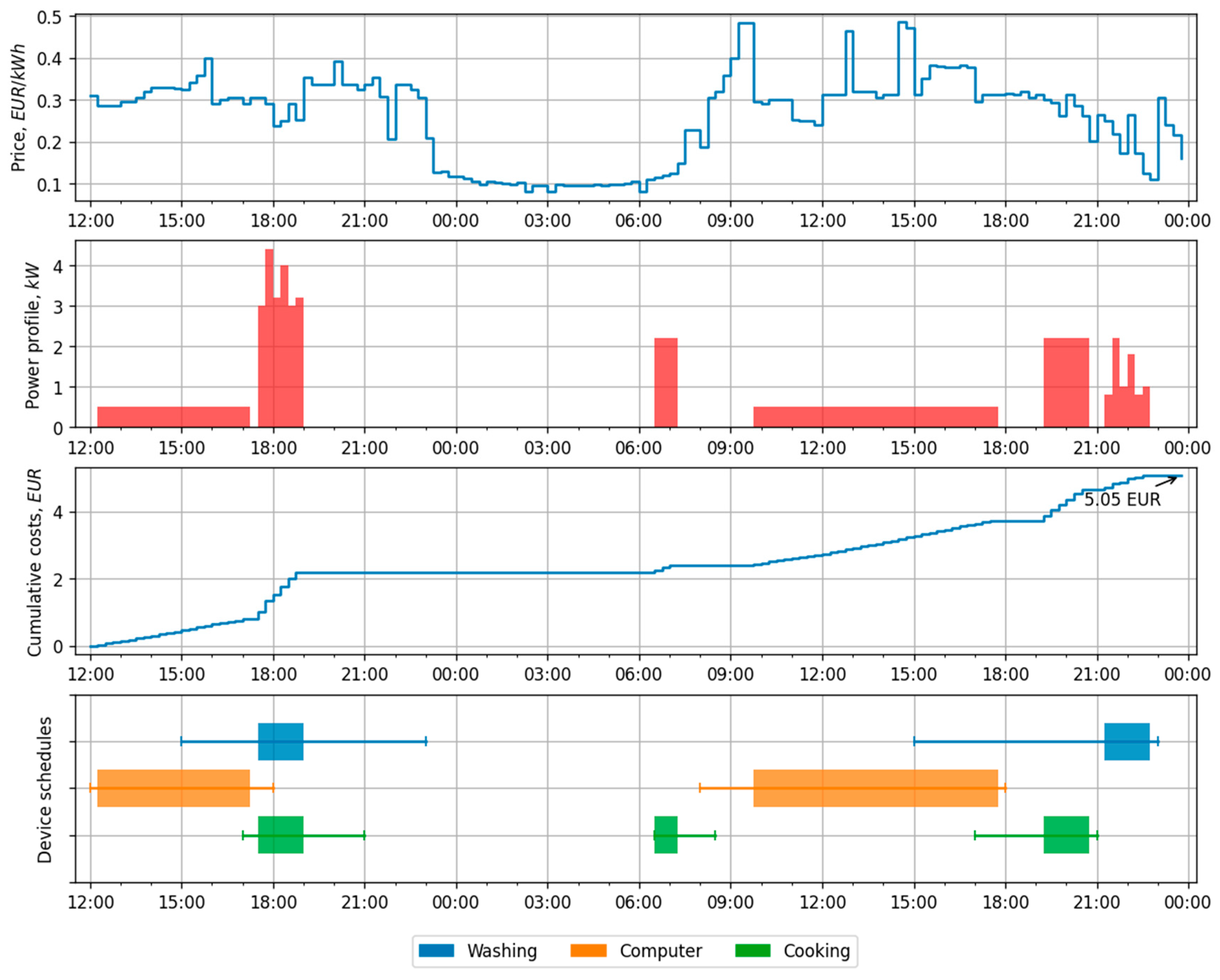
Figure 2 shows the results of CP-SAT optimisation for household appliance scheduling under time-varying electricity prices. It is structured into three aligned panels over a 36 h horizon. The top panel shows the market electricity price in EUR/kWh for a time horizon from 12 January 2026 12:00 to 14 January 2026 00:00. Prices are relatively low during the night and early morning hours, increase sharply in the morning, remain moderately high with fluctuations throughout the daytime, and peak again in the late afternoon and early evening before declining toward the end of the day. These prices are the basis for the optimisation problem.
The second panel depicts the summarised household power demand resulting from the CP-SAT schedule. As a result, higher consumption appears during periods when prices are relatively low or moderate, while consumption is reduced or completely absent during peak price intervals. This demonstrates effective load shifting and cost-aware coordination of appliances. The third panel shows cumulative costs in EUR.
The bottom panel visualises the operating intervals of individual appliances using horizontal bars. For the model, three devices are modelled. Potential time windows for the device usage are defined by the user (house resident).
(2) ESS only scheduling
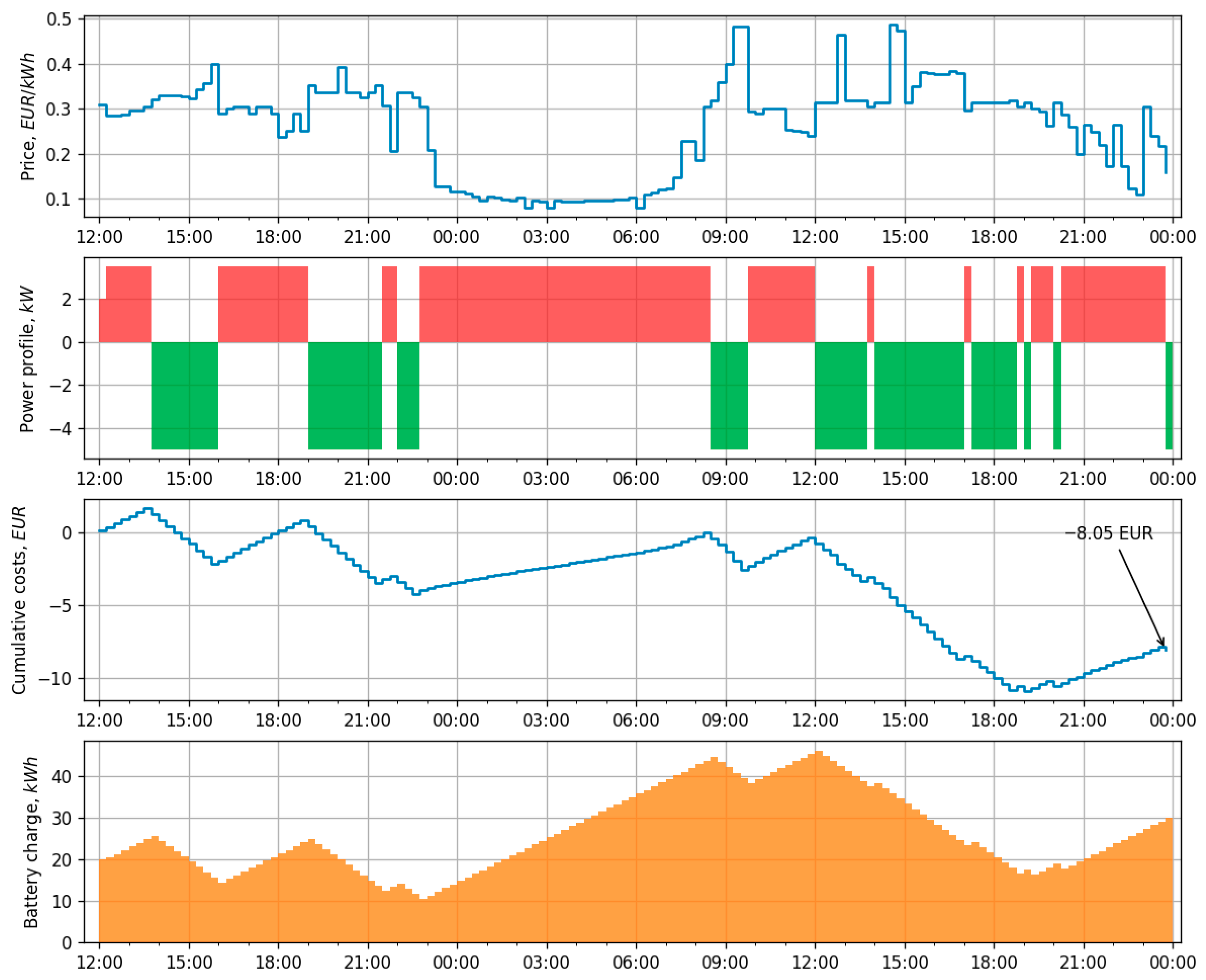
Figure 3 presents the outcome of a CP-SAT optimisation applied only to schedule charge and discharge the energy supply system (battery) under time-varying electricity prices. It is structured into four aligned panels over a 36 h horizon. The top panel shows the same market electricity price in EUR/kWh for a selected time horizon. The second panel shows battery power in/out in kW, where red is for charging and green is for discharging. The authors did not account for the battery degradation and considered that the battery can be switched on/off within 15 min intervals. In case there is a specific battery with different constraints, it could be incorporated in the model too. The third panel shows cumulative profit in EUR, showing the potential of earning during a day, while using the ESS alone. The bottom panel illustrates battery state of charge (SOC) in kWh, rising during cheap periods (e.g., early morning) and falling at high-price intervals like midday and evening.
(3) Scheduling of the ESS based on the average daily residential electricity consumption
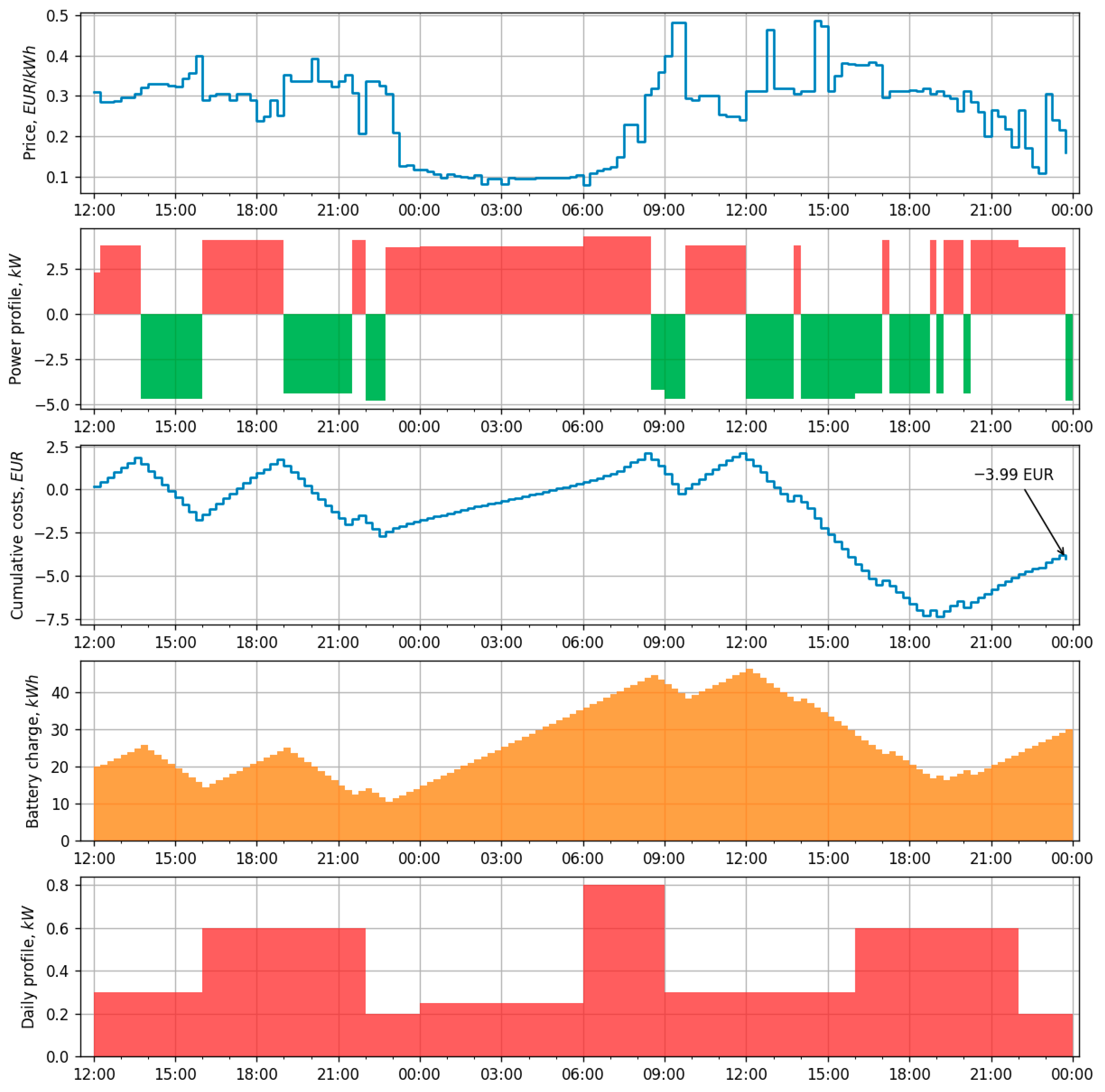
Figure 4 presents the outcome of a CP-SAT optimisation applied to schedule charge and discharge the energy supply system (battery) under time-varying electricity prices together with averaged daily residential electricity consumption. It is structured into five aligned panels over a 36 h horizon. The top panel shows the same market electricity price in EUR/kWh for a selected time horizon. The second panel shows battery power in/out in kW, where red is for charging and green is for discharging. The third panel shows cumulative profit in EUR. The fourth panel illustrates battery state of charge (SOC) in kWh. And the bottom panel demonstrates the residential electricity consumption profile.
(4) Combination of appliances and an energy storage system
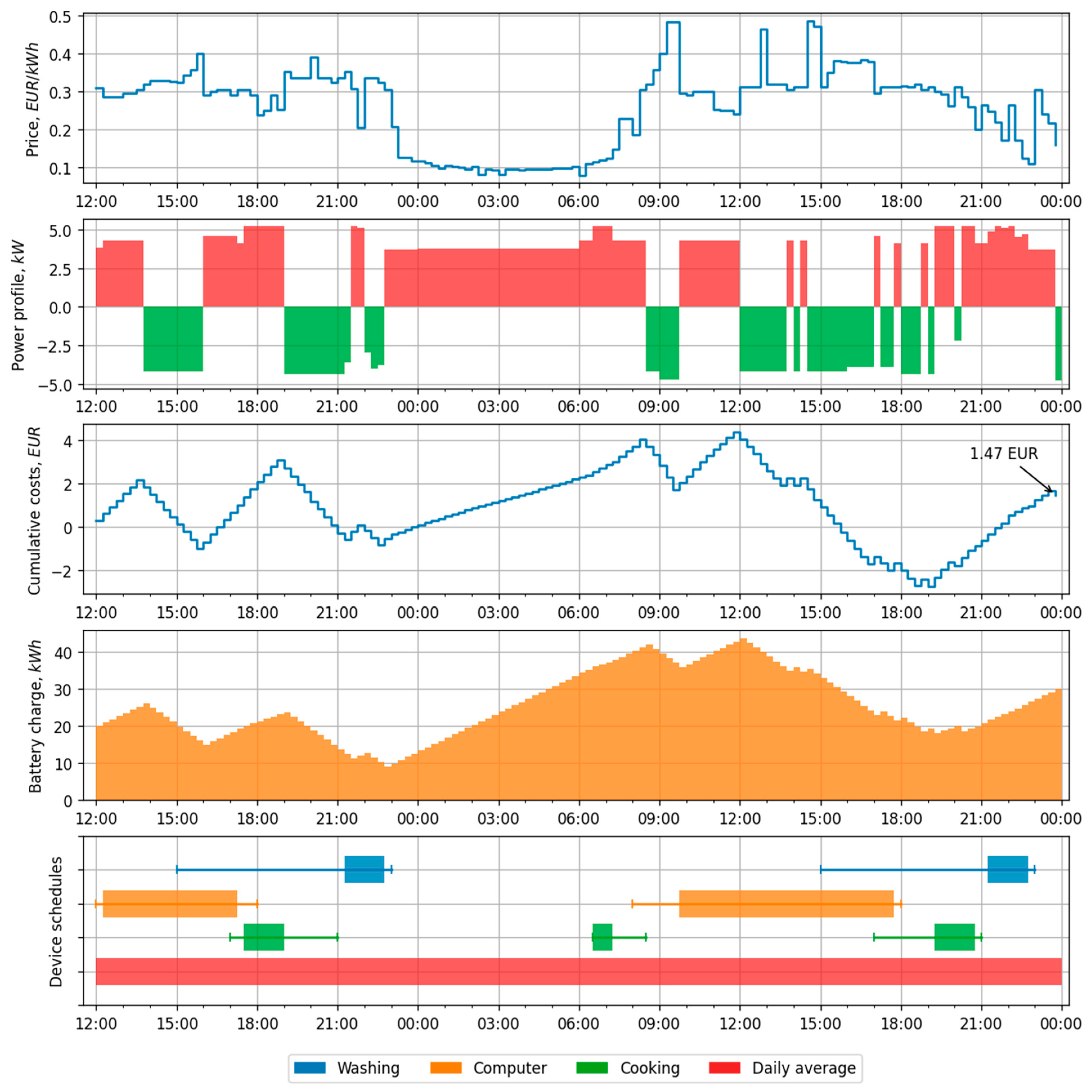
Figure 5 presents the main outcome of a CP-SAT optimisation applied to residential energy bill minimization under time-varying electricity prices. It is structured into five aligned panels over a 36 h horizon, combining panels from
Figure 2 and
Figure 4.
The fourth panel shows cumulative profit in EUR, showing a potential of earning during a day, while scheduling the household appliances and using the ESS.
(5) Modelling of multiple subsequent days
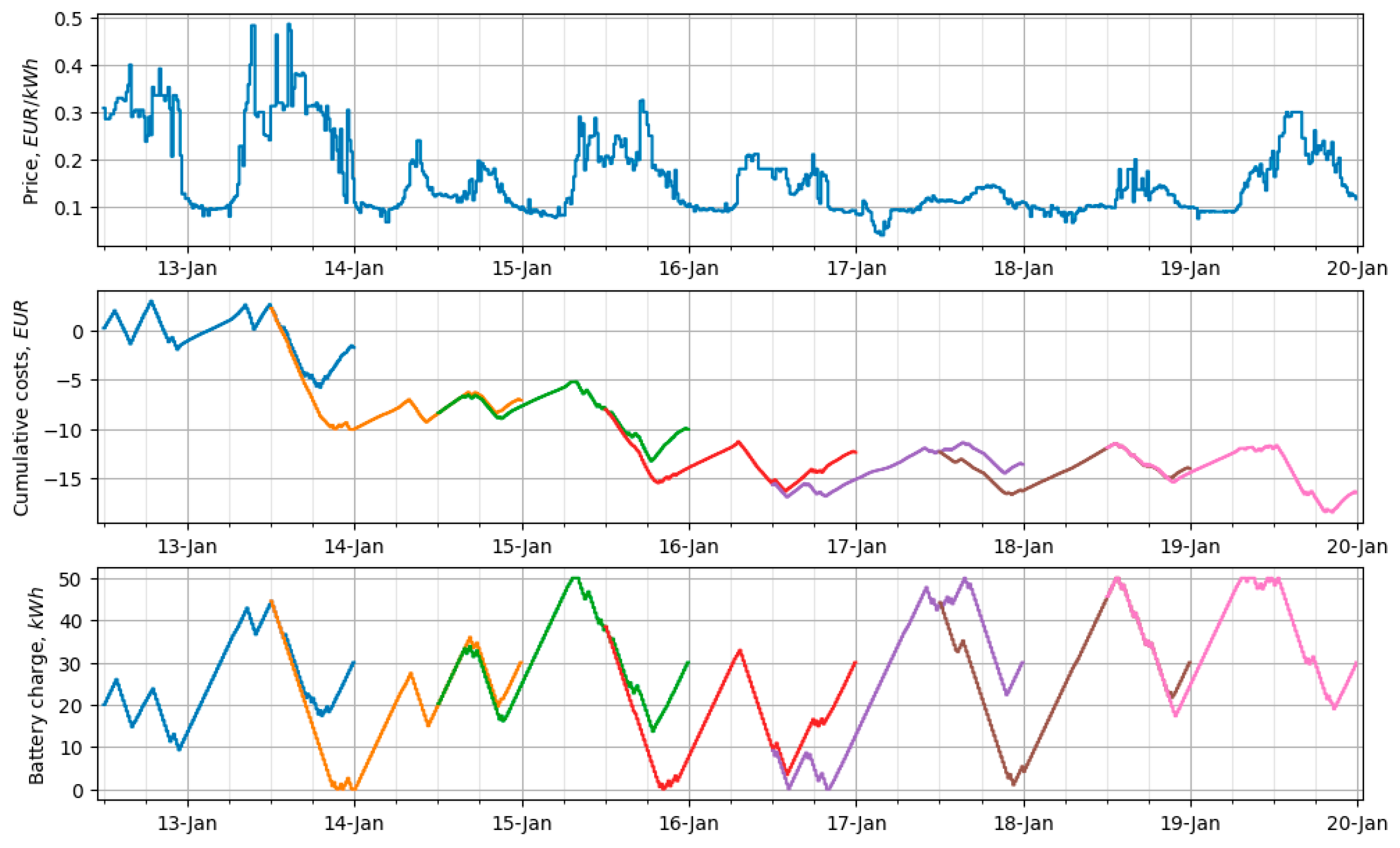
Figure 6 illustrates the operation of an ESS under a rolling day-ahead optimisation framework, where battery charge and discharge schedules are repeatedly recalculated as new day-ahead electricity prices become available. The scheduling horizon advances daily, enabling adaptive ESS operation in response to evolving market conditions.
The top panel shows the day-ahead electricity price profile over a multi-day period, expressed in EUR/kWh. The price signal exhibits significant temporal variability, with distinct low-price and high-price intervals that provide opportunities for cost-optimal energy arbitrage using the ESS.
The middle panel presents the cumulative electricity cost resulting from ESS operation and scheduling modelling. Each coloured segment corresponds to a single day-ahead optimisation run, starting at the time when new price information becomes available. The piecewise nature of the curves reflects the receding-horizon control strategy: the optimisation is solved for the upcoming day, implemented for one day, and then re-optimised as updated price forecasts are received.
The bottom panel depicts the battery state of charge (SOC) over time. The ESS is charged during low-price periods and discharged when prices are high, subject to storage capacity and operational constraints. Discontinuities in colour between consecutive days indicate re-optimisation boundaries, where updated day-ahead prices may alter the planned charging and discharging trajectory. Despite these recalculations, SOC continuity is maintained across days, ensuring physically consistent battery operation.
Overall, the figure demonstrates the effectiveness of rolling day-ahead optimisation for ESS scheduling. By continuously updating the battery control strategy based on newly available price information, the proposed approach achieves adaptive cost minimisation while respecting ESS operational limits and maintaining inter-day consistency.
Table 2 below presents a comparison of daily economic benefits obtained before and after applying rolling re-optimisation of the HEMS model over a multi-day horizon. The “before” values correspond to the initial optimisation based on previously available day-ahead prices, while the “after” values reflect updated results following daily recalculation using newly available price information.
The results indicate that rolling optimisation consistently improves or maintains the economic performance of the system. On 14 January 2026, a substantial improvement is observed, with the benefit increasing from −1.72 EUR to −10.02 EUR, demonstrating the significant impact of updated price information on scheduling decisions. For the remaining days, the improvements are more moderate but still positive, with daily benefit increases ranging from approximately 0.4 EUR to 3.97 EUR. The largest gain is observed on 16 January 2026, where the benefit improves by 3.97 EUR, highlighting the sensitivity of the optimisation outcome to variations in electricity price profiles.
Overall, the rolling optimisation approach results in a cumulative increase in economic benefit of approximately 12.83 EUR over the analysed period. These results confirm that periodic recalculation of the scheduling strategy enables the system to adapt to updated market conditions and avoid suboptimal decisions associated with fixed-horizon optimisation. The findings demonstrate that rolling optimisation provides a measurable economic advantage, particularly in scenarios with high variability in day-ahead electricity prices.
Table 3 below summarises economic outcomes across analysed scenarios.
As a baseline, a scenario was defined in which daily average consumption is considered without the use of an ESS or optimisation. Under these conditions, the total electricity cost amounts to 4.06 EUR.
Scenario #1 results in a total cost of 5.05 EUR, indicating that electricity was primarily purchased from the grid without significant cost offsets from optimisation strategies. In contrast, scenarios #2, #3 yield negative total costs of −8.05 EUR, −3.99 EUR, respectively. Negative values indicate that the optimisation strategy enables net economic benefit, likely due to effective utilisation of the ESS and scheduling of household loads in response to day-ahead electricity prices, allowing electricity to be stored during low-price periods and discharged or exported during high-price intervals.
Among the evaluated scenarios, scenario #2 achieves the most favourable economic outcome, resulting in the lowest cost (highest net benefit). It can be explained by the fact, that only ESS is considered in that scenario without house appliances. These results highlight the potential impact of different scheduling strategies and system configurations on the economic performance of the home energy management system.
In comparison to the baseline, it can be observed that all scenarios (except #1) provide economic benefits.
The column “Model computation time (s)” presents the runtime required to solve each optimisation scenario. The baseline scenario is marked as N/A, as it does not involve any optimisation procedure. For the remaining scenarios, the computation time varies between 0.13 s and 9.26 s, indicating that the proposed CP-SAT-based model achieves solutions within a very short time frame. Scenarios #1, #2, and #3 exhibit particularly low computation times of 1.99 s, 0.13 s, and 0.15 s, respectively, demonstrating the efficiency of the model when applied to individual components or simplified configurations. The longest computation time is observed in Scenario #4 (9.26 s), which corresponds to overall cost-optimal scheduling of energy consumption for the residents, including ESS, house appliances and daily averaged consumption.
The proposed optimisation model is designed to be flexible and easily adaptable to different residential configurations, user preferences, and energy system setups. This flexibility is achieved through a parameterised structure, where key components of the model, such as appliance characteristics, ESS parameters, and system constraints can be modified without altering the core optimisation framework.
The model allows for straightforward parameterisation of household appliances. Each device is defined by its power profile, duration, and admissible operating time window, enabling the representation of a wide range of appliance types, including shiftable, non-interruptible, and interruptible loads. This structure allows users to tailor the model to specific household behaviour patterns and incorporate additional devices with minimal modifications. Similarly, the ESS is modelled using configurable parameters, including storage capacity, initial state of charge, charge/discharge power limits, and optional end-of-horizon constraints. These parameters can be adjusted to represent different battery technologies and sizes, making the model applicable to various residential energy storage configurations.
The optimisation framework is also adaptable to different market conditions. While the current implementation is based on day-ahead electricity prices with a fixed time resolution, the model can be extended to incorporate other pricing schemes. Additionally, the time discretisation can be modified (e.g., from 15 min to hourly intervals) without changing the underlying model structure.
The proposed optimisation model focuses on short-term operational scheduling and therefore does not explicitly incorporate maintenance-related costs such as battery degradation due to cycling or efficiency losses associated with charge–discharge processes. The results presented in this study should therefore be interpreted as representing an upper-bound estimate of achievable economic benefits. In real-world deployments, the actual economic gains may be slightly reduced depending on the battery technology, round-trip efficiency, and cycling frequency. The proposed model is most applicable to scenarios where battery degradation costs are either small relative to electricity price differences or are treated separately through system-level lifecycle analysis.
While many previous studies on home energy management systems employ mixed-integer linear programming formulations [
19,
20,
21], the present work adopts the constraint programming satisfiability (CP-SAT) solver implemented in Google OR-Tools. The motivation for selecting CP-SAT lies in its ability to efficiently handle combinatorial scheduling structures that arise naturally in residential load management problems. In particular, appliance scheduling with predefined operation profiles, non-interruptible tasks, discrete start times, and mutually exclusive device states leads to highly combinatorial decision spaces that can be cumbersome to represent and solve efficiently using traditional MILP formulations. CP-SAT combines techniques from constraint programming, Boolean satisfiability (SAT), and integer linear programming, enabling strong propagation of logical constraints and effective search strategies for discrete optimisation problems. This hybrid architecture makes CP-SAT particularly suitable for modelling scheduling problems with complex logical relationships, such as appliance start-time constraints, battery charge/discharge exclusivity, and device operation windows, which are central to the proposed HEMS formulation. Moreover, CP-SAT operates on integer variables and Boolean constraints without requiring linear relaxations, which simplifies modelling and often leads to competitive or superior performance in large-scale combinatorial optimisation tasks. Although a full computational benchmarking against MILP approaches is beyond the scope of the present study, the use of CP-SAT demonstrates a flexible and scalable alternative framework for residential energy scheduling problems. The presented formulation highlights how constraint programming techniques can naturally represent device scheduling constraints and may therefore provide advantages for extending HEMS models to include additional discrete operational constraints, such as user preferences, appliance dependencies, or multi-device coordination.
The observed computation times are comparable to those reported in MILP-based HEMS optimisation studies, where solution times typically range from seconds to minutes depending on problem size and formulation complexity. This suggests that the proposed CP-SAT approach achieves competitive computational efficiency while providing additional advantages in modelling discrete and combinatorial scheduling constraints [
22].
4. Conclusions
This scientific research presented a home energy management system (HEMS) optimisation framework that exploits day-ahead electricity price signals to minimise daily household electricity costs. The proposed model jointly schedules the operation of household appliances and the charge–discharge behaviour of an ESS while respecting appliance-specific constraints, user-defined operating time windows, and ESS operational limits. By formulating the scheduling task as a combinatorial optimisation problem, the approach enables flexible and cost-effective coordination of residential energy consumption.
The results demonstrate that cost savings can be achieved through load shifting and coordinated ESS operation. High-consumption appliances are systematically scheduled during low-price periods, while the ESS effectively mitigates exposure to peak prices by storing energy when prices are low and discharging during expensive intervals. The results confirm that even under realistic constraints and fine-grained time resolution, day-ahead price-based scheduling can substantially improve household energy cost efficiency.
From a practical perspective, the proposed framework is compatible with existing smart metering infrastructure and current electricity market mechanisms. The use of day-ahead prices makes the approach particularly relevant for residential consumers participating in dynamic pricing schemes, offering a transparent and implementable pathway toward demand-side flexibility.
The results quantitatively demonstrate that rolling optimisation improves economic performance by dynamically adapting to updated price signals, yielding a cumulative benefit increase of approximately 12.83 EUR over the analysed period.
The modular and parameter-driven design of the proposed CP-SAT-based optimisation model enables its application to a wide range of residential energy management scenarios. This flexibility supports future extensions of the model and facilitates its integration into more complex smart grid environments.
All optimisation scenarios are solved within seconds, demonstrating the practical applicability of the proposed CP-SAT model for real-time or near real-time HEMS scheduling.
Despite these advantages, the model adopts several simplifying assumptions. In particular, battery degradation effects and switching-related wear are not explicitly considered. Battery efficiency, degradation cost, cycling limits, and switching constraints are not considered within this research. Because of these assumptions, the reported economic benefits, especially in the ESS-only scenario may be highly optimistic. Addressing these limitations represents an important direction for future research.
In addition, PV panels could be modelled as devices with negative power profiles. In any case, the total power profile is the most important parameter, and solar panels provide “free” energy.



 ,
,