A Well-to-Wheel Comparative Life Cycle Assessment (LCA) of First- and Second-Generation Bioethanol as Alternatives to Gasoline in Motorsport Races

 , , , ,
  and
and
Abstract
1. Introduction
2. Materials and Methods
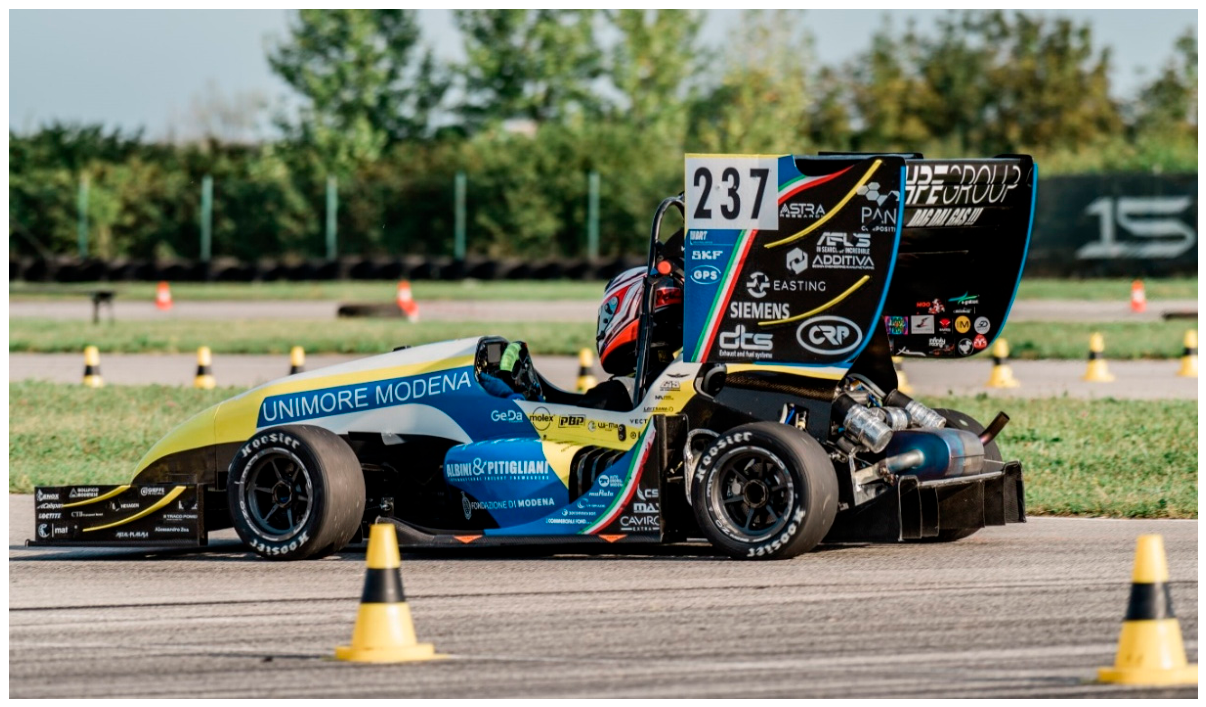
2.1. The Case Study
2.2. The Scope, Functional Units and System Boundaries
- Feedstock procurement, which involves crude oil extraction for gasoline, biomass cultivation for 1G-pure bioethanol, and wine waste collection for 2G-pure bioethanol.
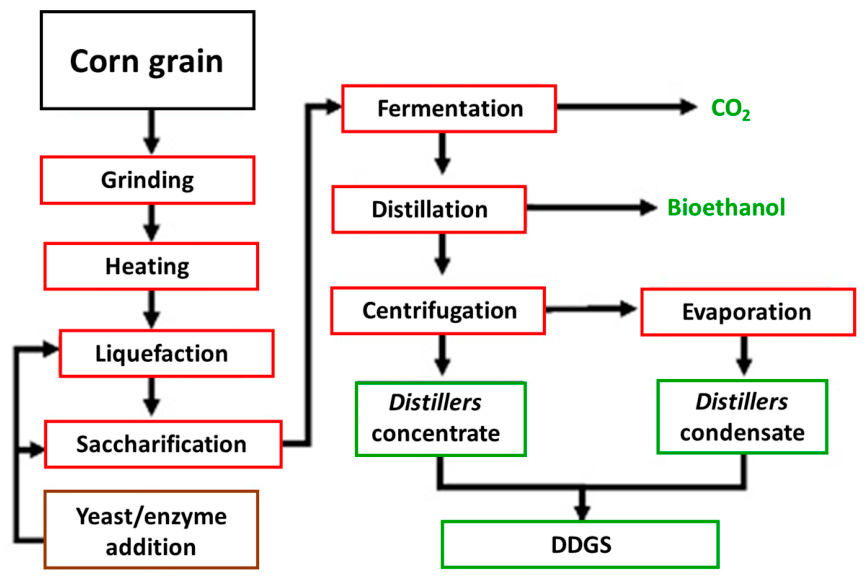
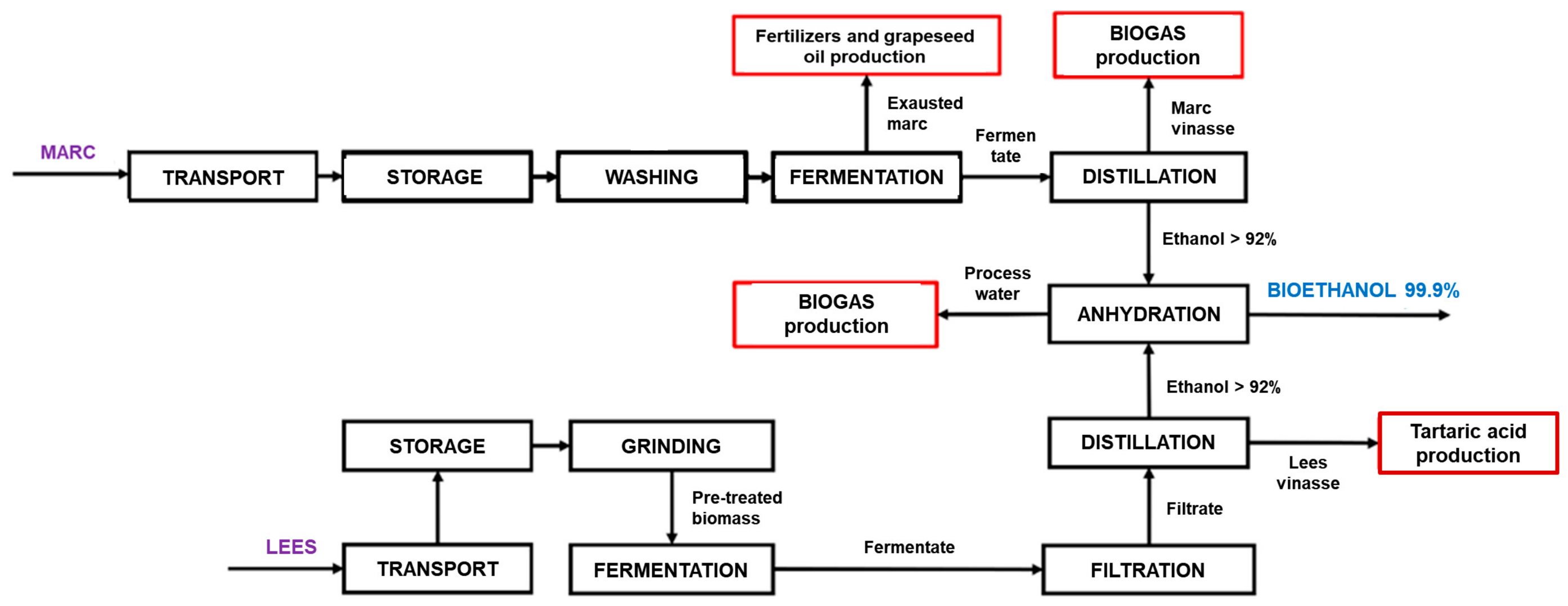
- Fuel production, encompassing the refining process and blending additives for gasoline; for 1G-pure bioethanol, this includes fermentation, distillation, and anhydrification; and for 2G-purebioethanol, this involves the collection and transportation of grape pomace, physical pretreatments (i.e., washing), enzymatic hydrolysis, fermentation, distillation, and anhydrification (see Figure 2 and Figure 3).
- Race emissions generated from fuel combustion during the 22 km race by the MMR vehicle.
- For 1G-pure bioethanol, the transportation of raw materials from fields to the plant and of bioethanol from the plant to Italy, due to the unavailability of detailed data.
- MMR vehicle production, as it is assumed that the same vehicle is used for all three fuels, thereby nullifying its impact in comparison.
- The construction and maintenance of infrastructure (i.e., energy, refineries, bioethanol infrastructures, roads), owing to the difficulty of accurately allocating these impacts to individual fuels and the lack of specific data.
- The end-of-life of fuels, assuming their complete combustion during the race.
2.3. Life Cycle Inventories
2.3.1. Production of 2G Bioethanol from Grape Pomace: Primary Data
2.3.2. Production of 1G-Pure Bioethanol and Fossil Gasoline: Secondary Data
2.3.3. Life Cycle Impact Assessment
2.3.4. Uncertainty Analysis
3. Results and Discussion
3.1. Well-to-Tank (WTT) Assessment
3.2. Tank-to-Wheel (TTW) Assessment
4. Conclusions
Author Contributions
Funding
Data Availability Statement
Conflicts of Interest
References
- Winkler, L.; Pearce, D.; Nelson, J.; Babacan, O. The Effect of Sustainable Mobility Transition Policies on Cumulative Urban Transport Emissions and Energy Demand. Nat. Commun. 2023, 14, 2357. [Google Scholar] [CrossRef] [Scilit]
- Sileo, A.; Bonacina, M. Why the EU risks missing its 2050 carbon neutrality target by focusing only on new (electric) car sales. Econ. Policy Energy Environ. 2024, 2024, 97–114. [Google Scholar] [CrossRef] [Scilit]
- European Environment Agency (EEA). Sustainability of Europe’s Mobility Systems 2025. Available online: https://www.eea.europa.eu/en/analysis/publications/sustainability-of-europes-mobility-systems-2025?utm_source=chatgpt.com (accessed on 31 March 2026).
- Perez-Bravo, M.; Linares, P.; Rodriguez-Matas, A.F.; Romero, J.C. Modeling the Decarbonization of Transport: The Relevance of Disaggregating Transport Demand. Int. J. Sustain. Transp. 2025, 20, 496–512. [Google Scholar] [CrossRef] [Scilit]
- Yadav, V.G.; Yadav, G.D.; Patankar, S.C. The Production of Fuels and Chemicals in the New World: Critical Analysis of the Choice between Crude Oil and Biomass Vis-à-Vis Sustainability and the Environment. Clean Technol. Environ. Policy 2020, 22, 1757–1774. [Google Scholar] [CrossRef] [Scilit]
- Patidar, A.K.; Jain, P.; Dhasmana, P.; Choudhury, T. Impact of Global Events on Crude Oil Economy: A Comprehensive Review of the Geopolitics of Energy and Economic Polarization. GeoJournal 2024, 89, 50. [Google Scholar] [CrossRef] [Scilit]
- Bouter, A.; Hurtig, O.; Besseau, R.; Buffi, M.; Kulisic, B.; Scarlat, N. Updating the Greenhouse Gas Emissions of Liquid Biofuels from Annex V of the Renewable Energy Directive II (RED II): An Overview. Biomass Bioenergy 2025, 199, 107886. [Google Scholar] [CrossRef] [Scilit]
- Banerjee, N. Biomass to Energy—An Analysis of Current Technologies, Prospects, and Challenges. Bioenerg. Res. 2023, 16, 683–716. [Google Scholar] [CrossRef] [Scilit]
- Duarah, P.; Haldar, D.; Patel, A.K.; Dong, C.-D.; Singhania, R.R.; Purkait, M.K. A Review on Global Perspectives of Sustainable Development in Bioenergy Generation. Bioresour. Technol. 2022, 348, 126791. [Google Scholar] [CrossRef] [Scilit]
- Hoang, A.T.; Sirohi, R.; Pandey, A.; Nižetić, S.; Lam, S.S.; Chen, W.-H.; Luque, R.; Thomas, S.; Arıcı, M.; Pham, V.V. Biofuel Production from Microalgae: Challenges and Chances. Phytochem. Rev. 2023, 22, 1089–1126. [Google Scholar] [CrossRef] [Scilit]
- Krishna, K.V.; Bhavana, S.; Koujalagi, K.; Malaviya, A. Biofuels From Bio-Waste and Biomass. In Biomass and Bioenergy Solutions for Climate Change Mitigation and Sustainability; IGI Global Scientific Publishing: Hershey, PA, USA, 2023; pp. 75–118. ISBN 978-1-6684-5269-1. [Google Scholar]
- Shubhnam; Garg, D. Renewable Energy Policies and Their Impact on Biofuel Development. In Biowaste to Biofuel; CRC Press: Boca Raton, FL, USA, 2025. [Google Scholar]
- Liang, K. Second-Generation Biofuels: Utilization of Agricultural Waste and Non-Food Parts. J. Energy Biosci. 2024, 15, 277–288. [Google Scholar] [CrossRef] [Scilit]
- Karimi, M.; Simsek, H.; Kheiralipour, K. Advanced Biofuel Production: A Comprehensive Techno-Economic Review of Pathways and Costs. Energy Convers. Manag. X 2025, 25, 100863. [Google Scholar] [CrossRef] [Scilit]
- Wang, M.; Ye, X.; Bi, H.; Shen, Z. Microalgae Biofuels: Illuminating the Path to a Sustainable Future amidst Challenges and Opportunities. Biotechnol. Biofuels 2024, 17, 10. [Google Scholar] [CrossRef] [Scilit] [PubMed]
- Zhang, J.; Rentizelas, A.; Zhang, X.; Li, J. Sustainable Production of Lignocellulosic Bioethanol towards Zero Waste Biorefinery. Sustain. Energy Technol. Assess. 2022, 53, 102627. [Google Scholar] [CrossRef] [Scilit]
- Hassan, G.; Shabbir, M.A.; Ahmad, F.; Pasha, I.; Aslam, N.; Ahmad, T.; Rehman, A.; Manzoor, M.F.; Inam-Ur-Raheem, M.; Aadil, R.M. Cereal Processing Waste, an Environmental Impact and Value Addition Perspectives: A Comprehensive Treatise. Food Chem. 2021, 363, 130352. [Google Scholar] [CrossRef] [Scilit]
- Ahmad, A.; Naqvi, S.A.; Jaskani, M.J.; Waseem, M.; Ali, E.; Khan, I.A.; Faisal Manzoor, M.; Siddeeg, A.; Aadil, R.M. Efficient Utilization of Date Palm Waste for the Bioethanol Production through Saccharomyces Cerevisiae Strain. Food Sci. Nutr. 2021, 9, 2066–2074. [Google Scholar] [CrossRef] [Scilit]
- Pan, S.; Zabed, H.M.; Wei, Y.; Qi, X. Technoeconomic and Environmental Perspectives of Biofuel Production from Sugarcane Bagasse: Current Status, Challenges and Future Outlook. Ind. Crops Prod. 2022, 188, 115684. [Google Scholar] [CrossRef] [Scilit]
- Nazar, M.; Xu, Q.; Zahoor; Ullah, M.W.; Khan, N.A.; Iqbal, B.; Zhu, D. Integrated Laccase Delignification with Improved Lignocellulose Recalcitrance for Enhancing Enzymatic Saccharification of Ensiled Rice Straw. Ind. Crops Prod. 2023, 202, 116987. [Google Scholar] [CrossRef] [Scilit]
- Tse, T.J.; Wiens, D.J.; Reaney, M.J.T. Production of Bioethanol—A Review of Factors Affecting Ethanol Yield. Fermentation 2021, 7, 268. [Google Scholar] [CrossRef] [Scilit]
- Zhou, Z.; Liu, D.; Zhao, X. Conversion of Lignocellulose to Biofuels and Chemicals via Sugar Platform: An Updated Review on Chemistry and Mechanisms of Acid Hydrolysis of Lignocellulose. Renew. Sustain. Energy Rev. 2021, 146, 111169. [Google Scholar] [CrossRef] [Scilit]
- Wang, C.; He, G.; Meng, J.; Wang, S.; Kong, Y.; Jiang, J.; Hu, R.; Zhou, G. Improved Lignocellulose Saccharification of a Miscanthus Reddish Stem Mutant Induced by Heavy-Ion Irradiation. GCB Bioenergy 2020, 12, 1066–1077. [Google Scholar] [CrossRef] [Scilit]
- Liu, Y.; Ding, Y.; Li, Y.; Wang, X.; Sun, Y.; Chen, C. A Comprehensive Review of Recent Advances in Delignification Technology. J. Text. Inst. 2024, 115, 2489–2504. [Google Scholar] [CrossRef] [Scilit]
- Vaidya, A.A.; Murton, K.D.; Smith, D.A.; Dedual, G. A Review on Organosolv Pretreatment of Softwood with a Focus on Enzymatic Hydrolysis of Cellulose. Biomass Conv. Biorefin. 2022, 12, 5427–5442. [Google Scholar] [CrossRef] [Scilit]
- Zabed, H.M.; Akter, S.; Tian, Y.; Dar, M.A.; Yun, J.; Zhao, M.; Ragauskas, A.J.; Li, J.; Qi, X. Assessing Microbial Systems and Process Configurations for Improved Ethanol Production from Sugary Stovers by Integrating Soluble Sugars and Holocellulose. Ind. Crops Prod. 2024, 212, 118269. [Google Scholar] [CrossRef] [Scilit]
- Dvorak, Z.; Rehak, D.; David, A.; Cekerevac, Z. Qualitative Approach to Environmental Risk Assessment in Transport. Int. J. Environ. Res. Public Health 2020, 17, 5494. [Google Scholar] [CrossRef] [Scilit]
- Elgowainy, A.; Wang, M.; Reddi, K. Sustainable Vehicle Fuels, Well-to-Wheel Analysis. In Electric, Hybrid, and Fuel Cell Vehicles; Elgowainy, A., Ed.; Springer: New York, NY, USA, 2021; pp. 225–252. ISBN 978-1-0716-1492-1. [Google Scholar]
- Pieragostini, C.; Mussati, M.C.; Aguirre, P. On Process Optimization Considering LCA Methodology. J. Environ. Manag. 2012, 96, 43–54. [Google Scholar] [CrossRef] [Scilit]
- Baldelli, M.; Bartolucci, L.; Cordiner, S.; De Maina, E.; Mulone, V. Toward Carbon Neutral Fuels: Process Analysis of Integrated Biomass Conversion Routes for Sustainable Biofuels Production. Energy 2025, 324, 136077. [Google Scholar] [CrossRef] [Scilit]
- Lombardi, S.; Tribioli, L.; Guandalini, G.; Iora, P. Energy Performance and Well-to-Wheel Analysis of Different Powertrain Solutions for Freight Transportation. Int. J. Hydrogen Energy 2020, 45, 12535–12554. [Google Scholar] [CrossRef] [Scilit]
- Ilyas, T.; Chowdhary, P.; Chaurasia, D.; Gnansounou, E.; Pandey, A.; Chaturvedi, P. Sustainable Green Processing of Grape Pomace for the Production of Value-Added Products: An Overview. Environ. Technol. Innov. 2021, 23, 101592. [Google Scholar] [CrossRef] [Scilit]
- Chowdhary, P.; Gupta, A.; Gnansounou, E.; Pandey, A.; Chaturvedi, P. Current Trends and Possibilities for Exploitation of Grape Pomace as a Potential Source for Value Addition. Environ. Pollut. 2021, 278, 116796. [Google Scholar] [CrossRef] [Scilit]
- Alessa, R.; Almunefi, S.; Alnajdi, N. Comparative Life Cycle Assessment on Fuel Types for a Formula 1 Engine in Belgian Grand Prix. J. Eng. Res. 2024, 13, 1820–1825. [Google Scholar] [CrossRef] [Scilit]
- Abdelkader, G.; Elgazzar, K.; Khamis, A. Connected Vehicles: Technology Review, State of the Art, Challenges and Opportunities. Sensors 2021, 21, 7712. [Google Scholar] [CrossRef] [Scilit]
- Öztopcu, A. Environmental Sustainability in Sport: Formula 1’s SDGs Responsiveness. Environ. Dev. Sustain. 2024, 26, 31075–31097. [Google Scholar] [CrossRef] [Scilit]
- Delavarrafiee, M.; Frey, H.C. Real-World Fuel Use and Gaseous Emission Rates for Flex Fuel Vehicles Operated on E85 versus Gasoline. J. Air Waste Manag. Assoc. 2018, 68, 235–254. [Google Scholar] [CrossRef] [Scilit]
- Usman, M.R. Hydrogen Storage Methods: Review and Current Status. Renew. Sustain. Energy Rev. 2022, 167, 112743. [Google Scholar] [CrossRef] [Scilit]
- Prussi, M.; Yugo, M.; De Prada, L.; Padella, M.; Edwards, R. JEC Well-to-Wheels Report v5; EUR 30284 EN; JRC121213; Publications Office of the European Union: Luxembourg, 2020; ISBN 978-92-76-20109-0. [Google Scholar] [CrossRef]
- Wyman, C.E.; Hinman, N.D. Ethanol. Appl. Biochem. Biotechnol. 1990, 24, 735–753. [Google Scholar] [CrossRef] [Scilit]
- Kheiralla, A.F.; Tola, E.; Bakhit, J.M. Performance of Ethanol-Gasoline Blends of up to E35 as Alternative Automotive Fuels. Adv. Bioresearch 2017, 8, 130–140. [Google Scholar] [CrossRef]
- Edelen, A.; Ingwersen, W.W.; Rodríguez, C.; Alvarenga, R.A.F.; de Almeida, A.R.; Wernet, G. Critical Review of Elementary Flows in LCA Data. Int. J. Life Cycle Assess. 2018, 23, 1261–1273. [Google Scholar] [CrossRef] [Scilit]
- Reap, J.; Roman, F.; Duncan, S.; Bras, B. A Survey of Unresolved Problems in Life Cycle Assessment. Int. J. Life Cycle Assess. 2008, 13, 290–300. [Google Scholar] [CrossRef] [Scilit]
- Heijungs, R.; Lenzen, M. Error Propagation Methods for LCA—A Comparison. Int. J. Life Cycle Assess. 2014, 19, 1445–1461. [Google Scholar] [CrossRef] [Scilit]
- Maga, D.; Thonemann, N.; Hiebel, M.; Sebastião, D.; Lopes, T.F.; Fonseca, C.; Gírio, F. Comparative Life Cycle Assessment of First- and Second-Generation Ethanol from Sugarcane in Brazil. Int. J. Life Cycle Assess. 2019, 24, 266–280. [Google Scholar] [CrossRef] [Scilit]
- Ayodele, B.V.; Alsaffar, M.A.; Mustapa, S.I. An Overview of Integration Opportunities for Sustainable Bioethanol Production from First- and Second-Generation Sugar-Based Feedstocks. J. Clean. Prod. 2020, 245, 118857. [Google Scholar] [CrossRef] [Scilit]
- Wietschel, L.; Messmann, L.; Thorenz, A.; Tuma, A. Environmental Benefits of Large-Scale Second-Generation Bioethanol Production in the EU: An Integrated Supply Chain Network Optimization and Life Cycle Assessment Approach. J. Ind. Ecol. 2021, 25, 677–692. [Google Scholar] [CrossRef] [Scilit]
- Soleymani Angili, T.; Grzesik, K.; Rödl, A.; Kaltschmitt, M. Life Cycle Assessment of Bioethanol Production: A Review of Feedstock, Technology and Methodology. Energies 2021, 14, 2939. [Google Scholar] [CrossRef] [Scilit]
- Shakelly, N.; Pérez-Cardona, J.R.; Deng, S.; Maani, T.; Li, Z.; Sutherland, J.W. Comparative Life Cycle Assessment of Bioethanol Production from Different Generations of Biomass and Waste Feedstocks. Procedia CIRP 2023, 116, 630–635. [Google Scholar] [CrossRef] [Scilit]
- Cai, H.; Dunn, J.B.; Wang, Z.; Han, J.; Wang, M.Q. Life-Cycle Energy Use and Greenhouse Gas Emissions of Production of Bioethanol from Sorghum in the United States. Biotechnol. Biofuels 2013, 6, 141. [Google Scholar] [CrossRef] [Scilit]
- Contributions of Life Cycle Assessment on Cellulosic Ethanol Production from Harvest Residues: Environmental Impacts and Public Policies in Brazil. In Production of Top 12 Biochemicals Selected by USDOE from Renewable Resources; Elsevier: Amsterdam, The Netherlands, 2022; pp. 81–108.
- Delgado, R.; Paz, S. Effect of Different Ethanol-Gasoline Blends on Exhaust Emissions and Fuel Consumption; SAE International: Warrendale, PA, USA, 2012. [Google Scholar]
- Iodice, P.; Cardone, M. Ethanol/Gasoline Blends as Alternative Fuel in Last Generation Spark-Ignition Engines: A Review on CO and HC Engine Out Emissions. Energies 2021, 14, 4034. [Google Scholar] [CrossRef] [Scilit]
- Tutak, W. Bioethanol E85 as a Fuel for Dual Fuel Diesel Engine. Energy Convers. Manag. 2014, 86, 39–48. [Google Scholar] [CrossRef] [Scilit]
- Alternative Fuels Data Center: Ethanol Benefits and Considerations. Available online: https://afdc.energy.gov/fuels/ethanol-benefits (accessed on 31 March 2026).
- Gerbrandt, K.; Chu, P.L.; Simmonds, A.; Mullins, K.A.; MacLean, H.L.; Griffin, W.M.; Saville, B.A. Life Cycle Assessment of Lignocellulosic Ethanol: A Review of Key Factors and Methods Affecting Calculated GHG Emissions and Energy Use. Curr. Opin. Biotechnol. 2016, 38, 63–70. [Google Scholar] [CrossRef] [Scilit]
- Zhai, H.; Frey, H.C.; Rouphail, N.M.; Gonçalves, G.A.; Farias, T.L. Comparison of Flexible Fuel Vehicle and Life-Cycle Fuel Consumption and Emissions of Selected Pollutants and Greenhouse Gases for Ethanol 85 Versus Gasoline. J. Air Waste Manag. Assoc. 2009, 59, 912–924. [Google Scholar] [CrossRef] [Scilit]
- Hubbard, C.P.; Anderson, J.E.; Wallington, T.J. Ethanol and Air Quality: Influence of Fuel Ethanol Content on Emissions and Fuel Economy of Flexible Fuel Vehicles. Environ. Sci. Technol. 2014, 48, 861–867. [Google Scholar] [CrossRef] [Scilit]
- Yuan, W.; Frey, H.C.; Wei, T.; Rastogi, N.; VanderGriend, S.; Miller, D.; Mattison, L. Comparison of Real-World Vehicle Fuel Use and Tailpipe Emissions for Gasoline-Ethanol Fuel Blends. Fuel 2019, 249, 352–364. [Google Scholar] [CrossRef] [Scilit]
- Frey, H.C.; Unal, A.; Rouphail, N.M.; Colyar, J.D. On-Road Measurement of Vehicle Tailpipe Emissions Using a Portable Instrument. J. Air Waste Manag. Assoc. 2003, 53, 992–1002. [Google Scholar] [CrossRef] [Scilit]



| Race | Fuel Consumption (L/22 km) | ||
|---|---|---|---|
| Gasoline | E85-1G | E85-2G | |
| Croatia | 4.39 | 5.01 | 5.01 |
| Italy | 4.70 | 4.99 | 4.99 |
| Austria | 4.10 | 4.76 | 4.76 |
| Fuel | Equivalent Molecular Formula | Equivalent Molecular Weight (g/gmolC) | Weight Percent of Carbon (%) | Weight Percent of Hydrogen (%) | Weight Percent of Oxygen (%) | Density (20 °C) (kg/m3) | LHV (MJ/L) | Ref. |
|---|---|---|---|---|---|---|---|---|
| Gasoline | CH1.875 | 13.87 | 86.5 | 13.5 | 0 | 740 | 32.2 | [38,39] |
| Pure ethanol | CH3O0.5 | 23.00 | 52.2 | 13.0 | 34.8 | 780 | 21.1 | [40] |
| E85 | CH2.758O0.392 | 21.03 | 57.0 | 13.2 | 29.8 | 782 | 22.8 | [41] |
| Production Stage | Input * | Output * | ||
|---|---|---|---|---|
| Raw material supply | Marc | Lees | Marc | Lees |
| Amount: >70,000 tons Distance: 137 km Water: approximately 1 m3/ton Storage: pile Electricity: approximately 0.008 KWh/ton Steam: approximately 0.05 tons/ton | Amount: >20,000 tons Distance: 120 km Water: approximately 1 m3/ton Storage: iron tanks | Fermentate to distillation: 75,000–85,000 tons Exhausted marc: 65,000–70,000 tons | Fermentate to distillation: 60,000–65,000 tons Exhausted lees: 45,000–50,000 tons | |
| Distillation | Electricity: approximately 4 KWh/ton Steam: approximately 0.1 tons/ton | Electricity: approximately 6 KWh/ton Steam: approximately 0.2 tons/ton | Bioethanol > 92%: 1500–1800 tons Marc vinasse: 80,000–85,000 tons | Bioethanol > 92%: 700–800 tons Lees vinasse: 60,000–65,000 tons |
| Anhydrification | Electricity: approximately 35 KWh/ton | Bioethanol 99.9%: 2200–2600 tons | ||
| Impact Category | Unit | General Description |
|---|---|---|
| Global warming potential (GWP100) | kg CO2 eq | accounts for the potential global warming due to emissions of greenhouse gases to air at a horizon of 100 years. Similar to carbon footprint indicator |
| Terrestrial Acidification Potential (TAP) | kg SO2 eq | accounts for the potential acidification of soils and water due to the release in air of nitrogen and sulphur oxides that are precursors of acidic rain |
| Eutrophication Potential (EP) | kg PO4 eq | accounts for the enrichment of the aquatic ecosystem with nutritional elements, due to the emission of nitrogen- or phosphorous-containing compounds, especially fertilizers |
| Photochemical Ozone Formation Potential (POFP) | kg NMVOC eq | accounts for the emissions to air of particulate that potentially creates photochemical ozone in the lower atmosphere (smog) catalyzed by sunlight. |
| Ionizing Radiation Potential (IRP) | kg U235eq/FU | accounts for the potential health hazards from radioactive releases, including decay products |
| Particulate Matter Formation Potential (PMFP) | kg PM10eq/FU | accounts for the impact on human health due to fine particulates, which are major contributors to respiratory diseases and mortality |
| Abiotic Resource Depletion Potential (ARDP) | kg Sb eq | accounts for the consumption of non-living, natural resources (minerals, metals, and fossil fuels) relative to their scarcity. |
| Human Toxicity Potential (HTP) | kg 1,4-DCB eq | accounts for the potential effects of toxic substances on human health |
| Eco-Toxicity Potential (ETP) | kg 1,4-DCB eq | accounts for the potential effects of toxic substances on ecosystems |
| Water Depletion Potential (WD) | m3 | accounts for the amount of water required to dilute toxic elements emitted into water or soil; similar to water footprint indicator |
| Land Use Potential (LUP) | m2 * a/FU | accounts for the land extension that is potentially subtracted to food production and thereby human health; similar to ecological footprint indicator of land use |
| Aspect | Present Study | Comparison with Literature | Reference |
|---|---|---|---|
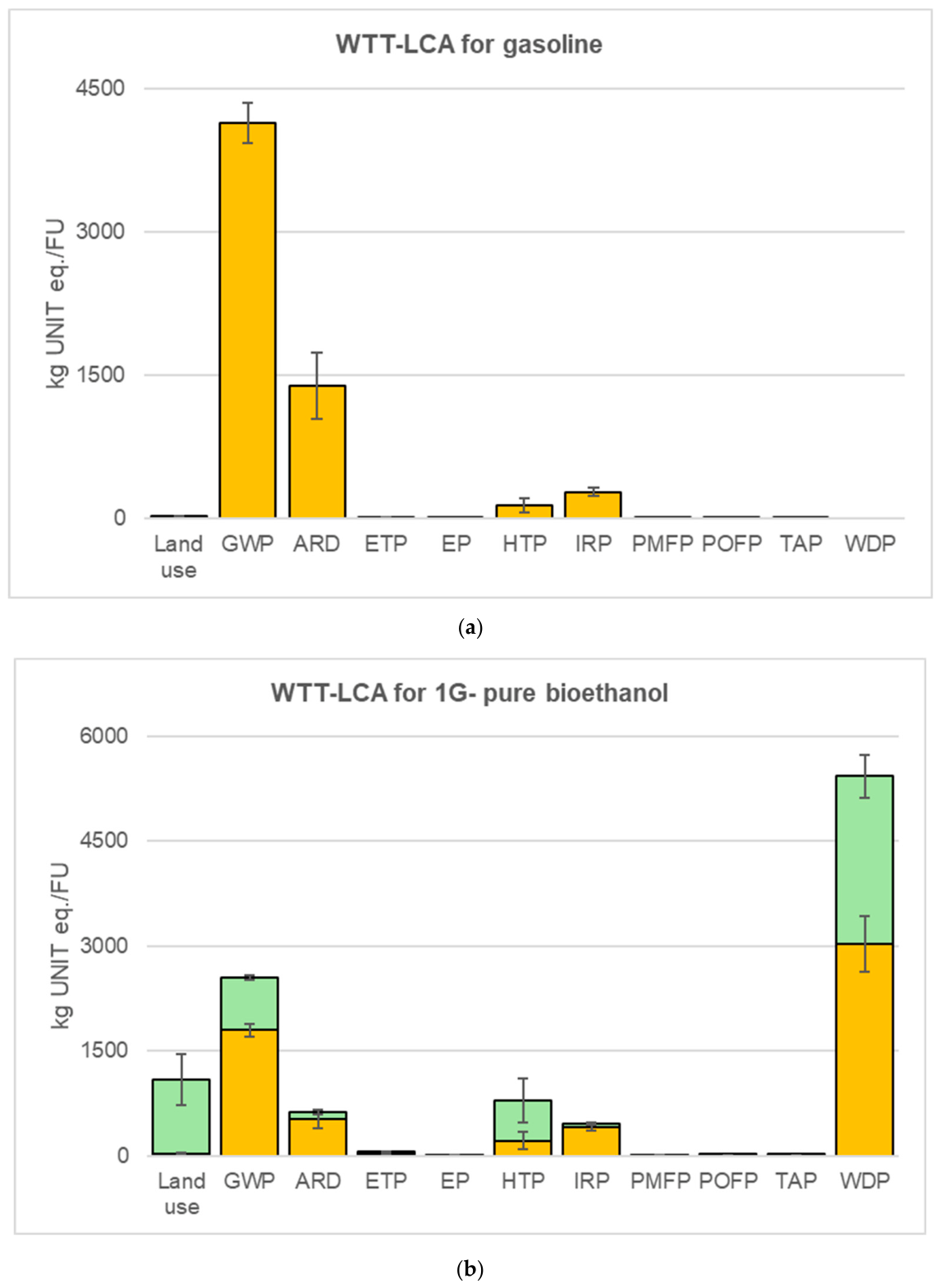
| WTT GWP performance | Gasoline showed the highest GWP; 1G-pure bioethanol was lower; 2G bioethanol was the lowest | Ethanol pathways generally provide ~30–90% GHG savings vs. gasoline depending on feedstock and route; lignocellulosic pathways are among the lowest-carbon options | [39] |
| 1G-pure vs. 2G-pure bioethanol | 1G-pure was penalized by corn cultivation; 2G performed better across categories | Reviews consistently report lower impacts for waste/residue-based ethanol than for crop-based ethanol | [48] |
| Land/water/agrochemical burdens | 1G-pure bioethanol showed higher burdens for land use, WDP, and HTP | The literature reports that crop-based pathways are more affected by land use, water use, fertilizers, and pesticides, while waste materials are more favorable | [48] |
| Transport hotspot in 2G | Pomace transport was the main hotspot for 2G-pure bioethanol | The literature notes that transport/logistics of low-density lignocellulosic residues can significantly affect environmental performance | [56] |
| Fuel consumption with E85 | +6–16% fuel consumption vs. gasoline over 22 km | E85 generally reduces fuel economy because of lower energy density energy/gal, up to +25% fuel consumption for E80 vs. gasoline | [28,55] |
| Emissions with E85 | Overall lower GWP contribution | E85 often lowers GWP; however, emission trends vary across vehicle types and test conditions | [57,58,60] |
Disclaimer/Publisher’s Note: The statements, opinions and data contained in all publications are solely those of the individual author(s) and contributor(s) and not of MDPI and/or the editor(s). MDPI and/or the editor(s) disclaim responsibility for any injury to people or property resulting from any ideas, methods, instructions or products referred to in the content. |
© 2026 by the authors. Licensee MDPI, Basel, Switzerland. This article is an open access article distributed under the terms and conditions of the Creative Commons Attribution (CC BY) license.
Share and Cite
Summa, D.; Raimondi, S.; Mangeruga, V.; Giacopini, M.; Tamburini, E.; Amaretti, A. A Well-to-Wheel Comparative Life Cycle Assessment (LCA) of First- and Second-Generation Bioethanol as Alternatives to Gasoline in Motorsport Races. Energies 2026, 19, 2155. https://doi.org/10.3390/en19092155
Summa D, Raimondi S, Mangeruga V, Giacopini M, Tamburini E, Amaretti A. A Well-to-Wheel Comparative Life Cycle Assessment (LCA) of First- and Second-Generation Bioethanol as Alternatives to Gasoline in Motorsport Races. Energies. 2026; 19(9):2155. https://doi.org/10.3390/en19092155
Chicago/Turabian StyleSumma, Daniela, Stefano Raimondi, Valerio Mangeruga, Matteo Giacopini, Elena Tamburini, and Alberto Amaretti. 2026. "A Well-to-Wheel Comparative Life Cycle Assessment (LCA) of First- and Second-Generation Bioethanol as Alternatives to Gasoline in Motorsport Races" Energies 19, no. 9: 2155. https://doi.org/10.3390/en19092155
APA StyleSumma, D., Raimondi, S., Mangeruga, V., Giacopini, M., Tamburini, E., & Amaretti, A. (2026). A Well-to-Wheel Comparative Life Cycle Assessment (LCA) of First- and Second-Generation Bioethanol as Alternatives to Gasoline in Motorsport Races. Energies, 19(9), 2155. https://doi.org/10.3390/en19092155