1. Introduction
The decarbonization of the building sector is widely recognized as a central challenge of modern energy systems, particularly in regions where residential space heating accounts for a significant share of final energy consumption, while maintaining adequate indoor thermal comfort remains a key requirement [
1,
2]. In this context, the electrification of heating technologies has emerged as a key pathway toward reducing greenhouse gas emissions, with heat pumps playing a prominent role. Numerous studies have identified air-to-water heat pumps (ASHPs) as a mature and efficient technology for residential heating, capable of utilizing renewable ambient energy and achieving high seasonal efficiencies under favorable operating conditions [
3,
4,
5].
However, large-scale heat pump deployment introduces challenges related to electricity consumption patterns, grid interaction, and economic performance. Unlike conventional heating systems based on fossil fuels, heat pumps rely entirely on electricity supply, making their operation highly sensitive not only to climatic conditions but also to electricity price structures and tariff schemes. Time-dependent electricity tariffs, such as day–night pricing, are increasingly implemented to mitigate peak electricity demand and encourage more flexible electricity consumption in residential buildings. Recent studies have confirmed that tariff-based control strategies can significantly improve the economic performance of heat pump systems by shifting operation toward lower-cost periods, while appropriate electricity pricing structures can also play a key role in promoting heat pump adoption and influencing system operation and electricity consumption patterns in real residential applications [
6,
7,
8]. In particular, previous studies have shown that the integration of TES with heat pumps enables effective shifting of electricity consumption toward lower tariff periods, resulting in improved economic performance under time-of-use pricing schemes [
9]. Furthermore, the flexibility potential of decentralized heat pumps in future energy systems has been increasingly emphasized in recent research, particularly in the context of tariff-responsive operation and thermal flexibility in residential buildings [
10,
11].
From a system-level perspective, the contribution of heat pumps to renewable energy integration cannot be evaluated solely on the basis of seasonal performance indicators such as the coefficient of performance (
COPH). Even systems with high seasonal efficiencies may impose unfavorable impacts on the electricity grid if their operation coincides with periods of high electricity demand or limited renewable electricity generation [
11]. In this regard, heat pumps should be assessed within the broader context of their interaction with the energy system rather than through isolated efficiency metrics [
6].
Thermal energy storage (TES) represents one of the most practical and technically feasible solutions for introducing operational flexibility into residential heat pump systems [
12]. By decoupling heat generation from instantaneous heat demand, TES enables the temporal shifting of heat pump operation toward periods that are more favorable from both thermodynamic and economic perspectives [
13]. Several comprehensive reviews and applied studies have addressed the integration of heat pumps and TES in building applications [
12,
13,
14,
15] with recent review studies further emphasizing its role in enabling demand-side flexibility [
13]. In particular, Heier et al. [
12] and Osterman and Stritih [
14] provided detailed overviews of system configurations and demonstrated the potential of TES to enhance operational flexibility and improve overall system performance. Recent studies have further investigated the performance of ASHP systems coupled with TES under variable electricity pricing conditions, confirming their potential for cost reduction and flexible operation [
9,
16].
Despite these advancements, a significant portion of existing research focuses either on improving seasonal energy efficiency or on the application of advanced predictive and optimization-based control strategies. Advanced control approaches such as model predictive control have been widely investigated for building energy systems, offering improved performance potential. However, these approaches require detailed system models, reliable forecasts, and increased computational effort, which can limit their practical applicability in residential systems [
17,
18]. Therefore, a clear research gap exists between advanced optimization-based and predictive control strategies, which offer high performance but require complex models and reliable forecasts, and their practical applicability in real residential systems.
In particular, there is a lack of simple, robust, and practically applicable control strategies capable of achieving comparable economic performance under long-term real climatic conditions. Experimental studies such as Wu et al. [
15] further confirm the physical behavior of TES-integrated heat pump systems, supporting the validity of simplified modeling approaches used in system-level analyses and reinforcing the reliability of the adopted modeling framework. Recent findings also highlight that electricity pricing significantly influences the operational flexibility of heat pump systems coupled with thermal storage [
10].
To address these limitations and provide a practically applicable solution, this study investigates the tariff-oriented operation of residential ASHP systems coupled with TES using long-term climatic data. The analysis focuses on the capability of TES to shift heat pump operation toward economically favorable periods, thereby reducing electricity costs and improving compatibility with renewable electricity integration. A previously validated system model is adopted and extended to enable tariff-based performance assessment while maintaining identical building characteristics, system configuration, and control strategy across all analyzed scenarios [
19].
Hourly simulations are performed using long-term measured meteorological data for multiple locations characterized by continental climatic conditions. In contrast to studies relying on complex predictive or optimization-based control algorithms [
9,
17], this work evaluates a simple and practically applicable storage operation strategy, emphasizing robustness and real-world feasibility. System performance is assessed primarily using economic indicators and the distribution of electricity consumption across tariff periods, complemented by conventional energy performance metrics.
Recent studies have explored the integration of heat pumps with TES using optimisation-based control strategies to reduce peak demand and improve system efficiency. For example, Al-Atari et al. [
20] demonstrated that optimised operation of heat pump and thermal storage systems can reduce peak demand by up to 21% in residential communities.
While optimization-based approaches can provide significant performance improvements, they often require detailed forecasting and increased computational complexity. In contrast, this study demonstrates that a simple rule-based strategy can achieve economic performance comparable to that reported for more advanced optimization-based approaches.
This work addresses the gap between advanced optimization-based control approaches and their practical applicability by focusing on robustness and real-world feasibility. Unlike most existing studies, which rely on short-term simulations or predictive control, the proposed approach enables consistent performance using a simple and practically applicable control strategy. This highlights that practical simplicity can be as important as theoretical optimality in real residential energy systems.
The main contributions of this study can be summarized as follows:
Long-term assessment of tariff-oriented operation of residential ASHP systems coupled with TES using multi-year hourly climatic data over an eight-year period.
Quantification of the operational flexibility provided by TES in shifting electricity consumption toward economically favorable tariff periods.
Demonstration of the effectiveness of a simple rule-based control strategy in achieving consistent economic benefits across different years and locations characterized by continental climatic conditions.
Identification of the storage size range that provides a balanced trade-off between operational savings and investment-related economic performance.
2. Materials and Methods
2.1. Heating System Description
The analyzed heating system represents a typical residential ASHP installation used in single-family houses under continental climatic conditions. The case study considers a building with a usable floor area of 170 m2 equipped with an underfloor heating system operating at supply and return water temperatures of 45 °C and 35 °C, respectively. The installed ASHP has a nominal heating capacity of 8.5 kW at an outdoor temperature of −18 °C, which corresponds to the design outdoor temperature for three locations in the Slavonia region. An auxiliary electric heater with a capacity of 2.5 kW is included to ensure full coverage of the building’s peak heating demand.
The heat pump system consists of a split configuration with an outdoor unit containing the compressor, evaporator, and expansion device, while the indoor hydraulic module incorporates the condenser and circulation pump. Thermal energy extracted from ambient air is transferred to the water circuit and supplied to the building heating system.
In the TES-integrated configuration, a water-based TES tank is installed between the heat pump and the heating distribution system. The storage tank acts as a hydraulic buffer that enables temporary decoupling between heat generation and heat demand. The TES is modeled as a simplified lumped system with uniform temperature distribution, neglecting thermal stratification effects. Heat losses to the environment are not explicitly considered, assuming well-insulated storage conditions. This simplified representation is adopted to ensure computational efficiency and consistency across all analyzed scenarios. While this approach does not capture detailed thermal dynamics within the storage tank, it is sufficient for system-level comparative analysis, where relative performance differences between control strategies are of primary interest.
2.2. Building Thermal Energy Demand Model
The thermal energy demand of the building was calculated using an hourly heat balance model based on the methodology defined in EN ISO 52016 [
21] which replaces the earlier EN ISO 13790 standard [
22]. The building was represented as a single thermal zone with a constant indoor air temperature maintained during the heating season.
The model accounts for transmission heat losses through the building envelope, ventilation heat losses, and useful heat gains from internal sources and solar radiation. Transmission losses were determined using the thermal transmittance coefficients and surface areas of the main building components, including external walls, windows, doors, roof, and floor structures.
Ventilation heat losses were calculated based on the air change rate and the heated building volume. Internal heat gains were assumed to originate from occupants, appliances, and lighting, while solar gains were estimated using measured hourly solar radiation data.
Using hourly outdoor temperature and solar radiation data, the heating demand of the building was calculated for each hour of the heating season, ensuring consistency with the temporal resolution of the simulation framework.
The adopted assumptions for internal heat gains and ventilation are consistent with values commonly used in building energy modeling studies based on standardized approaches such as EN ISO 52016 [
21] as well as in recent literature on heat pump and thermal storage systems [
11].
2.3. Heat Pump Performance Model
The performance of the analyzed ASHP system was characterized using the
COPH, defined as the ratio between the produced thermal energy
Q and the electrical energy consumed by the heat pump,
W:
In the simulation model,
values were defined as a function of outdoor air temperature and heating supply water temperature.
Table 1 shows the relationship between the
and the outdoor air temperature, as well as the supply water temperature. The heat pump performance characteristics
were based on manufacturer data provided by Viessmann [
23].
From the presented data, it is evident that the value increases with rising outdoor air temperature, as well as with decreasing supply water temperature for heating. This behavior is a result of a reduced compression ratio under more favorable operating conditions, which lowers the required compressor work and increases the overall system efficiency. The most favorable operating conditions are achieved at higher outdoor temperatures and lower supply water temperatures, confirming the advantages of low-temperature heating systems, such as underfloor heating, when combined with heat pumps. The relatively high values at an outdoor temperature of +30 °C correspond to operation under favorable thermodynamic conditions with a low temperature lift. Such conditions are not representative of typical heating operation but are included for completeness of the manufacturer data.
On the other hand, the table shows that at very low outdoor temperatures it is not possible to achieve higher supply water temperatures, indicating technical limitations of the system and the need for proper system sizing.
Seasonal performance was evaluated by aggregating hourly values of delivered thermal energy and consumed electrical energy over the heating season to determine the Seasonal Coefficient of Performance (
SCOP), defined as the ratio of total useful thermal energy to total electrical energy consumption.
where
is the useful thermal energy delivered in time step
t,
is the electrical energy consumption in time step
t, and
n is the total number of time steps (hours of the heating season).
More specifically, SCOP is calculated as the ratio of the total useful thermal energy delivered by the heat pump to the total electrical energy consumption over the entire heating season, based on hourly values. The model assumes steady-state operating conditions and does not explicitly include dynamic effects such as compressor cycling, defrost processes, or part-load degradation. However, identical modeling assumptions were applied to all analyzed system configurations, ensuring consistent comparative evaluation.
Model Validation
The validity of the adopted modelling approach was assessed through comparison with literature results for heat pump systems with TES [
10,
11,
15], considering both performance indicators and system behaviour. The calculated
SCOP in the present study (3.0–3.3) is consistent with values reported for ASHP systems under comparable climatic conditions [
10,
11], confirming a realistic representation of system efficiency.
The model also reproduces key operational characteristics such as load shifting, preheating behaviour, and the redistribution of electricity consumption toward lower tariff periods, in agreement with findings reported in [
10,
11]. From an economic perspective, the obtained electricity cost savings of 19–23% are within the range of values reported in the literature [
10,
11], supporting the reliability of the model.
It should be noted that the validation is based on comparison with literature rather than direct experimental data. Due to modelling simplifications, including a lumped representation of TES and the omission of dynamic effects, the model is intended for comparative and parametric analysis rather than detailed transient prediction.
Table 2 summarizes the comparison of key performance indicators and system behaviour with representative studies.
Table 2 shows that both the magnitude of the key performance indicators and the observed system behaviour are consistent with previously reported studies, confirming the validity of the adopted modelling approach.
2.4. Meteorological Data
The analysis was performed using measured hourly meteorological data from three locations in eastern Croatia: Gradište, Osijek, and Slavonski Brod. These locations represent typical continental climatic conditions of Eastern Croatia. The characteristic values presented in
Table 3 were calculated for the heating season only and therefore differ from typical annual averages.
As shown in
Table 3, the selected locations exhibit similar climatic characteristics, with only minor variations in average air temperature, temperature extremes, and heating degree days. These similarities confirm that the analyzed datasets are representative of typical continental climatic conditions, while still capturing a limited degree of spatial variability.
The inclusion of multiple locations allows for the evaluation of spatial variability and enhances the robustness of the results. The consistency of system performance trends observed across all locations indicates that the conclusions are not site-specific, but representative of similar climatic conditions.
The dataset covers an eight-year period from 2018 to 2025 and includes hourly outdoor air temperature and solar radiation measurements obtained from meteorological stations. The use of long-term measured climatic data enables a realistic representation of interannual climatic variability and daily temperature fluctuations.
Hourly outdoor temperature data were used as the primary input for both the building thermal demand model and the heat pump performance calculations. This approach ensures that the simulation framework captures the influence of real climatic conditions on heating system operation and seasonal energy consumption.
2.5. Electricity Tariff Model
Electricity prices were defined according to the applicable Croatian tariff system for households with dual-tariff meters [
24]. The pricing structure includes supply, distribution, transmission, and renewable energy fees.
The resulting total electricity price amounts to €0.199/kWh for the higher tariff and €0.101/kWh for the lower tariff, including VAT.
The higher tariff is applied during daytime hours (7:00–21:00 in winter), while the lower tariff applies during nighttime hours. Since the majority of the heating season occurs under wintertime conditions, these tariff periods were adopted throughout the analysis.
This tariff structure enables the evaluation of demand-side flexibility by shifting electricity consumption from higher to lower tariff periods. The selected tariff structure reflects typical European day–night pricing schemes, ensuring applicability to regions with similar tariff structures and climatic conditions.
3. Simulation Methodology
The performance of the analyzed heating system was evaluated using an hourly simulation model developed in MATLAB R2025B environment [
25]. The model integrates the building thermal demand, heat pump performance, TES and electricity tariff components described in the previous sections.
Two system configurations were considered: (i) a reference system without TES, (ii) a TES-integrated system. Both configurations were analyzed under identical boundary conditions, including building characteristics, climatic data, and system parameters, to ensure a consistent comparison.
The MATLAB model was developed as a modular hourly simulation framework consisting of four main components: (i) building heating demand calculation, (ii) heat pump performance evaluation, (iii) TES charging and discharging logic, (iv) electricity cost calculation according to tariff periods. The main model inputs include hourly outdoor temperature, solar radiation, building characteristics, heat pump performance data, TES volume, and electricity tariff schedule. The main outputs are hourly heat pump operation, TES state, electricity consumption, SCOP, annual electricity cost, and cost savings.
The simulation was performed over the entire heating season using measured hourly meteorological data. At each time step, the building heating demand was calculated and the heat pump operation was determined based on the corresponding values as a function of outdoor temperature and supply water temperature. Electrical energy consumption was then derived from the delivered thermal energy.
The model is implemented as a time-step procedure with hourly resolution. At each time step, the following sequence is applied:
- (1)
Calculation of building heating demand.
- (2)
Evaluation of heat pump performance based on outdoor temperature.
- (3)
Application of the control strategy determining charging or discharging of TES.
- (4)
Calculation of electrical energy consumption and allocation to tariff periods.
This structure ensures a consistent coupling between thermal demand, system operation, and economic evaluation.
The simulation workflow follows a deterministic time-step procedure, where all variables are updated sequentially at each hourly interval based on the current system state and input data.
The model does not rely on iterative optimization or convergence algorithms but instead applies predefined calculation rules and control logic at each time step. This ensures a transparent and reproducible simulation process.
All input parameters, including meteorological data, building characteristics, heat pump performance curves, TES capacity, and electricity tariff structure, are explicitly defined, allowing the simulation procedure to be replicated under identical conditions.
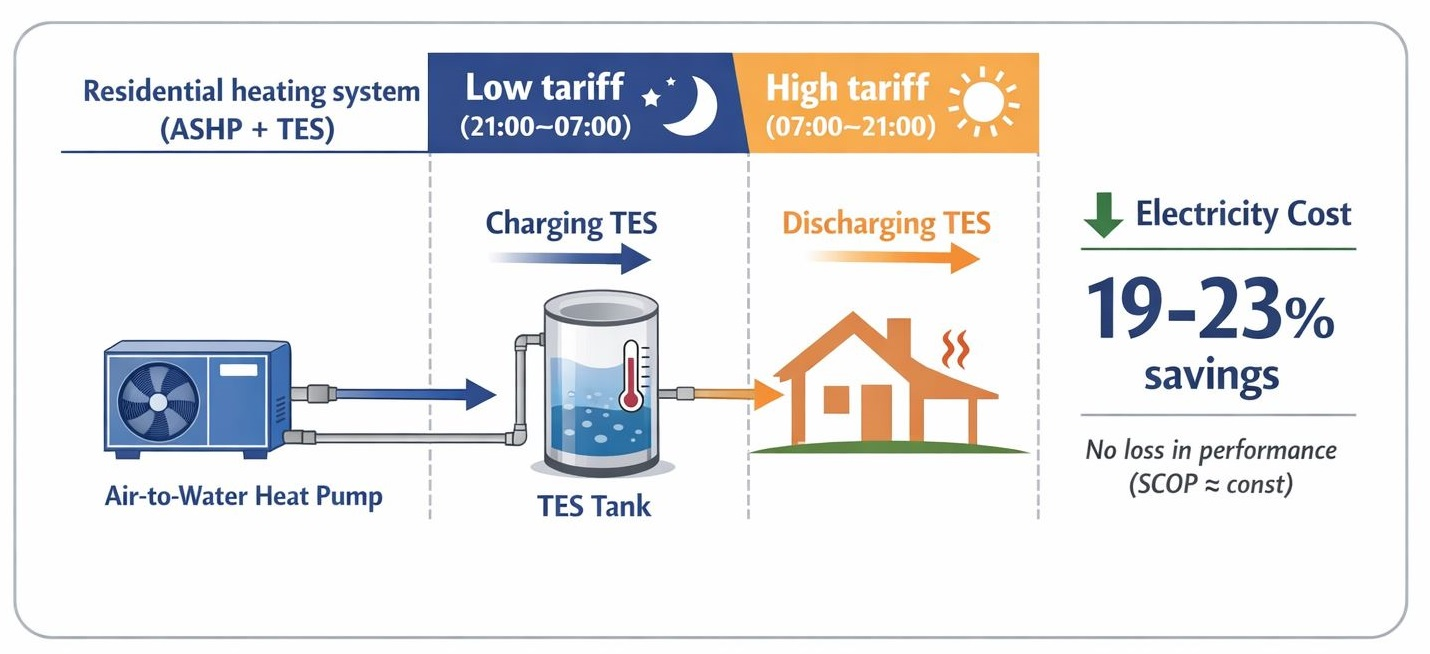
In the TES-integrated configuration, the heat pump operation is decoupled from instantaneous heating demand through storage charging and discharging. A simple rule-based control strategy was applied, as defined below. The control algorithm is implemented as a deterministic rule-based procedure. During lower tariff periods (21:00–07:00), the model prioritizes heat pump operation for TES charging, provided that the storage tank has not reached its maximum capacity. During higher tariff periods, stored thermal energy is used to meet the building heating demand, while direct heat pump operation is activated only when the available TES energy is insufficient.
Charging of the TES occurs when the heat pump operates during lower tariff periods and the storage temperature is below the predefined upper limit. Discharging occurs when the building heating demand exceeds the available stored energy or when heat pump operation is restricted during higher tariff periods.
This control logic allows the majority of electricity consumption to be shifted toward lower-cost periods while maintaining the required indoor thermal comfort.
The resulting hourly electricity consumption was allocated to the corresponding tariff periods and aggregated over the heating season to determine total energy use and electricity cost.
The observed system behaviour, particularly preheating and load shifting driven by tariff signals, is consistent with trends reported in the literature [
10,
11,
15]. This indicates that such behaviour is inherent to heat pump systems coupled with thermal energy storage and is not dependent on the specific modelling approach used.
4. Results
The results clearly demonstrate that TES enables a systematic shift in heat pump operation toward lower electricity tariff periods, resulting in significant cost reductions. The analysis is structured into three parts: daily operation characteristics, tariff distribution of operating hours, and long-term economic performance. For the purposes of detailed analysis, a representative year and location were selected. The year 2022 and the city of Osijek were chosen, as they correspond well to the average conditions of the observed multi-year period.
To further investigate system operation, a representative day was defined based on meteorological data. The representative day is determined as the day whose average daily value is closest to the overall average of the observed heating period. Using this method, 25 February 2022 was identified as the representative day. This selection enables a realistic depiction of system behavior under typical operating conditions, avoiding the influence of extreme values.
4.1. Daily Operation Characteristics
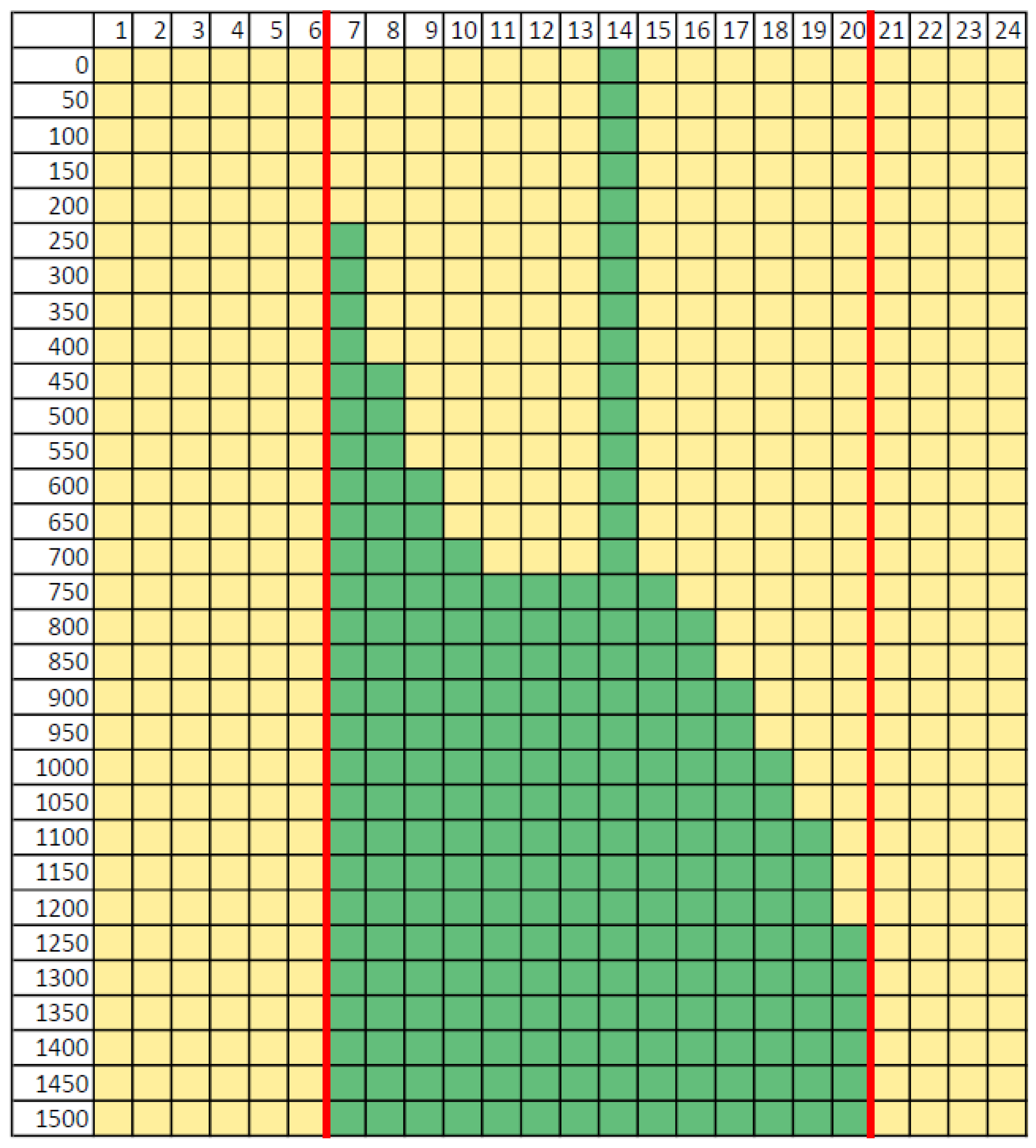
A heat map of heat pump operation is presented in
Figure 1 as a function of TES volume and hour of the day. It can be observed that, with increasing storage volume, heat pump operation becomes increasingly concentrated within the lower tariff period, while operation during the higher tariff is significantly reduced. Additionally, a short period without heating demand is observed around 14:00, during which the system remains inactive.
It should be emphasized that the presented results correspond to a representative day under average operating conditions, for which the minimum electricity cost is achieved, characterized by storage charging during the low-tariff period (21:00–07:00).
4.2. Operating Hours and Tariff Distribution
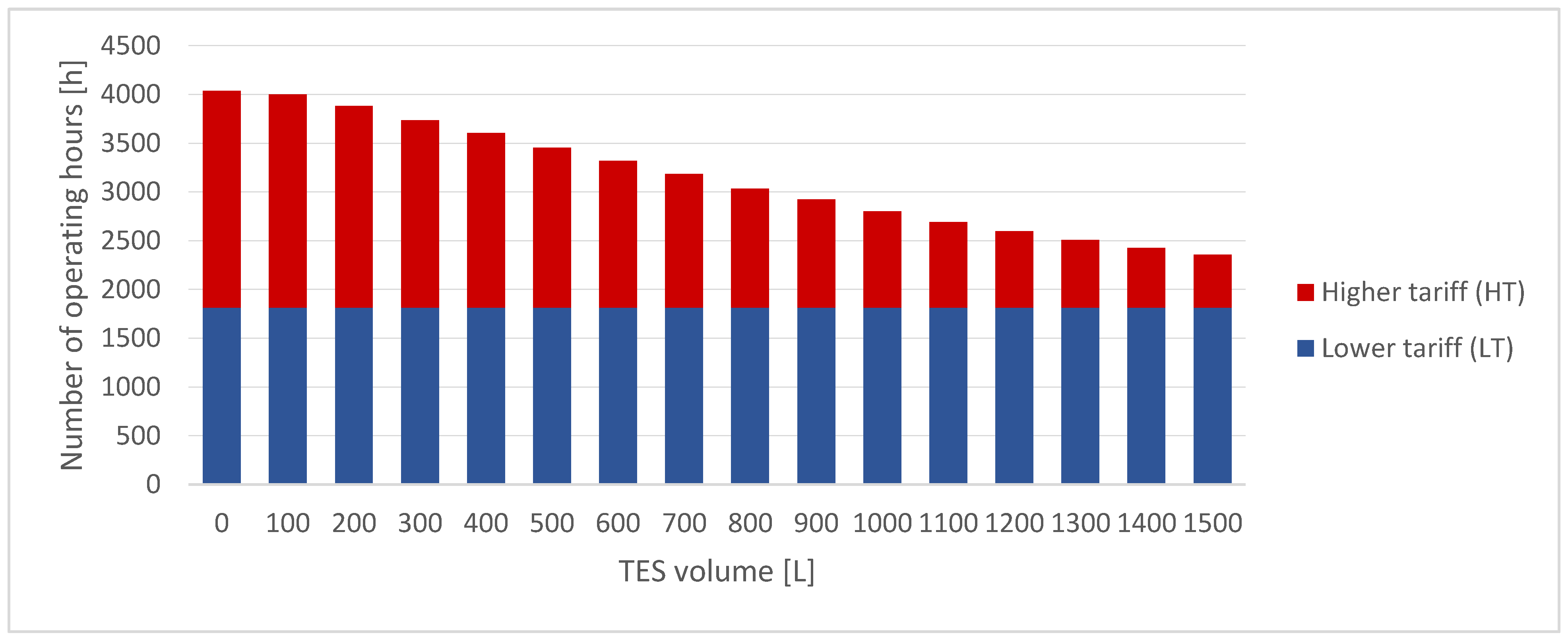
Figure 2 presents the total operating hours of the heat pump and their distribution between higher tariff (HT) and lower tariff (LT) periods as a function of TES volume. The
x-axis represents the TES volume, while the
y-axis shows the total number of operating hours. The bars illustrate the share of operation in HT and LT periods.
The results show a significant reduction in operation during the higher tariff period. Operating hours decrease from 2223 h in the system without storage to 544 h for a TES volume of 1500 L, representing a reduction of approximately 75.5%. In contrast, operating hours during the lower tariff period remain nearly constant across the analyzed range.
Consequently, the share of operation in the higher tariff period decreases from approximately 55% to about 23%, while the share in the lower tariff period increases from approximately 45% to about 77%.
In addition, a reduction in total operating hours is observed, decreasing from 4033 h (without TES) to 2357 h (with a TES volume of 1500 L). This behavior can be attributed to improved operating conditions during TES charging, where the heat pump operates closer to its nominal capacity, resulting in higher efficiency and reduced operating time.
It should be noted that these results correspond to a representative year selected for detailed analysis, reflecting average climatic and operational conditions.
4.3. Annual Performance and Economic Analysis
The analysis was performed for each individual year within the observed eight-year period, as well as for each of the three analyzed locations, enabling an assessment of the influence of climatic variability on system performance.
The analyzed range of TES volumes covered values from 50 to 1500 L. Due to technical and practical constraints, larger storage volumes were not considered.
For each case, the system configuration that minimizes total electricity cost was determined. The results show that, for every analyzed year and across all considered locations, the lowest electricity consumption was consistently achieved with a TES volume of 1500 L, corresponding to a configuration with charging starting at 21:00 and discharging at 07:00.
Table 4 presents a comparison of system performance with and without TES in terms of
SCOP and electricity cost.
The results indicate that the integration of TES leads to consistent electricity cost savings in the range of 19–23% across all analyzed years and locations.
Only minor variations in SCOP are observed between the analyzed configurations, indicating that the integration of TES does not significantly affect the thermodynamic performance of the system. This confirms that the observed cost reductions are primarily driven by tariff-based load shifting rather than improvements in system efficiency.
The results presented in
Table 4 reveal several important trends. The achieved cost savings remain within a relatively narrow range of approximately 19–23% across all analyzed years and locations, indicating a high level of robustness of the proposed control strategy. In addition, the results show low interannual variability in both
SCOP and cost savings, indicating that the proposed control strategy performs consistently under different climatic conditions. This consistency suggests that the obtained results are not case-specific, but can be generalized to similar climatic regions.
Furthermore, the integration of TES has only a marginal impact on SCOP values, confirming that the observed cost reductions are primarily driven by tariff-based load shifting rather than improvements in thermodynamic efficiency. While absolute electricity costs vary between years, the relative savings remain stable, demonstrating the transferability of the proposed approach across different operating conditions.
These results clearly demonstrate that tariff-oriented operation represents an effective strategy for improving the economic performance of residential heat pump systems.
5. Discussion
The results indicate that the economic performance of residential heat pump systems is primarily governed by tariff-based load shifting enabled by TES, rather than by thermodynamic efficiency alone. This highlights that system performance should be evaluated within the combined context of tariff structures, outdoor temperature conditions, and operational flexibility [
10,
11].
Conventional on–off or PID-based control strategies used in residential systems do not account for time-varying electricity prices and therefore offer limited potential for economic optimization. In contrast, the proposed rule-based control incorporates tariff information while maintaining low complexity, enabling systematic operation during lower-cost periods and improving economic performance without increasing control effort.
In contrast, the rule-based control strategy proposed in this study extends conventional control logic by incorporating tariff information into system operation. While maintaining comparable operational simplicity, the proposed approach enables systematic load shifting toward lower-cost periods, thereby improving economic performance without increasing control complexity.
TES plays a central role by decoupling heat generation from demand, allowing heat pump operation to be shifted to economically favorable periods. The resulting cost reductions are primarily driven by tariff-based load shifting, consistent with previous studies on flexible heat pump operation under variable pricing schemes [
6,
11]. Importantly, the effectiveness of this approach depends not only on tariff structures but also on diurnal outdoor temperature variation. Lower-tariff evening periods often coincide with relatively favorable ambient conditions for efficient charging, whereas early morning hours typically combine higher tariffs with lower temperatures, making direct operation less favorable. This natural alignment enhances the robustness of the proposed strategy without requiring predictive control.
The results further show that TES integration has a limited impact on conventional thermodynamic indicators. Although operation at higher ambient temperatures may improve instantaneous efficiency, it is not necessarily economically optimal due to higher electricity prices. Conversely, tariff-oriented operation may shift operation to less favorable temperatures without degrading seasonal performance. A slight improvement in
SCOP is observed, likely due to more stable operation and reduced cycling. These findings support the view that flexibility-oriented operation is at least as relevant as efficiency-driven strategies in modern electrified heating systems [
9,
16].
The results further indicate that the integration of TES has a limited impact on conventional thermodynamic performance indicators. Although operation during higher ambient temperatures may improve instantaneous efficiency, such operation is often economically suboptimal due to higher electricity costs. Conversely, tariff-oriented operation may shift operation toward less favorable temperature conditions, yet this does not result in a deterioration of seasonal performance. On the contrary, a slight improvement in seasonal efficiency is observed, likely due to more stable operation and reduced cycling. These findings suggest that flexibility-oriented operation may be more relevant than purely efficiency-driven strategies in modern electrified heating systems, which is consistent with previous studies emphasizing the role of TES in providing operational flexibility rather than significantly enhancing thermodynamic efficiency [
9,
16].
Increasing TES capacity further enhances operational flexibility; however, the results reveal diminishing economic returns beyond a certain storage size. This indicates the existence of an optimal TES capacity range within the analyzed domain, where the balance between investment cost and operational savings is achieved. However, since larger storage volumes were not analyzed in detail, global optimality cannot be confirmed [
9,
16].
Compared to advanced optimization or predictive control approaches, the proposed rule-based strategy achieves comparable economic benefits with significantly lower complexity. This improves its practical applicability and robustness for real residential systems.
To support the validity of the modelling approach, the results were compared with independent studies. The calculated
SCOP values (approximately 3.0–3.3) and the achieved electricity cost savings (19–23%) are in close agreement with values reported for similar systems under comparable climatic and tariff conditions [
9,
10,
11]. In addition, the observed system behaviour, including preheating and tariff-driven load shifting, is consistent with trends reported in the literature. This agreement in both performance indicators and system behaviour supports the validity of the adopted modelling framework.
Although the analysis is based on the Croatian tariff system, similar dual-tariff pricing structures are widely applied across Europe. The results are therefore indicative for regions with comparable climatic conditions and tariff schemes, while differences in price levels and regulatory frameworks may influence the magnitude of the observed economic benefits.
5.1. Estimation of the Payback Period
For the economic analysis, the year 2022 was selected as a representative case, as its results closely match the multi-year average for Osijek and align with trends observed across all analyzed locations. The low variability in
SCOP and cost savings between years and locations (
Table 4) confirms the robustness of the proposed control strategy and justifies the use of a single representative year for payback period evaluation.
The payback period was calculated by comparing the additional investment cost of integrating TES with the corresponding annual electricity cost savings.
where
PB is payback period (years), I is initial investment (€), and CF is annual electricity cost savings (€).
This approach is widely used for assessing the economic feasibility of energy systems with thermal storage [
26] as it provides a direct estimate of the time required to recover the initial investment under realistic operating conditions and tariff structures.
The total investment cost of the TES system includes the storage tank, installation, and auxiliary components required for system integration, such as an additional circulation pump and hydraulic fittings. Based on typical market prices for residential TES systems in Europe, the total investment cost is estimated to range between 200 and 1500 €, depending on TES volume and installation complexity.
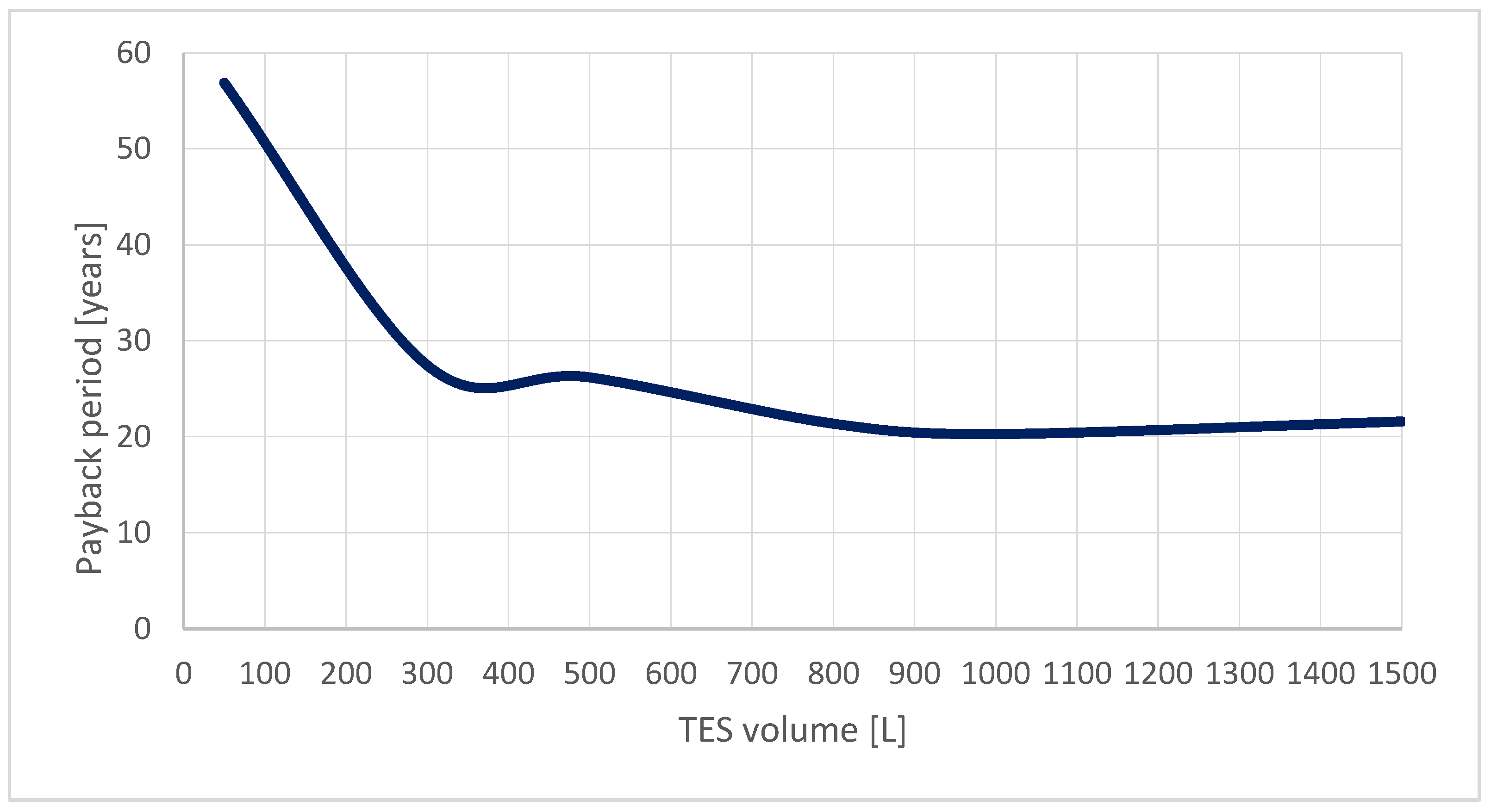
Figure 3 illustrates the dependence of the payback period on TES volume in the range from 50 to 1500 L. The
x-axis represents the TES volume, while the
y-axis shows the payback period in years.
For all analyzed volumes, the same optimal operating schedule was applied (charging at 21:00 and discharging at 07:00), ensuring consistent comparison of economic performance.
The results show a strong dependence of economic performance on storage size. For very small TES volumes, the payback period is extremely long, exceeding 50 years. This is due to the limited ability of small TES systems to shift electricity consumption toward lower tariff periods, resulting in minimal cost savings.
As the TES volume increases, the payback period decreases significantly, indicating improved economic performance. The most pronounced improvement occurs in the range of approximately 200 to 400 L, where the TES begins to provide sufficient capacity for effective load shifting. A local minimum in the payback period is observed around 300–400 L, followed by a slight increase and then a gradual decrease toward a global minimum of approximately 20 years at around 900–1100 L. In this range, the system achieves the best balance between investment cost and operational savings.
For larger storage volumes beyond this range, the payback period begins to increase slightly. This indicates diminishing economic returns, as additional investment costs are not matched by proportional increases in electricity cost savings.
Overall, the results confirm the existence of an economically favorable TES volume range, where the trade-off between investment cost and operational benefit is optimized.
It should be noted that the obtained payback period of 20 years exceeds the typical acceptable range for residential investments, which is commonly between 7 and 10 years. Therefore, under current economic conditions, the direct financial attractiveness of TES integration may be limited. However, the economic performance is highly dependent on electricity price developments and tariff structures. Future increases in energy prices or integration with renewable energy systems may significantly improve the economic viability.
These results highlight the importance of proper TES sizing in achieving economic viability. While larger storage systems enhance operational flexibility, their economic benefit is limited by diminishing returns. Conversely, undersized storage systems fail to provide sufficient load shifting potential, resulting in poor economic performance. Similar trends have been reported in previous studies on flexible operation of heat pump systems [
10].
In addition, the impact of defrost cycles should be considered, particularly under continental climatic conditions where outdoor temperatures frequently approach the freezing point. Under such conditions, ASHP periodically undergo defrost operation to remove frost formation on the evaporator, which temporarily reduces heating capacity and increases electricity consumption. Although, defrost operation is not explicitly modeled in this study, its influence can be assessed based on typical system behavior and findings reported in the literature. Defrost cycles are expected to reduce instantaneous
COPH values during specific operating periods, particularly at outdoor temperatures close to 0 °C. However, when averaged over the entire heating season, the impact of defrost operation on seasonal performance indicators such as
SCOP is generally limited. Therefore, while defrost cycles may influence short-term system performance, they are not expected to significantly alter the overall economic trends and conclusions of this study. This assumption is consistent with previous studies, where the seasonal impact of defrost operation remains within a limited range [
27].
While the payback period provides a simple and intuitive measure of economic feasibility, it does not account for the time value of money or long-term economic effects. Therefore, a more comprehensive economic assessment is performed using the net present value (NPV) method.
5.2. Net Present Value-Based Economic Assessment and Sensitivity Analysis
To complement the payback period analysis and provide a more comprehensive evaluation of long-term economic performance, an additional assessment was conducted using the NPV method. Unlike the payback period, which provides a simplified estimate of investment recovery time, the NPV method accounts for the time value of money and enables a more realistic evaluation of system profitability over its lifetime.
The NPV represents the difference between the initial investment and the discounted future cash flows, where annual electricity cost savings are considered as positive cash flows. This approach enables a consistent comparison of economic performance across different TES configurations. In this study, a time horizon of 25 years was assumed, corresponding to the typical lifetime of residential TES systems. A discount rate of 5% and an annual electricity price growth rate of 3% were adopted to reflect realistic economic conditions.
The net present value was calculated using the following expression:
where
I is the initial investment,
CF0 is the initial annual electricity cost savings,
g is the electricity price growth rate,
r is the discount rate, and
n is the number of years in the analysis period.
The annual savings are defined as the difference between the electricity costs of the reference system without TES and the system with integrated TES.
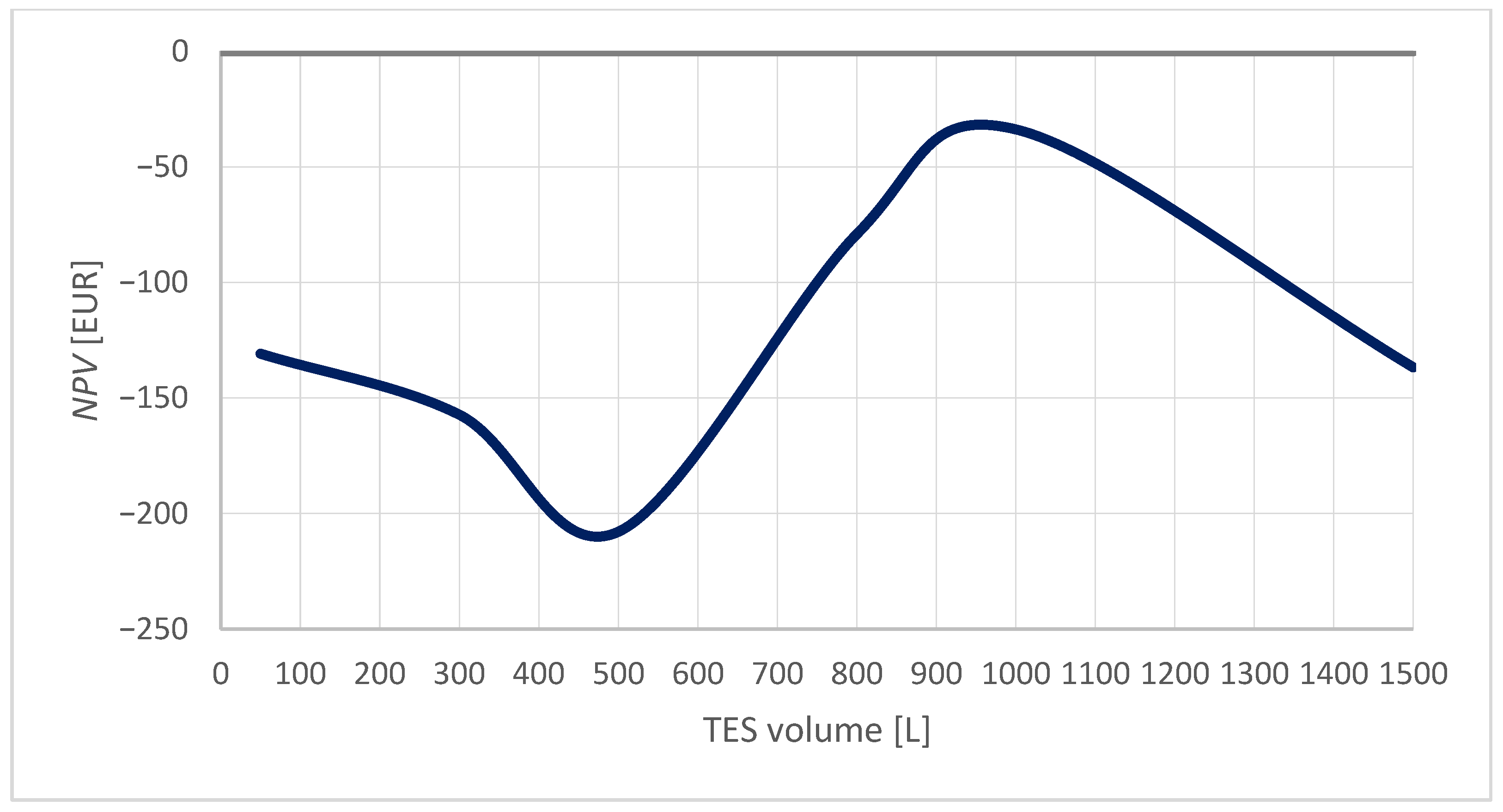
Figure 4 shows the dependence of
NPV on TES volume in the range from 50 to 1500 L, for the base economic scenario defined by a discount rate of 5% and an annual electricity price growth of 3%. The NPV is expressed in euros and represents the difference between the initial investment and the discounted future savings over the analyzed period of 25 years.
The results indicate that, under the base scenario, all calculated NPVs remain negative across the analyzed range of storage volumes, suggesting limited economic feasibility under current conditions. However, a strong dependence on storage volume is observed. For smaller TES volumes (50–300 L), NPVs are highly negative due to insufficient capacity for effective load shifting. As the storage volume increases, economic performance improves, reaching the most favorable values at approximately 1000 L, where the best balance between investment cost and operational savings is achieved. Further increases in storage volume result in a deterioration of NPV due to rising investment costs that are not compensated by proportional increases in savings. This behavior confirms the existence of an economically favorable storage volume range within the analyzed domain.
To further evaluate the robustness of the results, a sensitivity analysis was performed with respect to key economic parameters, namely the discount rate (3–7%) and the electricity price growth rate (0–5%).
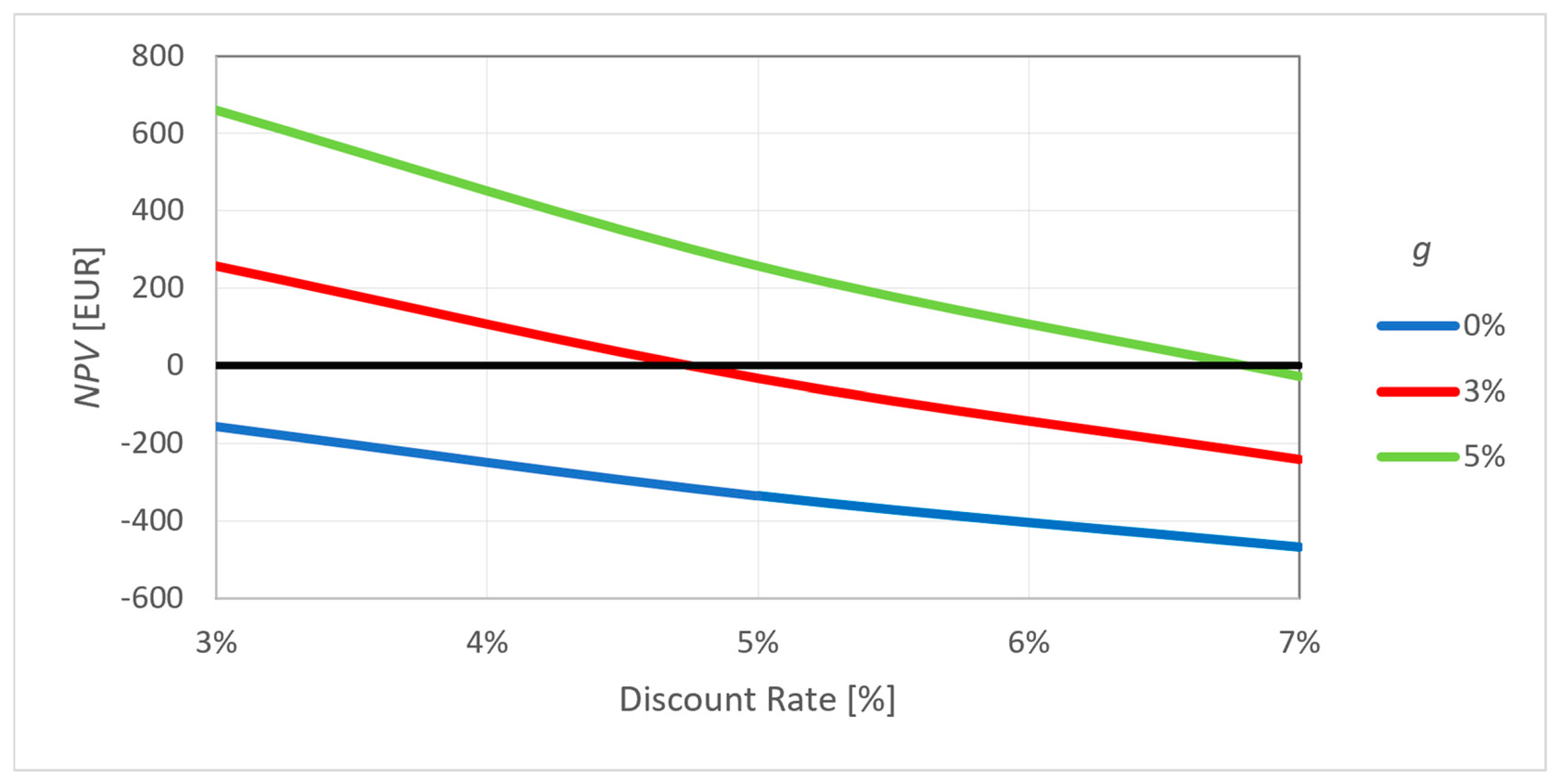
Figure 5 presents a sensitivity analysis of
NPV with respect to variations in the discount rate in the range from 3% to 7% for a TES volume of 1000 L. Three curves are shown, corresponding to different electricity price growth rates (
g is 0%, 3%, and 5%).
The results show that NPV is highly sensitive to variations in these parameters. An increase in the discount rate reduces the present value of future savings, resulting in lower NPVs. In contrast, higher electricity price growth rates significantly improve economic performance.
In the scenario without electricity price growth rate (g = 0%), the system remains economically unviable across all analyzed cases. However, for moderate and higher electricity price growth rates (g = 3%), positive NPVs can be achieved under favorable economic conditions. These results further emphasize the importance of future energy price developments as a key factor in determining the economic viability of TES integration. This confirms that the economic feasibility of the system is not solely determined by its technical performance, but is strongly influenced by external market conditions and the evolution of the energy market.
6. Conclusions
The results of this study demonstrate that tariff-oriented operation of residential ASHP systems coupled with TES can provide measurable economic benefits and enhanced operational flexibility under real climatic conditions.
The analysis shows that TES enables effective temporal decoupling between heat generation and demand, allowing heat pump operation to be shifted toward economically favorable tariff periods. This results in consistent electricity cost reductions in the range of 19–23% across all analyzed years and locations, primarily driven by load shifting rather than improvements in thermodynamic efficiency.
A key finding of this study is that such performance can be achieved using a simple and practically implementable rule-based control strategy, without relying on advanced predictive or optimization-based methods. This highlights the potential of low-complexity approaches for real-world applications and addresses the gap between theoretically optimal control strategies and their practical implementation in residential systems.
The analysis of storage sizing indicates that larger TES volumes increase operational flexibility and reduce electricity costs, with the lowest costs observed at a TES volume of 1500 L within the analyzed range. However, the economic assessment shows that the most favorable balance between investment cost and operational savings is achieved at intermediate storage sizes. In particular, the results indicate that a TES volume of approximately 1000 L provides the most favorable economic performance in terms of NPV, reflecting diminishing returns for larger storage capacities.
Despite the observed cost savings, the economic analysis indicates that, under current electricity prices and investment costs, the payback period remains relatively long (approximately 20 years), exceeding typical thresholds for residential investments. This suggests that the direct financial attractiveness of TES integration is currently limited.
However, the results also demonstrate that economic performance is highly sensitive to electricity price developments and tariff structures. Under scenarios with increasing electricity prices or different tariff designs, the economic viability of TES integration could be significantly improved.
In addition to economic considerations, TES integration provides important benefits in terms of demand-side flexibility, peak load reduction, and improved integration of renewable energy sources. These aspects are expected to become increasingly relevant in future energy systems.
Overall, while TES integration may not always be economically justified under current conditions, it represents a promising pathway for enhancing system flexibility and supporting the transition toward low-carbon and renewable-based energy systems.
Limitations and Future Work
The present study is based on a simplified modelling framework assuming steady-state heat pump performance and a lumped representation of thermal energy storage. Dynamic effects such as compressor cycling, defrost operation, and thermal stratification are not explicitly modelled. However, these simplifications are not expected to significantly affect the comparative results. Since identical modelling assumptions were applied to all analyzed configurations, the comparative validity of the results is preserved.
The economic analysis is based on a specific tariff structure, and the results are primarily influenced by the relative difference between higher and lower tariff periods rather than absolute price levels.
Future work should include dynamic modelling, experimental validation, and the evaluation of advanced control strategies.