Article

Techno-Economic and Environmental Analysis of a Hybrid Ground Source Heat Pump–Domestic Hot Water System with a Mode-Switching-Based Control Strategy

1
School of Infrastructure Engineering, Nanchang University, Nanchang 330031, China
2
School of Environmental Science and Engineering, Hubei Polytechnic University, Huangshi 435003, China
*
Author to whom correspondence should be addressed.
Energies 2026, 19(9), 2136; https://doi.org/10.3390/en19092136
Submission received: 27 March 2026 / Revised: 23 April 2026 / Accepted: 25 April 2026 / Published: 29 April 2026
(This article belongs to the Section B: Energy and Environment)

Abstract

To address the issue of performance degradation resulting from continuous thermal accumulation in the soil for conventional ground source heat pump (GSHP) systems in cooling-dominated regions, a hybrid ground source heat pump–domestic hot water system (HGSHP-DHW) is proposed, along with a corresponding mode-switching control strategy. The heat pumps for cooling, heating, and domestic hot water in the HGSHP-DHW share the same ground heat exchanger (GHE) group. To accommodate varying energy demands in different seasons, the configuration of the ground source/side loop is switched according to signals from the control strategy. The average soil temperature rise, the coefficient of performance (COP) of the heat pump units, the system performance factor (SPF), the life cycle climate performance (LCCP), and the net present value (NPV) are selected as comprehensive evaluation indicators for fifteen years of operation. A comparative analysis with traditional systems, including chiller–boiler (CB), cooling tower coupled hybrid ground source heat pump (CT-HGSHP) and GSHP, which are all equipped with an air source heat pump (ASHP) for DHW, is also conducted. By the 15th year, the average soil temperature rise in the HGSHP-DHWs is 4.94 °C, a reduction of 55.5%, effectively alleviating soil thermal accumulation. In terms of energy efficiency, the SPF is 3.79, an increase of 70.8% with 43% reduction in the accumulation of energy consumption (Pac), achieving high-efficiency and energy-saving operation. For environmental performance, the LCCP is 2,435,587 kgCO2, a reduction 38.8% in carbon emissions, showing a remarkable emission reduction effect. In respect of economic returns, the NPV is 644,867 CNY, which is positive and indicates favorable investment viability.

1. Introduction

The climate crisis is one of the most pressing issues of our time. The continuous escalation of carbon dioxide emissions, the primary driver of climate change, is a direct consequence of worldwide energy consumption patterns [1]. The building sector accounts for one-third of the world’s energy consumption and holds enormous potential for carbon reduction [2,3]. Heating, ventilation, and air conditioning (HVAC) systems in buildings, especially residential and public buildings, comprise a significant fraction of this total energy consumption. Therefore, they are a priority for carbon reduction, and the utilization of renewable energy provides a solution [4,5]. Geothermal energy is a renewable energy source that is abundant, widely distributed, stable and reliable. Compared to other renewable energy sources, the application of geothermal energy for air conditioning is relatively unaffected by natural conditions such as ambient air temperature, humidity, and solar radiation. The development of the geothermal industry is of great significance for the adjustment of the energy structure, energy savings and emission reduction, as well as the improvement of the environment. In China, geothermal resources account for about one-sixth of the global geothermal resources, and the annual recoverable amount of shallow geothermal resources in 336 major cities is equivalent to about 700 million tons of standard coal. The ground source heat pump (GSHP) is a typical shallow geothermal heat utilization technology that provides heating and cooling for buildings by exchanging heat with the soil through ground heat exchangers (GHEs) [6]. Many scholars have conducted relevant research on reducing energy consumption and improving the performance of GSHPs [7]. Safa et al. [8] analyzed the performance of GSHP systems with horizontal coupled-ground-loop pipes. The system includes a horizontal ground loop heat exchanger, a GSHP, a thermal storage buffer tank, and a fan coil AHU radiant in-floor heating, depending on the season. Chargui et al. [9] modeled a heat pump for heating in TRNSYS by using the geothermal source in southern Tunisia. To evaluate the feasibility and performance of a GSHP, installed in an office building, Liu et al. [10] implemented a TRNSYS model and conducted simulations for three cities located in cold climate zones in China, and ten years of operation were simulated to show the stability of the performance based on the outlet/inlet temperatures of the buried pipes and the soil temperature. Results showed that the GSHP showed its most suitable performance in Beijing, followed by Shenyang and worst in Qiqihaer.
The advantage of GSHPs is that they can provide cooling in summer and heating in winter. It is generally required that the heat discharged into the soil should be balanced with the heat extracted from the soil throughout the year. Otherwise, the soil temperature will continue to rise or fall due to the soil thermal accumulation caused by the imbalance of cooling and heating loads, which affects the operational efficiency of the heat pump units. The phenomenon of soil thermal imbalance in GSHPs is serious in cooling-dominated and heating-dominated areas. Therefore, GSHPs with auxiliary cold and heat sources are more common in these areas because the auxiliary cold and heat sources can help balance the load of the soil. Hybrid ground source heat pump systems (HGSHPs) integrate other cooling/heating sources, such as cooling towers, alleviating the soil thermal imbalance of GSHP operation and further enhancing the system performance. Fine et al. [11] focused on combining a ground source heat pump system with a solar thermal array to eliminate the effect of ground thermal imbalance and minimize system lifetime costs. Hou et al. [12] presented an integrated hybrid ground source heat pump (HGSHP) predictive model assisted by a liquid dry cooler (LDC), combined with a new computational component imported into the Transient System Simulation Tool (TRNSYS 18). Eisapour et al. [13] examined the use of solar energy to prevent soil thermal depletion in cold climates by comparing two systems. The results showed that the GSHPs equipped with solar thermal collectors outperformed the traditional system by 15% in terms of the seasonal coefficient of performance in the heating mode after 20 years. Miglani et al. [14] described an optimization method for the design and operation of a hybrid solar ground source heat pump, which consists of solar thermal collectors, borehole heat exchangers (BHE), a heat pump, a natural gas boiler, and a stratified daily storage tank. Saeidavi et al. [15] evaluated the performance, economic feasibility, and environmental impact of a hybrid ground source heat pump–photovoltaic thermal collectors (GSHP-PVT) system designed to meet the cooling, heating, and electricity demands of a residential building in Ahvaz, Iran. The results of these studies show that HGSHPs represent a viable option for GSHPs from technical and economic standpoints, can be used to avoid premature system failure, and can reduce system lifetime costs. This paper selects a laboratory building in Wuhan, located in the middle and lower reaches of the Yangtze River in China, as the research object. Wuhan is a typical cooling-dominated area, and the accumulated cooling load of the experimental office building in this area is generally greater than the heating load. As there are dormitories around the experimental office building, domestic hot water (DHW) can be selected as the auxiliary cold source for the GSHPs. Domestic hot water accounts for a relatively large proportion of energy consumption and is essential for carbon reduction. Bhadra et al. [16] investigated the performance of a solar-assisted air source heat pump for domestic hot water in an extremely cold climate. The operation of the air source heat pump (ASHP) is controlled based on the outdoor temperature and solar radiation. Ma et al. [17] proposed a solar-assisted air source heat pump (SA-ASHP) domestic hot water supply system; its thermal performance and economy were numerically simulated and experimentally verified, and the optimal design parameters were determined based on an economic optimization analysis. Knuutinen et al. [18] studied four different control methods for DHW heating in a building with a GSHP and a PV system. The main control method aims to minimize DHW heating costs. Many studies on the optimal design of domestic hot water systems (DHW) have been conducted. However, studies on the optimal design of ground source heat pump systems for DHW and the assessment of their potential in hot-summer and cold-winter areas are still scarce.
As the effect of soil thermal accumulation on GSHPs or HGSHPs is slow, continuous and long-term, more attention should be focused on their long-term operational performance. A reasonable and comprehensive evaluation method for GSHPs needs to be chosen. Adebayo et al. [19] carried out a comprehensive investigation into the long-term performance of single U-tube and double U-tube ground heat exchangers for solar-assisted ground source heat pump systems (SAGSHPs) and compared them with a conventional GSHP. Results show that the yearly average heating SPF increases by a factor of 1.21 and 1.18 for the single U-tube SAGSHP and double U-tube SAGSHP, respectively. Choi et al. [20] comprehensively evaluated the life cycle climate performance (LCCP) of a 10.5 kW heating capacity GSHP unit. This assessment was carried out using five distinct refrigerants across different countries. The research findings indicated that the unit’s operating efficiency exerted a more pronounced influence on the LCCP in countries characterized by a high grid emission factor. Notably, the system achieved the lowest LCCP value when the R290 refrigerant was employed. Bae et al. [21] evaluated the performance of the system in a real application; a full-scale experiment plant with a GSHP and PVT was constructed. The net present value (NPV) analysis method, which converts future values into present values, was used. The NPV of the proposed system is positive, indicating that the system is economically viable. Many studies regarding the evaluation of HGSHPs have been conducted, but there are few examples that evaluate HGSHPs from energy, environmental, and economic aspects.
Compared with GSHPs, the structure of HGSHPs is more complex, and the coupling operation of HGSHPs among multiple units is a big challenge. The long-term efficient operation of HGHSPs cannot be achieved without a reasonable and optimal control strategy. Gang et al. [22] investigated artificial neural network (ANN) models for the control of HGSHPs, which predict the temperature of the water exiting the GHEs. A numerical simulation package of a HGSHP system was adopted for training and testing the model. Results show that the ANN model can predict the GHE exit temperature with an absolute error of less than 0.2 °C. For the cooling tower-assisted hybrid GSHPs in cooling-dominated areas, Xie et al. [23] developed a group control strategy to achieve a high-efficiency operation of multiple heat pump units. The results concluded that the energy consumption of the hybrid GSHPs with a group control strategy was reduced by 12.4% and 19.8% compared to the hybrid GSHPs with PID variable-speed control and on–off control, respectively. Wang et al. [24] presented an adaptive model-based optimal control strategy for hybrid deep borehole ground source heat pump systems with integrated latent heat thermal energy storage and passive heating. The proposed control strategy achieved 11.9% of energy savings and 11.5% of electricity cost savings for the integrated system over a heating season with respect to a baseline control strategy. Xia et al. [25] presented a model-based optimal control strategy for ground source heat pump systems with integrated solar photovoltaic thermal collectors (GSHP-PVT), the optimal control strategy could save 7.8%, 7.1% and 7.5% of the energy consumption for the cooling, heating and transition seasons, respectively, in comparison to a conventional control strategy.
In summary, there are few studies on the optimization of control strategies for HGSHP-DHW. The objective of this study is to propose a novel mode-switching control strategy for the HGSHP-DHW. A comparative study between the HGSHP-DHWs and other traditional HVAC-DHW systems is also given. A comprehensive and long-term evaluation of the system was conducted, using indicators such as the COP, LCCP, and NPV for 15 years of operation. Furthermore, the most efficient solution among these systems is intended to be identified. The proposed mode-switching-based control strategy enhances stable and efficient operation of the HGSHP-DHW, reducing system energy consumption. Meanwhile, the integration of the DHW heat pump alleviates thermal accumulation in the soil, allowing the HGSHP-DHW to achieve superior energy efficiency, environmental performance, and economic benefits compared with reference systems in long-term operation.

2. System Description

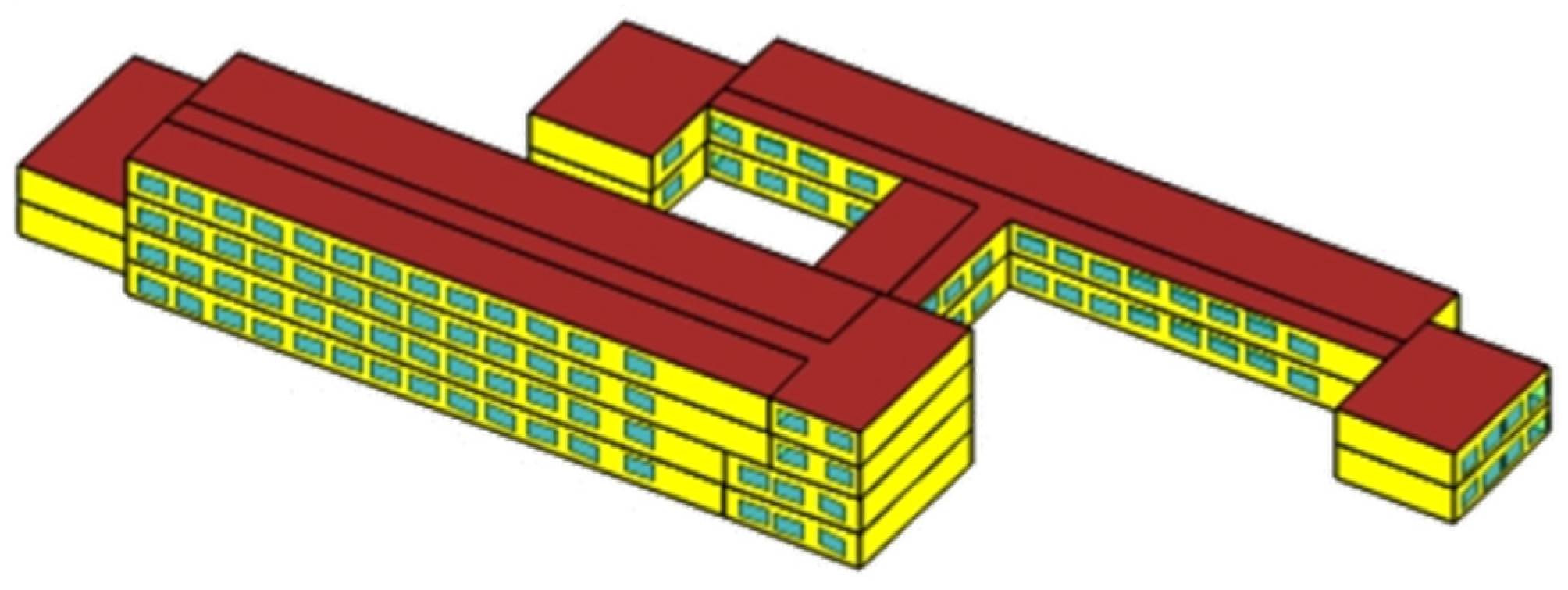
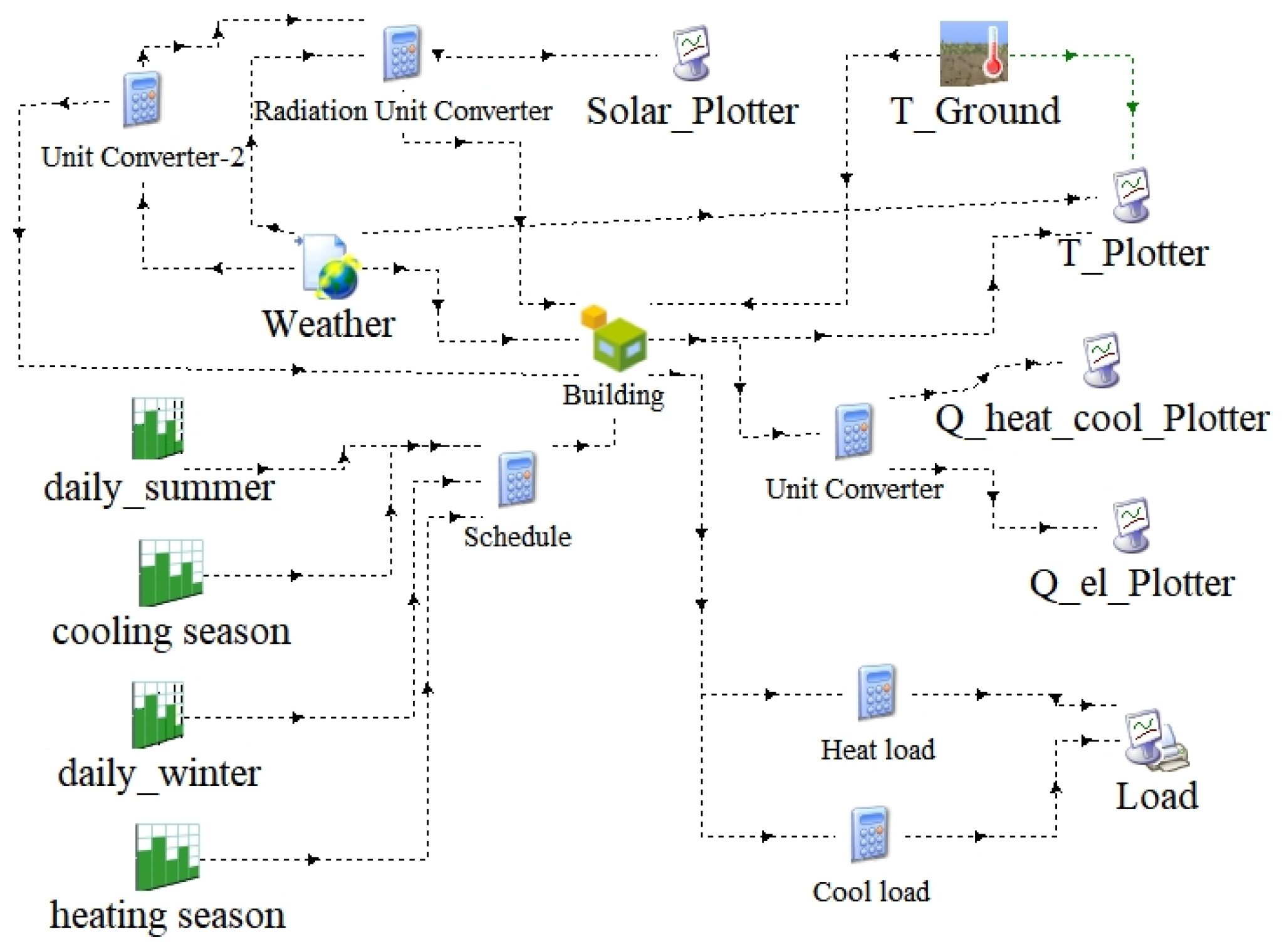
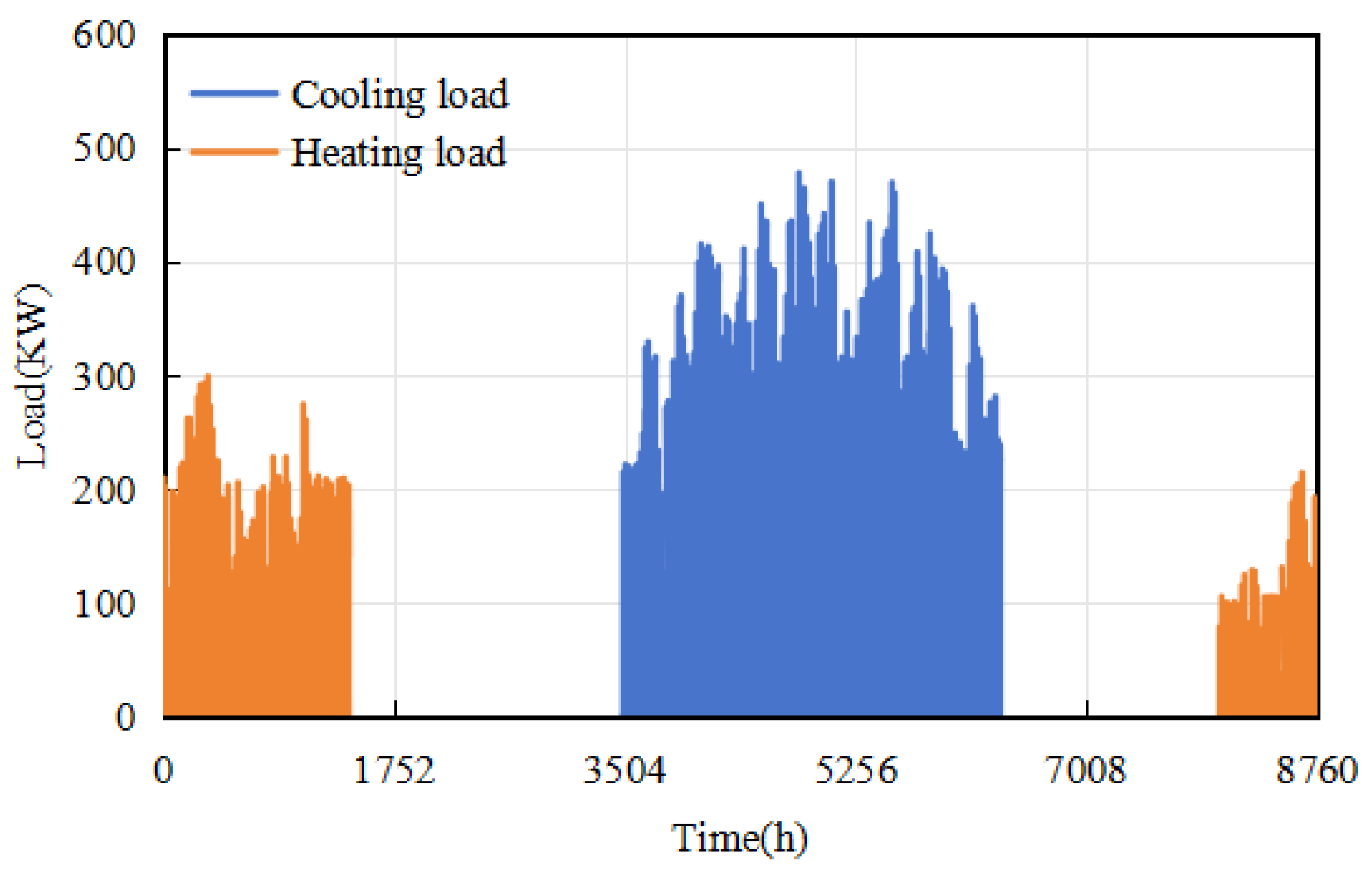
In this study, an actual laboratory building in Wuhan, China, was chosen for modeling in TRNSYS 18 and calculate the heating and cooling loads. The total conditioned area of the laboratory is approximately 5768 m2, comprising four floors with a floor-to-ceiling height of 3.5 m. The building model was developed using the SketchUp 2018 and TRNBuild software, as shown in Figure 1 and Figure 2. The meteorological file for the Wuhan region was selected for the simulation, which is a TMY2 format file generated by Meteonorm 7. The heating season is from 1 December to 1 February of the following year, and the cooling season is from 1 June to 1 September. The daily operating schedule of the HVAC system is from 9:00 a.m. to 6:00 p.m. The indoor temperatures in air-conditioned rooms are set to 20 °C and 26 °C for heating and cooling, respectively. These settings are determined in accordance with the typical operational requirements and comfort standards for office and laboratory buildings. The basic building parameters required for load calculation (including internal heat gains, building envelope components, and the thermo-physical properties of materials, etc.) are presented in Table 1 and Table 2. Table 1 presents the structural and thermal parameters of the building envelope, and Table 2 lists the thermal parameters of the materials used in the building envelope. The load simulation results are presented in Figure 3, where the designed cooling and heating loads are 460 kW and 252 kW, respectively. During transition seasons (spring and autumn), no cooling or heating supply is required for the building, as the outdoor ambient temperature falls within the thermal comfort range for indoor environments; hence, the hourly cooling and heating loads are set to zero. Also the laboratory was built in the 1990s, the building construction no longer meets current specification requirements, which means the U-value of the envelope and the load per area are relatively higher than those of new buildings.
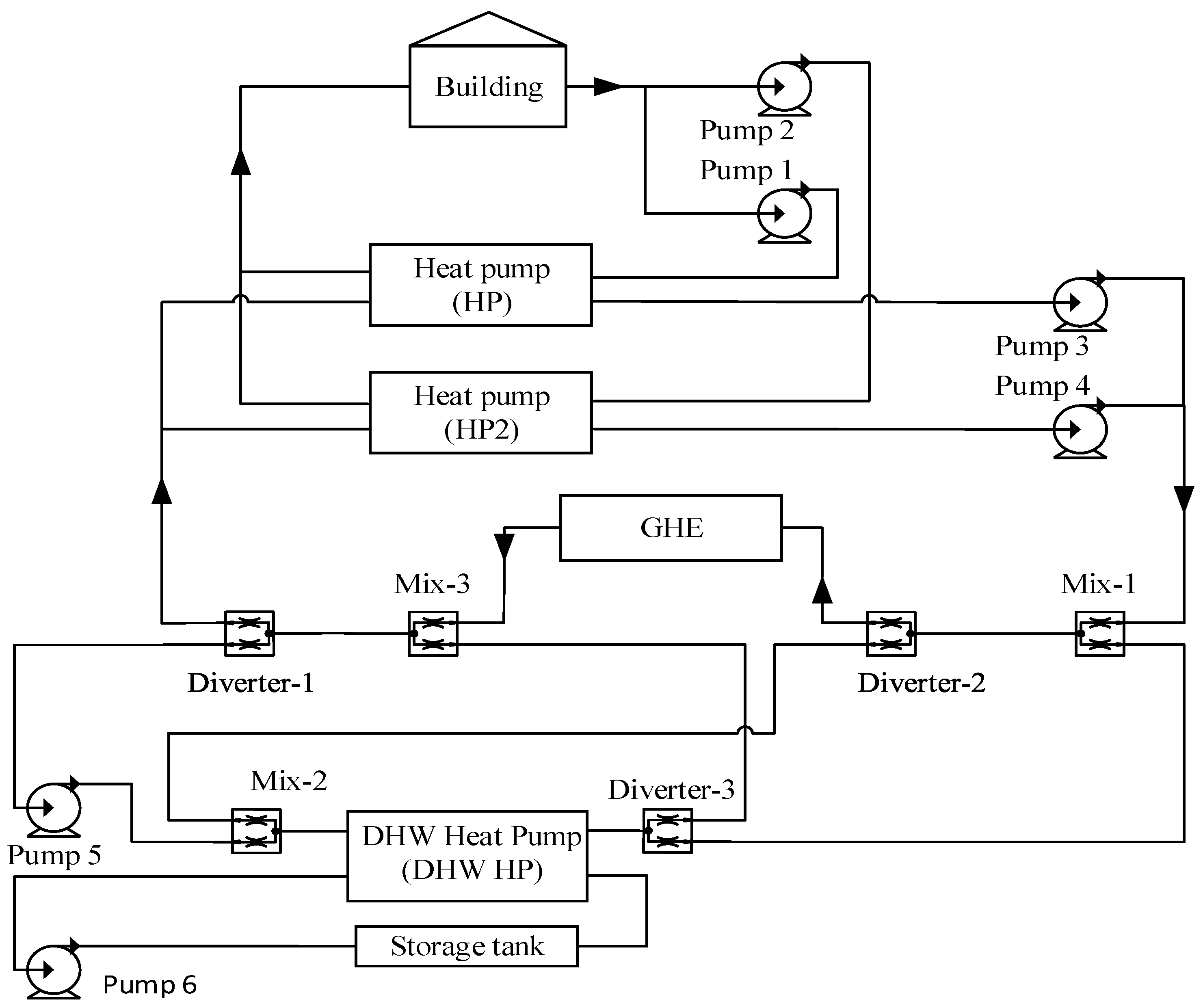
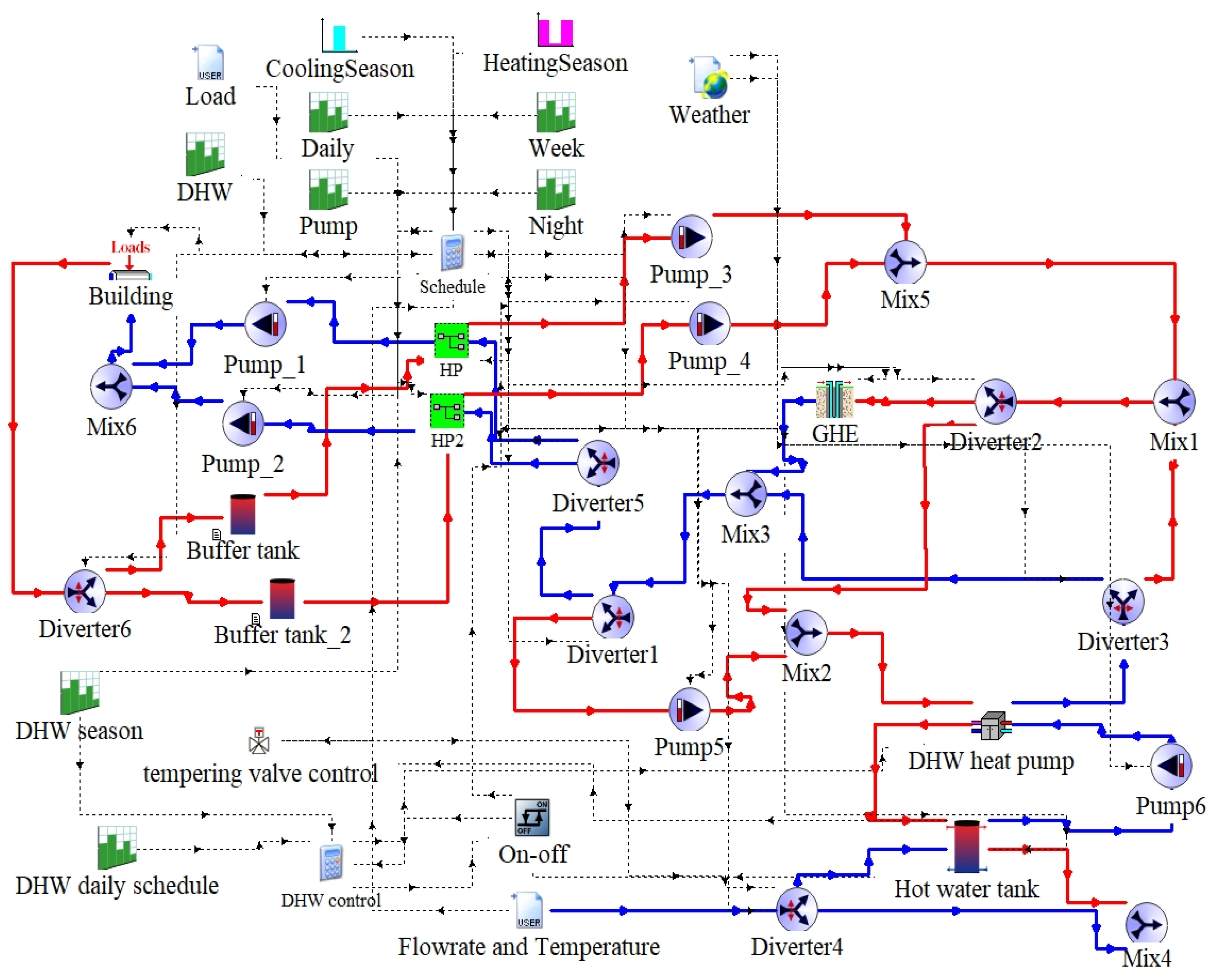
To take advantage of the opportunity provided by the renovation of the original system and improve system performance, an HGSHP-DHWs was established, as depicted in Figure 4. The HGSHP-DHWs is coupled with a DHW system within the GSHP system, where the demand for domestic hot water comes from the dormitory near the laboratory. The GSHP system mainly consists of two air-conditioning heat pump units (HP and HP2), four water pumps (Pumps 1 to 4), and GHXs. Due to the significant difference between the design heating load and cooling load, two heat pump units were selected. The HP2 is used for heating and cooling, while the HP is only used for cooling. The proposed HGSHP-DHWs includes a DHW heat pump, a water storage tank and two water pumps (Pump 5 and Pump 6). The water storage tank is designed to store the hot water. Pump 5 and Pump 6 are respectively installed in the DHW heat source-side loop and the DHW load-side loop, and are responsible for ensuring water circulation in both loops. The DHW heat pump is connected in parallel with the air-conditioning heat pumps and the GHXs through several dividers (Divider 1, 2, and 3) and mixers (Mix 1, 2, and 3). These connectors can change the flow direction of the loop through the newly proposed control strategies in this study, enabling the DHW heat pump to extract heat from the source loop of the HP and HP2 or from GHXs. The flow directions of the GSHP system are marked with arrows, and the flow paths of the GHE–DHW heat pump loop are detailed in Section 2.5 Control strategies. The HGSHP-DHW was developed in TRNSYS, as shown in Figure 5. The system is presented under the summer cooling condition, where blue pipelines represent chilled water and red pipelines represent hot water; the flow paths are switched accordingly in the heating season.

2.1. Heat Pump

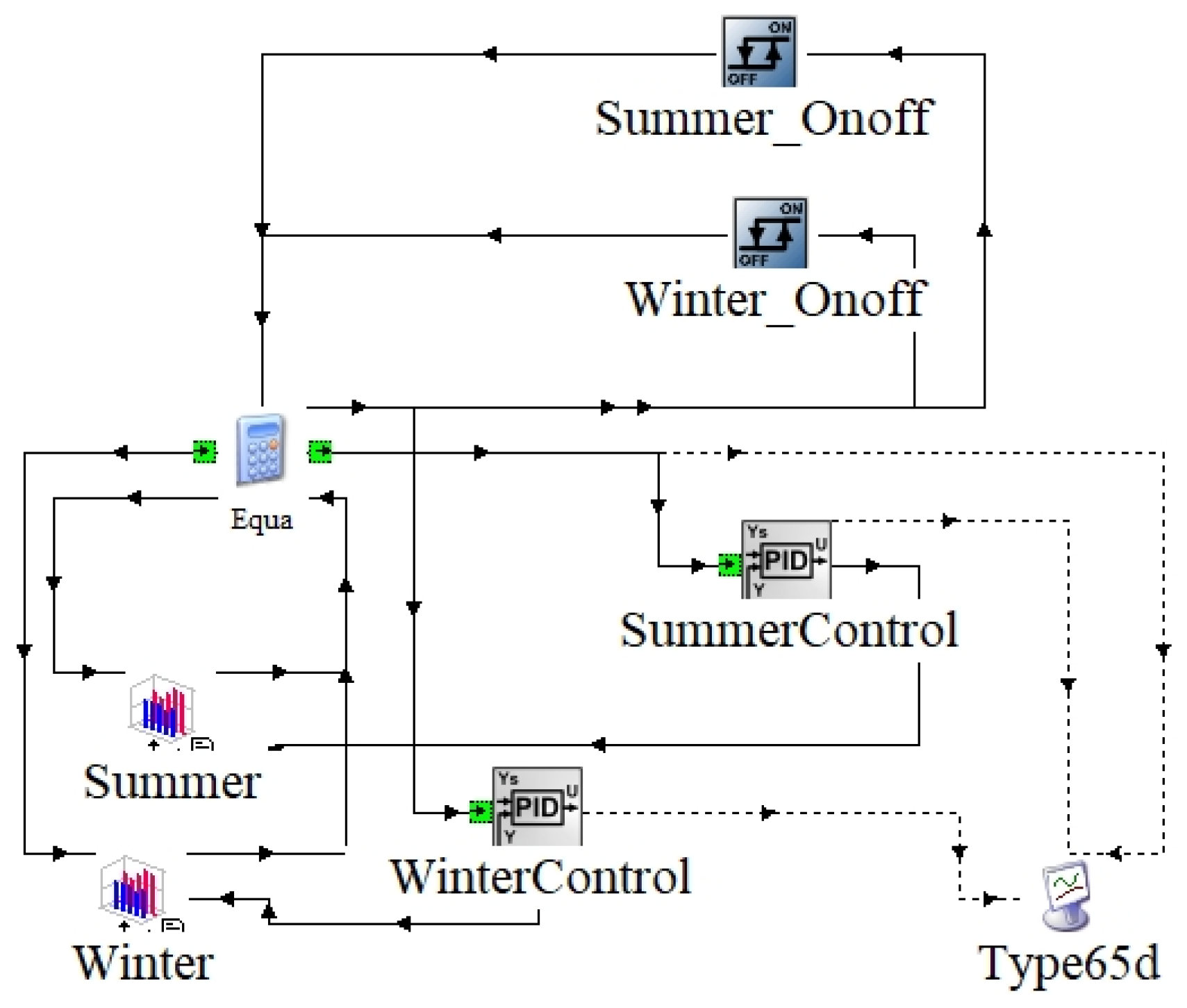
The variable-speed heat pump modules (HP and HP2) for cooling and heating in the HGSHP-DHW are developed based on the validated modeling framework presented in Ref. [26], which has been adopted and verified in the relevant literature. The key performance parameters of the heat pump units are proportionally scaled up according to the actual cooling and heating capacity requirements of the actual building, while maintaining the same structural logic and control algorithm as the validated base model. The configuration of the module is shown in Figure 6, which mainly consists of PID modules, on–off modules and multi-dimentional data interpolation modules.
There are two PID modules in the HP module, and their functions are to control the speed of the heat pump to maintain the outlet temperature at the set temperature for cooling and heating, respectively. The PID control logic and parameter tuning method for compressor speed regulation are adopted and modified based on the validated framework presented in Ref. [27], where a PID algorithm was employed to regulate the compressor speed of modulating heat pumps for stable outlet water temperature control. The controlled speed range of the HPs is from 600 RPM to 3000 RPM. The design supply water temperatures of both heat pumps are set to 7 °C in summer and 40 °C in winter, respectively. The air-conditioning terminals are conventional fan coils, but in this simulation, the main focus is on the impact of the load on the heat pump system, and the heat transfer of the air-conditioning terminals is not considered. The basic parameters of the PID modules, including the proportional gain (Kp), integral gain (Ti) and differential gain (Td) are −4, 180 and 0.
There are also two on–off modules corresponding to the two PID controllers. The function of the on–off controllers is to control the on–off status of the PID controllers. When the building load is relatively low and the heat pump units work under partial load, the PID controllers control the heat pump at a low speed. When the heat pumps work at the lowest speed, but the cooling or heating capacity is still higher than the demand, the supply water temperature cannot be controlled, and the water will continue to decrease or increase during cooling and heating, respectively. At this time, the on–off controller switches to 0 and the heat pump units are turned off until the supply water temperature returns to the design temperature. The upper limit error of the on–off module is 5 °C, and the lower limit error is 0 °C.
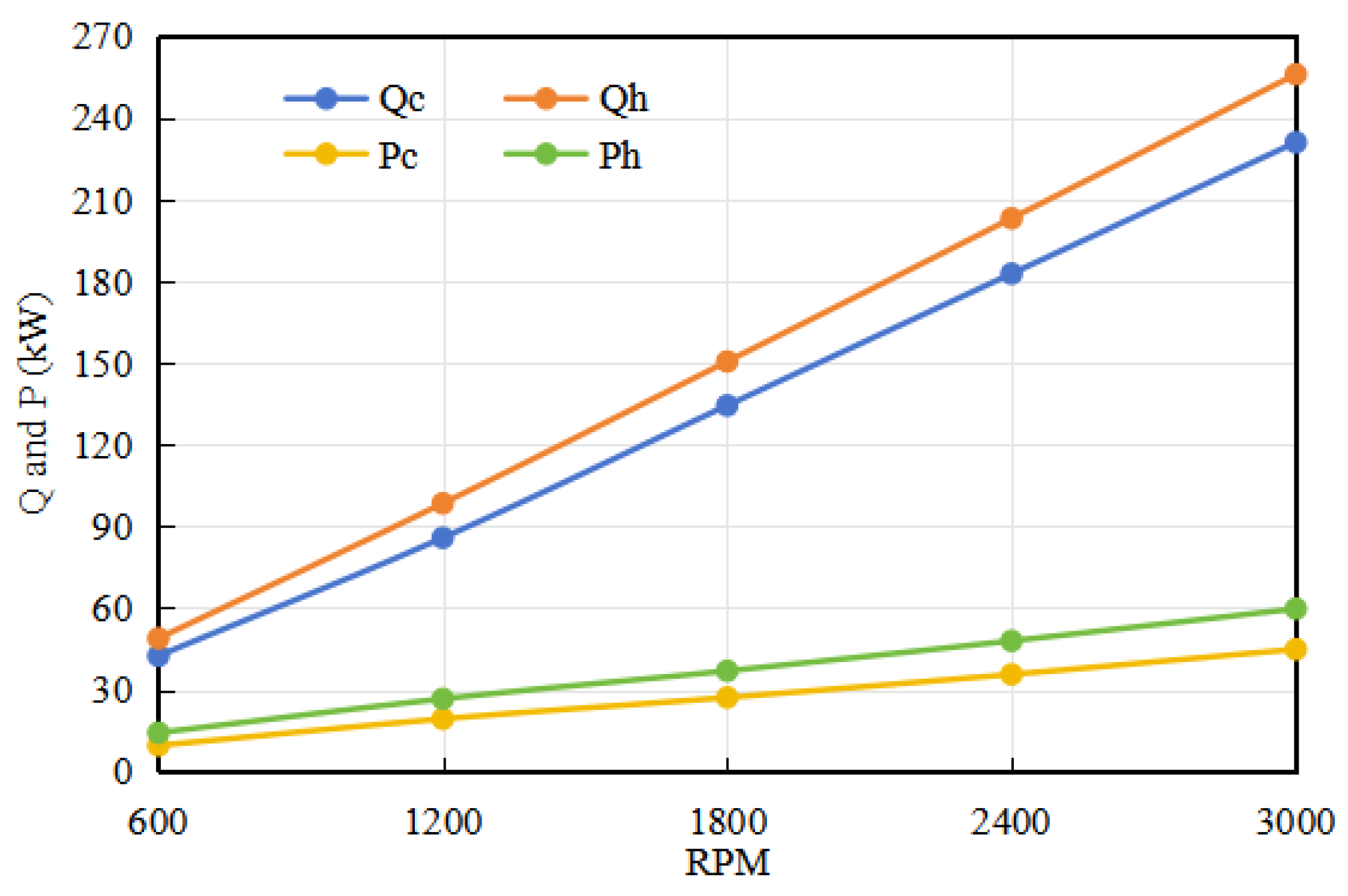
The function of multi-dimentional data interpolation modules is to call the heat pump performance curves through linear interpolation. There are three inputs and two outputs in the interpolation modules; the input variables entering temperature of water from the source (ETWs, °C), the entering temperature of water from the load (ETWl, °C), and the rotating speed of the compressor (Ncomp). The output variables are he cooling/heating capacity (Qc/Qh) and the power consumption (Pc/Ph). The two interpolation modules respectively represent the cooling and heating performance curves of the heat pump units, with the specifications of YSSR-250A, sourced from Beijing Yongyuan Heat Pump Co., Ltd. (Beijing, China). The capacity and power consumption performance curves of the heat pump are based on the manufacturer’s technical data, as shown in Figure 7. Both the capacity and power consumption of the heat pump increase with the rise in Ncomp. The rated cooling and heating capacities are 231 kW and 256 kW, and the corresponding powers are 44.9 kW and 59.8 kW with Ncomp being 3000. The rated return and supply water temperature conditions are 12/7 °C for cooling and 35/40 °C for heating. Both heat pumps are of the same type, and can fully satisfy the load demand of the building.

2.2. Water Pump

There are six water pumps in the HGSHP-DHWs in total. Pumps 1 to 4 are the circulating water pumps for air conditioning and the Pumps 5 to 6 are used for the DHW system. The operating times of water pumps 1 and 3 are consistent with that of the HP, and the operating times of water pumps 2 and 4 is consistent with that of the HP2. Except for Pump 5, all other pumps operate at a constant flow rate, meaning they work at nominal conditions. The Pump 5 is a three-stage variable-speed pump, and its stages are switched according to the proposed control strategy in this study. The power consumption of Pump 5 at various flow rates is calculated using Equation (1). The main nominal parameters of these pumps are listed in Table 3. These pumps are manufactured by Grundfos, Suzhou, Jiangsu Province, China.
P p u m p = A 1 × F 2 + A 2 × F + A 3
where P p u m p is the power consumption of Pump 5, F is the flow rate of the fluid through the pump, and A 1 , A 2 , and A 3 are the power coefficients, with A 1 = −0.0014, A 2 = 0.108, and A 3 = 1.912.

2.3. Ground Heat Exchangers

The ground heat exchangers (GHEs) of the HGSHP-DHWs are designed to fulfill the cooling, heating and DHW requirements. Type 557a was chosen to model their behavior in TRNSYS. This component is modeled as a vertical U-type borehole heat exchanger. The parameters of the GHEs are referred to in Ref. [28]. The total length of the GHEs is calculated separately for the cooling and heating seasons, with the greater value being adopted as total design length.
The total length of the GHEs in the cooling season is calculated using Equation (2):
L c   =   1000 Q c R b + R s t max t COP c + 1 COP c
where Qc is the rated cooling capacity of GSHP, which is the sum of the rated cooling capacity of HP and HP2, 462 kW; Rb is the total heat transfer resistance of the boreholes, 0.079 m·K/W; Rs is the ground thermal resistance, 0.499 m·K/W in the cooling seasons and 0.166 m·K/W in the heating seasons; COPc is the coefficient of performance (COP) of the GSHP in the cooling season, using the rated value of HP, 6.64; tmax is the design average temperature of the medium in the GHEs under cooling conditions (°C), 34 °C; and t is the initial temperature of the ground, 19 °C.
The total length of the GHEs in the heating season is calculated using Equation (3):
L h = 1000 Q h R b + R s t t max COP h + 1 COP h
where Qh is the rated heating capacity of the GSHP, which is the rated heating capacity of HP, 256 kW; COPh is the COP of the GSHP in the heating season, 4.28.
The quantity of GHEs is calculated using Equation (4):
N   =   max ( L c , L h ) H
where H is the depth of a single borehole, 100 m.
The calculation results indicate that the quantity of GHEs in HGSHP-DHWs is 95.
The basic parameters of the GHEs are listed in Table 4.

2.4. Domestic Hot Water (DHW)

Introducing the DHW system into the GSHP system can help solve the problem of thermal imbalance in the GHEs, but it also increases the complexity of the system. Therefore, for such a complex system, a reasonable design of the DHW equipment and efficient control strategies are particularly important. This section mainly introduces the design and selection of equipment in the DHW system, and the calculation formulas (From Equation (5) to Equation (8)) and relevant parameters adopted in the design process are all determined according to the standard [29]. A three-story dormitory near the laboratory was chosen, and the DHW demand ( Q d ) was calculated according to Equation (5), which is the selection criterion for the DHW heat pump.
Q d = U q r C ( t h t c ) ρ h T C γ
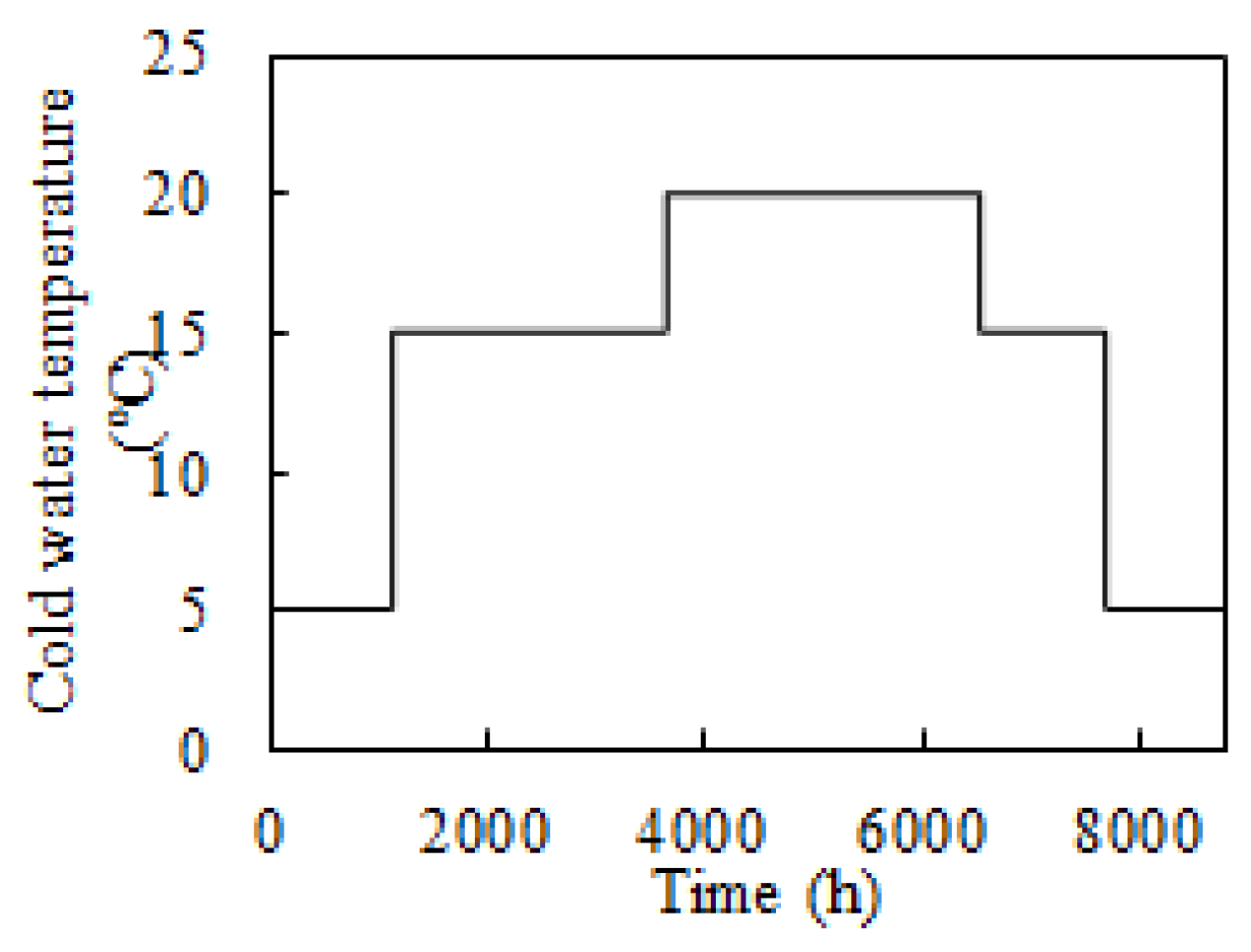
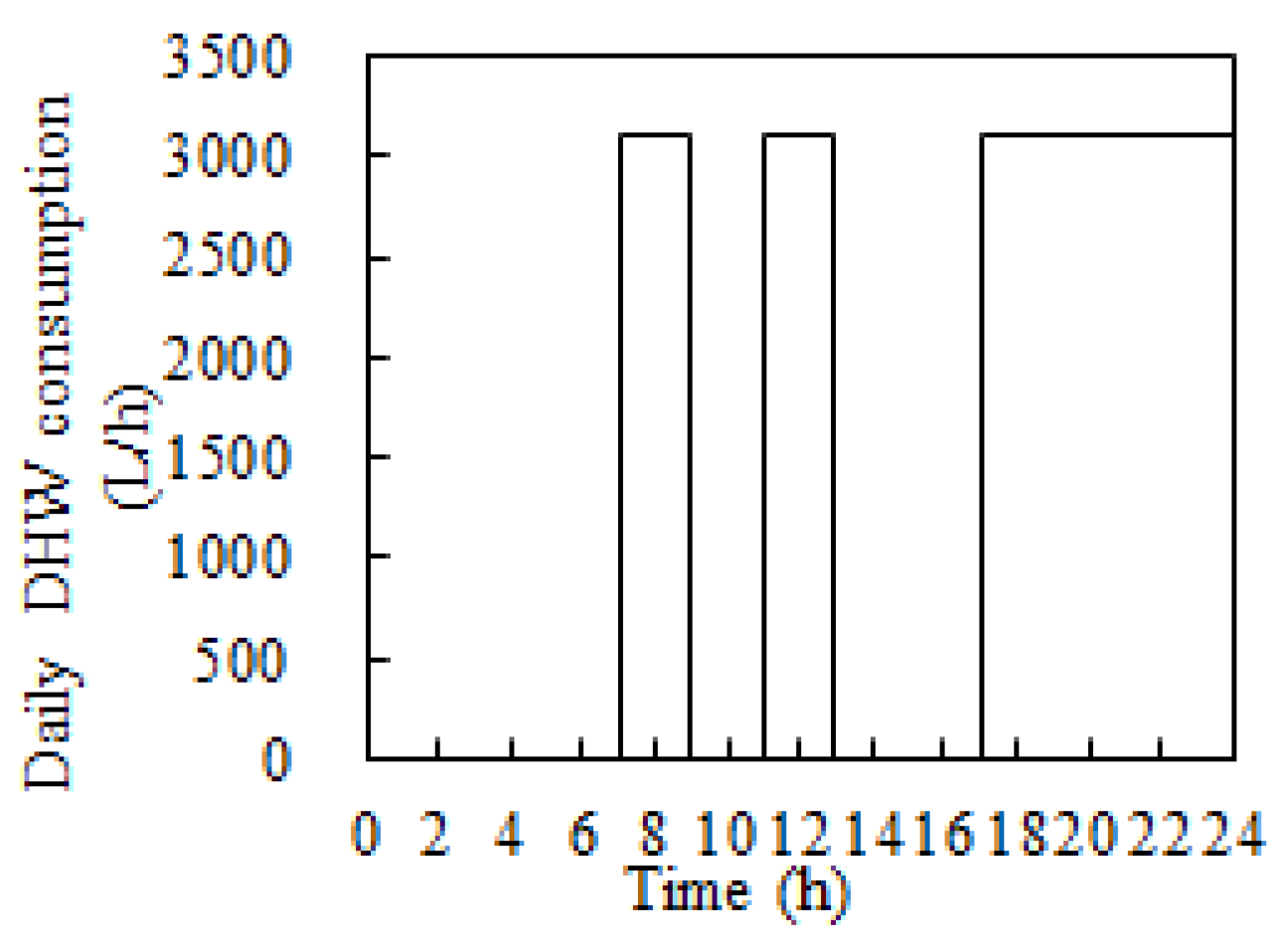
where U is the number of DHW users, with a value of 500 persons. q r is the per capita daily hot water quota and the value is 70 L/(person·day). t r is the design storage hot water temperature with the value of 50 °C. ρ h is the hot water density (kg/L), equals to 1, and C γ is the heat loss coefficient, equals to 1.1. t c is the temperature of supplementary water for the water storage tank, which may vary depending on the outdoor temperature and the seasonal variation schedule of the water temperature is given in Figure 8 based on the standard [29]; and T is the daily usage time (h), as shown in Figure 9, totaling 11 h. The hot water storage tank component is of Type 4 in TRNSYS.
The volume of the hot water storage tank ( V r ) can be determined using Equation (6), in which T 2 is the ratio of the daily hot water opening time to the whole day. The calculated volume of the storage tank is 19.3 m3 and the loss coefficient of the storage tank is 3 kJ/(h·m2·K).
V r = 1.1 T 2 U q r C γ 1000
The hourly DHW consumption ( q r h ) is calculated by Equation (7), which can be used to determine the capacity of the water pumps, as shown in Figure 8.
q r h = Q h ( t h t c ) C p ρ r C γ
Q h is the hourly heat consumption of DHW (kJ/h), calculated by Equation (8):
Q h = q h C t h l t c ρ h n 0 b g C γ
where q h is the hourly hot water quota (L/h) of the water-using appliance, with the value of 250 L/h; t h l is the hot water usage temperature (°C), equal to 40. n 0 is the number of sanitary appliances of the same type, with the value of 20; and b g is the percentage of simultaneous use of the same type of sanitary appliances, equal to 0.8.
After obtaining the Q d and the q r h , the specifications of the DHW heat pump and circulation pumps can be determined. Type 927, a single-stage water-to-water heat pump model, was used to model the DHW heat pump. The on–off controller helps the DHW heat pump control the storage water temperature around the design storage hot water temperature. The dead-band temperature difference in the controller was set to 5 °C. The specification of the DHW heat pump is SM-200W (manufactured by Shandong Keling Energy Saving Equipment Co., Ltd., Weifang, China ), with a rated heating capacity of 200 kW, a rated operating power consumption of 40.6 kW, a rated heating performance coefficient of 4.93, and a rated outlet water temperature of 45 °C. Based on the manufacturer’s technical data for the DHW heat pump, Pump 6 is specified with a rated flow rate of 34.37 m3/h and rated power of 2.8 kW. The flow rate of Pump 5 is calculated by Equation (9), as 17.12 m3/h in winter, 13.4 m3/h in transition seasons, and 11.5 m3/h in summer. To meet the annual source-side flow demand of the DHW heat pump, the rated flow rate of Pump 5 is set at 17.12 m3/h with a rated power of 1.44 kW.
M pump 5 = 1.1 Q d 1 1 COP d × 3600 C × T e _ DHW × 1000
where COP d is the rated COP of the DHW heat pump, 4.93; T e _ DHW is the temperature difference between the inlet and outlet water in the source side evaporator of the DHW heat pump, 8 °C.

2.5. Control Strategies

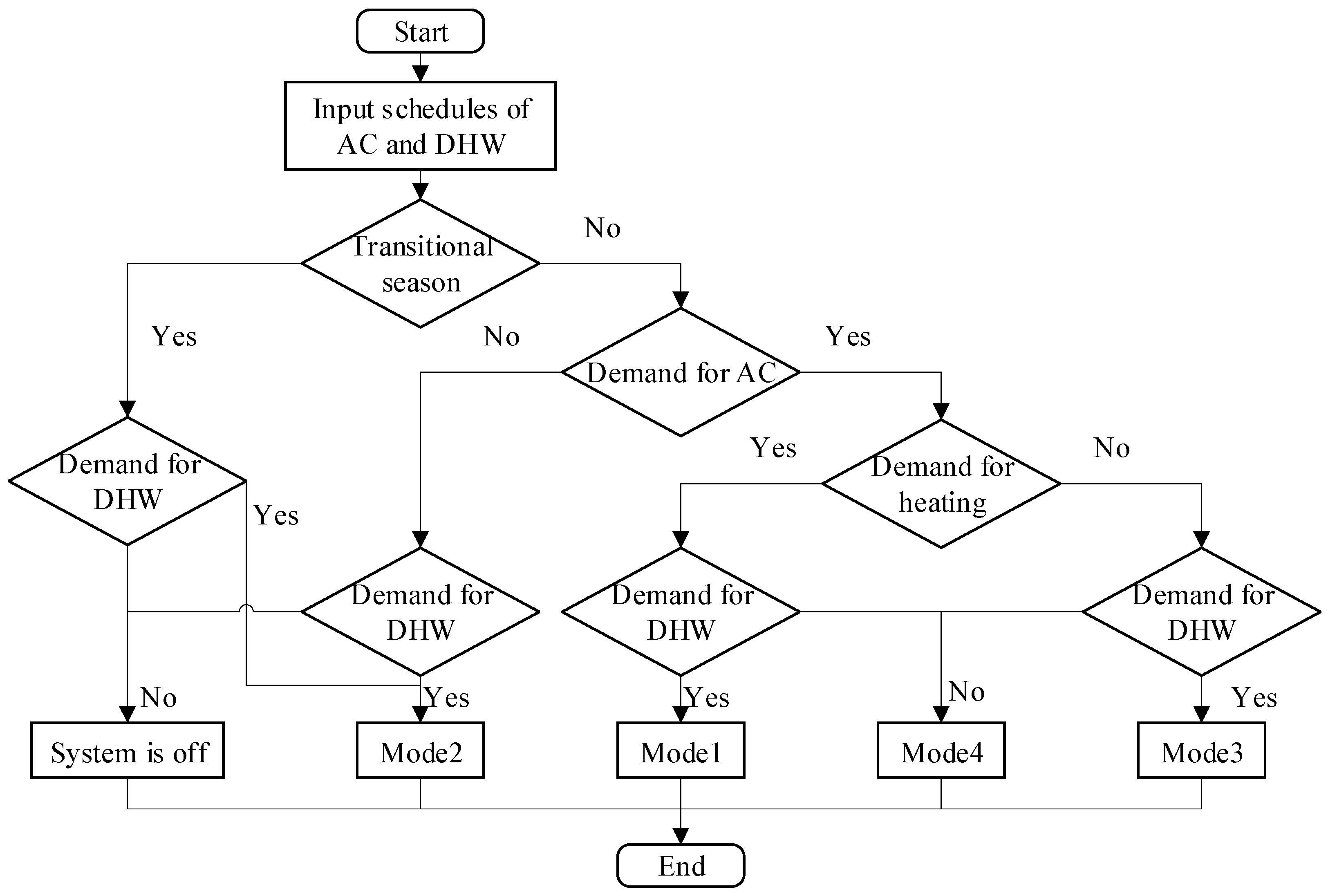
To meet the energy demands for cooling, heating, and DHW throughout the year and improve the energy efficiency of the HGSHP-DHWs, a new control strategy was developed. The control signal flow chart is presented as shown in Figure 10. There are four modes in the control strategy for the three seasons (cooling, heating and transition season). This control strategy changes the structure of the source-side loop by controlling the valve signals in the HGSHP-DHWs, thereby changing the direction of the circulating water flow, and ultimately achieving mode switching according to the demand.
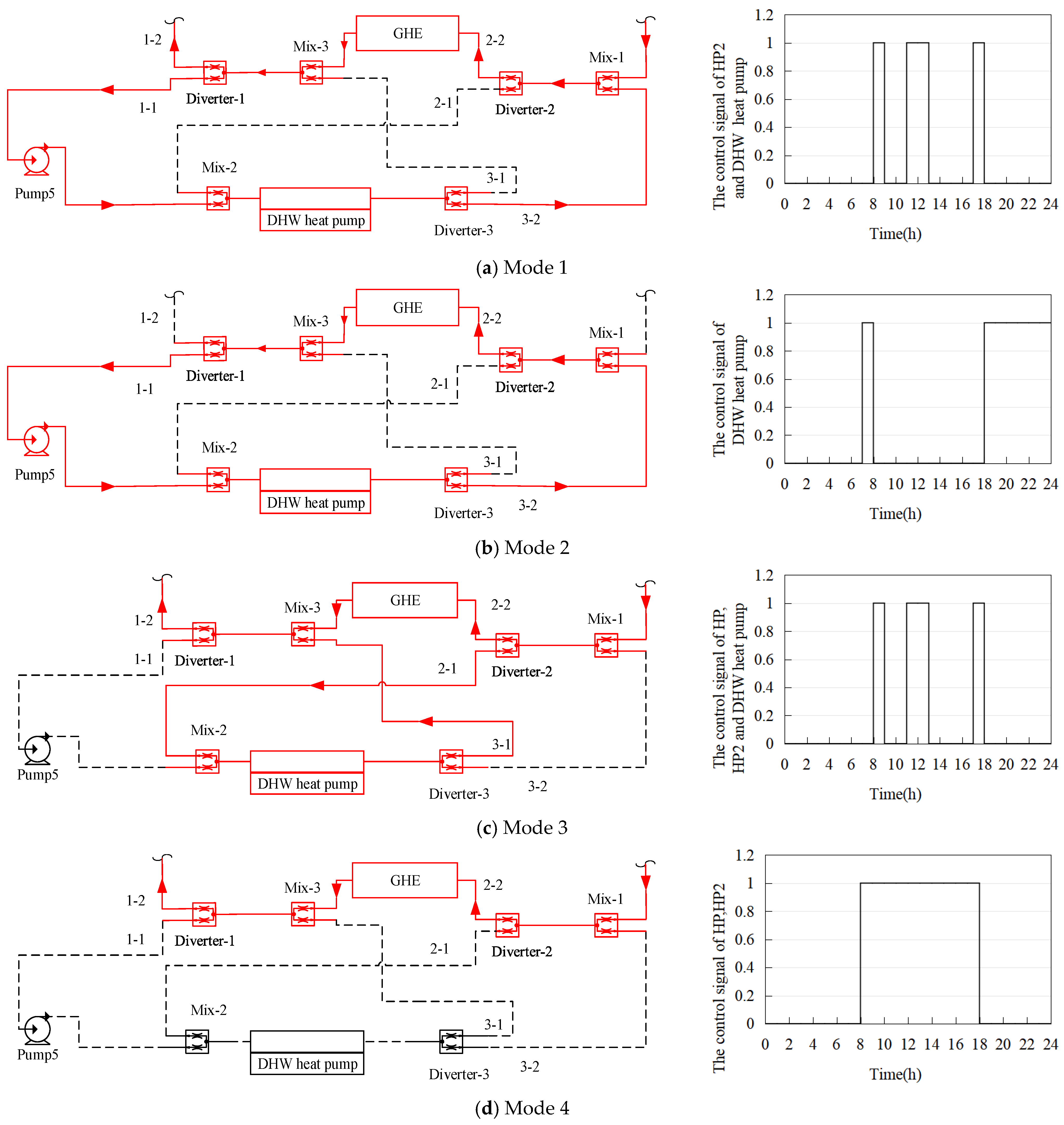
Based on the proposed control strategy, the HGSHP-DHWs switches between the four modes according to demand throughout the year, as shown in Figure 11. The left half of the figure represents the source-side loop structure of the system, the outlet directions of each divider are numbered (for instance, 1-1 indicates the outlet direction 1 of Divider 1). The red lines and arrows indicate the pathways and flow directions. The black dashed lines indicate circuit breaks, meaning that fluid will not flow through these sections of the pipeline in these modes. The right part represents the heat pumps control signals. From the vertical axis, it can be seen that the heat pumps, including HP, HP2 and DHW heat pump, that need to be controlled in different modes are different, depending on the season and the energy demands.
The diverters (Divider-1, 2 and 3) are the controlled objects. The diverters consist of one inlet and two outlets, and their control signals of them set the damper’s positions to control the flow rate proportion of the two outlets. The control signals for the diverters are calculated according to Equation (10).
S div _ n = M n 1 M in _ n
where n is the number of the diverter, S div _ n is the control signals for diverter, M n 1 is the flow rate at outlet direction 1 of Diverter n, M in _ n is the inlet flow rate of Diverter n.
The detailed explanations of the four modes are as follows:
  • Mode 1: Dual demand mode for heating and DHW in heating season
This mode is activated only when the system simultaneously requires heating and DHW supply. During operation, the DHW heat pump and air conditioning heat pump HP2 operate in parallel, jointly extracting low-grade thermal energy from GHEs to meet both load demands concurrently.
The control signals of the diverters: Both the control signals of HP2 and DHW heat pump are set to 1, indicating they are activated. The flow rate in the source side of HP2 is 50 m3/h, while the flow rate in the source side of the DHW heat pump is 17.12 m3/h. The control signals of the diverters are calculated according to Equation (10). Mn−1 of Diverter 1 is the source side flow rate of the DHW heat pump, 17.12 m3/h, while Mn−1 of Diverter 2 and Diverter 3 are both 0. The Min_n of Diverter 1 is the sum of the flow rates in the source side of HP2 and the DHW heat pump, 67.12 m3/h. The control signals for Diverter 1, 2, and 3 are calculated and set to 0.255, 0, and 0 respectively.
Flow rate of Pump 5 and flow distribution: Pump 5 operates at a rated flow rate of 17.12 m3/h. According to the control signals of the diverters, 25.5% of the flow rate of Diverter 1 flows to outlet direction 1, supplied to the DHW heat pump, while 74.5% flows to outlet direction 2, supplied to the air conditioning heat pump. All of the flow rate of Diverter 2 and 3 flows to outlet direction 2, supplied to GHEs.
  • Mode 2: Single demand mode for DHW throughout the year
This mode is activated only when the system requires DHW without air conditioning requirements. During operation, the DHW heat pump extracts thermal energy through GHEs to heat DHW, while the air conditioning heat pumps are off.
The control signals of the diverters: The control signals for the air conditioning heat pumps are set to 0 (turn off), while the control signal of the DHW heat pump is set to 1 (turn on). The control signals of the diverters are calculated according to Equation (10). Mn−1 of Diverter 1 equals Min_n, while Mn−1 of Diverters 2 and 3 are both set to 0. The control signals of Diverters 1, 2, and 3 are 1, 0, and 0, respectively.
Flow rate of Pump 5 and flow distribution: Due to seasonal variations, Pump 5 operates in a variable flow mode to meet load demands. During the heating seasons, when the DHW load remains relatively high, Pump 5 runs at the rated flow rate of 17.12 m3/h. During transitional seasons with reduced DHW load, the flow rate of Pump 5 flow rate is 13.4 m3/h (78% of rated flow rate). In the cooling seasons with further load reduction, the flow rate of Pump 5 is 11.5 m3/h (67% of the rated flow rate), achieving energy savings through flow rate control. According to the control signals of the diverters, all of the flow rate of Diverter 1 flows to outlet direction 1 (Pump 5), supplied to the DHW heat pump, while Diverters 2 and 3 maintain identical flow distribution to Mode 1.
  • Mode 3: Dual demand mode for cooling and DHW in cooling season
This mode activates only when the system simultaneously requires cooling and DHW supply. During operation, the DHW heat pump, GHEs, and air conditioning heat pumps HP and HP2 operate in parallel. During the operation of the air conditioning heat pumps, the high-grade thermal energy released is partially transferred to the GHEs for soil storage, while the remaining energy is supplied to the DHW heat pump.
The control signals of the diverters: The control signals for the air-conditioning heat pumps HP, HP2, and the DHW heat pumps are all set to 1 (turn on). The control signals of the diverters are calculated according to Equation (10). The Mn−1 of Diverter 1 is 0, while the Mn−1 and Min_n of Diverter 2 is 11.5 m3/h, 100 m3/h, respectively. The Mn−1 of Diverter 3 equals Min_n. The control signals of Diverters 1, 2, and 3 are 0, 0.115, and 1, respectively.
Flow rate of Pump 5 and flow distribution: Pump 5 is off. According to the control signals of the diverters, 11.5% of the flow rate of Diverter 2 flows to outlet direction 1, supplied to DHW heat pump and recover waste heat from air-conditioning heat pumps HP, HP2, while the remaining 88.5% flows to the GHEs for soil storage, regulating thermal accumulation. All of the flow rate of Diverter 1 flows to outlet direction 2, supplied to the air-conditioning heat pumps HP, HP2. All of the flow rate of Diverter 3 flows to outlet direction 1, supplied to the air-conditioning heat pumps HP, HP2.
  • Mode 4: Single demand mode for air conditioning throughout the year
This mode activates only when the system requires air conditioning heating or cooling supply without DHW demand. During operation, air conditioning heat pump (HP and HP2 operate in the cooling season, while HP2 operates alone in heating season) extracts thermal energy through the GHEs, while the DHW heat pump is off.
The control signals of the diverters: The control signal of the air-conditioning heat pump is set to 1 (turn on), while the control signal of the DHW heat pump is set to 0 (turn off). The control signals of the diverters are calculated according to Equation (10). Mn−1 of Diverter 1, 2, and 3 are all set to 0. Consequently, the control signals for diverter-1, 2, 3 are all set to 0.
Flow rate of Pump 5 and flow distribution: a there is no DHW load, Pump 5 is off. All of the flow rate of Diverter 1 flows to outlet direction 2, supplied to the air conditioning heat pumps. All of the flow rate of Diverter 2 flows to outlet direction 2, supplied to the GHEs.

2.6. Reference Systems for Comparison

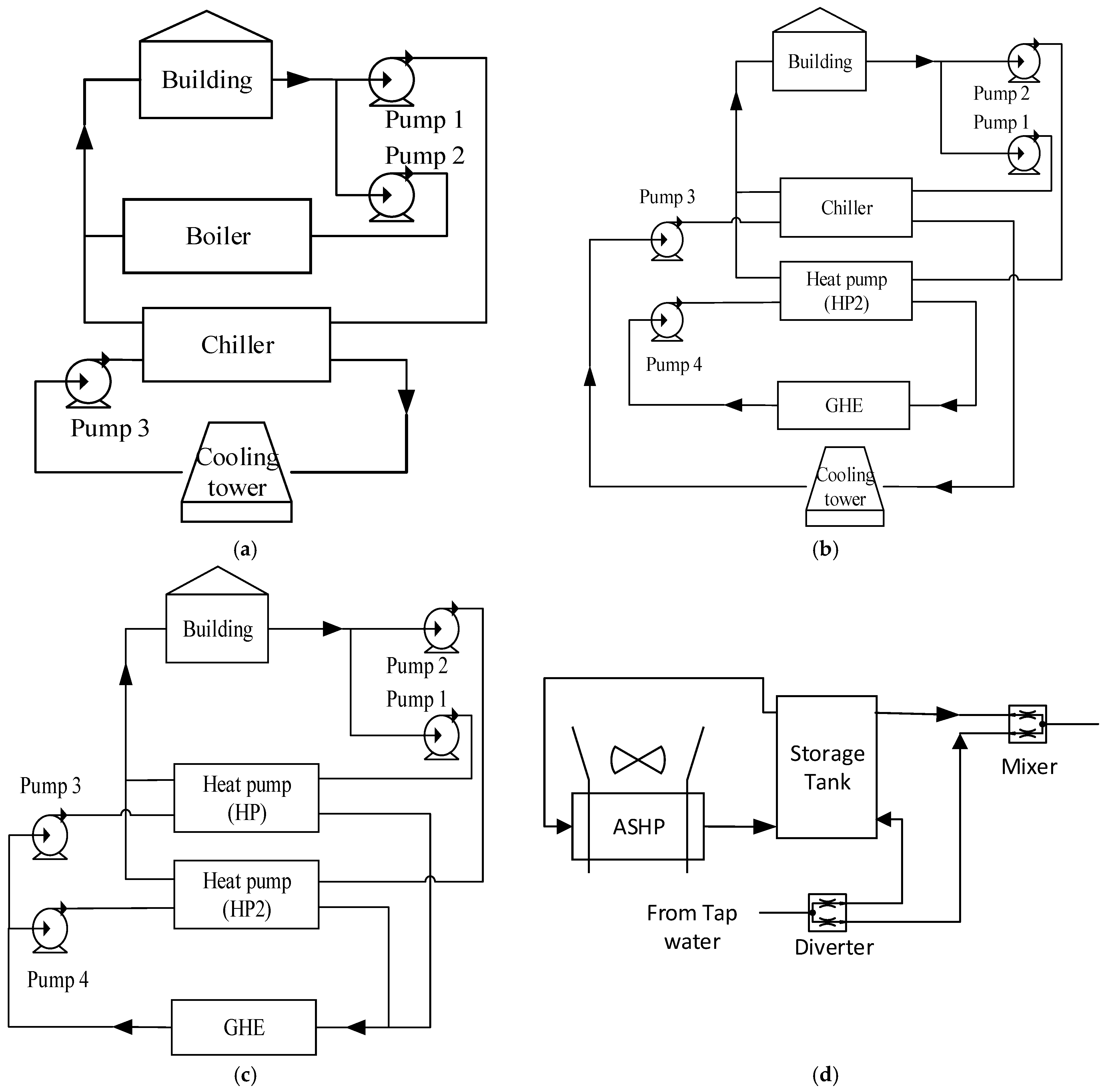
As depicted in Figure 12, three other traditional HVAC systems were selected for comparative analysis, which are the chiller–boiler (CB) system, the cooling tower-assisted hybrid ground source heat pump (CT-HGSHP) system, and the ground source heat pump (GSHP) system. These systems, built in TRNSYS, are all equipped with an independent air source heat pump domestic hot water (ASHP-DHW) system, which is the most popular DHW system in hot-summer and cold-winter areas. Three air source heat pumps with model MAC230DR5 (manufactured by McQuay International, Shanghai, China) have been selected for DHW production. The rated heating capacity, power consumption and COP for DHW production are 68 kW, 19.8 kW and 3.43, respectively. During operation, due to the simultaneous opening and closing of the three ASHP DHW units, only one TYPE 941 module was selected in the TRNSYS modeling, but the number of units in the module was set to 3.
The CBs is mainly composed of a chiller, a cooling tower, and a boiler. The module ‘HP’ in HGSHP-DHW was used as the chiller. In summer, the chiller and cooling tower provide cooling, and the boiler provides heating. The specification of the chiller is YSSR-500A, sourced from Beijing Yongyuan Heat Pump Co., Ltd. (Beijing, China). The chiller’s rated cooling capacity and power are 475 kW and 88.8 kW. The model of the chiller is the same as the HP model, but it is scaled up proportionally based on the capacity. Under rated cooling conditions, the evaporator’s inlet and outlet water temperatures are 12/7 °C, and the inlet and outlet water temperatures of the condenser are 32/37 °C. The design water flow rate of the cooling tower is 100 m3/h and the motor power is 2.5 kW, sourced from Guangdong Feiyang Industrial Group Co., Ltd. (Dongguan, China). The rated capacity of the boiler is 239 kW; it is assumed to be on during the heating season and will attempt to meet the specified outlet temperature, which is set to 40 °C.
The CT-HGSHPs consists of a heat pump, a chiller, a cooling tower and the GHEs. The modules and specifications for the chiller and heat pump are the same as the HP and HP2 in HGSHP-DHWs. The chiller is connected to the cooling tower, sourced from Guangdong Feiyang Industrial Group Co., Ltd. (Dongguan, China), the design water flow rate of the cooling tower is 51.5 m3/h and the fan power is 1.1 kW. Both the chiller and HP provide cooling, while HP is also used for heating. The design number of the GHEs is less, because only the heat pump (HP2) exchanges heat with the soil through the GHEs. There are 47 boreholes in total.
The GSHPs is similar to the HGSHP-DHW, except for the difference in the DHW section. There are two heat pumps (HP and HP2) connected to the GHEs for heat exchange with the soil. The number of GHEs is the same as the HGSHP-DHWs. To meet the cooling load, the two heat pumps are turned on. However, only one heat pump is turned on to meet the heating demand.

3. Evaluation Indices

3.1. Energy Efficiency and Soil Thermal Balance Performance

To evaluate the energy efficiency of heat pump units and the systems, the coefficient of performance (COP) and the system performance factor (SPF) are selected as evaluation indices. The energy efficiency performances of the heat pumps in these systems are evaluated by the COP, which is defined as the ratio of the cooling or heating capacity to the power consumption, calculated using Equation (11). A higher COP value indicates better energy efficiency and lower power consumption. The energy efficiency of the systems is evaluated by the SPF, calculated using Equation (12). The numerator of the equation consists of two parts: the cooling or heating capacity ( Q H V A C , kJ/h), and the DHW capacity ( Q D H W , kJ/h). The denominator includes the power consumption of all the heat pumps ( P H P , kJ/h), water pumps ( P W P , kJ/h) and fans ( P F A N , kJ/h).
C O P = Q H P P H P
S P F = Q H V A C + Q D H W P H P + P W P + P F A N
Soil temperature is a core indicator, and it is significant to the system’s efficiency, stability and lifespan. It reflects the long-term stability of the system and serves as a signal for soil thermal accumulation. Monitoring the soil temperature during operation enables the timely adjustment of operating strategies, ensuring the system operates in an energy-saving manner over long-term operation.

3.2. Life Cycle Climate Performance (LCCP)

To evaluate the system’s impact on the environment, LCCP is selected as the evaluation index. LCCP assesses the total CO2 emissions of systems across their full life cycle—from raw material extraction, production, operation to disposal. It is a key for low-carbon-system selection and carbon neutrality efforts. The LCCP of the system consists of the LCCP of each major component in the system, calculated using Equation (13). The subscripts of WHP, WP, CT and NGB represent the water-source heat pump, water pump, cooling tower and natural gas boiler, respectively. In the HGSHP-DHWs, the WHP units include HP, HP2 and DHW heat pump. The method for calculating the LCCP for the WHP, chiller and ASHP is the same, which is obtained by adding the direct and indirect emissions (DE and IE, respectively), as given in Equations (14)–(16), based on Ref. [30].
L C C P s y s t e m = L C C P W H P + L C C P A S H P + L C C P c h i l l e r + L C C P W P + L C C P C T + L C C P N G B + L C C P G H E
L C C P W H P & L C C P A S H P & L C C P c h i l l e r = D E + I E
D E = M r e f × ( L × ALR + EOL ) × ( GWP + G W P a d p )
I E = ( A E C × μ C O 2 , e l e c ) / η e l e c ,   g r i d + ( m × M ) + ( m r × R M ) + M r e f × ( 1 + L × A L R ) × R F M
where the annual leakage rates (ALR) and end-of-life leakage rates (EOL) were assumed to be 2.5% and 15%, respectively, and the system lifetime (L) was assumed to be 15 years. The refrigerant charge (Mref) is 45 kg. The global warming potential (GWP) and the global warming potential of atmospheric degradation product of the refrigerant ( G W P a d p ) are assumed to be 1810 kgCO2 kg−1 and 0 kgCO2 kg−1. AEC is annual energy consumption of the units, kWh. μ C O 2 , e l e c is CO2 emission conversion factor, with the value of 0.749 kg/kWh. η e l e c ,   g r i d is the efficiency of the electricity grid, equals to 0.99. m is the mass of material (kg). mr is the mass of recycled material (kg), and M and RM are the energy consumption coefficients of material and recycled material. R F M is the refrigerant manufacturing emissions (kgCO2kg−1), R F M = 5.
The LCCP calculation methods for the WP, CT and NGP only consider the carbon emissions generated by the equipment during operation and the carbon emissions generated by the consumption of raw materials such as metals during production, manufacturing and recycling processes, calculated by using (17)–(19) [31]:
L C C P W P = ( A E C W P × μ C O 2 , e l e c ) + ( m × M M + m r × R M ) W P
L C C P C T = ( A E C C T × G C T ) + ( m × M M + m r × R M ) C T
L C C P N G B = ( A E C N G B × μ C O 2 , N G ) η N G B + 0.2 × ( m × M M + m r × R M ) H P
The carbon emissions caused by the consumption of metal raw materials in the production, manufacturing and recycling process of boilers are assumed to be 20% of those of heat pumps. The CO2 emission conversion factors for natural gas ( μ C O 2 , N G ) is 0.266 kg/kWh and the efficiencies of natural gas-fired ( η N G B ) is 0.9. The CO2 emission factor of CT ( G C T ) is 12.9 kg/kWh. The raw material consumption of each device in each system is shown in Table 5.
The carbon emissions of the GHE are mainly generated in construction, installation and pipe production, and can be calculated using Equation (20) [31]:
L C C P G H E = S G H E × G G H E + M t u b e × G t u b e
where SGHE is the total length of boreholes, m. GGHE and Gtube are the CO2 emission factors of the boreholes and the heat exchange tubes, which are 11.96 kg CO2/m and 2.62 kg CO2/kg. Mtube is the mass of the GHE tubes, kg.

3.3. Economical Performance

The net present value (NPV) is used for evaluating the economic feasibility of the systems. This evaluation indicator is calculated by comparing the HGSHP-DHWs with the other reference systems. A positive NPV indicates an economically feasible project, while a negative value means the project is economically infeasible. The mathematical expression for the NPV is given in Equation (21) [34,35]:
N P V = n = 1 15 C n ( 1 + i ) n T I C
where C n is the difference in cash flow between the reference systems and the HGSHP-DHWs in the n -th year, which is calculated by subtracting the operating cost of the reference system from that of the HGSHP-DHWs. The annual systems’ operating cost is calculated by multiplying the total energy consumption by the electricity price, and the electricity price is 0.8283 CNY/kWh. i is the discount rate, i = 5%. T I C is the total investment cost difference, it can be defined as the total investment cost of HGSHP-DHWs minus the total investment cost of the reference systems. The information required for calculating the total investment cost of the systems is provided in Table 6.

4. Results and Discussion

4.1. Comparison of Average Soil Temperature Rise

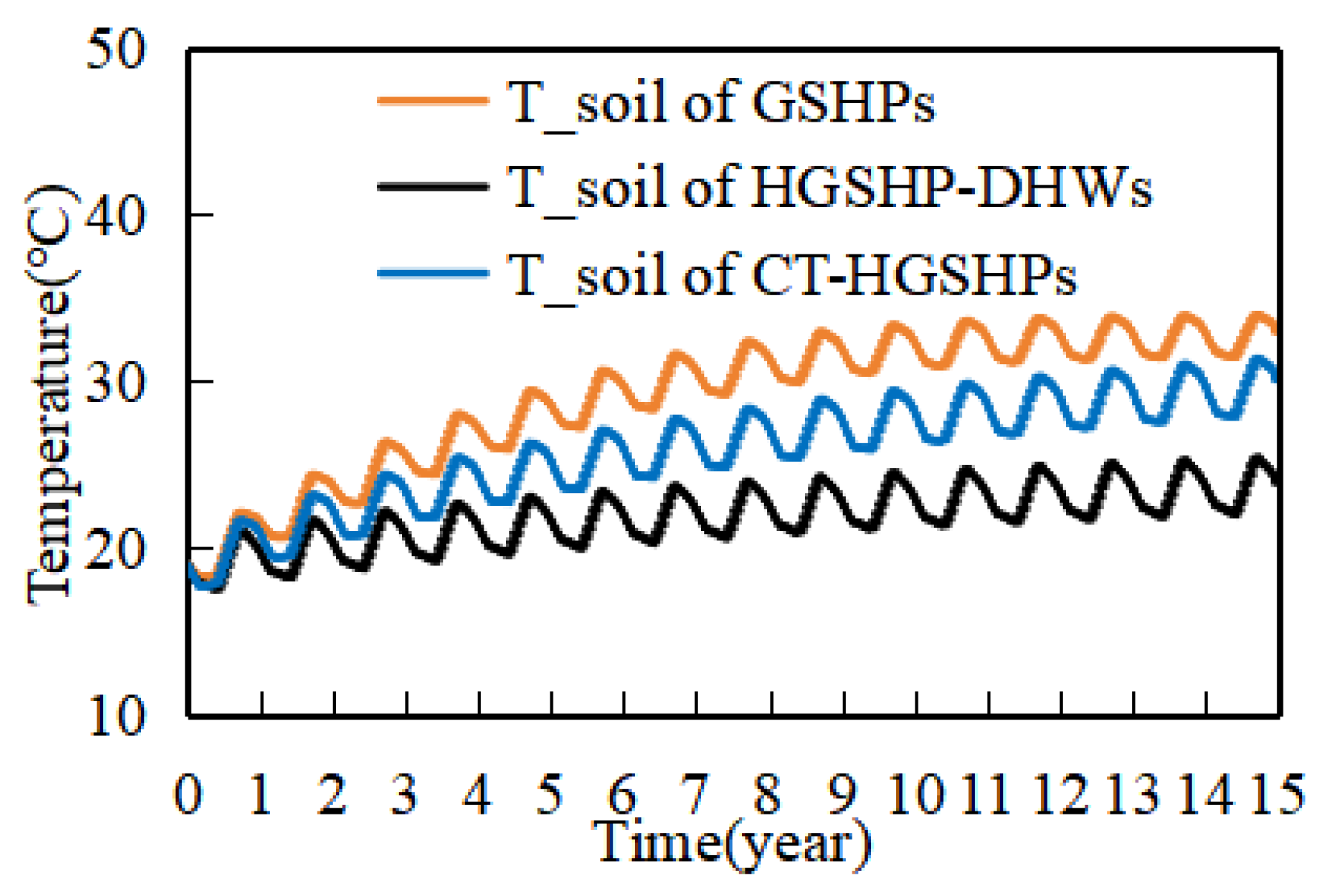
The change in the average soil temperature can intuitively reflect the soil thermal accumulation of a system installed with ground source heat pumps. The variations in the soil temperatures of the HGSHP-DHW, GSHP, and CT-HGSHP are shown in Figure 13. This indicator directly reflects the degree of soil thermal accumulation, which determines the long-term operating efficiency and service life of the GHEs. A lower soil temperature rise means less soil thermal accumulation and a more balanced heat exchange within the GHEs, which prevents performance degradation of the heat pump, helps maintain high heat pump efficiency and extends the service life of the GHEs. In contrast, a larger soil temperature rise indicates severe thermal accumulation in the ground, which will continuously degrade the heat pump performance, increase energy consumption, and even shorten the service life of the entire system. The CB, CT-HGSHP and GSHP mentioned in this part all include the ASHP-DHW. The initial temperature of the soil is 19 °C. After 15 years of operation, the average soil temperatures of the CT-HGSHP, GSHP and HGSHP-DHW have risen to 30.1 °C, 33.0 °C, and 23.9 °C and the soil temperature rises are 11.1 °C, 14.0 °C and 4.9 °C, respectively. Compared with CT-HGSHP and GSHP, the soil temperature rise in HGSHP-DHW is reduced by approximately 55.9% and 65.0%, respectively. The soil temperature rise in HGSHP-DHW is the minimum, because the DHW heat pump acts as an auxiliary cooling source for the air conditioning system at cooling conditions, providing domestic hot water while sharing the heat dissipation from the HP and HP2 to GHXs. During the heating and transition seasons, heat pumps for heating and DHW can extract heat from underground sources to maintain the thermal balance of the soil. It can be concluded that the soil thermal accumulation is alleviated for the HGSHP-DHW. This finding is consistent with the work of Liu et al. [36], who investigated a cooling tower-assisted HGSHPs in cooling-dominated regions and reported that the soil temperature rise in conventional GSHPs is 10.9 °C after 10 years of operation, while the cooling tower-assisted HGSHPs reduced the soil temperature rise to 5 °C (reduced by approximately 54%). However, this study achieved a 65% reduction in soil temperature rise compared to a conventional GSHP, 11% higher than the cooling tower assisted HGSHPs. This superior performance can be attributed to the mode-switching control strategy, which actively utilizes the remaining energy for DHW rather than simply rejecting it into the soil.

4.2. Energy Performance Comparison

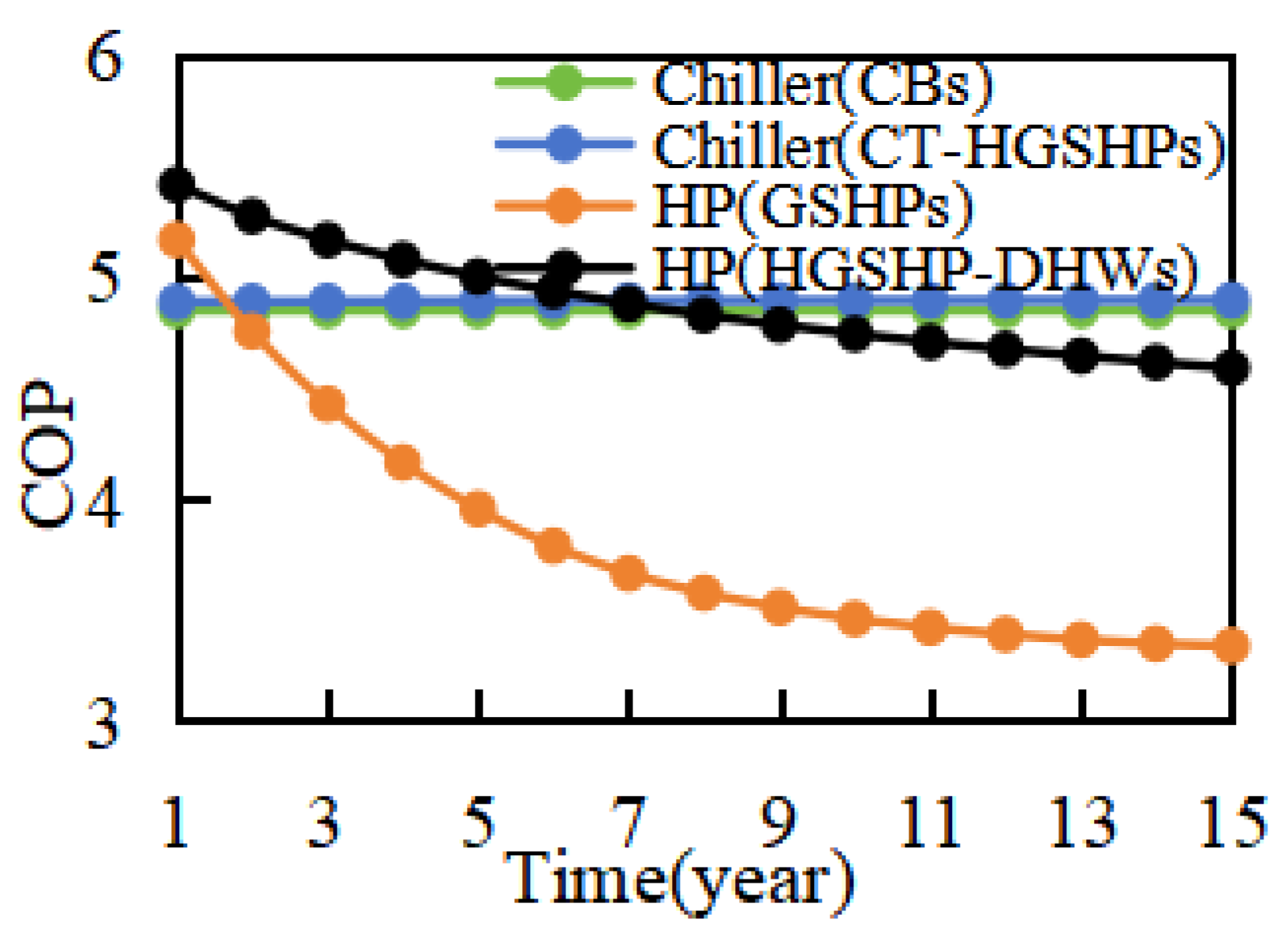
The energy efficiency indicator of the units (COP) represents coefficient of performance, defined as the ratio of the heating or cooling capacity to the electrical power consumption of the heat pump. A higher COP value indicates that the unit can provide more cooling or heating supply with lower electricity consumption, representing better operating performance. In contrast, a lower COP means lower energy utilization efficiency, higher power consumption, and less efficient operation of the heat pump. It is regarded as one of the most critical indicators for evaluating the performance of heat pump units. The comparison of COP can intuitively reflect whether the units are operating efficiently over the long term. The chillers in the CB and CT-HGSHP, and the HP in the GSHP and HGSHP-DHW are only used for cooling. The variations in their COP values are shown in Figure 14. The COP of the chillers in the CB and CT-HGSHP are relatively close, with values of approximately 4.85 and 4.89 per year, respectively. Since the meteorological parameters inputted into the cooling tower module in TRNSYS are the same every year, the COP remains unchanged every year. In the first year, the COP values of the ground source heat pump units are higher than that of the chiller unit, and the COP of the HP in the GSHP and HGSHP-DHW are 5.17 and 5.41, respectively. The HP in GSHP is most affected by soil thermal accumulation and the COP decreases the fastest, falling below the chiller’s COP in the second year and only reaching 3.34 by the fifteenth year. The COP of the HP in HGSHP-DHW decreases slowly, but it is also falls lower than the COP of the chillers in the eighth year, reaching 4.59 in the 15th year, which is 37.4% higher than COP of the HP in GSHPs. The higher COP values of the HP compared to the chillers are mainly due to the lower soil temperature telative to the outlet water temperature from the cooling tower, which lowers the condensing temperature, reduces compressor power consumption, and consequently leads to an improvement in the COP of the HP. The COP of HP declines gradually over time, which is attributed to the increasing soil temperature caused by soil thermal accumulation, which elevates the condensing temperature and consequently reduces COP.
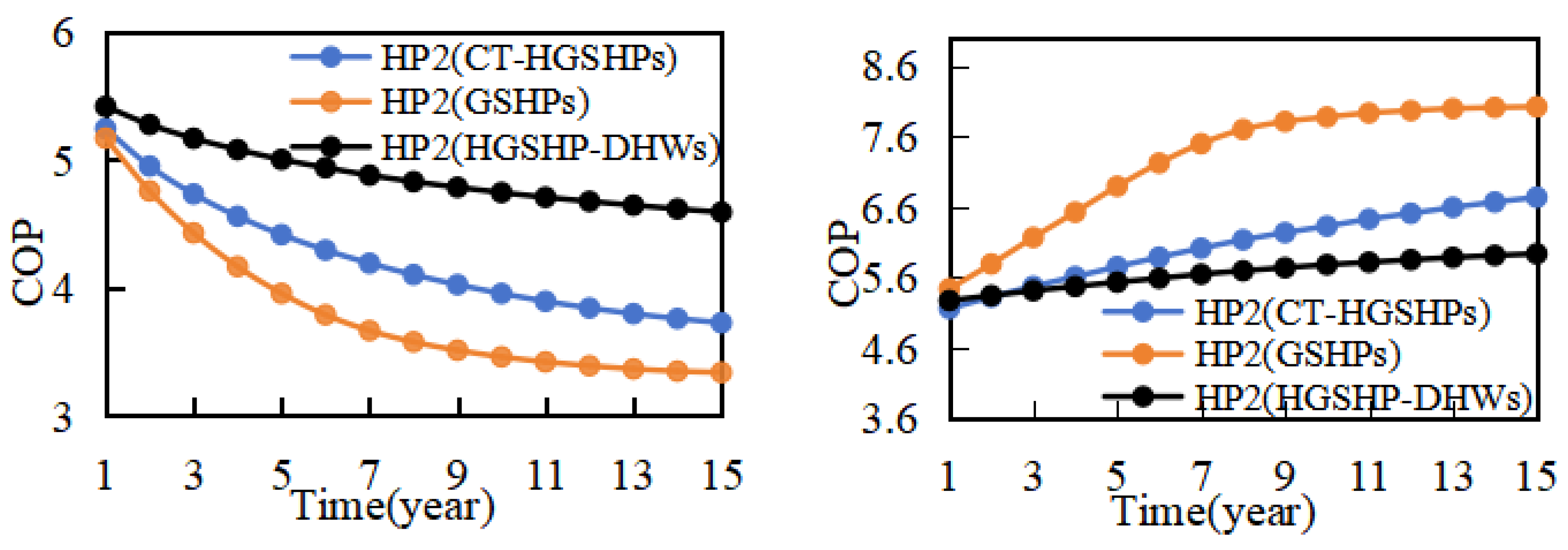
The HP2 in CT-HGSHP, GSHP and HGSHP-DHW is used for both cooling and heating. Figure 15 represents the HP2’s COP variations in the different systems under cooling and heating conditions. Compared to the HP2 in the other systems, the HP2 in HGSHP-DHW performs better and achieves a higher COP every year. In the first year, the COP values of HP2 in CT-HGSHPs, GSHPs and HGSHP-DHWs are 5.24, 5.17, and 5.41, respectively. As the operating years of the systems increase, due to the influence of soil thermal accumulation, the COP of HP2 in each system decreased, with the HP2’s COP in HGSHP-DHW decreasing the slowest. By the fifteenth year, the HP2’s COP in HGSHP-DHWs is the highest among them at 4.59, which is 23.2% and 37.5% higher than those in CT-HGSHPs and GSHPs, respectively.
The COP variation trend of HP2 in each system under heating conditions is the opposite of that under cooling conditions. The accumulation of soil heat causes an increase in the soil temperature, which is actually beneficial for heating conditions and the COP of HP2 in these systems also increases accordingly. HGSHP-DHW has the minimum soil temperature rise, and the HP2’s COP in HGSHP-DHW for heating is relatively low. In the 15th year, the COP of HP2 in CT-HGSHP, GSHP and HGSHP-DHW are 6.74, 8.02, and 5.94, respectively. Compared with the CT-HGSHP and GSHPs, the COP of HP2 in HGSHP-DHWs is reduced by 11.9% and 25.9%, respectively. Therefore, it is necessary to compare the energy efficiency of the systems in order to distinguish which system performs better.
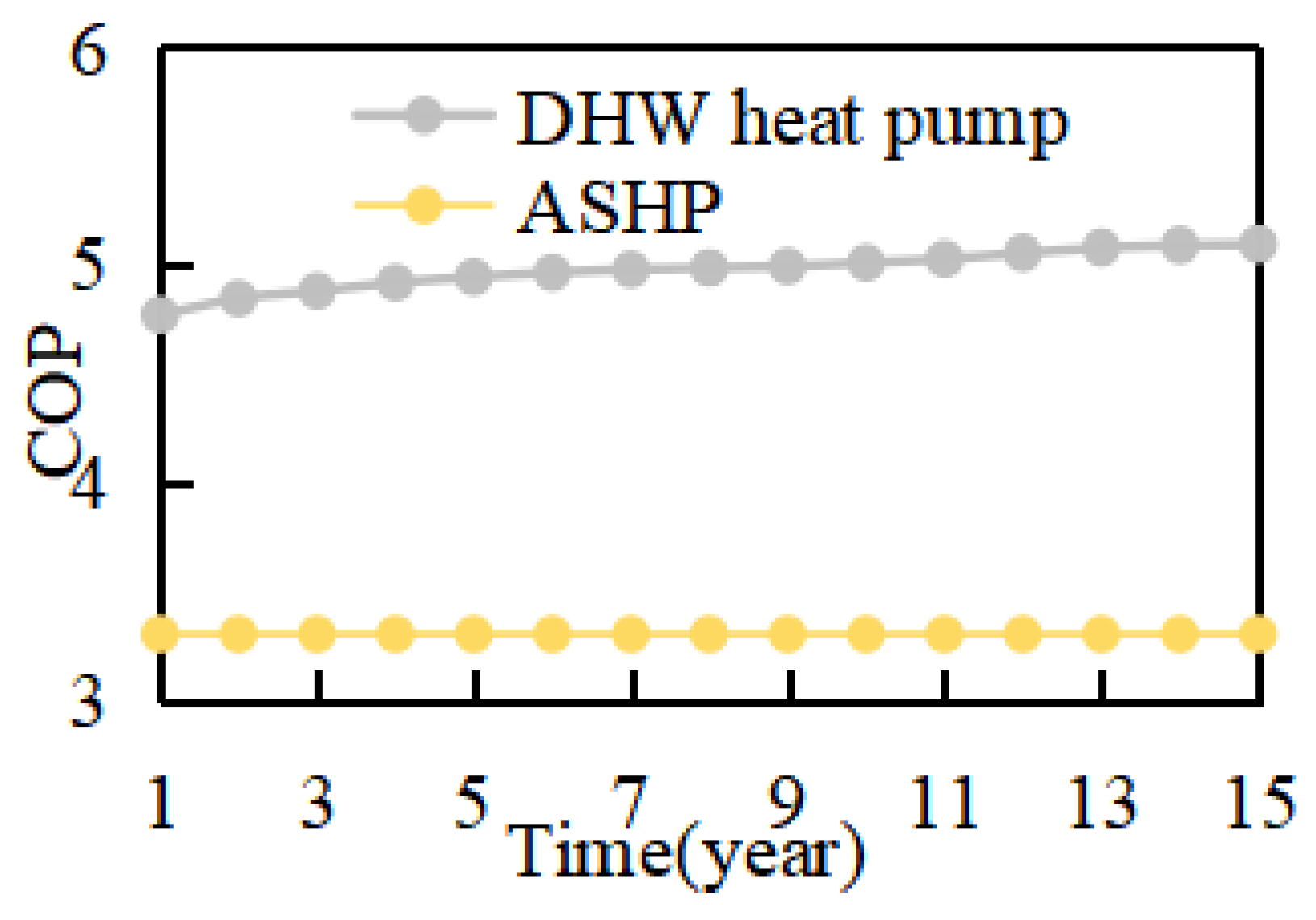
Figure 16 shows the comparison results of the COP between the DHW heat pump in the HGSHP-DHW and the ASHP DHW unit applied in the other systems throughout the year. The COP of the ASHP unit for DHW is 3.3, which remains unchanged every year because the DHW demand and meteorological parameters are the same. The COP of the DHW heat pump is slowly increasing, rising from 4.8 in the first year to 5.1 in the fifteenth year. The DHW heat pump’s COP is 45.4% and 54.5% higher than ASHP’s COP in the first and fifth years, respectively. This also indicates that the DHW heat pump unit has higher energy efficiency performance.
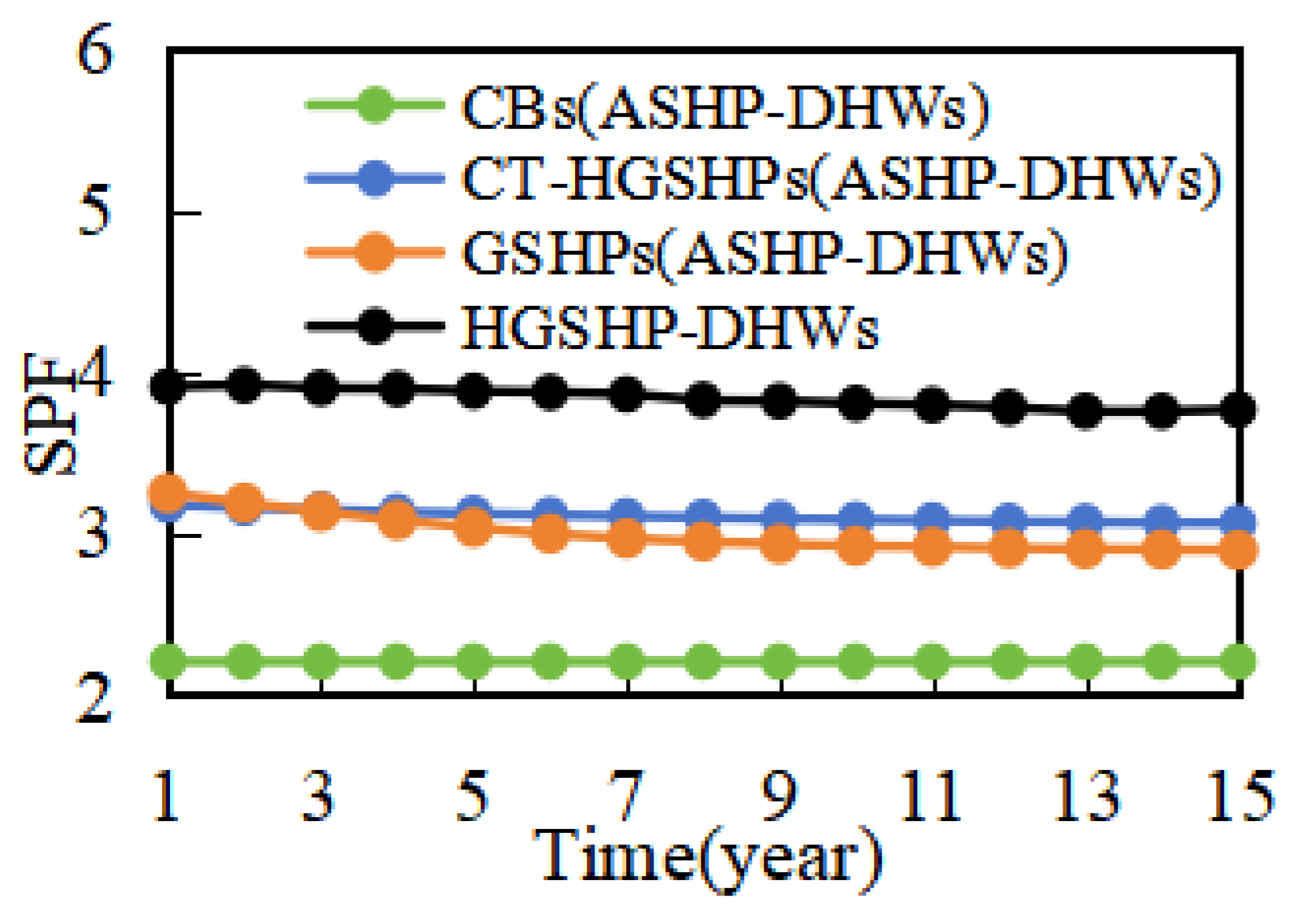
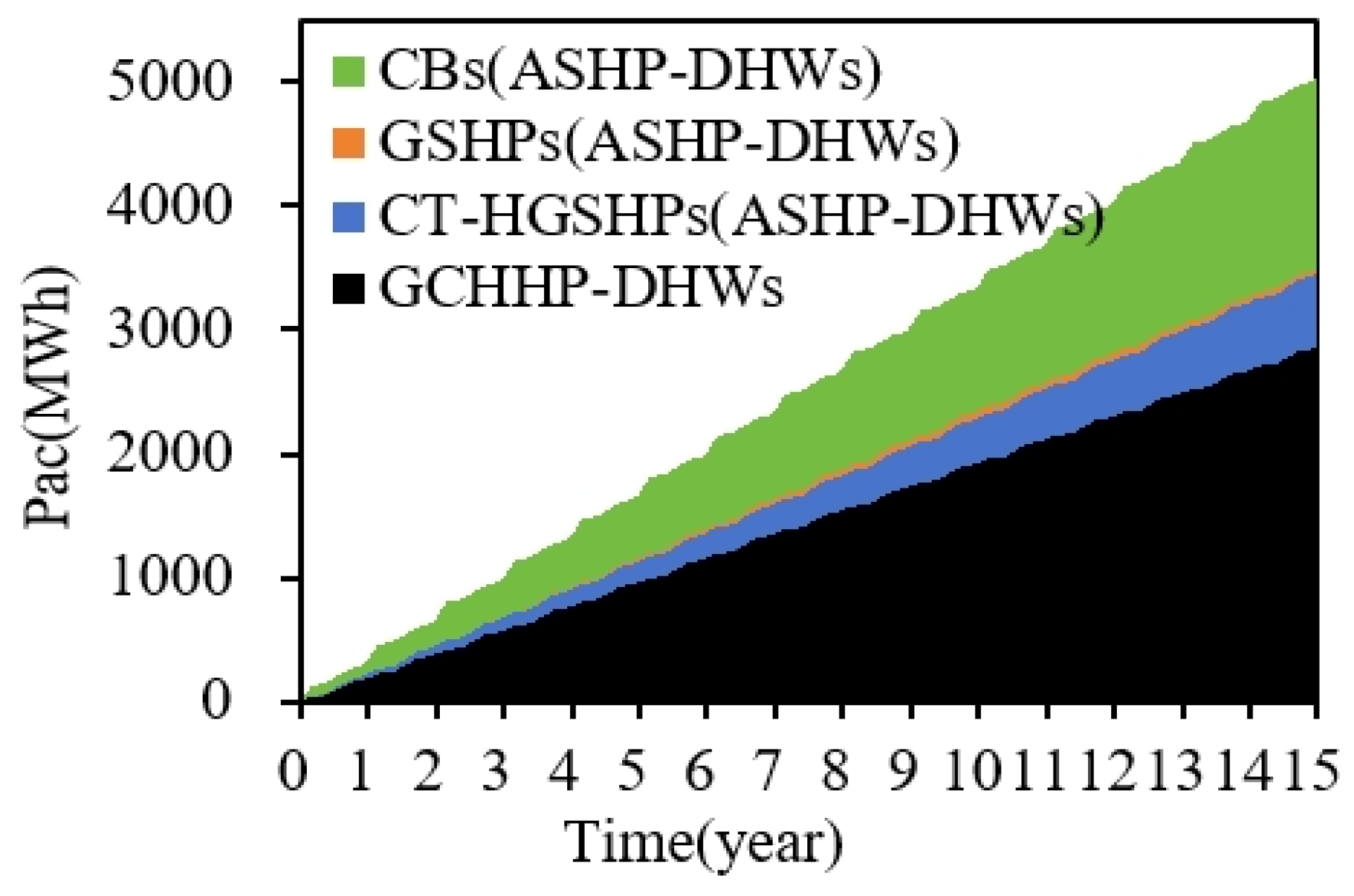
The SPF comparison of the systems is presented in Figure 17. The SPF represents the overall energy efficiency of the entire system, including all components, making it a critical indicator for practical operation. A higher SPF value indicates that the system can provide more cooling, heating, and domestic hot water supply with lower electricity consumption, which means higher energy efficiency and lower operating costs. Conversely, a lower SPF implies lower energy utilization efficiency, higher power consumption, and poorer system performance in practical engineering applications. In the first year, the SPF of CBs, CT-HGSHPs, GSHPs and HGSHP-DHWs are 2.20, 3.17, 3.25 and 3.91, respectively. The SPF of HGSHP-DHW is 77.7%, 23.3% and 20.3% higher than the SPF of CB, CT-HGSHP and GSHP, respectively. After 15 years of system operation, the SPF of CT-HGSHP, GSHP and HGSHP-DHW are 3.06, 2.89, and 3.79, reduced by 3.47%, 11.07%, and 3.07% respectively, compared to the first year. The SPF of CB remains unchanged. And the SPF of HGSHP-DHW is 72.3%, 23.9% and 31.1% higher than the SPF of CB, CT-HGSHP and GSHP, respectively. It can be seen from the comparative results that the HGSHP-DHW has the best energy efficiency performance, because the SPF of the HGSHP-DHW is the highest from the first year to the fifteenth year. The SPF of CT-HGSHPs, GSHPs and HGSHP-DHWs continues to decrease due to the rising temperature of the soil. The decreasing trend of the SPF of HGSHP-DHW is less pronounced than that of GSHP because the DHW in HGSHP-DHW serves as an auxiliary cold source, which alleviates soil thermal accumulation, resulting in a relatively lower soil temperature and higher SPF. The cumulative energy consumption (Pac) of the CB, CT-HGSHP, GSHP and HGSHP-DHW for fifteen years of operation is shown in Figure 18. After 15 years of operation, Pac of the CB, CT-HGSHP, GSHP and HGSHP-DHW are 5052 MWh, 3494.9 MWh, 3493.5 MWh, and 2967.3 MWh, respectively. Pac of HGSHP-DHWs is the lowest, which is 43%, 18% and 18% lower than that of CB, CT-HGSHP, and GSHP. Therefore, the HGSHP-DHW saves operating costs and is suitable for long-term operation. By using the control strategy proposed in this study to effectively schedule various components in the CT-HGSHPs, the maximum energy-saving potential of the system has been realized. Bina et al. [37] investigated a cooling tower-assisted hybrid GSHPs in Akita, Japan, a cooling-dominated region using TRNSYS simulations; the result showed that the system achieved an average SPF increase of approximately 0.72 compared to conventional GSHPs, with energy consumption reduced by 14%. However, this study achieves a 0.9 increase (31.1% higher) in SPF compared to the conventional GSHPs and approximately 41% cumulative energy reduction over 15 years. The mode-switching control strategy ensured the HGSHP-DHW operated with high efficiency.

4.3. Variation in Water Temperature, Capacity and Power Consumption of HGSHP-DHWs

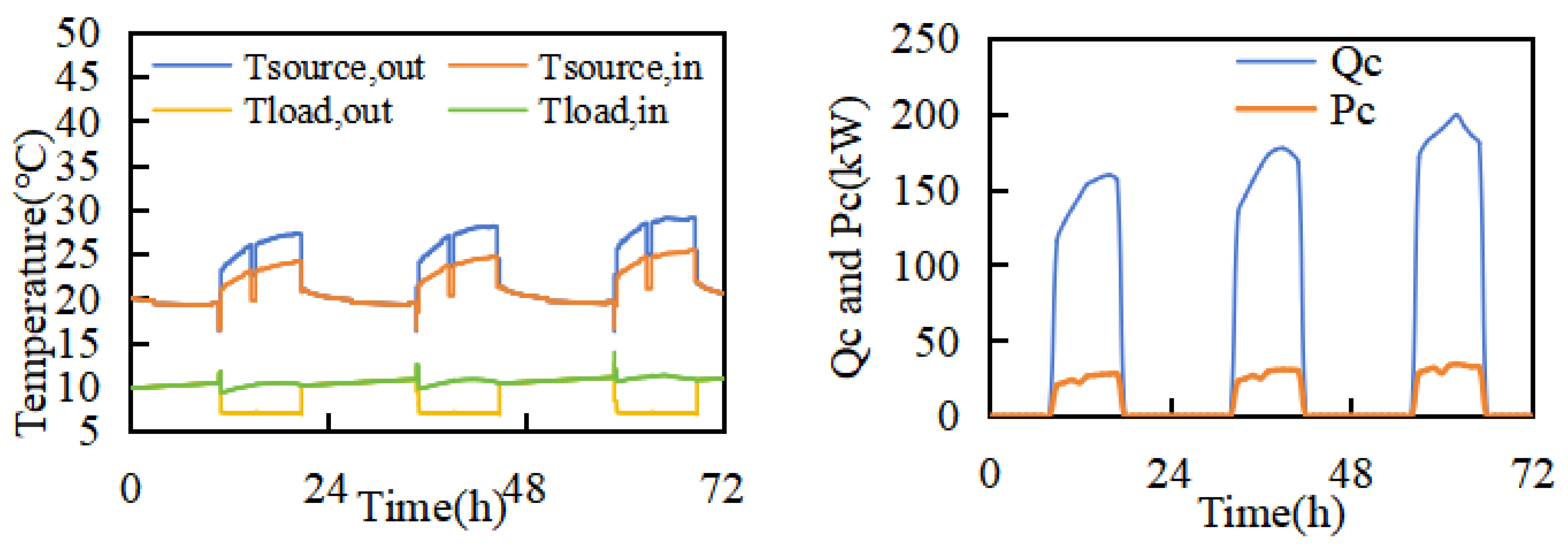
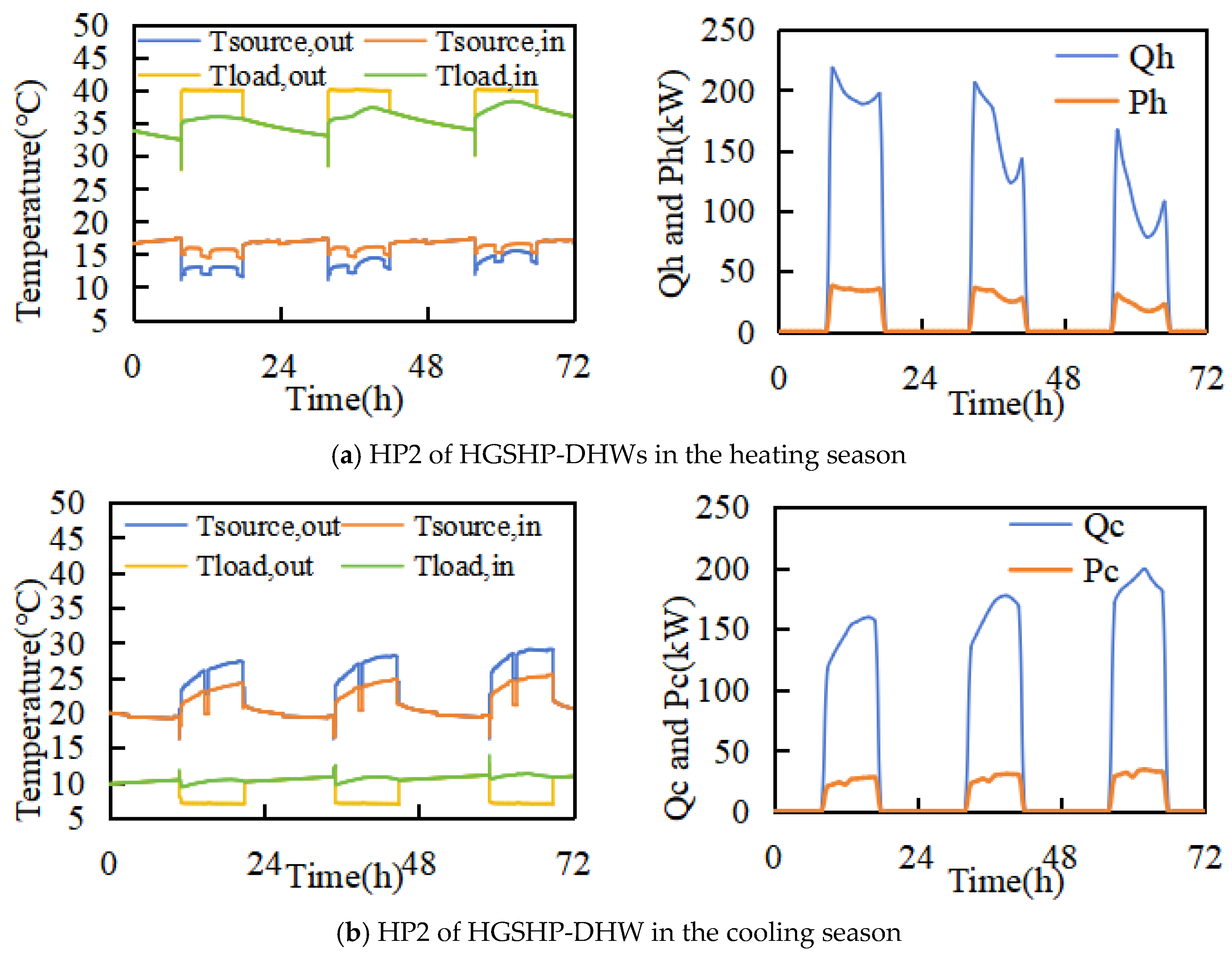
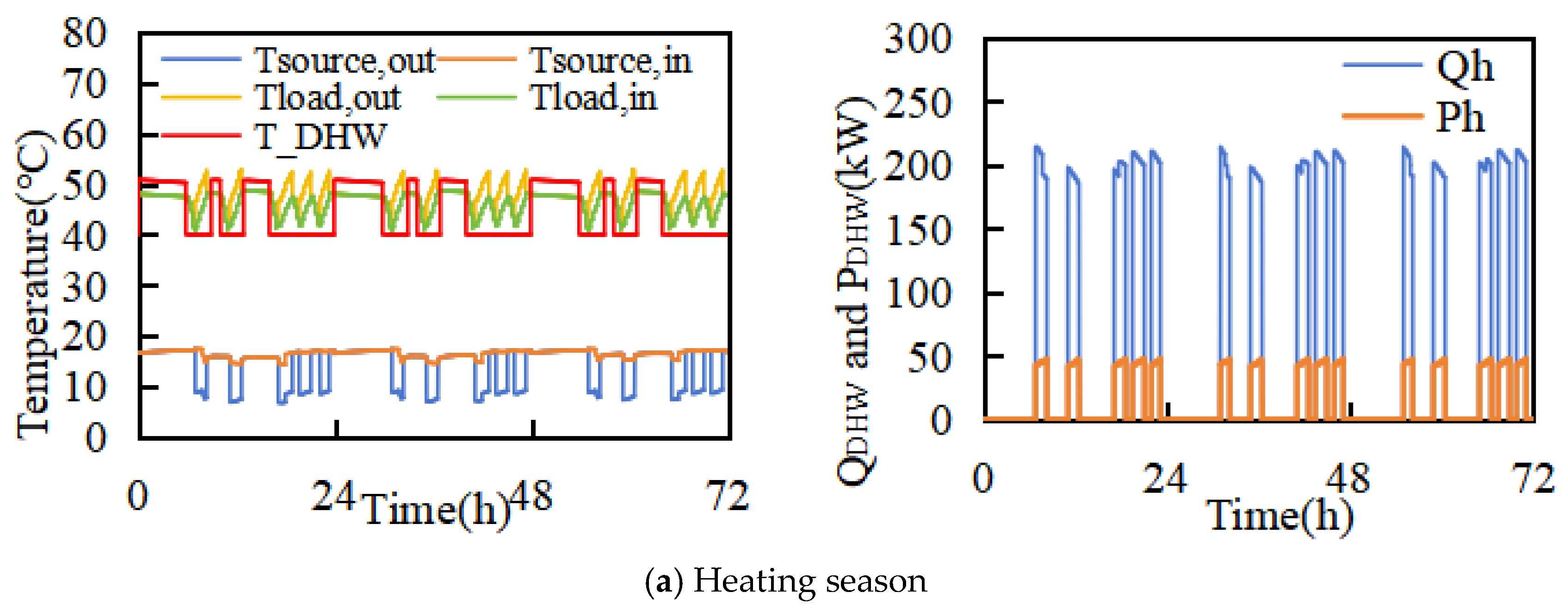
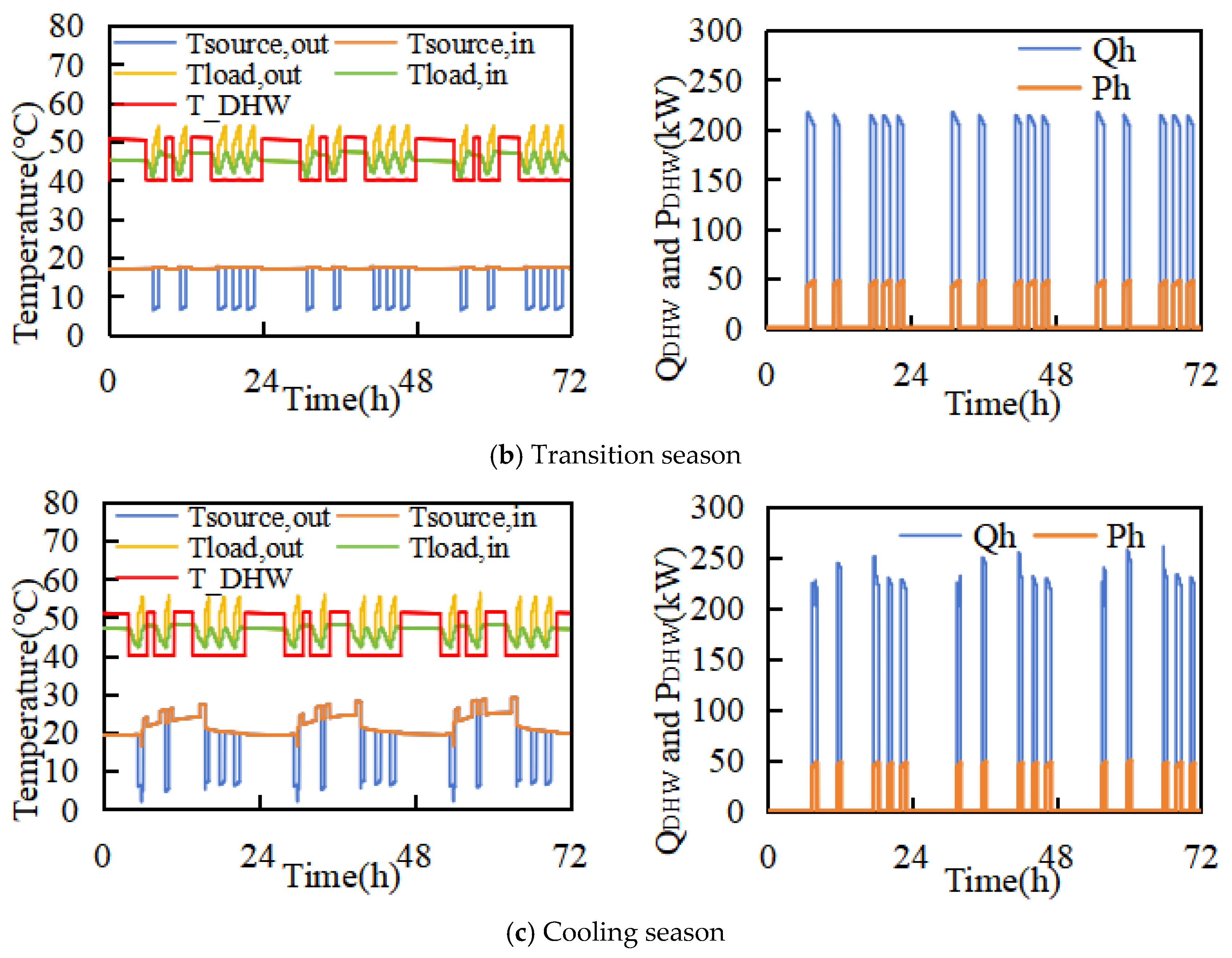
This section presents the hourly operating performance curves of the main units in the HGSHP-DHWs. The periods of 17 January to 19 January in the heating season, 16 May to 18 May in the transition season and 16 June to 18 June in the cooling season are selected as the typical days. The supply and return water temperatures (Tload,in, Tload,out, Tsource,in and Tsource,out), capacity (Q) and power consumption (P) of the HP, HP2 and DHW heat pump in the HGSHP-DHWs are shown in Figure 19, Figure 20 and Figure 21. The HP in the HGSHP-DHW only operates during the cooling season, and its water temperatures, capacity and power consumption changes are similar to those of HP2, as shown in Figure 19. It should be mentioned that the water temperature on the source side fluctuates at noon because both the hot water and air conditioning are turned on at the same time. Under the control strategy of Mode 3, a portion of the heat from the AC heat pump is used to produce DHW, which leads to a decrease in soil temperature. In addition to the inlet and outlet water temperatures of the DHW heat pump unit, the temperature of the DHW on the user side (T_DHW) is also provided in Figure 21, indicated by a red line. It can be seen that the T_DHW is maintained at the set temperature of 40 °C during operating hours. Due to the use of an on–off controller, the supply water temperature of the DHW heat pump unit fluctuates around the set temperature, and the heating capacity (QDHW) and power (PDHW) are both intermittent.

4.4. LCCP Comparison

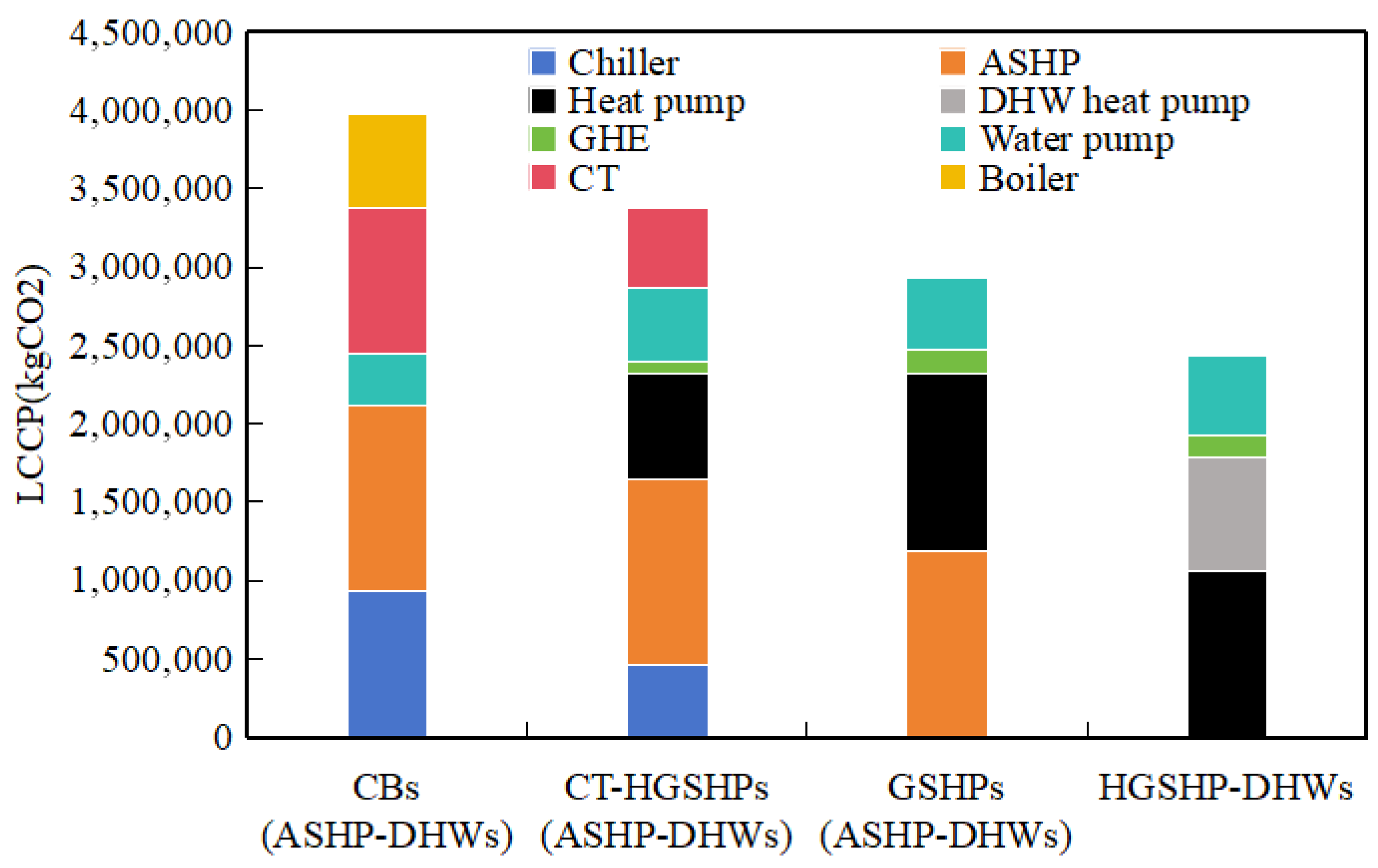
The LCCP evaluation follows the LCCP guideline [31] and includes two parts: direct refrigerant emissions and indirect carbon emissions from power consumptions, fully reflecting the environmental impact of the system. The LCCP calculation for each system includes the hot water component. LCCP evaluates the total equivalent CO2 emissions of a system throughout its full life cycle, including production, operation, and disposal. A lower LCCP value means lower overall carbon emissions and better environmental performance. In contrast, a higher LCCP indicates a greater environmental impact and higher carbon emissions from the system, meaning the system is less eco-friendly. In decision-making, the goal is typically to minimize the LCCP while meeting functional requirements (cooling, heating and DHW), aiming to balance technical feasibility and sustainability. Figure 22 shows the LCCP of the systems over 15 years. The LCCP of CB, CT-HGSHP, GSHP and HGSHP-DHW are 3,979,857 kg, 3,378,135 kg, 2,935,524 kg, and 2,435,587 kg, respectively. The HGSHP-DHW has the lowest LCCP, which is decreased by 38.8%, 27.9%, and 17.0% compared to CB, CT-HGSHP and GSHP. To clarify the contribution of each component to the total LCCP more transparently, the details of LCCP for each system are presented in Table 7. It clearly shows that the ASHP account for the largest share of LCCP in the reference systems, while in the HGSHP-DHWs, the high-emission ASHP is replaced by the high-efficiency DHW heat pump, which significantly reduces the overall carbon emissions of the system. In GSHPs, the ASHP, heat pump, GHE, and water pump account for 40.5%, 38.7%, 5.0%, and 15.8% of the total LCCP, respectively, with the ASHP and heat pump being the two dominant contributors. For HGSHP-DHW, heat pump, DHW heat pump, GHE, and water pump account for 43.4%, 29.8%, 6.1%, and 20.7% of the total LCCP, respectively, with heat pump, DHW heat pump contributing the main proportion due to their high energy consumption. Meanwhile, the LCCP of the DHW heat pump in HGSHP-DHWs is reduced by 38.8% compared with the ASHP in GSHPs, demonstrating the significant environmental benefit brought by the integrated hot water supply configuration. It should be mentioned that the carbon emissions generated by each system during operation account for a significant proportion. During the long-term operation of the system, the higher the energy consumption leads to the higher the LCCP. The LCCP reduction in HGSHP-DHWs comes from lower electricity consumption than the reference system and the fact that a the high-efficiency DHW heat pump replaces the ASHP. This makes the HGSHP-DHW more aligned with carbon-neutral building policies. Thus, to reduce the LCCP, improving the energy efficiency of the system should be a priority. Jeong et al. [38] performed a feasibility study on a PVT-GSHPs for a residential building; the result indicated that the system achieved a LCCP reduction of approximately 10–15% compared to conventional GSHPs. However, this study achieved a 17.0% reduction compared to the conventional GSHPs. This superior carbon emission performance is attributed to the mode-switching control strategy, which improved long-term energy efficiency, and replaced the low efficient ASHP by DHW heat pump.

4.5. Economic Comparison

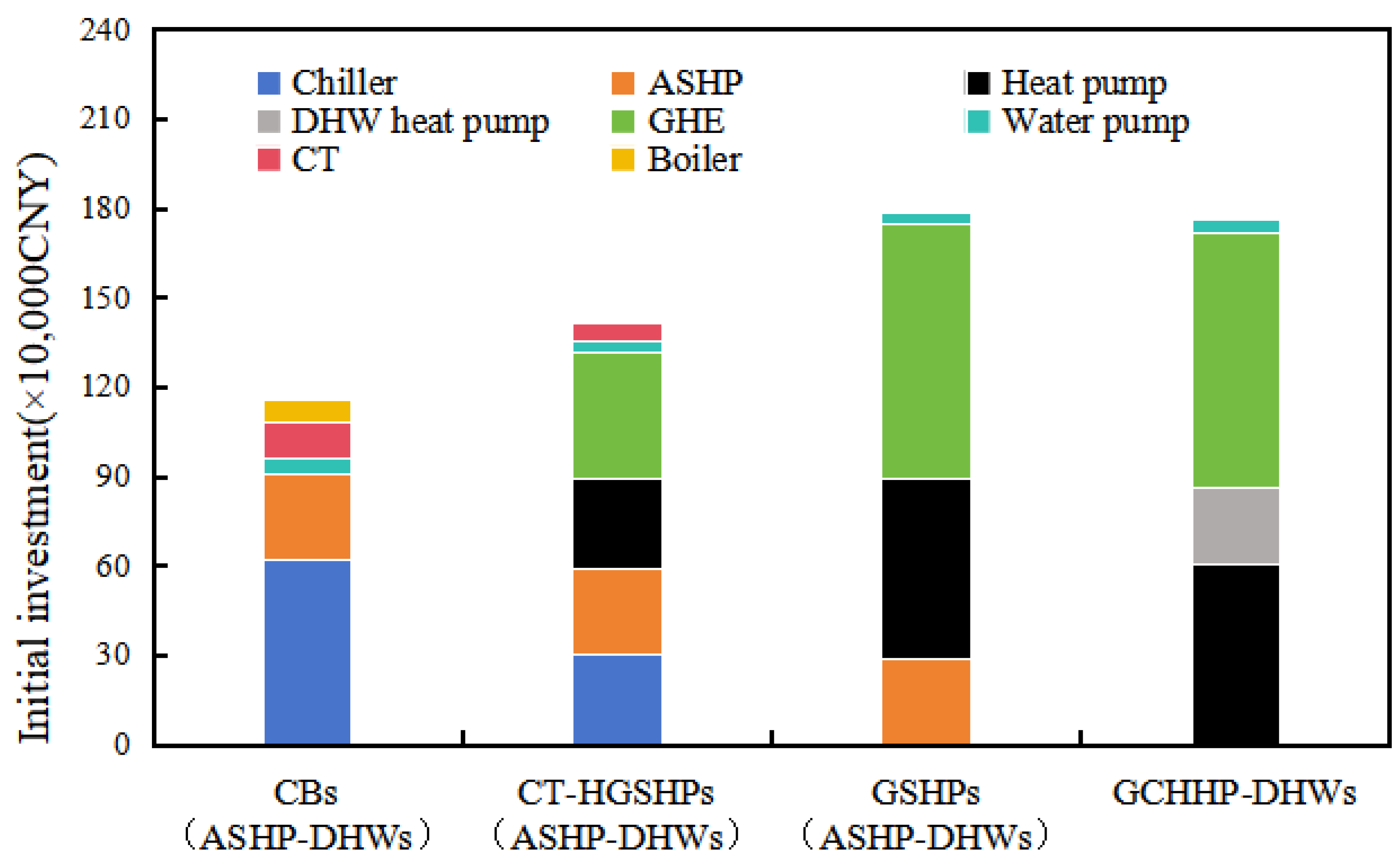
The contributions of different components to the total initial investment costs of the four systems are shown in Figure 23. The total initial investment costs of the CB, CT-HGSHP, GSHP and HGSHP-DHW are about 1160,000 CNY, 1416,000 CNY, 1788,000 CNY and 1764,000 CNY, respectively. The initial cost of the GSHP is the highest, while the initial cost of the CB is the lowest. This is due to the high initial construction cost of GHXs, which accounts for approximately half of the total cost for GSHP and HGSHP-DHW. Both systems are installed with 95 GHXs. The initial cost of the HGSHP-DHW is slightly lower than that of GSHPs, because the cost of the DHWs in HGSHP-DHWs is lower. CT-HGSHP has fewer GHXs compared to the GSHP and HGSHP-DHW, and the total initial investment of the heat pumps and the chiller in the three system is similar, so the total initial investment for HGSHP-DHW is in the middle. From the initial investment of the system, the cost of HGSHP-DHW is relatively high, about 52.1% and 24.6% higher than the CB and CT-HGSHPs, which indicates that the initial economic performance of HGSHP-DHW is not good. To present the economic analysis with improved transparency, the detailed initial investment composition of each system is listed in Table 8. The table quantifies the cost contribution of chillers, heat pumps, DHW heat pumps, GHEs, water pumps, cooling towers, and boilers separately. It clearly shows that GHEs account for the largest share of the initial investment for systems, while the DHW heat pump in the HGSHP-DHW replaces the high-cost ASHP used in the reference systems.
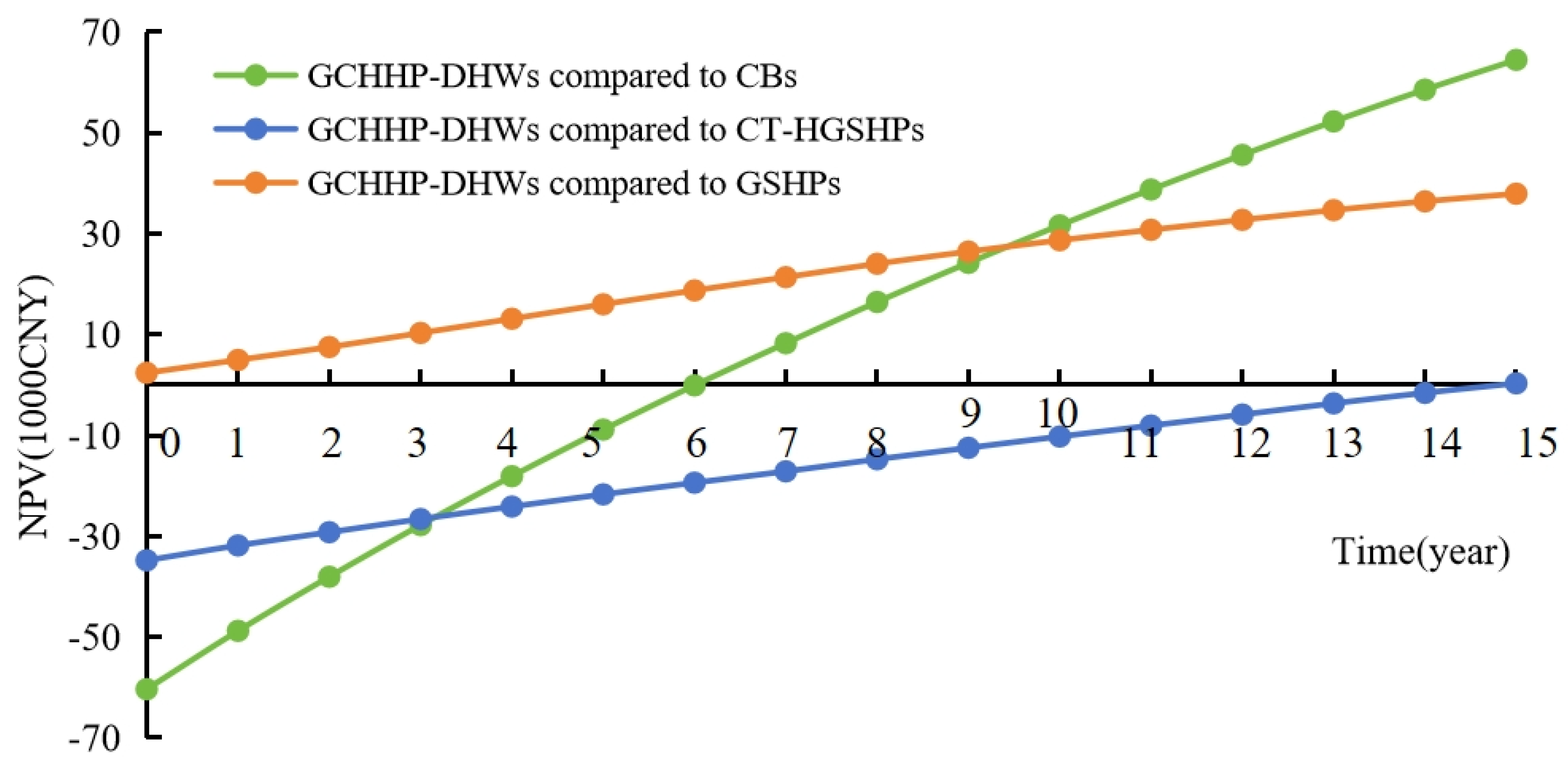
The initial investment comparison of each system cannot fully reflect the economic performance of the HGSHP-DHW; therefore, the economic benefit of the entire service life of the HGSHP-DHW should be considered. The service life of each system is 15 years. The CB, CT-HGSHP and GSHP are chosen as the references to calculates the NPV of the HGSHP-DHW. The larger the NPV, the better the economic performance compared to the reference system. If the NPV is negative, the HGSHP-DHW is economically unfeasible. The NPV of GCHHP-DHW compared to reference systems is shown in Figure 24. The NPVs of HGSHP-DHW are 644,866 CNY, 3310 CNY, and 379,400 CNY, compared to CB, CT-HGSHP, and GSHP in the 15th year, respectively. This means that HGSHP-DHW is more profitable than the reference systems. Moreover, the payback time of the HGSHP-DHWs are 7 years, 15 years, and 0 years compared to CB, CT-HGSHP, and GSHP, respectively, showing acceptable economic benefits for practical engineering applications. NPV converts future cost savings into present value and directly reflects economic viability. Although the initial investment of HGSHP-DHW is higher due to GHE costs, the low operating energy consumption significantly reduces operating expenses. The payback period is also acceptable for public and laboratory buildings. The positive NPV confirms that HGSHP-DHW is economically feasible and more competitive than conventional systems. Ashrafi et al. [39] conducted an assessment of GSHPs and the combination of GSHP and building integrated photovoltaics (BIPV-GSHP). Economically assessment revealed the total initial investment costs of BIPV-GSHPs is 18.8% higher than GSHPs. The payback time of BIPV-GSHP are 1 year compared to GSHP. However, in this study, HGSHP-DHW achieves a 1.3% lower initial investment cost than the conventional GSHPs, with a payback time of 0 years relative to GSHP, as it replaced the high-price ASHP by DHW heat pump and operated with high efficiency.

5. Conclusions

To alleviate the soil thermal accumulation of GSHPs and improve the long-term operating performance of the system in hot-summer and cold-winter areas, the HGSHP-DHWs was developed and a corresponding mode-switching-based control strategy was also proposed simultaneously, the proposed mode-switching-based control strategy enables the HGSHP-DHW to operate stably and achieve better comprehensive performance. The HGSHP-DHW introduced the DHW demand as an auxiliary cooling source for the GSHP air-conditioning system. The newly proposed control strategy, which includes four modes, effectively regulates the components in the system to meet the different demands for cooling, heating, and DHW throughout the year. Under different control modes, the source-side loop structure of HGSHP-DHW also changes accordingly, which fully utilizes the energy-saving potential of the components. The comparative evaluation between the HGSHP-DHW and reference systems was performed, and the average soil temperature, COP, SPF, LCCP and NPV were selected as the evaluation indicators. After 15 years of long-term operation of these systems, the comparison results show that HGSHP-DHW has significant advantages in energy performance, environmental impact, and economic feasibility. The main conclusions are as follows:
1.
Energy performance:
The results of soil average temperature changes indicate that the HGSHP-DHW has the least severe soil thermal accumulation compared to the reference systems. The soil temperature rises for CT-HGSHP, GSHP, and HGSHP-DHW are 11.1 °C, 14 °C and 4.9 °C, respectively. Compared with the CT-HGSHP and GSHP, the soil temperature rise in HGSHP-DHW is reduced by approximately 55.9% and 65.0%, respectively. The lower soil temperature rise indicates that the heat pump units in the HGSHP-DHWs can operate efficiently and stably for a long time. After 15-years of operation, the SPF of CT-HGSHP, GSHP and HGSHP-DHW are 3.06, 2.89, and 3.79, respectively. The SPF of HGSHP-DHW is highest, 72.3%, 23.9% and 31.1% higher than the SPF of CB, CT-HGSHP and GSHP, respectively. Therefore, the HGSHP-DHW system achieves higher SPF than reference systems and reduces soil thermal imbalance. The Pac of HGSHP-DHW is also the lowest, with the value of 2967.3 MWh, which is 43%, 18% and 18% lower than CBs, CT-HGSHP and GSHP. With the regulation of the newly proposed control strategy, the energy efficiency and operational reliability of the CT-HGSHP have been improved.
2.
Environmental impact:
The LCCP intuitively reflects the lifecycle carbon emissions of each system. The results indicate that the value of LCCP of CB, CT-HGSHP, GSHP, and HGSHP-DHW are 3,979,857 kg, 3,378,135 kg, 2,935,524 kg, and 2,435,587 kg, respectively. HGSHP-DHW has the lowest LCCP, representing a decrease of 38.8%, 27.9%, and 17.0% compared to the CB, CT-HGSHP and GSHP. The HGSHP-DHW is the most suitable system to balance technical feasibility and sustainability.
3.
Economic feasibility:
Although the initial investment of the HGSHP-DHW is relatively high, the comparative results of NPV denote that the economic efficiency of HGSHP-DHW during its operational lifecycle is still superior to other systems due to its low operating costs. The system shows positive NPVs of 644,866 CNY, 3310 CNY, and 379,400 CNY compared with the CB, CT-HGSHP and GSHP for a fifteen-year operation. Therefore, it is more economically feasible than reference systems.

Author Contributions

Conceptualization, Y.X.; Methodology, Y.X.; Software, Z.X.; Validation, Z.X.; Formal analysis, Z.X. and D.P.; Investigation, L.Y.; Resources, Y.X. and L.Y.; Writing—original draft, Z.X.; Writing—review & editing, Y.X.; Visualization, Z.X.; Supervision, Y.X. and D.P.; Project administration, D.P.; Funding acquisition, Y.X. All authors have read and agreed to the published version of the manuscript.

Funding

The authors would like to acknowledge the support from the National Natural Science Foundation of China, China (No. 52206256) and Jiangxi Provincial Natural Science Foundation, China (No. 20242BAB25278).

Data Availability Statement

The original contributions presented in this study are included in the article. Further inquiries can be directed to the corresponding author.

Conflicts of Interest

The authors declare no conflict of interest.

References

  1. Xu, S.; Zhao, X.; Taghizadeh-Hesary, F. Towards the environmental sustainability path: The role of fintech, renewable energy consumption, and climate policy uncertainty. Energy Policy 2025, 207, 114841. [Google Scholar] [CrossRef]
  2. Liu, J.; Zhang, S.; Ma, M.; He, Y.; Wang, B. From Energy Efficiency to Carbon Neutrality: A Global Bibliometric Review of Energy Conservation and Emission Reduction in Building Stock. Buildings 2025, 15, 2051. [Google Scholar] [CrossRef]
  3. Zhou, K.; Mao, J.; Li, Y.; Zhang, H.; Li, C.; Wang, L. Effect of environmental thermal disturbance on effective thermal conductivity of ground source heat pump system. Energy Convers. Manag. 2021, 237, 114149. [Google Scholar] [CrossRef]
  4. Wang, J.; Tang, C.Y.; Song, L. Analysis of precooling optimization for residential buildings. Appl. Energy 2022, 323, 119574. [Google Scholar] [CrossRef]
  5. Pérez-Lombard, L.; Ortiz, J.; Pout, C. A review on buildings energy consumption information. Energy Build. 2008, 40, 394–398. [Google Scholar] [CrossRef]
  6. You, T.; Wu, W.; Yang, H.; Liu, J.; Li, X. Hybrid photovoltaic/thermal and ground source heat pump: Review and perspective. Renew. Sustain. Energy Rev. 2021, 151, 111569. [Google Scholar] [CrossRef]
  7. Bina, S.M.; Fujii, H.; Kosukegawa, H.; Inagaki, F. A predictive model of long-term performance assessment of Ground Source Heat Pump (GSHP) systems in Japanese regions. Geothermics 2024, 119, 102955. [Google Scholar] [CrossRef]
  8. Safa, A.A.; Fung, A.S.; Kumar, R. Heating and cooling performance characterisation of ground source heat pump system by testing and TRNSYS simulation. Renew. Energy 2015, 83, 565–575. [Google Scholar] [CrossRef]
  9. Chargui, R.; Sammouda, H.; Farhat, A. Geothermal heat pump in heating mode: Modeling and simulation on TRNSYS. Int. J. Refrig. 2012, 35, 1824–1832. [Google Scholar] [CrossRef]
  10. Liu, Z.; Xu, W.; Qian, C.; Chen, X.; Jin, G. Investigation on the feasibility and performance of ground source heat pump (GSHP) in three cities in cold climate zone, China. Renew. Energy 2015, 84, 89–96. [Google Scholar] [CrossRef]
  11. Fine, J.P.; Nguyen, H.V.; Friedman, J.; Leong, W.H.; Dworkin, S.B. A simplified ground thermal response model for analyzing solar-assisted ground source heat pump systems. Energy Convers. Manag. 2018, 165, 276–290. [Google Scholar] [CrossRef]
  12. Hou, G.; Taherian, H.; Li, L. A predictive TRNSYS model for long-term operation of a hybrid ground source heat pump system with innovative horizontal buried pipe type. Renew. Energy 2020, 151, 1046–1054. [Google Scholar] [CrossRef]
  13. Eisapour, A.H.; Rad, F.M.; Fung, A.S. Techno-economic and environmental study of a hybrid solar ground source heat pumps for a heating-dominated community in a cold climate; a case study in Toronto. Renew. Energy 2024, 231, 120874. [Google Scholar] [CrossRef]
  14. Miglani, S.; Orehounig, K.; Carmeliet, J. Design and optimization of a hybrid solar ground source heat pump with seasonal regeneration. Energy Procedia 2017, 122, 1015–1020. [Google Scholar] [CrossRef]
  15. Saeidavi, A.; Kiani, M.K.D.; Mashhour, E. Simulation and evaluation of a hybrid ground source heat pump system with a photovoltaic thermal collector (PVT) in Ahvaz city using TRNSYS software. J. Build. Eng. 2025, 109, 113014. [Google Scholar] [CrossRef]
  16. Bhadra, S.; Mwesigye, A. Influence of control strategy on the energetic performance of an air source heat pump coupled with a solar air collector for domestic hot water in a cold climate. Renew. Energy 2025, 244, 122682. [Google Scholar] [CrossRef]
  17. Ma, S.; Lu, S.; Ma, D.; Li, C.; Liu, C.; Wu, L.; Chen, M.; Xu, C.; Ma, H. Investigation on the thermal performance and economy of a solar assisted air source heat pump domestic hot water system. Appl. Therm. Eng. 2023, 232, 121007. [Google Scholar] [CrossRef]
  18. Knuutinen, J.; Böök, H.; Ruuskanen, V.; Kosonen, A.; Immonen, P.; Ahola, J. Ground source heat pump control methods for solar photovoltaic-assisted domestic hot water heating. Renew. Energy 2021, 177, 732–742. [Google Scholar] [CrossRef]
  19. Adebayo, P.; Shor, R.; Mohamad, A.; Wemhöner, C.; Mwesigye, A. Performance analysis of a solar-assisted ground source heat pump with a single vertical U-tube ground heat exchanger. Appl. Therm. Eng. 2024, 257, 124452. [Google Scholar] [CrossRef]
  20. Choi, S.; Oh, J.; Hwang, Y.; Lee, H. Life cycle climate performance evaluation (LCCP) on cooling and heating systems in South Korea. Appl. Therm. Eng. 2017, 120, 88–98. [Google Scholar] [CrossRef]
  21. Bae, S.; Nam, Y. Feasibility analysis for an integrated system using photovoltaic-thermal and ground source heat pump based on real-scale experiment. Renew. Energy 2022, 185, 1152–1166. [Google Scholar] [CrossRef]
  22. Gang, W.; Wang, J. Predictive ANN models of ground heat exchanger for the control of hybrid ground source heat pump systems. Appl. Energy 2013, 112, 1146–1153. [Google Scholar] [CrossRef]
  23. Xie, Y.; Hu, P.; Peng, D.; Zhu, N.; Lei, F. Development of a group control strategy based on multi-step load forecasting and its application in hybrid ground source heat pump. Energy 2023, 273, 127196. [Google Scholar] [CrossRef]
  24. Wang, Z.; Zhou, X.; Wang, F.; Sha, X.; Lu, M.; Ma, Z. Adaptive model-based optimal control of hybrid deep borehole ground source heat pump systems with integrated latent heat thermal energy storage. Appl. Energy 2025, 390, 125737. [Google Scholar] [CrossRef]
  25. Xia, L.; Ma, Z.; Kokogiannakis, G.; Wang, S.; Gong, X. A model-based optimal control strategy for ground source heat pump systems with integrated solar photovoltaic thermal collectors. Appl. Energy 2018, 228, 1399–1412. [Google Scholar] [CrossRef]
  26. Dongellini, M.; Morini, G.L. On-off cycling losses of reversible air-to-water heat pump systems as a function of the unit power modulation capacity. Energy Convers. Manag. 2019, 196, 966–978. [Google Scholar] [CrossRef]
  27. Xie, Y.; Hu, P.; Zhu, N.; Lei, F.; Xing, L.; Xu, L. Collaborative optimization of ground source heat pump-radiant ceiling air conditioning system based on response surface method and NSGA-II. Renew. Energy 2020, 147, 249–264. [Google Scholar] [CrossRef]
  28. GB 50015-2019; Standard for Design of Building Water Supply and Drainage. China Planning Press: Beijing, China, 2019.
  29. Lee, M.; Kim, J.; Shin, H.H.; Cho, W.; Kim, Y. CO2 emissions and energy performance analysis of ground-source and solar-assisted ground-source heat pumps using low-GWP refrigerants. Energy 2022, 261, 125198. [Google Scholar] [CrossRef]
  30. Liu, Y.; Zhang, G.; Wang, Z.; Ding, J.; Wang, H.; Cao, Z. Multi-objective optimization and performance evaluation of a cooling tower assisted ground source heat pump system under different intermittent control strategies. Energy Build. 2025, 329, 115268. [Google Scholar] [CrossRef]
  31. Life Cycle Climate Performance Working Group. Guideline for Life Cycle Climate Performance; International Institute of Refrigeration: Life Cycle Climate Performance Working Group: Yokohama, Japan, 2016. [Google Scholar]
  32. Catrini, P.; Cellura, M.; Guarino, F.; Panno, D.; Piacentino, A. An integrated approach based on Life Cycle Assessment and Thermoeconomics: Application to a water-cooled chiller for an air conditioning plant. Energy 2018, 160, 72–86. [Google Scholar] [CrossRef]
  33. Abdelhady, S. Performance and cost evaluation of solar dish power plant: Sensitivity analysis of levelized cost of electricity (LCOE) and net present value (NPV). Renew. Energy 2021, 168, 332–342. [Google Scholar] [CrossRef]
  34. Zhou, K.; Mao, J.; Zhang, H.; Li, Y.; Yu, X.; Chen, F.; Li, M. Design strategy and techno-economic optimization for hybrid ground heat exchangers of ground source heat pump system. Sustain. Energy Technol. Assess. 2022, 52, 102140. [Google Scholar] [CrossRef]
  35. Luo, Z.; Zhu, N.; Yu, Z.; Zhang, Q.; Yan, L.; Hu, P. Performance study of dual-source heat pump integrated with radiation capillary terminal system. Energy 2024, 304, 132177. [Google Scholar] [CrossRef]
  36. Liu, Z.; Li, Y.; Xu, W.; Yin, H.; Gao, J.; Jin, G.; Lun, L.; Jin, G. Performance and feasibility study of hybrid ground source heat pump system assisted with cooling tower for one office building based on one Shanghai case. Energy 2019, 173, 28–37. [Google Scholar] [CrossRef]
  37. Bina, S.M.; Fujii, H.; Tsuya, S.; Kosukegawa, H. Comparative study of hybrid ground source heat pump in cooling and heating dominant climates. Energy Convers. Manag. 2022, 252, 115122. [Google Scholar] [CrossRef]
  38. Jeong, Y.D.; Yu, M.G.; Nam, Y. Feasibility study of a heating, cooling and domestic hot water system combining a photovoltaic-thermal system and a ground source heat pump. Energies 2017, 10, 1243. [Google Scholar] [CrossRef]
  39. Ashrafi, N.; Ahmadi, R.; Zahedi, A. Technical, economical, and environmental scenario based modeling of the building equipped with ground source heat pump (GSHP) and solar system. Energy Build. 2023, 289, 113048. [Google Scholar] [CrossRef]
Figure 1. Picture of the building model.
Energies 19 02136 g001
Figure 2. Simulation model for load calculation.
Energies 19 02136 g002
Figure 3. The hourly load of the laboratory.
Energies 19 02136 g003
Figure 4. Schematic of HGSHP-DHW.
Energies 19 02136 g004
Figure 5. HGSHP-DHW built in TRNSYS.
Energies 19 02136 g005
Figure 6. The configuration of the heat pump module.
Energies 19 02136 g006
Figure 7. Performance curve of the heat pump.
Energies 19 02136 g007
Figure 8. Cold water temperature.
Energies 19 02136 g008
Figure 9. The hourly DHW consumption.
Energies 19 02136 g009
Figure 10. Control flow chart of HGSHP-DHW.
Energies 19 02136 g010
Figure 11. The configuration of the GHE–DHW heat pump loop in different modes and the daily control schedules for the heat pumps.
Energies 19 02136 g011
Figure 12. The traditional systems (a) CBs, (b) CT-HGSHPs, (c) GSHPs, (d) ASHP-DHWs.
Energies 19 02136 g012
Figure 13. Variations in soil temperature.
Energies 19 02136 g013
Figure 14. Variations in COP of chillers and HPs of different systems in the cooling season.
Energies 19 02136 g014
Figure 15. Variations in COP of HP2 of different systems in cooling season (left) and heating season (right).
Energies 19 02136 g015
Figure 16. Variations in COP of DHW heat pump and ASHP DHW unit throughout the years.
Energies 19 02136 g016
Figure 17. The SPF of the systems.
Energies 19 02136 g017
Figure 18. Accumulation of energy consumption of the systems.
Energies 19 02136 g018
Figure 19. Supply and return water temperature, capacity and power consumption of the HP in HGSHP-DHWs.
Energies 19 02136 g019
Figure 20. Supply and return water temperature, capacity and power consumption of the HP2 in HGSHP-DHW.
Energies 19 02136 g020
Figure 21. Supply and return water temperature, capacity and power consumption of DHW heat pump.
Energies 19 02136 g021aEnergies 19 02136 g021b
Figure 22. Comparison of the LCCP for each system after 15 years operation.
Energies 19 02136 g022
Figure 23. Comparison of initial investments for the systems.
Energies 19 02136 g023
Figure 24. NPV of GCHHP-DHWs compared to reference systems.
Energies 19 02136 g024
Table 1. Building characteristics and settings in load calculation.
U-Value
(W/(m2·K))
Layers (FROM
External to Internal)
Thickness (mm)
EnvelopesExterior wall0.899Cement mortar20
Brick240
Insulation material35
Cement mortar20
Internal wall0.358Plaster13
Porotherm brick100
Plaster13
Roof0.915Asphalt20
Cement mortar20
Aerocrete20
Cement mortar25
window2.78Glass6
Internal gains150 W/person for people, 6 W/m2 for light, 230 W PC for computer
Table 2. Thermo-physical properties of the building envelopes layer.
LayerThermal Conductivity
(W/m·K)
Thermal Capacity
(J/kg·K)
Density
(kg/m3)
Cement mortar3.3481.051800
Brick2.921.051800
Insulation material0.211.1780
Plaster0.810001600
Porotherm brick0.25840600
Plaster0.810001600
Asphalt0.9721.681400
Aerocrete0.91.26600
Table 3. Main nominal parameters of the water pumps.
EquipmentFlowRated Power
Pump 1, Pump 240 m3/h4.6 kW
Pump 3, Pump 450 m3/h5.28 kW
Pump 517.12 m3/h1.44 kW
Pump 634.37 m3/h2.8 kW
Table 4. Basic parameters of the GHEs.
ParametersUnitValue
Type of GHX-Single U
Initial ground temperature°C19
Depth of boreholem100
Borehole spacingm4.5
Diameter of pipemm32
Diameter of boreholem0.14
Ground thermal conductivityW/(m·K)2.09
Table 5. Raw material consumptions of the main equipment in each system [32,33].
EquipmentWeight
(kg)
RefrigerantRefrigerant Charge (kg)Steel
(kg)
Aluminum
(kg)
Copper
(kg)
Plastics
(kg)
HP1400R2245644168266322
HP21400R2245644168266322
DHW heat pump1050R2235483126200242
ASHP1575R410A72725189299362
Chiller in CT-HGSHP1400R2245644168266322
Chiller in CB2800R22851288336532644
A water pump88.7--41111720
Cooling tower in CB2360--1086283448543
Cooling tower in CT-HGSHPs1410--649169268324
Table 6. Key economic parameters of the systems [35].
ParameterValueUnits
Cost of the GSHP and chiller1303CNY/kW
Cost of the ASHP1412CNY/kW
Cost of GHE (drill, pipe, grout)90CNY/m
Cost of the water pump200CNY/(m3/h)
Cost of the cooling tower217CNY/kW
Cost of the boiler325CNY/kW
Table 7. The values of LCCP for each system after 15 years operation (kgCO2).
ChillerASHPHeat PumpDHW Heat PumpGHEWater PumpCTBoiler
CBs
(ASHP-DHW)
924,3371,187,481---336,485935,979595,575
CT-HGSHP
(ASHP-DHW)
462,9201,187,481675,948-72,916463,741515,129-
GSHP
(ASHP-DHW)
-1,187,4811,136,919-147,383463,741--
HGSHP-DHW--1,056,835726,877147,383504,492--
Table 8. The values of initial investments for the systems (10,000 CNY).
ChillerASHPHeat PumpDHW Heat PumpGHEWater PumpCTBoiler
CB
(ASHP-DHW)
6229---5128
CT-HGSHP
(ASHP-DHW)
302930-4246-
GSHP
(ASHP-DHW)
-2960-864--
GCHHP-DHW--6026865--
Disclaimer/Publisher’s Note: The statements, opinions and data contained in all publications are solely those of the individual author(s) and contributor(s) and not of MDPI and/or the editor(s). MDPI and/or the editor(s) disclaim responsibility for any injury to people or property resulting from any ideas, methods, instructions or products referred to in the content.