Review

Update and Development Trend of Mobile Thermal Energy Storage: Bridge Between Waste Heat and Distributed Heating


1
School of Environment & Energy Engineering, Beijing University of Civil Engineering and Architecture, No. 15, Yongyuan Road, Daxing District, Beijing 100163, China
2
Yunnan Province Key Laboratory of Clean Energy and Energy Storage Technology, Kunming University of Science and Technology, Kunming 650032, China
3
State Key Laboratory of Complex Nonferrous Metal Resources Clean Utilization, Faculty of Metallurgical and Energy Engineering, Kunming University of Science and Technology, Kunming 650032, China
*
Author to whom correspondence should be addressed.
Energies 2026, 19(9), 2112; https://doi.org/10.3390/en19092112
Submission received: 20 March 2026 / Revised: 4 April 2026 / Accepted: 11 April 2026 / Published: 28 April 2026
(This article belongs to the Special Issue Novel Electrical Power System Combination with Energy Storage)

Abstract

Mobile thermal energy storage (M-TES) demonstrates significant commercialization potential in industrial waste heat recovery, distributed heating, and clean heating applications, which is primarily based on three technical pathways: sensible heat storage, latent heat storage using phase change materials (PCMs), and thermochemical heat storage. The updated status of M-TES, mainly on PCMs and thermochemical ones, and the challenges facing application were reviewed, and potential development trends were discussed in the present study. Sensible heat storage is relatively mature and cost-effective; however, it suffers from low energy density and comparatively high heat loss during storage and transport. Latent heat storage utilizes the phase transition enthalpy of PCMs to store thermal energy, offering higher energy density and near-isothermal heat release, making it a focal point of current academic and industrial research. Nevertheless, latent heat storage still faces technical bottlenecks, including low thermal conductivity, phase separation, and supercooling of PCMs. Thermochemical heat storage relies on reversible chemical reactions to convert and store thermal energy as chemical energy, theoretically achieving the highest energy density and minimal heat loss. However, due to its technical complexity and high system cost, thermochemical storage remains largely in the early stages of research and demonstration. Overall, as a bridge between heat supply and demand, the development trend emphasizes the design of high-performance composite PCMs, enhanced system integration, and intelligent operational management. However, its large-scale deployment is still constrained by challenges related to energy density, heat transfer enhancement, long-term material stability, and techno-economic feasibility.

1. Introduction

Heating services constitute essential infrastructure for modern urban operation and industrial production. With accelerating urbanization and profound transformation of the energy structure, traditional heating systems that rely on large-scale fixed pipeline networks and centralized heat sources face more limitations in spatial flexibility, economic viability, and emergency resilience. Key challenges include covering heating blind spots beyond centralized networks, efficiently recovering and utilizing dispersed industrial waste heat sources, and establishing a robust emergency heating support system. Against this backdrop, mobile heating technology characterized by “mobile storage and on-demand delivery” has emerged as an innovative solution with great development potential and application value [1].
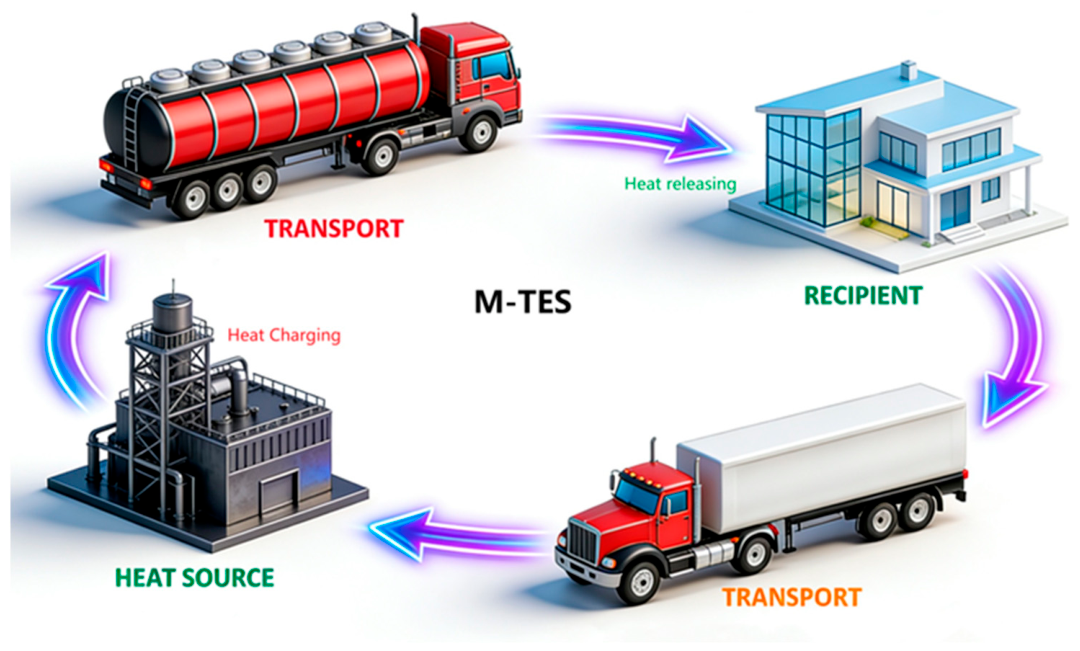
Mobile heating, also referred to as mobilized thermal energy storage (M-TES), enables flexible thermal energy transfer between heat sources and end users. As illustrated in Figure 1, it overcomes the spatial constraints of fixed heating networks by employing specialized vehicles equipped with thermal energy storage (TES) units to store thermal energy from stable sources such as power plants or industrial waste streams, transport it, and release it directly at the user site [2]. A standard heating vehicle typically transports 3–5 tons of steam or equivalent thermal energy, with an effective service radius of approximately 25 km. This configuration is particularly suitable for remote rural areas, newly developed industrial parks, large-scale exhibitions, temporary construction sites, and emergency shelters where pipeline construction is uneconomical or infeasible and heat demand is intermittent or temporary.
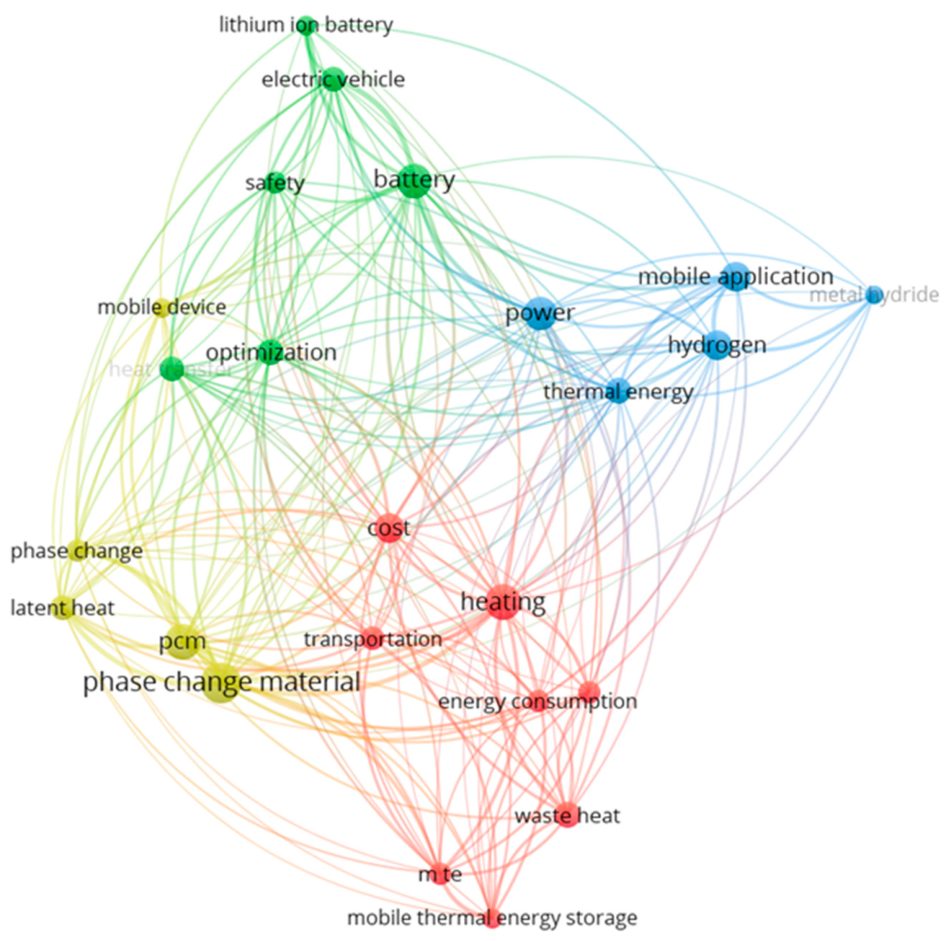
The current research boundaries and knowledge topology of M-TES can be clarified. To ensure transparency and reproducibility, a bibliometric analysis was conducted based on the Web of Science Core Collection database using the search query TS = (“mobile thermal energy storage”) AND TS = (“heating”). The initial search yielded 193 records (1996–present). After a relevance check to ensure consistency with thermal energy storage and heating-related topics, the resulting dataset was utilized for keyword co-occurrence analysis in VOSviewer 1.6.20. It should be noted that this approach captures not only core research on M-TES for heating, but also adjacent interdisciplinary domains due to the broad search strategy. Based on a bibliometric keyword co-occurrence network analysis (Figure 2), the global research landscape of M-TES can be broadly categorized into four clusters, including both core research areas and adjacent domains.
Cluster 1 (red area): Mobile thermal energy storage systems and techno-economic assessment.
This cluster mainly represents research on the system-level deployment of mobile thermal energy storage (M-TES) for heating applications. Key terms such as mobile thermal energy storage, M-TES, waste heat, heat source, and heating indicate a strong focus on utilizing industrial waste heat and transporting stored thermal energy to spatially separated demand sites. In addition, keywords including transportation, energy consumption, and cost highlight the importance of techno-economic evaluations, particularly regarding transport logistics and system efficiency.
Cluster 2 (yellow area): Phase change materials and latent heat thermal storage.
This cluster centers on the fundamental properties and applications of phase change materials for thermal energy storage. Core keywords such as phase change, phase change material (PCM), and latent heat indicate a focus on latent heat storage mechanisms and material performance. The presence of mobile device suggests potential applications of PCM-based thermal management in compact or mobile thermal systems.
Cluster 3 (green area): Thermal management and safety of electrochemical energy storage systems.
This cluster represents an adjacent research domain focusing on the thermal behavior and safety of battery-based energy storage systems. Representative keywords include battery, lithium-ion battery, and electric vehicle, indicating the relevance of battery technologies in mobile or distributed energy applications. Meanwhile, terms such as heat transfer, optimization, and safety reflect research efforts aimed at improving thermal management strategies to enhance operational stability and prevent thermal runaway.
Cluster 4 (blue area): Metal hydride hydrogen storage and thermal energy coupling.
This cluster corresponds to a peripheral research area related to hydrogen energy systems based on metal hydride storage materials. The keywords hydrogen, metal hydride, and thermal energy highlight the thermodynamic coupling between hydrogen absorption/desorption processes and heat transfer. Additional terms such as power and mobile application suggest that these systems are explored for energy supply and portable or mobile energy technologies where efficient thermal management is essential.
The core advantages of this technology stem from its flexibility, economic efficiency, and emergency support capability. In terms of flexibility, it enables precise door-to-door heat delivery, significantly expanding spatial accessibility and application adaptability. Economically, it avoids the substantial initial investment required for long-distance pipeline infrastructure when serving small and dispersed users, thereby lowering the entry barrier to heating services. By efficiently recovering waste heat from processes such as municipal solid waste incineration and biomass/coal power generation, it enhances overall energy utilization efficiency and fosters a mutually beneficial value chain among heat suppliers, operators, and users. From an emergency preparedness perspective, mobile heating functions as a reliable supplementary resource to centralized urban heating systems. Under extreme cold weather, heat source failures, or pipeline maintenance events, it can be rapidly deployed to provide emergency thermal support to affected areas and safeguard essential public services. So far, there are a lot of commercial application cases of such mobile heat storage in China and internationally, as listed in Table 1.
Nevertheless, as an emerging technology, M-TES still faces practical challenges and technical bottlenecks in large-scale implementation. Compared to conventional stationary TES, which operates at fixed locations with pipeline-based continuous heat transfer and stable operating conditions, M-TES introduces additional transport-related system-level complexities fundamentally associated with its mobility.
For example, its single-delivery heating capacity is limited by transport capability, making it unsuitable for independently meeting continuous, large-scale regional heat demand. This transport-dependent mode results in intermittent heat delivery and additional operational constraints. Operational uncertainties include traffic conditions during transport, safety risks, and the standardization and reliability of user-side pipeline connections. Limited market awareness and established user behavior patterns may also hinder broader adoption.
The feasibility, economic performance, and operational effectiveness of mobile heating fundamentally depend on its core component: thermal energy storage technology. This technology involves the transport and transfer of thermal energy between heat sources and users via specialized vehicles containing storage materials [1,2]. Unlike stationary TES, where heat loss is primarily governed by storage duration under relatively stable conditions, M-TES also involves thermal loss during transportation and requires storage systems with sufficient mechanical robustness to withstand dynamic transport conditions. Current research on TES mainly focuses on sensible heat storage, phase change heat storage, and thermochemical heat storage. Sensible heat storage, employing materials such as water, soil, or molten salts, is technically mature and widely applied, though its energy density remains relatively limited [8,9]. Phase change heat storage utilizes latent heat during phase transitions, achieving at least an order of magnitude higher energy density than sensible heat storage while enabling nearly constant-temperature heat output [10,11]. Thermochemical heat storage offers high energy density potential but involves complex and bulky systems that are currently difficult to integrate into mobile vehicle-based applications [12]. Consequently, mobile heating vehicles based on phase change heat storage demonstrate clear advantages in supply stability, transport efficiency, and operational flexibility and are becoming a primary focus of research and deployment [13]. Thermochemical storage remains attractive for mobile heating due to its high theoretical energy density, although ensuring system stability during transport remains a critical challenge. A comparative summary of different TES technologies is presented in Table 2.
By scanning the Web of Science Core Collection database using the search query TS = (“mobile ther-mal energy storage”) AND TS = (“heating”), 47 review publications were found. By comparing the focus on heat supply and demand with M-TES, 38 papers of zero or low relevance to heating, which focus on battery, heat management and insulation, were excluded, and the remaining nine publications are listed in Table 3.
The review publications in Table 3 mainly focus on hydrides and hydrogen storage, paying less attention to heating [17,18,20,21], or only on PCM storage [19,22], and only few focus on various types of TES and have higher relevance in heating [13,15,16].
Given the technical advantages of PCM heat storage and thermochemical heat storage, and their critical role in enhancing the overall performance of mobile heating systems, this work builds upon an overview of the development background, operational characteristics, and the challenges of mobile heating to conduct an in-depth investigation of these two technologies.
With more attention to the status of M-TES in the Chinese market, it systematically reviews their fundamental principles, material systems, system configurations, application status, and development trends. Through representative case studies, it further evaluates their techno-economic performance under various application scenarios. The objective is to provide valuable references for technology development, industrial planning, and commercial decision-making and to promote a coordinated, efficient, and resilient distributed heating with M-TES technology.

2. Mobile Phase Change Thermal Energy Storage

2.1. Domestic Research

To comprehensively assess the overall benefits of mobile heating and explore pathways for performance optimization, extensive studies have been conducted on techno-economic analysis and system optimization. Lyu et al. compared the economic performance of different heating schemes using a factory residential area as a case study and designed three alternative cases: traditional buried pipeline heating, hot-water-based mobile thermal storage vehicles, and phase-change-based mobile thermal storage vehicles. Equipment selection and operational parameters were calculated for each scheme, and economic indicators, including initial investment, operating costs, revenue, and lifecycle net income, were systematically evaluated. The results indicate that phase-change-based mobile storage vehicles offer higher single-vehicle storage capacity and superior economic performance compared with the other options [23]. Wu et al. examined the application prospects of mobile heating in China using a specific steam demand scenario (0.6 MPa, 180 °C, 2 t·h−1 continuous supply) and evaluated the feasibility of utilizing cold reheat steam from a 320 MW boiler unit as the heat source with a mobile vehicle, a feature listed in Table 4. Their analysis shows that the total investment is approximately RMB 4.65 million, with an expected annual profit of about RMB 0.895 million. The calculated static payback period is less than six years, below the industry benchmark, demonstrating favorable technical feasibility and economic viability [24]. Guo et al. did a review of studies on M-TES involving materials, containers and economic evaluation [25].
In area of technological application and material innovation, related research aims to enhance thermal performance and intelligent operation. Ning et al. proposed an intelligent mobile phase change heating method employing low-temperature PCM KAlSO4·12H2O with high latent heat as the storage medium to efficiently recover dispersed and intermittent industrial waste heat and enable intelligent system control [26]. To address severe wind curtailment in Inner Mongolia caused by insufficient grid transmission capacity, Liu et al. developed a mobile thermal storage heating device powered by off-peak wind electricity. The system converts curtailed wind power into thermal energy stored in solid storage media and transports it to nearby heat demand areas. This approach improves wind energy utilization, promotes electrification of heating, and reduces pollution associated with coal-fired heating, yielding both economic returns and social benefits [27].
The value of an integrated application with mobile heating in industrial waste heat recovery has also been demonstrated. Ning et al. analyzed its application in biomass power plants, highlighting advantages such as low initial investment, flexible service range, minimal heat loss, low operating cost, and rapid charge–discharge rates, thereby improving overall energy efficiency and economic returns [28]. Ding et al. conducted a case study on a 1200 t·d−1 municipal solid waste incineration power plant retrofit. After adopting mobile heating, waste heat utilization increased from 25% to over 60%, system thermal efficiency reached 85%, and annual CO2 emissions were reduced by approximately 47,000 tons, providing an effective pathway for diversified waste heat utilization [29]. Cheng et al. further demonstrated that integrating mobile thermal storage heating with waste heat in a landfill gas power generation unit enables cascade utilization, enhances overall energy efficiency, and achieves energy-saving and emission-reduction targets [30].
To optimize operational control and storage unit performance, advanced algorithms and numerical simulations have been introduced. Yang et al. developed a temperature quality classification model for mobile waste heat recovery by improving support vector machine parameters using particle swarm optimization. Simulation results confirm that the method robustly analyzes the influence of storage parameters on heat quality and improves classification accuracy for varying temperature demands, validating the feasibility of intelligent algorithms in temperature quality management [31]. Tian et al. performed transient numerical simulations of a mobile phase change thermal storage unit using Fluent software to investigate the evolution of temperature fields, phase interfaces, and liquid fraction during charging and discharging. The results reveal a non-uniform pear-shaped melting pattern driven by natural convection and identify heat transfer dead zones near the bottom and sidewalls. Optimization of heat transfer tube diameter, quantity, and fin structures effectively enhanced heat transfer, providing theoretical support for engineering design improvements [32]. Li et al. focused on developing high-performance storage materials by preparing a high-temperature organic eutectic PCM with a phase change temperature of 186.3 °C and latent heat of 261.5 J·g−1. By incorporating high-conductivity fillers in a simulation study, the thermal conductivity was increased from 0.5037 to 0.5912 W·m−1·K−1. When applied in an improved finned heat exchange tube configuration, the storage time was reduced to 1.5–2 h, demonstrating the substantial potential of advanced PCMs in accelerating thermal response [33].
Laboratory research primarily focuses on optimizing storage materials, particularly PCMs, and validating system performance. Wang et al. experimentally investigated a mobilized thermal storage system using 215 kg of sodium acetate trihydrate as the PCM. Charging and discharging processes required 1200 s and 1400 s, respectively, while non-uniform temperature distribution and supercooling were observed. Under simulated domestic hot water conditions with indirect heat exchange, the system achieved a thermal efficiency of 79.4% [34]. Li et al. comprehensively studied the properties, advantages and disadvantages of the various PCMs. The research progress of composite phase change technology and heat transfer enhancement technology are mainly discussed in the view of leakage, corrosion, supercooling, and poor heat conduction [35]. PCM-based M-TES systems effectively mitigate temperature fluctuations of industrial waste heat sources and ensure stable heat supply. The performance characteristics of representative materials are summarized in Table 5.
In summary, existing studies have investigated mobile heating in terms of multiple dimensions, including economic evaluation, scenario-based applications, system control optimization, and enhancement of key components such as materials and storage units. The findings demonstrate that mobile heating is economically competitive and highly effective in industrial waste heat recovery and renewable energy integration scenarios. By integrating intelligent control algorithms, optimizing heat transfer structures, and developing high-performance PCMs, the overall energy efficiency, operational stability, and economic viability of mobile heating systems can be significantly improved, thereby establishing a solid technical foundation for large-scale commercialization.

2.2. International Research

The site mismatch between energy resources and end users is the main challenge, especially for those that are far away from sources. The M-TES can provide a potential solution. Besides commercial or pilot applications of M-TES [38,39,40,41,42], listed in Table 6, many researchers from different countries did a lot work involving various kinds of advanced PCMs [43,44,45], techno-economic assessment, technological development, integrated energy management and industrial concepts [46,47,48,49].
In terms of techno-economic assessment, Anandan et al. demonstrated that the levelized cost of energy (€/MWh) for mobile thermal energy storage increases with transport distance between the heat source and end user. For latent heat storage systems with capacities ranging from 1.4 to 2.5 MWh and transport distances between 2 and 50 km, the energy cost is approximately 40–80 €/MWh [46]. Guo et al. conducted a techno-economic evaluation of M-TES systems based on a Chinese case study, focusing on compatibility with existing heating systems such as fan coil units and ground-source systems. Considering road transport regulations, they determined a container configuration with a maximum payload of 39 tons per trip. Under an optimal operation strategy involving two containers and four daily trips, the payback period was estimated at approximately 10 years, making the system suitable for small- and medium-scale heat users in China [47].
Regarding technological development status and potential, Kuta et al. reported that M-TES systems are primarily based on sensible, latent, and thermochemical storage principles, with latent heat storage dominating current research and demonstration projects. Although laboratory studies and simulations have progressed, large-scale demonstration and commercial deployment remain limited. Existing systems achieve storage capacities up to 5.4 MWh and operate over a wide temperature range from 58 °C to 1300 °C, highlighting both technological potential and research gaps toward commercialization [13]. Nagamani et al. investigated M-TES systems integrated into district energy networks by developing analytical performance models. Their 2022 evaluation reported an average round-trip efficiency of 53%, a maximum coefficient of performance of 1.74, and an exergy efficiency of 46.7%, with transport trucks achieving 50% exergy efficiency, supporting sustainable industrial waste heat utilization [40]. Naik et al. provided a comprehensive review of M-TES systems for district cooling and heating applications, comparing adsorption materials in terms of energy density, capacity, and cost, and outlining system design strategies and future research directions [50].
In enhancing system resilience and integrated energy management, Jordehi et al. assessed the contribution of M-TES-integrated industrial energy hubs to power system resilience. Using a modified IEEE 24-bus system model, their case study showed that M-TES integration improved the expected unserved load index by 2.4%, significantly strengthening system robustness and recovery capability [51]. Sonkar et al. developed and validated a thermodynamic model for an M-TES-based cooling system, with a maximum deviation within ±11% compared to experimental data. Annual performance analysis revealed that the average energy efficiency ratio and coefficient of performance were approximately four times and two times higher, respectively, than those of conventional vapor absorption cooling systems. The M-TES system also demonstrated superior exergy performance and external efficiency, confirming its practicality and cost-effectiveness for dynamic industrial waste heat utilization in seasonal cooling applications [52].
In novel system design and performance optimization, Yang et al. proposed an optimization model for a mobile waste heat recovery supply chain based on life cycle assessment, encompassing recovery, transport, and storage stages. Case analysis indicated that the optimized model ensures supply stability under stochastic demand while reducing overall supply chain costs compared to conventional waste heat recovery and fossil-fuel-based heating systems [53]. In a subsequent study, they developed a numerical model to analyze dynamic system behavior. Results showed that demand-driven production planning can achieve Pareto optimality, and with appropriate government subsidies, the project becomes profitable with a shortened payback period [54]. Mobile energy storage mounted in vehicles for heating projects is a flexible method to save end users’ heating costs, with lower space limitations. Such market potential is very promising [55].
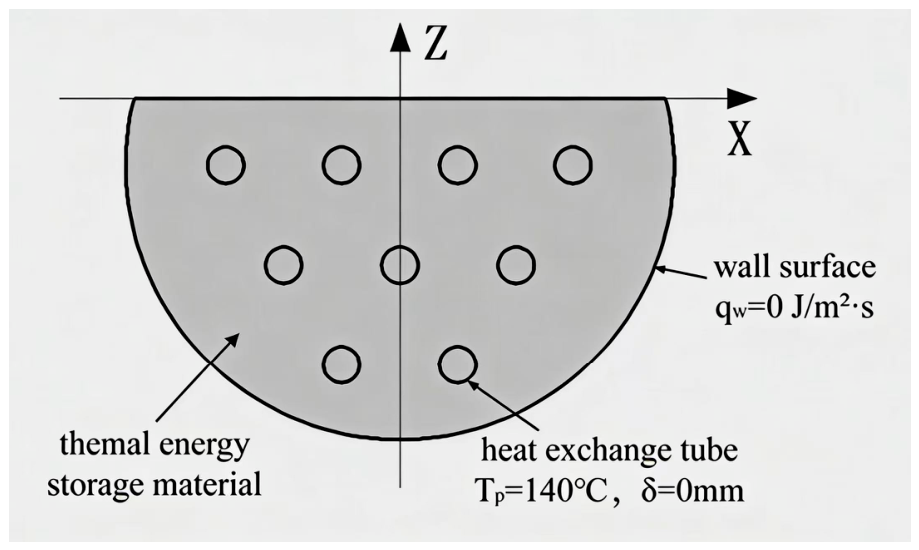
For industrial applications, Yang et al. designed a novel mobile TES device employing salt-based composite PCM modules and air as the heat transfer medium to recover industrial waste heat in the UK. A validated CFD model was developed for parametric analysis and performance evaluation. After a 10 h charging cycle, the system stored nearly 400 MJ of thermal energy at a density of 560 kJ/kg and released approximately 97% of the stored heat over a subsequent 10 h discharge period, with an average outlet air temperature exceeding 468 K, demonstrating feasibility for industrial deployment [56]. Kang et al. proposed a modular mobile PCM-based storage cabin and analyzed its performance using CFD simulations, as shown in Figure 3. Adding internal fins increased the PCM melting rate by approximately 30%, although the enhancement diminished with increasing fin number or height. By incorporating expanded graphite into erythritol at a volume fraction of 15.2%, the charging time was reduced to nearly 10% of the original duration, significantly improving thermal performance [57].
Overall, these studies deepen the understanding of M-TES technology from perspectives of techno-economics, system performance, application potential, resilience enhancement, and innovative design. The literature consistently confirms that M-TES is economically viable within specific transport distances and capacity ranges. It demonstrates substantial value in district energy management, industrial waste heat recovery, and power system resilience enhancement. Modular design, advanced PCM development, supply chain optimization, and refined modeling approaches collectively address uneven thermal performance and cost control challenges.
Although large-scale commercialization remains limited, ongoing technological innovation and system integration research are laying a solid foundation for the broader deployment of M-TES within future integrated energy systems.

3. Mobile Thermochemical Energy Storage

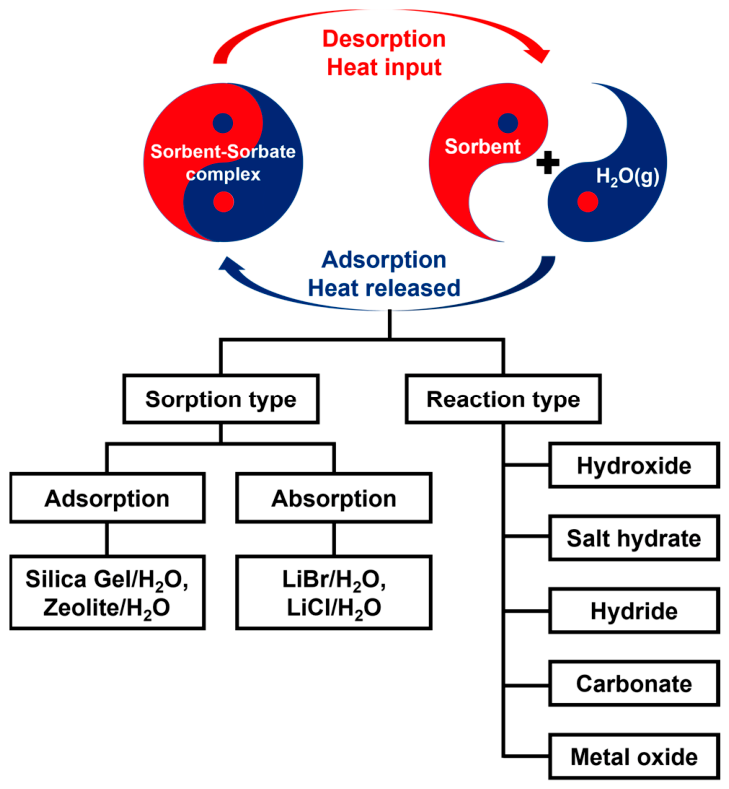
Comparing with PCM storage, thermochemical energy storage has attracted considerable attention in renewable energy integration and industrial waste heat recovery due to its high energy density and capability for seasonal storage [20,58], which is divided into two types: sorption-based energy storage and reversible chemical reaction-based energy storage. Sorption-based energy storage utilizes the strong binding forces formed between sorbents and sorbates during the desorption/sorption process to release/store thermal energy. Reversible chemical reaction-based energy storage operates by leveraging the reaction enthalpy of heat-storing materials in reversible chemical reactions, primarily involving gas–solid reactions. Examples include alkaline earth metal oxides (CaO/Ca(OH)2, CaO/CaCO3, MgO/Mg(OH)2, and MgO/MgCO3), metal hydrides (Mg/H2), ammonia, and salts, as seen in Figure 4.
Narwal et al. investigated the heat storage performance of zeolite materials under external charging conditions and evaluated their suitability for short-distance mobile storage. Zeolite charged at 200 °C achieved an energy storage density exceeding 110 kWh/m3 during desorption at 0.45 m/s airflow and 60% relative humidity. When zeolite beads were charged in movable stainless-steel mesh tubes, the energy storage density achieved was 30.6 kWh/m3 [59].
Lithium metal oxides such as Li4SiO4 have emerged as promising solid CO2 sorbents with potential for high-temperature thermochemical storage based on the reversible reaction Li4SiO4 + CO2 ⇌ Li2CO3 + Li2SiO3. This reaction releases heat during CO2 absorption and regenerates via an endothermic process above 700 °C under low CO2 partial pressure. Junko et al. employed a newly developed mobile microscale infrared thermography system to directly observe the thermal behavior of Li4SiO4 powder reacting with CO2 above 600 °C. Using a superimposed signal processing method, they achieved precise temperature quantification of microscale heat transfer during the reaction. Experiments showed that 50 μm Li4SiO4 particles emitted light above 600 °C due to the exothermic reaction in a CO2 atmosphere, with intensity increasing toward 700 °C. Thermal imaging also captured the endothermic melting of the reaction product Li2CO3 above 700 °C [60].
Based on reversible gas–solid reactions in thermochemical systems, thermal energy can be efficiently stored and released through dehydration/hydration or carbonation/calcination processes. In recent years, extensive research has focused on material modification, reactor design, system integration, and mobile storage applications.
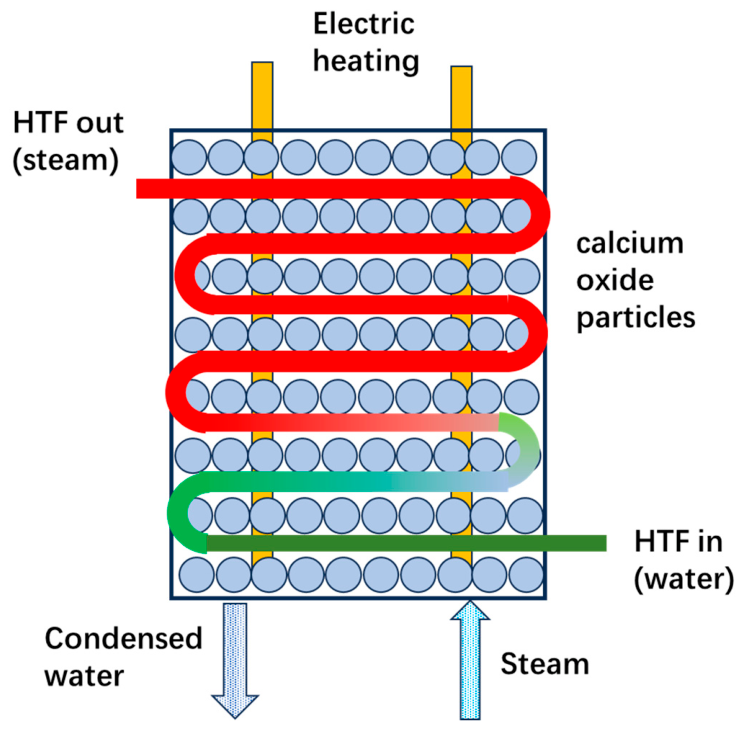
Wang et al. developed a pilot-scale containerized thermochemical energy storage prototype featuring an “electricity-in, steam-out” configuration, as shown in Figure 5. The core component is a packed-bed reactor loaded with 290.527 kg of spherical calcium oxide particles and designed with a nine-unit stacked modular structure for scalability. By integrating internal fin networks and electric heaters, the system achieves efficient heat transfer and flexible utilization of renewable and off-peak electricity. After ten charge–discharge cycles, the system demonstrated stable performance with maximum and final conversion rates of 95.87% and 87.28%, respectively. During charging, the system operated at a maximum power of 126.11 kW for 319 min, storing 1290.63 MJ with an energy efficiency of 98.84%. During discharging, the reactor produced superheated steam at an initial temperature of 166.63 °C and saturated steam at atmospheric pressure, operating at a maximum power of 73.02 kW for 351 min with a discharge efficiency of 91.80%. The overall round-trip efficiency reached 90.74%, and the overall heat transfer coefficient during discharge ranged from 20 to 140 W·m−2·K−1 [61].
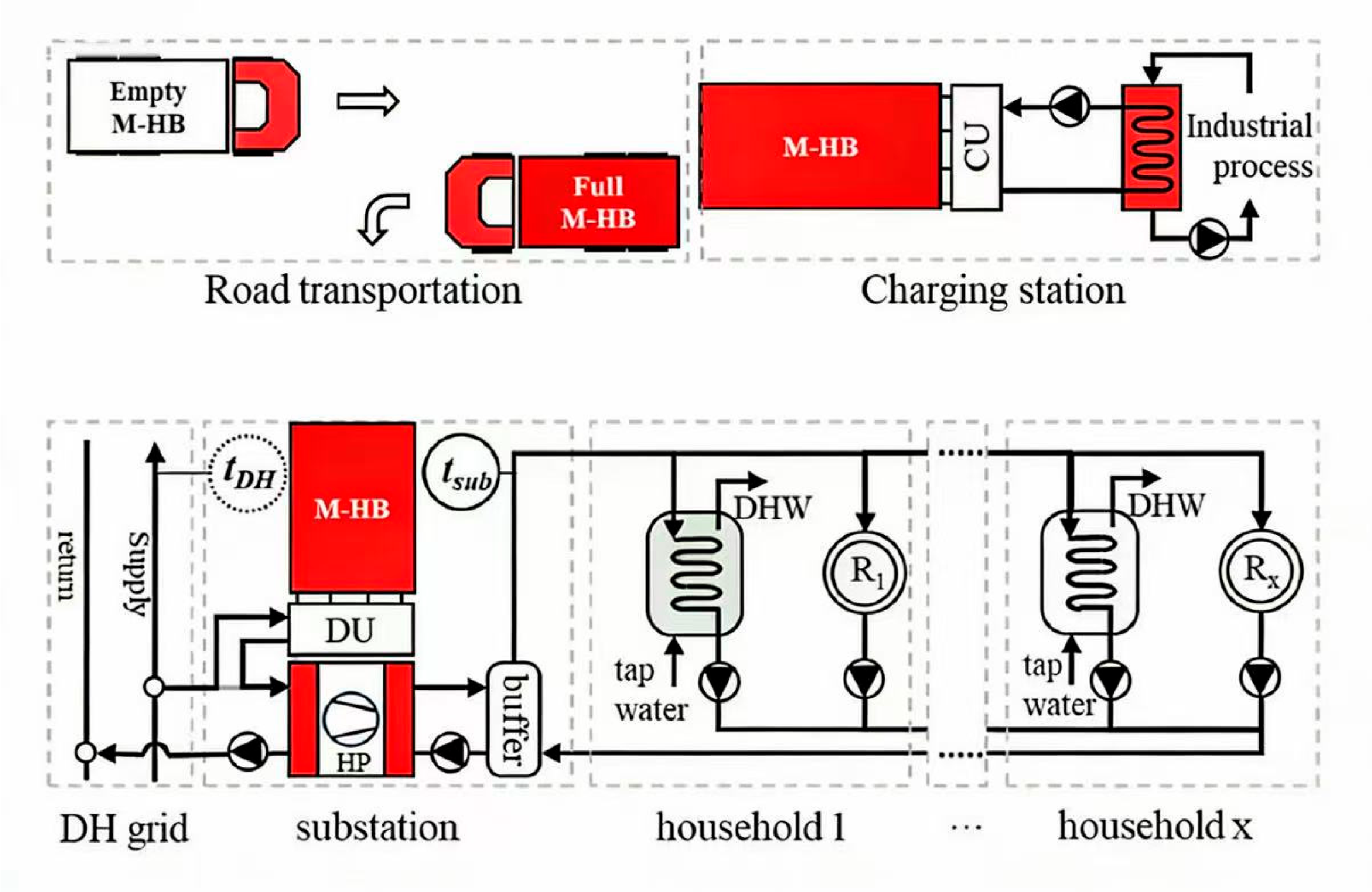
As one type of M-TES, a mobile heat battery (M-HB) was proposed by Cellcius BV, Eindhoven, Netherlands in 2023, using reversible hydration of potassium carbonate (K2CO3) in a container. It has a maximum heat capacity of 10 GJ and a discharging power of 110 kW [54]. Based on this M-HB, as shown in Figure 6, Wang et al. evaluated the potential of this battery in low-temperature district heating networks in the Netherlands using simulation-based case studies. Under optimal operation and waste heat source selection, operational carbon emissions decreased by approximately 80%, from 60 to 70 kg CO2/GJ to around 13 kg CO2/GJ. The analysis highlighted that emissions associated with transport and charging processes critically influence overall decarbonization performance, underscoring the importance of low-carbon heat source selection [62].
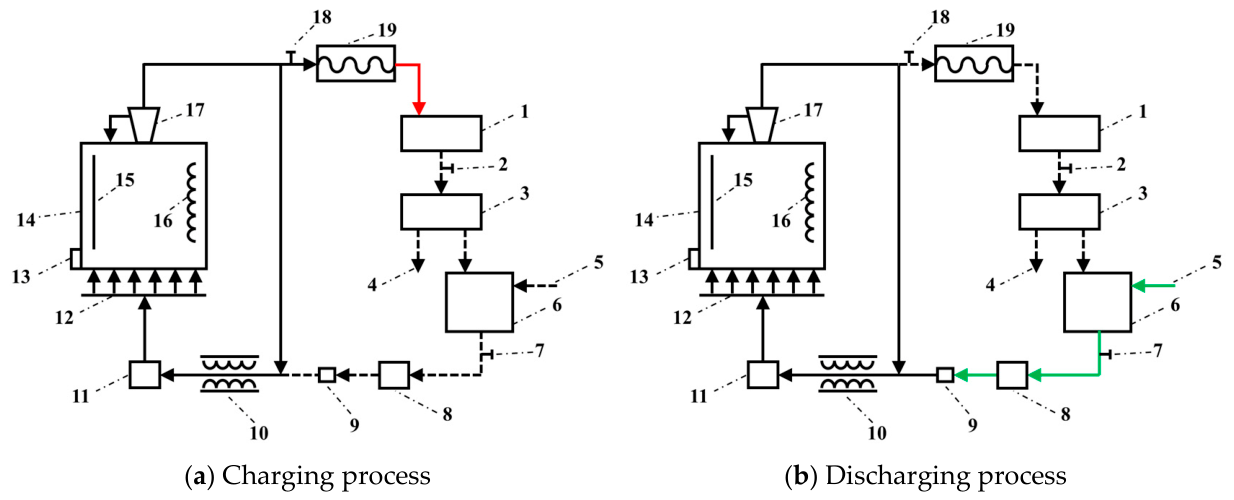
Feng et al. investigated the fluidized thermochemical storage characteristics of carbide slag (Ca(OH)2) through combined experimental and numerical methods. They elucidated rapid reaction kinetics, identified self-compensation and degradation mechanisms over multiple cycles, characterized bubble dynamics in bubbling fluidized beds, and proposed optimized process configurations for various application scenarios [63]. Unlike most packed beds of materials used in M-TES, one concept design for M-thermochemical storage, using one bubbling fluidized bed both for heat charging and discharging, was proposed [64], as shown in Figure 7. The characteristics of this process are as follows: (1) The process flow is simple, with the charging and discharging processes in a single chamber, avoiding the transportation of solid materials between chambers and simplifying the equipment composition. (2) Water vapor serves not only as the reactant in the exothermic process but also as the fluidizing medium in both processes, offering the advantage of a single gas component and eliminating the need for gas separation devices. (3) Due to the limited material storage capacity and simple structure, this process with a trailer is suitable for distributed heat storage application scenarios.
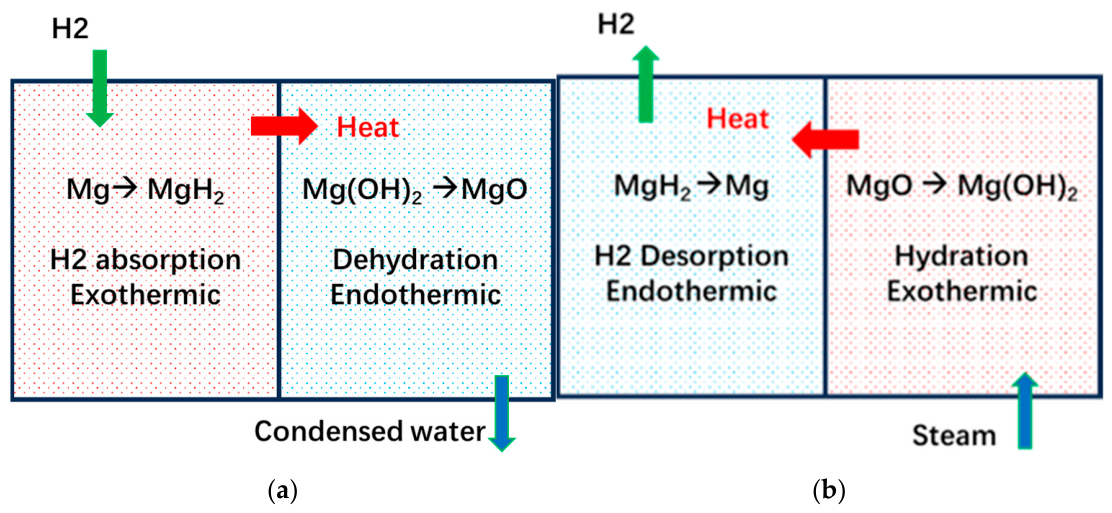
Bhouri proposed a concept and reactor design that consists of an adiabatic system where heat is exchanged internally/reversibly between magnesium hydride (MgH2) and a suitable thermochemical material, such as magnesium hydroxide (Mg(OH)2) [65]. In this reactor, the heat released during the absorption of hydrogen by magnesium is transferred to magnesium hydroxide (Mg(OH)2), which dehydrates H2O and stores the heat, as shown in Figure 8. The geometrical characteristics of the two storage media, properties and operation conditions were discussed. Such a pioneering attempt to combine double or multiple storage materials together may have potential market in B-TES application.
Collectively, these studies demonstrate the feasibility and optimization pathways of thermochemical storage technologies. Large-scale validation of packed-bed reactors confirms that calcium oxide-based “electricity-in, steam-out” systems can achieve stable performance and high round-trip efficiency. Microscale thermal characterization of lithium-based materials provides new approaches for material screening in high-temperature thermochemical storage. Zeolite systems with external charging illustrate their potential for short-distance mobile storage applications. M-TES cooling systems exhibit superior thermodynamic performance compared to conventional absorption refrigeration and adapt effectively to fluctuating waste heat. Carbon emission analyses of mobile heat batteries emphasize the decisive role of transport and charging emissions in determining overall decarbonization outcomes. Fluidized thermochemical storage using carbide slag offers theoretical support for the resource utilization of low-cost solid waste materials. Overall, thermochemical energy storage is advancing through parallel progress in material innovation and system integration. Future research should focus on low-cost material development, enhanced reactor heat transfer, dynamic system matching, and full lifecycle environmental assessment to enable large-scale deployment in practical energy systems.

4. Quantitative Techno-Economic Analysis

The economic performance of M-TES systems is inherently case-dependent and must be evaluated under clearly defined boundary conditions. In particular, the techno-economic performance is primarily governed by three coupled variables: transport distance, effective energy density of the storage medium, and system turnover rate (i.e., the number of charge–discharge cycles per unit time) [66].
For latent heat storage systems, economic feasibility is strongly constrained by the availability of low-cost or near-zero-cost heat sources, as well as the achievable cycle frequency. Since the capital costs associated with containers and PCMs are largely fixed, high-frequency operation is essential to amortize the investment [40]. The levelized cost of delivered heat for M-TES systems typically falls within the range of 40–80 €/MWh for short-to-medium transport distances and capacities of 1.4–2.5 MWh [66]. Conversely, sensitivity analyses suggest that transport distance may have a secondary impact on specific heat cost compared to payload utilization and cycle frequency. For example, a 50% increase in distance can lead to only a marginal cost increase (e.g., from 5.0 to 5.1 ct/kWh) when capital costs dominate [40].
As listed in Table 7, different storage mechanisms exhibit distinct economic baselines under specific operating conditions. For example, a pilot open sorption M-TES system using 14 tons of zeolite achieved a storage capacity of 2.3 MWh per cycle and a levelized cost of approximately 73 €/MWh [39]. This value is limited to short-distance and stable operation. In contrast, a continuous Zeolite 13X system operating over a similar transport distance (6.7 km) reported a lower LCOE of 60.9 €/MWh [67].
These comparisons indicate that economic performance is highly sensitive to operating conditions. In particular, transport distance, payload utilization, and cycle frequency jointly determine system feasibility, and quantitative indicators such as LCOE and payback period should therefore be interpreted on a case-by-case basis. Similarly, the reported payback period of approximately 10 years for certain PCM-based M-TES systems depends on strict operational assumptions. These include maximum payload utilization (e.g., 39 tons per trip), high daily cycle frequency (e.g., four trips per day), and limited transport distance [47]. Deviations from these conditions, such as longer transport distances or reduced cycle frequency, can significantly extend the payback period and reduce economic performance [47]. Therefore, such values should not be generalized without specifying the underlying assumptions.

5. Other Research Potential for Heating

Beyond conventional heat-source-based and phase-change-based mobile heating technologies, emerging studies have explored novel mobile energy systems as high-energy-density or clean energy supply units, opening new pathways for future mobile energy solutions.
In the field of mobile nuclear energy systems, Lin et al. investigated the MNPS-1000 mobile nuclear power system with a designed electric output of 1 MW. By integrating reactor, high-temperature heat pipe, heat pipe heat exchanger, and energy conversion system models, they established a comprehensive system simulation framework using MATLAB/Simulink. Steady-state analysis showed strong agreement between simulated and design values, with maximum relative errors below 6%, validating the analytical platform. Transient simulations of typical reactor and energy conversion system accidents indicated that the maximum fuel temperature remained below 1550 K, within material safety limits, demonstrating inherent safety characteristics [68]. In a subsequent study, Lin et al. further elaborated on the vehicle-mounted megawatt-class heat-pipe-cooled reactor system. The system consists of a 3 MWt heat-pipe-cooled reactor coupled with a hybrid open Brayton and closed Rankine cycle energy conversion system delivering 1 MWe output. The study detailed reactor and conversion system design schemes, analyzed key components, and updated the conceptual design based on system requirements [69].
Regarding hydrogen-based mobile power systems, Muhammad et al. proposed and simulated a 2 MW mobile power plant concept based on organic liquid hydrogen carriers. The system employs a methylcyclohexane–toluene–hydrogen cycle, where hydrogen for the gas turbine is produced via endothermic dehydrogenation of methylcyclohexane using turbine exhaust heat. After process modeling and parameter sensitivity analysis, the base-case thermal efficiency reached 35.44% with a methylcyclohexane flow rate of 24.96 kmol/h. By incorporating regenerative configurations and intercooling in a two-stage compression system, the optimized thermal efficiency improved to 36.79%, reducing fresh methylcyclohexane demand to 24.04 kmol/h [70].
Collectively, research on mobile nuclear systems and hydrogen-based mobile power plants highlights the potential evolution of mobile energy technologies toward high energy density and carbon neutrality. System modeling and safety assessment of mobile nuclear power sources preliminarily confirm their technical feasibility and inherent safety under specific designs, supporting future development of reliable high-power mobile energy units [68,69]. Conceptual design and process optimization of hydrogen carrier-based mobile power systems provide innovative pathways for safe and efficient hydrogen utilization [70]. Although these studies remain largely at the conceptual and simulation stages, they indicate future breakthroughs may arise from integrating advanced nuclear or hydrogen technologies to meet increasing demand for clean, compact, and high-power-density mobile energy, including electric or heat.

6. Conclusions and Prospective

Vehicle-mounted mobile heating, characterized by “mobile storage and on-demand delivery,” has emerged as an effective solution to complement centralized heating networks, enhance industrial waste heat utilization, and strengthen emergency heating resilience. Based on a systematic review of domestic and international research, several key conclusions can be drawn.
The technology is acting as a supplementary heating solution and is currently transitioning from pilot demonstration to large-scale commercial deployment.
Within reasonable transport distances (e.g., ≤50 km), projects generally demonstrate strong economic viability with payback periods of approximately 6–10 years, which are highly sensitive to operating conditions. In particular, transport distance, payload utilization, and cycle frequency jointly determine system feasibility, and quantitative indicators such as LCOE and payback period should therefore be interpreted on a case-by-case basis.
Performance enhancement increasingly relies on advanced materials and system innovation. The development of high-latent-heat, high-conductivity composite PCMs and optimized storage structures, such as fin-enhanced designs, has mitigated slow charging rates and temperature non-uniformity. Intelligent algorithms, including PSO-SVM models, and CFD simulations are enabling more refined and intelligent operational management.
Future development emphasizes system integration and multi-energy coupling. The technology is being explored as a flexible component within integrated energy systems, facilitating coordinated electricity–heat–hydrogen supply and enhancing overall system resilience.
Large-scale deployment faces challenges related to long-distance transport economics, user-side interface standardization, market acceptance, and policy support. Further progress should prioritize low-cost high-performance materials, modular and standardized equipment design, intelligent dispatch platforms, and expanded demonstration projects to establish mobile heating as a key component of modern low-carbon energy systems.

Author Contributions

Conceptualization, D.L.; methodology, C.H. and A.Z.; software, A.Z. and Y.Y.; validation, D.L.; formal analysis, Y.Y.; investigation, Y.Y. and C.H.; resources, A.Z.; data curation, C.H.; writing—original draft preparation, Y.Y.; writing—review and editing, D.L.; visualization, A.Z.; supervision, D.L.; project administration, D.L.; funding acquisition, D.L. All authors have read and agreed to the published version of the manuscript.

Funding

This research was supported by the National Natural Science Foundation of China (Grant No. 52266007), Yunnan Major Scientific and Technological Projects (Grant No. 202201BE070001-011, 202403AA080020, 202505AO120024), China Three Gorges Yunnan Energy Investment Co., Ltd. (YNF/0803), Yunnan Province Key Laboratory of Clean Energy and Energy Storage Technology (Grant No. 202302AN360004).

Data Availability Statement

The data presented in this study are available on request from the corresponding author.

Conflicts of Interest

The authors declare no conflicts of interest. The authors declare that this study received part funding from China Three Gorges Yunnan Energy Investment Co., Ltd. The funder was not involved in the study design, collection, analysis, interpretation of data, the writing of this article or the decision to submit it for publication.

Abbreviations

The following abbreviations are used in this manuscript:
LCOELevelized Cost of Energy
M-HBMobile heat battery
M-TESMobile thermal energy storage
PCMPhase-changing material
TESThermal energy storage

References

  1. Yang, B.; Li, X.; Zhao, J. Research progress of mobilized thermal energy storage technology. Chem. Ind. Eng. Prog. 2013, 32, 515–520. (In Chinese) [Google Scholar]
  2. Ward, P.A.; Corgnale, C.; Teprovich, J.A.; Motyka, T.; Hardy, B.; Sheppard, D.; Buckley, C.; Zian, R. Technical challenges and future direction for high-efficiency metal hydride thermal energy storage systems. Appl. Phys. A 2016, 122, 462. [Google Scholar] [CrossRef]
  3. Zhao, H. A Kind of Mobilized Heating Vehicle with Thermal Energy Storage by Compound Phase Transition. CN102910104 B, 29 October 2014. [Google Scholar]
  4. He, Y. High-Temperature Shaping Phase Change Particle Manufacturing Device and Method. CN119524725 A, 19 December 2025. [Google Scholar]
  5. Wang, Z. Moval Phase-Variable Thermal Storing Device with High Density. CN2755550 Y, 1 February 2006. [Google Scholar]
  6. Guangzhou’s First “Mobile Heating” Project Goes Operational: Huadu Ushers in a New Era of Green, Low-Carbon Heating. Available online: https://sthjj.gz.gov.cn/gkmlpt/content/10/10704/post_10704758.html#644 (accessed on 10 March 2026).
  7. Heat Storage Series. Available online: https://ytcn.com/xrdshvazqxl (accessed on 10 March 2026).
  8. Feng, Y.; Li, X.; Wu, H.; Li, C.; Zhang, M.; Yang, H. Critical review of Ca(OH)2/CaO thermochemical energy storage materials. Energies 2023, 16, 3019. [Google Scholar] [CrossRef]
  9. Rouse, J.; Xu, W.; Garvey, S.D. Energy storage capacity vs. renewable penetration: A study for the UK. Renew. Energy 2021, 171, 849–867. [Google Scholar] [CrossRef]
  10. Gerkman, M.A.; Han, G.G. Toward controlled thermal energy storage and release in organic phase change materials. Joule 2020, 4, 1621–1625. [Google Scholar] [CrossRef]
  11. Koca, A.; Oztop, H.F.; Koyun, T.; Yarol, Y. Energy and exergy analysis of a latent heat storage system with phase change material for a solar collector. Renew. Energy 2008, 33, 567–574. [Google Scholar] [CrossRef]
  12. Feng, Y.; Zhou, T.; Kong, H.; Bai, R.; Ding, Y.; Zhang, M.; Yang, H. Evaluation of thermodynamic and kinetic properties of carbide slag for fluidized thermochemical heat storage. J. Energy Storage 2022, 56, 105855. [Google Scholar] [CrossRef]
  13. Kuta, M.; Mlonka-Mędrala, A.; Radomska, E.; Gołdasz, A. Mobile Thermal Energy Storage—A Review and Analysis in the Context of Waste Heat Recovery. Energies 2025, 18, 4136. [Google Scholar] [CrossRef]
  14. International Renewable Energy Agency. Innovation Outlook: Thermal Energy Storage; International Renewable Energy Agency: Abu Dhabi, United Arab Emirates, 2020. [Google Scholar]
  15. Miro, L.; Jaurne, C.; Luisa, F. Thermal energy storage (TES) for industrial waste heat (IWH) recovery: A review. Appl. Energy 2016, 179, 284–301. [Google Scholar] [CrossRef]
  16. Nems, A.; Nems, M.; Bevilacqua, P.; Ushak, S.; Grageda, M. A comprehensive review of containers for mobilized heat and cold energy storage. J. Energy Storage 2026, 154, 121326. [Google Scholar] [CrossRef]
  17. Malleswararao, K.; Dutta, P.; Srinivasa Murthy, S. Applications of metal hydride based thermal systems: A review. Appl. Therm. Eng. 2022, 215, 118816. [Google Scholar] [CrossRef]
  18. Larpruenrudee, P.; Bennett, N.S.; Luo, Z.; Hossain, M.J.; Haque, N.; Sauret, E.; Fitch, R.; Islam, M. A Review on the Overall Performance of Metal Hydride-Based Hydrogen Storage Systems. Energies 2025, 18, 1291. [Google Scholar] [CrossRef]
  19. Yenare, R.R.; Sonawane, C.R.; Sur, A.; Singh, B.; Panchal, H.; Kumar, A.; Sadasivuni, K.K.; Siddigui, M.; Bhalerao, Y. A comprehensive review of portable cold storage: Technologies, applications, and future trends. Alex. Eng. J. 2024, 94, 23–33. [Google Scholar] [CrossRef]
  20. Davis Cortina, M.; Romero de Terreros Aramburu, M.; Neves, A.M.; Hurtado, L.; Jepsen, J.; Ulmer, U. The Integration of Thermal Energy Storage Within Metal Hydride Systems: A Comprehensive Review. Inorganics 2024, 12, 313. [Google Scholar] [CrossRef]
  21. Koelbig, M.; Weckerle, C.; Linder, M.; Bürger, I. Review on thermal applications for metal hydrides in fuel cell vehicles: Operation modes, recent developments and crucial design aspects. Renew. Sustain. Energy Rev. 2022, 162, 112385. [Google Scholar] [CrossRef]
  22. Nagar, S.; Sreenivasa, S. Mathematical modeling, numerical simulation and experimental validation of temperature profiles of PCMs and their applications in industry 4.0: A review. Proc. Inst. Mech. Eng. Part C-J. Mech. Eng. Sci. 2024, 238, 8850–8876. [Google Scholar] [CrossRef]
  23. Lyu, L. Research on Industrial Waste Heat Applied to Mobile EnergyStorage for Heating Supply. Master’s Thesis, Dalian University of Technology, Dalian, China, 2016. Available online: https://kns.cnki.net/kcms2/article/abstract?v=Jz5IuRg0t02llo_7R9rQxN_H50JiYRS_FlE12ijsNrHdmrWawaWmwILS3eOF5rI2ZnGUQ3x19vsbb8l7f6hAgWHBqvFgIkv3F4tkylGZFzDN992ldotEE96InEWQchNVfbgj-Z0oOcKZEzBTQ_M3TGIY--_tvVrPjjvgURTyDNo2f6EK4Wx3WQ==&uniplatform=NZKPT&language=CHS (accessed on 10 April 2026). (In Chinese)
  24. Wu, Z.; Jiang, B. Technical and economic analysis of mobile heating project for 320MW unit. In Proceedings of the 2021 Power Industry Technical Supervision Work Exchange Meeting and Professional Technical Forum; China Electric Power Technology Market Association: Guiyang, China, 2021; pp. 224–231. (In Chinese) [Google Scholar] [CrossRef]
  25. Guo, S.; Liu, Q.; Zhao, J.; Jin, G.; Wu, W.; Yan, J.; Li, H.; Jin, H. Mobilized thermal energy storage: Materials, containers and economic evaluation. Energy Convers. Manag. 2018, 177, 315–329. [Google Scholar] [CrossRef]
  26. Ning, Y.; Sun, S.; Tian, X.; Wang, G.; Jiang, W. A new intelligent mobile phase change heat storage and heating method. Energy Conserv. Environ. Prot. 2019, 47–48. (In Chinese) [Google Scholar]
  27. Liu, J.; Zhang, X. The Use of Abandoned Wind Power for Mobile Solid Electric Heat Storage Heating. Autom. Appl. 2020, 3, 94–96. (In Chinese) [Google Scholar] [CrossRef]
  28. Ning, B.; Hu, Z.; Yang, F.; Li, Y.; Lyu, Y. Application of mobile heating in biomass power plants. Energy Energy Conserv. 2025, 21–28. (In Chinese) [Google Scholar] [CrossRef]
  29. Ding, H. Application research of mobile heating mode in waste incineration power plants. Energy Conserv. Environ. Prot. 2025, 56–63. (In Chinese) [Google Scholar]
  30. Cheng, P. Research on the waste heat utilization of landfill gas internal combustion generator sets by mobile energy storage heating. Enterp. Sci. Technol. Dev. 2022, 140–142. (In Chinese) [Google Scholar]
  31. Yang, J.; Yang, M. Modeling and application of mobile waste heat recovery energy-saving system. Environ. Prot. Circ. Econ. 2019, 39, 12–16. (In Chinese) [Google Scholar]
  32. Tian, S.; Liu, D.; Niu, T.; Tian, P. Numerical simulation and optimization of mobile phase change heat storage system. Acta Energiae Solaris Sin. 2019, 40, 1511–1518. (In Chinese) [Google Scholar]
  33. Li, Z.; Han, Y.; Huang, L.; Yang, Y.; Shao, W.; Xu, T.; Lin, X.; Qin, F. Study on thermal characteristics of high temperature organic phase change heat storage materials. Guangdong Chem. Ind. 2024, 51, 12–15. (In Chinese) [Google Scholar]
  34. Wang, Y.; Yu, K.; Ling, X. Experimental study on thermal performance of a mobilized thermal energy storage system: A case study of hydrated salt latent heat storage. Energy Build. 2020, 210, 109744. [Google Scholar] [CrossRef]
  35. Li, Z.; Li, B.; Chen, H.; Wen, B.; Du, X. Research progress of phase change thermal storage technology. Chem. Ind. Eng. Prog. 2020, 39, 5066–5085. (In Chinese) [Google Scholar] [CrossRef]
  36. He, X.; Wang, W.; Shuai, Y.; Hou, Y.; Qiu, J. Cross-scale thermal analysis and comprehensive evaluation of biomimetic skin-flesh composite phase change material for waste heat recovery. Energy 2025, 314, 134176. [Google Scholar] [CrossRef]
  37. Zhou, X.; Yamashita, S.; Kubota, M.; Kita, H. Encapsu lated Copper-Based Phase-Change Materials for High Temperature Heat Storage. ACS Omega 2022, 7, 5442–5452. [Google Scholar] [CrossRef] [PubMed]
  38. Mobile Heat|Kraftblock. Available online: https://www.kraftblock.com/technology/mobile-heat (accessed on 10 March 2026).
  39. Krönauer, A.; Lävemann, E.; Brückner, S. Mobile Sorption Heat Storage in Industrial Waste Heat Recovery. Energy Procedia 2025, 73, 272–280. [Google Scholar] [CrossRef]
  40. Deckert, M.; Scholz, R.; Binder, S.; Hornung, A. Economic Efficiency of Mobile Latent Heat Storages. Energy Procedia 2014, 46, 171–177. [Google Scholar] [CrossRef]
  41. Kuta, M. Mobilized thermal energy storage (M-TES) system design for cooperation with geothermal energy sources. Appl. Energy 2023, 332, 120567. [Google Scholar] [CrossRef]
  42. Sanki Heat Containner. Available online: https://www.sanki.co.jp/service/technology/article/detail085.html (accessed on 10 March 2026).
  43. Al-mahmodi, A.F.; Munusamy, Y.; Atta, M.R.; Suyambulingan, I.; Mokaizh, A.; Muniyadi, M. Utilizing phase change materials in thermal energy systems: Applications in waste heat recovery. Appl. Therm. Eng. 2025, 279, 128003. [Google Scholar] [CrossRef]
  44. Malik, F.K.; Khan, M.M.; Ahmed, H.F.; Khan, M.M.; Ahmed, H.F.; Irfan, M.; Ahad, I. Performance characteristics of PCM based thermal energy storage system for fluctuating waste heat sources. Case Stud. Therm. Eng. 2022, 34, 102012. [Google Scholar] [CrossRef]
  45. Bayón, R. Special Issue “Advanced Phase Change Materials for Thermal Storage”. Appl. Sci. 2021, 11, 1390. [Google Scholar] [CrossRef]
  46. Anandan, S.S.; Sundarababu, J. A comprehensive review on mobilized thermal energy storage. Energy Sources Part A Recovery Util. Environ. Eff. 2021, 47, 9076–9099. [Google Scholar] [CrossRef]
  47. Guo, S.; Zhao, J.; Wang, W.; Yan, J.; Jin, G.; Wang, X. Techno-economic assessment of mobilized thermal energy storage for distributed users: A case study in China. Appl. Energy 2017, 194, 481–486. [Google Scholar] [CrossRef]
  48. Nagamani, G.; Naik, B.K.; Agarwal, S. Energetic and exergetic performance analyses of mobile thermochemical energy storage system employing industrial waste heat. Energy 2024, 288, 129730. [Google Scholar] [CrossRef]
  49. Miliozzi, A.; Nicolini, D.; Napoli, G.; Giorgi, G.; Liberatore, R. Experimental Evaluation of a Combined Sensible and Latent Heat Thermal Energy Storage System. Energies 2025, 18, 5808. [Google Scholar] [CrossRef]
  50. Naik, B.K.; Priyadarshi, G.; Agarwal, S.; Fernandes, R.; Mrkus, D. Sorption Based Mobile Thermal Energy Storage for Better Sustainability. Heat Transf. Eng. 2025, 1–18. [Google Scholar] [CrossRef]
  51. Rezaee Jordehi, A.; Mansouri, S.A.; Tostado-Véliz, M.; Igbal, A.; Marzband, M.; Jurado, F. Industrial energy hubs with electric, thermal and hydrogen demands for resilience enhancement of mobile storage-integrated power systems. Int. J. Hydrogen Energy 2024, 50, 77–91. [Google Scholar] [CrossRef]
  52. Sonkar, M.; Naik, B.K. Energy and exergy comparison of mobile thermochemical energy storage-based refrigeration system with vapor absorption refrigeration system. J. Therm. Anal. Calorim. 2025, 150, 12753–12775. [Google Scholar] [CrossRef]
  53. Yang, J.; Chen, J.; Zhang, Z.; Hong, M.; Li, H.; Li, Y.; Yang, M. Cost performance optimization of waste heat recovery supply chain by mobile heat storage vehicles. Energy Rep. 2020, 6, 137–146. [Google Scholar] [CrossRef]
  54. Yang, J.; Zhang, Z.; Chen, J.; Hong, M.; Li, H.; Li, Y.; Yang, M. Investigating the economic returns of mobile heat storage devices in the multi-stage closed-loop supply chain. Energy Rep. 2020, 6, 181–189. [Google Scholar] [CrossRef]
  55. Nwosu, P.N. Condenser-side integration of a simple solar-type WHR device in a thermal plant. J. Clean. Prod. 2017, 157, 333–341. [Google Scholar] [CrossRef]
  56. Yang, S.; Bai, M.; Grégoire, B.; Ma, H.; Zhang, T.; Ding, Y. Design and modelling of mobile thermal energy storage (M−TES) using structured composite phase change material modules. Appl. Therm. Eng. 2024, 254, 123896. [Google Scholar] [CrossRef]
  57. Kang, Z.; Tan, R.; Zhou, W.; Qin, Z.; Liu, S. Numerical Simulation and Optimization of a Phase-Change Energy Storage Box in a Modular Mobile Thermal Energy Supply System. Sustainability 2023, 15, 13886. [Google Scholar] [CrossRef]
  58. Prasad, J.; Muthukumar, P.; Desai, F.; Basu, D.; Rahman, M. A critical review of high temperature reversible thermochemical energy storage systems. Appl. Energy 2019, 254, 113733. [Google Scholar] [CrossRef]
  59. Narwal, K.; Farsad, S.; Kempers, R. Adsorption-Based Thermal Energy Storage Using Zeolites for Mobile Heat Transfer. Energy Storage 2024, 6, e70041. [Google Scholar] [CrossRef]
  60. Junko, M.; Hiroki, T.; Massimiliano, Z.; O’Brien, P.G. Micro-scale thermal imaging of CO2 absorption in the thermochemical energy storage of Li metal oxides at high temperature. In Thermosense: Thermal Infrared Applications XXXIX; Proc. SPIE 10214; SPIE: Bellingham, WA, USA, 2017; p. 1021408. [Google Scholar] [CrossRef]
  61. Wang, B.; Sun, J.; Ma, Z.; Mei, W.; Wei, J. Proposal of a pilot-scale prototype of ‘electricity-in-steam-out’ packed-bed reactor for thermochemical energy storage with Ca(OH)2/CaO. Chem. Eng. J. 2025, 505, 159211. [Google Scholar] [CrossRef]
  62. Wang, S.; Hoes, P.-J.; Hensen, J.L.M.; Adan, O. Quantifying the decarbonization potential of mobile heat battery in low-temperature district heating. Sustain. Cities Soc. 2024, 113, 105657. [Google Scholar] [CrossRef]
  63. Feng, Y.; Hu, X.; Li, X.; Zhang, M.; Zhu, S.; Yang, H. Self-Compensation and Attenuation Mechanisms of Carbide Slag in Multicycle Thermochemical Heat Storage. Renew. Energy 2023, 218, 119284. [Google Scholar] [CrossRef]
  64. Feng, Y.; Zhang, M.; Deng, B.; Yang, H. A Device and Method for Chemical Energy Storage and Release Using Carbide Slag. CN112604611 B, 29 March 2022. [Google Scholar]
  65. Bhouri, M.; Bürger, I.; Linder, M. Feasibility Analysis of a Novel Solid-State H2 Storage Reactor Concept Based on Thermochemical Heat Storage: MgH2 and Mg(OH)2 as Reference Materials. Int. J. Hydrogen Energy 2016, 41, 20549–20561. [Google Scholar] [CrossRef]
  66. Du, K.; Calautit, J.; Eames, P.; Wu, Y. A state-of-the-art review of the application of phase change materials (PCM) in Mobilized-Thermal Energy Storage (M-TES) for recovering low-temperature industrial waste heat (IWH) for distributed heat supply. Renew. Energy 2021, 168, 1040–1057. [Google Scholar] [CrossRef]
  67. Fujii, S.; Kanematsu, Y.; Kikuchi, Y.; Nakagaki, T.; Chiu, J.; Martin, V. Techno economic analysis of thermochemical energy storage and transport system utilizing “Zeolite Boiler”: Case study in Sweden. Energy Procedia 2018, 149, 102–111. [Google Scholar] [CrossRef]
  68. Lin, H.; Li, Z.; Wang, K.; Zhuge, W.; Yu, G.; Jiang, H.; Li, J.; Yang, J.; Su, Z.; Wang, H. Characteristics analysis of the typical vehicle-mounted megawatt-scale heat pipe cooled reactor power system. Ann. Nucl. Energy 2025, 219, 111467. [Google Scholar] [CrossRef]
  69. Lin, H.; Li, Z.; Yang, J.; Su, Z.; Wang, H.; Zhang, P.; Zhuge, W.; Jiang, H. Conceptual design and general scheme of vehicle-mounted mobile megawatt-class heat pipe cooled reactor nuclear power system. Nucl. Tech. 2025, 48, 145–158. (In Chinese) [Google Scholar]
  70. Muhammad, S.A.; Muhammad, R.U. Simulation and Optimization of Hydrogen Fueled Mobile Power Plant Based on Methylcyclohexane–Toluene–Hydrogen Cycle. Theor. Found. Chem. Eng. 2021, 55, 545–561. [Google Scholar] [CrossRef]
Figure 1. Diagram of the mobilized thermal energy storage pattern.
Energies 19 02112 g001
Figure 2. Keyword co-occurrence network based on literature searches for “mobile thermal energy storage” and “heating” (generated using VOSviewer 1.6.20).
Energies 19 02112 g002
Figure 3. Schematic the heat accumulator. Adapted and updated from [57].
Energies 19 02112 g003
Figure 4. Classification of the thermochemical energy storage materials, adapted and updated from [20].
Energies 19 02112 g004
Figure 5. Exothermic and endothermic cycle performance test system. Adapted and updated from Ref. [61].
Energies 19 02112 g005
Figure 6. District heating networks with M-HB. Adapted and updated from [62].
Energies 19 02112 g006
Figure 7. 1—Primary water tank; 2—Valve 1; 3—Purified water tank; 4—Slag discharge outlet; 5—Water replenishment inlet; 6—Secondary water tank; 7—Valve 2; 8—Water pump; 9—Atomizing nozzle; 10—Electric heater; 11—Fan; 12—Air distributor; 13—Inlet/discharge outlet; 14—Bubble bed chamber; 15—Built-in electric heating plate; 16—Built-in heat exchanger tube; 17—Cyclone separator; 18—Valve 3; 19—Heat exchanger. Adapted and updated from [64].
Energies 19 02112 g007
Figure 8. Operating principle of Mg/MgH2 reactor using Mg(OH)2 as heat storage media: (a) absorption of H2/dehydration of Mg(OH)2/condensation of H2O and (b) desorption of H2/hydration of MgO/evaporation of H2O. Adapted and updated from [65].
Energies 19 02112 g008
Table 1. Application cases of M-TES in China [3,4,5,6,7].
Project Name Implementing SiteThermal Storage TypeMaterialApplication ScenariosCore Advantages and Innovations
Auhuan New Energy Group [3]Taishan power plant, Qingdao subwayComposite PCM + container or semi-trailerMultiple temperature PCM Hot water or steam for end userFlexible distribution
State Energy Group [4]Power plants in Anqing, Yuyao, Puyang, Jiyuan, ZhumadianLatent Heat + Mobile Tanker Deliveryhigh-temperature phase change materials (PCMs), temperature range of 30–800 °C Centralized heating for industrial parks, emergency heating, areas not covered by pipelines.a single project can supply 34,500 GJ of heat
Zhongyineng Mobile project [5]Beijing and surrounding areasLatent Heat Storage erythritol-based organic phase change materials with temperature below approximately 230 °CDomestic hot water supply, district heating.waste heat from steel plants, cement plants, short-distance decentralized heating
Guangzhou Huadu [6]Guangzhou Environmental Investment GroupLatent Heat Storagephase change materialsLow-carbon park heating for food, pharmaceuticals, textiles, etc.“pipeline-loss-free” flexible distribution, economic radius of 30 km.
Yuntian Energy Storage Valley [7] Rudong County, Nantong, JiangsuSensible Heat Storage concrete or magnesium bricks as the heat storage body, temperatures up to 750 °CIndustrial drying, mine insulation, electric heating replacement.Utilizes valley electricity for heat storage
Military and Urban Various military units, emergency scenariosLatent Heat Storage + Modular Vehicle-Mounted Systemcomposite heat storage materials Field medical care, border outposts, emergency decontamination
Table 2. Comparison of Different Thermal Energy Storage Technologies [12,13,14].
FeatureSensible Heat StorageLatent Heat StorageThermochemical Storage
Working PrincipleRaises temperature of a medium (water, rocks, etc.)Utilizes latent heat during phase transitions (PCMs)Employs reversible chemical reactions or adsorption
Energy Density0.20–0.55 GJ/m3 [12]0.37–0.70 GJ/m3 [12]Typically > 0.90 GJ/m3 [14]
Working Temperature20–750 °C [13,14]58–1300 °C [13]25–600 °C [12]
Containment RequirementsStandard insulated tanks/containers; must minimize continuous heat bleed [13].Requires encapsulation to manage volume expansion, prevent leakage, and handle phase separation [13].Strict sealing to prevent premature hydration/carbonation; separation of reactants.
Heat Exchanger DesignSimple design (direct contact, basic tube-in-shell) [14].Enhanced heat exchanger required (fins) due to low PCM thermal conductivity [13].Complex reactor-integrated heat exchange (packed beds, fluidized beds) [12].
Transport Duration [14]Short-term
(Hours)
Medium-term
(Hours to Days)
Long-term to Seasonal
(Days to Months)
Charging SourceLow–medium temperature heat sources [13]Medium temperature heat (steam, district heating) [13]High-temperature heat, electricity-driven reactions [14]
Pros and ConsLow cost; mature;
low heat loss
Isothermal; low conductivity; supercoolingMinimal loss; high cost;
kinetic limits
System MaturityCommercialized (TRL 8–9) [14].Pilot scale to Early Commercialization (TRL 5–7) [13].Lab scale to Pilot scale (e.g., up to 20 kW) (TRL 3–5) [12].
Table 3. Published review references on M-TES and heating.
MaterialsFocusFundamental ResearchApplication Level
Water (steam), erythritol, zeolite [15]TES system, economic, environmentalless50 industry case studies
Various types [13]technology readiness level, operating parameterslaboratory and simulationPilot. commercial projects
Various types [16]container geometries, storage materials, heat exchange configurationsModeling, experimental prototypes/
Metal hydrides [17]refrigeration, heat transformers, heat pumps experiments and simulation/
Metal hydride [18]design and layout of heat exchanger in hydrogen storagecapacity, weight, materials cost and conductivitystationary and mobile case
PCM [19]energy efficiency, portability, and usecase studyportable cold storage units
Metal Hydride [20]energy efficiency and cost-effectiveness thermophysical, thermodynamic, kinetic propertiescase study
Metal hydrides [21]potential energy into thermal energycase studyfuel cell driven vehicle
PCM [22]modeling modeling, numerical simulationvaried applications of PCM
Table 4. Feature and economic analysis of mobile heat storage vehicle [24].
NameTank Semi-TrailerDimensions (mm)11,800 × 2500 × 3550
Maximum Thermal Storage Capacity25 GJRated Load Capacity22,000 kg
Heat Absorption Temperature250°C ≤ t ≤ 500 °CHeat Release Temperature≤175 °C
Heat Absorption Pressure2.5 MPa ≤ P ≤ 6.0 MPaHeat Release Pressure≤0.8 MPa
Cost of trailer4.5 million RMBCost of operation132.7 RMB/ton
Steam cost (319 °C/3.63 MPa)85.13 RMB/tonCost of charging/discharging interface0.15 million RMB
Steam product per year14,400 tonSale price of steam280 RMB/ton
Profit of steam62.17 RMBStatic payback period5.7 year
Table 5. Research on PCM for M-TES Systems [34,35,36,37].
Material TypeRepresentative Materials/CompositionOperating Temperature RangeCore Characteristics and PerformanceApplication Scenarios/R&D Purpose
Salt Hydrate PCMSodium acetate trihydrate, etc.Approx. 58 °CPossesses high latent heat; e the thermal efficiency of systems of 79.4%.Suitable for low-temperature M-TES systems.
Composite PCM PCM + thermally conductive fillers (graphite, metal powders)(Depends on the base material)Improves the intrinsic thermal conductivity of phase change materials.Overcoming the bottleneck of low thermal conductivity in single PCMs.
High-Temperature PCMMolten salts, metal alloys, etc.300–1300 °CWithstanding and storing extremely high-temperature thermal energy.Targeted at the recovery and utilization of high-temperature industrial waste heat.
Table 6. Cases of M-TES in pilot or commercial stages outside China.
Project NameThermal Storage TypeMaterialApplication Scenarios
Kraftblock, Germany [38]Sensible heat, container moves on trucksStorage temperature, max. 500 °C, max. 1.5 MWhBiomass CHP plant for various applications
ZAE Bayern, Germany [39]Packed bed of zeolite as adsorbentCharging temperature 250 °CSteam from incineration plant, hot air for the industrial drying process, 7 km distance, 2.3 MWh
Fraunhofer, Germany [40]Phase-changing materialSodium acetate trihydrate, 58 °CIncineration gas of 85 °C, 750 kWh in each tank
Enetech, Poland [41]phase change materialRT70HC, 7 GJGeothermal water at 85 °C, 80 °C hot water for house heating, 13 km distance
Sanki heat, Japan [42]Phase change material Sodium acetate trihydrate (58 °C), Erythritol(118 °C)Steam from incinerator, hot water of 65 °C to hot spring, 11 km distance
Table 7. Quantitative comparison of M-TES economic performance and boundary conditions.
TechnologyDistance (km)CapacityCycle FrequencyEconomic PerformanceKey Boundary Constraints
PCM (Erythritol) [47]1339 tons (max)4 cycles/day~10 year paybackHigh utilization required
Sorption (Zeolite) [39]714 tons (2.3 MWh)240 cycles/year73 €/MWh130 °C charging
Sorption (Zeolite) [67]6.717–22 tons47–73 cycles/month60.9 €/MWh560 °C charging
Disclaimer/Publisher’s Note: The statements, opinions and data contained in all publications are solely those of the individual author(s) and contributor(s) and not of MDPI and/or the editor(s). MDPI and/or the editor(s) disclaim responsibility for any injury to people or property resulting from any ideas, methods, instructions or products referred to in the content.