Analysis of a Boil-Off Gas Recovery System for Liquid Hydrogen Vessel Shipping with Cryogenic Compressed Hydrogen Storage

Abstract
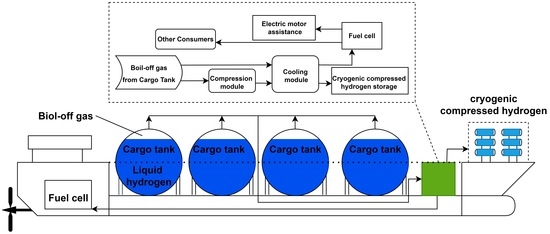
1. Introduction
2. Model Development
2.1. Design of Novel Cryogenic Compressed Boil-Off Gas Recovery System
2.2. Energy Analysis
2.3. Exergy Analysis
3. Assumptions and System Simulation
3.1. Assumptions
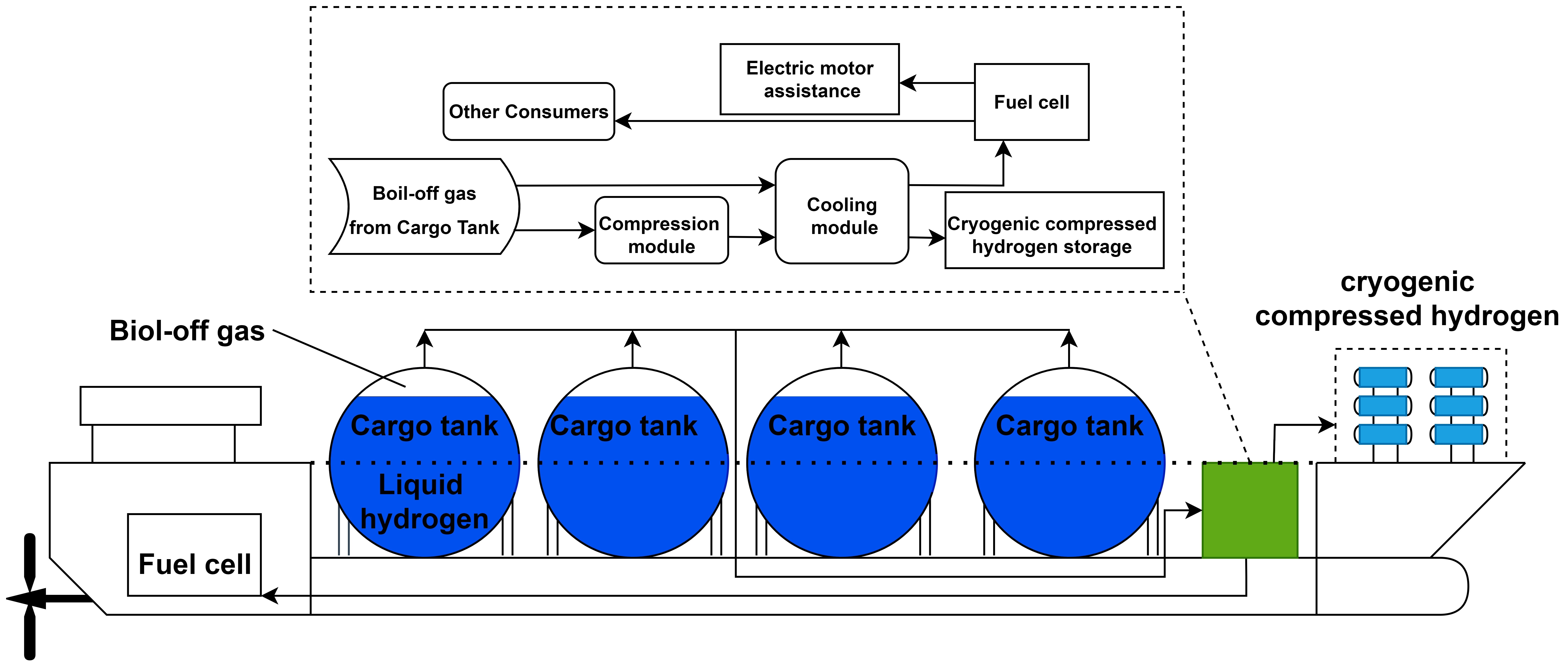
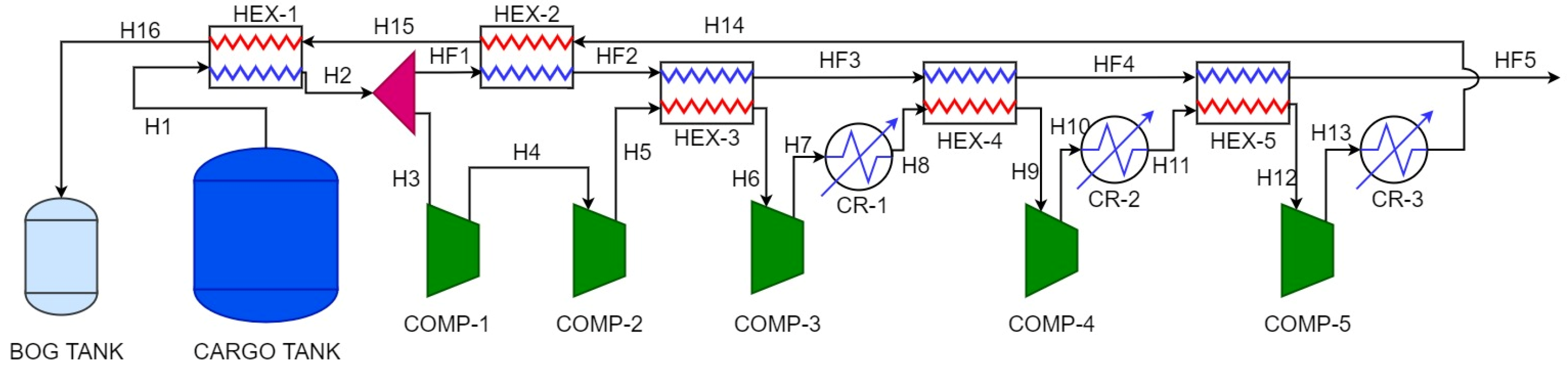
- Liquid hydrogen is stored in the cargo tank at 20 K and 0.1 MPa, and BOG is generated at the same pressure. After passing through pipelines and associated equipment, the BOG utilized for cryogenic compressed hydrogen production is supplied at 53 K and 0.1 MPa [30].
- The total BOG mass flow rate is set at 1400 kg/h, corresponding to a boil-off rate of 0.3% per day for a 160,000 m3 liquid hydrogen carrier.
- Heat losses throughout the system and pressure drops across all heat exchangers and piping components are neglected.
- The minimum approach temperature in all heat exchangers is 3 K [39].
- The seawater cooler consists of a seawater–hydrogen heat exchanger and an air-cooled heat exchanger. The hydrogen stream is ultimately cooled to 313 K [30], while the temperature-rising seawater during the cooling process is first cooled to ambient temperature by the air-cooled heat exchanger, ensuring that the seawater finally discharged back to the ocean does not cause thermal pollution.
- The isentropic efficiency of all compressors is assumed to be 85% [40].
- The reference state for exergy analysis is defined as 298 K and 0.1 MPa [41].
- The pressure ratio in each compressor stage does not exceed 4, and the maximum discharge temperature is maintained below 160 °C [30].
- The system operates at steady state, and heat leakage is considered negligible.
3.2. Selection of Cryogenic Compressed Hydrogen Storage Conditions
3.3. Simulation Analysis of Specific Operating Conditions
4. Analyses and Discussions
4.1. System Comparison
4.2. Parametric Analyses
5. Conclusions
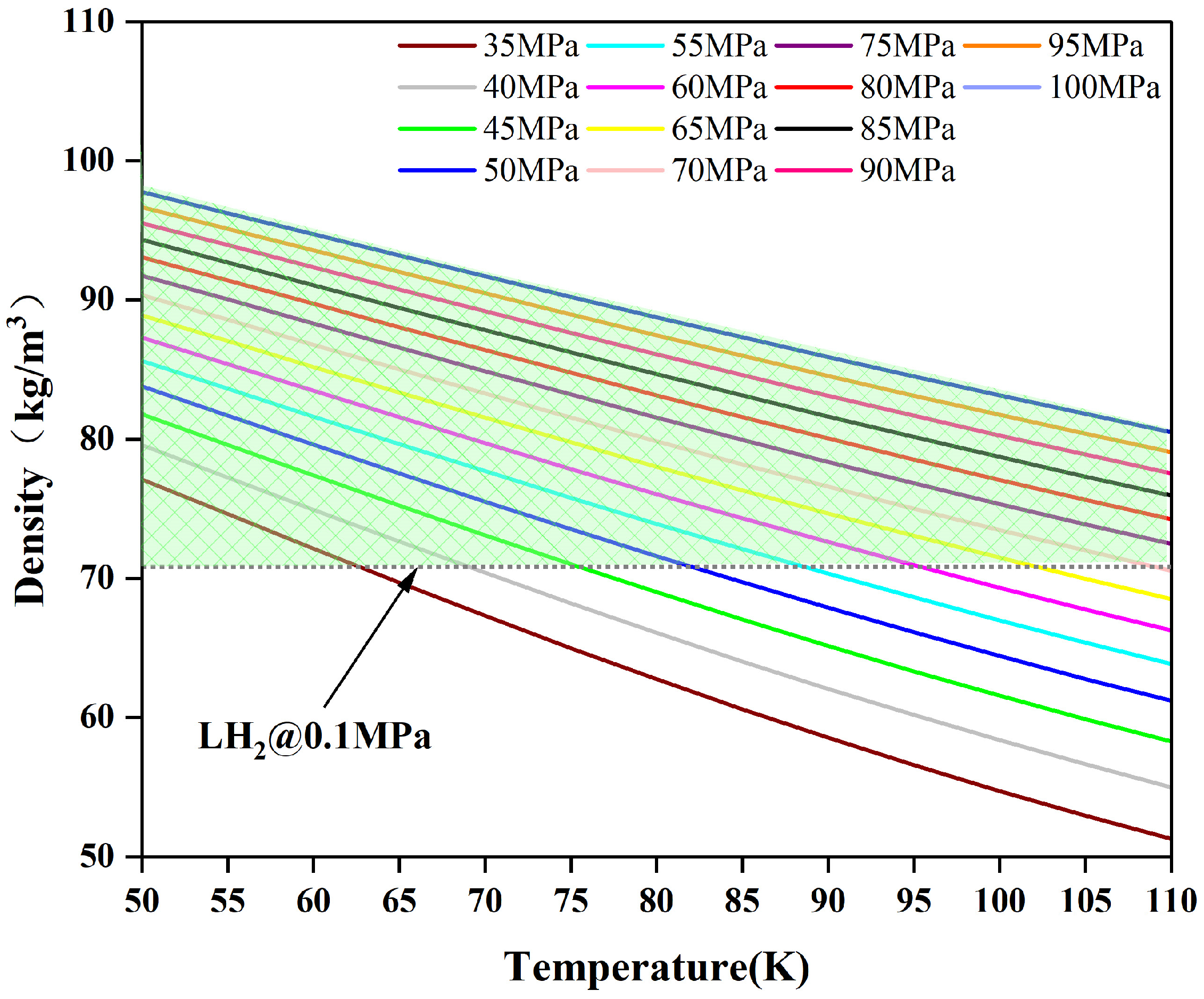
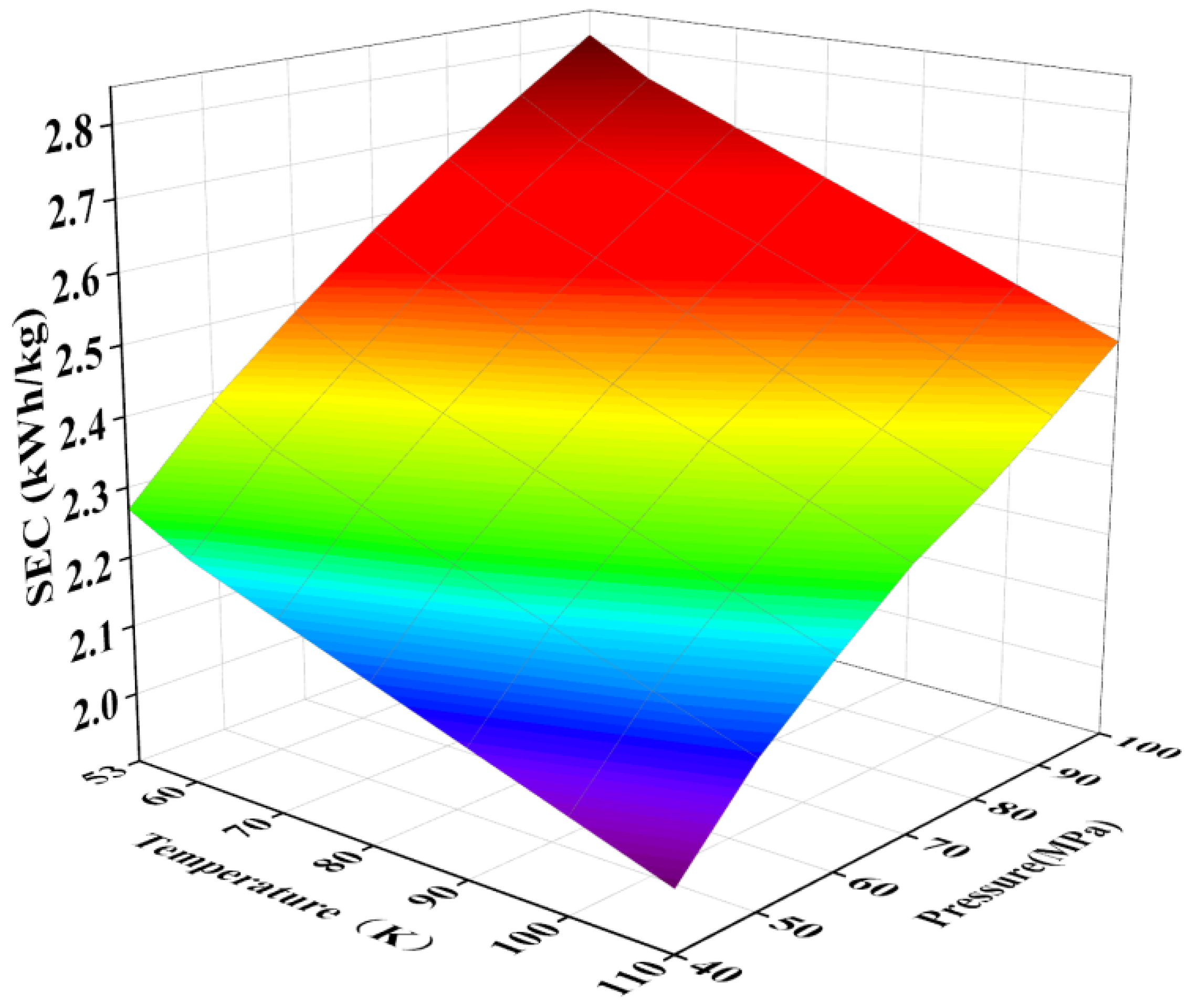
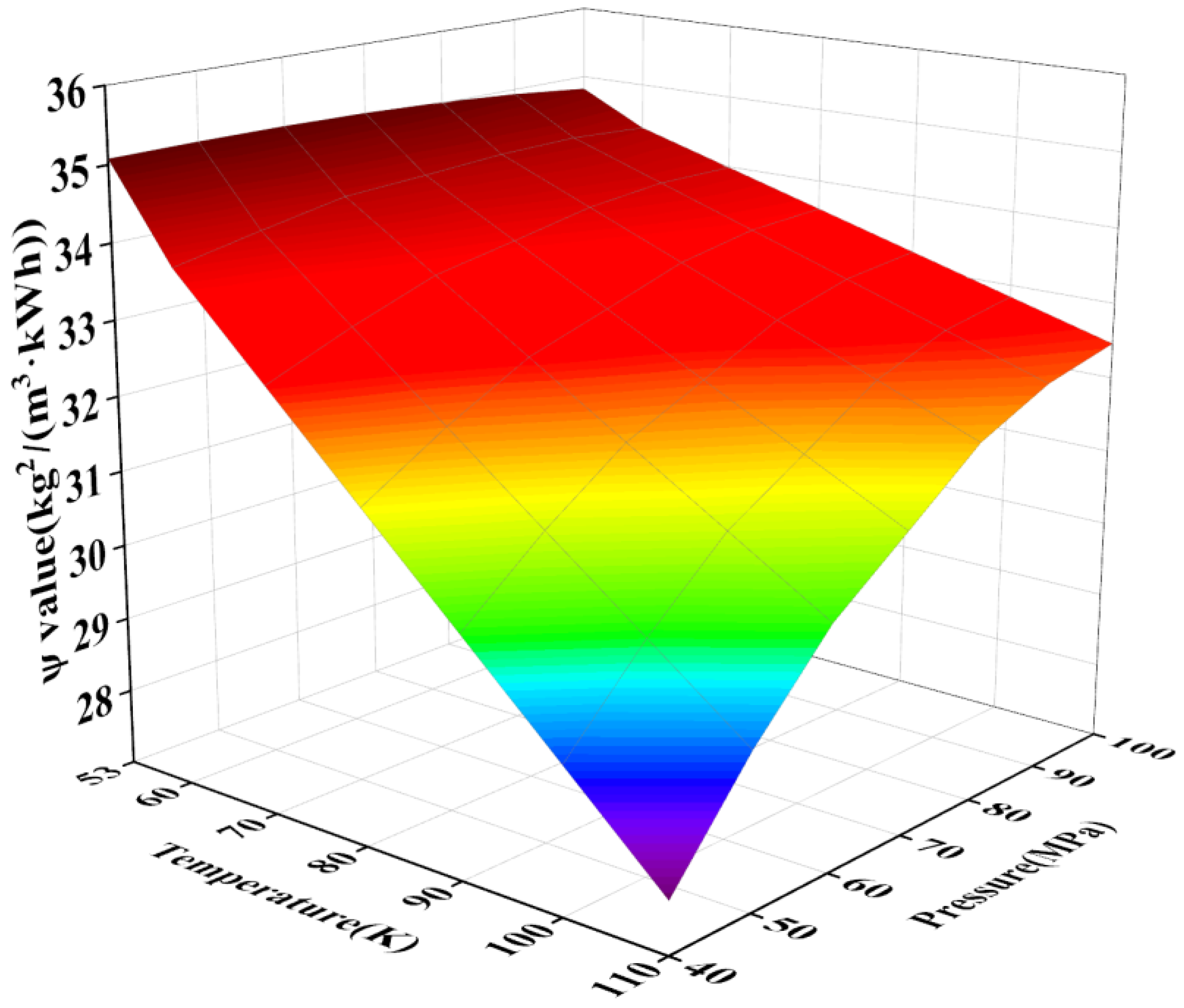
- The system can produce cryogenic compressed hydrogen over a wide range of operating conditions (53–110 K, 40–100 MPa). The specific energy consumption (SEC) increases with decreasing temperature and increasing pressure. Through a comprehensive evaluation of SEC and the ψ value (density/SEC) under different operating conditions, seven optimal operating points that balance energy consumption and storage density are identified: 60 K & 40 MPa, 70 K & 40 MPa, 70 K & 50 MPa, 80 K & 50 MPa, 90 K & 70 MPa, 100 K & 70 MPa, and 110 K & 80 MPa.
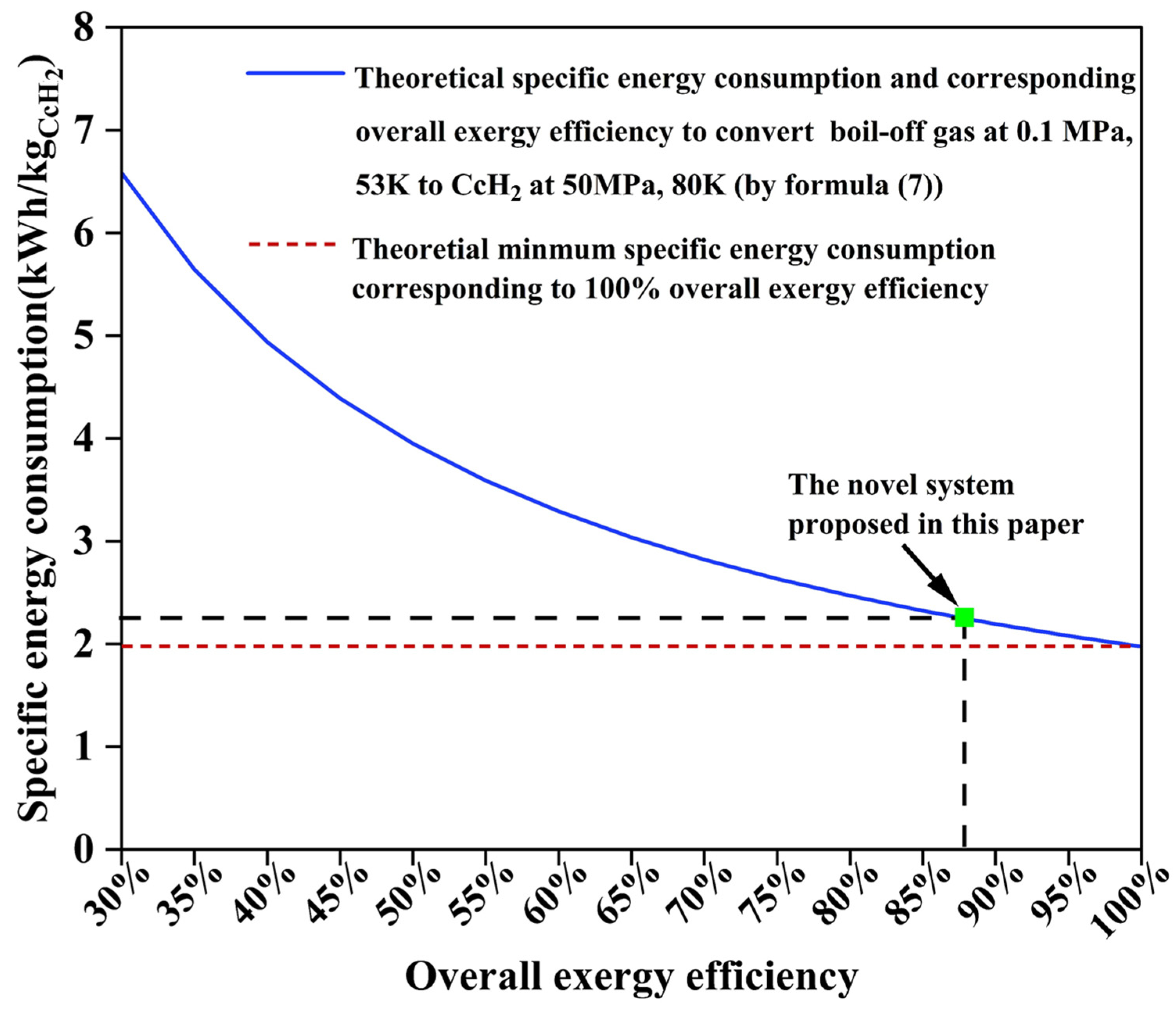
- Under the representative operating condition (80 K, 50 MPa), the system achieves an SEC of 2.25 kWh/kg and an exergy efficiency of 87.88%, respectively. Compared to a BOG re-liquefaction system, the SEC is reduced by 31.8% and the exergy efficiency is increased by 17.3%, respectively; compared to the MRJT CcH2 system, the SEC is reduced by 64.9% and the exergy efficiency is increased by 94.6%, respectively.
- Exergy analysis of individual components reveals that heat exchangers HEX-1 and HEX-2 contribute the largest exergy destructions, amounting to 395.16 kW and 218.38 kW, respectively. Meanwhile, compressors COMP-1 and COMP-2 exhibit the lowest exergy efficiencies, at 71.32% and 81.19%, respectively. Optimizing these specific components should be prioritized for enhancing the overall system performance.
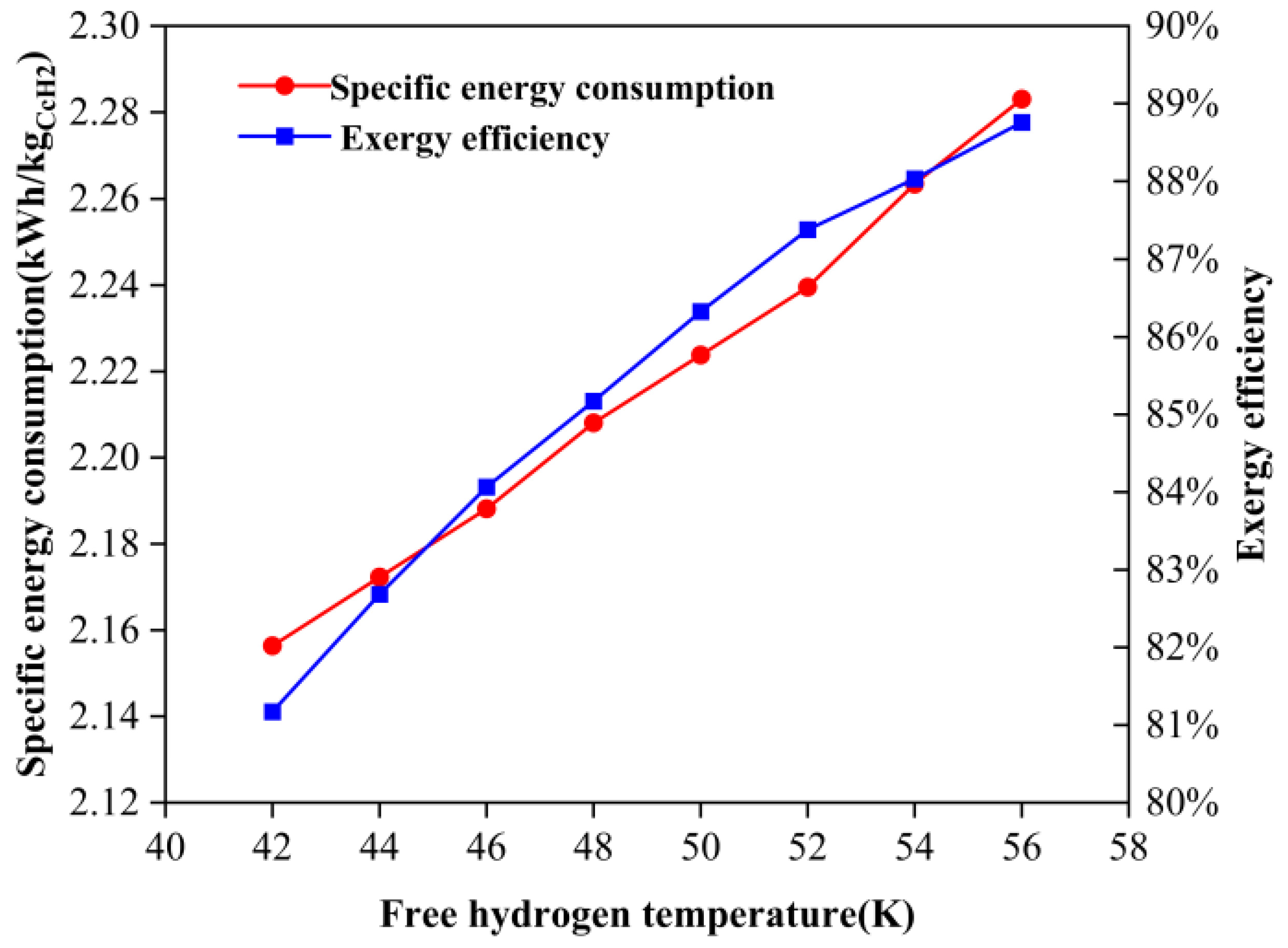
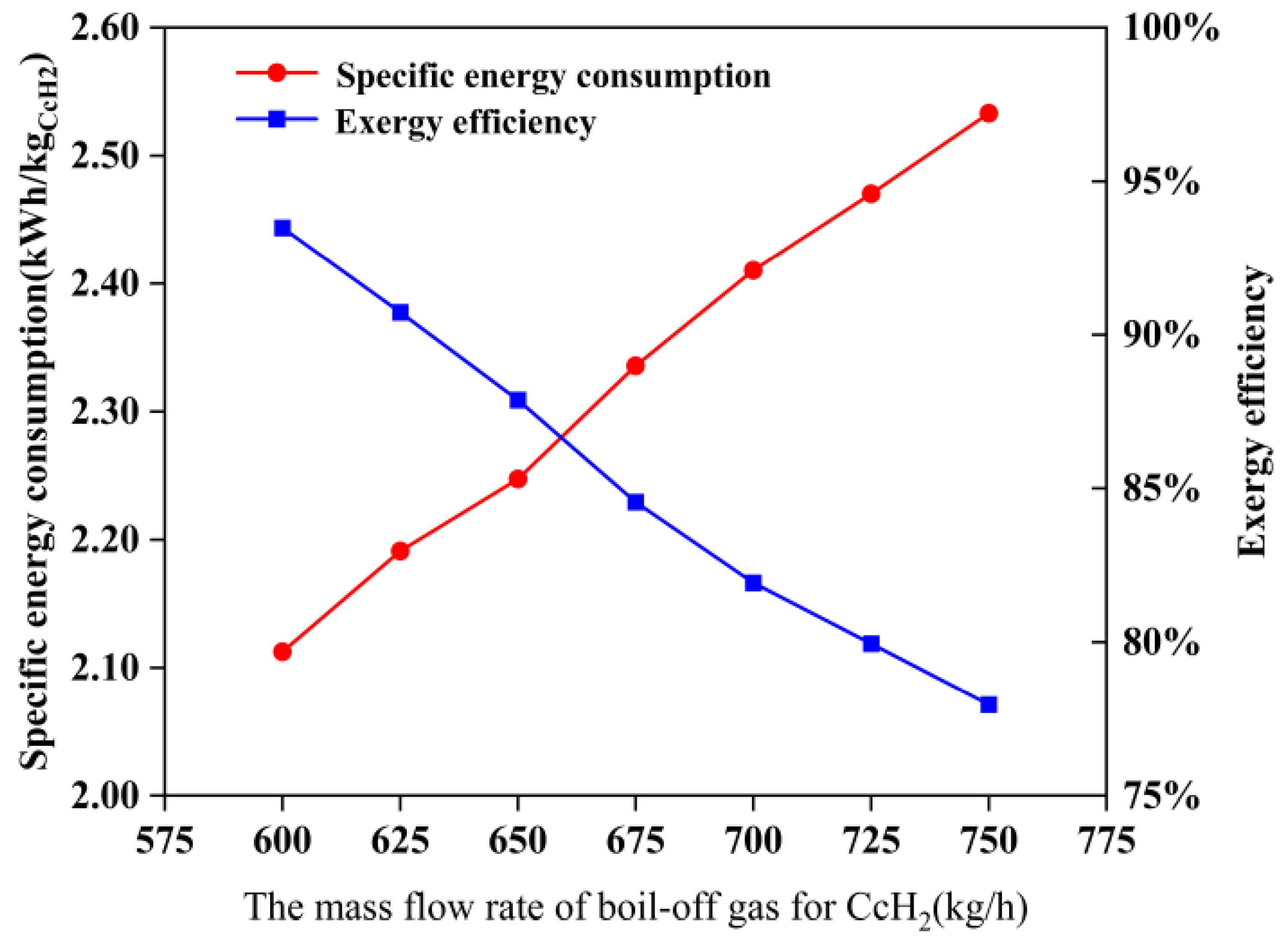
- Increasing the BOG feed temperature raises both SEC and exergy efficiency, while increasing the BOG recovery rate (production flow rate) increases SEC but decreases exergy efficiency. The system is constrained by the available cooling capacity, and the maximum feasible production flow rate is 750 kg/h.
Author Contributions
Funding
Data Availability Statement
Conflicts of Interest
References
- Li, J.; Jia, D.; Wang, X.; Chen, L.; Zhang, L. Recent research progress of MOFs-based heterostructures for photocatalytic hydrogen evolution. Chem. Eng. J. 2024, 498, 155194. [Google Scholar] [CrossRef]
- Gordon, J.A.; Balta-Ozkan, N.; Nabavi, S.A. Hopes and fears for a sustainable energy future: Enter the hydrogen acceptance matrix. Int. J. Hydrogen Energy 2024, 60, 1170–1191. [Google Scholar] [CrossRef]
- Ren, L.; Li, Y.; Zhang, N.; Yang, K.; Liu, M. Nanostructuring of Mg-based hydrogen storage materials: Recent advances for promoting key applications. Nano-Micro Lett. 2023, 15, 93. [Google Scholar] [CrossRef]
- Gunathilake, C.; Soliman, I.; Panthi, D.; Kumar, A.; Lee, S. A comprehensive review on hydrogen production, storage, and applications. Chem. Soc. Rev. 2024, 53, 10900–10969. [Google Scholar] [CrossRef]
- Calabrese, M.; Portarapillo, M.; Di Nardo, A.; Landi, G.; Sanchirico, R. Hydrogen safety challenges: A comprehensive review on production, storage, transport, utilization, and CFD-based consequence and risk assessment. Energies 2024, 17, 1350. [Google Scholar] [CrossRef]
- Thomas, S.B. From source to storage: An extensive review of hydrogen production, purification and storage for modern energy applications. Renew. Sustain. Energy Rev. 2026, 231, 116755. [Google Scholar] [CrossRef]
- Grouset, D.; Ridart, C. Lowering energy spending together with compression, storage, and transportation costs for hydrogen distribution in the early market. In Hydrogen Supply Chains; Springer: Cham, Switzerland, 2018; pp. 207–270. [Google Scholar]
- Xu, J.; Wan, R.; Chen, X.; Dou, B. Cryogenic supercritical hydrogen storage: Design and thermodynamic optimization via multi-stage Joule-Brayton refrigeration cycles. Energy 2025, 338, 138737. [Google Scholar] [CrossRef]
- Aguirre Ocampo, R.; Arias-Velandia, J.; Lenis, J.A.; Zuleta Gil, A.A.; Bello, S.; Correa, E.; Arrieta, C.E.; Bolívar, F.J.; Echeverria Echeverria, F. A scalable strategy for enhancing MgH2 hydrogen storage: Pre-hydrogenation and catalyst integration. Hydrogen 2026, 7, 17. [Google Scholar] [CrossRef]
- Edor, J.M.; Amenuvor, G.; Modisha, P.; Bessarabov, D. Homogeneous catalysis in liquid organic hydrogen carriers: Advances, challenges, and future directions. React. Chem. Eng. 2026, 11, 562–595. [Google Scholar] [CrossRef]
- Huang, Y.; Shi, X.; Zhu, S.; Wei, X.; Bai, W.; Li, P.; Xu, M.; Li, Y.; Yang, C. Comparative techno-economic analysis of large-scale underground hydrogen storage. Appl. Energy 2025, 400, 126564. [Google Scholar] [CrossRef]
- Ahmad, S.; Ullah, A.; Samreen, A.; Qasim, M.; Nawaz, K.; Ahmad, W.; Alnaser, A.; Kannan, A.M.; Egilmez, M. Hydrogen production, storage, transportation and utilization for energy sector: A current status review. J. Energy Storage 2024, 101, 113733. [Google Scholar] [CrossRef]
- Xu, H.; Zhang, Y.; Zhang, X. Towards efficient and safe hydrogen storage for green shipping: Progress on critical technical issues of material development and system construction. Int. J. Hydrogen Energy 2025, 167, 150913. [Google Scholar] [CrossRef]
- Peecock, A.; Hull-Bailey, B.; Hastings, A.; Martinez-Felipe, A.; Wilcox, L.B. Techno-economic assessment of liquid carrier methods for intercontinental shipping of hydrogen: A case study. Int. J. Hydrogen Energy 2024, 94, 971–983. [Google Scholar] [CrossRef]
- Wang, J.; Webley, P.A.; Hughes, T.J. Thermodynamic modelling of low fill levels in cryogenic storage tanks for application to liquid hydrogen maritime transport. Appl. Therm. Eng. 2024, 256, 124054. [Google Scholar] [CrossRef]
- Maekawa, K.; Takeda, M.; Miyake, Y.; Nakamura, S.; Hamaura, T. Sloshing measurements inside a liquid hydrogen tank with external-heating-type MgB2 level sensors during marine transportation by the training ship Fukae-Maru. Sensors 2018, 18, 3694. [Google Scholar] [CrossRef]
- Morales-Ospino, R.; Celzard, A.; Fierro, V. Strategies to recover and minimize boil-off losses during liquid hydrogen storage. Renew. Sustain. Energy Rev. 2023, 182, 113360. [Google Scholar] [CrossRef]
- Al Ghafri, S.Z.; Swanger, A.; Jusko, V.; Munro, T.; May, E.F. Modelling of liquid hydrogen boil-off. Energies 2022, 15, 1149. [Google Scholar] [CrossRef]
- Abe, A. Studies of the large-scale sea transportation of liquid hydrogen. Int. J. Hydrogen Energy 1998, 23, 115–121. [Google Scholar] [CrossRef]
- Wu, J.K.; Chen, S.; Yu, M.; Zhang, X.J.; Jiang, L. Techno-economic analysis on low-temperature and high-pressure cryo-adsorption hydrogen storage. Fuel 2025, 381, 133532. [Google Scholar] [CrossRef]
- Ghorbani, B.; Zendehboudi, S.; Alizadeh Afrouzi, Z.; Cata Saady, N.M. Optimized hydrogen boil-off gas re-liquefaction process for marine transport: Exergy, economic, environmental, and uncertainty perspectives. Energy 2025, 338, 138605. [Google Scholar] [CrossRef]
- Wang, Y.; Xiao, Z.; Wang, H.; Chen, Q.; Wang, X. Synergistic analysis via Aspen and MATLAB of cryo-compressed hydrogen production process based on liquid nitrogen cooling including pre-cooling. Energy 2025, 340, 139056. [Google Scholar] [CrossRef]
- Zhuzhgov, A.V.; Krivoruchko, O.P.; Isupova, L.A.; Martyanov, O.N.; Parmon, V.N. Catalysts and the process for low-temperature conversion of ortho-hydrogen to liquid para-hydrogen: A review. Katal. V. Promyshlennosti 2017, 5, 346–358. [Google Scholar] [CrossRef]
- Aceves, S.M.; Petitpas, G.; Espinosa-Loza, F.; Ross, M.O.; Martins, J.H. Safe, long range, inexpensive and rapidly refuelable hydrogen vehicles with cryogenic pressure vessels. Int. J. Hydrogen Energy 2013, 38, 2480–2489. [Google Scholar] [CrossRef]
- Wang, H.; Zhao, Y.; Dong, X.; Yang, J.; Guo, H.; Gong, M. Thermodynamic analysis of low-temperature and high-pressure (cryo-compressed) hydrogen storage processes cooled by mixed-refrigerants. Int. J. Hydrogen Energy 2022, 47, 30610–30620. [Google Scholar] [CrossRef]
- Yan, Y.; Han, F.; Li, S.; Wang, Z.; Xu, Z.; Ni, Z. Research on building cryo-compressed test condition on large CcH2 vessel for heavy-duty fuel cell trucks. J. Energy Storage 2023, 61, 106148. [Google Scholar] [CrossRef]
- Zhou, Y.; Han, B.; Liu, Y.; Dai, X.; Liu, Y.; Liu, P.; Yang, Y. Cross-scale strength analysis of cryogenic compressed hydrogen storage vessels. Int. J. Hydrogen Energy 2025, 170, 151066. [Google Scholar] [CrossRef]
- Fang, L.; Dong, X.; Wang, H.; Gong, M. Economic analysis of compressed gaseous hydrogen, liquid hydrogen, and cryo-compressed hydrogen storage methods for large-scale storage and transportation. Int. J. Hydrogen Energy 2025, 50, 150725. [Google Scholar] [CrossRef]
- Zhao, Y.X.; Gong, M.Q.; Zhou, Y. Theoretical analysis and comparison of hydrogen density and energy consumption for gas-phase low-temperature high-pressure storage. Chin. Sci. Bull. 2019, 64, 2654–2660. [Google Scholar] [CrossRef]
- Lee, H.; Shao, Y.; Lee, S.; Roh, G.; Chun, K.; Kang, H. Analysis and assessment of partial re-liquefaction system for liquefied hydrogen tankers using liquefied natural gas (LNG) and H2 hybrid propulsion. Int. J. Hydrogen Energy 2019, 44, 15056–15071. [Google Scholar] [CrossRef]
- Vatani, A.; Mehrpooya, M.; Palizdar, A. Energy and exergy analyses of five conventional liquefied natural gas processes. Int. J. Energy Res. 2014, 38, 1843–1863. [Google Scholar] [CrossRef]
- Li, K.; Zhang, S.; Liu, G. Model for analyzing the energy efficiency of hydrogen liquefaction process considering the variation of hydrogen liquefaction ratio and precooling temperature. Int. J. Hydrogen Energy 2022, 47, 24194–24211. [Google Scholar] [CrossRef]
- Ahamed, J.U.; Saidur, R.; Masjuki, H.H. A review on exergy analysis of vapor compression refrigeration system. Renew. Sustain. Energy Rev. 2011, 15, 1593–1600. [Google Scholar] [CrossRef]
- Thomas, R.J.; Ghosh, P.; Chowdhury, K. Exergy analysis of helium liquefaction systems based on modified Claude cycle with two-expanders. Cryogenics 2011, 51, 287–294. [Google Scholar] [CrossRef]
- Sadaghiani, M.S.; Mehrpooya, M. Introducing and energy analysis of a novel cryogenic hydrogen liquefaction process configuration. Int. J. Hydrogen Energy 2017, 42, 6033–6050. [Google Scholar] [CrossRef]
- Faramarzi, S.; Nainiyan, S.M.M.; Mafi, M.; Ghasemiasl, R. A novel hydrogen liquefaction process based on LNG cold energy and mixed refrigerant cycle. Int. J. Refrig. 2021, 131, 263–274. [Google Scholar] [CrossRef]
- Marcantonio, V.; Bocci, E.; Ouweltjes, J.P.; Del Zotto, L.; Monarca, D. Evaluation of sorbents for high temperature removal of tars, hydrogen sulphide, hydrogen chloride and ammonia from biomass-derived syngas by using Aspen Plus. Int. J. Hydrogen Energy 2020, 45, 6651–6662. [Google Scholar] [CrossRef]
- Tungalag, A.; Lee, B.; Yadav, M.; Akande, O. Yield prediction of MSW gasification including minor species through ASPEN Plus simulation. Energy 2020, 207, 117296. [Google Scholar] [CrossRef]
- Sun, H.; Geng, J.; Wang, C.; Rong, G.; Gao, X.; Xu, J.; Yang, D. Optimization of a hydrogen liquefaction process utilizing mixed refrigeration considering stages of ortho-para hydrogen conversion. Int. J. Hydrogen Energy 2022, 47, 17271–17284. [Google Scholar] [CrossRef]
- Sun, H.; Wang, Y.; Li, X.; Zhang, Z.; Chen, L. Optimization and analysis of a cascaded dual mixed refrigerant hydrogen liquefaction process considering the influence of pre-cooling stages. Int. J. Hydrogen Energy 2023, 48, 31653–31670. [Google Scholar] [CrossRef]
- Goyal, A.; Sherwani, A.F.; Tiwari, D.; Kumar, A. Sensitivity analysis and multi-objective optimization of organic Rankine cycle integrated with vapor compression refrigeration system. Energy Sources Part A 2021, 47, 7132–7144. [Google Scholar] [CrossRef]
- Nishino, Y.; Tamura, S.; Tatsumi, T. Liquid Hydrogen High Pressure Tank for Transportation. Japanese Patent JP2018066426A, 26 April 2018. [Google Scholar]
- Huber, M.L.; Lemmon, E.W.; Bell, I.H.; McLinden, M.O. Improvements in the reference fluid thermodynamic and transport properties database (REFPROP). Ind. Eng. Chem. Res. 2022, 61, 8690–8702. [Google Scholar] [CrossRef]
- Heuser, P.-M.; Ryberg, D.S.; Grube, T.; Robinius, M.; Stolten, D. Techno-economic analysis of a potential energy trading link between Patagonia and Japan based on CO2 free hydrogen. Int. J. Hydrogen Energy 2019, 44, 12733–12747. [Google Scholar] [CrossRef]



| Components | Exergy Destruction Rate | Exergy Efficiency |
|---|---|---|
| Compressors | ||
| Heat exchangers and Coolers |
| Parameters | Case 1 | Case 2 | Case 3 | Case 4 | Case 5 | Case 6 | Case 7 |
|---|---|---|---|---|---|---|---|
| T (K) | 60 | 70 | 70 | 80 | 90 | 100 | 110 |
| P (MPa) | 40 | 40 | 50 | 50 | 70 | 70 | 80 |
| ρ (kg/m3) | 74.93 | 70.39 | 75.52 | 71.59 | 76.59 | 73.48 | 74.26 |
| Hydrogen Storage Density (kg/m3) | Sailing Duration (Day) | Continuous Voyage Distance (km) |
|---|---|---|
| 70 | 26.92 | 21,540.18 |
| 73 | 28.08 | 22,463.34 |
| 76 | 29.23 | 23,386.49 |
| 79 | 30.38 | 24,309.64 |
| 82 | 31.54 | 25,232.79 |
| 85 | 32.69 | 26,155.94 |
| Stream | Temperature | Pressure | Mass Flow | Specific Enthalpy | Specific Entropy | Exergy Rate |
|---|---|---|---|---|---|---|
| K | MPa | kg/h | kJ/kg | kJ/(kg·K) | kW | |
| H1 | 53.00 | 0.10 | 1400 | −3409.15 | −23.86 | 1444.45 |
| H2 | 104.37 | 0.10 | 1400 | −2702.06 | −14.53 | 638.12 |
| H3 | 104.37 | 0.10 | 650 | −2702.06 | −14.53 | 296.27 |
| H4 | 160.06 | 0.35 | 650 | −1937.19 | −13.80 | 394.77 |
| H5 | 243.97 | 1.20 | 650 | −765.17 | −13.06 | 566.59 |
| H6 | 240.28 | 1.20 | 650 | −817.20 | −13.27 | 568.75 |
| H7 | 362.77 | 4.16 | 650 | 951.08 | −12.52 | 847.66 |
| H8 | 313.15 | 4.16 | 650 | 231.92 | −14.65 | 832.53 |
| H9 | 292.62 | 4.16 | 650 | −61.11 | −15.62 | 831.71 |
| H10 | 440.21 | 14.43 | 650 | 2140.93 | −14.85 | 1187.86 |
| H11 | 313.15 | 14.43 | 650 | 283.31 | −19.83 | 1120.40 |
| H12 | 262.30 | 14.43 | 650 | −455.24 | −22.41 | 1125.55 |
| H13 | 396.63 | 50.00 | 650 | 1728.12 | −21.56 | 1474.06 |
| H14 | 313.15 | 50.00 | 650 | 484.01 | −25.08 | 1439.00 |
| H15 | 172.00 | 50.00 | 650 | −1663.57 | −34.22 | 1543.17 |
| H16 | 80.00 | 50.00 | 650 | −3186.52 | −46.97 | 1954.34 |
| HF1 | 104.37 | 0.10 | 750 | −2702.07 | −14.53 | 296.27 |
| HF2 | 238.79 | 0.10 | 750 | −840.83 | −3.09 | 19.31 |
| HF3 | 242.00 | 0.10 | 750 | −795.74 | −2.90 | 17.05 |
| HF4 | 260.00 | 0.10 | 750 | −541.77 | −1.89 | 7.12 |
| HF5 | 305.00 | 0.10 | 750 | 98.29 | 0.38 | −0.47 |
| Production Process | Operating Conditions | Specific Energy Consumption (kWh/kg) | Exergy Efficiency (%) |
|---|---|---|---|
| Proposed System | From 0.1 MPa, 53 K to 50 MPa, 80 K | 2.25 | 87.88 |
| Re-liquefaction System | From 0.1 MPa, 53 K to 0.1 MPa, 20 K | 3.30 | 74.90 |
| MRJT CcH2 System | From 0.1 MPa, 298 K to 50 MPa, 80 K | 6.42 | 45.15 |
| Components | Exergy Destruction Rate (kW) | Proportion of Exergy Destruction Rate (%) | Exergy Efficiency (%) |
|---|---|---|---|
| COMP-1 | 39.60 | 4.16 | 71.32 |
| COMP-2 | 39.80 | 4.18 | 81.19 |
| COMP-3 | 40.37 | 4.24 | 87.36 |
| COMP-4 | 41.45 | 4.36 | 89.58 |
| COMP-5 | 45.71 | 4.81 | 88.40 |
| HEX-1 | 395.16 | 41.55 | 86.77 |
| HEX-2 | 218.38 | 22.96 | 87.74 |
| HEX-3 | 0.08 | 0.01 | 98.00 |
| HEX-4 | 10.75 | 1.13 | 98.73 |
| HEX-5 | 2.44 | 0.26 | 93.72 |
| CR-1 | 15.13 | 1.59 | 98.22 |
| CR-2 | 67.46 | 7.09 | 94.32 |
| CR-3 | 35.06 | 3.69 | 97.62 |
| Case | Cryogenic Compressed Hydrogen Mass Flow (kg/h) | Hydrogen Fuel Gas Mass Flow (kg/h) | Recovery Rate (%) |
|---|---|---|---|
| 1 | 600 | 800 | 42.86 |
| 2 | 625 | 775 | 44.64 |
| 3 | 650 | 750 | 46.43 |
| 4 | 675 | 725 | 48.21 |
| 5 | 700 | 700 | 50.00 |
| 6 | 725 | 675 | 51.79 |
| 7 | 750 | 650 | 53.57 |
Disclaimer/Publisher’s Note: The statements, opinions and data contained in all publications are solely those of the individual author(s) and contributor(s) and not of MDPI and/or the editor(s). MDPI and/or the editor(s) disclaim responsibility for any injury to people or property resulting from any ideas, methods, instructions or products referred to in the content. |
© 2026 by the authors. Licensee MDPI, Basel, Switzerland. This article is an open access article distributed under the terms and conditions of the Creative Commons Attribution (CC BY) license.
Share and Cite
Lu, W.; Liao, W.; Yang, S.; Qin, Z.; Jin, Q.; Chen, K. Analysis of a Boil-Off Gas Recovery System for Liquid Hydrogen Vessel Shipping with Cryogenic Compressed Hydrogen Storage. Energies 2026, 19, 2109. https://doi.org/10.3390/en19092109
Lu W, Liao W, Yang S, Qin Z, Jin Q, Chen K. Analysis of a Boil-Off Gas Recovery System for Liquid Hydrogen Vessel Shipping with Cryogenic Compressed Hydrogen Storage. Energies. 2026; 19(9):2109. https://doi.org/10.3390/en19092109
Chicago/Turabian StyleLu, Wei, Wendi Liao, Shihui Yang, Zelian Qin, Qihang Jin, and Kexin Chen. 2026. "Analysis of a Boil-Off Gas Recovery System for Liquid Hydrogen Vessel Shipping with Cryogenic Compressed Hydrogen Storage" Energies 19, no. 9: 2109. https://doi.org/10.3390/en19092109
APA StyleLu, W., Liao, W., Yang, S., Qin, Z., Jin, Q., & Chen, K. (2026). Analysis of a Boil-Off Gas Recovery System for Liquid Hydrogen Vessel Shipping with Cryogenic Compressed Hydrogen Storage. Energies, 19(9), 2109. https://doi.org/10.3390/en19092109